EP0200463A2 - Coating compositions for use in the production of light-sensitive reproduction materials - Google Patents
Coating compositions for use in the production of light-sensitive reproduction materials Download PDFInfo
- Publication number
- EP0200463A2 EP0200463A2 EP86303038A EP86303038A EP0200463A2 EP 0200463 A2 EP0200463 A2 EP 0200463A2 EP 86303038 A EP86303038 A EP 86303038A EP 86303038 A EP86303038 A EP 86303038A EP 0200463 A2 EP0200463 A2 EP 0200463A2
- Authority
- EP
- European Patent Office
- Prior art keywords
- light
- sensitive
- coating composition
- diaminoethane
- alkyl
- Prior art date
- Legal status (The legal status is an assumption and is not a legal conclusion. Google has not performed a legal analysis and makes no representation as to the accuracy of the status listed.)
- Granted
Links
- 239000000463 material Substances 0.000 title claims abstract description 22
- 239000008199 coating composition Substances 0.000 title claims abstract description 11
- 238000004519 manufacturing process Methods 0.000 title claims abstract description 7
- 239000000945 filler Substances 0.000 claims abstract description 19
- 125000000217 alkyl group Chemical group 0.000 claims abstract description 9
- 150000001412 amines Chemical class 0.000 claims abstract description 8
- 125000004432 carbon atom Chemical group C* 0.000 claims abstract description 8
- 125000003118 aryl group Chemical group 0.000 claims abstract description 4
- 125000001931 aliphatic group Chemical group 0.000 claims abstract description 3
- 125000003710 aryl alkyl group Chemical group 0.000 claims abstract description 3
- 229910052757 nitrogen Inorganic materials 0.000 claims abstract description 3
- 229910052760 oxygen Inorganic materials 0.000 claims abstract description 3
- 229920006395 saturated elastomer Polymers 0.000 claims abstract description 3
- 229910052717 sulfur Inorganic materials 0.000 claims abstract description 3
- 125000001183 hydrocarbyl group Chemical group 0.000 claims abstract 3
- 150000001875 compounds Chemical class 0.000 claims description 24
- 239000011230 binding agent Substances 0.000 claims description 11
- 235000012239 silicon dioxide Nutrition 0.000 claims description 11
- VYPSYNLAJGMNEJ-UHFFFAOYSA-N Silicium dioxide Chemical compound O=[Si]=O VYPSYNLAJGMNEJ-UHFFFAOYSA-N 0.000 claims description 9
- 239000000203 mixture Substances 0.000 claims description 9
- 125000005372 silanol group Chemical group 0.000 claims description 6
- PIICEJLVQHRZGT-UHFFFAOYSA-N Ethylenediamine Chemical compound NCCN PIICEJLVQHRZGT-UHFFFAOYSA-N 0.000 claims description 5
- RMAQACBXLXPBSY-UHFFFAOYSA-N silicic acid Chemical compound O[Si](O)(O)O RMAQACBXLXPBSY-UHFFFAOYSA-N 0.000 claims description 5
- 229910052681 coesite Inorganic materials 0.000 claims description 4
- 229910052906 cristobalite Inorganic materials 0.000 claims description 4
- NAQMVNRVTILPCV-UHFFFAOYSA-N hexane-1,6-diamine Chemical compound NCCCCCCN NAQMVNRVTILPCV-UHFFFAOYSA-N 0.000 claims description 4
- 239000003960 organic solvent Substances 0.000 claims description 4
- 239000000377 silicon dioxide Substances 0.000 claims description 4
- 229910052682 stishovite Inorganic materials 0.000 claims description 4
- 229910052905 tridymite Inorganic materials 0.000 claims description 4
- GSEJCLTVZPLZKY-UHFFFAOYSA-N Triethanolamine Chemical compound OCCN(CCO)CCO GSEJCLTVZPLZKY-UHFFFAOYSA-N 0.000 claims description 3
- ZBCBWPMODOFKDW-UHFFFAOYSA-N diethanolamine Chemical compound OCCNCCO ZBCBWPMODOFKDW-UHFFFAOYSA-N 0.000 claims description 3
- 230000005855 radiation Effects 0.000 claims description 3
- 229930195734 saturated hydrocarbon Chemical group 0.000 claims description 3
- 125000003277 amino group Chemical group 0.000 claims description 2
- 239000011164 primary particle Substances 0.000 claims description 2
- 230000001698 pyrogenic effect Effects 0.000 claims description 2
- 239000010410 layer Substances 0.000 claims 4
- 239000003638 chemical reducing agent Substances 0.000 claims 1
- MOWCFPWEMPKYRT-UHFFFAOYSA-N n,n'-diethylethane-1,2-diamine;n'-ethylethane-1,2-diamine Chemical compound CCNCCN.CCNCCNCC MOWCFPWEMPKYRT-UHFFFAOYSA-N 0.000 claims 1
- 239000011241 protective layer Substances 0.000 claims 1
- 239000000243 solution Substances 0.000 description 45
- 239000011248 coating agent Substances 0.000 description 36
- 238000000576 coating method Methods 0.000 description 36
- 239000007787 solid Substances 0.000 description 17
- -1 monomers Chemical class 0.000 description 9
- 239000000470 constituent Substances 0.000 description 8
- 238000000034 method Methods 0.000 description 7
- 239000002904 solvent Substances 0.000 description 7
- 239000000178 monomer Substances 0.000 description 6
- 125000005624 silicic acid group Chemical class 0.000 description 6
- RTZKZFJDLAIYFH-UHFFFAOYSA-N Diethyl ether Chemical compound CCOCC RTZKZFJDLAIYFH-UHFFFAOYSA-N 0.000 description 4
- PPBRXRYQALVLMV-UHFFFAOYSA-N Styrene Chemical compound C=CC1=CC=CC=C1 PPBRXRYQALVLMV-UHFFFAOYSA-N 0.000 description 4
- 229920000642 polymer Polymers 0.000 description 4
- YMWUJEATGCHHMB-UHFFFAOYSA-N Dichloromethane Chemical compound ClCCl YMWUJEATGCHHMB-UHFFFAOYSA-N 0.000 description 3
- OKKJLVBELUTLKV-UHFFFAOYSA-N Methanol Chemical compound OC OKKJLVBELUTLKV-UHFFFAOYSA-N 0.000 description 3
- OFOBLEOULBTSOW-UHFFFAOYSA-N Propanedioic acid Natural products OC(=O)CC(O)=O OFOBLEOULBTSOW-UHFFFAOYSA-N 0.000 description 3
- 239000000654 additive Substances 0.000 description 3
- VZCYOOQTPOCHFL-UPHRSURJSA-N maleic acid Chemical compound OC(=O)\C=C/C(O)=O VZCYOOQTPOCHFL-UPHRSURJSA-N 0.000 description 3
- 239000011976 maleic acid Substances 0.000 description 3
- 239000000049 pigment Substances 0.000 description 3
- 239000004014 plasticizer Substances 0.000 description 3
- 230000008569 process Effects 0.000 description 3
- 239000000126 substance Substances 0.000 description 3
- VZCYOOQTPOCHFL-UHFFFAOYSA-N trans-butenedioic acid Natural products OC(=O)C=CC(O)=O VZCYOOQTPOCHFL-UHFFFAOYSA-N 0.000 description 3
- AZQWKYJCGOJGHM-UHFFFAOYSA-N 1,4-benzoquinone Chemical compound O=C1C=CC(=O)C=C1 AZQWKYJCGOJGHM-UHFFFAOYSA-N 0.000 description 2
- LEJBBGNFPAFPKQ-UHFFFAOYSA-N 2-(2-prop-2-enoyloxyethoxy)ethyl prop-2-enoate Chemical compound C=CC(=O)OCCOCCOC(=O)C=C LEJBBGNFPAFPKQ-UHFFFAOYSA-N 0.000 description 2
- KUDUQBURMYMBIJ-UHFFFAOYSA-N 2-prop-2-enoyloxyethyl prop-2-enoate Chemical compound C=CC(=O)OCCOC(=O)C=C KUDUQBURMYMBIJ-UHFFFAOYSA-N 0.000 description 2
- VVBLNCFGVYUYGU-UHFFFAOYSA-N 4,4'-Bis(dimethylamino)benzophenone Chemical compound C1=CC(N(C)C)=CC=C1C(=O)C1=CC=C(N(C)C)C=C1 VVBLNCFGVYUYGU-UHFFFAOYSA-N 0.000 description 2
- KAKZBPTYRLMSJV-UHFFFAOYSA-N Butadiene Chemical compound C=CC=C KAKZBPTYRLMSJV-UHFFFAOYSA-N 0.000 description 2
- VTYYLEPIZMXCLO-UHFFFAOYSA-L Calcium carbonate Chemical compound [Ca+2].[O-]C([O-])=O VTYYLEPIZMXCLO-UHFFFAOYSA-L 0.000 description 2
- OPKOKAMJFNKNAS-UHFFFAOYSA-N N-methylethanolamine Chemical compound CNCCO OPKOKAMJFNKNAS-UHFFFAOYSA-N 0.000 description 2
- GLUUGHFHXGJENI-UHFFFAOYSA-N Piperazine Chemical compound C1CNCCN1 GLUUGHFHXGJENI-UHFFFAOYSA-N 0.000 description 2
- XTXRWKRVRITETP-UHFFFAOYSA-N Vinyl acetate Chemical compound CC(=O)OC=C XTXRWKRVRITETP-UHFFFAOYSA-N 0.000 description 2
- QYKIQEUNHZKYBP-UHFFFAOYSA-N Vinyl ether Chemical compound C=COC=C QYKIQEUNHZKYBP-UHFFFAOYSA-N 0.000 description 2
- 239000002253 acid Substances 0.000 description 2
- TZCXTZWJZNENPQ-UHFFFAOYSA-L barium sulfate Chemical compound [Ba+2].[O-]S([O-])(=O)=O TZCXTZWJZNENPQ-UHFFFAOYSA-L 0.000 description 2
- 230000008859 change Effects 0.000 description 2
- 229920001577 copolymer Polymers 0.000 description 2
- 238000004132 cross linking Methods 0.000 description 2
- 238000010790 dilution Methods 0.000 description 2
- 239000012895 dilution Substances 0.000 description 2
- 238000001035 drying Methods 0.000 description 2
- 239000000975 dye Substances 0.000 description 2
- 239000011521 glass Substances 0.000 description 2
- 150000002430 hydrocarbons Chemical group 0.000 description 2
- SCZVXVGZMZRGRU-UHFFFAOYSA-N n'-ethylethane-1,2-diamine Chemical compound CCNCCN SCZVXVGZMZRGRU-UHFFFAOYSA-N 0.000 description 2
- DIHKMUNUGQVFES-UHFFFAOYSA-N n,n,n',n'-tetraethylethane-1,2-diamine Chemical compound CCN(CC)CCN(CC)CC DIHKMUNUGQVFES-UHFFFAOYSA-N 0.000 description 2
- KIDHWZJUCRJVML-UHFFFAOYSA-N putrescine Chemical compound NCCCCN KIDHWZJUCRJVML-UHFFFAOYSA-N 0.000 description 2
- 238000011084 recovery Methods 0.000 description 2
- 150000003839 salts Chemical class 0.000 description 2
- 239000003381 stabilizer Substances 0.000 description 2
- OAKFFVBGTSPYEG-UHFFFAOYSA-N (4-prop-2-enoyloxycyclohexyl) prop-2-enoate Chemical compound C=CC(=O)OC1CCC(OC(=O)C=C)CC1 OAKFFVBGTSPYEG-UHFFFAOYSA-N 0.000 description 1
- WBYWAXJHAXSJNI-VOTSOKGWSA-M .beta-Phenylacrylic acid Natural products [O-]C(=O)\C=C\C1=CC=CC=C1 WBYWAXJHAXSJNI-VOTSOKGWSA-M 0.000 description 1
- ZBOWKDHBOFMERX-UHFFFAOYSA-N 1,3-diazepane Chemical compound C1CCNCNC1 ZBOWKDHBOFMERX-UHFFFAOYSA-N 0.000 description 1
- CXPUAWQOXQINEX-UHFFFAOYSA-N 1,4-diazocane Chemical compound C1CCNCCNC1 CXPUAWQOXQINEX-UHFFFAOYSA-N 0.000 description 1
- PWGJDPKCLMLPJW-UHFFFAOYSA-N 1,8-diaminooctane Chemical compound NCCCCCCCCN PWGJDPKCLMLPJW-UHFFFAOYSA-N 0.000 description 1
- VILCJCGEZXAXTO-UHFFFAOYSA-N 2,2,2-tetramine Chemical compound NCCNCCNCCN VILCJCGEZXAXTO-UHFFFAOYSA-N 0.000 description 1
- PUGOMSLRUSTQGV-UHFFFAOYSA-N 2,3-di(prop-2-enoyloxy)propyl prop-2-enoate Chemical compound C=CC(=O)OCC(OC(=O)C=C)COC(=O)C=C PUGOMSLRUSTQGV-UHFFFAOYSA-N 0.000 description 1
- SMZOUWXMTYCWNB-UHFFFAOYSA-N 2-(2-methoxy-5-methylphenyl)ethanamine Chemical compound COC1=CC=C(C)C=C1CCN SMZOUWXMTYCWNB-UHFFFAOYSA-N 0.000 description 1
- JAHNSTQSQJOJLO-UHFFFAOYSA-N 2-(3-fluorophenyl)-1h-imidazole Chemical compound FC1=CC=CC(C=2NC=CN=2)=C1 JAHNSTQSQJOJLO-UHFFFAOYSA-N 0.000 description 1
- HZAXFHJVJLSVMW-UHFFFAOYSA-N 2-Aminoethan-1-ol Chemical compound NCCO HZAXFHJVJLSVMW-UHFFFAOYSA-N 0.000 description 1
- NIXOWILDQLNWCW-UHFFFAOYSA-N 2-Propenoic acid Natural products OC(=O)C=C NIXOWILDQLNWCW-UHFFFAOYSA-N 0.000 description 1
- FLFWJIBUZQARMD-UHFFFAOYSA-N 2-mercapto-1,3-benzoxazole Chemical compound C1=CC=C2OC(S)=NC2=C1 FLFWJIBUZQARMD-UHFFFAOYSA-N 0.000 description 1
- GGRBZHPJKWFAFZ-UHFFFAOYSA-N 3,4-bis(2-methylprop-2-enoyloxy)butyl 2-methylprop-2-enoate Chemical compound CC(=C)C(=O)OCCC(OC(=O)C(C)=C)COC(=O)C(C)=C GGRBZHPJKWFAFZ-UHFFFAOYSA-N 0.000 description 1
- GFLJTEHFZZNCTR-UHFFFAOYSA-N 3-prop-2-enoyloxypropyl prop-2-enoate Chemical compound C=CC(=O)OCCCOC(=O)C=C GFLJTEHFZZNCTR-UHFFFAOYSA-N 0.000 description 1
- DBCAQXHNJOFNGC-UHFFFAOYSA-N 4-bromo-1,1,1-trifluorobutane Chemical compound FC(F)(F)CCCBr DBCAQXHNJOFNGC-UHFFFAOYSA-N 0.000 description 1
- OKTJSMMVPCPJKN-UHFFFAOYSA-N Carbon Chemical class [C] OKTJSMMVPCPJKN-UHFFFAOYSA-N 0.000 description 1
- CERQOIWHTDAKMF-UHFFFAOYSA-N Methacrylic acid Chemical compound CC(=C)C(O)=O CERQOIWHTDAKMF-UHFFFAOYSA-N 0.000 description 1
- WHNWPMSKXPGLAX-UHFFFAOYSA-N N-Vinyl-2-pyrrolidone Chemical compound C=CN1CCCC1=O WHNWPMSKXPGLAX-UHFFFAOYSA-N 0.000 description 1
- UEEJHVSXFDXPFK-UHFFFAOYSA-N N-dimethylaminoethanol Chemical compound CN(C)CCO UEEJHVSXFDXPFK-UHFFFAOYSA-N 0.000 description 1
- ALQSHHUCVQOPAS-UHFFFAOYSA-N Pentane-1,5-diol Chemical compound OCCCCCO ALQSHHUCVQOPAS-UHFFFAOYSA-N 0.000 description 1
- 239000004952 Polyamide Substances 0.000 description 1
- 239000004698 Polyethylene Substances 0.000 description 1
- 239000004743 Polypropylene Substances 0.000 description 1
- 239000004793 Polystyrene Substances 0.000 description 1
- WUGQZFFCHPXWKQ-UHFFFAOYSA-N Propanolamine Chemical compound NCCCO WUGQZFFCHPXWKQ-UHFFFAOYSA-N 0.000 description 1
- 239000005700 Putrescine Substances 0.000 description 1
- 229920002125 Sokalan® Polymers 0.000 description 1
- DAKWPKUUDNSNPN-UHFFFAOYSA-N Trimethylolpropane triacrylate Chemical compound C=CC(=O)OCC(CC)(COC(=O)C=C)COC(=O)C=C DAKWPKUUDNSNPN-UHFFFAOYSA-N 0.000 description 1
- 150000008065 acid anhydrides Chemical class 0.000 description 1
- 125000005396 acrylic acid ester group Chemical group 0.000 description 1
- 238000012644 addition polymerization Methods 0.000 description 1
- 150000008064 anhydrides Chemical class 0.000 description 1
- 239000000440 bentonite Substances 0.000 description 1
- 229910000278 bentonite Inorganic materials 0.000 description 1
- SVPXDRXYRYOSEX-UHFFFAOYSA-N bentoquatam Chemical compound O.O=[Si]=O.O=[Al]O[Al]=O SVPXDRXYRYOSEX-UHFFFAOYSA-N 0.000 description 1
- RWCCWEUUXYIKHB-UHFFFAOYSA-N benzophenone Chemical compound C=1C=CC=CC=1C(=O)C1=CC=CC=C1 RWCCWEUUXYIKHB-UHFFFAOYSA-N 0.000 description 1
- 239000012965 benzophenone Substances 0.000 description 1
- 230000015572 biosynthetic process Effects 0.000 description 1
- 229910000019 calcium carbonate Inorganic materials 0.000 description 1
- 239000000919 ceramic Substances 0.000 description 1
- 229930016911 cinnamic acid Natural products 0.000 description 1
- 235000013985 cinnamic acid Nutrition 0.000 description 1
- SSJXIUAHEKJCMH-UHFFFAOYSA-N cyclohexane-1,2-diamine Chemical compound NC1CCCCC1N SSJXIUAHEKJCMH-UHFFFAOYSA-N 0.000 description 1
- VKIRRGRTJUUZHS-UHFFFAOYSA-N cyclohexane-1,4-diamine Chemical compound NC1CCC(N)CC1 VKIRRGRTJUUZHS-UHFFFAOYSA-N 0.000 description 1
- YQLZOAVZWJBZSY-UHFFFAOYSA-N decane-1,10-diamine Chemical compound NCCCCCCCCCCN YQLZOAVZWJBZSY-UHFFFAOYSA-N 0.000 description 1
- 150000004985 diamines Chemical class 0.000 description 1
- 150000008049 diazo compounds Chemical class 0.000 description 1
- 239000012954 diazonium Substances 0.000 description 1
- 150000001989 diazonium salts Chemical class 0.000 description 1
- 239000006185 dispersion Substances 0.000 description 1
- 230000000694 effects Effects 0.000 description 1
- STVZJERGLQHEKB-UHFFFAOYSA-N ethylene glycol dimethacrylate Substances CC(=C)C(=O)OCCOC(=O)C(C)=C STVZJERGLQHEKB-UHFFFAOYSA-N 0.000 description 1
- 239000007789 gas Substances 0.000 description 1
- 238000005227 gel permeation chromatography Methods 0.000 description 1
- 229910052739 hydrogen Inorganic materials 0.000 description 1
- 239000001257 hydrogen Substances 0.000 description 1
- 125000002887 hydroxy group Chemical group [H]O* 0.000 description 1
- 230000006872 improvement Effects 0.000 description 1
- 239000003999 initiator Substances 0.000 description 1
- 230000000977 initiatory effect Effects 0.000 description 1
- 239000011256 inorganic filler Substances 0.000 description 1
- 229910003475 inorganic filler Inorganic materials 0.000 description 1
- FPYJFEHAWHCUMM-UHFFFAOYSA-N maleic anhydride Chemical compound O=C1OC(=O)C=C1 FPYJFEHAWHCUMM-UHFFFAOYSA-N 0.000 description 1
- 238000005259 measurement Methods 0.000 description 1
- QSHDDOUJBYECFT-UHFFFAOYSA-N mercury Chemical compound [Hg] QSHDDOUJBYECFT-UHFFFAOYSA-N 0.000 description 1
- CRVGTESFCCXCTH-UHFFFAOYSA-N methyl diethanolamine Chemical compound OCCN(C)CCO CRVGTESFCCXCTH-UHFFFAOYSA-N 0.000 description 1
- WBYWAXJHAXSJNI-UHFFFAOYSA-N methyl p-hydroxycinnamate Natural products OC(=O)C=CC1=CC=CC=C1 WBYWAXJHAXSJNI-UHFFFAOYSA-N 0.000 description 1
- LVHBHZANLOWSRM-UHFFFAOYSA-N methylenebutanedioic acid Natural products OC(=O)CC(=C)C(O)=O LVHBHZANLOWSRM-UHFFFAOYSA-N 0.000 description 1
- OCIDXARMXNJACB-UHFFFAOYSA-N n'-phenylethane-1,2-diamine Chemical compound NCCNC1=CC=CC=C1 OCIDXARMXNJACB-UHFFFAOYSA-N 0.000 description 1
- HDCAZTXEZQWTIJ-UHFFFAOYSA-N n,n',n'-triethylethane-1,2-diamine Chemical compound CCNCCN(CC)CC HDCAZTXEZQWTIJ-UHFFFAOYSA-N 0.000 description 1
- NOUUUQMKVOUUNR-UHFFFAOYSA-N n,n'-diphenylethane-1,2-diamine Chemical compound C=1C=CC=CC=1NCCNC1=CC=CC=C1 NOUUUQMKVOUUNR-UHFFFAOYSA-N 0.000 description 1
- SXJVFQLYZSNZBT-UHFFFAOYSA-N nonane-1,9-diamine Chemical compound NCCCCCCCCCN SXJVFQLYZSNZBT-UHFFFAOYSA-N 0.000 description 1
- 239000012766 organic filler Substances 0.000 description 1
- WXZMFSXDPGVJKK-UHFFFAOYSA-N pentaerythritol Chemical compound OCC(CO)(CO)CO WXZMFSXDPGVJKK-UHFFFAOYSA-N 0.000 description 1
- 230000035699 permeability Effects 0.000 description 1
- 229920002120 photoresistant polymer Polymers 0.000 description 1
- 239000002985 plastic film Substances 0.000 description 1
- 229920006255 plastic film Polymers 0.000 description 1
- 239000004584 polyacrylic acid Substances 0.000 description 1
- 229920002647 polyamide Polymers 0.000 description 1
- 229920000515 polycarbonate Polymers 0.000 description 1
- 239000004417 polycarbonate Substances 0.000 description 1
- 229920000728 polyester Polymers 0.000 description 1
- 229920000573 polyethylene Polymers 0.000 description 1
- 229920001223 polyethylene glycol Polymers 0.000 description 1
- 229920001155 polypropylene Polymers 0.000 description 1
- 229920002223 polystyrene Polymers 0.000 description 1
- 239000000843 powder Substances 0.000 description 1
- FAIDIRVMPHBRLT-UHFFFAOYSA-N propane-1,2,3-triol;prop-2-enoic acid Chemical compound OC(=O)C=C.OC(=O)C=C.OCC(O)CO FAIDIRVMPHBRLT-UHFFFAOYSA-N 0.000 description 1
- YPFDHNVEDLHUCE-UHFFFAOYSA-N propane-1,3-diol Chemical compound OCCCO YPFDHNVEDLHUCE-UHFFFAOYSA-N 0.000 description 1
- ZNZJJSYHZBXQSM-UHFFFAOYSA-N propane-2,2-diamine Chemical compound CC(C)(N)N ZNZJJSYHZBXQSM-UHFFFAOYSA-N 0.000 description 1
- 230000009467 reduction Effects 0.000 description 1
- 239000004576 sand Substances 0.000 description 1
- 238000007127 saponification reaction Methods 0.000 description 1
- 239000011877 solvent mixture Substances 0.000 description 1
- 125000000542 sulfonic acid group Chemical group 0.000 description 1
- 239000000454 talc Substances 0.000 description 1
- 229910052623 talc Inorganic materials 0.000 description 1
- 150000003512 tertiary amines Chemical class 0.000 description 1
- 150000003568 thioethers Chemical class 0.000 description 1
- 229960001124 trientine Drugs 0.000 description 1
- MBYLVOKEDDQJDY-UHFFFAOYSA-N tris(2-aminoethyl)amine Chemical compound NCCN(CCN)CCN MBYLVOKEDDQJDY-UHFFFAOYSA-N 0.000 description 1
- 229930195735 unsaturated hydrocarbon Natural products 0.000 description 1
- 125000000391 vinyl group Chemical group [H]C([*])=C([H])[H] 0.000 description 1
- 238000005406 washing Methods 0.000 description 1
- 229910052724 xenon Inorganic materials 0.000 description 1
- FHNFHKCVQCLJFQ-UHFFFAOYSA-N xenon atom Chemical compound [Xe] FHNFHKCVQCLJFQ-UHFFFAOYSA-N 0.000 description 1
Classifications
-
- G—PHYSICS
- G03—PHOTOGRAPHY; CINEMATOGRAPHY; ANALOGOUS TECHNIQUES USING WAVES OTHER THAN OPTICAL WAVES; ELECTROGRAPHY; HOLOGRAPHY
- G03F—PHOTOMECHANICAL PRODUCTION OF TEXTURED OR PATTERNED SURFACES, e.g. FOR PRINTING, FOR PROCESSING OF SEMICONDUCTOR DEVICES; MATERIALS THEREFOR; ORIGINALS THEREFOR; APPARATUS SPECIALLY ADAPTED THEREFOR
- G03F7/00—Photomechanical, e.g. photolithographic, production of textured or patterned surfaces, e.g. printing surfaces; Materials therefor, e.g. comprising photoresists; Apparatus specially adapted therefor
- G03F7/004—Photosensitive materials
- G03F7/027—Non-macromolecular photopolymerisable compounds having carbon-to-carbon double bonds, e.g. ethylenic compounds
-
- Y—GENERAL TAGGING OF NEW TECHNOLOGICAL DEVELOPMENTS; GENERAL TAGGING OF CROSS-SECTIONAL TECHNOLOGIES SPANNING OVER SEVERAL SECTIONS OF THE IPC; TECHNICAL SUBJECTS COVERED BY FORMER USPC CROSS-REFERENCE ART COLLECTIONS [XRACs] AND DIGESTS
- Y10—TECHNICAL SUBJECTS COVERED BY FORMER USPC
- Y10S—TECHNICAL SUBJECTS COVERED BY FORMER USPC CROSS-REFERENCE ART COLLECTIONS [XRACs] AND DIGESTS
- Y10S430/00—Radiation imagery chemistry: process, composition, or product thereof
- Y10S430/1053—Imaging affecting physical property or radiation sensitive material, or producing nonplanar or printing surface - process, composition, or product: radiation sensitive composition or product or process of making binder containing
- Y10S430/1055—Radiation sensitive composition or product or process of making
- Y10S430/114—Initiator containing
- Y10S430/12—Nitrogen compound containing
Definitions
- the invention relates to coating compositions that contain a thixotropy-producing filler, as well as to reproduction materials produced from these coating compositions.
- Light-sensitive reproduction materials in which differences in the properties of the exposed and unexposed areas of the light-sensitive layer, e.g. differences in solubility, differences in softening or tackiness point, differing adhesion or differing permeability for processing solutions, are used to produce the image, are employed for many applications in the photographic reproduction sector.
- the constituents of the light-sensitive layer which include a light-sensitive compound or light-sensitive system, a polymeric binder, and other additives, for example dyes, pigments, plasticizers, fillers or stabilizers, are dissolved in an organic solvent and are applied onto a suitable film base.
- Light-sensitive layers produced from these coating solutions must fulfil a series of requirements that can frequently only be combined with difficulty. Thus, these layers must have adequate elasticity and plasticity in both the unexposed and the exposed state.
- Organic binders with salt-forming groups used in aqueous-alkaline developable materials frequently cause undesirable brittleness in the exposed layer.
- plasticizer it is usual to add plasticizer to the layers or to use selected organic binders of a certain composition, or else, for instance in the case of light-curable reproduction materials, to select the binder/light-curable compound ratio such that the degree of cross-linking achieved during the exposure is not too high.
- the viscosity of coating solutions that contain a thixotropy-producing filler can be lowered by a factor of 3-120 by the addition of at least one amine-containing compound of above classes a), b), or c).
- the amine-containing compounds can be added to the coating solution in amounts of 0.01 to 5% preferably 0.1 to 1.5% by weight relative to the solids content of the dried layer.
- the process of this invention makes it possible to produce coating solutions having a content of up to 15% by weight of thixotropy-causing filler relative to the solids content of the dried material, whose viscosity is in the range of coating solutions with a similar solids content that do not contain this type of filler, and that can be coated without difficulty with conventional coating devices.
- Typical amine-containing compounds that lower the viscosity include: 1,2-diaminoethane, 1-3-diaminopropane. 1,4-diaminobutane, 1.5-diaminopentane, 1,6-diamiaohexane, 1.7-diaminoheptane, 1,8-diaminooctane, 1,9-diaminononane.
- triethylene tetramine 2.2'-diaminodiethyl ether, 2.2'-diaminodiethyl thioether. 6,6'-diaminodihexyl ether, o-.
- (2-hydroxyethyl)-dimethylamine (2-hydroxyethyl)-methylamine, bis-(2-hydroxyethyl)-methylamine, 1-amino-3-hydroxypropane.
- N-ethyl-N.N'-dimethyl-1.2-diaminoethane 1,3-diazacycloheptane
- piperazine 1,4-diazacyclooctane and, N-methyl-l,3-diazacycloheptane.
- Aliphatic amines with at least two optionally substituted amino groups and a saturated hydrocarbon chain with 2 to 6 carbon atoms such as e.g.: 1,2-diaminoethane, 1,6-diaminohexane, N-ethyl-1,2-diaminoethane, N.N'-diethyl-1.2-diaminoethane.
- N.N-diethyl-1,2-diaminoethane, and N,N,N',N'-tetraethyl-1,2-diaminoethane have particular significance thereby.
- Mono-, bis-, and tris-(2-hydroxyethyl)-amines have also proven to be particularly good.
- Finely divided silicic acids that greatly increase the mechanical strength in the dry mass of the coating solution at as low a percentage as possible, are suitable as fillers.
- Part of the silanol groups at the surface area of the silicic acid can be modified by organic radicals. According to the invention. however, it is essential that part of these silanol groups be present in a free form.
- Polymeric binders with groups suitable for salt formation are known. These binders contain preferably acid groups that form salts in an alkaline medium. Carboxyl-. sulfonic acid-, sulfonamide-. or hydroxyl groups are suitable. The following are illustrations: polymers composed of acrylic acid or methacrylic acid. or their copolymers with other monomers, e.g..
- acrylic acid ester or other acryl derivatives vinyl compounds such as vinyl ether, vinyl acetate, or its saponification products, styrene, vinyl pyrrolidone, butadiene and related monomers, polyacrylic acid anhydrides, copolymers of maleic acid anhydride, maleic acid, maleic acid semiesters, maleic acid semiamides or anhydrides and derivatives of related compounds respectively, e.g., itaconic acid, with suitable comonomers, e.g., styrene, vinyl ethers, vinyl acetates, etc.
- the amount of binder is, in general. 20-90t by weight based on the total constituents of the coating less any solvents present.
- the number average molecular weight of the binder is, in general, 5000 to 100,000, and the acid number is preferably between 60 and 200.
- the light-sensitive compounds There are no restrictions with respect to the light-sensitive compounds. All known light-sensitive compounds or light-sensitive systems. respectively, that change the solubility, tackiness, or adhesion of the light-sensitive layer by exposure to light, can be added to the coating solutions. Systems whose solubility in the processing solution changes when exposed to light, are particularly important. To this category belong both light-curing systems and those that become more soluble at the exposed points.
- the preferred light-curable systems contain as the light-sensitive component either one or more addition-polymerizable monomers, or polymer compounds that contain light-sensitive groups by which cross-linking of the polymer chain takes place during the exposure.
- polymers that contain cinnamic acid ester groups, arylazide-, or aryl sulfonazide groups in the side chain. Such compounds are described in Chapter 4 of the book “Light-Sensitive Systems” by Jaromir Kosar. New York. 1965.
- Light-sensitive layers in which the solubility is increased by light preferably contain diazo compounds such as quinone diazides or diazonium salts. Another system is known from German Preliminary Published Application 2,242,106 and German Patent 2,718,130.
- photopolymerization is particularly significant in connection with the present invention, whereby processes that lead to a relief structure are preferred.
- Other processing variants such as toning or peel-apart developing are also of interest. however.
- Suitable addition-polymerizable monomers for the production of photopolymerizable layers are known from the literature in large numbers. e.g., from German Patent 1,210,321.
- the following monomers should be mentioned: ethylene glycol diacrylate, diethylene glycol diacrylate, glycerin diacrylate, glycerin triacrylate, ethylene glycol dimethacrylate, 1.3-propanediol dimethacrylate, 1,2,4-butanetriol trimethacrylate, 1,4-cyclohexanediol diacrylate, 1,4-hydroquinone dimethacrylate, pentaery- thrite tetramethacrylate, trimethylolpropane triacrylate, 1,3-propanediol diacrylate.
- the photoinitiator system initiating the addition polymerization can contain one or more compounds that yield free radicals either directly when they are activated by irradiation, or after they have been excited to do so by means of a sensitizer activated by the irradiation.
- suitable photoinitiators or photoinitiator systems are: benzophenone/Michler's ketone, hexaaryl bisimidazoles/ mercaptobenzoxazole, substituted thioxanthones/ tertiary amines, and benzyl dimethyl ketal.
- the concentration of the photoinitiator system forming free radicals is preferably about 0.01 to 10% by weight present based on the total constituents of the coating (less solvent).
- the coating solution can contain further additives, e.g.. sensitizers, stabilizers, dyes. pigments, plasticizers, and coating aids, etc.
- Suitable supports include, e.q., paper, metallic supports, glass, and ceramic supports, as well as film bases composed of plastic films such as polyethylene, polypropylene, polycarbonate. polyamide. polyesters, etc.
- reproduction materials obtained from the coating solutions of the invention are suitable for a large number of applications in the reproduction sector, e.g., for the production of printing plates or colorproofing films.
- a preferred application, however, is as a photoresist.
- the light-sensitive material is preferably exposed through an original with radiation sources that emit an irradiation rich in ultraviolet light, e.g., mercury vapor lamps. xenon lamps, etc. It the light-sensitive material contains a sensitizer for visible light, light sources emitting longer wavelengths can also be used. Depending on the type of light-sensitive system used, the exposed material can then either be converted into a relief image by washing off with a suitable solvent, or the image is made visible by treating the light-sensitive layer with a toner, or by peeling apart.
- radiation sources that emit an irradiation rich in ultraviolet light
- the light-sensitive material contains a sensitizer for visible light
- the exposed material can then either be converted into a relief image by washing off with a suitable solvent, or the image is made visible by treating the light-sensitive layer with a toner, or by peeling apart.
- a coating solution of the following composition was produced:
- the solution was agitated for 4 min with a high-speed agitator to disperse the silicic acid.
- the solids content of the solution was 35% by weight.
- the coating solution was then divided into 5 samples a) to e) and 0.2 q of the compounds shown in Table 1 were added to each sample.
- the viscosity was then measured using a Brookfield viscosimeter, spindle 3, at 60 rpm. The results are summarized in Table 1.
- a coating solution of the following composition was produced as described in Example 1:
- the solids content of the solution was 35% by weight and the viscosity was 43,000 mPa's.
- the viscosity was lowered to 1800 mPa's.
- a coating solution of the following composition was produced as described in Example 1:
- the solids content of the solution was 35% by weight and the viscosity was 44,000 mPa's.
- a coating solution of the following composition was produced as described in Example 1:
- the solids content of the solution was 35% by weight and the viscosity was 45,000 mPa's.
- a coating solution of the following composition was produced as described in Example 1:
- the solids content of the solution was 35% by weight and the viscosity was 50,000 mPa's.
- the viscosity was lowered to 950 mPa's.
- a coating solution of the following composition was produced as described in Example 1:
- the solids content of the solution was 35% by weight and the viscosity was 35,000 mPa's.
- the viscosity was lowered to 500 mPa's.
- the solution must be diluted to a solids content of about 22% by weight. At this dilution, the viscosity is 900 mPa's. When such a diluted solution is coated, however, the amount of solvent to be removed is so great that the capability of both the conveying and drying equipment and also the equipment for solvent recovery, is exceeded.
Landscapes
- Physics & Mathematics (AREA)
- Spectroscopy & Molecular Physics (AREA)
- General Physics & Mathematics (AREA)
- Paints Or Removers (AREA)
- Polymerisation Methods In General (AREA)
Abstract


Description
- The invention relates to coating compositions that contain a thixotropy-producing filler, as well as to reproduction materials produced from these coating compositions.
- Light-sensitive reproduction materials in which differences in the properties of the exposed and unexposed areas of the light-sensitive layer, e.g. differences in solubility, differences in softening or tackiness point, differing adhesion or differing permeability for processing solutions, are used to produce the image, are employed for many applications in the photographic reproduction sector. To produce these materials, the constituents of the light-sensitive layer, which include a light-sensitive compound or light-sensitive system, a polymeric binder, and other additives, for example dyes, pigments, plasticizers, fillers or stabilizers, are dissolved in an organic solvent and are applied onto a suitable film base.
- Light-sensitive layers produced from these coating solutions must fulfil a series of requirements that can frequently only be combined with difficulty. Thus, these layers must have adequate elasticity and plasticity in both the unexposed and the exposed state. Organic binders with salt-forming groups used in aqueous-alkaline developable materials frequently cause undesirable brittleness in the exposed layer. In order to endow the layers with the necessary elasticity and plasticity, it is usual to add plasticizer to the layers or to use selected organic binders of a certain composition, or else, for instance in the case of light-curable reproduction materials, to select the binder/light-curable compound ratio such that the degree of cross-linking achieved during the exposure is not too high.
- -All these measures cause a reduction in mechanical-strength, particularly when these materials are rolled up or stacked or exposed in another manner to increased pressure and/or increased temperatures, so that the light-sensitive layer begins to flow at the margins and sticks together the edges of the stacked or rolled-up material. To prevent this cold flow, it is known from MacLachlan U.S. Patent 3,857.153 to cure the margins of the light-sensitive material by a diffuse exposure. Another known measure to control the rheological behavior of light-sensitive reproduction materials is the addition of organic or inorganic fillers such as e.g.. talc, calcium carbonate, barium sulfate, glass powder. bentonite, silicas, silicic acids, especially finely-divided pyrogenic silicic acids. Such fillers are known from U.S. Patent 2.927,022. U.S.S.R. Patent 900 244. German Preliminary Published Application 3 236 143. and German Preliminary Published Application 3 327 523. Finely divided silicic acids with a large surface area have proven to be particularly good as fillers, since they do not impair the other properties of light-sensitive materials.
- It is a disadvantage, however, that these silicic acids, because they cause thixotropy, increase the viscosity of the coating solutions so much that they can not be coated under the usual coating conditions. The amount of filler that can be added to the coating solutions is thus limited, i.e., it is frequently not possible to use these fillers in a concentration necessary for the effect to be achieved. Lowering the solids content of the solution by dilution does indeed reduce the viscosity. but places increased requirements on the drying capacity of the coating machine and on the solvent recovery, which considerably limits cost-effective production of the light-sensitive materials.
- It is an object of the present invention to lower the viscosity of coating solutions that contain a thixotropy-causing filler so that these solutions can be coated under the usual coating conditions, in spite of a high solids content.
- In accordance with this invention there is provided a process to lower the viscosity of coating solutions for the production of light-sensitive reproduction materials comprising the constituents:
- at least one polymeric binder containing salt-forming groups,
- at least one light-sensitive compound that, when exposed to actinic radiation in the form of a layer, changes the solubility, tackiness, or adhesion of the light-sensitive layer,
- optionally a photoinitiator or a photoinitiator system, and
- at least one thixotropy-causing filler, said constituents being
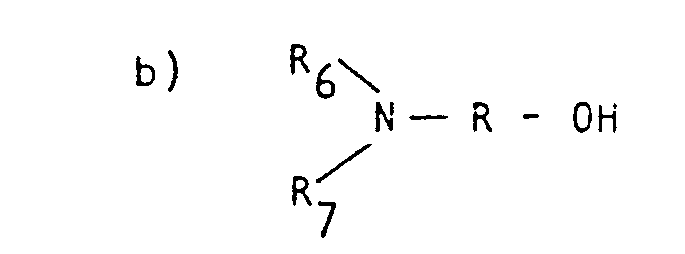
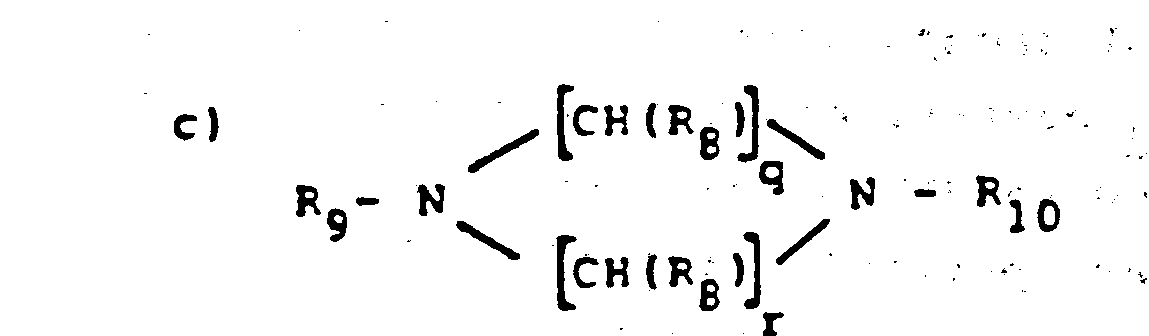
- R is a linear saturated or unsaturated hydrocarbon chain having 2 to 12 carbon atoms, optionally substituted in which one or more carbon atoms can be replaced by N(R5), O, S, and/or an aromatic radical, or a 5 to 8 membered aliphatic ring.
- R1 to R4 are H, alkyl, aryl, and aralkyl. whereby R1 to R4 can be the same or different; R5 is R1 to R4;
- R6 and R7 are R1 to R4, -(CHR8)p-OH;
- p is 1 to 6:
- q and r are 1 to 6 and can be the same or different:
- R is H, alkyl:
- R9 and R10 are H, alkyl, -(CHR8)p-OH.
- Surprisingly, it has turned out that the viscosity of coating solutions that contain a thixotropy-producing filler can be lowered by a factor of 3-120 by the addition of at least one amine-containing compound of above classes a), b), or c). The amine-containing compounds can be added to the coating solution in amounts of 0.01 to 5% preferably 0.1 to 1.5% by weight relative to the solids content of the dried layer.
- The process of this invention makes it possible to produce coating solutions having a content of up to 15% by weight of thixotropy-causing filler relative to the solids content of the dried material, whose viscosity is in the range of coating solutions with a similar solids content that do not contain this type of filler, and that can be coated without difficulty with conventional coating devices.
- This result is surprising for those skilled in the art insofar as it is known from the Degussa series Pigments, No. 23, that multifunctional compounds that can form hydrogen bridges, e.g., ethylene diamine, cause an increase in viscosity in nonpolar media in the presence of thixotropy-producing fillers.
- To produce the coating solutions, all soluble constituents such as binders, light-sensitive compounds such as monomers, photoinitiator systems. and other additives, are dissolved in at least one organic solvent. It is expedient to add one or more amine-containing compounds of substance classes a),
- b). or c) to the solution before adding the thixotropy-producing filler. It is also possible, however, to add the filler first and then the amine-containing compounds of substance classes a),
- b), or c). Both methods lead to coating solutions of equal viscosity. After all constituents have been added, the coating solution is treated, e.g., with a high-speed agitator, dissolver, a ball- or sand mill, to obtain a finely-divided dispersion of the filler.
- Typical amine-containing compounds that lower the viscosity include: 1,2-diaminoethane, 1-3-diaminopropane. 1,4-diaminobutane, 1.5-diaminopentane, 1,6-diamiaohexane, 1.7-diaminoheptane, 1,8-diaminooctane, 1,9-diaminononane. 1,10-diaminodecane, 1.11-diaminoundecane, 1,12-diamisododecane, 1.4-diaminobutene(2), 1.5-diaminopeatene(2), 1.6-diaminohexene(2). 1.6-diaminohexene(3), 1.5-diaminohexadiene(2,4), 1,7-diaminoheptene(2), 1.7-diaminoheptene(3). 1,7-diamiaoheptadiene(2,4), 1.7-diaminoheptadiene(2.5), 1,8-diaminooctene(2), 1.8-diaminooctene(4). triethylene tetramine, 2.2'-diaminodiethyl ether, 2.2'-diaminodiethyl thioether. 6,6'-diaminodihexyl ether, o-. m-, p-xylilene diamine, 1,2-diaminocyclahexane, 1,4-diaminocyclohexane, 1.2-bis-(2-aminoethyl)-cyclohexane, l,6-diamino-2-ethyl hexane, 1.2-diaminopropane. 1.3-diaminohexane. N-ethyl-1,2-diaminoethane. N-N'-diethyl-1,2-diaminoethane, N.N-diethyl-1.2-diaminoethane. N,N,N'-triethyl-1,2-diaminoethane, N,N,N',N'-tetraethyl-1,2-diaminoethane, N-phenyl-1.2-diaminoethane, N,N'-diphenyl-1,2-diaminoethane, tris-(2-aminoethyl)-amine, tris-(2-hydroxyethyl)-amine, mono-(2-hydroxyethyl)-amine, bis-(2-hydroxy-ethyl)-amine. (2-hydroxyethyl)-dimethylamine, (2-hydroxyethyl)-methylamine, bis-(2-hydroxyethyl)-methylamine, 1-amino-3-hydroxypropane. N-ethyl-N.N'-dimethyl-1.2-diaminoethane, 1,3-diazacycloheptane, piperazine. 1,4-diazacyclooctane and, N-methyl-l,3-diazacycloheptane. Aliphatic amines with at least two optionally substituted amino groups and a saturated hydrocarbon chain with 2 to 6 carbon atoms such as e.g.: 1,2-diaminoethane, 1,6-diaminohexane, N-ethyl-1,2-diaminoethane, N.N'-diethyl-1.2-diaminoethane. N.N-diethyl-1,2-diaminoethane, and N,N,N',N'-tetraethyl-1,2-diaminoethane, have particular significance thereby. Mono-, bis-, and tris-(2-hydroxyethyl)-amines have also proven to be particularly good.
- Finely divided silicic acids that greatly increase the mechanical strength in the dry mass of the coating solution at as low a percentage as possible, are suitable as fillers. Silicic acids having at least partially free silanol groups, an SiO2 content >70% by weight, a surface according to BET of between 50 and 400 m2/g, and a primary particle size between 7 and 50 nm, have proven to be particularly suitable. Part of the silanol groups at the surface area of the silicic acid can be modified by organic radicals. According to the invention. however, it is essential that part of these silanol groups be present in a free form.
- Polymeric binders with groups suitable for salt formation are known. These binders contain preferably acid groups that form salts in an alkaline medium. Carboxyl-. sulfonic acid-, sulfonamide-. or hydroxyl groups are suitable. The following are illustrations: polymers composed of acrylic acid or methacrylic acid. or their copolymers with other monomers, e.g.. acrylic acid ester or other acryl derivatives, vinyl compounds such as vinyl ether, vinyl acetate, or its saponification products, styrene, vinyl pyrrolidone, butadiene and related monomers, polyacrylic acid anhydrides, copolymers of maleic acid anhydride, maleic acid, maleic acid semiesters, maleic acid semiamides or anhydrides and derivatives of related compounds respectively, e.g., itaconic acid, with suitable comonomers, e.g., styrene, vinyl ethers, vinyl acetates, etc. The amount of binder is, in general. 20-90t by weight based on the total constituents of the coating less any solvents present.
- The number average molecular weight of the binder is, in general, 5000 to 100,000, and the acid number is preferably between 60 and 200.
- There are no restrictions with respect to the light-sensitive compounds. All known light-sensitive compounds or light-sensitive systems. respectively, that change the solubility, tackiness, or adhesion of the light-sensitive layer by exposure to light, can be added to the coating solutions. Systems whose solubility in the processing solution changes when exposed to light, are particularly important. To this category belong both light-curing systems and those that become more soluble at the exposed points. The preferred light-curable systems contain as the light-sensitive component either one or more addition-polymerizable monomers, or polymer compounds that contain light-sensitive groups by which cross-linking of the polymer chain takes place during the exposure. Particularly suitable are polymers that contain cinnamic acid ester groups, arylazide-, or aryl sulfonazide groups in the side chain. Such compounds are described in Chapter 4 of the book "Light-Sensitive Systems" by Jaromir Kosar. New York. 1965. Light-sensitive layers in which the solubility is increased by light preferably contain diazo compounds such as quinone diazides or diazonium salts. Another system is known from German Preliminary Published Application 2,242,106 and German Patent 2,718,130.
- Of the light-sensitive systems mentioned, photopolymerization is particularly significant in connection with the present invention, whereby processes that lead to a relief structure are preferred. Other processing variants such as toning or peel-apart developing are also of interest. however.
- Suitable addition-polymerizable monomers for the production of photopolymerizable layers are known from the literature in large numbers. e.g., from German Patent 1,210,321. By way of example the following monomers should be mentioned: ethylene glycol diacrylate, diethylene glycol diacrylate, glycerin diacrylate, glycerin triacrylate, ethylene glycol dimethacrylate, 1.3-propanediol dimethacrylate, 1,2,4-butanetriol trimethacrylate, 1,4-cyclohexanediol diacrylate, 1,4-hydroquinone dimethacrylate, pentaery- thrite tetramethacrylate, trimethylolpropane triacrylate, 1,3-propanediol diacrylate. 1.5-pentanediol dimethacrylate, or the bis-acrylates and bis-methacrylates of polyethylene glycols with a molecular weight of 200-500.
- Practically all compounds known for this purpose can be used as photopolymerization initiators. The photoinitiator system initiating the addition polymerization can contain one or more compounds that yield free radicals either directly when they are activated by irradiation, or after they have been excited to do so by means of a sensitizer activated by the irradiation. Examples of suitable photoinitiators or photoinitiator systems are: benzophenone/Michler's ketone, hexaaryl bisimidazoles/ mercaptobenzoxazole, substituted thioxanthones/ tertiary amines, and benzyl dimethyl ketal. The concentration of the photoinitiator system forming free radicals is preferably about 0.01 to 10% by weight present based on the total constituents of the coating (less solvent).
- In addition to the constituents already named, the coating solution can contain further additives, e.g.. sensitizers, stabilizers, dyes. pigments, plasticizers, and coating aids, etc.
- To produce the reproduction materials, the coating solutions are applied onto suitable supports by known methods and are subsequently dried. Suitable supports include, e.q., paper, metallic supports, glass, and ceramic supports, as well as film bases composed of plastic films such as polyethylene, polypropylene, polycarbonate. polyamide. polyesters, etc.
- The reproduction materials obtained from the coating solutions of the invention are suitable for a large number of applications in the reproduction sector, e.g., for the production of printing plates or colorproofing films. A preferred application, however, is as a photoresist.
- To produce the image. the light-sensitive material is preferably exposed through an original with radiation sources that emit an irradiation rich in ultraviolet light, e.g., mercury vapor lamps. xenon lamps, etc. It the light-sensitive material contains a sensitizer for visible light, light sources emitting longer wavelengths can also be used. Depending on the type of light-sensitive system used, the exposed material can then either be converted into a relief image by washing off with a suitable solvent, or the image is made visible by treating the light-sensitive layer with a toner, or by peeling apart.
- The following examples are intended to illustrate but not limit the invention. The percentages and parts are by weight unless further defined. All viscosity measurements were performed according to DIN 51398, 51550, and 53018, using a commercial Brookfield rotation viscosimeter, type LVF. The number average molecular weights (Mn) can be determined by gel permeation chromatography employing a polystyrene standard known to those skilled in the art. BET is a measuring method to determine the surface area of solids. The method is based on the fact that the surface area of solids adsorbs a defined quantity of gas molecules or molecules of substances dissolved in a solvent, whereby the adsorbed quantity is - under definite conditions - proportional to the size of the surface area. BET measuring is performed according to DIN 66131 and 66132.
- A coating solution of the following composition was produced:

- The solution was agitated for 4 min with a high-speed agitator to disperse the silicic acid. The solids content of the solution was 35% by weight. The viscosity, measured with a Brookfield viscosimeter. spindle 4 at 6 rpm, was 45,000 mPa's.
- The coating solution was then divided into 5 samples a) to e) and 0.2 q of the compounds shown in Table 1 were added to each sample. The viscosity was then measured using a Brookfield viscosimeter, spindle 3, at 60 rpm. The results are summarized in Table 1.

- A coating solution of the following composition was produced as described in Example 1:

- The solids content of the solution was 35% by weight and the viscosity was 43,000 mPa's. By adding 0.3 g of 1,2-diaminocyclohexane, the viscosity was lowered to 1800 mPa's.
- A coating solution of the following composition was produced as described in Example 1:
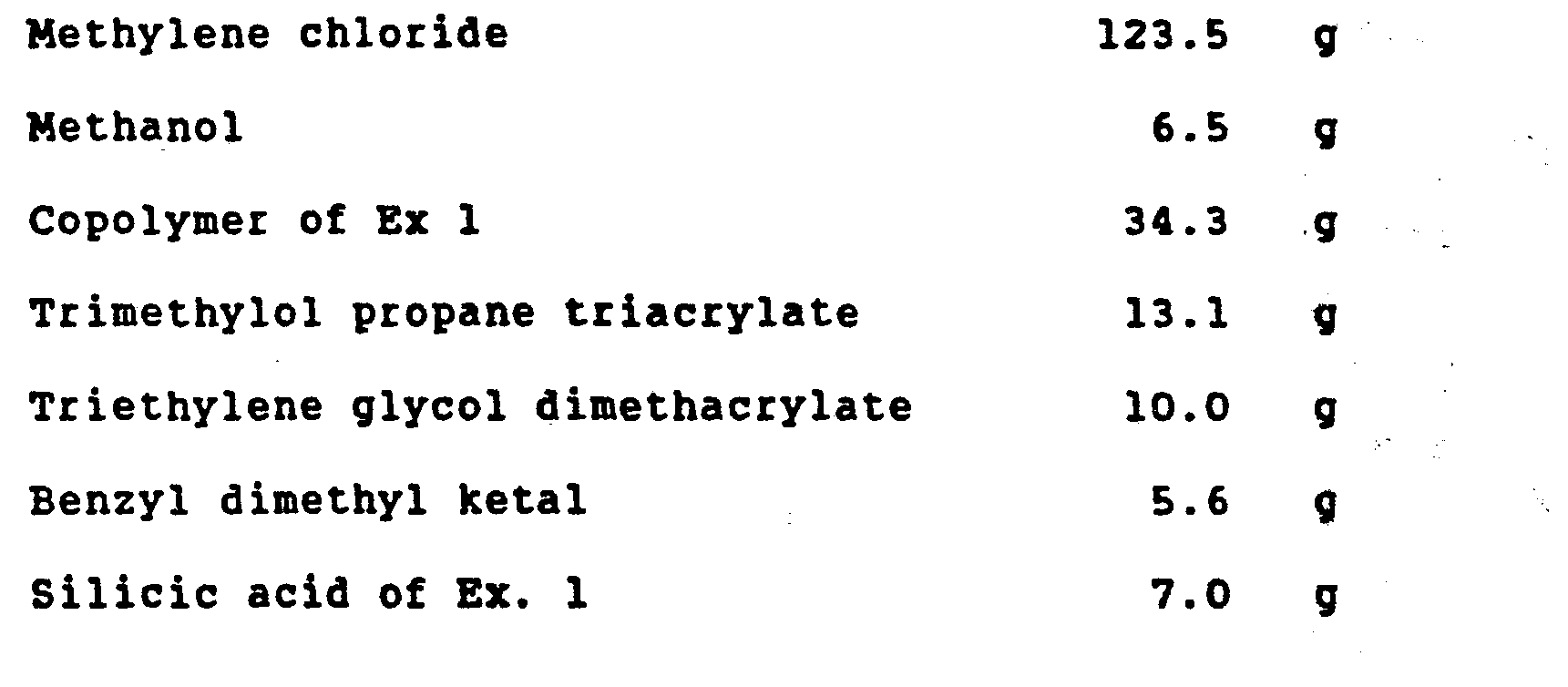
- The solids content of the solution was 35% by weight and the viscosity was 44,000 mPa's.
- 0.2 g respectively of the compounds shown in Table 2 were added to 100 g respectively of this . coating solution, and the viscosity was determined.
- The results are summarized in Table 2:

- A coating solution of the following composition was produced as described in Example 1:

- The solids content of the solution was 35% by weight and the viscosity was 45,000 mPa's.
- 0.2 g respectively of the compounds shown in Table 3 were added to 100 g respectively of this coating solution. and the viscosity was determined.

- A coating solution of the following composition was produced as described in Example 1:

- The solids content of the solution was 35% by weight and the viscosity was 50,000 mPa's. By adding 0.2 q of 1,6-diaminohexane, the viscosity was lowered to 950 mPa's.
- A coating solution of the following composition was produced as described in Example 1:

- The solids content of the solution was 35% by weight and the viscosity was 35,000 mPa's. By adding 0.2 g of 1,2-diaminoethane, the viscosity was lowered to 500 mPa's.
- In order to be able to coat a coating solution having the following solids composition:

- with usable viscosities in a methylene chloride (95%)/ methanol (5%) solvent mixture, the solution must be diluted to a solids content of about 22% by weight. At this dilution, the viscosity is 900 mPa's. When such a diluted solution is coated, however, the amount of solvent to be removed is so great that the capability of both the conveying and drying equipment and also the equipment for solvent recovery, is exceeded.
- If a change is made to concentrated solutions having a solids content of 35% by weight. the viscosity rises to over 45,000 mPa's, i.e., the solution cannot be coated. The viscosity can be lowered to 400 mPa's by adding 0.5% of 1.6-diaminohexane relative to the solids content of the coating solution. The values given are again summarized in Table 4.



Claims (8)

Applications Claiming Priority (2)
| Application Number | Priority Date | Filing Date | Title |
|---|---|---|---|
| DE3514768A DE3514768C1 (en) | 1985-04-24 | 1985-04-24 | Photosensitive mixture and recording material made therefrom |
| DE3514768 | 1985-04-24 |
Publications (3)
| Publication Number | Publication Date |
|---|---|
| EP0200463A2 true EP0200463A2 (en) | 1986-11-05 |
| EP0200463A3 EP0200463A3 (en) | 1987-11-04 |
| EP0200463B1 EP0200463B1 (en) | 1989-08-02 |
Family
ID=6268975
Family Applications (1)
| Application Number | Title | Priority Date | Filing Date |
|---|---|---|---|
| EP86303038A Expired EP0200463B1 (en) | 1985-04-24 | 1986-04-22 | Coating compositions for use in the production of light-sensitive reproduction materials |
Country Status (6)
| Country | Link |
|---|---|
| US (1) | US4683190A (en) |
| EP (1) | EP0200463B1 (en) |
| JP (1) | JPS61248038A (en) |
| BR (1) | BR8601426A (en) |
| CA (1) | CA1264021A (en) |
| DE (1) | DE3514768C1 (en) |
Cited By (2)
| Publication number | Priority date | Publication date | Assignee | Title |
|---|---|---|---|---|
| FR2596535A1 (en) * | 1986-02-14 | 1987-10-02 | Hercules Inc | PHOTOPOLYMERIZABLE COMPOSITION FOR USE AS A PHOTORESISTIVE AGENT COMPRISING IN PARTICULAR A SPECIFIC MIXTURE OF SILICEUX AND PLASTIFIANT |
| US4900795A (en) * | 1987-06-02 | 1990-02-13 | Basf Aktiengesellschaft | Polymer ammonium salts |
Families Citing this family (7)
| Publication number | Priority date | Publication date | Assignee | Title |
|---|---|---|---|---|
| US5004869A (en) * | 1984-06-14 | 1991-04-02 | Amp Incorporated | Electrical connector containing adipic acid polyester sealant composition |
| US5229244A (en) * | 1990-08-08 | 1993-07-20 | E. I. Du Pont De Nemours And Company | Dry processible photosensitive composition including photo-acid generator and optically clear polymer (co-polymer) blend that becomes tacky upon exposure to actinic radiation |
| US5286595A (en) * | 1990-08-08 | 1994-02-15 | E. I. Du Pont De Nemours And Company | Process for creating a tacky tonable image surface through exposure of a substrate coated with a polymer blend, including a photo-acid generator, to actinic radiation |
| ES2152258T3 (en) * | 1992-07-31 | 2001-02-01 | Du Pont | METHOD AND PRODUCT FOR PARTICLE ASSEMBLY. |
| DE19709037A1 (en) | 1997-03-06 | 1998-09-10 | Du Pont Deutschland | Material and process for edge-covering photopolymerizable printing plates for flexographic printing |
| JP4282783B2 (en) * | 1997-12-16 | 2009-06-24 | Jsr株式会社 | Radiation sensitive composition for color filter |
| US20040131970A1 (en) * | 2003-01-07 | 2004-07-08 | Meagley Robert P. | Photodefinable polymers for semiconductor applications |
Family Cites Families (7)
| Publication number | Priority date | Publication date | Assignee | Title |
|---|---|---|---|---|
| NL218803A (en) * | 1956-07-09 | |||
| CA923358A (en) * | 1969-08-01 | 1973-03-27 | Fuji Photo Film Co. | Light-sensitive stencil printing material |
| CA1110899A (en) * | 1976-11-08 | 1981-10-20 | David A. Simpson | Process for making photographic images using a photosensitive composition which forms peroxides on irradiation with u.v. light |
| SU900244A1 (en) * | 1980-01-07 | 1982-01-23 | Институт химии высокомолекулярных соединений АН УССР | Photopolymerizing composition for producing printing forms |
| DE3047126A1 (en) * | 1980-12-13 | 1982-07-29 | Basf Ag, 6700 Ludwigshafen | PHOTOPOLYMERIZABLE RECORDING MATERIAL AND METHOD FOR PRODUCING RELIEF FORMS BY THIS RECORDING MATERIAL |
| GB2108986B (en) * | 1981-11-03 | 1985-06-26 | Sericol Group Ltd | Photopolymerisable composition for producing screen printing stencils |
| DE3327523A1 (en) * | 1983-07-30 | 1985-02-07 | Basf Ag, 6700 Ludwigshafen | LIGHT-SENSITIVE MULTILAYER MATERIAL |
-
1985
- 1985-04-24 DE DE3514768A patent/DE3514768C1/en not_active Expired
- 1985-12-18 US US06/810,364 patent/US4683190A/en not_active Expired - Fee Related
-
1986
- 1986-03-31 BR BR8601426A patent/BR8601426A/en unknown
- 1986-04-22 EP EP86303038A patent/EP0200463B1/en not_active Expired
- 1986-04-22 CA CA000507227A patent/CA1264021A/en not_active Expired
- 1986-04-23 JP JP61092471A patent/JPS61248038A/en active Granted
Cited By (3)
| Publication number | Priority date | Publication date | Assignee | Title |
|---|---|---|---|---|
| FR2596535A1 (en) * | 1986-02-14 | 1987-10-02 | Hercules Inc | PHOTOPOLYMERIZABLE COMPOSITION FOR USE AS A PHOTORESISTIVE AGENT COMPRISING IN PARTICULAR A SPECIFIC MIXTURE OF SILICEUX AND PLASTIFIANT |
| EP0233623A3 (en) * | 1986-02-14 | 1988-10-05 | Hercules Incorporated | Photopolymerizable films containing plasticizer silica combinations |
| US4900795A (en) * | 1987-06-02 | 1990-02-13 | Basf Aktiengesellschaft | Polymer ammonium salts |
Also Published As
| Publication number | Publication date |
|---|---|
| EP0200463A3 (en) | 1987-11-04 |
| US4683190A (en) | 1987-07-28 |
| BR8601426A (en) | 1986-12-09 |
| JPS61248038A (en) | 1986-11-05 |
| DE3514768C1 (en) | 1986-07-24 |
| CA1264021A (en) | 1989-12-27 |
| EP0200463B1 (en) | 1989-08-02 |
| JPH0350260B2 (en) | 1991-08-01 |
Similar Documents
| Publication | Publication Date | Title |
|---|---|---|
| US3961961A (en) | Positive or negative developable photosensitive composition | |
| TW401534B (en) | Method for improving photoimage quality | |
| US3594410A (en) | Addition polymerizable branched chain polyol polyesters of alpha-methylene carboxylic acids | |
| US4590145A (en) | Photopolymerization initiator comprised of thioxanthones and oxime esters | |
| DE2055157C3 (en) | Photopolymerizable mixture | |
| EP0031566B2 (en) | Photosensitive negative-working tonable element | |
| JPS609248B2 (en) | photosensitive mixture | |
| US3203805A (en) | Wax-coated photopolymerizable elements and processes for using same | |
| EP0127765A1 (en) | Sensitization of glyoxylate photoinitiators | |
| EP0200463B1 (en) | Coating compositions for use in the production of light-sensitive reproduction materials | |
| CN103116246B (en) | A kind of photosensitive polymer combination and application thereof | |
| US3368900A (en) | Polymerizable compositions and elements | |
| EP0277915A2 (en) | Photoinitiator mixture containing a titanocene and a 3-ketocoumarin | |
| CN111825781A (en) | Photoinitiator composition containing sensitizer and sulfonium salt and application of photoinitiator composition in LED cation photocuring composition | |
| JP2018013799A (en) | Photosensitive resin element | |
| US4289843A (en) | Photopolymerizable element having initiator in adhesive layer | |
| JPS6187149A (en) | Water phenomenal photoporimirizing composition | |
| DE2405714A1 (en) | PHOTOPOLYMERIZABLE MASS | |
| JPH11509329A (en) | Heterogeneous photoinitiators, photopolymerizable compositions and uses thereof | |
| DE2232365A1 (en) | MIXTURES POLYMERIZABLE BY UV RADIATION | |
| US4239609A (en) | Photopolymerizable coating and recording materials containing a photoinitiator and an organic halogen compound | |
| JPS5941444B2 (en) | Photopolymerizable composition | |
| GB2198736A (en) | Photopolymerisable material | |
| US3847610A (en) | Photopolymerisation of ethylenically unsaturated organic compounds | |
| JPS5810737A (en) | Photosensitive resin composition |
Legal Events
| Date | Code | Title | Description |
|---|---|---|---|
| PUAI | Public reference made under article 153(3) epc to a published international application that has entered the european phase |
Free format text: ORIGINAL CODE: 0009012 |
|
| AK | Designated contracting states |
Kind code of ref document: A2 Designated state(s): BE CH FR GB IT LI NL |
|
| PUAL | Search report despatched |
Free format text: ORIGINAL CODE: 0009013 |
|
| AK | Designated contracting states |
Kind code of ref document: A3 Designated state(s): BE CH FR GB IT LI NL |
|
| 17P | Request for examination filed |
Effective date: 19871123 |
|
| 17Q | First examination report despatched |
Effective date: 19880601 |
|
| GRAA | (expected) grant |
Free format text: ORIGINAL CODE: 0009210 |
|
| AK | Designated contracting states |
Kind code of ref document: B1 Designated state(s): BE CH FR GB IT LI NL |
|
| ITF | It: translation for a ep patent filed | ||
| ET | Fr: translation filed | ||
| PG25 | Lapsed in a contracting state [announced via postgrant information from national office to epo] |
Ref country code: BE Effective date: 19900430 |
|
| PLBE | No opposition filed within time limit |
Free format text: ORIGINAL CODE: 0009261 |
|
| STAA | Information on the status of an ep patent application or granted ep patent |
Free format text: STATUS: NO OPPOSITION FILED WITHIN TIME LIMIT |
|
| 26N | No opposition filed | ||
| BERE | Be: lapsed |
Owner name: E.I. DU PONT DE NEMOURS AND CY Effective date: 19900430 |
|
| ITTA | It: last paid annual fee | ||
| PGFP | Annual fee paid to national office [announced via postgrant information from national office to epo] |
Ref country code: FR Payment date: 19940224 Year of fee payment: 9 |
|
| PGFP | Annual fee paid to national office [announced via postgrant information from national office to epo] |
Ref country code: CH Payment date: 19940308 Year of fee payment: 9 |
|
| PGFP | Annual fee paid to national office [announced via postgrant information from national office to epo] |
Ref country code: GB Payment date: 19940328 Year of fee payment: 9 |
|
| PGFP | Annual fee paid to national office [announced via postgrant information from national office to epo] |
Ref country code: NL Payment date: 19940430 Year of fee payment: 9 |
|
| PG25 | Lapsed in a contracting state [announced via postgrant information from national office to epo] |
Ref country code: GB Effective date: 19950422 |
|
| PG25 | Lapsed in a contracting state [announced via postgrant information from national office to epo] |
Ref country code: LI Effective date: 19950430 Ref country code: CH Effective date: 19950430 |
|
| PG25 | Lapsed in a contracting state [announced via postgrant information from national office to epo] |
Ref country code: NL Effective date: 19951101 |
|
| REG | Reference to a national code |
Ref country code: CH Ref legal event code: PL |
|
| GBPC | Gb: european patent ceased through non-payment of renewal fee |
Effective date: 19950422 |
|
| PG25 | Lapsed in a contracting state [announced via postgrant information from national office to epo] |
Ref country code: FR Effective date: 19951229 |
|
| NLV4 | Nl: lapsed or anulled due to non-payment of the annual fee |
Effective date: 19951101 |
|
| REG | Reference to a national code |
Ref country code: FR Ref legal event code: ST |
|
| PG25 | Lapsed in a contracting state [announced via postgrant information from national office to epo] |
Ref country code: IT Free format text: LAPSE BECAUSE OF NON-PAYMENT OF DUE FEES;WARNING: LAPSES OF ITALIAN PATENTS WITH EFFECTIVE DATE BEFORE 2007 MAY HAVE OCCURRED AT ANY TIME BEFORE 2007. THE CORRECT EFFECTIVE DATE MAY BE DIFFERENT FROM THE ONE RECORDED. Effective date: 20050422 |