EP0200524A2 - Dihydropyridine calcium antagonists - Google Patents
Dihydropyridine calcium antagonists Download PDFInfo
- Publication number
- EP0200524A2 EP0200524A2 EP86303225A EP86303225A EP0200524A2 EP 0200524 A2 EP0200524 A2 EP 0200524A2 EP 86303225 A EP86303225 A EP 86303225A EP 86303225 A EP86303225 A EP 86303225A EP 0200524 A2 EP0200524 A2 EP 0200524A2
- Authority
- EP
- European Patent Office
- Prior art keywords
- alkyl
- compound
- formula
- aryl
- halo
- Prior art date
- Legal status (The legal status is an assumption and is not a legal conclusion. Google has not performed a legal analysis and makes no representation as to the accuracy of the status listed.)
- Withdrawn
Links
- 0 C*(**)C1C(*)C(C2*C2)=C(C)*C1C Chemical compound C*(**)C1C(*)C(C2*C2)=C(C)*C1C 0.000 description 1
Classifications
-
- C—CHEMISTRY; METALLURGY
- C07—ORGANIC CHEMISTRY
- C07D—HETEROCYCLIC COMPOUNDS
- C07D211/00—Heterocyclic compounds containing hydrogenated pyridine rings, not condensed with other rings
- C07D211/04—Heterocyclic compounds containing hydrogenated pyridine rings, not condensed with other rings with only hydrogen or carbon atoms directly attached to the ring nitrogen atom
- C07D211/80—Heterocyclic compounds containing hydrogenated pyridine rings, not condensed with other rings with only hydrogen or carbon atoms directly attached to the ring nitrogen atom having two double bonds between ring members or between ring members and non-ring members
- C07D211/84—Heterocyclic compounds containing hydrogenated pyridine rings, not condensed with other rings with only hydrogen or carbon atoms directly attached to the ring nitrogen atom having two double bonds between ring members or between ring members and non-ring members with hetero atoms or with carbon atoms having three bonds to hetero atoms, with at the most one bond to halogen directly attached to ring carbon atoms
- C07D211/90—Carbon atoms having three bonds to hetero atoms with at the most one bond to halogen
Definitions
- This invention relates to certain dihydropyridines, specifically to certain 1,4-dihydropyridines having an amino-containing group attached to the 2-position, which have utility as anti-ischaemic and antihypertensive agents.
- the compounds of the invention reduce the movement of calcium into the cell and they are thus able to delay or prevent the cardiac contracture which is believed to be caused by an accumulation of intracellular calcium under ischaemic conditions.
- Excessive calcium influx during ischaemia can have a number of additional adverse effects which would further compromise the ischaemic myocardium. These include less efficient use of oxygen for ATP production, activation of mitochondrial fatty acid oxidation and possibly, promotion of cell necrosis.
- the compounds are useful in the treatment or prevention of a variety of cardiac conditions, such as angina pectoris, cardiac arrhythmias, heart attacks and cardiac hypertrophy.
- the compounds also have vasodilator activity since they can inhibit calcium influx in cells of vascular tissue and they are thus also useful as antihypertensive agents and for the treatment of coronary vasospasm.
- aryl as used in this specification includes unsubstituted phenyl and phenyl substituted by, for example, one or two substituents each independently selected from nitro, halo, C 1 -C 4 alkyl, C 1 -C 4 alkoxy, hydroxy, trifluoromethyl, trifluoromethoxy, difluoromethoxy and cyano. It also includes 1- and 2-naphthyl.
- Halo means F, Cl, Br or I.
- heteroaryl as used in this specification for R means an aromatic heterocyclic group which may optionally be substituted and includes, for example, benzofuranyl; benzothienyl; pyridyl optionally monosubstituted by methyl, methylthio, halo or cyano; quinolyl; benzoxazolyl; benzothiazolyl; furyl; pyrimidinyl; thiazolyl; 2,1,3-benzoxadiazol-4-yl; 2,1;3-benzothiadiazol-4-yl; and thienyl optionally monosubstituted by halo or C 1 -C 4 alkyl.
- Alkyl and alkoxy groups having 3 or more carbon atoms can be straight or branched chain.
- R is preferably phenyl substituted by 1 or 2 substituents each selected from halo (especially Cl) and CF 3 , or is 2-chloropyrid-3-yl.
- Examples of R are 2-chlorophenyl, 2,3-dichlorophenyl, 2-chloro-3-trifluoromethylphenyl and 2-chloropyrid-3-yl.
- R is most preferably 2-chlorophenyl or 2,3-dichlorophenyl.
- R 1 and R 2 are each independently CH 3 or C 2 H 5 .
- Y is preferably -(CH2)2- or -(CH 2 ) 3 -.
- the compounds of the formula (I) containing one or more asymmetric centres will exist as one or more pairs of enantiomers, and such pairs or individual isomers may be separable by physical methods, e.g. by fractional crystallisation or chromatography of the parent compounds or suitable derivatives thereof as will be known to those skilled in the art.
- the invention includes the separated pairs as well as mixtures thereof, as racemic mixtures or as separated optically-active isomeric forms.
- the pharmaceutically acceptable acid addition salts of the compounds of the formula (I) are those formed from acids which form non-toxic acid addition salts containing pharmaceutically acceptable anions, such as the hydrochloride, hydrobromide, sulphate, phosphate or acid phosphate, acetate, maleate, fumarate, lactate, tartrate, citrate, methanesulphonate and gluconate salts.
- the ability of the compounds of the formula (I) to inhibit the movement of calcium into the cell is shown by their effectiveness in reducing the contraction of vascular tissue in vitro which is the consequence of calcium influx caused by a high extracellular concentration of potassium ions.
- the test is performed by mounting spirally cut strips of rat aorta with one end fixed and the other attached to a force transducer. The tissue is immersed in a bath of physiological saline solution containing 2.5 mM Ca2+ and 5.9 mM K ⁇ . Potassium chloride is added to the bath with a pipette to give a final K 0 concentration of 45 millimolar. The change in tension caused by the resulting contraction of the tissue- is noted. The bath is drained and replaced with fresh saline solution and, after 45 minutes, the test is repeated with the particular compound under test present in the saline solution. The concentration of compound required to reduce the response by 50% (IC 50 ) is recorded.
- the antihypertensive activity of the compounds is evaluated after oral administration by measuring the fall in blood pressure in spontaneously hypertensive rats or renally hypertensive dogs..
- oral dosages of the compounds will be in the range of from 5-100 mg daily for an average adult patient (70 kg), typically 10-60 mg daily.
- individual tablets or capsules will generally contain 5, 10 or 20 mg of active compound, in a suitable pharmaceutically acceptable vehicle or carrier.
- Dosages for intravenous administration will typically be within the range 1 to 10 mg per single dose as required. In practice the physician will determine the actual dosage which will be most suitable for an individual patient and it will vary with the age, weight and response of the particular patient. The above dosages are exemplary of the average case but there can, of course, be individual instances where higher or lower dosage ranges are merited, and such are within the scope cf this invention.
- the compounds of the formula (I) can be administered alone, but will generally be administered in admixture with a pharmaceutical carrier selected with regard to the intended route of administration and standard pharmaceutical practice.
- a pharmaceutical carrier selected with regard to the intended route of administration and standard pharmaceutical practice.
- they may be administered orally in the form of tablets containing such excipients as starch or lactose, or in capsules or ovules either alone or in admixture with excipients, or in the form of elixirs or suspensions containing flavouring or colouring agents.
- They may be injected parenterally, for example, intravenously, intramuscularly or subcutaneously.
- parenteral administration they are best used in the form of a sterile aqueous solution which may contain other substances, for example, enough salts or glucose to make the solution isotonic.
- the invention provides a pharmaceutical composition
- a pharmaceutical composition comprising a compound of the formula (I) or a pharmaceutically acceptable salt thereof, together with a pharmaceutically acceptable diluent or carrier.
- the invention also includes a compound of the formula (I) or or a pharmaceutically acceptable salt thereof, for use in medicine, in particular in the treatment of ischaemic heart disease, angina, or hypertension in a human being.
- the invention also provides a method of protecting the heart from the deleterious effects of ischaemia, which comprises administering an effective amount of a compound of the formula (I) or pharmaceutically acceptable salt thereof, or a pharmaceutical composition as defined above.
- the invention also includes a method of treating hypertension which comprises administering an antihypertensive amount of a compound of the formula (I) or pharmaceutically acceptable salt thereof, or pharmaceutical composition as defined above.
- the compounds of the formula (I) in which m is O and R 3 is H or C 1 -C 4 alkyl can be prepared by the reaction of a compound of the formula:- where R , R 1 and R 2 are as defined for formula (I) and Q is a leaving group, with a thiol (or salt thereof) of the formula:- where R 3 is as defined in this method, and Y is as defined for formula (I).
- the alkali metal salts particularly the sodium and potassium salts, are preferred.
- Q is a leaving group such as Cl, Br, tosyloxy, methanesulphonyloxy, trifluoromethanesulphonyloxy or 1-imidazolylsulphonyloxy.
- reaction is typically carried out in an organic solvent such as dioxane, dimethylformamide or tetrahydrofuran and compound (III) is preferably used in alkali metal salt form, preparable by the reaction of the free thiol with an alkali metal base such as potassium carbonate.
- an alkali metal base such as potassium carbonate.
- the reaction will proceed at from 0°C to room temperature but, if necessary, the reaction mixture can be heated to, say, 80°C, to accelerate the rate of reaction. If compound (III) is added in acid addition salt form, excess base (e.g. K 2 C0 3 ) should be present.
- the compounds of the formulae (II) and (III) are in general known compounds and, if not available commercially, can be obtained by conventional methods.
- the compounds of the formula (II) are obtainable via the corresponding 2-methyl or 2-hydroxymethyl derivatives.
- Q is preferably Br or 1-imidazolylsulphonyloxy, and these starting materials are typically available by the bromination of the corresponding 2-methyl compounds using, e.g., pyridinium bromide perbromide (see Synthesis, 617, (1984)], or by reaction of the corresponding 2-hydroxymethyl compounds with sulphuryl chloride and imidazole.
- the compounds in which m is 0 and R 3 is -COCF 3 can be prepared by the acylation of thecorresponding compounds in which R 3 is H with an appropriate acylating agent, e.g. a C 1 -C 4 alkyl trifluoroacetate (preferably ethyl trifluoroacetate), trifluoroacetic anhydride or trifluoroacetyl chloride.
- an appropriate acylating agent e.g. a C 1 -C 4 alkyl trifluoroacetate (preferably ethyl trifluoroacetate), trifluoroacetic anhydride or trifluoroacetyl chloride.
- the reaction is typically carried out in an organic solvent such as ethanol, and in the presence of an organic base such as triethylamine or pyridine. Generally the reaction will proceed at a satisfactory rate at a temperature of from 0°C to room temperature (25°C).
- the product can then be recovered conventionally.
- All the compounds of the formula (I) in which m is 1 or 2, ie, the sulphinyl and sulphonyl compounds, can be prepared by the oxidation of the corresponding thio compounds, typically by using about one (sulphinyl) or two (sulphonyl) equivalents of a suitable oxidising agent such as meta-chloroperbenzoic acid (preferred) or sodium metaperiodate.
- a suitable oxidising agent such as meta-chloroperbenzoic acid (preferred) or sodium metaperiodate.
- sulphinyl and sulphonyl compounds in which R 3 is H or C l -C 4 alkyl it is however preferred to protect the primary or secondary amino group prior to oxidation by conventional means, removing the protecting group after oxidation.
- the preferred protecting group is trifluoroacetyl, which can be subsequently removed by alkaline hydrolysis, e.g. by using aqueous sodium hydroxide in dioxane.
- Use of an N-protecting group tends to facilitate the recovery of the sulphinyl and sulphonyl end products.
- Other conventional amino-protecting groups can be used in place of trifluoroacetyl, e. g.
- a mineral acid e.g. HC1
- Acid addition salts are obtainable conventionally, e.g. by reacting a solution of the free base in an organic solvent with a solution of the acid in an organic solvent, followed by recovering the acid addition salt by filtration or evaporation of the solution.
- Pyridinium bromide perbromide (2.00g) was added in one portion to a stirred, ice-cooled solution of 3,5-bis (methoxycarbonyl)-4-(2-chlorophenyl)-2,6-dimethyl-1,4-dihydropyridine (1.68g) (See DT-OS 2302866 [1973]) and pyridine (0.80ml) in chloroform (50ml).
- the mixture was stirred at 0°C for 30 minutes, washed twice with ice-cold 0.25 M hydrochloric acid and once with water, dried over Na 2 S0 4 and evaporated.
- 2-[3-Aminopropylthiomethyl]-3,5-bis(methoxycarbonyl)-4-(2-chlorophenyl)-6-methyl-1,4-dihydropyridine was prepared by the method described in Example 1 using 3-aminopropanethiol hydrochloride/K 2 CO 3 instead of 2-aminoethanethiol hydrochloride/K 2 CO 3 .
- the product was characterised as the hemifumarate and had a m.p. of 150-160°.
- 2-(2-Aminoethylthiomethyl)-3,5-bis(methoxycarbonyl)-4-(2,3-dichlorophenyl)-6-methyl-1,4-dihydropyridine was prepared by the method described in Example 1 but using 3,5-bis(methoxycarbonyl)-4-(2,3-dichlorophenyl)-2,6-dimethyl-l,4-dihydropyridine instead of 3,5-bis-(methoxycarbonyl)-4-(2-chlorophenyl)-2,6-dimethyl-1,4-dihydropyridine.
- the product was isolated as an oil which was not characterised analytically.
- 2-(2-Aminoethylthiomethyl)-4-(2,3-dichlorophenyl)-3-ethoxycarbonyl-5-methoxycarbonyl-6-methyl-1,4-dihydropyridine was prepared by the method described in the previous Example but using 4-(2,3-dichlorophenyl)-3-ethoxycarbonyl-2-hydroxymethyl-5-methoxycarbonyl-6-methyl-l,4-dihydropyridine instead of 4-(2-chlorophenyl)-3-ethoxycarbonyl-2-hydroxymethyl-5-methoxycarbonyl-6-methyl-l,4-dihydropyridine.
- the product was obtained as an essentially pure oil, which was not characterised analytically.
- 3,5-Bis(methoxycarbonyl)-4-(2-chlorophenyl)-6-methyl-2-[3-(trifluoroacetylamino)propylsulphonyl- methyl]-1,4-dihydropyridine was prepared by the method described in the previous Example but using 3,5-bis-(methoxycarbonyl)-4-(2-chlorophenyl)-6-methyl-2-[3-(trifluoroacetylamino)propylsulphinylmethyl]-1,4-dihydropyridine instead of 3,5-bis(methoxycarbonyl)-4-(2-chlorophenyl)-6-methyl-2-[3-(trifluoroacetylamino)-propylthiomethyl]-1,4-dihydropyridine.
- the product had a m.p. of 75-80°.
- 2-(3-Aminopropylsulphonylmethyl)-3,5-bis(methoxycarbonyl)-4-(2-chlorophenyl)-6-methyl-1,4-dihydropyridine was prepared by the method described in the previous Example but using 3,5-bis(methoxycarbonyl)-4-(2-chlorophenyl)-6-methyl-2-[3-(trifluoroacetylamino)-propylsulphonylmethyl]-1,4-dihydropyridine instead of 3,5-bis(methoxycarbonyl)-4-(2-chlorophenyl)-6-methyl-2-[3-(trifluoroacetylamino)propylsulphinylmethyl]-1,4-dihydropyridine.
- the product had a m.p. of 70-80°.
Landscapes
- Chemical & Material Sciences (AREA)
- Organic Chemistry (AREA)
- Pharmaceuticals Containing Other Organic And Inorganic Compounds (AREA)
- Plural Heterocyclic Compounds (AREA)
- Hydrogenated Pyridines (AREA)
Abstract
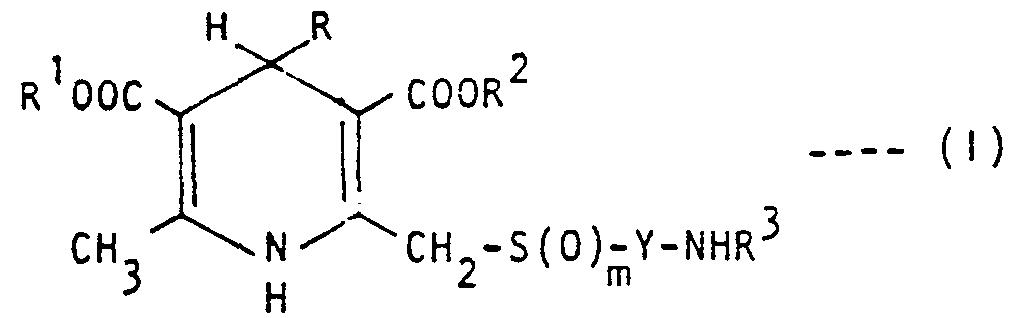
- R is an optionally substituted aryl or heteroaryl group;
- R' and R2 are each independently selected from
- i) C1-C4 alkyl and
- ii) C1-C4 alkyl substituted by C3-C7 cycloalkyl, aryl, CF3, C2-C4 alkanoyl, halo, hydroxy, C1-C4 alkoxy, C2-C4 alkanoyloxy, aryl-(C1-C4 alkoxy). or - NR4R5;
- m is 0, 1 or 2;
- R3 is H, C1-C4 alkyl or -COCF3;
- R4 is H or C1-C4 alkyl;
- R5 is H, C1-C4 alkyl or aryl-(C1-C4 alkyl); and
- Y is (CH2), where n is 2,3 or 4. CH2CH(CH3) - or
Description
- This invention relates to certain dihydropyridines, specifically to certain 1,4-dihydropyridines having an amino-containing group attached to the 2-position, which have utility as anti-ischaemic and antihypertensive agents.
- The compounds of the invention reduce the movement of calcium into the cell and they are thus able to delay or prevent the cardiac contracture which is believed to be caused by an accumulation of intracellular calcium under ischaemic conditions. Excessive calcium influx during ischaemia can have a number of additional adverse effects which would further compromise the ischaemic myocardium. These include less efficient use of oxygen for ATP production, activation of mitochondrial fatty acid oxidation and possibly, promotion of cell necrosis. Thus the compounds are useful in the treatment or prevention of a variety of cardiac conditions, such as angina pectoris, cardiac arrhythmias, heart attacks and cardiac hypertrophy. The compounds also have vasodilator activity since they can inhibit calcium influx in cells of vascular tissue and they are thus also useful as antihypertensive agents and for the treatment of coronary vasospasm.
- In addition, because of their ability to inhibit calcium influx into smooth muscle cells, it is expected that they will have activity in the treatment of congestive heart failure, gastrointestinal disorders, cerebrovascular disorders, peripheral vascular disease, bronchopulmonary disorders, pulmonary hypertension, smooth muscle disorders of the urino-genital system, and hypertrophic cardiac myopathy.
- According to the invention, there are provided 1,4-dihydropyridine derivatives of the formula:-
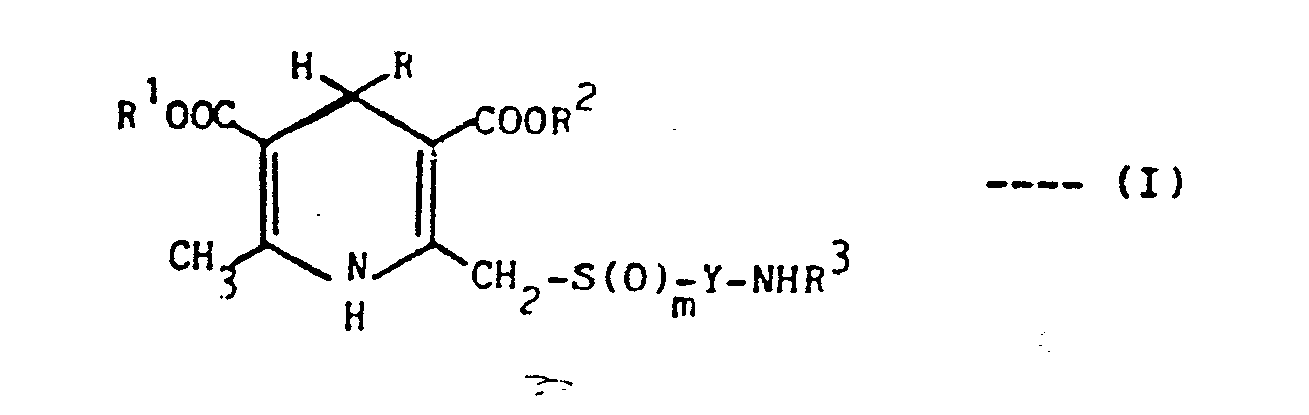
- heteroaryl group;
- R1 and R 2 are each independently selected from
- i) C1-C4 alkyl and
- ii) C1-C4 alkyl substituted by C3-C7 cycloalkyl, aryl, CF3, C2-C4 alkanoyl, halo, hydroxy, C1-C4 alkoxy, C 2-C 4 alkanoyloxy, aryl-(C1-C4 alkoxy), or -NR 4 R5;
- m is 0, 1 or 2;
- R3 is H, C1-C4 alkyl or -COCF3;
- R 4 is H or C1-C4 alkyl;
- R5 is H, C1-C4 alkyl or aryl-(C1-C4 alkyl);
- and Y is - (CH2)n- where n is 2,3 or 4, -CH2CH(CH3 )-
- or -CH2C(CH3)2-;
- The term "aryl" as used in this specification includes unsubstituted phenyl and phenyl substituted by, for example, one or two substituents each independently selected from nitro, halo, C1-C4 alkyl, C1-C4 alkoxy, hydroxy, trifluoromethyl, trifluoromethoxy, difluoromethoxy and cyano. It also includes 1- and 2-naphthyl.
- "Halo" means F, Cl, Br or I.
- The term "heteroaryl" as used in this specification for R means an aromatic heterocyclic group which may optionally be substituted and includes, for example, benzofuranyl; benzothienyl; pyridyl optionally monosubstituted by methyl, methylthio, halo or cyano; quinolyl; benzoxazolyl; benzothiazolyl; furyl; pyrimidinyl; thiazolyl; 2,1,3-benzoxadiazol-4-yl; 2,1;3-benzothiadiazol-4-yl; and thienyl optionally monosubstituted by halo or C1-C4 alkyl.
- Alkyl and alkoxy groups having 3 or more carbon atoms can be straight or branched chain.
- R is preferably phenyl substituted by 1 or 2 substituents each selected from halo (especially Cl) and CF3, or is 2-chloropyrid-3-yl. Examples of R are 2-chlorophenyl, 2,3-dichlorophenyl, 2-chloro-3-trifluoromethylphenyl and 2-chloropyrid-3-yl. R is most preferably 2-chlorophenyl or 2,3-dichlorophenyl.
- Preferably R 1 and R 2 are each independently CH3 or C 2 H5.
- Y is preferably -(CH2)2- or -(CH2)3-.
- The compounds of the formula (I) containing one or more asymmetric centres will exist as one or more pairs of enantiomers, and such pairs or individual isomers may be separable by physical methods, e.g. by fractional crystallisation or chromatography of the parent compounds or suitable derivatives thereof as will be known to those skilled in the art. The invention includes the separated pairs as well as mixtures thereof, as racemic mixtures or as separated optically-active isomeric forms.
- The pharmaceutically acceptable acid addition salts of the compounds of the formula (I) are those formed from acids which form non-toxic acid addition salts containing pharmaceutically acceptable anions, such as the hydrochloride, hydrobromide, sulphate, phosphate or acid phosphate, acetate, maleate, fumarate, lactate, tartrate, citrate, methanesulphonate and gluconate salts.
- The ability of the compounds of the formula (I) to inhibit the movement of calcium into the cell is shown by their effectiveness in reducing the contraction of vascular tissue in vitro which is the consequence of calcium influx caused by a high extracellular concentration of potassium ions. The test is performed by mounting spirally cut strips of rat aorta with one end fixed and the other attached to a force transducer. The tissue is immersed in a bath of physiological saline solution containing 2.5 mM Ca2+ and 5.9 mM K⊕. Potassium chloride is added to the bath with a pipette to give a final K0 concentration of 45 millimolar. The change in tension caused by the resulting contraction of the tissue- is noted. The bath is drained and replaced with fresh saline solution and, after 45 minutes, the test is repeated with the particular compound under test present in the saline solution. The concentration of compound required to reduce the response by 50% (IC50) is recorded.
- The antihypertensive activity of the compounds is evaluated after oral administration by measuring the fall in blood pressure in spontaneously hypertensive rats or renally hypertensive dogs..
- For administration to man in the curative or prophylactic treatment of cardiac conditions and hypertension, oral dosages of the compounds will be in the range of from 5-100 mg daily for an average adult patient (70 kg), typically 10-60 mg daily. Thus for a typical adult patient, individual tablets or capsules will generally contain 5, 10 or 20 mg of active compound, in a suitable pharmaceutically acceptable vehicle or carrier.
- Dosages for intravenous administration will typically be within the range 1 to 10 mg per single dose as required. In practice the physician will determine the actual dosage which will be most suitable for an individual patient and it will vary with the age, weight and response of the particular patient. The above dosages are exemplary of the average case but there can, of course, be individual instances where higher or lower dosage ranges are merited, and such are within the scope cf this invention.
- For human use, the compounds of the formula (I) can be administered alone, but will generally be administered in admixture with a pharmaceutical carrier selected with regard to the intended route of administration and standard pharmaceutical practice. For example, they may be administered orally in the form of tablets containing such excipients as starch or lactose, or in capsules or ovules either alone or in admixture with excipients, or in the form of elixirs or suspensions containing flavouring or colouring agents. They may be injected parenterally, for example, intravenously, intramuscularly or subcutaneously. For parenteral administration, they are best used in the form of a sterile aqueous solution which may contain other substances, for example, enough salts or glucose to make the solution isotonic.
- Thus in a further aspect the invention provides a pharmaceutical composition comprising a compound of the formula (I) or a pharmaceutically acceptable salt thereof, together with a pharmaceutically acceptable diluent or carrier.
- The invention also includes a compound of the formula (I) or or a pharmaceutically acceptable salt thereof, for use in medicine, in particular in the treatment of ischaemic heart disease, angina, or hypertension in a human being.
- The invention also provides a method of protecting the heart from the deleterious effects of ischaemia, which comprises administering an effective amount of a compound of the formula (I) or pharmaceutically acceptable salt thereof, or a pharmaceutical composition as defined above.
- The invention also includes a method of treating hypertension which comprises administering an antihypertensive amount of a compound of the formula (I) or pharmaceutically acceptable salt thereof, or pharmaceutical composition as defined above.
- The compounds of the formula (I) in which m is O and R3 is H or C1-C4 alkyl can be prepared by the reaction of a compound of the formula:-


- When a salt of the thiol (III) is used the alkali metal salts, particularly the sodium and potassium salts, are preferred.
- Q is a leaving group such as Cl, Br, tosyloxy, methanesulphonyloxy, trifluoromethanesulphonyloxy or 1-imidazolylsulphonyloxy.
- The reaction is typically carried out in an organic solvent such as dioxane, dimethylformamide or tetrahydrofuran and compound (III) is preferably used in alkali metal salt form, preparable by the reaction of the free thiol with an alkali metal base such as potassium carbonate. Generally the reaction will proceed at from 0°C to room temperature but, if necessary, the reaction mixture can be heated to, say, 80°C, to accelerate the rate of reaction. If compound (III) is added in acid addition salt form, excess base (e.g. K2C03) should be present.
- The compounds of the formulae (II) and (III) are in general known compounds and, if not available commercially, can be obtained by conventional methods. For example, the compounds of the formula (II) are obtainable via the corresponding 2-methyl or 2-hydroxymethyl derivatives. Q is preferably Br or 1-imidazolylsulphonyloxy, and these starting materials are typically available by the bromination of the corresponding 2-methyl compounds using, e.g., pyridinium bromide perbromide (see Synthesis, 617, (1984)], or by reaction of the corresponding 2-hydroxymethyl compounds with sulphuryl chloride and imidazole.
- The compounds in which m is 0 and R3 is -COCF3 can be prepared by the acylation of thecorresponding compounds in which R3 is H with an appropriate acylating agent, e.g. a C1-C4 alkyl trifluoroacetate (preferably ethyl trifluoroacetate), trifluoroacetic anhydride or trifluoroacetyl chloride. The reaction is typically carried out in an organic solvent such as ethanol, and in the presence of an organic base such as triethylamine or pyridine. Generally the reaction will proceed at a satisfactory rate at a temperature of from 0°C to room temperature (25°C). The product can then be recovered conventionally.
- All the compounds of the formula (I) in which m is 1 or 2, ie, the sulphinyl and sulphonyl compounds, can be prepared by the oxidation of the corresponding thio compounds, typically by using about one (sulphinyl) or two (sulphonyl) equivalents of a suitable oxidising agent such as meta-chloroperbenzoic acid (preferred) or sodium metaperiodate.
- To prepare the sulphinyl and sulphonyl compounds in which R3 is H or Cl-C4 alkyl it is however preferred to protect the primary or secondary amino group prior to oxidation by conventional means, removing the protecting group after oxidation. The preferred protecting group is trifluoroacetyl, which can be subsequently removed by alkaline hydrolysis, e.g. by using aqueous sodium hydroxide in dioxane. Use of an N-protecting group tends to facilitate the recovery of the sulphinyl and sulphonyl end products. Other conventional amino-protecting groups can be used in place of trifluoroacetyl, e.g. C2-C4 alkanoyl or Cl-C4 alkoxycarbonyl, both these being removable by alkaline hydrolysis, or phthalimido (R3=H only), removable by treatment with ethanolic or aqueous methylamine, or hydrazine hydrate, or an alkali metal hydroxide (e.g. KOH) followed by a mineral acid (e.g. HC1) - see e.g. EP-A-0089167.
- Acid addition salts are obtainable conventionally, e.g. by reacting a solution of the free base in an organic solvent with a solution of the acid in an organic solvent, followed by recovering the acid addition salt by filtration or evaporation of the solution.
- The following Examples, in which all temperatures are in °C, illustrate the invention:-
- Pyridinium bromide perbromide (2.00g) was added in one portion to a stirred, ice-cooled solution of 3,5-bis (methoxycarbonyl)-4-(2-chlorophenyl)-2,6-dimethyl-1,4-dihydropyridine (1.68g) (See DT-OS 2302866 [1973]) and pyridine (0.80ml) in chloroform (50ml). The mixture was stirred at 0°C for 30 minutes, washed twice with ice-cold 0.25 M hydrochloric acid and once with water, dried over Na2S04 and evaporated. A solution of the resulting oil in dioxane (10ml) was added to a mixture of potassium carbonate (5.54g) and 2-aminoethanethiol hydrochloride (2.26g) in a mixture of dioxane (50ml) and N,N-dimethylformamide (20ml) and the mixture was stirred at room temperature for 20 hours and evaporated. The residue was partitioned between water and ethyl acetate and the organic layer was washed with water, dried over Na2SO4, and evaporated. The residue was purified by chromatography on silica (8g) using dichloromethane plus 0-10% v/v methanol as the eluant. Appropriate fractions were combined and evaporated and the residue was taken up in ethanol and treated with an excess of a solution of fumaric acid in ether. The mixture was stirred overnight and the resulting solid was collected, washed with ether and dried in vacuo at 60-70° for four days to give the title compound, (0.32g), m.p. 180-185°.
- Found: C,53.87; H,5.51; N,6.13 C20H25ClNO4S, 0.5 C 4 H 4 0 4 requires: C,53.78; H,5.37; N,5.97.
- 2-[3-Aminopropylthiomethyl]-3,5-bis(methoxycarbonyl)-4-(2-chlorophenyl)-6-methyl-1,4-dihydropyridine was prepared by the method described in Example 1 using 3-aminopropanethiol hydrochloride/K2CO3 instead of 2-aminoethanethiol hydrochloride/K2CO3. The product was characterised as the hemifumarate and had a m.p. of 150-160°.
- Found: C,54.63; H,5.66; N,6.15; C20H25ClN2O4S, 0.5 C4H4O4 requires: C,54.70; H,5.63; N,5.80.
- 2-(2-Aminoethylthiomethyl)-3,5-bis(methoxycarbonyl)-4-(2,3-dichlorophenyl)-6-methyl-1,4-dihydropyridine was prepared by the method described in Example 1 but using 3,5-bis(methoxycarbonyl)-4-(2,3-dichlorophenyl)-2,6-dimethyl-l,4-dihydropyridine instead of 3,5-bis-(methoxycarbonyl)-4-(2-chlorophenyl)-2,6-dimethyl-1,4-dihydropyridine. The product was isolated as an oil which was not characterised analytically.
- Sulphuryl chloride (1.08 g) was added dropwise to stirred, ice-cooled N,N-dimethylformamide (10 ml) over 10 minutes and the resulting solution was then added slowly to a stirred, ice-cooled solution of 4-(2-chlorophenyl)-3-ethoxycarbonyl-2-hydroxymethyl- 5-methoxycarbonyl-6-methyl-l,4-dihydropyridine (1.45 g) and imidazole (1.36 g) in N,N-dimethylformamide (20 ml). The mixture was stirred at 0°C for 20 minutes and at room temperature for 2 hours and then evaporated. The residue was partitioned between ethyl acetate and 2M hydrochloric acid and the layers separated. The organic layer was washed once with 2M hydrochloric acid and once with water, dried over sodium sulphate and evaporated. The residue was dissolved in tetrahydrofuran (10 ml) and the solution added to a stirred, ice-cooled mixture of 2-aminoethanethiol hydrochloride (1.13 g) and potassium carbonate (1.38 g) in tetrahydrofuran (20 ml). The mixture was stirred at 0°C for 2 hours and at room temperature for 8 days and then partitioned between ethyl acetate and water. The layers were separated and the organic layer washed with water, dried over sodium sulphate and evaporated. The residue was purified by chromatography on silica (14 g) using dichloromethane plus 0-25% ethyl acetate followed by dichloromethane plus 25% ethyl acetate plus 0-15% methanol as eluant. Appropriate fractions were combined and evaporated and the residue triturated with diethyl ether. The resulting solid was collected, washed with diethyl ether and dried to give the title compound (0.78 g), m.p. 116-119°C.
- Found: C,56.69; H,6.18; N,6.44. C20H25ClN2O4S requires: C,56.54; H,5.89; N,6.60.
- 2-(2-Aminoethylthiomethyl)-4-(2,3-dichlorophenyl)-3-ethoxycarbonyl-5-methoxycarbonyl-6-methyl-1,4-dihydropyridine was prepared by the method described in the previous Example but using 4-(2,3-dichlorophenyl)-3-ethoxycarbonyl-2-hydroxymethyl-5-methoxycarbonyl-6-methyl-l,4-dihydropyridine instead of 4-(2-chlorophenyl)-3-ethoxycarbonyl-2-hydroxymethyl-5-methoxycarbonyl-6-methyl-l,4-dihydropyridine. The product was obtained as an essentially pure oil, which was not characterised analytically.
- A solution of 2-(3-aminopropylthiomethyl)-3,5- bis(methoxycarbonyl)-4-(2-chlorophenyl)-6-methyl-l,4-dihydropyridine (4.40 g - see Example 2), ethyl trifluoroacetate (2.90 g) and triethylamine (3.0 g) in ethanol (50 ml) was stirred at room temperature for 2.5 hours and evaporated. The residue was purified by chromatography on SiO2 (18 g) using hexane plus 50-100% dichloromethane as eluant. Appropriate fractions were combined and evaporated to give the title compound (3.0 g), as a hemihydrate, m.p. 50-60°.
- Found: C,49.60; H,4.60; N,5.26; C22H24ClF3N2O5S.0.5 H20 requires: C,49.85; H,4.75; N,5.29.
- A solution of 3,5-bis(methoxycarbonyl)-4-(2-chlorophenyl)-6-methyl-2-[3-(trifluoroacetylacetylamino)-propylthiomethyl]-1,4-dihydropyridine (0.90 g - see Example 6) and meta-chloroperbenzoic acid (0.30 g) in a mixture of dichloromethane (40 ml) and 2-propanol (8 ml) was stirred at room temperature for 3 hours, diluted with dichloromethane, washed three times with 5% aqueous sodium hydrogen carbonate solution and once with brine, dried over MgSO4 and evaporated. The residue was purified by chromatography on silica (4 g) using dichloromethane plus 0-3% methanol as eluant. Appropriate fractions were combined and evaporated to give the title compound (0.66 g), m.p. 85-90°.
- Found: C,49.18; H,4.67; N,5.09; C22H24ClF3N206S requires: C,49.20; H,4.50; N,5.22.
- 3,5-Bis(methoxycarbonyl)-4-(2-chlorophenyl)-6-methyl-2-[3-(trifluoroacetylamino)propylsulphonyl- methyl]-1,4-dihydropyridine was prepared by the method described in the previous Example but using 3,5-bis-(methoxycarbonyl)-4-(2-chlorophenyl)-6-methyl-2-[3-(trifluoroacetylamino)propylsulphinylmethyl]-1,4-dihydropyridine instead of 3,5-bis(methoxycarbonyl)-4-(2-chlorophenyl)-6-methyl-2-[3-(trifluoroacetylamino)-propylthiomethyl]-1,4-dihydropyridine. The product had a m.p. of 75-80°.
- Found: C,47.83; H,4.40; N,5.11; Calculated for C22H24C1F3N207S: C,47.78; H,4.37; N,5.07.
- A solution of sodium hydroxide (90 mg) in water (2 ml) was added to a stirred, ice-cooled solution of 3,5-bis(methoxycarbonyl)-4-(2-chlorophenyl)-6-methyl-2-[3-trifluoroacetylamino)propylsulphinylmethyl]-1,4-dihydropyridine (0.60 g - see Example 7) in dioxane (20 ml). The mixture was stirred at 0° for 1.5 hours and at room temperature for 2 hours and evaporated. The residue was partitioned between ethyl acetate and water and the layers separated. The organic layer was washed twice with water, dried over MgSO4 and evaporated to give the title compound (0.32 g) as a hemihydrate, m.p. 150°.
- Found: C,53.55; H,5.94; N,5.91; C20H25ClN2O5S.0.5 H20 requires: C,53.38; H,5.82; N,6.22.
- 2-(3-Aminopropylsulphonylmethyl)-3,5-bis(methoxycarbonyl)-4-(2-chlorophenyl)-6-methyl-1,4-dihydropyridine was prepared by the method described in the previous Example but using 3,5-bis(methoxycarbonyl)-4-(2-chlorophenyl)-6-methyl-2-[3-(trifluoroacetylamino)-propylsulphonylmethyl]-1,4-dihydropyridine instead of 3,5-bis(methoxycarbonyl)-4-(2-chlorophenyl)-6-methyl-2-[3-(trifluoroacetylamino)propylsulphinylmethyl]-1,4-dihydropyridine. The product had a m.p. of 70-80°.
- Found: C,52.69; H,5.68; N,5.81; C20H25ClN2O6S requires: C,52.56; H,5.51; N,6.13.
and their pharmaceutically acceptable salts.
Claims (24)

or a pharmaceutically acceptable salt thereof.

characterised by reacting a compound of the formula:-


Applications Claiming Priority (4)
| Application Number | Priority Date | Filing Date | Title |
|---|---|---|---|
| GB8511350 | 1985-05-03 | ||
| GB858511350A GB8511350D0 (en) | 1985-05-03 | 1985-05-03 | Dihydropyridines |
| GB868601382A GB8601382D0 (en) | 1986-01-21 | 1986-01-21 | Dihydropyridine antiischaemic & antihypertensive agents |
| GB8601382 | 1986-01-21 |
Publications (2)
| Publication Number | Publication Date |
|---|---|
| EP0200524A2 true EP0200524A2 (en) | 1986-11-05 |
| EP0200524A3 EP0200524A3 (en) | 1987-06-16 |
Family
ID=26289215
Family Applications (1)
| Application Number | Title | Priority Date | Filing Date |
|---|---|---|---|
| EP86303225A Withdrawn EP0200524A3 (en) | 1985-05-03 | 1986-04-29 | Dihydropyridine calcium antagonists |
Country Status (10)
| Country | Link |
|---|---|
| EP (1) | EP0200524A3 (en) |
| KR (1) | KR860008977A (en) |
| AU (1) | AU563024B2 (en) |
| DK (1) | DK202286A (en) |
| FI (1) | FI861847A7 (en) |
| GR (1) | GR861165B (en) |
| HU (1) | HUT41007A (en) |
| IL (1) | IL78642A0 (en) |
| NO (1) | NO861756L (en) |
| PT (1) | PT82493B (en) |
Cited By (6)
| Publication number | Priority date | Publication date | Assignee | Title |
|---|---|---|---|---|
| EP0206747A2 (en) | 1985-06-17 | 1986-12-30 | Warner-Lambert Company | 1,4-Dihydropyridine derivatives useful in the treatment of cardiovascular disorders, and a process for producing the derivatives |
| EP0271059A1 (en) * | 1986-12-11 | 1988-06-15 | Boehringer Mannheim Italia S.P.A. | 2-Methylthiomethyl-dihydropyridines, a process for their preparation and pharmaceutical compositions containing them |
| EP0272694A1 (en) * | 1986-12-24 | 1988-06-29 | Boehringer Mannheim Italia S.P.A. | 2-Dithioalkyl-dihydropyridines, a method for their preparation and pharmaceutical compositions containing them |
| EP0282050A1 (en) * | 1987-03-12 | 1988-09-14 | Boehringer Mannheim Italia S.P.A. | Carbonyl- and sulphonyl- derivatives of 2-(aminoalkylthio)- methyl-1,4-dihydropyridines, a method for their preparation and pharmaceutical compositions containing them |
| EP0232025A3 (en) * | 1986-01-21 | 1988-09-14 | Pfizer Limited | Dihydropyridine anti-ischaemic and antihypertensive agents |
| EP0295769A3 (en) * | 1987-04-21 | 1989-02-08 | Pfizer Limited | 1,4 dihydropyridine derivatives, process for their preparation and their uses in pharmaceutical compositions |
Families Citing this family (2)
| Publication number | Priority date | Publication date | Assignee | Title |
|---|---|---|---|---|
| EP0233228A1 (en) * | 1985-08-06 | 1987-08-26 | Boehringer Mannheim Italia S.P.A. | Pharmaceutically active 2-thiomethyl-substituted-1,4-dihydropyridines |
| DE3601196A1 (en) * | 1986-01-17 | 1987-07-23 | Merck Patent Gmbh | 1,4-DIHYDROPYRIDINE |
Family Cites Families (2)
| Publication number | Priority date | Publication date | Assignee | Title |
|---|---|---|---|---|
| DE3207982A1 (en) * | 1982-03-05 | 1983-09-08 | Bayer Ag, 5090 Leverkusen | NEW 1,4-DIHYDROPYRIDINE, METHOD FOR THE PRODUCTION AND USE THEREOF IN MEDICINAL PRODUCTS |
| DK161312C (en) * | 1982-03-11 | 1991-12-09 | Pfizer | CHANGES FOR THE PREPARATION FOR THE PREPARATION OF 2-Amino-CO-Methyl-4-Methyl-4-Methyl-4-Methyl-4-Methyl-4-Methyl-4-Methyl-2-D-Hydroxy |
-
1986
- 1986-04-29 IL IL78642A patent/IL78642A0/en unknown
- 1986-04-29 EP EP86303225A patent/EP0200524A3/en not_active Withdrawn
- 1986-04-30 PT PT82493A patent/PT82493B/en unknown
- 1986-04-30 HU HU861829A patent/HUT41007A/en unknown
- 1986-04-30 KR KR1019860003357A patent/KR860008977A/en not_active Withdrawn
- 1986-04-30 GR GR861165A patent/GR861165B/en unknown
- 1986-05-02 FI FI861847A patent/FI861847A7/en not_active Application Discontinuation
- 1986-05-02 DK DK202286A patent/DK202286A/en not_active Application Discontinuation
- 1986-05-02 AU AU57060/86A patent/AU563024B2/en not_active Ceased
- 1986-05-02 NO NO861756A patent/NO861756L/en unknown
Cited By (9)
| Publication number | Priority date | Publication date | Assignee | Title |
|---|---|---|---|---|
| EP0206747A2 (en) | 1985-06-17 | 1986-12-30 | Warner-Lambert Company | 1,4-Dihydropyridine derivatives useful in the treatment of cardiovascular disorders, and a process for producing the derivatives |
| EP0206747A3 (en) * | 1985-06-17 | 1987-08-19 | Warner-Lambert Company | 1,4-dihydropyridine derivatives useful in the treatment of cardiovascular disorders, and a process for producing the derivatives |
| EP0232025A3 (en) * | 1986-01-21 | 1988-09-14 | Pfizer Limited | Dihydropyridine anti-ischaemic and antihypertensive agents |
| EP0271059A1 (en) * | 1986-12-11 | 1988-06-15 | Boehringer Mannheim Italia S.P.A. | 2-Methylthiomethyl-dihydropyridines, a process for their preparation and pharmaceutical compositions containing them |
| US4971984A (en) * | 1986-12-11 | 1990-11-20 | Beehringer Biochemia Robin S.P.A. | 2-methylthiomethyl-dihydropyridines and pharmaceutical compositions containing them |
| EP0272694A1 (en) * | 1986-12-24 | 1988-06-29 | Boehringer Mannheim Italia S.P.A. | 2-Dithioalkyl-dihydropyridines, a method for their preparation and pharmaceutical compositions containing them |
| US4956369A (en) * | 1986-12-24 | 1990-09-11 | Boehringer Biochemia Robin S.P.A. | 2-dithioalkyl-dihydropyridines and pharmaceutical compositions containing them |
| EP0282050A1 (en) * | 1987-03-12 | 1988-09-14 | Boehringer Mannheim Italia S.P.A. | Carbonyl- and sulphonyl- derivatives of 2-(aminoalkylthio)- methyl-1,4-dihydropyridines, a method for their preparation and pharmaceutical compositions containing them |
| EP0295769A3 (en) * | 1987-04-21 | 1989-02-08 | Pfizer Limited | 1,4 dihydropyridine derivatives, process for their preparation and their uses in pharmaceutical compositions |
Also Published As
| Publication number | Publication date |
|---|---|
| KR860008977A (en) | 1986-12-19 |
| DK202286D0 (en) | 1986-05-02 |
| GR861165B (en) | 1986-08-14 |
| AU563024B2 (en) | 1987-06-25 |
| PT82493A (en) | 1986-05-01 |
| EP0200524A3 (en) | 1987-06-16 |
| HUT41007A (en) | 1987-03-30 |
| FI861847A0 (en) | 1986-05-02 |
| PT82493B (en) | 1988-03-23 |
| FI861847A7 (en) | 1986-11-04 |
| NO861756L (en) | 1986-11-04 |
| DK202286A (en) | 1986-11-04 |
| AU5706086A (en) | 1986-11-06 |
| IL78642A0 (en) | 1986-08-31 |
Similar Documents
| Publication | Publication Date | Title |
|---|---|---|
| EP0060674B1 (en) | Dihydropyridine anti-ischaemic and antihypertensive agents, processes for their production, and pharmaceutical compositions containing them | |
| EP0089167A2 (en) | Dihydropyridine anti-ischaemic and antihypertensive agents, processes for their production, and pharmaceutical compositions containing them | |
| EP0106462B1 (en) | Dihydropyridines | |
| PL140573B1 (en) | Method of obtaining new dihydropyridine derivatives | |
| EP0164247B1 (en) | Dihydropyridines | |
| JPH0676380B2 (en) | Novel 1,4-dihydropyridines | |
| US4983740A (en) | Process for 1,4-dihydropyridine compounds | |
| US4711901A (en) | 1-6-naphthyridine derivatives useful in the treatment of blood vessel diseases | |
| US4950676A (en) | Amino-esters of dihydropyridines, and their use as circulatory agents for treating ischaemic heart diseases | |
| US4889866A (en) | Arylsulfonyl dihydropyridine derivatives | |
| US4870091A (en) | 1,4-dihydropyridine compounds | |
| US4732985A (en) | 2-oxygen containing heteroalkoxyalkyl dihydropyridine intermediates | |
| EP0161917B1 (en) | Dihydropyridines | |
| NO861756L (en) | PROCEDURE FOR THE PREPARATION OF DIHYDROPYRIDINE DERIVATIVES. | |
| AU601946B2 (en) | 1,4-dihydropyridine derivatives useful for the treatment of cardiovascular disorders | |
| US4876255A (en) | Substituted 1,4-dihydropyridines for control of circulation and thromboses | |
| HUT52055A (en) | Process for producing basic 4-aryl-dihydropyridin-amides and pharmaceutical compositions containing them | |
| EP0221720B1 (en) | Dihydropyridines | |
| US4957930A (en) | Dihydropyridine derivatives | |
| US4547502A (en) | Dihydropyridines and their use in treating cardiac conditions and hypertension | |
| EP0103500B1 (en) | Phenethyl-1-alpha-phenyl-piperidine-3-propane-nitrile derivatives, their preparation and therapeutical use | |
| KR101261251B1 (en) | Piperidinesulfonylureas and -thioureas, their preparation, their use and pharmaceutical compositions comprising them | |
| JPS61254560A (en) | Dihydropyridine calcium antagonist | |
| EP0189254A1 (en) | Dihydropyridine anti-ischaemic and antihypertensive agents | |
| EP0165032A2 (en) | Dihydropyridine anti-ischaemic and antihypertensive agents |
Legal Events
| Date | Code | Title | Description |
|---|---|---|---|
| PUAI | Public reference made under article 153(3) epc to a published international application that has entered the european phase |
Free format text: ORIGINAL CODE: 0009012 |
|
| 17P | Request for examination filed |
Effective date: 19860506 |
|
| AK | Designated contracting states |
Kind code of ref document: A2 Designated state(s): AT BE CH DE FR GB IT LI LU NL SE |
|
| PUAL | Search report despatched |
Free format text: ORIGINAL CODE: 0009013 |
|
| AK | Designated contracting states |
Kind code of ref document: A3 Designated state(s): AT BE CH DE FR GB IT LI LU NL SE |
|
| 17Q | First examination report despatched |
Effective date: 19871208 |
|
| STAA | Information on the status of an ep patent application or granted ep patent |
Free format text: STATUS: THE APPLICATION IS DEEMED TO BE WITHDRAWN |
|
| 18D | Application deemed to be withdrawn |
Effective date: 19880419 |
|
| RIN1 | Information on inventor provided before grant (corrected) |
Inventor name: CAMPBELL, SIMON FRASER, DR. Inventor name: ALKER, DAVID, DR. |