EP0200616A1 - Boite à oeufs - Google Patents
Boite à oeufs Download PDFInfo
- Publication number
- EP0200616A1 EP0200616A1 EP86400764A EP86400764A EP0200616A1 EP 0200616 A1 EP0200616 A1 EP 0200616A1 EP 86400764 A EP86400764 A EP 86400764A EP 86400764 A EP86400764 A EP 86400764A EP 0200616 A1 EP0200616 A1 EP 0200616A1
- Authority
- EP
- European Patent Office
- Prior art keywords
- cover
- small
- egg box
- lid
- box according
- Prior art date
- Legal status (The legal status is an assumption and is not a legal conclusion. Google has not performed a legal analysis and makes no representation as to the accuracy of the status listed.)
- Granted
Links
- 229920003023 plastic Polymers 0.000 claims abstract description 9
- 239000000463 material Substances 0.000 claims abstract description 5
- 239000000853 adhesive Substances 0.000 claims abstract description 4
- 230000001070 adhesive effect Effects 0.000 claims abstract description 4
- 210000002445 nipple Anatomy 0.000 claims abstract 4
- 239000004033 plastic Substances 0.000 claims description 4
- 238000003856 thermoforming Methods 0.000 claims description 4
- 238000000926 separation method Methods 0.000 claims 1
- 238000007493 shaping process Methods 0.000 abstract 2
- 235000013601 eggs Nutrition 0.000 description 12
- 238000004806 packaging method and process Methods 0.000 description 8
- 238000009434 installation Methods 0.000 description 3
- 238000004026 adhesive bonding Methods 0.000 description 2
- 239000004793 Polystyrene Substances 0.000 description 1
- 239000002390 adhesive tape Substances 0.000 description 1
- 230000003750 conditioning effect Effects 0.000 description 1
- 229920002223 polystyrene Polymers 0.000 description 1
- 239000012780 transparent material Substances 0.000 description 1
Images
Classifications
-
- B—PERFORMING OPERATIONS; TRANSPORTING
- B65—CONVEYING; PACKING; STORING; HANDLING THIN OR FILAMENTARY MATERIAL
- B65D—CONTAINERS FOR STORAGE OR TRANSPORT OF ARTICLES OR MATERIALS, e.g. BAGS, BARRELS, BOTTLES, BOXES, CANS, CARTONS, CRATES, DRUMS, JARS, TANKS, HOPPERS, FORWARDING CONTAINERS; ACCESSORIES, CLOSURES, OR FITTINGS THEREFOR; PACKAGING ELEMENTS; PACKAGES
- B65D85/00—Containers, packaging elements or packages, specially adapted for particular articles or materials
- B65D85/30—Containers, packaging elements or packages, specially adapted for particular articles or materials for articles particularly sensitive to damage by shock or pressure
- B65D85/32—Containers, packaging elements or packages, specially adapted for particular articles or materials for articles particularly sensitive to damage by shock or pressure for eggs
- B65D85/324—Containers with compartments made of pressed material
Definitions
- the present invention relates to egg boxes of the type comprising on the one hand a body open upwards on which protrude downwards at least two longitudinal rows of converging cells and upwards of the pins, and on the other hand a cover fixed on this body and supported by the pins.
- the body is made of plastic, in particular transparent material, consisting of a flat sheet of generally rectangular shape on which are formed projecting downwards at least the two longitudinal rows of convergent cells open towards the top, and up, central pins open down and located between these two rows, as well as side pins open down and located along each longitudinal edge of the sheet, in line with the central pins.
- the cover is made from a rectangle cut from a strip of flat cardboard previously printed. This flat cardboard cover has two side wings which, after folding, are fixed by gluing to the side parts of the body.
- the packer is obliged to identify the boxes filled with eggs as soon as this operation, 'has not always the corresponding command which often arrives at the last minute.
- the conditioner does not want to stop the packaging line, he is obliged to supply certain lanes with temporary boxes or trays which will be reconditioned later.
- the cardboard cover does not allow customers, at the time of purchase, to have an overview of all the eggs contained in the box so as to check whether they have been damaged during transport between the packaging unit and the point of sale.
- the object of the invention is to provide an egg box of the same type which is easier to produce and which avoids the aforementioned drawbacks.
- the subject of the invention is an egg box of the type mentioned above and characterized in that the whole of the body and of the cover constituting the box is produced, by thermoforming in a single operation from a sheet. flat, and in that it comprises tamper-evident means and means for closing the cover on the body.
- the egg carton shown in Figs. 1 and 2 is produced by thermoforming in a single operation from a rectangular flat sheet 1 of transparent plastic, for example PVC or polystyrene.
- the body 2 has twelve cells 4, each having the general shape of a straight pyramid trunk with a regular ortogonal base. Each cell 4 is connected to the sheet 1 by a vertical wall 5 of low height which extends it upwards.
- the cells 4 are distributed symmetrically with respect to a longitudinal plane of symmetry P of the box, in two rows of six.
- This plane P is also a plane of symmetry for several elements projecting upwards. These projecting elements are formed by lateral pins 6a, 6b, 6c, distributed over the longitudinal edges 7a, 7b, and lateral 8 between two adjacent cells 4 and by pins of ends 9, of smaller dimension, arranged at the four body corners 2.
- the lateral pins 6a, 6b, 6c have the shape of pyramids with a triangular base converging upwards and. a height substantially equal to the height of the cover 3.
- the large base of said pins is constituted by an edge of the sheet 1 and by one side of the two adjacent cells 4.
- the end pins 9 also have the shape of triangular pyramids converging upwards.
- the large base of the pins 9 is formed by a lateral edge and a longitudinal edge of the sheet 1 and by one side of a cell 4.
- the outer faces of the lateral pins 6a, 6b, 6c and the end pins 9 define four inclined planes on which the cover 3 rests, as will be seen later.
- each lateral pin 6b disposed on the longitudinal edge 7b of the body 2, that is to say opposite the cover 3, is formed a small cylindrical stud 11 projecting.
- the longitudinal edge 7b has a cutout 14 whose length corresponds substantially to the length of the side of the external face of the pin 6b located in this plane of symmetry.
- small cylinders 13 with a vertical axis which serve, inter alia, to maintain a certain spacing between the boxes when they are stacked open before the conditioning operation.
- the cover 3 is produced at the same time as the body 2 from the same flat sheet of transparent plastic.
- the cover 3 has longitudinal edges 15a, 15b, and side edges 16.
- a cavity is formed comprising a rectangular top 20, two trapezoidal side walls 21, 22, a trapezoidal wall rear 23 and a front trapezoidal wall 24.
- These trapezoidal walls define four inclined planes which correspond to the four inclined planes formed by the pins 6 and 9, and have a height substantially equal to that of the cells 4 and to that of the pins 6.
- balusters 25 have the shape of straight pyramid trunks converging upwards and a height substantially equal to the height of the trapezoidal walls of the cover 3.
- small cylindrical recesses 26 which correspond substantially to the small cylinders 13 produced on the pads 12 of the body 2.
- the front trapezoidal wall 24 of the cover 3 has small holes 27 which are drilled in the same transverse plane as each small stud 11 which are provided on the external face of the lateral pins 6b and at a distance from the longitudinal edge 15a of the cover 3 corresponding to the distance between the small pins 11 and the longitudinal edge 7b of the body 2.
- the longitudinal edge 15a comprises a locking pawl 30 produced during the thermoforming operation.
- Fig. 3 the cover 3 is shown folded over the body 2 shown diagrammatically in dashed lines in order to facilitate understanding of the drawing.
- the locking pawl 30 is formed on the one hand by a tongue 31 of triangular shape which projects beyond the longitudinal edge 15a and on the other hand by an elastic inner flap 32.
- the zone of the front wall 24, in the extension of the pawl 30 is cut through an opening 33 to allow the passage, at the time of closing the box, of the small stud 11 located in the plane Q, and to form the inner flap 32.
- the sheet 1 is provided, between the body 2 and the cover 3, with a longitudinal fold line 29.
- the small cylindrical pins 11 of the pins 6b penetrate into the orifices 27 provided on the front wall 24 of the cover 3. At this time, the filled and closed boxes can be handled and stored at the conditioner pending their identification. and the installation of a tamper-evident band.
- an adhesive tape 40 is provided on the external face of the front wall 24 of the cover 3, carrying different indications.
- This adhesive strip 40 is applied at the same time to the pins 11 and to the wall 24 of the cover 3, which makes it possible to increase the rigidity of the box by bringing the lid and body into close contact, while constituting tamper-evident means making it possible to check whether the box has not been previously opened.
- the egg carton thus produced offers many advantages. First of all, making the whole box from a single sheet of plastic material avoids any bonding operation between the cover and the box. In addition, the use of a transparent plastic material for the lid and the body, allows to have an overview and instantaneous of the contents of the box, which undeniably constitutes a selling point. Finally, the cover can serve as a support for the adhesive strips carrying a lot of information, this marking operation being able to be carried out at the last moment with the conditioner, according to the orders recorded.
Landscapes
- Mechanical Engineering (AREA)
- Engineering & Computer Science (AREA)
- Packaging Frangible Articles (AREA)
- Transition And Organic Metals Composition Catalysts For Addition Polymerization (AREA)
- Medicines Containing Plant Substances (AREA)
- Steroid Compounds (AREA)
- Containers Having Bodies Formed In One Piece (AREA)
- Meat, Egg Or Seafood Products (AREA)
- Medicines Containing Material From Animals Or Micro-Organisms (AREA)
- Table Devices Or Equipment (AREA)
- Thermally Insulated Containers For Foods (AREA)
- Packages (AREA)
- Wrapping Of Specific Fragile Articles (AREA)
Abstract
Description
- La presente invention est relative aux boîtes à oeufs du type comprenant d'une part un corps ouvert vers le haut sur lequel font saillie vers le bas au moins deux rangées longitudinales d'alvéoles convergents et vers le haut des picots, et d'autre part un couvercle fixé sur ce corps et soutenu par les picots.
- Dans des boîtes connues du type précité, le corps est en matière plastique, notamment transparente, constitué d'une feuille plane de forme générale rectangulaire sur laquelle sont formées en saillie vers le bas au moins les deux rangées longitudinales d'alvéoles convergents ouverts vers le haut, et vers le haut, des picots centraux ouverts vers le bas et situés entre ces deux rangées, ainsi que des picots latéraux ouverts vers le bas et situés le long de chaque bord longitudinal de la feuille, au droit des picots centraux. D'autre part, le couvercle est réalisé à partir d'un rectangle découpé dans une bande de carton plat préalablement imprimé. Ce couvercle en carton plat comporte deux ailes latérales qui, après pliage, sont fixées par collage sur les parties latérales du corps.
- Mais ce type de boîtes pose des problèmes au moment du conditionnement des oeufs.
- En effet, on sait que sur les lignes de conditionnement, les oeufs arrivent sur des plateaux et sont triés en fonction du poids, puis placés dans des boites. Ensuite, le couvercle est fixé sur le corps, par exemple par collage, ce qui n'est pas toujours une opération très commode à réaliser, car elle requiert d'ajouter un matériel supplémentaire qui n'existe pas sur les lignes des conditionnement existantes sur les marchés pour conformer les cartons et les coller sur le fond en matière plastique.
- Par ailleurs, le couvercle préalablement imprimé au nom du revendeur, étant fixé au corps de la boite sur la ligne de conditionnement elle-même, le conditioneur est obligé d'identifier les boites remplies d'oeufs dès cette opération, alors qu'il n'a pas toujours la commande correspondante qui parvient souvent à la dernière minute.
- Si le conditionneur ne veut pas arrêter la ligne de conditionnement, il est obligé d'alimenter certains couloirs avec des boites provisoires ou des plateaux qui seront reconditionnés par la suite.
- De plus, le couvercle en carton ne permet pas aux clients, au moment de l'achat, d'avoir une vue d'ensemble de tous les oeufs contenus dans la boite de façon à vérifier s'ils n'ont pas subi de dommages au cours du transport entre l'unité de conditionnement et le point de vente.
- L'invention a pour but de fournir une boite à oeufs du même type qui soit plus facile à réaliser et qui évite les inconvénients précités.
- A cet effet, l'invention a pour objet une boite à oeufs du type mentionné plus haut et caractérisé en ce que l'ensemble du corps et du couvercle constituant la boite est réalisé, par thermoformage en une seule opération à partir d'une feuille plane, et en ce qu'elle comporte des moyens d'inviolabilité et des moyens de fermeture du couvercle sur le corps.
- D'autres caractéristiques et avantages de l'invention ressortiront de la description qui va suivre, donnée à titre d'exemple non limitatif et en regard des dessins annexés, sur lesquels :
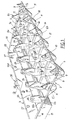
- -la Fig. 1 est une vue en perspective d'une boîte à oeufs ouverte, conforme à l'invention
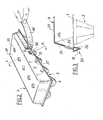
- -la Fig. 2 est une vue en perspective de la boîte à oeufs fermée ;
- -la Fig. 3 est une vue en coupe selon le plan A de la Fig. 2.
- La boîte à oeufs représentée aux Fig. 1 et 2 est réalisée par thermoformage en une seule opération à partir d'une feuille plane rectangulaire 1 de matière plastique transparente, par exemple de PVC ou de polystyrène.
- A partir de cette feuille plane 1, on forme en même temps un corps 2 et un couvercle 3.
- Le corps 2 comporte douze alvéoles 4, ayant chacun la forme générale de tronc de pyramide droit à base ortogonale régulière. Chaque alvéole 4 est relié à la feuille 1 par une paroi verticale 5 de faible hauteur qui le prolonge vers le haut.
- Les alvéoles 4 sont répartis symétriquement par rapport à un plan de symétrie longitudinal P de la boîte, en deux rangées de six.
- Ce plan P est également un plan de symétrie pour plusieurs éléments en saillie vers le haut. Ces éléments en saillie sont formés par des picots latéraux 6a, 6b, 6c, répartis sur les bordures longitudinales 7a, 7b, et latérales 8 entre deux alvéoles adjacents 4 et par des picots d'extrémités 9, de plus petite dimension, disposés aux quatre coins du corps 2.
- Les picots latéraux 6a, 6b, 6c, ont la forme de pyramides à base triangulaire convergeant vers le haut et. une hauteur sensiblement égale à la hauteur du couvercle 3. Vue en plan, la grande base desdits picots est constituée par un bord de la feuille 1 et par un côté des deux alvéoles adjacents 4. Les picots d'extrémités 9 ont également la forme de pyramides triangulaires convergeant vers le haut. Vue en plan, la grande base des picots 9 est formée par un bord latéral et un bord longitudinal de la feuille 1 et par un côté d'un alvéole 4.
- Les faces extérieures des picots latéraux 6a, 6b, 6c et des picots d'extrémités 9 définissent quatre plans inclinés sur lesquels vient s'appuyer le couvercle 3, comme on le verra ultérieurement.
- Sur la face extérieure 10 de chaque picot latéral 6b, disposé sur le bord longitudinal 7b du corps 2, c'est-à-dire à l'opposé du couvercle 3, est formé un petit téton cylindrique 11 en saillie.
- Dans le plan de symétrie transversal Q de la boite, le bord longitudinal 7b comporte une découpe 14 dont la longueur correspond sensiblement à la longueur du côté de la face externe du picot 6b situé dans ce plan de symétrie.
- Enfin, il est prévu sur les plages planes étroites 12 séparant les alvéoles 4 les uns des autres, des petits cylindres 13 à axe vertical qui servent, entre autres, à maintenir un certain espacement entre les boîtes lorsqu'elles sont empilées ouvertes avant l'opération de conditionnement.
- Le couvercle 3 est réalisé en même temps que le corps 2 à partir de la même feuille plane de matière plastique transparente. Comme pour le corps 2, le couvercle 3 comporte des bords longitudinaux 15a, 15b, et des bords latéraux 16. Dans le couvercle 3, on forme une cavité comprenant un sommet' rectangulaire 20, deux parois latérales trapézoïdales 21, 22, une paroi trapézoïdale arrière 23 et une paroi trapézoïdale avant 24. Ces parois trapézoïdales définissent quatre plans inclinés qui correspondent aux quatre plans inclinés formés par les picots 6 et 9, et ont une hauteur sensiblement égale à celle des alvéoles 4 et à celle des picots 6.
- Par ailleurs, on forme, à partir du sommet rectangulaire 20, dans l'axe de chaque plage 12 du corps 2, des colonnettes verticales 25 en saillie vers le haut. Ces colonnettes 25 ont la forme de troncs de pyramides droits convergeant vers le haut et une hauteur sensiblement égale à la hauteur des parois trapézoïdales du couvercle 3. Sur le sommet des colonnettes 25 sont formées, en retrait vers l'intérieur desdites colonnettes, des petits évidements cylindriques 26 qui correspondent sensiblement aux petits cylindres 13 réalisés sur les plages 12 du corps 2.
- La paroi trapézoïdale avant 24 du couvercle 3 comporte des petits orifices 27 qui sont percés dans le même plan transversal que chaque petit téton 11 qui sont prévus sur la face externe des picots latéraux 6b et à une distance par rapport au bord longitudinal 15a du couvercle 3 correspondant à la distance entre les petits tétons 11 et le bord longitudinal 7b du corps 2.
- Dans le plan transversal Q, le bord longitudinal 15a comporte un cliquet de verrouillage 30 réalisé au cours de l'opération de thermoformage.
- Sur la Fig. 3, on a représenté le couvercle 3 rabattu sur le corps 2 schématisé en traits mixtes afin de faciliter la compréhension du dessin.
- Le cliquet de verrouillage 30 est formé d'une part par un languette 31 de forme triangulaire qui déborde du bord longitudinal 15a et d'autre part par un rabat intérieur élastique 32. La zone de la paroi avant 24, dans le prolongement du cliquet 30, est découpée selon une ouverture 33 pour permettre le passage, au moment de la fermeture de la boîte, du petit téton 11 situé dans le plan Q, et pour former le rabat intérieur 32.
- Enfin, la feuille 1 est munie, entre le corps 2 et le couvercle 3, d'une ligne de pliage longitudinale 29.
- Après avoir rempli les alvéoles 4 avec des oeufs, il suffit de faire pivoter le couvercle 3 autour de la ligne de pliage 29 dans sa position de fermeture comme représenté sur la Fig. 2. Dans cette position, les bords du couvercle 3 viennent s'appliquer sur les bords du corps 2, et les parois trapézoïdales du couvercle 3 sur les faces externes des picots 6 et 9. De plus, les petits cylindres 13 pénètrent dans les évidements cylindriques 26 des colonnettes 25 et les sommets desdites colonnettes viennent en appui sur les plages 12. Le cliquet 30 pénètre dans la découpe 14. A ce moment, le rabat intérieur 32 du cliquet 30 vient en prise avec le bord longitudinal 7b du corps, afin de bloquer solidement le couvercle 3 dans sa position fermée, cette fermeture étant réalisée automatiquement par la machine de conditionnement.
- Par ailleurs, les petits tétons cylindriques 11 des picots 6b pénètrent dans les orifices 27 prévus sur la paroi avant 24 du couvercle 3. A ce moment, les boîtes remplies et fermées peuvent être manipulées et stockées chez le conditionneur dans l'attente de leur identification et de la pose d'une bande d'inviolabilité.
- En effet, afin d'empêcher une ouverture intempestive de la boite, pendant le transport et sur le lieu de vente, on colle sur la face externe de la paroi avant 24 du couvercle 3, une bande adhésive de g rantie 40 portant différentes indications. Cette bande adhésive 40 s'applique en même temps sur les tétons 11 et sur la paroi 24 du couvercle 3, ce qui permet d'augmenter la rigidité de la boîte par une mise en contact étroite du couvercle et corps, tout en constituant des moyens d'inviolabilité permettant de vérifier si la boîte n'a pas été préalablement ouverte.
- D'autre part, grâce à la forme en creux du couvercle 3, et à son appui central par les colonnettes 25 et à son appui latéral par les picots 6 et 9, lorsqu'on saisit la boîte par le couvercle, en la serrant, la rigidité de la boite s'accroît.
- La boîte à oeufs ainsi réalisée offre de nombreux avantages. Tout d'abord, la réalisation de l'ensemble de la boîte, à partir d'une feuille unique de matière plastique évite toute opération de collage entre le couvercle et la boite. De plus, l'utilisation d'une matière plastique transparente pour le couvercle et le corps, permet d'avoir une vue d'ensemble et instantanée du contenu de la boîte, ce qui constitue indéniablement un argument de vente. Enfin, le couvercle peut servir de support des bandes adhésives portant de nombreuses informations, cette opération de marquage pouvant être réalisée au dernier moment chez le conditionneur, en fonction des commandes enregistrées.
- La mise en place des bandes publicitaires, ainsi que la pose de la bande de gerantie peuvent s'effectuer de façon simultanée, entièrement automatique, au moyen de machines classiques bien connues dans la technique.
- En variante, au lieu que la boîte comporte deux rangées à six alvéoles, on peut bien évidemment prévoir par exemple deux rangées de trois alvéoles, ou toutes autres dispositions compatibles avec les lignes de conditionnement. Il est également possible de prévoir plusieurs cliquets, répartis sur le bord du couvercle.
Claims (8)
Priority Applications (1)
| Application Number | Priority Date | Filing Date | Title |
|---|---|---|---|
| AT86400764T ATE35800T1 (de) | 1985-04-22 | 1986-04-09 | Eierverpackung. |
Applications Claiming Priority (2)
| Application Number | Priority Date | Filing Date | Title |
|---|---|---|---|
| FR8506056 | 1985-04-22 | ||
| FR8506056A FR2580602B1 (fr) | 1985-04-22 | 1985-04-22 | Boite a oeufs |
Publications (2)
| Publication Number | Publication Date |
|---|---|
| EP0200616A1 true EP0200616A1 (fr) | 1986-11-05 |
| EP0200616B1 EP0200616B1 (fr) | 1988-07-20 |
Family
ID=9318498
Family Applications (1)
| Application Number | Title | Priority Date | Filing Date |
|---|---|---|---|
| EP86400764A Expired EP0200616B1 (fr) | 1985-04-22 | 1986-04-09 | Boite à oeufs |
Country Status (7)
| Country | Link |
|---|---|
| EP (1) | EP0200616B1 (fr) |
| AT (1) | ATE35800T1 (fr) |
| DE (1) | DE3660400D1 (fr) |
| DK (1) | DK162347C (fr) |
| ES (1) | ES293716Y (fr) |
| FI (1) | FI83065C (fr) |
| FR (1) | FR2580602B1 (fr) |
Cited By (3)
| Publication number | Priority date | Publication date | Assignee | Title |
|---|---|---|---|---|
| EP0380321A1 (fr) * | 1989-01-25 | 1990-08-01 | Dolphin Packaging Materials Limited | Boîte à oeufs |
| FR2822453A1 (fr) * | 2001-03-23 | 2002-09-27 | Jb Beaufils Ets | Boite d'emballage perfectionnee a couvercle articule et a temoin d'ouverture, notamment pour des oeufs |
| KR100714826B1 (ko) * | 2006-04-17 | 2007-05-04 | 노해중 | 계란판 덮개 |
Families Citing this family (9)
| Publication number | Priority date | Publication date | Assignee | Title |
|---|---|---|---|---|
| USD403956S (en) | 1998-01-16 | 1999-01-12 | Herbruck's Poultry Ranch | Egg carton for eggs and other ingredients |
| US5927501A (en) | 1998-01-16 | 1999-07-27 | Herbruck's Poultry Ranch | Egg carton having compartment for other ingredients |
| USD405362S (en) | 1998-06-01 | 1999-02-09 | Herbruck's Poultry Ranch | Egg carton for eggs and other ingredients |
| USD405363S (en) | 1998-06-01 | 1999-02-09 | Herbruck's Poultry Ranch | Egg carton for eggs and other ingredients |
| USD405364S (en) | 1998-06-01 | 1999-02-09 | Herbruck's Poultry Ranch | Egg carton for eggs and other ingredients |
| USD409483S (en) | 1998-06-01 | 1999-05-11 | Herbruck's Poultry Ranch | Egg carton for eggs and other ingredients |
| USD405366S (en) | 1998-06-12 | 1999-02-09 | Herbruck's Poultry Ranch | Egg carton for eggs and other ingredients |
| USD412841S (en) | 1998-11-02 | 1999-08-17 | Herbruck's Poultry Ranch | Egg carton for eggs and other ingredients |
| USD412277S (en) | 1998-11-02 | 1999-07-27 | Herbruck's Poultry Ranch | Egg carton for eggs and other ingredients |
Citations (5)
| Publication number | Priority date | Publication date | Assignee | Title |
|---|---|---|---|---|
| US2865548A (en) * | 1955-11-04 | 1958-12-23 | Keyes Fibre Co | Molded pulp container with tear strip |
| US3531044A (en) * | 1969-03-17 | 1970-09-29 | Theodore C Baker | Combined paperboard and plastic egg carton with self-locking cover |
| DE2228413A1 (de) * | 1972-06-10 | 1973-12-13 | Babcock & Wilcox Ag | Verpackung fuer massenkonsumgueter mit weiterverwendung |
| EP0006043A1 (fr) * | 1978-03-03 | 1979-12-12 | ONO Société dite: | Boîte à oeufs |
| EP0040835A1 (fr) * | 1980-05-24 | 1981-12-02 | Deltaplastic GmbH & Co., KG | Emballage pour oeufs |
-
1985
- 1985-04-22 FR FR8506056A patent/FR2580602B1/fr not_active Expired
-
1986
- 1986-04-09 DE DE8686400764T patent/DE3660400D1/de not_active Expired
- 1986-04-09 AT AT86400764T patent/ATE35800T1/de not_active IP Right Cessation
- 1986-04-09 EP EP86400764A patent/EP0200616B1/fr not_active Expired
- 1986-04-15 FI FI861585A patent/FI83065C/fi not_active IP Right Cessation
- 1986-04-21 ES ES1986293716U patent/ES293716Y/es not_active Expired
- 1986-04-21 DK DK182586A patent/DK162347C/da not_active IP Right Cessation
Patent Citations (5)
| Publication number | Priority date | Publication date | Assignee | Title |
|---|---|---|---|---|
| US2865548A (en) * | 1955-11-04 | 1958-12-23 | Keyes Fibre Co | Molded pulp container with tear strip |
| US3531044A (en) * | 1969-03-17 | 1970-09-29 | Theodore C Baker | Combined paperboard and plastic egg carton with self-locking cover |
| DE2228413A1 (de) * | 1972-06-10 | 1973-12-13 | Babcock & Wilcox Ag | Verpackung fuer massenkonsumgueter mit weiterverwendung |
| EP0006043A1 (fr) * | 1978-03-03 | 1979-12-12 | ONO Société dite: | Boîte à oeufs |
| EP0040835A1 (fr) * | 1980-05-24 | 1981-12-02 | Deltaplastic GmbH & Co., KG | Emballage pour oeufs |
Cited By (3)
| Publication number | Priority date | Publication date | Assignee | Title |
|---|---|---|---|---|
| EP0380321A1 (fr) * | 1989-01-25 | 1990-08-01 | Dolphin Packaging Materials Limited | Boîte à oeufs |
| FR2822453A1 (fr) * | 2001-03-23 | 2002-09-27 | Jb Beaufils Ets | Boite d'emballage perfectionnee a couvercle articule et a temoin d'ouverture, notamment pour des oeufs |
| KR100714826B1 (ko) * | 2006-04-17 | 2007-05-04 | 노해중 | 계란판 덮개 |
Also Published As
| Publication number | Publication date |
|---|---|
| ATE35800T1 (de) | 1988-08-15 |
| DK162347C (da) | 1992-03-09 |
| FI861585A0 (fi) | 1986-04-15 |
| ES293716U (es) | 1986-12-16 |
| DK162347B (da) | 1991-10-14 |
| ES293716Y (es) | 1987-08-01 |
| DE3660400D1 (en) | 1988-08-25 |
| FI83065B (fi) | 1991-02-15 |
| DK182586A (da) | 1986-10-23 |
| DK182586D0 (da) | 1986-04-21 |
| FI861585L (fi) | 1986-10-23 |
| FI83065C (fi) | 1991-05-27 |
| FR2580602B1 (fr) | 1987-12-11 |
| FR2580602A1 (fr) | 1986-10-24 |
| EP0200616B1 (fr) | 1988-07-20 |
Similar Documents
| Publication | Publication Date | Title |
|---|---|---|
| FR1450241A (fr) | Perfectionnements aux boîtes d'emballages | |
| EP0200616B1 (fr) | Boite à oeufs | |
| EP0232670A1 (fr) | Emballage de groupement avec lien-poignée et son procédé de confection | |
| CA2274719A1 (fr) | Emballage de type enveloppant a poignee laterale integree | |
| EP0919481B1 (fr) | Boíte d'emballage comportant un dispositif de calage | |
| EP1072523A1 (fr) | Emballage en matériau semi-rigide tel que carton pour linéaire de grandes surfaces | |
| FR2741324A1 (fr) | Boite d'emballage pour produits alimentaires comprenant une couronne et un triptyque | |
| EP0765823A1 (fr) | Conteneur pour le conditionnement et le transport des cycles | |
| CA1318266C (fr) | Emballage composite a fond du type barquette associee a une coiffe et a un lien interne de ceinturage lache | |
| FR2550764A1 (fr) | Carton d'emballage pour recipients tels que bouteilles | |
| EP0359613A1 (fr) | Emballage composite pour oeufs, fruits ou objects fragiles analogues | |
| FR2471923A1 (fr) | Barquette pour le conditionnement de produits alimentaires | |
| FR2471924A1 (fr) | Boite d'emballage a coffrets independants fermes par un couvercle commun | |
| FR2629432A1 (fr) | ||
| FR2540465A3 (fr) | Boite en carton ou similaire | |
| FR2683207A1 (fr) | Emballage de transport et de distribution. | |
| FR2778893A1 (fr) | Emballage a compartiments multiples | |
| FR2688200A1 (fr) | Boite pliable a enveloppe souple interne a bec verseur refermable. | |
| FR2779130A1 (fr) | Boite d'emballage notamment pour des oeufs | |
| FR2556319A1 (fr) | Bac repliable et procede de montage de celui-ci | |
| FR2555966A1 (fr) | Conteneur en carton ondule ou similaire, a parois laterales ouvrables et refermables a volonte | |
| EP1092651A1 (fr) | Emballage pour le conditionnement et la présentation d'articles regroupés par lots | |
| FR2771377A1 (fr) | Conditionnement a double ouverture pour produits longs permettant un stockage indifferemment dans deux positions de distribution | |
| CH442133A (fr) | Emballage formé à partir d'une feuille | |
| FR2788748A1 (fr) | Contenant en carton obtenu par pliage d'une bande, destine a des objets de hauteur variable et ayant des moyens de maintien en position intermediaire entre la presentation a plat et la fermeture |
Legal Events
| Date | Code | Title | Description |
|---|---|---|---|
| PUAI | Public reference made under article 153(3) epc to a published international application that has entered the european phase |
Free format text: ORIGINAL CODE: 0009012 |
|
| 17P | Request for examination filed |
Effective date: 19860924 |
|
| AK | Designated contracting states |
Kind code of ref document: A1 Designated state(s): AT BE CH DE GB IT LI LU NL SE |
|
| PUAB | Information related to the publication of an a document modified or deleted |
Free format text: ORIGINAL CODE: 0009199EPPU |
|
| PUAF | Information related to the publication of a search report (a3 document) modified or deleted |
Free format text: ORIGINAL CODE: 0009199SEPU |
|
| R17D | Deferred search report published (corrected) |
Effective date: 19861210 |
|
| RA1 | Application published (corrected) |
Date of ref document: 19861210 Kind code of ref document: A1 |
|
| 17Q | First examination report despatched |
Effective date: 19870514 |
|
| GRAA | (expected) grant |
Free format text: ORIGINAL CODE: 0009210 |
|
| AK | Designated contracting states |
Kind code of ref document: B1 Designated state(s): AT BE CH DE GB IT LI LU NL SE |
|
| REF | Corresponds to: |
Ref document number: 35800 Country of ref document: AT Date of ref document: 19880815 Kind code of ref document: T |
|
| ITF | It: translation for a ep patent filed | ||
| GBT | Gb: translation of ep patent filed (gb section 77(6)(a)/1977) | ||
| REF | Corresponds to: |
Ref document number: 3660400 Country of ref document: DE Date of ref document: 19880825 |
|
| PLBE | No opposition filed within time limit |
Free format text: ORIGINAL CODE: 0009261 |
|
| STAA | Information on the status of an ep patent application or granted ep patent |
Free format text: STATUS: NO OPPOSITION FILED WITHIN TIME LIMIT |
|
| 26N | No opposition filed | ||
| ITTA | It: last paid annual fee | ||
| EPTA | Lu: last paid annual fee | ||
| EAL | Se: european patent in force in sweden |
Ref document number: 86400764.6 |
|
| REG | Reference to a national code |
Ref country code: CH Ref legal event code: PUE Owner name: POLARCUP FRANCE S.A. |
|
| ITPR | It: changes in ownership of a european patent |
Owner name: CESSIONE;POLARCUP FRANCE S.A. |
|
| REG | Reference to a national code |
Ref country code: GB Ref legal event code: 732E |
|
| NLS | Nl: assignments of ep-patents |
Owner name: POLARCUP FRANCE S.A. |
|
| PGFP | Annual fee paid to national office [announced via postgrant information from national office to epo] |
Ref country code: LU Payment date: 19960301 Year of fee payment: 11 |
|
| PGFP | Annual fee paid to national office [announced via postgrant information from national office to epo] |
Ref country code: AT Payment date: 19960325 Year of fee payment: 11 |
|
| PGFP | Annual fee paid to national office [announced via postgrant information from national office to epo] |
Ref country code: CH Payment date: 19960326 Year of fee payment: 11 |
|
| PGFP | Annual fee paid to national office [announced via postgrant information from national office to epo] |
Ref country code: DE Payment date: 19960327 Year of fee payment: 11 |
|
| PGFP | Annual fee paid to national office [announced via postgrant information from national office to epo] |
Ref country code: NL Payment date: 19960328 Year of fee payment: 11 |
|
| PGFP | Annual fee paid to national office [announced via postgrant information from national office to epo] |
Ref country code: GB Payment date: 19960402 Year of fee payment: 11 |
|
| PGFP | Annual fee paid to national office [announced via postgrant information from national office to epo] |
Ref country code: SE Payment date: 19960418 Year of fee payment: 11 |
|
| PGFP | Annual fee paid to national office [announced via postgrant information from national office to epo] |
Ref country code: BE Payment date: 19960510 Year of fee payment: 11 |
|
| PG25 | Lapsed in a contracting state [announced via postgrant information from national office to epo] |
Ref country code: LU Free format text: LAPSE BECAUSE OF NON-PAYMENT OF DUE FEES Effective date: 19970409 Ref country code: GB Effective date: 19970409 Ref country code: AT Effective date: 19970409 |
|
| PG25 | Lapsed in a contracting state [announced via postgrant information from national office to epo] |
Ref country code: SE Effective date: 19970410 |
|
| PG25 | Lapsed in a contracting state [announced via postgrant information from national office to epo] |
Ref country code: LI Free format text: LAPSE BECAUSE OF NON-PAYMENT OF DUE FEES Effective date: 19970430 Ref country code: CH Free format text: LAPSE BECAUSE OF NON-PAYMENT OF DUE FEES Effective date: 19970430 Ref country code: BE Effective date: 19970430 |
|
| BERE | Be: lapsed |
Owner name: S.A. POLARCUP FRANCE Effective date: 19970430 |
|
| PG25 | Lapsed in a contracting state [announced via postgrant information from national office to epo] |
Ref country code: NL Effective date: 19971101 |
|
| GBPC | Gb: european patent ceased through non-payment of renewal fee |
Effective date: 19970409 |
|
| REG | Reference to a national code |
Ref country code: CH Ref legal event code: PL |
|
| PG25 | Lapsed in a contracting state [announced via postgrant information from national office to epo] |
Ref country code: DE Free format text: LAPSE BECAUSE OF NON-PAYMENT OF DUE FEES Effective date: 19980101 |
|
| NLV4 | Nl: lapsed or anulled due to non-payment of the annual fee |
Effective date: 19971101 |
|
| EUG | Se: european patent has lapsed |
Ref document number: 86400764.6 |
|
| PG25 | Lapsed in a contracting state [announced via postgrant information from national office to epo] |
Ref country code: IT Free format text: LAPSE BECAUSE OF NON-PAYMENT OF DUE FEES;WARNING: LAPSES OF ITALIAN PATENTS WITH EFFECTIVE DATE BEFORE 2007 MAY HAVE OCCURRED AT ANY TIME BEFORE 2007. THE CORRECT EFFECTIVE DATE MAY BE DIFFERENT FROM THE ONE RECORDED. Effective date: 20050409 |