EP0200843B1 - Verfahren zur fotochemischen Stabilisierung von ungefärbtem und gefärbtem Polyamidfasermaterial und dessen Mischungen - Google Patents
Verfahren zur fotochemischen Stabilisierung von ungefärbtem und gefärbtem Polyamidfasermaterial und dessen Mischungen Download PDFInfo
- Publication number
- EP0200843B1 EP0200843B1 EP85810509A EP85810509A EP0200843B1 EP 0200843 B1 EP0200843 B1 EP 0200843B1 EP 85810509 A EP85810509 A EP 85810509A EP 85810509 A EP85810509 A EP 85810509A EP 0200843 B1 EP0200843 B1 EP 0200843B1
- Authority
- EP
- European Patent Office
- Prior art keywords
- hydrogen
- formula
- alkyl
- compound
- methyl
- Prior art date
- Legal status (The legal status is an assumption and is not a legal conclusion. Google has not performed a legal analysis and makes no representation as to the accuracy of the status listed.)
- Expired
Links
- 239000004952 Polyamide Substances 0.000 title claims description 22
- 229920002647 polyamide Polymers 0.000 title claims description 22
- 238000000034 method Methods 0.000 title claims description 19
- 239000000203 mixture Substances 0.000 title claims description 19
- 230000006641 stabilisation Effects 0.000 title claims description 4
- 239000002657 fibrous material Substances 0.000 title description 14
- 150000001875 compounds Chemical class 0.000 claims description 46
- -1 carboxymethoxy Chemical group 0.000 claims description 45
- 229910052739 hydrogen Inorganic materials 0.000 claims description 39
- 239000001257 hydrogen Substances 0.000 claims description 39
- UFHFLCQGNIYNRP-UHFFFAOYSA-N Hydrogen Chemical compound [H][H] UFHFLCQGNIYNRP-UHFFFAOYSA-N 0.000 claims description 26
- 150000002431 hydrogen Chemical class 0.000 claims description 18
- 125000002496 methyl group Chemical group [H]C([H])([H])* 0.000 claims description 18
- 239000000835 fiber Substances 0.000 claims description 13
- 125000001495 ethyl group Chemical group [H]C([H])([H])C([H])([H])* 0.000 claims description 11
- 239000000463 material Substances 0.000 claims description 11
- UHOVQNZJYSORNB-UHFFFAOYSA-N monobenzene Natural products C1=CC=CC=C1 UHOVQNZJYSORNB-UHFFFAOYSA-N 0.000 claims description 10
- 125000000217 alkyl group Chemical group 0.000 claims description 9
- 150000004699 copper complex Chemical class 0.000 claims description 9
- 125000001997 phenyl group Chemical group [H]C1=C([H])C([H])=C(*)C([H])=C1[H] 0.000 claims description 9
- 125000004432 carbon atom Chemical group C* 0.000 claims description 8
- 239000010949 copper Substances 0.000 claims description 8
- ZAMOUSCENKQFHK-UHFFFAOYSA-N Chlorine atom Chemical compound [Cl] ZAMOUSCENKQFHK-UHFFFAOYSA-N 0.000 claims description 7
- 229910052801 chlorine Inorganic materials 0.000 claims description 7
- 239000000460 chlorine Substances 0.000 claims description 7
- 125000003545 alkoxy group Chemical group 0.000 claims description 6
- 125000002887 hydroxy group Chemical group [H]O* 0.000 claims description 6
- 125000000956 methoxy group Chemical group [H]C([H])([H])O* 0.000 claims description 6
- WKBOTKDWSSQWDR-UHFFFAOYSA-N Bromine atom Chemical compound [Br] WKBOTKDWSSQWDR-UHFFFAOYSA-N 0.000 claims description 5
- GDTBXPJZTBHREO-UHFFFAOYSA-N bromine Substances BrBr GDTBXPJZTBHREO-UHFFFAOYSA-N 0.000 claims description 5
- 229910052794 bromium Inorganic materials 0.000 claims description 5
- 125000001664 diethylamino group Chemical group [H]C([H])([H])C([H])([H])N(*)C([H])([H])C([H])([H])[H] 0.000 claims description 5
- RYGMFSIKBFXOCR-UHFFFAOYSA-N Copper Chemical compound [Cu] RYGMFSIKBFXOCR-UHFFFAOYSA-N 0.000 claims description 4
- 229910052802 copper Inorganic materials 0.000 claims description 4
- 229910052736 halogen Inorganic materials 0.000 claims description 4
- 150000002367 halogens Chemical class 0.000 claims description 4
- 125000004183 alkoxy alkyl group Chemical group 0.000 claims description 3
- 125000005083 alkoxyalkoxy group Chemical group 0.000 claims description 3
- 125000003282 alkyl amino group Chemical group 0.000 claims description 3
- 125000004663 dialkyl amino group Chemical group 0.000 claims description 3
- 125000002768 hydroxyalkyl group Chemical group 0.000 claims description 3
- 229920002635 polyurethane Polymers 0.000 claims description 3
- 239000004814 polyurethane Substances 0.000 claims description 3
- 125000000999 tert-butyl group Chemical group [H]C([H])([H])C(*)(C([H])([H])[H])C([H])([H])[H] 0.000 claims description 3
- 125000004178 (C1-C4) alkyl group Chemical group 0.000 claims 1
- ZMXDDKWLCZADIW-UHFFFAOYSA-N N,N-Dimethylformamide Chemical compound CN(C)C=O ZMXDDKWLCZADIW-UHFFFAOYSA-N 0.000 description 30
- 230000033228 biological regulation Effects 0.000 description 30
- LFQSCWFLJHTTHZ-UHFFFAOYSA-N Ethanol Chemical compound CCO LFQSCWFLJHTTHZ-UHFFFAOYSA-N 0.000 description 24
- 238000004043 dyeing Methods 0.000 description 20
- 239000000975 dye Substances 0.000 description 16
- 150000001879 copper Chemical class 0.000 description 13
- HEMHJVSKTPXQMS-UHFFFAOYSA-M Sodium hydroxide Chemical compound [OH-].[Na+] HEMHJVSKTPXQMS-UHFFFAOYSA-M 0.000 description 12
- XLYOFNOQVPJJNP-UHFFFAOYSA-N water Substances O XLYOFNOQVPJJNP-UHFFFAOYSA-N 0.000 description 9
- 238000004040 coloring Methods 0.000 description 8
- 238000011282 treatment Methods 0.000 description 8
- 238000007792 addition Methods 0.000 description 7
- 239000006185 dispersion Substances 0.000 description 7
- 238000002844 melting Methods 0.000 description 7
- 230000008018 melting Effects 0.000 description 7
- 239000002244 precipitate Substances 0.000 description 7
- 238000003756 stirring Methods 0.000 description 7
- QTBSBXVTEAMEQO-UHFFFAOYSA-N Acetic acid Chemical compound CC(O)=O QTBSBXVTEAMEQO-UHFFFAOYSA-N 0.000 description 6
- PIICEJLVQHRZGT-UHFFFAOYSA-N Ethylenediamine Chemical compound NCCN PIICEJLVQHRZGT-UHFFFAOYSA-N 0.000 description 6
- 239000002262 Schiff base Substances 0.000 description 6
- 150000004753 Schiff bases Chemical class 0.000 description 6
- 238000001035 drying Methods 0.000 description 6
- 150000003254 radicals Chemical class 0.000 description 6
- RXWOHFUULDINMC-UHFFFAOYSA-N 2-(3-nitrothiophen-2-yl)acetic acid Chemical compound OC(=O)CC=1SC=CC=1[N+]([O-])=O RXWOHFUULDINMC-UHFFFAOYSA-N 0.000 description 5
- 229920002302 Nylon 6,6 Polymers 0.000 description 5
- 150000004985 diamines Chemical class 0.000 description 5
- SMQUZDBALVYZAC-UHFFFAOYSA-N salicylaldehyde Chemical compound OC1=CC=CC=C1C=O SMQUZDBALVYZAC-UHFFFAOYSA-N 0.000 description 5
- 239000007787 solid Substances 0.000 description 5
- 239000000126 substance Substances 0.000 description 5
- WSFSSNUMVMOOMR-UHFFFAOYSA-N Formaldehyde Chemical compound O=C WSFSSNUMVMOOMR-UHFFFAOYSA-N 0.000 description 3
- 239000004677 Nylon Substances 0.000 description 3
- 238000002425 crystallisation Methods 0.000 description 3
- 230000008025 crystallization Effects 0.000 description 3
- 238000000921 elemental analysis Methods 0.000 description 3
- 238000009472 formulation Methods 0.000 description 3
- 238000004519 manufacturing process Methods 0.000 description 3
- 239000000434 metal complex dye Substances 0.000 description 3
- 229920001778 nylon Polymers 0.000 description 3
- 238000002360 preparation method Methods 0.000 description 3
- 239000000725 suspension Substances 0.000 description 3
- WZUODJNEIXSNEU-UHFFFAOYSA-N 2-Hydroxy-4-methoxybenzaldehyde Chemical compound COC1=CC=C(C=O)C(O)=C1 WZUODJNEIXSNEU-UHFFFAOYSA-N 0.000 description 2
- 239000005749 Copper compound Substances 0.000 description 2
- 239000002253 acid Substances 0.000 description 2
- 150000001299 aldehydes Chemical class 0.000 description 2
- BFNBIHQBYMNNAN-UHFFFAOYSA-N ammonium sulfate Chemical compound N.N.OS(O)(=O)=O BFNBIHQBYMNNAN-UHFFFAOYSA-N 0.000 description 2
- 229910052921 ammonium sulfate Inorganic materials 0.000 description 2
- 235000011130 ammonium sulphate Nutrition 0.000 description 2
- 239000011324 bead Substances 0.000 description 2
- 125000000484 butyl group Chemical group [H]C([*])([H])C([H])([H])C([H])([H])C([H])([H])[H] 0.000 description 2
- 150000001880 copper compounds Chemical class 0.000 description 2
- 239000002270 dispersing agent Substances 0.000 description 2
- 239000004744 fabric Substances 0.000 description 2
- 230000007062 hydrolysis Effects 0.000 description 2
- 238000006460 hydrolysis reaction Methods 0.000 description 2
- 125000001449 isopropyl group Chemical group [H]C([H])([H])C([H])(*)C([H])([H])[H] 0.000 description 2
- 125000004123 n-propyl group Chemical group [H]C([H])([H])C([H])([H])C([H])([H])* 0.000 description 2
- 230000007935 neutral effect Effects 0.000 description 2
- 239000000047 product Substances 0.000 description 2
- 239000010453 quartz Substances 0.000 description 2
- 239000001044 red dye Substances 0.000 description 2
- VYPSYNLAJGMNEJ-UHFFFAOYSA-N silicon dioxide Inorganic materials O=[Si]=O VYPSYNLAJGMNEJ-UHFFFAOYSA-N 0.000 description 2
- 238000011105 stabilization Methods 0.000 description 2
- 125000001424 substituent group Chemical group 0.000 description 2
- 229940124530 sulfonamide Drugs 0.000 description 2
- 239000010981 turquoise Substances 0.000 description 2
- 229910052724 xenon Inorganic materials 0.000 description 2
- FHNFHKCVQCLJFQ-UHFFFAOYSA-N xenon atom Chemical compound [Xe] FHNFHKCVQCLJFQ-UHFFFAOYSA-N 0.000 description 2
- 125000006273 (C1-C3) alkyl group Chemical group 0.000 description 1
- OITQDWKMIPXGFL-UHFFFAOYSA-N 1-hydroxy-2-naphthaldehyde Chemical compound C1=CC=C2C(O)=C(C=O)C=CC2=C1 OITQDWKMIPXGFL-UHFFFAOYSA-N 0.000 description 1
- JODRRPJMQDFCBJ-UHFFFAOYSA-N 2-Hydroxy-4-methylbenzaldehyde Chemical compound CC1=CC=C(C=O)C(O)=C1 JODRRPJMQDFCBJ-UHFFFAOYSA-N 0.000 description 1
- MMXJNCRINKJISE-UHFFFAOYSA-N 2-[2-[(2-hydroxy-3,6-dimethylphenyl)methylideneamino]ethyliminomethyl]-3,6-dimethylphenol Chemical compound OC1=C(C=CC(=C1C=NCCN=CC1=C(C=CC(=C1O)C)C)C)C MMXJNCRINKJISE-UHFFFAOYSA-N 0.000 description 1
- WPGYNBOWIGDFKP-UHFFFAOYSA-N 2-[C-ethyl-N-[2-[1-(2-hydroxyphenyl)propylideneamino]ethyl]carbonimidoyl]phenol Chemical compound OC1=C(C=CC=C1)C(CC)=NCCN=C(CC)C1=C(C=CC=C1)O WPGYNBOWIGDFKP-UHFFFAOYSA-N 0.000 description 1
- NTCCNERMXRIPTR-UHFFFAOYSA-N 2-hydroxy-1-naphthaldehyde Chemical compound C1=CC=CC2=C(C=O)C(O)=CC=C21 NTCCNERMXRIPTR-UHFFFAOYSA-N 0.000 description 1
- WLVPRARCUSRDNI-UHFFFAOYSA-N 2-hydroxy-1-phenyl-1-propanone Chemical compound CC(O)C(=O)C1=CC=CC=C1 WLVPRARCUSRDNI-UHFFFAOYSA-N 0.000 description 1
- WTHUWXPBPNTSHJ-UHFFFAOYSA-N 2-hydroxy-3,6-dimethylbenzaldehyde Chemical compound CC1=CC=C(C)C(C=O)=C1O WTHUWXPBPNTSHJ-UHFFFAOYSA-N 0.000 description 1
- TZXJJSAQSRHKCZ-UHFFFAOYSA-N 2-methoxyethyl 4-methylbenzenesulfonate Chemical compound COCCOS(=O)(=O)C1=CC=C(C)C=C1 TZXJJSAQSRHKCZ-UHFFFAOYSA-N 0.000 description 1
- FABVMBDCVAJXMB-UHFFFAOYSA-N 3,5-dichloro-2-hydroxybenzaldehyde Chemical compound OC1=C(Cl)C=C(Cl)C=C1C=O FABVMBDCVAJXMB-UHFFFAOYSA-N 0.000 description 1
- QCUNDLUTTXSPFM-UHFFFAOYSA-N 3-hydroxynaphthalene-2-carbaldehyde Chemical compound C1=CC=C2C=C(C=O)C(O)=CC2=C1 QCUNDLUTTXSPFM-UHFFFAOYSA-N 0.000 description 1
- XFVZSRRZZNLWBW-UHFFFAOYSA-N 4-(Diethylamino)salicylaldehyde Chemical compound CCN(CC)C1=CC=C(C=O)C(O)=C1 XFVZSRRZZNLWBW-UHFFFAOYSA-N 0.000 description 1
- MKKSTJKBKNCMRV-UHFFFAOYSA-N 5-bromo-2-hydroxybenzaldehyde Chemical compound OC1=CC=C(Br)C=C1C=O MKKSTJKBKNCMRV-UHFFFAOYSA-N 0.000 description 1
- RLACAFMNOVZCIP-UHFFFAOYSA-N 5-hydroxy-5-methoxycyclohexa-1,3-diene-1-carbaldehyde Chemical compound COC1(O)CC(C=O)=CC=C1 RLACAFMNOVZCIP-UHFFFAOYSA-N 0.000 description 1
- 0 C*(C)Nc(ccc(N*(C)*)c1C(c2c3cccc2)=O)c1C3=O Chemical compound C*(C)Nc(ccc(N*(C)*)c1C(c2c3cccc2)=O)c1C3=O 0.000 description 1
- KCGKYAORRXGWMN-UHFFFAOYSA-N CNS(=O)=O Chemical compound CNS(=O)=O KCGKYAORRXGWMN-UHFFFAOYSA-N 0.000 description 1
- GAWIXWVDTYZWAW-UHFFFAOYSA-N C[CH]O Chemical group C[CH]O GAWIXWVDTYZWAW-UHFFFAOYSA-N 0.000 description 1
- 229920002134 Carboxymethyl cellulose Polymers 0.000 description 1
- VYZAMTAEIAYCRO-UHFFFAOYSA-N Chromium Chemical compound [Cr] VYZAMTAEIAYCRO-UHFFFAOYSA-N 0.000 description 1
- QXNVGIXVLWOKEQ-UHFFFAOYSA-N Disodium Chemical class [Na][Na] QXNVGIXVLWOKEQ-UHFFFAOYSA-N 0.000 description 1
- IAYPIBMASNFSPL-UHFFFAOYSA-N Ethylene oxide Chemical compound C1CO1 IAYPIBMASNFSPL-UHFFFAOYSA-N 0.000 description 1
- PXGOKWXKJXAPGV-UHFFFAOYSA-N Fluorine Chemical compound FF PXGOKWXKJXAPGV-UHFFFAOYSA-N 0.000 description 1
- 238000005684 Liebig rearrangement reaction Methods 0.000 description 1
- IGFHQQFPSIBGKE-UHFFFAOYSA-N Nonylphenol Natural products CCCCCCCCCC1=CC=C(O)C=C1 IGFHQQFPSIBGKE-UHFFFAOYSA-N 0.000 description 1
- 229920000299 Nylon 12 Polymers 0.000 description 1
- 229920002292 Nylon 6 Polymers 0.000 description 1
- 240000007817 Olea europaea Species 0.000 description 1
- 238000010521 absorption reaction Methods 0.000 description 1
- 238000001632 acidimetric titration Methods 0.000 description 1
- 239000013543 active substance Substances 0.000 description 1
- 239000000654 additive Substances 0.000 description 1
- 230000000996 additive effect Effects 0.000 description 1
- 239000001000 anthraquinone dye Substances 0.000 description 1
- 150000004984 aromatic diamines Chemical class 0.000 description 1
- 125000004429 atom Chemical group 0.000 description 1
- 239000000987 azo dye Substances 0.000 description 1
- 230000001588 bifunctional effect Effects 0.000 description 1
- 125000004106 butoxy group Chemical group [*]OC([H])([H])C([H])([H])C(C([H])([H])[H])([H])[H] 0.000 description 1
- 125000003178 carboxy group Chemical group [H]OC(*)=O 0.000 description 1
- 239000001768 carboxy methyl cellulose Substances 0.000 description 1
- 235000010948 carboxy methyl cellulose Nutrition 0.000 description 1
- 239000008112 carboxymethyl-cellulose Substances 0.000 description 1
- 229910052804 chromium Inorganic materials 0.000 description 1
- 239000011651 chromium Substances 0.000 description 1
- 150000001868 cobalt Chemical class 0.000 description 1
- 230000000052 comparative effect Effects 0.000 description 1
- 239000007859 condensation product Substances 0.000 description 1
- 238000001816 cooling Methods 0.000 description 1
- 229910000365 copper sulfate Inorganic materials 0.000 description 1
- ARUVKPQLZAKDPS-UHFFFAOYSA-L copper(II) sulfate Chemical compound [Cu+2].[O-][S+2]([O-])([O-])[O-] ARUVKPQLZAKDPS-UHFFFAOYSA-L 0.000 description 1
- JZCCFEFSEZPSOG-UHFFFAOYSA-L copper(II) sulfate pentahydrate Chemical compound O.O.O.O.O.[Cu+2].[O-]S([O-])(=O)=O JZCCFEFSEZPSOG-UHFFFAOYSA-L 0.000 description 1
- 239000013078 crystal Substances 0.000 description 1
- 125000004977 cycloheptylene group Chemical group 0.000 description 1
- 125000004956 cyclohexylene group Chemical group 0.000 description 1
- 125000004979 cyclopentylene group Chemical group 0.000 description 1
- 125000000664 diazo group Chemical group [N-]=[N+]=[*] 0.000 description 1
- 239000000986 disperse dye Substances 0.000 description 1
- 230000000694 effects Effects 0.000 description 1
- 229910052731 fluorine Inorganic materials 0.000 description 1
- 239000011737 fluorine Substances 0.000 description 1
- 238000000227 grinding Methods 0.000 description 1
- 238000010438 heat treatment Methods 0.000 description 1
- CUILPNURFADTPE-UHFFFAOYSA-N hypobromous acid Chemical group BrO CUILPNURFADTPE-UHFFFAOYSA-N 0.000 description 1
- 239000000543 intermediate Substances 0.000 description 1
- 125000000959 isobutyl group Chemical group [H]C([H])([H])C([H])(C([H])([H])[H])C([H])([H])* 0.000 description 1
- 238000001465 metallisation Methods 0.000 description 1
- 125000001434 methanylylidene group Chemical group [H]C#[*] 0.000 description 1
- 238000002156 mixing Methods 0.000 description 1
- AJDUTMFFZHIJEM-UHFFFAOYSA-N n-(9,10-dioxoanthracen-1-yl)-4-[4-[[4-[4-[(9,10-dioxoanthracen-1-yl)carbamoyl]phenyl]phenyl]diazenyl]phenyl]benzamide Chemical compound O=C1C2=CC=CC=C2C(=O)C2=C1C=CC=C2NC(=O)C(C=C1)=CC=C1C(C=C1)=CC=C1N=NC(C=C1)=CC=C1C(C=C1)=CC=C1C(=O)NC1=CC=CC2=C1C(=O)C1=CC=CC=C1C2=O AJDUTMFFZHIJEM-UHFFFAOYSA-N 0.000 description 1
- 125000004108 n-butyl group Chemical group [H]C([H])([H])C([H])([H])C([H])([H])C([H])([H])* 0.000 description 1
- PSZYNBSKGUBXEH-UHFFFAOYSA-N naphthalene-1-sulfonic acid Chemical compound C1=CC=C2C(S(=O)(=O)O)=CC=CC2=C1 PSZYNBSKGUBXEH-UHFFFAOYSA-N 0.000 description 1
- 125000001624 naphthyl group Chemical group 0.000 description 1
- 239000002736 nonionic surfactant Substances 0.000 description 1
- SNQQPOLDUKLAAF-UHFFFAOYSA-N nonylphenol Chemical compound CCCCCCCCCC1=CC=CC=C1O SNQQPOLDUKLAAF-UHFFFAOYSA-N 0.000 description 1
- 238000005580 one pot reaction Methods 0.000 description 1
- 239000001048 orange dye Substances 0.000 description 1
- 239000002245 particle Substances 0.000 description 1
- 230000001376 precipitating effect Effects 0.000 description 1
- VXPLXMJHHKHSOA-UHFFFAOYSA-N propham Chemical compound CC(C)OC(=O)NC1=CC=CC=C1 VXPLXMJHHKHSOA-UHFFFAOYSA-N 0.000 description 1
- 238000010992 reflux Methods 0.000 description 1
- 150000003839 salts Chemical class 0.000 description 1
- 229920006395 saturated elastomer Polymers 0.000 description 1
- 125000002914 sec-butyl group Chemical group [H]C([H])([H])C([H])([H])C([H])(*)C([H])([H])[H] 0.000 description 1
- 159000000000 sodium salts Chemical class 0.000 description 1
- 239000002689 soil Substances 0.000 description 1
- 238000010025 steaming Methods 0.000 description 1
- 150000003456 sulfonamides Chemical class 0.000 description 1
- 239000000984 vat dye Substances 0.000 description 1
- 238000009970 yarn dyeing Methods 0.000 description 1
- 239000001043 yellow dye Substances 0.000 description 1
Classifications
-
- D—TEXTILES; PAPER
- D06—TREATMENT OF TEXTILES OR THE LIKE; LAUNDERING; FLEXIBLE MATERIALS NOT OTHERWISE PROVIDED FOR
- D06M—TREATMENT, NOT PROVIDED FOR ELSEWHERE IN CLASS D06, OF FIBRES, THREADS, YARNS, FABRICS, FEATHERS OR FIBROUS GOODS MADE FROM SUCH MATERIALS
- D06M13/00—Treating fibres, threads, yarns, fabrics or fibrous goods made from such materials, with non-macromolecular organic compounds; Such treatment combined with mechanical treatment
- D06M13/50—Treating fibres, threads, yarns, fabrics or fibrous goods made from such materials, with non-macromolecular organic compounds; Such treatment combined with mechanical treatment with organometallic compounds; with organic compounds containing boron, silicon, selenium or tellurium atoms
- D06M13/51—Compounds with at least one carbon-metal or carbon-boron, carbon-silicon, carbon-selenium, or carbon-tellurium bond
-
- C—CHEMISTRY; METALLURGY
- C07—ORGANIC CHEMISTRY
- C07F—ACYCLIC, CARBOCYCLIC OR HETEROCYCLIC COMPOUNDS CONTAINING ELEMENTS OTHER THAN CARBON, HYDROGEN, HALOGEN, OXYGEN, NITROGEN, SULFUR, SELENIUM OR TELLURIUM
- C07F1/00—Compounds containing elements of Groups 1 or 11 of the Periodic Table
- C07F1/005—Compounds containing elements of Groups 1 or 11 of the Periodic Table without C-Metal linkages
-
- D—TEXTILES; PAPER
- D06—TREATMENT OF TEXTILES OR THE LIKE; LAUNDERING; FLEXIBLE MATERIALS NOT OTHERWISE PROVIDED FOR
- D06P—DYEING OR PRINTING TEXTILES; DYEING LEATHER, FURS OR SOLID MACROMOLECULAR SUBSTANCES IN ANY FORM
- D06P1/00—General processes of dyeing or printing textiles, or general processes of dyeing leather, furs, or solid macromolecular substances in any form, classified according to the dyes, pigments, or auxiliary substances employed
- D06P1/44—General processes of dyeing or printing textiles, or general processes of dyeing leather, furs, or solid macromolecular substances in any form, classified according to the dyes, pigments, or auxiliary substances employed using insoluble pigments or auxiliary substances, e.g. binders
- D06P1/64—General processes of dyeing or printing textiles, or general processes of dyeing leather, furs, or solid macromolecular substances in any form, classified according to the dyes, pigments, or auxiliary substances employed using insoluble pigments or auxiliary substances, e.g. binders using compositions containing low-molecular-weight organic compounds without sulfate or sulfonate groups
- D06P1/642—Compounds containing nitrogen
- D06P1/6423—Compounds containing azide or oxime groups
-
- D—TEXTILES; PAPER
- D06—TREATMENT OF TEXTILES OR THE LIKE; LAUNDERING; FLEXIBLE MATERIALS NOT OTHERWISE PROVIDED FOR
- D06P—DYEING OR PRINTING TEXTILES; DYEING LEATHER, FURS OR SOLID MACROMOLECULAR SUBSTANCES IN ANY FORM
- D06P3/00—Special processes of dyeing or printing textiles, or dyeing leather, furs, or solid macromolecular substances in any form, classified according to the material treated
- D06P3/02—Material containing basic nitrogen
- D06P3/04—Material containing basic nitrogen containing amide groups
- D06P3/24—Polyamides; Polyurethanes
- D06P3/241—Polyamides; Polyurethanes using acid dyes
-
- D—TEXTILES; PAPER
- D06—TREATMENT OF TEXTILES OR THE LIKE; LAUNDERING; FLEXIBLE MATERIALS NOT OTHERWISE PROVIDED FOR
- D06P—DYEING OR PRINTING TEXTILES; DYEING LEATHER, FURS OR SOLID MACROMOLECULAR SUBSTANCES IN ANY FORM
- D06P5/00—Other features in dyeing or printing textiles, or dyeing leather, furs, or solid macromolecular substances in any form
- D06P5/02—After-treatment
-
- Y—GENERAL TAGGING OF NEW TECHNOLOGICAL DEVELOPMENTS; GENERAL TAGGING OF CROSS-SECTIONAL TECHNOLOGIES SPANNING OVER SEVERAL SECTIONS OF THE IPC; TECHNICAL SUBJECTS COVERED BY FORMER USPC CROSS-REFERENCE ART COLLECTIONS [XRACs] AND DIGESTS
- Y10—TECHNICAL SUBJECTS COVERED BY FORMER USPC
- Y10S—TECHNICAL SUBJECTS COVERED BY FORMER USPC CROSS-REFERENCE ART COLLECTIONS [XRACs] AND DIGESTS
- Y10S8/00—Bleaching and dyeing; fluid treatment and chemical modification of textiles and fibers
- Y10S8/92—Synthetic fiber dyeing
- Y10S8/924—Polyamide fiber
-
- Y—GENERAL TAGGING OF NEW TECHNOLOGICAL DEVELOPMENTS; GENERAL TAGGING OF CROSS-SECTIONAL TECHNOLOGIES SPANNING OVER SEVERAL SECTIONS OF THE IPC; TECHNICAL SUBJECTS COVERED BY FORMER USPC CROSS-REFERENCE ART COLLECTIONS [XRACs] AND DIGESTS
- Y10—TECHNICAL SUBJECTS COVERED BY FORMER USPC
- Y10S—TECHNICAL SUBJECTS COVERED BY FORMER USPC CROSS-REFERENCE ART COLLECTIONS [XRACs] AND DIGESTS
- Y10S8/00—Bleaching and dyeing; fluid treatment and chemical modification of textiles and fibers
- Y10S8/92—Synthetic fiber dyeing
- Y10S8/926—Polyurethane fiber
Definitions
- the present invention relates to a process for the photochemical stabilization of undyed and dyed polyamide fiber material and its blends with other fibers by treating this material with water-insoluble copper complexes of bisazomethines, e.g. prepared from optionally substituted salicylaldehydes and aliphatic diamines.
- bisazomethines e.g. prepared from optionally substituted salicylaldehydes and aliphatic diamines.
- copper salts e.g. Copper sulfate
- inorganic or organic copper salts often have the disadvantage that they only absorb insufficiently and unevenly on the polyamide fiber and therefore have to be used in high concentrations, to achieve the desired effect. Usually they can only be used as post-treatment and in discontinuous procedures.
- EP-A 51 188 it is recommended to treat the polyamide material before, during and after the dyeing with copper complexes of bisazomethines to improve the light fastness of polyamide dyeings.
- the copper complex compounds of the formula (I) are water-insoluble, provided that they have no carboxymethoxy radicals (-O-CH 2 -COOH) or their salts.
- a ' preferably represents n-propyl, ethyl, especially methyl or especially hydrogen.
- halogen is fluorine, bromine or, in particular, chlorine.
- Suitable alkyl radicals are, for example, methyl, ethyl, N-propyl, isopropyl or tert-butyl, hydroxyalkyl radicals are, for example, hydroxyethyl and alkoxy radicals are, for example, methoxy, ethoxy or butoxy.
- alkoxyalkoxy radical is methoxyethoxy (also called 2-oxabutyloxy) (-O-CH 2 -CH 2 -O-CH 3 ), an alkoxyalkoxyalkoxy radical is ethoxyethoxyethoxy (also called 3,6-dioxaoctyloxy) (-O-CH 2 -CH 2 -O-CH 2 - CH 2 -O-CH 2 CH 3 ) and a dialkylamino radical may be mentioned diethylamino.
- a particularly suitable sulfonamide radical is the sulfonamide, N-methylsulfonamide and N, N-dimethylsulfonamide radical.
- Two adjacent radicals R 1 -R 4 can also form a fused-on benzene radical together with the carbon atoms to which they are attached.
- Such bisazomethines are derived from 2-hydroxy-1-naphthaldehyde, 3-hydroxy-2-naphthaldehyde or 1-hydroxy-2-naphthaldehyde.
- the radicals X and Y can independently represent C 1 -C 4 alkyl, for. B. methyl, ethyl, n-propyl, isopropyl, n-butyl, isobutyl, sec-butyl and tert-butyl.
- Suitable aromatic radicals for X and Y are, in particular, optionally substituted naphthyl and in particular phenyl radicals.
- X and Y to a cycloaliphatic radical z.
- R'-R 4 are preferably each independently of the other hydrogen, chlorine, bromine, methyl, ethyl, butyl, methoxy, ethoxy, methoxyethoxy, ethoxyethoxyethoxy or diethylamino or R 1 and R 2 together form a condensed benzene residue.
- substituents X 1 and Y 1 one is preferably hydrogen and the other is hydrogen, methyl, ethyl or phenyl or X 1 and Y 1 together form a cyclohexylene radical.
- Water-insoluble copper complexes of the formula are preferably used in which R 5- R8 are each independently hydrogen, hydroxy, bromine, methyl, tert. Butyl, methoxy, methoxyethoxy, ethoxyethoxyethoxy or diethylamino, X 2 is hydrogen, methyl, ethyl or phenyl and Y 2 is hydrogen or R 5 and R 6 together form a condensed benzene radical or X 2 and Y 2 together form a cyclohexylene radical.
- R 3 is methyl and A 1 , R 1 , R 2 , R 4 , X 1 and X 2 are hydrogen; R 1 and R 4 are methyl and A 1 , R 2 , R 3 , X 1 and Y 1 are hydrogen; R 2 and R 4 are chlorine and A 1 , R 1 , R 3 , X 1 and Y 1 are hydrogen; R 4 is methoxy and A 1 , R 4 , R 2 , R 3 , X 1 and Y 1 are hydrogen; R 3 is methoxy, methoxyethoxy, ethoxyethoxyethoxy or diethylamino and A 1 , R 1 , R 2 , R 4 , X 1 and Y 1 are hydrogen; R 2 is methoxyethoxy or ethoxyethoxyethoxy and A 1
- the compounds of the formula (1) are obtained in a manner known per se by reacting 2 equivalents of the corresponding o-hydroxyaldehydes with 1 equivalent of the corresponding diamine to give the corresponding Schiff base and subsequent metallization with copper salts. However, one can also first form the copper complex of the o-hydroxyaldehyde and then convert it with an appropriate diamine to the copper complex of the biazomethine of the formula (1).
- the copper complexes of the formula (1) are expediently applied from an aqueous bath, these being used advantageously in an amount such that 5 to 200 ⁇ g, in particular 10 to 100 ⁇ g, copper are added to 1 g polyamide fiber material.
- the compounds of the formula (1) are expediently used as finely divided dispersions which are obtained by grinding in the presence of customary dispersants.
- the fiber material can be treated with copper complex before, during or after the coloring.
- the copper complex is expediently added directly to the dyeing or padding liquors.
- the coloring is carried out continuously or discontinuously. In the case of continuous operation, the copper complexes can be fixed by steaming or heat.
- Synthetic polyamide e.g. Polyamide-6, polyamide-6,6 or also polyamide-12 understood.
- fiber mixtures made of polyurethane and polyamide are also considered, e.g. Jersey material made of polyamide / polyurethane in a mixing ratio of 70:30.
- the pure or mixed polyamide material can be in a wide variety of processing forms, such as. B. as fiber, yarn, woven or knitted fabric.
- Mainly polyamide material that is exposed to light and heat e.g. As a car upholstery fabric or carpets, it is particularly suitable for being treated by the present method.
- the dyeing is carried out in the customary manner, for example using metal complex dyes or also using anthraquinone dyes or azo dyes.
- metal complex dyes or also using anthraquinone dyes or azo dyes.
- the known types in particular the 1: 2 chromium or 1: 2 cobalt complexes of mono- or disazo or -azo, are used as metal complex dyes methine dyes used, which are described in large numbers in the literature.
- dyes from other classes of dyes are of course also possible, such as, for example, disperse or vat dyes.
- a solution of 3 g of copper (II) acetate monohydrate in 100 ml of warm ethanol is then added to a solution of 6.15 g of the Schiff base of the formula (104) in 100 ml of warm ethanol.
- the product is filtered off with suction.
- the filter residue is stirred for 30 minutes with 30 ml of 1N sodium hydroxide solution and 20 ml of ethanol, suction filtered, washed neutral with water and dried.
- 5 g of the compounds prepared according to regulation A are mixed with 5 g of the condensation product of naphthalenesulfonic acid and formaldehyde as a dispersant, which is dissolved in 7.5 ml of water, with 20 g of quartz beads (diameter approx. 1 mm) and with a stirrer with approx. 1600 revolutions per minute until the particle size is below 2 ⁇ m.
- the dispersion is separated from the quartz beads using a fine mesh sieve and adjusted to 20% of the active substance with water.
- Stable dispersions can be prepared in the same way from the compounds of the regulations B-Q and Examples 1-8.
- Three pieces of a nylon 66 auto cushion of 15 g are treated in a dyeing machine with open treatment baths, with liquors (liquor ratio 1:25) containing 2% ammonium sulfate, 0.2% of the dye of the formula (each calculated on the fiber weight): as well as 0.35% of the wet-ground dispersion of the compounds obtained according to Example 9 according to the regulations A or C. Coloring without the addition of these compounds serves as a comparison.
- the treatment is first carried out at 50 ° for 5 minutes, then the temperature is raised to 95 ° at 2 ° / min. It is treated for 30 minutes at this temperature, then cooled to 70 °, rinsed cold, centrifuged and dried at 80 ° in a circulating air cabinet.
- the lightfastnesses are determined from the dyeings according to SN-ISO 105-B02 (xenon) and DIN 75.202 (prov.) (Fakra). With the dyeings (sample size approx. 18 x 10 cm), hot exposures are still carried out on a partial area (approx. 18 x 4.5 cm) with covered side parts for 250 hours in accordance with DIN 75.202 (prov.). These are then tested for their tensile strength and elongation in accordance with SNV 198.461.
- the copper content of the fiber material dyed in the presence of the compound in accordance with regulation A or C was determined to be 100 ⁇ g per Cu per g fiber material.
- the lightfastness of the dyeings which were produced in the presence of the compounds according to regulation A or C is significantly better than the lightfastness of the comparative dyeing without these compounds.
- Example 10 It is described as in Example 10, a 0.2% color with the red dye of the formula carried out as well as an analogous dyeing, in which an additional 0.35% of the dispersion of the compounds obtained according to the information in Example 9 according to regulation A or C are present. With this coloring too, the addition of the Cu complexes according to regulation A or C brings about a clear improvement in the lightfastness, the tear resistance and the elongation.
- the copper content of the fiber material dyed in the presence of the compound according to regulation A or C is 99 gg Cu per g fiber material.
- Example 10 As described in Example 10, 0.1% of the dye of the formula colored. The dyed fiber material is examined as noted in Example 10.
- Example A, B or C or Example 6 formulated according to Example 9 are tested on a nylon 66 filament yarn (7-3 tex). For this purpose, beige stains are made, which are produced as described below.
- the light fastness is determined on the one hand according to SN-ISO 105 B02 (xenon) and DIN 75.202 (prov.) (Fakra), on the other hand they are wound on cards (30 layers, clamping length approx. 22 cm) and 200 hours according to DIN 75.202 (prov.) hot exposed. Then tear strength and elongation are tested according to SNV 79.461.
- Bath no. 1 contains no further additive
- bath no. 2 contains 0.35% of the formulation of the compound obtained according to Example 9 according to regulation A
- bath no. 3 contains 0.2% of the dye of the formula
- bath no. 4 contains 0.2% of this dye and 0.35% of the formulation of the compound of instruction A obtained according to the instructions in Example 9.
- the treatment takes place at a liquor ratio 1:40, first at 50 °, then the temperature is raised to 95 ° within 30 minutes and treated for 60 minutes. It is then cooled to 70 °, rinsed cold, centrifuged and dried at 80 °.
- Example 10 The procedure is as described in Example 10, but dyeing 2 pieces of the 10 g nylon tricot with a liquor at a liquor ratio of 1:30, the 2% acetic acid 80%, 0 or 0.2% of the dispersion of the compound obtained according to Example 9 according to regulation A and 0.1% of the yellow dye of the formula contains.
- the addition of the compound according to regulation A in the dyeing liquor brings about a significant improvement in the lightfastness of the dyeings and in the tear strength and elongation of the polyamide material after exposure. This also applies if 1.0% of the dye of formula (111) is used in the dyeing liquor. Similar results are also obtained when 0.09% of the orange dye of the formula or 0.09% of the red dye of the formula used in the dyeing liquor. This also applies if 0.9% of the dye of the formula (112) or 0.9% of the dye of the formula (113) is used.
Landscapes
- Engineering & Computer Science (AREA)
- Textile Engineering (AREA)
- Chemical & Material Sciences (AREA)
- Organic Chemistry (AREA)
- Inorganic Chemistry (AREA)
- Coloring (AREA)
Description
- Die vorliegende Erfindung betrifft ein Verfahren zur fotochemischen Stabilisierung von ungefärbtem und gefärbtem Polyamidfasermaterial und dessen Mischungen mit anderen Fasern, indem man dieses Material mit wasserunlöslichen Kupferkomplexen von Bisazomethinen behandelt, die z.B. aus gegebenenfalls substituierten Salicylaldehyden und aliphatischen Diaminen hergestellt werden.
- Die Verwendung von Kupfersalzen, wie z.B. Kupfersulfat, zur Verbesserung der Lichtechtheit von Färbungen auf Polyamidfasern mit Metallkomplexfarbstoffen ist allgemein bekannt; verwiesen wird auf den Artikel von I. B. HANES in ADR 3 (1980), Seiten 19 und 20. Anorganische oder auch organische Kupfersalze haben jedoch vielfach den Nachteil, dass sie nur ungenügend und ungleichmässig auf die Polyamidfaser aufziehen und daher in hohen Konzentrationen verwendet werden müssen, um den gewünschten Effekt zu erzielen. Normalerweise können sie nur als Nachbehandlung und in Diskontinueverfahren eingesetzt werden.
- In der EP-A 51 188 wird empfohlen, zur Verbesserung der Lichtechtheit von Polyamidfärbungen das Polyamidmaterial vor, während und nach der Färbung mit Kupferkomplexen von Bisazomethinen zu behandeln, die z. B. aus gegebenenfalls substituierten Salicylaldehyden und aromatischen Diaminen hergestellt werden.
- Solche Lichtechtheitsverbesserer weisen jedoch eine unerwünschte Eigenfarbe und eine nicht ganz ausreichende Hydrolysen- und Säurestabilität auf, wie in der EP-A 113 856 des gleichen Anmelders zutreffend angegeben ist.
- Es wurde nun gefunden, dass überraschenderweise Kupferkomplexe von Bisazomethinen, die sich z.B. von gegebenenfalls substituierten Salicylaldehyden und aliphatischen Diaminen ableiten, die oben erwähnten Nachteile nicht aufweisen. Diese Komplexe weisen in den angewandten Konzentrationen keine unerwünschte Eigenfarbe auf und sind ausserdem in der Säurestabilität und Hydrolysestabilität den nächstvergleichbaren Komplexen gemäss EP-A 51 188 überlegen. Zudem schmutzen sie das Fasermaterial weniger an als die nächstvergleichbaren Komplexe.
- Gegenstand vorliegender Erfindung ist somit ein Verfahren zur fotochemischen Stabilisierung von ungefärbtem und gefärbtem synthetischem Polyamidfasermaterial, oder dessen Mischungen mit anderen Fasern, das dadurch gekennzeichnet ist, dass man das Polyamidfasermaterial mit einer faseraffinen, organischen Kupferkomplexverbindung der Formel

- A1 Wasserstoff oder C1-C3-Alkyl,
- R1, R2, R3 und R4 unabhängig voneinander je Wasserstoff, Halogen, Hydroxy, Hydroxyalkyl, Alkyl, Alkoxy, Alkoxyalkoxy, Alkoxyalkoxyalkoxy, Carboxymethoxy, Alkylamino, Dialkylamino, -S02NH2, -S02NHR oder -S02NR2 bedeuten, wobei R Alkyl oder Alkoxyalkyl ist und wobei unter Alkyl oder Alkoxy jeweils Gruppen mit 1-4 C-Atomen zu verstehen sind, oder
- R1 und R2 oder R2 und R3 oder R3 und R4 zusammen mit den C-Atomen, an die sie gebunden sind, einen ankondensierten Benzolrest bilden,
- X1 und Y1 unabhängig voneinander je Wasserstoff, Ci-C4-Alkyl oder einen aromatischen Rest bedeuten oder X1 und Y1 zusammen mit den C-Atomen, an die sie gebunden sind, einen cycloaliphatischen Rest mit 5-7 C-Atomen bilden.
- Das nach dem vorliegenden Verfahren photochemisch stabilisierte Polyamidfasermaterial oder dessen Mischungen mit anderen Fasern sowie die Verbindungen der Formel (I), sofern sie an sich neu sind, bilden weitere Gegenstände der vorliegenden Erfindung.
- Im allgemeinen sind die Kupferkomplexverbindungen der Formel (I) wasserunlöslich, sofern sie keine Carboxymethoxyreste (-O-CH2-COOH) oder deren Salze aufweisen.
- A' steht vorzugsweise für n-Propyl, Ethyl, vor allem Methyl oder insbesondere Wasserstoff. Bei den Resten R1-R4 bedeutet Halogen Fluor, Brom oder insbesondere Chlor. Geeignete Alkylreste sind z.B. Methyl, Ethyl, N-Propyl, Isopropyl oder tert.-Butyl, Hydroxyalkylreste sind z.B. Hydroxyethyl und Alkoxyreste sind z.B. Methoxy, Ethoxy oder Butoxy. Als Beispiel eines Alkoxyalkoxyrestes sei Methoxyethoxy (auch 2-Oxabutyloxy genannt) (-O-CH2-CH2-O-CH3), eines Alkoxyalkoxyalkoxyrestes sei Ethoxyethoxyethoxy (auch 3,6-Dioxaoctyloxy genannt) (-O-CH2-CH2-O-CH2― CH2-O-CH2CH3) und eines Dialkylaminorestes sei Diethylamino erwähnt. Als geeigneter Sulfonamidrest sind vor allem der Sulfonamid-, N-Methylsulfonamid- und N,N-Dimethylsulfonamid- rest zu nennen.
- Zwei benachbarte Reste R1-R4 können auch zusammen mit den C-Atomen, an die sie gebunden sind, einen ankondensierten Benzolrest bilden. Solche Bisazomethine leiten sich ab von 2-Hydroxy-1-naphthaldehyd, 3-Hydroxy-2-naphthal- dehyd oder 1-Hydroxy-2-naphthaldehyd.
- Die Reste X und Y können unabhängig voneinander C1-C4-Alkyl darstellen, z. B. Methyl, Ethyl, n-Propyl, Isopropyl, n-Butyl, Isobutyl, sek.-Butyl und tert.-Butyl. Als aromatische Reste kommen für X und Y vor allem gegebenenfalls substituierte Naphthyl- und insbesondere Phenylreste in Betracht. Ausserdem können X und Y zu einem cycloaliphatischen Rest z. B. Cyclohexylen, Cyclopentylen oder Cycloheptylen verknüpft sein.
- Vorzugsweise bedeuten R'-R4 unabhängig voneinander je Wasserstoff, Chlor, Brom, Methyl, Ethyl, Butyl, Methoxy, Ethoxy, Methoxyethoxy, Ethoxyethoxyethoxy oder Diethylamino oder R1 und R2 bilden zusammen einen ankondensierten Benzolrest.
- Von den Substituenten X1 und Y1 ist vorzugsweise einer Wasserstoff und der andere Wasserstoff, Methyl, Ethyl oder Phenyl oder X1 und Y1 bilden zusammen einen Cyclohexylenrest.
- Bevorzugt gelangen wasserunlösliche Kupferkomplexe der Formel

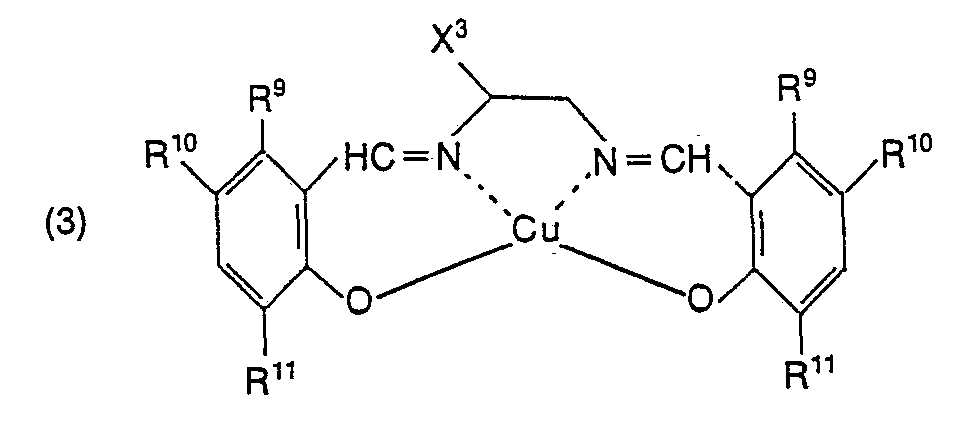
- Von besonderem Interesse sind Verbindungen der Formel

- R9, R10 und R" unabhängig voneinander je Wasserstoff, Chlor, Brom, Methyl oder Methoxy bedeuten und worin R9 und R10 zusammen einen ankondensierten Benzolring bilden und
- X3 Wasserstoff, Methyl, Ethyl oder Phenyl ist.
- Im Vordergrund des Interesses stehen indessen Verbindungen der Formel (3), worin R9, R10, R11 und X3 für Wasserstoff stehen.
- Die Verbindungen der Formel (I) stellen zum Teil an sich aus z.B. Beilstein und Chem. Abstr. bekannte Verbindungen und zum Teil an sich neue Verbindungen dar. So sind Verbindungen der Formel (I), worin R3 Methyl und A1, R1, R2, R 4, X1 und X2 Wasserstoff; R1 und R4 Methyl und A1, R2, R3, X1 und Y1 Wasserstoff; R2 und R4 Chlor und A1, R 1, R3, X1 und Y1 Wasserstoff; R4 Methoxy und A1, R4, R2, R3, X1 und Y1 Wasserstoff; R3 Methoxy, Methoxyethoxy, Ethoxyethoxyethoxy oder Diethylamino und A1, R1, R2, R4, X1 und Y1 Wasserstoff; R2 Methoxyethoxy oder Ethoxyethoxyethoxy und A1, R1, R3, R4, X1 und Y1 Wasserstoff; R2 und R3 Methoxyethoxy oder Ethoxyethoxyethoxy und A1, R1, R4, X1 und Y1 Wasserstoff, oder einer der beiden Substituenten R3 Hydroxyl und der andere Methoxyethoxy oder Ethoxyethoxyethoxy und A1, R1, R 2, R 4, X1 und Y1 Wasserstoff bedeuten, an sich neu.
- Die Verbindungen der Formel (1) erhält man auf an sich bekannte Weise durch Umsetzung von 2 Äquivalenten der entsprechenden o-Hydroxyaldehyde mit 1 Äquivalent des entsprechenden Diamins zur entsprechenden Schiffschen Base und anschliessende Metallisierung mit Kupfersalzen. Man kann aber auch zunächst den Kupferkomplex des o-Hydroxyaldehyds bilden und diesen anschliessend mit einem entsprechenden Diamin zum Kupferkomplex des Biazomethins der Formel (1) umsetzen.
- Es ist auch möglich, ohne Isolierung der Zwischenprodukte das o-Hydroxybenzaldehyd, das Diamin und das Kupersalz in einem einzigen Schritt im sogenannten Eintopfverfahren direkt zur Verbindung der Formel (1) umzusetzen, oder Substituenten, insbesondere Hydroxylgruppen, nach beendeter Herstellung der Verbindung der Formel (1) nachträglich durch eine weitere Umsetzung abzuändern, z. B. zu alkylieren. Diese 4 Herstellungsmethoden sind von Pfeiffer in Liebigs Annalen der Chemie, Bd. 503, S. 84-130 (1933) beschrieben.
- Die Kupferkomplexe der Formel (1) werden zweckmässigerweise aus wässrigem Bad appliziert, wobei diese vorteilhaft in einer Menge eingesetzt werden, dass auf 1 g Polyamidfasermaterial 5 bis 200 µg, insbesondere 10 bis 100 µg Kupfer kommen.
- Die Verbindungen der Formel (1) werden zweckmässig als fein verteilte Dispersionen eingesetzt, die durch Mahlen in Gegenwart üblicher Dispergiermittel erhalten werden.
- Werden die Kupferkomplexe zur Stabilisierung von gefärbtem Material verwendet, so kann das Fasermaterial vor, während oder nach der Färbung mit Kupferkomplex behandelt werden. Zweckmässigerweise wird der Kupferkomplex direkt den Färbe- oder Klotzflotten zugesetzt. Die Färbung erfolgt kontinuierlich oder diskontinuierlich. Bei kontinuierlicher Arbeitsweise kann die Fixierung der Kupferkomplexe durch Dämpfen oder Hitze erfolgen.
- Unter Polyamidmaterial wird synthetisches Polyamid, wie z.B. Polyamid-6, Polyamid-6,6 oder auch Polyamid-12, verstanden. Neben den reinen Polyamidfasern kommen vor allem auch Fasermischungen aus Polyurethan und Polyamid in Betracht, so z.B. Trikotmaterial aus Polyamid/Polyurethan im Mischungsverhältnis 70:30. Grundsätzlich kann das reine oder gemischte Polyamidmaterial in den verschiedensten Verarbeitungsformen vorliegen, wie z. B. als Faser, Garn, Gewebe oder Gewirke.
- Vor allem Polyamidmaterial, das Licht und Hitze ausgesetzt wird und z.B. als Autopolsterstoff oder Teppiche vorliegt, eignet sich besonders gut dazu, nach dem vorliegenden Verfahren behandelt zu werden.
- Die Färbung erfolgt in üblicher Weise z.B. mit Metallkomplexfarbstoffen oder auch mit Anthrachinonfarbstoffen oder Azofarbstoffen. Als Metallkomplexfarbstoffe werden die bekannten Typen, insbesondere die 1 : 2-Chrom- oder 1 : 2-Kobaltkomplexe von Mono- oder Disazo- oder -azomethinfarbstoffen eingesetzt, die in der Literatur in grosser Zahl beschrieben sind. Neben diesen kommen natürlich auch Farbstoffe aus anderen Farbstoffklassen in Frage, wie z.B. Dispersions-oder auch Küpenfarbstoffe.
- Die folgenden Herstellungsvorschriften und Beispiele dienen der Veranschaulichung der Erfindung. Teile bedeuten Gewichtsteile und Prozente Gewichtsprozente. Die Prozentangaben betreffend die Zusätze der einzelnen Behandlungs- bzw. Färbebäder beziehen sich, wenn nicht anders vermerkt, auf das Fasermaterial. Die Temperaturen sind in Grad Celsius angegeben.
- 3 g Ethylendiamin werden zu einer Lösung von 12,2 g Salicylaldehyd in 50 ml Ethanol gegeben. Man rührt noch 15 Minuten und saugt den ausgefallenen Niederschlag ab. Man erhält 12,7 g (94% d.Th.) gelbe Blättchen vom Schmelzpunkt 130-131° der Formel

- Zu 2,68 g dieser Verbindung, gelöst in 20 ml Dimethylformamid gibt man eine unter leichtem Erwärmen hergestellte Lösung von 1,99 g Kupfer-II-acetat-monohydrat in 50 ml Dimethylformamid. Man rührt noch 15 Minuten, saugt vom ausgefallenen Niederschlag ab und wäscht mit wenig Dimethylformamid und Ethanol nach. Man erhält 2,8 g (86% d.Th.) der Verbindung der Formel

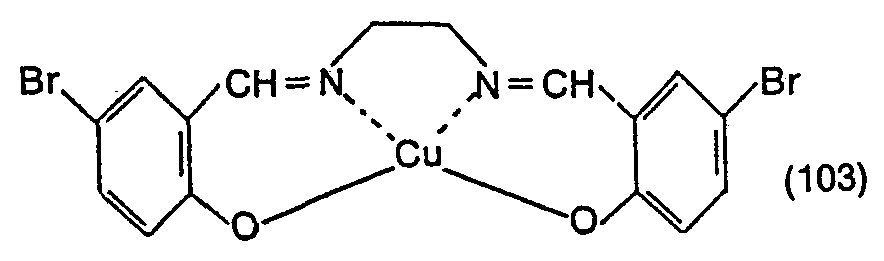
- Zu einer Lösung von 4,02 g 5-Brom-2-hydroxybenzaldehyd in 20 ml Dimethylformamid gibt man 0,6 g Ethylendiamin zu, wobei rasch die bifunktionelle Schiffsche Base als gelber Niederschlag ausfällt. Man setzt dann eine Lösung von 2 g Kupfer-II-acetat-monohydrat in 20 ml Dimethylformamid zu, rührt noch 8 Stunden, saugt ab und wäscht den Niederschlag mit Dimethylformamid und abs. Ethanol. Nach dem Trocknen erhält man 4,69 g (96% d.Th.) einer graugrünen Festsubstanz vom Schmelzpunkt 301-3020 (Zers.) der Formel
- Arbeitet man wie in den Vorschriften A oder B beschrieben, verwendet jedoch die in der folgenden Tabelle I verzeichneten Aldehyde und Diamine, so erhält man die analogen Kupferkomplexe in ähnlichen Ausbeuten.

- Zu 200 ml 2n Natronlauge gibt man bei 85° nacheinander unter Rühren 48,8 g 2-Hydroxybenzaldehyd, 12 g Ethylendiamin und dann eine 85° warme Lösung von 49,9 g Kupfer-II-sulfat-pentahydrat in 200 ml Wasser. Man lässt unter Rühren auf Raumtemperatur (15-25°) abkühlen, saugt ab, wäscht den Filterrückstand sulfatfrei und erhält nach Trocknen bei 70° unter vermindertem Druck (ca. 100 Torr) als dunkelolivfarbene Festsubstanz 62,5 g (94,8% d.Th.) der Verbindung der Formel (102).
- Verfährt man wie in Vorschrift B angegeben, setzt jedoch die in der nachfolgenden Tabelle 11 bezeichneten Aldehyde und Diamine ein, so erhält man die analogen Kupferkomplexe in ähnlichen Ausbeuten:


- Zu einer Lösung von 4,87 g N,N'-Bis [1-(2-hydroxy-phenyl)-propyliden]-enthylendiamin (hergestellt aus 1 Mol Ethylendiamin und 2 Mol 2-Hydroxypropionphenon) in 50 ml Dimethylformamid gibt man bei 60°C eine warme Lösung von 3 g Kupfer-II-acetat-monohydrat in 50 ml Dimethylformamid. Man lässt abkühlen, saugt den Niederschlag ab, wäscht nach und erhält nach dem Trocknen als violettrote Nädelchen (Schmelzpunkt 280-281 °C) 4,6 g (80% d.Th.) der Verbindung der Formel (1), worin A1 für Ethyl und R1, R2, R3, R4, X1 und Y1 für Wasserstoff stehen.
- 4,2 g N,N'-Bis (6-hydroxy-2,5-dimethyl-benzyliden)-ethylendiamin (hergestellt aus 1 Mol Ethylendiamin und 2 Mol 3,6-Dimethyl-2-hydroxybenzaldehyd) werden in der Hitze in 150 ml Äthanol und 50 ml Dimethylformamid gelöst. Man gibt eine heisse Lösung von 2,58 g Kupfer (II)-acetat-monohydrat in 100 ml Äthanol zu, lässt unter Rühren abkühlen, saugt ab und erhält nach dem Trocknen als rosaviolettfarbene Blättchen (Schmelzpunkt >340°) 4,72 g (91,4% d.Th.) der Verbindung der Formel (1),
worin R1 und R4 Methyl und A1, R2, R3, X1 und Y1 für Wasserstoff stehen. - Man verfährt wie in Beispiel 1 angegeben, setzt jedoch 4-Methyl-2-hydroxy-benzaldehyd als Ausgangskomponente bei der Herstellung der Schiffschen Base ein. Man erhält in ähnlicher Ausbeute als olivfarbene Festsubstanz die Verbindung der Formel (1), worin R3 für Methyl und A1, R1, R2, R4, X1 und Y1 für Wasserstoff stehen.
- Man verfährt wie in Beispiel 1 angegeben, setzt jedoch 4-Methoxy-2-hydroxy-benzaldehyd als Ausgangskomponente für die Herstellung der Schiffschen Base ein. Man erhält in ähnlicher Ausbeute als olivfarbene Blättchen eine Verbindung der Formel (1), worin R3 für Methoxy und A1, R1, R2, R4, X1 und Y1 für Wasserstoff stehen.
- 1,5 g Ethylendiamin werden zu einer Suspension von 9,66 g 4-Diäthylamino-2-hydroxybenzaldehyd in 20 ml Ethanol gegeben. Man kocht 1 Stunde am Rückfluss, lässt abkühlen, saugt ab und erhält nach Trocknen als hellgelbe, an sich neue Substanz (Schmelzpunkt: 137-138°) 8,15 g (77% d.Th.) der Schiffschen Base der Formel

- Hierauf wird eine Lösung von 3 g Kupfer-II-acetat-Monohydrat in 100 ml warmem Ethanol zu einer Lösung von 6,15 g der Schiffschen Base der Formel (104) in 100 ml warmen Ethanol gegeben. Nach 30 Min. Rühren saugt man ab. Der Filterrückstand wird während 30 Min. mit 30 ml 1 n Natronlauge und 20 ml Ethanol verrührt, abgesaugt, mit Wasser neutralgewaschen und getrocknet. Man erhält als dunkelgraue, feinkristalline Substanz (Schmelzpunkt 135-136° (Zers.)) 6,9 g (93% d.Th.) der Verbindung der Formel (1), worin R3 für Di- ethylamino und A1, R1, R2, R4, X1 und Y1 für Wasserstoff stehen. Die Substanz enthält nach Elementaranalyse 1 Mol Kristallwasser.
- Man verfährt, wie in Vorschrift B angegeben, setzt jedoch 3,5-Dichlor-2-hydroxybenzaldehyd ein. Man erhält in ähnlicher Ausbeute als violettrosafarbene Festsubstanz die Verbindung der Formel (1), worin R2 und R4für Chlor und A1, R1, R 3, X1 und Y1 für Wasserstoff stehen.
- Man verfährt wie in Vorschrift B angegeben, setzt jedoch 3-Methoxy-3-hydroxybenzaldehyd ein. Man erhält in ähnlicher Ausbeute als türkisfarbene Blättchen die Verbindung der Formel (1), worin R4 für Methoxy und A1, R1, R2, R3, X1 und Y1 für Wasserstoff stehen.
- Zu einer Suspension von 7,24 g des Kupferkomplexes gemäss Vorschrift I in 300 ml Ethanol gibt man bei 80° unter Rühren 5,32 g 30%ige Natronlauge (verdünnt mit 30 ml Ethanol) zu. Man lässt abkühlen, saugt den Niederschlag ab und wäscht mit Ethanol nach. Man erhält nach dem Trocknen 7,4 g (77% d.Th.) des entsprechenden, an sich neuen Natriumsalzes als dunkelviolettfarbene, fein kristalline Substanz, die nach Elementaranalyse und acidimetrischer Titration 6 Mol Kristallwasser enthält. Zu einer Suspension von 22,4 g des so erhaltenen Dinatriumsalzes in 300 ml Dimethylformamid werden hierauf 25,8 g 2-Methoxyäthyl-tosylat gegeben. Man rührt 70 Min. bei 140°. Nach Abkühlen giesst man unter Rühren in 1,5 Liter Wasser ein, saugt den Niederschlag ab und wäscht nach. Der Filterrückstand wird 1 Stunde lang mit 100 ml1 1 n Natronlauge verrührt, abgesaugt, neutral gewaschen und getrocknet. Man erhält als helltürkisfarbene Substanz (Schmelzpunkt 132-135°) 16,45 g (58% d.Th.) des Kupferkomplexes, welche nach Elementaranalyse 2 Mol Kristallwasser enthält und der Formel (1) entspricht, worin R3 für Methoxyethoxy und A1, R1, R2, R4, X1 und y1 für Wasserstoff stehen.
- Man verfährt wie in Beispiel 7 angegeben, setzt jedoch 2-[(2-Ethoxy)-ethoxy]-ethyl-tosylat ein. Man erhält in ähnlicher Ausbeute als helltürkisfarbene Festsubstanz die Verbindung der Formel (1), worin R3 für Ethoxyethoxyethoxy und A1, R1, R2, R4, X1 und X1 für Wasserstoff stehen.
- 5 g der gemäss Vorschrift A hergestellten Verbindungen werden mit 5 g des Kondensationsproduktes aus Naphthalinsulfonsäure und Formaldehyd als Dispergator, das in 7,5 ml Wasser gelöst ist, mit 20 g Quarzkügelchen (Druchmesser ca. 1 mm) versetzt und mit einem Rührer mit ca. 1600 Umdrehungen pro Minute so lange gemahlen, bis die Teilchengrösse unter 2 µm liegt. Die Dispersion wird von den Quarzkügelchen mittels eines feinen Maschensiebes abgetrennt und mit Wasser auf 20% an Wirksubstanz eingestellt.
- Das Einrühren von 0,3% Carboxymethylcellulose bewirkt eine Stabilisierung der Dispersion.
- In der gleichen Weise lassen sich aus den Verbindungen der Vorschriften B-Q und der Beispiele 1-8 stabile Dispersionen herstellen.
- Drei Stücke eines Nylon 66-Autopolstertrikots von 15 g werden in einem Färbeapparat mit offenen Behandlungsbädern, mit Flotten (Flottenverhältnis 1 : 25) behandelt, die 2% Ammoniumsulfat, 0,2% des Farbstoffes der Formel (jeweils auf das Fasergewicht berechnet):

- Der Kupfergehalt des in Anwesenheit der Verbindung gemäss Vorschrift A oder C gefärbten Fasermaterials wurde mit 100 µg pro Cu pro g Fasermaterial ermittelt.
- Die Lichtechtheit der Färbungen, welche in Gegenwart der Verbindungen gemäss Vorschrift A oder C hergestellt wurden, ist deutlich besser als die Lichtechtheit der Vergleichsfärbung ohne diese Verbindungen.
- Ausserdem wird durch Zusatz der Verbindungen gemäss Vorschrift A oder C die Reissfestigkeit des Polyamidmaterials nach der Belichtung erheblich verbessert und die Dehnung ist grösser. Ähnliche Ergebnisse werden erzielt, wenn man 0,35% der gemäss Beispiel 9 erhaltenen Dispersion der Verbindungen gemäss Vorschriften B oder D-Q oder Beispielen 1-8 einsetzt.
- Es wird wie im Beispiel 10 beschrieben, eine 0,2%ige Färbung mit dem Rotfarbstoff der Formel

- Der Kupfergehalt des in Anwesenheit der Verbindung gemäss Vorschrift A oder C gefärbten Fasermaterials beträgt 99 gg Cu pro g Fasermaterial.
- Wie im Beispiel 10 beschrieben, wird mit 0,1% des Farbstoffes der Formel

- Auch bei dieser Färbung bewirkt der Zusatz der Cu-Komplexe gemäss Vorschrift A oder C eine deutliche Verbesserung der Lichtechtheit, der Reissfestigkeit und der Dehnung.
- Die gemäss Beispiel 9 formulierten Verbindungen der Vorschriften A, B oder C oder des Beispiels 6, werden auf einem Nylon-66-Filamentgarn (7-3 tex) geprüft. Dazu werden Beigefärbungen angefertigt, die wie nachfolgend beschrieben hergestellt werden.
- Fünf Garnsträngchen von 10 g des Nylon-Filamentgarns werden auf einem Färbeapparat in offenen Färbebädern bei einem Flottenverhältnis von 1 : 40 behandelt. Die Färbebäder werden mit 2 g/l Ammonsulfat (pH 6,8) jeweils 0 bzw. 0,3% der gemäss Beispiel 10 hergestellten Formulierungen der Verbindungen gemäss Vorschriften A, B oder C oder des Beispiels 6, und der Farbstoffkombination (gelöst in Wasser).


- Von den Färbungen wird einerseits die Lichtechtheit bestimmt nach SN-ISO 105 B02 (Xenon) und DIN 75.202 (prov.) (Fakra), andererseits werden sie auf Karten gewickelt (30 Lagen, Einspannlänge ca. 22 cm) und 200 Stunden nach DIN 75.202 (prov.) heissbelichtet. Danach werden nach SNV 79.461 Reissfestigkeit und Dehnung geprüft.
- Der Zusatz der Verbindungen gemäss Vorschrift A, B oder C oder Beispiel 6 bewirkt bei mit den vorstehenden Farbstoffen gefärbtem Nylon-Filamentgarn eine deutliche Verbesserung der Lichtechtheit, der Reissfestigkeit und der Dehnung. Dies gilt auch für die Verbindungen gemäss Vorschriften D-Q oder Beispiel 1-5, 7 oder 8.
- Es werden vier 10 g Polyamid 66-Filamentgarn-Strängchen (7 x 3 tex) zur Behandlung auf einem Garnfärbeapparat vorbereitet. Die Behandlungsbäder werden generell mit 1% Essigsäure 80% (pH 5,5) versetzt.
- Das Bad Nr.1 enthält keinen weiteren Zusatz, das Bad Nr. 2 enthält 0,35% der gemäss Beispiel 9 erhaltenen Formulierung der Verbindung gemäss Vorschrift A, das Bad Nr. 3 enthält 0,2% des Farbstoffes der Formel
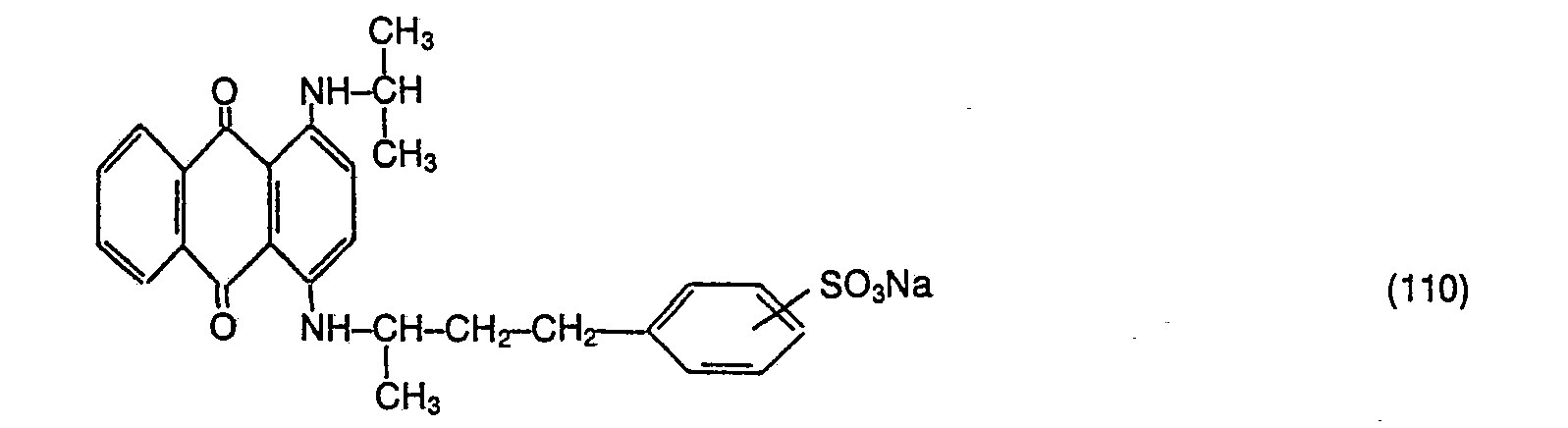
- Die Behandlung erfolgt bei einem Flottenverhältnis 1 : 40 zunächst bei 50°, sodann wird die Temperatur innerhalb von 30 Minuten auf 95° erhöht und 60 Minuten behandelt. Danach wird auf 70° abgekühlt, kalt gespült, zentrifugiert und bei 80° getrocknet.
- Die Prüfung der Behandlungen erfolgt wie im Beispiel 13 beschrieben.
- Der Zusatz von Kupferverbindung gemäss Vorschrift A bewirkt bei den in den Bädern Nr. 2 und 4 behandelten Mustern eine deutliche Verbesserung der Reissfestigkeit und Dehnung gegenüber den ohne die Kupferverbindung behandelten Mustern. Ausserdem ist die Lichtechtheit der mit dem Bad 4 erzeugten Färbung deutlich verbessert gegenüber der mit dem Bad 3 erzeugten Färbung.
- Man verfährt wie in Beispiel 10 angegeben, färbt jedoch je 2 Stücke des Nylontrikots von 10 g mit einer Flotte bei einem Flottenverhältnis von 1 : 30, die 2% Essigsäure 80%, 0 oder 0,2% der gemäss Beispiel 9 erhaltenen Dispersion der Verbindung gemäss Vorschrift A und 0,1 % des gelben Farbstoffes der Formel


- Werden zusätzlich zur Kupferkomplexverbindung gemäss Vorschrift A oder C 0,05% des Farbstoffes der Formel

- Wie in Beispiel 10 vermerkt, werden je 3 Nylon-66-Trikotstücke von 10 g mit je 0,2% der Farbstoffe der Formel (105), (106) oder (107) gefärbt, gespült und getrocknet. Während die Serie 1 dieser Färbungen unverändert bleibt, werden die beiden Serien 2 und 3 mit einer Flotte, die ½ g/I eines nichtionischen Tensids (Addukt aus 1 Mol Nonylphenol und 9½ Mol Ethylenoxid) und 2 g/I der gemäss Beispiel 9 formulierten Verbindung der Formel (102) enthält, bei einer Flottenaufnahme von 75% foulardiert und bei 120° während 1 Minute getrocknet. Die Färbungen der Serie 2 werden bei 180° während 60 Sekunden hitzebehandelt, die der Serie 3 mit Sattdampf von ca. 100° während 5 Minuten behandelt.
- Alle Färbungen werden wie in Beispiel 10 beschrieben getestet. Dabei zeigt es sich, dass die Färbungen der Serien 2 und 3 hinsichtlich Heisslichtechtheit, Reissfestigkeit und Dehnung gegenüber denjenigen der Serie 1 deutlich verbessert sind.
Claims (7)


Applications Claiming Priority (2)
| Application Number | Priority Date | Filing Date | Title |
|---|---|---|---|
| CH1975/85 | 1985-05-09 | ||
| CH197585 | 1985-05-09 |
Publications (2)
| Publication Number | Publication Date |
|---|---|
| EP0200843A1 EP0200843A1 (de) | 1986-11-12 |
| EP0200843B1 true EP0200843B1 (de) | 1988-06-22 |
Family
ID=4222993
Family Applications (1)
| Application Number | Title | Priority Date | Filing Date |
|---|---|---|---|
| EP85810509A Expired EP0200843B1 (de) | 1985-05-09 | 1985-11-04 | Verfahren zur fotochemischen Stabilisierung von ungefärbtem und gefärbtem Polyamidfasermaterial und dessen Mischungen |
Country Status (6)
| Country | Link |
|---|---|
| US (1) | US4655783A (de) |
| EP (1) | EP0200843B1 (de) |
| JP (1) | JPS61258082A (de) |
| BR (1) | BR8505623A (de) |
| CA (1) | CA1239254A (de) |
| DE (1) | DE3563462D1 (de) |
Families Citing this family (40)
| Publication number | Priority date | Publication date | Assignee | Title |
|---|---|---|---|---|
| US4874391A (en) * | 1986-07-29 | 1989-10-17 | Ciba-Geigy Corporation | Process for photochemical stabilization of polyamide fiber material and mixtures thereof with other fibers: water-soluble copper complex dye and light-stabilizer |
| ES2059820T3 (es) * | 1988-09-29 | 1994-11-16 | Ciba Geigy Ag | Procedimiento para la estabilizacion fotoquimica de material de fibras poliamidicas teñidas y sin teñir, y de sus mezclas. |
| US4902299A (en) * | 1989-02-28 | 1990-02-20 | E. I. Du Pont De Nemours And Company | Nylon fabrics with cupric salt and oxanilide for improved dye-lightfastness |
| US5069681A (en) * | 1990-01-03 | 1991-12-03 | Ciba-Geigy Corporation | Process for the photochemical stabilization of dyed polyamide fibres with foamed aqueous composition of copper organic complexes |
| EP0511166A1 (de) * | 1991-04-26 | 1992-10-28 | Ciba-Geigy Ag | Verfahren zur photochemischen und thermischen Stabilisierung von Polyamid-Fasermaterial mit einer faseraffinen Kupferkomplexverbindung und einem Oxalsäurediarylamid |
| US6017661A (en) | 1994-11-09 | 2000-01-25 | Kimberly-Clark Corporation | Temporary marking using photoerasable colorants |
| US5733693A (en) | 1993-08-05 | 1998-03-31 | Kimberly-Clark Worldwide, Inc. | Method for improving the readability of data processing forms |
| US5865471A (en) | 1993-08-05 | 1999-02-02 | Kimberly-Clark Worldwide, Inc. | Photo-erasable data processing forms |
| US5645964A (en) | 1993-08-05 | 1997-07-08 | Kimberly-Clark Corporation | Digital information recording media and method of using same |
| US5773182A (en) | 1993-08-05 | 1998-06-30 | Kimberly-Clark Worldwide, Inc. | Method of light stabilizing a colorant |
| US5700850A (en) | 1993-08-05 | 1997-12-23 | Kimberly-Clark Worldwide | Colorant compositions and colorant stabilizers |
| US5721287A (en) | 1993-08-05 | 1998-02-24 | Kimberly-Clark Worldwide, Inc. | Method of mutating a colorant by irradiation |
| US5681380A (en) | 1995-06-05 | 1997-10-28 | Kimberly-Clark Worldwide, Inc. | Ink for ink jet printers |
| US6017471A (en) | 1993-08-05 | 2000-01-25 | Kimberly-Clark Worldwide, Inc. | Colorants and colorant modifiers |
| US6211383B1 (en) | 1993-08-05 | 2001-04-03 | Kimberly-Clark Worldwide, Inc. | Nohr-McDonald elimination reaction |
| US6071979A (en) | 1994-06-30 | 2000-06-06 | Kimberly-Clark Worldwide, Inc. | Photoreactor composition method of generating a reactive species and applications therefor |
| US5685754A (en) | 1994-06-30 | 1997-11-11 | Kimberly-Clark Corporation | Method of generating a reactive species and polymer coating applications therefor |
| US6242057B1 (en) | 1994-06-30 | 2001-06-05 | Kimberly-Clark Worldwide, Inc. | Photoreactor composition and applications therefor |
| US6008268A (en) | 1994-10-21 | 1999-12-28 | Kimberly-Clark Worldwide, Inc. | Photoreactor composition, method of generating a reactive species, and applications therefor |
| US5837429A (en) | 1995-06-05 | 1998-11-17 | Kimberly-Clark Worldwide | Pre-dyes, pre-dye compositions, and methods of developing a color |
| US5786132A (en) | 1995-06-05 | 1998-07-28 | Kimberly-Clark Corporation | Pre-dyes, mutable dye compositions, and methods of developing a color |
| AU5535296A (en) | 1995-06-28 | 1997-01-30 | Kimberly-Clark Worldwide, Inc. | Novel colorants and colorant modifiers |
| US5782963A (en) | 1996-03-29 | 1998-07-21 | Kimberly-Clark Worldwide, Inc. | Colorant stabilizers |
| PL321573A1 (en) | 1995-11-28 | 1997-12-08 | Kimberly Clark Co | Improved stabilising agents for dyes |
| US5855655A (en) | 1996-03-29 | 1999-01-05 | Kimberly-Clark Worldwide, Inc. | Colorant stabilizers |
| US6099628A (en) | 1996-03-29 | 2000-08-08 | Kimberly-Clark Worldwide, Inc. | Colorant stabilizers |
| US5891229A (en) | 1996-03-29 | 1999-04-06 | Kimberly-Clark Worldwide, Inc. | Colorant stabilizers |
| US6524379B2 (en) | 1997-08-15 | 2003-02-25 | Kimberly-Clark Worldwide, Inc. | Colorants, colorant stabilizers, ink compositions, and improved methods of making the same |
| AU4320799A (en) | 1998-06-03 | 1999-12-20 | Kimberly-Clark Worldwide, Inc. | Neonanoplasts and microemulsion technology for inks and ink jet printing |
| SK1552000A3 (en) | 1998-06-03 | 2000-08-14 | Kimberly Clark Co | Novel photoinitiators and applications therefor |
| US6228157B1 (en) | 1998-07-20 | 2001-05-08 | Ronald S. Nohr | Ink jet ink compositions |
| CA2353685A1 (en) | 1998-09-28 | 2000-04-06 | Kimberly-Clark Worldwide, Inc. | Chelates comprising chinoid groups as photoinitiators |
| WO2000042110A1 (en) | 1999-01-19 | 2000-07-20 | Kimberly-Clark Worldwide, Inc. | Novel colorants, colorant stabilizers, ink compositions, and improved methods of making the same |
| US6331056B1 (en) | 1999-02-25 | 2001-12-18 | Kimberly-Clark Worldwide, Inc. | Printing apparatus and applications therefor |
| US6294698B1 (en) | 1999-04-16 | 2001-09-25 | Kimberly-Clark Worldwide, Inc. | Photoinitiators and applications therefor |
| US6368395B1 (en) | 1999-05-24 | 2002-04-09 | Kimberly-Clark Worldwide, Inc. | Subphthalocyanine colorants, ink compositions, and method of making the same |
| US6486227B2 (en) | 2000-06-19 | 2002-11-26 | Kimberly-Clark Worldwide, Inc. | Zinc-complex photoinitiators and applications therefor |
| TW200406466A (en) * | 2001-11-13 | 2004-05-01 | Ciba Sc Holding Ag | Compositions comprising at least one oxonol dye and at least one metal complex |
| EP1602779A1 (de) * | 2004-06-04 | 2005-12-07 | Clariant International Ltd. | Kupferkomplexe als Lichtstabilisatoren für Textilien |
| DE102011084639A1 (de) * | 2011-10-17 | 2013-04-18 | Osram Opto Semiconductors Gmbh | Organisches elektronisches bauelement mit dotierstoff, verwendung eines dotierstoffs und verfahren zur herstellung des dotierstoffs |
Family Cites Families (12)
| Publication number | Priority date | Publication date | Assignee | Title |
|---|---|---|---|---|
| GB799742A (en) * | 1955-09-19 | 1958-08-13 | Ici Ltd | Process for colouring aromatic polyester textile materials |
| NL287100A (de) * | 1961-12-22 | |||
| US3329696A (en) * | 1963-06-17 | 1967-07-04 | Universal Oil Prod Co | N-(2-hydroxyphenylmethylene)-cycloalkyl amines and metal salts thereof |
| US3363969A (en) * | 1964-02-12 | 1968-01-16 | Du Pont | Dyeing and light stabilizing nylon yarns with sulfonated dyes; sterically hindered phenols, and alkylnaphthalene sulfonates with or without other ultraviolet light absorbers |
| GB1321645A (en) * | 1970-07-02 | 1973-06-27 | Ici Ltd | Colouration process |
| GB1392953A (en) * | 1972-07-18 | 1975-05-07 | Ici Ltd | Colouration process |
| US3928328A (en) * | 1972-12-08 | 1975-12-23 | Du Pont | Schiff base and metal bisazomethine metal chelate |
| DE2625386A1 (de) * | 1976-06-05 | 1977-12-15 | Manfred Rembold | Farbstoffe mit verringerter katalytischer ausbleichung, faerbverfahren und inhibitoren zur verringerung der katalytischen ausbleichung |
| DE3041153A1 (de) * | 1980-10-31 | 1982-06-16 | Bayer Ag, 5090 Leverkusen | Verfahren zur verbesserung der lichtechtheit von polyamidfaerbungen |
| DE3247051A1 (de) * | 1982-12-20 | 1984-06-20 | Bayer Ag, 5090 Leverkusen | Verfahren zur verbesserung der lichtechtheit von polyamidfaerbungen |
| DE3326640A1 (de) * | 1983-07-23 | 1985-01-31 | Basf Ag, 6700 Ludwigshafen | Verfahren zur verbesserung der lichtechtheit von faerbungen mit saeure- oder metallkomplexfarbstoffen auf polyamid |
| EP0162811B1 (de) * | 1984-05-22 | 1989-10-11 | Ciba-Geigy Ag | Verfahren zur fotochemischen Stabilisierung von Polyamidfasermaterial |
-
1985
- 1985-11-04 EP EP85810509A patent/EP0200843B1/de not_active Expired
- 1985-11-04 DE DE8585810509T patent/DE3563462D1/de not_active Expired
- 1985-11-07 CA CA000494753A patent/CA1239254A/en not_active Expired
- 1985-11-08 BR BR8505623A patent/BR8505623A/pt unknown
- 1985-11-08 JP JP60250608A patent/JPS61258082A/ja active Granted
- 1985-11-12 US US06/797,098 patent/US4655783A/en not_active Expired - Lifetime
Also Published As
| Publication number | Publication date |
|---|---|
| US4655783A (en) | 1987-04-07 |
| BR8505623A (pt) | 1986-12-16 |
| DE3563462D1 (en) | 1988-07-28 |
| JPH0355590B2 (de) | 1991-08-23 |
| CA1239254A (en) | 1988-07-19 |
| EP0200843A1 (de) | 1986-11-12 |
| JPS61258082A (ja) | 1986-11-15 |
Similar Documents
| Publication | Publication Date | Title |
|---|---|---|
| EP0200843A1 (de) | Verfahren zur fotochemischen Stabilisierung von ungefärbtem und gefärbtem Polyamidfasermaterial und dessen Mischungen | |
| EP0162811B1 (de) | Verfahren zur fotochemischen Stabilisierung von Polyamidfasermaterial | |
| EP0511166A1 (de) | Verfahren zur photochemischen und thermischen Stabilisierung von Polyamid-Fasermaterial mit einer faseraffinen Kupferkomplexverbindung und einem Oxalsäurediarylamid | |
| EP0475905A1 (de) | Verfahren zum photochemischen Stabilisieren von Wolle | |
| EP0245204A1 (de) | Verfahren zur fotochemischen Stabilisierung von ungefärbtem und gefärbtem Polyamidfasermaterial und dessen Mischungen mit anderen Fasern | |
| EP0345212A1 (de) | Verfahren zur Verhinderung der Vergilbung von mit Fleckenschutzmitteln ausgerüsteten Polyamidfasermaterialien | |
| EP0113856B1 (de) | Verfahren zur Verbesserung der Lichtechtheit von Polyamidfärbungen | |
| DE2726433A1 (de) | Verfahren zur verbesserung der farbausbeute und der echtheiten von mit anionischen farbstoffen auf cellulosefasermaterial erzeugten faerbungen, kationische faserreaktive verbindungen und ihre herstellung | |
| EP0106104B1 (de) | Mischungen von Monoazofarbstoffen | |
| EP0657577A1 (de) | Verfahren zur photochemischen und thermischen Stabilisierung von ungefärbten und gefärbten oder bedruckten Polyesterfasermaterialien | |
| EP0362139B1 (de) | Verfahren zur fotochemischen Stabilisierung von ungefärbtem und gefärbtem Polyamidfasermaterial und dessen Mischungen | |
| EP0279272B2 (de) | Mischungen von Monoazofarbstoffen | |
| EP0591108B1 (de) | Verfahren zum Färben von wollhaltigen Fasermaterialien | |
| EP0474594B1 (de) | Verfahren zum Färben von Wolle und deren Mischungen mit anderen Fasern mit Reaktivfarbstoffen | |
| EP0507732B1 (de) | Asymmetrisches Oxalsäure-diarylamid | |
| DE1794190B2 (de) | Verfahren zum Farben von syntheti sehen Fasern mit Dispersionsfarbstoffen | |
| DE1769997A1 (de) | Verfahren zum Faerben von Wolle und Mischungen aus Wolle mit Polyesterfasern | |
| DE2826761A1 (de) | Verfahren zum faerben oder bedrucken von hydrophoben, synthetischen organischen fasermaterialien | |
| DE953827C (de) | Verfahren zur Herstellung metallhaltiger Azofarbstoffe | |
| EP0621266A1 (de) | Sterisch gehinderte Phenole und ihre Verwendung zur Stabilisierung von Polyamid-Fasermaterialen | |
| CH635856A5 (de) | Neue disazofarbstoffe und deren herstellung. | |
| DE3427806C2 (de) | ||
| DE633599C (de) | Verfahren zur Herstellung von sauren Farbstoffen und Verbindungen der Anthrapyrimidinreihe | |
| EP0593965A1 (de) | Mischungen von Reaktivfarbstoffen | |
| AT226190B (de) | Verfahren zum Färben von stickstoffhaltigen Fasern mit sulfonsäuregruppenhaltigen Kupferphthalocyaninen und Mittel zur Durchführung des Verfahrens |
Legal Events
| Date | Code | Title | Description |
|---|---|---|---|
| PUAI | Public reference made under article 153(3) epc to a published international application that has entered the european phase |
Free format text: ORIGINAL CODE: 0009012 |
|
| 17P | Request for examination filed |
Effective date: 19851106 |
|
| AK | Designated contracting states |
Kind code of ref document: A1 Designated state(s): BE CH DE FR GB IT LI NL |
|
| 17Q | First examination report despatched |
Effective date: 19870827 |
|
| GRAA | (expected) grant |
Free format text: ORIGINAL CODE: 0009210 |
|
| AK | Designated contracting states |
Kind code of ref document: B1 Designated state(s): BE CH DE FR GB IT LI NL |
|
| REF | Corresponds to: |
Ref document number: 3563462 Country of ref document: DE Date of ref document: 19880728 |
|
| ET | Fr: translation filed | ||
| GBT | Gb: translation of ep patent filed (gb section 77(6)(a)/1977) | ||
| ITF | It: translation for a ep patent filed | ||
| PLBE | No opposition filed within time limit |
Free format text: ORIGINAL CODE: 0009261 |
|
| STAA | Information on the status of an ep patent application or granted ep patent |
Free format text: STATUS: NO OPPOSITION FILED WITHIN TIME LIMIT |
|
| 26N | No opposition filed | ||
| ITTA | It: last paid annual fee | ||
| REG | Reference to a national code |
Ref country code: CH Ref legal event code: PUE Owner name: CIBA-GEIGY AG TRANSFER- CIBA SC HOLDING AG |
|
| BECN | Be: change of holder's name |
Effective date: 19961129 |
|
| NLS | Nl: assignments of ep-patents |
Owner name: CIBA SC HOLDING AG |
|
| REG | Reference to a national code |
Ref country code: FR Ref legal event code: TP |
|
| REG | Reference to a national code |
Ref country code: GB Ref legal event code: 732E |
|
| REG | Reference to a national code |
Ref country code: CH Ref legal event code: PFA Free format text: CIBA SC HOLDING AG TRANSFER- CIBA SPECIALTY CHEMICALS HOLDING INC. |
|
| NLT1 | Nl: modifications of names registered in virtue of documents presented to the patent office pursuant to art. 16 a, paragraph 1 |
Owner name: CIBA SPECIALTY CHEMICALS HOLDING INC. |
|
| REG | Reference to a national code |
Ref country code: FR Ref legal event code: CD |
|
| PGFP | Annual fee paid to national office [announced via postgrant information from national office to epo] |
Ref country code: CH Payment date: 20001002 Year of fee payment: 16 |
|
| PGFP | Annual fee paid to national office [announced via postgrant information from national office to epo] |
Ref country code: NL Payment date: 20001006 Year of fee payment: 16 |
|
| PG25 | Lapsed in a contracting state [announced via postgrant information from national office to epo] |
Ref country code: LI Free format text: LAPSE BECAUSE OF NON-PAYMENT OF DUE FEES Effective date: 20011130 Ref country code: CH Free format text: LAPSE BECAUSE OF NON-PAYMENT OF DUE FEES Effective date: 20011130 |
|
| REG | Reference to a national code |
Ref country code: GB Ref legal event code: IF02 |
|
| PG25 | Lapsed in a contracting state [announced via postgrant information from national office to epo] |
Ref country code: NL Free format text: LAPSE BECAUSE OF NON-PAYMENT OF DUE FEES Effective date: 20020601 |
|
| REG | Reference to a national code |
Ref country code: CH Ref legal event code: PL |
|
| NLV4 | Nl: lapsed or anulled due to non-payment of the annual fee |
Effective date: 20020601 |
|
| PGFP | Annual fee paid to national office [announced via postgrant information from national office to epo] |
Ref country code: GB Payment date: 20021105 Year of fee payment: 18 |
|
| PGFP | Annual fee paid to national office [announced via postgrant information from national office to epo] |
Ref country code: BE Payment date: 20021227 Year of fee payment: 18 |
|
| PGFP | Annual fee paid to national office [announced via postgrant information from national office to epo] |
Ref country code: FR Payment date: 20031027 Year of fee payment: 19 |
|
| PG25 | Lapsed in a contracting state [announced via postgrant information from national office to epo] |
Ref country code: GB Free format text: LAPSE BECAUSE OF NON-PAYMENT OF DUE FEES Effective date: 20031104 |
|
| PGFP | Annual fee paid to national office [announced via postgrant information from national office to epo] |
Ref country code: DE Payment date: 20031110 Year of fee payment: 19 |
|
| PG25 | Lapsed in a contracting state [announced via postgrant information from national office to epo] |
Ref country code: BE Free format text: LAPSE BECAUSE OF NON-PAYMENT OF DUE FEES Effective date: 20031130 |
|
| BERE | Be: lapsed |
Owner name: *CIBA SPECIALTY CHEMICALS HOLDING INC. Effective date: 20031130 |
|
| GBPC | Gb: european patent ceased through non-payment of renewal fee |
Effective date: 20031104 |
|
| PG25 | Lapsed in a contracting state [announced via postgrant information from national office to epo] |
Ref country code: DE Free format text: LAPSE BECAUSE OF NON-PAYMENT OF DUE FEES Effective date: 20050601 |
|
| PG25 | Lapsed in a contracting state [announced via postgrant information from national office to epo] |
Ref country code: FR Free format text: LAPSE BECAUSE OF NON-PAYMENT OF DUE FEES Effective date: 20050729 |
|
| REG | Reference to a national code |
Ref country code: FR Ref legal event code: ST |