EP0200985A2 - Procédé pour la fabrication d'oxyde de fer III gamma aciculaire ferrimagnétique - Google Patents
Procédé pour la fabrication d'oxyde de fer III gamma aciculaire ferrimagnétique Download PDFInfo
- Publication number
- EP0200985A2 EP0200985A2 EP86105532A EP86105532A EP0200985A2 EP 0200985 A2 EP0200985 A2 EP 0200985A2 EP 86105532 A EP86105532 A EP 86105532A EP 86105532 A EP86105532 A EP 86105532A EP 0200985 A2 EP0200985 A2 EP 0200985A2
- Authority
- EP
- European Patent Office
- Prior art keywords
- iron
- iii
- oxide
- rotary kiln
- magnetite
- Prior art date
- Legal status (The legal status is an assumption and is not a legal conclusion. Google has not performed a legal analysis and makes no representation as to the accuracy of the status listed.)
- Granted
Links
Images
Classifications
-
- C—CHEMISTRY; METALLURGY
- C01—INORGANIC CHEMISTRY
- C01G—COMPOUNDS CONTAINING METALS NOT COVERED BY SUBCLASSES C01D OR C01F
- C01G49/00—Compounds of iron
- C01G49/02—Oxides; Hydroxides
- C01G49/06—Ferric oxide [Fe2O3]
-
- G—PHYSICS
- G11—INFORMATION STORAGE
- G11B—INFORMATION STORAGE BASED ON RELATIVE MOVEMENT BETWEEN RECORD CARRIER AND TRANSDUCER
- G11B5/00—Recording by magnetisation or demagnetisation of a record carrier; Reproducing by magnetic means; Record carriers therefor
- G11B5/62—Record carriers characterised by the selection of the material
- G11B5/68—Record carriers characterised by the selection of the material comprising one or more layers of magnetisable material homogeneously mixed with a bonding agent
- G11B5/70—Record carriers characterised by the selection of the material comprising one or more layers of magnetisable material homogeneously mixed with a bonding agent on a base layer
- G11B5/706—Record carriers characterised by the selection of the material comprising one or more layers of magnetisable material homogeneously mixed with a bonding agent on a base layer characterised by the composition of the magnetic material
- G11B5/70626—Record carriers characterised by the selection of the material comprising one or more layers of magnetisable material homogeneously mixed with a bonding agent on a base layer characterised by the composition of the magnetic material containing non-metallic substances
- G11B5/70642—Record carriers characterised by the selection of the material comprising one or more layers of magnetisable material homogeneously mixed with a bonding agent on a base layer characterised by the composition of the magnetic material containing non-metallic substances iron oxides
- G11B5/70652—Record carriers characterised by the selection of the material comprising one or more layers of magnetisable material homogeneously mixed with a bonding agent on a base layer characterised by the composition of the magnetic material containing non-metallic substances iron oxides gamma - Fe2 O3
- G11B5/70663—Preparation processes specially adapted therefor, e.g. using stabilising agents
-
- C—CHEMISTRY; METALLURGY
- C01—INORGANIC CHEMISTRY
- C01P—INDEXING SCHEME RELATING TO STRUCTURAL AND PHYSICAL ASPECTS OF SOLID INORGANIC COMPOUNDS
- C01P2002/00—Crystal-structural characteristics
- C01P2002/60—Compounds characterised by their crystallite size
-
- C—CHEMISTRY; METALLURGY
- C01—INORGANIC CHEMISTRY
- C01P—INDEXING SCHEME RELATING TO STRUCTURAL AND PHYSICAL ASPECTS OF SOLID INORGANIC COMPOUNDS
- C01P2004/00—Particle morphology
- C01P2004/10—Particle morphology extending in one dimension, e.g. needle-like
-
- C—CHEMISTRY; METALLURGY
- C01—INORGANIC CHEMISTRY
- C01P—INDEXING SCHEME RELATING TO STRUCTURAL AND PHYSICAL ASPECTS OF SOLID INORGANIC COMPOUNDS
- C01P2004/00—Particle morphology
- C01P2004/60—Particles characterised by their size
- C01P2004/62—Submicrometer sized, i.e. from 0.1-1 micrometer
-
- C—CHEMISTRY; METALLURGY
- C01—INORGANIC CHEMISTRY
- C01P—INDEXING SCHEME RELATING TO STRUCTURAL AND PHYSICAL ASPECTS OF SOLID INORGANIC COMPOUNDS
- C01P2006/00—Physical properties of inorganic compounds
- C01P2006/12—Surface area
-
- C—CHEMISTRY; METALLURGY
- C01—INORGANIC CHEMISTRY
- C01P—INDEXING SCHEME RELATING TO STRUCTURAL AND PHYSICAL ASPECTS OF SOLID INORGANIC COMPOUNDS
- C01P2006/00—Physical properties of inorganic compounds
- C01P2006/42—Magnetic properties
Definitions
- the invention relates to a process for the production of gamma-iron (III) oxide by dehydration of esen (III) oxide hydroxides to ⁇ -iron (III) oxide and the reduction of the latter to magnetite with subsequent oxidation of the magnetite to gamma-iron (III) oxide.
- Acicular ferrimagnetic iron oxides have long been used as a magnetizable material in the manufacture of magnetic recording media.
- a large number of processes are known for producing the gamma-iron (III) oxide used in particular.
- Starting products of specifically produced gamma-iron (III) oxides are almost exclusively a- or ⁇ -modifications of iron (III) oxide hydroxides, i.e. from goethite or lepidocrocite, as these substances can be produced specifically as needle-shaped particles of defined length and thickness.
- these products initially produce ⁇ -iron (III) oxide with elimination of water, which is reduced to magnetite and converted into acicular, ferrimagnetic gamma-iron (III) oxide by careful oxidation.
- particle length and thickness of the needles are determined by defined process conditions.
- the particle length is 0.2 to 1.0 ⁇ m with a length-to-thickness ratio of 5: 1 to 15: 1.
- ⁇ -iron (III) oxide obtained by oxidation of magnetite, consists of single adein without sintering, if possible. From these relationships it follows that the type and implementation of drainage and reduction are of particular importance. It was previously known that when ⁇ - and / or ⁇ -iron oxide hydroxides were dewatered as a suitable process step, depending on the residence time and temperature control, without introducing gases or when nitrogen or air was introduced into a rotary kiln, preferably continuously, the resulting ⁇ -Fe 2 O 3 needles can be stabilized and solidified by targeted, superficial sintering with little loss of shape, so that this needle shape is reduced to magnetite and subsequently oxidized to ⁇ -egg (III) oxide Vertification of iron oxide hydroxides in ferromagnetic ⁇ -Elsen- (III) oxide as described are separate operations for dewatering / tempering, reduction.
- GB-PS 675 260 describes a process for the production of gamma-iron (III) oxide, in which needle-shaped ⁇ -iron oxide hydroxide dehydrates to ⁇ -iron (III) oxide, in a reducing atmosphere at more than 300 ° C. to magnetite is converted and oxidized in air at temperatures below 450 ° C to the gaseous-gaseous (III) oxide.
- ferrimagnetic iron oxides can be produced by heating iron oxide hydroxides with organic substances and, if appropriate, additionally by introducing an inert gas or reducing inorganic gases.
- the organic substances are decomposed and the iron oxide hydroxides reduced to magnetite, which itself can be used as a magnetic material but is usually oxidized to ⁇ -iron (III) oxide.
- magnetite which itself can be used as a magnetic material but is usually oxidized to ⁇ -iron (III) oxide.
- carbon is partially deposited on the oxide needles. This protects the needles against mutual sticking, so that the single-needle character of the starting product is preserved.
- Such procedures are described, for example, in US Pat. No. 2,900,236, DE-OS 20 64 804, DL-PS 91 017, DE-OS 12 03 656, DE-AS 17 71 327, DE-AS 22 12 435.
- the organic substances can be mixed into suspensions of donkey oxide hydroxides.
- the magnetic layer of which contains oxides of oxides produced from oxides of oxides of oxides, in which dewatering to ⁇ -Fe 2 O 3 and reduction to Fe 3 O 4 are combined in one process step, there are losses in copy loss and the coercive field strength.
- both the a and the y modifications can be used as iron (III) oxide hydroxides.
- the process according to the invention and in particular the dehydration of the iron oxide hydroxide and the reduction of the resulting a-Fe 2 03 to magnetite is carried out in continuous rotary kilns known per se.
- the iron oxide hydroxide is expediently introduced on one side by means of a screw conveyor and, after passing through the heatable furnace, is discharged again via a lock, the reducing agent being fed in in cocurrent and the exhaust gas being removed when the product is discharged.
- the iron oxide hydroxide and the reducing agent consisting of the organic compound which is decomposable in the presence of iron oxide or the reducing gas or one or both of these components, are introduced in cocurrent together with an inert gas.
- the iron oxide hydroxide is introduced in a known manner directly at the inlet of the rotary kiln by means of a screw conveyor, the organic compound and / or the reducing gas is fed to the rotary kiln with the aid of a metering device arranged concentrically with the first screw conveyor.
- this metering element also called lance
- this metering element is designed to be axially displaceable, so that the point of action of at least part of the reducing agent can be selected at any point along the axis of the rotary kiln.
- Gases to be introduced can be blown through the movable lance both via the feed screw of the iron oxide hydroxide powder, that is to say from the inlet of the rotary kiln, and together with the reducing agent, usually the organic compound.
- partial quantities can also be introduced via both conveying means, for example the inert gas flow via the powder feed screw and the reducing agent flow via the displaceable lance.
- the introduction of the gases, inert gas or reducing gas or inert gas and reducing gas, is possible via both charging devices and is to be dimensioned such that despite a reaction of the reducing gas which may be present per volume unit of the water vapor generated by the dewatering of the iron oxide hydroxide, one to three times the volume of these gases is discharged with the water vapor portion.
- the temperature required for dewatering and reduction is applied by heating the rotary kiln, which is designed so that the control range for the product temperature is 260 to 700 ° C. It is advantageous to divide the heating along the axis of the rotary kiln into several, preferably three to six, heating zones, which can be controlled separately. With this temperature control, the method according to the invention can be modified such that, after the dewatering zone, an intermediate tempering zone for the ⁇ -Fe 2 O 3 formed by dewatering is formed by a corresponding arrangement of the dosing member for the reducing agent. In general, the method according to the invention makes it possible to influence the special data of the resulting gamma-iron (III) oxide due to the properties of the magnetite by positioning the displaceable metering element in the reaction furnace.
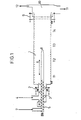
- FIG. 1 An apparatus which can be used for the process according to the invention is shown by way of example in FIG. 1.
- a rotary kiln 1 which is divided into 4 heating zones T1 to T4, is connected via a seal 2 to a screw conveyor 3, which feeds the iron oxide hydroxide powder, optionally together with a gas stream, into the furnace via the feed 4.
- Concentric to the screw conveyor 3, a metering orifice 5 is installed in its axis, which is arranged to be displaceable along the axis 6 of the furnace.
- the reducing agent can be introduced into the furnace at any point by means of the displaceable lance 5 at the exit point 8.
- the discharge device 10 On the opposite side of the rotary kiln, the discharge device 10 is connected by the seal 9, through which the magnetite formed is discharged via a lock 11 and fed to the subsequent device for oxidation to gamma-iron (III) oxide.
- the escaping exhaust gas can be removed via the outlet 12.
- the magnetite obtained after carrying out the process steps described is then, advantageously also in a rotary tube furnace in a manner known per se, by passing over oxygen-containing gases, generally air, at 150 to 540 ° C., preferably 200 to 400 ° C., to acicular ferrimagnetic iron oxides of the formula FeO x and values for x of greater than 1.33 to 1.50 are oxidized.
- oxygen-containing gases generally air
- the oxidation is usually carried out up to the level of gamma-iron (III) oxide.
- the gamma-etsen (III) oxides produced by the process according to the invention are distinguished by a very good preservation of the needle shape compared to the iron oxide hydroxides used. What is striking is the desired coercive force strength of 24 to 30 kA / m compared to a crystallite size of 24 to 35 nanometers obtained with a specific surface according to BET compared to a ⁇ -iron (III) oxide produced according to the current state of the art between 20 and 35 m 2 / g. This results in a particular suitability of these oxides to produce ma g netic Aufzeitsirägern with very good Tisfen andminenaus concedeberry with good print-through ratio and low operating noise.
- the magnetic recording media are produced using a gamma-iron (III) oxide obtained by the process according to the invention in a known manner and using customary technology.
- the invention is illustrated by the following examples and comparative experiments.
- the specific surface area of the powder is determined according to BET and is given in m 2 / g.
- the value of the average crystallite size in the individual particles is determined by X-ray diffraction. Using a Siemens counter tube goniometer, the reflex profile, e.g. of the (911) reflex. The average crystallite size is derived from this minus the apparatus constant.
- the radiation source is e.g. the iron-filtered K- ⁇ line of cobalt.
- the coercive force - (Hc) is given in kA / m
- the specific remanence - (Mr / p) and the specific magnetization (Mm / ⁇ ) are given in nTm 3 / g.
- the magnetic tape samples are also measured with a vibration magnetometer at a field strength of 100 kA / m.
- the competitive field strength Hc is given in kA / m, the remanent magnetization Mr in mT and the directional factor (Rf), ie the ratio of the remanent magnetization along the preferred direction to the transverse direction.
- the depth and height controllability is measured in accordance with DIN 45 512, Part II, against the IEC 1 reference band.
- the copy loss Kd and the operating noise (RGA signal-to-noise ratio measured via A filter) is based on the aforementioned IEC 1 reference band, which is set to 0 dB.
- needle-shaped lepidocrocite with a BET specific surface area of 32.5 m 2 / g, an average needle length of 0.5 ⁇ m and a length-to-length of Thickness ratio of 10: 1 promoted, with 20 Nm 3 nitrogen per hour being blown into the inlet screw.
- the lepidocrocite used is equipped with 0.25% Sn on the surface of the needles.
- the product is heated in the oven according to the 3 heating zones at 380, 450 and 520 ° C product temperature. After a dwell time set to 50 minutes, the reduced product, i.e.
- Example 3 The procedure is as described in Example 1, but the so-called movable lance, as in Example 3, is positioned in the middle of the heated length of the oven and 1.5 kg of stearic acid are metered in per hour without introduction of H Z through this lance.
- the measurement results are given in Table 1.
- the rotary kiln system consists of 3 rotary kilns, a dewatering oven with an inlet of 20 Nm 3 nitrogen per hour and a heater, which leads to a product temperature of 380 ° C, with a product dwell time of 30 minutes, a reduction oven in the 1.5 kg Stearic acid and 20 Nm 'of hydrogen are introduced per hour, the 2 heating zones of which have temperatures of 450 to 520 ° C, with a residence time of the product of 40 minutes and an oxidation furnace, the heating of which is a product temperature of 250 ° C and an introduction of 22 Nm 3 air per hour with a residence time of 30 minutes.
- Table 1 The measurement results are given in Table 1.
- the furnace line consists of a reduction and oxidation furnace. However, no so-called movable lance is attached to the reduction furnace.
Landscapes
- Chemical & Material Sciences (AREA)
- Organic Chemistry (AREA)
- Inorganic Chemistry (AREA)
- Hard Magnetic Materials (AREA)
- Compounds Of Iron (AREA)
Applications Claiming Priority (2)
| Application Number | Priority Date | Filing Date | Title |
|---|---|---|---|
| DE19853515085 DE3515085A1 (de) | 1985-04-26 | 1985-04-26 | Verfahren zur herstellung von nadelfoermigen, ferrimagnetischen gamma-eisen(iii)-oxiden |
| DE3515085 | 1985-04-26 |
Publications (3)
| Publication Number | Publication Date |
|---|---|
| EP0200985A2 true EP0200985A2 (fr) | 1986-11-12 |
| EP0200985A3 EP0200985A3 (en) | 1989-06-14 |
| EP0200985B1 EP0200985B1 (fr) | 1991-07-10 |
Family
ID=6269177
Family Applications (1)
| Application Number | Title | Priority Date | Filing Date |
|---|---|---|---|
| EP86105532A Expired - Lifetime EP0200985B1 (fr) | 1985-04-26 | 1986-04-22 | Procédé pour la fabrication d'oxyde de fer III gamma aciculaire ferrimagnétique |
Country Status (3)
| Country | Link |
|---|---|
| EP (1) | EP0200985B1 (fr) |
| JP (1) | JPS61251524A (fr) |
| DE (2) | DE3515085A1 (fr) |
Families Citing this family (2)
| Publication number | Priority date | Publication date | Assignee | Title |
|---|---|---|---|---|
| GB9721804D0 (en) | 1997-10-15 | 1997-12-17 | Gec Marconi Avionics Holdings | Improvements in or relating to liquid crystal displays |
| US6204906B1 (en) | 1999-03-22 | 2001-03-20 | Lawrence E. Tannas, Jr. | Methods of customizing the physical size and shape of commercial off-the-shelf (COTS) electronic displays |
Family Cites Families (2)
| Publication number | Priority date | Publication date | Assignee | Title |
|---|---|---|---|---|
| US4096292A (en) * | 1975-01-14 | 1978-06-20 | Montedison S.P.A. | Process for preparing ferrimagnetic acicular ferric oxide |
| DE3044340A1 (de) * | 1980-11-25 | 1982-06-24 | Basf Ag, 6700 Ludwigshafen | Verfahren zur herstellung von hochkoerzitivem nadelfoermigem gamma-eisen(iii)oxid |
-
1985
- 1985-04-26 DE DE19853515085 patent/DE3515085A1/de not_active Withdrawn
-
1986
- 1986-04-22 EP EP86105532A patent/EP0200985B1/fr not_active Expired - Lifetime
- 1986-04-22 DE DE8686105532T patent/DE3680146D1/de not_active Expired - Lifetime
- 1986-04-25 JP JP61094952A patent/JPS61251524A/ja active Pending
Also Published As
| Publication number | Publication date |
|---|---|
| JPS61251524A (ja) | 1986-11-08 |
| EP0200985A3 (en) | 1989-06-14 |
| DE3680146D1 (de) | 1991-08-14 |
| EP0200985B1 (fr) | 1991-07-10 |
| DE3515085A1 (de) | 1986-10-30 |
Similar Documents
| Publication | Publication Date | Title |
|---|---|---|
| DE2646348C2 (de) | Verfahren zur Herstellung von nadelförmigen, ferromagnetischen, im wesentlichen aus Eisen bestehenden Metallteilchen und deren Verwendung zur Herstellung von magnetischen Aufzeichnungsträgern | |
| EP0024693B1 (fr) | Procédé de préparation d'oxyde de fer ferrimagnétique aciculaire et son application | |
| EP0018009A1 (fr) | Oxyde de fer magnétique aciculaire modifié, procédé pour sa préparation et son utilisation pour la fabrication de supports d'enregistrements magnétiques | |
| EP0014902A1 (fr) | Procédé de préparation d'oxyde de fer magnétique aciculaire renfermant du cobalt | |
| DE1771327B1 (de) | Verfahren zur herstellung von magnetischemx gamma fe tief 2 o tief 3 aus alpha ferrioxid oder hydratisiertem alpha ferrioxyd | |
| EP0024694B1 (fr) | Procédé de préparation de particules aciculaires ferromagnétiques de fer, et leur application | |
| EP0105110B1 (fr) | Procédé de préparation de particules métalliques aciculaires ferromagnétiques composées essentiellement de fer | |
| EP0063730A2 (fr) | Procédé de stabilisation de particules métalliques pyrophores ferromagnétiques aciculaires constituées essentiellement par du fer | |
| EP0024692B1 (fr) | Procédé de préparation de particules aciculaires ferromagnétiques de fer, et leur application | |
| EP0097900B1 (fr) | Procédé de préparation d'oxydes de fer ferromagnétiques aciculaires | |
| EP0200985B1 (fr) | Procédé pour la fabrication d'oxyde de fer III gamma aciculaire ferrimagnétique | |
| EP0087578B1 (fr) | Oxyde de fer ferrimagnétique aciculaire et procédé pour sa préparation | |
| EP0078950B1 (fr) | Procédé de préparation d'oxydes de fer aciculaire, ferrimagnetique | |
| DD150271A5 (de) | Verfahren zur herstellung eines magnetischen materials aus oberflaechenmodifiziertem eisenoxid | |
| DE2447386C2 (de) | Verfahren zur Herstellung von γ-Eisen(III)oxid | |
| EP0052741B1 (fr) | Procédé de préparation d'oxyde de fer(III) gamma aciculair à champ coercitif élevé | |
| DE2520379B2 (de) | Verfahren zur Herstellung von nadeiförmigem γ -Ferrioxid und Verwendung desselben zur Herstellung eines magnetischen Aufzeichnungsmaterials | |
| EP0014302A1 (fr) | Procédé de préparation d'un oxyde de fer(III)gamma aciculaire très coercitif | |
| DE3941578A1 (de) | Verfahren zur herstellung von stabilisiertem chromdioxid und magnetischer aufzeichnungstraeger enthaltend dieses material | |
| EP0028767A1 (fr) | Procédé de fabrication d'oxyde ferrique (III) gamma et son utilisation dans la fabrication de supports d'enregistrement magnétiques | |
| EP0256459A2 (fr) | Procédé pour la fabrication d'un oxyde de fer aciculaire ferrimagnétique | |
| EP0201822B1 (fr) | Procédé pour la fabrication d'oxydes de fer aciculaire contenant du cobalt | |
| DE4005211A1 (de) | Verfahren zum stabilisieren von hochkoerzitivem chromdioxidmaterial | |
| DE1771327C (de) | Verfahren zur Herstellung von magneti schem gamma Fe tief 2 O tief 3 aus alpha Fernoxid oder hydratisiertem alpha Fernoxid | |
| DE1249242B (de) | Verfahren zur Herstellung von magnetischem Eisen-III-oxyd |
Legal Events
| Date | Code | Title | Description |
|---|---|---|---|
| PUAI | Public reference made under article 153(3) epc to a published international application that has entered the european phase |
Free format text: ORIGINAL CODE: 0009012 |
|
| AK | Designated contracting states |
Kind code of ref document: A2 Designated state(s): DE FR GB NL |
|
| PUAB | Information related to the publication of an a document modified or deleted |
Free format text: ORIGINAL CODE: 0009199EPPU |
|
| RA1 | Application published (corrected) |
Date of ref document: 19861217 Kind code of ref document: A2 |
|
| PUAL | Search report despatched |
Free format text: ORIGINAL CODE: 0009013 |
|
| RHK1 | Main classification (correction) |
Ipc: G11B 5/706 |
|
| AK | Designated contracting states |
Kind code of ref document: A3 Designated state(s): DE FR GB NL |
|
| 17P | Request for examination filed |
Effective date: 19890511 |
|
| 17Q | First examination report despatched |
Effective date: 19900830 |
|
| GRAA | (expected) grant |
Free format text: ORIGINAL CODE: 0009210 |
|
| AK | Designated contracting states |
Kind code of ref document: B1 Designated state(s): DE FR GB NL |
|
| REF | Corresponds to: |
Ref document number: 3680146 Country of ref document: DE Date of ref document: 19910814 |
|
| GBT | Gb: translation of ep patent filed (gb section 77(6)(a)/1977) | ||
| ET | Fr: translation filed | ||
| PLBE | No opposition filed within time limit |
Free format text: ORIGINAL CODE: 0009261 |
|
| STAA | Information on the status of an ep patent application or granted ep patent |
Free format text: STATUS: NO OPPOSITION FILED WITHIN TIME LIMIT |
|
| 26N | No opposition filed | ||
| PGFP | Annual fee paid to national office [announced via postgrant information from national office to epo] |
Ref country code: FR Payment date: 19930312 Year of fee payment: 8 |
|
| PGFP | Annual fee paid to national office [announced via postgrant information from national office to epo] |
Ref country code: GB Payment date: 19930416 Year of fee payment: 8 |
|
| PGFP | Annual fee paid to national office [announced via postgrant information from national office to epo] |
Ref country code: DE Payment date: 19930422 Year of fee payment: 8 |
|
| PGFP | Annual fee paid to national office [announced via postgrant information from national office to epo] |
Ref country code: NL Payment date: 19930430 Year of fee payment: 8 |
|
| PG25 | Lapsed in a contracting state [announced via postgrant information from national office to epo] |
Ref country code: GB Effective date: 19940422 |
|
| PG25 | Lapsed in a contracting state [announced via postgrant information from national office to epo] |
Ref country code: NL Effective date: 19941101 |
|
| NLV4 | Nl: lapsed or anulled due to non-payment of the annual fee | ||
| GBPC | Gb: european patent ceased through non-payment of renewal fee |
Effective date: 19940422 |
|
| PG25 | Lapsed in a contracting state [announced via postgrant information from national office to epo] |
Ref country code: FR Effective date: 19941229 |
|
| PG25 | Lapsed in a contracting state [announced via postgrant information from national office to epo] |
Ref country code: DE Effective date: 19950103 |
|
| REG | Reference to a national code |
Ref country code: FR Ref legal event code: ST |