EP0201033A2 - A method for processing silver halide color photographic materials - Google Patents
A method for processing silver halide color photographic materials Download PDFInfo
- Publication number
- EP0201033A2 EP0201033A2 EP19860105906 EP86105906A EP0201033A2 EP 0201033 A2 EP0201033 A2 EP 0201033A2 EP 19860105906 EP19860105906 EP 19860105906 EP 86105906 A EP86105906 A EP 86105906A EP 0201033 A2 EP0201033 A2 EP 0201033A2
- Authority
- EP
- European Patent Office
- Prior art keywords
- group
- general formula
- represented
- processing method
- hydrogen atom
- Prior art date
- Legal status (The legal status is an assumption and is not a legal conclusion. Google has not performed a legal analysis and makes no representation as to the accuracy of the status listed.)
- Granted
Links
- -1 silver halide Chemical class 0.000 title claims abstract description 290
- 229910052709 silver Inorganic materials 0.000 title claims abstract description 117
- 239000004332 silver Substances 0.000 title claims abstract description 117
- 239000000463 material Substances 0.000 title claims abstract description 39
- 238000000034 method Methods 0.000 title claims description 90
- 238000012545 processing Methods 0.000 title claims description 33
- 125000001424 substituent group Chemical group 0.000 claims abstract description 91
- 125000004435 hydrogen atom Chemical group [H]* 0.000 claims abstract description 49
- 125000000623 heterocyclic group Chemical group 0.000 claims abstract description 40
- 238000003672 processing method Methods 0.000 claims abstract description 29
- JKFYKCYQEWQPTM-UHFFFAOYSA-N 2-azaniumyl-2-(4-fluorophenyl)acetate Chemical compound OC(=O)C(N)C1=CC=C(F)C=C1 JKFYKCYQEWQPTM-UHFFFAOYSA-N 0.000 claims abstract description 25
- 229910021612 Silver iodide Inorganic materials 0.000 claims abstract description 25
- 229940045105 silver iodide Drugs 0.000 claims abstract description 25
- CPELXLSAUQHCOX-UHFFFAOYSA-M Bromide Chemical compound [Br-] CPELXLSAUQHCOX-UHFFFAOYSA-M 0.000 claims abstract description 10
- QJGQUHMNIGDVPM-UHFFFAOYSA-N nitrogen group Chemical group [N] QJGQUHMNIGDVPM-UHFFFAOYSA-N 0.000 claims abstract description 8
- 239000011258 core-shell material Substances 0.000 claims abstract 4
- 125000000217 alkyl group Chemical group 0.000 claims description 82
- 239000000839 emulsion Substances 0.000 claims description 56
- 125000003118 aryl group Chemical group 0.000 claims description 54
- 230000008569 process Effects 0.000 claims description 50
- 125000004432 carbon atom Chemical group C* 0.000 claims description 46
- 150000001875 compounds Chemical class 0.000 claims description 39
- 125000003545 alkoxy group Chemical group 0.000 claims description 26
- 239000003795 chemical substances by application Substances 0.000 claims description 26
- 239000002738 chelating agent Substances 0.000 claims description 25
- 125000001997 phenyl group Chemical group [H]C1=C([H])C([H])=C(*)C([H])=C1[H] 0.000 claims description 25
- 125000000753 cycloalkyl group Chemical group 0.000 claims description 24
- 125000005843 halogen group Chemical group 0.000 claims description 18
- ZUNKMNLKJXRCDM-UHFFFAOYSA-N silver bromoiodide Chemical compound [Ag].IBr ZUNKMNLKJXRCDM-UHFFFAOYSA-N 0.000 claims description 17
- 125000003342 alkenyl group Chemical group 0.000 claims description 15
- 150000003839 salts Chemical class 0.000 claims description 15
- 125000002252 acyl group Chemical group 0.000 claims description 14
- 125000004397 aminosulfonyl group Chemical group NS(=O)(=O)* 0.000 claims description 14
- 125000004104 aryloxy group Chemical group 0.000 claims description 14
- 125000004429 atom Chemical group 0.000 claims description 14
- 229910052783 alkali metal Inorganic materials 0.000 claims description 13
- 125000004414 alkyl thio group Chemical group 0.000 claims description 13
- 125000005110 aryl thio group Chemical group 0.000 claims description 13
- 125000003917 carbamoyl group Chemical group [H]N([H])C(*)=O 0.000 claims description 13
- 125000004423 acyloxy group Chemical group 0.000 claims description 12
- 125000005161 aryl oxy carbonyl group Chemical group 0.000 claims description 12
- 125000000472 sulfonyl group Chemical group *S(*)(=O)=O 0.000 claims description 12
- 125000004453 alkoxycarbonyl group Chemical group 0.000 claims description 11
- 125000003277 amino group Chemical group 0.000 claims description 11
- 125000004093 cyano group Chemical group *C#N 0.000 claims description 11
- 125000004442 acylamino group Chemical group 0.000 claims description 10
- 125000002947 alkylene group Chemical group 0.000 claims description 10
- XEEYBQQBJWHFJM-UHFFFAOYSA-N Iron Chemical compound [Fe] XEEYBQQBJWHFJM-UHFFFAOYSA-N 0.000 claims description 9
- 150000001340 alkali metals Chemical group 0.000 claims description 9
- 125000002887 hydroxy group Chemical group [H]O* 0.000 claims description 9
- 125000004466 alkoxycarbonylamino group Chemical group 0.000 claims description 8
- 125000000392 cycloalkenyl group Chemical group 0.000 claims description 8
- 150000002430 hydrocarbons Chemical class 0.000 claims description 8
- ADZWSOLPGZMUMY-UHFFFAOYSA-M silver bromide Chemical compound [Ag]Br ADZWSOLPGZMUMY-UHFFFAOYSA-M 0.000 claims description 8
- 125000001951 carbamoylamino group Chemical group C(N)(=O)N* 0.000 claims description 7
- 125000005420 sulfonamido group Chemical group S(=O)(=O)(N*)* 0.000 claims description 7
- 125000001769 aryl amino group Chemical group 0.000 claims description 6
- 125000005162 aryl oxy carbonyl amino group Chemical group 0.000 claims description 6
- 238000006243 chemical reaction Methods 0.000 claims description 6
- 230000003647 oxidation Effects 0.000 claims description 6
- 238000007254 oxidation reaction Methods 0.000 claims description 6
- 125000005499 phosphonyl group Chemical group 0.000 claims description 6
- 125000000475 sulfinyl group Chemical group [*:2]S([*:1])=O 0.000 claims description 6
- 125000000542 sulfonic acid group Chemical group 0.000 claims description 6
- 125000004122 cyclic group Chemical group 0.000 claims description 5
- 125000004663 dialkyl amino group Chemical group 0.000 claims description 5
- 150000003413 spiro compounds Chemical class 0.000 claims description 5
- 125000004070 6 membered heterocyclic group Chemical group 0.000 claims description 4
- NBIIXXVUZAFLBC-UHFFFAOYSA-N Phosphoric acid Chemical group OP(O)(O)=O NBIIXXVUZAFLBC-UHFFFAOYSA-N 0.000 claims description 4
- 125000003282 alkyl amino group Chemical group 0.000 claims description 4
- 125000005336 allyloxy group Chemical group 0.000 claims description 4
- 150000001768 cations Chemical class 0.000 claims description 3
- 229920006395 saturated elastomer Polymers 0.000 claims description 3
- 229910018828 PO3H2 Inorganic materials 0.000 claims description 2
- 125000002102 aryl alkyloxo group Chemical group 0.000 claims description 2
- 125000002993 cycloalkylene group Chemical group 0.000 claims description 2
- 125000004573 morpholin-4-yl group Chemical group N1(CCOCC1)* 0.000 claims description 2
- 125000000962 organic group Chemical group 0.000 claims description 2
- 125000000843 phenylene group Chemical group C1(=C(C=CC=C1)*)* 0.000 claims description 2
- 125000004469 siloxy group Chemical group [SiH3]O* 0.000 claims description 2
- 125000000304 alkynyl group Chemical group 0.000 claims 2
- 125000005586 carbonic acid group Chemical group 0.000 claims 2
- 229930195733 hydrocarbon Natural products 0.000 claims 2
- 125000001905 inorganic group Chemical group 0.000 claims 1
- 229910052739 hydrogen Inorganic materials 0.000 abstract description 11
- 239000001257 hydrogen Substances 0.000 abstract description 11
- 238000011161 development Methods 0.000 description 48
- 239000010410 layer Substances 0.000 description 42
- 238000005406 washing Methods 0.000 description 42
- BQCADISMDOOEFD-UHFFFAOYSA-N Silver Chemical compound [Ag] BQCADISMDOOEFD-UHFFFAOYSA-N 0.000 description 34
- 239000000243 solution Substances 0.000 description 26
- 239000000975 dye Substances 0.000 description 22
- 238000004061 bleaching Methods 0.000 description 19
- JHJLBTNAGRQEKS-UHFFFAOYSA-M sodium bromide Chemical compound [Na+].[Br-] JHJLBTNAGRQEKS-UHFFFAOYSA-M 0.000 description 18
- 238000000576 coating method Methods 0.000 description 17
- 239000000126 substance Substances 0.000 description 17
- QTBSBXVTEAMEQO-UHFFFAOYSA-N Acetic acid Chemical compound CC(O)=O QTBSBXVTEAMEQO-UHFFFAOYSA-N 0.000 description 16
- 230000000694 effects Effects 0.000 description 16
- 230000001235 sensitizing effect Effects 0.000 description 16
- 108010010803 Gelatin Proteins 0.000 description 14
- 229920000159 gelatin Polymers 0.000 description 14
- 239000008273 gelatin Substances 0.000 description 14
- 235000019322 gelatine Nutrition 0.000 description 14
- 235000011852 gelatine desserts Nutrition 0.000 description 14
- 239000000203 mixture Substances 0.000 description 14
- XLYOFNOQVPJJNP-UHFFFAOYSA-N water Substances O XLYOFNOQVPJJNP-UHFFFAOYSA-N 0.000 description 14
- 239000011248 coating agent Substances 0.000 description 13
- 238000005859 coupling reaction Methods 0.000 description 13
- 230000000087 stabilizing effect Effects 0.000 description 13
- 229910052801 chlorine Inorganic materials 0.000 description 9
- 125000000999 tert-butyl group Chemical group [H]C([H])([H])C(*)(C([H])([H])[H])C([H])([H])[H] 0.000 description 9
- UFHFLCQGNIYNRP-UHFFFAOYSA-N Hydrogen Chemical compound [H][H] UFHFLCQGNIYNRP-UHFFFAOYSA-N 0.000 description 8
- 239000002253 acid Substances 0.000 description 8
- 125000001495 ethyl group Chemical group [H]C([H])([H])C([H])([H])* 0.000 description 8
- 229910052757 nitrogen Inorganic materials 0.000 description 8
- 230000003287 optical effect Effects 0.000 description 8
- 238000003912 environmental pollution Methods 0.000 description 7
- 229910052736 halogen Inorganic materials 0.000 description 7
- 150000002367 halogens Chemical class 0.000 description 7
- 239000007800 oxidant agent Substances 0.000 description 7
- 239000000047 product Substances 0.000 description 7
- DHCDFWKWKRSZHF-UHFFFAOYSA-L thiosulfate(2-) Chemical compound [O-]S([S-])(=O)=O DHCDFWKWKRSZHF-UHFFFAOYSA-L 0.000 description 7
- IJGRMHOSHXDMSA-UHFFFAOYSA-N Atomic nitrogen Chemical compound N#N IJGRMHOSHXDMSA-UHFFFAOYSA-N 0.000 description 6
- WKBOTKDWSSQWDR-UHFFFAOYSA-N Bromine atom Chemical group [Br] WKBOTKDWSSQWDR-UHFFFAOYSA-N 0.000 description 6
- ZAMOUSCENKQFHK-UHFFFAOYSA-N Chlorine atom Chemical compound [Cl] ZAMOUSCENKQFHK-UHFFFAOYSA-N 0.000 description 6
- HEMHJVSKTPXQMS-UHFFFAOYSA-M Sodium hydroxide Chemical compound [OH-].[Na+] HEMHJVSKTPXQMS-UHFFFAOYSA-M 0.000 description 6
- 229960000583 acetic acid Drugs 0.000 description 6
- 125000003178 carboxy group Chemical group [H]OC(*)=O 0.000 description 6
- 239000000460 chlorine Substances 0.000 description 6
- 230000008878 coupling Effects 0.000 description 6
- 238000010168 coupling process Methods 0.000 description 6
- 229910052731 fluorine Inorganic materials 0.000 description 6
- 239000003112 inhibitor Substances 0.000 description 6
- 125000002496 methyl group Chemical group [H]C([H])([H])* 0.000 description 6
- 125000001624 naphthyl group Chemical group 0.000 description 6
- 125000004434 sulfur atom Chemical group 0.000 description 6
- PXGOKWXKJXAPGV-UHFFFAOYSA-N Fluorine Chemical compound FF PXGOKWXKJXAPGV-UHFFFAOYSA-N 0.000 description 5
- 206010070834 Sensitisation Diseases 0.000 description 5
- 229910052799 carbon Inorganic materials 0.000 description 5
- 150000004696 coordination complex Chemical class 0.000 description 5
- 229920001577 copolymer Polymers 0.000 description 5
- 125000000113 cyclohexyl group Chemical group [H]C1([H])C([H])([H])C([H])([H])C([H])(*)C([H])([H])C1([H])[H] 0.000 description 5
- 125000003438 dodecyl group Chemical group [H]C([H])([H])C([H])([H])C([H])([H])C([H])([H])C([H])([H])C([H])([H])C([H])([H])C([H])([H])C([H])([H])C([H])([H])C([H])([H])C([H])([H])* 0.000 description 5
- 238000001704 evaporation Methods 0.000 description 5
- 239000011737 fluorine Substances 0.000 description 5
- 150000002505 iron Chemical class 0.000 description 5
- 150000007524 organic acids Chemical class 0.000 description 5
- 125000000951 phenoxy group Chemical group [H]C1=C([H])C([H])=C(O*)C([H])=C1[H] 0.000 description 5
- 230000008313 sensitization Effects 0.000 description 5
- 125000000565 sulfonamide group Chemical group 0.000 description 5
- CDAWCLOXVUBKRW-UHFFFAOYSA-N 2-aminophenol Chemical compound NC1=CC=CC=C1O CDAWCLOXVUBKRW-UHFFFAOYSA-N 0.000 description 4
- SNRUBQQJIBEYMU-UHFFFAOYSA-N Dodecane Natural products CCCCCCCCCCCC SNRUBQQJIBEYMU-UHFFFAOYSA-N 0.000 description 4
- MUBZPKHOEPUJKR-UHFFFAOYSA-N Oxalic acid Chemical compound OC(=O)C(O)=O MUBZPKHOEPUJKR-UHFFFAOYSA-N 0.000 description 4
- CDBYLPFSWZWCQE-UHFFFAOYSA-L Sodium Carbonate Chemical compound [Na+].[Na+].[O-]C([O-])=O CDBYLPFSWZWCQE-UHFFFAOYSA-L 0.000 description 4
- 235000011054 acetic acid Nutrition 0.000 description 4
- 125000006193 alkinyl group Chemical group 0.000 description 4
- 230000015572 biosynthetic process Effects 0.000 description 4
- GDTBXPJZTBHREO-UHFFFAOYSA-N bromine Substances BrBr GDTBXPJZTBHREO-UHFFFAOYSA-N 0.000 description 4
- 229910052794 bromium Inorganic materials 0.000 description 4
- 150000001649 bromium compounds Chemical class 0.000 description 4
- 238000009833 condensation Methods 0.000 description 4
- 230000005494 condensation Effects 0.000 description 4
- 208000028659 discharge Diseases 0.000 description 4
- 238000009826 distribution Methods 0.000 description 4
- 238000005516 engineering process Methods 0.000 description 4
- 230000008020 evaporation Effects 0.000 description 4
- 229910052742 iron Inorganic materials 0.000 description 4
- 229910052751 metal Inorganic materials 0.000 description 4
- 239000002184 metal Substances 0.000 description 4
- 125000000449 nitro group Chemical group [O-][N+](*)=O 0.000 description 4
- 229910052760 oxygen Inorganic materials 0.000 description 4
- 239000001301 oxygen Substances 0.000 description 4
- 125000006678 phenoxycarbonyl group Chemical group 0.000 description 4
- IOLCXVTUBQKXJR-UHFFFAOYSA-M potassium bromide Chemical compound [K+].[Br-] IOLCXVTUBQKXJR-UHFFFAOYSA-M 0.000 description 4
- BWHMMNNQKKPAPP-UHFFFAOYSA-L potassium carbonate Chemical compound [K+].[K+].[O-]C([O-])=O BWHMMNNQKKPAPP-UHFFFAOYSA-L 0.000 description 4
- 239000002244 precipitate Substances 0.000 description 4
- 125000002924 primary amino group Chemical group [H]N([H])* 0.000 description 4
- 230000001172 regenerating effect Effects 0.000 description 4
- 230000035945 sensitivity Effects 0.000 description 4
- 238000003786 synthesis reaction Methods 0.000 description 4
- 125000003903 2-propenyl group Chemical group [H]C([*])([H])C([H])=C([H])[H] 0.000 description 3
- 125000002373 5 membered heterocyclic group Chemical group 0.000 description 3
- ZCYVEMRRCGMTRW-UHFFFAOYSA-N 7553-56-2 Chemical compound [I] ZCYVEMRRCGMTRW-UHFFFAOYSA-N 0.000 description 3
- WEVYAHXRMPXWCK-UHFFFAOYSA-N Acetonitrile Chemical compound CC#N WEVYAHXRMPXWCK-UHFFFAOYSA-N 0.000 description 3
- UHOVQNZJYSORNB-UHFFFAOYSA-N Benzene Chemical compound C1=CC=CC=C1 UHOVQNZJYSORNB-UHFFFAOYSA-N 0.000 description 3
- WVDDGKGOMKODPV-UHFFFAOYSA-N Benzyl alcohol Chemical class OCC1=CC=CC=C1 WVDDGKGOMKODPV-UHFFFAOYSA-N 0.000 description 3
- PEDCQBHIVMGVHV-UHFFFAOYSA-N Glycerine Chemical compound OCC(O)CO PEDCQBHIVMGVHV-UHFFFAOYSA-N 0.000 description 3
- OKKJLVBELUTLKV-UHFFFAOYSA-N Methanol Chemical compound OC OKKJLVBELUTLKV-UHFFFAOYSA-N 0.000 description 3
- KWYUFKZDYYNOTN-UHFFFAOYSA-M Potassium hydroxide Chemical compound [OH-].[K+] KWYUFKZDYYNOTN-UHFFFAOYSA-M 0.000 description 3
- 229910021607 Silver chloride Inorganic materials 0.000 description 3
- 125000002777 acetyl group Chemical group [H]C([H])([H])C(*)=O 0.000 description 3
- 239000000654 additive Substances 0.000 description 3
- 239000003513 alkali Substances 0.000 description 3
- 125000004448 alkyl carbonyl group Chemical group 0.000 description 3
- 125000005196 alkyl carbonyloxy group Chemical group 0.000 description 3
- 125000004390 alkyl sulfonyl group Chemical group 0.000 description 3
- 125000005199 aryl carbonyloxy group Chemical group 0.000 description 3
- 125000004391 aryl sulfonyl group Chemical group 0.000 description 3
- QVGXLLKOCUKJST-UHFFFAOYSA-N atomic oxygen Chemical compound [O] QVGXLLKOCUKJST-UHFFFAOYSA-N 0.000 description 3
- 125000001164 benzothiazolyl group Chemical group S1C(=NC2=C1C=CC=C2)* 0.000 description 3
- 125000003236 benzoyl group Chemical group [H]C1=C([H])C([H])=C(C([H])=C1[H])C(*)=O 0.000 description 3
- 239000007844 bleaching agent Substances 0.000 description 3
- 125000001309 chloro group Chemical group Cl* 0.000 description 3
- KRKNYBCHXYNGOX-UHFFFAOYSA-N citric acid Chemical compound OC(=O)CC(O)(C(O)=O)CC(O)=O KRKNYBCHXYNGOX-UHFFFAOYSA-N 0.000 description 3
- 238000004090 dissolution Methods 0.000 description 3
- 230000006870 function Effects 0.000 description 3
- 229910052740 iodine Inorganic materials 0.000 description 3
- 239000011630 iodine Substances 0.000 description 3
- 125000001449 isopropyl group Chemical group [H]C([H])([H])C([H])(*)C([H])([H])[H] 0.000 description 3
- 239000007788 liquid Substances 0.000 description 3
- 238000002156 mixing Methods 0.000 description 3
- 125000004433 nitrogen atom Chemical group N* 0.000 description 3
- 125000004430 oxygen atom Chemical group O* 0.000 description 3
- 125000003356 phenylsulfanyl group Chemical group [*]SC1=C([H])C([H])=C([H])C([H])=C1[H] 0.000 description 3
- 229920000642 polymer Polymers 0.000 description 3
- HKZLPVFGJNLROG-UHFFFAOYSA-M silver monochloride Chemical compound [Cl-].[Ag+] HKZLPVFGJNLROG-UHFFFAOYSA-M 0.000 description 3
- 239000003381 stabilizer Substances 0.000 description 3
- 229910052717 sulfur Inorganic materials 0.000 description 3
- 230000002194 synthesizing effect Effects 0.000 description 3
- 125000003944 tolyl group Chemical group 0.000 description 3
- HBEDSQVIWPRPAY-UHFFFAOYSA-N 2,3-dihydrobenzofuran Chemical compound C1=CC=C2OCCC2=C1 HBEDSQVIWPRPAY-UHFFFAOYSA-N 0.000 description 2
- YTVCECQSAPGJBB-UHFFFAOYSA-N 2,4-dichloro-3-ethyl-6-nitrophenol Chemical compound CCC1=C(Cl)C=C([N+]([O-])=O)C(O)=C1Cl YTVCECQSAPGJBB-UHFFFAOYSA-N 0.000 description 2
- 125000002941 2-furyl group Chemical group O1C([*])=C([H])C([H])=C1[H] 0.000 description 2
- PLIKAWJENQZMHA-UHFFFAOYSA-N 4-aminophenol Chemical compound NC1=CC=C(O)C=C1 PLIKAWJENQZMHA-UHFFFAOYSA-N 0.000 description 2
- VHUUQVKOLVNVRT-UHFFFAOYSA-N Ammonium hydroxide Chemical compound [NH4+].[OH-] VHUUQVKOLVNVRT-UHFFFAOYSA-N 0.000 description 2
- OKTJSMMVPCPJKN-UHFFFAOYSA-N Carbon Chemical compound [C] OKTJSMMVPCPJKN-UHFFFAOYSA-N 0.000 description 2
- RYGMFSIKBFXOCR-UHFFFAOYSA-N Copper Chemical compound [Cu] RYGMFSIKBFXOCR-UHFFFAOYSA-N 0.000 description 2
- LFQSCWFLJHTTHZ-UHFFFAOYSA-N Ethanol Chemical compound CCO LFQSCWFLJHTTHZ-UHFFFAOYSA-N 0.000 description 2
- VEXZGXHMUGYJMC-UHFFFAOYSA-N Hydrochloric acid Chemical class Cl VEXZGXHMUGYJMC-UHFFFAOYSA-N 0.000 description 2
- MHAJPDPJQMAIIY-UHFFFAOYSA-N Hydrogen peroxide Chemical compound OO MHAJPDPJQMAIIY-UHFFFAOYSA-N 0.000 description 2
- QIGBRXMKCJKVMJ-UHFFFAOYSA-N Hydroquinone Chemical compound OC1=CC=C(O)C=C1 QIGBRXMKCJKVMJ-UHFFFAOYSA-N 0.000 description 2
- KDLHZDBZIXYQEI-UHFFFAOYSA-N Palladium Chemical compound [Pd] KDLHZDBZIXYQEI-UHFFFAOYSA-N 0.000 description 2
- ISWSIDIOOBJBQZ-UHFFFAOYSA-N Phenol Chemical compound OC1=CC=CC=C1 ISWSIDIOOBJBQZ-UHFFFAOYSA-N 0.000 description 2
- 229920003171 Poly (ethylene oxide) Polymers 0.000 description 2
- 239000002202 Polyethylene glycol Chemical class 0.000 description 2
- 239000004793 Polystyrene Substances 0.000 description 2
- NPXOKRUENSOPAO-UHFFFAOYSA-N Raney nickel Chemical compound [Al].[Ni] NPXOKRUENSOPAO-UHFFFAOYSA-N 0.000 description 2
- 229910000564 Raney nickel Inorganic materials 0.000 description 2
- VMHLLURERBWHNL-UHFFFAOYSA-M Sodium acetate Chemical compound [Na+].CC([O-])=O VMHLLURERBWHNL-UHFFFAOYSA-M 0.000 description 2
- FAPWRFPIFSIZLT-UHFFFAOYSA-M Sodium chloride Chemical compound [Na+].[Cl-] FAPWRFPIFSIZLT-UHFFFAOYSA-M 0.000 description 2
- LSNNMFCWUKXFEE-UHFFFAOYSA-N Sulfurous acid Chemical compound OS(O)=O LSNNMFCWUKXFEE-UHFFFAOYSA-N 0.000 description 2
- SJOOOZPMQAWAOP-UHFFFAOYSA-N [Ag].BrCl Chemical compound [Ag].BrCl SJOOOZPMQAWAOP-UHFFFAOYSA-N 0.000 description 2
- 238000009825 accumulation Methods 0.000 description 2
- 125000003668 acetyloxy group Chemical group [H]C([H])([H])C(=O)O[*] 0.000 description 2
- 125000005194 alkoxycarbonyloxy group Chemical group 0.000 description 2
- 125000005422 alkyl sulfonamido group Chemical group 0.000 description 2
- SWLVFNYSXGMGBS-UHFFFAOYSA-N ammonium bromide Chemical compound [NH4+].[Br-] SWLVFNYSXGMGBS-UHFFFAOYSA-N 0.000 description 2
- 239000000908 ammonium hydroxide Substances 0.000 description 2
- 125000002490 anilino group Chemical group [H]N(*)C1=C([H])C([H])=C([H])C([H])=C1[H] 0.000 description 2
- 125000005129 aryl carbonyl group Chemical group 0.000 description 2
- 230000008901 benefit Effects 0.000 description 2
- 125000001231 benzoyloxy group Chemical group C(C1=CC=CC=C1)(=O)O* 0.000 description 2
- 125000001584 benzyloxycarbonyl group Chemical group C(=O)(OCC1=CC=CC=C1)* 0.000 description 2
- 230000005540 biological transmission Effects 0.000 description 2
- 125000000484 butyl group Chemical group [H]C([*])([H])C([H])([H])C([H])([H])C([H])([H])[H] 0.000 description 2
- 125000002843 carboxylic acid group Chemical group 0.000 description 2
- 239000012295 chemical reaction liquid Substances 0.000 description 2
- 239000000084 colloidal system Substances 0.000 description 2
- 238000011109 contamination Methods 0.000 description 2
- 229910052802 copper Inorganic materials 0.000 description 2
- 239000010949 copper Substances 0.000 description 2
- 239000007771 core particle Substances 0.000 description 2
- 239000013078 crystal Substances 0.000 description 2
- 235000014113 dietary fatty acids Nutrition 0.000 description 2
- 238000005868 electrolysis reaction Methods 0.000 description 2
- 125000001301 ethoxy group Chemical group [H]C([H])([H])C([H])([H])O* 0.000 description 2
- 238000002474 experimental method Methods 0.000 description 2
- 239000000194 fatty acid Substances 0.000 description 2
- 229930195729 fatty acid Natural products 0.000 description 2
- 150000004665 fatty acids Chemical class 0.000 description 2
- 125000002541 furyl group Chemical group 0.000 description 2
- 239000012362 glacial acetic acid Substances 0.000 description 2
- 150000002334 glycols Chemical class 0.000 description 2
- 150000004820 halides Chemical class 0.000 description 2
- 150000002431 hydrogen Chemical class 0.000 description 2
- ZMZDMBWJUHKJPS-UHFFFAOYSA-N hydrogen thiocyanate Natural products SC#N ZMZDMBWJUHKJPS-UHFFFAOYSA-N 0.000 description 2
- 239000004615 ingredient Substances 0.000 description 2
- 238000007689 inspection Methods 0.000 description 2
- 239000011229 interlayer Substances 0.000 description 2
- 238000004519 manufacturing process Methods 0.000 description 2
- 125000001160 methoxycarbonyl group Chemical group [H]C([H])([H])OC(*)=O 0.000 description 2
- 125000004170 methylsulfonyl group Chemical group [H]C([H])([H])S(*)(=O)=O 0.000 description 2
- 230000003472 neutralizing effect Effects 0.000 description 2
- 229910052755 nonmetal Inorganic materials 0.000 description 2
- 238000000655 nuclear magnetic resonance spectrum Methods 0.000 description 2
- 125000002347 octyl group Chemical group [H]C([*])([H])C([H])([H])C([H])([H])C([H])([H])C([H])([H])C([H])([H])C([H])([H])C([H])([H])[H] 0.000 description 2
- 239000006179 pH buffering agent Substances 0.000 description 2
- 125000002958 pentadecyl group Chemical group [H]C([*])([H])C([H])([H])C([H])([H])C([H])([H])C([H])([H])C([H])([H])C([H])([H])C([H])([H])C([H])([H])C([H])([H])C([H])([H])C([H])([H])C([H])([H])C([H])([H])C([H])([H])[H] 0.000 description 2
- 125000003170 phenylsulfonyl group Chemical group C1(=CC=CC=C1)S(=O)(=O)* 0.000 description 2
- 230000000704 physical effect Effects 0.000 description 2
- BASFCYQUMIYNBI-UHFFFAOYSA-N platinum Chemical compound [Pt] BASFCYQUMIYNBI-UHFFFAOYSA-N 0.000 description 2
- 229920001223 polyethylene glycol Chemical class 0.000 description 2
- 239000004848 polyfunctional curative Substances 0.000 description 2
- 229920002223 polystyrene Polymers 0.000 description 2
- 229910000027 potassium carbonate Inorganic materials 0.000 description 2
- 235000011181 potassium carbonates Nutrition 0.000 description 2
- 238000001556 precipitation Methods 0.000 description 2
- 125000001436 propyl group Chemical group [H]C([*])([H])C([H])([H])C([H])([H])[H] 0.000 description 2
- 239000011241 protective layer Substances 0.000 description 2
- JEXVQSWXXUJEMA-UHFFFAOYSA-N pyrazol-3-one Chemical class O=C1C=CN=N1 JEXVQSWXXUJEMA-UHFFFAOYSA-N 0.000 description 2
- 125000003226 pyrazolyl group Chemical group 0.000 description 2
- 230000002829 reductive effect Effects 0.000 description 2
- 238000010992 reflux Methods 0.000 description 2
- 230000001105 regulatory effect Effects 0.000 description 2
- 239000003352 sequestering agent Substances 0.000 description 2
- 239000001632 sodium acetate Substances 0.000 description 2
- 235000017281 sodium acetate Nutrition 0.000 description 2
- 229910000029 sodium carbonate Inorganic materials 0.000 description 2
- 235000017550 sodium carbonate Nutrition 0.000 description 2
- 235000011121 sodium hydroxide Nutrition 0.000 description 2
- AKHNMLFCWUSKQB-UHFFFAOYSA-L sodium thiosulfate Chemical compound [Na+].[Na+].[O-]S([O-])(=O)=S AKHNMLFCWUSKQB-UHFFFAOYSA-L 0.000 description 2
- 235000019345 sodium thiosulphate Nutrition 0.000 description 2
- YBBRCQOCSYXUOC-UHFFFAOYSA-N sulfuryl dichloride Chemical compound ClS(Cl)(=O)=O YBBRCQOCSYXUOC-UHFFFAOYSA-N 0.000 description 2
- 239000004094 surface-active agent Substances 0.000 description 2
- 125000003831 tetrazolyl group Chemical group 0.000 description 2
- 125000001544 thienyl group Chemical group 0.000 description 2
- 150000003852 triazoles Chemical group 0.000 description 2
- ZMANZCXQSJIPKH-UHFFFAOYSA-N triethylamine Natural products CCN(CC)CC ZMANZCXQSJIPKH-UHFFFAOYSA-N 0.000 description 2
- 125000002023 trifluoromethyl group Chemical group FC(F)(F)* 0.000 description 2
- 229920002554 vinyl polymer Polymers 0.000 description 2
- TXUICONDJPYNPY-UHFFFAOYSA-N (1,10,13-trimethyl-3-oxo-4,5,6,7,8,9,11,12,14,15,16,17-dodecahydrocyclopenta[a]phenanthren-17-yl) heptanoate Chemical compound C1CC2CC(=O)C=C(C)C2(C)C2C1C1CCC(OC(=O)CCCCCC)C1(C)CC2 TXUICONDJPYNPY-UHFFFAOYSA-N 0.000 description 1
- JYEUMXHLPRZUAT-UHFFFAOYSA-N 1,2,3-triazine Chemical compound C1=CN=NN=C1 JYEUMXHLPRZUAT-UHFFFAOYSA-N 0.000 description 1
- NWUYHJFMYQTDRP-UHFFFAOYSA-N 1,2-bis(ethenyl)benzene;1-ethenyl-2-ethylbenzene;styrene Chemical compound C=CC1=CC=CC=C1.CCC1=CC=CC=C1C=C.C=CC1=CC=CC=C1C=C NWUYHJFMYQTDRP-UHFFFAOYSA-N 0.000 description 1
- CBCKQZAAMUWICA-UHFFFAOYSA-N 1,4-phenylenediamine Chemical compound NC1=CC=C(N)C=C1 CBCKQZAAMUWICA-UHFFFAOYSA-N 0.000 description 1
- 125000004173 1-benzimidazolyl group Chemical group [H]C1=NC2=C([H])C([H])=C([H])C([H])=C2N1* 0.000 description 1
- 125000001637 1-naphthyl group Chemical group [H]C1=C([H])C([H])=C2C(*)=C([H])C([H])=C([H])C2=C1[H] 0.000 description 1
- 125000005978 1-naphthyloxy group Chemical group 0.000 description 1
- 125000004214 1-pyrrolidinyl group Chemical group [H]C1([H])N(*)C([H])([H])C([H])([H])C1([H])[H] 0.000 description 1
- 125000001462 1-pyrrolyl group Chemical group [*]N1C([H])=C([H])C([H])=C1[H] 0.000 description 1
- KJUGUADJHNHALS-UHFFFAOYSA-N 1H-tetrazole Substances C=1N=NNN=1 KJUGUADJHNHALS-UHFFFAOYSA-N 0.000 description 1
- QRYKUYZUDZFZTN-UHFFFAOYSA-N 2-(2-amino-2-oxoethyl)nonadecanoic acid Chemical group CCCCCCCCCCCCCCCCCC(C(O)=O)CC(N)=O QRYKUYZUDZFZTN-UHFFFAOYSA-N 0.000 description 1
- HYVGFUIWHXLVNV-UHFFFAOYSA-N 2-(n-ethylanilino)ethanol Chemical compound OCCN(CC)C1=CC=CC=C1 HYVGFUIWHXLVNV-UHFFFAOYSA-N 0.000 description 1
- NGNBDVOYPDDBFK-UHFFFAOYSA-N 2-[2,4-di(pentan-2-yl)phenoxy]acetyl chloride Chemical compound CCCC(C)C1=CC=C(OCC(Cl)=O)C(C(C)CCC)=C1 NGNBDVOYPDDBFK-UHFFFAOYSA-N 0.000 description 1
- JKRNNIGZNCVVHA-UHFFFAOYSA-N 2-[2-[bis(carboxylatomethyl)amino]ethyl-(carboxylatomethyl)amino]acetate;trimethylazanium Chemical compound C[NH+](C)C.C[NH+](C)C.C[NH+](C)C.C[NH+](C)C.[O-]C(=O)CN(CC([O-])=O)CCN(CC([O-])=O)CC([O-])=O JKRNNIGZNCVVHA-UHFFFAOYSA-N 0.000 description 1
- XNCSCQSQSGDGES-UHFFFAOYSA-N 2-[2-[bis(carboxymethyl)amino]propyl-(carboxymethyl)amino]acetic acid Chemical compound OC(=O)CN(CC(O)=O)C(C)CN(CC(O)=O)CC(O)=O XNCSCQSQSGDGES-UHFFFAOYSA-N 0.000 description 1
- 125000001340 2-chloroethyl group Chemical group [H]C([H])(Cl)C([H])([H])* 0.000 description 1
- 125000000094 2-phenylethyl group Chemical group [H]C1=C([H])C([H])=C(C([H])=C1[H])C([H])([H])C([H])([H])* 0.000 description 1
- 125000004105 2-pyridyl group Chemical group N1=C([*])C([H])=C([H])C([H])=C1[H] 0.000 description 1
- 125000000175 2-thienyl group Chemical group S1C([*])=C([H])C([H])=C1[H] 0.000 description 1
- QJVYRYDARHKQAF-UHFFFAOYSA-N 3,3-dimethyl-2-methylidenebutanoic acid Chemical compound CC(C)(C)C(=C)C(O)=O QJVYRYDARHKQAF-UHFFFAOYSA-N 0.000 description 1
- PYSRRFNXTXNWCD-UHFFFAOYSA-N 3-(2-phenylethenyl)furan-2,5-dione Chemical compound O=C1OC(=O)C(C=CC=2C=CC=CC=2)=C1 PYSRRFNXTXNWCD-UHFFFAOYSA-N 0.000 description 1
- KWYJDIUEHHCHCZ-UHFFFAOYSA-N 3-[2-[bis(2-carboxyethyl)amino]ethyl-(2-carboxyethyl)amino]propanoic acid Chemical compound OC(=O)CCN(CCC(O)=O)CCN(CCC(O)=O)CCC(O)=O KWYJDIUEHHCHCZ-UHFFFAOYSA-N 0.000 description 1
- BMYNFMYTOJXKLE-UHFFFAOYSA-N 3-azaniumyl-2-hydroxypropanoate Chemical compound NCC(O)C(O)=O BMYNFMYTOJXKLE-UHFFFAOYSA-N 0.000 description 1
- XRZDIHADHZSFBB-UHFFFAOYSA-N 3-oxo-n,3-diphenylpropanamide Chemical compound C=1C=CC=CC=1NC(=O)CC(=O)C1=CC=CC=C1 XRZDIHADHZSFBB-UHFFFAOYSA-N 0.000 description 1
- HVBSAKJJOYLTQU-UHFFFAOYSA-N 4-aminobenzenesulfonic acid Chemical compound NC1=CC=C(S(O)(=O)=O)C=C1 HVBSAKJJOYLTQU-UHFFFAOYSA-N 0.000 description 1
- 125000000242 4-chlorobenzoyl group Chemical group ClC1=CC=C(C(=O)*)C=C1 0.000 description 1
- ZVNPWFOVUDMGRP-UHFFFAOYSA-N 4-methylaminophenol sulfate Chemical compound OS(O)(=O)=O.CNC1=CC=C(O)C=C1.CNC1=CC=C(O)C=C1 ZVNPWFOVUDMGRP-UHFFFAOYSA-N 0.000 description 1
- MTOCKMVNXPZCJW-UHFFFAOYSA-N 4-n-dodecyl-4-n-ethyl-2-methylbenzene-1,4-diamine Chemical compound CCCCCCCCCCCCN(CC)C1=CC=C(N)C(C)=C1 MTOCKMVNXPZCJW-UHFFFAOYSA-N 0.000 description 1
- QJNVAFZHBQNXJT-UHFFFAOYSA-N 4-n-ethyl-4-n-(2-methoxyethyl)-2-methylbenzene-1,4-diamine;4-methylbenzenesulfonic acid Chemical compound CC1=CC=C(S(O)(=O)=O)C=C1.COCCN(CC)C1=CC=C(N)C(C)=C1 QJNVAFZHBQNXJT-UHFFFAOYSA-N 0.000 description 1
- IJJSFSXLZYFTKV-UHFFFAOYSA-N 4-n-methylbenzene-1,4-diamine;hydrochloride Chemical compound Cl.CNC1=CC=C(N)C=C1 IJJSFSXLZYFTKV-UHFFFAOYSA-N 0.000 description 1
- QTBSBXVTEAMEQO-UHFFFAOYSA-M Acetate Chemical compound CC([O-])=O QTBSBXVTEAMEQO-UHFFFAOYSA-M 0.000 description 1
- 102000009027 Albumins Human genes 0.000 description 1
- 108010088751 Albumins Proteins 0.000 description 1
- QGZKDVFQNNGYKY-UHFFFAOYSA-N Ammonia Chemical compound N QGZKDVFQNNGYKY-UHFFFAOYSA-N 0.000 description 1
- QGZKDVFQNNGYKY-UHFFFAOYSA-O Ammonium Chemical compound [NH4+] QGZKDVFQNNGYKY-UHFFFAOYSA-O 0.000 description 1
- NOWKCMXCCJGMRR-UHFFFAOYSA-N Aziridine Chemical compound C1CN1 NOWKCMXCCJGMRR-UHFFFAOYSA-N 0.000 description 1
- BTBUEUYNUDRHOZ-UHFFFAOYSA-N Borate Chemical compound [O-]B([O-])[O-] BTBUEUYNUDRHOZ-UHFFFAOYSA-N 0.000 description 1
- KXDHJXZQYSOELW-UHFFFAOYSA-N Carbamic acid Chemical compound NC(O)=O KXDHJXZQYSOELW-UHFFFAOYSA-N 0.000 description 1
- BVKZGUZCCUSVTD-UHFFFAOYSA-L Carbonate Chemical compound [O-]C([O-])=O BVKZGUZCCUSVTD-UHFFFAOYSA-L 0.000 description 1
- 229920002134 Carboxymethyl cellulose Polymers 0.000 description 1
- 229920002284 Cellulose triacetate Polymers 0.000 description 1
- PQUCIEFHOVEZAU-UHFFFAOYSA-N Diammonium sulfite Chemical compound [NH4+].[NH4+].[O-]S([O-])=O PQUCIEFHOVEZAU-UHFFFAOYSA-N 0.000 description 1
- MYMOFIZGZYHOMD-UHFFFAOYSA-N Dioxygen Chemical compound O=O MYMOFIZGZYHOMD-UHFFFAOYSA-N 0.000 description 1
- KCXVZYZYPLLWCC-UHFFFAOYSA-N EDTA Chemical compound OC(=O)CN(CC(O)=O)CCN(CC(O)=O)CC(O)=O KCXVZYZYPLLWCC-UHFFFAOYSA-N 0.000 description 1
- ZGTMUACCHSMWAC-UHFFFAOYSA-L EDTA disodium salt (anhydrous) Chemical compound [Na+].[Na+].OC(=O)CN(CC([O-])=O)CCN(CC(O)=O)CC([O-])=O ZGTMUACCHSMWAC-UHFFFAOYSA-L 0.000 description 1
- 239000004129 EU approved improving agent Substances 0.000 description 1
- 239000004354 Hydroxyethyl cellulose Substances 0.000 description 1
- 229920000663 Hydroxyethyl cellulose Polymers 0.000 description 1
- 229910021578 Iron(III) chloride Inorganic materials 0.000 description 1
- PEEHTFAAVSWFBL-UHFFFAOYSA-N Maleimide Chemical compound O=C1NC(=O)C=C1 PEEHTFAAVSWFBL-UHFFFAOYSA-N 0.000 description 1
- 229920000881 Modified starch Polymers 0.000 description 1
- QPCDCPDFJACHGM-UHFFFAOYSA-N N,N-bis{2-[bis(carboxymethyl)amino]ethyl}glycine Chemical compound OC(=O)CN(CC(O)=O)CCN(CC(=O)O)CCN(CC(O)=O)CC(O)=O QPCDCPDFJACHGM-UHFFFAOYSA-N 0.000 description 1
- 125000005118 N-alkylcarbamoyl group Chemical group 0.000 description 1
- 229910002651 NO3 Inorganic materials 0.000 description 1
- NHNBFGGVMKEFGY-UHFFFAOYSA-N Nitrate Chemical compound [O-][N+]([O-])=O NHNBFGGVMKEFGY-UHFFFAOYSA-N 0.000 description 1
- 239000000020 Nitrocellulose Substances 0.000 description 1
- 241000047703 Nonion Species 0.000 description 1
- 229910019142 PO4 Inorganic materials 0.000 description 1
- 239000004952 Polyamide Substances 0.000 description 1
- 239000004698 Polyethylene Substances 0.000 description 1
- 239000004743 Polypropylene Substances 0.000 description 1
- 239000004372 Polyvinyl alcohol Substances 0.000 description 1
- ZLMJMSJWJFRBEC-UHFFFAOYSA-N Potassium Chemical compound [K] ZLMJMSJWJFRBEC-UHFFFAOYSA-N 0.000 description 1
- 239000007868 Raney catalyst Substances 0.000 description 1
- BUGBHKTXTAQXES-UHFFFAOYSA-N Selenium Chemical compound [Se] BUGBHKTXTAQXES-UHFFFAOYSA-N 0.000 description 1
- VYPSYNLAJGMNEJ-UHFFFAOYSA-N Silicium dioxide Chemical compound O=[Si]=O VYPSYNLAJGMNEJ-UHFFFAOYSA-N 0.000 description 1
- UIIMBOGNXHQVGW-DEQYMQKBSA-M Sodium bicarbonate-14C Chemical compound [Na+].O[14C]([O-])=O UIIMBOGNXHQVGW-DEQYMQKBSA-M 0.000 description 1
- DWAQJAXMDSEUJJ-UHFFFAOYSA-M Sodium bisulfite Chemical compound [Na+].OS([O-])=O DWAQJAXMDSEUJJ-UHFFFAOYSA-M 0.000 description 1
- 239000004902 Softening Agent Substances 0.000 description 1
- 229920000147 Styrene maleic anhydride Polymers 0.000 description 1
- QAOWNCQODCNURD-UHFFFAOYSA-L Sulfate Chemical class [O-]S([O-])(=O)=O QAOWNCQODCNURD-UHFFFAOYSA-L 0.000 description 1
- NINIDFKCEFEMDL-UHFFFAOYSA-N Sulfur Chemical compound [S] NINIDFKCEFEMDL-UHFFFAOYSA-N 0.000 description 1
- FEWJPZIEWOKRBE-UHFFFAOYSA-N Tartaric acid Natural products [H+].[H+].[O-]C(=O)C(O)C(O)C([O-])=O FEWJPZIEWOKRBE-UHFFFAOYSA-N 0.000 description 1
- ZMZDMBWJUHKJPS-UHFFFAOYSA-M Thiocyanate anion Chemical compound [S-]C#N ZMZDMBWJUHKJPS-UHFFFAOYSA-M 0.000 description 1
- 229910021626 Tin(II) chloride Inorganic materials 0.000 description 1
- NNLVGZFZQQXQNW-ADJNRHBOSA-N [(2r,3r,4s,5r,6s)-4,5-diacetyloxy-3-[(2s,3r,4s,5r,6r)-3,4,5-triacetyloxy-6-(acetyloxymethyl)oxan-2-yl]oxy-6-[(2r,3r,4s,5r,6s)-4,5,6-triacetyloxy-2-(acetyloxymethyl)oxan-3-yl]oxyoxan-2-yl]methyl acetate Chemical compound O([C@@H]1O[C@@H]([C@H]([C@H](OC(C)=O)[C@H]1OC(C)=O)O[C@H]1[C@@H]([C@@H](OC(C)=O)[C@H](OC(C)=O)[C@@H](COC(C)=O)O1)OC(C)=O)COC(=O)C)[C@@H]1[C@@H](COC(C)=O)O[C@@H](OC(C)=O)[C@H](OC(C)=O)[C@H]1OC(C)=O NNLVGZFZQQXQNW-ADJNRHBOSA-N 0.000 description 1
- FJWGYAHXMCUOOM-QHOUIDNNSA-N [(2s,3r,4s,5r,6r)-2-[(2r,3r,4s,5r,6s)-4,5-dinitrooxy-2-(nitrooxymethyl)-6-[(2r,3r,4s,5r,6s)-4,5,6-trinitrooxy-2-(nitrooxymethyl)oxan-3-yl]oxyoxan-3-yl]oxy-3,5-dinitrooxy-6-(nitrooxymethyl)oxan-4-yl] nitrate Chemical compound O([C@@H]1O[C@@H]([C@H]([C@H](O[N+]([O-])=O)[C@H]1O[N+]([O-])=O)O[C@H]1[C@@H]([C@@H](O[N+]([O-])=O)[C@H](O[N+]([O-])=O)[C@@H](CO[N+]([O-])=O)O1)O[N+]([O-])=O)CO[N+](=O)[O-])[C@@H]1[C@@H](CO[N+]([O-])=O)O[C@@H](O[N+]([O-])=O)[C@H](O[N+]([O-])=O)[C@H]1O[N+]([O-])=O FJWGYAHXMCUOOM-QHOUIDNNSA-N 0.000 description 1
- KTWNIUBGGFBRKH-UHFFFAOYSA-N [4-(dimethylamino)phenyl]azanium;chloride Chemical compound Cl.CN(C)C1=CC=C(N)C=C1 KTWNIUBGGFBRKH-UHFFFAOYSA-N 0.000 description 1
- AUJUKHGWOKKPAN-UHFFFAOYSA-J [Na+].[Na+].[Na+].[Na+].CC(CN(CC([O-])=O)CC([O-])=O)N(CC([O-])=O)CC([O-])=O Chemical compound [Na+].[Na+].[Na+].[Na+].CC(CN(CC([O-])=O)CC([O-])=O)N(CC([O-])=O)CC([O-])=O AUJUKHGWOKKPAN-UHFFFAOYSA-J 0.000 description 1
- 239000006096 absorbing agent Substances 0.000 description 1
- 125000000738 acetamido group Chemical group [H]C([H])([H])C(=O)N([H])[*] 0.000 description 1
- LRSAWRZHGQQHBJ-UHFFFAOYSA-N acetic acid;benzene-1,2-diamine Chemical compound CC(O)=O.CC(O)=O.CC(O)=O.CC(O)=O.NC1=CC=CC=C1N LRSAWRZHGQQHBJ-UHFFFAOYSA-N 0.000 description 1
- 125000003647 acryloyl group Chemical group O=C([*])C([H])=C([H])[H] 0.000 description 1
- 239000012190 activator Substances 0.000 description 1
- 230000000996 additive effect Effects 0.000 description 1
- 230000002411 adverse Effects 0.000 description 1
- 229910001508 alkali metal halide Inorganic materials 0.000 description 1
- 150000008045 alkali metal halides Chemical class 0.000 description 1
- 150000001447 alkali salts Chemical class 0.000 description 1
- 125000005193 alkenylcarbonyloxy group Chemical group 0.000 description 1
- 150000003973 alkyl amines Chemical class 0.000 description 1
- 125000004457 alkyl amino carbonyl group Chemical group 0.000 description 1
- 125000004471 alkyl aminosulfonyl group Chemical group 0.000 description 1
- 125000003806 alkyl carbonyl amino group Chemical group 0.000 description 1
- 125000004644 alkyl sulfinyl group Chemical group 0.000 description 1
- 125000004656 alkyl sulfonylamino group Chemical group 0.000 description 1
- 235000011114 ammonium hydroxide Nutrition 0.000 description 1
- 150000003863 ammonium salts Chemical class 0.000 description 1
- 238000004458 analytical method Methods 0.000 description 1
- 150000001450 anions Chemical class 0.000 description 1
- 239000002518 antifoaming agent Substances 0.000 description 1
- 239000002216 antistatic agent Substances 0.000 description 1
- 239000007864 aqueous solution Substances 0.000 description 1
- 125000003710 aryl alkyl group Chemical group 0.000 description 1
- 125000004658 aryl carbonyl amino group Chemical group 0.000 description 1
- 125000005135 aryl sulfinyl group Chemical group 0.000 description 1
- 125000004657 aryl sulfonyl amino group Chemical group 0.000 description 1
- 125000005200 aryloxy carbonyloxy group Chemical group 0.000 description 1
- QVQLCTNNEUAWMS-UHFFFAOYSA-N barium oxide Chemical compound [Ba]=O QVQLCTNNEUAWMS-UHFFFAOYSA-N 0.000 description 1
- 229910001864 baryta Inorganic materials 0.000 description 1
- 230000006399 behavior Effects 0.000 description 1
- 235000019445 benzyl alcohol Nutrition 0.000 description 1
- 125000001797 benzyl group Chemical group [H]C1=C([H])C([H])=C(C([H])=C1[H])C([H])([H])* 0.000 description 1
- 230000033228 biological regulation Effects 0.000 description 1
- 229910052797 bismuth Inorganic materials 0.000 description 1
- JCXGWMGPZLAOME-UHFFFAOYSA-N bismuth atom Chemical compound [Bi] JCXGWMGPZLAOME-UHFFFAOYSA-N 0.000 description 1
- 229910021538 borax Inorganic materials 0.000 description 1
- KGBXLFKZBHKPEV-UHFFFAOYSA-N boric acid Chemical compound OB(O)O KGBXLFKZBHKPEV-UHFFFAOYSA-N 0.000 description 1
- 239000004327 boric acid Substances 0.000 description 1
- 235000010338 boric acid Nutrition 0.000 description 1
- SXDBWCPKPHAZSM-UHFFFAOYSA-M bromate Inorganic materials [O-]Br(=O)=O SXDBWCPKPHAZSM-UHFFFAOYSA-M 0.000 description 1
- SXDBWCPKPHAZSM-UHFFFAOYSA-N bromic acid Chemical compound OBr(=O)=O SXDBWCPKPHAZSM-UHFFFAOYSA-N 0.000 description 1
- 125000004744 butyloxycarbonyl group Chemical group 0.000 description 1
- 229910052793 cadmium Inorganic materials 0.000 description 1
- BDOSMKKIYDKNTQ-UHFFFAOYSA-N cadmium atom Chemical compound [Cd] BDOSMKKIYDKNTQ-UHFFFAOYSA-N 0.000 description 1
- 125000002915 carbonyl group Chemical group [*:2]C([*:1])=O 0.000 description 1
- 239000001768 carboxy methyl cellulose Substances 0.000 description 1
- 235000010948 carboxy methyl cellulose Nutrition 0.000 description 1
- 239000008112 carboxymethyl-cellulose Substances 0.000 description 1
- 239000005018 casein Substances 0.000 description 1
- BECPQYXYKAMYBN-UHFFFAOYSA-N casein, tech. Chemical compound NCCCCC(C(O)=O)N=C(O)C(CC(O)=O)N=C(O)C(CCC(O)=N)N=C(O)C(CC(C)C)N=C(O)C(CCC(O)=O)N=C(O)C(CC(O)=O)N=C(O)C(CCC(O)=O)N=C(O)C(C(C)O)N=C(O)C(CCC(O)=N)N=C(O)C(CCC(O)=N)N=C(O)C(CCC(O)=N)N=C(O)C(CCC(O)=O)N=C(O)C(CCC(O)=O)N=C(O)C(COP(O)(O)=O)N=C(O)C(CCC(O)=N)N=C(O)C(N)CC1=CC=CC=C1 BECPQYXYKAMYBN-UHFFFAOYSA-N 0.000 description 1
- 235000021240 caseins Nutrition 0.000 description 1
- 239000001913 cellulose Substances 0.000 description 1
- 229920002678 cellulose Polymers 0.000 description 1
- 229920002301 cellulose acetate Polymers 0.000 description 1
- VZWXIQHBIQLMPN-UHFFFAOYSA-N chromane Chemical compound C1=CC=C2CCCOC2=C1 VZWXIQHBIQLMPN-UHFFFAOYSA-N 0.000 description 1
- 230000001112 coagulating effect Effects 0.000 description 1
- 229910017052 cobalt Inorganic materials 0.000 description 1
- 239000010941 cobalt Substances 0.000 description 1
- GUTLYIVDDKVIGB-UHFFFAOYSA-N cobalt atom Chemical compound [Co] GUTLYIVDDKVIGB-UHFFFAOYSA-N 0.000 description 1
- 230000000052 comparative effect Effects 0.000 description 1
- 238000010924 continuous production Methods 0.000 description 1
- 230000001276 controlling effect Effects 0.000 description 1
- 238000007766 curtain coating Methods 0.000 description 1
- 125000006165 cyclic alkyl group Chemical group 0.000 description 1
- 150000001924 cycloalkanes Chemical class 0.000 description 1
- 150000001925 cycloalkenes Chemical class 0.000 description 1
- 125000001511 cyclopentyl group Chemical group [H]C1([H])C([H])([H])C([H])([H])C([H])(*)C1([H])[H] 0.000 description 1
- 238000001739 density measurement Methods 0.000 description 1
- 229920005994 diacetyl cellulose Polymers 0.000 description 1
- 238000000502 dialysis Methods 0.000 description 1
- 238000007598 dipping method Methods 0.000 description 1
- 238000007599 discharging Methods 0.000 description 1
- PCAXGMRPPOMODZ-UHFFFAOYSA-N disulfurous acid, diammonium salt Chemical compound [NH4+].[NH4+].[O-]S(=O)S([O-])(=O)=O PCAXGMRPPOMODZ-UHFFFAOYSA-N 0.000 description 1
- AFOSIXZFDONLBT-UHFFFAOYSA-N divinyl sulfone Chemical compound C=CS(=O)(=O)C=C AFOSIXZFDONLBT-UHFFFAOYSA-N 0.000 description 1
- 238000000921 elemental analysis Methods 0.000 description 1
- 238000003379 elimination reaction Methods 0.000 description 1
- 238000010828 elution Methods 0.000 description 1
- 230000002708 enhancing effect Effects 0.000 description 1
- 230000007613 environmental effect Effects 0.000 description 1
- 150000002148 esters Chemical class 0.000 description 1
- 125000003754 ethoxycarbonyl group Chemical group C(=O)(OCC)* 0.000 description 1
- 125000000031 ethylamino group Chemical group [H]C([H])([H])C([H])([H])N([H])[*] 0.000 description 1
- 125000000816 ethylene group Chemical group [H]C([H])([*:1])C([H])([H])[*:2] 0.000 description 1
- 125000004705 ethylthio group Chemical group C(C)S* 0.000 description 1
- 238000011156 evaluation Methods 0.000 description 1
- 125000001153 fluoro group Chemical group F* 0.000 description 1
- 125000002485 formyl group Chemical class [H]C(*)=O 0.000 description 1
- 239000011521 glass Substances 0.000 description 1
- 125000005456 glyceride group Chemical group 0.000 description 1
- PCHJSUWPFVWCPO-UHFFFAOYSA-N gold Chemical compound [Au] PCHJSUWPFVWCPO-UHFFFAOYSA-N 0.000 description 1
- 229910052737 gold Inorganic materials 0.000 description 1
- 239000010931 gold Substances 0.000 description 1
- 229920000578 graft copolymer Polymers 0.000 description 1
- 125000005842 heteroatom Chemical group 0.000 description 1
- 229920001519 homopolymer Polymers 0.000 description 1
- 235000019447 hydroxyethyl cellulose Nutrition 0.000 description 1
- 125000004029 hydroxymethyl group Chemical group [H]OC([H])([H])* 0.000 description 1
- 239000005457 ice water Substances 0.000 description 1
- 150000004693 imidazolium salts Chemical class 0.000 description 1
- 125000002883 imidazolyl group Chemical group 0.000 description 1
- 125000001841 imino group Chemical group [H]N=* 0.000 description 1
- NBZBKCUXIYYUSX-UHFFFAOYSA-N iminodiacetic acid Chemical compound OC(=O)CNCC(O)=O NBZBKCUXIYYUSX-UHFFFAOYSA-N 0.000 description 1
- LOCAIGRSOJUCTB-UHFFFAOYSA-N indazol-3-one Chemical class C1=CC=C2C(=O)N=NC2=C1 LOCAIGRSOJUCTB-UHFFFAOYSA-N 0.000 description 1
- 230000002401 inhibitory effect Effects 0.000 description 1
- 238000005342 ion exchange Methods 0.000 description 1
- 239000003014 ion exchange membrane Substances 0.000 description 1
- 239000003456 ion exchange resin Substances 0.000 description 1
- 229920003303 ion-exchange polymer Polymers 0.000 description 1
- 150000002503 iridium Chemical class 0.000 description 1
- 229910052741 iridium Inorganic materials 0.000 description 1
- GKOZUEZYRPOHIO-UHFFFAOYSA-N iridium atom Chemical compound [Ir] GKOZUEZYRPOHIO-UHFFFAOYSA-N 0.000 description 1
- RBTARNINKXHZNM-UHFFFAOYSA-K iron trichloride Chemical compound Cl[Fe](Cl)Cl RBTARNINKXHZNM-UHFFFAOYSA-K 0.000 description 1
- 125000000959 isobutyl group Chemical group [H]C([H])([H])C([H])(C([H])([H])[H])C([H])([H])* 0.000 description 1
- 239000004816 latex Substances 0.000 description 1
- 229920000126 latex Polymers 0.000 description 1
- 125000000400 lauroyl group Chemical group O=C([*])C([H])([H])C([H])([H])C([H])([H])C([H])([H])C([H])([H])C([H])([H])C([H])([H])C([H])([H])C([H])([H])C([H])([H])C([H])([H])[H] 0.000 description 1
- 239000000314 lubricant Substances 0.000 description 1
- 239000011976 maleic acid Substances 0.000 description 1
- 125000002960 margaryl group Chemical group [H]C([*])([H])C([H])([H])C([H])([H])C([H])([H])C([H])([H])C([H])([H])C([H])([H])C([H])([H])C([H])([H])C([H])([H])C([H])([H])C([H])([H])C([H])([H])C([H])([H])C([H])([H])C([H])([H])C([H])([H])[H] 0.000 description 1
- 239000011159 matrix material Substances 0.000 description 1
- 239000006224 matting agent Substances 0.000 description 1
- DZVCFNFOPIZQKX-LTHRDKTGSA-M merocyanine Chemical compound [Na+].O=C1N(CCCC)C(=O)N(CCCC)C(=O)C1=C\C=C\C=C/1N(CCCS([O-])(=O)=O)C2=CC=CC=C2O\1 DZVCFNFOPIZQKX-LTHRDKTGSA-M 0.000 description 1
- 229910021645 metal ion Inorganic materials 0.000 description 1
- 125000005948 methanesulfonyloxy group Chemical group 0.000 description 1
- 125000000956 methoxy group Chemical group [H]C([H])([H])O* 0.000 description 1
- 125000006626 methoxycarbonylamino group Chemical group 0.000 description 1
- 235000019426 modified starch Nutrition 0.000 description 1
- 239000000178 monomer Substances 0.000 description 1
- 125000001421 myristyl group Chemical group [H]C([*])([H])C([H])([H])C([H])([H])C([H])([H])C([H])([H])C([H])([H])C([H])([H])C([H])([H])C([H])([H])C([H])([H])C([H])([H])C([H])([H])C([H])([H])C([H])([H])[H] 0.000 description 1
- 150000004780 naphthols Chemical class 0.000 description 1
- 125000001038 naphthoyl group Chemical group C1(=CC=CC2=CC=CC=C12)C(=O)* 0.000 description 1
- MGFYIUFZLHCRTH-UHFFFAOYSA-N nitrilotriacetic acid Chemical compound OC(=O)CN(CC(O)=O)CC(O)=O MGFYIUFZLHCRTH-UHFFFAOYSA-N 0.000 description 1
- 229920001220 nitrocellulos Polymers 0.000 description 1
- 229910000510 noble metal Inorganic materials 0.000 description 1
- 235000012149 noodles Nutrition 0.000 description 1
- 238000010534 nucleophilic substitution reaction Methods 0.000 description 1
- 125000001117 oleyl group Chemical group [H]C([*])([H])C([H])([H])C([H])([H])C([H])([H])C([H])([H])C([H])([H])C([H])([H])C([H])([H])/C([H])=C([H])\C([H])([H])C([H])([H])C([H])([H])C([H])([H])C([H])([H])C([H])([H])C([H])([H])C([H])([H])[H] 0.000 description 1
- 235000006408 oxalic acid Nutrition 0.000 description 1
- 230000001590 oxidative effect Effects 0.000 description 1
- 125000005740 oxycarbonyl group Chemical group [*:1]OC([*:2])=O 0.000 description 1
- 229910052763 palladium Inorganic materials 0.000 description 1
- 150000002940 palladium Chemical class 0.000 description 1
- 125000000913 palmityl group Chemical group [H]C([*])([H])C([H])([H])C([H])([H])C([H])([H])C([H])([H])C([H])([H])C([H])([H])C([H])([H])C([H])([H])C([H])([H])C([H])([H])C([H])([H])C([H])([H])C([H])([H])C([H])([H])C([H])([H])[H] 0.000 description 1
- 230000036961 partial effect Effects 0.000 description 1
- LQPLDXQVILYOOL-UHFFFAOYSA-I pentasodium;2-[bis[2-[bis(carboxylatomethyl)amino]ethyl]amino]acetate Chemical compound [Na+].[Na+].[Na+].[Na+].[Na+].[O-]C(=O)CN(CC([O-])=O)CCN(CC(=O)[O-])CCN(CC([O-])=O)CC([O-])=O LQPLDXQVILYOOL-UHFFFAOYSA-I 0.000 description 1
- 229960003330 pentetic acid Drugs 0.000 description 1
- JRKICGRDRMAZLK-UHFFFAOYSA-L peroxydisulfate Chemical compound [O-]S(=O)(=O)OOS([O-])(=O)=O JRKICGRDRMAZLK-UHFFFAOYSA-L 0.000 description 1
- CMCWWLVWPDLCRM-UHFFFAOYSA-N phenidone Chemical compound N1C(=O)CCN1C1=CC=CC=C1 CMCWWLVWPDLCRM-UHFFFAOYSA-N 0.000 description 1
- 150000002989 phenols Chemical class 0.000 description 1
- WVDDGKGOMKODPV-ZQBYOMGUSA-N phenyl(114C)methanol Chemical compound O[14CH2]C1=CC=CC=C1 WVDDGKGOMKODPV-ZQBYOMGUSA-N 0.000 description 1
- NBIIXXVUZAFLBC-UHFFFAOYSA-K phosphate Chemical compound [O-]P([O-])([O-])=O NBIIXXVUZAFLBC-UHFFFAOYSA-K 0.000 description 1
- 239000010452 phosphate Substances 0.000 description 1
- 125000004437 phosphorous atom Chemical group 0.000 description 1
- 229910052698 phosphorus Inorganic materials 0.000 description 1
- 125000005544 phthalimido group Chemical group 0.000 description 1
- 125000000587 piperidin-1-yl group Chemical group [H]C1([H])N(*)C([H])([H])C([H])([H])C([H])([H])C1([H])[H] 0.000 description 1
- KNCYXPMJDCCGSJ-UHFFFAOYSA-N piperidine-2,6-dione Chemical group O=C1CCCC(=O)N1 KNCYXPMJDCCGSJ-UHFFFAOYSA-N 0.000 description 1
- 239000004014 plasticizer Substances 0.000 description 1
- 229910052697 platinum Inorganic materials 0.000 description 1
- 150000003057 platinum Chemical class 0.000 description 1
- 229920002006 poly(N-vinylimidazole) polymer Polymers 0.000 description 1
- 229920003229 poly(methyl methacrylate) Polymers 0.000 description 1
- 229920002401 polyacrylamide Polymers 0.000 description 1
- 229920002647 polyamide Polymers 0.000 description 1
- 229920000768 polyamine Polymers 0.000 description 1
- 229920006289 polycarbonate film Polymers 0.000 description 1
- 229920006267 polyester film Polymers 0.000 description 1
- 229920000573 polyethylene Polymers 0.000 description 1
- 229920000139 polyethylene terephthalate Polymers 0.000 description 1
- 239000005020 polyethylene terephthalate Substances 0.000 description 1
- 239000004926 polymethyl methacrylate Substances 0.000 description 1
- 229920001155 polypropylene Polymers 0.000 description 1
- 229920002451 polyvinyl alcohol Polymers 0.000 description 1
- 235000019422 polyvinyl alcohol Nutrition 0.000 description 1
- 229910052700 potassium Inorganic materials 0.000 description 1
- 239000011591 potassium Substances 0.000 description 1
- 239000011736 potassium bicarbonate Substances 0.000 description 1
- 235000015497 potassium bicarbonate Nutrition 0.000 description 1
- 229910000028 potassium bicarbonate Inorganic materials 0.000 description 1
- TYJJADVDDVDEDZ-UHFFFAOYSA-M potassium hydrogencarbonate Chemical compound [K+].OC([O-])=O TYJJADVDDVDEDZ-UHFFFAOYSA-M 0.000 description 1
- 235000011118 potassium hydroxide Nutrition 0.000 description 1
- RWPGFSMJFRPDDP-UHFFFAOYSA-L potassium metabisulfite Chemical compound [K+].[K+].[O-]S(=O)S([O-])(=O)=O RWPGFSMJFRPDDP-UHFFFAOYSA-L 0.000 description 1
- 229940043349 potassium metabisulfite Drugs 0.000 description 1
- 235000010263 potassium metabisulphite Nutrition 0.000 description 1
- BHZRJJOHZFYXTO-UHFFFAOYSA-L potassium sulfite Chemical compound [K+].[K+].[O-]S([O-])=O BHZRJJOHZFYXTO-UHFFFAOYSA-L 0.000 description 1
- 235000019252 potassium sulphite Nutrition 0.000 description 1
- 238000002360 preparation method Methods 0.000 description 1
- 150000003142 primary aromatic amines Chemical class 0.000 description 1
- 125000002572 propoxy group Chemical group [*]OC([H])([H])C(C([H])([H])[H])([H])[H] 0.000 description 1
- 235000018102 proteins Nutrition 0.000 description 1
- 108090000623 proteins and genes Proteins 0.000 description 1
- 102000004169 proteins and genes Human genes 0.000 description 1
- UBQKCCHYAOITMY-UHFFFAOYSA-N pyridin-2-ol Chemical group OC1=CC=CC=N1 UBQKCCHYAOITMY-UHFFFAOYSA-N 0.000 description 1
- 125000004076 pyridyl group Chemical group 0.000 description 1
- 125000000246 pyrimidin-2-yl group Chemical group [H]C1=NC(*)=NC([H])=C1[H] 0.000 description 1
- 239000000376 reactant Substances 0.000 description 1
- 230000009257 reactivity Effects 0.000 description 1
- 238000011084 recovery Methods 0.000 description 1
- 230000009467 reduction Effects 0.000 description 1
- 238000007670 refining Methods 0.000 description 1
- 238000011160 research Methods 0.000 description 1
- 150000003283 rhodium Chemical class 0.000 description 1
- 229910052703 rhodium Inorganic materials 0.000 description 1
- 239000010948 rhodium Substances 0.000 description 1
- MHOVAHRLVXNVSD-UHFFFAOYSA-N rhodium atom Chemical compound [Rh] MHOVAHRLVXNVSD-UHFFFAOYSA-N 0.000 description 1
- 239000012266 salt solution Substances 0.000 description 1
- 238000005070 sampling Methods 0.000 description 1
- 229910052711 selenium Inorganic materials 0.000 description 1
- 239000011669 selenium Substances 0.000 description 1
- 229910052814 silicon oxide Inorganic materials 0.000 description 1
- 150000003378 silver Chemical class 0.000 description 1
- HAAYBYDROVFKPU-UHFFFAOYSA-N silver;azane;nitrate Chemical compound N.N.[Ag+].[O-][N+]([O-])=O HAAYBYDROVFKPU-UHFFFAOYSA-N 0.000 description 1
- 239000011780 sodium chloride Substances 0.000 description 1
- HRZFUMHJMZEROT-UHFFFAOYSA-L sodium disulfite Chemical compound [Na+].[Na+].[O-]S(=O)S([O-])(=O)=O HRZFUMHJMZEROT-UHFFFAOYSA-L 0.000 description 1
- 235000010267 sodium hydrogen sulphite Nutrition 0.000 description 1
- 229940001584 sodium metabisulfite Drugs 0.000 description 1
- 235000010262 sodium metabisulphite Nutrition 0.000 description 1
- DZCAZXAJPZCSCU-UHFFFAOYSA-K sodium nitrilotriacetate Chemical compound [Na+].[Na+].[Na+].[O-]C(=O)CN(CC([O-])=O)CC([O-])=O DZCAZXAJPZCSCU-UHFFFAOYSA-K 0.000 description 1
- 159000000000 sodium salts Chemical class 0.000 description 1
- 239000004328 sodium tetraborate Substances 0.000 description 1
- 235000010339 sodium tetraborate Nutrition 0.000 description 1
- SDKPSXWGRWWLKR-UHFFFAOYSA-M sodium;9,10-dioxoanthracene-1-sulfonate Chemical compound [Na+].O=C1C2=CC=CC=C2C(=O)C2=C1C=CC=C2S(=O)(=O)[O-] SDKPSXWGRWWLKR-UHFFFAOYSA-M 0.000 description 1
- GGCZERPQGJTIQP-UHFFFAOYSA-N sodium;9,10-dioxoanthracene-2-sulfonic acid Chemical compound [Na+].C1=CC=C2C(=O)C3=CC(S(=O)(=O)O)=CC=C3C(=O)C2=C1 GGCZERPQGJTIQP-UHFFFAOYSA-N 0.000 description 1
- 239000006104 solid solution Substances 0.000 description 1
- 239000002904 solvent Substances 0.000 description 1
- 230000003595 spectral effect Effects 0.000 description 1
- 239000001119 stannous chloride Substances 0.000 description 1
- 235000011150 stannous chloride Nutrition 0.000 description 1
- 125000004079 stearyl group Chemical group [H]C([*])([H])C([H])([H])C([H])([H])C([H])([H])C([H])([H])C([H])([H])C([H])([H])C([H])([H])C([H])([H])C([H])([H])C([H])([H])C([H])([H])C([H])([H])C([H])([H])C([H])([H])C([H])([H])C([H])([H])C([H])([H])[H] 0.000 description 1
- 238000003756 stirring Methods 0.000 description 1
- 238000003860 storage Methods 0.000 description 1
- 238000006467 substitution reaction Methods 0.000 description 1
- JDVPQXZIJDEHAN-UHFFFAOYSA-N succinamic acid Chemical group NC(=O)CCC(O)=O JDVPQXZIJDEHAN-UHFFFAOYSA-N 0.000 description 1
- 239000001384 succinic acid Substances 0.000 description 1
- 229950000244 sulfanilic acid Drugs 0.000 description 1
- 239000011593 sulfur Substances 0.000 description 1
- 239000000725 suspension Substances 0.000 description 1
- 230000002195 synergetic effect Effects 0.000 description 1
- 239000011975 tartaric acid Substances 0.000 description 1
- 235000002906 tartaric acid Nutrition 0.000 description 1
- 125000001973 tert-pentyl group Chemical group [H]C([H])([H])C([H])([H])C(*)(C([H])([H])[H])C([H])([H])[H] 0.000 description 1
- UEUXEKPTXMALOB-UHFFFAOYSA-J tetrasodium;2-[2-[bis(carboxylatomethyl)amino]ethyl-(carboxylatomethyl)amino]acetate Chemical compound [Na+].[Na+].[Na+].[Na+].[O-]C(=O)CN(CC([O-])=O)CCN(CC([O-])=O)CC([O-])=O UEUXEKPTXMALOB-UHFFFAOYSA-J 0.000 description 1
- 150000003536 tetrazoles Chemical class 0.000 description 1
- 239000002562 thickening agent Substances 0.000 description 1
- IRYJRGCIQBGHIV-UHFFFAOYSA-N trimethadione Chemical compound CN1C(=O)OC(C)(C)C1=O IRYJRGCIQBGHIV-UHFFFAOYSA-N 0.000 description 1
- 229960004453 trimethadione Drugs 0.000 description 1
- 125000002221 trityl group Chemical group [H]C1=C([H])C([H])=C([H])C([H])=C1C([*])(C1=C(C(=C(C(=C1[H])[H])[H])[H])[H])C1=C([H])C([H])=C([H])C([H])=C1[H] 0.000 description 1
- 238000009827 uniform distribution Methods 0.000 description 1
- 229920001567 vinyl ester resin Polymers 0.000 description 1
- 239000002699 waste material Substances 0.000 description 1
Classifications
-
- G—PHYSICS
- G03—PHOTOGRAPHY; CINEMATOGRAPHY; ANALOGOUS TECHNIQUES USING WAVES OTHER THAN OPTICAL WAVES; ELECTROGRAPHY; HOLOGRAPHY
- G03C—PHOTOSENSITIVE MATERIALS FOR PHOTOGRAPHIC PURPOSES; PHOTOGRAPHIC PROCESSES, e.g. CINE, X-RAY, COLOUR, STEREO-PHOTOGRAPHIC PROCESSES; AUXILIARY PROCESSES IN PHOTOGRAPHY
- G03C7/00—Multicolour photographic processes or agents therefor; Regeneration of such processing agents; Photosensitive materials for multicolour processes
- G03C7/30—Colour processes using colour-coupling substances; Materials therefor; Preparing or processing such materials
- G03C7/44—Regeneration; Replenishers
Definitions
- the present invention relates to the method for processing silver halide color photographic materials and particularly to the method for processing silver halide color photographic materials capable of improving remarkably the processing variation in the color development and of realizing the low environmental pollution.
- color photographic materials produce thereon photographic images after they pass through the processing steps including a color developing step wherein color photographic materials,, after they are exposed to light, are processed in the developer containing paraphenylene type color developing agent, a bleaching step and a fixing step or a bleach-fix step in place of previous two steps and a washing step.
- color images are formed by the coupling reaction between an oxidation product of color developing agent and a color coupler and metallic silver are concurrently produced in the photographic step.
- the metallic silver are oxidized by bleaching agents in the succeeding desilverizing step and then form, through the aid of fixing agents, the soluble silver complexes which are dissolved away.
- This method does not require a large and expensive apparatus and a skilled analyzer and therefore it is a desirable method for achieving low environmental pollution, which is different from aforesaid methods.
- this method it is possible to attain a low replenishment to a certain extent but this method has serious disadvantages such as the condensation of color developer caused by evaporation, mixing of iron salt and thiosulfate caused by the belt contamination and back contamination and a large process variation and a large process stain both caused by the substances eluted from the emulsion such as, for example, an outflow of activator and inhibitor. This tendency is remarkable especially when the low replenishment is accelerated under the conditions of high temperature processing and low volume processing.
- An object of the invention is to improve greatly the process variation for silver halide photographic materials caused by the low replenishment and another object is to attain a remarkable low environmental pollution through a simple and inexpensive method. Further object of the invention is to provide a processing method capable of forming a color photographic image that is high sensitive and is excellent in its image quality.
- the inventors of the present invention found that the processing of silver halide color photographic material having at least one layer of core/shell emulsion containing 3 mol% or more of silver iodide and containing magenta coupler represented by following general formula [I] is attained by replenishing 9 ml and less of the replenisher for color development containing 3.0 x 10 -3 mol and less of bromides per 100 cm 2 of silver halide color photographic material.
- Z represents a nonmetallic atom group necessary for forming a nitrogen-containing heterocyclic ring and a ring formed by said Z may have a substituent.
- X represents a hydrogen atom or a substituent capable of splitting off through the reaction with an oxidized substance of color developing agent.
- R represents a hydrogen atom or a substituent.
- a and B represent respectively a monovalent group or an atom and they may be either an inorganic substance or an organic one.
- D represents a group of non-metal atoms necessary for forming an aromatic cyclic ring or a heterocyclic ring which may have a substituent and M represents a hydrogen atom or an alkali metal atom.
- the process variation and process stain for color photographic materials grow large when the low replenishment is made for realizing a low environmental pollution and a low cost and especially when 9 ml and less of the replenisher for color development is replenished for processing per 100 cm 2 of silver halide color photographic material, the process variation grows large remarkably.
- color photographic materials containing silver iodide such as, for example, color negative films like color photographic materials for use in photographing require the replenishment of about 15 ml of the replenisher for color development per 100 cm 2 of the color photographic material. In this case, there is no big problem except mixing of ingredients from a previous bath such as iron salt and thiosulfate because the amount of replenishment is large.
- the replenishing amount of replenisher for color development of the invention is 9 ml and less but when the evaporating amount is taken into consideration, the range from 1 ml to 9 ml in replenishment is preferable and the range from 3 ml to 8 ml is especially preferable.
- the replenisher for color development is replenished through a known method but it is recommendable to use a metering pump such as a bellows pump.
- the replenisher for color development of the invention contains 3.0 x 10 -3 mol per liter and less of bromides and it is necessary to adjust the concentration of bromide depending on the level of low replenishment. In general, it is necessary to reduce the concentration of bromide contained in the replenisher for color development as a replenishing amount is reduced.
- the concentration of bromide in the replenisher for color development is adjusted so that the concentration of bromide (mainly determined by elution from emulsion and evaporation) is kept constant,and when the concentration of bromide is 3.0 x 10 -3 mol per liter and less and the amount of the replenisher for color development is within the range of from 0.5 to 9 ml/100 cm 2 a stable processing can be achieved without so affecting any photographic characteristics.
- an alkali metal salt such as sodium bromide, potassium bromide and ammonium bromide as well as hydrobromic acid.
- magenta coupler of the invention represented by aforesaid general formula [I],
- Z represents a nonmetallic atom group necessary for forming a nitrogen-containing heterocyclic ring and a ring formed by aforesaid Z may have a substituent.
- X represents a hydrogen atom or a substituent capable of splitting off through the reaction with an oxidation product of color developing agent.
- R represents a hydrogen atom or a substituent.
- R a substituent represented by aforesaid R
- a substituent represented by aforesaid R there may be given, for example, a halogen atom, an alkyl group, a cycloalkyl group, an alkenyl group, a cycloalkenyl group, an alkinyl group, an aryl group, a heterocyclic group, an acyl group, a sulfonyl group, a sulfinyl group, a phosphonyl group, a carbamoyl group, a sulfamoyl group, a cyano group, a spiro-compound residue, a bridge-type hydrocarbon compound residue, an alkoxy group, an aryloxy group, a heterocyclicoxy group, a cyloxy group, an acyloxy group, a carbamoyloxy group, an amino group, an acylamino group, a sulfonamide group,
- halogen atom a chlorine atom and a bromine atom, for example, are given and a chlorine atom is particularly preferable.
- an alkyl group represented by R the alkyl group having the number of carbons of 1-32 and an alkenyl group, the one having the number of carbons of 2-32 and a cycloalkyl group and the one having the number of carbons of 3-12, especially of 5-7 as a cycloalkenyl group are preferable and an alkyl group, an alkenyl group and an alkinyl group may be of the type of either straight chain or branching.
- these alkyl group, alkenyl group, alkinyl group, cycloalkyl group and cycloalkenyl group may have a substituent [for example, in addition to an aryl group, a cyano group, a halogen atom, a heterocyclic group, a cycloalkyl group, a cycloalkenyl group, a spiro-compound residue and a bridge-type hydrocarbon compound residue, the substituent that substitutes through a carbonyl group such as an acyl group, a carboxy group, a carbamoyl group, an alkoxycarbonyl group and an aryloxycarbonyl group, the substituent that substitutes through a hetero-atom ⁇ concretely, the substituent that substitutes through an oxygen atom such as a hydroxy group, an alkoxy group, an aryloxy group, a heterocyclicoxy group, a cyloxy group, an acyloxy group and a carbamoyl
- a phenyl group is preferable and it may have a substituent (for example, an alkyl group, an alkoxy group or an acylamino group).
- phenyl group a 4-t-butylphenyl group, a 2,4-di-t-amylphenyl group, a 4-tetra- decaneamidephenyl group, a hexadecyloxyphenyl group and a 4'-[a-(4"-t-butylphenoxy)tetradecaneamide]phenyl group.
- heterocyclic group represented by R the heterocyclic group having 5-7 members is preferable and it can either be substituted or condensed.
- Concrete examples are a 2-furyl group, a 2-thienyl group, a 2-pyrimidinyl group, a benzothiazolyl group and others.
- an alkylcarbonyl group such as, for example, an acetyl group, a phenylacetyl group, a dodecanoyl group and an a-2,4-di-t-amylphenoxybutanoyl group and an arylcarbonyl group such as a benzoyl group, a 3-penta- decyloxybenzoyl group and a p-chlorobenzoyl group are given.
- an alkylsulfonyl group such as a methylsulfonyl group and a dodecylsulfonyl group as well as an arylsulfonyl group such as a benzenesulfonyl group and a p-toluenesulfonyl group are given.
- an alkylsulfinyl group such as an ethylsulfinyl group, an octylsulfinyl group and a 3-phenoxybutylsulfinyl group as well as an arylsulfinyl group such as a phenylsulfinyl group and a m-pentadecyl- phenylsulfinyl group are cited.
- a phosphonyl group represented by R there may be cited an alkylphosphonyl group such as a butyloctylphosphonyl group, an alkoxyphosphonyl group such as an octyloxyphosphonyl group, an aryloxyphosphonyl group such as phenoxyphosphonyl group and an arylphosphonyl group such as a phenylphosphonyl group.
- a carbamoyl group represented by R may be substituted with an alkyl group or with an aryl group (preferably, phenyl group) and there may be cited, for example, an N-methylcarbamoyl group, an N,N-dibutylcarbamoyl group, an N-(2-pentadecyloctylethyl)carbamoyl group, an N-ethyl-N-dodecylcarbamoyl group and an N- ⁇ 3-(2,4-di-t-amylphenoxy)propyl ⁇ carbamoyl group.
- a sulfamoyl group represented by R may be substituted with an alkyl group or with an aryl group (preferably, a phenyl group) and there may be cited as an example, an N-propylsulfamoyl group, an N,N-diethylsulfamoyl group, an N-(2-pentadecyloxyethyl)sulfamoyl group, an N-ethyl-N-dodecylsulfamoyl group and an N-phenylsulfamoyl group.
- spiro[3.3]heptane-1-yl may be cited as an example.
- bicyclo[2.2.1]heptane-1-yl, tricyclo[3.3.1.1 3,7 ]decane-1-yl and 7,7-dimethyl-bicyclo[2.2.1]heptane-1-yl are cited as an example.
- An alkoxy group represented by R may further be substituted with a substituent cited for aforesaid alkyl group and a methoxy group, a propoxy group, a 2-ethoxyethoxy group, a pentadecyloxy group, a 2-dodecyloxynitoxy group and a phenethyloxyethoxy group are cited as an example.
- a phenyloxy group is preferable and an aryl nucleus may further be substituted with a substituent or an atom cited for aforesaid aryl group and a phenoxy group, a p-t-butylphenoxy group and an m-pentadecylphenoxy group may be cited as an example.
- heterocyclicoxy group represented by R a group having a heterocyclic ring of 5-7 members is preferable and the heterocyclic ring may further have a substituent and a 3,4,5,6-tetrahydropyranyl-2-oxy group and a 1-phenyltetrazole-5-oxy group are given as an example.
- a cyloxy group represented by R may further be substituted with an alkyl group and others and a trimethyl- cyloxy group, a triethylcyloxy group and a dimethylbutylcyloxy group are given as an example.
- an alkylcarbonyloxy group and an arylcarbonyloxy group are cited as an example and they may further have a substituent and concrete examples thereof include an acetyloxy group, an a-chloroacetyloxy group and a benzoyloxy group.
- a carbamoyloxy group represented by R may be substituted with an alkyl group or with an aryl group and an N-ethyl- carbamoyloxy group, an N,N-diethylcarbamoyloxy group and an N-phenylcarbamoyloxy group may be cited as an example.
- An amino group represented by R may be substituted with an alkyl group or with an aryl group (preferably, a phenyl group) and examples thereof are an ethylamino group, an anilino group, an m-chloroanilino group, a 3-pentadecyloxy- carbonylanilino group and a 2-chloro-5-hexadecaneamidoanilino group.
- an alkylcarbonylamino group represented by R an alkylcarbonylamino group, an arylcarbonylamino group (preferably, a phenylcarbonylamino group) and others are given and they may further have a substituent and there are concretely cited an acetamido group, an a-ethylpropaneamido group, an N-phenylacetamido group, a dodecaneamido group, a 2,4-dit-amylphenoxyacetamido group, a-3-t-butyl 4-hydroxyphenoxy- butaneamido group and others.
- an alkylsulfonylamino group, an arylsulfonylamino group and others are given and they may further have a substituent.
- a methylsulfonylamino group, a pentadecylsulfonylamino group, a benzenesulfonamido group, a p-toluenesulfonamido group, a 2-methoxy-5-t-amylbenzenesulfonamido group and others are concretely cited.
- An imido group represented by R may be either of an open- chain type or of a cyclic type and it may have a substituent.
- a succinic acid amide group and a 3-heptadecyl succinic acid amide group, a phthalimido group, a glutarimide group and others are given as an example.
- An ureido group represented by R may be substituted with an alkyl group or with an aryl group (preferably, a phenyl group) and an N-ethylureido group, an N-methyl-N-decylureido group, an N-phenylureido group, an N-p-tolylureido group and others are given as an example.
- a sulfamoylamino group represented by R may be substituted with an alkyl group or with an aryl group (preferably, a phenyl group) and an N,N-dibutylsulfamoylamino group, an N-methylsulfamoylamino group, an N-phenylsulfamoyl- amino group and others are given as an example.
- An alkoxycarbonylamino group represented by R may further have a substituent and a methoxycarbonylamino group, a methoxyethoxycarbonylamino group, an octadecyloxycarbonylamino -group and others are given as an example.
- An aryloxycarbonylamino group represented by R may have a substituent and a phenoxycarbonylamino group and a 4-methylphenoxycarbonylamino group are given as an example.
- An alkoxycarbonyl group represented by R may further have a substituent and a methoxycarbonyl group, a butyloxycarbonyl group, a dodecyloxycarbonyl group, an octadecyloxy- carbonyl group, an ethoxymethoxycarbonyloxy group, a benzyloxycarbonyl group and others are given as an example.
- An aryloxycarbonyl group represented by R may further have a substituent and a phenoxycarbonyl group, a p-chloro- phenoxycarbonyl group, an m-pentadecyloxyphenoxycarbonyl group and others are given as an example.
- An alkylthio group represented by R may further have a substituent and an ethylthio group, a dodecylthio group, an octadecylthio group, a phenetilthio group and a 3-phenoxy- propylthio group are given as an example.
- a phenylthio group is preferable and it may further have a substituent and a phenylthio group, a p-methoxyphenylthio group, a 2-t-octyl- phenylthio group, a 3-octadecylphenylthio group, a 2-carboxy- phenylthio group, a p-acetaminophenylthio group and others are given as an example.
- heterocyclicthio group represented by R a heterocyclicthio group with 5-7 members is preferable and it may further have a condensed ring and even a substituent.
- a 2-pyridylthio group, a 2-benzthiazolylthio group and a 2,4-diphenoxy-1,3,5-triazole-6-thio group are given.
- substituent represented by X capable of splitting off through the reaction with an oxidation product of color developing agent
- the groups substituted through carbon atoms, oxygen atoms, sulfur atoms or nitrogen atoms are given as an example in addition to the group substituted through halogen atoms (chlorine atom, bromine atom, fluorine atom .or the like).
- R 1 ' is synonymous with aforesaid R
- Z' is synonymous with aforesaid Z
- R 2 1 and R 3 1 represent a hydrogen atom, an aryl group, an alkyl group or a heterocyclic group.
- an alkoxy group, an aryloxy group, a heterocyclicoxy group, an acyloxy group, a sulfonyloxy group, an alkoxycarbonyloxy group, an aryloxycarbonyloxy group, an alkyloxyalyloxy group and an alkoxyoxalyloxy group are given as an example.
- Aforesaid alkoxy group may further have a substituent and an ethoxy group, a 2-phenoxyethoxy group, a 2-cyanoethoxy group, a phenethyloxy group, a p-chlorobenzyloxy group and others are given as an example.
- a phenoxy group is preferable and aforesaid aryl group may further have a substituent.
- Concrete examples thereof are a phenoxy group, a 3-methylphenoxy group, a 3-dodecylphenoxy group, a 4-methanesulfonamidephenoxy group, a 4-[a-(3'-pentadecylphenoxy)butaneamide]phenoxy group, a hexydecylcarbamoylmethoxy group, a 4-cyanophenoxy group, a 4-methanesulfonylphenoxy group, a 1-naphthyloxy group, a p-methoxyphenoxy group and others.
- heterocyclicoxy group a heterocyclicoxy group with 5-7 members is preferable and it may be a condensed ring and it may have a substituent. Concretely, a 1-phenyltetrazolyl- oxy group, a 2-benzthiazolyloxy group and others are given.
- acyloxy group an alkylcarbonyloxy group such as acetoxy group and a butanoloxy group, an alkenyl- carbonyloxy group such as a cinnamoyloxy group and an arylcarbonyloxy group such as a benzoyloxy group are given as an example.
- sulfonyloxy group a butanesulfonyloxy group and a methanesulfonyloxy group are given as an example.
- alkoxycarbonyloxy group an ethoxycarbonyloxy group and a benzyloxycarbonyloxy group are given as an example.
- a methyloxalyloxy group is given as an example.
- an alkylthio group As a group substituted through sulfur atoms, an alkylthio group, an arylthio group, a heterocyclicthio group and an alkyloxythiocarbonylthio group are given as an example.
- alkylthio group a butylthio group, a 2-cyanoethylthio group, a phenethylthio group, a benzylthio group and others are given.
- arylthio group a phenylthio group, a 4-methanesulfonamidephenylthio group, a 4-dodecylphenethylthio group, a 4-nonafluoropentaneamidephenethylthio group, a 2-ethoxy-5-t-butylphenylthio group and others are given.
- heterocyclicthio group a 1-phenyl-1,2,3,4-tetrazolyl-5-thio group and a 2-benzthiazolylthio group are given as an example.
- R 4 1 and R 5 1 represent hydrogen atoms, an alkyl group, an aryl group, a heterocyclic group, a sulfamoyl group, a carbamoyl group, an acyl group, a sulfonyl group, an aryloxycarbonyl group and an alkoxycarbonyl group and both R 4 1 and R 5 ' may be combined to form a heterocyclic ring.
- both R 4 1 and R 5 ' are hydrogen atoms should not take place.
- Aforesaid alkyl group may be either of a straight chain type or of a branching type and it is preferably the one having carbons ranging from 1 to 22 in number.
- an alkyl group may have a substituent which is cited as an aryl group, an alkoxy group, an aryloxy group, an alkylthio group, an arylthio group, an alkylamino group, an arylamino group, an acylamino group, a sulfonamide group, an imino group, an acyl group, an alkylsulfonyl group, an arylsulfonyl group, a carbamoyl group, a sulfamoyl group, an alkoxycarbonyl group, an aryloxycarbonyl group, an alkyloxycarbonylamino group, an aryloxycarbonylamino group, a hydroxyl group, a carboxyl group, a cyano group and hal
- alkyl group there are given, as an example, an ethyl group, an octyl group, a 2-ethylhexyl group and a 2-chloroethyl group.
- aryl group represented by R 4 1 or R 5 ' the one having carbons ranging from 6 to 32 in number, especially a phenyl group and a naphthyl group are preferable and the aryl group may have a substituent which includes the ones given previously as a substituent for aforesaid'alkyl group represented by R 4 1 or R 5 ' as well as an alkyl group.
- a phenyl group, a 1-naphthyl group and a 4-methylsulfonylphenyl group are given as an example.
- heterocyclic group represented by R 4 1 or by R 5 ' the one with 5-6 members is preferable and it may be a condensed ring and it may have a substituent.
- a 2-furyl group, a 2-quinolyl group, a 2-pyrimidyl group, a 2-benzthiazolyl group and a 2-pyridyl group are given.
- an N-alkylsulfamoyl group represented by R 4 1 or by R 5 '
- an N-alkylsulfamoyl group an N,N-dialkylsulfamoyl group, an N-arylsulfamoyl group, an N,N-diarylsulfamoyl group and others are given and these alkyl groups and aryl groups may have the substituents referred previously concerning aforesaid alkyl group and aryl group.
- sulfamoyl group there are given an N,N-diethylsulfamoyl group, an N-methylsulfamoyl group, an N-dodecylsulfamoyl group and an N-p-tolylsulfamoyl group.
- an N-alkylcarbamoyl group As a carbamoyl group represented by R 4 1 or R 5 ', an N-alkylcarbamoyl group, an N,N-dialkylcarbamoyl group, an N-arylcarbamoyl group, an N,N-diarylcarbamoyl group and others are given and these alkyl groups and aryl group may have a substituent referred previously concerning aforesaid alkyl group and aryl group.
- carbamoyl group there may be given an N,N-diethylcarbamoyl group, an N-methylcarbamoyl group, an N-dodecylcarbamoyl group, an N-p-cyanophenylcarbamoyl group and an N-p-tolylcarbamoyl group.
- acyl group represented by R 4 1 or by R 5 ' there are given an alkylcarbonyl group, an arylcarbonyl group and a heterocycliccarbonyl group as an example and aforesaid alkyl group, aryl group and heterocyclic group may have a substituent.
- a concrete acyl group a hexafluorobutanoyl group, a 2,3,4,5,6-pentafluorobenzoyl group, an acetyl group, a benzoyl group, a naphthoyl group and a 2-furylcarbonyl group are cited as an example.
- an alkylsulfonyl group, an arylsulfonyl group and a hetero- cyclicsulfonyl group are cited and they may have a substituent and concrete examples thereof include an ethanesulfonyl group, a benzenesulfonyl group, an octanesulfonyl group, a naphthalenesulfonyl group and a p-chlorobenzenesulfonyl group.
- An aryloxycarbonyl group represented by R 4 1 or by R 5 1 may have ones referred as a substituent concerning aforesaid aryl group and a concrete example thereof is a phenoxycarbonyl group.
- An alkoxycarbonyl group represented by R 4 1 or by R 5 ' may have substituents referred previously concerning aforesaid alkyl groups and concrete examples thereof include a methoxycarbonyl group, a dodecyloxycarbonyl group and a benzyloxycarbonyl group.
- the one having 5-6 members is preferable and it may be either saturated or unsaturated and it may have either aromaticity or no aromaticity and it may further be a condensed ring.
- heterocyclic ring examples include an N-phthalimido group, an N-succinic acid imido group, a 4-N-urazolyl group, a 1-N-hydantoinyl group, a 3-N-2,4-dioxooxazolizinyl group, a 2-N-1,1-dioxo-3-(3H)-oxo-1,2- benzthiazolyl group, a 1-pyrrolyl group, a 1-pyrrolidinyl group, a 1-piperidinyl group, a 1-pyrrolinyl group, a 1-imidazolyl group, a 1-imidazolinyl group, a 1-indolyl group, a 1-isoindolinyl group, a 2-isoindolyl group, a 2-isoindolinyl group, a 1-benztriazolyl group, a 1-benzimidazolyl group, a 1-(1,2,4-triazolyl)
- a nitrogen containing heterocyclic ring formed by Z or by Z' a pyrazole ring, an imidazole ring, a triazole ring or a tetrazole ring are given and substituents which aforesaid rings may have are the ones referred previously concerning aforesaid R.
- R 1 -R 8 and X in aforesaid general formulae [II]-[VII] are synonymous with aforesaid R and X respectively.
- R 1 , X and Z 1 are synonymous with R 1 , X and Z in general formula respectively.
- magenta couplers represented by aforesaid general formulae [II]-[VII] is the one represented by general formula [II].
- R in general formula [I] and R 1 in general formulae [II]-[VIII] satisfy following condition 1 and it is more preferable that they satisfy following conditions 1 and 2 and the most preferable case is that following conditions 1, 2 and 3 are satisfied.
- R 9 , R 10 and R 11 represent respectively a hydrogen atom, a halogen atom, an alkyl group, a cycloalkyl group, an alkenyl group, a cycloalkenyl group, an alkinyl group, an aryl group, a heterocyclic group, an acyl group, a sulfonyl group, a sulfinyl group, a phosphonyl group, a carbamoyl group, a sulfamoyl group, a cyano group, a spiro-compound residue, a bridge-type hydrocarbon compound residue, an alkoxy group, an aryloxy group, a heterocyclicoxy group, a siloxy group, an acyloxy group, a carbamoyloxy group, an amino group, an acylamino group, a sulfonamide group, an imido group, an ureido group, a sul
- R 9 , R 10 and R 11 for example R 9 and R 10 may be combined to form a saturated or unsaturated ring (e.g. cycloalkane, cycloalkene, heterocyclic ring) and this ring may further be combined with R 11 to form a bridge-type hydrocarbon compound residue.
- a saturated or unsaturated ring e.g. cycloalkane, cycloalkene, heterocyclic ring
- a group represented by R 9 -R 11 may have a substituent and concrete examples of the group represented by R 9 -R 11 and substituents which may be owned by aforesaid group are the concrete examples and substituents of the group represented by R in aforesaid general formula [I].
- the concrete examples of the ring formed through the combination of R 9 and R 10 , for example, and of the bridge-type hydrocarbon compound residue and their substituents are the concrete examples and their substituents of cycloalkyl, cycloalkenyl and heterocyclic ring bridge-type hydrocarbon compound residue represented by R in aforesaid general formula [I].
- Aforesaid alkyl and aforesaid cycloalkyl may further have a substituent and the concrete examples of aforesaid alkyl, aforesaid cycloalkyl and their substituents are given as the concrete examples of alkyl and cycloalkyl represented by R in aforesaid general formula [I] and their substituents.
- R represents alkylene and R 2 represents alkyl, cycloalkyl or aryl.
- Alkylene represented by R 1 is preferable when the number of carbons on the straight chain portion is 2 or more and it is more preferable when the number of carbons is from 3 to 6 and it may be either of a straight chain type or of a branching type. Further, this alkylene may have a substituent.
- a phenyl is given.
- An alkyl group represented by R 2 may be either of a straight chain type or of a branching type.
- a methyl group, an ethyl group, a propyl group, an isopropyl group, a butyl group, a 2-ethylhexyl group, an octyl group, a dodecyl group, a tetradecyl group, a hexadecyl group, an octadecyl group and a 2-hexyldecyl group are given.
- a cycloalkyl group represented by R 2 the one with 5-6 members is preferable and a cyclohexyl group is given as an example.
- An alkyl group and a cycloalkyl group both represented by R 2 may have a substituent and the examples thereof are the same as those exemplified as a substituent to aforesaid R 1 .
- aryl group represented by R 2 phenyl and naphthyl are concretely given.
- Aforesaid aryl group may have a substituent.
- substituents the ones exemplified as a substituent to aforesaid R are given in addition to an alkyl group that is of a straight chain type or a branching type, for example.
- substituents when there are two or more substituents, they may be either of the same type or of different types.
- R and X are synonymous with R and X in general formula [I] and R 1 and R 2 are synonymous with R 1 and R 2 in general formula [X].
- couplers of the invention within the range from 1 x 10 -3 mol to 1 mol of coupler per mol of silver halide usually and within the range from 1 x 1 0 -2 mol to 8 x 10 -1 mol per mol of silver halide preferably.
- the couplers of the invention may further be used together with magenta couplers of other types.
- R 100 and R 101 represents hydrogen, while the other represents a normal chained or branch chained alkyl group having at least 2 to 12 carbon atoms;
- X 101 represents hydrogen or a group capable of splitting off through a coupling reaction; and
- R 102 represents a ballast group.
- R 104 in which R 104 represents an alkyl, alkenyl, cycloalkyl, aryl or heterocyclic group, and R 105 represents hydrogen, an alkyl, alkenyl, cycloalkyl, aryl or heterocyclic group, provided that the R 104 and R 105 in combination may form a 5- or 6-membered ring; R 103 represents a ballast group; and Z 101 represents hydrogen or a group capable of splitting off through the coupling thereof to the oxidation product of an aromatic primary amine color developing agent.
- the normal chained or branch chained alkyl groups each having 2 to 12 carbon atoms which are represented by R 100 and R 101 in the above-given Formula [C-I], include, for example, an ethyl group, a propyl group and a butyl group.
- the ballast groups represented by R 102 are the organic groups each having such size and configuration that each molecule of couplers has an adequate volume so as not to substantially diffuse the couplers to any other layer from the layer to which the couplers are intrinsically applied.
- the typical ballast groups include, for example, an alkyl or aryl group having 8 to 32 carbon atoms and more preferably those each having 13 to 28 carbon atoms.
- the substituents for the above-mentioned alkyl or aryl groups include, for example, an alkyl, aryl, alkoxy, allyloxy, carboxy, acyl, ester, hydroxy, cyano, nitro, carbamoyl, carbonamido, alkylthio, arylthio, sulfonyl, sulfonamido or sulfamoyl group or a halogen.
- the substituents for the above-mentioned alkyl groups include, for example, those given for the above-mentioned aryl groups.
- ballast groups are represented by the following formula: wherein R 107 represents an alkyl group having 1 to 12 carbon atoms; and Ar represents an aryl group such as a phenyl group, which is also allowed to have a substituent.
- substituents include, for example, an alkyl group, a hydroxy group, a halogen atom, an alkylsulfonamido group and the like and, most preferably, such a branch-chained alkyl group as a t-butyl group and the like.
- the groups represented by X in the above-given Formula .[C-1], which are capable of splitting off through a coupling reaction, will determine the equivalent number of a coupler and at the same time exert an influence upon a coupling reactivity.
- the typical examples of such groups include, a halogen such as chlorine and fluorine, an aryloxy, substituted or unsubstituted alkoxy, acyloxy, sulfonamido, arylthio, heteroylthio, heteroyloxy, sulfonyloxy, carbamoyloxy or like group.
- the more typical examples thereof include those described in, for example, Japanese Patent O.P.I. Publication Nos.
- a dissolution of 18.5 g of a crude amino substance prepared in the above-mentioned [(1)-b] process was made in a mixture liquid comprising 500 ml of glacial acetic acid and 16.7 g of sodium acetate and whereto an acetic acid solution prepared by dissolving 28.0 g of 2,4-di-tert-aminophenoxyacetic acid chloride in 50 ml of acetic acid was dropped at room temperature for 30 minutes. After stirring it for 30 minutes, the resulted reaction liquid was poured into ice water. The resulted precipitate was filterated and dried up. The resulted dried precipitate was recrystallized twice with acetonitrile, so that the object matter was obtained. The object matter was confirmed by an elemental analysis and nuclear magnetic resonance spectra.
- Y 101 represents -CONHCOR104, -CONH S O 2 R 104 ; wherein R 104 represents an alkyl group and more preferably those each having 1 to 20 carbon atoms such as a methyl, ethyl, t-butyl, dodecyl or like group; an alkenyl group and more preferably those each having 2 to 20 carbon atoms such as an allyl, heptadecenyl or like group; a cycloalkyl group and more preferably those each having a 5- to 7-membered ring such as a cyclohexyl group; an aryl group such as a phenyl, tolyl, naphthyl or like group; and a heterocyclic group and more preferably those each having a 5- to 6-membered ring containing 1 to 4 nitrogen, oxygen or sulfur atoms such as furyl, thienyl, benzothiazolyl or
- R 104 and R 105 are allowed to couple to each other so as to form a 5- or 6-membered heterocyclic ring containing nitrogen, and they are also allowed to introduce an arbitrary substituent thereinto including, for example, an alkyl group having 1 to 10 carbon atoms such as an ethyl, i-propyl, i-butyl, t-butyl, t-butyl or like groups; an aryl group such as a phenyl, naphthyl or like groups; a halogen such as fluorine, chlorine, bromine or like elements; a cyano group; a nitro group; a sulfonamido group such as a methanesulfonamido, butanesulfonamido, p-toluenesulfonamido or like groups; a sulfamoyl group such as a methylsulfamoyl, phenylsulfamoyl
- R 103 represents a ballast group necessary for giving antidispersibility to the cyan couplers represented by the Formulas [C-II] and [C-III] and the cyan dyes each formed by the above-mentioned cyan couplers and, more preferably, an alkyl, aryl or heterocyclic group each having 4 to 30 carbon atoms, including, for example, an alkyl group such as a t-butyl, n-octyl, t-octyl, n-dodecyl or like groups; an alkenyl group; a cycloalkyl group; a 5- or 6-membered heterocyclic group; or the like groups; each of which is normal chained or branch chained.
- an alkyl group such as a t-butyl, n-octyl, t-octyl, n-dodecyl or like groups
- an alkenyl group a cycloalky
- Z 101 represents hydrogen or a group capable of splitting off at the time of coupling reaction thereof on the oxidation products of a color developing agent.
- a halogen such as chlorine, bromine, fluorine or like elements
- R 107 represents a substituted or unsubstituted aryl group and, more preferably, a phenyl group in particular.
- substituents include, for example, at least one substituent selected from the group consisting of -SO 2 R 109 ; a halogen such as fluorine, bromine, chlorine or like elements; -CF, and wherein R 109 represents an alkyl group and, more preferably, those each having 1 to 20 carbon atoms such as a methyl, ethyl, tert-butyl, dodecyl or like groups; an alkenyl group and, more preferably, those each having 2 to 20 carbon atoms such as an allyl, heptadecenyl or like groups; a cycloalkyl group and, more preferably, those each having a 5- to 7-membered
- the compounds suitable for the phenol type cyan couplers each represented by the Formula [C-V] are those in which R 107 is a substituted or unsubstituted phenyl group and the substituent to the phenyl group is a cyano, nitro, -SO 2 R 111 in which R111 represents an alkyl group, a halogen or a trifluoromethyl group.
- R 108 represents an alkyl group and, more preferably, those each having 1 to 20 carbon atoms such as a methyl, ethyl, tert-butyl, dodecyl or like groups; an alkenyl group and, more preferably, those each having 2 to 20 carbon atoms such as an allyl, oleyl or like groups; a cycloalkyl group and, more preferably, a 5- to 7-membered cyclic group such as a cyclohexyl or like groups; an aryl group such as a phenyl, tolyl, naphthyl or like groups; and a heterocyclic group and, more preferably, a 5- or 6-membered heterocyclic group each containing 1 to 4 nitrogen, oxygen or sulfur atoms such as a furyl, thienyl, benzothiazolyl or like groups.
- the preferable substituents include, particularly, a halogen such as chlorine, fluorine or like elements.
- ballast groups represented by R 108 include the groups each represented by the following Formula [VIII]:
- J 101 represents an oxygen or sulfur atom or a sulfonyl group
- k is an integer of from 0 to 4 and l is an integer of 0 or 1; and, if k is not less than 2 and there are 2 or more R 113 s, such R 113 s may be the same with or the different from each other
- R 112 represents a substituted or unsubstituted alkylene group having 1 to 20 carbon atoms, in which the aryl group thereof is substituted
- R 113 represents a monovalent group including, for example, a hydrogen atom; a halogen atom such as chlorine or bromine; an alkyl group and, more preferably, a normal chained or branch chained alkyl group having 1 to 20 carbon atoms such as a methyl, t-butyl, t-pentyl, t-octyl, dodecyl, pentadecyl, benzyl, phene
- cyan couplers can be prepared in any well-known processes described in, for example, U.S. Patent Nos. 2,772,162, 3,758,308, 3,880,661, 4,124,396 and 3,222,176; British Patent Nos. 975,773, 8,011,693 and 8,011,694; Japanese Patent O.P.I. Publication Nos. 21139/1972, 112038/1975, 163537/1980, 29235/1981, 99341/1980, 116030/1981, 69329/1977, 55945/1981, 80045/1981 and 134644/1975; and, besides the above, British Patent Nos. 1,011,940; U.S. Patent Nos.
- the cyan couplers represented by the Formula [I], [II] or [III] may be used in combination with the other cyan couplers, and may also be used in combination with those represented by the Formula [C-I], [C-II] or [C-III].
- an amount of the cyan couplers to be used is normally within the range of from about 0.005 to 2 mol per mol of the silver halide to be used and, more preferably, from 0.01 to 1 mol.
- Aromatic primary amine color developing agents used for color developer and for replenisher for color development include what are widely known and widely used in various processes of color photography. These developing agents include aminophenol type derivatives and p-phenylenediamine type derivatives. These compounds are generally used in the form of a salt such as, for example, hydrochloride or sulfate because of its stability rather than in the form of a free state. Further, these compounds are used in the range of concentration from about 0.1 g to about 30 g per of color developer usually and in the range from about 1 g to about 1.5 g per of color developer preferably.
- Aminophenol type developing agents include, for example, o-aminophenol, p-aminophenol, 5-amino-2-oxytoluene, 2-amino-3-oxytoluene, 2-oxy-3-amino-1 and 4-dimethylbenzene.
- N,N'-dialkyl-p-phenylenediamine type compounds and an alkyl group and a phenyl group thereof may be substituted with any substituent.
- a color developer used for the processing in the invention can include, in addition to aforesaid primary aromatic amine type color developing agents, various types of ingredients generally added to a color developer such as, for example, alkali agents of sodium hydroxide, sodium carbonate and potassium carbonate, alkali metal sulfite, alkali metal bisulfite, alkali metal thiocyanate, alkali metal halide, benzyl alcohol, 1-phenyl-3-pyrazolidone, Metol and hydroquinone black and white developing agent, water-softening agent and concentrating agent and in the present invention, chelating agents represented by following general formulae [XII], [XIII] and [XIV] are preferably used for achieving further effects of the invention.
- a and B in the formulae represent respectively a monovalent group or atom and they may be either an inorganic substance or an organic one.
- D represents a group of non-metal atoms necessary for forming an aromatic ring or a heterocyclic ring both of which may have a substituent and M represents a hydrogen atom or an alkali metal atom.
- the preferable ones for the invention are the compounds represented by any one of following general formulae [XV]-[XXVI].
- E in the formula represents substituted or unsubstituted alkylene group, cycloalkylene group, phenylene group, - R 7 -O R 7 -, -R 7 -OR 7 OR 7 - and -R 7 ZR 7 -, Z represents >N-R 7 -A 6 and >N-A 6 , R 1 -R 7 represents substituted or unsubstituted alkylene group, A 1 -A 6 represent hydrogen, -OH, -COOM, -PO 3 M 2 , M represents hydrogen and an alkali metal atom, m represents integers of 3-6 and n represents integers of 2-20.
- R 8 represents a lower alkyl group, an aryl group, an aralkyl group and a nitrogen-containing 6-member ring group [-OH, -OR, -COOM as a substituent] and M represents a hydrogen atom and an alkali metal atom.
- R 29 -R 31 represent a hydrogen atom, -OH, lower alkyl (-OH, -COOM, -PO 3 M 2 as an unsubstituted group or a substituent)
- B 1 -B 3 represent a hydrogen atom, -OH, -COOM, -PO 3 M 2 and -Nj 2
- J represents a hydrogen atom, lower alkyl, C 2 H 4 OH and -PO 3 M 2
- M represents a hydrogen atom and alkali metal
- n' and m' represent 0 or 1.
- R 32 and R 33 in the formula represent a hydrogen atom, alkali metal, alkyl groups having C 1 -C 12 , an alkenyl group and a cyclic alkyl group.
- R 34 represents alkyl groups having C 1-12 , alkoxy groups having C 1-12 , monoalkylamino groups having C 1-12 , dialk y lamino groups having C 2-12 , an amino group, allyloxy groups having C 1-24 , arylamino groups having C 6-24 and an amyloxy group and Q 1 -Q 3 represent -OH, alkoxy groups having C 1-24 , an aralkyloxy group, an allyloxy group, -OM' (M' represents cation), an amino group, a morpholino group, a cyclic amino group, an alkylamino group, a dialkylamino group, an arylamino group and an alkyloxy group.
- R 35 , R 36' R 37 and R 38 respectively represent a.hydrogen atom, a halogen atom, a sulfonic acid group, substituted or unsubstituted alkyl groups having 1-7 carbon atoms, -OR 39 , -COOR 40 , or a substituted or unsubstituted phenyl group.
- R 39 , R 40' R 41 and R 42 respectively represent a hydrogen atom or alkyl groups having 1-18 carbon atoms.
- R 43 and R 44 represent a hydrogen atom, a halogen atom and a sulfonic acid group.
- R 29 and R 30 respectively represent a hydrogen atom, a phosphoric acid group, a carboxylic acid group, -CH 2 COOH, -CH 2 PO 3 H 2 or a salt thereof; while X 10 represents a hydroxyl group or the salts thereof, and W 10' Z 10 and Y 10 respectively represent a hydrogen atom, a halogen atom, a hydroxyl group, a cyano group, a carboxylic acid group, a phosphoric acid group, a sulfonic acid group or a salt thereof, an alkoxy group or an alkyl group.
- m 1 represents an integer of 0 or 1
- n 1 represents integers 1-4
- I 1 represents 1 or 2
- P 1 represents'integers 0-3
- q 1 represents integers 0-2.
- chelating agents represented by general formulae [XV], [XVI], [XVII], [XVIII], [XVIX], [XX], [XXI] and [XXVI].
- Chelating agents which are represented by any of aforesaid general formulae [XI]-[XIII] and used in the invention may be added within the range from 1 x 10 -4 mol to 1 mol of chelating agent per of a developer used and within the preferable range from 2 x 10 -4 mol to 1 x 10 1 mol and further preferable range from 5 x 10 -4 mol to 5 x 10 -2 mol per of developer.
- a pH value of the color developer is usually 7 or more and it is most generally about 10 to about 13.
- a processing solution having a fixing capability is used for the processing and when the processing solution having a fixing capability is a fixer, the bleaching process is carried out before the processing with the fixer.
- a bleaching agent used for a bleaching solution or a bleach-fix solution metal complex of organic acid is used and aforesaid metal complex has a function for changing metal silver produced through the development to silver halide by oxidizing aforesaid metal silver and for causing concurrently the uncolored portion of the color forming agent to be colored.
- the structure of the metal complex is represented by an organic acid such as amino polycarboxylic acid, oxalic acid or citric acid, wherein a metal ion such as that of iron, cobalt or copper is coordinated.
- organic acid such as amino polycarboxylic acid, oxalic acid or citric acid
- a metal ion such as that of iron, cobalt or copper is coordinated.
- polycarboxylic acid or amino carboxylic acid is given.
- Such polycarboxylic acid or amino polycarboxylic acid may also be alkali metallic salt, ammonium salt or water-soluble amine salt.
- a bleaching solution to be used may contain metal complex of aforesaid organic acid as a bleaching agent and contain various types of additives.
- alkali halide or ammonium halide such as, for example, rehalogenating agent like potassium bromide, sodium bromide, sodium chloride and ammonium bromide as well as metallic salts and chelating agents are contained in particular.
- pH buffering agents such as borate, oxalate, acetate, carbonate, phosphate or the like and alkylamines, polyethyleneoxides and others which are known to be added generally to a bleaching solution.
- a fixer and a bleach-fix solution may contain one kind or two or more kinds of pH buffering agents composed of sulfite such as ammonium sulfite, potassium sulfite, sodium bisulfite, ammonium metabisulfite, potassium metabisulfite, sodium metabisulfite and others and of various kinds of salts such as boric acid, borax, sodium hydroxide, potassium hydroxide, sodium carbonate, potassium carbonate, sodium bicarbonate, potassium bicarbonate, acetic acid, sodium acetate, ammonium hydroxide and others.
- sulfite such as ammonium sulfite, potassium sulfite, sodium bisulfite, ammonium metabisulfite, potassium metabisulfite, sodium metabisulfite and others
- salts such as boric acid, borax, sodium hydroxide, potassium hydroxide, sodium carbonate, potassium carbonate, sodium bicarbonate, potassium bicarbonate, acetic acid, sodium acetate, ammonium hydrox
- a bleaching solution in the invention air or oxygen is allowed to be blown in the bleach-fix bath and in the storage tank for bleach-fix replenisher at need for enhancing the activity of a bleach-fix solution, or proper oxidizing agents such as, for example, hydrogen peroxide, bromate, persulfate or the like may be added according to circumstances.
- the silver recovery may be carried out from processing solution containing soluble silver complex salts such as a fixer and a bleach-fix solution as well as the washing water or a stabilizer of the substitute for washing.
- processing solution containing soluble silver complex salts such as a fixer and a bleach-fix solution as well as the washing water or a stabilizer of the substitute for washing.
- a core/shell emulsion used for the invention is described in detail in Japanese Patent O.P.I. Publication No. 154232/1982.
- the composition of a core in terms of silver halide is that the silver halide contains 0.1-20 mol %, preferably 0.5-10 mol % of silver iodide and a shell consists of silver bromide, silver chloride, silver iodobromide, silver chlorobromide or the mixture of the foregoing.
- a shell is a silver halide emulsion consisting of silver bromide or silver iodobromide. Further, in the invention, a preferable effect may be achieved when a core is a monodispersed silver halide grain and the thickness of a shell is 0.01-0.5 ⁇ m.
- a silver halide color photographic material of the invention is characterized in that it consists of silver halide grains containing 3 mol % of silver iodide and silver halide grains containing silver iodide are used especially as a core thereof and the nature toward the high sensitivity of silver halide grains containing silver iodide is put to practical use by covering the core of a silver halide grain consisting of silver bromide, silver chloride, silver chlorobromide, silver iodobromide or the mixture of the foregoing using the shell having aforesaid specific thickness and further the process variation is improved by hiding the disadvantageous nature of aforesaid grains.
- a core of silver halide containing silver iodide is given a shell having the strictly regulated range of its thickness necessary for bringing out effectively only the preferable nature of the core and for hiding the unpreferable behavior of the core.
- the method for covering with a shell having the absolute thickness that is necessary and minimum for bringing out effectively the nature owned by the core may also be utilized extensively for the purposes of improving the process variation, the life or the spectral sensitizer- absorbing property by changing the purpose, namely changing the material of the shell, which is advantageous to a great extent.
- a silver iodide content in a matrix of silver halide grain ranges from the solid solution of 0.1-20 mol % to the mixed crystal and it preferably is within the range from 0.5 mol % to 10 mol %.
- the distribution in the core of silver iodide contained may either be an omnipresent state or a uniform state and the uniform distribution is preferable.
- a silver halide emulsion of the invention containing a silver halide grain having a shell with a specific thickness may be manufactured by covering with aforesaid shell the core of silver halide grain contained in a monodispersed emulsion.
- the ratio of silver iodide to silver bromide in the case that a shell is silver iodobromide is 10 mol % and less.
- a grain having the desired size When causing a core to be a monodispersed silver halide grain, it is possible to obtain a grain having the desired size through a double-jet method wherein the pAg is kept constant. Further, for manufacturing a silver halide emulsion having a high-level monodispersibility, it is possible to use the method disclosed in Japanese Patent O.P.I. Publication No. 48521/1979.
- the preferable embodiment among aforesaid methods is to manufacture, by adding potassium iodobromide- gelatin solution and ammoniacal silver nitrate solution into gelatin solution containing silver halide seed grains through the adding method wherein the adding speed changes as a function.of time. In this case, it is possible to obtain a silver halide emulsion having a high-level dispersibility by selecting properly the function of time for adding speed, pH, pAg, temperature or the like.
- a monodispersed core/shell emulsion in the invention is preferably used and monodispersed silver halide grains mean silver halide grains wherein the weight of silver halide whose grain size is within the range of ⁇ 20% of the average grain size r that is centered is 60% or more of the weight of total silver halide grains.
- Aforesaid average grain size r is defined as the grain size r, (valid figures, 3 digits) under the condition that the product of frequency n i of the grain having the grain size r i multiplied by r i 3 is maximum.
- the grain size mentioned here is a diameter of a silver halide grain when the silver halide grain is spherical, while, when it is of a shape other than a spherical shape, the grain size is a diameter of a circle image converted from the projected image of the grain and having the same area as that of projected image.
- the grain size is obtained by photographing the grain through an electron microscope with a magnification of 10,000 times to 50,000 times and by measuring the grain diameter or the area of a projected image on the print.
- the number of grains to be measured is 1000 or more selected through the random sampling.
- a monodispersed silver halide emulsion used in the invention gives an effect that the density variation in the high density portion is made smaller compared with a polydisperse emulsion, which is a preferable embodiment in the working of the invention.
- the thickness of a shell that covers a core it is required to be the thickness which does not hide the preferable nature of the core and does hide the unpreferable nature thereof. Namely, the thickness is limited to a narrow range between the upper limit and the lower one.
- Such shell may be formed in a way wherein soluble halide solution and soluble silver salt solution are treated through a double-jet method to be deposited in a form of a monodispersed core.
- the thickness of a shell is too thin, on the other hand, there are produced portions where the foundation of a core containing silver iodide is bared and thereby the effects of covering the surface with shells, namely, the effect of chemical sensitization and the property of quick development, fixing or the like are lost. It is preferable that the limit of the thickness is 0.01 ⁇ m.
- the preferable thickness of a core ranges from 0.01 ⁇ m to 0.06 ⁇ m and the most preferable thickness is 0.03 ⁇ m and below.
- Aforesaid effects that sufficient filaments of developed silver are produced and thereby the chemical density is improved, the sensitizing effect is achieved by making the best use of the nature of a core toward the high sensitivity and the property of quick development and fixing is obtained, are caused by the shell whose thickness is regulated, as mentioned above, by the high monodispersed core and by the synergetic effect between the silver halide composition of core and shell.
- silver iodobromide, silver bromide, silver chloride,-silver chlorobromide or the mixture thereof may be used as silver halide constituting aforesaid shell.
- silver bromide, silver iodobromide or the mixture thereof are preferable from the viewpoints of a congeniality with a core, process stability and process stain or of a life.
- a photosensitive silver halide emulsion used in the invention may be doped with various types of metallic salts or metal complexes.
- metallic salts or complexes of gold, platinum, palladium, iridium, rhodium, bismuth, cadmium and copper or the mixture thereof may be applied.
- halogenated compounds produced during the preparation of an emulsion of the invention or salts such as a nitrate, ammonium or the like and compounds which are produced as a secondary product or have become unnecessary may be eliminated.
- noodle washing method, a dialysis method or a coagulating method, all of which are commonly used for general emulsions may be used at need.
- chemical sensitizing methods used for general emulsions may be applied to the emulsion of the invention.
- chemical sensitizing agents like reduction sensitizer such as active gelatin; noble metal sensitizer such as water-soluble gold salt, water-soluble platinum salt, water-soluble palladium salt, water-soluble rhodium salt and water-soluble iridium salt; sulfur sensitizer; selenium sensitizer; polyamine and stannous chloride, it is possible to carry out the chemical sensitization using one of aforesaid chemical sensitizers or using plural chemical sensitizers mentioned above in combination. It is further possible to carry out the optical sensitization for the desired wavelength range on the silver halide.
- optical sensitizers such as cyan dye like zerometin dye, cyan dye like trimetin dye or merocyanine dye may be used individually or in combination thereof (e.g. strong color sensitization) for the optical sensitization.
- These technologies are disclosed in U.S. Patent Nos. 2,688,545, 2,912,329, 3,397,060, 3,615,635 and 3,628,964, British Patent Nos. 1,195,302, 1,242,588 and 1,293,862, West German OLS Patent Nos. 2,030,326 and 2,121,780 and Japanese Patent Examined Publication Nos. 4936/1968 and 14030/1969.
- the selection may freely be made from aforesaid technologies according to the purpose and application for the photosensitive material, such as the wavelength range to be sensitized, the sensitivity and others.
- a monodispersed silver halide emulsion wherein shells are mostly uniform in thickness is obtained by using the silver halide emulsion in which core particles are represented by monodispersed silver halide grains and by coating aforesaid core particle with a shell, when forming silver halide grains to be further contained.
- Such monodispersed silver halide emulsion may be used either without changing its grain size distribution or with blending, for obtaining desired gradient, 2 or more kinds of monodispersed emulsions having different average grain sizes each other at an optional moment after forming grains.
- silver halide grains other than the invention are allowed to be contained within the range that the effect of the invention is not impeded.
- Aforesaid silver halide other than the invention is allowed to be either of a core/shell type or of a non-core/shell type and it is further allowed to be either monodispersed one or polydispersed one.
- it is preferable that at least 65% by weight of silver halide grains contained in aforesaid emulsion is the silver halide grains of the invention and it is desirable that almost all of silver halide grains in the emulsion are the silver halide grains of the invention.
- phenol type compounds and naphthol type compounds are preferable as a cyan coupler and they may be selected from the ones described, for example, in U.S. Patent Nos. 2,369,929, 2,434,272, 2,474,293, 2,895,826, 3,253,924, 3,034,892, 3,311,476, 3,386,301, 3,419,390, 3,458,315 and 3,591,383 which also include synthesizing methods for those compounds.
- magenta couplers of the invention may be used together with the former and the actual examples of aforesaid other magenta couplers are pyrazolone compounds, pyrazolinobenzimidazole compounds and indazolone compounds.
- pyrazolone magenta couplers the compounds described in U.S. Patent Nos. 2,600,788, 3,062,653, 3,127,269, 3,311,476, 3,419,391, 3,519,429, 3,558,318, 3,684,514, 3,888,680, Japanese Patent O.P.I. Publication Nos.
- yellow coupler for photographic use, open chain ketomethylene compounds have been used and it is possible to use a benzoylacetanilide type yellow coupler and a pivaloylacetanilide type yellow coupler both of which are widely used. Further, a 2-equivalent type yellow coupler wherein a carbon atom in a coupling position is substituted with a substituent capable of splitting off during a coupling reaction may also be used advantageously.
- the examples of aforesaid yellow coupler are described together with synthesizing methods thereof in U.S. Patent Nos. 2,875,057, 3,265,506, 3,664,841, 3,408,194, 3,277,155, 3,447,928, 3,415,652, Japanese Patent Examined Publication No. 13576/1974, Japanese Patent O.P.I. Publication Nos. 29432/1973, 68834/1973, 10736/1974, 122335/1974, 28834/1975
- An amount of aforesaid diffusion-proof coupler used in the invention is generally 0.05 mol-2.0 mol per 1 mol of silver in a photosensitive silver halide emulsion layer.
- DIR compounds are preferably used in addition to aforesaid diffusion-proof couplers.
- DIR'compounds used in the invention are the compounds capable of reacting on oxidants of developing agent and thereby discharging development inhibitors.
- DIR coupler wherein a group capable of forming, when splitting from a coupling position, a compound having a development-inhibiting action is substituted to the coupling position of the coupler and the examples thereof are described in British Patent No. 935,454, U.S. Patent Nos. 3,227,554, 4,095,984 and 4,149,886.
- Aforesaid DIR coupler has a property that the coupler parent group of the DIR coupler, during the coupling reaction on oxidants of developing agent, forms a dye and discharges, on the other hand, a development inhibitor.
- the present invention further includes the compounds which discharge, during the coupling reaction on oxidants of developing agents as described in U.S. Patent Nos. 3,652,345, 3,928,041, 3,958,993, 3,961,959 and 4,052,213, Japanese Patent O.P.I. Publication Nos. 110529/1978, 13333/1979 and 161237/1980, the development inhibitors but do not form any dye.
- the invention includes what is called a timing DIR compound which is a compound whose parent group forms, when reacting on oxidants of developing agent as described in Japanese Patent O.P.I. Publication Nos. 145135/1979, 114946/1981 and 154234/1982, a dye or a colorless compound, while, a timing group splitted off discharges development inhibitor through an intramolecular nucleophilic substitution reaction or an elimination reaction.
- a timing DIR compound which is a compound whose parent group forms, when reacting on oxidants of developing agent as described in Japanese Patent O.P.I. Publication Nos. 145135/1979, 114946/1981 and 154234/1982, a dye or a colorless compound, while, a timing group splitted off discharges development inhibitor through an intramolecular nucleophilic substitution reaction or an elimination reaction.
- the invention also includes a timing DIR compound wherein a timing group is connected to a coupler parent group that produces completely diffusive dye when reacting on oxidants of developing agent as described in Japanese Patent O.P.I. Publication Nos. 160954/1983 and 162949/1983.
- an amount of DIR compound contained in a photosensitive material the amount ranging from 1 x 10" mol to 10 x 10 mol per 1 mol of silver is preferably used.
- a silver halide emulsion layer of the invention is allowed to contain various additives normally used according to purposes.
- stabilizers and antifoggants such as azaindenes, triazoles, tetrazoles, imidazolium salts, tetrazolium salts and polyhydroxy compounds
- development accelerators such as benzyl alcohol and polyoxyethylene compounds: image stabilizers of the types of chroman, coumaran, bisphenyl and phosphorous ester; and lubricants such as wax, glyceride of higher fatty acid and higher alcohol ester of higher fatty acid are given.
- coating aids as a surface active agent, penetrability- improving agents for processing solution, defoaming agents or materials for controlling various physical properties of photosensitive material such as the materials of an anion type, a cation type, a non-ion type and an amphoteric type are allowed to be used.
- an antistatic agent diacetyl cellulose, styreneperfluoroalkyllithiummalate copolymer and alkali salt of reactant between styrene-maleic anhydride copolymer and p-aminobenzenesulfonic acid are useful.
- As a matting agent polymethyl methacrylate, polystyrene and alkali-soluble polymer are given.
- Colloidal silicon oxide may further be used.
- a latex to be added for improving physical properties of a layer copolymers polymerized from acrylic ester or vinyl ester and a monomer having other ethylene group are given.
- a gelatin plasticizer glycerol and glycol compounds are given and as a thickener, styrene- sodium maleate copolymer and alkylvinylether-maleic acid copolymer are given.
- hydrophilic colloid used for preparing an emulsion and other coating solution for hydrophilic colloidal layers includes any of protein such as gelatin, derivative gelatin, graft polymer of gelatin and other high polymer, albumin and casein; cellulose derivative such as hydroxyethylcellulose derivative and carboxymethylcellulose; and homopolymer type or copolymer type synthesized hydrophilic high polymer such as starch derivative, polyvinylalcohol, polyvinylimidazole and polyacrylamide.
- a support for silver halide color photographic materials of the invention there are given, as an example, a glass plate, polyester film such as cellulose acetate, cellulose nitrate or polyethylene-terephthalate, polyamide film, polycarbonate film and polystyrene film and further an ordinary reflective support (e.g. baryta paper, polyethylene-coated paper, polypropylene synthetic paper and transparent support provided with a reflective layer or having a reflective substance to be used together with transparent support) is also allowed to be used and these supports are selected according to the purpose of the application of photosensitive materials.
- polyester film such as cellulose acetate, cellulose nitrate or polyethylene-terephthalate, polyamide film, polycarbonate film and polystyrene film
- an ordinary reflective support e.g. baryta paper, polyethylene-coated paper, polypropylene synthetic paper and transparent support provided with a reflective layer or having a reflective substance to be used together with transparent support
- a silver halide emulsion layer used in the invention For coating arrangement of a silver halide emulsion layer used in the invention and other photographic structural layers, various types of coating methods such as a dipping coating method, an air doctor coating method, a curtain coating method and a hopper coating method are allowed to be used. Further, a method of simultaneous coating of 2 or more layers based on the means described in U.S. Patent Nos. 2,761,791 and 2,941,893 may also be used.
- the invention may be applied to silver halide color photosensitive materials such as color paper, color negative film, color positive film, color reversal film for slide, color reversal film for cinematography, color reversal film for TV and reversal color paper.
- Aforesaid photosensitive materials were processed continuously by an automatic processor according to the following steps.
- the automatic processor used was a modified suspension type Film Automatic Processor Type H4-220W-2 made by Noritsu Koki Co.
- composition of replenisher for color development was as follows.
- composition of bleaching solution used was as follows.
- composition of replenisher for bleaching used was as follows.
- the composition of replenisher for fixing was as follows.
- composition of stabilizing solution used was as follows.
- the replenisher for color development was replenished to the color developing bath in the amount of 8.0 ml per 100 cm 2 of color negative film
- the replenisher for bleaching was replenished to the bleaching bath in the amount of 18 ml per 100 cm 2 of color negative film
- the replenisher for fixing was replenished to the fixing bath in the amount of 7 ml per 100 cm 2 of color negative film
- the replenisher for stabilizing was replenished to the stabilizing bath in the amount of 11 ml per 100 cm 2 of color negative film.
- water in the amount of 30 ml per 100 cm 2 of color negative film was replenished to the washing bath of small amount of water and water in the amount of 150 ml per 100 cm 2 of color negative film was poured to the washing bath.
- the color negative film in the amount of 1000 m 2 was continuously processed with a fixing bath whose pH value was kept at 6.5 constantly through the continuous processing by adding ammonium hydroxide or acetic acid properly to aforesaid replenisher for fixing.
- Such CNK-4 process is the same as the process used in the aforementioned experiments, except that an amount of sodium bromide used in the developing solution, a concentration of sodium bromide used in the developing replenisher and the replenishing amount thereof are changed to those indicated below:
- Table (2) exhibits the respective results obtained from the samples, with respect to the absolute values of the gamma difference (
- the green-light transmission density of each sample was measured by making use of a SA K URA Optical Densitometer, Model PDA-65, manufactured by KONISHIROKU PHOTO INDUSTRY CO., LTD., Japan.
- ⁇ represents an average y of minimum density ranging from +3.0 to 1.2.
- magenta coupler it is understood that the couplers other than those of the invention are remarkably poor in the process stability.
- Sample Nos. 41 through 43 were prepared respectively in the same manner as in Example (1), except that the cyan couplers used in the Example (1) were replaced by the cyan couplers shown in Table (4).
- Example 4 The resulted samples were processed in the same manner as in Example (1). The results thereof are shown in Table (4). In the table, the data of the Examples 16 and 14 obtained in Example (1) are also shown for the comparison purpose.
- the characteristics of the cyan images thereof were obtained by measuring the red-light transmission density with the same optical densitometer used in Example (1).
- the processing stability (i.e., ⁇ D min in green density) of magenta images can further be improved and, at the same time, the processing stability [i.e.,
Landscapes
- Physics & Mathematics (AREA)
- General Physics & Mathematics (AREA)
- Silver Salt Photography Or Processing Solution Therefor (AREA)
Abstract
Description
- The present invention relates to the method for processing silver halide color photographic materials and particularly to the method for processing silver halide color photographic materials capable of improving remarkably the processing variation in the color development and of realizing the low environmental pollution.
- Generally, color photographic materials produce thereon photographic images after they pass through the processing steps including a color developing step wherein color photographic materials,, after they are exposed to light, are processed in the developer containing paraphenylene type color developing agent, a bleaching step and a fixing step or a bleach-fix step in place of previous two steps and a washing step.
- In aforesaid color developing step, color images are formed by the coupling reaction between an oxidation product of color developing agent and a color coupler and metallic silver are concurrently produced in the photographic step. The metallic silver are oxidized by bleaching agents in the succeeding desilverizing step and then form, through the aid of fixing agents, the soluble silver complexes which are dissolved away.
- Researches for low environmental pollution have been made recently from the viewpoints of an environmental protection and a cost and have been put to practical use in a partial processing steps. Especially in the color developing step, various technologies for low environmental pollution have been proposed in the past due to the level of an influence of the color developing step upon environmental pollution. For example, regenerating methods through an electrolysis described in Japanese Patent Publication Open to Public Inspection Nos. 37731/1979, 1048/1981, 1049/1981, 27142/1981, 33644/1981 and 149036/1981 (hereinafter referred to as Japanese Patent O.P.I. Publication), generating methods by means of activated carbon described in Japanese Patent Examined Publication No. 1571/1980 and Japanese Patent O.P.I. Publication No. 14831/1983, an ion exchange membrane method described in Japanese Patent O.P.I. Publication No. 105820/1977 and methods by means of an ion exchange resin described in Japanese Patent O.P.I. Publication Nos. 132343/1978, 144240/1980, 146249/1982 and U.S. Patent No. 4,348,475 and disclosed. However, aforesaid methods require a large and expensive regenerating apparatus and a skilled person who can analyze regenerating liquid for keeping the development level constant and therefore the methods are not utilized except an occasion where the methods are used by only a few photofinishing laboratories. Recently, on the other hand, a method for reducing waste liquid not by using a regenerating method but by reducing replenisher for the color developer has become popular. This method does not require a large and expensive apparatus and a skilled analyzer and therefore it is a desirable method for achieving low environmental pollution, which is different from aforesaid methods. Through this method, it is possible to attain a low replenishment to a certain extent but this method has serious disadvantages such as the condensation of color developer caused by evaporation, mixing of iron salt and thiosulfate caused by the belt contamination and back contamination and a large process variation and a large process stain both caused by the substances eluted from the emulsion such as, for example, an outflow of activator and inhibitor. This tendency is remarkable especially when the low replenishment is accelerated under the conditions of high temperature processing and low volume processing. As a technology for preventing the process variation caused by iron salt and thiosulfate both mixed into color developer during the low replenishment, various types of chelating agents are disclosed and further polyvinyl pirrolidone type compounds and polyethylene glycol type compounds are disclosed in Japanese Patent O.P.I. Publication Nos. 150847/1982, 120250/1983 and 121036/1983, but all of them only prevent iron salt and thiosulfate both in a small amount to be mixed and they are not so effective when the low replenishment is accelerated and the amount level of iron salt and thiosulfate mixed into color developer is high. Further, when aforesaid chelating agents and polyvinyl pirrolidone type and polyethylene glycol type high molecular compounds are added in abundance, the photographic characteristics of photosensitive materials are adversely affected, which is not desirable.
- An object of the invention is to improve greatly the process variation for silver halide photographic materials caused by the low replenishment and another object is to attain a remarkable low environmental pollution through a simple and inexpensive method. Further object of the invention is to provide a processing method capable of forming a color photographic image that is high sensitive and is excellent in its image quality.
- After an enthusiastic study, the inventors of the present invention found that the processing of silver halide color photographic material having at least one layer of core/shell emulsion containing 3 mol% or more of silver iodide and containing magenta coupler represented by following general formula [I] is attained by replenishing 9 ml and less of the replenisher for color development containing 3.0 x 10⁻³ mol and less of bromides per 100 cm2 of silver halide color photographic material.

- In the formula, Z represents a nonmetallic atom group necessary for forming a nitrogen-containing heterocyclic ring and a ring formed by said Z may have a substituent. X represents a hydrogen atom or a substituent capable of splitting off through the reaction with an oxidized substance of color developing agent.
- R, on the other hand, represents a hydrogen atom or a substituent.
- Further, the embodiments of the invention wherein chelating agents represented by following general formulas [XI]-[XIII] are contained and further 2.0 x 10⁻³ mol and less of bromides are contained in the replenisher for color development and aforesaid replenisher for color development in the amount of 7.5 ml and less is replenished per 100 cm2 of silver halide color photographic material, show remarkable effects of the invention.


- In the formulas, A and B represent respectively a monovalent group or an atom and they may be either an inorganic substance or an organic one. D represents a group of non-metal atoms necessary for forming an aromatic cyclic ring or a heterocyclic ring which may have a substituent and M represents a hydrogen atom or an alkali metal atom.
- Following is a detailed description of the invention. The inventors of the invention found that the process variation and process stain for color photographic materials grow large when the low replenishment is made for realizing a low environmental pollution and a low cost and especially when 9 ml and less of the replenisher for color development is replenished for processing per 100 cm2 of silver halide color photographic material, the process variation grows large remarkably. Generally, color photographic materials containing silver iodide such as, for example, color negative films like color photographic materials for use in photographing require the replenishment of about 15 ml of the replenisher for color development per 100 cm2 of the color photographic material. In this case, there is no big problem except mixing of ingredients from a previous bath such as iron salt and thiosulfate because the amount of replenishment is large. However, when the amount of replenishment is lowered down to 9 ml and below, the problems including the condensation of color developer caused by the evaporation and the accumulation of the substances eluted from the emulsion take place and especially, the density variation of a green-sensitive layer and stain tend to be caused, which was found by the inventors of the invention. Therefore, it is necessary to prevent the condensation of color developer caused by evaporation or to prevent the influence on color photographic material to some extent despite the condensation and further it is necessary to prevent or to control constant the accumulation of the substances eluted from emulsion, especially of alkali salt halide.
- A lower replenishment has hitherto been impossible because no solutions for the aforesaid problems have been found out. However, with silver halide color photographic material having at least one emulsion layer containing core/shell type silver halide grains holding 3 mol% or more of silver iodide and containing magenta coupler represented by general formula [I], the low replenishment of 9 ml/100 cm2 and less has been realized by keeping bromides in the replenisher for color development at 3.0 x 10 mol per liter and less and by maintaining at bromide concentration which causes no problem in the color development.
- Further detailed description of the invention will be made as follows. The replenishing amount of replenisher for color development of the invention is 9 ml and less but when the evaporating amount is taken into consideration, the range from 1 ml to 9 ml in replenishment is preferable and the range from 3 ml to 8 ml is especially preferable.
- With regard to the replenishing method, the replenisher for color development is replenished through a known method but it is recommendable to use a metering pump such as a bellows pump. The replenisher for color development of the invention contains 3.0 x 10⁻³ mol per liter and less of bromides and it is necessary to adjust the concentration of bromide depending on the level of low replenishment. In general, it is necessary to reduce the concentration of bromide contained in the replenisher for color development as a replenishing amount is reduced.
- The concentration of bromide in the replenisher for color development is adjusted so that the concentration of bromide (mainly determined by elution from emulsion and evaporation) is kept constant,and when the concentration of bromide is 3.0 x 10⁻³ mol per liter and less and the amount of the replenisher for color development is within the range of from 0.5 to 9 ml/100 cm2 a stable processing can be achieved without so affecting any photographic characteristics.
- As an actual compound of bromide, there may be given an alkali metal salt such as sodium bromide, potassium bromide and ammonium bromide as well as hydrobromic acid.
- A concrete description of the invention will be made as follows.
- In magenta coupler of the invention represented by aforesaid general formula [I],

- Z represents a nonmetallic atom group necessary for forming a nitrogen-containing heterocyclic ring and a ring formed by aforesaid Z may have a substituent.
- X represents a hydrogen atom or a substituent capable of splitting off through the reaction with an oxidation product of color developing agent.
- R, on the other hand, represents a hydrogen atom or a substituent.
- As a substituent represented by aforesaid R, there may be given, for example, a halogen atom, an alkyl group, a cycloalkyl group, an alkenyl group, a cycloalkenyl group, an alkinyl group, an aryl group, a heterocyclic group, an acyl group, a sulfonyl group, a sulfinyl group, a phosphonyl group, a carbamoyl group, a sulfamoyl group, a cyano group, a spiro-compound residue, a bridge-type hydrocarbon compound residue, an alkoxy group, an aryloxy group, a heterocyclicoxy group, a cyloxy group, an acyloxy group, a carbamoyloxy group, an amino group, an acylamino group, a sulfonamide group, an imido group, an ureido group, a sulfamoylamino group, an alkoxycarbonylamino group, an aryloxycarbonyl group, an alkylthio group, an arylthio group and a heterocyclicthio group.
- As a halogen atom, a chlorine atom and a bromine atom, for example, are given and a chlorine atom is particularly preferable.
- As an alkyl group represented by R, the alkyl group having the number of carbons of 1-32 and an alkenyl group, the one having the number of carbons of 2-32 and a cycloalkyl group and the one having the number of carbons of 3-12, especially of 5-7 as a cycloalkenyl group are preferable and an alkyl group, an alkenyl group and an alkinyl group may be of the type of either straight chain or branching.
- Further, these alkyl group, alkenyl group, alkinyl group, cycloalkyl group and cycloalkenyl group may have a substituent [for example, in addition to an aryl group, a cyano group, a halogen atom, a heterocyclic group, a cycloalkyl group, a cycloalkenyl group, a spiro-compound residue and a bridge-type hydrocarbon compound residue, the substituent that substitutes through a carbonyl group such as an acyl group, a carboxy group, a carbamoyl group, an alkoxycarbonyl group and an aryloxycarbonyl group, the substituent that substitutes through a hetero-atom {concretely, the substituent that substitutes through an oxygen atom such as a hydroxy group, an alkoxy group, an aryloxy group, a heterocyclicoxy group, a cyloxy group, an acyloxy group and a carbamoyloxy group, the substituent that substitutes through a nitrogen atom such as a nitro group, an amino (including dialkylamino and others) group, a sulfamoylamino group, an alkoxycarbonylamino group, an alkoxycarbonylamino group, an aryloxycarbonylamino group, an acylamino group, a sulfonamide group, an imido group and a ureido group, the substituent that substitutes through a sulfur atom such as an alkylthio group, an arylthio group, a heterocyclicthio group, a sulfonyl group, a sulfinyl group and a sulfamoyl group and the substituent that substitutes through a phosphorus atom such as a phosphonyl group}].
- Concretely, there are given a methyl group, an ethyl group, an isopropyl group, a t-butyl group, a pentadecyl group, a heptadecyl group, a 1-hexylnonyl group, a 1,1'- dipentylnonyl group, a 2-chloro-t-butyl group, a trifluoromethyl group, a 1-ethoxytridecyl group, a 1-methoxyisopropyl group, a methanesulfonylethyl group, a 2,4-di-t-amyl- phenoxyemethyl group, an anilino group, a 1-phenylisopropyl group, a 3-m-butanesulfonaminophenoxypropyl group, a 3-4'- {α-[4"(p-hydroxybenzenesulfonyl)phenoxy]dodecanoylamino} phenylpropyl group, 3-{4'-[α-(2",4"-di-t-amylphenoxy)-butaneamide]phenyl}-propyl group, 4-[a-(o-chlorophenoxy)-tetradecaneamidephenoxy]propyl group, an aryl group, a cyclopentyl group and a cyclohexyl group.
- As an aryl group represented by R, a phenyl group is preferable and it may have a substituent (for example, an alkyl group, an alkoxy group or an acylamino group).
- Concretely, there are given phenyl group, a 4-t-butylphenyl group, a 2,4-di-t-amylphenyl group, a 4-tetra- decaneamidephenyl group, a hexadecyloxyphenyl group and a 4'-[a-(4"-t-butylphenoxy)tetradecaneamide]phenyl group.
- As a heterocyclic group represented by R, the heterocyclic group having 5-7 members is preferable and it can either be substituted or condensed. Concrete examples are a 2-furyl group, a 2-thienyl group, a 2-pyrimidinyl group, a benzothiazolyl group and others.
- As an acyl group represented by R, an alkylcarbonyl group such as, for example, an acetyl group, a phenylacetyl group, a dodecanoyl group and an a-2,4-di-t-amylphenoxybutanoyl group and an arylcarbonyl group such as a benzoyl group, a 3-penta- decyloxybenzoyl group and a p-chlorobenzoyl group are given.
- As a sulfonyl group represented by R, an alkylsulfonyl group such as a methylsulfonyl group and a dodecylsulfonyl group as well as an arylsulfonyl group such as a benzenesulfonyl group and a p-toluenesulfonyl group are given.
- As a sulfinyl group represented by R, an alkylsulfinyl group such as an ethylsulfinyl group, an octylsulfinyl group and a 3-phenoxybutylsulfinyl group as well as an arylsulfinyl group such as a phenylsulfinyl group and a m-pentadecyl- phenylsulfinyl group are cited.
- As a phosphonyl group represented by R, there may be cited an alkylphosphonyl group such as a butyloctylphosphonyl group, an alkoxyphosphonyl group such as an octyloxyphosphonyl group, an aryloxyphosphonyl group such as phenoxyphosphonyl group and an arylphosphonyl group such as a phenylphosphonyl group.
- A carbamoyl group represented by R may be substituted with an alkyl group or with an aryl group (preferably, phenyl group) and there may be cited, for example, an N-methylcarbamoyl group, an N,N-dibutylcarbamoyl group, an N-(2-pentadecyloctylethyl)carbamoyl group, an N-ethyl-N-dodecylcarbamoyl group and an N-{3-(2,4-di-t-amylphenoxy)propyl} carbamoyl group.
- A sulfamoyl group represented by R may be substituted with an alkyl group or with an aryl group (preferably, a phenyl group) and there may be cited as an example, an N-propylsulfamoyl group, an N,N-diethylsulfamoyl group, an N-(2-pentadecyloxyethyl)sulfamoyl group, an N-ethyl-N-dodecylsulfamoyl group and an N-phenylsulfamoyl group.
- As a spiro-compound residue represented by R, spiro[3.3]heptane-1-yl may be cited as an example.
- As a bridge-type carbonized compound residue represented by R, bicyclo[2.2.1]heptane-1-yl, tricyclo[3.3.1.13,7]decane-1-yl and 7,7-dimethyl-bicyclo[2.2.1]heptane-1-yl are cited as an example.
- An alkoxy group represented by R may further be substituted with a substituent cited for aforesaid alkyl group and a methoxy group, a propoxy group, a 2-ethoxyethoxy group, a pentadecyloxy group, a 2-dodecyloxynitoxy group and a phenethyloxyethoxy group are cited as an example.
- As an aryloxy group represented by R, a phenyloxy group is preferable and an aryl nucleus may further be substituted with a substituent or an atom cited for aforesaid aryl group and a phenoxy group, a p-t-butylphenoxy group and an m-pentadecylphenoxy group may be cited as an example.
- As a heterocyclicoxy group represented by R, a group having a heterocyclic ring of 5-7 members is preferable and the heterocyclic ring may further have a substituent and a 3,4,5,6-tetrahydropyranyl-2-oxy group and a 1-phenyltetrazole-5-oxy group are given as an example.
- A cyloxy group represented by R may further be substituted with an alkyl group and others and a trimethyl- cyloxy group, a triethylcyloxy group and a dimethylbutylcyloxy group are given as an example.
- As an acyloxy group represented by R, an alkylcarbonyloxy group and an arylcarbonyloxy group are cited as an example and they may further have a substituent and concrete examples thereof include an acetyloxy group, an a-chloroacetyloxy group and a benzoyloxy group.
- A carbamoyloxy group represented by R may be substituted with an alkyl group or with an aryl group and an N-ethyl- carbamoyloxy group, an N,N-diethylcarbamoyloxy group and an N-phenylcarbamoyloxy group may be cited as an example.
- An amino group represented by R may be substituted with an alkyl group or with an aryl group (preferably, a phenyl group) and examples thereof are an ethylamino group, an anilino group, an m-chloroanilino group, a 3-pentadecyloxy- carbonylanilino group and a 2-chloro-5-hexadecaneamidoanilino group.
- As an acylamino group represented by R, an alkylcarbonylamino group, an arylcarbonylamino group (preferably, a phenylcarbonylamino group) and others are given and they may further have a substituent and there are concretely cited an acetamido group, an a-ethylpropaneamido group, an N-phenylacetamido group, a dodecaneamido group, a 2,4-dit-amylphenoxyacetamido group, a-3-t-butyl 4-hydroxyphenoxy- butaneamido group and others.
- As a sulfonamide group represented by R, an alkylsulfonylamino group, an arylsulfonylamino group and others are given and they may further have a substituent. A methylsulfonylamino group, a pentadecylsulfonylamino group, a benzenesulfonamido group, a p-toluenesulfonamido group, a 2-methoxy-5-t-amylbenzenesulfonamido group and others are concretely cited.
- An imido group represented by R may be either of an open- chain type or of a cyclic type and it may have a substituent. A succinic acid amide group and a 3-heptadecyl succinic acid amide group, a phthalimido group, a glutarimide group and others are given as an example.
- An ureido group represented by R may be substituted with an alkyl group or with an aryl group (preferably, a phenyl group) and an N-ethylureido group, an N-methyl-N-decylureido group, an N-phenylureido group, an N-p-tolylureido group and others are given as an example.
- A sulfamoylamino group represented by R may be substituted with an alkyl group or with an aryl group (preferably, a phenyl group) and an N,N-dibutylsulfamoylamino group, an N-methylsulfamoylamino group, an N-phenylsulfamoyl- amino group and others are given as an example.
- An alkoxycarbonylamino group represented by R may further have a substituent and a methoxycarbonylamino group, a methoxyethoxycarbonylamino group, an octadecyloxycarbonylamino -group and others are given as an example.
- An aryloxycarbonylamino group represented by R may have a substituent and a phenoxycarbonylamino group and a 4-methylphenoxycarbonylamino group are given as an example.
- An alkoxycarbonyl group represented by R may further have a substituent and a methoxycarbonyl group, a butyloxycarbonyl group, a dodecyloxycarbonyl group, an octadecyloxy- carbonyl group, an ethoxymethoxycarbonyloxy group, a benzyloxycarbonyl group and others are given as an example.
- An aryloxycarbonyl group represented by R may further have a substituent and a phenoxycarbonyl group, a p-chloro- phenoxycarbonyl group, an m-pentadecyloxyphenoxycarbonyl group and others are given as an example.
- An alkylthio group represented by R may further have a substituent and an ethylthio group, a dodecylthio group, an octadecylthio group, a phenetilthio group and a 3-phenoxy- propylthio group are given as an example.
- As an arylthio group represented by R, a phenylthio group is preferable and it may further have a substituent and a phenylthio group, a p-methoxyphenylthio group, a 2-t-octyl- phenylthio group, a 3-octadecylphenylthio group, a 2-carboxy- phenylthio group, a p-acetaminophenylthio group and others are given as an example.
- As a heterocyclicthio group represented by R, a heterocyclicthio group with 5-7 members is preferable and it may further have a condensed ring and even a substituent. For example, a 2-pyridylthio group, a 2-benzthiazolylthio group and a 2,4-diphenoxy-1,3,5-triazole-6-thio group are given.
- As a substituent represented by X capable of splitting off through the reaction with an oxidation product of color developing agent, the groups substituted through carbon atoms, oxygen atoms, sulfur atoms or nitrogen atoms are given as an example in addition to the group substituted through halogen atoms (chlorine atom, bromine atom, fluorine atom .or the like).
- As a group substituted through carbon atoms, a group represented by the following general formula, a hydroxymethyl group and a triphenylmethyl group are given in addition to carboxyl group.

- As a group substituted through oxygen atoms, an alkoxy group, an aryloxy group, a heterocyclicoxy group, an acyloxy group, a sulfonyloxy group, an alkoxycarbonyloxy group, an aryloxycarbonyloxy group, an alkyloxyalyloxy group and an alkoxyoxalyloxy group are given as an example.
- Aforesaid alkoxy group may further have a substituent and an ethoxy group, a 2-phenoxyethoxy group, a 2-cyanoethoxy group, a phenethyloxy group, a p-chlorobenzyloxy group and others are given as an example.
- As an aryloxy group, a phenoxy group is preferable and aforesaid aryl group may further have a substituent. Concrete examples thereof are a phenoxy group, a 3-methylphenoxy group, a 3-dodecylphenoxy group, a 4-methanesulfonamidephenoxy group, a 4-[a-(3'-pentadecylphenoxy)butaneamide]phenoxy group, a hexydecylcarbamoylmethoxy group, a 4-cyanophenoxy group, a 4-methanesulfonylphenoxy group, a 1-naphthyloxy group, a p-methoxyphenoxy group and others.
- As a heterocyclicoxy group, a heterocyclicoxy group with 5-7 members is preferable and it may be a condensed ring and it may have a substituent. Concretely, a 1-phenyltetrazolyl- oxy group, a 2-benzthiazolyloxy group and others are given.
- As aforesaid acyloxy group, an alkylcarbonyloxy group such as acetoxy group and a butanoloxy group, an alkenyl- carbonyloxy group such as a cinnamoyloxy group and an arylcarbonyloxy group such as a benzoyloxy group are given as an example.
- As aforesaid sulfonyloxy group, a butanesulfonyloxy group and a methanesulfonyloxy group are given as an example.
- As aforesaid alkoxycarbonyloxy group, an ethoxycarbonyloxy group and a benzyloxycarbonyloxy group are given as an example.
- As aforesaid aryloxycarbonyl group, a phenoxycarbonyloxy group and others are given.
- As aforesaid alkyloxalyloxy group, a methyloxalyloxy group is given as an example.
- As aforesaid alkoxyoxalyloxy group, an ethoxyoxalyloxy group and others are given.
- As a group substituted through sulfur atoms, an alkylthio group, an arylthio group, a heterocyclicthio group and an alkyloxythiocarbonylthio group are given as an example.
- As aforesaid alkylthio group, a butylthio group, a 2-cyanoethylthio group, a phenethylthio group, a benzylthio group and others are given.
- As aforesaid arylthio group, a phenylthio group, a 4-methanesulfonamidephenylthio group, a 4-dodecylphenethylthio group, a 4-nonafluoropentaneamidephenethylthio group, a 2-ethoxy-5-t-butylphenylthio group and others are given.
- As aforesaid heterocyclicthio group, a 1-phenyl-1,2,3,4-tetrazolyl-5-thio group and a 2-benzthiazolylthio group are given as an example.
- As aforesaid alkyloxythiocarbonylthio group, a dodecyloxythiocarbonylthio group and others are given.
- As a group substituted through aforesaid nitrogen atoms, the group represented by general formula

- Aforesaid alkyl group may be either of a straight chain type or of a branching type and it is preferably the one having carbons ranging from 1 to 22 in number. Further, an alkyl group may have a substituent which is cited as an aryl group, an alkoxy group, an aryloxy group, an alkylthio group, an arylthio group, an alkylamino group, an arylamino group, an acylamino group, a sulfonamide group, an imino group, an acyl group, an alkylsulfonyl group, an arylsulfonyl group, a carbamoyl group, a sulfamoyl group, an alkoxycarbonyl group, an aryloxycarbonyl group, an alkyloxycarbonylamino group, an aryloxycarbonylamino group, a hydroxyl group, a carboxyl group, a cyano group and halogen atoms, for example.
- As concrete ones of aforesaid alkyl group, there are given, as an example, an ethyl group, an octyl group, a 2-ethylhexyl group and a 2-chloroethyl group.
- As an aryl group represented by R4 1 or R5', the one having carbons ranging from 6 to 32 in number, especially a phenyl group and a naphthyl group are preferable and the aryl group may have a substituent which includes the ones given previously as a substituent for aforesaid'alkyl group represented by R4 1 or R5' as well as an alkyl group. As concrete ones for aforesaid aryl group, a phenyl group, a 1-naphthyl group and a 4-methylsulfonylphenyl group are given as an example.
- As a heterocyclic group represented by R4 1 or by R5', the one with 5-6 members is preferable and it may be a condensed ring and it may have a substituent. As a concrete example thereof, a 2-furyl group, a 2-quinolyl group, a 2-pyrimidyl group, a 2-benzthiazolyl group and a 2-pyridyl group are given.
- As a sulfamoyl group represented by R4 1 or by R5', an N-alkylsulfamoyl group, an N,N-dialkylsulfamoyl group, an N-arylsulfamoyl group, an N,N-diarylsulfamoyl group and others are given and these alkyl groups and aryl groups may have the substituents referred previously concerning aforesaid alkyl group and aryl group. As concrete examples of sulfamoyl group, there are given an N,N-diethylsulfamoyl group, an N-methylsulfamoyl group, an N-dodecylsulfamoyl group and an N-p-tolylsulfamoyl group.
- As a carbamoyl group represented by R4 1 or R5', an N-alkylcarbamoyl group, an N,N-dialkylcarbamoyl group, an N-arylcarbamoyl group, an N,N-diarylcarbamoyl group and others are given and these alkyl groups and aryl group may have a substituent referred previously concerning aforesaid alkyl group and aryl group. As a concrete example of a carbamoyl group, there may be given an N,N-diethylcarbamoyl group, an N-methylcarbamoyl group, an N-dodecylcarbamoyl group, an N-p-cyanophenylcarbamoyl group and an N-p-tolylcarbamoyl group.
- As an acyl group represented by R4 1 or by R5', there are given an alkylcarbonyl group, an arylcarbonyl group and a heterocycliccarbonyl group as an example and aforesaid alkyl group, aryl group and heterocyclic group may have a substituent. As a concrete acyl group, a hexafluorobutanoyl group, a 2,3,4,5,6-pentafluorobenzoyl group, an acetyl group, a benzoyl group, a naphthoyl group and a 2-furylcarbonyl group are cited as an example.
- As a sulfonyl.group represented by R4 1 or by R5', an alkylsulfonyl group, an arylsulfonyl group and a hetero- cyclicsulfonyl group are cited and they may have a substituent and concrete examples thereof include an ethanesulfonyl group, a benzenesulfonyl group, an octanesulfonyl group, a naphthalenesulfonyl group and a p-chlorobenzenesulfonyl group.
- An aryloxycarbonyl group represented by R4 1 or by R5 1 may have ones referred as a substituent concerning aforesaid aryl group and a concrete example thereof is a phenoxycarbonyl group.
- An alkoxycarbonyl group represented by R4 1 or by R5' may have substituents referred previously concerning aforesaid alkyl groups and concrete examples thereof include a methoxycarbonyl group, a dodecyloxycarbonyl group and a benzyloxycarbonyl group.
- As a heterocyclic ring formed by the combination of R4 1 and R5', the one having 5-6 members is preferable and it may be either saturated or unsaturated and it may have either aromaticity or no aromaticity and it may further be a condensed ring. The examples of the heterocyclic ring include an N-phthalimido group, an N-succinic acid imido group, a 4-N-urazolyl group, a 1-N-hydantoinyl group, a 3-N-2,4-dioxooxazolizinyl group, a 2-N-1,1-dioxo-3-(3H)-oxo-1,2- benzthiazolyl group, a 1-pyrrolyl group, a 1-pyrrolidinyl group, a 1-piperidinyl group, a 1-pyrrolinyl group, a 1-imidazolyl group, a 1-imidazolinyl group, a 1-indolyl group, a 1-isoindolinyl group, a 2-isoindolyl group, a 2-isoindolinyl group, a 1-benztriazolyl group, a 1-benzimidazolyl group, a 1-(1,2,4-triazolyl) group, a 1-(1,2,3-triazolyl) group, a 1-(1,2,3,4-tetrazolyl) group, an N-morpholinyl group, a 1,2,3,4-tetrahydroquinolyl group, a 2-oxo-1-pyrrolidinyl group, a 2-1H-pyridone group, a phthaladione and a 2-oxo-1-piperidinyl group, and these heterocyclic groups may be substituted with an alkyl group, an aryl group, an alkyloxy group, an aryloxy group, an acyl group, a sulfonyl group, an alkylamino group, an arylamino group, an acylamino group, a sulfonamino group, a carbamoyl group, a sulfamoyl group, an alkylthio group, an arylthio group, an ureido group, an alkoxycarbonyl group, an aryloxycarbonyl group, an imido group, a nitro group, a cyano group, a carboxyl group and halogen atoms.
- Further, as a nitrogen containing heterocyclic ring formed by Z or by Z', a pyrazole ring, an imidazole ring, a triazole ring or a tetrazole ring are given and substituents which aforesaid rings may have are the ones referred previously concerning aforesaid R.
- Further, when substituents (e.g., R, R1-R8) on the heterocyclic rings in general formula [I] and general formulae [II]-[VIII] mentioned later have a portion

- What are represented by general formula [I] are further represented by following general formulae [II]-[VII] concretely.


- R1-R8 and X in aforesaid general formulae [II]-[VII] are synonymous with aforesaid R and X respectively.
- The preferable one among what are represented by general formula [I] is what is represented by following general formula [VIII].

- In the formula, R1, X and Z1 are synonymous with R1, X and Z in general formula respectively.
- The especially preferable one among magenta couplers represented by aforesaid general formulae [II]-[VII] is the one represented by general formula [II].
- Further, as for substituents on heterocyclic rings in general formulae [I]-[VIII], it is preferable that R in general formula [I] and R1 in general formulae [II]-[VIII] satisfy following condition 1 and it is more preferable that they satisfy following conditions 1 and 2 and the most preferable case is that following conditions 1, 2 and 3 are satisfied.
- condition 1 A root atom being directly combined to a heterocyclic ring is a carbon atom.
- condition 2 Only one hydrogen atom or no hydrogen atom is combined to aforesaid carbon atom.
- condition 3 Every combination between aforesaid carbon atom and its adjacent atom is of a single bond type.
- The most preferable ones as substituents R and R1 on aforesaid heterocyclic ring are the substituents represented by following general formula [IX].

- In the formula, R 9, R 10 and R11 represent respectively a hydrogen atom, a halogen atom, an alkyl group, a cycloalkyl group, an alkenyl group, a cycloalkenyl group, an alkinyl group, an aryl group, a heterocyclic group, an acyl group, a sulfonyl group, a sulfinyl group, a phosphonyl group, a carbamoyl group, a sulfamoyl group, a cyano group, a spiro-compound residue, a bridge-type hydrocarbon compound residue, an alkoxy group, an aryloxy group, a heterocyclicoxy group, a siloxy group, an acyloxy group, a carbamoyloxy group, an amino group, an acylamino group, a sulfonamide group, an imido group, an ureido group, a sulfamoylamino group, an alkoxycarbonylamino group, an aryloxycarbonylamino group, an alkoxycarbonyl group, an aryloxycarbonyl group, an alkylthio group, an arylthio group and a heterocyclicthio group and at least two of R9, R10 and R11 are not a hydrogen atom.
- Further, two of aforesaid R9, R10 and R11 for example R9 and R10 may be combined to form a saturated or unsaturated ring (e.g. cycloalkane, cycloalkene, heterocyclic ring) and this ring may further be combined with R11 to form a bridge-type hydrocarbon compound residue.
- A group represented by R9-R11 may have a substituent and concrete examples of the group represented by R9-R11 and substituents which may be owned by aforesaid group are the concrete examples and substituents of the group represented by R in aforesaid general formula [I].
- The concrete examples of the ring formed through the combination of R9 and R10, for example, and of the bridge-type hydrocarbon compound residue and their substituents are the concrete examples and their substituents of cycloalkyl, cycloalkenyl and heterocyclic ring bridge-type hydrocarbon compound residue represented by R in aforesaid general formula [I].
- The preferable cases in general formula [IX] are;
- (i) the case wherein two of R9-R11 are an alkyl group, and
- (ii) the case wherein one of R9-R11, for example R11, is a hydrogen atom and other two of R9 and R10 combine and form cycloalkyl together with a root carbon atom.
- What is further preferable in aforesaid (i) is the case wherein two of R9-R11 are an alkyl group and remaining one is a hydrogen atom or an alkyl group.
- Aforesaid alkyl and aforesaid cycloalkyl may further have a substituent and the concrete examples of aforesaid alkyl, aforesaid cycloalkyl and their substituents are given as the concrete examples of alkyl and cycloalkyl represented by R in aforesaid general formula [I] and their substituents.
- As the substituents which may be owned by the ring formed by Z in general formula [I] and by the ring formed by Z in general formula [VIII] and as R2-R8 in general formulae [II]-[VI], the ones represented by the following general formula [X] are preferable.

- In the formula, R represents alkylene and R2 represents alkyl, cycloalkyl or aryl.
- Alkylene represented by R1 is preferable when the number of carbons on the straight chain portion is 2 or more and it is more preferable when the number of carbons is from 3 to 6 and it may be either of a straight chain type or of a branching type. Further, this alkylene may have a substituent.
- The examples of aforesaid substituent are the same as those shown as a substituent which may be owned by the alkyl group when R in aforesaid general formula [I] is an alkyl group.
- As a preferable substituent, a phenyl is given.
- Preferable concrete examples of alkylene represented by R1 are shown below.


- An alkyl group represented by R2 may be either of a straight chain type or of a branching type.
- Concretely, a methyl group, an ethyl group, a propyl group, an isopropyl group, a butyl group, a 2-ethylhexyl group, an octyl group, a dodecyl group, a tetradecyl group, a hexadecyl group, an octadecyl group and a 2-hexyldecyl group are given.
- As a cycloalkyl group represented by R2, the one with 5-6 members is preferable and a cyclohexyl group is given as an example.
- An alkyl group and a cycloalkyl group both represented by R2 may have a substituent and the examples thereof are the same as those exemplified as a substituent to aforesaid R1.
- As an aryl group represented by R2, phenyl and naphthyl are concretely given. Aforesaid aryl group may have a substituent. As aforesaid substituent, the ones exemplified as a substituent to aforesaid R are given in addition to an alkyl group that is of a straight chain type or a branching type, for example.
- Further, when there are two or more substituents, they may be either of the same type or of different types.
- Among compounds represented by general formula [I], the compounds represented by the following general formula [XI] are preferable in particular.

- In the formula, R and X are synonymous with R and X in general formula [I] and R1 and R2 are synonymous with R1 and R 2 in general formula [X].


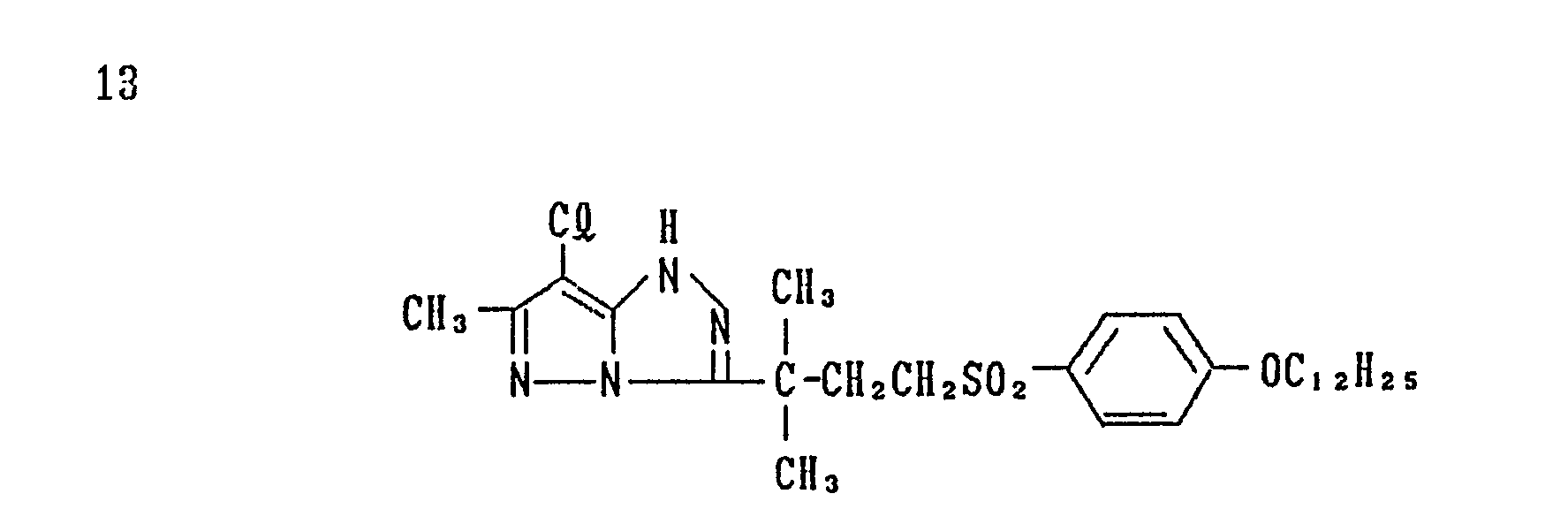


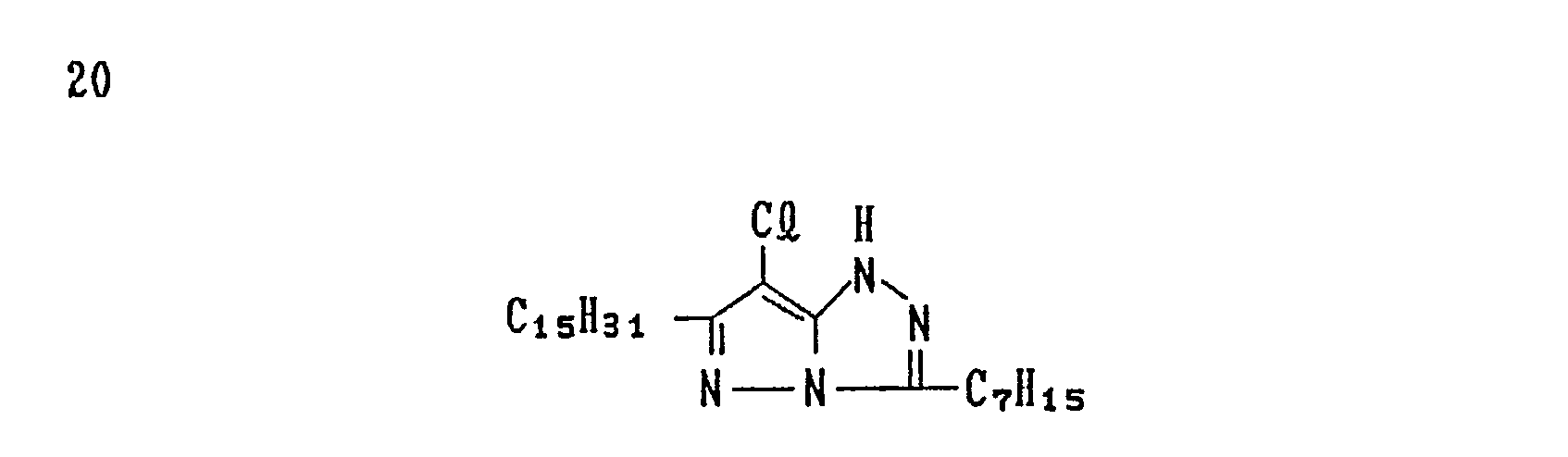
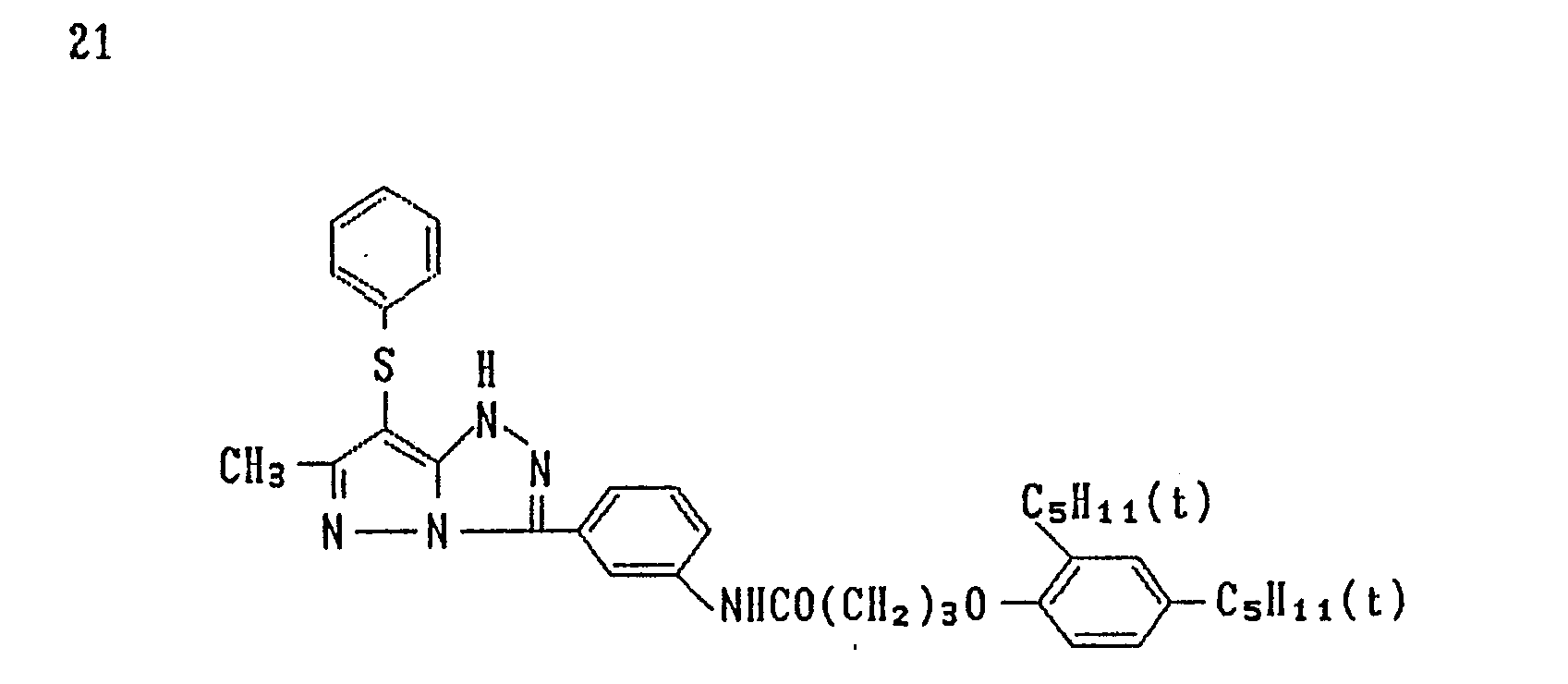


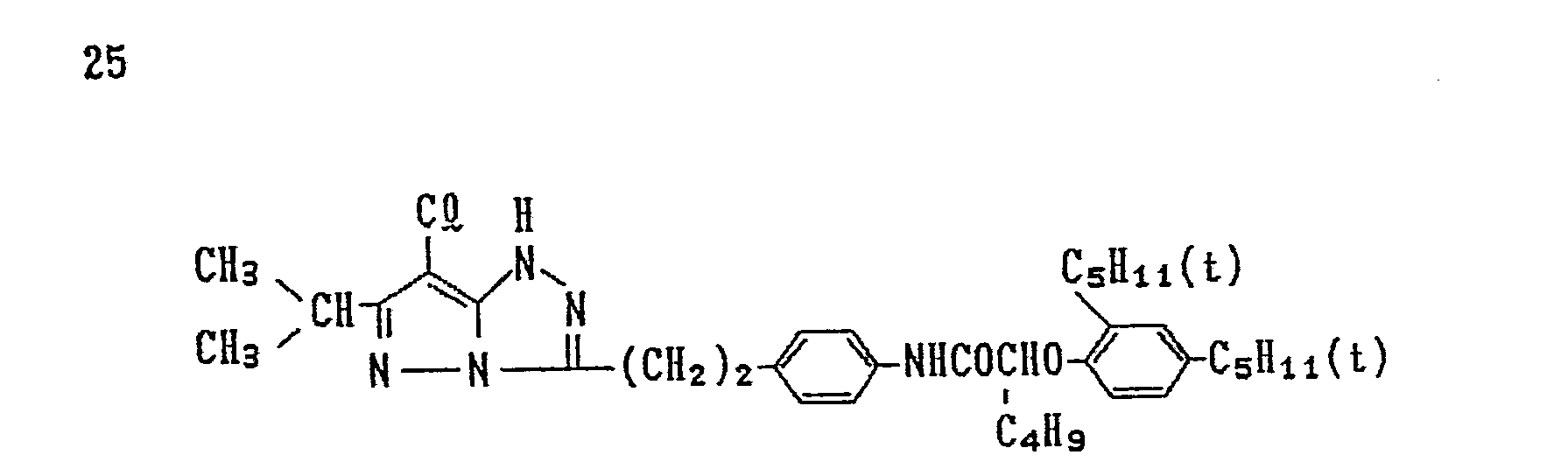


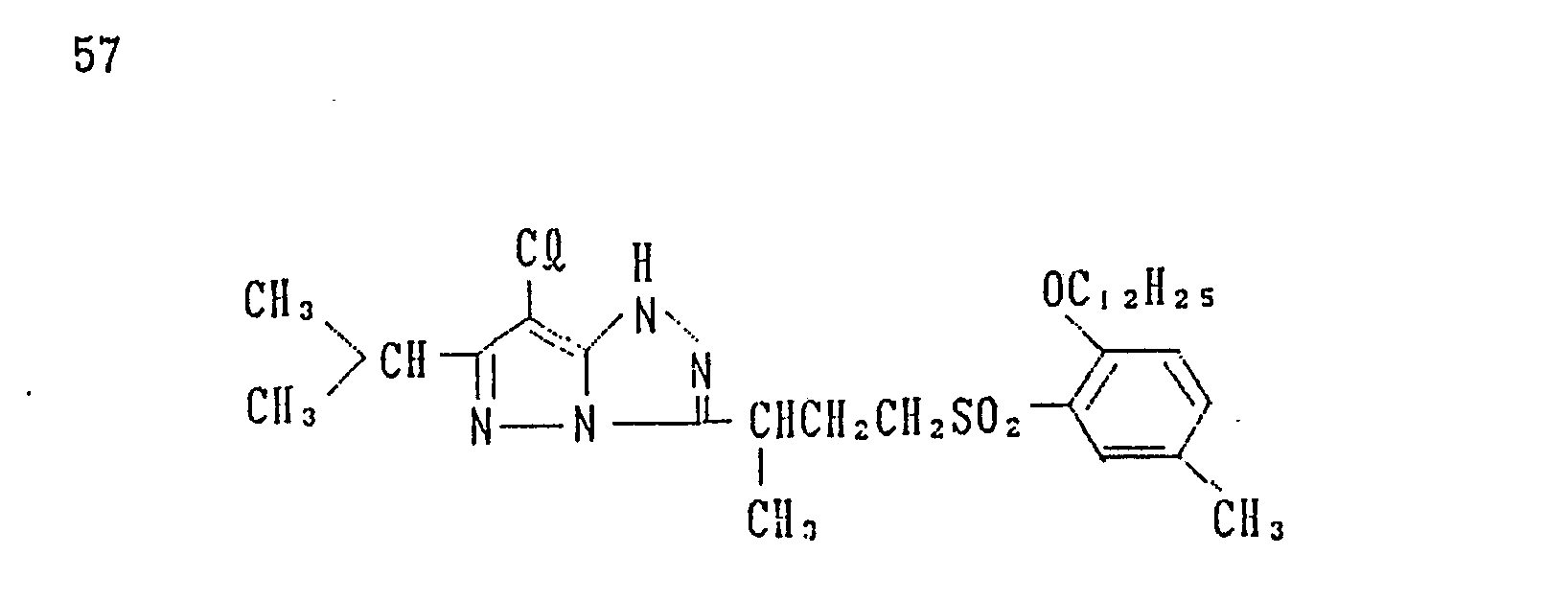


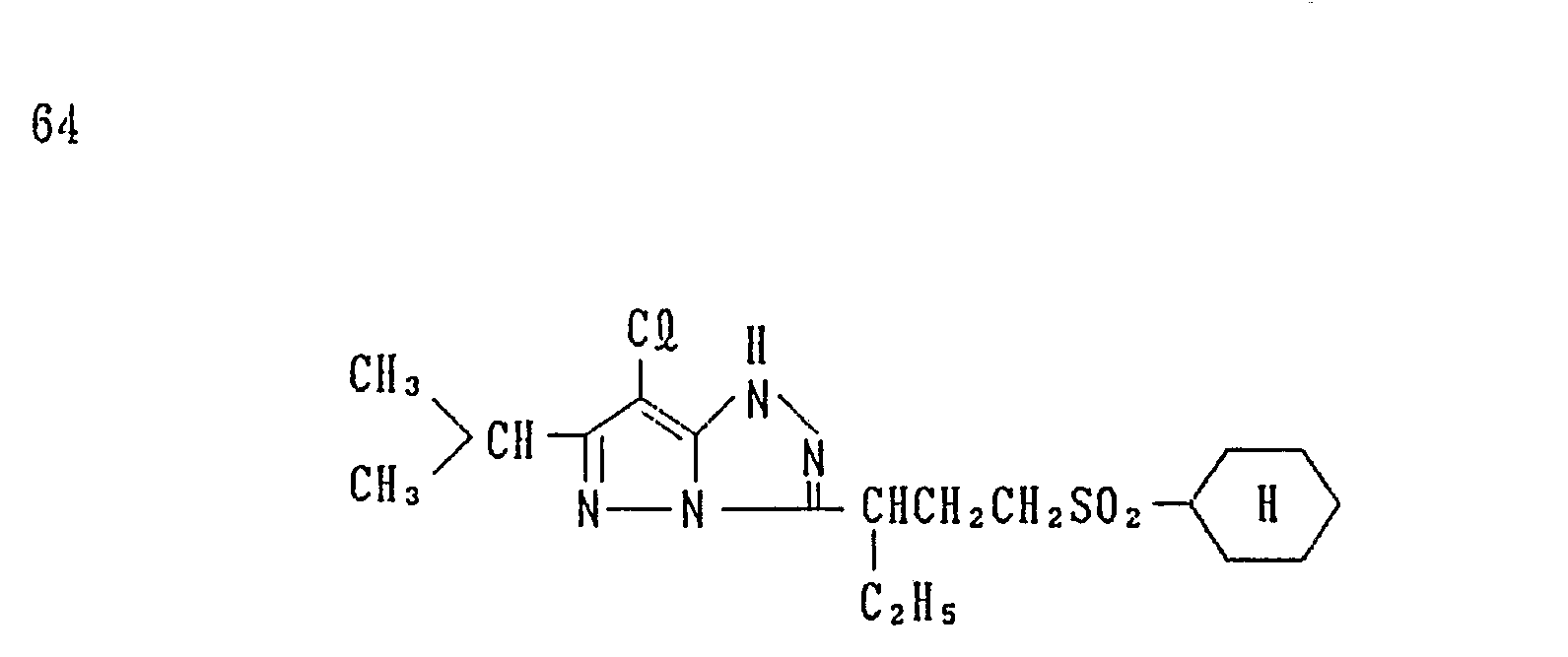


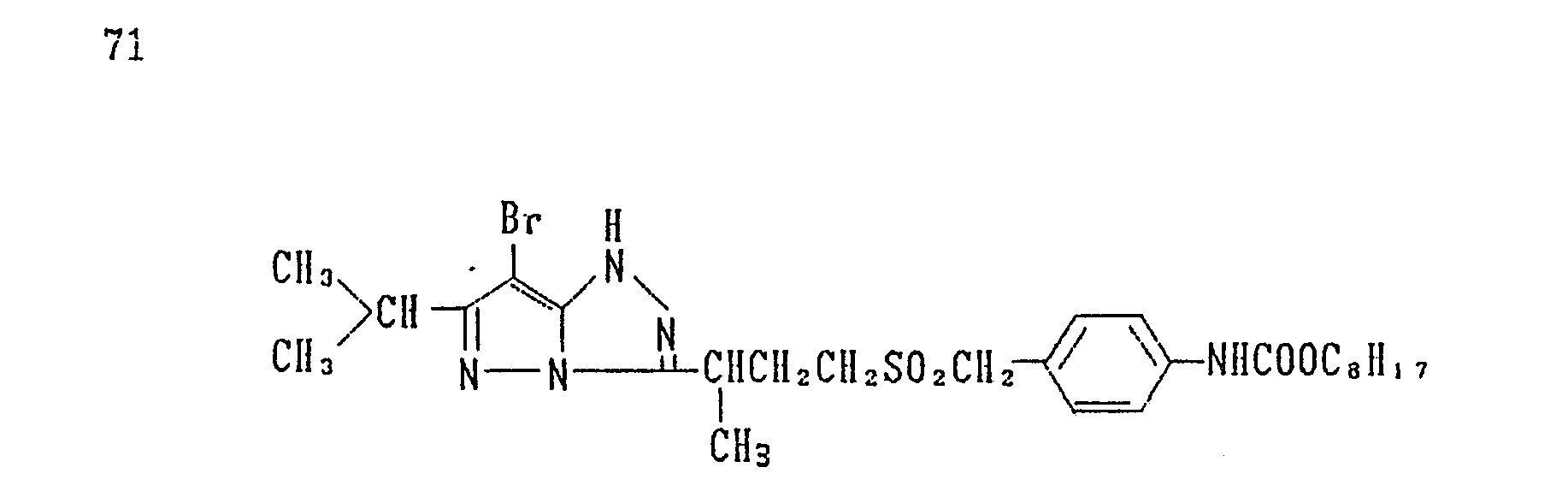


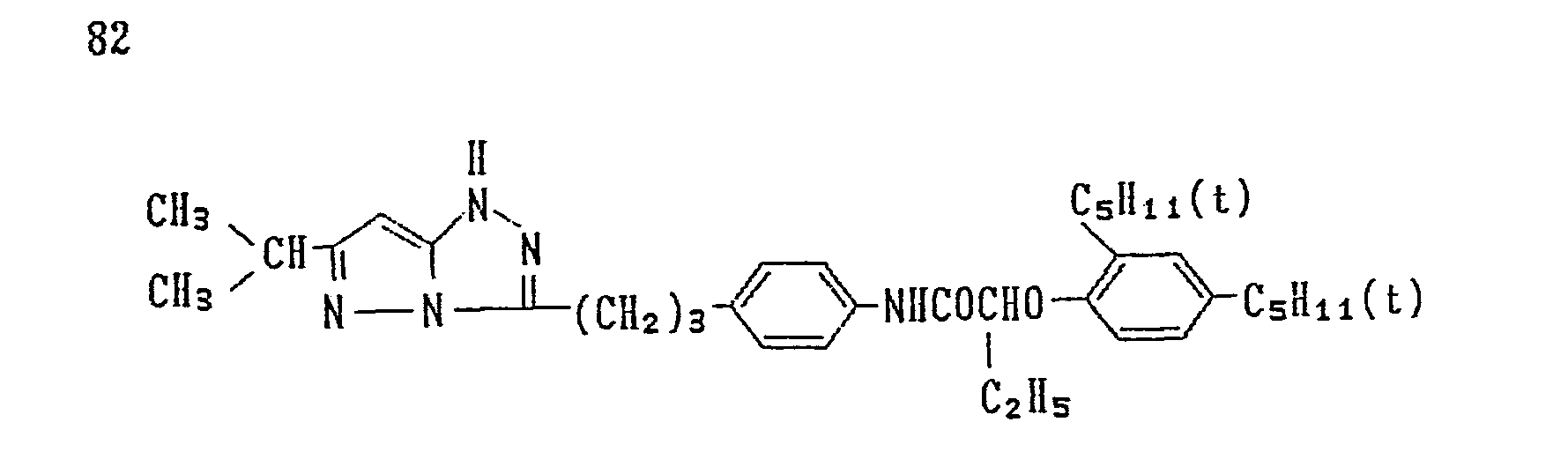
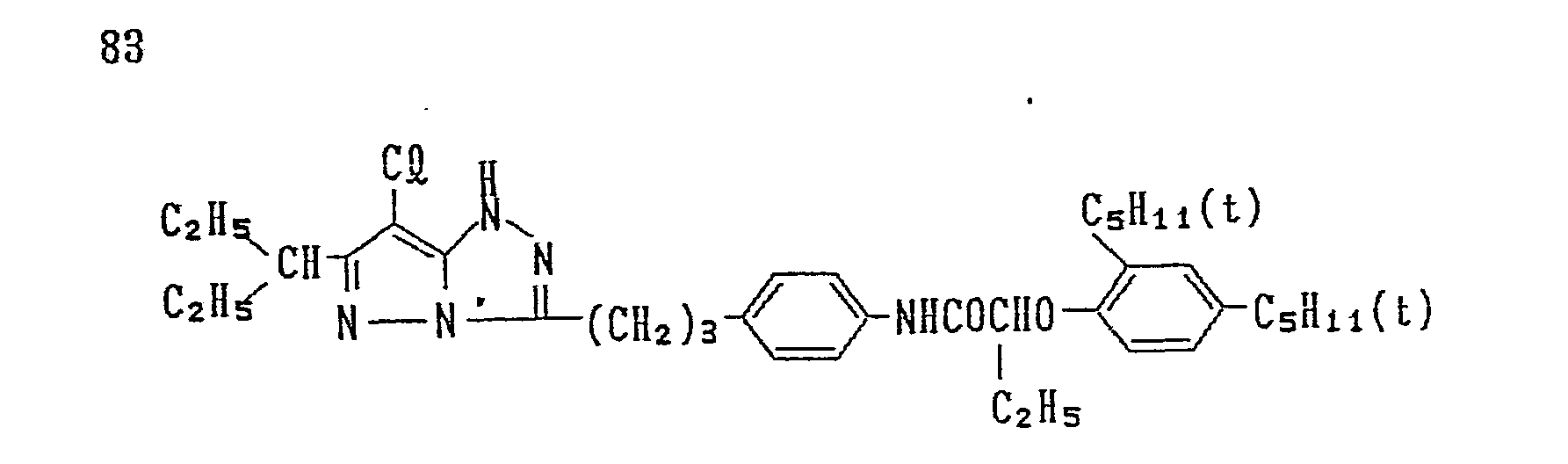


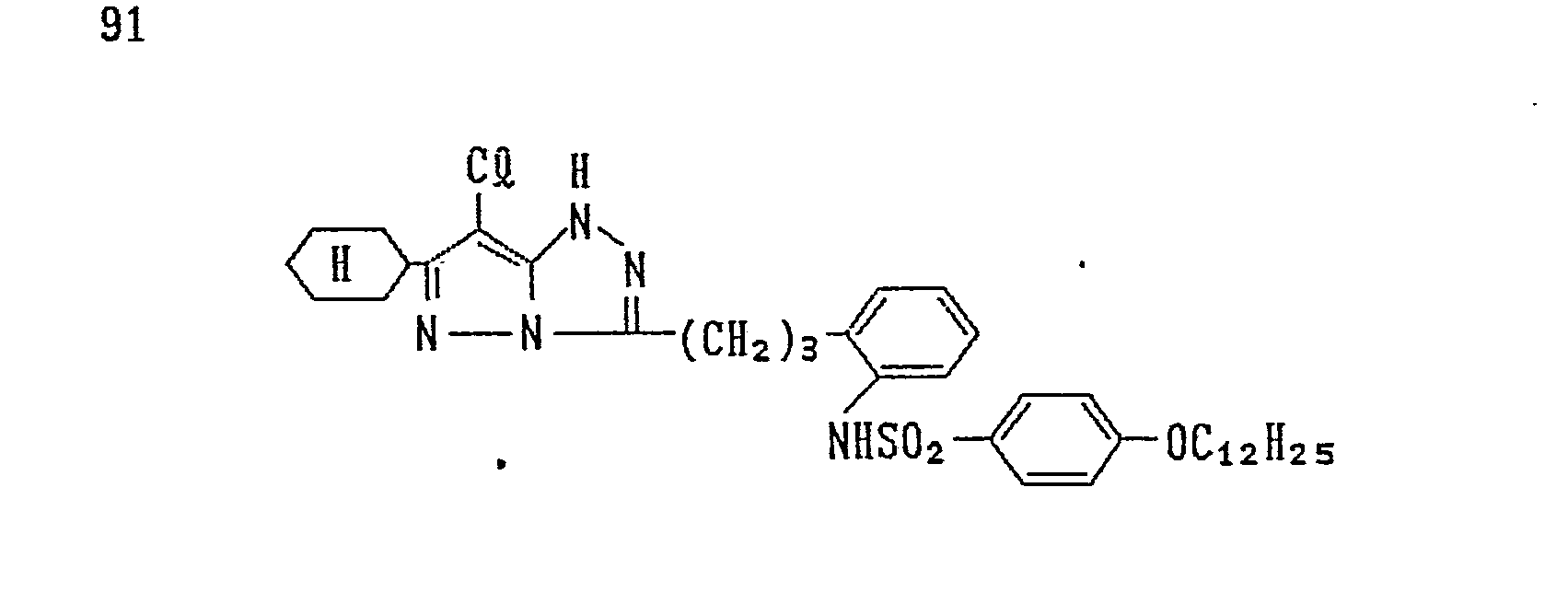


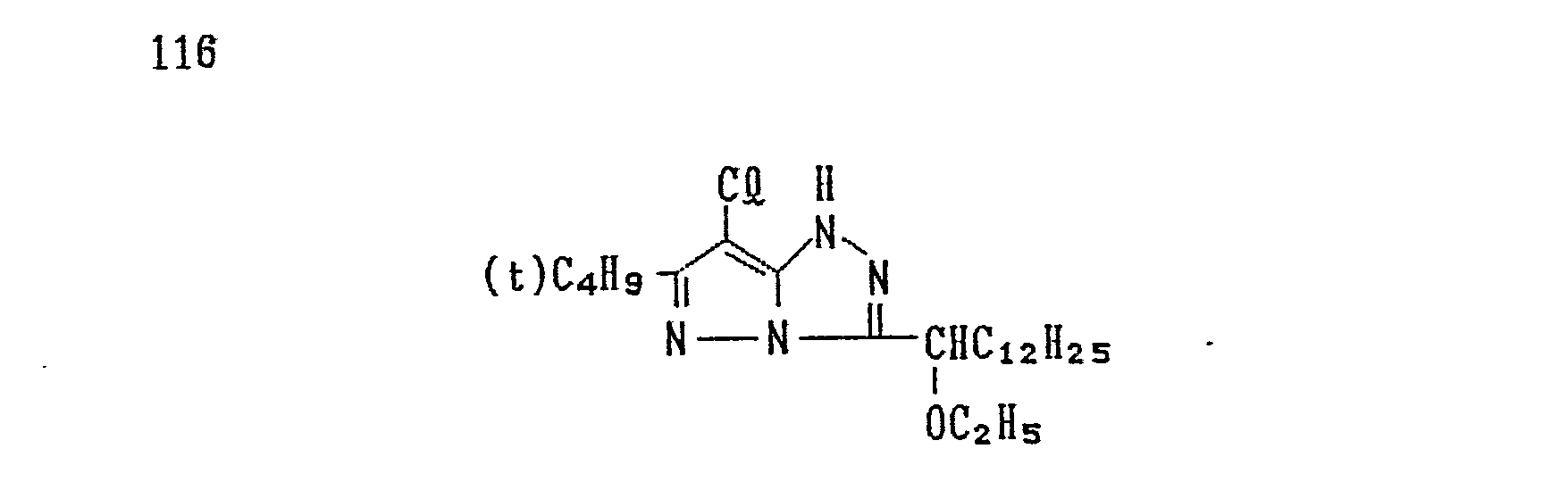


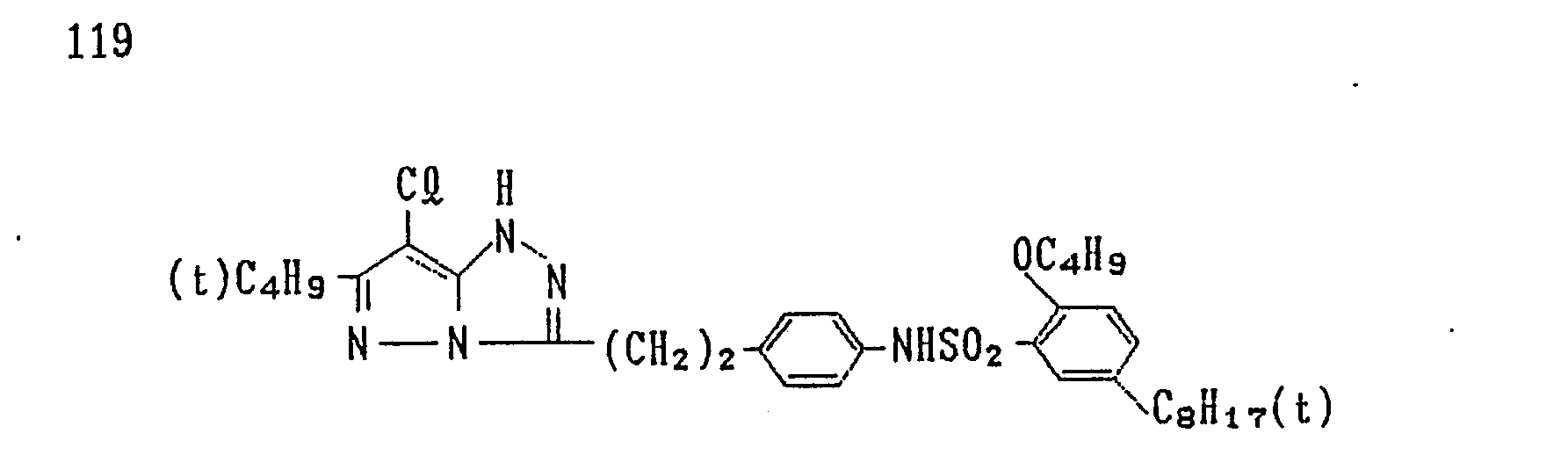


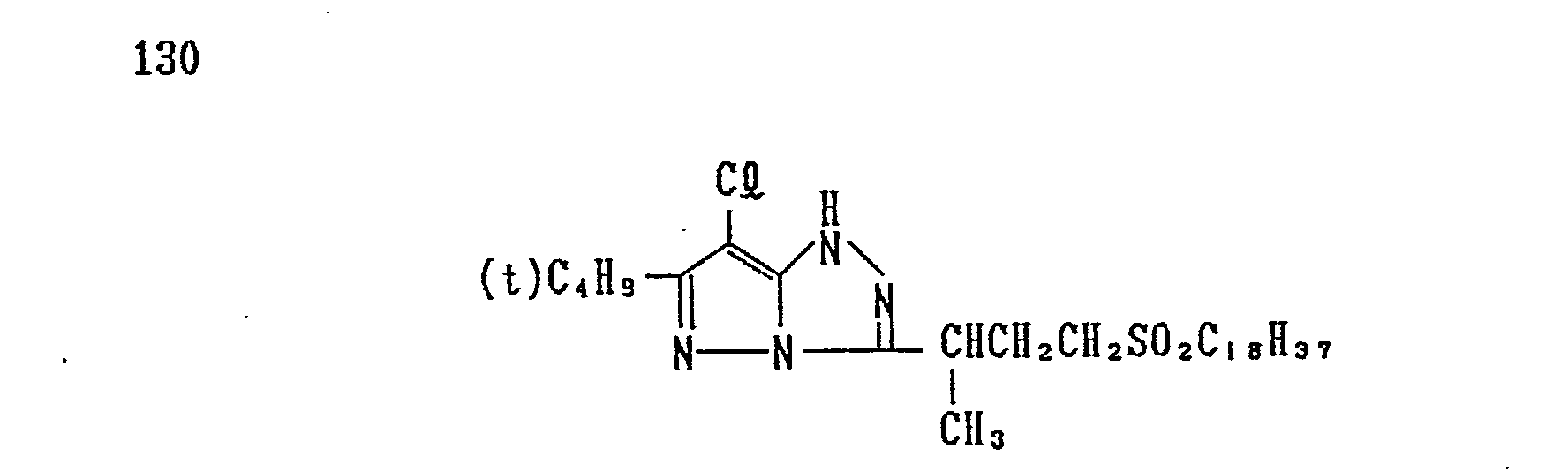


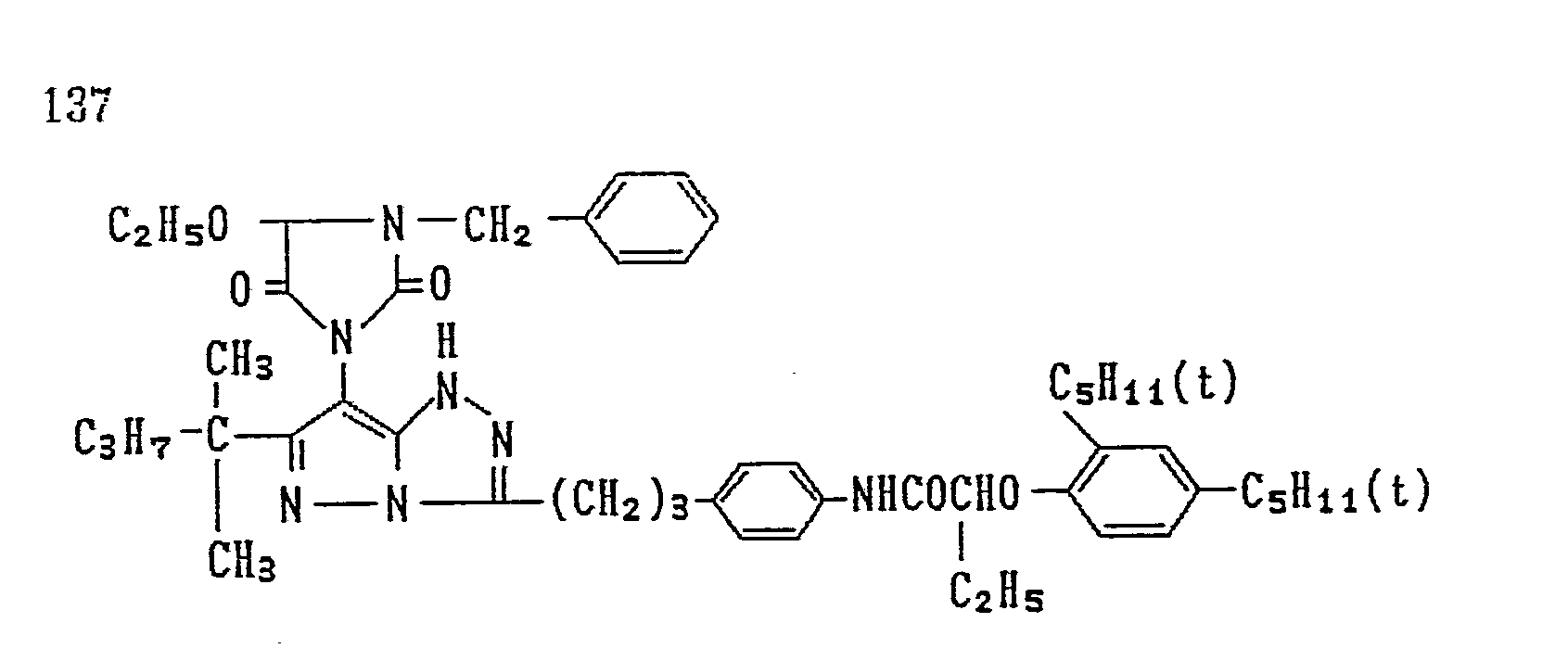


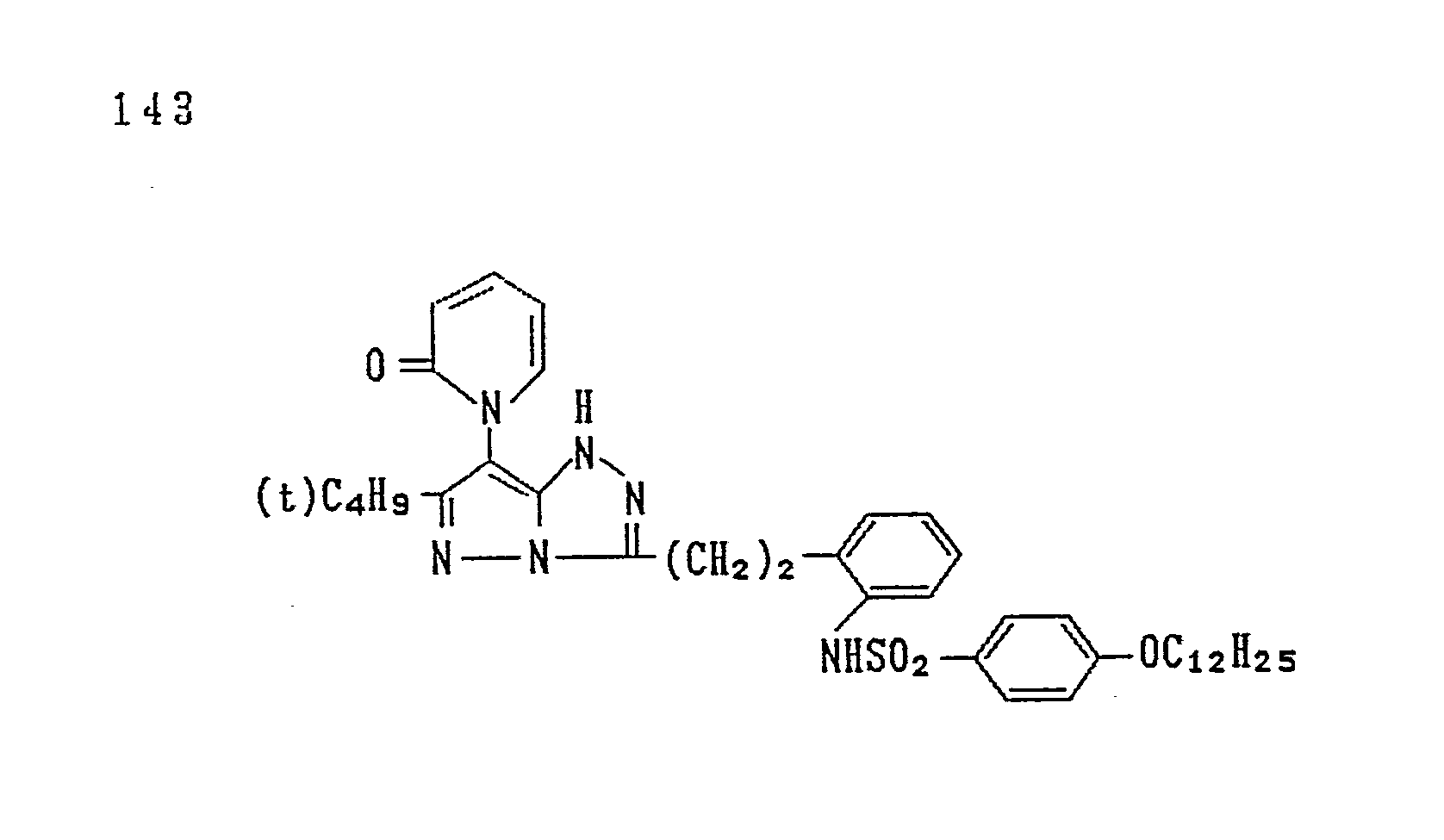


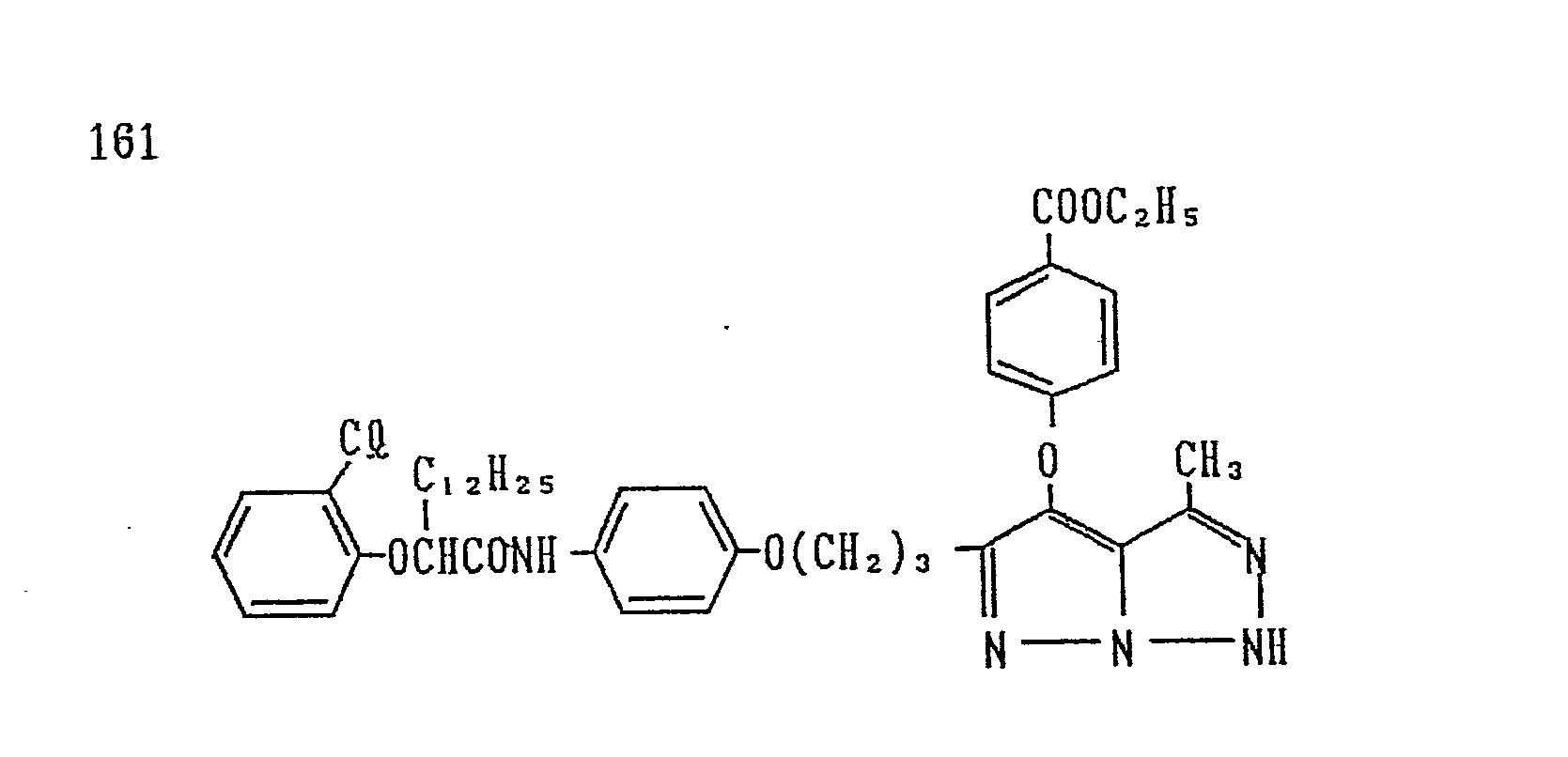


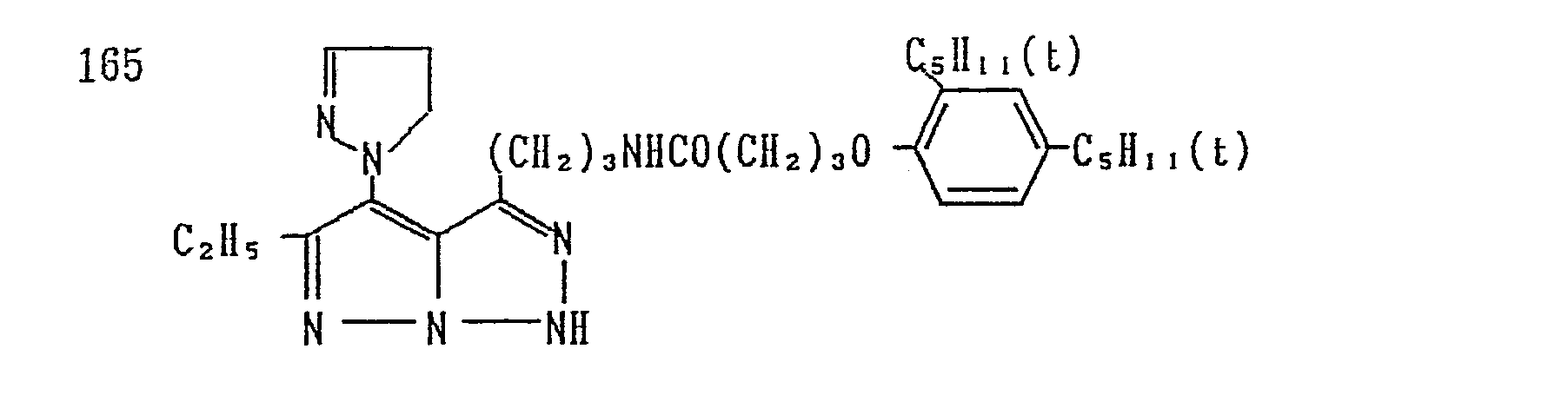


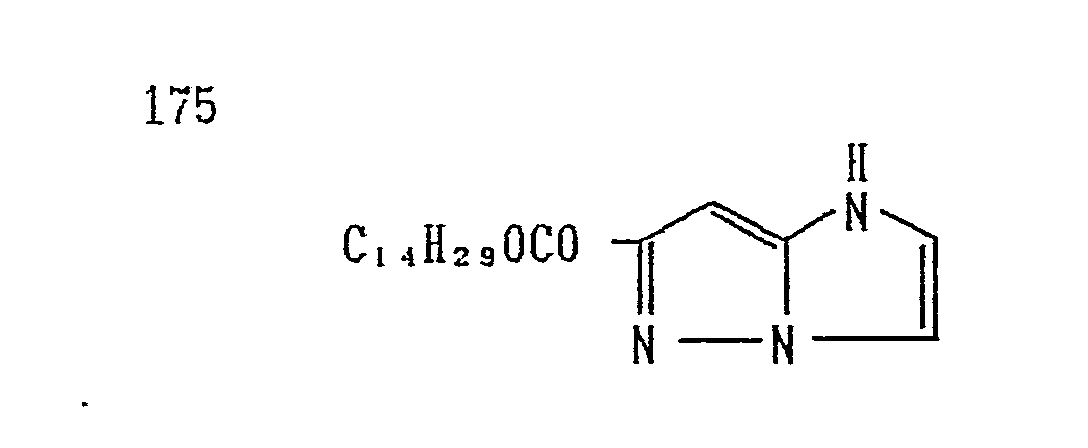


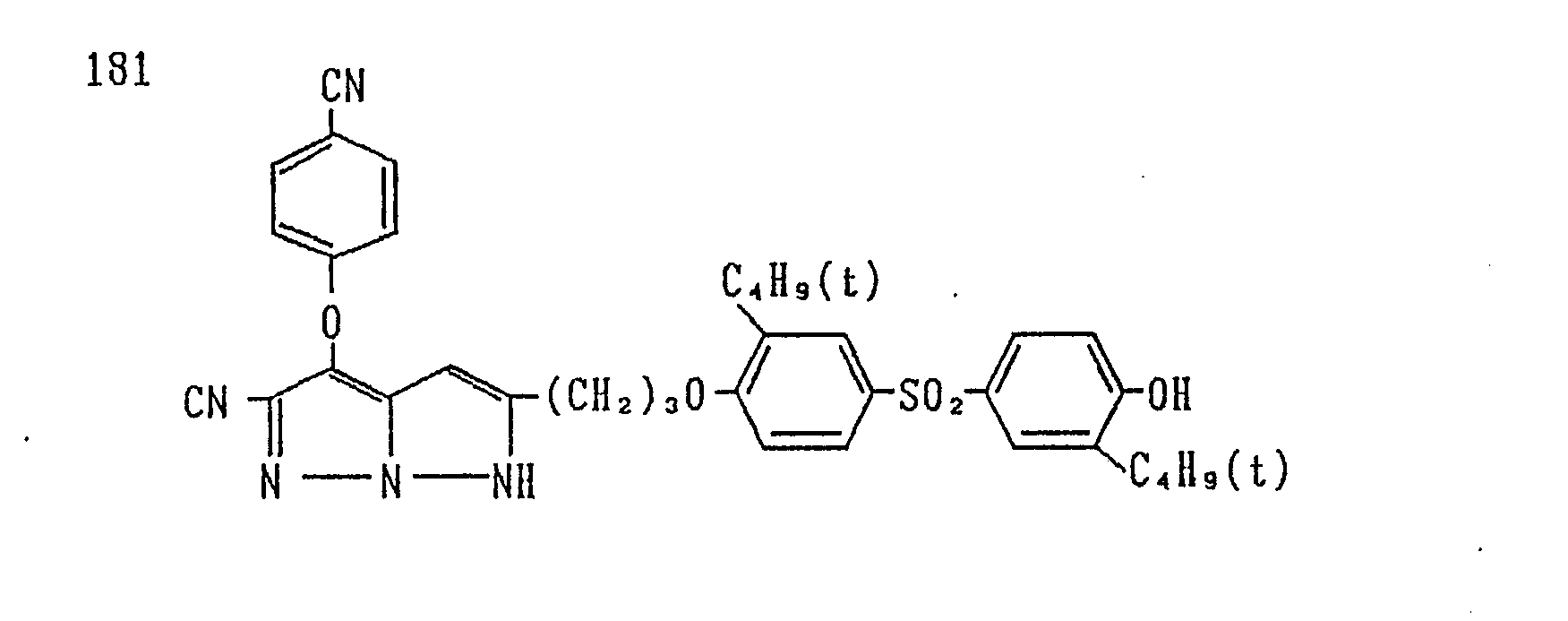
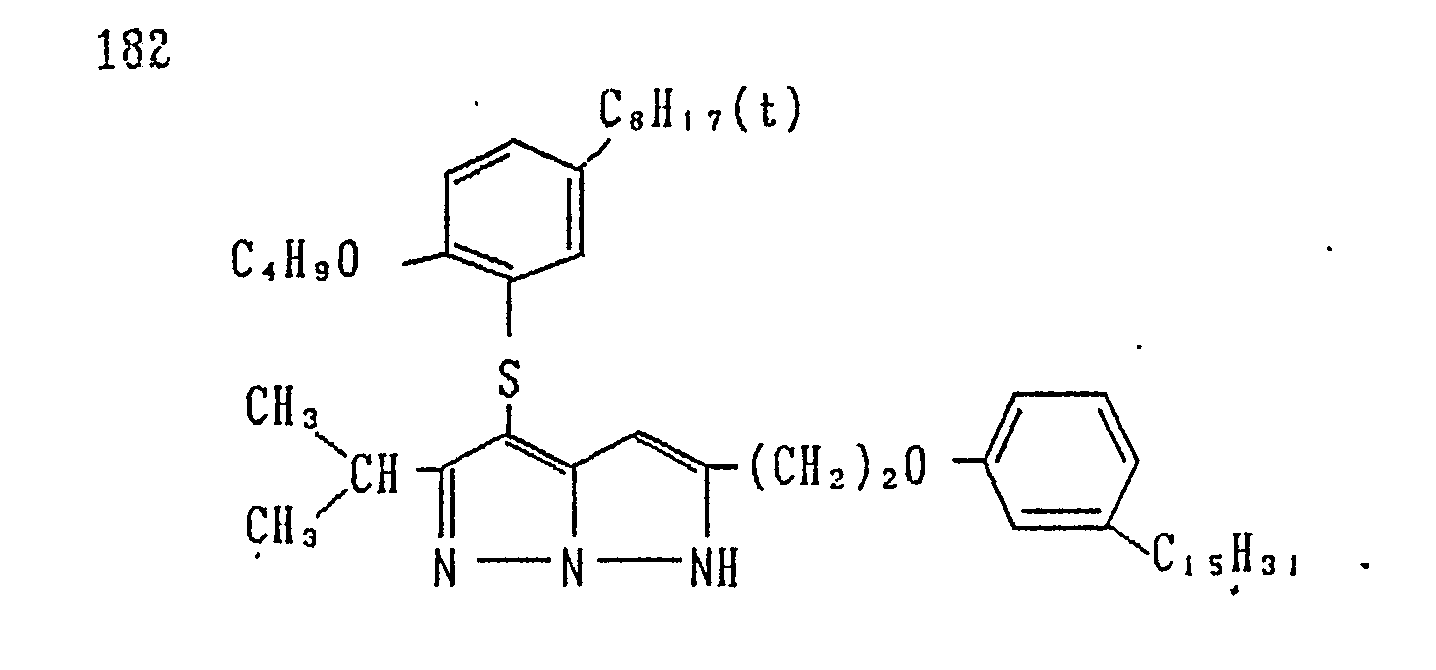


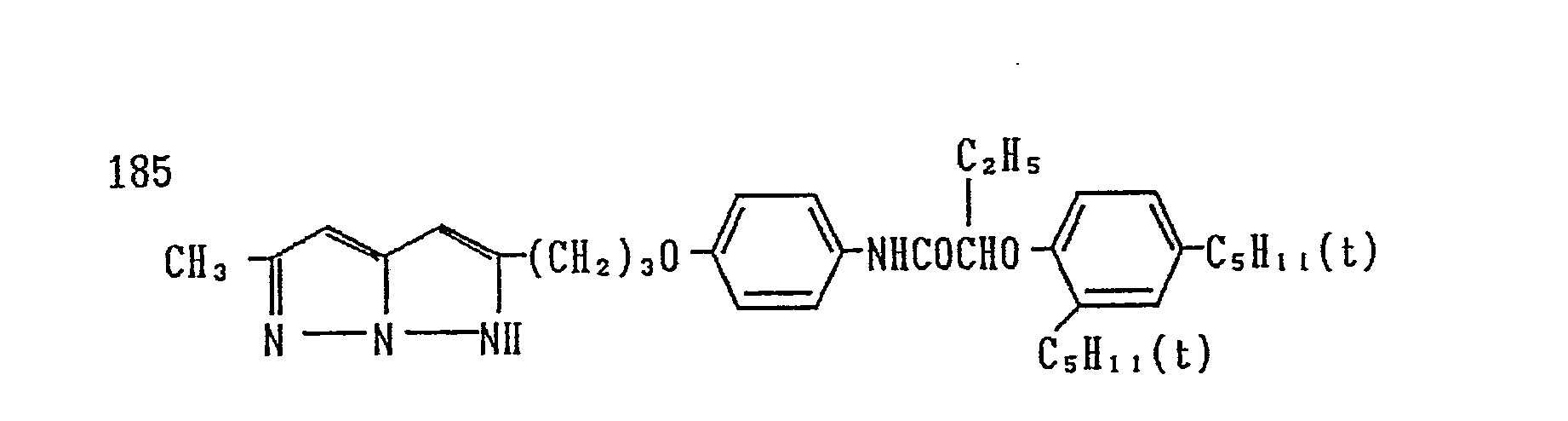


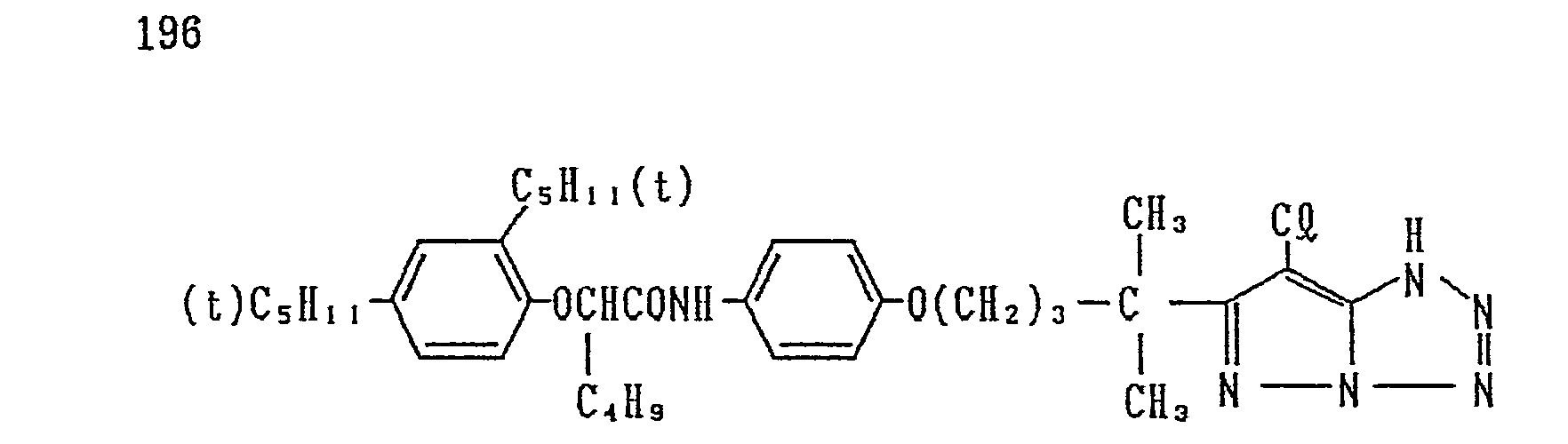


- Aforesaid couplers were synthesized with reference to Journal of the Chemical Society, Perkin I (1977), 2047-2052, U.S. Patent No. 3,725,067 and Japanese Patent Publication Open to Public Inspection Nos. 99437/1984, 42045/1983, 162548/1984, 171956/1984, 33552/1985 and 43659/1985 (hereinafter referred to as Japanese Patent Publication O.P.I. Publication).
- It is possible to use the couplers of the invention within the range from 1 x 10⁻³ mol to 1 mol of coupler per mol of silver halide usually and within the range from 1 x 10 -2 mol to 8 x 10⁻¹ mol per mol of silver halide preferably.
- The couplers of the invention may further be used together with magenta couplers of other types.
- In the case that the compounds represented by any one of the following Formulas [I] through [III] are used as cyan couplers in the color photographic light-sensitive materials relating to the invention, the advantages of the invention can be more excellently displayed and, further, another advantage that a cyan-fog variation can be more effectively prevented than in the other cases.

- wherein, either one of R100 and R101 represents hydrogen, while the other represents a normal chained or branch chained alkyl group having at least 2 to 12 carbon atoms; X101 represents hydrogen or a group capable of splitting off through a coupling reaction; and R102 represents a ballast group.


- The normal chained or branch chained alkyl groups each having 2 to 12 carbon atoms, which are represented by R100 and R101 in the above-given Formula [C-I], include, for example, an ethyl group, a propyl group and a butyl group.
- In the Formula [C-I], the ballast groups represented by R 102 are the organic groups each having such size and configuration that each molecule of couplers has an adequate volume so as not to substantially diffuse the couplers to any other layer from the layer to which the couplers are intrinsically applied. The typical ballast groups include, for example, an alkyl or aryl group having 8 to 32 carbon atoms and more preferably those each having 13 to 28 carbon atoms. The substituents for the above-mentioned alkyl or aryl groups include, for example, an alkyl, aryl, alkoxy, allyloxy, carboxy, acyl, ester, hydroxy, cyano, nitro, carbamoyl, carbonamido, alkylthio, arylthio, sulfonyl, sulfonamido or sulfamoyl group or a halogen. The substituents for the above-mentioned alkyl groups include, for example, those given for the above-mentioned aryl groups.
- The preferable ones of the above-mentioned ballast groups are represented by the following formula:

- As it is well known by the skilled in the art that the groups represented by X in the above-given Formula .[C-1], which are capable of splitting off through a coupling reaction,, will determine the equivalent number of a coupler and at the same time exert an influence upon a coupling reactivity. The typical examples of such groups include, a halogen such as chlorine and fluorine, an aryloxy, substituted or unsubstituted alkoxy, acyloxy, sulfonamido, arylthio, heteroylthio, heteroyloxy, sulfonyloxy, carbamoyloxy or like group. The more typical examples thereof include those described in, for example, Japanese Patent O.P.I. Publication Nos. 10135/1975, 120334/1975, 130441/1975, 48237/1979, 146828/1976, 14736/1979, 37425/1972, 123341/1975 and 95346/1983; Japanese Patent Examined Publication No. 36894/1973; and U.S. Patent Nos. 3,476,563, 3,737,316 and 3,227,551. Next, the exemplified compounds of the cyan couplers represented by the Formula [I] will be given below. It is, however, to be understood that the invention shall not be limited thereto.

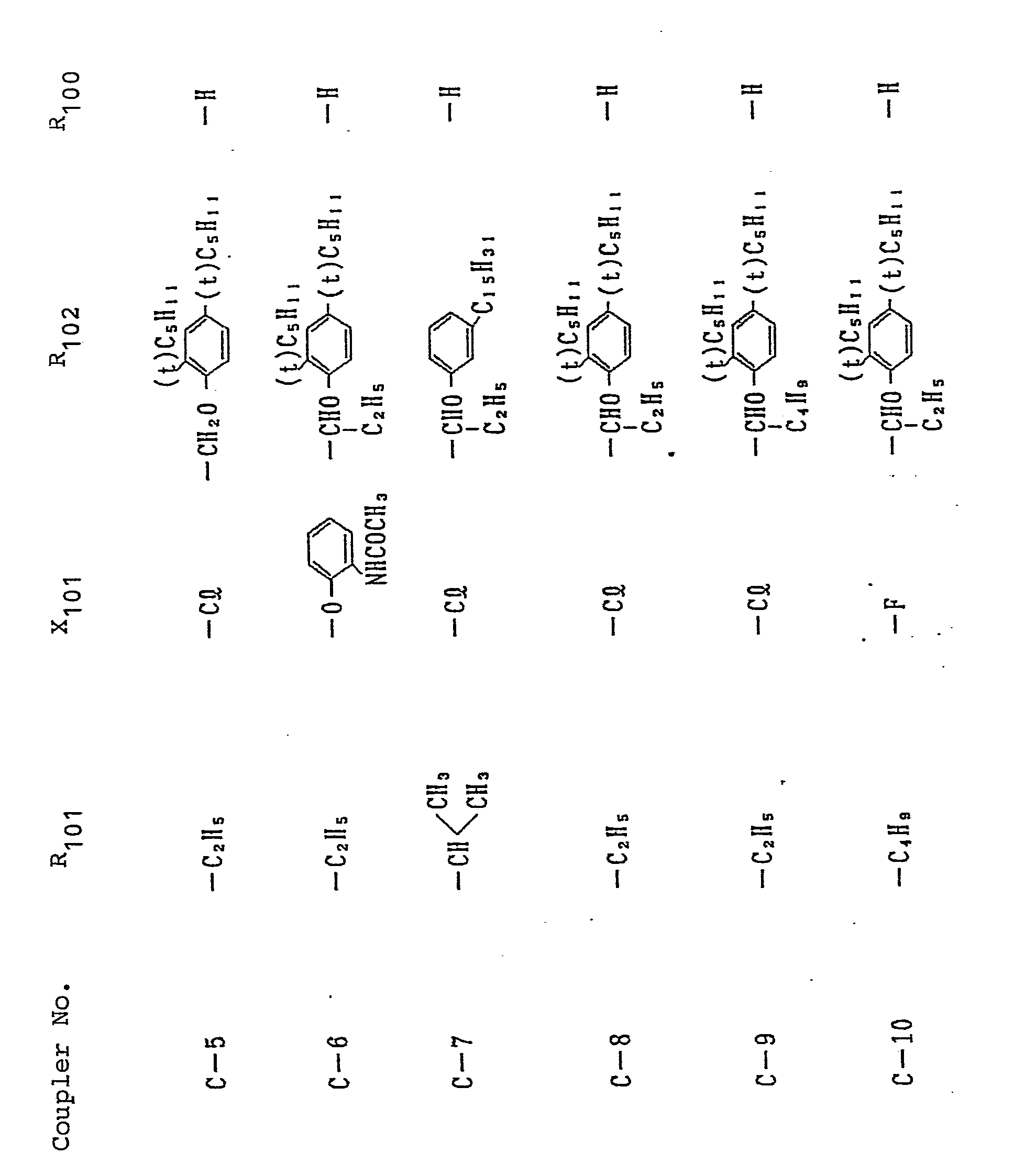


- The processes each for synthesizing the exemplified compounds will now be described below. The other exemplified compounds may also be synthesized in the same processes as above.
- Synthesis Example of Exemplified Compound C-5:
- A dissolution of 0.6 g of iodine and 1.5 g of ferric chloride was made in 150 ml of glacial acetic acid. To the resulted'solution, 75 ml of sulfuryl chloride were dropped at 40°C for 3 hours. The precipitates produced in the course of the dropping were reactively dissolved after completing the dropping of the sulfuryl chloride by heatedly refluxing the precipitates. It took about two hours to complete the heat-reflux treatment. The crystals produced by pouring a reaction liquid in water were recrystallized and then refined by making use of methanol. The [(1)-a] was confirmed by making use of nuclear magnetic resonance spectra and in elementary analyses.
- A dissolution of 21.2 g of the compound of [(1)-a] was made in 300 ml of alcohol. Whereto, a Raney nickel catalyst in a decatalyzing amount was added and then hydrogen was applied at an atmospheric pressure until the hydrogen was not absorbed. After the reaction, the Raney nickel was removed and the resulted matter was distilled off with alcohol at reduced pressure. The [(1)-b], the resulted residue, was acylated without refining, in the following manner:
- A dissolution of 18.5 g of a crude amino substance prepared in the above-mentioned [(1)-b] process was made in a mixture liquid comprising 500 ml of glacial acetic acid and 16.7 g of sodium acetate and whereto an acetic acid solution prepared by dissolving 28.0 g of 2,4-di-tert-aminophenoxyacetic acid chloride in 50 ml of acetic acid was dropped at room temperature for 30 minutes. After stirring it for 30 minutes, the resulted reaction liquid was poured into ice water. The resulted precipitate was filterated and dried up. The resulted dried precipitate was recrystallized twice with acetonitrile, so that the object matter was obtained. The object matter was confirmed by an elemental analysis and nuclear magnetic resonance spectra.


- Now, the cyan couplers represented by the Formulas [C-II] and [C-III] will be described below.
- In the Formulas [C-II] and [C-III], Y101 represents

- In the Formulas [C-II] and [C-III], R103 represents a ballast group necessary for giving antidispersibility to the cyan couplers represented by the Formulas [C-II] and [C-III] and the cyan dyes each formed by the above-mentioned cyan couplers and, more preferably, an alkyl, aryl or heterocyclic group each having 4 to 30 carbon atoms, including, for example, an alkyl group such as a t-butyl, n-octyl, t-octyl, n-dodecyl or like groups; an alkenyl group; a cycloalkyl group; a 5- or 6-membered heterocyclic group; or the like groups; each of which is normal chained or branch chained.
- In the Formulas [C-II] and [C-III], Z101 represents hydrogen or a group capable of splitting off at the time of coupling reaction thereof on the oxidation products of a color developing agent. They include, for example, a halogen such as chlorine, bromine, fluorine or like elements; substituted or unsubstituted alkoxy, aryloxy, heterocyclic oxy, acyloxy, carbamoyloxy, sulfonyloxy, alkylthio, arylthio, heterocyclic thio, sulfonamido or like groups and, more typically, those described in, for example, U.S. Patent No. 3,741,563; Japanese Patent O.P.I. Publication Nos. 37425/1972, 10135/1975, 117422/1975, 130441/1975, 108841/1976, 120343/1975, 18315/1877, 105226/1978, 14736/1979, 48237/1979, 32071/1980, 65957/1980, 1938/1981, 12643/1981, 27147/1981, 146050/1984, 166956/1984, 24547/1985, 35731/1985 and 37557/1985; and Japanese Patent Examined Publication No. 36894/1973.
- Among the cyan couplers represented by the Formula [C-II] or [C-III], those couplers each represented by the following Formula [C-V], [C-VI] or [C-VII] are further preferable in the invention:


- In the above-given Formulas [C-V] through [C-VII], R107 represents a substituted or unsubstituted aryl group and, more preferably, a phenyl group in particular. When the above-mentioned aryl group has a substituent, such substituents include, for example, at least one substituent selected from the group consisting of -SO2R109; a halogen such as fluorine, bromine, chlorine or like elements; -CF,,


- The compounds suitable for the phenol type cyan couplers each represented by the Formula [C-V] are those in which R107 is a substituted or unsubstituted phenyl group and the substituent to the phenyl group is a cyano, nitro, -SO2R111 in which R111 represents an alkyl group, a halogen or a trifluoromethyl group.
- In the Formulas [C-V], [C-VI] and [C-VII], R 108 represents an alkyl group and, more preferably, those each having 1 to 20 carbon atoms such as a methyl, ethyl, tert-butyl, dodecyl or like groups; an alkenyl group and, more preferably, those each having 2 to 20 carbon atoms such as an allyl, oleyl or like groups; a cycloalkyl group and, more preferably, a 5- to 7-membered cyclic group such as a cyclohexyl or like groups; an aryl group such as a phenyl, tolyl, naphthyl or like groups; and a heterocyclic group and, more preferably, a 5- or 6-membered heterocyclic group each containing 1 to 4 nitrogen, oxygen or sulfur atoms such as a furyl, thienyl, benzothiazolyl or like groups.
- The above-mentioned R109 and R110, and R108 denoted in the Formulas [C-V], [C-VI] and [C-VII], each are further allowed to introduce thereinto an arbitrary substituent which typically includes such a substituent as is capable of being introduced into the R104 or R105 denoted in the aforegiven Formulas [II] and [III]. The preferable substituents include, particularly, a halogen such as chlorine, fluorine or like elements.
- In the Formulas [V], [VI] and [VII], Z102 and R108 are synonymous with those denoted in the Formulas [II] and [III], respectively. The preferable examples of the ballast groups represented by R108 include the groups each represented by the following Formula [VIII]:
- Formula [VIII]

- The typical exemplified compounds of the cyan couplers each represented by the Formula [C-II] or [C-III], which are capable of being used in the invention will be given below:
-


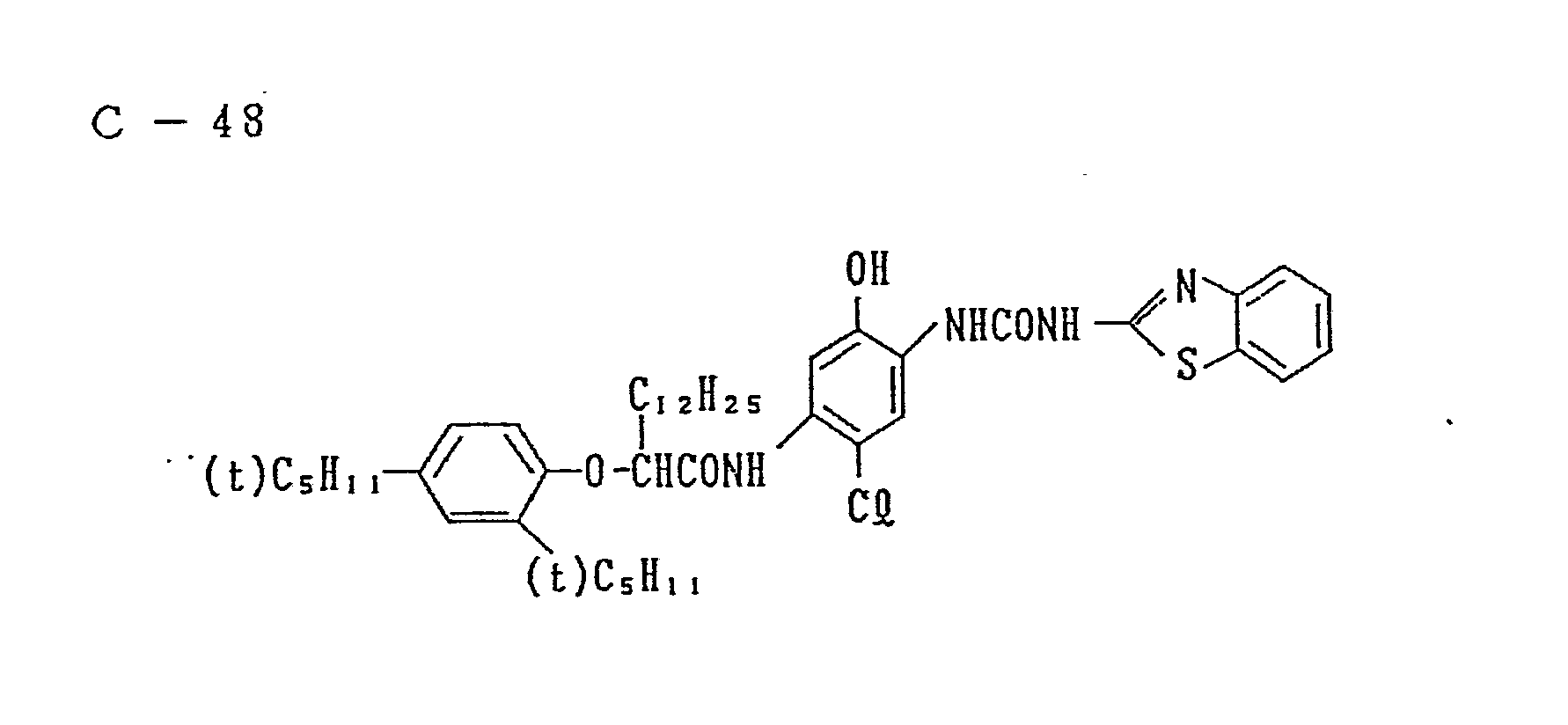


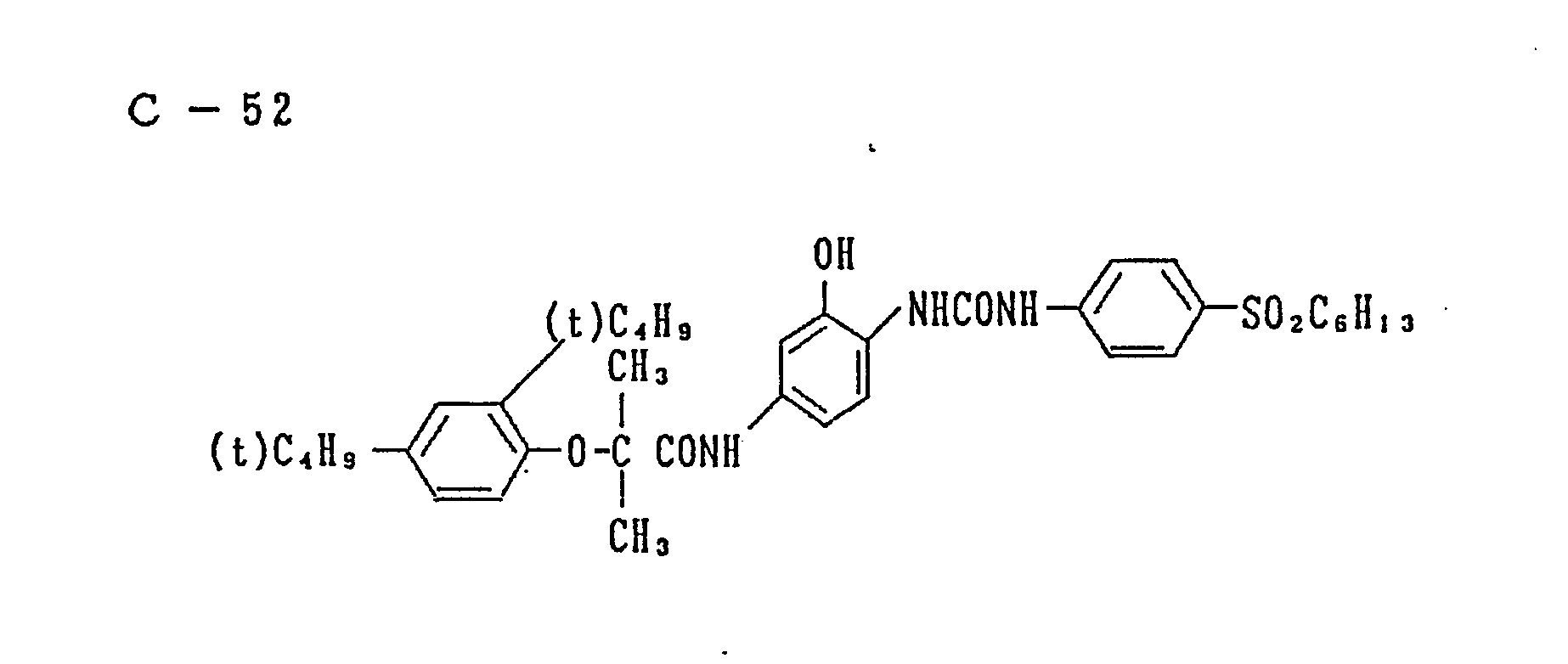


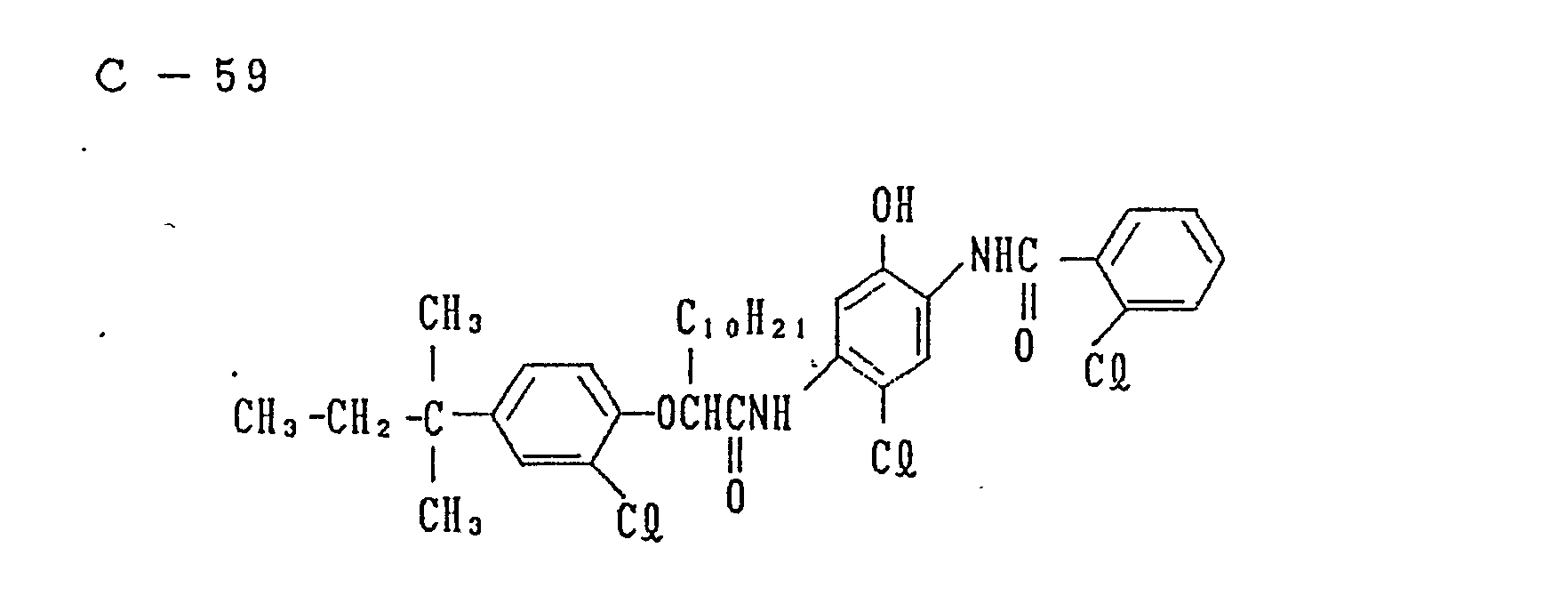


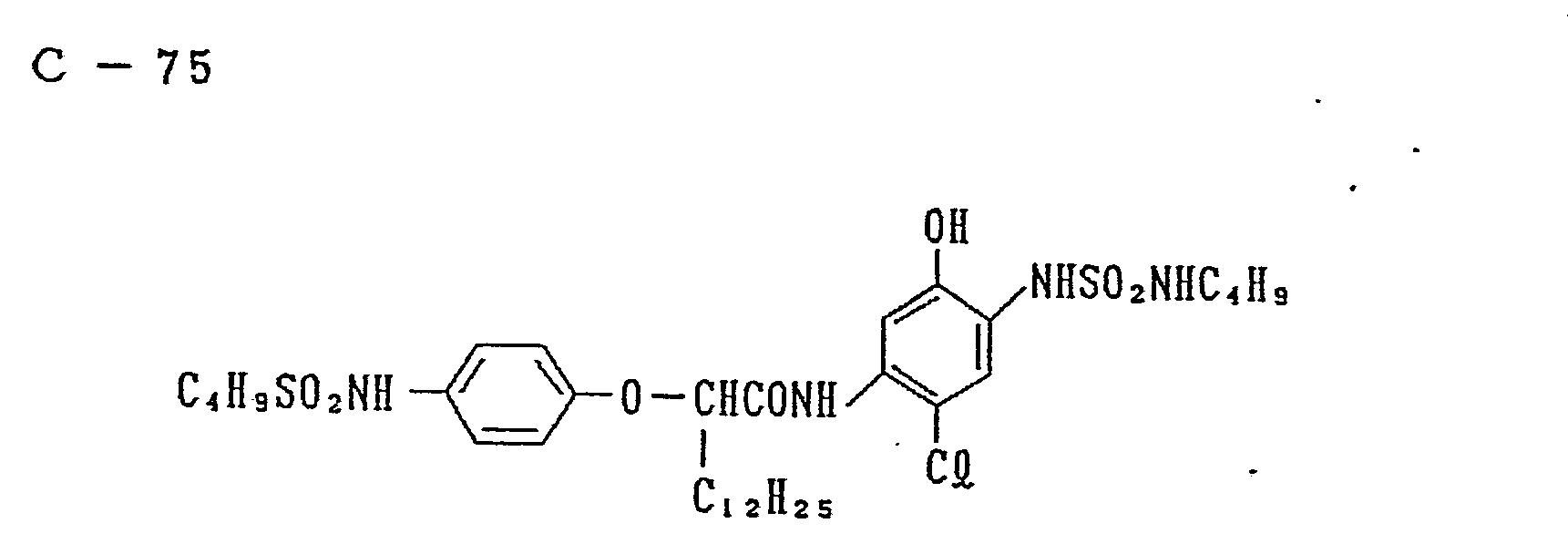


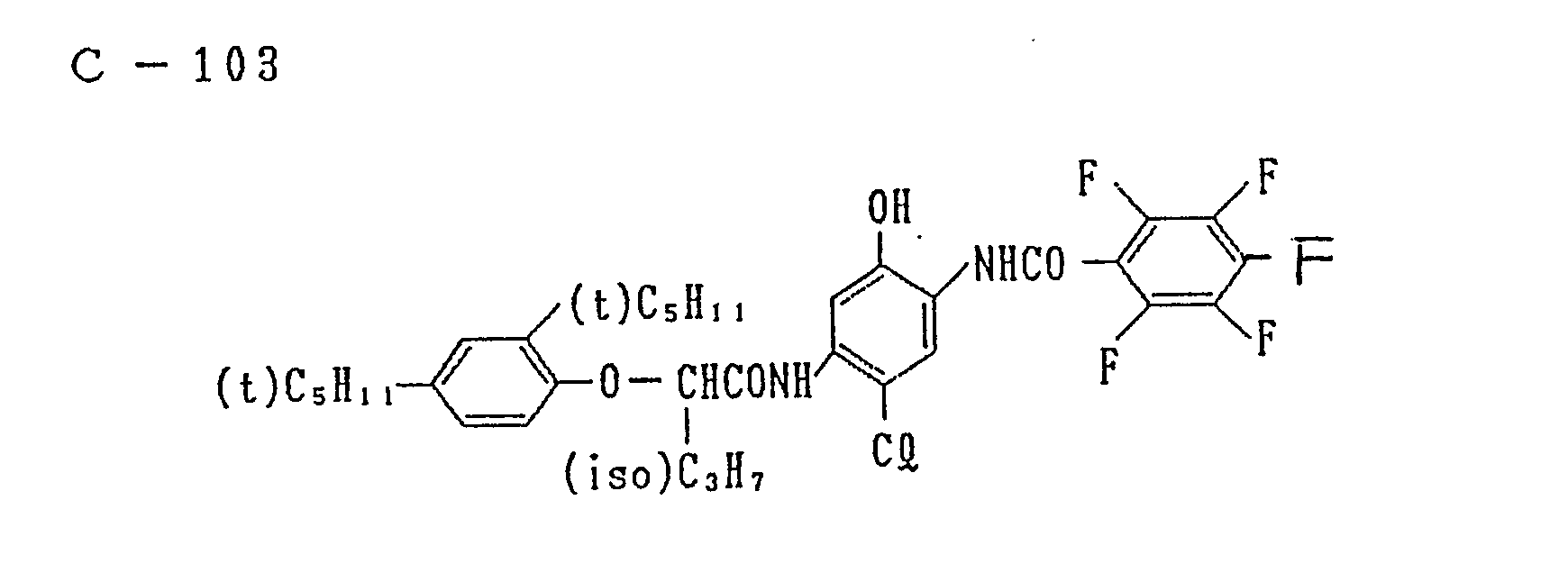
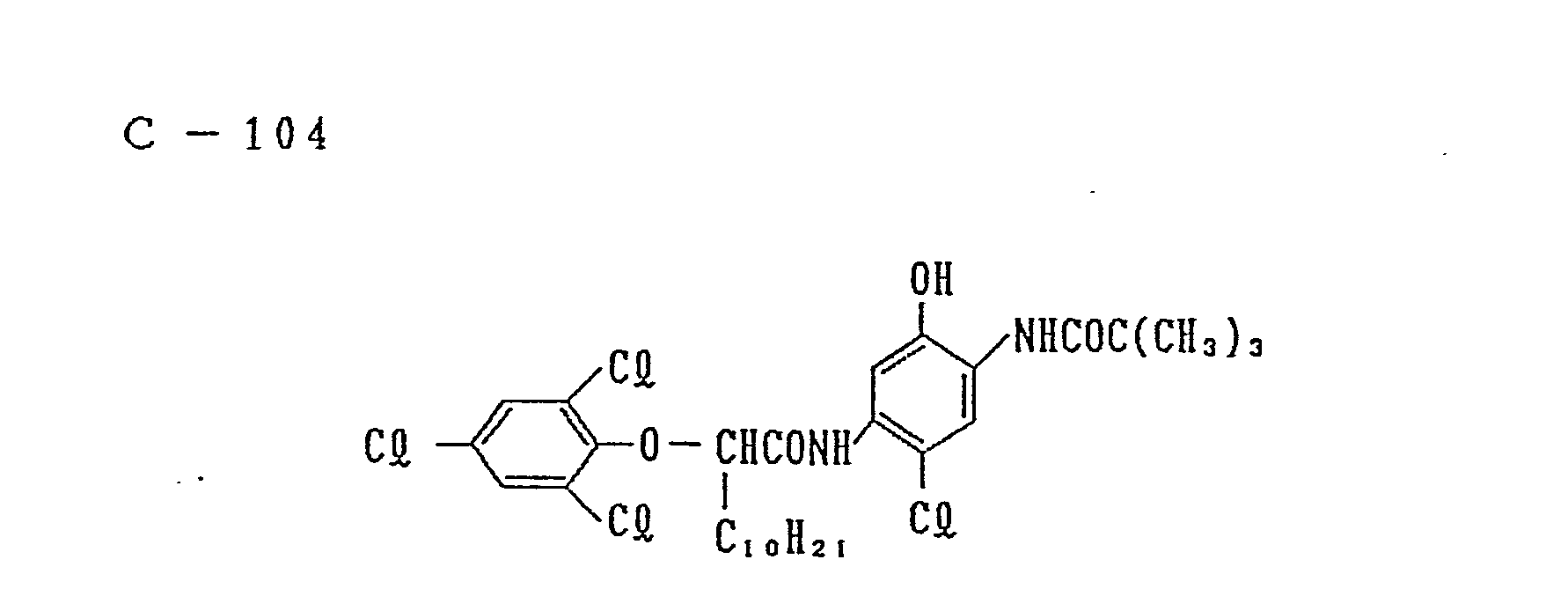
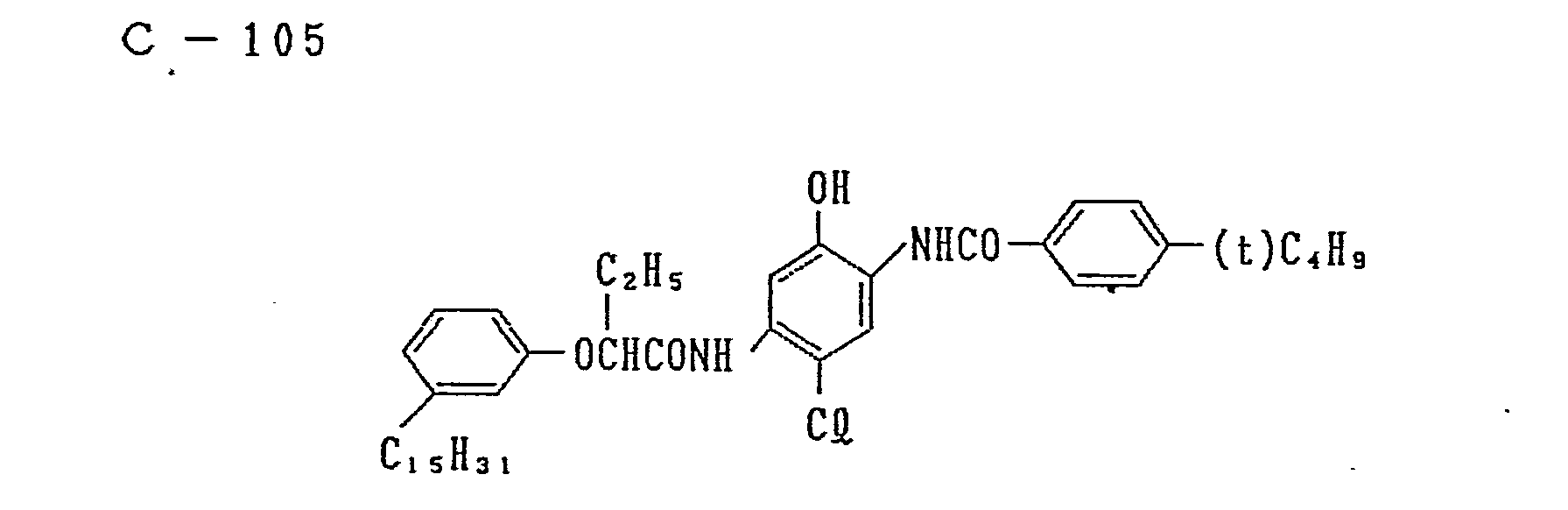


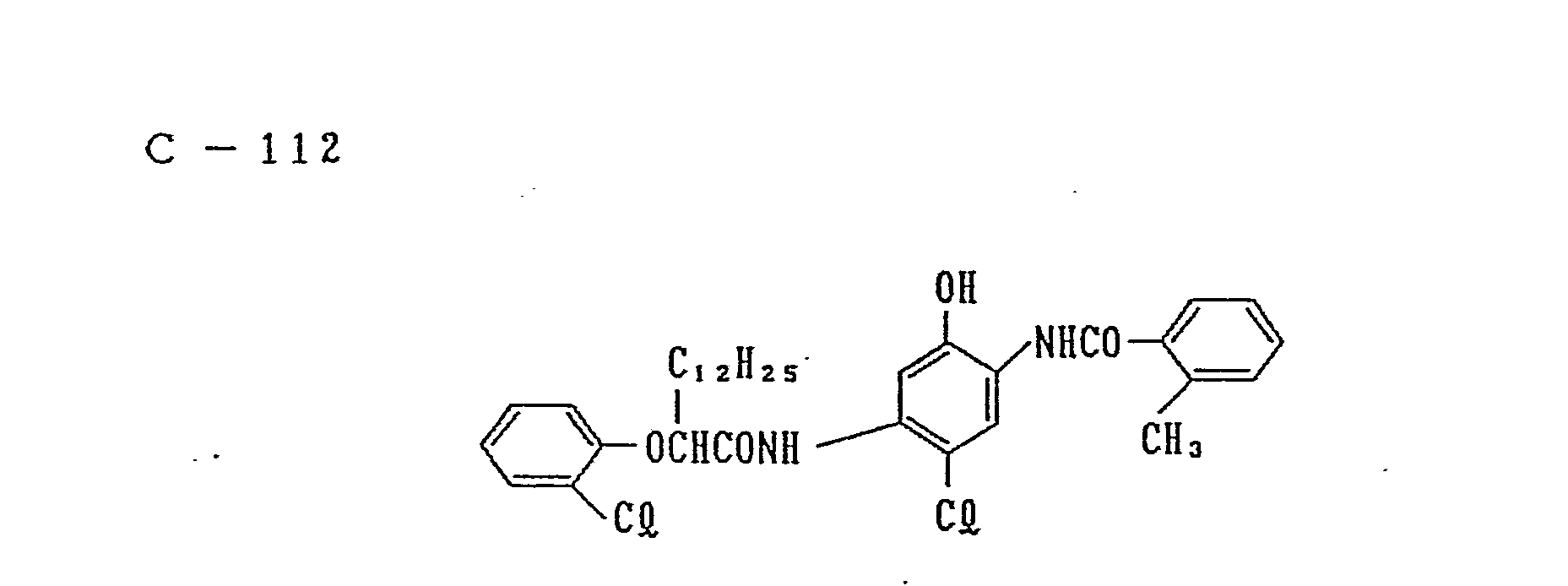
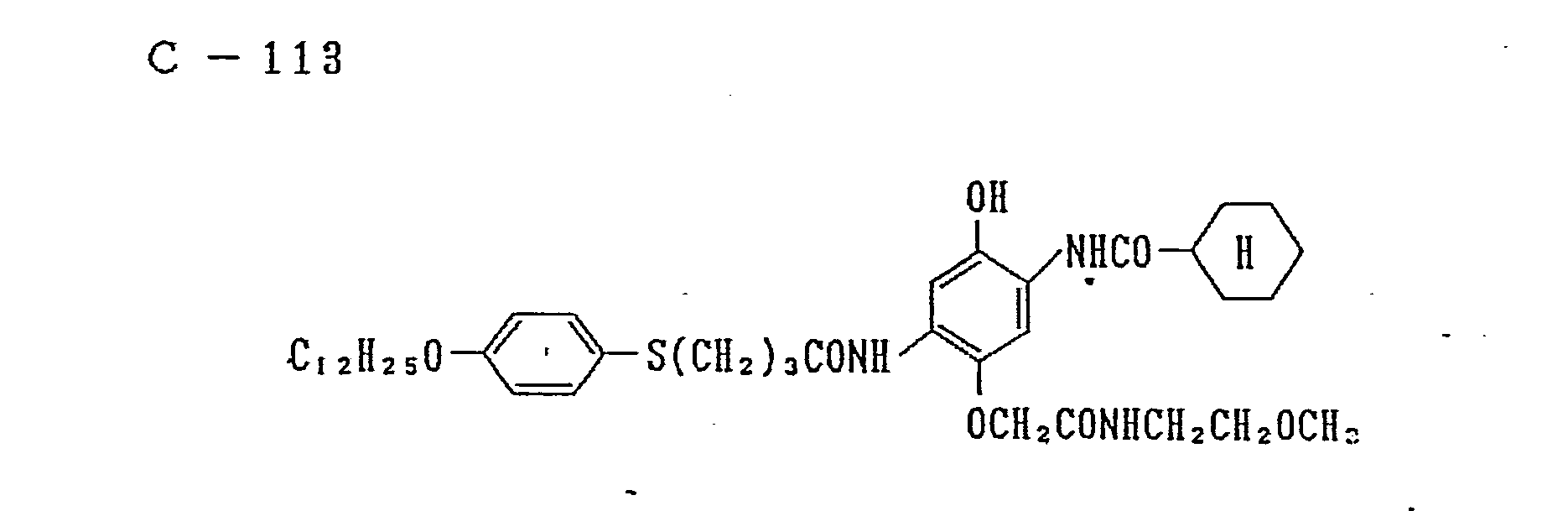


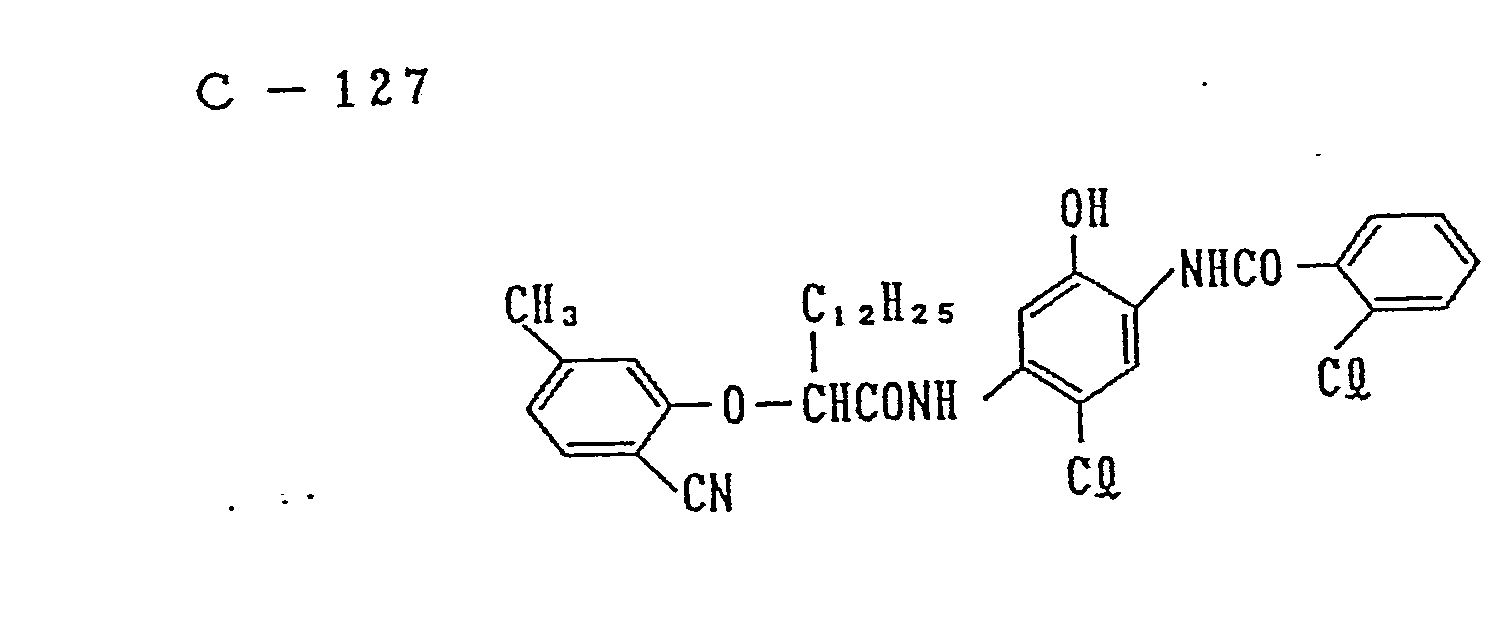
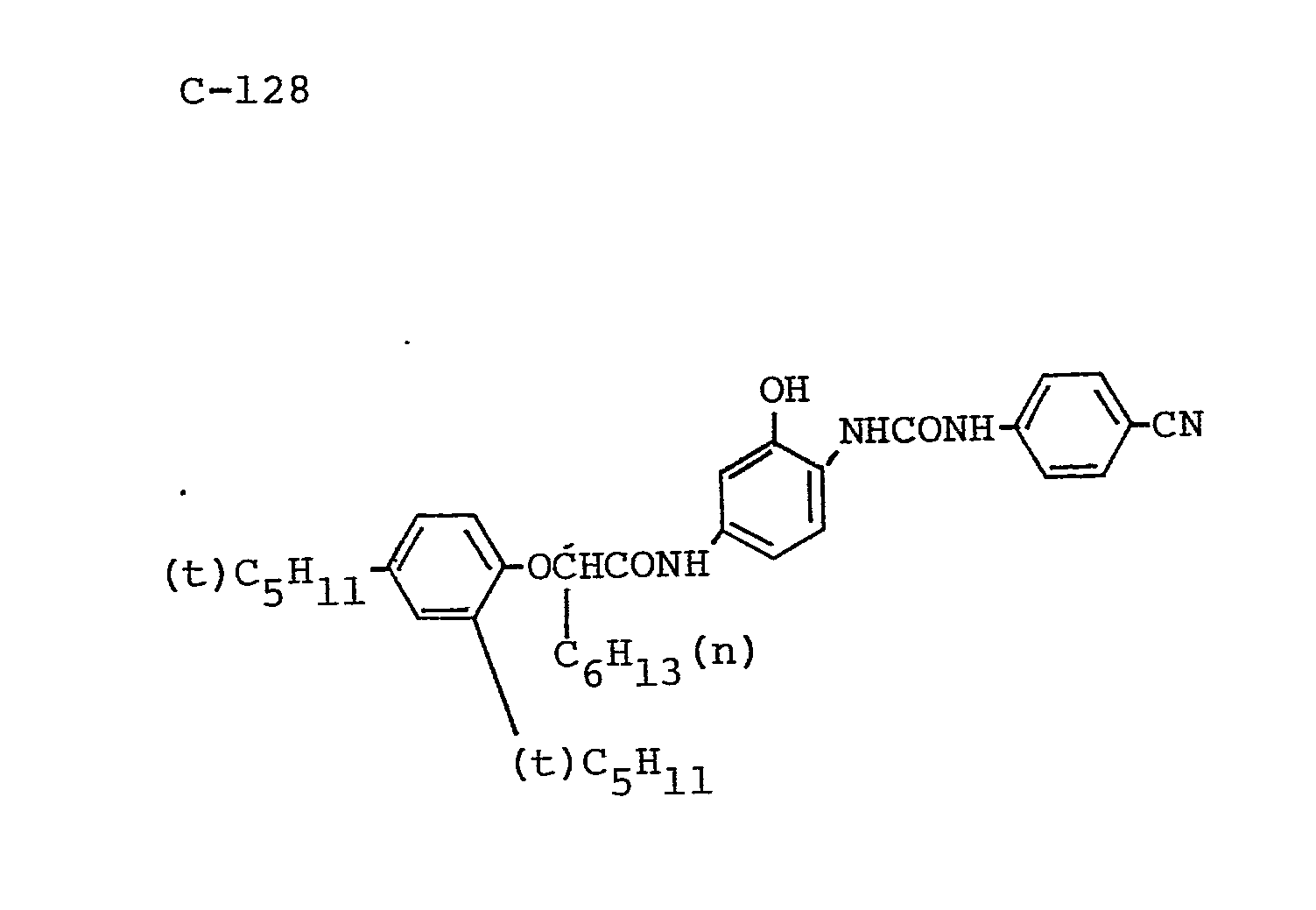
- The above-given cyan couplers can be prepared in any well-known processes described in, for example, U.S. Patent Nos. 2,772,162, 3,758,308, 3,880,661, 4,124,396 and 3,222,176; British Patent Nos. 975,773, 8,011,693 and 8,011,694; Japanese Patent O.P.I. Publication Nos. 21139/1972, 112038/1975, 163537/1980, 29235/1981, 99341/1980, 116030/1981, 69329/1977, 55945/1981, 80045/1981 and 134644/1975; and, besides the above, British Patent Nos. 1,011,940; U.S. Patent Nos. 3,446,622 and 33,996,253; Japanese Patent O.P.I. Publication Nos. 65134/1981, 204543/1982, 204544/1982 and 204545/1982; Japanese Patent Application Nos. 131312/1981, 131313/1981, 131314/1981, 131309/1981, 131311/1981, 149791/1982 and 130459/1981; and Japanese Patent O.P.I. Publication Nos. 146050/1984, 166956/1984, 24547/1985, 35731/1985, 37557/1985 and 55340/1985; and the like.
- In the invention, the cyan couplers represented by the Formula [I], [II] or [III] may be used in combination with the other cyan couplers, and may also be used in combination with those represented by the Formula [C-I], [C-II] or [C-III].
- When a silver halide emulsion layer will contain the cyan couplers each represented by the Formulas [C-I] through [C-III], an amount of the cyan couplers to be used is normally within the range of from about 0.005 to 2 mol per mol of the silver halide to be used and, more preferably, from 0.01 to 1 mol.
- Aromatic primary amine color developing agents used for color developer and for replenisher for color development include what are widely known and widely used in various processes of color photography. These developing agents include aminophenol type derivatives and p-phenylenediamine type derivatives. These compounds are generally used in the form of a salt such as, for example, hydrochloride or sulfate because of its stability rather than in the form of a free state. Further, these compounds are used in the range of concentration from about 0.1 g to about 30 g per of color developer usually and in the range from about 1 g to about 1.5 g per of color developer preferably.
- Aminophenol type developing agents include, for example, o-aminophenol, p-aminophenol, 5-amino-2-oxytoluene, 2-amino-3-oxytoluene, 2-oxy-3-amino-1 and 4-dimethylbenzene.
- Primary aromatic amino type color developing agents which are especially useful are N,N'-dialkyl-p-phenylenediamine type compounds and an alkyl group and a phenyl group thereof may be substituted with any substituent. Among those compounds, N,NI-diethyl-p-phenylenediamine hydrochloride, N-methyl-p-phenylenediamine hydrochloride, N,N-dimethyl-p-phenylenediamine hydrochloride, 2-amino-5-(N-ethyl-N-dodecylamino)-toluene, N-ethyl-N-β-methanesulfonamideethyl-3-methyl-4-aminoaniline hydrochloride, N-ethyl-N-β-hydroxyethylaniline, 4-amino-3-methyl-N,N'-diethylaniline and 4-amino-N-(2-methoxyethyl)-N-ethyl-3-methylaniline-p-toluenesulfonate are given as a particularly useful compound.
- A color developer used for the processing in the invention can include, in addition to aforesaid primary aromatic amine type color developing agents, various types of ingredients generally added to a color developer such as, for example, alkali agents of sodium hydroxide, sodium carbonate and potassium carbonate, alkali metal sulfite, alkali metal bisulfite, alkali metal thiocyanate, alkali metal halide, benzyl alcohol, 1-phenyl-3-pyrazolidone, Metol and hydroquinone black and white developing agent, water-softening agent and concentrating agent and in the present invention, chelating agents represented by following general formulae [XII], [XIII] and [XIV] are preferably used for achieving further effects of the invention.


- A and B in the formulae represent respectively a monovalent group or atom and they may be either an inorganic substance or an organic one. D represents a group of non-metal atoms necessary for forming an aromatic ring or a heterocyclic ring both of which may have a substituent and M represents a hydrogen atom or an alkali metal atom.
- Among chelating agents represented by aforesaid general formula [XII], [XIII] or [XIV] and used in the invention, the preferable ones for the invention are the compounds represented by any one of following general formulae [XV]-[XXVI].




- E in the formula represents substituted or unsubstituted alkylene group, cycloalkylene group, phenylene group, -R 7-OR 7-, -R7-OR7OR7- and -R7ZR7-, Z represents >N-R7-A6 and >N-A6, R1-R7 represents substituted or unsubstituted alkylene group, A1-A6 represent hydrogen, -OH, -COOM, -PO3M2, M represents hydrogen and an alkali metal atom, m represents integers of 3-6 and n represents integers of 2-20.

- In the formula, R8 represents a lower alkyl group, an aryl group, an aralkyl group and a nitrogen-containing 6-member ring group [-OH, -OR, -COOM as a substituent] and M represents a hydrogen atom and an alkali metal atom.

- In the formula, R29-R31 represent a hydrogen atom, -OH, lower alkyl (-OH, -COOM, -PO3M2 as an unsubstituted group or a substituent), B1-B3 represent a hydrogen atom, -OH, -COOM, -PO3M2 and -Nj2, J represents a hydrogen atom, lower alkyl, C2H4OH and -PO3M2, M represents a hydrogen atom and alkali metal and n' and m' represent 0 or 1.
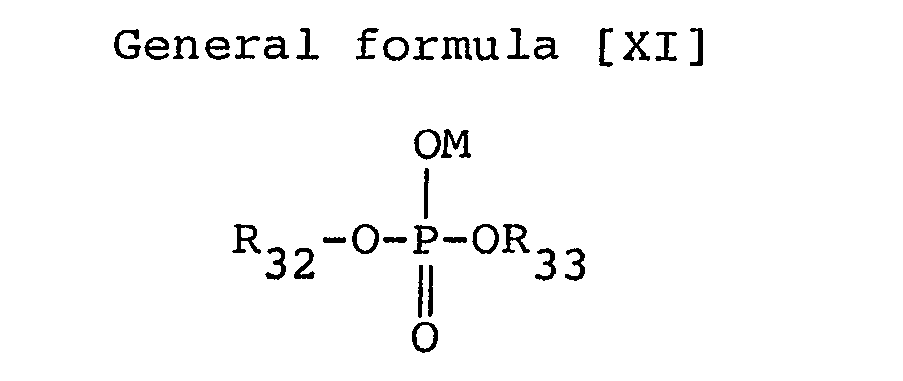
- R 32 and R 33 in the formula represent a hydrogen atom, alkali metal, alkyl groups having C1-C12, an alkenyl group and a cyclic alkyl group.

- In the formula, R34 represents alkyl groups having C1-12, alkoxy groups having C1-12, monoalkylamino groups having C1-12, dialkylamino groups having C2-12, an amino group, allyloxy groups having C1-24, arylamino groups having C6-24 and an amyloxy group and Q1-Q3 represent -OH, alkoxy groups having C1-24, an aralkyloxy group, an allyloxy group, -OM' (M' represents cation), an amino group, a morpholino group, a cyclic amino group, an alkylamino group, a dialkylamino group, an arylamino group and an alkyloxy group.
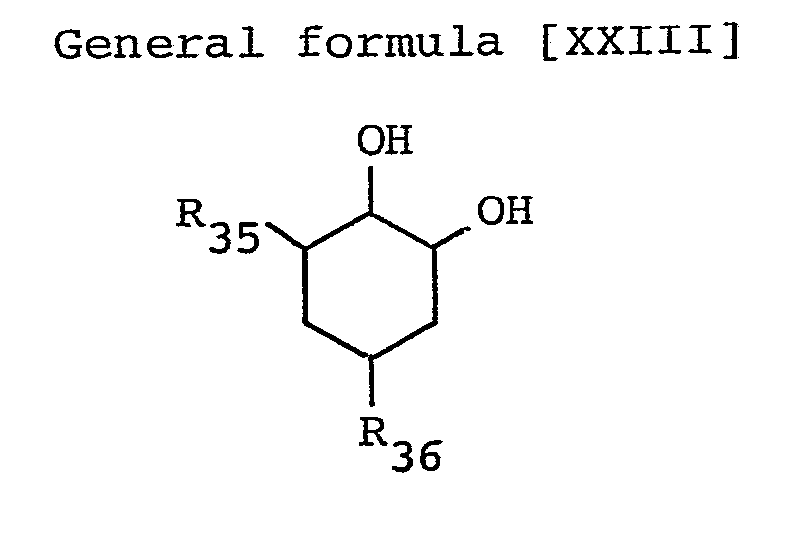

- In the formula, R35, R36' R37 and R 38 respectively represent a.hydrogen atom, a halogen atom, a sulfonic acid group, substituted or unsubstituted alkyl groups having 1-7 carbon atoms, -OR39, -COOR40,


- In the formula, R43 and R44 represent a hydrogen atom, a halogen atom and a sulfonic acid group.

- In the formula, R29 and R30 respectively represent a hydrogen atom, a phosphoric acid group, a carboxylic acid group, -CH2COOH, -CH2PO3H2 or a salt thereof; while X10 represents a hydroxyl group or the salts thereof, and W10' Z10 and Y10 respectively represent a hydrogen atom, a halogen atom, a hydroxyl group, a cyano group, a carboxylic acid group, a phosphoric acid group, a sulfonic acid group or a salt thereof, an alkoxy group or an alkyl group. On the other hand, m1 represents an integer of 0 or 1, n1 represents integers 1-4, I1 represents 1 or 2, P1 represents'integers 0-3 and q1, represents integers 0-2.
- Actual examples of chelating agents represented by aforesaid general formulae [XV]-[XXVI] are given as follows. [exemplified chelating agents]


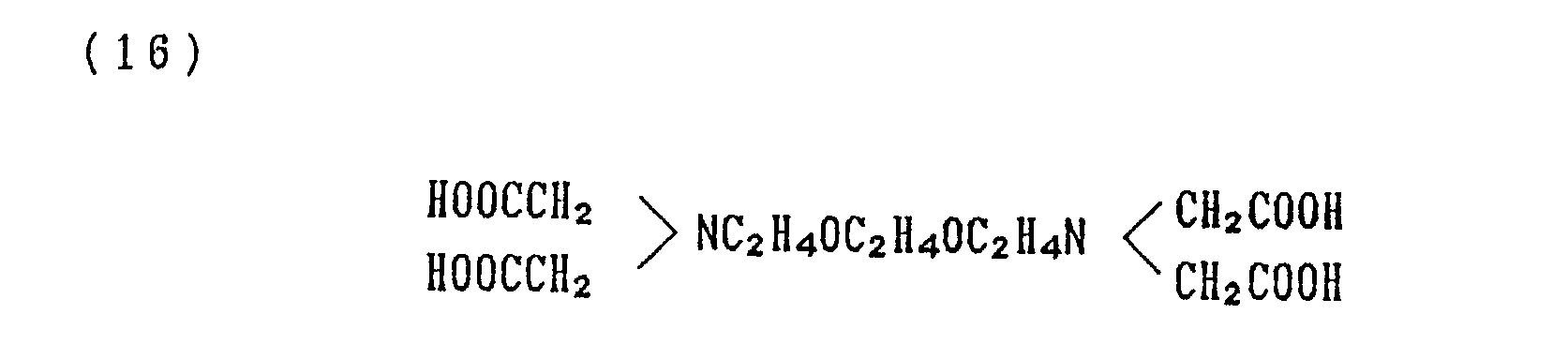
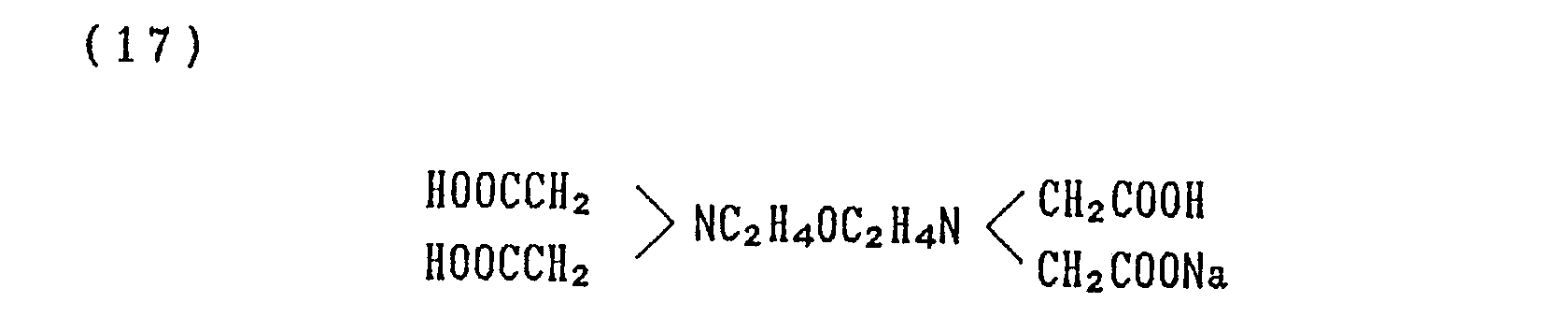


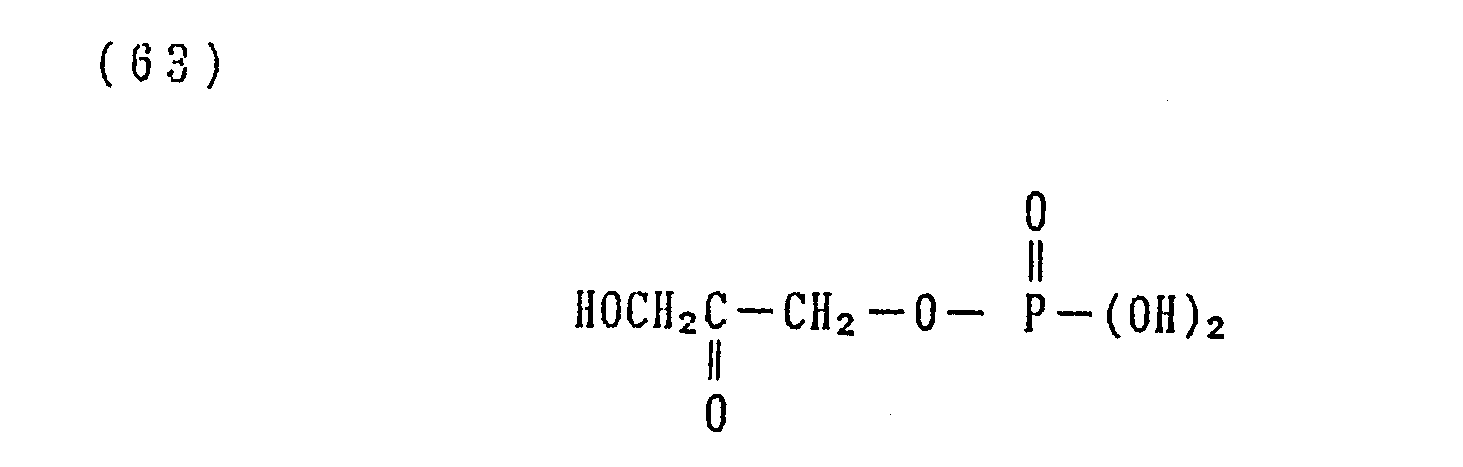
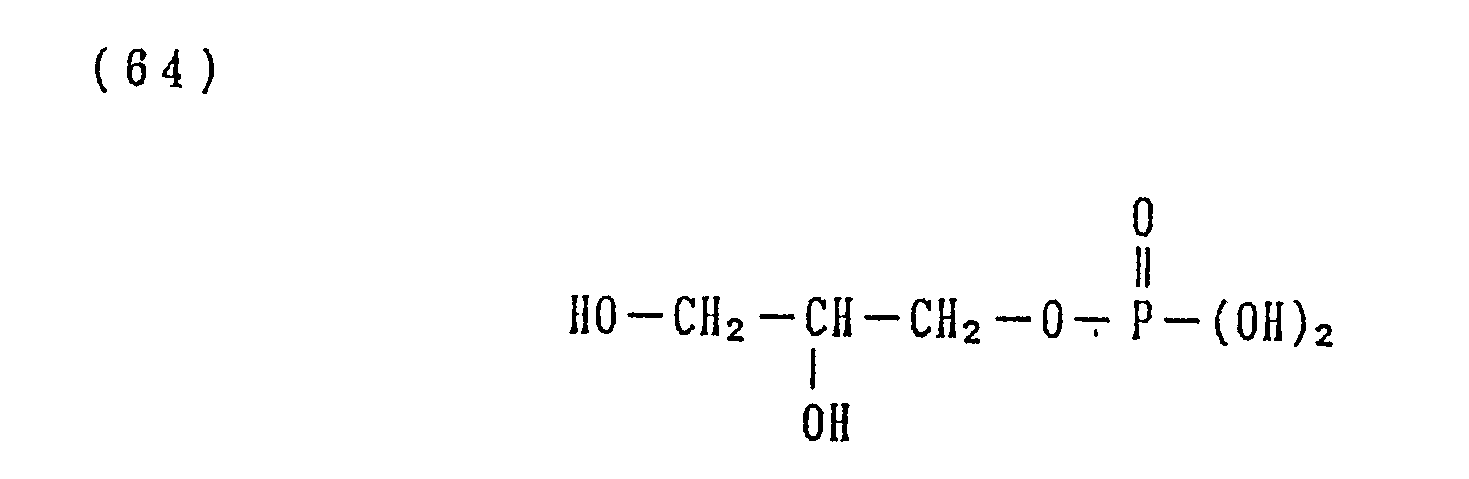


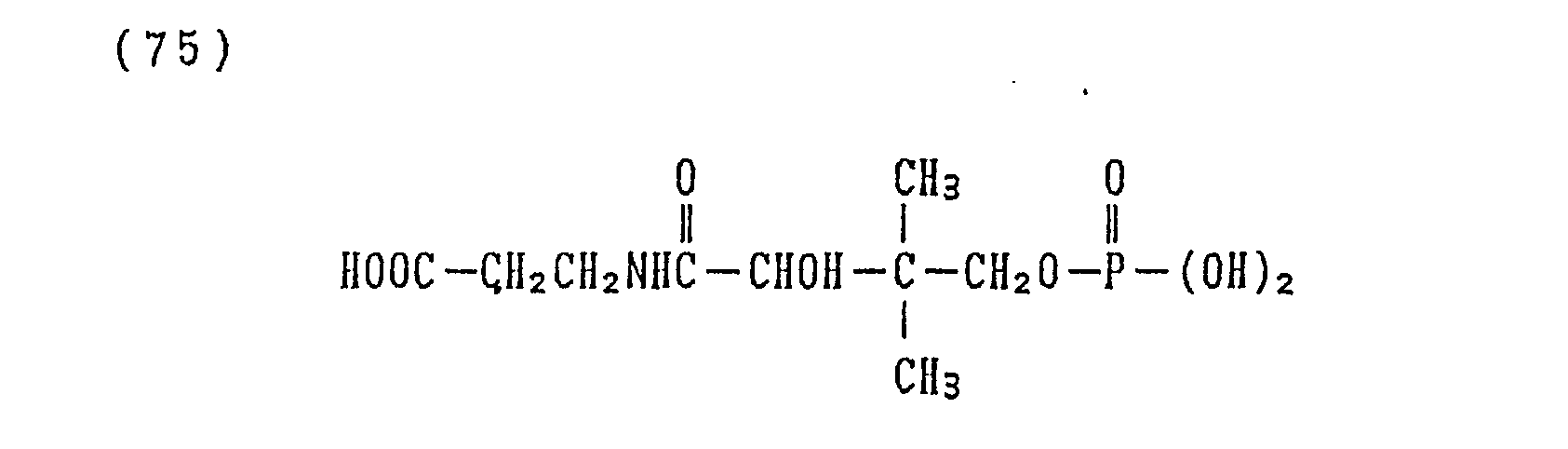


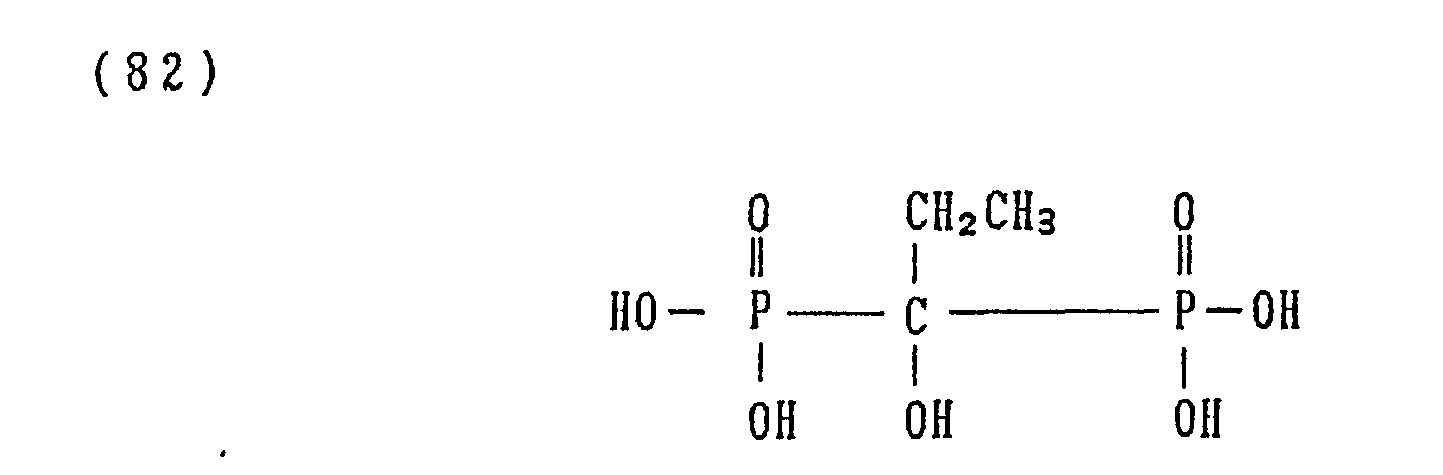

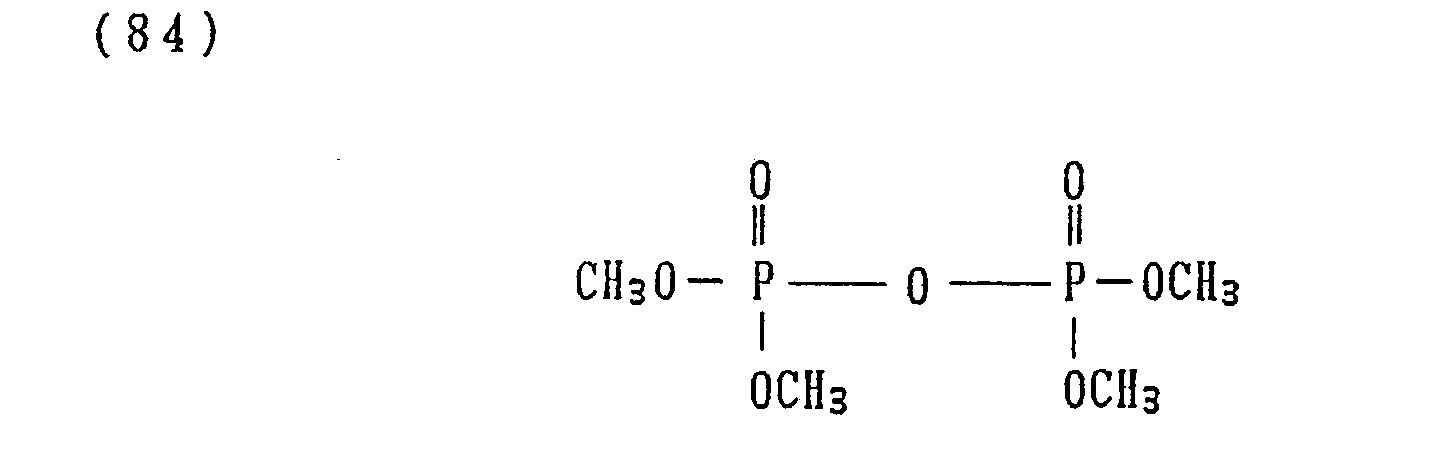


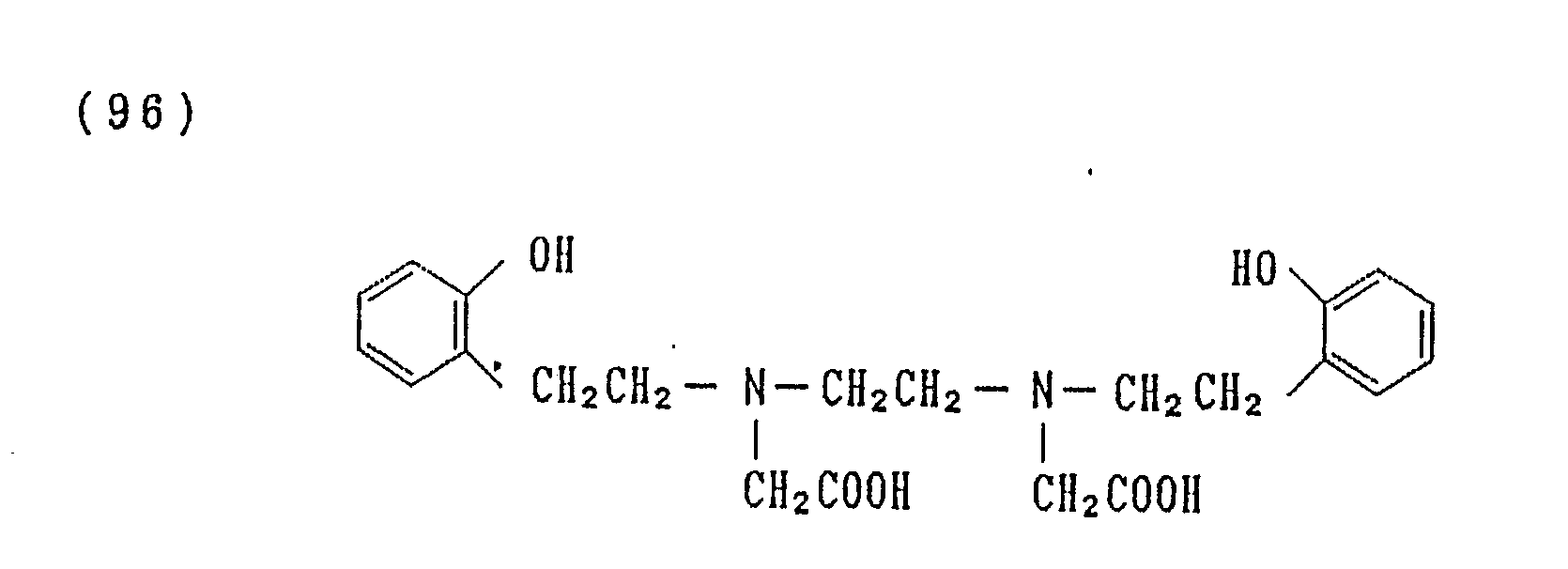


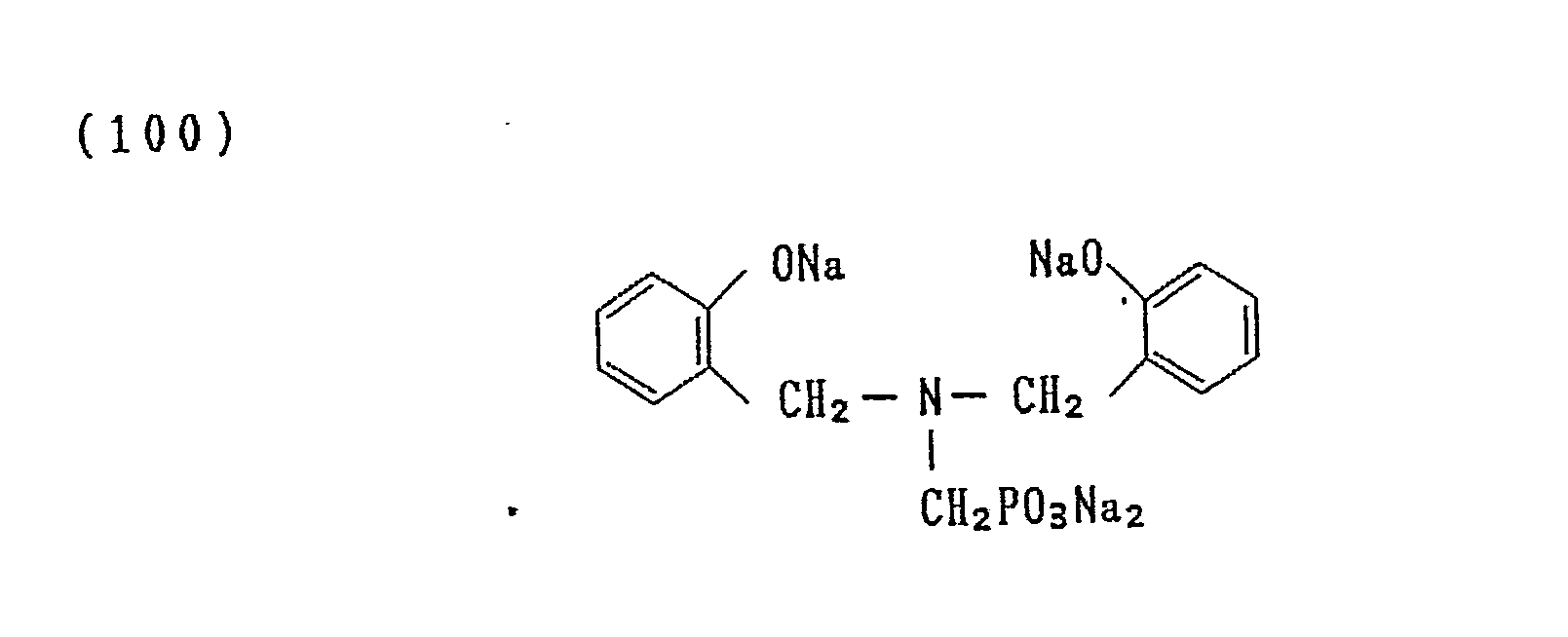

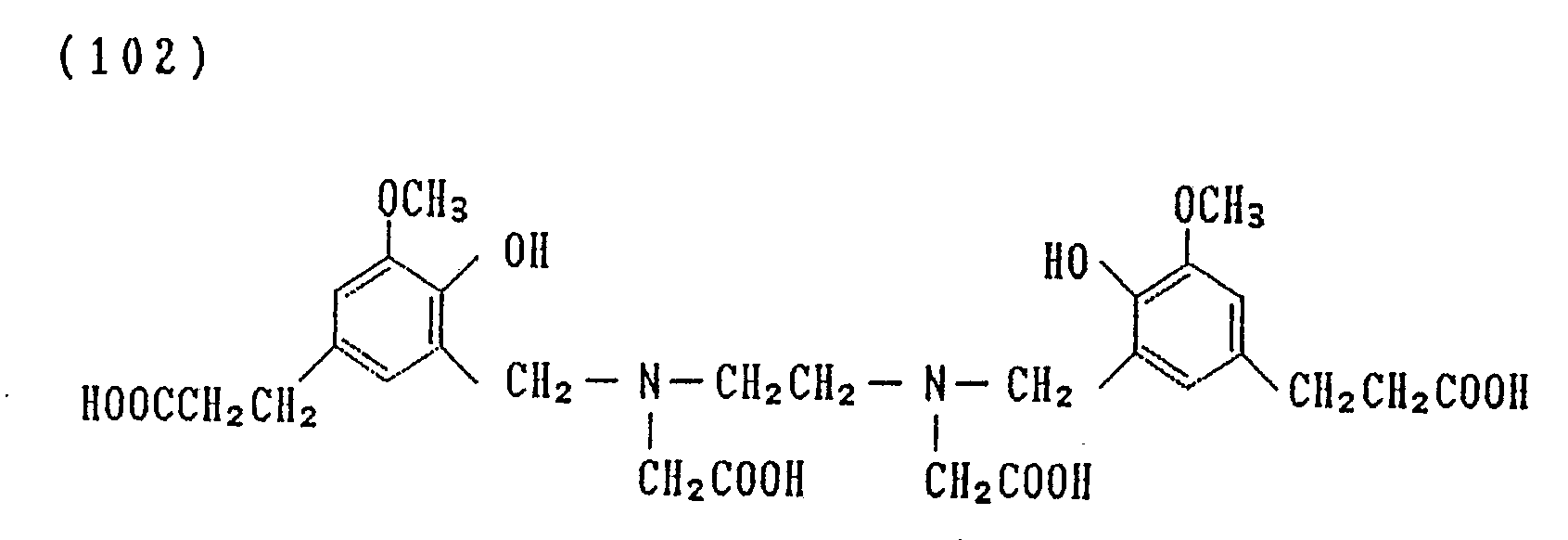


- In the invention, it is advantageous to use chelating agents represented by general formulae [XV], [XVI], [XVII], [XVIII], [XVIX], [XX], [XXI] and [XXVI].
- Chelating agents which are represented by any of aforesaid general formulae [XI]-[XIII] and used in the invention may be added within the range from 1 x 10⁻⁴ mol to 1 mol of chelating agent per of a developer used and within the preferable range from 2 x 10⁻⁴ mol to 1 x 10 1 mol and further preferable range from 5 x 10⁻⁴ mol to 5 x 10⁻² mol per of developer.
- A pH value of the color developer is usually 7 or more and it is most generally about 10 to about 13.
- In the present invention, after the processing of color development, a processing solution having a fixing capability is used for the processing and when the processing solution having a fixing capability is a fixer, the bleaching process is carried out before the processing with the fixer. As a bleaching agent used for a bleaching solution or a bleach-fix solution, metal complex of organic acid is used and aforesaid metal complex has a function for changing metal silver produced through the development to silver halide by oxidizing aforesaid metal silver and for causing concurrently the uncolored portion of the color forming agent to be colored. The structure of the metal complex is represented by an organic acid such as amino polycarboxylic acid, oxalic acid or citric acid, wherein a metal ion such as that of iron, cobalt or copper is coordinated. As the most preferable organic acid to be used for forming metal complex of aforesaid organic acid, polycarboxylic acid or amino carboxylic acid is given. Such polycarboxylic acid or amino polycarboxylic acid may also be alkali metallic salt, ammonium salt or water-soluble amine salt.
- Concrete and typical examples of the foregoing are given as follows.
- [1] ethylenediaminetetraacetic acid
- [2] diethylenetriaminepentaacetic acid
- [3] ethylenediamine-N-(β-oxyethyl)-N,N,N-triacetic acid
- [4] propylenediaminetetraacetic acid
- [5] nitrilotriacetic acid
- [6] cyclohexandiaminetetraacetic acid
- [7] iminodiacetic acid
- [8] dihydroxyethylglycinecitric acid (or tartaric acid)
- [9] ethyletherdiaminetetraacetic acid
- [10] glycoletheraminetetraacetic acid
- [11] ethylenediaminetetrapropionic acid
- [12] phenylenediaminetetraacetic acid
- [13] ethylenediaminetetraacetic acid disodium salt
- [14] ethylenediaminetetraacetic acid tetra(trimethylammonium) salt
- [15] ethylenediaminetetraacetic acid tetrasodium salt
- [16] diethylenetriaminepentaacetic acid pentasodium salt
- [17] ethylenediamine-N-(S-oxyethyl)-N,N',N'-triacetic acid sodium salt
- [18] propylenediaminetetraacetic acid sodium salt
- [19] nitrilotriacetic acid sodium salt
- [20] cyclohexanediaminetetraacetic acid sodium salt
- A bleaching solution to be used may contain metal complex of aforesaid organic acid as a bleaching agent and contain various types of additives. As an additive, it is preferable that alkali halide or ammonium halide such as, for example, rehalogenating agent like potassium bromide, sodium bromide, sodium chloride and ammonium bromide as well as metallic salts and chelating agents are contained in particular. It is further possible to add, according to circumstances, pH buffering agents such as borate, oxalate, acetate, carbonate, phosphate or the like and alkylamines, polyethyleneoxides and others which are known to be added generally to a bleaching solution.
- Further, a fixer and a bleach-fix solution may contain one kind or two or more kinds of pH buffering agents composed of sulfite such as ammonium sulfite, potassium sulfite, sodium bisulfite, ammonium metabisulfite, potassium metabisulfite, sodium metabisulfite and others and of various kinds of salts such as boric acid, borax, sodium hydroxide, potassium hydroxide, sodium carbonate, potassium carbonate, sodium bicarbonate, potassium bicarbonate, acetic acid, sodium acetate, ammonium hydroxide and others.
- When processing while replenishing a bleach-fix replenisher to the bleach-fix solution (bath), either the case where the bleach-fix solution (bath) contains thiosulfate, thiocyanate or sulfite or the case where the bleach-fix replenisher contains aforesaid salts and is replenished to the processing path is allowed.
- As for a bleaching solution in the invention, air or oxygen is allowed to be blown in the bleach-fix bath and in the storage tank for bleach-fix replenisher at need for enhancing the activity of a bleach-fix solution, or proper oxidizing agents such as, for example, hydrogen peroxide, bromate, persulfate or the like may be added according to circumstances.
- In the processing of the invention, the silver recovery may be carried out from processing solution containing soluble silver complex salts such as a fixer and a bleach-fix solution as well as the washing water or a stabilizer of the substitute for washing. For example, an electrolysis method (French Patent No. 2,299,667), a precipitation method (Japanese Patent O.P.I. Publication No. 73037/1977, West German Patent No. 2,331,220), an ion exchange method (Japanese Patent O.P.I. Publication No. 17114/1976 and West German Patent No. 2,548,237) and a metal substitution method (British Patent No. 1,353,805) are utilized effectively.
- After the bleaching process and fixing process (or bleach-fix process) following the color developing process in the invention, either the case wherein no washing is conducted and the substitutive process for washing is carried out or the case wherein washing is conducted and then the substitutive stabilizing process for washing is carried out is allowed. In addition to the aforesaid processes, known auxiliary processes such as the processes for hardening, neutralizing, black and white developing, reversal and washing with a small quantity of water may be added at need. Typical concrete examples of preferable processing method include the following processes.
- (1) color development → bleach-fix + washing
- (2) color development → bleach-fix → washing with a small quantity of water → washing
- (3) color development → bleach-fix → washing + substitutive process for washing
- (4) color development → bleach-fix → substitutive process for washing
- (5) color development → bleach-fix → substitutive process for washing → stabilizing
- (6) color development → washing (or substitutive process for washing) → bleach-fix → washing (or substitutive process for washing)
- (7) color development → stop → bleach-fix → washing (or substitutive process for washing)
- (8) color development → bleaching → washing → fixing washing → stabilizing
- (9) color development → bleaching → fixing → washing + stabilizing
- (10) color development → bleaching → fixing → substitutive process for washing → stabilizing
- (11) color development → bleaching → washing with a small quantity of water → fixing → washing with a small quantity of water → washing → stabilizing
- (12) color development → washing with a small quantity of water → bleaching → washing with a small quantity of water → fixing → washing with a small quantity of water → washing → stabilizing
- (13) color development → stop → bleaching → washing with a small quantity of water → fixing → washing with a small quantity of water → washing stabilizing
- (14) black and white development → washing (or substitutive process for washing) → reversal process color development + bleaching → fixing → washing (or omission) → stabilizing
- (15) pre-hardening → neutralizing → black and white development → stop + color development → bleaching → fixing + washing (or omission) → stabilizing
- A core/shell emulsion used for the invention is described in detail in Japanese Patent O.P.I. Publication No. 154232/1982. In the invention, it is satisfactory that a core/shell emulsion contains 3 mol % or more of silver iodide and in the preferable color photographic material, the composition of a core in terms of silver halide is that the silver halide contains 0.1-20 mol %, preferably 0.5-10 mol % of silver iodide and a shell consists of silver bromide, silver chloride, silver iodobromide, silver chlorobromide or the mixture of the foregoing.
- What is preferable in particular is that a shell is a silver halide emulsion consisting of silver bromide or silver iodobromide. Further, in the invention, a preferable effect may be achieved when a core is a monodispersed silver halide grain and the thickness of a shell is 0.01-0.5 µm.
- A silver halide color photographic material of the invention is characterized in that it consists of silver halide grains containing 3 mol % of silver iodide and silver halide grains containing silver iodide are used especially as a core thereof and the nature toward the high sensitivity of silver halide grains containing silver iodide is put to practical use by covering the core of a silver halide grain consisting of silver bromide, silver chloride, silver chlorobromide, silver iodobromide or the mixture of the foregoing using the shell having aforesaid specific thickness and further the process variation is improved by hiding the disadvantageous nature of aforesaid grains. More particularly, a core of silver halide containing silver iodide is given a shell having the strictly regulated range of its thickness necessary for bringing out effectively only the preferable nature of the core and for hiding the unpreferable behavior of the core. The method for covering with a shell having the absolute thickness that is necessary and minimum for bringing out effectively the nature owned by the core may also be utilized extensively for the purposes of improving the process variation, the life or the spectral sensitizer- absorbing property by changing the purpose, namely changing the material of the shell, which is advantageous to a great extent.
- A silver iodide content in a matrix of silver halide grain (core) ranges from the solid solution of 0.1-20 mol % to the mixed crystal and it preferably is within the range from 0.5 mol % to 10 mol %. The distribution in the core of silver iodide contained may either be an omnipresent state or a uniform state and the uniform distribution is preferable.
- A silver halide emulsion of the invention containing a silver halide grain having a shell with a specific thickness may be manufactured by covering with aforesaid shell the core of silver halide grain contained in a monodispersed emulsion. Incidentally, it is preferable that the ratio of silver iodide to silver bromide in the case that a shell is silver iodobromide is 10 mol % and less.
- When causing a core to be a monodispersed silver halide grain, it is possible to obtain a grain having the desired size through a double-jet method wherein the pAg is kept constant. Further, for manufacturing a silver halide emulsion having a high-level monodispersibility, it is possible to use the method disclosed in Japanese Patent O.P.I. Publication No. 48521/1979. The preferable embodiment among aforesaid methods is to manufacture, by adding potassium iodobromide- gelatin solution and ammoniacal silver nitrate solution into gelatin solution containing silver halide seed grains through the adding method wherein the adding speed changes as a function.of time. In this case, it is possible to obtain a silver halide emulsion having a high-level dispersibility by selecting properly the function of time for adding speed, pH, pAg, temperature or the like.
- A monodispersed core/shell emulsion in the invention is preferably used and monodispersed silver halide grains mean silver halide grains wherein the weight of silver halide whose grain size is within the range of ± 20% of the average grain size r that is centered is 60% or more of the weight of total silver halide grains. Aforesaid average grain size r is defined as the grain size r, (valid figures, 3 digits) under the condition that the product of frequency ni of the grain having the grain size ri multiplied by ri 3 is maximum.
- The grain size mentioned here is a diameter of a silver halide grain when the silver halide grain is spherical, while, when it is of a shape other than a spherical shape, the grain size is a diameter of a circle image converted from the projected image of the grain and having the same area as that of projected image. The grain size is obtained by photographing the grain through an electron microscope with a magnification of 10,000 times to 50,000 times and by measuring the grain diameter or the area of a projected image on the print. The number of grains to be measured is 1000 or more selected through the random sampling.
- A monodispersed silver halide emulsion used in the invention gives an effect that the density variation in the high density portion is made smaller compared with a polydisperse emulsion, which is a preferable embodiment in the working of the invention.
- As for the thickness of a shell that covers a core, it is required to be the thickness which does not hide the preferable nature of the core and does hide the unpreferable nature thereof. Namely, the thickness is limited to a narrow range between the upper limit and the lower one. Such shell may be formed in a way wherein soluble halide solution and soluble silver salt solution are treated through a double-jet method to be deposited in a form of a monodispersed core.
- For example, in the experiment wherein monodispersed silver halide grains having an average grain size of 1 µm and containing silver iodide of 3 mol % in the core were used and the covering thickness of 0.2 mol % silver iodobromide which is a shell was changed variously, when the shell having the thickness of 0.85 µm was prepared, the covering power of monodispersed silver halide grains in the aforesaid method was too low to be put to practical use. This was treated in the processing bath containing a solvent capable of dissolving silver halide and having a physical development property and then was observed under a scanning type electron microscope which proved that no filament of developed silver appeared. This suggests that the optical density is lowered and the covering power is further lowered. Therefore, it was tried, taking the form of a filament of developed silver into consideration, that the thickness of a shell of silver bromide on the surface was gradually thinned while changing the average grain size of a core. As the result of aforesaid trial, it was found that many excellent filaments of developed silver were produced and thereby sufficient optical densities were obtained and nevertheless the nature of high sensitivity of the core was not deteriorated, independently of the average grain size of a core but dependently on an absolute thickness of a shell of 0.5 µm and less (preferably, 0.2 µm and less).
- When the thickness of a shell is too thin, on the other hand, there are produced portions where the foundation of a core containing silver iodide is bared and thereby the effects of covering the surface with shells, namely, the effect of chemical sensitization and the property of quick development, fixing or the like are lost. It is preferable that the limit of the thickness is 0.01 µm.
- When confirmed by the high monodispersed core, the preferable thickness of a core ranges from 0.01 µm to 0.06 µm and the most preferable thickness is 0.03 µm and below.
- Aforesaid effects that sufficient filaments of developed silver are produced and thereby the chemical density is improved, the sensitizing effect is achieved by making the best use of the nature of a core toward the high sensitivity and the property of quick development and fixing is obtained, are caused by the shell whose thickness is regulated, as mentioned above, by the high monodispersed core and by the synergetic effect between the silver halide composition of core and shell. Provided that the regulation of shell thickness is satisfied, silver iodobromide, silver bromide, silver chloride,-silver chlorobromide or the mixture thereof may be used as silver halide constituting aforesaid shell. Among them, silver bromide, silver iodobromide or the mixture thereof are preferable from the viewpoints of a congeniality with a core, process stability and process stain or of a life.
- When silver halide of core and shell is produced in a form of precipitation and when grains thereof grow or after the completion of the growth, a photosensitive silver halide emulsion used in the invention may be doped with various types of metallic salts or metal complexes. For example, metallic salts or complexes of gold, platinum, palladium, iridium, rhodium, bismuth, cadmium and copper or the mixture thereof may be applied.
- Further, excess halogenated compounds produced during the preparation of an emulsion of the invention or salts such as a nitrate, ammonium or the like and compounds which are produced as a secondary product or have become unnecessary may be eliminated. As an eliminating method, noodle washing method, a dialysis method or a coagulating method, all of which are commonly used for general emulsions may be used at need.
- Further, various types of chemical sensitizing methods used for general emulsions may be applied to the emulsion of the invention. Namely, through chemical sensitizing agents like reduction sensitizer such as active gelatin; noble metal sensitizer such as water-soluble gold salt, water-soluble platinum salt, water-soluble palladium salt, water-soluble rhodium salt and water-soluble iridium salt; sulfur sensitizer; selenium sensitizer; polyamine and stannous chloride, it is possible to carry out the chemical sensitization using one of aforesaid chemical sensitizers or using plural chemical sensitizers mentioned above in combination. It is further possible to carry out the optical sensitization for the desired wavelength range on the silver halide. There is no restriction in particular in the optical sensitizing methods for the emulsion of the invention, and, for example, optical sensitizers such as cyan dye like zerometin dye, cyan dye like trimetin dye or merocyanine dye may be used individually or in combination thereof (e.g. strong color sensitization) for the optical sensitization. These technologies are disclosed in U.S. Patent Nos. 2,688,545, 2,912,329, 3,397,060, 3,615,635 and 3,628,964, British Patent Nos. 1,195,302, 1,242,588 and 1,293,862, West German OLS Patent Nos. 2,030,326 and 2,121,780 and Japanese Patent Examined Publication Nos. 4936/1968 and 14030/1969. The selection may freely be made from aforesaid technologies according to the purpose and application for the photosensitive material, such as the wavelength range to be sensitized, the sensitivity and others.
- As for the silver halide emulsion to be used in the invention, a monodispersed silver halide emulsion wherein shells are mostly uniform in thickness is obtained by using the silver halide emulsion in which core particles are represented by monodispersed silver halide grains and by coating aforesaid core particle with a shell, when forming silver halide grains to be further contained. Such monodispersed silver halide emulsion may be used either without changing its grain size distribution or with blending, for obtaining desired gradient, 2 or more kinds of monodispersed emulsions having different average grain sizes each other at an optional moment after forming grains.
- As for the silver halide emulsion used in the invention, the one containing silver halide grains of the invention at the rate identical to or higher than that of the emulsion obtained by covering with shells monodispersed cores having the distribution area of 20% and less against total silver halide grains contained in the emulsion wherein the ratio of the silver halide grains of the invention to the total silver halide grains contained in the emulsion is identical to or higher than that of the emulsion obtained by covering with shells the monodispersed cores having the distribution area of 20% and less is preferable.
- However, silver halide grains other than the invention are allowed to be contained within the range that the effect of the invention is not impeded. Aforesaid silver halide other than the invention is allowed to be either of a core/shell type or of a non-core/shell type and it is further allowed to be either monodispersed one or polydispersed one. In the silver halide emulsion used in the invention, it is preferable that at least 65% by weight of silver halide grains contained in aforesaid emulsion is the silver halide grains of the invention and it is desirable that almost all of silver halide grains in the emulsion are the silver halide grains of the invention.
- As for other couplers for photographic use used in the invention, phenol type compounds and naphthol type compounds are preferable as a cyan coupler and they may be selected from the ones described, for example, in U.S. Patent Nos. 2,369,929, 2,434,272, 2,474,293, 2,895,826, 3,253,924, 3,034,892, 3,311,476, 3,386,301, 3,419,390, 3,458,315 and 3,591,383 which also include synthesizing methods for those compounds.
- In addition to magenta couplers of the invention, other magenta couplers may be used together with the former and the actual examples of aforesaid other magenta couplers are pyrazolone compounds, pyrazolinobenzimidazole compounds and indazolone compounds. As pyrazolone magenta couplers, the compounds described in U.S. Patent Nos. 2,600,788, 3,062,653, 3,127,269, 3,311,476, 3,419,391, 3,519,429, 3,558,318, 3,684,514, 3,888,680, Japanese Patent O.P.I. Publication Nos. 29639/1974, 111631/1974, 129538/1974, 13041/1975, Japanese Patent Examined Publication Nos. 47167/1978, 10491/1979 and 30615/1980 are used and as diffusion-proof colored magenta couplers, the compounds wherein a coupling position of a colorless magenta coupler is substituted with arylazo are generally used and the examples thereof are described in U.S. Patent Nos. 2,801,171, 2,983,608, 3,005,712, 3,684,514, British Patent No. 937,621, Japanese Patent O.P.I. Publication Nos. 123625/1974 and 31448/1974. Further, the colored magenta coupler of the type wherein dyes flow out into processing solution during the reaction with oxidants of developing agents, which is identical to the one described in U.S. Patent No. 3,419,391 is allowed to be used.
- As a yellow coupler for photographic use, open chain ketomethylene compounds have been used and it is possible to use a benzoylacetanilide type yellow coupler and a pivaloylacetanilide type yellow coupler both of which are widely used. Further, a 2-equivalent type yellow coupler wherein a carbon atom in a coupling position is substituted with a substituent capable of splitting off during a coupling reaction may also be used advantageously. The examples of aforesaid yellow coupler are described together with synthesizing methods thereof in U.S. Patent Nos. 2,875,057, 3,265,506, 3,664,841, 3,408,194, 3,277,155, 3,447,928, 3,415,652, Japanese Patent Examined Publication No. 13576/1974, Japanese Patent O.P.I. Publication Nos. 29432/1973, 68834/1973, 10736/1974, 122335/1974, 28834/1975
- and 132926/1975.
- An amount of aforesaid diffusion-proof coupler used in the invention is generally 0.05 mol-2.0 mol per 1 mol of silver in a photosensitive silver halide emulsion layer.
- In the invention, DIR compounds are preferably used in addition to aforesaid diffusion-proof couplers.
- Furthermore, in addition to DIR compounds, the compounds which discharge development inhibitors during the development are also included in the invention and the examples thereof are described in U.S. Patent Nos. 3,297,445 and 3,379,529, West German OLS Patent No. 2,417,914, Japanese Patent O.P.I. Publication Nos. 15271/1977, 9116/1978, 123838/1984 and 127038/1984.
- DIR'compounds used in the invention are the compounds capable of reacting on oxidants of developing agent and thereby discharging development inhibitors.
- As a typical one of aforesaid DIR compounds, there is given a DIR coupler wherein a group capable of forming, when splitting from a coupling position, a compound having a development-inhibiting action is substituted to the coupling position of the coupler and the examples thereof are described in British Patent No. 935,454, U.S. Patent Nos. 3,227,554, 4,095,984 and 4,149,886.
- Aforesaid DIR coupler has a property that the coupler parent group of the DIR coupler, during the coupling reaction on oxidants of developing agent, forms a dye and discharges, on the other hand, a development inhibitor. The present invention further includes the compounds which discharge, during the coupling reaction on oxidants of developing agents as described in U.S. Patent Nos. 3,652,345, 3,928,041, 3,958,993, 3,961,959 and 4,052,213, Japanese Patent O.P.I. Publication Nos. 110529/1978, 13333/1979 and 161237/1980, the development inhibitors but do not form any dye.
- Furthermore, the invention includes what is called a timing DIR compound which is a compound whose parent group forms, when reacting on oxidants of developing agent as described in Japanese Patent O.P.I. Publication Nos. 145135/1979, 114946/1981 and 154234/1982, a dye or a colorless compound, while, a timing group splitted off discharges development inhibitor through an intramolecular nucleophilic substitution reaction or an elimination reaction.
- Further, the invention also includes a timing DIR compound wherein a timing group is connected to a coupler parent group that produces completely diffusive dye when reacting on oxidants of developing agent as described in Japanese Patent O.P.I. Publication Nos. 160954/1983 and 162949/1983.
- As for an amount of DIR compound contained in a photosensitive material, the amount ranging from 1 x 10" mol to 10 x 10 mol per 1 mol of silver is preferably used.
- A silver halide emulsion layer of the invention is allowed to contain various additives normally used according to purposes. For example, stabilizers and antifoggants such as azaindenes, triazoles, tetrazoles, imidazolium salts, tetrazolium salts and polyhydroxy compounds; hardeners of the types of aldehyde, aziridine, isoxyazole, vinyl sulfone, acryloyl, carbodiimido, maleimide, ester methanesulfonate and triazine; development accelerators such as benzyl alcohol and polyoxyethylene compounds: image stabilizers of the types of chroman, coumaran, bisphenyl and phosphorous ester; and lubricants such as wax, glyceride of higher fatty acid and higher alcohol ester of higher fatty acid are given. Further, coating aids as a surface active agent, penetrability- improving agents for processing solution, defoaming agents or materials for controlling various physical properties of photosensitive material such as the materials of an anion type, a cation type, a non-ion type and an amphoteric type are allowed to be used. As an antistatic agent, diacetyl cellulose, styreneperfluoroalkyllithiummalate copolymer and alkali salt of reactant between styrene-maleic anhydride copolymer and p-aminobenzenesulfonic acid are useful. As a matting agent, polymethyl methacrylate, polystyrene and alkali-soluble polymer are given. Colloidal silicon oxide may further be used. As a latex to be added for improving physical properties of a layer, copolymers polymerized from acrylic ester or vinyl ester and a monomer having other ethylene group are given. As a gelatin plasticizer, glycerol and glycol compounds are given and as a thickener, styrene- sodium maleate copolymer and alkylvinylether-maleic acid copolymer are given.
- In silver halide color photographic materials of the invention, hydrophilic colloid used for preparing an emulsion and other coating solution for hydrophilic colloidal layers includes any of protein such as gelatin, derivative gelatin, graft polymer of gelatin and other high polymer, albumin and casein; cellulose derivative such as hydroxyethylcellulose derivative and carboxymethylcellulose; and homopolymer type or copolymer type synthesized hydrophilic high polymer such as starch derivative, polyvinylalcohol, polyvinylimidazole and polyacrylamide.
- As a support for silver halide color photographic materials of the invention, there are given, as an example, a glass plate, polyester film such as cellulose acetate, cellulose nitrate or polyethylene-terephthalate, polyamide film, polycarbonate film and polystyrene film and further an ordinary reflective support (e.g. baryta paper, polyethylene-coated paper, polypropylene synthetic paper and transparent support provided with a reflective layer or having a reflective substance to be used together with transparent support) is also allowed to be used and these supports are selected according to the purpose of the application of photosensitive materials.
- For coating arrangement of a silver halide emulsion layer used in the invention and other photographic structural layers, various types of coating methods such as a dipping coating method, an air doctor coating method, a curtain coating method and a hopper coating method are allowed to be used. Further, a method of simultaneous coating of 2 or more layers based on the means described in U.S. Patent Nos. 2,761,791 and 2,941,893 may also be used.
- The invention may be applied to silver halide color photosensitive materials such as color paper, color negative film, color positive film, color reversal film for slide, color reversal film for cinematography, color reversal film for TV and reversal color paper.
- The invention will be explained as follows in detail referring to the examples which do not limit the embodiments of the invention.
- A multilayer color photosensitive material having, on its support of cellulose triacetate film, the layers each of which has a composition shown below was prepared. First layer: antihalation layer
- gelatin layer containing black colloidal silver Second layer: interlayer (gelatin layer) Third layer: first red-sensitive emulsion layer silver iodobromide (monodispersed spherical grains having an average grain size of 0.4 µm and containing silver iodide of 4.0 mol %)
- ... coating weight of silver 0.8 g/m 2 silver iodobromide (monodispersed spherical grains having an average grain size of 0.5 µm and containing silver iodide of 4 mol %)
- ... coating weight of silver 0.8 g/m 2 sensitizing dye I (mentioned below) ... 6 x 10⁻⁵ mol per mol of silver
- sensitizing dye II (mentioned below) ... 1.0 x 10⁻⁵ mol per mol of silver
- cyan coupler (mentioned below) ... 0.044 mol per mol of silver
- Fourth layer: second red-sensitive emulsion layer silver iodobromide (monodispersed spherical grains having an average grain size of 1.0 µm and containing silver iodide of 6 mol %)
- ... coating weight of silver 2.0 g/m 2 sensitizing dye I ... 3.5 x 10 mol per mol of silver
- sensitizing dye II ... 1.0 x 10⁻⁵ mol per mol of silver
- cyan coupler ... 0.020 mol per mol of silver Fifth layer: interlayer
- Same as Second layer
- Sixth layer: first green-sensitive emulsion layer silver halide emulsion (Table 1)
- ... coating weight of silver 1.8 g/m2 sensitizing dye III (mentioned below)
- ... 3.3 x 10⁻⁵ mol per mol of silver sensitizing dye IV (mentioned below)
- ... 1.1 x 10⁻⁵ mol per mol of silver magenta coupler (Table 2)
- ... 12 g per mol of silver
- Seventh layer: second green-sensitive emulsion layer silver halide emulsion (Table 1)
- ... coating weight of silver 1.8 g/m2
- sensitizing dye III ... 2.65 x 10⁻⁵ mol per mol of silver
- sensitizing dye IV ... 0.89 x 10⁻⁵ mol per mol of silver magenta coupler (Table 2)
- ... 0.02 mol per mol of silver
- Eighth layer: yellow filter layer gelatin layer wherein yellow colloid is contained in gelatin aqueous solution
- Ninth layer: first blue-sensitive emulsion layer silver iodobromide (monodispersed spherical grains having an average grain size of 0.4 µm and containing silver iodide of 5.6 mol %)
- ... coating weight of silver 1.5 g/m2
- Tenth layer: second blue-sensitive emulsion layer silver iodobromide (spherical grains having an average grain size of 0.90 µm and containing silver iodide of 6 mol %)
- ... coating weight of silver 1.21 g/m2 yellow coupler ... 0.06 mol per mol of silver
- Eleventh layer: first protective layer
- silver iodobromide (silver iodide: 1 mol %, average grain size 0.07 µm)
- ... coating weight of silver 0.5 g gelatin layer containing emulsified and dispersed UV absorbing agent
- Twelfth layer: second protective layer
- gelatin layer containing trimethylmethacrylate grains (diameter 1.5 µm)
- Gelatin hardener and surface active agent were added to each layer in addition to aforesaid composing
- substances.
- sensitizing dye I: anhydro-5,5'-dichloro-3,3'-(y-sulfopropyl)-9-ethylthiacarbocyanine- hydroxide·pyridinium salt
- sensitizing dye II: anhydro-9-ethyl-3,3'-di-(y-sulfopropyl)-4,5,41,5'-dibenzothiacarbo- cyaninehydroxide·triethylamine salt
- sensitizing dye III: anhydro-9-ethyl-5,5'-dichloro 3,3'-di-(γ-sulfopropyl)oxacarbo-cyanine·sodium salt
- sensitizing dye IV: anhydro-5,6,5',6'-tetradichloro-1,1'-diethyl-3,3'-di-{β-[β-(γ-sulfopropoxy)ethoxy]}- ethylimidazolocarbocyanine-hydroxide·sodium salt

- Cyan coupler (comparative)


- Aforesaid photosensitive materials were processed continuously by an automatic processor according to the following steps. The automatic processor used was a modified suspension type Film Automatic Processor Type H4-220W-2 made by Noritsu Koki Co.


- The composition of replenisher for color development was as follows.

- The composition of bleaching solution used was as follows.

- The composition of replenisher for bleaching used was as follows.


- The composition of replenisher for fixing was as follows.

- The composition of stabilizing solution used was as follows.

- The replenisher for color development was replenished to the color developing bath in the amount of 8.0 ml per 100 cm2 of color negative film, the replenisher for bleaching was replenished to the bleaching bath in the amount of 18 ml per 100 cm2 of color negative film, the replenisher for fixing was replenished to the fixing bath in the amount of 7 ml per 100 cm2 of color negative film and further the replenisher for stabilizing was replenished to the stabilizing bath in the amount of 11 ml per 100 cm2 of color negative film. Further, water in the amount of 30 ml per 100 cm2 of color negative film was replenished to the washing bath of small amount of water and water in the amount of 150 ml per 100 cm2 of color negative film was poured to the washing bath.
- The color negative film in the amount of 1000 m2 was continuously processed with a fixing bath whose pH value was kept at 6.5 constantly through the continuous processing by adding ammonium hydroxide or acetic acid properly to aforesaid replenisher for fixing.
- On the other hand, with the purpose of comparing, 1000 m2 of the respective samples were continuously processed in a developing process for which a relatively larger amount of developing replenishers are used, which has so far popularly been used. (Hereinafter called a CNK-4 standard process.)
- Such CNK-4 process is the same as the process used in the aforementioned experiments, except that an amount of sodium bromide used in the developing solution, a concentration of sodium bromide used in the developing replenisher and the replenishing amount thereof are changed to those indicated below:

- At the points of time when starting and completing the continuous process of 1000 m2 each of the samples, the light-sensitive characteristics thereof were measured in such a manner that they were exposed to white light through a step wedge by making use of a photosensitometer, Model KS-7, manufactured by KONISHIROKU PHOTO INDUSTRY CO., LTD., Japan, and then processed. On each of the samples, an ordinary scene was taken by making use of a camera, Model FS-1, manufactured by KONISHIROKU PHOTO INDUSTRY CO., LTD., Japan.
- The characteristics of the samples each obtained at the point of time when starting the processing were almost the same therebetween, however, every sample was observed some variations in their characteristics at the point of time when 1000 m2 each of them were processed.
- Table (2) exhibits the respective results obtained from the samples, with respect to the absolute values of the gamma difference (|△γ|) and the minimum density difference (ΔD min) obtained after completing 1000 m2 each thereof were processed in the process of the invention and the CNK-4 standard process, respectively.
- In the density measurements, the green-light transmission density of each sample was measured by making use of a SAKURA Optical Densitometer, Model PDA-65, manufactured by KONISHIROKU PHOTO INDUSTRY CO., LTD., Japan.
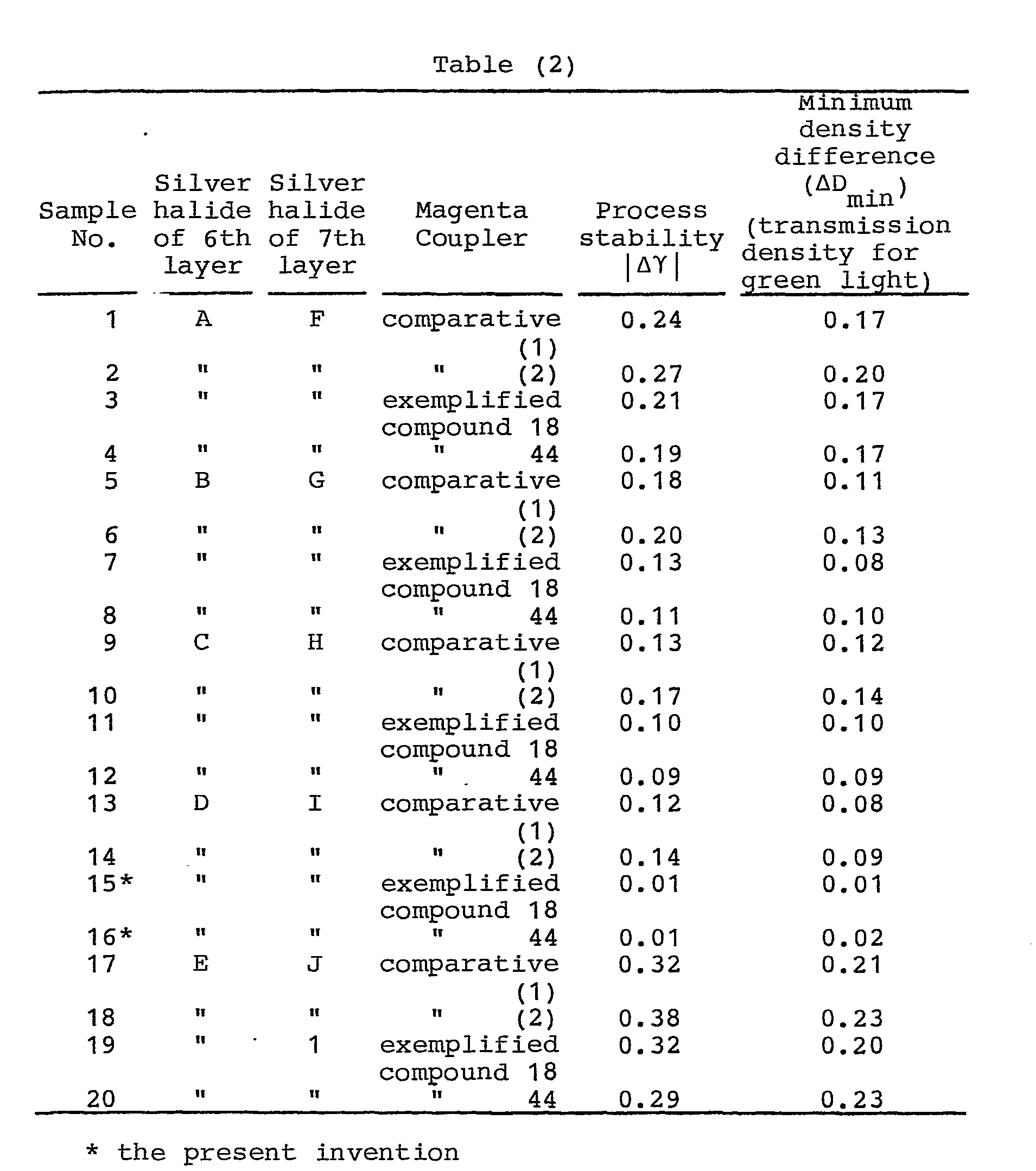
- The symbol γ represents an average y of minimum density ranging from +3.0 to 1.2.


- As is apparent from the results shown in Table (2), it is understood that the Sample Nos. 15 and 16 each using the Emulsions D and I of the invention, which are of the core/shell type, comprising a silver halide that is silver iodobromide containing not less than 3 mol% iodine and the Exemplified couplers of the invention to serve as the couplers; such samples have almost no difference in processing variation and in minimum density variation when processed in the process of the invention and even when processed in the CNK-4 standard process which requires a large amount of replenishers, so that almost the same gamma value and the minimum density value can be obtained; and in contrast with the above, the minimum density variation is too great and the y-stability is too poor to be put to practical use in the case of the emulsion containing no silver iodide. The results of Table (2) also show that, even if the emulsion is a silver iodobromide emulsion, it shows the same tendency as that of aforesaid emulsion containing no silver iodide, when the silver iodobromide emulsion is not of a core/shell type and the content of iodine is low.
- As for a magenta coupler, it is understood that the couplers other than those of the invention are remarkably poor in the process stability.
- Incidentally, exemplified compounds for magenta coupler of the invention 7, 15, 22, 41, 100, 104 and 117 were examined and the same effect as that of Table (2) was obtained. Example (2)
- Samples were prepared in the same manner as in the Sample (15) of Example (1) except that the magenta couplers were replaced by those described in Table (4), and the resulted samples were evaluated in the same manner that was taken for Example (1), except that the sodium bromide concentration in each of the color developing replenishers were changed to those shown in Table (3).


- It is clearly understood in Table (3) that the process variation is great when magenta couplers other than those of the invention are used, even if the concentration of sodium bromide in the color developer and the replenishing amount are increased but the magenta couplers of the invention offer the remarkable effect despite the replenishment in a small amount and the concentration of sodium bromide as low as 3.0 x 10⁻³ mol/ℓ and below. Despite the use of magenta couplers of the invention, no effect on the process variation is observed at all when the replenishing amount other than that of the invention and the concentration of sodium bromide other than that of the invention are used.
- In order to evaluate an effect of the invention on secondary iron ion and thiosulfate, 0 ppm, 5 ppm and 10 ppm of secondary iron ion and 0 ppm, 20 ppm and 50 ppm of sodium thiosulfate were added respectively to each of the samples of Example (1) and then the process stability (|Δγ|)and the minimum density variation were examined, using (7), (12), (52'), (93) and (88) as a sequestering agent. As a result of the evaluation, the process variation and the minimum density variation both affected by secondary iron ion and sodium thiosulfate were small only when the emulsions and couplers of the invention were used, similarly to Example (1) and the use of aforesaid sequestering agent offered remarkable effects.
- Sample Nos. 41 through 43 were prepared respectively in the same manner as in Example (1), except that the cyan couplers used in the Example (1) were replaced by the cyan couplers shown in Table (4).
- The resulted samples were processed in the same manner as in Example (1). The results thereof are shown in Table (4). In the table, the data of the Examples 16 and 14 obtained in Example (1) are also shown for the comparison purpose.
- The characteristics of the cyan images thereof were obtained by measuring the red-light transmission density with the same optical densitometer used in Example (1).
- As is obvious from the results shown in Table (4), the processing stability (i.e., ΔDmin in green density) of magenta images can further be improved and, at the same time, the processing stability [i.e., |Δγ|, ΔDmin (fog and stain) in red density] can also remarkably be improved.
- The exemplified cyan couplers, C-2, C-14, C-29, C-51, C-86, C-88, C-96 and C-101 were also tested. The results therefrom were almost the same as those shown in Table (3).

- With respect to the Samples No. 31 and No. 33 both prepared in Example (2), each of the gamma-difference (|Δγ|) between that at the time of starting and that at the time of completing a continuous processing was measured in the same manner as in Example (2), and the processing variations thereof were evaluated. The results thereof are shown in Table(5).

- As is obvious from the above-given Table (5), it can be observed that the Sample No. 33 in which the couplers of the invention were used is relatively less in y variation at the time of starting and completing a continuous processing and, in particular, it displays remarkable effects in the cases of a replenishing amount and a concentration of sodium bromide in the invention.
- The same effects can also be obtained when the Exemplified Compounds Nos. 7, 18, 59 and 104 each are used in place of the Exemplified compound (5).
Claims (27)


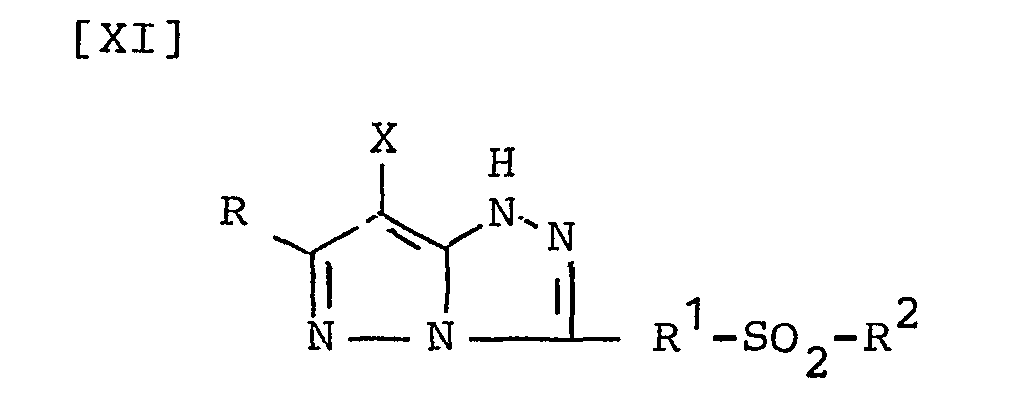


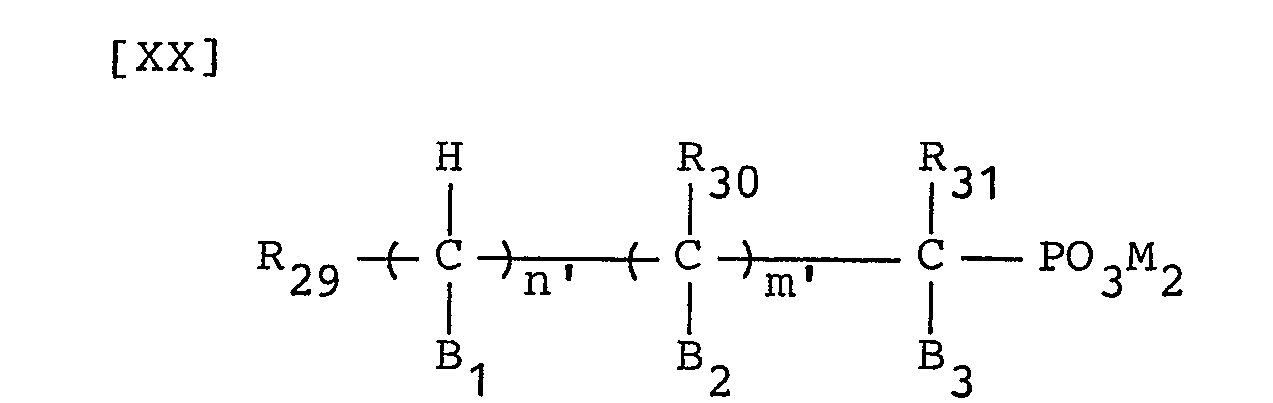


Applications Claiming Priority (2)
| Application Number | Priority Date | Filing Date | Title |
|---|---|---|---|
| JP94760/85 | 1985-04-30 | ||
| JP60094760A JPS61251852A (en) | 1985-04-30 | 1985-04-30 | Method for processing silver halide color photographic sensitive material |
Publications (3)
| Publication Number | Publication Date |
|---|---|
| EP0201033A2 true EP0201033A2 (en) | 1986-11-12 |
| EP0201033A3 EP0201033A3 (en) | 1989-02-22 |
| EP0201033B1 EP0201033B1 (en) | 1992-06-24 |
Family
ID=14119052
Family Applications (1)
| Application Number | Title | Priority Date | Filing Date |
|---|---|---|---|
| EP86105906A Expired EP0201033B1 (en) | 1985-04-30 | 1986-04-29 | A method for processing silver halide color photographic materials |
Country Status (6)
| Country | Link |
|---|---|
| US (1) | US4797351A (en) |
| EP (1) | EP0201033B1 (en) |
| JP (1) | JPS61251852A (en) |
| AU (1) | AU588871B2 (en) |
| CA (1) | CA1267556A (en) |
| DE (1) | DE3685774T2 (en) |
Cited By (6)
| Publication number | Priority date | Publication date | Assignee | Title |
|---|---|---|---|---|
| JPS61251851A (en) * | 1985-04-30 | 1986-11-08 | Konishiroku Photo Ind Co Ltd | Method for processing silver halide color photographic sensitive material |
| JPS61261741A (en) * | 1985-05-15 | 1986-11-19 | Konishiroku Photo Ind Co Ltd | Treatment of silver halide color photographic sensitive material |
| EP0284082A3 (en) * | 1987-03-25 | 1989-09-20 | Fuji Photo Film Co., Ltd. | A method for processing silver halide color photographic materials |
| EP0325277A3 (en) * | 1988-01-21 | 1990-06-27 | Fuji Photo Film Co., Ltd. | A method for processing a silver halide color photograhic material |
| EP0207794B1 (en) * | 1985-07-04 | 1990-11-14 | Konica Corporation | Silver halide photographic material |
| EP0425258A1 (en) * | 1989-10-25 | 1991-05-02 | Konica Corporation | Method for processing light-sensitive silver halide photographic material |
Families Citing this family (19)
| Publication number | Priority date | Publication date | Assignee | Title |
|---|---|---|---|---|
| AU590563B2 (en) * | 1985-05-16 | 1989-11-09 | Konishiroku Photo Industry Co., Ltd. | Method for color-developing a silver halide color photographic light-sensitive material |
| AU588878B2 (en) * | 1985-05-31 | 1989-09-28 | Konishiroku Photo Industry Co., Ltd. | Method for forming direct positive color image |
| US5278032A (en) * | 1985-06-07 | 1994-01-11 | Fuji Photo Film Co., Ltd. | Method of processing silver halide color photographic material using a reduced amount of replenisher |
| JPH07117719B2 (en) * | 1986-08-05 | 1995-12-18 | コニカ株式会社 | Processing method of silver halide color photographic light-sensitive material capable of obtaining dye image excellent in graininess |
| JPH0833630B2 (en) * | 1986-08-05 | 1996-03-29 | コニカ株式会社 | Processing method of silver halide color photographic light-sensitive material capable of obtaining dye image excellent in graininess |
| JPH07113754B2 (en) * | 1986-12-15 | 1995-12-06 | コニカ株式会社 | Processing method of silver halide color photographic light-sensitive material capable of obtaining dye image excellent in graininess |
| JPS63153548A (en) * | 1986-12-17 | 1988-06-25 | Konica Corp | Silver halide color photographic sensitive material |
| JP2558465B2 (en) * | 1987-05-28 | 1996-11-27 | コニカ株式会社 | Silver halide photographic material |
| JPH06100808B2 (en) * | 1987-05-28 | 1994-12-12 | 富士写真フイルム株式会社 | Processing method of silver halide color photographic light-sensitive material |
| JP2601665B2 (en) * | 1987-10-19 | 1997-04-16 | 富士写真フイルム株式会社 | Processing method of silver halide color photographic light-sensitive material |
| US5110713A (en) * | 1987-10-30 | 1992-05-05 | Fuji Photo Film Co., Ltd. | Method for processing silver halide color photographic material |
| JP2627070B2 (en) * | 1987-12-28 | 1997-07-02 | 富士写真フイルム株式会社 | Processing method of silver halide color photographic light-sensitive material |
| US5246819A (en) * | 1987-12-28 | 1993-09-21 | Fuji Photo Film Co., Ltd. | Method for processing silver halide color photographic material |
| US5260176A (en) * | 1988-07-06 | 1993-11-09 | Fuji Photo Film Co., Ltd. | Method of forming a color image |
| DE68926522T2 (en) * | 1988-08-05 | 1996-10-17 | Fuji Photo Film Co Ltd | Process for processing a silver halide color photographic material |
| JPH087418B2 (en) * | 1988-10-03 | 1996-01-29 | 富士写真フイルム株式会社 | Processing method of silver halide color photographic light-sensitive material |
| JP2549304B2 (en) * | 1988-10-28 | 1996-10-30 | 富士写真フイルム株式会社 | Processing method of silver halide color photographic light-sensitive material |
| DE69027267T2 (en) * | 1989-09-07 | 1996-10-17 | Fuji Photo Film Co Ltd | Process for processing a silver halide color photographic material |
| US5436118A (en) * | 1994-03-31 | 1995-07-25 | Eastman Kodak Company | Method of processing silver halide photographic elements using a low volume thin tank processing system |
Citations (168)
| Publication number | Priority date | Publication date | Assignee | Title |
|---|---|---|---|---|
| US2369929A (en) | 1943-03-18 | 1945-02-20 | Eastman Kodak Co | Acylamino phenol couplers |
| US2434272A (en) | 1944-05-03 | 1948-01-13 | Eastman Kodak Co | Color photography with azosubstituted couplers |
| US2474293A (en) | 1947-09-10 | 1949-06-28 | Eastman Kodak Co | 1-naphthol-2-carboxylic acid amide couplers for color photography |
| US2600788A (en) | 1949-06-07 | 1952-06-17 | Eastman Kodak Co | Halogen-substituted pyrazolone couplers for color photography |
| US2688545A (en) | 1953-05-28 | 1954-09-07 | Eastman Kodak Co | Supersensitization of photographic emulsions with benzimidazolocarbocyanine dyes |
| US2761791A (en) | 1955-02-23 | 1956-09-04 | Eastman Kodak Co | Method of multiple coating |
| US2772162A (en) | 1954-11-03 | 1956-11-27 | Eastman Kodak Co | Diacylaminophenol couplers |
| US2801171A (en) | 1954-12-20 | 1957-07-30 | Eastman Kodak Co | Photographic color former dispersions |
| US2875057A (en) | 1954-12-20 | 1959-02-24 | Eastman Kodak Co | Benzoylacet-o-alkoxyanilide couplers for color photography |
| US2895826A (en) | 1956-10-08 | 1959-07-21 | Eastman Kodak Co | Photographic color couplers containing fluoroalkylcarbonamido groups |
| US2912329A (en) | 1957-08-23 | 1959-11-10 | Eastman Kodak Co | Green sensitization for photographic emulsions containing coupler dispersions |
| US2941893A (en) | 1955-12-22 | 1960-06-21 | Mcconnaughay Kenneth Earl | Bituminous emulsion |
| US2983608A (en) | 1958-10-06 | 1961-05-09 | Eastman Kodak Co | Yellow-colored magenta-forming couplers |
| US3005712A (en) | 1958-09-26 | 1961-10-24 | Eastman Kodak Co | Yellow-colored magenta-forming couplers |
| US3034892A (en) | 1958-10-27 | 1962-05-15 | Eastman Kodak Co | Magenta-colored cyan-forming couplers |
| US3062653A (en) | 1960-02-18 | 1962-11-06 | Eastman Kodak Co | Photographic emulsion containing pyrazolone magenta-forming couplers |
| GB935454A (en) | 1960-08-03 | 1963-08-28 | Giuseppe Zecchinato | A device of automatically advancing in rotation the mouth of a water sprinkler |
| US3127269A (en) | 1961-09-11 | 1964-03-31 | Colour photography | |
| GB975773A (en) | 1960-09-13 | 1964-11-18 | Gevaert Photo Prod Nv | Improvements in or relating to the manufacture of photographic colour images |
| GB1011940A (en) | 1962-11-06 | 1965-12-01 | Agfa Ag | A process for the production of coloured photographic images and ureido-phenols for use in the process |
| US3222176A (en) | 1960-10-04 | 1965-12-07 | Gevaert Photo Prod Nv | Photographic colour images from amino substituted phenols |
| US3227551A (en) | 1959-04-06 | 1966-01-04 | Eastman Kodak Co | Photographic color reproduction process and element |
| US3253924A (en) | 1965-02-08 | 1966-05-31 | Eastman Kodak Co | Two-equivalent thiocyano couplers |
| US3265506A (en) | 1964-05-04 | 1966-08-09 | Eastman Kodak Co | Yellow forming couplers |
| US3277155A (en) | 1960-08-24 | 1966-10-04 | Eastman Kodak Co | Monofluoro-beta-ketoacetanilide couplers for color photography |
| US3297445A (en) | 1963-04-01 | 1967-01-10 | Eastman Kodak Co | Photographic inhibitor releasing developers |
| US3311476A (en) | 1962-12-26 | 1967-03-28 | Eastman Kodak Co | Two-equivalent couplers for color photography |
| US3379529A (en) | 1963-02-28 | 1968-04-23 | Eastman Kodak Co | Photographic inhibitor-releasing developers |
| US3386301A (en) | 1964-09-16 | 1968-06-04 | Koyama Mikio | Camshaft driving system for internal combustion engines |
| US3397060A (en) | 1964-10-19 | 1968-08-13 | Eastman Kodak Co | Supersensitization of green-sensitive silver halide emulsions |
| US3408194A (en) | 1963-10-01 | 1968-10-29 | Eastman Kodak Co | Silver halide emulsion layers containing yellow dye forming couplers |
| US3415652A (en) | 1965-04-01 | 1968-12-10 | Eastman Kodak Co | Silver halide color photographic elements utilizing alpha-sulfonyloxy substituted two-equivalent yellow-forming couplers |
| US3419391A (en) | 1965-05-24 | 1968-12-31 | Eastman Kodak Co | Silver halide color photography utilizing magenta-dye-forming couplers |
| US3419390A (en) | 1965-05-03 | 1968-12-31 | Eastman Kodak Co | Elements and developers for color photography utilizing phenolic couplers containingan aminoalkyl group on the coupling position |
| US3446622A (en) | 1966-01-11 | 1969-05-27 | Ferrania Spa | Process for the preparation of color images using 2 - ureido phenolic couplers |
| US3447928A (en) | 1965-07-26 | 1969-06-03 | Eastman Kodak Co | Silver halide emulsion containing twoequivalent yellow dye-forming coupler |
| US3458315A (en) | 1965-10-24 | 1969-07-29 | Eastman Kodak Co | Cyan couplers for color photography |
| US3476563A (en) | 1965-08-30 | 1969-11-04 | Eastman Kodak Co | Photographic silver halide elements containing two equivalent cyan couplers |
| GB1195302A (en) | 1966-08-30 | 1970-06-17 | Fuji Photo Film Co Ltd | Spectrally Sensitized Silver Halide Emulsions |
| US3519429A (en) | 1966-05-16 | 1970-07-07 | Eastman Kodak Co | Silver halide emulsions containing a stabilizer pyrazolone coupler |
| DE2030326A1 (en) | 1969-06-19 | 1971-01-07 | Fuji Photo Film Co Ltd Kanagawa (Japan) | Silver halide photographic emulsions |
| US3558318A (en) | 1968-07-18 | 1971-01-26 | Tecnifax Corp | Light-sensitive diazotype material which comprise aryl-substituted acylacetonitriles or ester or amide derivatives of said aryl-substituted acylacetonitriles as coupling components |
| US3591383A (en) | 1967-10-13 | 1971-07-06 | Fuji Photo Film Co Ltd | Color photographic light sensitive material containing cyan coupler |
| GB1242588A (en) | 1967-08-29 | 1971-08-11 | Fuji Photo Film Co Ltd | Improvements in and relating to photographic silver halide emulsions |
| US3615635A (en) | 1967-11-27 | 1971-10-26 | Fuji Photo Film Co Ltd | Silver halide photographic emulsion |
| DE2121780A1 (en) | 1970-05-01 | 1971-11-25 | Fuji Photo Film Co. Ltd., Kanagawa (Japan) | Spectrally sensitized silver halide photographic emulsions |
| US3628964A (en) | 1967-07-17 | 1971-12-21 | Fuji Photo Film Co Ltd | Photographic supersensitized silver halide emulsions |
| US3652345A (en) | 1968-09-18 | 1972-03-28 | Japan National Railway | Method of removing residual stress for improving fatigue strength of boundary of heated zone |
| US3664841A (en) | 1969-11-28 | 1972-05-23 | Konishiroku Photo Ind | Light-sensitive silver halide color photographic emulsion containing yellow-forming coupler |
| US3684514A (en) | 1969-02-06 | 1972-08-15 | Konishiroku Photo Ind | Light-sensitive silver halide color photographic emulsions |
| GB1293862A (en) | 1969-06-25 | 1972-10-25 | Fuji Photo Film Co Ltd | Supersensitized silver halide photographic emulsion |
| US3725067A (en) | 1970-01-15 | 1973-04-03 | Eastman Kodak Co | Silver halide emulsion containing 1-h-pyrazolo(3,2-c)-s-triazole color couplers |
| JPS4829432A (en) | 1971-04-26 | 1973-04-19 | ||
| US3737316A (en) | 1971-08-31 | 1973-06-05 | Eastman Kodak Co | Two-equivalent sulfonamido couplers |
| US3741563A (en) | 1970-03-30 | 1973-06-26 | Alfa Laval Ab | Apparatus for heat treating packaged products |
| US3758308A (en) | 1971-02-18 | 1973-09-11 | Eastman Kodak Co | Silver halide emulsion containing para fluoro phenols |
| JPS4868834A (en) | 1971-12-21 | 1973-09-19 | ||
| JPS4836894B1 (en) | 1967-05-30 | 1973-11-07 | ||
| DE2331220A1 (en) | 1972-06-21 | 1974-01-10 | Ilford Ltd | METHOD OF REMOVING SILVER IONS FROM PHOTOGRAPHIC BATHS |
| JPS4910736A (en) | 1972-05-27 | 1974-01-30 | ||
| JPS4929639A (en) | 1972-07-12 | 1974-03-16 | ||
| JPS4931448A (en) | 1972-07-10 | 1974-03-20 | ||
| JPS4913576B1 (en) | 1970-12-26 | 1974-04-01 | ||
| GB1353805A (en) | 1971-08-20 | 1974-05-22 | Kodak Ltd | Silver recovery |
| DE2417914A1 (en) | 1973-04-13 | 1974-10-17 | Fuji Photo Film Co Ltd | COLOR PHOTOGRAPHIC SENSITIVE MATERIAL |
| JPS49111631A (en) | 1973-02-22 | 1974-10-24 | ||
| JPS49122335A (en) | 1973-03-23 | 1974-11-22 | ||
| JPS49123625A (en) | 1973-03-31 | 1974-11-26 | ||
| JPS49129538A (en) | 1973-04-13 | 1974-12-11 | ||
| JPS5010135A (en) | 1973-05-25 | 1975-02-01 | ||
| JPS5013041A (en) | 1973-05-19 | 1975-02-10 | ||
| JPS5028834A (en) | 1973-07-16 | 1975-03-24 | ||
| US3880661A (en) | 1971-12-29 | 1975-04-29 | Eastman Kodak Co | Silver halide emulsion containing acylamidophenol photographic couplers |
| US3888680A (en) | 1970-12-18 | 1975-06-10 | Konishiroku Photo Ind | Light-sensitive silver halide color photographic material containing bis-pyrazolone couplers |
| JPS50112038A (en) | 1974-01-25 | 1975-09-03 | ||
| JPS50117422A (en) | 1974-02-08 | 1975-09-13 | ||
| JPS50120334A (en) | 1974-03-05 | 1975-09-20 | ||
| JPS50120343A (en) | 1974-02-20 | 1975-09-20 | ||
| JPS50123341A (en) | 1974-03-04 | 1975-09-27 | ||
| JPS50130441A (en) | 1974-04-02 | 1975-10-15 | ||
| JPS50132926A (en) | 1975-03-18 | 1975-10-21 | ||
| JPS50134644A (en) | 1974-04-12 | 1975-10-24 | ||
| US3928041A (en) | 1972-12-18 | 1975-12-23 | Konishiroku Photo Ind | Development inhibitor yielding compound for silver halide photography |
| JPS5117114A (en) | 1974-08-02 | 1976-02-10 | Fuji Photo Film Co Ltd | Ginno kaishuhoho |
| DE2548237A1 (en) | 1974-10-29 | 1976-05-13 | Leuven Res & Dev Vzw | PROCESS FOR RECOVERING SILVER FROM SOLUTIONS CONTAINING SILVER |
| US3958993A (en) | 1972-11-29 | 1976-05-25 | Konishiroku Photo Industry Co., Ltd. | Development inhibitor-releasing type compound for photographic use |
| US3961959A (en) | 1973-02-05 | 1976-06-08 | Konishiroku Photo Industry Co., Ltd. | Process for developing a light-sensitive silver halide photographic material |
| FR2299667A1 (en) | 1975-01-29 | 1976-08-27 | Lakehal Denis | Electrolytic cell for recovery of silver from photographic chemicals - using intense agitation and high current density |
| JPS51108841A (en) | 1975-02-17 | 1976-09-27 | Konishiroku Photo Ind | Shashinyo 2 toryogatashiankapuraa |
| US3996253A (en) | 1966-01-11 | 1976-12-07 | Minnesota Mining And Manufacturing Company | Process for the preparation of color images |
| JPS51146828A (en) | 1975-06-11 | 1976-12-16 | Fuji Photo Film Co Ltd | Photographic colour coupler |
| JPS5215271A (en) | 1975-07-25 | 1977-02-04 | Toshiba Corp | Method of selecting electrodes of semiconductor device |
| JPS5218315A (en) | 1975-08-02 | 1977-02-10 | Konishiroku Photo Ind Co Ltd | Photographic 2-equivalent type cyan coupler |
| JPS5269329A (en) | 1975-12-05 | 1977-06-09 | Fuji Photo Film Co Ltd | Image formation |
| JPS5273037A (en) | 1975-12-15 | 1977-06-18 | Sekisui Chemical Co Ltd | Electrostatic recording material |
| JPS52105820A (en) | 1976-03-02 | 1977-09-05 | Fuji Photo Film Co Ltd | Treatment of photographic treating liquid |
| US4052213A (en) | 1975-09-13 | 1977-10-04 | Agfa-Gevaert, A.G. | Light-sensitive photographic material |
| JPS539116A (en) | 1976-07-13 | 1978-01-27 | Fuji Photo Film Co Ltd | Silver halide photographic light sensitive material |
| US4095984A (en) | 1975-12-29 | 1978-06-20 | Fuji Photo Film Co., Ltd. | Development inhibitor releasing coupler and photographic element containing same |
| JPS53105226A (en) | 1977-01-28 | 1978-09-13 | Konishiroku Photo Ind Co Ltd | Color image formation method |
| JPS53110529A (en) | 1977-03-05 | 1978-09-27 | Agfa Gevaert Ag | Photosensitive materials for color photograph |
| US4124396A (en) | 1977-03-03 | 1978-11-07 | Eastman Kodak Company | 2,5-Dicarbonylaminophenol dye-forming couplers |
| JPS53132343A (en) | 1977-04-21 | 1978-11-18 | Agfa Gevaert Ag | Method of regenerating fatigued color developing agent |
| JPS5347167B2 (en) | 1975-11-08 | 1978-12-19 | ||
| JPS5413333A (en) | 1977-06-29 | 1979-01-31 | Agfa Gevaert Ag | Photo sensitive material for color photography |
| JPS5414736A (en) | 1977-07-06 | 1979-02-03 | Fuji Photo Film Co Ltd | Photographic cyan coupler |
| JPS5437731A (en) | 1977-08-30 | 1979-03-20 | Fuji Photo Film Co Ltd | Method and apparatus for controlling halogen ion concentration in photographic processing solution |
| JPS5448237A (en) | 1977-09-22 | 1979-04-16 | Fuji Photo Film Co Ltd | Cyan coupler for photography |
| JPS5448521A (en) | 1977-09-16 | 1979-04-17 | Konishiroku Photo Ind Co Ltd | Manufacture of silver halide crystais |
| US4149886A (en) | 1975-12-09 | 1979-04-17 | Fuji Photo Film Co., Ltd. | Light-sensitive material with coupler containing triazole coupling-off group |
| JPS5410491B2 (en) | 1975-02-28 | 1979-05-07 | ||
| JPS54145135A (en) | 1977-12-23 | 1979-11-13 | Eastman Kodak Co | Novel photographic coupler and photographic element using same coupler and method of using same |
| JPS551571B2 (en) | 1974-03-25 | 1980-01-16 | ||
| JPS5532071A (en) | 1978-08-29 | 1980-03-06 | Fuji Photo Film Co Ltd | Silver halide photographic material |
| JPS5565957A (en) | 1978-11-14 | 1980-05-17 | Fuji Photo Film Co Ltd | Silver halide photographic material |
| JPS5599341A (en) | 1979-01-24 | 1980-07-29 | Tanaka Kikinzoku Kogyo Kk | Platinum group base oxidation catalyst and production thereof |
| JPS5530615B2 (en) | 1975-12-26 | 1980-08-12 | ||
| JPS55144240A (en) | 1979-04-26 | 1980-11-11 | Agfa Gevaert Ag | Method of forming photography image |
| JPS55161237A (en) | 1979-06-01 | 1980-12-15 | Konishiroku Photo Ind Co Ltd | Silver halide photographic material |
| JPS55163537A (en) | 1979-05-07 | 1980-12-19 | Konishiroku Photo Ind Co Ltd | Forming method of cyan dye image |
| JPS561048A (en) | 1979-06-15 | 1981-01-08 | Fuji Photo Film Co Ltd | Regenerating method for waste photographic processing solution |
| JPS561049A (en) | 1979-06-15 | 1981-01-08 | Fuji Photo Film Co Ltd | Regenerating method for waste photographic processing solution |
| JPS561938A (en) | 1979-06-19 | 1981-01-10 | Fuji Photo Film Co Ltd | Silver halide photographic material |
| JPS5612643A (en) | 1979-07-12 | 1981-02-07 | Fuji Photo Film Co Ltd | Silver halide color photographic material |
| JPS5627147A (en) | 1979-08-13 | 1981-03-16 | Fuji Photo Film Co Ltd | Silver halide photographic sensitive material |
| JPS5627142A (en) | 1979-08-13 | 1981-03-16 | Fuji Photo Film Co Ltd | Developr regenerating method |
| JPS5629235A (en) | 1979-05-07 | 1981-03-24 | Konishiroku Photo Ind Co Ltd | Cyan dye image forming method |
| JPS5633644A (en) | 1979-08-27 | 1981-04-04 | Fuji Photo Film Co Ltd | Regenerating method for photographic processing solution |
| JPS5655945A (en) | 1979-10-15 | 1981-05-16 | Fuji Photo Film Co Ltd | Color photographic material |
| JPS5665134A (en) | 1979-10-15 | 1981-06-02 | Eastman Kodak Co | Photography element |
| JPS5680045A (en) | 1979-12-05 | 1981-07-01 | Fuji Photo Film Co Ltd | Color photographic material |
| JPS56114946A (en) | 1980-02-15 | 1981-09-09 | Konishiroku Photo Ind Co Ltd | Silver halide photographic sensitive material |
| JPS56116030A (en) | 1980-01-14 | 1981-09-11 | Konishiroku Photo Ind Co Ltd | Forming method for cyan dye image |
| JPS56130459A (en) | 1980-03-19 | 1981-10-13 | Nisshin Steel Co Ltd | Stainless steel for precipitation hardening spring |
| JPS56131312A (en) | 1980-03-14 | 1981-10-14 | Yanmar Agricult Equip | Straw pick-up device of combined harvester |
| JPS56131314A (en) | 1980-03-17 | 1981-10-14 | Kubota Ltd | Automatic threshing depth controller of combined harvester |
| JPS56131311A (en) | 1980-03-15 | 1981-10-14 | Iseki Agricult Mach | Digger |
| JPS56131309A (en) | 1981-01-10 | 1981-10-14 | Iseki Agricult Mach | Tank for auxiliary nursery plant |
| JPS56131313A (en) | 1980-03-19 | 1981-10-14 | Sato Zoki Co Ltd | Binder for straw |
| JPS56149036A (en) | 1980-04-22 | 1981-11-18 | Fuji Photo Film Co Ltd | Regenerating method for developer |
| JPS57146249A (en) | 1981-03-05 | 1982-09-09 | Konishiroku Photo Ind Co Ltd | Method for removing development hindering component in developing solution |
| JPS57149791A (en) | 1981-03-11 | 1982-09-16 | Uemura Kogyo Kk | Device for removing printed board |
| JPS57150847A (en) | 1981-03-13 | 1982-09-17 | Konishiroku Photo Ind Co Ltd | Processing for silver halide color photographic material |
| JPS57154234A (en) | 1981-03-19 | 1982-09-24 | Konishiroku Photo Ind Co Ltd | Phtotographic sensitive silver halide material |
| JPS57154232A (en) | 1981-02-18 | 1982-09-24 | Konishiroku Photo Ind Co Ltd | Photosensitive silver halide emulsion |
| JPS57204545A (en) | 1981-06-11 | 1982-12-15 | Konishiroku Photo Ind Co Ltd | Formation of color photographic image of silver halide |
| JPS57204544A (en) | 1981-06-11 | 1982-12-15 | Konishiroku Photo Ind Co Ltd | Formation of color photographic image of silver halide |
| JPS57204543A (en) | 1981-06-11 | 1982-12-15 | Konishiroku Photo Ind Co Ltd | Color photographic sensitive silver halide material containing phenolic cyan coupler |
| JPS5814831A (en) | 1981-07-21 | 1983-01-27 | Konishiroku Photo Ind Co Ltd | Method for removing development inhibitor out of developing solution |
| JPS5842045A (en) | 1981-08-25 | 1983-03-11 | イ−ストマン・コダツク・カンパニ− | Photographic element including coupler containing ballast group |
| JPS5895346A (en) | 1981-11-23 | 1983-06-06 | イ−ストマン・コダツク・カンパニ− | Photographic element |
| JPS58120250A (en) | 1982-01-11 | 1983-07-18 | Konishiroku Photo Ind Co Ltd | Method for processing silver halide color photographic sensitive material |
| JPS58121036A (en) | 1982-01-13 | 1983-07-19 | Konishiroku Photo Ind Co Ltd | Treatment of silver halide color photosensitive material |
| JPS58160954A (en) | 1982-03-19 | 1983-09-24 | Konishiroku Photo Ind Co Ltd | Color photographic sensitive silver halide material |
| JPS58162949A (en) | 1982-03-20 | 1983-09-27 | Konishiroku Photo Ind Co Ltd | Color photographic sensitive silver halide material |
| JPS5999437A (en) | 1982-10-28 | 1984-06-08 | Fuji Photo Film Co Ltd | Color photosensitive silver halide material |
| JPS59123838A (en) | 1982-12-29 | 1984-07-17 | Fuji Photo Film Co Ltd | Photosensitive silver halide material |
| JPS59127038A (en) | 1983-01-11 | 1984-07-21 | Fuji Photo Film Co Ltd | Method for bleaching color photosensitive material |
| JPS59146050A (en) | 1983-02-09 | 1984-08-21 | Fuji Photo Film Co Ltd | Color photographic sensitive silver halide material |
| JPS59162548A (en) | 1983-02-15 | 1984-09-13 | Fuji Photo Film Co Ltd | Formation of magenta image |
| JPS59166956A (en) | 1983-03-14 | 1984-09-20 | Fuji Photo Film Co Ltd | Silver halide color photosensitive material |
| JPS59171956A (en) | 1983-03-18 | 1984-09-28 | Fuji Photo Film Co Ltd | Color image forming method |
| JPS6024547A (en) | 1983-07-21 | 1985-02-07 | Fuji Photo Film Co Ltd | Color photographic sensitive silver halide material |
| JPS6033552A (en) | 1983-08-04 | 1985-02-20 | Fuji Photo Film Co Ltd | Color image forming method |
| JPS6035731A (en) | 1983-08-08 | 1985-02-23 | Fuji Photo Film Co Ltd | Color photographic sensitive material |
| JPS6037557A (en) | 1983-08-10 | 1985-02-26 | Fuji Photo Film Co Ltd | Color photographic sensitive material |
| JPS6043659A (en) | 1983-08-19 | 1985-03-08 | Fuji Photo Film Co Ltd | Formation of color image |
| JPS6055340A (en) | 1983-09-06 | 1985-03-30 | Fuji Photo Film Co Ltd | Color photosensitive silver halide material |
Family Cites Families (7)
| Publication number | Priority date | Publication date | Assignee | Title |
|---|---|---|---|---|
| JPS5674247A (en) * | 1979-11-22 | 1981-06-19 | Konishiroku Photo Ind Co Ltd | Method for continuously processing silver halide photographic material |
| US4477564A (en) * | 1982-04-01 | 1984-10-16 | Minnesota Mining And Manufacturing Company | Photographic silver halide emulsions, process for preparing the same and their use in color reversal films |
| US4546068A (en) * | 1983-06-09 | 1985-10-08 | Konishiroku Photo Industry Co., Ltd. | Method for processing of light-sensitive silver halide color photographic material |
| JPS60220344A (en) * | 1984-04-16 | 1985-11-05 | Konishiroku Photo Ind Co Ltd | Method for feeding replenishing agent composition of liquid color developer |
| AU4743985A (en) * | 1984-09-14 | 1986-04-10 | Konishiroku Photo Industry Co., Ltd. | Silver halide photographic material with magenta coupler |
| US4665015A (en) * | 1984-09-14 | 1987-05-12 | Konishiroku Photo Industry Co., Ltd. | Silver halide color photographic material containing a magenta coupler |
| US4639415A (en) * | 1984-09-17 | 1987-01-27 | Konishiroku Photo Industry Co., Ltd. | Silver halide color photographic material containing a magenta color image-forming coupler |
-
1985
- 1985-04-30 JP JP60094760A patent/JPS61251852A/en active Granted
-
1986
- 1986-04-25 US US06/856,779 patent/US4797351A/en not_active Expired - Fee Related
- 1986-04-29 DE DE8686105906T patent/DE3685774T2/en not_active Expired - Lifetime
- 1986-04-29 EP EP86105906A patent/EP0201033B1/en not_active Expired
- 1986-04-30 CA CA000508039A patent/CA1267556A/en not_active Expired - Fee Related
- 1986-04-30 AU AU56859/86A patent/AU588871B2/en not_active Ceased
Patent Citations (171)
| Publication number | Priority date | Publication date | Assignee | Title |
|---|---|---|---|---|
| US2369929A (en) | 1943-03-18 | 1945-02-20 | Eastman Kodak Co | Acylamino phenol couplers |
| US2434272A (en) | 1944-05-03 | 1948-01-13 | Eastman Kodak Co | Color photography with azosubstituted couplers |
| US2474293A (en) | 1947-09-10 | 1949-06-28 | Eastman Kodak Co | 1-naphthol-2-carboxylic acid amide couplers for color photography |
| US2600788A (en) | 1949-06-07 | 1952-06-17 | Eastman Kodak Co | Halogen-substituted pyrazolone couplers for color photography |
| US2688545A (en) | 1953-05-28 | 1954-09-07 | Eastman Kodak Co | Supersensitization of photographic emulsions with benzimidazolocarbocyanine dyes |
| US2772162A (en) | 1954-11-03 | 1956-11-27 | Eastman Kodak Co | Diacylaminophenol couplers |
| US2875057A (en) | 1954-12-20 | 1959-02-24 | Eastman Kodak Co | Benzoylacet-o-alkoxyanilide couplers for color photography |
| US2801171A (en) | 1954-12-20 | 1957-07-30 | Eastman Kodak Co | Photographic color former dispersions |
| US2761791A (en) | 1955-02-23 | 1956-09-04 | Eastman Kodak Co | Method of multiple coating |
| US2941893A (en) | 1955-12-22 | 1960-06-21 | Mcconnaughay Kenneth Earl | Bituminous emulsion |
| US2895826A (en) | 1956-10-08 | 1959-07-21 | Eastman Kodak Co | Photographic color couplers containing fluoroalkylcarbonamido groups |
| US2912329A (en) | 1957-08-23 | 1959-11-10 | Eastman Kodak Co | Green sensitization for photographic emulsions containing coupler dispersions |
| US3005712A (en) | 1958-09-26 | 1961-10-24 | Eastman Kodak Co | Yellow-colored magenta-forming couplers |
| GB937621A (en) | 1958-10-06 | 1963-09-25 | Kodak Ltd | Improvements in colour photography and in colour-forming phenylazo-pyrazolones therefor |
| US2983608A (en) | 1958-10-06 | 1961-05-09 | Eastman Kodak Co | Yellow-colored magenta-forming couplers |
| US3034892A (en) | 1958-10-27 | 1962-05-15 | Eastman Kodak Co | Magenta-colored cyan-forming couplers |
| US3227551A (en) | 1959-04-06 | 1966-01-04 | Eastman Kodak Co | Photographic color reproduction process and element |
| US3227554A (en) | 1959-04-06 | 1966-01-04 | Eastman Kodak Co | Photographic elements and processes utilizing mercaptan-forming couplers |
| US3062653A (en) | 1960-02-18 | 1962-11-06 | Eastman Kodak Co | Photographic emulsion containing pyrazolone magenta-forming couplers |
| GB935454A (en) | 1960-08-03 | 1963-08-28 | Giuseppe Zecchinato | A device of automatically advancing in rotation the mouth of a water sprinkler |
| US3277155A (en) | 1960-08-24 | 1966-10-04 | Eastman Kodak Co | Monofluoro-beta-ketoacetanilide couplers for color photography |
| GB975773A (en) | 1960-09-13 | 1964-11-18 | Gevaert Photo Prod Nv | Improvements in or relating to the manufacture of photographic colour images |
| US3222176A (en) | 1960-10-04 | 1965-12-07 | Gevaert Photo Prod Nv | Photographic colour images from amino substituted phenols |
| US3127269A (en) | 1961-09-11 | 1964-03-31 | Colour photography | |
| GB1011940A (en) | 1962-11-06 | 1965-12-01 | Agfa Ag | A process for the production of coloured photographic images and ureido-phenols for use in the process |
| US3311476A (en) | 1962-12-26 | 1967-03-28 | Eastman Kodak Co | Two-equivalent couplers for color photography |
| US3379529A (en) | 1963-02-28 | 1968-04-23 | Eastman Kodak Co | Photographic inhibitor-releasing developers |
| US3297445A (en) | 1963-04-01 | 1967-01-10 | Eastman Kodak Co | Photographic inhibitor releasing developers |
| US3408194A (en) | 1963-10-01 | 1968-10-29 | Eastman Kodak Co | Silver halide emulsion layers containing yellow dye forming couplers |
| US3265506A (en) | 1964-05-04 | 1966-08-09 | Eastman Kodak Co | Yellow forming couplers |
| US3386301A (en) | 1964-09-16 | 1968-06-04 | Koyama Mikio | Camshaft driving system for internal combustion engines |
| US3397060A (en) | 1964-10-19 | 1968-08-13 | Eastman Kodak Co | Supersensitization of green-sensitive silver halide emulsions |
| US3253924A (en) | 1965-02-08 | 1966-05-31 | Eastman Kodak Co | Two-equivalent thiocyano couplers |
| US3415652A (en) | 1965-04-01 | 1968-12-10 | Eastman Kodak Co | Silver halide color photographic elements utilizing alpha-sulfonyloxy substituted two-equivalent yellow-forming couplers |
| US3419390A (en) | 1965-05-03 | 1968-12-31 | Eastman Kodak Co | Elements and developers for color photography utilizing phenolic couplers containingan aminoalkyl group on the coupling position |
| US3419391A (en) | 1965-05-24 | 1968-12-31 | Eastman Kodak Co | Silver halide color photography utilizing magenta-dye-forming couplers |
| US3447928A (en) | 1965-07-26 | 1969-06-03 | Eastman Kodak Co | Silver halide emulsion containing twoequivalent yellow dye-forming coupler |
| US3476563A (en) | 1965-08-30 | 1969-11-04 | Eastman Kodak Co | Photographic silver halide elements containing two equivalent cyan couplers |
| US3458315A (en) | 1965-10-24 | 1969-07-29 | Eastman Kodak Co | Cyan couplers for color photography |
| US3446622A (en) | 1966-01-11 | 1969-05-27 | Ferrania Spa | Process for the preparation of color images using 2 - ureido phenolic couplers |
| US3996253A (en) | 1966-01-11 | 1976-12-07 | Minnesota Mining And Manufacturing Company | Process for the preparation of color images |
| US3519429A (en) | 1966-05-16 | 1970-07-07 | Eastman Kodak Co | Silver halide emulsions containing a stabilizer pyrazolone coupler |
| GB1195302A (en) | 1966-08-30 | 1970-06-17 | Fuji Photo Film Co Ltd | Spectrally Sensitized Silver Halide Emulsions |
| JPS4836894B1 (en) | 1967-05-30 | 1973-11-07 | ||
| US3628964A (en) | 1967-07-17 | 1971-12-21 | Fuji Photo Film Co Ltd | Photographic supersensitized silver halide emulsions |
| GB1242588A (en) | 1967-08-29 | 1971-08-11 | Fuji Photo Film Co Ltd | Improvements in and relating to photographic silver halide emulsions |
| US3591383A (en) | 1967-10-13 | 1971-07-06 | Fuji Photo Film Co Ltd | Color photographic light sensitive material containing cyan coupler |
| US3615635A (en) | 1967-11-27 | 1971-10-26 | Fuji Photo Film Co Ltd | Silver halide photographic emulsion |
| US3558318A (en) | 1968-07-18 | 1971-01-26 | Tecnifax Corp | Light-sensitive diazotype material which comprise aryl-substituted acylacetonitriles or ester or amide derivatives of said aryl-substituted acylacetonitriles as coupling components |
| US3652345A (en) | 1968-09-18 | 1972-03-28 | Japan National Railway | Method of removing residual stress for improving fatigue strength of boundary of heated zone |
| US3684514A (en) | 1969-02-06 | 1972-08-15 | Konishiroku Photo Ind | Light-sensitive silver halide color photographic emulsions |
| DE2030326A1 (en) | 1969-06-19 | 1971-01-07 | Fuji Photo Film Co Ltd Kanagawa (Japan) | Silver halide photographic emulsions |
| GB1293862A (en) | 1969-06-25 | 1972-10-25 | Fuji Photo Film Co Ltd | Supersensitized silver halide photographic emulsion |
| US3664841A (en) | 1969-11-28 | 1972-05-23 | Konishiroku Photo Ind | Light-sensitive silver halide color photographic emulsion containing yellow-forming coupler |
| US3725067A (en) | 1970-01-15 | 1973-04-03 | Eastman Kodak Co | Silver halide emulsion containing 1-h-pyrazolo(3,2-c)-s-triazole color couplers |
| US3741563A (en) | 1970-03-30 | 1973-06-26 | Alfa Laval Ab | Apparatus for heat treating packaged products |
| DE2121780A1 (en) | 1970-05-01 | 1971-11-25 | Fuji Photo Film Co. Ltd., Kanagawa (Japan) | Spectrally sensitized silver halide photographic emulsions |
| US3888680A (en) | 1970-12-18 | 1975-06-10 | Konishiroku Photo Ind | Light-sensitive silver halide color photographic material containing bis-pyrazolone couplers |
| JPS4913576B1 (en) | 1970-12-26 | 1974-04-01 | ||
| US3758308A (en) | 1971-02-18 | 1973-09-11 | Eastman Kodak Co | Silver halide emulsion containing para fluoro phenols |
| JPS4829432A (en) | 1971-04-26 | 1973-04-19 | ||
| GB1353805A (en) | 1971-08-20 | 1974-05-22 | Kodak Ltd | Silver recovery |
| US3737316A (en) | 1971-08-31 | 1973-06-05 | Eastman Kodak Co | Two-equivalent sulfonamido couplers |
| JPS4868834A (en) | 1971-12-21 | 1973-09-19 | ||
| US3880661A (en) | 1971-12-29 | 1975-04-29 | Eastman Kodak Co | Silver halide emulsion containing acylamidophenol photographic couplers |
| JPS4910736A (en) | 1972-05-27 | 1974-01-30 | ||
| DE2331220A1 (en) | 1972-06-21 | 1974-01-10 | Ilford Ltd | METHOD OF REMOVING SILVER IONS FROM PHOTOGRAPHIC BATHS |
| JPS4931448A (en) | 1972-07-10 | 1974-03-20 | ||
| JPS4929639A (en) | 1972-07-12 | 1974-03-16 | ||
| US3958993A (en) | 1972-11-29 | 1976-05-25 | Konishiroku Photo Industry Co., Ltd. | Development inhibitor-releasing type compound for photographic use |
| US3928041A (en) | 1972-12-18 | 1975-12-23 | Konishiroku Photo Ind | Development inhibitor yielding compound for silver halide photography |
| US3961959A (en) | 1973-02-05 | 1976-06-08 | Konishiroku Photo Industry Co., Ltd. | Process for developing a light-sensitive silver halide photographic material |
| JPS49111631A (en) | 1973-02-22 | 1974-10-24 | ||
| JPS49122335A (en) | 1973-03-23 | 1974-11-22 | ||
| JPS49123625A (en) | 1973-03-31 | 1974-11-26 | ||
| JPS49129538A (en) | 1973-04-13 | 1974-12-11 | ||
| DE2417914A1 (en) | 1973-04-13 | 1974-10-17 | Fuji Photo Film Co Ltd | COLOR PHOTOGRAPHIC SENSITIVE MATERIAL |
| JPS5013041A (en) | 1973-05-19 | 1975-02-10 | ||
| JPS5010135A (en) | 1973-05-25 | 1975-02-01 | ||
| JPS5028834A (en) | 1973-07-16 | 1975-03-24 | ||
| JPS50112038A (en) | 1974-01-25 | 1975-09-03 | ||
| JPS50117422A (en) | 1974-02-08 | 1975-09-13 | ||
| JPS50120343A (en) | 1974-02-20 | 1975-09-20 | ||
| JPS50123341A (en) | 1974-03-04 | 1975-09-27 | ||
| JPS50120334A (en) | 1974-03-05 | 1975-09-20 | ||
| JPS551571B2 (en) | 1974-03-25 | 1980-01-16 | ||
| JPS50130441A (en) | 1974-04-02 | 1975-10-15 | ||
| JPS50134644A (en) | 1974-04-12 | 1975-10-24 | ||
| JPS5117114A (en) | 1974-08-02 | 1976-02-10 | Fuji Photo Film Co Ltd | Ginno kaishuhoho |
| DE2548237A1 (en) | 1974-10-29 | 1976-05-13 | Leuven Res & Dev Vzw | PROCESS FOR RECOVERING SILVER FROM SOLUTIONS CONTAINING SILVER |
| FR2299667A1 (en) | 1975-01-29 | 1976-08-27 | Lakehal Denis | Electrolytic cell for recovery of silver from photographic chemicals - using intense agitation and high current density |
| JPS51108841A (en) | 1975-02-17 | 1976-09-27 | Konishiroku Photo Ind | Shashinyo 2 toryogatashiankapuraa |
| JPS5410491B2 (en) | 1975-02-28 | 1979-05-07 | ||
| JPS50132926A (en) | 1975-03-18 | 1975-10-21 | ||
| JPS51146828A (en) | 1975-06-11 | 1976-12-16 | Fuji Photo Film Co Ltd | Photographic colour coupler |
| JPS5215271A (en) | 1975-07-25 | 1977-02-04 | Toshiba Corp | Method of selecting electrodes of semiconductor device |
| JPS5218315A (en) | 1975-08-02 | 1977-02-10 | Konishiroku Photo Ind Co Ltd | Photographic 2-equivalent type cyan coupler |
| US4052213A (en) | 1975-09-13 | 1977-10-04 | Agfa-Gevaert, A.G. | Light-sensitive photographic material |
| JPS5347167B2 (en) | 1975-11-08 | 1978-12-19 | ||
| JPS5269329A (en) | 1975-12-05 | 1977-06-09 | Fuji Photo Film Co Ltd | Image formation |
| US4149886A (en) | 1975-12-09 | 1979-04-17 | Fuji Photo Film Co., Ltd. | Light-sensitive material with coupler containing triazole coupling-off group |
| JPS5273037A (en) | 1975-12-15 | 1977-06-18 | Sekisui Chemical Co Ltd | Electrostatic recording material |
| JPS5530615B2 (en) | 1975-12-26 | 1980-08-12 | ||
| US4095984A (en) | 1975-12-29 | 1978-06-20 | Fuji Photo Film Co., Ltd. | Development inhibitor releasing coupler and photographic element containing same |
| JPS52105820A (en) | 1976-03-02 | 1977-09-05 | Fuji Photo Film Co Ltd | Treatment of photographic treating liquid |
| JPS539116A (en) | 1976-07-13 | 1978-01-27 | Fuji Photo Film Co Ltd | Silver halide photographic light sensitive material |
| JPS53105226A (en) | 1977-01-28 | 1978-09-13 | Konishiroku Photo Ind Co Ltd | Color image formation method |
| US4124396A (en) | 1977-03-03 | 1978-11-07 | Eastman Kodak Company | 2,5-Dicarbonylaminophenol dye-forming couplers |
| JPS53110529A (en) | 1977-03-05 | 1978-09-27 | Agfa Gevaert Ag | Photosensitive materials for color photograph |
| JPS53132343A (en) | 1977-04-21 | 1978-11-18 | Agfa Gevaert Ag | Method of regenerating fatigued color developing agent |
| JPS5413333A (en) | 1977-06-29 | 1979-01-31 | Agfa Gevaert Ag | Photo sensitive material for color photography |
| JPS5414736A (en) | 1977-07-06 | 1979-02-03 | Fuji Photo Film Co Ltd | Photographic cyan coupler |
| JPS5437731A (en) | 1977-08-30 | 1979-03-20 | Fuji Photo Film Co Ltd | Method and apparatus for controlling halogen ion concentration in photographic processing solution |
| JPS5448521A (en) | 1977-09-16 | 1979-04-17 | Konishiroku Photo Ind Co Ltd | Manufacture of silver halide crystais |
| JPS5448237A (en) | 1977-09-22 | 1979-04-16 | Fuji Photo Film Co Ltd | Cyan coupler for photography |
| JPS54145135A (en) | 1977-12-23 | 1979-11-13 | Eastman Kodak Co | Novel photographic coupler and photographic element using same coupler and method of using same |
| JPS5532071A (en) | 1978-08-29 | 1980-03-06 | Fuji Photo Film Co Ltd | Silver halide photographic material |
| JPS5565957A (en) | 1978-11-14 | 1980-05-17 | Fuji Photo Film Co Ltd | Silver halide photographic material |
| JPS5599341A (en) | 1979-01-24 | 1980-07-29 | Tanaka Kikinzoku Kogyo Kk | Platinum group base oxidation catalyst and production thereof |
| JPS55144240A (en) | 1979-04-26 | 1980-11-11 | Agfa Gevaert Ag | Method of forming photography image |
| US4348475A (en) | 1979-04-26 | 1982-09-07 | Agfa-Gevaert Aktiengesellschaft Ag | Process for the production of photographic images |
| JPS5629235A (en) | 1979-05-07 | 1981-03-24 | Konishiroku Photo Ind Co Ltd | Cyan dye image forming method |
| JPS55163537A (en) | 1979-05-07 | 1980-12-19 | Konishiroku Photo Ind Co Ltd | Forming method of cyan dye image |
| JPS55161237A (en) | 1979-06-01 | 1980-12-15 | Konishiroku Photo Ind Co Ltd | Silver halide photographic material |
| JPS561048A (en) | 1979-06-15 | 1981-01-08 | Fuji Photo Film Co Ltd | Regenerating method for waste photographic processing solution |
| JPS561049A (en) | 1979-06-15 | 1981-01-08 | Fuji Photo Film Co Ltd | Regenerating method for waste photographic processing solution |
| JPS561938A (en) | 1979-06-19 | 1981-01-10 | Fuji Photo Film Co Ltd | Silver halide photographic material |
| JPS5612643A (en) | 1979-07-12 | 1981-02-07 | Fuji Photo Film Co Ltd | Silver halide color photographic material |
| JPS5627142A (en) | 1979-08-13 | 1981-03-16 | Fuji Photo Film Co Ltd | Developr regenerating method |
| JPS5627147A (en) | 1979-08-13 | 1981-03-16 | Fuji Photo Film Co Ltd | Silver halide photographic sensitive material |
| JPS5633644A (en) | 1979-08-27 | 1981-04-04 | Fuji Photo Film Co Ltd | Regenerating method for photographic processing solution |
| JPS5655945A (en) | 1979-10-15 | 1981-05-16 | Fuji Photo Film Co Ltd | Color photographic material |
| JPS5665134A (en) | 1979-10-15 | 1981-06-02 | Eastman Kodak Co | Photography element |
| JPS5680045A (en) | 1979-12-05 | 1981-07-01 | Fuji Photo Film Co Ltd | Color photographic material |
| JPS56116030A (en) | 1980-01-14 | 1981-09-11 | Konishiroku Photo Ind Co Ltd | Forming method for cyan dye image |
| JPS56114946A (en) | 1980-02-15 | 1981-09-09 | Konishiroku Photo Ind Co Ltd | Silver halide photographic sensitive material |
| JPS56131312A (en) | 1980-03-14 | 1981-10-14 | Yanmar Agricult Equip | Straw pick-up device of combined harvester |
| JPS56131311A (en) | 1980-03-15 | 1981-10-14 | Iseki Agricult Mach | Digger |
| JPS56131314A (en) | 1980-03-17 | 1981-10-14 | Kubota Ltd | Automatic threshing depth controller of combined harvester |
| JPS56131313A (en) | 1980-03-19 | 1981-10-14 | Sato Zoki Co Ltd | Binder for straw |
| JPS56130459A (en) | 1980-03-19 | 1981-10-13 | Nisshin Steel Co Ltd | Stainless steel for precipitation hardening spring |
| JPS56149036A (en) | 1980-04-22 | 1981-11-18 | Fuji Photo Film Co Ltd | Regenerating method for developer |
| JPS56131309A (en) | 1981-01-10 | 1981-10-14 | Iseki Agricult Mach | Tank for auxiliary nursery plant |
| JPS57154232A (en) | 1981-02-18 | 1982-09-24 | Konishiroku Photo Ind Co Ltd | Photosensitive silver halide emulsion |
| JPS57146249A (en) | 1981-03-05 | 1982-09-09 | Konishiroku Photo Ind Co Ltd | Method for removing development hindering component in developing solution |
| JPS57149791A (en) | 1981-03-11 | 1982-09-16 | Uemura Kogyo Kk | Device for removing printed board |
| JPS57150847A (en) | 1981-03-13 | 1982-09-17 | Konishiroku Photo Ind Co Ltd | Processing for silver halide color photographic material |
| JPS57154234A (en) | 1981-03-19 | 1982-09-24 | Konishiroku Photo Ind Co Ltd | Phtotographic sensitive silver halide material |
| JPS57204544A (en) | 1981-06-11 | 1982-12-15 | Konishiroku Photo Ind Co Ltd | Formation of color photographic image of silver halide |
| JPS57204545A (en) | 1981-06-11 | 1982-12-15 | Konishiroku Photo Ind Co Ltd | Formation of color photographic image of silver halide |
| JPS57204543A (en) | 1981-06-11 | 1982-12-15 | Konishiroku Photo Ind Co Ltd | Color photographic sensitive silver halide material containing phenolic cyan coupler |
| JPS5814831A (en) | 1981-07-21 | 1983-01-27 | Konishiroku Photo Ind Co Ltd | Method for removing development inhibitor out of developing solution |
| JPS5842045A (en) | 1981-08-25 | 1983-03-11 | イ−ストマン・コダツク・カンパニ− | Photographic element including coupler containing ballast group |
| JPS5895346A (en) | 1981-11-23 | 1983-06-06 | イ−ストマン・コダツク・カンパニ− | Photographic element |
| JPS58120250A (en) | 1982-01-11 | 1983-07-18 | Konishiroku Photo Ind Co Ltd | Method for processing silver halide color photographic sensitive material |
| JPS58121036A (en) | 1982-01-13 | 1983-07-19 | Konishiroku Photo Ind Co Ltd | Treatment of silver halide color photosensitive material |
| JPS58160954A (en) | 1982-03-19 | 1983-09-24 | Konishiroku Photo Ind Co Ltd | Color photographic sensitive silver halide material |
| JPS58162949A (en) | 1982-03-20 | 1983-09-27 | Konishiroku Photo Ind Co Ltd | Color photographic sensitive silver halide material |
| JPS5999437A (en) | 1982-10-28 | 1984-06-08 | Fuji Photo Film Co Ltd | Color photosensitive silver halide material |
| JPS59123838A (en) | 1982-12-29 | 1984-07-17 | Fuji Photo Film Co Ltd | Photosensitive silver halide material |
| JPS59127038A (en) | 1983-01-11 | 1984-07-21 | Fuji Photo Film Co Ltd | Method for bleaching color photosensitive material |
| JPS59146050A (en) | 1983-02-09 | 1984-08-21 | Fuji Photo Film Co Ltd | Color photographic sensitive silver halide material |
| JPS59162548A (en) | 1983-02-15 | 1984-09-13 | Fuji Photo Film Co Ltd | Formation of magenta image |
| JPS59166956A (en) | 1983-03-14 | 1984-09-20 | Fuji Photo Film Co Ltd | Silver halide color photosensitive material |
| JPS59171956A (en) | 1983-03-18 | 1984-09-28 | Fuji Photo Film Co Ltd | Color image forming method |
| JPS6024547A (en) | 1983-07-21 | 1985-02-07 | Fuji Photo Film Co Ltd | Color photographic sensitive silver halide material |
| JPS6033552A (en) | 1983-08-04 | 1985-02-20 | Fuji Photo Film Co Ltd | Color image forming method |
| JPS6035731A (en) | 1983-08-08 | 1985-02-23 | Fuji Photo Film Co Ltd | Color photographic sensitive material |
| JPS6037557A (en) | 1983-08-10 | 1985-02-26 | Fuji Photo Film Co Ltd | Color photographic sensitive material |
| JPS6043659A (en) | 1983-08-19 | 1985-03-08 | Fuji Photo Film Co Ltd | Formation of color image |
| JPS6055340A (en) | 1983-09-06 | 1985-03-30 | Fuji Photo Film Co Ltd | Color photosensitive silver halide material |
Non-Patent Citations (1)
| Title |
|---|
| JOURNAL OF THE CHEMICAL SOCIETY, 1977, pages 2047 - 2052 |
Cited By (7)
| Publication number | Priority date | Publication date | Assignee | Title |
|---|---|---|---|---|
| JPS61251851A (en) * | 1985-04-30 | 1986-11-08 | Konishiroku Photo Ind Co Ltd | Method for processing silver halide color photographic sensitive material |
| JPS61261741A (en) * | 1985-05-15 | 1986-11-19 | Konishiroku Photo Ind Co Ltd | Treatment of silver halide color photographic sensitive material |
| EP0207794B1 (en) * | 1985-07-04 | 1990-11-14 | Konica Corporation | Silver halide photographic material |
| EP0284082A3 (en) * | 1987-03-25 | 1989-09-20 | Fuji Photo Film Co., Ltd. | A method for processing silver halide color photographic materials |
| EP0325277A3 (en) * | 1988-01-21 | 1990-06-27 | Fuji Photo Film Co., Ltd. | A method for processing a silver halide color photograhic material |
| EP0425258A1 (en) * | 1989-10-25 | 1991-05-02 | Konica Corporation | Method for processing light-sensitive silver halide photographic material |
| US5085978A (en) * | 1989-10-25 | 1992-02-04 | Konica Corporation | Method for processing light-sensitive silver halide photographic material |
Also Published As
| Publication number | Publication date |
|---|---|
| EP0201033B1 (en) | 1992-06-24 |
| DE3685774T2 (en) | 1993-01-28 |
| US4797351A (en) | 1989-01-10 |
| AU588871B2 (en) | 1989-09-28 |
| JPS61251852A (en) | 1986-11-08 |
| DE3685774D1 (en) | 1992-07-30 |
| AU5685986A (en) | 1986-11-06 |
| CA1267556A (en) | 1990-04-10 |
| EP0201033A3 (en) | 1989-02-22 |
| JPH0435738B2 (en) | 1992-06-12 |
Similar Documents
| Publication | Publication Date | Title |
|---|---|---|
| EP0201033B1 (en) | A method for processing silver halide color photographic materials | |
| US4906559A (en) | Light-sensitive silver halide photographic material | |
| US4623617A (en) | Silver halide color photographic material | |
| US4828970A (en) | Method for processing a light-sensitive silver halide color photographic material by controlling the pH value of the bleach fixing solution | |
| US4692399A (en) | Silver halide photographic light-sensitive material | |
| EP0244160B1 (en) | Light-sensitive silver halide photographic material improved in stability of dye image | |
| US5002865A (en) | Silver halide photographic material | |
| US4839264A (en) | Silver halide photographic material | |
| EP0203465B1 (en) | Light-sensitive silver halide photographic material | |
| US4738917A (en) | Method for color-developing a silver halide photographic light-sensitive material with a color developer containing an n-hydroxyalkyl-p-phenylenediamine derivative | |
| US4777123A (en) | Light-sensitive silver halide color photographic material | |
| US4912027A (en) | Silver halide photographic light-sensitive material | |
| JPH071387B2 (en) | Silver halide photographic light-sensitive material with improved fastness of dye image | |
| JPH065371B2 (en) | Silver halide photographic light-sensitive material with improved dye image stability | |
| JPH0379698B2 (en) | ||
| JPH0473939B2 (en) | ||
| JPH087403B2 (en) | Processing method of silver halide color photographic light-sensitive material | |
| EP0182486A1 (en) | Silver halide color photographic material | |
| JPH0555030B2 (en) | ||
| JPH0693104B2 (en) | Silver halide photographic light-sensitive material with improved fastness of dye image | |
| JPH0814692B2 (en) | Silver halide photographic light-sensitive material with excellent processing stability | |
| JPH073565B2 (en) | Silver halide photographic light-sensitive material with improved dye image stability | |
| JPH063536B2 (en) | Silver halide photographic light-sensitive material | |
| JPH063535B2 (en) | Silver halide photographic light-sensitive material | |
| JPH067251B2 (en) | Silver halide photographic light-sensitive material with improved dye image stability |
Legal Events
| Date | Code | Title | Description |
|---|---|---|---|
| PUAI | Public reference made under article 153(3) epc to a published international application that has entered the european phase |
Free format text: ORIGINAL CODE: 0009012 |
|
| AK | Designated contracting states |
Kind code of ref document: A2 Designated state(s): DE FR GB |
|
| PUAL | Search report despatched |
Free format text: ORIGINAL CODE: 0009013 |
|
| AK | Designated contracting states |
Kind code of ref document: A3 Designated state(s): DE FR GB |
|
| 17P | Request for examination filed |
Effective date: 19890812 |
|
| RAP3 | Party data changed (applicant data changed or rights of an application transferred) |
Owner name: KONICA CORPORATION |
|
| 17Q | First examination report despatched |
Effective date: 19901218 |
|
| GRAA | (expected) grant |
Free format text: ORIGINAL CODE: 0009210 |
|
| AK | Designated contracting states |
Kind code of ref document: B1 Designated state(s): DE FR GB |
|
| PG25 | Lapsed in a contracting state [announced via postgrant information from national office to epo] |
Ref country code: FR Effective date: 19920624 |
|
| REF | Corresponds to: |
Ref document number: 3685774 Country of ref document: DE Date of ref document: 19920730 |
|
| EN | Fr: translation not filed | ||
| PLBI | Opposition filed |
Free format text: ORIGINAL CODE: 0009260 |
|
| 26 | Opposition filed |
Opponent name: FUJI PHOTO FILM CO., LTD. Effective date: 19930324 |
|
| PLBO | Opposition rejected |
Free format text: ORIGINAL CODE: EPIDOS REJO |
|
| PLBN | Opposition rejected |
Free format text: ORIGINAL CODE: 0009273 |
|
| STAA | Information on the status of an ep patent application or granted ep patent |
Free format text: STATUS: OPPOSITION REJECTED |
|
| 27O | Opposition rejected |
Effective date: 19961129 |
|
| REG | Reference to a national code |
Ref country code: GB Ref legal event code: IF02 |
|
| PGFP | Annual fee paid to national office [announced via postgrant information from national office to epo] |
Ref country code: GB Payment date: 20020424 Year of fee payment: 17 |
|
| PG25 | Lapsed in a contracting state [announced via postgrant information from national office to epo] |
Ref country code: GB Free format text: LAPSE BECAUSE OF NON-PAYMENT OF DUE FEES Effective date: 20030429 |
|
| GBPC | Gb: european patent ceased through non-payment of renewal fee | ||
| PGFP | Annual fee paid to national office [announced via postgrant information from national office to epo] |
Ref country code: DE Payment date: 20050421 Year of fee payment: 20 |