EP0201064A2 - Rechnersystem mit transparenter Datenresidenz und transparentem Datenzugriff - Google Patents
Rechnersystem mit transparenter Datenresidenz und transparentem Datenzugriff Download PDFInfo
- Publication number
- EP0201064A2 EP0201064A2 EP86106071A EP86106071A EP0201064A2 EP 0201064 A2 EP0201064 A2 EP 0201064A2 EP 86106071 A EP86106071 A EP 86106071A EP 86106071 A EP86106071 A EP 86106071A EP 0201064 A2 EP0201064 A2 EP 0201064A2
- Authority
- EP
- European Patent Office
- Prior art keywords
- file
- access
- context
- name
- request
- Prior art date
- Legal status (The legal status is an assumption and is not a legal conclusion. Google has not performed a legal analysis and makes no representation as to the accuracy of the status listed.)
- Granted
Links
Images


Classifications
-
- G—PHYSICS
- G06—COMPUTING OR CALCULATING; COUNTING
- G06F—ELECTRIC DIGITAL DATA PROCESSING
- G06F15/00—Digital computers in general; Data processing equipment in general
- G06F15/16—Combinations of two or more digital computers each having at least an arithmetic unit, a program unit and a register, e.g. for a simultaneous processing of several programs
- G06F15/163—Interprocessor communication
- G06F15/173—Interprocessor communication using an interconnection network, e.g. matrix, shuffle, pyramid, star, snowflake
- G06F15/17337—Direct connection machines, e.g. completely connected computers, point to point communication networks
-
- G—PHYSICS
- G06—COMPUTING OR CALCULATING; COUNTING
- G06F—ELECTRIC DIGITAL DATA PROCESSING
- G06F16/00—Information retrieval; Database structures therefor; File system structures therefor
- G06F16/10—File systems; File servers
- G06F16/14—Details of searching files based on file metadata
- G06F16/148—File search processing
Definitions
- This invention relates generally to digital data processing, and, in particular, to a data management system comprising a plurality of file systems coupled in a logical ring.
- the present invention concerns a distributed data processing system - that is, two or more data processing systems which are capable of functioning independently but which are so coupled as to send and receive messages to and from one another.
- a Local Area Network is an example of a distributed data processing system.
- a typical LAN comprises a number of autonomous data processing "cells", each comprising at least a processor and memory. Each cell is capable of conducting data processing operations independently.
- each cell is coupled (by appropriate means such as a twisted wire pair, coaxial cable, fiber optic cable, etc.) to a network of other cells which may be, for example, a loop, star, tree, etc., depending upon the design considerations.
- the present invention finds utility in such a distributed data processing system, since there is a need in such a system for the processes which are executing or to be executed in the individual cells to share data and to communicate data among themselves.
- a file system is a way of logically organizing data, and it may comprise one or more physical data storage devices.
- a file system comprises an organized arrangement of data and a file index identifying the data, its location, and perhaps other characteristics.
- any of the individual cells of a LAN may contain one or more file systems. Certain file systems may be unique, while other file systems may be copies in order to provide a degree of redundancy.
- Data access transparency is defined herein to mean that any file can be accessed by any process located anywhere in the distributed data processing system.
- Data residence transparency is defined herein to mean that any file can be accessed wherever it may reside, even if it has been physically moved within the system.
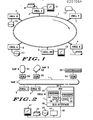
- a distributed computer configuration comprising multiple cells 2-7 (nodes) loosely coupled by a local area network (LAN) 1.
- LAN local area network
- Each cell comprises at least a processor and memory, as will be discussed in greater detail with reference to FIG. 2 below.
- each cell may also include other units, such as a printer 8, operator display module (ODM) 9, mass memory module 13, and other I/O device 10.
- ODM operator display module
- LAN 1 is additionally coupled to a third local area network LAN 3 via ICM 52.
- a process controller 55 is also coupled to LAN 1 via ICM 54.
- a representative cell N (7, FIG. 2) comprises a processor 24 which, in a preferred embodiment, is a Motorola 68010 processor. Each cell further includes a read only memory (ROM) 28 and a random access memory (RAM) 26. In addition, each cell includes a Network Interface Module (NIM) 21, which connects the cell to the LAN, and a Bus Interface 29, which couples the cell to additional devices within a cell. While a minimal cell is capable of supporting two peripheral devices, such as an Operator Display Module (ODM) 41 and an I/O Module 44, additional devices (including additional processors, such as processor 27) can be provided within a cell . Other additional devices may comprise, for example, a printer 42, and a mass-storage module 43 which supports a hard disk and a back-up device (floppy disk or streaming tape drive).
- ODM Operator Display Module
- I/O Module 44 additional devices (including additional processors, such as processor 27) can be provided within a cell .
- Other additional devices may comprise, for example, a printer 42, and a mass
- the Operator Display Module 41 provides a keyboard and screen to enable an operator to input information and receive visual information.
- While a single cell may comprise all of the above units, in the typical user application individual cells will normally be dedicated to specialized functions. For example, one or more mass storage cells may be set up to function as data base servers. There may also be several operator consoles and at least one cell for generating hard-copy printed output. Either these same cells, or separate dedicated cells, may execute particular application programs.
- the system is particularly designed to provide an integrated solution for factory automation, data acquisition, and other real-time applications. As such, it includes a full complement of services, such as a graphical output, windows, menus, icons, dynamic displays, electronic mail, event recording, and file management.
- Software development features include compilers, a window-oriented editor, a debugger, and performance-monitoring tools.
- the local area network as depicted in either FIG.1 or FIG. 2, ties the entire system together and makes possible the distributed virtual machine model described below.
- the LAN provides high throughput, guaranteed response, reliability, and low entry cost.
- the LAN is also autonomous, in the sense that all system and applications software is unaware of its existence. For example, any Network Interface Module (e.g. NIM 21, FIG. 2) could be replaced without rewriting any software other than that which directly drives it.
- the LAN interconnection medium may be twisted-pair or coaxial cable.
- Two channels (logically, two distinct networks) may be provided for reliability and for increased throughput.
- the LAN architecture is a logical ring, in which an electronic "token" is constantly passed from cell to cell at high speed.
- the current holder of the token may use it to send a "frame" of data or may pass it on to the next cell in the ring.
- the NIM only needs to know the logical address and status of its immediately succeeding neighbor. The NIM's responsibility is limited to detecting the failure of that neighbor or the inclusion of a new neighbor. In general, adjustment to failed or newly added cells is automatic.
- the LAN may be connected to other LAN's operating under the same LAN protocol via so-called “bridgeways”, or it may be connected to other types of LAN's via "gateways".
- Processes are referenced without regard to their physical location via a small set of message-passing primitives. Every process has both a unique system-generated identifier and a not necessarily unique name assigned by the programmer. The identifier provides quick direct access, while the name has a limited scope and provides symbolic, indirect access.
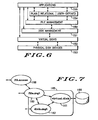
- the bottom, or hardware, layer 63 comprises a number of processors 71-76, as described above.
- the processors 71-76 may exist physically within one or more cells.
- the top, or software, layer 60 illustrates a number of processes P1-P10 which send messages ml-m6 to each other.
- the middle layer 61 labelled "virtual machine", isolates the hardware from the software, and it allows programs to be written as if they were going to be executed on a single processor. Conversely, programs can be distributed across multiple processors without having been explicitly designed for that purpose.
- a "process” is a self-contained package of data and executable procedures which operate on that data.
- the data is totally private and cannot be accessed by other processes.
- There is no concept of shared memory within the present invention. Execution of a process is strictly sequential. Multiple processes execute concurrently and must be scheduled by the operating system. The processes can be re-entrant, in which case only one copy of the code is loaded even if multiple instances are active.
- Every process has a unique "process identifier number" (PID) by which it can be referenced.
- PID process identifier number
- the PID is assigned by the system when the process is created and remains in effect until the process terminates.
- the PID assignment contains a randomizing factor which guarantees that the PID will not be re-used in the near future.
- the contents of the PID are irrelevant to the programmer but are used by the virtual machine to physically locate the process.
- a PID may be thought of as a "pointer" to a process.
- Every process also has a "name" which is a variable-length string of characters assigned by the programmer.
- a name need not be unique, and this ambiguity may be used to add new services transparently and to aid in fault-tolerance.
- FIG. 4 illustrates that the system-wide name space is partitioned into distinct subsets by means of "contexts" identified by reference numerals 90-92.
- a context is simply a collection of related processes whose names are not known outside of the context.
- Context 90 for example, contains processes A, a, a, b, c, d, and e.
- Context 91 contains processes B, a, b, c, and f.
- context 92 contains processes C, a, c, d, and x.
- context process One particular process in each context, called the “context process”, is known both within the context and within the immediately enclosing one (referred to as its “parent context”).
- processes A-C are context processes for contexts 90-92, respectively.
- the parent context of context 91 is context 90
- the parent context of context 92 is context 91.
- the context process is located on the boundary of the context and acts as a gate into it.
- Processes inside context 92 can reference any processes inside contexts 90 and 91 by name. However, processes in context 91 can only access processes in context 92 by going through the context process C. Processes in context 90 can only access processes in context 92 by going through context processes B and C.
- Contexts may be nested, allowing a hierarchy of abstractions to be constructed. A context must reside completely on one cell. The entire system is treated as an all-encompassing context which is always present and which is the highest level in the hierarchy. In essence, contexts define localized protection domains and greatly reduce the chances of unintentional naming conflicts.
- a process inside one context can be "connected" to one inside another context by exchanging PID's, once contact has been established through one or the other of the context processes.
- Most process servers within the present invention function that way. Initial access is by name. Once the desired function (such as a window or file) is "opened", the user process and the service communicate directly via PID's.
- a “message” is a variable-length buffer (limited only by the processor's physical memory size) which carries information between processes.
- a header, inaccessible to the programmer, contains the destination name and the sender's PID.
- the first field in a message is a null-terminated string which defines the type of message (e.g., "read”, "status”, etc.) Messages are queued to the receiving process when they are sent. Queuing ensures serial access and is used in preference to semaphores, monitors, etc.
- Messages provide the mechanism by which hardware transparency is achieved.
- a process located anywhere in the virtual machine can send a message to any other process if it knows its name.
- Transparency applies with some restrictions across bridgeways (i.e., the interfaces between LAN's operating under identical network protocols) and, in general, not at all across gateways (i.e., the interfaces between LAN's operating under different network protocols) due to performance degradation. However, they could so operate, depending upon the required level of performance.
- the virtual machine kernel primitives are the following:
- the PUT primitive queues a message to another process.
- the sending process resumes execution as soon as the message is queued.
- CALL essentially implements remote subroutine invocations, causing the caller to suspend until the receiver executes a REPLY. Subsequently, the replied message is dequeued out of sequence, immediately upon arrival, and the caller resumes execution.
- process y sends a message to ALL processes by the name x.
- Process y first searches within its own context 141 but finds no process x.
- the process y searches within the next higher context 131 (its parent context) but again finds no process x.
- process y searches within the next higher context 110 and finds a process x, identified by reference numeral 112. Since it is the only process x in context 110, it is the only recipient of the message from process y.
- process b in context 131 sends a message to ALL processes by the name A. It would find process A (111) in context 110, as well as process A (122) which is the context process for context 121.
- a process may also send a message to itself or to its context process without knowing either name explicitly.
- the virtual machine guarantees that each NEXT transmission will reach a different process and that eventually a transmission will be sent to the logically "first" process (the one that sent the original message) in the ring, completing the loop. In other words, all processes with the same name at the same level can communicate with each other without knowing how many there are or where they are located.
- the logical ring is essential for distributing services such as a data base. The ordering of processes in the ring is not predictable.
- process a (125) in context 121 sends a message to process a using the NEXT primitive
- the search finds a first process a (124) in the same context 121.
- Process a (124) is marked as having received the message, and then process a (124) sends the message on to the NEXT process a (123) in context 121.
- Process a (123) is marked as having received the message, and then it sends the message on to the NEXT process a, which is the original sender process a (125), which knows not to send it further on, since it's been marked as having already received the message.
- a process sends a message in the LOCAL transmission mode, it sends it only to a process having the given name in the sender's own context.BBB
- Messages are usually transmitted by queueing a pointer to the buffer containing the message.
- a message is only copied when there are multiple destinations or when the destination is on another cell.
- the operating system of the present invention consists of a kernel, which implements the primitives described above, plus a set of processes which provide process creation and termination, time management (set time, set alarm, etc.) and which perform cell start-up and configuration.
- Drivers for devices are also implemented as processes (EESP's), as described above. This allows both system services and device drivers to be added or replaced easily.
- the operating system also supports swapping and paging, although both are invisible to applications software.
- a minimal bootstrap program resides permanently (in ROM) on every cell, e.g. ROM 28 in cell N of FIG. 2.
- the bootstrap program executes automatically when a cell is powered up and begins by performing basic on-board diagnostics. It then attempts to find and start an initial system code module which comprises the entire kernel, and EESP's for the clock, disk (if required), and NIM (if required).
- the module is sought on the first disk drive on the cell, if any. If there isn't a disk, and the cell is on the LAN, a message will be sent out requesting the module. Failing that, the required software must be resident in ROM.
- System services for the clock and for process creation, an initialization program, and a minimal file system are also built into the module.
- the initialization program sets up all of the kernel's internal tables and then calls predefined entry points in each of the preloaded services (file management, etc.). The net result is that EESP's for the attached devices are scheduled to run, and the cell is available.
- a template file describing the initial software and hardware for each cell in the system.
- the template defines a set of initial processes (usually one per service) which are scheduled immediately after the cell start-up. These processes then start up their respective subsystems.
- a cell configuration service on each cell sends configuration messages to each subsystem when it is being initialized, informing it of the devices it owns. Thereafter, similar messages are sent whenever a new device is added to the cell or a device fails or is removed from the cell.
- the present invention allows the user to store and retrieve data at several levels of abstraction. At various levels it provides device-independence, transparency, multiple views of the same data and support for transaction processing. Transparency means that a process need not know where a file is stored in order to access it. It also means that the file can be moved to another device without affecting the process. Only as many levels as are required for a particular application need be included in the system.
- the lowest level of data management is the physical disk layer 153, which is completely hidden from all applications software 155.
- virtual disks 152 which define an interface in terms of linear arrays of 1K blocks, regardless of the actual medium. Although the usual medium is disk, RAM may also be used (for temporary files) to improve performance.
- Three types of messages are supported at this level: “initial”, to format the virtual disk, and “read” and “write” to access specific blocks.
- the third level, disk management 151 organizes data within a virtual disk by means of indices.
- a disk index is a file at this level and is viewed as an extensible linear array of bytes. Messages are accepted to initialize the disk, allocate and delete indices, and read and write indices. The latter two functions operate starting at a given byte offset for a given byte length. An index is automatically extended when a request references a location outside the current limits. Physical storage is allocated only when data is actually written. Optional data caching is supported at the disk management level on a per cell basis.
- File management 150 is layered on top of disk management 151 and introduces the concept of a "file system".
- a file system is a collection of named files (or named indices, in terms of the disk management layer 151).
- the name space constitutes a flat (single- level) directory which is allocated when the file system is initialized.
- a name may be up to 64 characters long and is hashed into the directory.
- Unnamed files are useful for building complex disk structures which are logically linked to each other, such as a hierarchical file directory or a database, or for temporary files which only the creator will use.
- Transparency is supported only at the file management level 150 and above. It is used by simply omitting the file system name from the request (NEW, DELETE, RENAME, or OPEN). In this case, the request is forwarded through all file systems until the given file name is found.
- a file management context When a file management context starts up, it attempts to read the volume header of its associated disk. If successful, the volume name is read and becomes the name of the file system which that context manages. If unsuccessful, the volume is marked as uninitialized. Thereafter only an INITIAL command is accepted.
- requests which reference a file by name are sent to the context process "file mgt”.
- Requests which access data are sent directly by their PID to the disk_mgt process within the file management context. This PID, as well as the associated disk index, is returned in the reply to a successful NEW or OPEN command. This connects the user (e.g., a data management process) to a specific file allocation on a specific volume.
- all active file management contexts are viewed as forming a logical ring.
- Requests referencing a file by name are sent to the context process named "file_mgt" using transmission mode NEXT.
- Each context process "file_mgt” determines whether the request is for the file system which it manages, and, if it is not, it forwards the request to the next context "file_mgt". If a request circulates the logical ring without success, then it is returned to the caller with an error indication.
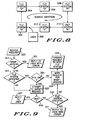
- a user 300 e.g. an application context
- the file access request is first received by the "file_mgt” context process of file system "B” 302, which determines that the request is not for file system “B” and forwards it to file system "S” 304.
- file system "S” 304 forwards the request on to file system "G” 306.
- the "file_mgt” context process of file system "G” 306 recognizes that the request is intended for this file system and then responds to user 300 that it will attempt to satisfy the request.
- a file access request may either specify both a file system name and a file name, or it may simply specify a file name. Data residence transparency is achieved by not specifying the file system name.
- user 300 doesn't know on which file system a desired file is located or doesn't care where a file is to be opened. In this case, an attempt is made by each successive "file_mgt" context to satisfy the request of user 300.
- the set of all disk volumes in the system may be considered one large disk space, and the user doesn't have to know on which file system any given file is logically or physically located.
- FIG. 9 illustrates how a file access request is handled by the present invention.
- a file access request is received in block 320.
- Decision block 321 queries whether this is a wrap-around. If so, an error message is sent to the user, as indicated by block 322. If not, the procedure passes to decision block 323, which queries whether a file system has been specified. If not, this particular file system attempts to satisfy the request, as indicated by block 325. If so, decision block 324 queries whether this particular file system is the one specified. If so, this particular file system attempts to satisfy the request.
- decision block 330 queries whether a file system was specified. If so, an error message is sent to the user, as indicated by block 331. If not, the request is marked for wrap-around (block 328), and the request is forwarded to the next file system (block 329).
- Appendix A contains a "C" language implementation of the flow diagram shown in FIG. 9.
- Appendix B is a detailed description of the relevant portions of the source code listing of Appendix A.
Landscapes
- Engineering & Computer Science (AREA)
- Theoretical Computer Science (AREA)
- Computer Hardware Design (AREA)
- Physics & Mathematics (AREA)
- General Physics & Mathematics (AREA)
- General Engineering & Computer Science (AREA)
- Mathematical Physics (AREA)
- Software Systems (AREA)
- Library & Information Science (AREA)
- Data Mining & Analysis (AREA)
- Databases & Information Systems (AREA)
- Information Retrieval, Db Structures And Fs Structures Therefor (AREA)
- Information Transfer Between Computers (AREA)
- Computer And Data Communications (AREA)
Applications Claiming Priority (2)
| Application Number | Priority Date | Filing Date | Title |
|---|---|---|---|
| US73092985A | 1985-05-06 | 1985-05-06 | |
| US730929 | 1985-05-06 |
Publications (3)
| Publication Number | Publication Date |
|---|---|
| EP0201064A2 true EP0201064A2 (de) | 1986-11-12 |
| EP0201064A3 EP0201064A3 (en) | 1989-04-05 |
| EP0201064B1 EP0201064B1 (de) | 1993-07-07 |
Family
ID=24937376
Family Applications (1)
| Application Number | Title | Priority Date | Filing Date |
|---|---|---|---|
| EP86106071A Expired - Lifetime EP0201064B1 (de) | 1985-05-06 | 1986-05-02 | Rechnersystem mit transparenter Datenresidenz und transparentem Datenzugriff |
Country Status (5)
| Country | Link |
|---|---|
| EP (1) | EP0201064B1 (de) |
| JP (1) | JPS61294573A (de) |
| CA (1) | CA1263193A (de) |
| DE (1) | DE3688658T2 (de) |
| HK (1) | HK1000739A1 (de) |
Families Citing this family (1)
| Publication number | Priority date | Publication date | Assignee | Title |
|---|---|---|---|---|
| US8447909B2 (en) * | 2010-07-19 | 2013-05-21 | International Business Machines Corporation | Register access in distributed virtual bridge environment |
Family Cites Families (1)
| Publication number | Priority date | Publication date | Assignee | Title |
|---|---|---|---|---|
| JPS533031A (en) * | 1976-06-30 | 1978-01-12 | Toshiba Corp | Parallel file processing unit |
-
1986
- 1986-04-28 CA CA000507767A patent/CA1263193A/en not_active Expired
- 1986-05-02 EP EP86106071A patent/EP0201064B1/de not_active Expired - Lifetime
- 1986-05-02 DE DE86106071T patent/DE3688658T2/de not_active Expired - Fee Related
- 1986-05-06 JP JP61103698A patent/JPS61294573A/ja active Pending
-
1997
- 1997-12-01 HK HK97102301A patent/HK1000739A1/en not_active IP Right Cessation
Non-Patent Citations (2)
| Title |
|---|
| IEE PROCEEDINGS, vol. 131, no. 2, part E, section A-I, March 1984, pages 38-44, Old Woking, Surrey, GB; R. HULL et al.: "Virtual resource ring: Technique for decentralised resource management in fault-tolerant distributed computer systems" * |
| THE FIRST INTERNATIONAL CONFERENCE ON COMPUTER COMMUNICATION, Washington, 24th-26th October 1972, pages 364-370, A.C.M., New York, US; D.J. FARBER et al.: "The structure of a distributed computer system - the distributed file system" * |
Also Published As
| Publication number | Publication date |
|---|---|
| DE3688658D1 (de) | 1993-08-12 |
| EP0201064A3 (en) | 1989-04-05 |
| JPS61294573A (ja) | 1986-12-25 |
| EP0201064B1 (de) | 1993-07-07 |
| DE3688658T2 (de) | 1993-10-28 |
| HK1000739A1 (en) | 1998-04-24 |
| CA1263193A (en) | 1989-11-21 |
Similar Documents
| Publication | Publication Date | Title |
|---|---|---|
| US5014192A (en) | System for locating a file in a logical ring by sequentially forwarding access request with file system name and file name | |
| US4754395A (en) | Network interface module with minimized data paths | |
| US4694396A (en) | Method of inter-process communication in a distributed data processing system | |
| US4914583A (en) | Method of indicating processes resident within a cell of a data processing system | |
| US4835685A (en) | Virtual single machine with message-like hardware interrupts and processor exceptions | |
| US5047925A (en) | Logical ring in a virtual single machine | |
| US5060150A (en) | Process creation and termination monitors for use in a distributed message-based operating system | |
| EP0274406B1 (de) | Selbstkonfiguration von Knotenpunkten in einem verteilten, auf Nachrichten gegründeten Betriebssystem | |
| US5109486A (en) | Distributed computer system with network and resource status monitoring | |
| Leach et al. | The architecture of an integrated local network | |
| US5325526A (en) | Task scheduling in a multicomputer system | |
| US5226172A (en) | Methods for configuring and performing 3-level password searching in a distributed computer system | |
| US5687372A (en) | Customer information control system and method in a loosely coupled parallel processing environment | |
| US7246167B2 (en) | Communication multiplexor using listener process to detect newly active client connections and passes to dispatcher processes for handling the connections | |
| EP0501610A2 (de) | Objektorientiertes verteiltes Rechnersystem | |
| KR20070049155A (ko) | 파일 서버 재초기화 장치, 방법 및 컴퓨터 프로그램 | |
| EP0201063B1 (de) | Methode zur Lokalisierung von Prozessen in einem verteilten Datenverarbeitungssystem | |
| US5682507A (en) | Plurality of servers having identical customer information control procedure functions using temporary storage file of a predetermined server for centrally storing temporary data records | |
| JPH08339355A (ja) | 分散形システムでの処理タスク実行呼び出し方法及び装置 | |
| US5790868A (en) | Customer information control system and method with transaction serialization control functions in a loosely coupled parallel processing environment | |
| US5101488A (en) | Method for retrieving and updating data in a real-time data base system | |
| US20090276502A1 (en) | Network Switch with Shared Memory | |
| US5630133A (en) | Customer information control system and method with API start and cancel transaction functions in a loosely coupled parallel processing environment | |
| EP0201064B1 (de) | Rechnersystem mit transparenter Datenresidenz und transparentem Datenzugriff | |
| EP0201065A2 (de) | Virtuelle Einzelmaschine mit logischem Ring und nachrichtenartigen Hardware-Unterbrechungen und Prozessorausnahmebedingungen |
Legal Events
| Date | Code | Title | Description |
|---|---|---|---|
| PUAI | Public reference made under article 153(3) epc to a published international application that has entered the european phase |
Free format text: ORIGINAL CODE: 0009012 |
|
| AK | Designated contracting states |
Kind code of ref document: A2 Designated state(s): DE FR GB |
|
| RAP3 | Party data changed (applicant data changed or rights of an application transferred) |
Owner name: COMPUTER X, INC. |
|
| PUAL | Search report despatched |
Free format text: ORIGINAL CODE: 0009013 |
|
| AK | Designated contracting states |
Kind code of ref document: A3 Designated state(s): DE FR GB |
|
| 17P | Request for examination filed |
Effective date: 19891002 |
|
| 17Q | First examination report despatched |
Effective date: 19911015 |
|
| GRAA | (expected) grant |
Free format text: ORIGINAL CODE: 0009210 |
|
| AK | Designated contracting states |
Kind code of ref document: B1 Designated state(s): DE FR GB |
|
| REF | Corresponds to: |
Ref document number: 3688658 Country of ref document: DE Date of ref document: 19930812 |
|
| ET | Fr: translation filed | ||
| PLBE | No opposition filed within time limit |
Free format text: ORIGINAL CODE: 0009261 |
|
| STAA | Information on the status of an ep patent application or granted ep patent |
Free format text: STATUS: NO OPPOSITION FILED WITHIN TIME LIMIT |
|
| 26N | No opposition filed | ||
| PGFP | Annual fee paid to national office [announced via postgrant information from national office to epo] |
Ref country code: GB Payment date: 19980401 Year of fee payment: 13 |
|
| PGFP | Annual fee paid to national office [announced via postgrant information from national office to epo] |
Ref country code: FR Payment date: 19980407 Year of fee payment: 13 |
|
| PG25 | Lapsed in a contracting state [announced via postgrant information from national office to epo] |
Ref country code: GB Free format text: LAPSE BECAUSE OF NON-PAYMENT OF DUE FEES Effective date: 19990502 |
|
| GBPC | Gb: european patent ceased through non-payment of renewal fee |
Effective date: 19990502 |
|
| PG25 | Lapsed in a contracting state [announced via postgrant information from national office to epo] |
Ref country code: FR Free format text: LAPSE BECAUSE OF NON-PAYMENT OF DUE FEES Effective date: 20000131 |
|
| REG | Reference to a national code |
Ref country code: FR Ref legal event code: ST |
|
| PGFP | Annual fee paid to national office [announced via postgrant information from national office to epo] |
Ref country code: DE Payment date: 20000418 Year of fee payment: 15 |
|
| PG25 | Lapsed in a contracting state [announced via postgrant information from national office to epo] |
Ref country code: DE Free format text: LAPSE BECAUSE OF NON-PAYMENT OF DUE FEES Effective date: 20020301 |
|
| P01 | Opt-out of the competence of the unified patent court (upc) registered |
Effective date: 20230520 |