EP0201213B1 - Stabilization of pitch fiber - Google Patents
Stabilization of pitch fiber Download PDFInfo
- Publication number
- EP0201213B1 EP0201213B1 EP86302646A EP86302646A EP0201213B1 EP 0201213 B1 EP0201213 B1 EP 0201213B1 EP 86302646 A EP86302646 A EP 86302646A EP 86302646 A EP86302646 A EP 86302646A EP 0201213 B1 EP0201213 B1 EP 0201213B1
- Authority
- EP
- European Patent Office
- Prior art keywords
- pitch
- fiber
- stabilization
- fibers
- temperature
- Prior art date
- Legal status (The legal status is an assumption and is not a legal conclusion. Google has not performed a legal analysis and makes no representation as to the accuracy of the status listed.)
- Expired
Links
- 239000000835 fiber Substances 0.000 title claims description 64
- 230000006641 stabilisation Effects 0.000 title claims description 25
- 238000011105 stabilization Methods 0.000 title claims description 25
- 230000001590 oxidative effect Effects 0.000 claims description 19
- 238000000034 method Methods 0.000 claims description 14
- 239000012298 atmosphere Substances 0.000 claims description 11
- QVGXLLKOCUKJST-UHFFFAOYSA-N atomic oxygen Chemical compound [O] QVGXLLKOCUKJST-UHFFFAOYSA-N 0.000 claims description 7
- 239000001301 oxygen Substances 0.000 claims description 7
- 229910052760 oxygen Inorganic materials 0.000 claims description 7
- 229920000049 Carbon (fiber) Polymers 0.000 claims description 5
- 239000004917 carbon fiber Substances 0.000 claims description 5
- VNWKTOKETHGBQD-UHFFFAOYSA-N methane Chemical compound C VNWKTOKETHGBQD-UHFFFAOYSA-N 0.000 claims description 5
- CBENFWSGALASAD-UHFFFAOYSA-N Ozone Chemical compound [O-][O+]=O CBENFWSGALASAD-UHFFFAOYSA-N 0.000 claims description 4
- 239000011295 pitch Substances 0.000 description 32
- IJGRMHOSHXDMSA-UHFFFAOYSA-N Atomic nitrogen Chemical compound N#N IJGRMHOSHXDMSA-UHFFFAOYSA-N 0.000 description 12
- 239000007789 gas Substances 0.000 description 8
- 238000010438 heat treatment Methods 0.000 description 8
- 239000004576 sand Substances 0.000 description 8
- 238000007254 oxidation reaction Methods 0.000 description 7
- 229910052757 nitrogen Inorganic materials 0.000 description 6
- 239000011302 mesophase pitch Substances 0.000 description 5
- 229920001187 thermosetting polymer Polymers 0.000 description 5
- 238000003763 carbonization Methods 0.000 description 4
- 238000002844 melting Methods 0.000 description 4
- 230000008018 melting Effects 0.000 description 4
- 230000003647 oxidation Effects 0.000 description 4
- 230000004927 fusion Effects 0.000 description 3
- 238000002074 melt spinning Methods 0.000 description 3
- 230000000087 stabilizing effect Effects 0.000 description 3
- XKRFYHLGVUSROY-UHFFFAOYSA-N Argon Chemical compound [Ar] XKRFYHLGVUSROY-UHFFFAOYSA-N 0.000 description 2
- 229910052799 carbon Inorganic materials 0.000 description 2
- 238000010000 carbonizing Methods 0.000 description 2
- 238000006243 chemical reaction Methods 0.000 description 2
- 238000007654 immersion Methods 0.000 description 2
- 238000000386 microscopy Methods 0.000 description 2
- 239000012299 nitrogen atmosphere Substances 0.000 description 2
- OKTJSMMVPCPJKN-UHFFFAOYSA-N Carbon Chemical compound [C] OKTJSMMVPCPJKN-UHFFFAOYSA-N 0.000 description 1
- MYMOFIZGZYHOMD-UHFFFAOYSA-N Dioxygen Chemical compound O=O MYMOFIZGZYHOMD-UHFFFAOYSA-N 0.000 description 1
- UFHFLCQGNIYNRP-UHFFFAOYSA-N Hydrogen Chemical compound [H][H] UFHFLCQGNIYNRP-UHFFFAOYSA-N 0.000 description 1
- 229910052786 argon Inorganic materials 0.000 description 1
- -1 aromatic organic compounds Chemical class 0.000 description 1
- 230000015572 biosynthetic process Effects 0.000 description 1
- 239000011280 coal tar Substances 0.000 description 1
- 238000007796 conventional method Methods 0.000 description 1
- 238000001816 cooling Methods 0.000 description 1
- 238000004132 cross linking Methods 0.000 description 1
- 230000007423 decrease Effects 0.000 description 1
- 230000001419 dependent effect Effects 0.000 description 1
- 230000000694 effects Effects 0.000 description 1
- 238000001125 extrusion Methods 0.000 description 1
- 239000001257 hydrogen Substances 0.000 description 1
- 229910052739 hydrogen Inorganic materials 0.000 description 1
- 239000011261 inert gas Substances 0.000 description 1
- 239000004973 liquid crystal related substance Substances 0.000 description 1
- 239000000203 mixture Substances 0.000 description 1
- 238000001907 polarising light microscopy Methods 0.000 description 1
- 238000002360 preparation method Methods 0.000 description 1
- 238000000197 pyrolysis Methods 0.000 description 1
- 239000007787 solid Substances 0.000 description 1
- 229910001220 stainless steel Inorganic materials 0.000 description 1
- 239000010935 stainless steel Substances 0.000 description 1
- 239000011269 tar Substances 0.000 description 1
- 239000011800 void material Substances 0.000 description 1
Classifications
-
- D—TEXTILES; PAPER
- D01—NATURAL OR MAN-MADE THREADS OR FIBRES; SPINNING
- D01F—CHEMICAL FEATURES IN THE MANUFACTURE OF ARTIFICIAL FILAMENTS, THREADS, FIBRES, BRISTLES OR RIBBONS; APPARATUS SPECIALLY ADAPTED FOR THE MANUFACTURE OF CARBON FILAMENTS
- D01F9/00—Artificial filaments or the like of other substances; Manufacture thereof; Apparatus specially adapted for the manufacture of carbon filaments
- D01F9/08—Artificial filaments or the like of other substances; Manufacture thereof; Apparatus specially adapted for the manufacture of carbon filaments of inorganic material
- D01F9/12—Carbon filaments; Apparatus specially adapted for the manufacture thereof
- D01F9/14—Carbon filaments; Apparatus specially adapted for the manufacture thereof by decomposition of organic filaments
- D01F9/32—Apparatus therefor
- D01F9/322—Apparatus therefor for manufacturing filaments from pitch
-
- C—CHEMISTRY; METALLURGY
- C10—PETROLEUM, GAS OR COKE INDUSTRIES; TECHNICAL GASES CONTAINING CARBON MONOXIDE; FUELS; LUBRICANTS; PEAT
- C10C—WORKING-UP PITCH, ASPHALT, BITUMEN, TAR; PYROLIGNEOUS ACID
- C10C3/00—Working-up pitch, asphalt, bitumen
- C10C3/02—Working-up pitch, asphalt, bitumen by chemical means reaction
- C10C3/04—Working-up pitch, asphalt, bitumen by chemical means reaction by blowing or oxidising, e.g. air, ozone
-
- D—TEXTILES; PAPER
- D01—NATURAL OR MAN-MADE THREADS OR FIBRES; SPINNING
- D01F—CHEMICAL FEATURES IN THE MANUFACTURE OF ARTIFICIAL FILAMENTS, THREADS, FIBRES, BRISTLES OR RIBBONS; APPARATUS SPECIALLY ADAPTED FOR THE MANUFACTURE OF CARBON FILAMENTS
- D01F9/00—Artificial filaments or the like of other substances; Manufacture thereof; Apparatus specially adapted for the manufacture of carbon filaments
- D01F9/08—Artificial filaments or the like of other substances; Manufacture thereof; Apparatus specially adapted for the manufacture of carbon filaments of inorganic material
- D01F9/12—Carbon filaments; Apparatus specially adapted for the manufacture thereof
- D01F9/14—Carbon filaments; Apparatus specially adapted for the manufacture thereof by decomposition of organic filaments
- D01F9/145—Carbon filaments; Apparatus specially adapted for the manufacture thereof by decomposition of organic filaments from pitch or distillation residues
Definitions
- This invention relates to a process for stabilizing (thermosetting) a pitch fiber in preparation for carbonization to carbon fiber.
- Pitch fiber is normally melt-spun from mesophase or isotropic pitch or combinations thereof.
- the melt-spun fiber is then stabilized, also referred to as thermoset, in the presence of an oxidizing gas such as air, oxygen or ozone. It is believed that a certain degree of cross-linking occurs during stabilization which allows the fiber to be subsequently exposed to much higher temperatures without deformation or fusion.
- the fiber is generally subjected to elevated temperatures in an inert atmosphere to carbonize the fiber.
- the time needed for oxidative stabilization is relatively long.
- the present invention concerns an improvement in this step which accelerates stabilization.
- This invention deals with an improvement in the process of producing carbon fiber which involves the general steps of melt-spinning pitch fiber, oxidatively stabilizing the fiber and then carbonizing the stabilized fiber.
- This improvement comprises accelerating the oxidative stabilization of the pitch fiber by subjecting the fiber to elevated temperatures in an oxidizing atmosphere at a pressure of at least two atmospheres (200 kPa).
- This invention deals with an improvement in the process for making carbon fiber from pitch.
- a conventional method involves melt-spinning a pitch, oxidatively stabilizing the melt-spin fiber and then carbonizing the fiber.
- the pitch fiber is melt-spun from mesophase pitch, isotropic (non-mesophase) pitch or a combination of mesophase and non-mesophase.
- pitch is to be understood as it is used in the art and generally refers to a carbonaceous residue consisting of a complex mixture of primarily aromatic organic compounds which is solid at room temperature and exhibits a relatively broad melting or softening temperature range.
- mesophase is to be understood as it is used in the art and is synonymous with liquid crystal.
- the melt-spun pitch fiber is then subjected to oxidative stabilization.
- the pitch is believed to be thermoset or cross-linked to some extent which permits the fiber to be exposed to elevated temperatures in the carbonization step without significant fusion or deformation.
- Oxidative stabilization is carried out in an oxidizing atmosphere such as air, oxygen or ozone.
- thermosetting depends in part upon the temperature of the oxidizing gas being supplied, the duration of time the pitch fiber is permitted to thermoset and the nature of the oxidizing gas.
- the oxidizing gas establishing the gaseous environment has a temperature of at least 200°C and no more than 400°C.
- the minimum suitable temperature is determined by the lowest temperature at which pitch will react, 200°C.
- the maximum temperature to be used is the temperature at which the pitch will flow causing sticking or deorientation and weaking with resulting breakage about 300 to 400°C depending on the particular pitch and on the heat generated by the oxidation reactions. It should be understood that the flow temperature increases as the oxidation reactions proceed and therefore the temperature may be raised as the process proceeds.
- Air, oxygen or ozone is used for the stabilization.
- the oxidizing gas treatment is carried out under pressure.
- the oxidizing gas is at a pressure of at least about two atmospheres (200 kPa) during the stabilization step, and preferably at a pressure of at least five atmospheres (500 kPa).
- the pitch fibers were placed in an autoclave which was pressurised with air at room temperature. The autoclave was then heated, thus providing the elevated temperature and pressure at which stabilization took place.
- Stabilization the point at which the fiber becomes infusible is time, temperature and pressure dependent. The time required for stabilization depends on the pressure and temperature. It is believed that the reaction may be accomplished in as little as one second. At lower temperatures and pressures the maximum time could be as high as several hours. Over-oxidation should be avoided since it may result in pitting of the fiber surface and loss of fiber strength.
- the stabilized fiber is next carbonized in an inert atmosphere at about 1700°C in accordance with conventional practice. Nitrogen or argon may be used to provide the inert atmosphere.
- Untopped decant oil was heated at 385°C for 31.5 hours while sparging with nitrogen at a rate of 0.026 m 3 /h (0.42 cubic feet per hour) per kilogram (per pound) of decant oil feed.
- the resulting pitch was almost totally anisotropic.
- Using polarized light microscopy the mesophase content was estimated to be 95%.
- Fibers were prepared from this mesophase pitch by methods known in the art: the pitch was extruded at 324°C through a single capillary 152 pm (6 mils) in diameter and 305 11m (12 mils) long. Fibers were wound up at a speed of 500 meters per minute. As-spun fibers had a density of 1.3 gtcm 3 and an average diameter of 14.8 um.
- a 7.6 cm (three inch) skein of the as-spun fibers was removed from the wind-up bobbin and placed in a cylindrical autoclave 1.1 cm in diameter and 9.3 cm long (inside dimensions).
- the autoclave was pressurized with air to 689 kPa (100 psig) at room temperature and immersed in a sand bath which had been preheated to 265°C and the sand bath temperature was controlled so as to keep the autoclave at 250°C. At 250°C the pressure is calculated to be 187 psig (1288 kPa). After a total immersion time of 25 minutes the autoclave was removed and rapidly cooled.
- the resulting oxidatively stabilized fibers were removed and found to have increased in density to 1.462 gtcm 3.
- the fibers were carbonized to 900°C in a nitrogen atmosphere. The carbonized fibers were completely fibrous and showed no evidence of fusion or sticking.
- This example illustrates the use of oxygen in the stabilization process of this invention.
- the as-spun mesophase pitch fibers prepared in Example 1 were cut into a skein 3.5 inches (88.9 mm) long and placed in an autoclave at atmospheric pressure air. Using an electrically heated jacket and temperature was raised to 250°C over a period of 36 minutes. The autoclave was then pressurized with oxygen to 75 psig (520 kPa) and the temperature and pressure were held constant for 20 minutes. After rapid cooling and release of pressure the fibers were removed.
- the resulting oxidatively stabilized fibers had a density of 1.407 g/cm 3 and were stable to further heat treatment in nitrogen at 900°C, after which the fibers were intact and completely fibrous.
- Mesophase pitch was prepared by a process similar to that disclosed in Greenwood patent, US-A-4,277,324.
- the mesophase pitch was essentially 100% anisotropic as determined by polarized reflected light microscopy.
- Five hundred filament yarn was obtained by melt spinning.
- Four 25.4 cm (ten inch) long skeins of yarn were placed in a stainless steel cylindrical autoclave measuring approximately 29 cm long and 1.1 cm in diameter.
- the autoclave was pressurized to 200 psig (1388 kPa) with air at room temperature and sealed.
- the autoclave was immersed in a sand bath. The temperature of the bath was raised over a period of 33 minutes to 225°C.
- the pressure was estimated to be 344 psig (2387 kPa) at 225°C).
- the sample was held at this temperature for 80 minutes, after which the autoclave was removed from the sand bath, cooled rapidly, and the pressure released.
- the oxidatively stabilized fibers which resulted had a density of 1.433 g/cm 3 and were infusible upon further heat treatment. 17.8 cm (Seven inch) portions of the oxidatively stabilized yarn were carbonized at a temperature of 1936°C.
- These carbonized fibers had a tenacity of 11.479 cN/dtex (13.0 grams per denier) (average of 10 filaments, 2.54 (one inch gage length), a modulus of 1766 cN/dtex (2000 grams per denier), an average (1.34 dtex) (denier per filament of 1.21 cm 3 and a density of 2.16 g/cm 3 .
- An optically isotropic pitch was prepared by heating the 482°C (900°F) plus fraction of a pyrolysis tar at 385°C (725°F) for 6 hours while sparging the pitch with nitrogen at 4 standard cubic feet per hour per pound of starting pitch (0.025 cubic metres per kilogram). The resulting pitch was completely isotropic as determined by reflected light microscopy of its polished surface. The pitch had a carbon to hydrogen ratio of 1.57.
- This isotropic pitch was melt spun into fibers by extrusion at 321°C through a 228 11m (9 mil) capillary. The fibers were wound onto a bobbin at 525 meters per minute. The resulting fibers had a diameter of 17 11m and a density of 1.245 g/cm 3 .
- a 7.6 cm (three inch) skein of the above fibers was removed from the wind-up bobbin and placed in an autoclave tube.
- the tube was heated to 250°C over a period of 35 minutes as described in Example 9.
- the internal pressure was then raised to 165 psig (1145 kPa) by the addition of air, and the temperature and pressure were held constant for a period of 20 minutes.
- the pressure and temperature were rapidly lowered.
- the resulting oxidatively stabilized fibers had a density of 1.324 g/cm 3 .
- the resulting fibers were completely infusible to further heating as determined by heating them to 900°C in a nitrogen atmosphere.
Landscapes
- Chemical & Material Sciences (AREA)
- Engineering & Computer Science (AREA)
- General Chemical & Material Sciences (AREA)
- Chemical Kinetics & Catalysis (AREA)
- Textile Engineering (AREA)
- Civil Engineering (AREA)
- Manufacturing & Machinery (AREA)
- Structural Engineering (AREA)
- Materials Engineering (AREA)
- Oil, Petroleum & Natural Gas (AREA)
- Organic Chemistry (AREA)
- Inorganic Fibers (AREA)
- Spinning Methods And Devices For Manufacturing Artificial Fibers (AREA)
Description
- This invention relates to a process for stabilizing (thermosetting) a pitch fiber in preparation for carbonization to carbon fiber.
- Pitch fiber is normally melt-spun from mesophase or isotropic pitch or combinations thereof. The melt-spun fiber is then stabilized, also referred to as thermoset, in the presence of an oxidizing gas such as air, oxygen or ozone. It is believed that a certain degree of cross-linking occurs during stabilization which allows the fiber to be subsequently exposed to much higher temperatures without deformation or fusion. Following stabilization, the fiber is generally subjected to elevated temperatures in an inert atmosphere to carbonize the fiber.
- The time needed for oxidative stabilization is relatively long. The present invention concerns an improvement in this step which accelerates stabilization.
- This invention deals with an improvement in the process of producing carbon fiber which involves the general steps of melt-spinning pitch fiber, oxidatively stabilizing the fiber and then carbonizing the stabilized fiber.
- This improvement comprises accelerating the oxidative stabilization of the pitch fiber by subjecting the fiber to elevated temperatures in an oxidizing atmosphere at a pressure of at least two atmospheres (200 kPa).
- This invention deals with an improvement in the process for making carbon fiber from pitch. A conventional method involves melt-spinning a pitch, oxidatively stabilizing the melt-spin fiber and then carbonizing the fiber. The pitch fiber is melt-spun from mesophase pitch, isotropic (non-mesophase) pitch or a combination of mesophase and non-mesophase. The term "pitch" is to be understood as it is used in the art and generally refers to a carbonaceous residue consisting of a complex mixture of primarily aromatic organic compounds which is solid at room temperature and exhibits a relatively broad melting or softening temperature range. The term "mesophase" is to be understood as it is used in the art and is synonymous with liquid crystal.
- The melt-spun pitch fiber is then subjected to oxidative stabilization. In this process the pitch is believed to be thermoset or cross-linked to some extent which permits the fiber to be exposed to elevated temperatures in the carbonization step without significant fusion or deformation. Oxidative stabilization is carried out in an oxidizing atmosphere such as air, oxygen or ozone.
- The amount of thermosetting depends in part upon the temperature of the oxidizing gas being supplied, the duration of time the pitch fiber is permitted to thermoset and the nature of the oxidizing gas.
- Preferably, the oxidizing gas establishing the gaseous environment has a temperature of at least 200°C and no more than 400°C. The minimum suitable temperature is determined by the lowest temperature at which pitch will react, 200°C. The maximum temperature to be used is the temperature at which the pitch will flow causing sticking or deorientation and weaking with resulting breakage about 300 to 400°C depending on the particular pitch and on the heat generated by the oxidation reactions. It should be understood that the flow temperature increases as the oxidation reactions proceed and therefore the temperature may be raised as the process proceeds.
- Air, oxygen or ozone is used for the stabilization. The oxidizing gas treatment is carried out under pressure. In accordance with the invention it has been found that oxidation stabilization of the pitch fiber is accelerated if the oxidizing gas is at a pressure of at least about two atmospheres (200 kPa) during the stabilization step, and preferably at a pressure of at least five atmospheres (500 kPa). In the examples which follow, the pitch fibers were placed in an autoclave which was pressurised with air at room temperature. The autoclave was then heated, thus providing the elevated temperature and pressure at which stabilization took place. Stabilization, the point at which the fiber becomes infusible is time, temperature and pressure dependent. The time required for stabilization depends on the pressure and temperature. It is believed that the reaction may be accomplished in as little as one second. At lower temperatures and pressures the maximum time could be as high as several hours. Over-oxidation should be avoided since it may result in pitting of the fiber surface and loss of fiber strength.
- It should be understood that other factors such as fiber, denier, type of pitch, oxygen concentration in the treating atmosphere, and rate of removal of heat of oxidation will also influence the length of time needed for stabilization. Thus, low denier fibers stabilize faster than heavier denier fibers. Stabilization must occur substantially throughout the fiber cross-section and not merely at the surface. Failure to so stabilize may result in melting of the core during subsequent fiber treatment, interfilament sticking, void formation and deorientation. Further, some pitches, such as coal tar pitches stabilize more slowly than other pitches, and of course, higher melting pitch fibers can be stabilized at higher temperatures without melting or sticking.
- It is preferred to employ air as the oxidizing gas because the presence of the inert gases assists in removal of heat of oxidation whereas pure oxygen promotes oxidation.
- The stabilized fiber is next carbonized in an inert atmosphere at about 1700°C in accordance with conventional practice. Nitrogen or argon may be used to provide the inert atmosphere.
- The examples which follow illustrate the effect of increased oxidizing gas pressures. In each case samples were placed in small autoclaves and submitted to various time-temperature-pressure conditions. The autoclaves were immersed in a sand bath of controlled temperature. A series of sand bath runs were carried out in which pressure and time were varied at a constant bath temperature of 250°C. Fiber density and fusibility were monitored. Fusibility was monitored by heating the fibers in nitrogen to 900° and observing the results. Insufficiently stabilized fibers either completely fused together or had sufficient fiber sticking to give a stiffer, more brittle fiber bundle. As shown by the examples, increased pressure or increased time at a given temperature lead to fibers with higher density, and in general, less tendency to fuse or stick. From these runs, it is evident that pressure accelerates the stabilization reaction.
- Untopped decant oil was heated at 385°C for 31.5 hours while sparging with nitrogen at a rate of 0.026 m3/h (0.42 cubic feet per hour) per kilogram (per pound) of decant oil feed. The resulting pitch was almost totally anisotropic. Using polarized light microscopy the mesophase content was estimated to be 95%. Fibers were prepared from this mesophase pitch by methods known in the art: the pitch was extruded at 324°C through a single capillary 152 pm (6 mils) in diameter and 305 11m (12 mils) long. Fibers were wound up at a speed of 500 meters per minute. As-spun fibers had a density of 1.3 gtcm3 and an average diameter of 14.8 um. A 7.6 cm (three inch) skein of the as-spun fibers was removed from the wind-up bobbin and placed in a cylindrical autoclave 1.1 cm in diameter and 9.3 cm long (inside dimensions). The autoclave was pressurized with air to 689 kPa (100 psig) at room temperature and immersed in a sand bath which had been preheated to 265°C and the sand bath temperature was controlled so as to keep the autoclave at 250°C. At 250°C the pressure is calculated to be 187 psig (1288 kPa). After a total immersion time of 25 minutes the autoclave was removed and rapidly cooled. The resulting oxidatively stabilized fibers were removed and found to have increased in density to 1.462 gtcm3. To test the fibers to determine whether or not they were sufficiently oxidized to withstand further heat treatment in inert atmosphere, the fibers were carbonized to 900°C in a nitrogen atmosphere. The carbonized fibers were completely fibrous and showed no evidence of fusion or sticking.
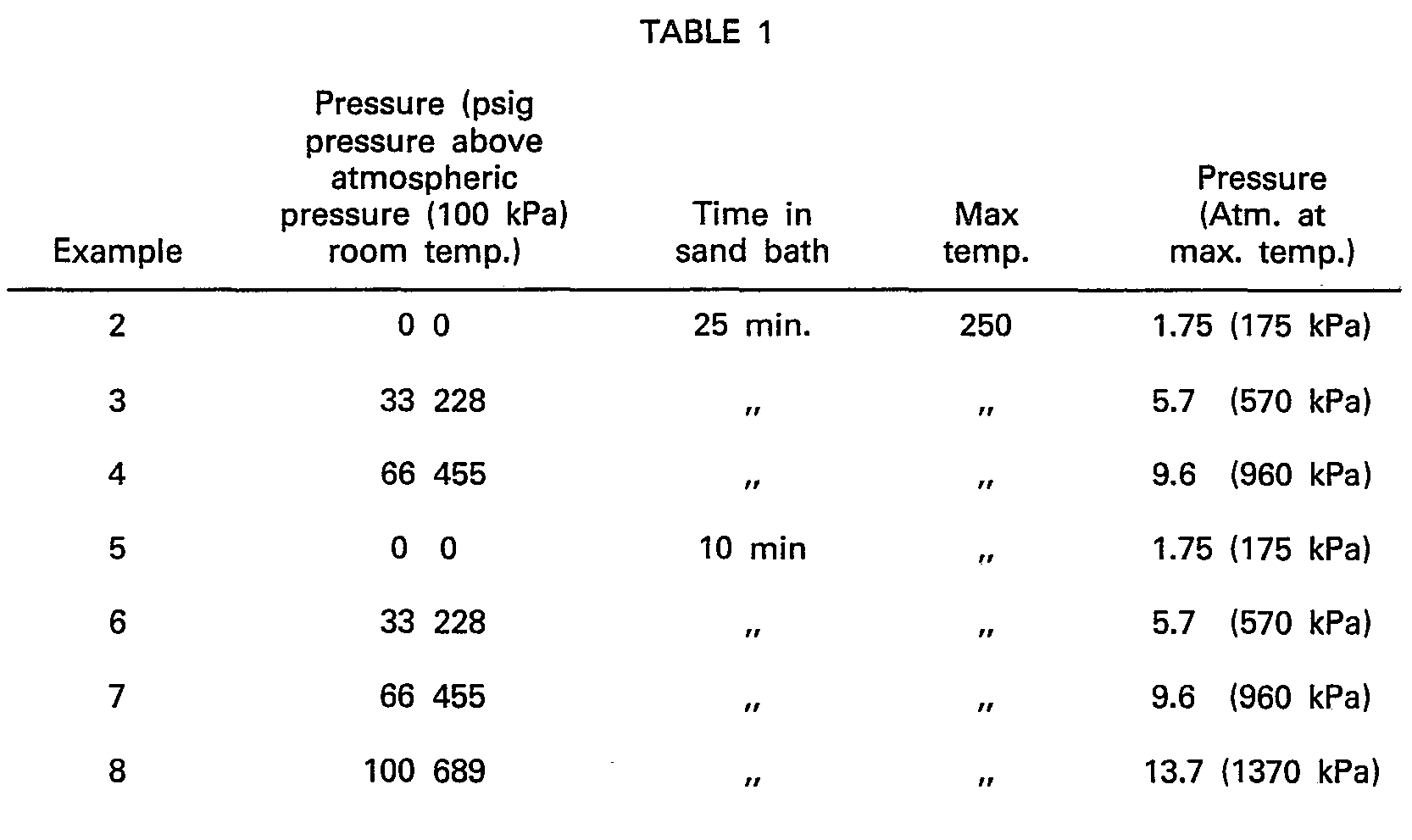
- Skeins of the as-spun pitch fibers prepared in Example 1 were placed in similar sized autoclaves, pressurized, and immersed in the sand bath described in Example 1. The maximum temperature in the autoclave was 250°C and was reached in about 7 minutes. Total time in the sand bath and air pressure (where o psig represents atmosphercc pressure) in the autoclave before immersion were varied and the air pressure at the maximum temperature calculated, all as reported in Table 1. The densities of the resulting fibers increased with increased time and with increased pressure as shown in Table 2. The fibres were carbonized by heating to 900°C in nitrogen to test for sufficient stabilization Fibers which are completely fibrous after carbonization are deemed sufficiently stabilized.

- This example illustrates the use of oxygen in the stabilization process of this invention. The as-spun mesophase pitch fibers prepared in Example 1 were cut into a skein 3.5 inches (88.9 mm) long and placed in an autoclave at atmospheric pressure air. Using an electrically heated jacket and temperature was raised to 250°C over a period of 36 minutes. The autoclave was then pressurized with oxygen to 75 psig (520 kPa) and the temperature and pressure were held constant for 20 minutes. After rapid cooling and release of pressure the fibers were removed. The resulting oxidatively stabilized fibers had a density of 1.407 g/cm3 and were stable to further heat treatment in nitrogen at 900°C, after which the fibers were intact and completely fibrous.
- Mesophase pitch was prepared by a process similar to that disclosed in Greenwood patent, US-A-4,277,324. The mesophase pitch was essentially 100% anisotropic as determined by polarized reflected light microscopy. Five hundred filament yarn was obtained by melt spinning. Four 25.4 cm (ten inch) long skeins of yarn were placed in a stainless steel cylindrical autoclave measuring approximately 29 cm long and 1.1 cm in diameter. The autoclave was pressurized to 200 psig (1388 kPa) with air at room temperature and sealed. The autoclave was immersed in a sand bath. The temperature of the bath was raised over a period of 33 minutes to 225°C. (The pressure was estimated to be 344 psig (2387 kPa) at 225°C). The sample was held at this temperature for 80 minutes, after which the autoclave was removed from the sand bath, cooled rapidly, and the pressure released. The oxidatively stabilized fibers which resulted had a density of 1.433 g/cm3 and were infusible upon further heat treatment. 17.8 cm (Seven inch) portions of the oxidatively stabilized yarn were carbonized at a temperature of 1936°C. These carbonized fibers had a tenacity of 11.479 cN/dtex (13.0 grams per denier) (average of 10 filaments, 2.54 (one inch gage length), a modulus of 1766 cN/dtex (2000 grams per denier), an average (1.34 dtex) (denier per filament of 1.21 cm3 and a density of 2.16 g/cm3.
- An optically isotropic pitch was prepared by heating the 482°C (900°F) plus fraction of a pyrolysis tar at 385°C (725°F) for 6 hours while sparging the pitch with nitrogen at 4 standard cubic feet per hour per pound of starting pitch (0.025 cubic metres per kilogram). The resulting pitch was completely isotropic as determined by reflected light microscopy of its polished surface. The pitch had a carbon to hydrogen ratio of 1.57. This isotropic pitch was melt spun into fibers by extrusion at 321°C through a 228 11m (9 mil) capillary. The fibers were wound onto a bobbin at 525 meters per minute. The resulting fibers had a diameter of 17 11m and a density of 1.245 g/cm3. A 7.6 cm (three inch) skein of the above fibers was removed from the wind-up bobbin and placed in an autoclave tube. The tube was heated to 250°C over a period of 35 minutes as described in Example 9. The internal pressure was then raised to 165 psig (1145 kPa) by the addition of air, and the temperature and pressure were held constant for a period of 20 minutes. The pressure and temperature were rapidly lowered. The resulting oxidatively stabilized fibers had a density of 1.324 g/cm3. The resulting fibers were completely infusible to further heating as determined by heating them to 900°C in a nitrogen atmosphere.
Claims (6)
Applications Claiming Priority (2)
| Application Number | Priority Date | Filing Date | Title |
|---|---|---|---|
| US728519 | 1985-04-29 | ||
| US06/728,519 US4657753A (en) | 1985-04-29 | 1985-04-29 | Stabilization of pitch fiber |
Publications (3)
| Publication Number | Publication Date |
|---|---|
| EP0201213A2 EP0201213A2 (en) | 1986-11-12 |
| EP0201213A3 EP0201213A3 (en) | 1987-04-22 |
| EP0201213B1 true EP0201213B1 (en) | 1990-03-14 |
Family
ID=24927181
Family Applications (1)
| Application Number | Title | Priority Date | Filing Date |
|---|---|---|---|
| EP86302646A Expired EP0201213B1 (en) | 1985-04-29 | 1986-04-10 | Stabilization of pitch fiber |
Country Status (5)
| Country | Link |
|---|---|
| US (1) | US4657753A (en) |
| EP (1) | EP0201213B1 (en) |
| JP (1) | JPS61252316A (en) |
| CA (1) | CA1270611A (en) |
| DE (1) | DE3669550D1 (en) |
Families Citing this family (7)
| Publication number | Priority date | Publication date | Assignee | Title |
|---|---|---|---|---|
| JPH0737689B2 (en) * | 1987-04-23 | 1995-04-26 | 東燃株式会社 | Method for producing carbon fiber and graphite fiber |
| JPH02118121A (en) * | 1988-10-25 | 1990-05-02 | Osaka Gas Co Ltd | Pitch-based active carbon fiber and production thereof |
| EP0678570B1 (en) * | 1991-12-27 | 1998-04-29 | Nippon Oil Company, Ltd. | Electrorheological fluid having carbonaceous particles with shape anisotropy |
| ES2255729T3 (en) * | 1997-04-09 | 2006-07-01 | University Of Tennessee Research Foundation | STABILIZATION OF HIGH TEMPERATURE AND LOW OXIDATION RESIN FIBERS. |
| US6123829A (en) * | 1998-03-31 | 2000-09-26 | Conoco Inc. | High temperature, low oxidation stabilization of pitch fibers |
| CN108940134B (en) * | 2018-06-20 | 2020-07-31 | 东南大学 | Continuous reaction device and method for coal tar pitch ball oxidation infusibility |
| CN115434043B (en) * | 2022-10-20 | 2024-02-06 | 中国科学院山西煤炭化学研究所 | Device and method for pressurizing and not melting asphalt fibers |
Family Cites Families (9)
| Publication number | Priority date | Publication date | Assignee | Title |
|---|---|---|---|---|
| US3718493A (en) * | 1968-06-04 | 1973-02-27 | Great Lakes Carbon Corp | Process for the production of carbon filaments from coal tar pitch |
| US3556729A (en) * | 1969-03-24 | 1971-01-19 | Monsanto Co | Process for oxidizing and carbonizing acrylic fibers |
| US3995014A (en) * | 1973-12-11 | 1976-11-30 | Union Carbide Corporation | Process for producing carbon fibers from mesophase pitch |
| GB1454629A (en) * | 1974-11-26 | 1976-11-03 | Coal Industry Patents Ltd | Carbon fibres |
| US4350672A (en) * | 1976-02-25 | 1982-09-21 | United Technologies Corporation | Binderless carbon or graphite articles |
| US4140832A (en) * | 1976-12-23 | 1979-02-20 | Union Carbide Corporation | Electromotive brushes produced from mesophase pitch fibers |
| US4301135A (en) * | 1979-12-26 | 1981-11-17 | Union Carbide Corporation | Process for spinning pitch fiber into a hot gaseous environment |
| GB2099848B (en) * | 1981-06-09 | 1984-04-18 | British Petroleum Co Plc | Production of pitch from petroleum cracking residue |
| JPS5930915A (en) * | 1982-08-13 | 1984-02-18 | Nippon Oil Co Ltd | Preparation of carbon fiber |
-
1985
- 1985-04-29 US US06/728,519 patent/US4657753A/en not_active Expired - Fee Related
-
1986
- 1986-04-10 DE DE8686302646T patent/DE3669550D1/en not_active Expired - Lifetime
- 1986-04-10 EP EP86302646A patent/EP0201213B1/en not_active Expired
- 1986-04-25 JP JP61095007A patent/JPS61252316A/en active Pending
- 1986-04-29 CA CA000507839A patent/CA1270611A/en not_active Expired
Also Published As
| Publication number | Publication date |
|---|---|
| CA1270611A (en) | 1990-06-26 |
| JPS61252316A (en) | 1986-11-10 |
| DE3669550D1 (en) | 1990-04-19 |
| EP0201213A3 (en) | 1987-04-22 |
| US4657753A (en) | 1987-04-14 |
| EP0201213A2 (en) | 1986-11-12 |
Similar Documents
| Publication | Publication Date | Title |
|---|---|---|
| US3595946A (en) | Process for the production of carbon filaments from coal tar pitch | |
| EP0338212B1 (en) | Ultra-high modulus and high tensile strength carbon fibre | |
| EP0201213B1 (en) | Stabilization of pitch fiber | |
| EP0226819B1 (en) | Process for producing chopped strand of carbon fiber | |
| US4066737A (en) | Method for making isotropic carbon fibers | |
| EP0147005A2 (en) | Oxidation of pitch fibers | |
| US4574077A (en) | Process for producing pitch based graphite fibers | |
| US4975263A (en) | Process for producing mesophase pitch-based carbon fibers | |
| US5037590A (en) | Method for the preparation of carbon fibers | |
| US4948574A (en) | Method of manufacturing of pitch-base carbon fiber | |
| JPH0737689B2 (en) | Method for producing carbon fiber and graphite fiber | |
| CA1055664A (en) | Rapid thermosetting of carbonaceous fibers produced from mesophase pitch | |
| US4990285A (en) | Balanced ultra-high modulus and high tensile strength carbon fibers | |
| US4534950A (en) | Process for producing carbon fibers | |
| US4656022A (en) | Process for producing pitch carbon fibers | |
| US4788050A (en) | Process for producing pitch-based carbon fibers | |
| US4608150A (en) | Pitch material for carbonaceous body and a method for the preparation thereof | |
| US4618463A (en) | Process for producing pitch carbon fibers | |
| JPH01314734A (en) | Production of pitch-based carbon fiber | |
| EP0612870B1 (en) | Process for producing carbon fibers | |
| JPH01314733A (en) | Production of pitch-based carbon fiber | |
| JPH04272234A (en) | Production of pitch-base carbon fiber and graphite fiber | |
| JPH04272233A (en) | Production of pitch-base carbon fiber and graphite fiber | |
| JPH01156513A (en) | Production of pitch based carbon fiber | |
| JPS60181313A (en) | Manufacture of pitch fiber |
Legal Events
| Date | Code | Title | Description |
|---|---|---|---|
| PUAI | Public reference made under article 153(3) epc to a published international application that has entered the european phase |
Free format text: ORIGINAL CODE: 0009012 |
|
| AK | Designated contracting states |
Kind code of ref document: A2 Designated state(s): BE DE FR GB IT NL |
|
| PUAL | Search report despatched |
Free format text: ORIGINAL CODE: 0009013 |
|
| AK | Designated contracting states |
Kind code of ref document: A3 Designated state(s): BE DE FR GB IT NL |
|
| 17P | Request for examination filed |
Effective date: 19870925 |
|
| 17Q | First examination report despatched |
Effective date: 19890215 |
|
| GRAA | (expected) grant |
Free format text: ORIGINAL CODE: 0009210 |
|
| AK | Designated contracting states |
Kind code of ref document: B1 Designated state(s): BE DE FR GB IT NL |
|
| ITF | It: translation for a ep patent filed | ||
| REF | Corresponds to: |
Ref document number: 3669550 Country of ref document: DE Date of ref document: 19900419 |
|
| ET | Fr: translation filed | ||
| PLBE | No opposition filed within time limit |
Free format text: ORIGINAL CODE: 0009261 |
|
| STAA | Information on the status of an ep patent application or granted ep patent |
Free format text: STATUS: NO OPPOSITION FILED WITHIN TIME LIMIT |
|
| 26N | No opposition filed | ||
| ITTA | It: last paid annual fee | ||
| PGFP | Annual fee paid to national office [announced via postgrant information from national office to epo] |
Ref country code: GB Payment date: 19980312 Year of fee payment: 13 |
|
| PGFP | Annual fee paid to national office [announced via postgrant information from national office to epo] |
Ref country code: NL Payment date: 19980324 Year of fee payment: 13 |
|
| PGFP | Annual fee paid to national office [announced via postgrant information from national office to epo] |
Ref country code: FR Payment date: 19980408 Year of fee payment: 13 |
|
| PGFP | Annual fee paid to national office [announced via postgrant information from national office to epo] |
Ref country code: DE Payment date: 19980429 Year of fee payment: 13 |
|
| PGFP | Annual fee paid to national office [announced via postgrant information from national office to epo] |
Ref country code: BE Payment date: 19980512 Year of fee payment: 13 |
|
| PG25 | Lapsed in a contracting state [announced via postgrant information from national office to epo] |
Ref country code: GB Free format text: LAPSE BECAUSE OF NON-PAYMENT OF DUE FEES Effective date: 19990410 |
|
| PG25 | Lapsed in a contracting state [announced via postgrant information from national office to epo] |
Ref country code: BE Free format text: LAPSE BECAUSE OF NON-PAYMENT OF DUE FEES Effective date: 19990430 |
|
| BERE | Be: lapsed |
Owner name: CONOCO INC. Effective date: 19990430 |
|
| PG25 | Lapsed in a contracting state [announced via postgrant information from national office to epo] |
Ref country code: NL Free format text: LAPSE BECAUSE OF NON-PAYMENT OF DUE FEES Effective date: 19991101 |
|
| GBPC | Gb: european patent ceased through non-payment of renewal fee |
Effective date: 19990410 |
|
| PG25 | Lapsed in a contracting state [announced via postgrant information from national office to epo] |
Ref country code: FR Free format text: LAPSE BECAUSE OF NON-PAYMENT OF DUE FEES Effective date: 19991231 |
|
| NLV4 | Nl: lapsed or anulled due to non-payment of the annual fee |
Effective date: 19991101 |
|
| REG | Reference to a national code |
Ref country code: FR Ref legal event code: ST |
|
| PG25 | Lapsed in a contracting state [announced via postgrant information from national office to epo] |
Ref country code: DE Free format text: LAPSE BECAUSE OF NON-PAYMENT OF DUE FEES Effective date: 20000201 |
|
| PG25 | Lapsed in a contracting state [announced via postgrant information from national office to epo] |
Ref country code: IT Free format text: LAPSE BECAUSE OF NON-PAYMENT OF DUE FEES;WARNING: LAPSES OF ITALIAN PATENTS WITH EFFECTIVE DATE BEFORE 2007 MAY HAVE OCCURRED AT ANY TIME BEFORE 2007. THE CORRECT EFFECTIVE DATE MAY BE DIFFERENT FROM THE ONE RECORDED. Effective date: 20050410 |