EP0201217A1 - Bouclier thermique pour tube réfractaire dans un distributeur de verre fondu - Google Patents
Bouclier thermique pour tube réfractaire dans un distributeur de verre fondu Download PDFInfo
- Publication number
- EP0201217A1 EP0201217A1 EP86302700A EP86302700A EP0201217A1 EP 0201217 A1 EP0201217 A1 EP 0201217A1 EP 86302700 A EP86302700 A EP 86302700A EP 86302700 A EP86302700 A EP 86302700A EP 0201217 A1 EP0201217 A1 EP 0201217A1
- Authority
- EP
- European Patent Office
- Prior art keywords
- refractory
- tube
- feeder
- refractory tube
- plungers
- Prior art date
- Legal status (The legal status is an assumption and is not a legal conclusion. Google has not performed a legal analysis and makes no representation as to the accuracy of the status listed.)
- Granted
Links
- 239000006060 molten glass Substances 0.000 title claims abstract description 31
- 239000002184 metal Substances 0.000 claims abstract description 6
- 239000011521 glass Substances 0.000 claims description 11
- 239000011819 refractory material Substances 0.000 claims description 9
- 230000013011 mating Effects 0.000 claims description 4
- 230000002093 peripheral effect Effects 0.000 claims description 2
- 230000007246 mechanism Effects 0.000 description 17
- 239000011810 insulating material Substances 0.000 description 5
- 238000004519 manufacturing process Methods 0.000 description 3
- 230000008439 repair process Effects 0.000 description 3
- 241000538562 Banjos Species 0.000 description 2
- 230000006872 improvement Effects 0.000 description 2
- 238000009413 insulation Methods 0.000 description 2
- 230000015572 biosynthetic process Effects 0.000 description 1
- 238000010276 construction Methods 0.000 description 1
- 238000005336 cracking Methods 0.000 description 1
- 238000009434 installation Methods 0.000 description 1
- 239000012212 insulator Substances 0.000 description 1
- 230000002452 interceptive effect Effects 0.000 description 1
- 238000012423 maintenance Methods 0.000 description 1
- 239000000463 material Substances 0.000 description 1
- 230000001681 protective effect Effects 0.000 description 1
- 230000005855 radiation Effects 0.000 description 1
- 230000009467 reduction Effects 0.000 description 1
- 230000004044 response Effects 0.000 description 1
- 238000004260 weight control Methods 0.000 description 1
Images



Classifications
-
- C—CHEMISTRY; METALLURGY
- C03—GLASS; MINERAL OR SLAG WOOL
- C03B—MANUFACTURE, SHAPING, OR SUPPLEMENTARY PROCESSES
- C03B7/00—Distributors for the molten glass; Means for taking-off charges of molten glass; Producing the gob, e.g. controlling the gob shape, weight or delivery tact
- C03B7/08—Feeder spouts, e.g. gob feeders
- C03B7/084—Tube mechanisms
Definitions
- This invention relates generally to maintaining a desired temperature of the molten glass in a feeder of the type having reciprocating plungers operating inside a refractory tube that is adapted to rotate inside a feeder bowl. More particularly, this invention relates to a heat shield for the upper end of such a refractory tube to reduce heat losses and thereby facilitate closer control of the molten glass temperature, and hence viscosity, in the feeder bowl, and thereby enhance the consistence of the glass gobs produced at the outlet of the feeder bowl.
- molten glass is supplied to the glassware forming machines through a heated forehearth channel, and a feeder is provided at the downstream end of the forehearth channel in order to form gobs of glass for delivery to the various sections of a typical glassware forming machine.
- the feeder has a plurality of side-by-side vertically reciprocating refractory plungers and the lower end of each plunger is generally associated with an orifice defined in the lower portion of the feeder bowl into which the molten glass is received from the forehearth.
- An annular refractory tube surrounds the plungers and extends downwardly into the molten glass so that the bottom of the tube can cooperate with an annular seating surface inside the feeder bowl to interrupt the flow of glass when the feeder is to be shut down.
- this tube is raised to some predetermined height and rotates in the feeder bowl providing a passageway between its lower end and the feeder bowl through which the molten glass flows toward the orifices.
- the refractory tube is supported for rotation on its central axis in a frame which can be raised or lowered, and the frame is generally provided with means for rotating the refractory tube, which means includes an annular bevelled gear provided coaxially with the refractory tube.
- U.S. Patent Specification No. 4 554 000 such a mechanism is described in some detail.
- U.S. Patent Specification No. 4 551 163 describes in some detail the mechanism for operating the vertically reciprocating refractory plungers.
- the present invention relates to an improved heat shield fitted to the upper end of the refractory tube, surrounding the vertically reciprocating plungers, and designed to reduce heat loss from the molten glass in the feeder bowl without interfering with vertical movement of the plungers, and rotating movement of the refractory tube.
- U.S. Patent No. 4 328 023 shows a molten glass feeder having a refractory heat shield inside a refractory tube to reduce the exposed area above the molten glass in the feeder bowl and reduce heat loss.
- this prior art patent suggests a one-piece cast refractory shield which cannot be removed without first withdrawing the refractory plungers.
- U.S. Patent No. 4 478 631 shows a molten glass feeder having heat baffles of refractory material provided inside a refractory tube to reduce the exposed area above the molten glass in the feeder bowl and avoid excessive heat loss.
- two unconnected heat baffles of cumbersome size are provided alongside the plungers in this prior art patent and because they are fabricated solely from refractory material these baffles must be designed to fit rather loosely inside the rotating refractory tube itself.
- the present invention represents an improvement over these prior art patents, and also provides advantages when utilised in a feeder of the type referred to in the above-identified pending patent applications.
- both prior art configurations require different installations for different size refractory tubes. This requirement is obviated in the subject disclosure.
- This invention resides in a molten glass feeder comprising a refractory feeder bowl or spout with several side-by-side orifices defined in the outlet portion of the bowl so that the lower ends of several vertically reciprocating plungers are adapted to cooperate with these orifices to produce molten glass gobs for delivery to a glassware machine.
- a refractory tube is provided in the feeder bowl and surrounds the lower refractory portions of the plungers.
- This tube is supported for rotation in a frame that has an opening to receive the tube and the tube, in turn, permits the plungers to be provided inside it so that upper portions of the plunger are secured in a plunger support structure that provides for vertical movement of the plungers in timed relationship to operation of the other components of the glassware forming machine and of other elements of the feeder to produce the glass gobs in an accurately controlled manner.
- a generally tubular metal sheath means is provided above the refractory tube, and this sheath means has a through opening of at least the same circular area as that of the inside of the refractory tube.
- This sheath is preferably fabricated from two mating half sections or shells such that these half sections are readily removable from their position in the frame above the refractory tube without necessity for removal of the plungers.
- a plurality of insulatory semi-circular segments are stacked in sets inside the sheath means to a depth of at least, approximately one-half the inside diameter of the refractory tube.
- Each insulatory semi-circular segment has a diametrically extending edge abutting another diametrically extending edge of a corresponding semi-circular segment in a particular set, that is, each segment in the set is a mirror image of the other and they abut each other along a diametrically extending edge.
- Each such diametrically extending edge is relieved to accommodate the side-by-side reciprocating plungers normally provided in the feeder itself.
- These semi-circular insulatory segments are fabricated from an insulating material and preferably the lowermost set is fabricated from a refractory material not unlike that provided in the components which are in direct contact with the molten glass in the feeder.
- the metal sheath is also preferably, made in sections and the upper portions of each section define an enlarged collar, which collar is received in an opening defined for it in housing associated with the frame that supports the refractory tube.
- the heat shield of the present invention is conveniently supported from the frame and its housing, which are provided for support of the refractory tube itself. Furthermore, the heat shield does not interfere with rotation of the refractory tube during normal operation of the feeder.
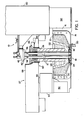
- Figure 1 shows in elevation, and partly in vertical section, a plunger operating mechanism indicated generally at 10 constructed in accordance with the disclosure of U.S. Patent Specification No. 4 551 163.
- glass feeder plungers 12, 12 reciprocate vertically relative to orifices defined in an orifice ring 18 so as to form gobs of molten glass for delivery to a glassware machine (not shown).
- Molten glass moves toward the viewer in Figure 1 from a forehearth furnace 14 into a feeder bowl 22, which bowl is provided with molten glass to the level indicated generally at 24 from the furnace forehearth.
- the forward end 16 of the furnace forehearth supports the feeder bowl 22 and other components of the feeder mechanism to be described.
- the plunger operating mechanism 10 is mounted by means of bracket 312 to the front end of the furnace forehearth 16, and the feeder bowl casing 21 is of conventional configuration being provided with a peripherally extending gib 20 to which may be mounted the shear mechanism (not shown) in accordance with conventional practice.
- bracket 52 supports a refractory tube operating mechanism 27 described in detail in U.S. Patent Specification No. 4 554 000.
- the refractory tube is indicated generally at 26 in Figure 1 and is fabricated from a refractory material as is the feeder bowl 22 and lower end portions of the plungers 12, 12.
- the refractory tube 26 normally rotates in the position shown, that is such that the lower end thereof is spaced slightly above an annular seating surface provided for this purpose inside the feeder bowl 22.
- refractory tube 26 allows molten glass to flow toward the orifices in the orifice plate 18.
- the tube 26 is also adapted to be lowered so as to seal the molten glass from the area of the orifices as described in U.S. Patent Specification No. 4 554 000.
- the actual spacing provided between the lower end of the tube 26 and the inside of the feeder bowl will determine the flow rate of the molten glass to these orifices.
- the orifice plate also comprises a refractory element which is held in a super-insulating material and surrounded by a shell-like protective housing in accordance with conventional practice. Furthermore, the orifice plate is conventionally mounted in a pivoted holder or frame so that orifice plate support structure 32 can be pivoted downwardly from the position shown, about the axis of pivot pin 34 to a depending position for removal or replacement of the orifice plate. Latching mechanism 30 is provided for securing the orifice plate support structure 32 in the position shown.
- the plungers 12, 12 are secured in plunger chucks 36, 36 and the plunger chucks are in turn mounted in a plunger carrier disk 40.
- this carrier disk 40 is attached to a plunger holder or banjo frame 42, the banjo frame being in turn secured to a bracket 44 that is connected to mechanism inside housing 50 for raising and lowering the plungers in timed relationship with movement of other components of the feeder and of the glassware machine itself.
- the plungers have lower end portions that cooperate with the orifices in the orifice plate 18 to cause molten glass gobs to issue from these orifices so that the gobs can be fed to the various individual sections of a conventional glassware forming machine.
- the refractory tube 26 rotates in the position shown for it in Figure 1 so as to maintain the molten glass in a homogeneous state as the glass travels from the forehearth channel (not shown) toward the orifices in the orifice plate 18.
- the temperature of the molten glass is directly related to its viscosity and hence it is important in the formation of the glass gobs to maintain an optimum temperature in the feeder bowl, and particularly in the area of the feeder bowl where the vertically reciprocating plungers are operating to form the glass gobs.
- the present invention relates to a heat shield for the upper end of the refractory tube the purpose of which is to reduce heat losses from the molten glass inside the refractory tube as a result of radiation and convection upwardly through the normally open area provided between the upper end of the refractory tube and the vertically reciprocating plungers.
- the improved heat shield of the present invention is provided above the upper end of the refractory tube, rather than inside this refractory tube as is the case with prior art configurations, but which heat shield is nevertheless supported from the frame and housing structure containing the means for rotating the refractory tube.
- the refractory tube mechanism is provided on bracket 52 at the front end of the forehearth and more particularly on a vertically extending pivot post 56 which is mounted in a support structure 54 such that the refractory tube support mechanism in housing 58 can be raised and lowered as referred to previously.
- the means for rotating the refractory tube is provided within the housing 58 and more particularly is supported on a horizontally extending frame 60 described in some detail in said specification.
- FIG 2 shows a portion of this frame 60 for supporting an annular bearing 104 in which the refractory tube chucking means is rotatably provided.
- This chucking means is indicated generally at 72 and comprises cooperating annular shaped members adapted to be clamped axially on to the flange provided for this purpose on the outside of the refractory tube 26.
- An annular bevel gear 90 is provided on the annular bearing for so rotating the refractory tube in response to rotation of a drive gear (not shown) but described in some detail in said specification.
- Figure 2 illustrates in pertinent part the portion of the housing means associated with the frame 60 for the refractory tube support mechanism.
- This housing 58 defines an opening through which the refractory tube can be conveniently removed for replacement or repair.
- FIG. 1 One of three eye-bolts is illustrated at 80 in Figure 2 for serving this purpose. These bolts 80, 80 also serve to clamp the annular chucking means 72 axially as referred to previously. Still with reference to Figure 2 the location for the vertically reciprocating refractory plungers 12, 12 is also shown in this view as it the heat shield to be described.
- the heat shield comprises a generally tubular metal sheath means 200 provided above the refractory tube and including an upper collar portion 202 which serves to support the sheath 200 from the housing means 58 associated with the refractory tube support mechanism.
- the collar portion 202 includes an inwardly extending peripheral portion spaced above said collar portion so supported on said frame housing means 58 and serving as a convenient portion for manual removal of said shells (200a, 200b).
- the tubular sheath means 200 also includes a depending portion 204 of generally cylindrical external configuration and adapted to fit inside the refractory tube chucking mechanism 72.
- This portion 204 of the sheath means 200 defines a generally cylindrical inner diameter which defines a cross sectional area at least as great as the inside circular area of the refractory tube itself.
- this inside diameter of the portion 204 of the sheath means is somewhat greater in cross sectional area than that of the inside of the refractory tube.
- the dimension D in Figure 2 illustrates the inside diameter of the refractory tube
- the dimension A illustrates the inside diameter of the portion 204 of sheath means 200.
- this depending portion 204 of the sheath means 200 is preferably such that it is at least, approximately equal to one-half the dimension A, and this geometry is deemed important to provide adequate insulating material in this sheath means portion 204 to assure that the desired reductions in heat loss in this area of the feeder can be achieved.
- Figure 3' which view is also a vertical section but taken on a line oriented at substantially right angles to that of Figure 2, the,tubular sheath means 200 and more particularly the depending portion 204 thereof is there provided with at least two and preferably four layers of insulating material 210, 210.
- the lowermost layer 212 of insulating material is preferably a refractory material similar to that used in the fabrication of the refractory tube 26 and plungers 12. It is important to note that the total vertical height B for these insulating layers is at least approximately equal to one-half the inside diameter of the refractory tube.
- the layers 210 are preferably fabricated from a non-refractory material such as the super-insulation used in areas of a feeder or forehearth furnace not in direct contact with the molten glass.
- Layer 212 is preferably fabricated from a refractory material.
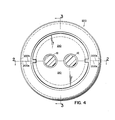
- FIG. 4 illustrates in plan view the makeup of the tubular heat shield 200 as two mating half section or shells 200a and 200b which shells or sections cooperate to define the tubular shell means 200.
- Each such half-shell section is a mirror image of the other.
- Figure 5 shows one such shell section 200a and from this view it will be apparent that the collar defining portion 202 extends radially outwardly beyond the depending portion 204, and that the latter includes radially inwardly extending walls 206 which cooperate with one another to define locating or indexing devices for receiving notches defined for this purpose in the semi-circular insulating segments 210, 210.
- a readily removable heat shield is provided for the upper end of the refractory tube in a glassware feeder of the type having several plungers aligned in side-by-side relationship all in accordance with the feeder geometry disclosed in the above-identified U.S. specifications.
- Present day heat shields are generally fabricated from refractory material which is by nature a rather poor insulator, and susceptible to cracking.
- the use of separate sections or segments provided in sets in the heat shield geometry described herein provides a very convenient construction that is well adapted for removal for replacement or repair of the various feeder components.
- the heat shield disclosed herein need not be bolted or otherwise secured to the top of the refractory tube mechanism as shown for the prior art heat shields referred to previously.
- the improved geometry facilitates the repair and maintenance of the refractory tube mechanism.
- the insulation elements themselves. are not attached to the metal sheath or shell structure, which sheath can fit closely into an opening provided for this purpose in the housing for the refractory tube support frame.
- the heat shield is designed to improve control of the temperature in the molten glass and hence viscosity of the glass leading to more accurate gob weight control. This improvement in uniformity of gob production leads to advantages in the production of the glassware from these gobs and of course the presence of a heat shield located as described herein also leads to lower energy costs in the glassware plant itself.
Landscapes
- Chemical & Material Sciences (AREA)
- Engineering & Computer Science (AREA)
- Materials Engineering (AREA)
- Organic Chemistry (AREA)
- Vertical, Hearth, Or Arc Furnaces (AREA)
- Furnace Housings, Linings, Walls, And Ceilings (AREA)
- Tunnel Furnaces (AREA)
Applications Claiming Priority (2)
| Application Number | Priority Date | Filing Date | Title |
|---|---|---|---|
| US06/722,278 US4581055A (en) | 1985-04-11 | 1985-04-11 | Heat shield for refractory tube in molten glass feeder |
| US722278 | 1985-04-11 |
Publications (2)
| Publication Number | Publication Date |
|---|---|
| EP0201217A1 true EP0201217A1 (fr) | 1986-11-12 |
| EP0201217B1 EP0201217B1 (fr) | 1989-07-05 |
Family
ID=24901171
Family Applications (1)
| Application Number | Title | Priority Date | Filing Date |
|---|---|---|---|
| EP86302700A Expired EP0201217B1 (fr) | 1985-04-11 | 1986-04-11 | Bouclier thermique pour tube réfractaire dans un distributeur de verre fondu |
Country Status (3)
| Country | Link |
|---|---|
| US (1) | US4581055A (fr) |
| EP (1) | EP0201217B1 (fr) |
| DE (1) | DE3664206D1 (fr) |
Cited By (1)
| Publication number | Priority date | Publication date | Assignee | Title |
|---|---|---|---|---|
| FR2727960A1 (fr) * | 1994-12-08 | 1996-06-14 | Emhart Glass Mach Invest | Ensemble doseur de bol de coulee |
Families Citing this family (4)
| Publication number | Priority date | Publication date | Assignee | Title |
|---|---|---|---|---|
| US4717412A (en) * | 1986-12-08 | 1988-01-05 | Emhart Industries, Inc. | Stationary tube holder and revolving rotor assemby for a glass spout bowl |
| US4793849A (en) * | 1988-02-03 | 1988-12-27 | Emhart Industries, Inc. | Heat shield for refractory tube in molten glass feeder |
| US5660610A (en) * | 1994-10-24 | 1997-08-26 | Owens-Brockway Glass Container Inc. | Remotely adjustable glass feeder needle assembly |
| US5593472A (en) * | 1995-11-02 | 1997-01-14 | Emhart Glass Machinery Investments Inc. | Glass feeder heat baffle |
Citations (2)
| Publication number | Priority date | Publication date | Assignee | Title |
|---|---|---|---|---|
| US4328023A (en) * | 1979-10-12 | 1982-05-04 | B.H.F. (Engineering) Limited | Heat retaining shield in glass gob former |
| US4478631A (en) * | 1983-04-06 | 1984-10-23 | Owens-Illinois, Inc. | Glass feeder heat baffle |
Family Cites Families (3)
| Publication number | Priority date | Publication date | Assignee | Title |
|---|---|---|---|---|
| US1792932A (en) * | 1927-10-17 | 1931-02-17 | Owens Illinois Glass Co | Glass-feeding apparatus |
| US2039242A (en) * | 1932-09-17 | 1936-04-28 | Hartford Empire Co | Glass feeding method and apparatus |
| US3582309A (en) * | 1970-03-16 | 1971-06-01 | Maul Bros Inc | Triple gob feeder having adjustable plungers |
-
1985
- 1985-04-11 US US06/722,278 patent/US4581055A/en not_active Expired - Lifetime
-
1986
- 1986-04-11 EP EP86302700A patent/EP0201217B1/fr not_active Expired
- 1986-04-11 DE DE8686302700T patent/DE3664206D1/de not_active Expired
Patent Citations (2)
| Publication number | Priority date | Publication date | Assignee | Title |
|---|---|---|---|---|
| US4328023A (en) * | 1979-10-12 | 1982-05-04 | B.H.F. (Engineering) Limited | Heat retaining shield in glass gob former |
| US4478631A (en) * | 1983-04-06 | 1984-10-23 | Owens-Illinois, Inc. | Glass feeder heat baffle |
Cited By (1)
| Publication number | Priority date | Publication date | Assignee | Title |
|---|---|---|---|---|
| FR2727960A1 (fr) * | 1994-12-08 | 1996-06-14 | Emhart Glass Mach Invest | Ensemble doseur de bol de coulee |
Also Published As
| Publication number | Publication date |
|---|---|
| EP0201217B1 (fr) | 1989-07-05 |
| US4581055A (en) | 1986-04-08 |
| DE3664206D1 (en) | 1989-08-10 |
Similar Documents
| Publication | Publication Date | Title |
|---|---|---|
| US4049384A (en) | Cold crucible system | |
| CA1211939A (fr) | Ecran thermique entre decharges de paraisons de verre | |
| EP0201217B1 (fr) | Bouclier thermique pour tube réfractaire dans un distributeur de verre fondu | |
| US8726694B2 (en) | Method and apparatus for manufacturing glass tubes having a predetermined inner profile, preferably for continuously manufacturing such glass tubes | |
| CA2214949C (fr) | Methode et appareil pour deverser un flux de verre double | |
| US4305747A (en) | Multiple gob glass feeder system and method of operation | |
| US3721544A (en) | Molten glass gob distribution system | |
| EP0499471B1 (fr) | Appareillage pour le tirage de monocristaux | |
| USRE28759E (en) | Molten glass gob distribution system | |
| US4227909A (en) | Electric forehearth and method of melting therein | |
| US3663192A (en) | Glass melting pot | |
| US3516812A (en) | Triple gob glass feeder | |
| US3723084A (en) | Method and apparatus for blending molten glass | |
| US3580713A (en) | Apparatus for feeding glass | |
| JPH0559849B2 (fr) | ||
| US4793849A (en) | Heat shield for refractory tube in molten glass feeder | |
| JP2665889B2 (ja) | 陰極線管のネックにガラスステム・ウエハを含む電子銃マウントを封入する方法および装置 | |
| US2226498A (en) | Glass melting and delivering apparatus and method | |
| JP2922482B2 (ja) | 色着せガラス流を供給する方法および装置 | |
| US3754883A (en) | Glass tube forming apparatus and method | |
| US3240583A (en) | Method and apparatus for forming multiple-bore tubing | |
| EP0078715A1 (fr) | Fours de fusion de verre | |
| US1735837A (en) | Apparatus for feeding molten glass | |
| US5928401A (en) | Process of making fibers with a rotary ring furnace above a circular forehearth | |
| LT3691B (en) | Molten glass feeder tube-stirrer assembly, feeder cup and feed assembly |
Legal Events
| Date | Code | Title | Description |
|---|---|---|---|
| PUAI | Public reference made under article 153(3) epc to a published international application that has entered the european phase |
Free format text: ORIGINAL CODE: 0009012 |
|
| AK | Designated contracting states |
Kind code of ref document: A1 Designated state(s): DE FR GB IT |
|
| 17P | Request for examination filed |
Effective date: 19870508 |
|
| 17Q | First examination report despatched |
Effective date: 19880204 |
|
| GRAA | (expected) grant |
Free format text: ORIGINAL CODE: 0009210 |
|
| AK | Designated contracting states |
Kind code of ref document: B1 Designated state(s): DE FR GB IT |
|
| REF | Corresponds to: |
Ref document number: 3664206 Country of ref document: DE Date of ref document: 19890810 |
|
| ET | Fr: translation filed | ||
| ITF | It: translation for a ep patent filed | ||
| PLBE | No opposition filed within time limit |
Free format text: ORIGINAL CODE: 0009261 |
|
| STAA | Information on the status of an ep patent application or granted ep patent |
Free format text: STATUS: NO OPPOSITION FILED WITHIN TIME LIMIT |
|
| 26N | No opposition filed | ||
| REG | Reference to a national code |
Ref country code: GB Ref legal event code: 732 |
|
| REG | Reference to a national code |
Ref country code: FR Ref legal event code: TP |
|
| ITTA | It: last paid annual fee | ||
| ITPR | It: changes in ownership of a european patent |
Owner name: CESSIONE;EMHART GLASS MACHINERY INC. |
|
| REG | Reference to a national code |
Ref country code: FR Ref legal event code: TP |
|
| REG | Reference to a national code |
Ref country code: GB Ref legal event code: IF02 |
|
| PGFP | Annual fee paid to national office [announced via postgrant information from national office to epo] |
Ref country code: GB Payment date: 20030402 Year of fee payment: 18 |
|
| PGFP | Annual fee paid to national office [announced via postgrant information from national office to epo] |
Ref country code: FR Payment date: 20030418 Year of fee payment: 18 |
|
| PGFP | Annual fee paid to national office [announced via postgrant information from national office to epo] |
Ref country code: DE Payment date: 20030430 Year of fee payment: 18 |
|
| PG25 | Lapsed in a contracting state [announced via postgrant information from national office to epo] |
Ref country code: GB Free format text: LAPSE BECAUSE OF NON-PAYMENT OF DUE FEES Effective date: 20040411 |
|
| PG25 | Lapsed in a contracting state [announced via postgrant information from national office to epo] |
Ref country code: DE Free format text: LAPSE BECAUSE OF NON-PAYMENT OF DUE FEES Effective date: 20041103 |
|
| GBPC | Gb: european patent ceased through non-payment of renewal fee |
Effective date: 20040411 |
|
| PG25 | Lapsed in a contracting state [announced via postgrant information from national office to epo] |
Ref country code: FR Free format text: LAPSE BECAUSE OF NON-PAYMENT OF DUE FEES Effective date: 20041231 |
|
| REG | Reference to a national code |
Ref country code: FR Ref legal event code: ST |
|
| PG25 | Lapsed in a contracting state [announced via postgrant information from national office to epo] |
Ref country code: IT Free format text: LAPSE BECAUSE OF NON-PAYMENT OF DUE FEES;WARNING: LAPSES OF ITALIAN PATENTS WITH EFFECTIVE DATE BEFORE 2007 MAY HAVE OCCURRED AT ANY TIME BEFORE 2007. THE CORRECT EFFECTIVE DATE MAY BE DIFFERENT FROM THE ONE RECORDED. Effective date: 20050411 |