EP0201438B1 - Verfahren zur genauen Regulierung einer geringen Tonerdegehalts in einer schmelzflüssigen Elektrolysezelle zur Aluminiumherstellung - Google Patents
Verfahren zur genauen Regulierung einer geringen Tonerdegehalts in einer schmelzflüssigen Elektrolysezelle zur Aluminiumherstellung Download PDFInfo
- Publication number
- EP0201438B1 EP0201438B1 EP86420118A EP86420118A EP0201438B1 EP 0201438 B1 EP0201438 B1 EP 0201438B1 EP 86420118 A EP86420118 A EP 86420118A EP 86420118 A EP86420118 A EP 86420118A EP 0201438 B1 EP0201438 B1 EP 0201438B1
- Authority
- EP
- European Patent Office
- Prior art keywords
- alumina
- rate
- electrolysis
- cell
- bath
- Prior art date
- Legal status (The legal status is an assumption and is not a legal conclusion. Google has not performed a legal analysis and makes no representation as to the accuracy of the status listed.)
- Expired
Links
Classifications
-
- C—CHEMISTRY; METALLURGY
- C25—ELECTROLYTIC OR ELECTROPHORETIC PROCESSES; APPARATUS THEREFOR
- C25C—PROCESSES FOR THE ELECTROLYTIC PRODUCTION, RECOVERY OR REFINING OF METALS; APPARATUS THEREFOR
- C25C3/00—Electrolytic production, recovery or refining of metals by electrolysis of melts
- C25C3/06—Electrolytic production, recovery or refining of metals by electrolysis of melts of aluminium
- C25C3/20—Automatic control or regulation of cells
Definitions
- the present invention relates to a process for the precise regulation of a low alumina content in an igneous electrolysis tank for the production of aluminum according to the Hall-Héroult process, this regulation also having the aim of maintaining the Faraday yield at a level high, at least equal to 94%.
- This parameter is generally the variation of the internal resistance, or, more exactly, of the internal pseudo-resistance which is equal to:
- Eo being an image of the counter-electromotive force of the tank, the value of which is generally assumed to be 1.65 volts, U the voltage across the terminals of the tank and J the intensity passing through it.
- the alumina concentration is fixed in the range of 2 to 8%.
- the disadvantage of this process is that its sensitivity varies with the alumina content, which is precisely minimal in the interval used, from 3 to 5% of A1 2 0 3 (table p. 8).
- the alumina content is also fixed in the range of 2 to 8% and, preferably, 4 to 6%.
- the tank is fed for a predetermined time t with an amount of alumina higher than its theoretical consumption, until a predetermined alumina concentration is obtained (for example up to 7%), then the supply is switched to a rate equal to the theoretical consumption for a predetermined time t 2 , then the feeding is stopped until the appearance of the first symptoms of anode effect ("packaging"), and the feeding cycle is resumed at a rate which is greater than the theoretical consumption.
- the alumina concentration varies, during the cycle, from 4.9 to 8% (example 1) or from 4.0 to 7% (example 2).
- slope calculation is based on successive measurements of the internal resistance R;, at equal time intervals, on the evaluation of the slope dRi / dt of variation of R i as a function of time, and the comparison of R i on the one hand and of dRi / dt on the other hand, to set values, and on the modification of the rate of introduction of alumina, so as to reduce dRi / dt and R i at setpoint values.
- the search for the optimal operating mode that is to say the search for the operating parameters of the electrolytic cells giving the best cost price, or the biggest profit margin for a given investment, has always been a permanent concern. for those skilled in the art.
- the object of the invention is an improvement of the process for the precise regulation of a low alumina content in the electrolysis tank, making it possible to significantly improve the Faraday yield.
- Energy consumption per tonne of aluminum produced can depend on the yield Faraday, F, and the voltage across a tank, U, in the form:
- this optimal alumina content is very close to the minimum content below which appears the "anode effect", also called “packaging” or “polarization” , which results in a very sharp rise in the voltage across the cell and in the temperature of the electrolysis bath, and in the release in significant quantities of fluorinated products from the decomposition of the electrolysis bath.
- the object of the invention is therefore to provide such a process for regulating the alumina content of the bath in the low content range, by the use of a synthetic parameter P which can be calculated simply from conventional measurements made on a tank.
- electrolysis namely: the voltage at the terminals of each cell, the intensity traversing the file of cells and the rate of supply of alumina (in kg / hour for example).
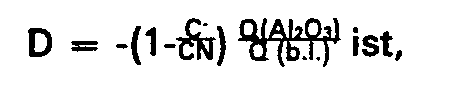
- CN being the nominal rate of supply of alumina and C- the rate of undernourishment, counted in kg of alumina per unit of time, Q (AI 2 0 3 ) being the quantity of alumina consumed by the tank in the same time unit and
- the parameter P is evaluated from the internal pseudo-resistance of the tank, R;, itself defined by:
- Eo is a standard value, in volts, of the dynamic counter-electromotive force of the tank, generally between 1.5 and 2.0 volts, and most often of the order of 1.65 to 1.75 volts
- R i is then expressed in microohms;
- D is the alumina content drift of the electrolysis bath, expressed in weight percent per hour
- P is expressed by the formula: (P being expressed in microohms per second and per% weight per hour).
- This initial period which generally lasts only a few minutes, corresponds to the end of dissolution of the excess alumina introduced during the overeating period and not immediately assimilated by the bath.
- Another method is to add a period of a few minutes at nominal rate after overeating before going on to undereating.
- the alumina content of the bath decreases all the faster the slower the feed rate, and, in parallel, the measured slope dR; / dt increases.
- the alumina content drift, D, counted in% weight per hour, is then proportional to:
- C- is the rate of undernourishment counted in kg of A1 2 0 3 introduced per second and C N is the nominal rate of feed (counted in the same units).
- Any other coherent system of units can of course be used, for example the inverse of the time separating the introduction of 2 consecutive doses of alumina.
- Q (Al 2 O 3 ) is the weight of alumina consumed per unit of time, by electrolysis.
- Q (bl) is the weight of liquid bath, capable of dissolving alumina, contained in the crucible of the tank (for information, if the weight of liquid bath is measured in kg, of the order of 30 J where J is the electrolysis intensity counted in kA): note that the time constant for the melting or solidification of the bath at the slope is very large (generally of the order of several hours), this quantity only varies very slowly over time.
- the targeted alumina content being close to the limit content triggering the appearance of a polarization of the tank, it is essential that after operation at nominal rate, the readjustment is done by preceding the search phase of the operating point (characterized by Po), during an under-timing, by a period of over-timing which allows s '' move away from this limit content before starting the search.
- Po search phase of the operating point
- the regulation method according to the invention can be used only during part of the operating time of the tank, and preferably when the tank is stable.
- this parameter Po will be maintained between the limit values of 2/100 J and 10/100 J.
- K I and K 2 The estimation of K I and K 2 can be done as follows:
- the economic coefficient K I summarizes the economic conditions of the moment. It is substantially equal to the ratio of the sum of the fixed transformation costs (excluding alumina), including in particular the cost of energy and consumable carbon products, labor and depreciation, including financial costs, at cost Energy.
- K I is approximately equal to: (an estimate of K 1 at ⁇ 20% is more than enough to get close enough to the economic optimum).
- the "technical” coefficient K 2 summarizes the technological and physicochemical characteristics of the tank and can be evaluated as follows:
- F is the Faraday yield of the tank, generally between 0.88 and 0.96 for these same properly conducted tanks
- dF / d (AI 2 0 3 ) is the algebraic drift of the Faraday yield relative to the alumina content of the bath , counted as a% of Faraday per% of alumina, in the region of alumina contents between 1% and 4%, and preferably in the region of A1 2 0 3 contents between 1.5% and 3%.
- this factor dF / d (Al 2 O 3 ) must be determined experimentally for each type of tank and for the various types of bath used (low acid baths, with less than 8% excess of AIF 3 , or very acid baths, with more than 8% excess of AIF 3 or with sub-additives such as LiF and MgF 2 ). Once determined, it no longer depends, as a first approximation, on economic conditions.
- the invention was applied to a series of electrolysis cells operating at an intensity of 280 KA, at a voltage of 4.10 volts per cell and giving a Faraday yield of 95.0% for an average alumina content in the bath. electrolysis equal to 2.3%, previously regulated according to the method of our patent FR-2 487 386 already cited (process called "slope calculation").
- the daily production of the series per tank was 2.145 kg / day, for an energy consumption of 12.860 kWh / ton.
- the gain on the cost price was 20 F per tonne of aluminum produced.
Landscapes
- Chemical & Material Sciences (AREA)
- Engineering & Computer Science (AREA)
- Chemical Kinetics & Catalysis (AREA)
- Electrochemistry (AREA)
- Materials Engineering (AREA)
- Metallurgy (AREA)
- Organic Chemistry (AREA)
- Electrolytic Production Of Metals (AREA)
- Compounds Of Alkaline-Earth Elements, Aluminum Or Rare-Earth Metals (AREA)
- Electrolytic Production Of Non-Metals, Compounds, Apparatuses Therefor (AREA)
- Cell Separators (AREA)
- Investigating Or Analysing Materials By Optical Means (AREA)
- Table Devices Or Equipment (AREA)
- Electrical Discharge Machining, Electrochemical Machining, And Combined Machining (AREA)
- Diaphragms For Electromechanical Transducers (AREA)
- Weting (AREA)
- Manufacture And Refinement Of Metals (AREA)
Claims (8)

Priority Applications (1)
| Application Number | Priority Date | Filing Date | Title |
|---|---|---|---|
| AT86420118T ATE44165T1 (de) | 1985-05-07 | 1986-05-05 | Verfahren zur genauen regulierung einer geringen tonerdegehalts in einer schmelzfluessigen elektrolysezelle zur aluminiumherstellung. |
Applications Claiming Priority (2)
| Application Number | Priority Date | Filing Date | Title |
|---|---|---|---|
| FR8507319 | 1985-05-07 | ||
| FR8507319A FR2581660B1 (fr) | 1985-05-07 | 1985-05-07 | Procede de regulation precise d'une faible teneur en alumine dans une cuve d'electrolyse ignee pour la production d'aluminium |
Publications (2)
| Publication Number | Publication Date |
|---|---|
| EP0201438A1 EP0201438A1 (de) | 1986-11-12 |
| EP0201438B1 true EP0201438B1 (de) | 1989-06-21 |
Family
ID=9319270
Family Applications (1)
| Application Number | Title | Priority Date | Filing Date |
|---|---|---|---|
| EP86420118A Expired EP0201438B1 (de) | 1985-05-07 | 1986-05-05 | Verfahren zur genauen Regulierung einer geringen Tonerdegehalts in einer schmelzflüssigen Elektrolysezelle zur Aluminiumherstellung |
Country Status (22)
| Country | Link |
|---|---|
| US (1) | US4654129A (de) |
| EP (1) | EP0201438B1 (de) |
| JP (1) | JPS61261490A (de) |
| CN (1) | CN1006307B (de) |
| AT (1) | ATE44165T1 (de) |
| AU (1) | AU576152B2 (de) |
| BR (1) | BR8602039A (de) |
| CA (1) | CA1251417A (de) |
| DE (1) | DE3664058D1 (de) |
| ES (1) | ES8800733A1 (de) |
| FR (1) | FR2581660B1 (de) |
| GR (1) | GR861139B (de) |
| HU (1) | HU205632B (de) |
| IN (1) | IN164906B (de) |
| IS (1) | IS1347B6 (de) |
| MY (1) | MY101644A (de) |
| NO (1) | NO172192C (de) |
| NZ (1) | NZ216051A (de) |
| OA (1) | OA08324A (de) |
| PL (1) | PL144950B1 (de) |
| TR (1) | TR22683A (de) |
| ZA (1) | ZA863380B (de) |
Families Citing this family (11)
| Publication number | Priority date | Publication date | Assignee | Title |
|---|---|---|---|---|
| FR2605410B1 (fr) * | 1986-10-17 | 1988-11-25 | Pechiney Aluminium | Procede et dispositif de mesure electrochimique de la concentration en ions oxyde dans un bain a base d'halogenures fondus |
| DE69025080D1 (de) | 1989-02-24 | 1996-03-14 | Comalco Alu | Kontrollverfahren für Aluminium-Schmelzflussöfen |
| EP0455590B1 (de) * | 1990-05-04 | 1995-06-28 | Alusuisse-Lonza Services Ag | Regulierung und Stabilisierung des A1F3-Gehaltes in einer Aluminiumelektrolysezelle |
| ZA915511B (en) * | 1990-07-17 | 1992-04-29 | Commw Scient Ind Res Org | Rock bolt system and method of rock bolting |
| FR2749858B1 (fr) * | 1996-06-17 | 1998-07-24 | Pechiney Aluminium | Procede de regulation de la teneur en alumine du bain des cuves d'electrolyse pour la production d'aluminium |
| CA2230882C (en) | 1997-03-14 | 2004-08-17 | Dubai Aluminium Company Limited | Intelligent control of aluminium reduction cells using predictive and pattern recognition techniques |
| NO311623B1 (no) * | 1998-03-23 | 2001-12-17 | Norsk Hydro As | Fremgangsmåte for styring av aluminiumoksidtilförsel til elektrolyseceller for fremstilling av aluminium |
| FR2821364B1 (fr) | 2001-02-28 | 2004-04-09 | Pechiney Aluminium | Procede de regulation d'une cellule d'electrolyse |
| US6837982B2 (en) | 2002-01-25 | 2005-01-04 | Northwest Aluminum Technologies | Maintaining molten salt electrolyte concentration in aluminum-producing electrolytic cell |
| CA2671066C (en) * | 2006-12-19 | 2016-07-26 | Michael Schneller | Aluminum production process control |
| EP2135975A1 (de) | 2008-06-16 | 2009-12-23 | Alcan International Limited | Verfahren zur Herstellung von Aluminium in einer Elektrolysezelle |
Family Cites Families (6)
| Publication number | Priority date | Publication date | Assignee | Title |
|---|---|---|---|---|
| US3629079A (en) * | 1968-02-23 | 1971-12-21 | Kaiser Aluminium Chem Corp | Alumina feed control |
| US3712857A (en) * | 1968-05-20 | 1973-01-23 | Reynolds Metals Co | Method for controlling a reduction cell |
| US3622475A (en) * | 1968-08-21 | 1971-11-23 | Reynolds Metals Co | Reduction cell control system |
| FR2487386A1 (fr) * | 1980-07-23 | 1982-01-29 | Pechiney Aluminium | Procede et appareillage pour reguler de facon precise la cadence d'introduction et la teneur en alumine d'une cuve d'electrolyse ignee, et application a la production d'aluminium |
| US4425201A (en) * | 1982-01-27 | 1984-01-10 | Reynolds Metals Company | Method for improved alumina control in aluminum electrolytic cells |
| NO166821C (no) * | 1985-02-21 | 1991-09-04 | Aardal & Sunndal Verk As | Fremgangsmaate for styring av aluminiumoksyd-tilfoerselen til elektrolyseovner for fremstilling av aluminium. |
-
1985
- 1985-05-07 FR FR8507319A patent/FR2581660B1/fr not_active Expired
-
1986
- 1986-04-24 IN IN321/CAL/86A patent/IN164906B/en unknown
- 1986-04-29 GR GR861139A patent/GR861139B/el unknown
- 1986-05-02 IS IS3095A patent/IS1347B6/is unknown
- 1986-05-05 NZ NZ216051A patent/NZ216051A/xx unknown
- 1986-05-05 US US06/859,907 patent/US4654129A/en not_active Expired - Fee Related
- 1986-05-05 EP EP86420118A patent/EP0201438B1/de not_active Expired
- 1986-05-05 AT AT86420118T patent/ATE44165T1/de not_active IP Right Cessation
- 1986-05-05 DE DE8686420118T patent/DE3664058D1/de not_active Expired
- 1986-05-06 ES ES554683A patent/ES8800733A1/es not_active Expired
- 1986-05-06 AU AU57157/86A patent/AU576152B2/en not_active Ceased
- 1986-05-06 ZA ZA863380A patent/ZA863380B/xx unknown
- 1986-05-06 BR BR8602039A patent/BR8602039A/pt not_active IP Right Cessation
- 1986-05-06 CN CN86103165A patent/CN1006307B/zh not_active Expired
- 1986-05-06 NO NO861806A patent/NO172192C/no unknown
- 1986-05-06 CA CA000508520A patent/CA1251417A/fr not_active Expired
- 1986-05-06 PL PL1986259354A patent/PL144950B1/pl unknown
- 1986-05-07 OA OA58855A patent/OA08324A/xx unknown
- 1986-05-07 TR TR25030/86A patent/TR22683A/xx unknown
- 1986-05-07 HU HU861893A patent/HU205632B/hu not_active IP Right Cessation
- 1986-05-07 JP JP61104591A patent/JPS61261490A/ja active Pending
-
1987
- 1987-04-09 MY MYPI87000457A patent/MY101644A/en unknown
Also Published As
| Publication number | Publication date |
|---|---|
| IN164906B (de) | 1989-07-01 |
| AU576152B2 (en) | 1988-08-11 |
| US4654129A (en) | 1987-03-31 |
| NO172192C (no) | 1993-06-16 |
| CA1251417A (fr) | 1989-03-21 |
| HUT45102A (en) | 1988-05-30 |
| GR861139B (en) | 1986-08-21 |
| DE3664058D1 (en) | 1989-07-27 |
| EP0201438A1 (de) | 1986-11-12 |
| HU205632B (en) | 1992-05-28 |
| NO861806L (no) | 1986-11-10 |
| FR2581660A1 (fr) | 1986-11-14 |
| AU5715786A (en) | 1986-11-13 |
| BR8602039A (pt) | 1987-01-06 |
| ES554683A0 (es) | 1987-11-16 |
| CN86103165A (zh) | 1986-11-05 |
| NO172192B (no) | 1993-03-08 |
| PL144950B1 (en) | 1988-07-30 |
| CN1006307B (zh) | 1990-01-03 |
| OA08324A (fr) | 1988-02-29 |
| JPS61261490A (ja) | 1986-11-19 |
| IS3095A7 (is) | 1986-11-08 |
| ES8800733A1 (es) | 1987-11-16 |
| MY101644A (en) | 1991-12-31 |
| ATE44165T1 (de) | 1989-07-15 |
| FR2581660B1 (fr) | 1987-06-05 |
| ZA863380B (en) | 1987-02-25 |
| NZ216051A (en) | 1989-10-27 |
| IS1347B6 (is) | 1989-03-20 |
| TR22683A (tr) | 1988-03-03 |
Similar Documents
| Publication | Publication Date | Title |
|---|---|---|
| EP0044794B1 (de) | Verfahren und Vorrichtung zur genauen Regulierung der Zufuhrgeschwindigkeit und des Tonerdegehaltes in einer schmelzflüssigen Elektrolysezelle und Anwendung zur Aluminiumherstellung | |
| EP0201438A1 (de) | Verfahren zur genauen Regulierung einer geringen Tonerdegehalts in einer schmelzflüssigen Elektrolysezelle zur Aluminiumherstellung | |
| Wang et al. | Recovery of zinc from galvanizing dross by a method of super-gravity separation | |
| EP0570308B1 (de) | Legierungen aus Metall mit hohen Schmelzpunkten geeignet für die Umwandlung in homogene und rein Blöcke, und Herstellungsverfahren dieser Legierungen | |
| CA2540137C (fr) | Procede et systeme de controle des ajouts de matieres pulverulentes dans le bain d'une cellule d'electrolyse destinee a la production d'aluminium | |
| US4834842A (en) | Method of measuring the effective inhibitor concentration during a deposition of metal from aqueous electrolytes and test apparatus therefor | |
| Oishi et al. | Process for solar grade silicon production by molten salt electrolysis using aluminum-silicon liquid alloy | |
| FR2749858A1 (fr) | Procede de regulation de la teneur en alumine du bain des cuves d'electrolyse pour la production d'aluminium | |
| FR2774701A1 (fr) | Procede pour reguler la teneur en alf3 de masses fondues de cryolithe | |
| CA1329789C (fr) | Procede de regulation de l'acidite du bain d'electrolyse par recyclage des produits emis par les cuves hall-heroult | |
| Tkacheva et al. | Aluminum electrolysis in an inert anode cell | |
| FR2830875A1 (fr) | Procede de regulation d'une cellule d'electrolyse pour la production d'aluminium | |
| EP1451390A2 (de) | Verfahren und vorrichtung zur erfassung des anodeneffektes in einer elektrolysezelle für die aluminium-herstellung | |
| FR2646842A1 (fr) | Procede de reduction de la teneur en chlorure de sodium dans du chlorure de potassium et appareil pour sa mise en oeuvre | |
| US20130277227A1 (en) | Method and apparatus for producing silicon | |
| Chipman et al. | Application of AC superimposed DC waveforms to bismuth electrorefining | |
| WO2018202959A9 (fr) | Procédé de pilotage d'une cuve d'électrolyse de l'aluminium | |
| CA2439321C (fr) | Procede de regulation d'une cellule d'electrolyse | |
| CA2342712C (fr) | Procede de controle granulometrique dans une chaine de decomposition du circuit bayer, incluant une phase d'agglomeration | |
| Kjos et al. | Electrochemical production of titanium from oxycarbide anodes | |
| IT7309671A1 (it) | Processo ed apparecchiatura per la raffinazione elettrolitica del piombo | |
| FR2462491A1 (fr) | Procede de reglage du depot electrolytique d'un metal en presence d'impuretes | |
| RU2599312C1 (ru) | Электролитический способ непрерывного получения алюминиевого сплава со скандием | |
| FR2615848A1 (fr) | Procede de separation du hafnium du zirconium par electrolyse d'un sel fondu | |
| EP0198775A1 (de) | Verfahren zur kontinuierlichen Überwachung des Gehalts eines in einem geschmolzenen Salzbad aufgelösten Metalls und dessen Anwendung zur kontinuierlichen Zufuhr dieser Metallsalze in einer Elektrolysezelle |
Legal Events
| Date | Code | Title | Description |
|---|---|---|---|
| PUAI | Public reference made under article 153(3) epc to a published international application that has entered the european phase |
Free format text: ORIGINAL CODE: 0009012 |
|
| AK | Designated contracting states |
Kind code of ref document: A1 Designated state(s): AT CH DE GB IT LI NL SE |
|
| 17P | Request for examination filed |
Effective date: 19861124 |
|
| 17Q | First examination report despatched |
Effective date: 19880222 |
|
| GRAA | (expected) grant |
Free format text: ORIGINAL CODE: 0009210 |
|
| AK | Designated contracting states |
Kind code of ref document: B1 Designated state(s): AT CH DE GB IT LI NL SE |
|
| PG25 | Lapsed in a contracting state [announced via postgrant information from national office to epo] |
Ref country code: AT Effective date: 19890621 |
|
| REF | Corresponds to: |
Ref document number: 44165 Country of ref document: AT Date of ref document: 19890715 Kind code of ref document: T |
|
| ITF | It: translation for a ep patent filed | ||
| GBT | Gb: translation of ep patent filed (gb section 77(6)(a)/1977) | ||
| REF | Corresponds to: |
Ref document number: 3664058 Country of ref document: DE Date of ref document: 19890727 |
|
| PLBE | No opposition filed within time limit |
Free format text: ORIGINAL CODE: 0009261 |
|
| STAA | Information on the status of an ep patent application or granted ep patent |
Free format text: STATUS: NO OPPOSITION FILED WITHIN TIME LIMIT |
|
| PG25 | Lapsed in a contracting state [announced via postgrant information from national office to epo] |
Ref country code: LI Effective date: 19900531 Ref country code: CH Effective date: 19900531 |
|
| 26N | No opposition filed | ||
| REG | Reference to a national code |
Ref country code: CH Ref legal event code: PL |
|
| PGFP | Annual fee paid to national office [announced via postgrant information from national office to epo] |
Ref country code: DE Payment date: 19940418 Year of fee payment: 9 |
|
| ITTA | It: last paid annual fee | ||
| PGFP | Annual fee paid to national office [announced via postgrant information from national office to epo] |
Ref country code: NL Payment date: 19940531 Year of fee payment: 9 |
|
| EAL | Se: european patent in force in sweden |
Ref document number: 86420118.1 |
|
| PG25 | Lapsed in a contracting state [announced via postgrant information from national office to epo] |
Ref country code: NL Effective date: 19951201 |
|
| NLV4 | Nl: lapsed or anulled due to non-payment of the annual fee |
Effective date: 19951201 |
|
| PG25 | Lapsed in a contracting state [announced via postgrant information from national office to epo] |
Ref country code: DE Effective date: 19960201 |
|
| PGFP | Annual fee paid to national office [announced via postgrant information from national office to epo] |
Ref country code: SE Payment date: 19960422 Year of fee payment: 11 |
|
| PG25 | Lapsed in a contracting state [announced via postgrant information from national office to epo] |
Ref country code: SE Effective date: 19970506 |
|
| EUG | Se: european patent has lapsed |
Ref document number: 86420118.1 |
|
| REG | Reference to a national code |
Ref country code: GB Ref legal event code: IF02 |
|
| PGFP | Annual fee paid to national office [announced via postgrant information from national office to epo] |
Ref country code: GB Payment date: 20040429 Year of fee payment: 19 |
|
| PG25 | Lapsed in a contracting state [announced via postgrant information from national office to epo] |
Ref country code: IT Free format text: LAPSE BECAUSE OF NON-PAYMENT OF DUE FEES;WARNING: LAPSES OF ITALIAN PATENTS WITH EFFECTIVE DATE BEFORE 2007 MAY HAVE OCCURRED AT ANY TIME BEFORE 2007. THE CORRECT EFFECTIVE DATE MAY BE DIFFERENT FROM THE ONE RECORDED. Effective date: 20050505 Ref country code: GB Free format text: LAPSE BECAUSE OF NON-PAYMENT OF DUE FEES Effective date: 20050505 |
|
| GBPC | Gb: european patent ceased through non-payment of renewal fee |
Effective date: 20050505 |