EP0201670A2 - Dispositif pour la préparation des liquides essentiellement composés de méthanol - Google Patents
Dispositif pour la préparation des liquides essentiellement composés de méthanol Download PDFInfo
- Publication number
- EP0201670A2 EP0201670A2 EP86102304A EP86102304A EP0201670A2 EP 0201670 A2 EP0201670 A2 EP 0201670A2 EP 86102304 A EP86102304 A EP 86102304A EP 86102304 A EP86102304 A EP 86102304A EP 0201670 A2 EP0201670 A2 EP 0201670A2
- Authority
- EP
- European Patent Office
- Prior art keywords
- catalyst
- methanol
- noble metal
- metal component
- weight
- Prior art date
- Legal status (The legal status is an assumption and is not a legal conclusion. Google has not performed a legal analysis and makes no representation as to the accuracy of the status listed.)
- Granted
Links
Images
Classifications
-
- F—MECHANICAL ENGINEERING; LIGHTING; HEATING; WEAPONS; BLASTING
- F02—COMBUSTION ENGINES; HOT-GAS OR COMBUSTION-PRODUCT ENGINE PLANTS
- F02M—SUPPLYING COMBUSTION ENGINES IN GENERAL WITH COMBUSTIBLE MIXTURES OR CONSTITUENTS THEREOF
- F02M27/00—Apparatus for treating combustion-air, fuel, or fuel-air mixture, by catalysts, electric means, magnetism, rays, sound waves, or the like
- F02M27/02—Apparatus for treating combustion-air, fuel, or fuel-air mixture, by catalysts, electric means, magnetism, rays, sound waves, or the like by catalysts
-
- B—PERFORMING OPERATIONS; TRANSPORTING
- B01—PHYSICAL OR CHEMICAL PROCESSES OR APPARATUS IN GENERAL
- B01J—CHEMICAL OR PHYSICAL PROCESSES, e.g. CATALYSIS OR COLLOID CHEMISTRY; THEIR RELEVANT APPARATUS
- B01J23/00—Catalysts comprising metals or metal oxides or hydroxides, not provided for in group B01J21/00
- B01J23/38—Catalysts comprising metals or metal oxides or hydroxides, not provided for in group B01J21/00 of noble metals
- B01J23/40—Catalysts comprising metals or metal oxides or hydroxides, not provided for in group B01J21/00 of noble metals of the platinum group metals
-
- B—PERFORMING OPERATIONS; TRANSPORTING
- B01—PHYSICAL OR CHEMICAL PROCESSES OR APPARATUS IN GENERAL
- B01J—CHEMICAL OR PHYSICAL PROCESSES, e.g. CATALYSIS OR COLLOID CHEMISTRY; THEIR RELEVANT APPARATUS
- B01J23/00—Catalysts comprising metals or metal oxides or hydroxides, not provided for in group B01J21/00
- B01J23/38—Catalysts comprising metals or metal oxides or hydroxides, not provided for in group B01J21/00 of noble metals
- B01J23/54—Catalysts comprising metals or metal oxides or hydroxides, not provided for in group B01J21/00 of noble metals combined with metals, oxides or hydroxides provided for in groups B01J23/02 - B01J23/36
- B01J23/56—Platinum group metals
- B01J23/63—Platinum group metals with rare earths or actinides
-
- B—PERFORMING OPERATIONS; TRANSPORTING
- B01—PHYSICAL OR CHEMICAL PROCESSES OR APPARATUS IN GENERAL
- B01J—CHEMICAL OR PHYSICAL PROCESSES, e.g. CATALYSIS OR COLLOID CHEMISTRY; THEIR RELEVANT APPARATUS
- B01J37/00—Processes, in general, for preparing catalysts; Processes, in general, for activation of catalysts
- B01J37/02—Impregnation, coating or precipitation
- B01J37/024—Multiple impregnation or coating
-
- F—MECHANICAL ENGINEERING; LIGHTING; HEATING; WEAPONS; BLASTING
- F02—COMBUSTION ENGINES; HOT-GAS OR COMBUSTION-PRODUCT ENGINE PLANTS
- F02M—SUPPLYING COMBUSTION ENGINES IN GENERAL WITH COMBUSTIBLE MIXTURES OR CONSTITUENTS THEREOF
- F02M25/00—Engine-pertinent apparatus for adding non-fuel substances or small quantities of secondary fuel to combustion-air, main fuel or fuel-air mixture
- F02M25/10—Engine-pertinent apparatus for adding non-fuel substances or small quantities of secondary fuel to combustion-air, main fuel or fuel-air mixture adding acetylene, non-waterborne hydrogen, non-airborne oxygen, or ozone
- F02M25/12—Engine-pertinent apparatus for adding non-fuel substances or small quantities of secondary fuel to combustion-air, main fuel or fuel-air mixture adding acetylene, non-waterborne hydrogen, non-airborne oxygen, or ozone the apparatus having means for generating such gases
-
- Y—GENERAL TAGGING OF NEW TECHNOLOGICAL DEVELOPMENTS; GENERAL TAGGING OF CROSS-SECTIONAL TECHNOLOGIES SPANNING OVER SEVERAL SECTIONS OF THE IPC; TECHNICAL SUBJECTS COVERED BY FORMER USPC CROSS-REFERENCE ART COLLECTIONS [XRACs] AND DIGESTS
- Y02—TECHNOLOGIES OR APPLICATIONS FOR MITIGATION OR ADAPTATION AGAINST CLIMATE CHANGE
- Y02T—CLIMATE CHANGE MITIGATION TECHNOLOGIES RELATED TO TRANSPORTATION
- Y02T10/00—Road transport of goods or passengers
- Y02T10/10—Internal combustion engine [ICE] based vehicles
- Y02T10/12—Improving ICE efficiencies
-
- Y—GENERAL TAGGING OF NEW TECHNOLOGICAL DEVELOPMENTS; GENERAL TAGGING OF CROSS-SECTIONAL TECHNOLOGIES SPANNING OVER SEVERAL SECTIONS OF THE IPC; TECHNICAL SUBJECTS COVERED BY FORMER USPC CROSS-REFERENCE ART COLLECTIONS [XRACs] AND DIGESTS
- Y10—TECHNICAL SUBJECTS COVERED BY FORMER USPC
- Y10S—TECHNICAL SUBJECTS COVERED BY FORMER USPC CROSS-REFERENCE ART COLLECTIONS [XRACs] AND DIGESTS
- Y10S123/00—Internal-combustion engines
- Y10S123/12—Hydrogen
Definitions
- the invention relates to a device for the preparation of liquids consisting essentially of methanol as fuels for mobile or stationary internal combustion engines or as a hydrogen source for fuel elements, with a reaction chamber having a noble metal supported catalyst for the catalytic splitting or steam reforming of at least some of the methanol at elevated temperatures .
- Fuel processing systems in which at least a portion of the fuel, which is present in the liquid state and can be supplied, for example, to an internal combustion engine for work performance, are initially split, are already known.
- the splitting of the liquid fuel preferably into gaseous carbon monoxide and hydrogen, is intended to achieve better and, above all, less polluting combustion in the internal combustion engine, in particular when idling and at low partial loads, as well as during a cold start and during the warm-up phase.
- methanol as a fuel has proven to be particularly favorable.
- this fuel can be produced relatively easily and at relatively low cost from almost all primary energy sources containing carbon; moreover, the methanol cracking reaction is an endothermic process, in which the otherwise lost thermal energy of the exhaust gases of the internal combustion engine can be used to increase the efficiency.
- the reaction gases generated in the methanol cracking contain a relatively large amount of hydrogen, which burns very well and ignites even under very lean fuel-air ratios, which contributes to a desirable reduction in fuel consumption by the internal combustion engine, especially in part-load conditions.
- the reaction (1) is highly endothermic and can be carried out at temperatures above 200 ° C using heterogeneous catalysts.
- the gas mixture obtained, referred to as synthesis gas contains approximately 30% by volume of CO and 66% by volume of H 2
- methanol steam reforming Another technically interesting reaction is the methanol steam reforming, which according to the equation expires. This endothermic reaction can also be used as a combination of the methanol cleavage reaction (1) and the CO conversion according to the equation be considered.
- the methanol steam reforming is catalyzed by the same catalysts as the methanol cracking reaction.
- non-noble metal catalysts have been used as catalysts for these reactions the base of copper and chrome, optionally with the addition of zinc.
- a decisive disadvantage of these catalysts is that they are not thermally stable and cannot be operated permanently, in particular under partially oxidizing conditions, ie when oxygen is added.
- the cleavage reaction in particular should not only take place under reducing but also under partially oxidizing conditions, so that the heat balance of the reaction can be controlled, in particular with regard to an autothermal course of the reaction.
- noble metal catalysts for the cleavage of methanol.
- These catalysts are, for example, so set - is building, that a group consisting essentially of alumina (A1 2 0 3) intermediate carrier layer is formed on one of a ceramic material such as cordierite-made honeycomb carrier body having a plurality of longitudinally continuous flow channels applied, the actual which catalytically active coating consisting of precious metals.
- Another possibility of catalyst production is to apply the noble metal layer to shaped ceramic bodies, which in turn consist either directly of aluminum oxide (Al 2 O 3 ) or of another ceramic material which is however provided with an Al 2 O 3 intermediate layer.
- Al 2 O 3 aluminum oxide
- these noble metal catalysts can also perform the methanol cleavage under partially oxidizing conditions at relatively low temperatures and with favorable degrees of conversion.
- the formation of dimethyl ether and of is disadvantageous R USS in a non-negligible amount. While R uence the active sites of the catalyst support disabled and in larger quantities even adding the flow channels of the catalyst body, dimethyl ether is undesirable because of its low knock resistance at least in fuels for internal combustion engines.
- the object on which the invention is based is therefore to provide a device for the treatment of liquids consisting essentially of methanol of the type defined above, in which the catalytic cleavage or steam reforming of the methanol takes place with a low optimum reaction temperature, in particular under partially oxidizing conditions, in which the formation of dimethyl ether and soot is largely avoided and instead a high degree of conversion can be guaranteed with a constant or easily controllable composition of the cracked gases over the entire operating temperature range and with a high proportion of hydrogen.
- the noble metal component (A) of the catalyst used according to the invention is preferably platinum and / or rhodium and / or iridium, preferably platinum, and alloys of these metals can also be present.
- the concentration of the noble metal component (A) is preferably 0.01 to 3% by weight, in particular 0.05 to 0.3% by weight, based on the total catalyst.
- the oxidic support (B 1 ) or the intermediate layer (B 2 ), ie the Ti0 2 or the CeO 2 or a mixture of Ti0 2 or CeO 2 can be used as other refractory metal oxides Zr0 2 or Za 2 O 3 in concentra ions of 1 to 20 wt .-%, preferably 1 to 10 wt .-%, in particular 5 to 10 wt .-%, contain.
- the hydraulic binder preferably Portland or calcium aluminate cement, also contributes to increasing the strength, the concentration of the hydraulic binder generally being 5 to 50% by weight, preferably 15 to 25% by weight, based on the total catalyst. Cordierite, mullite, silicon carbide or ⁇ -Al 2 O 3 are preferably used as the preformed refractory support.
- the oxidic support according to variant (B 1 ) or the preformed refractory support according to variant (B 2 ) can be in the form of rings, spheres or honeycomb bodies, tablets or extrusions.
- the catalysts used in the devices according to the invention can be used in different ways getting produced.
- the catalyst is produced by pressing the starting components for (B 1 ) without a hydraulic binder with a lubricant, in particular aluminum stearate and / or graphite, into shaped bodies, calcining the shaped bodies and covering the calcined shaped bodies with the noble metal component (A).
- a lubricant in particular aluminum stearate and / or graphite
- the catalyst becomes the starting components containing a hydraulic binder for (B 1 ) production of shaped bodies, drying and calcining the shaped bodies and covering of the calcined shaped bodies with the noble metal component (A) made.
- the catalyst can be applied to the surface of the preformed refractory support by applying the components of (B.), ie of TiO 2 and / or CeO 2 in the form of their soluble salts, calcining the
- the water- or methanol-soluble salts of the components of (B 2 ) are preferably used in the form of nitrates, formates, acetates or oxalates.
- the preformed refractory support is immersed in or impregnated with the salt solution.
- the catalyst can be obtained by impregnating or immersing the preformed refractory support with an alcoholic, in particular methanolic, solution of an alkoxytitanate, calcining the support treated in this way and covering the calcined support with the noble metal component (A).
- alkoxy titanates such as tetraisopropyl titanate ((CH 3 ) 2 CHO) 4 Ti) or tetra-n-butyl titanate ((nC 4 Fi 8 O) 4 Ti
- the alkoxy titanates are preferably hydrolyzed with steam.
- the coating of the support with the noble metal component is usually carried out using water-soluble noble metal salts, in particular H 2 Ptcl 6 or (NH 4 ) 2 PtCl 6 or the corresponding Pd or Rh salts.
- the catalyst precursors thus produced are then dried and calcined.
- the calcination is usually carried out at 450 to 650 ° C, especially at 550 to 640 ° C.
- the calcined catalyst precursors can be activated with hydrogen, the activation being able to take place immediately after the calcination or only in the reaction chamber of the processing device.
- the invention further relates to the use of the device according to the invention for the catalytic splitting or steam reforming of liquids consisting essentially of methanol under autothermal conditions with the addition of oxygen or an oxygen-containing gas.
- a little water is preferably added to the methanol, the reaction of the water-containing methanol then preferably in the temperature range from 300 to 600 ° C. under a pressure of 0.1 to 10 bar at a space velocity of 0.5 to 20 liters of water-containing methanol per hour and liter Catalyst is carried out.
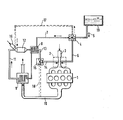
- 1 denotes a conventional multi-cylinder internal combustion engine which draws 3 air from the environment via an intake line.
- 2 denotes a fuel metering device in which, depending on the operating state of the internal combustion engine, fuel is supplied in the liquid and / or gaseous phase.
- a gaseous fuel-supplying gas line 14 and a liquid fuel-supplying fuel line 6 are connected to the fuel metering device 2, the latter being connectable by a first control valve 4 to a fuel line 5 coming from a fuel reservoir 19.
- the fuel tank 19 contains liquid methanol as fuel.
- a second fuel line 7, which can be acted upon alternatively or additionally by the control valve 4, is via a first one Heat exchanger 8 and a second heat exchanger 9 are connected to a fuel line 11 leading to a reaction chamber 12, in which the methanol used as fuel is transported essentially in vapor form.
- a catalyst is present in the reaction chamber 12 which, under the influence of elevated temperatures in the range of approximately 300 ° C., causes the methanol to be split under reducing or partially oxidizing conditions, so that a reactor gas is present at the exit of the reaction chamber 12, which essentially contains CO and H 2 , also contains C0 2 and H 2 0 under partially oxidizing conditions.
- This gas is discharged via a line 13 and fed from a second control valve 15 to the gas line 14 leading to the fuel metering device 2.
- a burner provided at the entrance of the reaction chamber 12 is designated, which draws in air from the environment and introduces it into the reaction chamber 12 for producing the partially oxidizing atmosphere.
- the burner 16 receives fuel from the first control valve 4 via a starting line 17, which fuel is ignited and burned during this starting process for the purpose of heating the reaction chamber.
- the combustion gases generated in the reaction chamber during this starting process are passed through a corresponding circuit of the second control valve 15 via a line 18 directly into an exhaust line designated 10, which discharges the combustion gases of the internal combustion engine 1.
- the reaction heat required to carry out the endothermic methanol splitting process in the reaction chamber 12 is provided, on the one hand, by heating, evaporating and superheating the fuel supplied to this splitting process in two heat exchangers 8 and 9 in the embodiment shown in the drawing, and in addition an exothermic one in the reaction chamber 12 Partial oxidation of the fuel takes place using the air supplied via the burner 16.
- the liquid methanol is heated and partially evaporated, while at the same time the fission gas emerging from the reaction chamber 12 through the line 13 is cooled, so that filling losses in the internal combustion engine 1 due to increased mixture temperatures are avoided.
- the second heat exchanger 9 heated by the exhaust gases of the internal combustion engine 1 the remaining liquid methanol is evaporated and the steam is overheated, so that the fuel can be supplied to the reaction chamber 12 in vapor form and at elevated temperatures.
- the combustion air liquid fuel sucked in via the intake line 3 and / or the cracked gas supplied from the reaction chamber 12 can now be mixed in.
- the quantity of fission gas supply which is limited in terms of quantity, will prevail particularly in the operating states in which high levels of pollutants are usually generated.
- Such operating states are, in particular, the cold start and the warm-up of the internal combustion engine, as well as part-load operating states in which work is carried out with lean fuel / air ratios.
- liquid fuel is increasingly being used in operating conditions close to full load in order to achieve the high desired output.
- reaction chamber 12 In order to be able to work with the lowest possible temperatures in the order of about 300 ° C. in the methanol cleavage taking place in the reaction chamber 12 and to convert the methanol completely as far as possible into carbon monoxide and hydrogen and at the same time to exclude the formation of dimethyl ether, the reaction chamber 12 will be the catalyst used according to the invention.
- This catalyst can also be used in a basically similarly constructed splitting device for producing hydrogen in accordance with equation (2), the hydrogen then being supplied to a fuel cell for direct conversion into electrical energy after removal of the CO 2 .
- the catalyst (K-1) thus obtained contained 0.3% by weight of Pt, its physico-mechanical data are compiled in Table I.
- the moist mass was laid out in a thin layer and air-dried until a drying loss (TV) at 120 ° C of 8 to 12% was reached.
- the mass was then pressed into cylindrical tablets 4.5 mm in diameter and 4.5 mm in height.
- the tablets were stored in a closed vessel for 4 days and then steam-treated in a steam autoclave at 5.5 bar and 155 ° C. for 12 hours. The tablets were then stored open for one day and finally heated to 640 ° C.
- the catalyst (K-2) thus obtained contained 0.3% by weight of Pt, its physico-mechanical data are summarized in Table I.
- a commercial honeycomb ceramic body with square openings of 1.5 mm side length was at room temperature for 30 min. immersed in tetraisopropyl titanate (TIPT).
- TIPT tetraisopropyl titanate
- the carrier was then steam-treated in a steam autoclave at 5.5 bar and 155 ° C. for 12 hours for the hydrolysis of the TIPT. It was then calcined in a muffle furnace at 600 ° C. (2 hours); after this treatment, the honeycomb ceramic support contained 6% by weight of TiO 2 .
- the TiO 2 -containing support was impregnated with an aqueous solution of H 2 PtCl 6 , carefully dried and recalcined at 400 ° C. (2 hours).
- the cold analyzer (K-4) thus obtained contained 0.3% Pt, its physico-mechanical data are summarized in Table I.
- the Pt-containing spheres were dried at 120 ° C. (4 hours) and recalcined at 400 ° C. (2 hours).
- the catalyst (K-5) thus obtained contained 0.3% by weight of Pt, its physico-mechanical data are summarized in Table I.
- BET-Os 45 m 2 / g
- the mass was compressed to 4.5 ⁇ 4.5 mm tablets and the tablets produced were heated to 640 ° C. in air for 8 hours, then kept at 640 ° C. for 1 hour and then cooled again to ambient temperature.
- the impregnation with H 2 PtCl 6 aqueous solution was carried out analogously to Example 1.
- the catalyst (K-6) thus obtained contained 0.3% by weight of Pt, its physico-mechanical data are summarized in Table I.
- the Pt-containing tablets were dried (120 ° C., 4 hours) and subsequently calcined at 400 ° C. (2 hours).
- the catalyst (K-7) thus obtained contained 0.3% by weight of Pt; its physico-mechanical data are summarized in Table I.
- Example 7 The procedure of Example 7 was repeated with the difference that the same amount of ZrO 2 was used instead of La 2 CO 3 .
- the physical-mechanical data of the catalyst thus obtained (K-8 are summarized in Table I.
- the catalysts obtained according to Examples 1 and 2 were heated to 400 ° C. in a hydrogen stream over a period of 3 hours in order to reduce the noble metal component. After cooling to 300 ° C., methanol cleavage was started in a conventional metal tube reactor. The methanol contained 2.2% by volume
- the methanol cleavage was carried out at a space velocity of 2 liters / hour and liter of catalyst at 300, 350 and 400 ° C.
- the catalysts obtained according to Examples 1 to 8 were heated to 400 ° C. over a period of 3 hours to reduce the noble metal component. After cooling to 300 ° C., these catalysts were used to cleave methanol in a test reactor, the conditions in the test reactor corresponding to a largely isothermal cleavage. This methanol splitting was carried out at a space velocity of 2 liters / hour and liter of catalyst at 300, 350 and 400 ° C. The gas developed by the catalytic cleavage was measured using a gas meter and analyzed by gas chromatography. The results are summarized in Table II.
- a methanol cleavage was carried out under largely autothermal conditions, which essentially corresponded to the conditions in the reaction chamber 12 of the fuel processing device shown in the drawing.
- the catalysts K1 and K5 were used in 2 experiments as typical gas compositions to determine the concentrations in vol.% Given in Table III.
- the space velocities in these experiments were between 3 liters / hour and liter of catalyst and 6 liters / hour and liter of catalyst.
- the temperatures in the reactor assumed values between 2200C and 400 ° C.
Landscapes
- Chemical & Material Sciences (AREA)
- Engineering & Computer Science (AREA)
- Chemical Kinetics & Catalysis (AREA)
- Materials Engineering (AREA)
- Organic Chemistry (AREA)
- Combustion & Propulsion (AREA)
- Mechanical Engineering (AREA)
- General Engineering & Computer Science (AREA)
- Catalysts (AREA)
- Hydrogen, Water And Hydrids (AREA)
Applications Claiming Priority (2)
| Application Number | Priority Date | Filing Date | Title |
|---|---|---|---|
| DE3516562 | 1985-05-08 | ||
| DE3516562 | 1985-05-08 |
Publications (3)
| Publication Number | Publication Date |
|---|---|
| EP0201670A2 true EP0201670A2 (fr) | 1986-11-20 |
| EP0201670A3 EP0201670A3 (en) | 1989-06-14 |
| EP0201670B1 EP0201670B1 (fr) | 1993-05-26 |
Family
ID=6270162
Family Applications (1)
| Application Number | Title | Priority Date | Filing Date |
|---|---|---|---|
| EP86102304A Expired - Lifetime EP0201670B1 (fr) | 1985-05-08 | 1986-02-22 | Dispositif pour la préparation des liquides essentiellement composés de méthanol |
Country Status (4)
| Country | Link |
|---|---|
| US (1) | US4716859A (fr) |
| EP (1) | EP0201670B1 (fr) |
| JP (1) | JPS6256301A (fr) |
| DE (1) | DE3688476D1 (fr) |
Cited By (5)
| Publication number | Priority date | Publication date | Assignee | Title |
|---|---|---|---|---|
| US4839146A (en) * | 1987-04-15 | 1989-06-13 | General Motors Corporation | Catalyst for simultaneous NO decomposition and CO oxidation under cycled operating conditions |
| EP0370757A1 (fr) * | 1988-11-23 | 1990-05-30 | Exxon Research And Engineering Company | Catalyseurs contenant de l'oxyde de titane, leur préparation et utilisation dans la synthèse de fischer-tropsch |
| DE19516879C1 (de) * | 1995-05-09 | 1996-11-28 | Daimler Benz Ag | Gaserzeugungssystem |
| EP1134188A3 (fr) * | 2000-03-02 | 2004-06-09 | The Boc Group, Inc. | Oxydation partielle catalytique d'hydrocarbures |
| US8207241B2 (en) | 2004-12-09 | 2012-06-26 | Wacker Chemie Ag | Platinum catalysts supported on nanosize titanium dioxide, their use in hydrosilylation and compositions comprising such catalysts |
Families Citing this family (51)
| Publication number | Priority date | Publication date | Assignee | Title |
|---|---|---|---|---|
| US4884531A (en) * | 1988-06-30 | 1989-12-05 | Mobil Oil Corporation | Operation of an internal combustion engine with a pre-engine reformer |
| US20030012985A1 (en) | 1998-08-03 | 2003-01-16 | Mcalister Roy E. | Pressure energy conversion systems |
| US5343699A (en) * | 1989-06-12 | 1994-09-06 | Mcalister Roy E | Method and apparatus for improved operation of internal combustion engines |
| US5394685A (en) * | 1990-11-14 | 1995-03-07 | United Technologies Corporation | Method and apparatus to enhance combustion rates and extend extinction limits in high speed propulsion units |
| US5248566A (en) * | 1991-11-25 | 1993-09-28 | The United States Of America As Represented By The United States Department Of Energy | Fuel cell system for transportation applications |
| PT1662113E (pt) | 1994-04-10 | 2012-12-24 | Roy E Mcalister | Aparelho para operação de motores |
| US6079373A (en) * | 1997-05-13 | 2000-06-27 | Isuzu Ceramics Research Institute Co., Ltd. | Gas engine with a gas fuel reforming device |
| WO1999049204A1 (fr) * | 1998-03-26 | 1999-09-30 | Alexandr Vasilievich Pugachev | Procede de preparation de melange air-carburant pour moteur a combustion interne, dispositif de mise en oeuvre de ce procede et echangeur de chaleur |
| US6298834B1 (en) | 1998-04-22 | 2001-10-09 | Safe Energy Systems, Inc. | Fuel vaporizing attachment for liquid fueled internal combustion engines |
| EP1063011B1 (fr) * | 1999-05-22 | 2001-12-12 | OMG AG & Co. KG | Utilisation d'un catalyseur pour le réformage à la vapeur du méthanol |
| DE19924777A1 (de) * | 1999-05-29 | 2000-11-30 | Bayerische Motoren Werke Ag | Verfahren zur Erzeugung eines Hilfsbrennstoffes aus dem Betriebskraftstoff einer gemischverdichtenden Brennkraftmaschine, insbesondere auf Kraftfahrzeugen |
| RU2159666C1 (ru) | 1999-11-24 | 2000-11-27 | Дыкман Аркадий Самуилович | Способ очистки промышленных газовых выбросов |
| US20060058184A1 (en) * | 2000-03-02 | 2006-03-16 | Weibin Jiang | Metal catalyst and method of preparation and use |
| US20030007926A1 (en) * | 2000-03-02 | 2003-01-09 | Weibin Jiang | Metal catalyst and method of preparation and use |
| DE10013895A1 (de) * | 2000-03-21 | 2001-10-04 | Dmc2 Degussa Metals Catalysts Cerdec Ag | Verfahren zur katalytischen Umsetzung von Kohlenmonoxid in einem Wasserstoff enthaltenden Gasgemisch |
| DE10133390C2 (de) * | 2001-07-13 | 2003-06-18 | Audi Ag | Kraftfahrzeug-Antriebssystem mit einem Verbrennungsmotor |
| US6935282B2 (en) * | 2001-08-16 | 2005-08-30 | Bayerische Motoren Werke Aktiengesellschaft | Vehicle having an internal combustion engine and a fuel cell and method of making a vehicle |
| US6810658B2 (en) * | 2002-03-08 | 2004-11-02 | Daimlerchrysler Ag | Exhaust-gas purification installation and exhaust-gas purification method for purifying an exhaust gas from an internal combustion engine |
| US7128769B2 (en) * | 2002-06-27 | 2006-10-31 | Idatech, Llc | Methanol steam reforming catalysts, steam reformers, and fuel cell systems incorporating the same |
| CN1327121C (zh) * | 2002-12-05 | 2007-07-18 | 天津大学 | 超低排放甲醇燃料发动机 |
| US20070104998A1 (en) * | 2003-02-28 | 2007-05-10 | Towler Gavin P | Solid Fuel Devices for Fuel Cells |
| US7354461B2 (en) | 2003-02-28 | 2008-04-08 | Uop Llc | Solid fuels for fuel cells |
| US7037632B2 (en) * | 2003-09-25 | 2006-05-02 | Samsung Electronics Co. Ltd. | Organophotoreceptor with charge transport material with fluorenone azine groups |
| DE102004014092B4 (de) * | 2004-03-20 | 2012-04-19 | Viessmann Werke Gmbh & Co Kg | Vorrichtung zur Umwandlung von Kohlenwasserstoffgas und Wasserdampf in Wasserstoff und weitere Reformerprodukte |
| EP1919823A1 (fr) * | 2005-08-03 | 2008-05-14 | Genesis Fueltech, Inc. | Catalyseur de conversion du co et de reformage ainsi que procede permettant de reformer l'alcool |
| CN101063430A (zh) * | 2006-04-26 | 2007-10-31 | 黄诗炎 | 一种汽车油路催化节油器 |
| JP4789116B2 (ja) * | 2007-05-17 | 2011-10-12 | 本田技研工業株式会社 | 内燃機関用エタノール燃料改質システム |
| US20080295501A1 (en) * | 2007-05-31 | 2008-12-04 | Weidong Gong | Stoichiometric engine system utilizing reformed exhaust gas |
| US20090108238A1 (en) * | 2007-10-31 | 2009-04-30 | Sud-Chemie Inc. | Catalyst for reforming hydrocarbons |
| JP5690716B2 (ja) * | 2008-04-22 | 2015-03-25 | ビーエーエスエフ ソシエタス・ヨーロピアBasf Se | エタノールを予備改質する方法 |
| JP2014100613A (ja) * | 2011-03-09 | 2014-06-05 | Kuraray Co Ltd | 水素および一酸化炭素の混合ガスの製造方法 |
| DE102012014755A1 (de) * | 2012-07-26 | 2014-05-15 | Man Truck & Bus Ag | Verfahren und Vorrichtung zur Umwandlung eines Alkohols in ein Kraftstoffgemisch |
| US8838367B1 (en) | 2013-03-12 | 2014-09-16 | Mcalister Technologies, Llc | Rotational sensor and controller |
| US9377105B2 (en) | 2013-03-12 | 2016-06-28 | Mcalister Technologies, Llc | Insert kits for multi-stage compressors and associated systems, processes and methods |
| US9255560B2 (en) | 2013-03-15 | 2016-02-09 | Mcalister Technologies, Llc | Regenerative intensifier and associated systems and methods |
| US9091204B2 (en) | 2013-03-15 | 2015-07-28 | Mcalister Technologies, Llc | Internal combustion engine having piston with piston valve and associated method |
| JP6258779B2 (ja) * | 2014-05-16 | 2018-01-10 | 株式会社Soken | 燃料供給システム |
| DE102016225172A1 (de) * | 2016-12-15 | 2018-06-21 | Clariant International Ltd | Tablettierter Katalysator mit erhöhter Stabilität gegenüber Säureeinwirkung |
| CN107084045A (zh) * | 2017-04-21 | 2017-08-22 | 深圳瑞科天启科技有限公司 | 一种使用甲醇基燃料的压燃式内燃机系统及其运行方法 |
| EP4321596A1 (fr) | 2022-08-12 | 2024-02-14 | Bp P.L.C. | Production fischer-tropsch d'hydrocarbures à partir de dioxyde de carbone par l'intermédiaire de méthanol |
| EP4321597A1 (fr) | 2022-08-12 | 2024-02-14 | Bp P.L.C. | Production fischer-tropsch d'hydrocarbures à partir de méthanol |
| EP4321598A1 (fr) | 2022-08-12 | 2024-02-14 | Bp P.L.C. | Production fischer-tropsch d'hydrocarbures à partir de dioxyde de carbone par l'intermédiaire de méthanol |
| EP4321478A1 (fr) | 2022-08-12 | 2024-02-14 | Bp P.L.C. | Production de gaz de synthèse à partir de dioxyde de carbone par l'intermédiaire de méthanol |
| EP4484363A1 (fr) | 2023-06-28 | 2025-01-01 | Bp P.L.C. | Procédés intégrés pour l'utilisation de méthanol synthétisé et stocké |
| WO2025252845A1 (fr) | 2024-06-04 | 2025-12-11 | Bp P.L.C. | Décomposition du méthanol en présence d'eau |
| WO2025252856A1 (fr) | 2024-06-04 | 2025-12-11 | Bp P.L.C. | Décomposition du méthanol à l'aide de catalyseurs au platine et au palladium |
| WO2025252847A1 (fr) | 2024-06-04 | 2025-12-11 | Bp P.L.C. | Décomposition du méthanol à l'aide de catalyseurs au platine à une pression supérieure |
| WO2025252833A1 (fr) | 2024-06-04 | 2025-12-11 | Bp P.L.C. | Catalyseurs de décomposition du méthanol incorporant du manganèse, et procédés de fabrication et d'utilisation de tels catalyseurs |
| WO2025252846A1 (fr) | 2024-06-04 | 2025-12-11 | Bp P.L.C. | Décomposition de méthanol à l'aide de catalyseurs au platine à pression élevée |
| WO2025252829A1 (fr) | 2024-06-04 | 2025-12-11 | Bp P.L.C. | Décomposition de méthanol à l'aide de platine sur des catalyseurs à base de silice |
| WO2025252848A1 (fr) | 2024-06-04 | 2025-12-11 | Bp P.L.C. | Décomposition du méthanol avec introduction simultanée de monoxyde de carbone |
Family Cites Families (18)
| Publication number | Priority date | Publication date | Assignee | Title |
|---|---|---|---|---|
| FR701571A (fr) * | 1929-12-06 | 1931-03-18 | Brevets Catalex Soc D | Perfectionnements à la fabrication des catalyseurs et vaporiseurs de de carburants pour moteurs à explosion |
| US3400019A (en) * | 1961-12-26 | 1968-09-03 | Pullman Inc | Electrode including nonmetallic substrate |
| US3450507A (en) * | 1966-10-27 | 1969-06-17 | Chemical Construction Corp | Integrated reforming of hydrocarbons |
| US3914090A (en) * | 1971-05-13 | 1975-10-21 | Engelhard Min & Chem | Method and furnace apparatus |
| US4170200A (en) * | 1974-06-14 | 1979-10-09 | Nippondenso Co., Ltd. | Internal combustion engine with reformed gas generator |
| DE2541687C3 (de) * | 1975-09-18 | 1978-08-24 | Siemens Ag, 1000 Berlin Und 8000 Muenchen | Umrichter und Verfahren zu seinem Betrieb |
| JPS5831468B2 (ja) * | 1978-12-28 | 1983-07-06 | 日産自動車株式会社 | アルコ−ルエンジンの始動装置 |
| US4282835A (en) * | 1979-07-02 | 1981-08-11 | Wm. D. Peterson & Associates | Internal combustion engine with gas synthesizer |
| JPS5621721A (en) * | 1979-08-01 | 1981-02-28 | Hitachi Ltd | Mold cutting device |
| US4244188A (en) * | 1979-08-14 | 1981-01-13 | Williams Research Corporation | Methanol fueled spark ignition engine |
| US4567857A (en) * | 1980-02-26 | 1986-02-04 | The United States Of America As Represented By The Administrator Of The National Aeronautics And Space Administration | Combustion engine system |
| US4366782A (en) * | 1981-07-27 | 1983-01-04 | Conoco Inc. | Method of fuel treatment and distribution |
| JPS5867344A (ja) * | 1981-10-16 | 1983-04-21 | Nissan Motor Co Ltd | メタノ−ル改質用触媒 |
| JPS58177153A (ja) * | 1982-04-12 | 1983-10-17 | Nissan Motor Co Ltd | メタノ−ル改質用触媒 |
| US4519342A (en) * | 1982-09-03 | 1985-05-28 | Conco Inc. | Alcohol dissociation reactor for motor vehicles |
| US4441461A (en) * | 1982-09-03 | 1984-04-10 | Conoco Inc. | Alcohol dissociation and waste heat recovery process for automobiles |
| US4499863A (en) * | 1982-11-04 | 1985-02-19 | Ford Motor Company | Method of operating an internal combustion engine on a methanol fuel |
| DE3340569A1 (de) * | 1983-11-09 | 1985-05-23 | Sued Chemie Ag | Katalysator zur herstellung von synthesegas bzw. von wasserstoff und verfahren zu dessen herstellung |
-
1986
- 1986-02-22 EP EP86102304A patent/EP0201670B1/fr not_active Expired - Lifetime
- 1986-02-22 DE DE8686102304T patent/DE3688476D1/de not_active Expired - Fee Related
- 1986-04-30 US US06/858,062 patent/US4716859A/en not_active Expired - Lifetime
- 1986-05-08 JP JP61103990A patent/JPS6256301A/ja active Pending
Cited By (5)
| Publication number | Priority date | Publication date | Assignee | Title |
|---|---|---|---|---|
| US4839146A (en) * | 1987-04-15 | 1989-06-13 | General Motors Corporation | Catalyst for simultaneous NO decomposition and CO oxidation under cycled operating conditions |
| EP0370757A1 (fr) * | 1988-11-23 | 1990-05-30 | Exxon Research And Engineering Company | Catalyseurs contenant de l'oxyde de titane, leur préparation et utilisation dans la synthèse de fischer-tropsch |
| DE19516879C1 (de) * | 1995-05-09 | 1996-11-28 | Daimler Benz Ag | Gaserzeugungssystem |
| EP1134188A3 (fr) * | 2000-03-02 | 2004-06-09 | The Boc Group, Inc. | Oxydation partielle catalytique d'hydrocarbures |
| US8207241B2 (en) | 2004-12-09 | 2012-06-26 | Wacker Chemie Ag | Platinum catalysts supported on nanosize titanium dioxide, their use in hydrosilylation and compositions comprising such catalysts |
Also Published As
| Publication number | Publication date |
|---|---|
| JPS6256301A (ja) | 1987-03-12 |
| US4716859A (en) | 1988-01-05 |
| EP0201670A3 (en) | 1989-06-14 |
| DE3688476D1 (de) | 1993-07-01 |
| EP0201670B1 (fr) | 1993-05-26 |
Similar Documents
| Publication | Publication Date | Title |
|---|---|---|
| EP0201670B1 (fr) | Dispositif pour la préparation des liquides essentiellement composés de méthanol | |
| DE68909975T2 (de) | Katalysatorträger und Katalysator zur Behandlung von Motorabgasen und Verfahren zu deren Herstellung. | |
| DE69101701T2 (de) | Katalytische Zusammensetzung zur Reinigung von Abgasen und Verfahren zu seiner Herstellung. | |
| DE69609703T2 (de) | Oxidations- und/oder verbrennungskatalysator | |
| DE69627231T2 (de) | Katalysator zur Reduktion von Stickstoffoxiden in oxidierender Atmosphäre und dessen Verwendung | |
| EP1101528B1 (fr) | Procédé pour fabriquer un matériau d'accumulation des oxydes d'azote et matériau obtenu par ce procédé | |
| DE69435061T2 (de) | Katalysatorzusammensetzung | |
| DE69620370T2 (de) | Katalytisches Verbrennungsverfahren mit mehreren aufeinanderfolgenden Bereichen | |
| DE69230758T2 (de) | Oxidationskatalysator und verfahren zur anwendung | |
| DE69100988T2 (de) | Verbesserter Alumina-ceria katalytischer Überzug. | |
| EP0144506A2 (fr) | Catalyseur pour la préparation de gaz de synthèse ou d'hydrogène et procédé de sa préparation | |
| DE3803122C1 (fr) | ||
| DE69627400T2 (de) | Katalysator zur selektiven Reduktion von Stichoxiden in einer oxidierenden Umgebung, Verfahren zur Herstellung und Verwendung | |
| DE69101548T2 (de) | Verfahren zur herstellung von multimetallischen katalysatoren. | |
| DE3856024T2 (de) | Verfahren zur Behandlung von Abgasen mit einem Kupfer- und Ceroxid enthaltenden Katalysator | |
| DE3531757A1 (de) | Verfahren zum reformieren von methanol | |
| DE102017124764A1 (de) | Katalysatoren mit atomar dispergierten komplexen der platingruppe | |
| DE2818824A1 (de) | Verfahren zur herstellung einer katalysatorzusammensetzung | |
| DE2045488A1 (de) | Verfahren und Katalysator zur Reinigung von Gasen | |
| CH652941A5 (de) | Katalysator fuer die autotherme reformierung und autothermes reformierungsverfahren. | |
| DE60030198T2 (de) | Verfahren zur Herstellung eines Dreiwegkatalysators | |
| DE1274084B (de) | Verfahren zur Katalysatorherstellung | |
| DE2524483A1 (de) | Katalysator fuer kraftfahrzeugabgase sowie verfahren zu dessen herstellung | |
| DE69823147T2 (de) | Verfahren zur Reduktion von NO und NO2 in einer oxidierenden Umgebung | |
| DE68904570T2 (de) | Katalysatoren fuer kraftwagenabgase. |
Legal Events
| Date | Code | Title | Description |
|---|---|---|---|
| PUAI | Public reference made under article 153(3) epc to a published international application that has entered the european phase |
Free format text: ORIGINAL CODE: 0009012 |
|
| AK | Designated contracting states |
Kind code of ref document: A2 Designated state(s): DE FR GB IT |
|
| PUAL | Search report despatched |
Free format text: ORIGINAL CODE: 0009013 |
|
| AK | Designated contracting states |
Kind code of ref document: A3 Designated state(s): DE FR GB IT |
|
| 17P | Request for examination filed |
Effective date: 19891028 |
|
| 17Q | First examination report despatched |
Effective date: 19900307 |
|
| GRAA | (expected) grant |
Free format text: ORIGINAL CODE: 0009210 |
|
| AK | Designated contracting states |
Kind code of ref document: B1 Designated state(s): DE FR GB IT |
|
| REF | Corresponds to: |
Ref document number: 3688476 Country of ref document: DE Date of ref document: 19930701 |
|
| ET | Fr: translation filed | ||
| ITF | It: translation for a ep patent filed | ||
| GBT | Gb: translation of ep patent filed (gb section 77(6)(a)/1977) |
Effective date: 19930812 |
|
| PLBE | No opposition filed within time limit |
Free format text: ORIGINAL CODE: 0009261 |
|
| STAA | Information on the status of an ep patent application or granted ep patent |
Free format text: STATUS: NO OPPOSITION FILED WITHIN TIME LIMIT |
|
| 26N | No opposition filed | ||
| REG | Reference to a national code |
Ref country code: GB Ref legal event code: IF02 |
|
| PGFP | Annual fee paid to national office [announced via postgrant information from national office to epo] |
Ref country code: FR Payment date: 20030130 Year of fee payment: 18 |
|
| PGFP | Annual fee paid to national office [announced via postgrant information from national office to epo] |
Ref country code: GB Payment date: 20030214 Year of fee payment: 18 |
|
| PG25 | Lapsed in a contracting state [announced via postgrant information from national office to epo] |
Ref country code: GB Free format text: LAPSE BECAUSE OF NON-PAYMENT OF DUE FEES Effective date: 20040222 |
|
| PGFP | Annual fee paid to national office [announced via postgrant information from national office to epo] |
Ref country code: DE Payment date: 20040312 Year of fee payment: 19 |
|
| GBPC | Gb: european patent ceased through non-payment of renewal fee |
Effective date: 20040222 |
|
| PG25 | Lapsed in a contracting state [announced via postgrant information from national office to epo] |
Ref country code: FR Free format text: LAPSE BECAUSE OF NON-PAYMENT OF DUE FEES Effective date: 20041029 |
|
| REG | Reference to a national code |
Ref country code: FR Ref legal event code: ST |
|
| PG25 | Lapsed in a contracting state [announced via postgrant information from national office to epo] |
Ref country code: IT Free format text: LAPSE BECAUSE OF NON-PAYMENT OF DUE FEES;WARNING: LAPSES OF ITALIAN PATENTS WITH EFFECTIVE DATE BEFORE 2007 MAY HAVE OCCURRED AT ANY TIME BEFORE 2007. THE CORRECT EFFECTIVE DATE MAY BE DIFFERENT FROM THE ONE RECORDED. Effective date: 20050222 |
|
| PG25 | Lapsed in a contracting state [announced via postgrant information from national office to epo] |
Ref country code: DE Free format text: LAPSE BECAUSE OF NON-PAYMENT OF DUE FEES Effective date: 20050901 |