EP0201827A2 - Elektroviskose Flüssigkeiten - Google Patents
Elektroviskose Flüssigkeiten Download PDFInfo
- Publication number
- EP0201827A2 EP0201827A2 EP86106109A EP86106109A EP0201827A2 EP 0201827 A2 EP0201827 A2 EP 0201827A2 EP 86106109 A EP86106109 A EP 86106109A EP 86106109 A EP86106109 A EP 86106109A EP 0201827 A2 EP0201827 A2 EP 0201827A2
- Authority
- EP
- European Patent Office
- Prior art keywords
- weight
- evf
- polymers
- silica gel
- dispersant
- Prior art date
- Legal status (The legal status is an assumption and is not a legal conclusion. Google has not performed a legal analysis and makes no representation as to the accuracy of the status listed.)
- Granted
Links
Images

Classifications
-
- C—CHEMISTRY; METALLURGY
- C10—PETROLEUM, GAS OR COKE INDUSTRIES; TECHNICAL GASES CONTAINING CARBON MONOXIDE; FUELS; LUBRICANTS; PEAT
- C10M—LUBRICATING COMPOSITIONS; USE OF CHEMICAL SUBSTANCES EITHER ALONE OR AS LUBRICATING INGREDIENTS IN A LUBRICATING COMPOSITION
- C10M171/00—Lubricating compositions characterised by purely physical criteria, e.g. containing as base-material, thickener or additive, ingredients which are characterised exclusively by their numerically specified physical properties, i.e. containing ingredients which are physically well-defined but for which the chemical nature is either unspecified or only very vaguely indicated
- C10M171/001—Electrorheological fluids; smart fluids
-
- C—CHEMISTRY; METALLURGY
- C10—PETROLEUM, GAS OR COKE INDUSTRIES; TECHNICAL GASES CONTAINING CARBON MONOXIDE; FUELS; LUBRICANTS; PEAT
- C10M—LUBRICATING COMPOSITIONS; USE OF CHEMICAL SUBSTANCES EITHER ALONE OR AS LUBRICATING INGREDIENTS IN A LUBRICATING COMPOSITION
- C10M125/00—Lubricating compositions characterised by the additive being an inorganic material
- C10M125/26—Compounds containing silicon or boron, e.g. silica, sand
-
- C—CHEMISTRY; METALLURGY
- C10—PETROLEUM, GAS OR COKE INDUSTRIES; TECHNICAL GASES CONTAINING CARBON MONOXIDE; FUELS; LUBRICANTS; PEAT
- C10M—LUBRICATING COMPOSITIONS; USE OF CHEMICAL SUBSTANCES EITHER ALONE OR AS LUBRICATING INGREDIENTS IN A LUBRICATING COMPOSITION
- C10M143/00—Lubricating compositions characterised by the additive being a macromolecular hydrocarbon or such hydrocarbon modified by oxidation
- C10M143/10—Lubricating compositions characterised by the additive being a macromolecular hydrocarbon or such hydrocarbon modified by oxidation containing aromatic monomer, e.g. styrene
-
- C—CHEMISTRY; METALLURGY
- C10—PETROLEUM, GAS OR COKE INDUSTRIES; TECHNICAL GASES CONTAINING CARBON MONOXIDE; FUELS; LUBRICANTS; PEAT
- C10M—LUBRICATING COMPOSITIONS; USE OF CHEMICAL SUBSTANCES EITHER ALONE OR AS LUBRICATING INGREDIENTS IN A LUBRICATING COMPOSITION
- C10M143/00—Lubricating compositions characterised by the additive being a macromolecular hydrocarbon or such hydrocarbon modified by oxidation
- C10M143/12—Lubricating compositions characterised by the additive being a macromolecular hydrocarbon or such hydrocarbon modified by oxidation containing conjugated diene
-
- C—CHEMISTRY; METALLURGY
- C10—PETROLEUM, GAS OR COKE INDUSTRIES; TECHNICAL GASES CONTAINING CARBON MONOXIDE; FUELS; LUBRICANTS; PEAT
- C10M—LUBRICATING COMPOSITIONS; USE OF CHEMICAL SUBSTANCES EITHER ALONE OR AS LUBRICATING INGREDIENTS IN A LUBRICATING COMPOSITION
- C10M145/00—Lubricating compositions characterised by the additive being a macromolecular compound containing oxygen
- C10M145/02—Macromolecular compounds obtained by reactions only involving carbon-to-carbon unsaturated bonds
-
- C—CHEMISTRY; METALLURGY
- C10—PETROLEUM, GAS OR COKE INDUSTRIES; TECHNICAL GASES CONTAINING CARBON MONOXIDE; FUELS; LUBRICANTS; PEAT
- C10M—LUBRICATING COMPOSITIONS; USE OF CHEMICAL SUBSTANCES EITHER ALONE OR AS LUBRICATING INGREDIENTS IN A LUBRICATING COMPOSITION
- C10M149/00—Lubricating compositions characterised by the additive being a macromolecular compound containing nitrogen
- C10M149/02—Macromolecular compounds obtained by reactions only involving carbon-to-carbon unsaturated bonds
-
- C—CHEMISTRY; METALLURGY
- C10—PETROLEUM, GAS OR COKE INDUSTRIES; TECHNICAL GASES CONTAINING CARBON MONOXIDE; FUELS; LUBRICANTS; PEAT
- C10M—LUBRICATING COMPOSITIONS; USE OF CHEMICAL SUBSTANCES EITHER ALONE OR AS LUBRICATING INGREDIENTS IN A LUBRICATING COMPOSITION
- C10M161/00—Lubricating compositions characterised by the additive being a mixture of a macromolecular compound and a non-macromolecular compound, each of these compounds being essential
-
- C—CHEMISTRY; METALLURGY
- C10—PETROLEUM, GAS OR COKE INDUSTRIES; TECHNICAL GASES CONTAINING CARBON MONOXIDE; FUELS; LUBRICANTS; PEAT
- C10M—LUBRICATING COMPOSITIONS; USE OF CHEMICAL SUBSTANCES EITHER ALONE OR AS LUBRICATING INGREDIENTS IN A LUBRICATING COMPOSITION
- C10M2201/00—Inorganic compounds or elements as ingredients in lubricant compositions
- C10M2201/087—Boron oxides, acids or salts
-
- C—CHEMISTRY; METALLURGY
- C10—PETROLEUM, GAS OR COKE INDUSTRIES; TECHNICAL GASES CONTAINING CARBON MONOXIDE; FUELS; LUBRICANTS; PEAT
- C10M—LUBRICATING COMPOSITIONS; USE OF CHEMICAL SUBSTANCES EITHER ALONE OR AS LUBRICATING INGREDIENTS IN A LUBRICATING COMPOSITION
- C10M2201/00—Inorganic compounds or elements as ingredients in lubricant compositions
- C10M2201/10—Compounds containing silicon
-
- C—CHEMISTRY; METALLURGY
- C10—PETROLEUM, GAS OR COKE INDUSTRIES; TECHNICAL GASES CONTAINING CARBON MONOXIDE; FUELS; LUBRICANTS; PEAT
- C10M—LUBRICATING COMPOSITIONS; USE OF CHEMICAL SUBSTANCES EITHER ALONE OR AS LUBRICATING INGREDIENTS IN A LUBRICATING COMPOSITION
- C10M2201/00—Inorganic compounds or elements as ingredients in lubricant compositions
- C10M2201/10—Compounds containing silicon
- C10M2201/102—Silicates
-
- C—CHEMISTRY; METALLURGY
- C10—PETROLEUM, GAS OR COKE INDUSTRIES; TECHNICAL GASES CONTAINING CARBON MONOXIDE; FUELS; LUBRICANTS; PEAT
- C10M—LUBRICATING COMPOSITIONS; USE OF CHEMICAL SUBSTANCES EITHER ALONE OR AS LUBRICATING INGREDIENTS IN A LUBRICATING COMPOSITION
- C10M2201/00—Inorganic compounds or elements as ingredients in lubricant compositions
- C10M2201/10—Compounds containing silicon
- C10M2201/105—Silica
-
- C—CHEMISTRY; METALLURGY
- C10—PETROLEUM, GAS OR COKE INDUSTRIES; TECHNICAL GASES CONTAINING CARBON MONOXIDE; FUELS; LUBRICANTS; PEAT
- C10M—LUBRICATING COMPOSITIONS; USE OF CHEMICAL SUBSTANCES EITHER ALONE OR AS LUBRICATING INGREDIENTS IN A LUBRICATING COMPOSITION
- C10M2205/00—Organic macromolecular hydrocarbon compounds or fractions, whether or not modified by oxidation as ingredients in lubricant compositions
- C10M2205/04—Organic macromolecular hydrocarbon compounds or fractions, whether or not modified by oxidation as ingredients in lubricant compositions containing aromatic monomers, e.g. styrene
-
- C—CHEMISTRY; METALLURGY
- C10—PETROLEUM, GAS OR COKE INDUSTRIES; TECHNICAL GASES CONTAINING CARBON MONOXIDE; FUELS; LUBRICANTS; PEAT
- C10M—LUBRICATING COMPOSITIONS; USE OF CHEMICAL SUBSTANCES EITHER ALONE OR AS LUBRICATING INGREDIENTS IN A LUBRICATING COMPOSITION
- C10M2205/00—Organic macromolecular hydrocarbon compounds or fractions, whether or not modified by oxidation as ingredients in lubricant compositions
- C10M2205/06—Organic macromolecular hydrocarbon compounds or fractions, whether or not modified by oxidation as ingredients in lubricant compositions containing conjugated dienes
-
- C—CHEMISTRY; METALLURGY
- C10—PETROLEUM, GAS OR COKE INDUSTRIES; TECHNICAL GASES CONTAINING CARBON MONOXIDE; FUELS; LUBRICANTS; PEAT
- C10M—LUBRICATING COMPOSITIONS; USE OF CHEMICAL SUBSTANCES EITHER ALONE OR AS LUBRICATING INGREDIENTS IN A LUBRICATING COMPOSITION
- C10M2207/00—Organic non-macromolecular hydrocarbon compounds containing hydrogen, carbon and oxygen as ingredients in lubricant compositions
- C10M2207/28—Esters
- C10M2207/287—Partial esters
- C10M2207/289—Partial esters containing free hydroxy groups
-
- C—CHEMISTRY; METALLURGY
- C10—PETROLEUM, GAS OR COKE INDUSTRIES; TECHNICAL GASES CONTAINING CARBON MONOXIDE; FUELS; LUBRICANTS; PEAT
- C10M—LUBRICATING COMPOSITIONS; USE OF CHEMICAL SUBSTANCES EITHER ALONE OR AS LUBRICATING INGREDIENTS IN A LUBRICATING COMPOSITION
- C10M2209/00—Organic macromolecular compounds containing oxygen as ingredients in lubricant compositions
- C10M2209/02—Macromolecular compounds obtained by reactions only involving carbon-to-carbon unsaturated bonds
-
- C—CHEMISTRY; METALLURGY
- C10—PETROLEUM, GAS OR COKE INDUSTRIES; TECHNICAL GASES CONTAINING CARBON MONOXIDE; FUELS; LUBRICANTS; PEAT
- C10M—LUBRICATING COMPOSITIONS; USE OF CHEMICAL SUBSTANCES EITHER ALONE OR AS LUBRICATING INGREDIENTS IN A LUBRICATING COMPOSITION
- C10M2215/00—Organic non-macromolecular compounds containing nitrogen as ingredients in lubricant Compositions
- C10M2215/22—Heterocyclic nitrogen compounds
-
- C—CHEMISTRY; METALLURGY
- C10—PETROLEUM, GAS OR COKE INDUSTRIES; TECHNICAL GASES CONTAINING CARBON MONOXIDE; FUELS; LUBRICANTS; PEAT
- C10M—LUBRICATING COMPOSITIONS; USE OF CHEMICAL SUBSTANCES EITHER ALONE OR AS LUBRICATING INGREDIENTS IN A LUBRICATING COMPOSITION
- C10M2215/00—Organic non-macromolecular compounds containing nitrogen as ingredients in lubricant Compositions
- C10M2215/22—Heterocyclic nitrogen compounds
- C10M2215/221—Six-membered rings containing nitrogen and carbon only
-
- C—CHEMISTRY; METALLURGY
- C10—PETROLEUM, GAS OR COKE INDUSTRIES; TECHNICAL GASES CONTAINING CARBON MONOXIDE; FUELS; LUBRICANTS; PEAT
- C10M—LUBRICATING COMPOSITIONS; USE OF CHEMICAL SUBSTANCES EITHER ALONE OR AS LUBRICATING INGREDIENTS IN A LUBRICATING COMPOSITION
- C10M2215/00—Organic non-macromolecular compounds containing nitrogen as ingredients in lubricant Compositions
- C10M2215/22—Heterocyclic nitrogen compounds
- C10M2215/225—Heterocyclic nitrogen compounds the rings containing both nitrogen and oxygen
-
- C—CHEMISTRY; METALLURGY
- C10—PETROLEUM, GAS OR COKE INDUSTRIES; TECHNICAL GASES CONTAINING CARBON MONOXIDE; FUELS; LUBRICANTS; PEAT
- C10M—LUBRICATING COMPOSITIONS; USE OF CHEMICAL SUBSTANCES EITHER ALONE OR AS LUBRICATING INGREDIENTS IN A LUBRICATING COMPOSITION
- C10M2215/00—Organic non-macromolecular compounds containing nitrogen as ingredients in lubricant Compositions
- C10M2215/22—Heterocyclic nitrogen compounds
- C10M2215/225—Heterocyclic nitrogen compounds the rings containing both nitrogen and oxygen
- C10M2215/226—Morpholines
-
- C—CHEMISTRY; METALLURGY
- C10—PETROLEUM, GAS OR COKE INDUSTRIES; TECHNICAL GASES CONTAINING CARBON MONOXIDE; FUELS; LUBRICANTS; PEAT
- C10M—LUBRICATING COMPOSITIONS; USE OF CHEMICAL SUBSTANCES EITHER ALONE OR AS LUBRICATING INGREDIENTS IN A LUBRICATING COMPOSITION
- C10M2215/00—Organic non-macromolecular compounds containing nitrogen as ingredients in lubricant Compositions
- C10M2215/24—Organic non-macromolecular compounds containing nitrogen as ingredients in lubricant Compositions having hydrocarbon substituents containing thirty or more carbon atoms, e.g. nitrogen derivatives of substituted succinic acid
- C10M2215/30—Heterocyclic compounds
-
- C—CHEMISTRY; METALLURGY
- C10—PETROLEUM, GAS OR COKE INDUSTRIES; TECHNICAL GASES CONTAINING CARBON MONOXIDE; FUELS; LUBRICANTS; PEAT
- C10M—LUBRICATING COMPOSITIONS; USE OF CHEMICAL SUBSTANCES EITHER ALONE OR AS LUBRICATING INGREDIENTS IN A LUBRICATING COMPOSITION
- C10M2217/00—Organic macromolecular compounds containing nitrogen as ingredients in lubricant compositions
- C10M2217/02—Macromolecular compounds obtained from nitrogen containing monomers by reactions only involving carbon-to-carbon unsaturated bonds
-
- C—CHEMISTRY; METALLURGY
- C10—PETROLEUM, GAS OR COKE INDUSTRIES; TECHNICAL GASES CONTAINING CARBON MONOXIDE; FUELS; LUBRICANTS; PEAT
- C10M—LUBRICATING COMPOSITIONS; USE OF CHEMICAL SUBSTANCES EITHER ALONE OR AS LUBRICATING INGREDIENTS IN A LUBRICATING COMPOSITION
- C10M2217/00—Organic macromolecular compounds containing nitrogen as ingredients in lubricant compositions
- C10M2217/02—Macromolecular compounds obtained from nitrogen containing monomers by reactions only involving carbon-to-carbon unsaturated bonds
- C10M2217/022—Macromolecular compounds obtained from nitrogen containing monomers by reactions only involving carbon-to-carbon unsaturated bonds containing monomers having an unsaturated radical bound to an amino group
-
- C—CHEMISTRY; METALLURGY
- C10—PETROLEUM, GAS OR COKE INDUSTRIES; TECHNICAL GASES CONTAINING CARBON MONOXIDE; FUELS; LUBRICANTS; PEAT
- C10M—LUBRICATING COMPOSITIONS; USE OF CHEMICAL SUBSTANCES EITHER ALONE OR AS LUBRICATING INGREDIENTS IN A LUBRICATING COMPOSITION
- C10M2217/00—Organic macromolecular compounds containing nitrogen as ingredients in lubricant compositions
- C10M2217/02—Macromolecular compounds obtained from nitrogen containing monomers by reactions only involving carbon-to-carbon unsaturated bonds
- C10M2217/022—Macromolecular compounds obtained from nitrogen containing monomers by reactions only involving carbon-to-carbon unsaturated bonds containing monomers having an unsaturated radical bound to an amino group
- C10M2217/023—Macromolecular compounds obtained from nitrogen containing monomers by reactions only involving carbon-to-carbon unsaturated bonds containing monomers having an unsaturated radical bound to an amino group the amino group containing an ester bond
-
- C—CHEMISTRY; METALLURGY
- C10—PETROLEUM, GAS OR COKE INDUSTRIES; TECHNICAL GASES CONTAINING CARBON MONOXIDE; FUELS; LUBRICANTS; PEAT
- C10M—LUBRICATING COMPOSITIONS; USE OF CHEMICAL SUBSTANCES EITHER ALONE OR AS LUBRICATING INGREDIENTS IN A LUBRICATING COMPOSITION
- C10M2217/00—Organic macromolecular compounds containing nitrogen as ingredients in lubricant compositions
- C10M2217/02—Macromolecular compounds obtained from nitrogen containing monomers by reactions only involving carbon-to-carbon unsaturated bonds
- C10M2217/024—Macromolecular compounds obtained from nitrogen containing monomers by reactions only involving carbon-to-carbon unsaturated bonds containing monomers having an unsaturated radical bound to an amido or imido group
-
- C—CHEMISTRY; METALLURGY
- C10—PETROLEUM, GAS OR COKE INDUSTRIES; TECHNICAL GASES CONTAINING CARBON MONOXIDE; FUELS; LUBRICANTS; PEAT
- C10M—LUBRICATING COMPOSITIONS; USE OF CHEMICAL SUBSTANCES EITHER ALONE OR AS LUBRICATING INGREDIENTS IN A LUBRICATING COMPOSITION
- C10M2217/00—Organic macromolecular compounds containing nitrogen as ingredients in lubricant compositions
- C10M2217/02—Macromolecular compounds obtained from nitrogen containing monomers by reactions only involving carbon-to-carbon unsaturated bonds
- C10M2217/026—Macromolecular compounds obtained from nitrogen containing monomers by reactions only involving carbon-to-carbon unsaturated bonds containing monomers having an unsaturated radical bound to a nitrile group
-
- C—CHEMISTRY; METALLURGY
- C10—PETROLEUM, GAS OR COKE INDUSTRIES; TECHNICAL GASES CONTAINING CARBON MONOXIDE; FUELS; LUBRICANTS; PEAT
- C10M—LUBRICATING COMPOSITIONS; USE OF CHEMICAL SUBSTANCES EITHER ALONE OR AS LUBRICATING INGREDIENTS IN A LUBRICATING COMPOSITION
- C10M2217/00—Organic macromolecular compounds containing nitrogen as ingredients in lubricant compositions
- C10M2217/02—Macromolecular compounds obtained from nitrogen containing monomers by reactions only involving carbon-to-carbon unsaturated bonds
- C10M2217/028—Macromolecular compounds obtained from nitrogen containing monomers by reactions only involving carbon-to-carbon unsaturated bonds containing monomers having an unsaturated radical bound to a nitrogen-containing hetero ring
-
- C—CHEMISTRY; METALLURGY
- C10—PETROLEUM, GAS OR COKE INDUSTRIES; TECHNICAL GASES CONTAINING CARBON MONOXIDE; FUELS; LUBRICANTS; PEAT
- C10M—LUBRICATING COMPOSITIONS; USE OF CHEMICAL SUBSTANCES EITHER ALONE OR AS LUBRICATING INGREDIENTS IN A LUBRICATING COMPOSITION
- C10M2217/00—Organic macromolecular compounds containing nitrogen as ingredients in lubricant compositions
- C10M2217/06—Macromolecular compounds obtained by functionalisation op polymers with a nitrogen containing compound
-
- C—CHEMISTRY; METALLURGY
- C10—PETROLEUM, GAS OR COKE INDUSTRIES; TECHNICAL GASES CONTAINING CARBON MONOXIDE; FUELS; LUBRICANTS; PEAT
- C10N—INDEXING SCHEME ASSOCIATED WITH SUBCLASS C10M RELATING TO LUBRICATING COMPOSITIONS
- C10N2040/00—Specified use or application for which the lubricating composition is intended
- C10N2040/14—Electric or magnetic purposes
-
- C—CHEMISTRY; METALLURGY
- C10—PETROLEUM, GAS OR COKE INDUSTRIES; TECHNICAL GASES CONTAINING CARBON MONOXIDE; FUELS; LUBRICANTS; PEAT
- C10N—INDEXING SCHEME ASSOCIATED WITH SUBCLASS C10M RELATING TO LUBRICATING COMPOSITIONS
- C10N2040/00—Specified use or application for which the lubricating composition is intended
- C10N2040/14—Electric or magnetic purposes
- C10N2040/16—Dielectric; Insulating oil or insulators
-
- C—CHEMISTRY; METALLURGY
- C10—PETROLEUM, GAS OR COKE INDUSTRIES; TECHNICAL GASES CONTAINING CARBON MONOXIDE; FUELS; LUBRICANTS; PEAT
- C10N—INDEXING SCHEME ASSOCIATED WITH SUBCLASS C10M RELATING TO LUBRICATING COMPOSITIONS
- C10N2040/00—Specified use or application for which the lubricating composition is intended
- C10N2040/14—Electric or magnetic purposes
- C10N2040/17—Electric or magnetic purposes for electric contacts
-
- C—CHEMISTRY; METALLURGY
- C10—PETROLEUM, GAS OR COKE INDUSTRIES; TECHNICAL GASES CONTAINING CARBON MONOXIDE; FUELS; LUBRICANTS; PEAT
- C10N—INDEXING SCHEME ASSOCIATED WITH SUBCLASS C10M RELATING TO LUBRICATING COMPOSITIONS
- C10N2040/00—Specified use or application for which the lubricating composition is intended
- C10N2040/14—Electric or magnetic purposes
- C10N2040/175—Pantographs, i.e. printing devices
-
- C—CHEMISTRY; METALLURGY
- C10—PETROLEUM, GAS OR COKE INDUSTRIES; TECHNICAL GASES CONTAINING CARBON MONOXIDE; FUELS; LUBRICANTS; PEAT
- C10N—INDEXING SCHEME ASSOCIATED WITH SUBCLASS C10M RELATING TO LUBRICATING COMPOSITIONS
- C10N2040/00—Specified use or application for which the lubricating composition is intended
- C10N2040/14—Electric or magnetic purposes
- C10N2040/18—Electric or magnetic purposes in connection with recordings on magnetic tape or disc
-
- C—CHEMISTRY; METALLURGY
- C10—PETROLEUM, GAS OR COKE INDUSTRIES; TECHNICAL GASES CONTAINING CARBON MONOXIDE; FUELS; LUBRICANTS; PEAT
- C10N—INDEXING SCHEME ASSOCIATED WITH SUBCLASS C10M RELATING TO LUBRICATING COMPOSITIONS
- C10N2040/00—Specified use or application for which the lubricating composition is intended
- C10N2040/14—Electric or magnetic purposes
- C10N2040/185—Magnetic fluids
Definitions
- the invention is based on electroviscous suspensions which contain more than 25% by weight of silica gel with a water content of 1 to 15% by weight as the disperse phase and liquid hydrocarbons as the liquid phase and a dispersant.
- Electroviscous liquids are dispersions of finely divided hydrophilic solids in hydrophobic, electrically non-conductive oils, the viscosity of which can be increased very quickly and reversibly from the liquid to the plastic or solid state under the influence of a sufficiently strong electric field. Both electrical DC fields and AC fields can be used to change the viscosity.
- the currents flowing through the EVF are extremely low. Therefore EVF can be used wherever the transmission of large forces should be controlled with the help of low electrical power, e.g. in couplings, hydraulic valves, shock absorbers, vibrators or devices for positioning and holding workpieces.
- General requirements made in practice are that the EVF has a temperature range of approx. -50 . C to 150 .
- C is liquid and chemically stable and at least in a temperature range of -30 .
- C to 110 ° C shows a sufficient electroviscous effect. It is also important that the EVF remains stable over a long period of time, ie there is no phase separation and in particular no sediment that is difficult to redisperse is formed.
- EVF based on silica gel dispersions in non-conductive oils are described in detail in British Patent No. 1,076,754.
- water-containing silica gel particles are dispersed in a non-conductive oil.
- the water content of the silica gel particles and the way in which this water is bound is said to be critical with regard to the electrical activity of the EVF.
- Nonionic surfactants and / or surfactants which contain a basic N atom are used to disperse the particles.
- these EVF tend to settle heavily and to form a sediment that is difficult to redisperse.
- the examples of the aforementioned patent therefore also relate to strongly thixotropic liquids and pastes.
- both limit the application possibilities of the EVF This applies in particular to the use of a thixotropic EVF as clutch fluid or the use of a paste as hydraulic fluid.
- the object of the present invention is to provide EVF which are liquid, not or little thixotropic dispersions at room temperature, preferably no phase separation when standing for a long time show or are at least easily redispersible in a phase separation. Furthermore, it should have strong electroviscous effects over a larger temperature range and react quickly and reversibly to changes in the electric field.
- this object is achieved according to the invention by adding dispersants which are polymers which are soluble in the liquid hydrocarbon phase, these polymers 0.1 to 10% by weight N and / or OH and 25 to 83 wt .-% C 4 - to C 24 alkyl groups and have a molecular weight in the range of 5 ⁇ 10 3 to 106.
- the polymeric dispersants are added at a concentration of 1 to 30% by weight, preferably up to 20% by weight, based on the silica particles. Surprisingly, it was also found that significantly stronger electroviscous effects can be achieved with the aid of the aforementioned polymeric dispersants than with the known dispersants.
- Polymers which contain amine, amide, imide, nitrile groups or nitrogen-containing 5- or 6-membered heterocyclic rings are primarily suitable as N-containing polymers.
- the polymer contains 25 to 83% by weight, preferably 45 to 78% by weight, of C 4 to C 24 -alkyl radicals.
- Alkyl radicals are understood to mean both linear and branched alkyl radicals. Alkyl radicals having 8 to 18 carbon atoms are particularly preferred. These alkyl radicals can be part of the functional monomers described above, for example when using 2-vinyl-5-stearylpyridine. In general, however, the alkyl groups are introduced into the polymer by copolymerization. Suitable comonomers are, for example, stearyl methacrylate, dodecyl methacrylate, decyl methacrylate, 2-ethylhexyl methacrylate and the corresponding acrylate compounds.
- the favorable properties of the polymer are retained if to a lesser extent, for example up to a maximum of 35% by weight, other known vinyl and vinylidene compounds, such as C 1 to C 3 alkyl acrylate, C 1 to C 3 alkyl methacrylate, vinyl acetate, vinyl propionate, styrene, methyl styrene, butadiene, vinyl chloride or vinylidene chloride can be copolymerized with.
- other known vinyl and vinylidene compounds such as C 1 to C 3 alkyl acrylate, C 1 to C 3 alkyl methacrylate, vinyl acetate, vinyl propionate, styrene, methyl styrene, butadiene, vinyl chloride or vinylidene chloride can be copolymerized with.
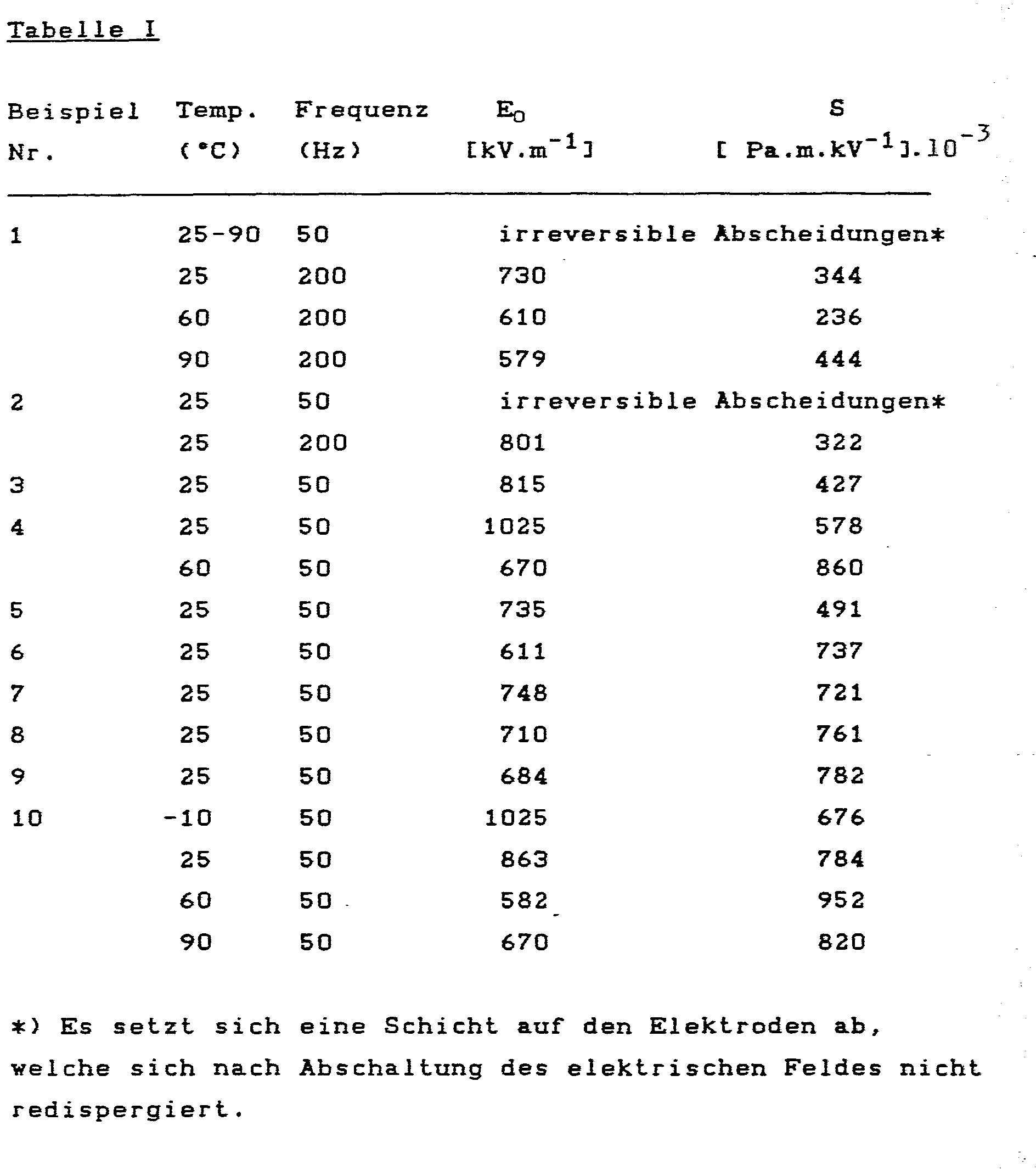
- the figure shows the dependence of the shear stress measured in the EVF as a function of the electric field strength at constant shear rate, Tables I and II the characteristic data of the EVF according to the invention in comparison with the prior art.
- the process engineering measures for the production of the EVF, the chemical production route for the dispersants, the measurement technology required to control the desired physical properties and typical exemplary embodiments for the EVF according to the invention are given.
- silica gels can be used to manufacture EVF. If necessary, the moisture content of the silica gel can be increased or decreased.
- the dispersion medium and part or all of the amount of dispersant are introduced and the silica gel is stirred into the dispersion medium with constant stirring.
- the silica gel can be quickly metered in at the beginning, while the silica gel is slowly added towards the end as the viscosity increases. If only a part of the dispersant is initially introduced, the remaining amount of dispersant is added simultaneously while the silica gel is being added.
- the type of mixing is also not critical for the end properties of the EVF. For example, simple stirring devices, ball mills or ultrasound can be used for dispersion. With intensive mixing, however, the dispersions can generally be produced more quickly and also become somewhat finer.
- the amount of dispersant required depends very much on the specific surface of the silica gel used. Approx. 1 to 4 mglm 2 are required as a guideline. However, the absolute amount required still depends on the type of silica gel used and the dispersant.
- silica gels are, for example, Ultrasil, Durosil, Extrusil from Degussa or Vulkasil, Silicasil and Baysikal types from Bayer.
- the silica gels used do not need to be pure Si0 2 and can easily contain up to 20 wt .-% A1 2 0 3 , Na 2 0 and Ca0. Furthermore, a few percent by weight of SO 3 , Cl and Fe 2 O 3 can often be present.
- the loss on ignition is the weight loss at 1000 . C, generally ranges between 10 and 15% by weight. An average of approx. 6% by weight of this is moisture, which is equivalent to the weight loss which is determined by drying at 105 ° C.
- the specific surface measured by the BET method, is generally between 20 and 200 m 2 / g. However, it is not critical and can be a bit smaller or larger. Too high a specific surface area can, however, lead to an excessive dispersant requirement, which can easily lead to an inadmissibly high intrinsic viscosity of the dispersion, particularly in the case of dispersants with higher molecular weights.
- Liquid hydrocarbons suitable as the dispersion medium can be paraffins, olefins and aromatic hydrocarbons. Since the EVF has the lowest possible basic viscosity and should also be used at higher temperatures, hydrocarbons with a boiling range between 150 and 220 ° C are preferred. Substances which also have a high flash point, such as e.g. Isododecane.
- ionic and preferably radical polymerization methods can be used to prepare the polymers, it being possible for the reaction to be carried out as a bulk, solution, precipitation, suspension or emulsion polymerization.
- a radical solution polymerization in non-polar solvents for example in toluene or isododecane, is particularly advantageous.
- the polymerization is initiated using conventional radical formers, such as peroxides and azo compounds.
- the electrode area of the inner rotating cylinder with a diameter of 50 mm is approximately 78 cm 2 , the gap between the electrodes is 0.58 mm.
- the shear load can be set up to a maximum of 2330 s -1 .
- the measuring range of the viscometer for the shear stress is a maximum of 750 Pa. Static and dynamic measurements are possible.
- the EVF can be excited with both DC voltage and AC voltage.
- a constant shear rate of 0 ⁇ D ⁇ 2330 s is set and the dependence of the shear stress T on the electrical field strength E is measured.
- Alternating fields can be measured with the test equipment up to a maximum effective field strength of 2370 kV / m at a maximum effective current of 4 mA and a frequency between 50 to 550 Hz. However, measurement is preferably carried out at 50 Hz, because then the total current is the lowest and the electrical power required is the lowest. Flow curves corresponding to the figure are obtained. It can be seen that the shear stress T initially increases parabolically with small field strengths and linearly with larger field strengths.
- the measurements can be repeated with different shear rates D.
- the values determined for E o and S generally range from about +5 % to + 20% around the mean.
- the thixotropy and the redispersibility of the samples were checked after 2 and after 6 weeks by assessing the flow behavior of the samples and the shaking time which is necessary to make the samples thin again.
- the shaking was done either by hand or, in the case of difficult redispersibility, with a shaking machine.
- recipes 1 and 2 correspond to the prior art.
- Examples 3 to 10 are the EVF according to the invention.
- the comparative examples were based on recipes according to Example III of British Patent 1,076,754, which show the best properties both with regard to strong electroviscous properties in a DC field and in an AC field.
- Table I lists the electroviscous properties and Table II lists the stability behavior of the samples.
- Silica gel approx. 80% by weight SiO 2 approx. 6% by weight CaO approx. 3% by weight Na 2 O ⁇ 0.4% by weight Al 2 O 3
- Dispersion medium isododecane
- the polymers can be isolated by precipitation with methanol. In general, however, the polymer solutions obtained are used directly for the production of EV liquids.
- Decyl methacrylate, NN-dimethylaminoethyl methacrylate and 1 g azoisobutyronitrile are dissolved in 500 g isododecane and heated to 60 ° C for 18 h.
- Decyl methacrylate, acrylonitrile and 1 g azoisobutyronitrile are dissolved in 500 g isododecane and kept at 60 ° C for 18 h.
- Dispersant CPY 1005 475 g of dodecyl methacrylate and 25 g of freshly distilled vinyl pyridine are dissolved in 500 g of isododecane and 1 g of azoisobutyronitrile is added. The solution is kept at 60 ° C. with stirring for 18 h.
Landscapes
- Chemical & Material Sciences (AREA)
- Chemical Kinetics & Catalysis (AREA)
- General Chemical & Material Sciences (AREA)
- Oil, Petroleum & Natural Gas (AREA)
- Organic Chemistry (AREA)
- Inorganic Chemistry (AREA)
- Compositions Of Macromolecular Compounds (AREA)
- Lubricants (AREA)
- Emulsifying, Dispersing, Foam-Producing Or Wetting Agents (AREA)
- Colloid Chemistry (AREA)
Abstract
Description
- Die Erfindung geht aus von elektroviskosen Suspensionen, welche mehr als 25 Gew.-% Silikagel mit einem Wassergehalt von 1 bis 15 Gew.-% als disperse Phase und flüssige Kohlenwasserstoffe als flüssige Phase sowie ein Dispergiermittel enthalten.
- Elektroviskose Flüssigkeiten (EVF) sind Dispersionen feinverteilter hydrophiler Feststoffe in hydrophoben elektrisch nicht leitenden Ölen, deren Viskosität sich unter dem Einfluß eines hinreichend starken elektrischen Feldes sehr schnell und reversibel vom flüssigen bis zum plastischen oder festen Zustand erhöhen läßt. Zur Änderung der Viskosität kann man sowohl elektrische Gleichfelder als auch Wechselfelder benutzen. Die dabei durch die EVF fließenden Ströme sind extrem niedrig. Daher lassen sich EVF überall dort einsetzen, wo die Übertragung großer Kräfte mit Hilfe geringer elektrischer Leistungen gesteuert werden soll, z.B. in Kupplungen, Hydraulikventilen, Stoßdämpfern, Vibratoren oder Vorrichtungen zum Positionieren und Festhalten von Werkstücken. Allgemeine, von der Praxis her gestellte Anforderungen bestehen darin, daß die EVF in einem Temperaturbereich von ca. -50.C bis 150.C flüssig und chemisch beständig ist und zumindest in einem Temperaturbereich von -30.C bis 110°C einen ausreichenden elektroviskosen Effekt zeigt. Wichtig ist weiter, daß die EVF in einem langen Zeitraum stabil bleibt, d.h. keine Phasentrennung stattfindet und sich insbesondere kein schwer redispergierbares Sediment bildet.
- EVF auf der Grundlage von Silikagel-Dispersionen in nicht leitenden ölen sind ausführlich in dem britischen Patent No. 1 076 754 beschrieben. Bei diesen Dispersionen sind wasserhaltige Silikagel-Teilchen in einem nicht leitenden Öl dispergiert. Der Wassergehalt der Silikagel-Teilchen und die Art,wie dieses Wasser gebunden ist, soll kritisch sein in bezug auf die Elektroaktivität der EVF. Zur Dispergierung der Teilchen werden nicht ionische Tenside und/oder Tenside benutzt, welche ein basisches N-Atom enthalten. Diese EVF neigen aber zu einem starken Absetzen und zur Bildung eines schwer redispergierbaren Sediments. Die Beispiele des vorgenannten Patentes beziehen sich daher auch auf stark thixotrope Flüssigkeiten und Pasten. Beides beschränkt aber die Anwendungsmöglichkeiten der EVF. Dies gilt insbesondere für die Verwendung einer thixotropen EVF als Kupplungsflüssigkeit oder die Verwendung einer Paste als Hydraulikflüssigkeit.
- Hier setzt die Erfindung an.
- Aufgabe der vorliegenden Erfindung ist es, EVF bereitzustellen, welche bei Raumtemperatur flüssige, nicht oder wenig thixotrope Dispersionen sind, möglichst bei längerem Stehen keine Phasentrennung zeigen oder bei einer Phasentrennung wenigstens leicht redispergierbar sind. Weiter sollte sie über einen größeren Temperaturbereich starke elektroviskose Effekte aufweisen und schnell und reversibel auf Änderungen des elektrischen Feldes reagieren.
- Diese Aufgabe wird, ausgehend von einer elektroviskosen Suspension auf der Basis von Silikagel und nicht leitender flüssiger Kohlenwasserstoffe, erfindungsgemäß dadurch gelöst, daß Dispergiermittel zugesetzt werden, welche in der flüssigen Kohlenwasserstoffphase lösliche Polymere sind, diese Polymere 0,1 bis 10 Gew.-% N und/oder OH sowie 25 bis 83 Gew.-% C4- bis C24-Alkylgruppen enthalten und ein Molekulargewicht im Bereich von 5·103 bis 106 haben. Dabei sind die polymeren Dispergiermittel mit einer Konzentration von 1 bis 30 Gew.-%, vorzugsweise bis 20 Gew.-%, bezogen auf die Silikateilchen, zugesetzt. Uberraschenderweise wurde hierbei weiter gefunden, daß mit Hilfe der vorgenannten polymeren Dispergiermittel deutlich stärkere elektroviskose Effekte erzielt werden können als mit den bekannten Dispergiermitteln.
- Als N-haltige Polymere sind in erster Linie Polymere geeignet, die Amin-, Amid-, Imid-, Nitril-Gruppen oder stickstoffhaltige 5- oder 6-gliedrige heterocyclische Ringe enthalten.
- Besonders geeignet sind Polymere, die zumindest anteilmäßig aus Monomeren mit folgenden Gruppen aufgebaut sind: Amingruppen:
- Aminoalkylmethacrylate und Acrylate, wie Dimethylaminoethylmethacrylat, 3-Dimethylamino-2,2-dimethyl-propylmethacrylat, NN-Dihydroxyethylaminoethylmethacrylat, Diethylaminoethylacrylat, N-Vinyl- und N-Allylamine, wie beispielsweise N-Vinylanilin.
- Amidgruppen:
- Acrylamid, Methacrylamid, einschließlich ihrer N-Alkylderivate, wie z.B. NN-Dimethylacrylamid und'Acrylanilid. Vinylderivate von Carbonsäureamiden, wie N-Vinylacetamid.
- Imidgruppen:
- Maleinimid und die N-substituierten Derivate.
- Nitrilgruppen:
- Acrylnitril und Methacrylnitril.
- 5-gliedrige Ringe:
- Vorzugsweise Derivate mit einem Pyrol-, Imidazol-, Pyrazol- oder Oxazolring, wie N-Vinylpyrrolidon, kernalkylierte N-Vinylpyrrolidone, N-Vinyl-2-methylimidazol, 3,5-Dimethyl-1-vinylpyrazol, 1-(4-Vinylphenyl)-pyrazoli- don-3, 4,5-Dimethyl-2-vinyloxazol, 2-Isopropenyl-4,5-dimethyloxazol, 5-Decyl-3-vinyl-oxazolidinon, 4-Ethyl-2-isopropenyl-4-methyl-oxazolinon-5.
- 6-gliedrige Ringe:
- Vorzugsweise Pyridinverbindungen, wie z.B. 2-Vinylpyridin, 4-Vinylpyridin, 2-Isopropenylpyridin, 5-Ethyl-2-vinylpyridin, 2-Dimethylamino-4-vinylpyridin.
- Geeignete OH-haltige Polymere enthalten vorzugsweise aliphatische, primäre, sekundäre oder tertiäre Alkoholgruppen. Beispielsweise können Copolymerisate mit Vinylalkoholeinheiten verwendet werden, die durch Hydrolyse der entsprechenden Vinylacetatcopolymerisate zugänglich sind. Weiterhin sind Polymere, die die folgenden Monomerbausteine beinhalten, gut geeignet:
- Hydroxyalkylmethacrylate, Hydroxyalkylacrylate, wie 2-Hydroxyethylmethacrylat, 2-Hydroxypropylmethacrylat und 3-Hydroxy-2,2-bis(hydroxymethyl)propylacrylat, Acrylamidderivate, wie N-Hydroxymethylacrylamid, Styrolderivate, wie «,«-Dimethyl-4-vinylbenzylalkohol.
- Neben den genannten N- und OH-Bausteinen enthält das Polymere 25 bis 83 Gew.-%, vorzugsweise 45 bis 78 Gew.-%, C4- bis C24-Alkylreste. Unter Alkylreste sind sowohl lineare als auch verzweigte Alkylreste zu verstehen. Besonders bevorzugt werden Alkylreste mit 8 bis 18 C-Atomen. Diese Alkylreste können Bestandteil der oben beschriebenen funktionellen Monomeren sein, wie z.B. bei Anwendung von 2-Vinyl-5-stearylpyridin. Im allgemeinen werden die Alkylgruppen jedoch durch Copolymerisation in das Polymere eingeführt. Geeignete Comonomere sind beispielsweise Stearylmethacrylat, Dodecylmethacrylat, Decylmethacrylat, 2-Ethylhexylmethacrylat sowie die entsprechenden Acrylatverbindungen.
- Die günstigen Eigenschaften des Polymeren bleiben erhalten, wenn in untergeordnetem Maße, beispielsweise bis zu maximal 35 Gew.-%, weitere bekannte Vinyl- und Vinylidenverbindungen, wie z.B. C1- bis C3-Alkylacrylat, C1- bis C3-AlKylmethacrylat, Vinylacetat, Vinylpropionat, Styrol, «-Methylstyrol, Butadien, Vinylchlorid oder Vinylidenchlorid mit copolymerisiert werden.
- Mit der Erfindung werden folgende Vorteile erzielt:
- Die erfindungsgemäßen EVF zeigen eine hohe Absetzstabilität und geringe Thixotropie und sind in jedem Falle wieder ganz leicht zu verflüssigen. Uberraschenderweise zeigen die erfindungsgemäßen EVF auch deutlich stärkere elektroviskose Effekte wie die bekannten EVF. Weiter reagieren sie vollkommen reversibel auf das angelegte elektrische Feld,unabhängig von der Frequenz, und sind über einen großen Temperaturbereich wirksam. Als weiterer Vorteil ist hervorzuheben, daß die Herstellung der EVF relativ einfach und daher preisgünstig ist und handelsübliche Silikagele als Ausgangsstoffe verwendet werden können.
- Im folgenden wird die Erfindung anhand von Beispielen, die in Diagrammen und mittels einer Tabelle verdeutlicht werden, näher erläutert.
- Die Figur zeigt die Abhängigkeit der bei der EVF gemessenen Schubspannung als Funktion der elektrischen Feldstärke bei konstanter Schergeschwindigkeit, die Tabellen I und II die charakteristischen Daten der erfindungsgemäßen EVF im Vergleich zum Stand der Technik. Es werden die verfahrenstechnischen Maßnahmen zur Herstellung der EVF, der chemische Herstellungsweg für die Dispergiermittel, die zur Kontrolle der gewünschten physikalischen Eigenschaften erforderliche Meßtechnik sowie typische Ausführungsbeispiele für die erfindungsgemäßen EVF angegeben.
- Zur Herstellung von EVF können handelsübliche Silikagele verwendet werden. Bei Bedarf kann der Feuchtegehalt des Silikagels erhöht oder erniedrigt werden. Bei der Herstellung der Dispersionen wird das Dispersionsmedium und ein Teil oder die gesamte Menge Dispergiermittel vorgelegt und unter ständigem Umrühren das Silikagel in das Dispersionsmedium eingerührt. Am Anfang kann das Silikagel schnell eindosiert werden, während gegen Ende mit zunehmender Viskosität das Silikagel langsam zugegeben wird. Wird am Anfang nur ein Teil des Dispergiermittels vorgelegt, so wird während der Zugabe des Silikagels die restliche Dispergiermittelmenge gleichzeitig mitzugegeben. Für die Endeigenschaften der EVF ist die Herstellungsprozedur aber nicht kritisch. Auch die Art der Vermischung ist nicht kritisch für die Endeigenschaften der EVF. Es können z.B. einfache Rührvorrichtungen, Kugelmühlen oder Ultraschall zur Dispergierung verwendet werden. Bei einer intensiven Vermischung können die Dispersionen aber im allgemeinen schneller hergestellt werden und dabei auch etwas feinteiliger werden.
- Die Menge des benötigten Dispergiermittels hängt stark von der spezifischen Oberfläche des verwendeten Silikagels ab. Als Richtwert werden ca. 1 bis 4 mglm2 benötigt. Die absolut benötigte Menge hängt aber weiter noch von der Art des verwendeten Silikagels sowie des Dispergiermittels ab.
- Handelsübliche Silikagele sind z.B. Ultrasil, Durosil, Extrusil der Fa. Degussa oder Vulkasil-, Silikasil- und Baysikal-Typen der Fa. Bayer. Die verwendeten Silikagele brauchen kein reines Si02 zu sein und können ohne weiteres bis zu 20 Gew.-% A1203, Na20 und Ca0 enthalten. Weiter können oft noch einige Gewichtsprozent SO3, Cl und Fe2O3 vorhanden sein. Der Glühverlust, das ist der Gewichtsverlust bei 1000.C, bewegt sich im allgemeinen zwischen 10 und 15 Gew.-%. Hiervon sind im Schnitt ca. 6 Gew.-% Feuchte, was gleichbedeutend ist mit dem Gewichtsverlust, der durch Trocknen bei 105°C bestimmt wird. Die spezifische Oberfläche, gemessen nach der BET-Methode, beträgt im allgemeinen zwischen 20 und 200 m2/g. Sie ist jedoch nicht kritisch und kann durchaus etwas kleiner oder größer sein. Eine zu hohe spezifische Oberfläche kann aber zu einem zu großen Dispergiermittelbedarf führen, welches insbesondere bei den Dispergiermitteln mit höheren Molekulargewichten leicht zu einer unzulässig hohen Grundviskosität der Dispersion führen kann.
- Als Dispersionsmedium geeignete flüssige Kohlenwasserstoffe können Paraffine, Olefine und aromatische Kohlenwasserstoffe verwendet werden. Da die EVF eine möglichst niedrige Grundviskosität aufweisen und außerdem bei höheren Temperaturen verwendet werden sollen, sind Kohlenwasserstoffe mit einem Siedebereich zwischen 150 und 220°C zu bevorzugen. Besonders zu bevorzugen sind weiterhin Substanzen, welche außerdem noch einen hohen Flammpunkt besitzen, wie z.B. Isododecan.
- Die Herstellung der als Dispergiermittel verwendeten Polymere ist dem Fachmann im Prinzip bekannt.
- Zur Herstellung der Polymerisate können bekannte ionische und vorzugsweise radikalische Polymerisationsmethoden angewendet werden, wobei die Reaktion als Masse, Lösungs-, Fällungs-, Suspensions- oder Emulsionspolymerisation geführt werden kann. Besonders vorteilhaft ist eine radikalische Lösungspolymerisation in unpolaren Lösungsmitteln, beispielsweise in Toluol oder Isododecan. Die Einleitung der Polymerisation erfolgt dabei mit üblichen Radikalbildnern, wie Peroxiden und Azoverbindungen.
- Die so hergestellten EVF wurden in einem modifizierten Rotationsviskosimeter untersucht, wie es bereits von W.M. Winslow in J. Appl. Phys. 20 (1949) Seite 1137 bis 1140, beschrieben wurde.
- Die Elektrodenfläche des inneren rotierenden Zylinders mit einem Durchmesser von 50 mm beträgt ca. 78 cm2, die Spaltweite zwischen den Elektroden 0,58 mm. Bei den dynamischen Messungen kann die Scherbelastung bis maximal 2330 s-1 eingestellt werden. Der Meßbereich des Viskosimeters für die Schubspannung beträgt maximal 750 Pa. Es sind statische und dynamische Messungen möglich. Die Anregung der EVF kann sowohl mit Gleichspannung als auch mit Wechselspannung erfolgen.
- Bei Anregung mit Gleichspannung können bei einigen Flüssigkeiten neben der spontanen Erhöhung der Viskosität oder der Fließgrenze beim Einschalten des Feldes auch noch langsame Abscheidungsvorgänge der festen Teilchen auf den Elektrodenoberflächen stattfinden, die das Meßergebnis verfälschen, insbesondere bei kleinen Schergeschwindigkeiten, bzw. bei statischen Messungen. Daher wird die Prüfung der EVF bevorzugt mit Wechselspannung und bei dynamischer Scherbeanspruchung durchgeführt. Man erhält so gut reproduzierbare Fließkurven.
- Zur Bestimmung der Elektroreaktivität stellt man eine konstante Schergeschwindigkeit 0 < D <2330 s ein und mißt die Abhängigkeit der Schubspannung T von der elektrischen Feldstärke E. Mit der Prüfapparatur können Wechselfelder bis zu einer maximalen effektiven Feldstärke von 2370 kV/m bei einem maximalen effektiven Strom von 4 mA und einer Frequenz zwischen 50 bis 550 Hz erzeugt werden. Vorzugsweise wird aber bei 50 Hz gemessen, weil dann der Gesamtstrom am niedrigsten und dadurch die benötigte elektrische Leistung am geringsten ist. Man erhält dabei Fließkurven entsprechend der Figur. Man erkennt, daß die Schubspannung T bei kleinen Feldstärken zunächst parabelförmig und bei größeren Feldstärken linear ansteigt. Die Steigung S des linearen Teils der Kurve kann aus der Figur entnommen werden und wird in Pa.m/kV angegeben. Aus dem Schnittpunkt der Geraden S mit der Geraden T = t0 (Schubspannung ohne elektrisches Feld) wird der Schwellwert Eo der elektrischen Feldstärke bestimmt und in kV/m angegeben. Für die Erhöhung der Schubspannung T (E) - τo im elektrischen Feld E > EO gilt:

- Die Messungen kann man mit verschiedenen Schergeschwindigkeiten D wiederholen. Die dabei bestimmten Werte für Eo, und S streuen im allgemeinen in einem Bereich von ca. +5 % bis + 20 % um den Mittelwert.
- Die Thixotropie und die Redispergierbarkeit der Proben wurde nach 2 und nach 6 Wochen geprüft durch Beurteilung des Fließverhaltens der Proben und der Aufschüttelzeit, die notwendig ist, um die Proben wieder dünnflüssig werden zu lassen. Das Aufschütteln geschah entweder von Hand oder bei schwerer Redispergierbarkeit mit einer Schüttelmaschine.
- Bei den nachfolgend beschriebenen Ausführungsbeispielen entsprechen die Rezepturen Nr. 1 und 2 dem Stand der Technik. Bei den Beispielen Nr. 3 bis 10 handelt es sich um die erfindungsgemäßen EVF. Bei den Vergleichsbeispielen wurden Rezepturen nach Beispiel III des britischen Patentes 1 076 754 zugrundegelegt, welche sowohl im Hinblick auf starke elektroviskose Eigenschaften in einem Gleichfeld als auch in einem Wechselfeld die besten Eigenschaften zeigen. In der Tabelle I sind die elektroviskosen Eigenschaften und in der Tabelle II das Stabilitätsverhalten der Proben aufgeführt.
- Silikagel: ca. 80 Gew.-% SiO2 ca. 6 Gew.-% CaO ca. 3 Gew.-% Na2O < 0,4 Gew.-% Al2O3
- Glühverlust nach DIN 55921/2: ca. 7 Gew.-% Trocknungsverlust nach DIN 55921/2: ca. 6 Gew.-% BET-Oberfläche: ca. 35 m2/g
- Dispersionsmedium: Isododecan
- Viskosität bei 25°C: 1,3 (mPa.s)
- Dichte bei 20°C: 0,75 (g/ml)
- Dielektrizitätskonstante bei 20°C: 2,1
- Die nachfolgenden polymeren Dispergiermittel wurden nach der folgenden allgemeinen Arbeitsweise hergestellt:
- In einem 2 Liter-Planschliffbecher mit Blattrührer, Gaseinlaß- und Gasauslaßrohr werden unter Sauerstoffausschluß Monomere und Starter in Isododecan gelöst. Unter Rühren mit 400 UpM und Stickstoffbegasung wird die Polymerisation bei der angegebenen Temperatur durchgeführt.
- Die Polymeren können durch Ausfällen mit Methanol isoliert werden. Im allgemeinen werden jedoch.die erhaltenen Polymerlösungen direkt zur Herstellung von EV-Flüssigkeiten eingesetzt.
- Dispergiermittel: CNH 1010 und CNH 1020
- Decylmethacrylat, NN-Dimethylaminoethylmethacrylat und 1 g Azoisobuttersäuredinitril werden in 500 g Isododecan gelöst und 18 h auf 60°C erhitzt.

- Dispergiermittel: CBA 1010
- Es werden 90 g Decylmethacrylat, 10 g tert.-Butylacrylamid und 2 g Dibenzoylperoxid in 400 g Isododecan 1 h bei 70°C und anschließend 1 h bei 90°C umgesetzt.
- Dispergiermittel: CVP 1010
- 180 g Decylmethacrylat und 20 g Vinylpyrrolidion gelöst in 800 g Isododecan werden mit 2 g Dibenzoylperoxid versetzt und 2 h auf 70°C gehalten. Anschließend werden weitere 2 g Dibenzoylperoxid zugesetzt und 2 h auf 90°C erhitzt.
- Feststoffgehalt der Lösung 18,9 % N-Gehalt des Feststoffs 1,1 %
- Dispergiermittel: COH 1002
- 245 g Dodecylmethacrylat, 2 g ß-Hydroxyethylmethacrylat und 0,5 g Azoisobuttersäuredinitril werden in 250 g Isododecan gelöst und 7 h auf 60°C erhitzt.
- Feststoffgehalt der Lösung 43 %
- [η] bei 25°C in Chloroform 1,5 [dl/g]
- Dispergiermittel: CCN 1005 und CCN 1010
- Decylmethacrylat, Acrylnitril und 1 g Azoisobuttersäuredinitril werden in 500 g Isododecan gelöst und 18 h bei 60°C gehalten.

- Dispergiermittel: CCN 805
- Wie CCN 1005, aber statt Decylmethacrylat wurde Ethylhexylmethacrylat verwendet.
- Dispergiermittel: CPY 1005 475 g Dodecylmethacrylat und 25 g frisch destilliertes Vinylpyridin werden in 500 g Isododecan gelöst und mit 1 g Azoisobuttersäuredinitril versetzt. Die Lösung wird unter Rühren 18 h bei 60°C gehalten.
- Feststoffgehalt der Lösung 43 %.
- Bei allen Beispielen wurden 50 Gew.-Teile Silikagel und 50 Gew.-Teile Isododecan verwendet. Nachfolgend wird nur noch die Art und die Menge des Dispergiermittels erwähnt. Die Menge bezieht sich dabei auf den Feststoffgehalt der Dispergiermittellösungen.
- 1,5 Gew.-Teile 2-Heptadecenyl-4-ethyl-2-oxazolin-4- methanol (Alkaterge E)
- 1,5 Gew.-Teile Glycerolmono- und -dioleat (Atmos 300)
- 2,5 Gew.-Teile 2-Heptadecenyl-4-ethyl-2-oxazolin-4- methanol (Alkaterge E)
- 2,5 Gew.-Teile Glycerolmono- und -dioleat (Atmos 300)
- 3,75 Gew.-Teile Dispergiermittel CNH 1010
- 5 Gew.-Teile Dispergiermittel CNH 1020
- 5 Gew.-Teile Dispergiermittel CBA 1010
- 7,5 Gew.-Teile Dispergiermittel COH 1002
- 2,5 Gew.-Teile Dispergiermittel CCN 1005
- 2,5 Gew.-Teile Dispergiermittel CCN 1010
- 5 Gew.-Teile Dispergiermittel CCN 805
- 5 Gew.-Teile Dispergiermittel CPY 1005
- 2,5 Gew.-Teile Dispergiermittel CNH 1010
- 2,5 Gew.-Teile Dispergiermittel CVP 1010

Claims (5)


Applications Claiming Priority (2)
| Application Number | Priority Date | Filing Date | Title |
|---|---|---|---|
| DE19853517281 DE3517281A1 (de) | 1985-05-14 | 1985-05-14 | Elektroviskose fluessigkeiten |
| DE3517281 | 1985-05-14 |
Publications (3)
| Publication Number | Publication Date |
|---|---|
| EP0201827A2 true EP0201827A2 (de) | 1986-11-20 |
| EP0201827A3 EP0201827A3 (en) | 1987-10-07 |
| EP0201827B1 EP0201827B1 (de) | 1989-11-08 |
Family
ID=6270659
Family Applications (1)
| Application Number | Title | Priority Date | Filing Date |
|---|---|---|---|
| EP86106109A Expired EP0201827B1 (de) | 1985-05-14 | 1986-05-05 | Elektroviskose Flüssigkeiten |
Country Status (5)
| Country | Link |
|---|---|
| US (1) | US4668417A (de) |
| EP (1) | EP0201827B1 (de) |
| JP (1) | JPH0710993B2 (de) |
| BR (1) | BR8602157A (de) |
| DE (2) | DE3517281A1 (de) |
Cited By (4)
| Publication number | Priority date | Publication date | Assignee | Title |
|---|---|---|---|---|
| EP0350167A1 (de) * | 1988-06-13 | 1990-01-10 | Castrol Limited | Funktionelle Flüssigkeiten |
| EP0636683A1 (de) * | 1993-07-30 | 1995-02-01 | Nippon Shokubai Co., Ltd. | Elektrorheologische Flüssigkeit |
| EP0699743A3 (de) * | 1994-08-19 | 1996-09-11 | Lubrizol Corp | Poläre Feststoffe und organische Halbleiter enthaltende elektrorheologische Flüssigkeiten |
| EP0699744A3 (de) * | 1994-08-19 | 1996-09-11 | Lubrizol Corp | Elektrorheologische Flüssigkeiten, enthaltend Partikeln eines polaren, festen Materials und eines inaktiven Polymermaterials |
Families Citing this family (33)
| Publication number | Priority date | Publication date | Assignee | Title |
|---|---|---|---|---|
| JP2693434B2 (ja) * | 1986-12-29 | 1997-12-24 | 株式会社ブリヂストン | サスペンション用減衰力発生装置およびそれの作動制御装置 |
| US4986689A (en) * | 1988-01-11 | 1991-01-22 | Trw Inc. | Ball joint |
| JPH01266195A (ja) * | 1988-04-19 | 1989-10-24 | Bridgestone Corp | 電気粘性液体 |
| US5266229A (en) * | 1988-05-12 | 1993-11-30 | Tonen Corporation | Stable electro-rheological fluid having a high viscosity-increasing effect |
| JPH02164438A (ja) * | 1988-12-17 | 1990-06-25 | Bridgestone Corp | 電気粘性液体 |
| US4992190A (en) * | 1989-09-22 | 1991-02-12 | Trw Inc. | Fluid responsive to a magnetic field |
| US5032308A (en) * | 1989-11-07 | 1991-07-16 | The Dow Chemical Company | Layered mixed metal hydroxides in electrorheological fluids |
| US5071581A (en) * | 1990-03-01 | 1991-12-10 | The Dow Chemical Company | Electrorheological fluids based on crown ethers and quaternary amines |
| JPH07108989B2 (ja) * | 1990-08-02 | 1995-11-22 | 株式会社コロイドリサーチ | 電気レオロジー流体 |
| DE4119670A1 (de) * | 1991-06-14 | 1992-12-17 | Bayer Ag | Elektroviskose fluessigkeit auf basis von polyetheracrylaten als disperse phase |
| DE4131142A1 (de) * | 1991-09-19 | 1993-03-25 | Bayer Ag | Elektroviskose fluessigkeit |
| CA2096130A1 (en) * | 1991-10-10 | 1993-04-11 | Joseph W. Pialet | Electrorheological fluids containing polyanilines |
| US5595680A (en) * | 1991-10-10 | 1997-01-21 | The Lubrizol Corporation | Electrorheological fluids containing polyanilines |
| DE4142634C1 (de) * | 1991-12-21 | 1993-03-25 | Heraeus Instruments Gmbh, 6450 Hanau, De | |
| US5336423A (en) * | 1992-05-05 | 1994-08-09 | The Lubrizol Corporation | Polymeric salts as dispersed particles in electrorheological fluids |
| AU666607B2 (en) * | 1993-03-12 | 1996-02-15 | Camp, Inc. | Electrorheological fluids with hydrocarbyl aromatic hydroxy compounds |
| US5412006A (en) * | 1994-03-14 | 1995-05-02 | Dow Corning Corporation | Electrorheological cels and a method for the preparation thereof |
| US5552076A (en) * | 1994-06-08 | 1996-09-03 | The Regents Of The University Of Michigan | Anhydrous amorphous ceramics as the particulate phase in electrorheological fluids |
| US5607996A (en) * | 1994-10-05 | 1997-03-04 | Ford Motor Company | Electrorheological elastomers useful as variable stiffness articles |
| DE19717693A1 (de) | 1997-04-26 | 1998-10-29 | Schenck Ag Carl | Stell- und Dämpfervorrichtung |
| DE19735897A1 (de) * | 1997-08-19 | 1999-02-25 | Bayer Ag | Kupplung |
| DE19735898A1 (de) | 1997-08-19 | 1999-02-25 | Schenck Ag Carl | Ventil und Stoßdämpfer auf Basis elektrorheologischer Flüssigkeiten |
| US6029783A (en) * | 1998-04-16 | 2000-02-29 | Wirthlin; Alvin R. | Variable resistance device using electroactive fluid |
| KR20010019614A (ko) | 1999-08-28 | 2001-03-15 | 윤덕용 | 다상계 전기유변유체 |
| US20020171067A1 (en) * | 2001-05-04 | 2002-11-21 | Jolly Mark R. | Field responsive shear thickening fluid |
| US7413063B1 (en) | 2003-02-24 | 2008-08-19 | Davis Family Irrevocable Trust | Compressible fluid magnetorheological suspension strut |
| DE102006031738A1 (de) * | 2006-07-10 | 2008-01-17 | Kastriot Merlaku | Brems-System für Fahrzeuge oder Maschinen aller Art |
| DE102011018177A1 (de) | 2011-04-19 | 2012-10-25 | Raino Petricevic | Paste und deren Verwendung |
| DE102012004586A1 (de) | 2012-03-09 | 2013-09-12 | Fludicon Gmbh | Elektrorheologische Zusammensetzung |
| WO2015057583A1 (en) | 2013-10-14 | 2015-04-23 | The United States Of America, As Represented By The Secretary | Treatment of chronic kidney disease with sahps |
| WO2016138160A1 (en) | 2015-02-24 | 2016-09-01 | The United States Of America, As Represented By The Secretary, Department Of Health And Human Services | Middle east respiratory syndrome coronavirus immunogens, antibodies, and their use |
| US10960070B2 (en) | 2016-10-25 | 2021-03-30 | The United States Of America, As Represented By The Secretary, Department Of Health And Human Services | Prefusion coronavirus spike proteins and their use |
| US20230381293A1 (en) | 2020-10-14 | 2023-11-30 | The United States Of America, As Represented By The Secretary, Department Of Health And Human Servic | Stabilized norovirus virus-like particles as vaccine immunogens |
Family Cites Families (6)
| Publication number | Priority date | Publication date | Assignee | Title |
|---|---|---|---|---|
| US3047507A (en) * | 1960-04-04 | 1962-07-31 | Wefco Inc | Field responsive force transmitting compositions |
| GB1076754A (en) * | 1964-06-09 | 1967-07-19 | Pure Oil Co | Electric field responsive fluid and method of preparation |
| DE1644951C3 (de) * | 1967-07-17 | 1974-01-10 | Shell Internationale Research Maatschappij N.V., Den Haag (Niederlande) | Verwendung eines Mischpolymerisats als Kraftübertragungs- und/oder Dämpfungsflüssigkeit oder als Bestandteil einer derartigen funktioneilen Flüssigkeit |
| US3397147A (en) * | 1968-01-10 | 1968-08-13 | Union Oil Co | Electroviscous fluid composition |
| US3970573A (en) * | 1975-08-25 | 1976-07-20 | Westhaver James W | Electroviscous fluids |
| CA1205590A (en) * | 1981-12-21 | 1986-06-03 | Shell Canada Limited | Dispersant-viscosity index improver product |
-
1985
- 1985-05-14 DE DE19853517281 patent/DE3517281A1/de not_active Withdrawn
-
1986
- 1986-04-24 US US06/855,873 patent/US4668417A/en not_active Expired - Fee Related
- 1986-05-05 DE DE8686106109T patent/DE3666835D1/de not_active Expired
- 1986-05-05 EP EP86106109A patent/EP0201827B1/de not_active Expired
- 1986-05-12 JP JP61106884A patent/JPH0710993B2/ja not_active Expired - Lifetime
- 1986-05-13 BR BR8602157A patent/BR8602157A/pt not_active IP Right Cessation
Cited By (5)
| Publication number | Priority date | Publication date | Assignee | Title |
|---|---|---|---|---|
| EP0350167A1 (de) * | 1988-06-13 | 1990-01-10 | Castrol Limited | Funktionelle Flüssigkeiten |
| AU622910B2 (en) * | 1988-06-13 | 1992-04-30 | Castrol Limited | Functional fluids |
| EP0636683A1 (de) * | 1993-07-30 | 1995-02-01 | Nippon Shokubai Co., Ltd. | Elektrorheologische Flüssigkeit |
| EP0699743A3 (de) * | 1994-08-19 | 1996-09-11 | Lubrizol Corp | Poläre Feststoffe und organische Halbleiter enthaltende elektrorheologische Flüssigkeiten |
| EP0699744A3 (de) * | 1994-08-19 | 1996-09-11 | Lubrizol Corp | Elektrorheologische Flüssigkeiten, enthaltend Partikeln eines polaren, festen Materials und eines inaktiven Polymermaterials |
Also Published As
| Publication number | Publication date |
|---|---|
| US4668417A (en) | 1987-05-26 |
| JPH0710993B2 (ja) | 1995-02-08 |
| JPS61259752A (ja) | 1986-11-18 |
| EP0201827A3 (en) | 1987-10-07 |
| BR8602157A (pt) | 1987-01-13 |
| DE3666835D1 (en) | 1989-12-14 |
| DE3517281A1 (de) | 1986-11-20 |
| EP0201827B1 (de) | 1989-11-08 |
Similar Documents
| Publication | Publication Date | Title |
|---|---|---|
| EP0201827B1 (de) | Elektroviskose Flüssigkeiten | |
| EP0219751B1 (de) | Elektroviskose Flüssigkeiten | |
| EP0170939B1 (de) | Elektroviskose Flüssigkeiten | |
| EP1353975B2 (de) | Verfahren zur herstellung von wasser-in-wasser-polymerdispersionen | |
| DE68921053T3 (de) | Hochleistungs-Polymer-Flokkuliermittel. | |
| EP1033378B1 (de) | Copolymere und ihre Verwendung als Bohrhilfsmittel | |
| DE2618898C2 (de) | ||
| DE69018118T2 (de) | Verdickte wässerige Zusammensetzungen. | |
| DE2537586A1 (de) | Latexpolymere mit hohem hlb | |
| DE69311241T2 (de) | Organosiloxane enthaltende verbesserte elektrorheologische Flüssigkeitszubereitungen | |
| DE69214962T2 (de) | Elektroviskose flüssigkeit | |
| EP0123297B1 (de) | Vernetzte hydrophile Copolymerisate, ihre Herstellung und Verwendung | |
| DE2432699C3 (de) | Verfahren zur Herstellung von sedimentationsstabilen Wasser-in-Öl-Dispersionen von Acrylamid-Polymerisaten | |
| EP0432601A1 (de) | Elektroviskose Flüssigkeiten auf der Basis dispergierter Polyether | |
| DE3912888C2 (de) | ||
| EP0557311B1 (de) | Neue wasser-in-öl-emulsionen | |
| DE69003231T2 (de) | Kosmetische oder pharmazeutische Zubereitungen enthaltend vernetzte carboxylische Copolymerisate als Verdicker. | |
| DE4022651C2 (de) | ||
| DE2333927C2 (de) | Flüssige, bzw. pumpfähige stabile Dispersionen von Typ Wasser-in-Öl und ihre Verwendung | |
| EP0208217B1 (de) | Umweltfreundliche Flockungsmittelorganosole | |
| DE2554082A1 (de) | Herstellung von stabilen wasser-in- oel-dispersionen von acrylamidpolymerisaten | |
| DE2520028C3 (de) | Flüssige, pumpfähige, stabile Dispersionen vom Typ Wasser-in-Öl und ihre Verwendung | |
| DE69434355T2 (de) | Elektrorheologische Flüssigkeit | |
| WO2016062655A1 (de) | Verfahren zur herstellung einer wässrigen polymerdispersion | |
| DE69024569T2 (de) | Herstellungsverfahren von Verbundwerkstoff aus porösen, hohlen Teilchen |
Legal Events
| Date | Code | Title | Description |
|---|---|---|---|
| PUAI | Public reference made under article 153(3) epc to a published international application that has entered the european phase |
Free format text: ORIGINAL CODE: 0009012 |
|
| 17P | Request for examination filed |
Effective date: 19860505 |
|
| AK | Designated contracting states |
Kind code of ref document: A2 Designated state(s): DE FR GB IT SE |
|
| PUAL | Search report despatched |
Free format text: ORIGINAL CODE: 0009013 |
|
| AK | Designated contracting states |
Kind code of ref document: A3 Designated state(s): DE FR GB IT SE |
|
| 17Q | First examination report despatched |
Effective date: 19890203 |
|
| GRAA | (expected) grant |
Free format text: ORIGINAL CODE: 0009210 |
|
| AK | Designated contracting states |
Kind code of ref document: B1 Designated state(s): DE FR GB IT SE |
|
| ITF | It: translation for a ep patent filed | ||
| ET | Fr: translation filed | ||
| REF | Corresponds to: |
Ref document number: 3666835 Country of ref document: DE Date of ref document: 19891214 |
|
| RAP2 | Party data changed (patent owner data changed or rights of a patent transferred) |
Owner name: METZELER GESELLSCHAFT MIT BESCHRAENKTER HAFTUNG Owner name: BAYER AG |
|
| GBT | Gb: translation of ep patent filed (gb section 77(6)(a)/1977) | ||
| PLBE | No opposition filed within time limit |
Free format text: ORIGINAL CODE: 0009261 |
|
| STAA | Information on the status of an ep patent application or granted ep patent |
Free format text: STATUS: NO OPPOSITION FILED WITHIN TIME LIMIT |
|
| 26N | No opposition filed | ||
| ITTA | It: last paid annual fee | ||
| EAL | Se: european patent in force in sweden |
Ref document number: 86106109.1 |
|
| PGFP | Annual fee paid to national office [announced via postgrant information from national office to epo] |
Ref country code: DE Payment date: 19970414 Year of fee payment: 12 |
|
| PGFP | Annual fee paid to national office [announced via postgrant information from national office to epo] |
Ref country code: FR Payment date: 19970425 Year of fee payment: 12 |
|
| PGFP | Annual fee paid to national office [announced via postgrant information from national office to epo] |
Ref country code: GB Payment date: 19970428 Year of fee payment: 12 |
|
| PGFP | Annual fee paid to national office [announced via postgrant information from national office to epo] |
Ref country code: SE Payment date: 19980324 Year of fee payment: 13 |
|
| PG25 | Lapsed in a contracting state [announced via postgrant information from national office to epo] |
Ref country code: GB Free format text: LAPSE BECAUSE OF NON-PAYMENT OF DUE FEES Effective date: 19980505 |
|
| PG25 | Lapsed in a contracting state [announced via postgrant information from national office to epo] |
Ref country code: FR Free format text: LAPSE BECAUSE OF NON-PAYMENT OF DUE FEES Effective date: 19980531 |
|
| GBPC | Gb: european patent ceased through non-payment of renewal fee |
Effective date: 19980505 |
|
| PG25 | Lapsed in a contracting state [announced via postgrant information from national office to epo] |
Ref country code: DE Free format text: LAPSE BECAUSE OF NON-PAYMENT OF DUE FEES Effective date: 19990302 |
|
| REG | Reference to a national code |
Ref country code: FR Ref legal event code: ST |
|
| PG25 | Lapsed in a contracting state [announced via postgrant information from national office to epo] |
Ref country code: SE Free format text: LAPSE BECAUSE OF NON-PAYMENT OF DUE FEES Effective date: 19990506 |
|
| EUG | Se: european patent has lapsed |
Ref document number: 86106109.1 |
|
| PG25 | Lapsed in a contracting state [announced via postgrant information from national office to epo] |
Ref country code: IT Free format text: LAPSE BECAUSE OF NON-PAYMENT OF DUE FEES;WARNING: LAPSES OF ITALIAN PATENTS WITH EFFECTIVE DATE BEFORE 2007 MAY HAVE OCCURRED AT ANY TIME BEFORE 2007. THE CORRECT EFFECTIVE DATE MAY BE DIFFERENT FROM THE ONE RECORDED. Effective date: 20050505 |