EP0202107B1 - Keramische Körper mit niedriger Ausdehnung und ihr Herstellungsverfahren - Google Patents
Keramische Körper mit niedriger Ausdehnung und ihr Herstellungsverfahren Download PDFInfo
- Publication number
- EP0202107B1 EP0202107B1 EP86303624A EP86303624A EP0202107B1 EP 0202107 B1 EP0202107 B1 EP 0202107B1 EP 86303624 A EP86303624 A EP 86303624A EP 86303624 A EP86303624 A EP 86303624A EP 0202107 B1 EP0202107 B1 EP 0202107B1
- Authority
- EP
- European Patent Office
- Prior art keywords
- cordierite
- weight
- ceramics
- low expansion
- mgo
- Prior art date
- Legal status (The legal status is an assumption and is not a legal conclusion. Google has not performed a legal analysis and makes no representation as to the accuracy of the status listed.)
- Expired
Links
- 239000000919 ceramic Substances 0.000 title claims description 98
- 238000000034 method Methods 0.000 title claims description 8
- JSKIRARMQDRGJZ-UHFFFAOYSA-N dimagnesium dioxido-bis[(1-oxido-3-oxo-2,4,6,8,9-pentaoxa-1,3-disila-5,7-dialuminabicyclo[3.3.1]nonan-7-yl)oxy]silane Chemical compound [Mg++].[Mg++].[O-][Si]([O-])(O[Al]1O[Al]2O[Si](=O)O[Si]([O-])(O1)O2)O[Al]1O[Al]2O[Si](=O)O[Si]([O-])(O1)O2 JSKIRARMQDRGJZ-UHFFFAOYSA-N 0.000 claims description 89
- DLYUQMMRRRQYAE-UHFFFAOYSA-N tetraphosphorus decaoxide Chemical compound O1P(O2)(=O)OP3(=O)OP1(=O)OP2(=O)O3 DLYUQMMRRRQYAE-UHFFFAOYSA-N 0.000 claims description 66
- 229910052878 cordierite Inorganic materials 0.000 claims description 55
- VYPSYNLAJGMNEJ-UHFFFAOYSA-N Silicium dioxide Chemical compound O=[Si]=O VYPSYNLAJGMNEJ-UHFFFAOYSA-N 0.000 claims description 32
- 239000002994 raw material Substances 0.000 claims description 28
- 238000010304 firing Methods 0.000 claims description 27
- 239000000463 material Substances 0.000 claims description 24
- PNEYBMLMFCGWSK-UHFFFAOYSA-N aluminium oxide Inorganic materials [O-2].[O-2].[O-2].[Al+3].[Al+3] PNEYBMLMFCGWSK-UHFFFAOYSA-N 0.000 claims description 20
- 239000000395 magnesium oxide Substances 0.000 claims description 20
- CPLXHLVBOLITMK-UHFFFAOYSA-N magnesium oxide Inorganic materials [Mg]=O CPLXHLVBOLITMK-UHFFFAOYSA-N 0.000 claims description 20
- 239000000203 mixture Substances 0.000 claims description 19
- 239000011148 porous material Substances 0.000 claims description 16
- 239000000377 silicon dioxide Substances 0.000 claims description 16
- 239000000126 substance Substances 0.000 claims description 15
- 239000002253 acid Substances 0.000 claims description 14
- 229910052681 coesite Inorganic materials 0.000 claims description 14
- 229910052593 corundum Inorganic materials 0.000 claims description 14
- 229910052906 cristobalite Inorganic materials 0.000 claims description 14
- 235000012239 silicon dioxide Nutrition 0.000 claims description 14
- 229910052682 stishovite Inorganic materials 0.000 claims description 14
- 229910052905 tridymite Inorganic materials 0.000 claims description 14
- 229910001845 yogo sapphire Inorganic materials 0.000 claims description 14
- 239000013078 crystal Substances 0.000 claims description 11
- 239000000454 talc Substances 0.000 claims description 11
- 229910052623 talc Inorganic materials 0.000 claims description 11
- XEEYBQQBJWHFJM-UHFFFAOYSA-N iron Substances [Fe] XEEYBQQBJWHFJM-UHFFFAOYSA-N 0.000 claims description 9
- 239000002245 particle Substances 0.000 claims description 9
- 239000004927 clay Substances 0.000 claims description 7
- 229910052570 clay Inorganic materials 0.000 claims description 7
- 239000011777 magnesium Substances 0.000 claims description 7
- 239000011701 zinc Substances 0.000 claims description 7
- 239000001095 magnesium carbonate Substances 0.000 claims description 6
- ZLNQQNXFFQJAID-UHFFFAOYSA-L magnesium carbonate Chemical compound [Mg+2].[O-]C([O-])=O ZLNQQNXFFQJAID-UHFFFAOYSA-L 0.000 claims description 6
- 235000014380 magnesium carbonate Nutrition 0.000 claims description 6
- 229910000021 magnesium carbonate Inorganic materials 0.000 claims description 6
- WNROFYMDJYEPJX-UHFFFAOYSA-K aluminium hydroxide Chemical compound [OH-].[OH-].[OH-].[Al+3] WNROFYMDJYEPJX-UHFFFAOYSA-K 0.000 claims description 5
- ILRRQNADMUWWFW-UHFFFAOYSA-K aluminium phosphate Chemical compound O1[Al]2OP1(=O)O2 ILRRQNADMUWWFW-UHFFFAOYSA-K 0.000 claims description 4
- 229910000398 iron phosphate Inorganic materials 0.000 claims description 4
- WBJZTOZJJYAKHQ-UHFFFAOYSA-K iron(3+) phosphate Chemical compound [Fe+3].[O-]P([O-])([O-])=O WBJZTOZJJYAKHQ-UHFFFAOYSA-K 0.000 claims description 4
- GVALZJMUIHGIMD-UHFFFAOYSA-H magnesium phosphate Chemical compound [Mg+2].[Mg+2].[Mg+2].[O-]P([O-])([O-])=O.[O-]P([O-])([O-])=O GVALZJMUIHGIMD-UHFFFAOYSA-H 0.000 claims description 4
- 239000004137 magnesium phosphate Substances 0.000 claims description 4
- 229960002261 magnesium phosphate Drugs 0.000 claims description 4
- 229910000157 magnesium phosphate Inorganic materials 0.000 claims description 4
- 235000010994 magnesium phosphates Nutrition 0.000 claims description 4
- 238000006467 substitution reaction Methods 0.000 claims description 3
- LRXTYHSAJDENHV-UHFFFAOYSA-H zinc phosphate Chemical compound [Zn+2].[Zn+2].[Zn+2].[O-]P([O-])([O-])=O.[O-]P([O-])([O-])=O LRXTYHSAJDENHV-UHFFFAOYSA-H 0.000 claims description 3
- 229910000165 zinc phosphate Inorganic materials 0.000 claims description 3
- 229910052782 aluminium Inorganic materials 0.000 claims 1
- 238000001035 drying Methods 0.000 claims 1
- 229910052749 magnesium Inorganic materials 0.000 claims 1
- 229910052698 phosphorus Inorganic materials 0.000 claims 1
- 229910052710 silicon Inorganic materials 0.000 claims 1
- 241000365446 Cordierites Species 0.000 description 52
- 239000012071 phase Substances 0.000 description 17
- 238000010306 acid treatment Methods 0.000 description 9
- 229910000147 aluminium phosphate Inorganic materials 0.000 description 9
- 239000011521 glass Substances 0.000 description 9
- 230000035939 shock Effects 0.000 description 9
- QAOWNCQODCNURD-UHFFFAOYSA-N sulfuric acid Substances OS(O)(=O)=O QAOWNCQODCNURD-UHFFFAOYSA-N 0.000 description 9
- 238000010438 heat treatment Methods 0.000 description 6
- 230000007547 defect Effects 0.000 description 5
- 238000005192 partition Methods 0.000 description 5
- NBIIXXVUZAFLBC-UHFFFAOYSA-N Phosphoric acid Chemical compound OP(O)(O)=O NBIIXXVUZAFLBC-UHFFFAOYSA-N 0.000 description 4
- 230000000694 effects Effects 0.000 description 4
- 238000005245 sintering Methods 0.000 description 4
- VEXZGXHMUGYJMC-UHFFFAOYSA-N Hydrochloric acid Chemical compound Cl VEXZGXHMUGYJMC-UHFFFAOYSA-N 0.000 description 3
- 238000002441 X-ray diffraction Methods 0.000 description 3
- 238000004458 analytical method Methods 0.000 description 3
- 230000015572 biosynthetic process Effects 0.000 description 3
- 239000012530 fluid Substances 0.000 description 3
- 230000004907 flux Effects 0.000 description 3
- 229910052742 iron Inorganic materials 0.000 description 3
- 239000007791 liquid phase Substances 0.000 description 3
- 238000012856 packing Methods 0.000 description 3
- 229910052725 zinc Inorganic materials 0.000 description 3
- ODINCKMPIJJUCX-UHFFFAOYSA-N Calcium oxide Chemical compound [Ca]=O ODINCKMPIJJUCX-UHFFFAOYSA-N 0.000 description 2
- DGAQECJNVWCQMB-PUAWFVPOSA-M Ilexoside XXIX Chemical compound C[C@@H]1CC[C@@]2(CC[C@@]3(C(=CC[C@H]4[C@]3(CC[C@@H]5[C@@]4(CC[C@@H](C5(C)C)OS(=O)(=O)[O-])C)C)[C@@H]2[C@]1(C)O)C)C(=O)O[C@H]6[C@@H]([C@H]([C@@H]([C@H](O6)CO)O)O)O.[Na+] DGAQECJNVWCQMB-PUAWFVPOSA-M 0.000 description 2
- GRYLNZFGIOXLOG-UHFFFAOYSA-N Nitric acid Chemical compound O[N+]([O-])=O GRYLNZFGIOXLOG-UHFFFAOYSA-N 0.000 description 2
- ZLMJMSJWJFRBEC-UHFFFAOYSA-N Potassium Chemical compound [K] ZLMJMSJWJFRBEC-UHFFFAOYSA-N 0.000 description 2
- -1 alkaline earths Chemical compound 0.000 description 2
- 239000000292 calcium oxide Substances 0.000 description 2
- 235000012255 calcium oxide Nutrition 0.000 description 2
- 239000003054 catalyst Substances 0.000 description 2
- 238000001816 cooling Methods 0.000 description 2
- 230000003247 decreasing effect Effects 0.000 description 2
- 239000012535 impurity Substances 0.000 description 2
- 239000004615 ingredient Substances 0.000 description 2
- AXZKOIWUVFPNLO-UHFFFAOYSA-N magnesium;oxygen(2-) Chemical compound [O-2].[Mg+2] AXZKOIWUVFPNLO-UHFFFAOYSA-N 0.000 description 2
- 238000002844 melting Methods 0.000 description 2
- 230000008018 melting Effects 0.000 description 2
- 238000000465 moulding Methods 0.000 description 2
- 229910052700 potassium Inorganic materials 0.000 description 2
- 239000011591 potassium Substances 0.000 description 2
- 238000007493 shaping process Methods 0.000 description 2
- 229910052708 sodium Inorganic materials 0.000 description 2
- 239000011734 sodium Substances 0.000 description 2
- 239000007787 solid Substances 0.000 description 2
- 239000006104 solid solution Substances 0.000 description 2
- XLYOFNOQVPJJNP-UHFFFAOYSA-N water Substances O XLYOFNOQVPJJNP-UHFFFAOYSA-N 0.000 description 2
- 239000005995 Aluminium silicate Substances 0.000 description 1
- 229910019142 PO4 Inorganic materials 0.000 description 1
- 229920002472 Starch Polymers 0.000 description 1
- HCHKCACWOHOZIP-UHFFFAOYSA-N Zinc Chemical compound [Zn] HCHKCACWOHOZIP-UHFFFAOYSA-N 0.000 description 1
- 230000002411 adverse Effects 0.000 description 1
- 229910052784 alkaline earth metal Inorganic materials 0.000 description 1
- 150000001342 alkaline earth metals Chemical class 0.000 description 1
- 235000012211 aluminium silicate Nutrition 0.000 description 1
- 229910021486 amorphous silicon dioxide Inorganic materials 0.000 description 1
- 229910010293 ceramic material Inorganic materials 0.000 description 1
- 238000002425 crystallisation Methods 0.000 description 1
- 230000008025 crystallization Effects 0.000 description 1
- 230000001419 dependent effect Effects 0.000 description 1
- 238000005516 engineering process Methods 0.000 description 1
- 238000001125 extrusion Methods 0.000 description 1
- 239000002241 glass-ceramic Substances 0.000 description 1
- 238000000227 grinding Methods 0.000 description 1
- 230000035876 healing Effects 0.000 description 1
- 239000012770 industrial material Substances 0.000 description 1
- KFZAUHNPPZCSCR-UHFFFAOYSA-N iron zinc Chemical compound [Fe].[Zn] KFZAUHNPPZCSCR-UHFFFAOYSA-N 0.000 description 1
- NLYAJNPCOHFWQQ-UHFFFAOYSA-N kaolin Chemical compound O.O.O=[Al]O[Si](=O)O[Si](=O)O[Al]=O NLYAJNPCOHFWQQ-UHFFFAOYSA-N 0.000 description 1
- 230000000670 limiting effect Effects 0.000 description 1
- 239000007788 liquid Substances 0.000 description 1
- 238000010137 moulding (plastic) Methods 0.000 description 1
- 229910017604 nitric acid Inorganic materials 0.000 description 1
- 230000036961 partial effect Effects 0.000 description 1
- 235000021317 phosphate Nutrition 0.000 description 1
- 150000003013 phosphoric acid derivatives Chemical class 0.000 description 1
- 239000000843 powder Substances 0.000 description 1
- 238000002360 preparation method Methods 0.000 description 1
- 230000002035 prolonged effect Effects 0.000 description 1
- 238000010298 pulverizing process Methods 0.000 description 1
- 238000011084 recovery Methods 0.000 description 1
- 238000001953 recrystallisation Methods 0.000 description 1
- 230000002829 reductive effect Effects 0.000 description 1
- 238000007569 slipcasting Methods 0.000 description 1
- 235000019698 starch Nutrition 0.000 description 1
- 239000008107 starch Substances 0.000 description 1
- 239000000758 substrate Substances 0.000 description 1
Images




Classifications
-
- C—CHEMISTRY; METALLURGY
- C04—CEMENTS; CONCRETE; ARTIFICIAL STONE; CERAMICS; REFRACTORIES
- C04B—LIME, MAGNESIA; SLAG; CEMENTS; COMPOSITIONS THEREOF, e.g. MORTARS, CONCRETE OR LIKE BUILDING MATERIALS; ARTIFICIAL STONE; CERAMICS; REFRACTORIES; TREATMENT OF NATURAL STONE
- C04B35/00—Shaped ceramic products characterised by their composition; Ceramics compositions; Processing powders of inorganic compounds preparatory to the manufacturing of ceramic products
- C04B35/01—Shaped ceramic products characterised by their composition; Ceramics compositions; Processing powders of inorganic compounds preparatory to the manufacturing of ceramic products based on oxide ceramics
- C04B35/16—Shaped ceramic products characterised by their composition; Ceramics compositions; Processing powders of inorganic compounds preparatory to the manufacturing of ceramic products based on oxide ceramics based on silicates other than clay
- C04B35/18—Shaped ceramic products characterised by their composition; Ceramics compositions; Processing powders of inorganic compounds preparatory to the manufacturing of ceramic products based on oxide ceramics based on silicates other than clay rich in aluminium oxide
- C04B35/195—Alkaline earth aluminosilicates, e.g. cordierite or anorthite
Definitions
- the present invention relates to low expansion ceramics, more particularly cordierite series dense, low expansion ceramics of excellent thermal shock resistant property, airtight property and heat resistant property.
- Thermal shock resistance of a ceramics is influenced by the thermal expansion coefficient (herein abbreviated to "CTE"), thermal conductivity, strength, elastic modulus, Poisson's ratio, etc. of the ceramics, by shape and size of products, and further by heating or cooling conditions of the ceramics, namely, heat transfer rate of the ceramics.
- CTE thermal expansion coefficient
- thermal shock resistance of ceramics is influenced largely by the thermal expansion coefficient, among the aforementioned factors, and is largely dependent exclusively on the thermal expansion coefficient especially when the heat transfer rate of the ceramics is large. Therefore, it has been sought to develop low expansion ceramics of excellent thermal shock resistance.
- Cordierite is known as a ceramic substance of relatively low expansion. However, it is generally difficult to produce dense cordierite by sintering. Particularly, when it is desired to produce low expansion cordierite of an average thermal expansion coefficient of not over than 2.0 ⁇ 10 ⁇ 6/°C in a temperature range of from ambient to 800°C, it has been necessary to restrict the amount of impurities such as calcia, alkaline earth metals, potassium, sodium and the like which act as a flux in producing the cordierite to a very minor amount, so that the resultant cordierite has a very small amount of glass phase and is very porous.
- impurities such as calcia, alkaline earth metals, potassium, sodium and the like which act as a flux in producing the cordierite
- cordierite honeycomb structures which are recently widely used as substrates for catalysts for purifying exhaust gas of automobiles require an average thermal expansion coefficient of not over than 1.5 ⁇ 10 ⁇ 6/°C in a temperature range of from ambient to 800°C, so that a raw material such as talc, kaolin, alumina or the like raw material of a low impurity or flux content is used.
- a raw material such as talc, kaolin, alumina or the like raw material of a low impurity or flux content is used.
- the open porosity of the cordierite produced is 25-45% at the minimum.
- cordierite ceramics for instance, as a honeycomb structure body of a regenerator type heat exchanger
- the honeycomb body has such a large open porosity that the pores, particularly the communicated pores, on the partition walls which define the passages of the honeycomb structure, cause leakage of fluids between a heating fluid and a heat recovery fluid.
- efficiency of the heat exchanger and efficiency of the total system wherein the heat exchanger is used become inferior.
- cordierite of high open porosity is used e.g. as a housing of a turbocharger or an exhaust manifold of an engine
- a serious drawback occurs that the interior air of high pressure leaks to the exterior of the manifold etc. due to the high open porosity. Therefore, it has been sought to develop dense and low expansion cordierite ceramics of good thermal shock resistance.
- JP-A-59-13,741 and JP-A-59-92,943 propose crystallized glass bodies produced by preparing compositions of main components of raw materials containing Y2O3 or ZnO with B2O3 and/or P2O5 added , firing the compositions to produce crystallized glass components, pulverizing or grinding the crystallized glass components to form glass frits of 2-7 ⁇ m, forming or moulding the glass frits to a desired shape, and refiring the shaped glass frits to obtain the crystallized glass bodies which, however, has a drawback of large thermal expansion coefficients of 2.4-2.6 ⁇ 10 ⁇ 6/°C.
- US-A-3,885,977 discloses a low expansion cordierite ceramics wherein crystal phases of cordierite ceramics are oriented in plane due to the use of planar clay or laminated clay in raw materials for the cordierite ceramics.
- the chemical composition is 46.6-53.0% SiO2, 33-41% Al2O3 and 11.5 to 16.5% MgO by weight. Thermal expansion coefficients of 1.0 ⁇ 10 ⁇ 6/°C can be achieved. However, the porosity of such materials remains high.
- US-A-3,958,058 discloses a process in which a starting crystalline cordierite material is leached by acid to effect selective removal of MgO and Al2O3.
- the product is an amorphous SiO2-rich phase, which is not a cordierite phase.
- Low thermal expansion coefficients, below 0.54 ⁇ 10 ⁇ 6/°C can be obtained.
- An object of the present invention is to obviate the drawbacks of the prior art mentioned above.
- Another object of the present invention is to provide dense and low expansion ceramics without vitrifying the ceramics.
- the present invention is set out in claim 1.
- the ceramics have CTE of 1.0 ⁇ 10 ⁇ 6/°C or less.
- the ceramics have a dimensional change of not more than ⁇ 0.05% when held at a temperature of 500-1,200°C for 1,000 hrs.
- Total pore volume of pores of diameters of 5 ⁇ m or more (abbreviated as "TVP of +5 ⁇ m", hereinafter) is usually about 0.06 ml/g or less in the present ceramics.
- the present invention provides a method as set out in claim 5.
- the shaping or forming of the prepared batch to a shaped body of a desired shape may be by a shaping treatment such as cast moulding including slip casting etc., plastic moulding including extrusion moulding etc., press forming, and the like.
- the firing is effected at 1,250-1,450°C for 2-20 hrs. If the firing temperature is below 1,250°C, the cordierite phases may not be formed sufficiently, while if the firing temperature is above 1,450°C the sintered body may be softened and deformed. Though the formation of the cordierite phases depends largely on the firing temperature, the cordierite phases may not be formed sufficiently, if the firing time is less than 2 hrs. While, if the firing time exceeds 20 hours, the sintered body may be liable to soften and deformed depending on the firing temperature.
- the acid treated body is heat treated at a temperature in the range of 1,150°C to the firing temperature to heal the defects formed in the sintered body by the acid treatment, thereby to diminish the dimensional change rate when held at 500-1,200°C for 1,000 hrs. to not more than ⁇ 0.05%.
- P2O5 contained in the raw materials of cordierite series ceramics is converted to AlPO4 during the firing of the raw materials, and substitutes a part of SiO2 in the cordierite crystals to form a cordierite series solid solution having a melting point which is slightly lower than that of unsubstituted cordierite ceramics.
- the amount of the liquid phase produced during the firing or sintering is increased, so that dense cordierite is easily produced.
- most of the liquid phase is crystallized in the cordierite series solid solution during the cooling following the sintering, so that the CTE is not increased.
- the raw materials can be selected from talc, clay, alumina, bluesite, magnesite, aluminum hydroxide and the like that are used for producing conventional cordierite ceramics, so as to orient the cordierite crystals in the ceramics, so that dense and low expansion ceramics of cordierite series ceramics can be obtained with low CTE of 2.0 ⁇ 10 ⁇ 6/°C or less.
- the acid treated ceramics is heat treated at a temperature in the range of 1,150°C to the firing temperature, so that the defects formed in the sintered body by the acid treatment are healed, so that the dimensional change of the heat treated ceramics becomes lessened to a small value of ⁇ 0.05% or less even when it is held in a prolonged thermal usage condition of 500-1,200°C for 1,000 hrs.
- Mg in the cordierite phase of the dense and low expansion ceramics can be replaced or substituted partially by Zn and/or Fe by 10 mol % at the maximum to provide useful iron cordierite, zinc cordierite or iron zinc cordierite which fall within the scope of the present invention.
- P2O5 source material is preferably selected from the group consisting of aluminum phosphate, magnesium phosphate, zinc phosphate, iron phosphate and combinations thereof.
- MgO source material, Al2O3 source material and SiO2 source material are preferably selected mainly from the group consisting of bluesite, magnesite, talc, clay, alumina and aluminum hydroxide. Further, magnesium oxide, silica etc. can be included in the group.
- the MgO source material such as bluesite, magnesite, talc and the like having an average particle diameter of not over than 5 ⁇ m is used in the raw materials, dense cordierite series ceramics of sufficiently airtight property can be obtained wherein the diameter of the remaining open pores are suppressed to not over than 5 ⁇ m and the open porosity is not over than 25% by volume.
- the present invention is based on a novel finding that dense and low expansion cordierite series ceramics of low open porosity of 25% by volume or less and low CTE of 2.0 ⁇ 10 ⁇ 6/°C or less can be obtained by solid solving 2-10% by weight of P2O5 in cordierite phases to convert P2O5 to AlPO4 by firing, and acid treating the fired or sintered body of open porosity of 15% by volume or less to selectively remove mainly P2O5 from the sintered body to a low P2O5 content of less than 2% by weight.
- the present invention is also based on a novel finding that dense and low expansion ceramics of dimensional change of ⁇ 0.05% or less when held at a temperature of 500-1,200°C for 1,000 hrs.
- the lower limit of P2O5 of 2% by weight in the raw materials is because sufficient amount of liquid phase for densifying the cordierite ceramics is not produced, so that dense cordierite series ceramics can not be obtained, if the amount of P2O5 is below the lower limit.
- the upper limit of P2O5 of 10% by weight in the raw materials is because an excessive amount of P2O5 exceeds the solid soluble amount permissible for converting P2O5 to AlPO4 in the cordierite, so that highly expansive cordierite series ceramics are produced.
- the reason why the dimensional change of the cordierite series ceramics when held at 500-1,200°C for 1,000 hrs. is defined to not over than ⁇ 0.05% is because the cordierite series ceramics can not be used practically as mechanical parts for high temperature use, if the dimensional change exceeds the defined value.
- the reason of defining the chemical composition of the batch of the raw materials of the cordierite series ceramics to the range as mentioned above is because cordierite phase are not produced sufficiently, so that highly expansive cordierite ceramics are produced, if the chemical composition of the batch is beyond the range specified above.
- the reason for selectively removing P2O5 from the sintered body to the low P2O5 content of less than 2% by weight by the acid treatment is because a P2O5 content of not less than 2% by weight can not achieve the desired sufficient low expansion effect of the ceramics.
- the reason for defining the chemical composition of the cordierite series ceramics after acid treatment to the range as mentioned above is because otherwise the purposed dense and low expansion ceramics of open porosity of 25% by volume or less and CTE of 2.0 ⁇ 10 ⁇ 6/°C or less are not provided.
- TVP of +5 ⁇ m is usually restricted to 0.06 ml/g or less, because leakage of pressurized gas depends on TVP of +5 ⁇ m, and leakage of the cordierite series ceramics can be reduced to half or less than that of convertional cordierite by restricting TVP of +5 ⁇ m to 0.06 ml/g or less.
- Mg in the cordierite phase 2MgO ⁇ 2Al2O3 ⁇ 5SiO2 of the ceramics can be substituted or replaced partially by Zn and/or Fe by 10 mol % at the maximum, because such substitution affords cordierite series ceramics of properties substantially equal to those of the cordierite series ceramics of the present invention not containing 2n or Fe.
- the reason for limiting the heat treatment temperature to the range of 1,150°C to the firing temperature is because at less than 1,150°C the defects formed in the sintered body by the acid treatment are not easily removed, while at more than the firing temperature recrystallization occurs and microstructures of the ceramics changes widely so that the desired properties cannot be achieved.
- P2O5 source from the group consisting of aluminum phosphate, magnesium phosphate, zinc phosphate, iron phosphate and mixtures thereof is because phosphoric acid is liquid so that it is difficult to mix and an inhomogeneous mixture results. Besides, phosphoric acid causes the ceramic materials to locally melt at low temperatures below the formation temperature of cordierite thereby to produce macropores, so that it is preferably added in the aforementioned form of water-insoluble phosphates of relatively higher melting points in the raw materials.
- MgO source material Al2O3 source material and SiO2 source material from the group consisting of bluesite, magnesite, talc, clay, alumina and aluminum hydroxide is because the cordierite series ceramics produced from these raw materials are particularly low expansive. Further, magnesium oxide for the MgO source material, silica and the like material for the SiO2 source material can be included in the group for the same reason.
- Average particle diameter of MgO source material is restricted to 5 ⁇ m or less, because the cordierite series ceramics produced by sintering have remaining pores in the skeleton of MgO source material particles, which skeleton pores become a cause of open pores, so that such restriction can suppress the formation of open pores of diameters of more than 5 ⁇ m and the desired highly airtight cordierite series ceramics can be obtained.
- Raw materials bluesite, magnesite, talc, alumina, aluminum hydroxide, clay, aluminum phosphate, magnesium phosphate and iron phosphate are prepared and mixed according to the recipes shown in the later-described Table 1. Particles of the raw materials were preliminarily adjusted to desired sizes. Chemical analysis values of the raw materials used are shown in the later-described Table 2. 100 parts of the mixture is added with 5-10 parts of water and 20 parts of starch paste (water content 80%), kneaded completely by a kneader, and extruded by a vacuum extruder to columnar bodies of 65 mm square and 120 mm length of honeycomb structure of a triangular cell shape of pitch of 1.0 mm and partition wall thickness of 0.10 mm. The honeycomb structure bodies are dried, fired at the firing conditions described in Table 1, and then acid treated with sulfuric acid, nitric acid or hydrochoric acid to obtain cordierite series ceramic honeycomb structures of Examples 1-13 and Referential Examples 1-10.
- the various cordierite series ceramic honeycomb structures of Table 1 so obtained are analyzed for comparison respectively for cordierite crystal contents by X-ray diffraction on powder thereof, CTE and open porosities.
- TVP of +5 ⁇ m are determined by mercury-urging type porosimeter. Leakage or leaked amounts of pressurized air through the thin partition walls thereof are measured by the following way.
- One end surface of the cordierite series ceramic honeycomb structure is airtightly sealed by a rubber packing of 65 mm ⁇ 65 mm size with a square hole of 20 mm ⁇ 20 mm at the center, and the other end surface of the honeycomb structure is airtightly sealed with a rubber packing of the same size but without the centeral square hole, and then pressurized air of pressure of 1.4 kg/cm2 is introduced into the honeycomb structure through the central hole of the rubber packing to measure a flow rate of the pressurized air leaking to the exterior through unit surface area of the partition walls of the honeycomb structure per unit of time so as to express the leakage by the dimension of kg/m2 ⁇ sec.
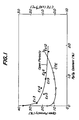
- Fig. 1 shows influences or effects of P2O5 content of the raw materials on open porosity and CTE of the product cordierite series ceramics, based on the results of Table 1.
- attached Fig. 2 is epicted based on the results of Table 1.
- the symbol * is for a talc raw material of an average particle diameter of 2.0 ⁇ m
- the symbol ** is for talc raw materials of an average particle diameter of 10.0 ⁇ m
- those without the symbols are for talc raw materials of an average particle diameter of 5.0 ⁇ m.
- Fig. 2 shows relations between weight decrease in % of the sintered body of the recipe of Example 4 and Referential Example 1 fired in the firing condition of Table 1 and treating time when treated with 1.5N-sulfuric acid at 95°C.
- Fig. 3 shows a relation between weight decrease rate in % of respective chemical ingredients of the sintered body of the recipe of Example 4 and fired in the firing condition of Table 1 and treating time when treated with 1.5N-sulfuric acid at 95°C.
- Fig. 4 shows relations between CTE of the sintered bodies of the recipe of Example 4 and Referential Example 1 fired in the firing conditions of Table 1 and treating time when treated with 1.5N-sulfuric acid at 95°C.
- the fired body containing P2O5 according to the present invention exchbits a remarkable effect of decrease of CTE by the acid treatment, compared with that not containing P2O5.
- the cordierite series ceramics of the present invention can achieve excellent airtight and thermal shock resistant properties suited well to structural material for high temperature use.
- Figs. 7 and 8 are microstructures respectively of the ceramics of Referential Examples 1 and 10, showing the structures are porous and have many large pores.
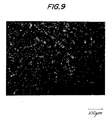
- Figs. 9 and 13 are microstructures respectively of the ceramics of Examples 4 and 13, showing the structures are dense and have few large pores.
- Fig. 10 is an X-ray diffraction chart of the ceramics of Example 4 by CuK ⁇ ray, showing that the main crystal phase is cordierite phase.
- the low expansion ceramics obtained in Examples 1-13 are acid treated with sulfuric, nitric or hydrochloric acid to selectively remove mainly P2O5, and further heat treated in the range 1,150°C to the firing temperature as shown in the following Table 3 to produce cordierite series ceramic honeycomb structures of Examples 14-26.
- Table 3 shows also cordierite series honeycomb structures of Examples 27-29 which are produced in the similar manner as in Examples 14-26 by using the chemical compositions, the recipes, the firing conditions, acid treatment conditions and the heat treatment conditons of Table 3.
- Cordierite crystal phases, CTE, the open porosity, TVP of +5 ⁇ m, and the leakage are measured in the same manner as mentioned above, and further the dimensional change in % of the ceramic honeycomb structures held at 1,200°C for 1,000 hrs. are measured with the aid of a micrometer by producing and using specimens of the honeycomb structure of a size of 5 mm x 5 mm and 50 mm length.
- the results are shown also in Table 1 and 3.
- Table 3 for the talc particle size the symbols * and ** and the items without the symbols have the same significance as in Table 1.
- the results are also shown in Figs. 11-13, partially.
- cordierite series ceramics of more preferable dimensional stability can be obtained which, after held at 1,200°C for 1,000 hrs., has small dimensional change of ⁇ 0.05% or less, so that they are particularly suited to structural materials for high temperature use which necessitate superior airtight property and excellent thermal shock resistant property owing to low CTE.
- the cordierite series ceramics of Example 17 has few large pores and is more dense as compared with those of Referential Examples 1 and 10 shown in Figs. 7 and 8.
- the present invention provides dense and low expansion ceramics with decreased dimensional change at high temperatures, while maintaining the low expansion property of cordierite, so that the low expansion ceramics of the present invention can be used in practice not only as ceramic regenerators (CRG), but also broadly as ceramic recuperators (CRP), ceramic turbocharger rotor (CTR) housing, gas turbine rotors, nuclear reactor materials, and various automobile parts such as engine muffler, exhaust port, exhaust manifold and exhaust gas purifying catalyst carrier, heat exchangers.
- CCG ceramic regenerators
- CRP ceramic recuperators
- CTR ceramic turbocharger rotor
- gas turbine rotors gas turbine rotors
- nuclear reactor materials nuclear reactor materials
- various automobile parts such as engine muffler, exhaust port, exhaust manifold and exhaust gas purifying catalyst carrier, heat exchangers.
Landscapes
- Engineering & Computer Science (AREA)
- Chemical & Material Sciences (AREA)
- Ceramic Engineering (AREA)
- Manufacturing & Machinery (AREA)
- Materials Engineering (AREA)
- Structural Engineering (AREA)
- Organic Chemistry (AREA)
- Compositions Of Oxide Ceramics (AREA)
Claims (8)
- Keramikmaterial mit niedrigem Ausdehnungskoeffizienten und einer chemischen Zusammensetzung, die umfaßt 8,0 bis 20,5 Gew.-% MgO, 24,0 bis 45,0 Gew.-% Al₂O₃, 40,5 bis 61,0 Gew.-% SiO₂, wobei das Magnesium in der Cordierit-Phase gegebenenfalls teilweise substituiert ist in einer Menge von höchstens 10 Mol-% durch Zn und/oder Fe, und das eine Cordierit-Phase als eine Hauptkristallphase und einen durchschnittlichen Wärmeausdehnungskoeffizienten in dem Temperaturbereich von 25 bis 800°C von nicht mehr als 2,0 x 10⁻⁶/°C aufweist, dadurch gekennzeichnet, daß die chemische Zusammensetzung 0,1 bis weniger als 2,0 Gew.-% P₂O₅ enthält und daß das Keramikmaterial eine offene Porosität von nicht mehr als 25 Vol.-% aufweist.
- Keramikmaterial mit niedrigem Ausdehnungskoeffizienten nach Anspruch 1, das einen durchschnittlichen Wärmeausdehnungskoeffizienten in dem Temperaturbereich von 25 bis 800°C von nicht mehr als 1,0 x 10⁻⁶/°C aufweist.
- Keramikmaterial mit niedrigem Ausdehnungskoeffizienten nach Anspruch 1 oder 2, das beim Halten bei einer Temperatur von 500 bis 1 200°C für 1 000 Stunden eine Dimensionsänderung von nicht mehr als + 0,05 % erfährt.
- Keramikmaterial mit niedrigem Ausdehnungskoeffizienten nach einem der Ansprüche 1 bis 3, das ein Gesamtporenvolumen der Poren mit einem Durchmesser von nicht weniger als 5 µm von nicht mehr als 0,06 ml/g aufweist.
- Verfahren zur Herstellung eines Keramikmaterials mit niedrigem Ausdehnungskoeffizienten, das umfaßt die Herstellung einer Charge von Ausgangsmaterialien mit einer chemischen Zusammensetzung, die umfaßt Mg, Al, Si und P in Mengen, ausgedrückt als MgO, Al₂O₃, SiO₂ und P₂O₅, von 7,5 bis 20,0 Gew.-% MgO, 22,0 bis 44,3 Gew.-% Al₂O₃, 37,0 bis 60,0 Gew.-% SiO₂ und 2,0 bis 10,0 Gew.-% P₂O₅, das Formender hergestellten Charge zu einem Formkörper, das Trocknen des Formkörpers, das Brennen des getrockneten Formkörpers zur Herstellung eines gesinterten Körpers und das Behandeln des gesinterten Körpers mit Säure, um selektiv hauptsächlich P₂O₅ aus dem gesinterten Körper zu entfernen zur Herstellung eines Keramikmaterials mit niedrigem Ausdehnungskoeffizienten, das aufweist einen P₂O₅-Gehalt von weniger als 2 Gew.-%, eine Cordierit-Phase als eine Hauptkristallphase, eine offene Porosität von nicht mehr als 25 Vol.-% und einen durchschnittlichen Wärmeausdehnungskoeffizienten in dem Temperaturbereich von 25 bis 800°C von nicht mehr als 2,0 x 10⁻⁶/°C, wobei das Mg in der Ausgangsmaterial-Charge gegebenenfalls teilweise substituiert ist zur Erzielung einer Mg-Substitution in der Cordierit-Phase durch Zn und/oder Fe in einer Menge von höchstens 10 Mol-%.
- Verfahren nach Anspruch 5, das außerdem umfaßt das Wärmebehandeln des säurebehandelten Körpers bei einer Temperatur in dem Bereich von 1 150°C bis zur Brenntemperatur.
- Verfahren nach Anspruch 5 oder 6, worin ein Quellenmaterial für das P₂O₅ ausgewählt wird aus Aluminiumphosphat, Magnesiumphosphat, Zinkphosphat und Eisenphosphat und das Quellenmaterial für das MgO, das Quellenmaterial für das Al₂O₃ und das Quellenmaterial für das SiO₂ hauptsächlich ausgewählt werden aus Bluesit, Magnesit, Talk, Ton, Aluminiumoxid und Aluminiumhydroxid.
- Verfahren nach einem der Ansprüche 5 bis 7, worin das Quellenmaterial für das MgO einen durchschnittlichen Teilchendurchmesser von nicht mehr als 5 µm hat.
Applications Claiming Priority (4)
| Application Number | Priority Date | Filing Date | Title |
|---|---|---|---|
| JP102385/85 | 1985-05-14 | ||
| JP60102385A JPS61261259A (ja) | 1985-05-14 | 1985-05-14 | 低膨脹セラミツクスとその製造方法 |
| JP102386/85 | 1985-05-14 | ||
| JP60102386A JPS61261260A (ja) | 1985-05-14 | 1985-05-14 | 低膨脹セラミツクスおよびその製造方法 |
Publications (3)
| Publication Number | Publication Date |
|---|---|
| EP0202107A2 EP0202107A2 (de) | 1986-11-20 |
| EP0202107A3 EP0202107A3 (en) | 1987-12-02 |
| EP0202107B1 true EP0202107B1 (de) | 1992-01-08 |
Family
ID=26443100
Family Applications (1)
| Application Number | Title | Priority Date | Filing Date |
|---|---|---|---|
| EP86303624A Expired EP0202107B1 (de) | 1985-05-14 | 1986-05-13 | Keramische Körper mit niedriger Ausdehnung und ihr Herstellungsverfahren |
Country Status (3)
| Country | Link |
|---|---|
| US (1) | US4722916A (de) |
| EP (1) | EP0202107B1 (de) |
| DE (1) | DE3683314D1 (de) |
Families Citing this family (20)
| Publication number | Priority date | Publication date | Assignee | Title |
|---|---|---|---|---|
| EP0227482B1 (de) * | 1985-12-27 | 1991-07-24 | Ngk Insulators, Ltd. | Gegenstand aus Cordierit mit Honigwabenstruktur und Methode zu dessen Produktion |
| US4877670A (en) * | 1985-12-27 | 1989-10-31 | Ngk Insulators, Ltd. | Cordierite honeycomb structural body and method of producing the same |
| US4869944A (en) * | 1987-02-12 | 1989-09-26 | Ngk Insulators, Ltd. | Cordierite honeycomb-structural body and a method for producing the same |
| JPH0669534B2 (ja) * | 1987-02-12 | 1994-09-07 | 日本碍子株式会社 | コージェライトハニカム構造体 |
| US5182584A (en) * | 1989-11-29 | 1993-01-26 | Mita Industrial Co., Ltd. | Multicolor developing device with improved movable frame arrangement |
| US5434896A (en) * | 1990-09-04 | 1995-07-18 | Combustion Engineering, Inc. | Wear resistant coating for components of fuel assemblies and control assemblies, and method of enhancing wear resistance of fuel assembly and control assembly components using wear-resistant coating |
| US5332703A (en) * | 1993-03-04 | 1994-07-26 | Corning Incorporated | Batch compositions for cordierite ceramics |
| DE4428322A1 (de) * | 1993-08-11 | 1995-02-23 | Technology Co Ag | Cordieritaggregat mit geringer thermischer Ausdehnung und daraus hergestellter Verbundkörper |
| JP2981107B2 (ja) * | 1994-03-07 | 1999-11-22 | 日本碍子株式会社 | コージェライトハニカムセラミックスの製造方法 |
| US6479104B1 (en) * | 1994-04-29 | 2002-11-12 | Mcdonnell Douglas Corporation | Cementitious ceramic surface having controllable reflectance and texture |
| US6265334B1 (en) * | 1997-10-24 | 2001-07-24 | Kyocera Corporation | Ceramic sintered product and process for producing the same |
| US6077796A (en) * | 1997-12-02 | 2000-06-20 | Corning Incorporated | Low CTE-low porosity cordierite bodies and method of making same |
| JP2000225340A (ja) * | 1998-11-30 | 2000-08-15 | Denso Corp | ハニカム構造体 |
| JP2000279823A (ja) | 1999-03-31 | 2000-10-10 | Ngk Insulators Ltd | セラミックハニカム構造体及びその製造方法 |
| BR0001560B1 (pt) | 1999-04-09 | 2010-04-06 | processo para produzir um corpo cerámico-catalisador, e, corpo cerámico-catalisador. | |
| JP2003502261A (ja) * | 1999-06-11 | 2003-01-21 | コーニング インコーポレイテッド | 低膨張/高多孔度/高強度コージエライト体及び方法 |
| JP4030320B2 (ja) * | 2001-03-22 | 2008-01-09 | 株式会社デンソー | セラミック体およびセラミック触媒体 |
| GB0115204D0 (en) * | 2001-06-21 | 2001-08-15 | Zellwerk Gmbh | Ceramic materials, method for their production and use thereof |
| JP3936238B2 (ja) * | 2002-05-20 | 2007-06-27 | 株式会社デンソー | 触媒体および触媒体の製造方法 |
| CN115974540B (zh) * | 2022-12-03 | 2023-11-24 | 昆明理工大学 | 一种稀土掺杂堇青石陶瓷材料及其制备方法 |
Family Cites Families (13)
| Publication number | Priority date | Publication date | Assignee | Title |
|---|---|---|---|---|
| US3531307A (en) * | 1967-02-23 | 1970-09-29 | Intern Pipe & Ceramics Corp | Ceramic article and method for producing same |
| SU409998A1 (de) * | 1971-02-15 | 1974-01-05 | ||
| US3881944A (en) * | 1972-12-11 | 1975-05-06 | Corning Glass Works | Porous glass-ceramic bodies for catalyst supports |
| DE2411757A1 (de) * | 1973-03-28 | 1974-10-10 | Corning Glass Works | Verfahren zur verbesserung der waermeschockfestigkeit von cordierit |
| US3885977A (en) * | 1973-11-05 | 1975-05-27 | Corning Glass Works | Anisotropic cordierite monolith |
| US3958058A (en) * | 1974-07-29 | 1976-05-18 | Corning Glass Works | Ultra-low expansion ceramic articles |
| JPS602270B2 (ja) * | 1976-04-08 | 1985-01-21 | 日本碍子株式会社 | コージエライト系セラミツクハニカムおよびその製法 |
| JPS589783B2 (ja) * | 1979-04-23 | 1983-02-22 | 日本碍子株式会社 | 低膨脹セラミツクス |
| US4268311A (en) * | 1979-11-01 | 1981-05-19 | Anchor Hocking Corporation | High strength cordierite ceramic |
| JPS5919069B2 (ja) * | 1980-04-02 | 1984-05-02 | 日本碍子株式会社 | 低膨脹セラミックス |
| JPS5920632B2 (ja) * | 1980-09-03 | 1984-05-14 | 日本碍子株式会社 | 低熱膨脹セラミツク製品およびその製造法 |
| JPS6035312B2 (ja) * | 1982-01-14 | 1985-08-14 | 工業技術院長 | 低膨脹性コ−デイエライトセラミツクスの製造法 |
| JPS5992943A (ja) * | 1982-11-15 | 1984-05-29 | Ngk Spark Plug Co Ltd | 結晶化ガラス体 |
-
1986
- 1986-05-12 US US06/861,703 patent/US4722916A/en not_active Expired - Lifetime
- 1986-05-13 EP EP86303624A patent/EP0202107B1/de not_active Expired
- 1986-05-13 DE DE8686303624T patent/DE3683314D1/de not_active Expired - Fee Related
Also Published As
| Publication number | Publication date |
|---|---|
| US4722916A (en) | 1988-02-02 |
| EP0202107A3 (en) | 1987-12-02 |
| EP0202107A2 (de) | 1986-11-20 |
| DE3683314D1 (de) | 1992-02-20 |
Similar Documents
| Publication | Publication Date | Title |
|---|---|---|
| EP0202107B1 (de) | Keramische Körper mit niedriger Ausdehnung und ihr Herstellungsverfahren | |
| EP0545008B1 (de) | Herstellung eines hochporöses Kordierit-Körpers mit geringer thermischer Ausdehnung | |
| US5030398A (en) | Method of producing a cordierite honeycomb structural body | |
| US4001028A (en) | Method of preparing crack-free monolithic polycrystalline cordierite substrates | |
| EP0037868B2 (de) | Verfahren zur Herstellung keramischer Materialien mit geringer Wärmedehnung | |
| US4295892A (en) | Cordierite ceramic honeycomb and a method for producing the same | |
| EP1261564B1 (de) | Herstellung von cordieritstrukturen mit ultradünnen wänden | |
| EP1027304B1 (de) | Verfahren zum brennen von keramischen wabenkörpern | |
| EP0613869B1 (de) | Zusammensetzung für Cordierit-Keramik | |
| US4772580A (en) | Catalyst carrier of cordierite honeycomb structure and method of producing the same | |
| EP0498934B1 (de) | Herstellung von Kordieritkörpern | |
| EP0227482B1 (de) | Gegenstand aus Cordierit mit Honigwabenstruktur und Methode zu dessen Produktion | |
| WO2006039255A2 (en) | Ceramic body based on aluminum titanate and including a glass phase | |
| JP3311650B2 (ja) | コージェライト質セラミックハニカム構造体の製造方法 | |
| US4883781A (en) | Heat resisting low expansion zirconyl phosphate-zircon composite | |
| EP0416823B1 (de) | Wärmebeständige gesinterte Phosphatkörper und Verfahren zu ihrer Herstellung | |
| JPH0582343B2 (de) | ||
| JPH0436113B2 (de) | ||
| JPH066506B2 (ja) | 低膨脹セラミックス製法 | |
| US5217934A (en) | Heat resistive phosphate-zircon composite bodies and process for producing same | |
| JPS62182158A (ja) | コ−ジェライトハニカム構造体及びその製造方法 | |
| JPH0436114B2 (de) | ||
| JPH0242788B2 (de) | ||
| EP0416796B1 (de) | Wärmebeständige Phosphat-Zirkoniumsilikat-Verbundkörper und Verfahren zu ihrer Herstellung | |
| JPH0242787B2 (de) |
Legal Events
| Date | Code | Title | Description |
|---|---|---|---|
| PUAI | Public reference made under article 153(3) epc to a published international application that has entered the european phase |
Free format text: ORIGINAL CODE: 0009012 |
|
| AK | Designated contracting states |
Kind code of ref document: A2 Designated state(s): BE DE FR GB SE |
|
| PUAL | Search report despatched |
Free format text: ORIGINAL CODE: 0009013 |
|
| AK | Designated contracting states |
Kind code of ref document: A3 Designated state(s): BE DE FR GB SE |
|
| 17P | Request for examination filed |
Effective date: 19880216 |
|
| 17Q | First examination report despatched |
Effective date: 19900115 |
|
| GRAA | (expected) grant |
Free format text: ORIGINAL CODE: 0009210 |
|
| AK | Designated contracting states |
Kind code of ref document: B1 Designated state(s): BE DE FR GB SE |
|
| REF | Corresponds to: |
Ref document number: 3683314 Country of ref document: DE Date of ref document: 19920220 |
|
| ET | Fr: translation filed | ||
| PLBE | No opposition filed within time limit |
Free format text: ORIGINAL CODE: 0009261 |
|
| STAA | Information on the status of an ep patent application or granted ep patent |
Free format text: STATUS: NO OPPOSITION FILED WITHIN TIME LIMIT |
|
| 26N | No opposition filed | ||
| EAL | Se: european patent in force in sweden |
Ref document number: 86303624.0 |
|
| PGFP | Annual fee paid to national office [announced via postgrant information from national office to epo] |
Ref country code: GB Payment date: 19990430 Year of fee payment: 14 |
|
| PGFP | Annual fee paid to national office [announced via postgrant information from national office to epo] |
Ref country code: FR Payment date: 19990514 Year of fee payment: 14 |
|
| PGFP | Annual fee paid to national office [announced via postgrant information from national office to epo] |
Ref country code: DE Payment date: 19990517 Year of fee payment: 14 |
|
| PGFP | Annual fee paid to national office [announced via postgrant information from national office to epo] |
Ref country code: SE Payment date: 19990518 Year of fee payment: 14 |
|
| PGFP | Annual fee paid to national office [announced via postgrant information from national office to epo] |
Ref country code: BE Payment date: 19990519 Year of fee payment: 14 |
|
| PG25 | Lapsed in a contracting state [announced via postgrant information from national office to epo] |
Ref country code: GB Free format text: LAPSE BECAUSE OF NON-PAYMENT OF DUE FEES Effective date: 20000513 |
|
| PG25 | Lapsed in a contracting state [announced via postgrant information from national office to epo] |
Ref country code: SE Free format text: LAPSE BECAUSE OF NON-PAYMENT OF DUE FEES Effective date: 20000514 |
|
| PG25 | Lapsed in a contracting state [announced via postgrant information from national office to epo] |
Ref country code: BE Free format text: LAPSE BECAUSE OF NON-PAYMENT OF DUE FEES Effective date: 20000531 |
|
| BERE | Be: lapsed |
Owner name: NGK INSULATORS LTD Effective date: 20000531 |
|
| GBPC | Gb: european patent ceased through non-payment of renewal fee |
Effective date: 20000513 |
|
| EUG | Se: european patent has lapsed |
Ref document number: 86303624.0 |
|
| PG25 | Lapsed in a contracting state [announced via postgrant information from national office to epo] |
Ref country code: FR Free format text: LAPSE BECAUSE OF NON-PAYMENT OF DUE FEES Effective date: 20010131 |
|
| PG25 | Lapsed in a contracting state [announced via postgrant information from national office to epo] |
Ref country code: DE Free format text: LAPSE BECAUSE OF NON-PAYMENT OF DUE FEES Effective date: 20010301 |
|
| REG | Reference to a national code |
Ref country code: FR Ref legal event code: ST |