EP0202436A2 - Verfahren zum Färben oder Bedrucken von Cellulosefasern oder Cellulosemischfasern - Google Patents
Verfahren zum Färben oder Bedrucken von Cellulosefasern oder Cellulosemischfasern Download PDFInfo
- Publication number
- EP0202436A2 EP0202436A2 EP86104441A EP86104441A EP0202436A2 EP 0202436 A2 EP0202436 A2 EP 0202436A2 EP 86104441 A EP86104441 A EP 86104441A EP 86104441 A EP86104441 A EP 86104441A EP 0202436 A2 EP0202436 A2 EP 0202436A2
- Authority
- EP
- European Patent Office
- Prior art keywords
- fibers
- carboxylic acid
- dyes
- dye
- water
- Prior art date
- Legal status (The legal status is an assumption and is not a legal conclusion. Google has not performed a legal analysis and makes no representation as to the accuracy of the status listed.)
- Withdrawn
Links
- 238000004043 dyeing Methods 0.000 title claims abstract description 49
- 238000000034 method Methods 0.000 title claims abstract description 36
- 230000008569 process Effects 0.000 title claims abstract description 28
- 239000000975 dye Substances 0.000 claims abstract description 70
- 239000000835 fiber Substances 0.000 claims abstract description 53
- 239000000985 reactive dye Substances 0.000 claims abstract description 40
- 229920003043 Cellulose fiber Polymers 0.000 claims abstract description 23
- 229920002678 cellulose Polymers 0.000 claims abstract description 11
- 239000001913 cellulose Substances 0.000 claims abstract description 11
- 150000001408 amides Chemical class 0.000 claims abstract description 6
- 125000002887 hydroxy group Chemical group [H]O* 0.000 claims abstract description 6
- 125000000542 sulfonic acid group Chemical group 0.000 claims abstract description 6
- PAYRUJLWNCNPSJ-UHFFFAOYSA-N Aniline Chemical compound NC1=CC=CC=C1 PAYRUJLWNCNPSJ-UHFFFAOYSA-N 0.000 claims abstract description 5
- 125000002485 formyl group Chemical class [H]C(*)=O 0.000 claims abstract description 4
- 125000005843 halogen group Chemical group 0.000 claims abstract description 4
- 239000012736 aqueous medium Substances 0.000 claims abstract description 3
- 150000002148 esters Chemical class 0.000 claims abstract description 3
- 125000004029 hydroxymethyl group Chemical group [H]OC([H])([H])* 0.000 claims abstract description 3
- 239000003086 colorant Substances 0.000 claims abstract 3
- -1 Cyano- Chemical class 0.000 claims description 64
- 239000000203 mixture Substances 0.000 claims description 20
- 229920000728 polyester Polymers 0.000 claims description 18
- 239000000986 disperse dye Substances 0.000 claims description 14
- 150000001732 carboxylic acid derivatives Chemical class 0.000 claims description 12
- 229920002284 Cellulose triacetate Polymers 0.000 claims description 6
- 239000004952 Polyamide Substances 0.000 claims description 5
- NNLVGZFZQQXQNW-ADJNRHBOSA-N [(2r,3r,4s,5r,6s)-4,5-diacetyloxy-3-[(2s,3r,4s,5r,6r)-3,4,5-triacetyloxy-6-(acetyloxymethyl)oxan-2-yl]oxy-6-[(2r,3r,4s,5r,6s)-4,5,6-triacetyloxy-2-(acetyloxymethyl)oxan-3-yl]oxyoxan-2-yl]methyl acetate Chemical compound O([C@@H]1O[C@@H]([C@H]([C@H](OC(C)=O)[C@H]1OC(C)=O)O[C@H]1[C@@H]([C@@H](OC(C)=O)[C@H](OC(C)=O)[C@@H](COC(C)=O)O1)OC(C)=O)COC(=O)C)[C@@H]1[C@@H](COC(C)=O)O[C@@H](OC(C)=O)[C@H](OC(C)=O)[C@H]1OC(C)=O NNLVGZFZQQXQNW-ADJNRHBOSA-N 0.000 claims description 5
- IEQIEDJGQAUEQZ-UHFFFAOYSA-N phthalocyanine Chemical class N1C(N=C2C3=CC=CC=C3C(N=C3C4=CC=CC=C4C(=N4)N3)=N2)=C(C=CC=C2)C2=C1N=C1C2=CC=CC=C2C4=N1 IEQIEDJGQAUEQZ-UHFFFAOYSA-N 0.000 claims description 5
- 229920002647 polyamide Polymers 0.000 claims description 5
- 150000003857 carboxamides Chemical class 0.000 claims description 4
- 229910052751 metal Inorganic materials 0.000 claims description 4
- 239000002184 metal Substances 0.000 claims description 4
- 229920002239 polyacrylonitrile Polymers 0.000 claims description 4
- 210000002268 wool Anatomy 0.000 claims description 4
- 125000003545 alkoxy group Chemical group 0.000 claims description 3
- PYKYMHQGRFAEBM-UHFFFAOYSA-N anthraquinone Chemical class CCC(=O)c1c(O)c2C(=O)C3C(C=CC=C3O)C(=O)c2cc1CC(=O)OC PYKYMHQGRFAEBM-UHFFFAOYSA-N 0.000 claims description 3
- 150000004056 anthraquinones Chemical class 0.000 claims description 3
- 125000000664 diazo group Chemical group [N-]=[N+]=[*] 0.000 claims description 3
- PPSZHCXTGRHULJ-UHFFFAOYSA-N dioxazine Chemical class O1ON=CC=C1 PPSZHCXTGRHULJ-UHFFFAOYSA-N 0.000 claims description 3
- NYGZLYXAPMMJTE-UHFFFAOYSA-M metanil yellow Chemical class [Na+].[O-]S(=O)(=O)C1=CC=CC(N=NC=2C=CC(NC=3C=CC=CC=3)=CC=2)=C1 NYGZLYXAPMMJTE-UHFFFAOYSA-M 0.000 claims description 3
- 125000000951 phenoxy group Chemical group [H]C1=C([H])C([H])=C(O*)C([H])=C1[H] 0.000 claims description 3
- VEPOHXYIFQMVHW-XOZOLZJESA-N 2,3-dihydroxybutanedioic acid (2S,3S)-3,4-dimethyl-2-phenylmorpholine Chemical class OC(C(O)C(O)=O)C(O)=O.C[C@H]1[C@@H](OCCN1C)c1ccccc1 VEPOHXYIFQMVHW-XOZOLZJESA-N 0.000 claims description 2
- PCNDJXKNXGMECE-UHFFFAOYSA-N Phenazine Chemical class C1=CC=CC2=NC3=CC=CC=C3N=C21 PCNDJXKNXGMECE-UHFFFAOYSA-N 0.000 claims description 2
- 125000002091 cationic group Chemical group 0.000 claims description 2
- 150000004985 diamines Chemical class 0.000 claims description 2
- 125000004435 hydrogen atom Chemical group [H]* 0.000 claims description 2
- 150000005125 dioxazines Chemical class 0.000 claims 2
- VMGAPWLDMVPYIA-HIDZBRGKSA-N n'-amino-n-iminomethanimidamide Chemical class N\N=C\N=N VMGAPWLDMVPYIA-HIDZBRGKSA-N 0.000 claims 2
- BOLDJAUMGUJJKM-LSDHHAIUSA-N renifolin D Chemical class CC(=C)[C@@H]1Cc2c(O)c(O)ccc2[C@H]1CC(=O)c3ccc(O)cc3O BOLDJAUMGUJJKM-LSDHHAIUSA-N 0.000 claims 2
- 150000004696 coordination complex Chemical class 0.000 claims 1
- 125000002924 primary amino group Chemical group [H]N([H])* 0.000 claims 1
- 239000001018 xanthene dye Substances 0.000 claims 1
- 150000001735 carboxylic acids Chemical class 0.000 abstract 4
- XLYOFNOQVPJJNP-UHFFFAOYSA-N water Substances O XLYOFNOQVPJJNP-UHFFFAOYSA-N 0.000 description 22
- 229920000742 Cotton Polymers 0.000 description 18
- 239000004744 fabric Substances 0.000 description 17
- FAPWRFPIFSIZLT-UHFFFAOYSA-M Sodium chloride Chemical compound [Na+].[Cl-] FAPWRFPIFSIZLT-UHFFFAOYSA-M 0.000 description 10
- 239000000460 chlorine Substances 0.000 description 9
- 239000011734 sodium Substances 0.000 description 9
- 229910052801 chlorine Inorganic materials 0.000 description 8
- 125000004432 carbon atom Chemical group C* 0.000 description 6
- 239000002657 fibrous material Substances 0.000 description 6
- 239000000243 solution Substances 0.000 description 6
- 125000001424 substituent group Chemical group 0.000 description 6
- WKBOTKDWSSQWDR-UHFFFAOYSA-N Bromine atom Chemical group [Br] WKBOTKDWSSQWDR-UHFFFAOYSA-N 0.000 description 5
- ZAMOUSCENKQFHK-UHFFFAOYSA-N Chlorine atom Chemical compound [Cl] ZAMOUSCENKQFHK-UHFFFAOYSA-N 0.000 description 5
- 125000000217 alkyl group Chemical group 0.000 description 5
- 239000003599 detergent Substances 0.000 description 5
- 239000011780 sodium chloride Substances 0.000 description 5
- 239000007864 aqueous solution Substances 0.000 description 4
- 239000003795 chemical substances by application Substances 0.000 description 4
- 239000000463 material Substances 0.000 description 4
- 125000002496 methyl group Chemical group [H]C([H])([H])* 0.000 description 4
- DVECLMOWYVDJRM-UHFFFAOYSA-N pyridine-3-sulfonic acid Chemical compound OS(=O)(=O)C1=CC=CN=C1 DVECLMOWYVDJRM-UHFFFAOYSA-N 0.000 description 4
- 150000003222 pyridines Chemical class 0.000 description 4
- 229920002994 synthetic fiber Polymers 0.000 description 4
- 239000012209 synthetic fiber Substances 0.000 description 4
- JIHQDMXYYFUGFV-UHFFFAOYSA-N 1,3,5-triazine Chemical group C1=NC=NC=N1 JIHQDMXYYFUGFV-UHFFFAOYSA-N 0.000 description 3
- KZBUYRJDOAKODT-UHFFFAOYSA-N Chlorine Chemical compound ClCl KZBUYRJDOAKODT-UHFFFAOYSA-N 0.000 description 3
- JUJWROOIHBZHMG-UHFFFAOYSA-N Pyridine Chemical group C1=CC=NC=C1 JUJWROOIHBZHMG-UHFFFAOYSA-N 0.000 description 3
- CDBYLPFSWZWCQE-UHFFFAOYSA-L Sodium Carbonate Chemical compound [Na+].[Na+].[O-]C([O-])=O CDBYLPFSWZWCQE-UHFFFAOYSA-L 0.000 description 3
- PMZURENOXWZQFD-UHFFFAOYSA-L Sodium Sulfate Chemical compound [Na+].[Na+].[O-]S([O-])(=O)=O PMZURENOXWZQFD-UHFFFAOYSA-L 0.000 description 3
- HEMHJVSKTPXQMS-UHFFFAOYSA-M Sodium hydroxide Chemical compound [OH-].[Na+] HEMHJVSKTPXQMS-UHFFFAOYSA-M 0.000 description 3
- 239000002253 acid Substances 0.000 description 3
- 125000003277 amino group Chemical group 0.000 description 3
- 239000011230 binding agent Substances 0.000 description 3
- 125000003178 carboxy group Chemical group [H]OC(*)=O 0.000 description 3
- 125000001495 ethyl group Chemical group [H]C([H])([H])C([H])([H])* 0.000 description 3
- 229910052736 halogen Inorganic materials 0.000 description 3
- 150000002367 halogens Chemical group 0.000 description 3
- 125000001449 isopropyl group Chemical group [H]C([H])([H])C([H])(*)C([H])([H])[H] 0.000 description 3
- PTMBWNZJOQBTBK-UHFFFAOYSA-N pyridin-4-ylmethanol Chemical compound OCC1=CC=NC=C1 PTMBWNZJOQBTBK-UHFFFAOYSA-N 0.000 description 3
- 150000003254 radicals Chemical class 0.000 description 3
- 239000001488 sodium phosphate Substances 0.000 description 3
- 229910052938 sodium sulfate Inorganic materials 0.000 description 3
- 235000011152 sodium sulphate Nutrition 0.000 description 3
- RYFMWSXOAZQYPI-UHFFFAOYSA-K trisodium phosphate Chemical compound [Na+].[Na+].[Na+].[O-]P([O-])([O-])=O RYFMWSXOAZQYPI-UHFFFAOYSA-K 0.000 description 3
- HXXLWTPFYWMBSC-UHFFFAOYSA-N 2-[3-chloro-4-[(2,6-dichloro-4-nitrophenyl)diazenyl]-n-(2-hydroxyethyl)anilino]ethanol Chemical compound ClC1=CC(N(CCO)CCO)=CC=C1N=NC1=C(Cl)C=C([N+]([O-])=O)C=C1Cl HXXLWTPFYWMBSC-UHFFFAOYSA-N 0.000 description 2
- PWRBCZZQRRPXAB-UHFFFAOYSA-N 3-chloropyridine Chemical compound ClC1=CC=CN=C1 PWRBCZZQRRPXAB-UHFFFAOYSA-N 0.000 description 2
- GZPHSAQLYPIAIN-UHFFFAOYSA-N 3-pyridinecarbonitrile Chemical compound N#CC1=CC=CN=C1 GZPHSAQLYPIAIN-UHFFFAOYSA-N 0.000 description 2
- BSDGZUDFPKIYQG-UHFFFAOYSA-N 4-bromopyridine Chemical compound BrC1=CC=NC=C1 BSDGZUDFPKIYQG-UHFFFAOYSA-N 0.000 description 2
- PVMNPAUTCMBOMO-UHFFFAOYSA-N 4-chloropyridine Chemical compound ClC1=CC=NC=C1 PVMNPAUTCMBOMO-UHFFFAOYSA-N 0.000 description 2
- GCNTZFIIOFTKIY-UHFFFAOYSA-N 4-hydroxypyridine Chemical compound OC1=CC=NC=C1 GCNTZFIIOFTKIY-UHFFFAOYSA-N 0.000 description 2
- XQABVLBGNWBWIV-UHFFFAOYSA-N 4-methoxypyridine Chemical compound COC1=CC=NC=C1 XQABVLBGNWBWIV-UHFFFAOYSA-N 0.000 description 2
- ORLGPUVJERIKLW-UHFFFAOYSA-N 5-chlorotriazine Chemical compound ClC1=CN=NN=C1 ORLGPUVJERIKLW-UHFFFAOYSA-N 0.000 description 2
- ONMOULMPIIOVTQ-UHFFFAOYSA-N 98-47-5 Chemical compound OS(=O)(=O)C1=CC=CC([N+]([O-])=O)=C1 ONMOULMPIIOVTQ-UHFFFAOYSA-N 0.000 description 2
- XBLVHTDFJBKJLG-UHFFFAOYSA-N Ethyl nicotinate Chemical compound CCOC(=O)C1=CC=CN=C1 XBLVHTDFJBKJLG-UHFFFAOYSA-N 0.000 description 2
- DFPAKSUCGFBDDF-UHFFFAOYSA-N Nicotinamide Chemical compound NC(=O)C1=CC=CN=C1 DFPAKSUCGFBDDF-UHFFFAOYSA-N 0.000 description 2
- 230000002378 acidificating effect Effects 0.000 description 2
- 230000009471 action Effects 0.000 description 2
- 125000001931 aliphatic group Chemical group 0.000 description 2
- GDTBXPJZTBHREO-UHFFFAOYSA-N bromine Substances BrBr GDTBXPJZTBHREO-UHFFFAOYSA-N 0.000 description 2
- 229910052794 bromium Inorganic materials 0.000 description 2
- 125000001246 bromo group Chemical group Br* 0.000 description 2
- 238000006243 chemical reaction Methods 0.000 description 2
- 230000008878 coupling Effects 0.000 description 2
- 238000010168 coupling process Methods 0.000 description 2
- 238000005859 coupling reaction Methods 0.000 description 2
- 125000004093 cyano group Chemical group *C#N 0.000 description 2
- HPNMFZURTQLUMO-UHFFFAOYSA-N diethylamine Chemical compound CCNCC HPNMFZURTQLUMO-UHFFFAOYSA-N 0.000 description 2
- TUXJTJITXCHUEL-UHFFFAOYSA-N disperse red 11 Chemical compound C1=CC=C2C(=O)C3=C(N)C(OC)=CC(N)=C3C(=O)C2=C1 TUXJTJITXCHUEL-UHFFFAOYSA-N 0.000 description 2
- 239000002270 dispersing agent Substances 0.000 description 2
- 229910052731 fluorine Inorganic materials 0.000 description 2
- 239000011737 fluorine Substances 0.000 description 2
- TWBYWOBDOCUKOW-UHFFFAOYSA-N isonicotinic acid Natural products OC(=O)C1=CC=NC=C1 TWBYWOBDOCUKOW-UHFFFAOYSA-N 0.000 description 2
- YNBADRVTZLEFNH-UHFFFAOYSA-N methyl nicotinate Chemical compound COC(=O)C1=CC=CN=C1 YNBADRVTZLEFNH-UHFFFAOYSA-N 0.000 description 2
- 125000004123 n-propyl group Chemical group [H]C([H])([H])C([H])([H])C([H])([H])* 0.000 description 2
- 230000007935 neutral effect Effects 0.000 description 2
- 125000000449 nitro group Chemical group [O-][N+](*)=O 0.000 description 2
- GPHQHTOMRSGBNZ-UHFFFAOYSA-N pyridine-4-carbonitrile Chemical compound N#CC1=CC=NC=C1 GPHQHTOMRSGBNZ-UHFFFAOYSA-N 0.000 description 2
- 150000003839 salts Chemical class 0.000 description 2
- 229910052708 sodium Inorganic materials 0.000 description 2
- 229910000162 sodium phosphate Inorganic materials 0.000 description 2
- 235000011008 sodium phosphates Nutrition 0.000 description 2
- LJRGBERXYNQPJI-UHFFFAOYSA-M sodium;3-nitrobenzenesulfonate Chemical compound [Na+].[O-][N+](=O)C1=CC=CC(S([O-])(=O)=O)=C1 LJRGBERXYNQPJI-UHFFFAOYSA-M 0.000 description 2
- 230000003068 static effect Effects 0.000 description 2
- 239000004753 textile Substances 0.000 description 2
- 238000005406 washing Methods 0.000 description 2
- JYEUMXHLPRZUAT-UHFFFAOYSA-N 1,2,3-triazine Chemical compound C1=CN=NN=C1 JYEUMXHLPRZUAT-UHFFFAOYSA-N 0.000 description 1
- ZLCUIOWQYBYEBG-UHFFFAOYSA-N 1-Amino-2-methylanthraquinone Chemical compound C1=CC=C2C(=O)C3=C(N)C(C)=CC=C3C(=O)C2=C1 ZLCUIOWQYBYEBG-UHFFFAOYSA-N 0.000 description 1
- FFRBMBIXVSCUFS-UHFFFAOYSA-N 2,4-dinitro-1-naphthol Chemical compound C1=CC=C2C(O)=C([N+]([O-])=O)C=C([N+]([O-])=O)C2=C1 FFRBMBIXVSCUFS-UHFFFAOYSA-N 0.000 description 1
- VQIRFOAILLIZOY-UHFFFAOYSA-N 2-[5-acetamido-n-(2-acetyloxyethyl)-4-[(2-bromo-4,6-dinitrophenyl)diazenyl]-2-ethoxyanilino]ethyl acetate Chemical compound C1=C(N(CCOC(C)=O)CCOC(C)=O)C(OCC)=CC(N=NC=2C(=CC(=CC=2Br)[N+]([O-])=O)[N+]([O-])=O)=C1NC(C)=O VQIRFOAILLIZOY-UHFFFAOYSA-N 0.000 description 1
- FOGYNLXERPKEGN-UHFFFAOYSA-N 3-(2-hydroxy-3-methoxyphenyl)-2-[2-methoxy-4-(3-sulfopropyl)phenoxy]propane-1-sulfonic acid Chemical compound COC1=CC=CC(CC(CS(O)(=O)=O)OC=2C(=CC(CCCS(O)(=O)=O)=CC=2)OC)=C1O FOGYNLXERPKEGN-UHFFFAOYSA-N 0.000 description 1
- NYPYPOZNGOXYSU-UHFFFAOYSA-N 3-bromopyridine Chemical compound BrC1=CC=CN=C1 NYPYPOZNGOXYSU-UHFFFAOYSA-N 0.000 description 1
- WNRKFPWXDQNVPN-UHFFFAOYSA-N 3-methoxypyridine Chemical compound COC1=C[C]=CN=C1 WNRKFPWXDQNVPN-UHFFFAOYSA-N 0.000 description 1
- MVQVNTPHUGQQHK-UHFFFAOYSA-N 3-pyridinemethanol Chemical compound OCC1=CC=CN=C1 MVQVNTPHUGQQHK-UHFFFAOYSA-N 0.000 description 1
- GRFNBEZIAWKNCO-UHFFFAOYSA-N 3-pyridinol Chemical compound OC1=CC=CN=C1 GRFNBEZIAWKNCO-UHFFFAOYSA-N 0.000 description 1
- FHVDTGUDJYJELY-UHFFFAOYSA-N 6-{[2-carboxy-4,5-dihydroxy-6-(phosphanyloxy)oxan-3-yl]oxy}-4,5-dihydroxy-3-phosphanyloxane-2-carboxylic acid Chemical compound O1C(C(O)=O)C(P)C(O)C(O)C1OC1C(C(O)=O)OC(OP)C(O)C1O FHVDTGUDJYJELY-UHFFFAOYSA-N 0.000 description 1
- GJCOSYZMQJWQCA-UHFFFAOYSA-N 9H-xanthene Chemical compound C1=CC=C2CC3=CC=CC=C3OC2=C1 GJCOSYZMQJWQCA-UHFFFAOYSA-N 0.000 description 1
- LSNNMFCWUKXFEE-UHFFFAOYSA-M Bisulfite Chemical compound OS([O-])=O LSNNMFCWUKXFEE-UHFFFAOYSA-M 0.000 description 1
- IAYPIBMASNFSPL-UHFFFAOYSA-N Ethylene oxide Chemical compound C1CO1 IAYPIBMASNFSPL-UHFFFAOYSA-N 0.000 description 1
- PXGOKWXKJXAPGV-UHFFFAOYSA-N Fluorine Chemical compound FF PXGOKWXKJXAPGV-UHFFFAOYSA-N 0.000 description 1
- YCKRFDGAMUMZLT-UHFFFAOYSA-N Fluorine atom Chemical compound [F] YCKRFDGAMUMZLT-UHFFFAOYSA-N 0.000 description 1
- DGAQECJNVWCQMB-PUAWFVPOSA-M Ilexoside XXIX Chemical compound C[C@@H]1CC[C@@]2(CC[C@@]3(C(=CC[C@H]4[C@]3(CC[C@@H]5[C@@]4(CC[C@@H](C5(C)C)OS(=O)(=O)[O-])C)C)[C@@H]2[C@]1(C)O)C)C(=O)O[C@H]6[C@@H]([C@H]([C@@H]([C@H](O6)CO)O)O)O.[Na+] DGAQECJNVWCQMB-PUAWFVPOSA-M 0.000 description 1
- 241001366278 Leptotes marina Species 0.000 description 1
- IGFHQQFPSIBGKE-UHFFFAOYSA-N Nonylphenol Natural products CCCCCCCCCC1=CC=C(O)C=C1 IGFHQQFPSIBGKE-UHFFFAOYSA-N 0.000 description 1
- 241000083869 Polyommatus dorylas Species 0.000 description 1
- YFPSDOXLHBDCOR-UHFFFAOYSA-N Pyrene-1,6-dione Chemical compound C1=CC(C(=O)C=C2)=C3C2=CC=C2C(=O)C=CC1=C32 YFPSDOXLHBDCOR-UHFFFAOYSA-N 0.000 description 1
- 239000004115 Sodium Silicate Substances 0.000 description 1
- XSQUKJJJFZCRTK-UHFFFAOYSA-N Urea Chemical compound NC(N)=O XSQUKJJJFZCRTK-UHFFFAOYSA-N 0.000 description 1
- 238000010521 absorption reaction Methods 0.000 description 1
- 125000000738 acetamido group Chemical group [H]C([H])([H])C(=O)N([H])[*] 0.000 description 1
- 125000002777 acetyl group Chemical group [H]C([H])([H])C(*)=O 0.000 description 1
- 125000002252 acyl group Chemical group 0.000 description 1
- 125000004442 acylamino group Chemical group 0.000 description 1
- 239000000654 additive Substances 0.000 description 1
- 229940072056 alginate Drugs 0.000 description 1
- 235000010443 alginic acid Nutrition 0.000 description 1
- 229920000615 alginic acid Polymers 0.000 description 1
- 229910052783 alkali metal Inorganic materials 0.000 description 1
- 229910001514 alkali metal chloride Inorganic materials 0.000 description 1
- 229910000318 alkali metal phosphate Inorganic materials 0.000 description 1
- 229910052936 alkali metal sulfate Inorganic materials 0.000 description 1
- 239000012670 alkaline solution Substances 0.000 description 1
- 125000004453 alkoxycarbonyl group Chemical group 0.000 description 1
- 125000003282 alkyl amino group Chemical group 0.000 description 1
- 125000004397 aminosulfonyl group Chemical group NS(=O)(=O)* 0.000 description 1
- 125000002490 anilino group Chemical group [H]N(*)C1=C([H])C([H])=C([H])C([H])=C1[H] 0.000 description 1
- 150000004984 aromatic diamines Chemical group 0.000 description 1
- 125000003118 aryl group Chemical group 0.000 description 1
- POJOORKDYOPQLS-UHFFFAOYSA-L barium(2+) 5-chloro-2-[(2-hydroxynaphthalen-1-yl)diazenyl]-4-methylbenzenesulfonate Chemical compound [Ba+2].C1=C(Cl)C(C)=CC(N=NC=2C3=CC=CC=C3C=CC=2O)=C1S([O-])(=O)=O.C1=C(Cl)C(C)=CC(N=NC=2C3=CC=CC=C3C=CC=2O)=C1S([O-])(=O)=O POJOORKDYOPQLS-UHFFFAOYSA-L 0.000 description 1
- 125000003236 benzoyl group Chemical group [H]C1=C([H])C([H])=C(C([H])=C1[H])C(*)=O 0.000 description 1
- 239000007853 buffer solution Substances 0.000 description 1
- 125000004106 butoxy group Chemical group [*]OC([H])([H])C([H])([H])C(C([H])([H])[H])([H])[H] 0.000 description 1
- 239000004202 carbamide Substances 0.000 description 1
- 125000001951 carbamoylamino group Chemical group C(N)(=O)N* 0.000 description 1
- 150000004649 carbonic acid derivatives Chemical class 0.000 description 1
- 230000008859 change Effects 0.000 description 1
- 238000012512 characterization method Methods 0.000 description 1
- 239000007795 chemical reaction product Substances 0.000 description 1
- 125000001309 chloro group Chemical group Cl* 0.000 description 1
- 238000004140 cleaning Methods 0.000 description 1
- 238000004040 coloring Methods 0.000 description 1
- 230000000052 comparative effect Effects 0.000 description 1
- 229910052802 copper Inorganic materials 0.000 description 1
- MGNCLNQXLYJVJD-UHFFFAOYSA-N cyanuric chloride Chemical compound ClC1=NC(Cl)=NC(Cl)=N1 MGNCLNQXLYJVJD-UHFFFAOYSA-N 0.000 description 1
- 125000004122 cyclic group Chemical group 0.000 description 1
- 125000004177 diethyl group Chemical group [H]C([H])([H])C([H])([H])* 0.000 description 1
- 238000009792 diffusion process Methods 0.000 description 1
- 125000000118 dimethyl group Chemical group [H]C([H])([H])* 0.000 description 1
- 230000000694 effects Effects 0.000 description 1
- 239000003792 electrolyte Substances 0.000 description 1
- 125000004185 ester group Chemical group 0.000 description 1
- 238000010016 exhaust dyeing Methods 0.000 description 1
- 125000005842 heteroatom Chemical group 0.000 description 1
- 125000001183 hydrocarbyl group Chemical group 0.000 description 1
- 230000007062 hydrolysis Effects 0.000 description 1
- 238000006460 hydrolysis reaction Methods 0.000 description 1
- 150000004679 hydroxides Chemical class 0.000 description 1
- 239000000543 intermediate Substances 0.000 description 1
- 238000010409 ironing Methods 0.000 description 1
- VFQXVTODMYMSMJ-UHFFFAOYSA-N isonicotinamide Chemical compound NC(=O)C1=CC=NC=C1 VFQXVTODMYMSMJ-UHFFFAOYSA-N 0.000 description 1
- QDLAGTHXVHQKRE-UHFFFAOYSA-N lichenxanthone Natural products COC1=CC(O)=C2C(=O)C3=C(C)C=C(OC)C=C3OC2=C1 QDLAGTHXVHQKRE-UHFFFAOYSA-N 0.000 description 1
- 239000002609 medium Substances 0.000 description 1
- 125000001624 naphthyl group Chemical group 0.000 description 1
- 229910052759 nickel Inorganic materials 0.000 description 1
- 235000005152 nicotinamide Nutrition 0.000 description 1
- 239000011570 nicotinamide Substances 0.000 description 1
- 229960003966 nicotinamide Drugs 0.000 description 1
- 235000001968 nicotinic acid Nutrition 0.000 description 1
- 239000011664 nicotinic acid Substances 0.000 description 1
- PVNIIMVLHYAWGP-UHFFFAOYSA-N nicotinic acid Natural products OC(=O)C1=CC=CN=C1 PVNIIMVLHYAWGP-UHFFFAOYSA-N 0.000 description 1
- 229960003512 nicotinic acid Drugs 0.000 description 1
- 229910052757 nitrogen Inorganic materials 0.000 description 1
- SNQQPOLDUKLAAF-UHFFFAOYSA-N nonylphenol Chemical compound CCCCCCCCCC1=CC=CC=C1O SNQQPOLDUKLAAF-UHFFFAOYSA-N 0.000 description 1
- 125000002080 perylenyl group Chemical group C1(=CC=C2C=CC=C3C4=CC=CC5=CC=CC(C1=C23)=C45)* 0.000 description 1
- CSHWQDPOILHKBI-UHFFFAOYSA-N peryrene Natural products C1=CC(C2=CC=CC=3C2=C2C=CC=3)=C3C2=CC=CC3=C1 CSHWQDPOILHKBI-UHFFFAOYSA-N 0.000 description 1
- 239000008363 phosphate buffer Substances 0.000 description 1
- 125000002572 propoxy group Chemical group [*]OC([H])([H])C(C([H])([H])[H])([H])[H] 0.000 description 1
- 239000001044 red dye Substances 0.000 description 1
- 230000009467 reduction Effects 0.000 description 1
- 239000004627 regenerated cellulose Substances 0.000 description 1
- 229910000029 sodium carbonate Inorganic materials 0.000 description 1
- 235000017550 sodium carbonate Nutrition 0.000 description 1
- 235000011121 sodium hydroxide Nutrition 0.000 description 1
- 235000019795 sodium metasilicate Nutrition 0.000 description 1
- 159000000000 sodium salts Chemical class 0.000 description 1
- NTHWMYGWWRZVTN-UHFFFAOYSA-N sodium silicate Chemical compound [Na+].[Na+].[O-][Si]([O-])=O NTHWMYGWWRZVTN-UHFFFAOYSA-N 0.000 description 1
- 229910052911 sodium silicate Inorganic materials 0.000 description 1
- 125000000547 substituted alkyl group Chemical group 0.000 description 1
- 125000000020 sulfo group Chemical group O=S(=O)([*])O[H] 0.000 description 1
- DIORMHZUUKOISG-UHFFFAOYSA-N sulfoformic acid Chemical compound OC(=O)S(O)(=O)=O DIORMHZUUKOISG-UHFFFAOYSA-N 0.000 description 1
- 229910052717 sulfur Inorganic materials 0.000 description 1
- 230000008719 thickening Effects 0.000 description 1
- 238000011282 treatment Methods 0.000 description 1
- 229910000406 trisodium phosphate Inorganic materials 0.000 description 1
- 235000019801 trisodium phosphate Nutrition 0.000 description 1
- YXZRCLVVNRLPTP-UHFFFAOYSA-J turquoise blue Chemical compound [Na+].[Na+].[Na+].[Na+].[Cu+2].NC1=NC(Cl)=NC(NC=2C=C(NS(=O)(=O)C3=CC=4C(=C5NC=4NC=4[N-]C(=C6C=CC(=CC6=4)S([O-])(=O)=O)NC=4NC(=C6C=C(C=CC6=4)S([O-])(=O)=O)NC=4[N-]C(=C6C=CC(=CC6=4)S([O-])(=O)=O)N5)C=C3)C(=CC=2)S([O-])(=O)=O)=N1 YXZRCLVVNRLPTP-UHFFFAOYSA-J 0.000 description 1
Classifications
-
- D—TEXTILES; PAPER
- D06—TREATMENT OF TEXTILES OR THE LIKE; LAUNDERING; FLEXIBLE MATERIALS NOT OTHERWISE PROVIDED FOR
- D06P—DYEING OR PRINTING TEXTILES; DYEING LEATHER, FURS OR SOLID MACROMOLECULAR SUBSTANCES IN ANY FORM
- D06P1/00—General processes of dyeing or printing textiles, or general processes of dyeing leather, furs, or solid macromolecular substances in any form, classified according to the dyes, pigments, or auxiliary substances employed
- D06P1/38—General processes of dyeing or printing textiles, or general processes of dyeing leather, furs, or solid macromolecular substances in any form, classified according to the dyes, pigments, or auxiliary substances employed using reactive dyes
-
- D—TEXTILES; PAPER
- D06—TREATMENT OF TEXTILES OR THE LIKE; LAUNDERING; FLEXIBLE MATERIALS NOT OTHERWISE PROVIDED FOR
- D06P—DYEING OR PRINTING TEXTILES; DYEING LEATHER, FURS OR SOLID MACROMOLECULAR SUBSTANCES IN ANY FORM
- D06P3/00—Special processes of dyeing or printing textiles, or dyeing leather, furs, or solid macromolecular substances in any form, classified according to the material treated
- D06P3/82—Textiles which contain different kinds of fibres
- D06P3/8204—Textiles which contain different kinds of fibres fibres of different chemical nature
- D06P3/8266—Textiles which contain different kinds of fibres fibres of different chemical nature mixtures of fibres containing hydroxyl and nitrile groups
-
- D—TEXTILES; PAPER
- D06—TREATMENT OF TEXTILES OR THE LIKE; LAUNDERING; FLEXIBLE MATERIALS NOT OTHERWISE PROVIDED FOR
- D06P—DYEING OR PRINTING TEXTILES; DYEING LEATHER, FURS OR SOLID MACROMOLECULAR SUBSTANCES IN ANY FORM
- D06P1/00—General processes of dyeing or printing textiles, or general processes of dyeing leather, furs, or solid macromolecular substances in any form, classified according to the dyes, pigments, or auxiliary substances employed
- D06P1/38—General processes of dyeing or printing textiles, or general processes of dyeing leather, furs, or solid macromolecular substances in any form, classified according to the dyes, pigments, or auxiliary substances employed using reactive dyes
- D06P1/382—General processes of dyeing or printing textiles, or general processes of dyeing leather, furs, or solid macromolecular substances in any form, classified according to the dyes, pigments, or auxiliary substances employed using reactive dyes reactive group directly attached to heterocyclic group
-
- D—TEXTILES; PAPER
- D06—TREATMENT OF TEXTILES OR THE LIKE; LAUNDERING; FLEXIBLE MATERIALS NOT OTHERWISE PROVIDED FOR
- D06P—DYEING OR PRINTING TEXTILES; DYEING LEATHER, FURS OR SOLID MACROMOLECULAR SUBSTANCES IN ANY FORM
- D06P3/00—Special processes of dyeing or printing textiles, or dyeing leather, furs, or solid macromolecular substances in any form, classified according to the material treated
- D06P3/58—Material containing hydroxyl groups
- D06P3/60—Natural or regenerated cellulose
- D06P3/66—Natural or regenerated cellulose using reactive dyes
- D06P3/663—Natural or regenerated cellulose using reactive dyes reactive group directly attached to heterocyclic group
-
- D—TEXTILES; PAPER
- D06—TREATMENT OF TEXTILES OR THE LIKE; LAUNDERING; FLEXIBLE MATERIALS NOT OTHERWISE PROVIDED FOR
- D06P—DYEING OR PRINTING TEXTILES; DYEING LEATHER, FURS OR SOLID MACROMOLECULAR SUBSTANCES IN ANY FORM
- D06P3/00—Special processes of dyeing or printing textiles, or dyeing leather, furs, or solid macromolecular substances in any form, classified according to the material treated
- D06P3/82—Textiles which contain different kinds of fibres
- D06P3/8204—Textiles which contain different kinds of fibres fibres of different chemical nature
- D06P3/8219—Textiles which contain different kinds of fibres fibres of different chemical nature mixtures of fibres containing hydroxyl and amide groups
-
- D—TEXTILES; PAPER
- D06—TREATMENT OF TEXTILES OR THE LIKE; LAUNDERING; FLEXIBLE MATERIALS NOT OTHERWISE PROVIDED FOR
- D06P—DYEING OR PRINTING TEXTILES; DYEING LEATHER, FURS OR SOLID MACROMOLECULAR SUBSTANCES IN ANY FORM
- D06P3/00—Special processes of dyeing or printing textiles, or dyeing leather, furs, or solid macromolecular substances in any form, classified according to the material treated
- D06P3/82—Textiles which contain different kinds of fibres
- D06P3/8204—Textiles which contain different kinds of fibres fibres of different chemical nature
- D06P3/8223—Textiles which contain different kinds of fibres fibres of different chemical nature mixtures of fibres containing hydroxyl and ester groups
- D06P3/8238—Textiles which contain different kinds of fibres fibres of different chemical nature mixtures of fibres containing hydroxyl and ester groups using different kinds of dye
- D06P3/8252—Textiles which contain different kinds of fibres fibres of different chemical nature mixtures of fibres containing hydroxyl and ester groups using different kinds of dye using dispersed and reactive dyes
-
- Y—GENERAL TAGGING OF NEW TECHNOLOGICAL DEVELOPMENTS; GENERAL TAGGING OF CROSS-SECTIONAL TECHNOLOGIES SPANNING OVER SEVERAL SECTIONS OF THE IPC; TECHNICAL SUBJECTS COVERED BY FORMER USPC CROSS-REFERENCE ART COLLECTIONS [XRACs] AND DIGESTS
- Y10—TECHNICAL SUBJECTS COVERED BY FORMER USPC
- Y10S—TECHNICAL SUBJECTS COVERED BY FORMER USPC CROSS-REFERENCE ART COLLECTIONS [XRACs] AND DIGESTS
- Y10S8/00—Bleaching and dyeing; fluid treatment and chemical modification of textiles and fibers
- Y10S8/916—Natural fiber dyeing
- Y10S8/918—Cellulose textile
Definitions
- the invention relates to a method for dyeing or printing cellulose fibers or cellulose mixed fibers with water-soluble reactive dyes with a certain structural element.
- the process according to the invention is particularly suitable for the single-bath dyeing of mixtures of cellulose and polyester fibers with combinations of water-soluble reactive dyes containing a certain structural element and disperse dyes.
- DE-OS 1 419 859, DE-PS 1 209 describes the use of dyes which contain a pyridinium residue or a pyridinium residue substituted by a methyl group bonded to the dye residue via the s-triazine ring for dyeing textile materials, in particular cellulose fiber materials 544, GB-PS 946 998, GB-PS 1 005 240 and GB-PS 1 012 625 known.
- the dyes are applied in conjunction with the use of acid-binding agents, such as sodium carbonate, sodium hydroxide, trisodium phosphate or sodium metasilicate, i.e. in an alkaline medium at temperatures from 0 to 100 ° C.
- the dyes used according to the processes cited in the references cited above have clear disadvantages with regard to their lower absorbency in the exhaust dyeing process when dyeing cellulose fiber materials.
- reactive dyes which are in the 3-position by a carboxyl or. Contain alkali metal carboxylate substituted pyridinium residue bound to the dye residue via the s-triazine ring, for dyeing cellulose fibers, or together with disperse dyes for dyeing cellulose mixed fibers, such as cellulose / polyester mixed fibers, by a one-bath process within a pH range of 4-10 at temperatures of 95-150 ° C is described in DE-OS 33 14 663.
- the fixing optimum of the reactive dyes used according to the invention is not in the alkaline range, but preferably around the neutral range, which makes them more suitable in a mixture with disperse dyes for single-bath dyeing of cellulose / polyester fiber mixtures.
- This avoids damage to the disperse dyes caused by the alkaline agents normally required in the one-step dyeing process for fixing the reactive dyes, which damage is manifested in color deviations, a reduction in the fastness level and loss of color strength.
- the hydrolysis of the reactive dyes used at the same time in the alkaline range, which occurs in the temperature range 110-140.degree. C., which is required for dyeing the polyester fiber portion with disperse dyes can be prevented, with the result that the dyeing yield is reduced.
- cellulose fibers or cellulose mixed fibers can be dyed very advantageously by treating the fibers mentioned with water-soluble reactive dyes which contain the structural element of the formula (1) at least once in the dye molecule. contain in which Y is a hydroxyl, hydroxymethyl, alkoxyC 1 -C 4 , aldehyde, carboxamide, carboxylic acid monoalkyl c , - C , amide, carboxylic acid dialkyl c , - C.
- amide carboxylic acid monophenylamide, cyano, Carboxylic acid alkyl c , - C , ester or sulfonic acid group or a halogena tom, for example a chlorine or bromine atom, means dyeing in an aqueous medium in the pH range 4-11.
- the mixture with the cellulose fibers can contain both synthetic fibers, such as, for example, polyester, polyamide, acid-modified polyacrylonitrile fibers or cellulose triacetate fibers, and native fibers, such as, for example, silk or wool, the fiber materials in any shape, for example as fibers, filaments, Strands or fabrics can be present.
- synthetic fibers such as, for example, polyester, polyamide, acid-modified polyacrylonitrile fibers or cellulose triacetate fibers
- native fibers such as, for example, silk or wool
- both the cellulose fiber portion and the portion of native fiber or synthetic polyamide fiber are dyed by the (acidic) reactive dyes used according to the invention alone.
- the reactive dyes with the structural element of the formula (1) mentioned, both after the exhaust process at temperatures of about 30-90 ° C., are preferred about 40-80 ° C, and also suitable for the padding process at temperatures of about 20-50 ° C, the optimum dyeing temperature to be used in each case depending on the cellulose fiber or cellulose mixed fiber to be dyed.
- the fiber material is impregnated with aqueous, optionally salt-containing dye solutions and the dyes are then optionally fixed under the action of heat.
- the reactive dyes mentioned are used together with the dyes suitable for the synthetic fibers, for example disperse dyes in the presence of mixed fibers made of cellulose and polyester or cellulose triacetate fibers in the temperature range from about 95 ° C. to about 150 ° C. at pH values between about 4 and 8, the addition of alkaline agents being generally unnecessary. It is advisable to add a suitable buffer system to maintain a precisely defined pH value. Since dyes are fixed with the structural element of formula (1) even without alkaline agents, cellulose-polyester or. Color cellulose-cellulose triacetate mixed fibers evenly from a bath without causing damage to the disperse dyes used at the same time.
- the two categories of dyes are dissolved or predispersed in a conventional manner and added to the aqueous dye liquor with the amount of electrolyte customary for exhaust processes.
- the pH of the dye liquor is adjusted to a pH between 4 and 8.
- the dye liquor containing the material to be dyed is heated and dyed at 95 ° C. to 150 ° C., preferably 110 ° C. and 135 ° C., for 30 to 90 minutes, or dyeing is carried out beforehand with a dye liquor containing a disperse dye and - for example, pre-stained for 20 minutes Completion of the dyeing process, the solution of the reactive dye in the high-temperature dyeing process in progress.
- the dyeings obtained by the process according to the invention are subjected to thorough rinsing with cold and hot water, if appropriate with the addition of an agent which has a dispersing action and promotes the diffusion of the unfixed portions.
- reactive dyes which contain the structural element of the formula (1) one or more times are suitable for dyeing cellulose fibers or the cellulose fiber fraction and, if appropriate, the other, non-synthetic fiber fraction of fiber mixtures by the process according to the invention, such dyes being used one or more times are preferred, which are characterized by a high affinity for cellulose fiber.
- Reactive dyes suitable for the process according to the invention are, for example, those of the following formulas: wherein D, D 'and D "are residues of an organic dye of the mono- or polyazo, metal complex azo, formazane, anthraquinone, phthalocyanine, dioxazine, phenazine, azomethine, xanthene, pyrenequinone or perylene tetracarboximide series, R is a hydrogen atom or an optionally substituted alkyl c , -C .
- X is an aliphatic, araliphatic or aromatic diamine residue
- Y is a hydroxyl, cyano, hydroxymethyl, alkoxyC 1 -C 4 , aldehyde, carboxamide, carboxylic acid monalkylC 1 -C 4 amide, carboxylic acid dialylC 1 -C 4 amide, carboxylic acid
- monophenylamide or carboxylic acid alkyl c , -C 4 ester group for example the carboxylic acid methyl, carboxylic acid ethyl, carboxylic acid or i-propyl ester group, furthermore a sulfonic acid group or a halogen atom, for example a chlorine or bromine atom, and Z is an unsubstituted, mono- or -disubstituted amino group, an alkoxy c , - C , or phenoxy group.
- the dye residues D, D 'and D "of the general formulas (2) to (7) can be substituted in the customary manner, in particular by one or more sulfonic acid groups.
- substituents are alkyl groups with 1 to 4 carbon atoms, such as in particular Methyl, ethyl, n- or i-propyl; alkoxy groups with 1 to 4 carbon atoms, such as methoxy, ethoxy, propoxy and butoxy; acylamino groups with 1 to 4 carbon atoms, such as in particular acetylamino and propionylamino; the amino group, alkylamino groups with 1 up to 4 carbon atoms, phenylamine and alkoxycarbonyl groups with 1 to 4 carbon atoms in the alkoxy radical; furthermore hydroxyl, carboxy, sulfonic acid, nitro, cyano, carbamoyl, sulfamoyl and ureido groups and halogen atoms,
- a straight-chain or branched alkylC 1 -C 4 radical which can be substituted by, for example, hydroxyl, sulfonic acid, sulfato or cyano groups, is suitable for R in formulas (2) to (7).
- R are methyl, ethyl, sulfomethyl, ⁇ -hydroxyethyl, ⁇ -hydroxypropyl, ⁇ -sulfoethyl, ⁇ -sulfatoethyl and ⁇ -cyanoethyl.
- Suitable substituents Z in the general formulas (2), (4), (6) and (7) are the amino group and alkylC 1 -C 4 amino groups, it being possible for the alkyl groups to be substituted, for example, by hydroxy, methoxy, carboxy, sulfato , Sulfo, cyano, alkylC 1 -C 4 amino or di (alkyl) C 1 -C 3 amino, where the alkyl radicals can in turn be substituted, for example by hydroxy, methoxy and sulfato, and an alkyl radical in Oi (alkylc, -C 3 ) -amino can be substituted by hydroxy, methoxy, sulfo, sulfato, carboxy and halogen, such as chlorine and bromine, further residues of cyclic amines such as piperidino, morpholino and piperazino, anilino, the latter optionally substituted by alkylC 1 -C 4 alkoxy C 1
- the dyes of the aforementioned general formulas (2) to (7) can be prepared, for example, by reacting the corresponding halotriazine dyes, where halogen is fluorine, chlorine or bromine, with pyridine derivatives in aqueous solution in the temperature range from about 40 ° C. to 120 ° C. in weakly acidic to alkaline pH range (pH approx. 5 to 9).
- the reactive residue of the general Formula (1) may be bound either to the rest of the diazo component or to the rest of the coupling component.
- the ring systems marked by dashed lines are to alternatively symbolize possible naphthalene rings.
- MePc means the Cu or Ni phthalocyanine residue and the number of substituents on the metal phthalocyanine residue is on average 3 to 4.
- the dye residues of all the structures mentioned can be further substituted in the alkyl or aryl residues, in particular by the substituents mentioned in the characterization of D, D 'and D ".
- the dyeing process according to the invention can also be carried out in such a way that in the dye bath the dyes of the general formulas (2) to (7) from the corresponding halotriazine-containing dyes and the pyridine derivatives mentioned in the pH range from 5 to 8 immediately before or during the Dyeing process can be produced.
- Halogen triazine-containing dyes are understood to mean those which contain a fluorine, chlorine or bromine atom on the s-triazinyl ring.
- the dye liquors can contain the generally customary additives, such as, for example, inorganic salts, such as alkali metal chlorides or alkali metal sulfates, or urea, and also dispersants and leveling aids.
- the dyeings produced with the dyes used according to the invention are distinguished by clear shades and by a high dye-fiber binding stability, by good to very good light fastness and very good wet fastness properties, such as fastness to washing, water, over-dyeing and perspiration, and through good pleating fastness, ironing fastness and rubbing fastness.
- the parts given are parts by weight, the temperature data relate to degrees Celsius.
- a dyebath is prepared by dissolving 2 parts of the dye of the formula and 50 parts of Na 2 SO. and 1 part sodium m-nitrobenzenesulfonic acid in 900 parts water.
- the dyebath is mixed with 50 parts of a cotton fabric at 40 ° C. and, after 45 minutes, 100 parts of a solution containing 2 parts of calcined soda are added. The temperature of the dyebath is kept at 60 ° C. for a further 45 minutes. The dyed cotton fabric is then rinsed, soaped at the boil with a nonionic detergent for about 10 minutes, rinsed again and finally dried. An intensely golden yellow color with very good fastness properties is obtained. '
- 2 parts of the reactive dye of the formula are dissolved in 200 parts of water. 800 parts of an aqueous solution containing 50 parts of Na 2 SO 4 are added to the solution, and a pH of 6.5 is set with 2 parts of phosphate buffer (from NaH 2 PO 4 and Na 2 HPO 4 .12H 2 O) a. 100 parts of a cotton fabric are placed in this dye bath. The temperature is then raised to 125 ° C. in about 20 minutes under static pressure and dyeing is continued at this temperature for 1 hour. Then the dye bath is allowed to cool.
- phosphate buffer from NaH 2 PO 4 and Na 2 HPO 4 .12H 2 O
- the dyed goods are then rinsed with water, soaped at the boil with a nonionic detergent for about 15 minutes, rinsed again with water and dried. A deep bluish red color is obtained which has very good fastness properties.
- a dyebath is prepared from 800 parts of water, 1 part of a reactive dye of the following formula 2 parts CI Disperse Orange 25.11 227, 20 parts Na 2 S0., 1 part sodium m-nitrobenzenesulfonate and 2 parts of a dispersing agent customary in disperse dyes, such as lignosulfonic acid.
- the resulting dye is salted out with sodium chloride at room temperature, suction filtered, washed with a 5% sodium chloride solution and dried.
- the reactive dyes used according to Examples 1 and 2 were prepared quite analogously by reacting the corresponding monochlorotriazine dyes with nicotinamide or 3-chloropyridine.
- a blend of 67% polyester fibers and 33% cotton is dyed with an aqueous liquor which - based on the weight of the dry goods - 1.5% of the disperse dye (in commercial form and Texture) of the formula 1.5% of the reactive dye of the formula and contains 60 g / l sodium chloride.
- the pH of the dye liquor is adjusted to 6.0.
- the textile material is dyed with this dyebath at 130 ° C. for 1 hour. After the usual rinsing and soaping process, a lively turquoise blue color is obtained on both fiber portions, which has very good fastness properties.
- the monochlorotriazine dye is reacted with iso-nicotinamide within 16 hours at 80 ° C.
- cross-wound bobbins made of mercerized cotton yarn are dyed with a liquor which contains an aqueous solution of 1% (by weight of the dry yarn) of the reactive dye of the formula and contains 50 g / l sodium chloride.
- the pH is adjusted to 6.2.
- the material to be dyed is passed into the dyebath at room temperature, the liquor is heated to the dying temperature of 120 ° C. and the goods are dyed at this temperature for about 1 hour.
- the mixture is then left to cool, the dyeing obtained is rinsed hot and cold with water and the dyed cotton yarn is finally dried. An intense navy blue coloration is obtained which shows good fastness properties.
- a dyebath is prepared from 1100 parts of water, 1 part of the reactive dye described in Example 5, 3 parts of CI Disperse Blue 79 (in commercial form), 50 parts of Na 2 SO 4 . and 1 part of the sodium salt of m-nitrobenzenesulfonic acid and adjust the pH to 6.
- a cotton / polyester blend (50:50) is added and the liquor is heated to the dyeing temperature of 130 ° C. After dyeing for 50 minutes, the mixture is allowed to cool and an intensive marine blue dyeing is obtained on both parts of the fiber by customary post-cleaning.
- a mixed fabric of polyester fibers and cotton (60:40) is treated with an aqueous liquor which, based on the weight of the dry goods, -1.5% of the disperse dye Cl Disperse Blue 333 ( in commercial form and quality) and 40 g / I sodium chloride.
- the fiber mixture in this liquor is first dyed at 130 ° C. for 45 minutes and then an aqueous solution is passed in, based on the weight of the dry goods, 1.5% of the reactive dye of the formula whose initial pH is 7.5, and dyes the fabric for another 45 minutes under these conditions.
- the dyeing thus produced is further processed in the usual way. A deep blue color is obtained on both fiber parts.
- a navy blue dyeing, as obtained according to Example 6, can also be produced on a polyester / cotton blended fabric by carrying out the dyeing process according to the instructions there and using an aqueous liquor which, based on the weight of the dry goods,
- a blend of 67 parts of polyester fibers and 33 parts of cotton is printed with a printing paste that contains 1 kg
- the fabric is steamed for 5 minutes at 130 ° C after printing to fix the dye.
- the pressure obtained is then rinsed hot with water, soaped hot and neutral for 5 minutes with an aqueous bath with the addition of 0.5 g / l of a nonionic detergent, rinsed again with water and dried.
- the result is brilliant and level red prints with a change effect on both fiber parts.
- a mixed fabric of polyester fibers / cotton (67/33) with 70% liquor absorption (by weight of the dry goods) is padded with an aqueous padding liquor
- the fabric is then steamed for 10 minutes at 125 ° C to fix the dyes.
- the dyeing is then boiled for 10 minutes with an aqueous bath with the addition of 0.5 g / l of the reaction product of 1 mol of nonylphenol with 8 mol of ethylene oxide.
- a dye bath consisting of 250 parts of water, 20 parts of sodium sulfate and 0.5 part of the dye of the formula is prepared
- the pH is adjusted to 6.5 by adding sodium phosphate.
- This dye bath is entered at 40 ° C. with 12 parts of a mercerized cotton fabric, the temperature is raised to 95-100 ° C. within 10 minutes and dyeing is carried out at this temperature for 45 minutes.
- the fabric is then rinsed cold and hot with water and soaped at the boil for 10 minutes with a nonionic detergent. A strong, brilliant red color is obtained which is very resistant to washing treatments and exposure to light.
- a dye bath consisting of 250 parts of water, 20 parts of sodium sulfate and 0.5 part of the dye of the formula is prepared
- the pH is adjusted to 6.5 by adding sodium phosphate.
- This dye bath is entered at 40 ° C. with 12 parts of a mercerized cotton fabric, the temperature is raised to 95-100 ° C. within 10 minutes and dyeing is carried out at this temperature for 45 minutes.
- the fabric is then rinsed cold and hot with water and soaped at the boil for 10 minutes with a nonionic detergent.
- the cotton fabric thus obtained is dyed pale pink.
- the example shows that the dye containing the chlorotriazinyl group is practically not fixed in the absence of an acid-binding agent on the fiber material.
- 100 parts of a mixed fabric of 50 parts of cellulose and 50 parts of polyamide fibers are mixed on a HT reel runner with a 70 ° C warm liquor consisting of 2000 parts of water, 6 parts of sodium m-nitrobenzenesulfonate, 50 parts of sodium sulfate and 3 parts of the dye of formula
- the liquor is brought to 110 ° C. with vigorous circulation and left at this temperature for 1 hour.
- the remaining liquor is then drained off, rinsed and soaped at the boil for 10 minutes.
Landscapes
- Engineering & Computer Science (AREA)
- Textile Engineering (AREA)
- Chemical & Material Sciences (AREA)
- Dispersion Chemistry (AREA)
- Coloring (AREA)
Abstract
Description
- Die Erfindung betrifft ein Verfahren zum Färben oder Bedrucken von Cellulosefasern oder Cellulosemischfasern mit wasserlöslichen Reaktivfarbstoffen mit einem bestimmten Strukturelement. Im Falle von Fasermischungen ist das erfindungsgemäße Verfahren insbesondere für das einbadige Färben von Mischungen aus Cellulose-und Polyesterfasern mit Kombinationen aus wasserlöslichen Reaktivfarbstoffen enthaltend ein bestimmtes Strukturelement und Dispersionsfarbstoffen geeignet.
- Die Verwendung von Farbstoffen, die einen Pyridiniumrest bzw. einen durch eine Methylgruppe substituierten Pyridiniumrest über den s-Triazinring an den Farbstoffrest gebunden enthalten, zum Färben von Textilmaterialien, insbesondere Cellulosefasermaterialien, ist aus der DE-OS 1 419 859, DE-PS 1 209 544, GB-PS 946 998, GB-PS 1 005 240 und GB-PS 1 012 625 bekannt. Die Applikation der Farbstoffe erfolgt hierbei in Verbindung mit der Anwendung säurebindender Mittel, wie Natriumcarbonat, Natriumhydroxid, Trinatriumphosphat oder Natriummetasilikat, d.h. in alkalischem Medium bei Temperaturen von 0 bis 100°C.
- Das Färben von Cellulosefasermaterialien mit Reaktivfarbstoffen, die einen in 3-Stellung durch eine Carboxylgruppe bzw. Natriumcarboxylatgruppe substituierten Pyridiniumrest über den s-Triazinring an den Farbstoffrest gebunden enthalten, wobei in Gegenwart säurebindender Mittel, wie Hydroxiden, Carbonaten oder Alkalitriphosphaten bei Temperaturen von 30 bis 90°C gearbeitet wird, ist aus der DE-OS 1 544 352 und der DE-OS 1 544 356 bekannt.
- Gegenüber den erfindungsgemäß zur Anwendung gelangenden Reaktivfarbstoffen zeigen die nach den Verfahren der vorstehend zitierten Literaturstellen eingesetzten Farbstoffe deutliche Nachteile hinsichtlich ihres geringeren Aufziehvermögens beim Ausziehfärbeverfahren beim Färben von Cellulosefasermaterialien.
- Die Verwendung von Reaktivfarbstoffen, die einen in 3-Stellung durch eine Carboxyl-bzw. Alkalimetallcarboxylatgruppe substituierten Pyridiniumrest über den s-Triazinring an den Farbstoffrest gebunden enthalten, zum Färben von Cellulosefasern, oder zusammen mit Dispersionsfarbstoffen zum Färben von Cellulosemischfasern, wie Cellulose/Polyester-Mischfasern, nach einem Einbadverfahren innerhalb eines pH-Bereichs von 4-10 bei Temperaturen von 95-150°C ist in der DE-OS 33 14 663 beschrieben.
- Gegenüber den nach diesem bekannten Verfahren zur Anwendung gelangenden Farbstoffen liegt das Fixieroptimum der erfindungsgemäß angewandten Reaktivfarbstoffe nicht im alkalischen Bereich, sondern vorzugsweise um den Neutralbereich, wodurch sie im Gemisch mit Dispersionsfarbstoffen für das einbadige Färben von Cellulose/Polyester-Fasermischungen besser geeignet sind. Dadurch können die durch die beim einstufigen Färbeverfahren zur Fixierung der Reaktivfarbstoffe üblicherwiese erforderlichen alkalischen Mittel verursachten Schädigungen der Dispersionsfarbstoffe vermieden werden, welche sich in Farbtonabweichungen, Verringerung des Echtsheitshiveaus und Farbstärkeverlusten äußern. Hinzu kommt, daß die im Temperaturbereich 110 - 140°C, welcher zum Färben des Polyesterfaseranteils mit Dispersionsfarbstoffen erforderlich ist, im alkalischen Bereich verstärkt auftretende Hydrolyse der gleichzeitig eingesetzten Reaktivfarbstoffe mit der Folge einer verminderten färberischen Ausbeute verhindert werden kann.
- Es wurde gefunden, daß man Cellulosefasern oder Cellulosemischfasem sehr vorteilhaft färben kann, indem man die genannten Fasern mit wasserlöslichen Reaktivfarbstoffen, die im Farbstoffmolekül mindestens einmal das Strukturelement der Formel (1)

- Im Gemisch mit den Cellulosefasern können sowohl synthetische Fasern, wie beispielsweise Polyester-, Polyamid-, sauermodifizierte Polyacrylnitrilfasem oder Cellulosetriacetatfasern als auch native Fasern, wie beispielsweise Seide oder Wolle, enthalten sein, wobei die Fasermaterialien in jeder beliebigen Form, beispielsweise als Fasern, Filamente, Stränge oder Gewebe vorliegen können.
- Beim Färben von Mischfasem, die neben der Cellulosefaser native Fasern, wie beispielsweise Seide oder Wolle, oder die synthetische Polyamidfaser enthalten, wird sowohl der Cellulosefaseranteil als auch der Anteil an nativer Faser bzw. synthetischer Polyamidfaser durch die erfindungsgemäß angewandten (sauren) Reaktivfarbstoffe allein gefärbt.
- Zum Färben von Cellulosefasem aus beispielsweise regenerierter Cellulose, Leinen oder insbesondere Baumwolle, oder von Cellulosefasern in Mischung mit Seide oder Wolle sind die Reaktivfarbstoffe mit dem Strukturelement der genannten Formel (1) sowohl nach dem Ausziehverfahren bei Temperaturen von etwa 30-90°C, vorzugsweise etwa 40-80°C, als auch nach dem Foulardverfahren bei Temperaturen von zweckmäßigerweise etwa 20-50°C geeignet, wobei sich die jeweils anzuwendende optimale Färbetemperatur nach der zu färbenden Cellulosefaser bzw. Cellulosemischfaser richtet. Beim Färben nach dem Foulardverfahren wird das Fasermaterial mit wäßrigen, gegebenenfalls salzhaltigen Farbstofflösungen imprägniert und die Farbstoffe werden anschließend gegebenenfalls unter Wärmeeinwirkung fixiert.
- Beim Färben von Mischfasern, die neben der Cellulosefaser synthetische Fasern, wie Polyester-oder sauermodifizierte Polyacrylnitrilfasern, oder Cellulosetriacetatfasern enthalten, werden die genannten Reaktivfarbstoffe gemeinsam mit den für die synthetischen Fasern geeigneten Farbstoffen, beispielsweise Dispersionsfarbstoffen im Falle des Vorliegens von Mischfasern aus Cellulose-und Polyester-oder Cellulosetriacetatfasern im Temperaturbereich von etwa 95°C bis etwa 150°C bei pH-Werten zwischen etwa 4 und 8 eingesetzt, wobei im allgemeinen der Zusatz alkalisch wirkender Mittel entbehrlich ist. Für die Einhaltung eines genau definierten pH-Wertes ist die Zugabe eines geeigneten Puffersystems zweckmäßig. Da die Fixierung von Farbstoffen mit dem Strukturelement der Formel (1) auch ohne alkalisch wirkende Mittel erfolgt, lassen sich nach dem erfindungsgemäßen Verfahren Cellulose-Polyester-bzw. Cellulose-Cellulosetriacetat-Mischfasern gleichmäßig aus einem Bad färben, ohne daß es bei den gleichzeitig eingesetzten Dispersionsfarbstoffen zu einer Schädigung kommen kann.
- Beim Färben von Mischfasern aus Cellulosefasern und sauer modifizierten Polyacrylnitrilfasern wendet man die genannten Reaktivfarbstoffe zusammen mit kationischen Farbstoffen an.
- Bei der Durchführung des erfindungsgemäßen Verfahrens zum Färben von Fasermischungen aus Cellulosefasem und Polyester-oder Cellulosetriacetatfasem werden die beiden Farbstoffkategorien - (Reaktiv-und Dispersionsfarbstoffe) in herkömmlicher Weise gelöst bzw. vordispergiert und mit der für Ausziehverfahren üblichen Menge an Elektrolyt der wäßrigen Färbeflotte zugesetzt. Der pH-Wert der Färbeflotte wird auf einen pH-Wert zwischen 4 und 8 eingestellt.
- Dann wird die das Färbegut enthaltende Färbeflotte aufgeheizt und bei 95°C bis 150°C, vorzugsweise 110°C und 135°C, 30 bis 90 Minuten gefärbt, oder man färbt mit einer einen Dispersionsfarbstoff enthaltenden Färbeflotte voraus und - schleust beispielsweise 20 Minuten vor Beendigung des Färbevorgangs die Lösung des Reaktivfarbstoffs in den in Gang befindlichen Hochtemperatur-Färbeprozeß ein.
- Die nach erfindungsgemäßen Verfahren erhaltenen Färbungen werden einem gründlichen Spülen mit kaltem und heißem Wasser unterzogen, gegebenenfalls unter Zusatz eines dispergierend wirkenden und die Diffusion der nicht fixierten Anteile fördernden Mittels.
- Für das Färben von Cellulosefasern bzw. des Cellulosefaseranteils und gegebenenfalls des anderen, nicht synthetischen Faseranteils von Fasermischungen nach dem erfindungsgemäßen Verfahren kommen, wie schon dargelegt, Reaktivfarbstoffe in Betracht, die ein-oder mehrmals das Strukturelement der Formel (1) enthalten, wobei solche Farbstoffe bevorzugt werden, die sich durch eine hohe Affinität zur Cellulosefaser auszeichnen.
- Für das erfindungsgemäße Verfahren geeignete Reaktivfarbstoffe sind beispielsweise solche der folgenden Formeln:


- monophenylamid-oder Carbonsäure-alkylc,-C4 estergruppe, beispielsweise die Carbonsäuremethyl-, Carbonsäureethyl-, Carbonsäuren-oder i-propylestergruppe, ferner eine Sulfonsäuregruppe oder ein Halogenatom, beispielsweise ein Chlor-oder Bromatom, und Z eine unsubstituierte, mono-oder -disubstituierte Aminogruppe, eine Alkoxyc,-C, oder Phenoxygruppe bedeuten.
- Die Farbstoffreste D und D' der allgemeinen Formeln (3) und (5) können gleich (D = D') oder voneinander verschieden sein (D‡D').
- Die Farbstoffreste D, D' und D" der allgemeinen Formeln (2) bis (7) können in üblicher Weise substituiert sein, insbesondere durch einen oder mehrere Sulfonsäuregruppen. Als weitere Substituenten seien beispielsweise genannt Alkylgruppen mit 1 bis 4 C-Atomen, wie insbesondere Methyl, Ethyl, n-oder i-Propyl; Alkoxygruppen mit 1 bis 4 C-Atomen, wie Methoxy, Ethoxy, Propoxy und Butoxy; Acylaminogruppen mit 1 bis 4 C-Atomen, wie insbesondere Acetylamino und Propionylamino; die Aminogruppe, Alkylaminogruppen mit 1 bis 4 C-Atomen, Phenylaminound Alkoxycarbonylgruppen mit 1 bis 4 C-Atomen im Alkoxyrest; ferner Hydroxy-, Carboxy-, Sulfonsäure, Nitro-, Cyano-, Carbamoyl-, Sulfamoyl-und Ureidogruppen sowie Halogenatome, wie beispielsweise Chlor-oder Bromatome.
- Für R kommt in den Formeln (2) bis (7) ein geradkettiger oder verzweigter AlkylC1-C4 -rest in Betracht, der durch beispielsweise Hydroxy-, Sulfonsäure, Sulfato-oder Cyangruppen substituiert sein kann. Beispiele für R sind Methyl, Ethyl, Sulfomethyl, β-Hydroxyethyl, ß-Hydroxypropyl, β-Sulfoethyl, β-Sulfatoethyl und β-Cyanoethyl.
- Als Zwischenglieder X in den allgemeinen Formeln (4) und (5) kommen Reste eines Diamins in Betracht, wie beispielsweise die folgenden:


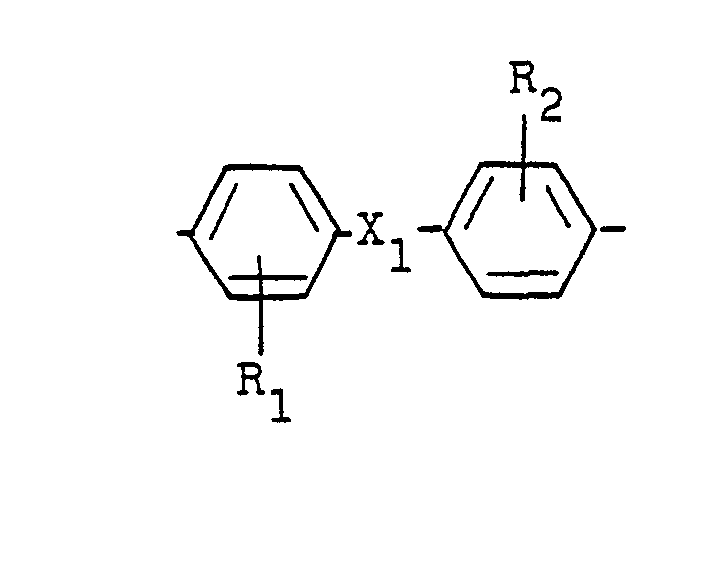
- Als Substituenten Z in den allgemeinen Formeln (2), (4), (6) und (7) kommen in Betracht die Aminogruppe und AlkylC1-C4 aminogruppen, wobei die Alkylgruppen beispielsweise substituiert sein können durch Hydroxy, Methoxy, Carboxy, Sulfato, Sulfo, Cyan, AlkylC1-C4 amino oder Di(alkyl)C1-C3 amino, wobei die Alkylreste ihrerseits substituiert sein können, beispielsweise durch Hydroxy, Methoxy und Sulfato, und ein Alkylrest in Oi(alkylc,-C3)-amino substituiert sein kann durch Hydroxy, Methoxy, Sulfo, Sulfato, Carboxy und Halogen, wie Chlor und Brom, weiterhin Reste cyclischer Amine wie Piperidino, Morpholino und Piperazino, Anilino, letzter gegebenenfalls substituiert durch AlkylC1-C4 Alkoxy C1-C4, Chlor, Carboxy, Sulfo und Nitro; weiterhin kommen als Substituenten Z AlkoxyC1-C4 gruppen, die substituiert sein können durch AI- koxyC1-C4, wie Methoxy, Ethoxy oder Propoxy, und ferner die Phenoxygruppen, die beispielsweise durch Methyl, Chlor, Sulfo, Carboxy oder Nitro substituiert sein kann, in Betracht.
- An Einzelbeispielen für den Substituenten Z seien beispielsweise folgende Gruppen genannt:
- Amino-, Methyl-, Ethyl-, n-und i-Propyl und n-und i-Butylamino-, β-Hydroxyethyl-, ß-Methoxyethyl-, β-Carboxyethyl-, β-Sulfatoethyl-, βSulfoethyl-, β-Cyanoethyl-, Carboxymethyl-, ß-Dimehylaminoethyl-, y-Dimethylaminopropyl-, ß-Hydroxypropyl-und β-Sulfatopropylamino-, Dimethyl-, Diethyl-, Diethanol-, Methyl-ßhydroxyethylamino-, Methyl-β-methoxyethylamino-, Methyl-ß-sulfoethylamino-, Methyl-ßsulfatoethylamino-, Methyl-ß-carboxyethylamino-, Methyl-carboxymethylamino-und Methyl-β-chlorethylamino-, Anilino, o-, m-oder p-Toluidino-, o-, m-oder p-Methoxyanlino-, o-, m-oder p-Chloranilino-, o-, m-oder p-Carboxyanilino-, 2,4-und 2,5-Dicarboxyanilino-, o-, m-oder p-Sulfoanilino-, 2,4-und 2,5-Disulfoanilino-, m-Nitroanilino-, 2-Methyl-und 2-Methoxy-4-sulfoanilino-, 4-Chlor-und 4-Methyl-2-sulfoanilino-, N-Methylanilino-, N-Methyl-m-toluidino-, N-Methyl-p-sulfoanilino-, N-Ethylanilino-, N-ß-Hydroxyethylanilino-und N-ß-Hydroxyethylm-toluidino-, weiterhin Methoxy-, Ethoxy-, Propoxy-, Butoxy-, Methoxyethoxy-, Methoxypropoxy-, Ethoxyethoxy-und Propoxy-, ethoxy-, Phenoxy-, o-, m-und p-Chlorphenoxy-, o-, m-und p-Sulfophenoxy-, o-, m-und p-Carboxyphenoxy-oder p-Nitrophenoxy-.
- Die Farbstoffe der ganannten allgemeinen Formeln (2) bis (7) können beispielsweise hergestellt werden durch Umsetzung der entsprechenden Halogentriazinfarbstoffe, wobei Halogen für Fluor, Chlor oder Brom steht, mit Pyridinderivaten in wäßriger Lösung im Temperaturbereich von etwa 40°C bis 120°C im schwach sauren bis alkalischen pH-Bereich (pH ca. 5 bis 9).
- Als Pyridinderivate sind beispielsweise die folgenden geeignet:
- Pyridin-3-carbonamid, Pyridin-4-carbonamid, Pyridin-3-carbonsäuremethylester, Pyridin-3-car- bonsäureethylester, Pyridin-4-carbonsäuremethyl-und -4-carbonsäureethylester, Pyridin-3-carbonitril, Pyridin-4-carbonitril, 3-und 4-Chlor-pyridin, 3-und 4-Brom-pyridin, 3-und 4-Methoxy-pyridin, Pyridin-3-sulfonsäure, Pyridin-3-und 4-aldehyd, Nicotinsäure-dimethyl-und -diethylamind, Isonicotinsäure-dimethyl-und -diethylamind, 3-und 4-Hydroxypyridin und 3-und 4-(Hydroxymethyl)-pyridin.
- Bei Farbstoffstrukturen der allgemeinen Formeln (2), (3), (4), (5) und (7), bei denen D und D' die Reste von Monoazo-, Polyazo-oder Metallkomplexazo-Farbstoffen bedeuten, kann der Reaktivrest der allgemeinen Formel (1) entweder an den Rest der Diazokomponente oder an den Rest der Kupplungskomponente gebunden sein.
- Im Falle von D" der allgemeinen Formeln (6) und (7) sind die Reaktivreste der allgemeinen Formel (1) sowohl mit dem Rest der Diazokomponente als auch mit dem Rest der Kupplungskomponente verbunden.
- Bevorzugte Farbstoffstrukturen von D-N(R)-, D'-N(R)-und -(R)N-D"-N(R)-der allgemeinen Formeln - (2) bis (7) sind beispielsweise die folgenden, wobei n, und n2 Null oder 1 sein kann und bei D und D' entweder n, oder n2 Null ist und bei D" n, und n2 jeweils 1 bedeuten:


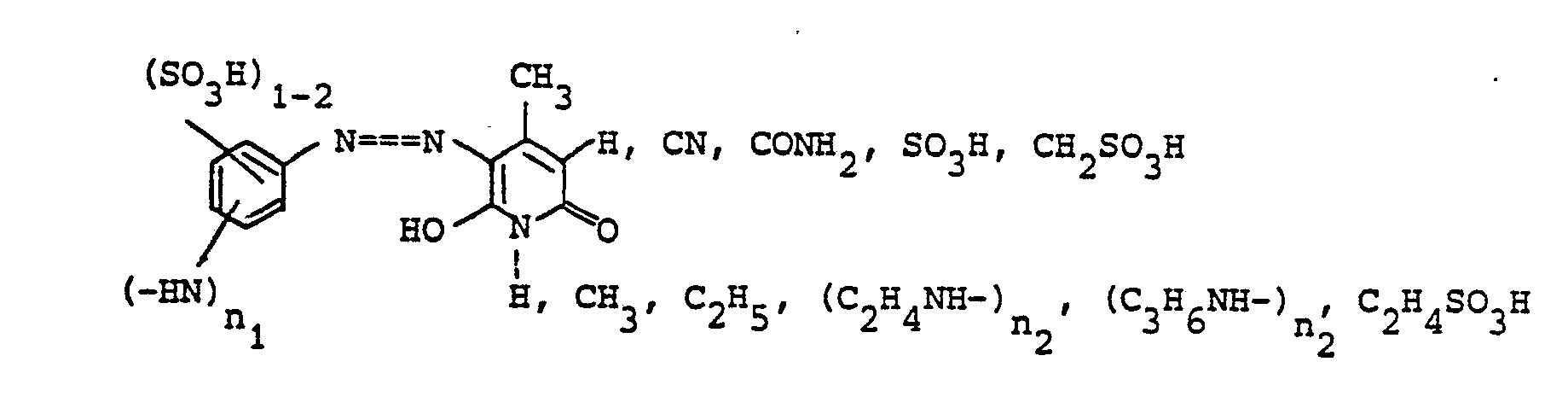


- Metallkomplexe von Farbstoffen der folgenden Strukturen:


- Bevorzugt sind dabei 1:1-Cu-Komplexe oder 1:2-Cr-und 1:2-Co-Komplexe.

- Die durch Strichelung markierten Ringsysteme sollen alternativ mögliche Naphthalinringe symbolisieren.


- wobei MePc den Cu-oder Ni-Phthalocyaninrest bedeutet und die Anzahl der Substituenten am Metallphthalocyaninrest im Durchschnitt 3 bis 4 ist.
- Dioxazin-Farbstoffreste der folgenden Strukturen:


- Die Farbstoffreste aller genannten Strukturen können dabei in den Alkyl-oder Arylresten weitersubstituiert sein, insbesondere durch die bei der Charakterisierung von D, D' und D"genannten Substituenten.
- In einer speziellen Variante läßt sich das erfindungsgemäße Färbeverfahren auch so durchführen, daß im Färbebad die Farbstoffe der allgemeinen Formeln (2) bis (7) aus den entsprechenden halogentriazinhaltigen Farbstoffen und den genannten Pyridinderivaten im pH-Bereich von 5 bis 8 unmittelbar vor oder während des Färbeverfahrens hergestellt werden. Unter halogentriazinhaltigen Farbstoffen versteht man hierbei solche, die am s-Triazinylring ein Fluor-, Chlor-oder Bromatom enthalten.
- Die Färbeflotten können die allgemein üblichen Zusätze enthalten, wie beispielsweise anorganische Salze, wie Alkalimetallchloride oder Alkalimetallsulfate, oder Harnstoff, sowie Dispergierungsmittel und Egalisierhilfsmittel.
- Die mit den erfindungsgemäß zur Anwendung gelangenden Farbstoffen hergestellten Färbungen zeichnen sich aus durch klare Nuancen sowie durch eine hohe Farbstoff-Faser-Bindungsstabilität, durch gute bis sehr gute Lichtechtheit und sehr gute Naßechtheitseigenschaften, wie Wasch-, Wasser-, Überfärbe-und Schweißechtheiten, sowie durch gute Plissierechtheit, Bügelechtheit und Reibechtheit.
- Die nachstehenden Beispiele sollen die Erfindung veranschaulichen, ohne sie auf den Inhalt der Beispiele zu limitieren.
- Die angegebenen Teile sind Gewichtsteile, die Temperaturangaben beziehen sich auf Grad Celsius.
- Man bereitet ein Färbebad durch Auflösen von 2 Teilen des Farbstoffs der Formel

- In das Färbebad geht man bei 40°C mit 50 Teilen eines Baumwollgewebes ein und fügt nach 45 Minuten 100 Teile einer Lösung, die 2 Teile calcinierte Soda enthält, zu. Die Temperatur des Färbebades wird weitere 45 Minuten bei 60°C gehalten. Danach wird das gefärbte Baumwollgewebe gespült, ca. 10 Minuten mit einem nichtionogenen Waschmittel kochend geseift, nochmals nachgespült und schließlich getrocknet. Es wird eine intensiv goldgelbe Färbung mit sehr guten Echtheitseigenschaften erhalten. '
- 2 Teile des Reaktivfarbstoffs der Formel

- Anschließend wird die gefärbte Ware mit Wasser gespült, etwa 15 Minuten mit einem nichtionogenen Waschmittel kochend geseift, nochmals mit Wasser gespült und getrocknet. Es wird eine tiefe blaustichig rote Färbung erhalten, die sehr gute Echtheitseigenschaften aufweist.
- Man bereitet ein Färbebad aus 800 Teilen Wasser, 1 Teil eines Reaktivfarbstoffs der folgenden Formel

- Man geht bei 40°C mit 100 Teilen Baumwolle/Polyestermischgewebe (50 : 50) in das auf pH 6,5 gestellte Färbebad ein, heizt die Flotte unter statischem Druck rasch auf die Färbetemperatur von 130°C und färbt 1 Stunde bei dieser Temperatur. Die Weiterbehandlung der so erzeugten Färbung erfolgt durch Spülen und Seifen in üblicher Weise.
- Es resultiert eine lebhafte Orangefärbung auf beiden Faseranteilen, die gute Echtheitseigenschaften besitzt.
- Der für die Färbung des Baumwollanteils verwendete Reaktivfarbstoff der vorstehend genannten Struktur wurde wie folgt hergestellt:
- 15,7 Teile des Chlortriazinfarbstoffs der Formel

- Nach Beendigung der Umsetzung wird der entstandene Farbstoff mit Natriumchlorid bei Raumtemperatur ausgesalzen, abgesaugt, mit einer 5 %igen Natriumchloridlösung nachgewaschen und getrocknet.
- Die gemäß den Beispielen 1 und 2 eingesetzten Reaktivfarbstoffe wurden ganz analog durch Umsetzung der entsprechenden Monochlortriazinfarbstoffe mit Nicotinsäureamid bzw. 3-Chlorpyridin hergestellt.
- In einer HT-Färbeapparatur wird bei einem Flottenverhältnis von 1:20 ein Mischgewebe aus 67 % Polyesterfasern und 33 % Baumwolle mit einer wäßrigen Flotte gefärbt, die - bezogen auf das Gewicht der trockenen Ware -1,5 % des Dispersionsfarbstoffs (in handelsüblicher Form und Beschaffenheit) der Formel


- Man färbt das Textilgut mit dieser Färbeflotte 1 Stunde lang bei 130°C. Nach dem üblichen Spül-und Seifvorgang erhält man auf beiden Faseranteilen eine lebhafte Türkisblaufärbung, die sehr gute Echtheiten aufweist.
- Zur Herstellung des Reaktivfarbstoffs wird gemäß Beispiel 3 der Monochortriazinfarbstoff mit Iso-Nicotinsäureamid innerhalb von 16 Stunden bei 80°C umgesetzt.
- In einem HT-Färbeapparat werden bei einem Flottenverhältnis von 1 : 20 Kreuzspulen aus mercerisiertem Baumwollgarn mit einer Flotte gefärbt, die eine wäßrige Lösung von 1 % (vom Gewicht des trockenen Garns) des Reaktivfarbstoffs der Formel

- Man bereitet ein Färbebad aus 1100 Teilen Wasser, 1 Teil des in Beispiel 5 beschriebenen Reaktivfarbstoffs, 3 Teilen C.I. Disperse Blue 79 (in handelsüblicher Form), 50 Teilen Na2SO. sowie 1 Teil des Natriumsalzes der m-Nitrobenzolsulfonsäure und stellt den pH-Wert auf 6 ein. Es wird ein Baumwolle/Polyester-Mischgewebe (50 : 50) zugegeben und die Flotte auf die Färbetemperatur von 130°C hochgeheizt. Nach 50 minutigem Färben läßt man abkühlen und erhält durch übliche Nachreinigung eine intensive Marineblaufärbung auf beiden Faseranteilen.
- In einer HT-Färbeapparatur wird bei einem Flottenverhältnis von 1 : 20 ein Mischgewebe aus Polyesterfasern und Baumwolle (60 : 40) mit einer wäßrigen Flotte behandelt, die bezogen auf das Gewicht der trockenen Ware -1,5 % des Dispersionsfarbstoffs C.l. Disperse Blue 333 (in handelsüblicher Form und Beschaffenheit) sowie 40 g/I Natriumchlorid enthält. Man färbt die Fasermischung in dieser Flotte zunächst 45 Minuten bei 130°C und schleust dann eine wäßrige Lösung von -bezogen auf das Gewicht der trockenen Ware -1,5 % des Reaktivfarbstoffs der Formel

- In einem Färbebad, das aus 900 Teilen Wasser, 1 Teil des Reaktivfarbstoffs der Formel

- Eine marineblaue Färbung, wie gemäß Beispiel 6 erhalten, kann auch auf einem Polyester/Baumwolle-Mischgewebe hergestellt werden, indem man den Färbevorgang nach der dortigen Vorschrift durchführt und eine wäßrige Flotte verwendet, die - bezogen auf das Gewicht der trockenen Ware -
- 1,8 % des Farbstoffs C.I. Disperse Blue 56, 63 285, 0,5 % des Farbstoffs C.I. Disperse Brown 1, 11 152, 0,5 % des Farbstoffs C.I. Disperse Violet 48 - (jeweils in handelsüblicher Form und Beschaffenheit) sowie 0,9 % des in Beispiel 5 genannten Reaktivfarbstoffs, 0,2 % des Reaktivfarbstoffs der Formel

- Gleichgute Färbungen mit vergleichbaren Echtheiten werden auch mit Farbstoffen erhalten, die sich durch Umsetzung der in der folgenden Tabelle aufgelisteten Halogentriazinfarbstoffe mit den auf Seite 6 genannten Pyridinderivaten analog Beispiel 3 herstellen lassen.


- Ein Mischgewebe aus 67 Teilen Polyesterfasern und 33 Teilen Baumwolle wird mit einer Druckpaste bedruckt, die je kg enthält
- 30 g des Farbstoffes Disperse Red der C.I.-Nr. 60 756,
- 30 g des Reaktivfarbstoffes der Formel

- 600 g Alginatverdickung (4 %ig) und
- 340 g Wasser
- 1000 g Druckpaste.
- Das Gewebe wird nach dem Bedrucken zur Farbstoff-Fixierung 5 Minuten bei 130°C gedämpft. Der erhaltene Druck wird so dann mit Wasser heiß gespült, mit einem wäßrigen Bad unter Zusatz von 0,5 g/I eines nichtionogenen Waschmittels 5 Minuten heiß und neutral geseift, erneut mit Wasser gespült und getrocknet.
- Es resultieren brillante und egale rote Drucke mit Changeanteffekt auf beiden Faseranteilen.
- Man klotzt ein Mischgewebe aus Polyesterfasern/Baumwolle (67/33) bei 70 % Flottenaufnahme (vom Gewicht der trockenen Ware) mit einer wäßrigen Klotzflotte enthaltend
- 18 g/I des Farbstoffes Disperse Blue 56 der C.I.-Nr. 63 285,
- 5 g/I des Farbstoffes Disperse Brown 1 der C.I.-Nr. 11 152,
- 5 g/I des Dispersionsfarbstoffes der Formel


- Zur Fixierung der Farbstoffe wird das Gewebe anschließend 10 Minuten bei 125°C mittels Druckdampf gedämpft. Danach wird die Färbung für 10 Minuten mit einem wäßrigen Bad unter Zusatz von 0,5 g/I des Umsetzungsproduktes von 1 Mol Nonylphenol mit 8 Mol Äthylenoxid kochend nachbehandelt.
- Man erhält eine tiefe Blaufärbung des Gewebes mit guter Ton-in-Ton-Deckung beider Faseranteile.
- Man bereitet ein Färbebad bestehend aus 250 Teilen Wasser, 20 Teilen Natriumsulfat und 0,5 Teilen des Farbstoffes der Formel

- Durch Zugabe von Natriumphosphat wird der pH-Wert 6,5 eingestellt. In dieses Färbebad geht man bei 40°C mit 12 Teilen eines mercerisierten Baumwollgewebes ein, steigert die Temperatur innerhalb von 10 Minuten auf 95 -100°C und färbt 45 Minuten bei dieser Temperatur. Anschließend wird das Gewebe mit Wasser kalt und heiß gespült und mit einem nichtionogenen Waschmittel 10 Minuten kochend geseift. Man erhält eine kräftige, brillante Rotfärbung, die gegenüber Waschbehandlungen und Lichteinwirkung sehr beständig ist.
- Man bereitet ein Färbebad bestehend aus 250 Teilen Wasser, 20 Teilen Natriumsulfat und 0,5 Teilen des Farbstoffes der Formel

- Durch Zugabe von Natriumphosphat wird der pH-Wert 6,5 eingestellt. In dieses Färbebad geht man bei 40°C mit 12 Teilen eines mercerisierten Baumwollgewebes ein, steigert die Temperatur innerhalb von 10 Minuten auf 95-100°C und färbt 45 Minuten bei dieser Temperatur. Anschließend wird das Gewebe mit Wasser kalt und heiß gespült und mit einem nichtionogenen Waschmittel 10 Minuten kochend geseift. Das so erhaltene Baumwollgewebe ist blaßrosa angefärbt.
- Das Beispiel zeigt, daß der Farbstoff, der die Chlortriazinyl-Gruppe enthält, in Abwesenheit eines säurebindenden Mittels auf dem Fasermaterial praktisch nicht fixiert wird.
- 100 Teile eines Mischgewebes aus 50 Teilen Zellwolle und 50 Teilen Polyamidfasern werden auf einer HT-Haspelkufe mit einer 70°C warmen Flotte versetzt, bestehend aus 2000 Teilen Wasser, 6 Teilen Natrium-m-nitrobenzolsulfonat, 50 Teilen Natriumsulfat und 3 Teilen des Farbstoffes der Formel

- Man erhält eine gleichmäßige Blaufärbung auf beiden Faserkomponenten.
Claims (10)


Applications Claiming Priority (2)
| Application Number | Priority Date | Filing Date | Title |
|---|---|---|---|
| DE19853512630 DE3512630A1 (de) | 1985-04-06 | 1985-04-06 | Verfahren zum faerben oder bedrucken von cellulosefasern oder cellulosemischfasern |
| DE3512630 | 1985-04-06 |
Publications (2)
| Publication Number | Publication Date |
|---|---|
| EP0202436A2 true EP0202436A2 (de) | 1986-11-26 |
| EP0202436A3 EP0202436A3 (de) | 1989-02-01 |
Family
ID=6267499
Family Applications (1)
| Application Number | Title | Priority Date | Filing Date |
|---|---|---|---|
| EP86104441A Withdrawn EP0202436A3 (de) | 1985-04-06 | 1986-04-01 | Verfahren zum Färben oder Bedrucken von Cellulosefasern oder Cellulosemischfasern |
Country Status (6)
| Country | Link |
|---|---|
| US (1) | US4693726A (de) |
| EP (1) | EP0202436A3 (de) |
| JP (1) | JPS61231281A (de) |
| KR (1) | KR860008336A (de) |
| DE (1) | DE3512630A1 (de) |
| IN (1) | IN165369B (de) |
Cited By (8)
| Publication number | Priority date | Publication date | Assignee | Title |
|---|---|---|---|---|
| EP0419413A1 (de) * | 1989-09-22 | 1991-03-27 | Ciba-Geigy Ag | Verfahren zum Färben oder Bedrucken von Mischfasern aus cellulosehaltigen Fasermaterialien und Seide |
| DE102012107095A1 (de) | 2012-08-02 | 2014-02-06 | Contitech Schlauch Gmbh | Umlageschlauch, insbesondere zur Verwendung bei hohen Temperaturen |
| EP3175977A1 (de) | 2015-12-03 | 2017-06-07 | ContiTech Schlauch GmbH | Umlageschlauch |
| WO2017092893A1 (de) | 2015-12-03 | 2017-06-08 | Contitech Schlauch Gmbh | Umlageschlauch |
| DE102015224173A1 (de) | 2015-12-03 | 2017-06-08 | Contitech Schlauch Gmbh | Umlageschlauch mit wenigstens einem Umlagenschutz |
| EP3685999A1 (de) | 2019-01-24 | 2020-07-29 | ContiTech Schlauch GmbH | Umlageschlauch mit verbesserter alterungsbeständigkeit |
| EP3795350A1 (de) | 2019-09-18 | 2021-03-24 | ContiTech Schlauch GmbH | Umlageschlauch, insbesondere zur verwendung als scr-schlauch |
| DE102020206733A1 (de) | 2020-05-28 | 2021-12-02 | Contitech Techno-Chemie Gmbh | Temperaturbeständiger Schlauch |
Families Citing this family (32)
| Publication number | Priority date | Publication date | Assignee | Title |
|---|---|---|---|---|
| JPS6253486A (ja) * | 1985-08-29 | 1987-03-09 | 日本化薬株式会社 | 含窒素繊維材料の染色法 |
| US5238464A (en) * | 1986-06-05 | 1993-08-24 | Burlington Industries, Inc. | Process for making flame-resistant cellulosic fabrics |
| US4902300A (en) * | 1986-06-05 | 1990-02-20 | Burlington Industries, Inc. | Simultaneously dyed and flame-retarded fabric blends |
| GB8621795D0 (en) * | 1986-09-10 | 1986-10-15 | Ici Plc | Coloration process |
| DE3643752A1 (de) * | 1986-12-20 | 1988-06-23 | Hoechst Ag | Verfahren zum einbandig/einstufigen faerben von mischungen aus carrierfrei faerbbaren polyesterfasern und cellulosefasern |
| GB2284918B (en) * | 1993-12-17 | 1997-05-21 | Fuji Heavy Ind Ltd | Inflation pressure sensor for automobile pneumatic tyre |
| GB9402618D0 (en) * | 1994-02-10 | 1994-04-06 | Zeneca Ltd | Organic chemicals |
| US5925746A (en) * | 1997-07-02 | 1999-07-20 | Ciba Specialty Chemicals Corporation | Azo dyes, processes for their preparation and the use thereof |
| AU772205B2 (en) * | 1998-12-11 | 2004-04-22 | Clariant Finance (Bvi) Limited | Fiber-reactive disazo dyestuffs |
| CN102985557B (zh) | 2009-03-13 | 2018-06-15 | 安吉奥斯医药品有限公司 | 用于细胞增殖相关病症的方法和组合物 |
| PE20120693A1 (es) | 2009-06-29 | 2012-07-04 | Agios Pharmaceuticals Inc | Compuestos heterociclos como moduladores de la piruvato cinasa m2 (pkm2) |
| WO2011050210A1 (en) | 2009-10-21 | 2011-04-28 | Agios Pharmaceuticals, Inc. | Methods and compositions for cell-proliferation-related disorders |
| KR101231050B1 (ko) | 2010-11-29 | 2013-02-07 | 주식회사에스케이니트 | 레이온-폴리에스테르 교직물의 염색방법 |
| PT3406251T (pt) | 2011-05-03 | 2024-01-24 | Agios Pharmaceuticals Inc | Ativadores da piruvato-cinase para utilização em terapia |
| CN102827170A (zh) | 2011-06-17 | 2012-12-19 | 安吉奥斯医药品有限公司 | 治疗活性组合物和它们的使用方法 |
| CN102827073A (zh) | 2011-06-17 | 2012-12-19 | 安吉奥斯医药品有限公司 | 治疗活性组合物和它们的使用方法 |
| SMT201800334T1 (it) | 2012-01-06 | 2018-09-13 | Agios Pharmaceuticals Inc | Composti terapeuticamente attivi e loro metodi di utilizzo |
| US9474779B2 (en) | 2012-01-19 | 2016-10-25 | Agios Pharmaceuticals, Inc. | Therapeutically active compositions and their methods of use |
| WO2014062511A1 (en) | 2012-10-15 | 2014-04-24 | Agios Pharmaceuticals, Inc. | Therapeutic compounds and compositions |
| JP5996096B2 (ja) * | 2013-03-28 | 2016-09-21 | 富士フイルム株式会社 | 着色組成物、捺染方法、布帛、板材、及びテトラアザポルフィリン系化合物 |
| WO2015003360A2 (en) | 2013-07-11 | 2015-01-15 | Agios Pharmaceuticals, Inc. | Therapeutically active compounds and their methods of use |
| WO2015003355A2 (en) | 2013-07-11 | 2015-01-15 | Agios Pharmaceuticals, Inc. | Therapeutically active compounds and their methods of use |
| CN105593215B (zh) | 2013-07-11 | 2019-01-15 | 安吉奥斯医药品有限公司 | 用于治疗癌症的作为idh2突变体抑制剂的2,4-或4,6-二氨基嘧啶化合物 |
| MX375030B (es) * | 2013-07-11 | 2025-03-06 | Agios Pharmaceuticals Inc | Compuestos de n,6-bis(aril o heteroaril)-1,3,5-triazin-2,4-diamina como inhibidores de idh2 mutantes para el tratamiento de cancer. |
| WO2015010297A1 (en) | 2013-07-25 | 2015-01-29 | Agios Pharmaceuticals, Inc. | Therapeutically active compounds and their methods of use |
| CN105916507A (zh) | 2013-08-02 | 2016-08-31 | 安吉奥斯医药品有限公司 | 治疗活性化合物及其使用方法 |
| PH12021551647A1 (en) | 2014-03-14 | 2022-06-06 | Agios Pharmaceuticals Inc | Pharmaceutical compositions of therapeutically active compounds |
| MX384883B (es) | 2015-06-11 | 2025-03-14 | Agios Pharmaceuticals Inc | Métodos para usar activadores de piruvato cinasa. |
| CN108349933A (zh) | 2015-08-05 | 2018-07-31 | 安吉奥斯医药品有限公司 | 制备6-(芳基或杂芳基)-1,3,5-三嗪-2,4-二醇和6-(芳基或杂芳基)-1,3,5-三嗪-2,4-二胺的方法 |
| HUE067449T2 (hu) | 2015-10-15 | 2024-10-28 | Servier Lab | Ivozidenib, citarabin és daunorubicin vagy idarubicin kombinációs terápa akut mielogén leukémia kezelésére |
| MD3362066T2 (ro) | 2015-10-15 | 2022-08-31 | Les Laboratoires Servier Sas | Terapie combinată pentru tratamentul tumorilor maligne |
| US10980788B2 (en) | 2018-06-08 | 2021-04-20 | Agios Pharmaceuticals, Inc. | Therapy for treating malignancies |
Family Cites Families (12)
| Publication number | Priority date | Publication date | Assignee | Title |
|---|---|---|---|---|
| GB937182A (en) * | 1959-09-24 | 1963-09-18 | Ici Ltd | New heterocyclic dyestuffs containing a quaternary ammonium group |
| GB946998A (en) * | 1961-08-10 | 1964-01-15 | Ici Ltd | Water-soluble monoazo dyestuffs |
| GB1005240A (en) * | 1963-04-10 | 1965-09-22 | Ici Ltd | New anthraquinone dyestuffs containing a quaternary ammonium group |
| GB1012625A (en) * | 1963-04-10 | 1965-12-08 | Ici Ltd | New anthraquinone dyestuffs containing a quaternary ammonium group |
| NL6508612A (de) * | 1964-07-17 | 1966-01-18 | ||
| CH447433A (it) * | 1965-08-09 | 1967-11-30 | Acna | Procedimento di preparazione di coloranti reattivi triazinici quaternarizzati |
| IT1075013B (it) * | 1975-07-31 | 1985-04-22 | Ici Ltd | Coloranti reattivi aventi un gruppo triazinilico che porta un sostituente quaternario particolarmente per materiali tessili di cellulosa |
| GB2051139A (en) * | 1979-06-18 | 1981-01-14 | Ici Ltd | Reactive dyeing and printing of cellulose |
| GB2054662A (en) * | 1979-06-18 | 1981-02-18 | Ici Ltd | Colouration process |
| JPS58186682A (ja) * | 1982-04-27 | 1983-10-31 | 日本化薬株式会社 | セルロ−ス又はセルロ−ス含有繊維材料の染色法 |
| JPH07116375B2 (ja) * | 1984-02-20 | 1995-12-13 | 住友化学工業株式会社 | トリアジン化合物およびそれを用いる繊維材料の染色または捺染法 |
| JPS6155275A (ja) * | 1984-08-20 | 1986-03-19 | 日本化薬株式会社 | 天然皮革の堅牢染色法 |
-
1985
- 1985-04-06 DE DE19853512630 patent/DE3512630A1/de not_active Withdrawn
-
1986
- 1986-03-31 IN IN254/CAL/86A patent/IN165369B/en unknown
- 1986-04-01 EP EP86104441A patent/EP0202436A3/de not_active Withdrawn
- 1986-04-03 US US06/847,722 patent/US4693726A/en not_active Expired - Fee Related
- 1986-04-04 KR KR1019860002566A patent/KR860008336A/ko not_active Withdrawn
- 1986-04-04 JP JP61076811A patent/JPS61231281A/ja active Pending
Cited By (13)
| Publication number | Priority date | Publication date | Assignee | Title |
|---|---|---|---|---|
| EP0419413A1 (de) * | 1989-09-22 | 1991-03-27 | Ciba-Geigy Ag | Verfahren zum Färben oder Bedrucken von Mischfasern aus cellulosehaltigen Fasermaterialien und Seide |
| DE102012107095A1 (de) | 2012-08-02 | 2014-02-06 | Contitech Schlauch Gmbh | Umlageschlauch, insbesondere zur Verwendung bei hohen Temperaturen |
| WO2014019796A2 (de) | 2012-08-02 | 2014-02-06 | Contitech Schlauch Gmbh | Umlageschlauch, insbesondere zur verwendung bei hohen temperaturen |
| US10690271B2 (en) | 2012-08-02 | 2020-06-23 | Contitech Schlauch Gmbh | Transfer hose, in particular for use at high temperatures |
| DE102015224173A1 (de) | 2015-12-03 | 2017-06-08 | Contitech Schlauch Gmbh | Umlageschlauch mit wenigstens einem Umlagenschutz |
| WO2017092893A1 (de) | 2015-12-03 | 2017-06-08 | Contitech Schlauch Gmbh | Umlageschlauch |
| DE102015224174A1 (de) | 2015-12-03 | 2017-06-08 | Contitech Schlauch Gmbh | Umlageschlauch |
| DE102015224172A1 (de) | 2015-12-03 | 2017-06-08 | Contitech Schlauch Gmbh | Umlageschlauch |
| EP3175977A1 (de) | 2015-12-03 | 2017-06-07 | ContiTech Schlauch GmbH | Umlageschlauch |
| EP3685999A1 (de) | 2019-01-24 | 2020-07-29 | ContiTech Schlauch GmbH | Umlageschlauch mit verbesserter alterungsbeständigkeit |
| DE102019200896A1 (de) | 2019-01-24 | 2020-07-30 | Contitech Schlauch Gmbh | Umlageschlauch mit verbesserter Alterungsbeständigkeit |
| EP3795350A1 (de) | 2019-09-18 | 2021-03-24 | ContiTech Schlauch GmbH | Umlageschlauch, insbesondere zur verwendung als scr-schlauch |
| DE102020206733A1 (de) | 2020-05-28 | 2021-12-02 | Contitech Techno-Chemie Gmbh | Temperaturbeständiger Schlauch |
Also Published As
| Publication number | Publication date |
|---|---|
| US4693726A (en) | 1987-09-15 |
| DE3512630A1 (de) | 1986-10-23 |
| KR860008336A (ko) | 1986-11-14 |
| JPS61231281A (ja) | 1986-10-15 |
| IN165369B (de) | 1989-09-30 |
| EP0202436A3 (de) | 1989-02-01 |
Similar Documents
| Publication | Publication Date | Title |
|---|---|---|
| DE3512630A1 (de) | Verfahren zum faerben oder bedrucken von cellulosefasern oder cellulosemischfasern | |
| EP0040790B2 (de) | Verfahren zum Färben und Bedrucken von Hydroxy- und/oder Carbonamidgruppen enthaltenden Fasermaterialien | |
| EP0870807A1 (de) | Mischungen von Reaktivfarbstoffen und deren Verwendung | |
| US4267107A (en) | Reactive dyestuffs | |
| EP0199950A1 (de) | Verfahren zum Färben oder Bedrucken von Hydroxygruppen enthaltenden Fasermaterialien mit neuen faserreaktiven Farbstoffen | |
| EP0352222B1 (de) | Faserreaktive Formazanfarbstoffe, Verfahren zu deren Herstellung und deren Verwendung | |
| DE2154942C3 (de) | faserreaktive Monoazofarbstoffe, Verfahren zu ihrer Herstellung und ihre Verwendung zum Färben oder Bedrucken von nativen oder regenerierten Cellulosefasern, natürlichen oder synthetischen Polyamidfasern oder von Polyurethanfasern | |
| CH485360A (fr) | Moteur électrique synchrone monophasé de petites dimensions | |
| DE69702963T2 (de) | Faserreaktive farbstoffe | |
| EP0548014A1 (de) | Farbstoffmischungen und deren Verwendung | |
| DE2658268A1 (de) | Reaktive disazofarbstoffe mit monochlortriazin-reaktivgruppen | |
| DE3629574A1 (de) | Wasserloesliche disazoverbindungen, verfahren zu ihrer herstellung und ihre verwendung als farbstoffe | |
| CH641197A5 (de) | Reaktive monoazofarbstoffe und verfahren zu deren herstellung. | |
| DE3636398A1 (de) | Wasserloesliche disazoverbindungen, verfahren zu ihrer herstellung und ihre verwendung als farbstoffe | |
| DE2819197C2 (de) | ||
| EP0342159B1 (de) | Wasserlösliche Phthalocyaninverbindungen, Verfahren zu ihrer Herstellung und ihre Verwendung | |
| EP0410930B1 (de) | Faserreaktive Formazanfarbstoffe, Verfahren zu deren Herstellung und deren Verwendung | |
| DE2801398A1 (de) | Kontinuierliches verfahren zum faerben von textilmaterialien aus einem aromatischen polyester oder cellulosetriacetat | |
| EP0342158B1 (de) | Wasserlösliche Phthalocyaninverbindungen, Verfahren zu ihrer Herstellung und ihre Verwendung | |
| DE2025158B2 (de) | Verfahren zum faerben und bedrucken von textilmaterialien aus synthetischen organischen fasern | |
| DE1923539C3 (de) | Phthalocyaninfarbstoffe, deren Herstellung und Verwendung | |
| AT236902B (de) | Verfahren zum Färben und Drucken mit Reaktivfarbstoffen | |
| DE1934123C (de) | Monoazoverbmdungen und ihre Verwen dung zum Farben von Textilgut | |
| AT220739B (de) | Verfahren zur Herstellung von neuen Farbstoffen | |
| DE1644104C3 (de) | Besiehe Monoazofarbstoffe |
Legal Events
| Date | Code | Title | Description |
|---|---|---|---|
| PUAI | Public reference made under article 153(3) epc to a published international application that has entered the european phase |
Free format text: ORIGINAL CODE: 0009012 |
|
| AK | Designated contracting states |
Kind code of ref document: A2 Designated state(s): CH DE FR GB IT LI |
|
| PUAL | Search report despatched |
Free format text: ORIGINAL CODE: 0009013 |
|
| AK | Designated contracting states |
Kind code of ref document: A3 Designated state(s): CH DE FR GB IT LI |
|
| 17P | Request for examination filed |
Effective date: 19890718 |
|
| 17Q | First examination report despatched |
Effective date: 19900808 |
|
| STAA | Information on the status of an ep patent application or granted ep patent |
Free format text: STATUS: THE APPLICATION HAS BEEN WITHDRAWN |
|
| 18W | Application withdrawn |
Withdrawal date: 19901129 |
|
| R18W | Application withdrawn (corrected) |
Effective date: 19901129 |
|
| RIN1 | Information on inventor provided before grant (corrected) |
Inventor name: MEININGER, FRITZ, DR. Inventor name: MISCHKE, PETER, DR. Inventor name: KOENIG, GERD, DR. Inventor name: SPRINGER, HARTMUT, DR. |