EP0203284A2 - Support pour catalyseur de gaz d'échappement formé à partir d'une matière inorganique - Google Patents
Support pour catalyseur de gaz d'échappement formé à partir d'une matière inorganique Download PDFInfo
- Publication number
- EP0203284A2 EP0203284A2 EP86103241A EP86103241A EP0203284A2 EP 0203284 A2 EP0203284 A2 EP 0203284A2 EP 86103241 A EP86103241 A EP 86103241A EP 86103241 A EP86103241 A EP 86103241A EP 0203284 A2 EP0203284 A2 EP 0203284A2
- Authority
- EP
- European Patent Office
- Prior art keywords
- aluminum oxide
- aluminum
- silicate solution
- alkali silicate
- rods
- Prior art date
- Legal status (The legal status is an assumption and is not a legal conclusion. Google has not performed a legal analysis and makes no representation as to the accuracy of the status listed.)
- Ceased
Links
Images
Classifications
-
- F—MECHANICAL ENGINEERING; LIGHTING; HEATING; WEAPONS; BLASTING
- F01—MACHINES OR ENGINES IN GENERAL; ENGINE PLANTS IN GENERAL; STEAM ENGINES
- F01N—GAS-FLOW SILENCERS OR EXHAUST APPARATUS FOR MACHINES OR ENGINES IN GENERAL; GAS-FLOW SILENCERS OR EXHAUST APPARATUS FOR INTERNAL-COMBUSTION ENGINES
- F01N3/00—Exhaust or silencing apparatus having means for purifying, rendering innocuous, or otherwise treating exhaust
- F01N3/08—Exhaust or silencing apparatus having means for purifying, rendering innocuous, or otherwise treating exhaust for rendering innocuous
- F01N3/10—Exhaust or silencing apparatus having means for purifying, rendering innocuous, or otherwise treating exhaust for rendering innocuous by thermal or catalytic conversion of noxious components of exhaust
- F01N3/24—Exhaust or silencing apparatus having means for purifying, rendering innocuous, or otherwise treating exhaust for rendering innocuous by thermal or catalytic conversion of noxious components of exhaust characterised by constructional aspects of converting apparatus
- F01N3/28—Construction of catalytic reactors
- F01N3/2803—Construction of catalytic reactors characterised by structure, by material or by manufacturing of catalyst support
- F01N3/2825—Ceramics
- F01N3/2828—Ceramic multi-channel monoliths, e.g. honeycombs
-
- B—PERFORMING OPERATIONS; TRANSPORTING
- B01—PHYSICAL OR CHEMICAL PROCESSES OR APPARATUS IN GENERAL
- B01J—CHEMICAL OR PHYSICAL PROCESSES, e.g. CATALYSIS OR COLLOID CHEMISTRY; THEIR RELEVANT APPARATUS
- B01J35/00—Catalysts, in general, characterised by their form or physical properties
- B01J35/50—Catalysts, in general, characterised by their form or physical properties characterised by their shape or configuration
- B01J35/56—Foraminous structures having flow-through passages or channels, e.g. grids or three-dimensional [3D] monoliths
-
- B—PERFORMING OPERATIONS; TRANSPORTING
- B01—PHYSICAL OR CHEMICAL PROCESSES OR APPARATUS IN GENERAL
- B01J—CHEMICAL OR PHYSICAL PROCESSES, e.g. CATALYSIS OR COLLOID CHEMISTRY; THEIR RELEVANT APPARATUS
- B01J37/00—Processes, in general, for preparing catalysts; Processes, in general, for activation of catalysts
-
- B—PERFORMING OPERATIONS; TRANSPORTING
- B01—PHYSICAL OR CHEMICAL PROCESSES OR APPARATUS IN GENERAL
- B01J—CHEMICAL OR PHYSICAL PROCESSES, e.g. CATALYSIS OR COLLOID CHEMISTRY; THEIR RELEVANT APPARATUS
- B01J37/00—Processes, in general, for preparing catalysts; Processes, in general, for activation of catalysts
- B01J37/02—Impregnation, coating or precipitation
- B01J37/024—Multiple impregnation or coating
-
- F—MECHANICAL ENGINEERING; LIGHTING; HEATING; WEAPONS; BLASTING
- F01—MACHINES OR ENGINES IN GENERAL; ENGINE PLANTS IN GENERAL; STEAM ENGINES
- F01N—GAS-FLOW SILENCERS OR EXHAUST APPARATUS FOR MACHINES OR ENGINES IN GENERAL; GAS-FLOW SILENCERS OR EXHAUST APPARATUS FOR INTERNAL-COMBUSTION ENGINES
- F01N3/00—Exhaust or silencing apparatus having means for purifying, rendering innocuous, or otherwise treating exhaust
- F01N3/08—Exhaust or silencing apparatus having means for purifying, rendering innocuous, or otherwise treating exhaust for rendering innocuous
- F01N3/10—Exhaust or silencing apparatus having means for purifying, rendering innocuous, or otherwise treating exhaust for rendering innocuous by thermal or catalytic conversion of noxious components of exhaust
- F01N3/24—Exhaust or silencing apparatus having means for purifying, rendering innocuous, or otherwise treating exhaust for rendering innocuous by thermal or catalytic conversion of noxious components of exhaust characterised by constructional aspects of converting apparatus
- F01N3/28—Construction of catalytic reactors
- F01N3/2803—Construction of catalytic reactors characterised by structure, by material or by manufacturing of catalyst support
- F01N3/2825—Ceramics
Definitions
- Exhaust gas catalyst carriers for exhaust gas catalysts in, for example, motor vehicles or for gas cleaning of industrial plants or power plants with hollow channels therein, in which the catalyst materials are applied generally consist of ceramic shaped bodies which are fired at the high temperatures required for ceramic materials and thereby hardened are on which a support material made of y-aluminum oxide must be applied in the channels contained, on which the catalyst can be anchored from preferably finely divided catalyst metals.
- the shaped body of the exhaust gas catalyst carrier from an inorganic molding compound which cures at low temperatures of at most 120 ° C. and which consists of a solid inorganic reaction component and a liquid alkali silicate solution, the required hollow channels and the lining being formed in a simplified manner the hollow channels with ⁇ -aluminum oxide is produced in a new way, which is possible by using the alkaline alkali silicate solution as a component of the flowable molding compound.
- the aluminum oxide hydrates that are formed are converted into y-aluminum oxide as firmly adhering cladding for the hollow channels, on which the catalyst metals can be firmly anchored.
- the shaped bodies of the exhaust gas catalyst supports are accordingly produced from a flowable inorganic molding composition which is capable of hardening to form a stone at low temperatures of 60 to 120 ° C., preferably at temperatures of 60 to 98 ° C.
- Such stone-forming, solid, reactive constituents of the molding composition are the materials of groups a), b) and c) and their mixtures of claims 1 and 2.
- Metakaolin as a solid, reactive component of the molding composition is obtained from natural kaolin by heating at high temperatures and is known from European Patent 0026 687 as a component of moldings which can be used to produce art objects.
- the oxide mixture with contents of amorphous SiO 2 and aluminum oxide is water-free and arises in high-temperature processes as finely divided dust by cooling from the steam or.
- Gas phase in the manufacture of industrial melt products such as in particular corundum or mullite from bauxite, the oxide mixture not corresponding to the respective melt product when the composition changes.
- changing contents of the constituents of 7 to 75% by weight SiO 2 and 12 to 87% Al 2 O 3 in addition to other constituents, can be contained in the oxide mixture for example iron oxides or small amounts of fluorides, P 2 O 5 or ZrO 2 .
- the Si0 2 is in X-ray amorphous form, while Al 2 O 3 is at least partially crystalline, whereby ⁇ -Al 2 O 3 - (corundum) and especially the alkali-containing ⁇ -Al 2 -O 3 was found.
- ⁇ -Al 2 O 3 - (corundum) and especially the alkali-containing ⁇ -Al 2 -O 3 was found.
- small proportions of well crystalline secondary constituents in amounts of 0.1 to 0.5 wt.% Result in sharp x-ray reflections of, for example, quartz, TiO 2 or Al 2 O 3 modification, while the majority of the constituents are unclear, very broad and weak elevation of low crystallinity above the surface.
- the oxide mixture 75 to 95% by weight, mostly 85 to 95, consists analytically of Al 2 O 3 plus SiO 2 . This oxide mixture, also called ROS, is the preferred reactive component.
- Electrostatic filter ash is produced as a dust-like deposit in the electrostatic precipitators of high-temperature hard coal power plants with combustion chamber temperatures of 1,600 to 1,700 ° C. Only this electrostatic precipitator ash, which arises at the temperatures mentioned, can be used as a reactive component in the molding compositions, while separations from power plants are not usable at a lower chamber temperature .
- Electro filter ash is glassy-amorphous and contains 45 to 55% by weight of SiO 2 glass, 25 to 35% by weight of Al 2 O 3 in addition to smaller amounts of Fe 2 O 3 . The analysis of most samples is 48 to 52% by weight SiO 2 , 25 to 30% by weight Al 2 O 3 in addition to 8 to 11% by weight Fe 2 O 3 .
- the grain size is 65% below 10 ⁇ m, 80% below 50 ⁇ m and 90% below 60 ⁇ m.
- Calcined bauxite is made from ground or broken bauxite through a calcination process at high temperatures and is available as a raw material for the aluminum industry.
- So-called water glass solutions with the molar ratios mentioned are suitable as alkali silicate solution, those with K20 being preferred over those with Na20 and preferably an alkali should be present in excess.
- the alkali silicate solutions generally have a water content of 28 to 45% by weight, which can also be up to 60% by weight in the case of sodium water glass solutions, although lower water solutions are preferred.
- Such an alkali silicate solution is preferably prepared by dissolving amorphous, disperse powdery, water-containing silica, the so-called precipitated silica, in alkali metal hydroxides or their aqueous solutions.
- the molding compositions have a water content of 20 to 65% by weight, based on the active stone-forming constituents, without taking the fillers into account, water contents of 26 to 58% by weight being preferred.
- Preferred fillers are those which have increased temperature resistance and do not change in a disruptive manner when heated to produce y-Al 2 O 3 .
- fillers are e.g. Talc, Si02, quartz, aluminum oxides and MgO.
- suitable fillers are also the reactive components of the molding composition mentioned, which go beyond the stated amounts and therefore do not actively react.
- a new approach is being taken to introducing the hollow channels into the catalyst carrier, which are to be provided in an appropriate number and a suitable diameter in accordance with the maximum amount of exhaust gas.
- a simple path is followed, according to which aluminum rods or wires are already arranged there when the molding compounds are cast and react with the alkalis of the molding compound to form hydrogen and aluminum oxide hydrate and thus form the cavities. It is advantageous that enlarged channels, compared to the diameter of the wires, have a large inner surface.
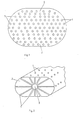
- the arrangement of the hollow channels, and thus of the Ai wires, differs depending on the type of catalyst support; Often there is a parallel arrangement of the hollow channels and a radial arrangement, starting from a central inlet of larger diameter.
- This process can be promoted by applying a DC electrical voltage.
- a DC electrical voltage for example, it is expedient to hold part of the mold wall for holding the rods or wires, for example in the case of a cylindrical construction of the catalytic converter, the top surfaces of the cylinder with e.g. To equip perforated disks in which the Al rods are held.
- the head ends of the rods can then be connected to a power source in a simple manner if required.
- the rods or wires can be completely converted into the oxide hydrate, or the remaining cores of the rods can be removed. The resulting hydrogen is removed by suction.
- the temperatures required for hardening arise partly from the heat of reaction in the reaction of the solid reactants with the alkali silicate solution, but can be generated by external heating or by electrical resistance heating or by the heat of reaction of the reaction of aluminum with alkalis.
- the curing time of the molding compositions to give shaped bodies is short and is generally 20 to 60, preferably 20 to 40 minutes.
- a heating process to known temperatures is required, which are predetermined by the formation temperature of this aluminum oxide modification and are at a maximum of 850 to 880 ° C. and generally in the range from 600 to 850 ° C.
- a particular advantage arises from the solid storage of the y-aluminum oxide through the formation of the corresponding oxide hydrate during the hardening reaction.
- the water content of the molding composition is essentially retained.
- This water content can expediently be removed in a simple manner by storing the moldings produced in air, but removal by heating to temperatures above 120 ° C. or by heating during the formation of the y-aluminum oxide is also possible.
- Heating to 600 to 850 ° C is used exclusively for the formation of ⁇ -Al 2 O 3 , but not for curing the shaped bodies, which already have the required strength in the order of magnitude of the strength of ceramic materials after curing at temperatures of at most 120 ° C
- this strength only arises through the firing process, while the molding compositions according to the invention have the reactive solid components a) to c), which give the required strength through chemical chemical reactions with the alkali silicate solution.
- a flowable molding compound is prepared by intensively mixing 100 g of a potassium-potassium silicic acid solution with a molar ratio of 1.5 SiO 2 to 1 K20, made from precipitated amorphous disperse-powdered silica with 50% by weight SiO 2 content, by dissolving in 50% by weight .-% KOH, 1.00 g of oxide mixture with contents of amorphous Si02 and aluminum oxide, which was obtained as furnace filter dust in the melt processing of bauxite and 100 g of calcined ground bauxite with a grain size below 0.2 mm and filled into a limiting vessel , which contains aluminum wires of 0.2 mm diameter arranged parallel to each other, standing vertically at a distance of 0.6 cm from each other.
- the curing takes place at 85 ° C and is in 60 min. completed.
- the surface of the wires is decomposed by alkali with the formation of gaseous hydrogen and local heat development.
- the remainder of the wires are removed during demolding.
- a molded body with a large number of channels has been created.
- the channels are greatly enlarged by the gas formation and covered with a layer of aluminum oxide hydrate.
- Several catalyst supports are placed in an oven heated to 700 ° C., whereupon the oven is heated to 750 ° C., whereby the aluminum oxide hydrate forms ⁇ -Al 2 O 3 .
- the finished catalyst support can be provided with noble metal compounds by known methods, which are fixed on the ⁇ -Al 2 O 3 formed .
- a catalyst carrier as in Example 1, is produced, but a fitting piece is placed on the perforated disk, which holds the aluminum wires in the limiting shape, which has an electrical contact at the passage points of the aluminum rods, to which an electrical current is present.
- Remnants of the aluminum wires do not have to be removed during demolding.
- the hollow channels are enlarged more than in the shaped body obtained according to Example 1.
- Example 1 is repeated, but using a potassium-potassium silicic acid solution with a molar ratio of 1.2 SiO 2 to 1 K20 in the same amount.
- Example 1 is repeated, but instead of 100 g of calcined bauxite, 100 g of talc is used as the filler.
- Example 1 is repeated, but using a sodium-alkaline silica solution with a molar ratio of 1.3SiO 2 to 1 Na 2 0, which had been prepared accordingly by dissolving the precipitated silica in 50% by weight NaOH.
Landscapes
- Chemical & Material Sciences (AREA)
- Engineering & Computer Science (AREA)
- Chemical Kinetics & Catalysis (AREA)
- Materials Engineering (AREA)
- Organic Chemistry (AREA)
- Ceramic Engineering (AREA)
- Health & Medical Sciences (AREA)
- Toxicology (AREA)
- Combustion & Propulsion (AREA)
- Mechanical Engineering (AREA)
- General Engineering & Computer Science (AREA)
- Catalysts (AREA)
- Exhaust Gas Treatment By Means Of Catalyst (AREA)
- Silicates, Zeolites, And Molecular Sieves (AREA)
Applications Claiming Priority (3)
| Application Number | Priority Date | Filing Date | Title |
|---|---|---|---|
| DE3512586 | 1985-04-06 | ||
| DE8510301U DE8510301U1 (de) | 1985-04-06 | 1985-04-06 | Abgaskatalysator-Träger aus anorganischen Formmassen |
| DE19853512586 DE3512586A1 (de) | 1985-04-06 | 1985-04-06 | Abgaskatalysator-traeger aus anorganischen formmassen |
Publications (2)
| Publication Number | Publication Date |
|---|---|
| EP0203284A2 true EP0203284A2 (fr) | 1986-12-03 |
| EP0203284A3 EP0203284A3 (fr) | 1988-11-02 |
Family
ID=25831157
Family Applications (1)
| Application Number | Title | Priority Date | Filing Date |
|---|---|---|---|
| EP86103241A Ceased EP0203284A3 (fr) | 1985-04-06 | 1986-03-11 | Support pour catalyseur de gaz d'échappement formé à partir d'une matière inorganique |
Country Status (5)
| Country | Link |
|---|---|
| US (1) | US4668659A (fr) |
| EP (1) | EP0203284A3 (fr) |
| JP (1) | JPS61230735A (fr) |
| DE (2) | DE3512586A1 (fr) |
| SU (1) | SU1468404A3 (fr) |
Cited By (2)
| Publication number | Priority date | Publication date | Assignee | Title |
|---|---|---|---|---|
| EP0254165A3 (en) * | 1986-07-23 | 1988-10-19 | Huls Troisdorf Aktiengesellschaft | High-temperature resistant catalyst body and process for its manufacture |
| WO1993003840A1 (fr) * | 1991-08-26 | 1993-03-04 | Ford Motor Company Limited | Supports de catalyseur a l'oxyde d'aluminium produits a partir de sols d'alumine |
Families Citing this family (5)
| Publication number | Priority date | Publication date | Assignee | Title |
|---|---|---|---|---|
| DE4206310A1 (de) * | 1992-02-28 | 1993-09-02 | Sperling Friedrich Dr Ing | Abgaskatalysator fuer brennkraftmaschinen |
| DE4322037A1 (de) * | 1993-07-02 | 1995-01-26 | Bischoff Erhardt Gmbh Co Kg | Katalysator für Verbrennungsmotore |
| DE4329558A1 (de) * | 1993-09-02 | 1995-03-09 | Friedrich Dr Ing Sperling | Rußfilter für Dieselbrennkraftmaschinen |
| JP4355469B2 (ja) * | 2002-03-08 | 2009-11-04 | 日本碍子株式会社 | アルミナ担持担体、触媒体及びアルミナ担持担体の製造方法 |
| US10865681B2 (en) * | 2016-10-21 | 2020-12-15 | Cummins Emission Solutions Inc. | Substrate shape, geometry, positioning, and/or cell density to improve aftertreatment performance |
Family Cites Families (7)
| Publication number | Priority date | Publication date | Assignee | Title |
|---|---|---|---|---|
| GB343441A (en) * | 1929-05-03 | 1931-02-16 | Lloyd Francis Nickell | Improvements relating to catalyst carriers |
| US3755534A (en) * | 1971-08-12 | 1973-08-28 | Grace W R & Co | Catalytic control of auto exhaust emissions |
| JPS5322557B2 (fr) * | 1973-04-13 | 1978-07-10 | ||
| JPS5345687A (en) * | 1976-10-06 | 1978-04-24 | Toyota Motor Corp | Catalyst carrier and catalyst |
| US4189404A (en) * | 1977-01-06 | 1980-02-19 | Engelhard Minerals & Chemicals Corporation | Catalyst and process of its preparation |
| DE2935914A1 (de) * | 1979-09-06 | 1981-04-02 | Kali-Chemie Ag, 3000 Hannover | Verfahren zur herstellung von kugelfoermigen formkoerpern auf basis al(pfeil abwaerts)2(pfeil abwaerts)o(pfeil abwaerts)3(pfeil abwaerts) und/oder sio(pfeil abwaerts)2(pfeil abwaerts) |
| FR2517365A1 (fr) * | 1981-11-27 | 1983-06-03 | Pro Catalyse | Procede de traitement de gaz d'echappement des moteurs a combustion interne fonctionnant avec un carburant contenant du plomb |
-
1985
- 1985-04-06 DE DE19853512586 patent/DE3512586A1/de active Granted
- 1985-04-06 DE DE8510301U patent/DE8510301U1/de not_active Expired
-
1986
- 1986-03-11 EP EP86103241A patent/EP0203284A3/fr not_active Ceased
- 1986-04-04 SU SU864027234A patent/SU1468404A3/ru active
- 1986-04-04 JP JP61076829A patent/JPS61230735A/ja active Granted
- 1986-04-07 US US06/848,494 patent/US4668659A/en not_active Expired - Fee Related
Cited By (2)
| Publication number | Priority date | Publication date | Assignee | Title |
|---|---|---|---|---|
| EP0254165A3 (en) * | 1986-07-23 | 1988-10-19 | Huls Troisdorf Aktiengesellschaft | High-temperature resistant catalyst body and process for its manufacture |
| WO1993003840A1 (fr) * | 1991-08-26 | 1993-03-04 | Ford Motor Company Limited | Supports de catalyseur a l'oxyde d'aluminium produits a partir de sols d'alumine |
Also Published As
| Publication number | Publication date |
|---|---|
| DE3512586A1 (de) | 1986-10-09 |
| US4668659A (en) | 1987-05-26 |
| JPH0559788B2 (fr) | 1993-08-31 |
| DE8510301U1 (de) | 1985-10-24 |
| JPS61230735A (ja) | 1986-10-15 |
| DE3512586C2 (fr) | 1988-09-29 |
| SU1468404A3 (ru) | 1989-03-23 |
| EP0203284A3 (fr) | 1988-11-02 |
Similar Documents
| Publication | Publication Date | Title |
|---|---|---|
| EP0254165B1 (fr) | Corps de catalyseur résistant à des températures élevées et son procédé de fabrication | |
| DE69033420T2 (de) | Keramischer Filter für staubhaltige Gase und Verfahren zu seiner Herstellung | |
| EP0762932B1 (fr) | Supports de catalyseurs a base de dioxyde de titane | |
| DE3146250A1 (de) | Verfahren zum herstellen eines dichroit-keramikproduktes | |
| DE69110654T2 (de) | Herstellung von Kordieritkörpern. | |
| DE69106866T2 (de) | Herstellung von Cordieritkörpern. | |
| DE69830852T2 (de) | Verfahren zum brennen von keramischen wabenkörpern | |
| DE3784092T2 (de) | Verfahren zur herstellung eines filters fuer fluessige metalle. | |
| DE4339172A1 (de) | Verfahren zur Herstellung eines Cordieritkörpers | |
| DE102009041585A1 (de) | Wabenstruktur und Verfahren zu deren Herstellung | |
| DE102004043250B4 (de) | Verfahren zur Herstellung einer Wabenstruktur und Wabenstruktur | |
| DE69800379T2 (de) | Verfahren zur Herstellung einer Cordierit-Keramik mit Honigwabenstruktur | |
| US2834738A (en) | Production of skeletal glass catalysts | |
| EP0268166A2 (fr) | Matériaux résistants aux métaux et aux sels en fusion, leur fabrication et application | |
| DE3827646A1 (de) | Sinterbares rohstoffpulver auf basis von aluminiumtitanat, verfahren zu seiner herstellung sowie daraus hergestellte sinterformkoerper und deren verwendung | |
| DE3512586C2 (fr) | ||
| DE3512516C2 (fr) | ||
| DE4242227A1 (de) | Katalysatorträger und Verfahren für seine Herstellung | |
| DE3930502A1 (de) | Formkoerper aus einer schnellhaertenden, anorganischen formmasse | |
| DE69015344T2 (de) | Phosphatzusammensetzungen, gesinterter Körper davon und Herstellung dieses gesinterten Körpers. | |
| DE2632422A1 (de) | Feuerleichtsteine auf der basis von siliciumoxynitrid | |
| WO1994003410A1 (fr) | Corps moules refractaires en carbure de silicium avec liaison de mullite, leur procede de fabrication, matiere a mouler a utiliser comme produit intermediaire et utilisation desdits corps moules comme materiel d'enfournement | |
| DE3920048A1 (de) | Alumosilikat-katalysatorformkoerper und verfahren zu seiner herstellung | |
| DE4326014A1 (de) | Keramisches Bauteil mit einem korrosionsbeständigen Überzug | |
| DE19702091A1 (de) | Bauteile aus einem Aluminiumwerkstoff und Verfahren zu ihrer Herstellung |
Legal Events
| Date | Code | Title | Description |
|---|---|---|---|
| PUAI | Public reference made under article 153(3) epc to a published international application that has entered the european phase |
Free format text: ORIGINAL CODE: 0009012 |
|
| AK | Designated contracting states |
Kind code of ref document: A2 Designated state(s): AT BE CH DE FR GB IT LI LU NL SE |
|
| RAP1 | Party data changed (applicant data changed or rights of an application transferred) |
Owner name: HUELS TROISDORF AKTIENGESELLSCHAFT |
|
| PUAL | Search report despatched |
Free format text: ORIGINAL CODE: 0009013 |
|
| AK | Designated contracting states |
Kind code of ref document: A3 Designated state(s): AT BE CH DE FR GB IT LI LU NL SE |
|
| 17P | Request for examination filed |
Effective date: 19890426 |
|
| 17Q | First examination report despatched |
Effective date: 19900315 |
|
| STAA | Information on the status of an ep patent application or granted ep patent |
Free format text: STATUS: THE APPLICATION HAS BEEN REFUSED |
|
| 18R | Application refused |
Effective date: 19901129 |
|
| RIN1 | Information on inventor provided before grant (corrected) |
Inventor name: ENGELS, HANS-WERNER Inventor name: SPIELAU, PAUL, DR. Inventor name: NEUSCHAEFFER, KARL-HEINZ, DR. |