EP0203326A2 - Procédé et dispositif de lutte contre la vermine rampante - Google Patents
Procédé et dispositif de lutte contre la vermine rampante Download PDFInfo
- Publication number
- EP0203326A2 EP0203326A2 EP86104883A EP86104883A EP0203326A2 EP 0203326 A2 EP0203326 A2 EP 0203326A2 EP 86104883 A EP86104883 A EP 86104883A EP 86104883 A EP86104883 A EP 86104883A EP 0203326 A2 EP0203326 A2 EP 0203326A2
- Authority
- EP
- European Patent Office
- Prior art keywords
- frame
- vacuuming
- crawling
- flushing
- recovery container
- Prior art date
- Legal status (The legal status is an assumption and is not a legal conclusion. Google has not performed a legal analysis and makes no representation as to the accuracy of the status listed.)
- Granted
Links
Images


Classifications
-
- A—HUMAN NECESSITIES
- A01—AGRICULTURE; FORESTRY; ANIMAL HUSBANDRY; HUNTING; TRAPPING; FISHING
- A01M—CATCHING, TRAPPING OR SCARING OF ANIMALS; APPARATUS FOR THE DESTRUCTION OF NOXIOUS ANIMALS OR NOXIOUS PLANTS
- A01M7/00—Special adaptations or arrangements of liquid-spraying apparatus for purposes covered by this subclass
- A01M7/0025—Mechanical sprayers
- A01M7/0032—Pressure sprayers
- A01M7/0046—Hand-operated sprayers
-
- A—HUMAN NECESSITIES
- A01—AGRICULTURE; FORESTRY; ANIMAL HUSBANDRY; HUNTING; TRAPPING; FISHING
- A01M—CATCHING, TRAPPING OR SCARING OF ANIMALS; APPARATUS FOR THE DESTRUCTION OF NOXIOUS ANIMALS OR NOXIOUS PLANTS
- A01M1/00—Stationary means for catching or killing insects
- A01M1/08—Attracting and catching insects by using combined illumination or colours and suction effects
-
- A—HUMAN NECESSITIES
- A01—AGRICULTURE; FORESTRY; ANIMAL HUSBANDRY; HUNTING; TRAPPING; FISHING
- A01M—CATCHING, TRAPPING OR SCARING OF ANIMALS; APPARATUS FOR THE DESTRUCTION OF NOXIOUS ANIMALS OR NOXIOUS PLANTS
- A01M1/00—Stationary means for catching or killing insects
- A01M1/14—Catching by adhesive surfaces
-
- A—HUMAN NECESSITIES
- A01—AGRICULTURE; FORESTRY; ANIMAL HUSBANDRY; HUNTING; TRAPPING; FISHING
- A01M—CATCHING, TRAPPING OR SCARING OF ANIMALS; APPARATUS FOR THE DESTRUCTION OF NOXIOUS ANIMALS OR NOXIOUS PLANTS
- A01M5/00—Catching insects in fields, gardens, or forests by movable appliances
- A01M5/02—Portable appliances
-
- A—HUMAN NECESSITIES
- A01—AGRICULTURE; FORESTRY; ANIMAL HUSBANDRY; HUNTING; TRAPPING; FISHING
- A01M—CATCHING, TRAPPING OR SCARING OF ANIMALS; APPARATUS FOR THE DESTRUCTION OF NOXIOUS ANIMALS OR NOXIOUS PLANTS
- A01M2200/00—Kind of animal
- A01M2200/01—Insects
- A01M2200/011—Crawling insects
Definitions
- the present invention relates to systems and methods for eliminating crawling pests from residential and commercial structures. It more particularly relates to systems and methods for elminating cockroaches, ants and spides.
- Another object of the present invention is to provide an improved system for eliminating crawling pests.
- a further object of the present invention is to provide a safer system and method for eliminating cockroaches and other crawling insects using miniumum amounts of pesticides.
- a still further object is to provide an improved method of eliminating crawling pests which have become resistant to current pesticides.
- Another object is to provide a novel system and method which effectively eliminate the cockroach egg from the interior of structures.
- a further object is to provide a novel system for elminating crawling pests which minimizes the promotion of the development of insecticide resistance.
- a still further object is to provide an apparatus for eliminating crawling pests which is convenient to use and transport.
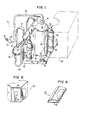
- FIG. 1 0 The apparatus or system embodying the present invention is shown generally in Figure 1 at 1 0 .
- a frame 12 having a horizontal base member 14 and a vertical back member 16 secured thereto are provided.
- Suitable shoulder straps 18 having an adjustable belt 2o passing through their lower loops 22 allow frame 12, with the crawling pest eliminator equipment secured thereto, to be easily mounted on the back of the pesticide control operator. The operator can thus freely and conveniently manuever the equipment to and between the desired locations in the structure and operate the equipment while still on his back, as will later be described in detail.
- frame 12 by disconnecting belt 2o can be removed from the operator's back and rested on horizontal base member 14 after the process has been completed.
- a vacuum system recovery tank 24 is secured to base member 14 in a central location. As better shown in Figures 2 and 3, recovery tank 24 with removable tank top 25 houses the vacuum motor 26 at its base portion. A filter 28, as illustrated in Figure 3, is positioned between the recovery bag 3o and motor 26. Motor 26 is a one and a half to two horsepower two-stage motor about four inches deep. Motor 26 is positioned beneath bag 3o so that its heat is dissipated away from the apparatus and operator, and so that vacuum suction and equilibrium are increased. The actual motor internal construction, however, does not form a part of the subject invention and would be apparent to one skilled in the art from the subject disclosure.
- the electrical connection box 32 for motor 26 is also mounted to base member 14 and it includes a suitable outlet 33 into which an electrical cord can be plugged. An on-off switch 34 having positions for, alternatively, the first and second stages of motor 26 is also positioned on connection box 32.
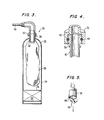
- a revolving valve 36 is mounted at the top of recovery tank 24, as best shown in Figures 3 and 4.
- Valve 36 has a lower portion 38 with threads 4o which are screwed into recovery tank 24 and secured thereto.
- Revolving valve 36 also has an upper outer portion 42 which revolves freely about the bearings 44. This bearing arrangement allows the vacuum hose 46 to rotate relative to tank 24 and to be operated by either hand of the operator or from either side of frame 12.
- a hex nut 47 can be threaded on threads 4o to secure recovery bag 3o within tank 24.
- a trap door 48 can be provided at the lower end of lower portion 38 and biased shut so that the pests do not escape from bag 3o but opened when motor 26 is operating by the air sucked through it.
- Bag 3o is constructed of any suitable material, such as cotton or synthetic fabric that has breathing holes and adapted so that air can freely pass through them and the pests cannot escape out through them. However, it is expected that it will be a sixty four ounce cloth material of rather tough tear-resistant construction. It is further within the scope of the present invention to have the bag formed from a transparent material so that the interior contents can be easily viewed and its fullness readily noted. After bag 3o has filled it is removed from the tank and destroyed in a blending or crushing device (not shown) to ensure that not only the pests but also their eggs are completly disintegrated. A six inch piece of soft wire (not shown) is twisted about the top of bag 3o just below hex nut 48 prior to removing it to ensure that the pests do not escape from the bag.
- a blending or crushing device not shown
- Hose 46 is connected to revolving valve 36 and extends angularly to its remote end.
- Hose 46 is about two to three feet long and one inch in diameter.
- An extension hose can also be attached thereto and used to reach higher walls and ceilings.
- An adapter 5o is secured at the remote end of the hose.
- Adapter 5 0 as best shown in Figure 2, has an outer female opening 52 into which any of a variety of nozzles 54, 56, 58 can be inserted. Three nozzles are shown in Figure 2 and each is designed for its specific use.
- Nozzle 54 which is cone shaped is designed to be used in open areas, both vertical and horizontal.
- Nozzle 56 is used to extract cockroaches and other pests from cracks and crevices, such as closets, kitchen cabinets and dressers and other places where the pest may be visible, resting in cracks and crevices.
- Nozzle 58 is used under similar circumstances as nozzle 56 but is also provided with a ninety-degree angle to access hard-to-reach cracks and crevices.
- Adapter 5o has a flashlight integrally built therein as best illustrated in Figure 6 at 6 0 .
- Flashlight 6o is positioned on the upper portion of adapter 5o where its push button switch 62 can be easily manipulated by the operator's hand when he is grasping adapter 5 0 .
- Flashlight 6 0 itself is of conventional operation having a pen light battery 62 with a bulb 64 in electrical contact therewith and positioned in a lens 66 which can be screwed into the opening 68 provided for the flashlight in adapter 5 0 .
- Aerosol canisters 7o, 72, 74 are held in circular base sleeves 76, 78, 8 0 , respectively, secured on base member 14.
- Canisters 7 0 , 72 are positioned adjacent vertical member 16 and are further held in upper sleeves 82, 84 extending out from vertical member 16.
- the third canister 74 is similarly positionable in upper sleeve 86 secured to the outside of recovery tank 24.
- Each of the aerosol canisters has a line 88, 9 0 , 92 passing through a common carrier hose 94 and to a spray gun shown generally at 96.
- Spray gun 96 is best illustrated in Figure 7, and is shown to comprise a trigger nozze 98 having a thin elongated nozzle 1oo extending out from it.
- a tubing 1 0 4 communicates with nozzle 100 and is positioned in trigger nozzle 98.
- a ball lo6 having three spaced openings lo8 passing through it communicates with the three openings 11 0 of the hose end 112.
- Nozzle 1oo can be causd to communicate with the desired canister by rotating or twisting ball lo6 to one of the three positions marked on the ball.
- the cone-shaped pin 114 retained in tubing lo4 remains stationary and when the ball is turned to opening 11 0 , spring 116 forces the pin into that position. The pin locks it in that hole until ball 106 is rotated to another setting.
- trigger nozzle 98 is dispensed through nozzle 1oo by depressing trigger nozzle 98.
- the trigger nozzle can be conveniently held in one of the operator's hands while the adapter is held in the other.
- a trigger 117 is positioned on the top of each canister which causes it to be closed or opened. In the vertical position, trigger 117 is open and at a 9o degree angle (as shown) it is closed. Even when trigger 117 is open, the pressure in lines 88, 9o or 92 will not permit the chemical to be released out nozzle loo, until trigger nozzle 98 is depressed.
- Aerosol canister 7o is filled with a flushing agent.
- the flushing agent preferably is non-toxic since it is not meant to kill the crawling pests but merely to flush them out of their hiding places.
- Commercially available low toxic agents which can be used include Pyrethrum .5% and Resmethrin 1%.
- the second canister 72 is filled with a residual such as Darban .5%, Diazinen 1%, Bagon 1% or DDVP .5%.
- the third canister 74 is a reserve canister which can be filled with either the flushing agent or the residual.
- the system functions very conveniently with apparatus 1 0 mounted to the operator's back by securing shoulder straps 18 over his shoulders and belt 2o through loops 22 of the straps. The operator is thereby free to move about the structure.
- a battery pack (not shown) on frame 12 to power the apparatus, it is anticipated that this would be too heavy for most uses.
- an electrical cord is first plugged into a suitable electric outlet and into the outlet box 32 on frame 12. The wall and floor surfaces of the structure can be investigated to determine the location of the crawling pests and their eggs visually by pressing button 62 on flashlight 6 0 and illuminating the darkened crevices and cracks therein.
- Spray gun 96 is then manipulated until nozzle loo is in communication with flushing agent aerosol container 7 0 .
- Spray gun 96 is then pointed in the desired direction in the cracks and crevices and trigger nozzle 98 depressed and the flushing agent sprayed therein.
- the crawling pests such as cockroaches, ants or spiders, are thereby flushed out of the cracks.
- vacuum motor 26 can be turned to its first stage position by adjusting switch 34. With the desired nozzle 54, 56 or 58 secured in adapter 5 0 , the adapter is grasped and the nozzle slid along the surface. It is noted that the opening of each nozzle has a rubbery, flexible perimeter 12 thereby facilitating a close sliding action of the nozzle along the surfaces.
- the crawling pests are thereby suctioned up through vacuum hose 46 into the recovery bag 3o by the suction created by vacuum motor 26.
- the vacuum motor can be turned or switched to its second stage by adjusting switch 34 which provides additional suction power. It is recommended though, to extend the operational life of vacuum motor 26, that the second stage only be used when necessary.
- vacuum motor 26 is turned off and spray gun 96 is turned to its position wherein it communicates with residual aerosol canister 72 and the residual is then sprayed from canister 72 on the surfaces by depressing trigger nozzle 98.
- the baited sticky traps as best shown in Figures 8 and 9 at 122 are positioned on the various surfaces.
- the traps have an adhesive coating 124 on their bottom surface 126 so that they can be adhered to vertical surfaces as well as downwardly depending horizontal surfaces, such as inside cabinets, behind bookcases and in bathrooms and closets. They can thus be then placed out of sight and positioned so as to attact to their non-toxic baited sticky interior floor 128 and trap any remaining pests that might later crawl out of their hiding places in search of food or water.
- the traps will last for about two months.
- the present design of the traps also better disguises the baited sticky trap floor 128 from the view of the exterior.
- Trap 122 is also smaller (three inches long and one and one half to three and one half inches wide) than existing so-called "Mr. Stickey" traps to better fit in small out-of-the-way places. Trap 122 is supplied in a flat configuration for easy transporting and then at the job site can be folded as shown in Figure 8 and secured together to form its complete design as shown in Figure 9.
- Trap 124 does not use any toxic eliminator pesticides so the entire system of the present invention provides a safer means than previously possible for ridding structures of crawling pests, such as cockroaches, even those varieties which have become resistant to current pesticides. Since little or no pesticides are used, the development of insecticide resistance also is not promoted. In addition to removing the pests, their eggs are also removed subsequently and destroyed thus stopping the roach propagation cycle and thereby providing a more efficient and safer pest eliminator means.
Landscapes
- Life Sciences & Earth Sciences (AREA)
- Pest Control & Pesticides (AREA)
- Engineering & Computer Science (AREA)
- Insects & Arthropods (AREA)
- Wood Science & Technology (AREA)
- Zoology (AREA)
- Environmental Sciences (AREA)
- Biodiversity & Conservation Biology (AREA)
- Ecology (AREA)
- Forests & Forestry (AREA)
- Mechanical Engineering (AREA)
- Catching Or Destruction (AREA)
Applications Claiming Priority (2)
| Application Number | Priority Date | Filing Date | Title |
|---|---|---|---|
| US739531 | 1985-05-31 | ||
| US06/739,531 US4594807A (en) | 1985-05-31 | 1985-05-31 | Crawling pest eliminator system and method |
Publications (3)
| Publication Number | Publication Date |
|---|---|
| EP0203326A2 true EP0203326A2 (fr) | 1986-12-03 |
| EP0203326A3 EP0203326A3 (en) | 1988-05-11 |
| EP0203326B1 EP0203326B1 (fr) | 1992-08-12 |
Family
ID=24972730
Family Applications (1)
| Application Number | Title | Priority Date | Filing Date |
|---|---|---|---|
| EP86104883A Expired EP0203326B1 (fr) | 1985-05-31 | 1986-04-10 | Procédé et dispositif de lutte contre la vermine rampante |
Country Status (5)
| Country | Link |
|---|---|
| US (1) | US4594807A (fr) |
| EP (1) | EP0203326B1 (fr) |
| CA (1) | CA1269532A (fr) |
| DE (1) | DE3686355T2 (fr) |
| IN (1) | IN167172B (fr) |
Cited By (1)
| Publication number | Priority date | Publication date | Assignee | Title |
|---|---|---|---|---|
| US8388222B2 (en) | 2010-02-09 | 2013-03-05 | Gary Joseph Potter | Device for indicating eradication of a pest infestation |
Families Citing this family (18)
| Publication number | Priority date | Publication date | Assignee | Title |
|---|---|---|---|---|
| US4882873A (en) * | 1987-04-02 | 1989-11-28 | Purnell Gabriel L | Insect elimination kit and methods for its use |
| US5068993A (en) * | 1990-10-05 | 1991-12-03 | Millar John G | Method and apparatus for anesthetizing caught fish |
| US5989360A (en) * | 1997-09-23 | 1999-11-23 | Hamilton; Thomas I. | Gas-driven portable self-contained vacuum device |
| US6079149A (en) * | 1998-09-02 | 2000-06-27 | Hastings; Glenn | Method and apparatus for the removal and elimination of fire ants |
| US6205702B1 (en) * | 1999-08-18 | 2001-03-27 | Richard L M Ammons | Environmentally safe insect control system |
| US6345592B1 (en) * | 1999-09-09 | 2002-02-12 | Brett Hollis | Pet vacuum |
| US6688036B1 (en) | 2003-02-11 | 2004-02-10 | John Gunn | Method and apparatus for controlling pests |
| US7249437B2 (en) * | 2003-04-24 | 2007-07-31 | Soundstarts, Inc. | Method and apparatus for exterminating gophers and other burrowing pests |
| US6907690B1 (en) * | 2003-04-25 | 2005-06-21 | Jimmie L. Stallings | Environmentally friendly insect eradication method and apparatus |
| US20110088309A1 (en) * | 2009-10-05 | 2011-04-21 | Emory University Office Of Technology Transfer | Device for capturing insects |
| WO2013009803A1 (fr) * | 2011-07-13 | 2013-01-17 | J & C Innovations, LLC | Systèmes et procédés d'extermination d'insectes |
| JP6869635B2 (ja) | 2015-07-09 | 2021-05-12 | 株式会社マキタ | 集塵機 |
| US10383493B2 (en) * | 2015-07-09 | 2019-08-20 | Makita Corporation | Dust collector |
| US10973218B2 (en) | 2017-03-02 | 2021-04-13 | Craig Neal | Belt vac system |
| US11839206B2 (en) * | 2018-08-07 | 2023-12-12 | Mark LaCroix | Systems and methods for extermination of ants |
| JP7198104B2 (ja) | 2019-02-06 | 2022-12-28 | 株式会社マキタ | クリーナ |
| JP7224967B2 (ja) | 2019-03-05 | 2023-02-20 | 株式会社マキタ | アップライト集じん機 |
| CN114208793B (zh) * | 2021-11-26 | 2022-11-18 | 安阳沃林生态科技有限公司 | 一种田间虫害自动监测预警站 |
Family Cites Families (12)
| Publication number | Priority date | Publication date | Assignee | Title |
|---|---|---|---|---|
| US26950A (en) * | 1860-01-24 | p peters | ||
| US1586484A (en) * | 1924-08-09 | 1926-05-25 | John S Suggs | Insect exterminator |
| NL18984C (fr) * | 1925-10-21 | |||
| US1797557A (en) * | 1929-11-23 | 1931-03-24 | Ernest R Stine | Vacuum cleaner |
| US2117419A (en) * | 1937-03-11 | 1938-05-17 | Marie M Hamrick | Insect exterminator, sterilizer, and drier |
| US2340944A (en) * | 1941-09-02 | 1944-02-08 | Harry C Easter | Insect eliminator |
| US2686694A (en) * | 1950-04-11 | 1954-08-17 | Dryco Corp | Garment spot-removing device |
| USRE26950E (en) | 1968-07-22 | 1970-09-22 | Steam-vacuum generator for rug and upholstery cleaning | |
| US4141174A (en) * | 1977-05-27 | 1979-02-27 | The United States Of America As Represented By The Secretary Of Agriculture | Quantitative apparatus for sampling athropods associated with field crops |
| US4160336A (en) * | 1978-02-09 | 1979-07-10 | Query Grady W | Method for treating fireants |
| FR2540719A1 (fr) * | 1983-02-14 | 1984-08-17 | Neveu Marcel | Utilisation de desinfectants dans le circuit d'air des aspirateurs afin d'eviter la diffusion dans l'atmosphere des bacteries et tout polluant biologique |
| BE898456A (fr) * | 1983-12-14 | 1984-03-30 | Debetencourt Jean J | Dispositif pour la capture et l'extermination des insectes. |
-
1985
- 1985-05-31 US US06/739,531 patent/US4594807A/en not_active Expired - Lifetime
-
1986
- 1986-04-10 DE DE8686104883T patent/DE3686355T2/de not_active Expired - Fee Related
- 1986-04-10 EP EP86104883A patent/EP0203326B1/fr not_active Expired
- 1986-04-11 IN IN274/MAS/86A patent/IN167172B/en unknown
- 1986-04-14 CA CA000506623A patent/CA1269532A/fr not_active Expired
Cited By (1)
| Publication number | Priority date | Publication date | Assignee | Title |
|---|---|---|---|---|
| US8388222B2 (en) | 2010-02-09 | 2013-03-05 | Gary Joseph Potter | Device for indicating eradication of a pest infestation |
Also Published As
| Publication number | Publication date |
|---|---|
| US4594807A (en) | 1986-06-17 |
| DE3686355T2 (de) | 1993-03-25 |
| DE3686355D1 (de) | 1992-09-17 |
| EP0203326A3 (en) | 1988-05-11 |
| EP0203326B1 (fr) | 1992-08-12 |
| CA1269532A (fr) | 1990-05-29 |
| IN167172B (fr) | 1990-09-15 |
Similar Documents
| Publication | Publication Date | Title |
|---|---|---|
| US4594807A (en) | Crawling pest eliminator system and method | |
| US8181385B2 (en) | Portable electronic lighted insect zapper | |
| US4729147A (en) | Pet groomer and flea annihilator | |
| US20110226868A1 (en) | Ultrasonic humidifier for repelling insects | |
| US8296993B2 (en) | Ultrasonic humidifier for repelling insects | |
| US4607451A (en) | Insect trap | |
| CA2092658C (fr) | Piege pour moustiques et insectes nocturnes et methode correspondante | |
| US4945673A (en) | Centralized extermination system | |
| US6862839B2 (en) | Attracting mite confirmation apparatus and mite capturing method thereof | |
| US6327810B1 (en) | Pest trap | |
| JPH09504178A (ja) | 捕虫器及び捕虫方法 | |
| US5915950A (en) | Fly and roach eliminator | |
| US20070256351A1 (en) | Device and method for converting a container into an insect trapping device | |
| WO2004036989A1 (fr) | Systeme permettant de pieger des insectes volants et procede afferent | |
| US7320439B2 (en) | Self-contained insect repelling and killing apparatus | |
| EP1040756A1 (fr) | Appareil pour capturer des insectes | |
| US10973218B2 (en) | Belt vac system | |
| US20050246944A1 (en) | Pest inhaler | |
| US20220369614A1 (en) | Non-chemical spray device for insects, pests and germs | |
| KR20110094386A (ko) | 포터블타입의 해충 박멸장치 | |
| JP2004057076A (ja) | 害虫の捕獲駆除機 | |
| US4790039A (en) | Technique for sanitizing toilet seats | |
| JP2002369647A (ja) | マルチタイプ殺虫器 | |
| JP2000201570A (ja) | 有柄卵の採取方法およびこれに利用する器具 | |
| Wagner | Control of the Yellowjacket, Vespula pennsylvanica, in Public Parks |
Legal Events
| Date | Code | Title | Description |
|---|---|---|---|
| PUAI | Public reference made under article 153(3) epc to a published international application that has entered the european phase |
Free format text: ORIGINAL CODE: 0009012 |
|
| AK | Designated contracting states |
Kind code of ref document: A2 Designated state(s): CH DE FR GB IT LI SE |
|
| PUAL | Search report despatched |
Free format text: ORIGINAL CODE: 0009013 |
|
| AK | Designated contracting states |
Kind code of ref document: A3 Designated state(s): CH DE FR GB IT LI SE |
|
| 17P | Request for examination filed |
Effective date: 19881110 |
|
| 17Q | First examination report despatched |
Effective date: 19900619 |
|
| GRAA | (expected) grant |
Free format text: ORIGINAL CODE: 0009210 |
|
| AK | Designated contracting states |
Kind code of ref document: B1 Designated state(s): CH DE FR GB IT LI SE |
|
| PG25 | Lapsed in a contracting state [announced via postgrant information from national office to epo] |
Ref country code: LI Effective date: 19920812 Ref country code: CH Effective date: 19920812 |
|
| REF | Corresponds to: |
Ref document number: 3686355 Country of ref document: DE Date of ref document: 19920917 |
|
| ITF | It: translation for a ep patent filed | ||
| REG | Reference to a national code |
Ref country code: CH Ref legal event code: PL |
|
| ET | Fr: translation filed | ||
| ITTA | It: last paid annual fee | ||
| PLBE | No opposition filed within time limit |
Free format text: ORIGINAL CODE: 0009261 |
|
| STAA | Information on the status of an ep patent application or granted ep patent |
Free format text: STATUS: NO OPPOSITION FILED WITHIN TIME LIMIT |
|
| 26N | No opposition filed | ||
| EAL | Se: european patent in force in sweden |
Ref document number: 86104883.3 |
|
| PGFP | Annual fee paid to national office [announced via postgrant information from national office to epo] |
Ref country code: GB Payment date: 19950407 Year of fee payment: 10 |
|
| PGFP | Annual fee paid to national office [announced via postgrant information from national office to epo] |
Ref country code: DE Payment date: 19950428 Year of fee payment: 10 |
|
| PGFP | Annual fee paid to national office [announced via postgrant information from national office to epo] |
Ref country code: SE Payment date: 19960321 Year of fee payment: 11 |
|
| PG25 | Lapsed in a contracting state [announced via postgrant information from national office to epo] |
Ref country code: GB Effective date: 19960410 |
|
| GBPC | Gb: european patent ceased through non-payment of renewal fee |
Effective date: 19960410 |
|
| PG25 | Lapsed in a contracting state [announced via postgrant information from national office to epo] |
Ref country code: DE Effective date: 19970101 |
|
| PG25 | Lapsed in a contracting state [announced via postgrant information from national office to epo] |
Ref country code: SE Effective date: 19970411 |
|
| EUG | Se: european patent has lapsed |
Ref document number: 86104883.3 |
|
| PGFP | Annual fee paid to national office [announced via postgrant information from national office to epo] |
Ref country code: FR Payment date: 19991029 Year of fee payment: 14 |
|
| PG25 | Lapsed in a contracting state [announced via postgrant information from national office to epo] |
Ref country code: FR Free format text: LAPSE BECAUSE OF NON-PAYMENT OF DUE FEES Effective date: 20001229 |
|
| REG | Reference to a national code |
Ref country code: FR Ref legal event code: ST |
|
| PG25 | Lapsed in a contracting state [announced via postgrant information from national office to epo] |
Ref country code: IT Free format text: LAPSE BECAUSE OF NON-PAYMENT OF DUE FEES;WARNING: LAPSES OF ITALIAN PATENTS WITH EFFECTIVE DATE BEFORE 2007 MAY HAVE OCCURRED AT ANY TIME BEFORE 2007. THE CORRECT EFFECTIVE DATE MAY BE DIFFERENT FROM THE ONE RECORDED. Effective date: 20050410 |