EP0203356A2 - Procédé pour la fabrication continue de poly(éthers de phénylène) - Google Patents
Procédé pour la fabrication continue de poly(éthers de phénylène) Download PDFInfo
- Publication number
- EP0203356A2 EP0203356A2 EP86105518A EP86105518A EP0203356A2 EP 0203356 A2 EP0203356 A2 EP 0203356A2 EP 86105518 A EP86105518 A EP 86105518A EP 86105518 A EP86105518 A EP 86105518A EP 0203356 A2 EP0203356 A2 EP 0203356A2
- Authority
- EP
- European Patent Office
- Prior art keywords
- zone
- reactor
- concentration
- oxygen
- solvent
- Prior art date
- Legal status (The legal status is an assumption and is not a legal conclusion. Google has not performed a legal analysis and makes no representation as to the accuracy of the status listed.)
- Withdrawn
Links
- 238000000034 method Methods 0.000 title claims abstract description 30
- 238000010924 continuous production Methods 0.000 title claims abstract description 9
- -1 poly(phenylene ethers) Polymers 0.000 title description 2
- QVGXLLKOCUKJST-UHFFFAOYSA-N atomic oxygen Chemical compound [O] QVGXLLKOCUKJST-UHFFFAOYSA-N 0.000 claims abstract description 47
- 239000001301 oxygen Substances 0.000 claims abstract description 47
- 229910052760 oxygen Inorganic materials 0.000 claims abstract description 47
- 239000007789 gas Substances 0.000 claims abstract description 25
- 239000002904 solvent Substances 0.000 claims abstract description 20
- ISWSIDIOOBJBQZ-UHFFFAOYSA-N Phenol Chemical compound OC1=CC=CC=C1 ISWSIDIOOBJBQZ-UHFFFAOYSA-N 0.000 claims abstract description 15
- 239000011541 reaction mixture Substances 0.000 claims abstract description 15
- 238000005691 oxidative coupling reaction Methods 0.000 claims abstract description 12
- 238000006116 polymerization reaction Methods 0.000 claims abstract description 12
- 229920001955 polyphenylene ether Polymers 0.000 claims abstract description 12
- 239000007791 liquid phase Substances 0.000 claims abstract description 10
- MIHINWMALJZIBX-UHFFFAOYSA-N cyclohexa-2,4-dien-1-ol Chemical class OC1CC=CC=C1 MIHINWMALJZIBX-UHFFFAOYSA-N 0.000 claims abstract description 9
- 239000003054 catalyst Substances 0.000 claims abstract description 8
- 238000010790 dilution Methods 0.000 claims description 4
- 239000012895 dilution Substances 0.000 claims description 4
- 239000011261 inert gas Substances 0.000 claims description 4
- 238000007599 discharging Methods 0.000 claims description 2
- 238000004880 explosion Methods 0.000 claims description 2
- 238000006243 chemical reaction Methods 0.000 description 50
- IJGRMHOSHXDMSA-UHFFFAOYSA-N Atomic nitrogen Chemical compound N#N IJGRMHOSHXDMSA-UHFFFAOYSA-N 0.000 description 10
- 239000000178 monomer Substances 0.000 description 10
- 239000000243 solution Substances 0.000 description 9
- 239000006227 byproduct Substances 0.000 description 8
- 239000000047 product Substances 0.000 description 8
- 150000002989 phenols Chemical class 0.000 description 7
- 229920000642 polymer Polymers 0.000 description 7
- 239000000203 mixture Substances 0.000 description 5
- 229910052757 nitrogen Inorganic materials 0.000 description 5
- YNQLUTRBYVCPMQ-UHFFFAOYSA-N Ethylbenzene Chemical compound CCC1=CC=CC=C1 YNQLUTRBYVCPMQ-UHFFFAOYSA-N 0.000 description 4
- 150000001412 amines Chemical class 0.000 description 4
- 230000015572 biosynthetic process Effects 0.000 description 4
- QWVGKYWNOKOFNN-UHFFFAOYSA-N o-cresol Chemical compound CC1=CC=CC=C1O QWVGKYWNOKOFNN-UHFFFAOYSA-N 0.000 description 4
- IWDCLRJOBJJRNH-UHFFFAOYSA-N p-cresol Chemical compound CC1=CC=C(O)C=C1 IWDCLRJOBJJRNH-UHFFFAOYSA-N 0.000 description 4
- OKKJLVBELUTLKV-UHFFFAOYSA-N Methanol Chemical compound OC OKKJLVBELUTLKV-UHFFFAOYSA-N 0.000 description 3
- YXFVVABEGXRONW-UHFFFAOYSA-N Toluene Chemical compound CC1=CC=CC=C1 YXFVVABEGXRONW-UHFFFAOYSA-N 0.000 description 3
- 239000000470 constituent Substances 0.000 description 3
- 238000001816 cooling Methods 0.000 description 3
- 239000006185 dispersion Substances 0.000 description 3
- 238000009826 distribution Methods 0.000 description 3
- 239000012071 phase Substances 0.000 description 3
- 238000006068 polycondensation reaction Methods 0.000 description 3
- KVNYFPKFSJIPBJ-UHFFFAOYSA-N 1,2-diethylbenzene Chemical compound CCC1=CC=CC=C1CC KVNYFPKFSJIPBJ-UHFFFAOYSA-N 0.000 description 2
- QQOMQLYQAXGHSU-UHFFFAOYSA-N 2,3,6-Trimethylphenol Chemical compound CC1=CC=C(C)C(O)=C1C QQOMQLYQAXGHSU-UHFFFAOYSA-N 0.000 description 2
- NXXYKOUNUYWIHA-UHFFFAOYSA-N 2,6-Dimethylphenol Chemical compound CC1=CC=CC(C)=C1O NXXYKOUNUYWIHA-UHFFFAOYSA-N 0.000 description 2
- CIRRFAQIWQFQSS-UHFFFAOYSA-N 6-ethyl-o-cresol Chemical compound CCC1=CC=CC(C)=C1O CIRRFAQIWQFQSS-UHFFFAOYSA-N 0.000 description 2
- HEDRZPFGACZZDS-UHFFFAOYSA-N Chloroform Chemical compound ClC(Cl)Cl HEDRZPFGACZZDS-UHFFFAOYSA-N 0.000 description 2
- RYGMFSIKBFXOCR-UHFFFAOYSA-N Copper Chemical compound [Cu] RYGMFSIKBFXOCR-UHFFFAOYSA-N 0.000 description 2
- LFQSCWFLJHTTHZ-UHFFFAOYSA-N Ethanol Chemical compound CCO LFQSCWFLJHTTHZ-UHFFFAOYSA-N 0.000 description 2
- KFZMGEQAYNKOFK-UHFFFAOYSA-N Isopropanol Chemical compound CC(C)O KFZMGEQAYNKOFK-UHFFFAOYSA-N 0.000 description 2
- YNAVUWVOSKDBBP-UHFFFAOYSA-N Morpholine Chemical compound C1COCCN1 YNAVUWVOSKDBBP-UHFFFAOYSA-N 0.000 description 2
- GLUUGHFHXGJENI-UHFFFAOYSA-N Piperazine Chemical compound C1CNCCN1 GLUUGHFHXGJENI-UHFFFAOYSA-N 0.000 description 2
- JUJWROOIHBZHMG-UHFFFAOYSA-N Pyridine Chemical compound C1=CC=NC=C1 JUJWROOIHBZHMG-UHFFFAOYSA-N 0.000 description 2
- SMWDFEZZVXVKRB-UHFFFAOYSA-N Quinoline Chemical compound N1=CC=CC2=CC=CC=C21 SMWDFEZZVXVKRB-UHFFFAOYSA-N 0.000 description 2
- 238000003889 chemical engineering Methods 0.000 description 2
- 150000001879 copper Chemical class 0.000 description 2
- 229910052802 copper Inorganic materials 0.000 description 2
- 239000010949 copper Substances 0.000 description 2
- JQVDAXLFBXTEQA-UHFFFAOYSA-N dibutylamine Chemical compound CCCCNCCCC JQVDAXLFBXTEQA-UHFFFAOYSA-N 0.000 description 2
- 230000000694 effects Effects 0.000 description 2
- 239000002360 explosive Substances 0.000 description 2
- 239000007788 liquid Substances 0.000 description 2
- RLSSMJSEOOYNOY-UHFFFAOYSA-N m-cresol Chemical compound CC1=CC=CC(O)=C1 RLSSMJSEOOYNOY-UHFFFAOYSA-N 0.000 description 2
- 238000005259 measurement Methods 0.000 description 2
- 238000002360 preparation method Methods 0.000 description 2
- 239000003380 propellant Substances 0.000 description 2
- NCXUNZWLEYGQAH-UHFFFAOYSA-N 1-(dimethylamino)propan-2-ol Chemical compound CC(O)CN(C)C NCXUNZWLEYGQAH-UHFFFAOYSA-N 0.000 description 1
- MCMFEZDRQOJKMN-UHFFFAOYSA-N 1-butylimidazole Chemical compound CCCCN1C=CN=C1 MCMFEZDRQOJKMN-UHFFFAOYSA-N 0.000 description 1
- PZPVXSMCRLNVRD-UHFFFAOYSA-N 2,6-dibutylphenol Chemical compound CCCCC1=CC=CC(CCCC)=C1O PZPVXSMCRLNVRD-UHFFFAOYSA-N 0.000 description 1
- METWAQRCMRWDAW-UHFFFAOYSA-N 2,6-diethylphenol Chemical compound CCC1=CC=CC(CC)=C1O METWAQRCMRWDAW-UHFFFAOYSA-N 0.000 description 1
- NXSQQKKFGJHACS-UHFFFAOYSA-N 2-methyl-6-propylphenol Chemical compound CCCC1=CC=CC(C)=C1O NXSQQKKFGJHACS-UHFFFAOYSA-N 0.000 description 1
- BSKHPKMHTQYZBB-UHFFFAOYSA-N 2-methylpyridine Chemical compound CC1=CC=CC=N1 BSKHPKMHTQYZBB-UHFFFAOYSA-N 0.000 description 1
- BKZXZGWHTRCFPX-UHFFFAOYSA-N 2-tert-butyl-6-methylphenol Chemical compound CC1=CC=CC(C(C)(C)C)=C1O BKZXZGWHTRCFPX-UHFFFAOYSA-N 0.000 description 1
- 239000004215 Carbon black (E152) Substances 0.000 description 1
- QPLDLSVMHZLSFG-UHFFFAOYSA-N Copper oxide Chemical compound [Cu]=O QPLDLSVMHZLSFG-UHFFFAOYSA-N 0.000 description 1
- MYMOFIZGZYHOMD-UHFFFAOYSA-N Dioxygen Chemical compound O=O MYMOFIZGZYHOMD-UHFFFAOYSA-N 0.000 description 1
- CPELXLSAUQHCOX-UHFFFAOYSA-N Hydrogen bromide Chemical class Br CPELXLSAUQHCOX-UHFFFAOYSA-N 0.000 description 1
- DJEQZVQFEPKLOY-UHFFFAOYSA-N N,N-dimethylbutylamine Chemical compound CCCCN(C)C DJEQZVQFEPKLOY-UHFFFAOYSA-N 0.000 description 1
- CTQNGGLPUBDAKN-UHFFFAOYSA-N O-Xylene Chemical compound CC1=CC=CC=C1C CTQNGGLPUBDAKN-UHFFFAOYSA-N 0.000 description 1
- GSEJCLTVZPLZKY-UHFFFAOYSA-N Triethanolamine Chemical compound OCCN(CCO)CCO GSEJCLTVZPLZKY-UHFFFAOYSA-N 0.000 description 1
- 238000006887 Ullmann reaction Methods 0.000 description 1
- 239000012190 activator Substances 0.000 description 1
- 150000001447 alkali salts Chemical class 0.000 description 1
- 150000004996 alkyl benzenes Chemical group 0.000 description 1
- 125000003118 aryl group Chemical group 0.000 description 1
- 239000002585 base Substances 0.000 description 1
- 239000007795 chemical reaction product Substances 0.000 description 1
- 150000001875 compounds Chemical class 0.000 description 1
- 238000010276 construction Methods 0.000 description 1
- NKNDPYCGAZPOFS-UHFFFAOYSA-M copper(i) bromide Chemical compound Br[Cu] NKNDPYCGAZPOFS-UHFFFAOYSA-M 0.000 description 1
- 238000007872 degassing Methods 0.000 description 1
- 238000013461 design Methods 0.000 description 1
- 238000011161 development Methods 0.000 description 1
- HPNMFZURTQLUMO-UHFFFAOYSA-N diethylamine Chemical compound CCNCC HPNMFZURTQLUMO-UHFFFAOYSA-N 0.000 description 1
- LVTYICIALWPMFW-UHFFFAOYSA-N diisopropanolamine Chemical compound CC(O)CNCC(C)O LVTYICIALWPMFW-UHFFFAOYSA-N 0.000 description 1
- 229940043276 diisopropanolamine Drugs 0.000 description 1
- 238000005516 engineering process Methods 0.000 description 1
- 150000004820 halides Chemical class 0.000 description 1
- 238000004128 high performance liquid chromatography Methods 0.000 description 1
- 229930195733 hydrocarbon Natural products 0.000 description 1
- 150000002430 hydrocarbons Chemical class 0.000 description 1
- 239000012433 hydrogen halide Substances 0.000 description 1
- 229910000039 hydrogen halide Inorganic materials 0.000 description 1
- 238000011065 in-situ storage Methods 0.000 description 1
- 238000004519 manufacturing process Methods 0.000 description 1
- 238000012544 monitoring process Methods 0.000 description 1
- KGHYGBGIWLNFAV-UHFFFAOYSA-N n,n'-ditert-butylethane-1,2-diamine Chemical compound CC(C)(C)NCCNC(C)(C)C KGHYGBGIWLNFAV-UHFFFAOYSA-N 0.000 description 1
- 238000006384 oligomerization reaction Methods 0.000 description 1
- 125000004430 oxygen atom Chemical group O* 0.000 description 1
- 239000003444 phase transfer catalyst Substances 0.000 description 1
- 125000001997 phenyl group Chemical group [H]C1=C([H])C([H])=C(*)C([H])=C1[H] 0.000 description 1
- UMJSCPRVCHMLSP-UHFFFAOYSA-N pyridine Natural products COC1=CC=CN=C1 UMJSCPRVCHMLSP-UHFFFAOYSA-N 0.000 description 1
- 239000000376 reactant Substances 0.000 description 1
- 230000001105 regulatory effect Effects 0.000 description 1
- 239000000523 sample Substances 0.000 description 1
- 238000005204 segregation Methods 0.000 description 1
- 238000000926 separation method Methods 0.000 description 1
- 239000007858 starting material Substances 0.000 description 1
- 238000003860 storage Methods 0.000 description 1
- 238000003786 synthesis reaction Methods 0.000 description 1
- 238000012546 transfer Methods 0.000 description 1
- RKBCYCFRFCNLTO-UHFFFAOYSA-N triisopropylamine Chemical compound CC(C)N(C(C)C)C(C)C RKBCYCFRFCNLTO-UHFFFAOYSA-N 0.000 description 1
- 239000008096 xylene Substances 0.000 description 1
Images
Classifications
-
- C—CHEMISTRY; METALLURGY
- C08—ORGANIC MACROMOLECULAR COMPOUNDS; THEIR PREPARATION OR CHEMICAL WORKING-UP; COMPOSITIONS BASED THEREON
- C08G—MACROMOLECULAR COMPOUNDS OBTAINED OTHERWISE THAN BY REACTIONS ONLY INVOLVING UNSATURATED CARBON-TO-CARBON BONDS
- C08G65/00—Macromolecular compounds obtained by reactions forming an ether link in the main chain of the macromolecule
- C08G65/34—Macromolecular compounds obtained by reactions forming an ether link in the main chain of the macromolecule from hydroxy compounds or their metallic derivatives
- C08G65/38—Macromolecular compounds obtained by reactions forming an ether link in the main chain of the macromolecule from hydroxy compounds or their metallic derivatives derived from phenols
- C08G65/44—Macromolecular compounds obtained by reactions forming an ether link in the main chain of the macromolecule from hydroxy compounds or their metallic derivatives derived from phenols by oxidation of phenols
Definitions
- the invention relates to a process for the continuous production of high molecular weight polyphenylene ethers from monohydric phenols by oxidative coupling reaction in at least two polymerization zones arranged in series, the first zone being provided by a stirred tank reactor and additionally a propulsion jet reactor arranged within a reactor circulation system, and the further zone (s) ) are each formed by a conventional reactor, by introducing oxygen and discharging the resulting exhaust gas at temperatures between 10 and 50 ° C and pressures between 1 and 10 bar in the presence of a catalyst complex and a solvent.
- EP-A1-107 653 describes a process in which monomeric phenols, together with the solvent, are metered into a so-called gassing stirred reactor, in which a catalyst complex is initially introduced, with constant oxygen supply over a certain period of time at constant speed with the aim that To adjust the molecular weight of the polyphenylene ethers in a targeted manner or to reduce the by-product formation of the alkyl-substituted 4,4'-diphenoquinones.
- US Pat. No. 3,405,092 describes a continuous multi-stage process in which the polymerization is carried out in at least two bubble column reactors.
- Another continuous multi-stage process is proposed in U.S. Patent 4,477,649.
- the first stage consists of a gassing stirred reactor and the second stage consists of a so-called multi-zone reactor.
- a constant gas input or a controlled supply of oxygen that is not oriented towards the reaction and by-product formation also has the disadvantage that the dissipation energy to be applied for the gas dispersion does not have to be introduced in accordance with the requirements but in excess.
- the discontinuous or feed processes mentioned work uneconomically due to insufficient utilization of existing plant capacities.
- the capacity of the heat exchanger is only fully utilized during the oligomerization phase.
- the object of the present invention was therefore to develop a continuous process for the preparation of polyphenylene ether by oxidative coupling of phenols with oxygen which, with the highest possible conversion to oligomers in the first reaction stage, with high space-time yields and with little by-product formation, minimal emission of gas and volatile be constituents and can be carried out safely and economically with the formation of polymers with as uniform a molecular weight distribution as possible under stationary conditions.
- High molecular weight polyphenylene ethers in the sense of the invention are understood to mean the benzene rings which are oxidatively coupled by 2,6-dialkyl and / or 2,3,6-trialkylphenols to form a chain of alkyl-substituted benzene rings which are ether-bonded in the para position by oxygen atoms.
- the polymers have number average molecular weights of 10,000 to 50,000, preferably 20,000 to 30,000, determined by the method described in "Macromolecular Syntheses" 1, (1978), page 83.
- the monohydric phenols used to prepare the high molecular weight polyphenylene ethers, which have alkyl substituents in the two ortho positions but not in the para position, are conventional phenols such as 2,6-dimethylphenol, 2,6-diethylphenol, 2-methyl-6- ethylphenol, 2-methyl-6-tertiary-butylphenol, 2-methyl-6-propylphenol, 2,6-dibutylphenol, 2,3,6-trimethylphenol and mixtures of these phenols.
- the monohydric phenol provided for the polymerization is preferably used with an o-cresol and p-cresol content of less than 0.1% by weight.
- a monohydric phenol which contains less than 0.05% by weight of o-cresol and less than 0.01% by weight of p-cresol is particularly preferably subjected to the oxidative coupling.
- a method is particularly preferred in which phenol, m-cresol and polynuclear phenols are present in the starting materials in less than 0.02% by weight.
- a process for the continuous production of polyphenylene ethers in two polymerization zones arranged in series, the first zone by a stirred tank reactor and additionally a propulsion jet reactor arranged within a reactor circulation system, and the further zone (s) in each case by a conventional reactor, such as a stirred tank reactor , are already proposed in German patent application P 34 42 117 [EP-A1- .........].
- the propellant jet and stirred tank reactors used are known per se and e.g.
- oxygen preferably oxygen with a purity of> 98% by weight
- the oxidative coupling reaction with oxygen should be carried out at temperatures between 10 and 50, preferably 20 and 30 ° C., and at pressures between 1 and 10, preferably 1.1 and 4 bar absolute.
- a process for the continuous production of polyphenylene ethers is also described in EP-A1-103 154.
- the catalyst complex used for the oxidative coupling is a combination of one or more amines, such as dibutylamine, diethylamine, N, N'-di-tert-butylethylenediamine, picoline, quinoline, morpholine, piperazine, pyridine bases, dimethylbutylamine , Dimethylisopropanolamine, triethanolamine, triisopropylamine, diisopropanolamine or N-butylimidazole with a copper salt, such as copper-i-bromide, copper-I-chloride, copper-i-iodide, copper-II-acetate, copper - !!
- a copper salt such as copper-i-bromide, copper-I-chloride, copper-i-iodide, copper-II-acetate, copper - !!
- Copper I / II halides can also be generated in situ from copper (i / II) oxide by reaction with hydrogen halide.
- hydrobromides of the amines used are also formed, which in turn can act as phase transfer catalysts.
- a preferred range for the amount of the amines used is usually 2.0 to 25.0 mol per 100 mol of the monomer, but the concentration of the amines in the reaction mixture can vary within wide limits, but low concentrations are expedient.
- the concentration of the copper salts is kept low and 'preferably varies from 0.2 to 2.5 moles per 100 moles of the monomer.
- the proportion of the solvent is usually in the range from 1: 1 to 20: 1, ie at most up to an excess of 20 times the solvent, based on the monomer.
- An aromatic C e to C, o-hydrocarbon is to be used as the solvent, which may optionally also contain small amounts of a C, to C 8 alkanol.
- Suitable hydrocarbons are in particular ethylbenzene, xylene, diethylbenzene or mixtures thereof, preferably ethyl benzene or toluene can be used.
- Suitable alkanols are, for example, methanol, ethanol and / or isopropanol.
- the solvents are usually preferably used in the range from 1: 1 to 10: 1 parts by weight, based on the monomeric phenol.
- reaction mixture can be an activator such as a diarylguanidine. Contain diarylformamidine or alkali salt.
- the monohydric phenols are reacted continuously in such a way that the oxygen concentration in the liquid phase of the propulsion jet reactor and the concentration of the phenol in the solvent in the first zone are adjusted so that more than 95, preferably 99 percent by weight of that in the first zone reaction mixture consisting of oligomers or higher condensed products.
- Oligomers are compounds that consist of a small number of monomeric molecules.
- the term oligomers or products condensed to a higher degree is therefore generally understood to mean polymers which are not fully condensed to high molecular weight polyphenylene ethers.
- the oxygen concentration in the liquid phase of the jet reactor should reach at least 70% by weight of the saturation concentration, the saturation concentration being the equilibrium concentration at the working pressure and at the working temperature in the polymer solution with an intrinsic viscosity of 0.4 dlig, measured at 25 ° C. in Chloroform according to DIN 51 562 is understood.
- the oxygen concentration can be determined during the polycondensation with commercially available electrodes working according to the principle of the Clark cell or Hersch cell (cf. Michael Hitchman "Measurement of dissolved oxygen", publisher John Wiley and Sons, 2nd edition, 1978).
- the average residence time of the reaction mixture in the first zone is between 10 and 60. in particular 20 and 45 minutes.
- the average residence time can, as usual, be set by the continuous throughput of the reactants and the solvent through the polymerization zone.
- the average residence time of the reaction mixture in the first zone consisting essentially of a jet jet and stirred tank reactor, is the time that the reaction mixture remains on average in the zone in question. It is defined as the ratio of the amount of reaction in the zone in question to the amount of reaction mixture carried through per unit of time in the zone.
- concentration of the phenol in the solvent in the first zone is adjusted to 5 to 50, in particular 10 to 30 percent by weight, based on the weight of the solution.
- concentration of the phenol in the solvent in the first zone is adjusted to 5 to 50, in particular 10 to 30 percent by weight, based on the weight of the solution.
- the composition of the exhaust gas is of particular importance in the process according to the invention with regard to the emission of gases and volatile constituents.
- the exhaust gas is to be brought to an oxygen concentration below the explosion limit by dilution with inert gas such as nitrogen.
- inert gas such as nitrogen
- the concentration of oxygen in the exhaust gas of the reaction zones is measured using commercially available measuring probes such as Hersch or Clark cells.
- nitrogen is added as a dilution into the gas space of the reaction zones, or the oxygen supply is throttled, taking into account an at least 95% conversion to the oligomer.
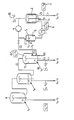
- the reaction of the monohydric phenols is carried out continuously in two reaction zones.
- the first reaction zone consists of a jet nozzle reactor connected in series and a stirred tank reactor. Heat exchangers and a delivery unit are installed between these reactors.
- the second reaction zone consists of a conventional flow tube reactor or a bubble column reactor or a multi-zone reactor or preferably from a cascade of stirred tanks. Sufficient oxygen is supplied to the propellant jet reactor for the oxidative coupling that more than 95% by weight, in the particularly preferred process more than 99% by weight, of the monomer are converted to the oligomer in the first reaction zone.
- the oxidative coupling is carried out under largely isothermal and isobaric conditions.
- largely isothermal conditions it should be understood that the temperature at the outlet of the heat exchangers of the first reaction zone or that in the reactors of the second reaction zone only fluctuates in a range of 3 ° C.
- Largely isobaric conditions are said to mean that the pressure in the gas phase of the reaction zones only fluctuates by approximately 0.2 bar.
- the heat exchangers used for an isothermal mode of operation in the first reaction zone are designed such that segregation of the gas-liquid dispersion is prevented.
- the delivery unit in the first reaction zone has the task of providing a delivery rate necessary for the removal of the heat of reaction in the heat exchanger of the first reaction zone, the dissipation energy required for the dispersion of the gas phase into the jet nozzle reactor of the first reaction zone and a part of the feed stream corresponding to the monomers To promote reaction goods from the first reaction zone into the second reaction zone. It is to be ensured constructively that up to 20% by volume of gas can be conveyed in the liquid phase.
- the hourly circulation volume is usually in the range of 5 to 50 times, preferably in the range of 6 to 20 times the total volume in the first reaction zone.
- the oxygen metering can be regulated in such a way that the concentration of the dissolved oxygen after the jet nozzle reactor of the first reaction zone is greater than 60% by weight of the saturation concentration during the reaction.
- This form of oxygen metering with high oxygen concentration in the liquid phase of the jet nozzle reactor (more than 70% by weight) also ensures that the metered monomer is already more than 95% by weight in the first reaction zone, and more than 99% in the particularly preferred mode of operation % By weight reacts to the oligomer, which is a prerequisite for a uniform product with a low proportion of by-products in a continuous procedure.
- the separation of the continuous process into two reaction zones that are fundamentally different in terms of apparatus has the advantage that the installed apparatus parts of the first reaction zone, which are principally designed for high oxygen demand, high heat development, high circulation rates and the generation of a sufficiently large mass transfer area, can be used optimally at any time.
- the second reaction zone in which the oligomers react to form polymers, heat exchangers and delivery units are not absolutely necessary. It has been shown that a considerable increase in the space-time yield and an increased apparatus efficiency can be achieved in this way. In addition, incrustations or adhesions caused by product can be avoided even in the case of high concentrations of phenols in the partially sensitive apparatus of the first reaction zone.
- the product from the continuous polymerization plant ideally reaches the subsequent process stages, which are also operated continuously, such as catalyst removal and two-stage degassing. As a result, the system capacities for interim storage can be minimized.
- the oxygen which is still necessary for the construction of the polymers in the second reaction zone reaches the second reaction zone in physically dissolved form from the first reaction zone together with the reaction solution. If necessary, additional gaseous oxygen can also be metered into the second reaction zone. Because of the low oxygen requirement in the second reaction zone, an isothermal mode of operation is ensured even without cooling capacities. Emissions of gases and volatile components are largely avoided.
- the second reaction zone can consist of a customary flow tube reactor, a customary bubble column reactor, a customary multi-zone reactor or, because of its simple design, a customary stirred tank cascade.
- a propulsion jet pipe (1), a heat exchanger (2), a stirred reactor (3) and a centrifugal pump (4) are connected to one another via pipes in a circuit system.
- a pulse exchange space (5) is indicated in the lower part of the propulsion jet reactor.
- the required volume of the reaction mixture is introduced at (7) in such a way that up to 90% of the usable circulatory volume is filled.
- the amount of phenol to be polymerized is metered in continuously via the inlet connection (7) in such a way that the average residence time of the reaction solution in the circulation system is between 20 min and 30 min.
- a device for supplying oxygen to the jet nozzle reactor (1) is designated.
- the concentration of the dissolved oxygen can be measured at (9) and (10).
- the measuring device - (11) detects the oxygen content in the exhaust line (12).
- a partial flow corresponding to the feed quantity is conveyed via a pipeline (13) into the first boiler (14) of the second reaction zone.
- a measuring device (11) is connected to the exhaust pipe - (17).
- Another measuring device (20) for determining the oxygen dissolved in the reaction solution is connected to the stirred reactor (14).
Landscapes
- Chemical & Material Sciences (AREA)
- Health & Medical Sciences (AREA)
- Chemical Kinetics & Catalysis (AREA)
- Medicinal Chemistry (AREA)
- Polymers & Plastics (AREA)
- Organic Chemistry (AREA)
- Polyethers (AREA)
- Organic Low-Molecular-Weight Compounds And Preparation Thereof (AREA)
Applications Claiming Priority (2)
| Application Number | Priority Date | Filing Date | Title |
|---|---|---|---|
| DE3515516 | 1985-04-30 | ||
| DE19853515516 DE3515516A1 (de) | 1985-04-30 | 1985-04-30 | Verfahren zur kontinuierlichen herstellung von polyphenylenethern |
Publications (2)
| Publication Number | Publication Date |
|---|---|
| EP0203356A2 true EP0203356A2 (fr) | 1986-12-03 |
| EP0203356A3 EP0203356A3 (fr) | 1987-10-28 |
Family
ID=6269456
Family Applications (1)
| Application Number | Title | Priority Date | Filing Date |
|---|---|---|---|
| EP86105518A Withdrawn EP0203356A3 (fr) | 1985-04-30 | 1986-04-22 | Procédé pour la fabrication continue de poly(éthers de phénylène) |
Country Status (2)
| Country | Link |
|---|---|
| EP (1) | EP0203356A3 (fr) |
| DE (1) | DE3515516A1 (fr) |
Families Citing this family (1)
| Publication number | Priority date | Publication date | Assignee | Title |
|---|---|---|---|---|
| DE102005005796A1 (de) * | 2005-02-09 | 2006-08-17 | Applikations- Und Technikzentrum Für Energieverfahrens-, Umwelt- Und Strömungstechnik (Atz-Evus) | Verfahren und Vorrichtung zur thermochemischen Umsetzung eines Brennstoffs |
Family Cites Families (6)
| Publication number | Priority date | Publication date | Assignee | Title |
|---|---|---|---|---|
| US3432469A (en) * | 1967-02-02 | 1969-03-11 | Gen Electric | Process for producing high molecular weight polymers from impure 2,6-xylenol |
| DE3206661A1 (de) * | 1982-02-25 | 1983-09-01 | Basf Ag, 6700 Ludwigshafen | Verfahren zur vermeidung einer explosiblen gasphase bei gas/fluessig-reaktionen |
| WO1983003833A1 (fr) * | 1982-05-04 | 1983-11-10 | General Electric Company | Procede de polymerisation de phenols a de faibles debits d'oxygene |
| EP0103154A1 (fr) * | 1982-08-16 | 1984-03-21 | General Electric Company | Procédé continu pour la préparation d'une résine de poly(éther de phénylène) utilisant des ions bromures en haute concentration |
| US4477649A (en) * | 1983-03-25 | 1984-10-16 | General Electric Company | Two-stage continuous process for preparation of polyphenylene oxides |
| US4503214A (en) * | 1983-12-05 | 1985-03-05 | General Electric Company | Continuous process for preparing polyphenylene oxides |
-
1985
- 1985-04-30 DE DE19853515516 patent/DE3515516A1/de not_active Withdrawn
-
1986
- 1986-04-22 EP EP86105518A patent/EP0203356A3/fr not_active Withdrawn
Also Published As
| Publication number | Publication date |
|---|---|
| EP0203356A3 (fr) | 1987-10-28 |
| DE3515516A1 (de) | 1986-11-06 |
Similar Documents
| Publication | Publication Date | Title |
|---|---|---|
| EP0752268B1 (fr) | Procédé et dispositif pour la production de polymères en continu | |
| EP0696573B1 (fr) | Procédé pour la préparation d'amines aromatiques | |
| DE3410386C2 (fr) | ||
| DE69026590T2 (de) | Nitrierungsverfahren | |
| EP0699695B1 (fr) | Procédé de préparation de copolyacétals | |
| DE2908804C2 (de) | Verfahren zur Herstellung von p-Nitrodiphenylaminen | |
| DE1570683B2 (fr) | ||
| EP0847414B1 (fr) | Procede de production continue d'un polyamide 6 a faible teneur en dimeres | |
| DE60132133T2 (de) | Verfahren zur Herstellung von Polyphenylenether | |
| EP0781748A2 (fr) | Procédé pour la préparation continue d'alcool benzylique | |
| EP1113848A1 (fr) | Procede pour l'evaporation de solutions polymeres de polymeres thermoplastiques | |
| EP0673920B1 (fr) | Procédé de préparation d'éthanolamines | |
| EP0020946A1 (fr) | Procédé continu de préparation de polycaprolactame ainsi qu'un dispositif pour la mise en oeuvre de ce procédé | |
| EP1709013B1 (fr) | Procede pour produire en continu de la melamine hautement methylolisee et des resines de melamine-formaldehyde etherifiees | |
| DE2822858A1 (de) | Verfahren zur herstellung von mit chinon gekuppelten polyphenylenoxiden | |
| EP0203356A2 (fr) | Procédé pour la fabrication continue de poly(éthers de phénylène) | |
| DE3044803C2 (fr) | ||
| DE3932793C2 (de) | Verfahren zur Abtrennung niedermolekularer Verbindungen aus einer Polycaproamid-Schmelze | |
| DE3410385C2 (de) | Oxidatives Kupplungsverfahren zur Herstellung eines Polyphenylenoxids | |
| DE60306347T2 (de) | Verfahren zur epoxidierung von olefinen | |
| EP0197469B1 (fr) | Procédé de préparation en continu de poly(éthers de phénylène) | |
| EP0108324B1 (fr) | Procédé pour la préparation de polyoxyméthylènes à partir de formaldéhyde | |
| EP0071081A1 (fr) | Procédé de préparation de poly(éther de phénylène) | |
| DE19911024A1 (de) | Verfahren zum Anfahren von Schlaufenreaktorsystemen, in denen zumindest eine exotherme Reaktion durchgeführt werden soll | |
| DE2401295C2 (de) | Verfahren zum Durchführen von exothermen Copolymerisationsreaktionen von Äthylen und Propylen und gegebenenfalls 1,4-Hexadien oder 5-Äthylidennorbornen |
Legal Events
| Date | Code | Title | Description |
|---|---|---|---|
| PUAI | Public reference made under article 153(3) epc to a published international application that has entered the european phase |
Free format text: ORIGINAL CODE: 0009012 |
|
| AK | Designated contracting states |
Kind code of ref document: A2 Designated state(s): BE DE FR GB IT NL |
|
| PUAL | Search report despatched |
Free format text: ORIGINAL CODE: 0009013 |
|
| AK | Designated contracting states |
Kind code of ref document: A3 Designated state(s): BE DE FR GB IT NL |
|
| 17P | Request for examination filed |
Effective date: 19870911 |
|
| 17Q | First examination report despatched |
Effective date: 19890413 |
|
| STAA | Information on the status of an ep patent application or granted ep patent |
Free format text: STATUS: THE APPLICATION HAS BEEN WITHDRAWN |
|
| 18W | Application withdrawn |
Withdrawal date: 19890719 |
|
| R18W | Application withdrawn (corrected) |
Effective date: 19890719 |
|
| RIN1 | Information on inventor provided before grant (corrected) |
Inventor name: SIEBEL, PETER, DR. Inventor name: DREHER, HERMANN, DR. Inventor name: HAMBRECHT, JUERGEN, DR. Inventor name: HEIL, EDUARD Inventor name: FISCHER, HERMANN, DR. Inventor name: BRANDT, HERMANN, DR. Inventor name: GAUSEPOHL, HERMANN, DR. |