EP0204123A1 - Procédé et appareillage pour la production de masse à mouler contenant du polycaprolactame - Google Patents
Procédé et appareillage pour la production de masse à mouler contenant du polycaprolactame Download PDFInfo
- Publication number
- EP0204123A1 EP0204123A1 EP86105640A EP86105640A EP0204123A1 EP 0204123 A1 EP0204123 A1 EP 0204123A1 EP 86105640 A EP86105640 A EP 86105640A EP 86105640 A EP86105640 A EP 86105640A EP 0204123 A1 EP0204123 A1 EP 0204123A1
- Authority
- EP
- European Patent Office
- Prior art keywords
- extruder
- caprolactam
- mass
- autoclave
- screw
- Prior art date
- Legal status (The legal status is an assumption and is not a legal conclusion. Google has not performed a legal analysis and makes no representation as to the accuracy of the status listed.)
- Granted
Links
- 238000000034 method Methods 0.000 title claims abstract description 36
- 238000004519 manufacturing process Methods 0.000 title claims abstract description 11
- 229920002292 Nylon 6 Polymers 0.000 title description 19
- 238000000465 moulding Methods 0.000 title description 13
- JBKVHLHDHHXQEQ-UHFFFAOYSA-N epsilon-caprolactam Chemical compound O=C1CCCCCN1 JBKVHLHDHHXQEQ-UHFFFAOYSA-N 0.000 claims abstract description 111
- XLYOFNOQVPJJNP-UHFFFAOYSA-N water Substances O XLYOFNOQVPJJNP-UHFFFAOYSA-N 0.000 claims abstract description 29
- 239000000654 additive Substances 0.000 claims abstract description 12
- 239000000178 monomer Substances 0.000 claims abstract description 11
- 238000009757 thermoplastic moulding Methods 0.000 claims abstract description 9
- 239000000945 filler Substances 0.000 claims abstract description 7
- 230000003301 hydrolyzing effect Effects 0.000 claims abstract description 5
- 239000000314 lubricant Substances 0.000 claims abstract description 5
- 239000002253 acid Substances 0.000 claims abstract description 4
- 239000012779 reinforcing material Substances 0.000 claims abstract description 3
- 239000000203 mixture Substances 0.000 claims description 21
- 238000007872 degassing Methods 0.000 claims description 19
- 238000006116 polymerization reaction Methods 0.000 claims description 16
- 238000006243 chemical reaction Methods 0.000 claims description 10
- 238000004898 kneading Methods 0.000 claims description 6
- 150000003951 lactams Chemical class 0.000 claims description 6
- 239000000470 constituent Substances 0.000 claims description 5
- 229920000578 graft copolymer Polymers 0.000 claims description 4
- 239000012760 heat stabilizer Substances 0.000 claims description 4
- 229920001577 copolymer Polymers 0.000 claims description 3
- 239000004014 plasticizer Substances 0.000 claims description 3
- 150000003839 salts Chemical class 0.000 claims description 3
- 239000000126 substance Substances 0.000 claims description 3
- 229920000181 Ethylene propylene rubber Polymers 0.000 claims 2
- 229920000459 Nitrile rubber Polymers 0.000 claims 1
- 239000003795 chemical substances by application Substances 0.000 claims 1
- 239000003086 colorant Substances 0.000 claims 1
- 230000000694 effects Effects 0.000 claims 1
- 150000002148 esters Chemical class 0.000 claims 1
- 229920006242 ethylene acrylic acid copolymer Polymers 0.000 claims 1
- 238000012423 maintenance Methods 0.000 claims 1
- FPYJFEHAWHCUMM-UHFFFAOYSA-N maleic anhydride Chemical group O=C1OC(=O)C=C1 FPYJFEHAWHCUMM-UHFFFAOYSA-N 0.000 claims 1
- -1 colouring Substances 0.000 abstract description 5
- 238000003756 stirring Methods 0.000 abstract description 4
- 239000004608 Heat Stabiliser Substances 0.000 abstract 1
- 238000004040 coloring Methods 0.000 abstract 1
- 230000001105 regulatory effect Effects 0.000 abstract 1
- 229920002647 polyamide Polymers 0.000 description 21
- 239000004952 Polyamide Substances 0.000 description 17
- IJGRMHOSHXDMSA-UHFFFAOYSA-N Atomic nitrogen Chemical compound N#N IJGRMHOSHXDMSA-UHFFFAOYSA-N 0.000 description 12
- 229920000642 polymer Polymers 0.000 description 12
- 239000000155 melt Substances 0.000 description 11
- WNLRTRBMVRJNCN-UHFFFAOYSA-N adipic acid Chemical compound OC(=O)CCCCC(O)=O WNLRTRBMVRJNCN-UHFFFAOYSA-N 0.000 description 9
- 239000000047 product Substances 0.000 description 8
- 238000000605 extraction Methods 0.000 description 7
- NAQMVNRVTILPCV-UHFFFAOYSA-N hexane-1,6-diamine Chemical compound NCCCCCCN NAQMVNRVTILPCV-UHFFFAOYSA-N 0.000 description 7
- QTBSBXVTEAMEQO-UHFFFAOYSA-N Acetic acid Chemical compound CC(O)=O QTBSBXVTEAMEQO-UHFFFAOYSA-N 0.000 description 6
- 150000001875 compounds Chemical class 0.000 description 6
- 229910052757 nitrogen Inorganic materials 0.000 description 6
- 239000000243 solution Substances 0.000 description 5
- 239000001361 adipic acid Substances 0.000 description 4
- 235000011037 adipic acid Nutrition 0.000 description 4
- 238000001035 drying Methods 0.000 description 4
- 238000011049 filling Methods 0.000 description 4
- 239000003365 glass fiber Substances 0.000 description 4
- 238000005406 washing Methods 0.000 description 4
- JHWNWJKBPDFINM-UHFFFAOYSA-N Laurolactam Chemical compound O=C1CCCCCCCCCCCN1 JHWNWJKBPDFINM-UHFFFAOYSA-N 0.000 description 3
- OKKJLVBELUTLKV-UHFFFAOYSA-N Methanol Chemical compound OC OKKJLVBELUTLKV-UHFFFAOYSA-N 0.000 description 3
- 238000010924 continuous production Methods 0.000 description 3
- 238000001125 extrusion Methods 0.000 description 3
- 239000011521 glass Substances 0.000 description 3
- CMIAIUZBKPLIOP-YZLZLFLDSA-N methyl (1r,4ar,4br,10ar)-7-(2-hydroperoxypropan-2-yl)-4a-methyl-2,3,4,4b,5,6,10,10a-octahydro-1h-phenanthrene-1-carboxylate Chemical compound C1=C(C(C)(C)OO)CC[C@@H]2[C@]3(C)CCC[C@@H](C(=O)OC)[C@H]3CC=C21 CMIAIUZBKPLIOP-YZLZLFLDSA-N 0.000 description 3
- 239000000049 pigment Substances 0.000 description 3
- KKEYFWRCBNTPAC-UHFFFAOYSA-N Terephthalic acid Chemical compound OC(=O)C1=CC=C(C(O)=O)C=C1 KKEYFWRCBNTPAC-UHFFFAOYSA-N 0.000 description 2
- XBDQKXXYIPTUBI-UHFFFAOYSA-N dimethylselenoniopropionate Natural products CCC(O)=O XBDQKXXYIPTUBI-UHFFFAOYSA-N 0.000 description 2
- 238000004821 distillation Methods 0.000 description 2
- 239000000975 dye Substances 0.000 description 2
- 238000005265 energy consumption Methods 0.000 description 2
- 238000001746 injection moulding Methods 0.000 description 2
- QQVIHTHCMHWDBS-UHFFFAOYSA-N isophthalic acid Chemical compound OC(=O)C1=CC=CC(C(O)=O)=C1 QQVIHTHCMHWDBS-UHFFFAOYSA-N 0.000 description 2
- BDAGIHXWWSANSR-UHFFFAOYSA-N methanoic acid Natural products OC=O BDAGIHXWWSANSR-UHFFFAOYSA-N 0.000 description 2
- BDJRBEYXGGNYIS-UHFFFAOYSA-N nonanedioic acid Chemical compound OC(=O)CCCCCCCC(O)=O BDJRBEYXGGNYIS-UHFFFAOYSA-N 0.000 description 2
- XNGIFLGASWRNHJ-UHFFFAOYSA-N phthalic acid Chemical compound OC(=O)C1=CC=CC=C1C(O)=O XNGIFLGASWRNHJ-UHFFFAOYSA-N 0.000 description 2
- 239000000843 powder Substances 0.000 description 2
- 230000005855 radiation Effects 0.000 description 2
- CXMXRPHRNRROMY-UHFFFAOYSA-N sebacic acid Chemical compound OC(=O)CCCCCCCCC(O)=O CXMXRPHRNRROMY-UHFFFAOYSA-N 0.000 description 2
- 239000007921 spray Substances 0.000 description 2
- 238000003860 storage Methods 0.000 description 2
- TYFQFVWCELRYAO-UHFFFAOYSA-N suberic acid Chemical compound OC(=O)CCCCCCC(O)=O TYFQFVWCELRYAO-UHFFFAOYSA-N 0.000 description 2
- 239000010409 thin film Substances 0.000 description 2
- GUOSQNAUYHMCRU-UHFFFAOYSA-N 11-Aminoundecanoic acid Chemical compound NCCCCCCCCCCC(O)=O GUOSQNAUYHMCRU-UHFFFAOYSA-N 0.000 description 1
- RLEQVGMLDNITBW-UHFFFAOYSA-N 2,4,4-trimethylhexanedioic acid Chemical compound OC(=O)C(C)CC(C)(C)CC(O)=O RLEQVGMLDNITBW-UHFFFAOYSA-N 0.000 description 1
- MVDKKZZVTWHVMC-UHFFFAOYSA-N 2-hexadecylpropanedioic acid Chemical compound CCCCCCCCCCCCCCCCC(C(O)=O)C(O)=O MVDKKZZVTWHVMC-UHFFFAOYSA-N 0.000 description 1
- OSWFIVFLDKOXQC-UHFFFAOYSA-N 4-(3-methoxyphenyl)aniline Chemical compound COC1=CC=CC(C=2C=CC(N)=CC=2)=C1 OSWFIVFLDKOXQC-UHFFFAOYSA-N 0.000 description 1
- DZIHTWJGPDVSGE-UHFFFAOYSA-N 4-[(4-aminocyclohexyl)methyl]cyclohexan-1-amine Chemical compound C1CC(N)CCC1CC1CCC(N)CC1 DZIHTWJGPDVSGE-UHFFFAOYSA-N 0.000 description 1
- 241001136792 Alle Species 0.000 description 1
- 241001214176 Capros Species 0.000 description 1
- 206010013786 Dry skin Diseases 0.000 description 1
- VGGSQFUCUMXWEO-UHFFFAOYSA-N Ethene Chemical compound C=C VGGSQFUCUMXWEO-UHFFFAOYSA-N 0.000 description 1
- 239000005977 Ethylene Substances 0.000 description 1
- PIICEJLVQHRZGT-UHFFFAOYSA-N Ethylenediamine Chemical compound NCCN PIICEJLVQHRZGT-UHFFFAOYSA-N 0.000 description 1
- 239000005057 Hexamethylene diisocyanate Substances 0.000 description 1
- OFOBLEOULBTSOW-UHFFFAOYSA-N Malonic acid Chemical compound OC(=O)CC(O)=O OFOBLEOULBTSOW-UHFFFAOYSA-N 0.000 description 1
- 241001676573 Minium Species 0.000 description 1
- XTXRWKRVRITETP-UHFFFAOYSA-N Vinyl acetate Chemical compound CC(=O)OC=C XTXRWKRVRITETP-UHFFFAOYSA-N 0.000 description 1
- ISKQADXMHQSTHK-UHFFFAOYSA-N [4-(aminomethyl)phenyl]methanamine Chemical compound NCC1=CC=C(CN)C=C1 ISKQADXMHQSTHK-UHFFFAOYSA-N 0.000 description 1
- 238000010521 absorption reaction Methods 0.000 description 1
- 125000005396 acrylic acid ester group Chemical group 0.000 description 1
- 230000000996 additive effect Effects 0.000 description 1
- 150000001298 alcohols Chemical class 0.000 description 1
- 239000000956 alloy Substances 0.000 description 1
- 229910045601 alloy Inorganic materials 0.000 description 1
- XAGFODPZIPBFFR-UHFFFAOYSA-N aluminium Chemical compound [Al] XAGFODPZIPBFFR-UHFFFAOYSA-N 0.000 description 1
- 229910052782 aluminium Inorganic materials 0.000 description 1
- 239000007864 aqueous solution Substances 0.000 description 1
- YDLSUFFXJYEVHW-UHFFFAOYSA-N azonan-2-one Chemical compound O=C1CCCCCCCN1 YDLSUFFXJYEVHW-UHFFFAOYSA-N 0.000 description 1
- 239000011805 ball Substances 0.000 description 1
- 230000015572 biosynthetic process Effects 0.000 description 1
- 238000009835 boiling Methods 0.000 description 1
- WERYXYBDKMZEQL-UHFFFAOYSA-N butane-1,4-diol Chemical compound OCCCCO WERYXYBDKMZEQL-UHFFFAOYSA-N 0.000 description 1
- 239000007795 chemical reaction product Substances 0.000 description 1
- 238000009833 condensation Methods 0.000 description 1
- 238000002425 crystallisation Methods 0.000 description 1
- 230000008025 crystallization Effects 0.000 description 1
- 238000013461 design Methods 0.000 description 1
- 150000004985 diamines Chemical class 0.000 description 1
- 150000002009 diols Chemical class 0.000 description 1
- 239000012153 distilled water Substances 0.000 description 1
- QFTYSVGGYOXFRQ-UHFFFAOYSA-N dodecane-1,12-diamine Chemical compound NCCCCCCCCCCCCN QFTYSVGGYOXFRQ-UHFFFAOYSA-N 0.000 description 1
- 238000006253 efflorescence Methods 0.000 description 1
- 239000000284 extract Substances 0.000 description 1
- 210000000416 exudates and transudate Anatomy 0.000 description 1
- 235000019253 formic acid Nutrition 0.000 description 1
- 239000013505 freshwater Substances 0.000 description 1
- 230000004927 fusion Effects 0.000 description 1
- 239000008187 granular material Substances 0.000 description 1
- 238000005469 granulation Methods 0.000 description 1
- 230000003179 granulation Effects 0.000 description 1
- 238000010438 heat treatment Methods 0.000 description 1
- RRAMGCGOFNQTLD-UHFFFAOYSA-N hexamethylene diisocyanate Chemical compound O=C=NCCCCCCN=C=O RRAMGCGOFNQTLD-UHFFFAOYSA-N 0.000 description 1
- 229910052500 inorganic mineral Inorganic materials 0.000 description 1
- 239000012948 isocyanate Substances 0.000 description 1
- 238000010930 lactamization Methods 0.000 description 1
- 238000002844 melting Methods 0.000 description 1
- 239000011707 mineral Substances 0.000 description 1
- 239000012764 mineral filler Substances 0.000 description 1
- 238000012986 modification Methods 0.000 description 1
- 230000004048 modification Effects 0.000 description 1
- 239000003607 modifier Substances 0.000 description 1
- 239000006082 mold release agent Substances 0.000 description 1
- ZETYUTMSJWMKNQ-UHFFFAOYSA-N n,n',n'-trimethylhexane-1,6-diamine Chemical compound CNCCCCCCN(C)C ZETYUTMSJWMKNQ-UHFFFAOYSA-N 0.000 description 1
- 239000012299 nitrogen atmosphere Substances 0.000 description 1
- 230000000704 physical effect Effects 0.000 description 1
- 239000004033 plastic Substances 0.000 description 1
- 229920003023 plastic Polymers 0.000 description 1
- 229920000728 polyester Polymers 0.000 description 1
- 229920005862 polyol Polymers 0.000 description 1
- 150000003077 polyols Chemical class 0.000 description 1
- 229920001451 polypropylene glycol Polymers 0.000 description 1
- 229920000909 polytetrahydrofuran Polymers 0.000 description 1
- 229920002635 polyurethane Polymers 0.000 description 1
- 239000004814 polyurethane Substances 0.000 description 1
- 238000002360 preparation method Methods 0.000 description 1
- 238000012545 processing Methods 0.000 description 1
- 235000019260 propionic acid Nutrition 0.000 description 1
- IUVKMZGDUIUOCP-BTNSXGMBSA-N quinbolone Chemical compound O([C@H]1CC[C@H]2[C@H]3[C@@H]([C@]4(C=CC(=O)C=C4CC3)C)CC[C@@]21C)C1=CCCC1 IUVKMZGDUIUOCP-BTNSXGMBSA-N 0.000 description 1
- 206010037844 rash Diseases 0.000 description 1
- 239000011541 reaction mixture Substances 0.000 description 1
- 230000035484 reaction time Effects 0.000 description 1
- 238000011084 recovery Methods 0.000 description 1
- 239000012744 reinforcing agent Substances 0.000 description 1
- 230000002040 relaxant effect Effects 0.000 description 1
- 238000012958 reprocessing Methods 0.000 description 1
- 229920006395 saturated elastomer Polymers 0.000 description 1
- 238000004904 shortening Methods 0.000 description 1
- 150000004760 silicates Chemical class 0.000 description 1
- 238000009987 spinning Methods 0.000 description 1
- 230000003685 thermal hair damage Effects 0.000 description 1
- 238000012546 transfer Methods 0.000 description 1
- 150000004072 triols Chemical class 0.000 description 1
- 238000009834 vaporization Methods 0.000 description 1
- 230000008016 vaporization Effects 0.000 description 1
Images


Classifications
-
- C—CHEMISTRY; METALLURGY
- C08—ORGANIC MACROMOLECULAR COMPOUNDS; THEIR PREPARATION OR CHEMICAL WORKING-UP; COMPOSITIONS BASED THEREON
- C08G—MACROMOLECULAR COMPOUNDS OBTAINED OTHERWISE THAN BY REACTIONS ONLY INVOLVING UNSATURATED CARBON-TO-CARBON BONDS
- C08G69/00—Macromolecular compounds obtained by reactions forming a carboxylic amide link in the main chain of the macromolecule
- C08G69/02—Polyamides derived from amino-carboxylic acids or from polyamines and polycarboxylic acids
- C08G69/08—Polyamides derived from amino-carboxylic acids or from polyamines and polycarboxylic acids derived from amino-carboxylic acids
- C08G69/14—Lactams
- C08G69/16—Preparatory processes
Definitions
- the invention relates to a method and a device for the production of thermoplastic molding compositions containing caprolactam under hydrolytic polymerization of caprolactam in an autoclave at pressures up to 20 bar and temperatures up to at least 240 ° C. in the presence of water and a weak acid, after which the molten mass from the autoclave is transferred to an intermediate container under vacuum for further polymerization and for removing volatile constituents such as water, monomeric caprolactam and oligomers.
- the energy balance of the above-mentioned multi-stage process is very unfavorable, as shown below: mat needs about 300 kcal to melt and heat 1 kg of caprolactam to this temperature. During the polymerization, a heat of reaction of approx. 100 kcal / kg free, so that about 200 kcal / kg caprolactam are required for the polymerization.
- a further 36 x 2 kWh 72 kWh / 1000 kg are required for the vacuum pump. This gives a total of 268 kWh, effectively 280 to 300 kWh due to heat loss and radiation.
- the extracted and dried polyamide must be melted in an extruder in order to incorporate pigments, additives and, if appropriate, fillers.
- approximately 300 to 380 kWh / 1000 kg of polyamide 6 molding compound are required for this process.
- the present invention is based on the object, starting from the aforementioned method, with the greatest possible energy saving without re-melting and without Extraction of the monomers with water in a quasi-continuous process to produce a range of different ready-made injection molding compositions, including a suitable manufacturing facility.
- the aforementioned object is achieved in that the polymerization in the main stage is carried out discontinuously in autoclaves with a stirring device at temperatures of 220 to 280 ° C., that the intermediate container is charged essentially quasi-continuously from more than one autoclave, that the mass flows continuously from the intermediate container into a multi-screw extruder, with segmented screw and housing parts that can be heated to different temperatures, that the mass is brought to the desired degree of polymerization and the desired monomer content by means of elevated temperatures and negative pressure and in the subsequent area of the extruder Additives, such as lubricants, heat stabilizers, dyes, fillers and reinforcing materials, plasticizers and elasticizers, are provided, after which a further degassing in the End section of the extruder takes place and the mass is then pressed out and, if necessary, granulated.
- Additives such as lubricants, heat stabilizers, dyes, fillers and reinforcing materials, plasticizers and elasticizers,
- Another advantage of the process according to the invention is the possibility of producing caprolactam-containing thermoplastic molding compositions with a specific and desired monomer content.
- the previous washing process gave molding compositions which contained practically no monomers. The content was well below 1%, usually below 0.5% after remelting in the extruder. Molding compositions with a desired monomer content of between 0.5 and 10%, primarily between 1 and 8%, can be produced by the process according to the invention.
- the dry impact strength is significantly increased without the product showing exudate of caprolactam by water absorption.
- Higher lactam contents further improve the impact resistance, but these products are only suitable for use in a damp environment, in which the efflorescence of caprolactam is dissolved and replaced by water retention.
- the molding compositions produced and described by the process according to the invention have a higher level of physical properties, in particular because there is no thermal damage caused by remelting, as was necessary according to the previously known multi-stage process.
- the invention also relates to a device or system for carrying out the prescribed method according to the invention for producing thermoplastic molding compositions containing caprolactam with hydrolytic polymerization of caprolactam, in particular for carrying out the method according to one of claims 1 to 5, wherein a heatable pressure vessel is a heatable and evacuable one Container to continue the reaction with removal of volatile components is connected downstream.
- this device is only suitable for discontinuous operation and laboratory scale. There is also no possibility of removing volatile substances, at least water, in the first reaction stage, so that the reaction proceeds with a poor yield of higher molecular weight polyamides. At best, the products seem to be suitable for the spinning process.
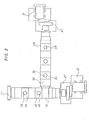
- the 1 contains a storage boiler 10 for caprolactam.
- the caprolactam is supplied in the form of a melt - generally at a temperature of 70 to 80 ° C. - and stored in the storage container 10 at this temperature.
- a certain predetermined amount is pumped with the metering pump 12 into one of the stirred autoclaves 14 or 15.
- Further polyamide formers can be fed to the stirred autoclave 14 or 15 separately, provided that the production of copolymers, graft polymers or sequence polymers is intended.
- the stirred autoclaves can be heated up to a temperature of 340 ° C.
- the polymerization is controlled either manually or automatically according to a planned program.
- the raw polymer is pumped via the discharge pump 16 into the intermediate container 18, which is under vacuum. Post-condensation takes place here because water and caprolactam and oligomers are partially removed.
- the use of an intermediate container 18 according to the invention saves residence time in the complex stirred autoclaves 14 and 15 and permits an increased throughput per investment unit. From here, the pre-evacuated melt is fed to a multi-shaft extruder 20, which can have either 1 or 2 separate drives 21, 22 (FIG. 2). In the extruder 20, the monomeric caprolactam and the
- the monomer content can be adjusted via the screw speed, the dwell time in the degassing zones, the number of degassing zones and finally by applying certain negative pressures. All necessary additives such as lubricants, crystallization accelerators, mold release agents, heat stabilizers and other additives, furthermore pigments, plasticizers, fillers such as mineral powders, glass balls or glass fibers are added in the extruder 20. Other polymers can also be added for modification. The polymer melt is thoroughly kneaded and homogenized with all additives.
- the melt is extruded in the form of a strand, briefly quenched in a water bath 24, granulated in the granulator 26 and conveyed into a drying and filling silo (not shown).
- the monomeric caprolactam drawn off in a vacuum through degassing nozzle 34 and the low molecular weight fractions (oligomers) are deposited in a condenser 40 and fed back to the process.
- the extruder is built on a modular principle with a housing segment elements that are either closed, for example 30 or have degassing or filling openings, such as the segments 28, 32, 34.
- the polymer melt is introduced into the housing segment 28 through the filling opening 29 from the intermediate container 18. Degassing takes place in housing segments 34 with openings 35.
- the transfer takes place in the second extruder section, which has a separate drive 22.
- This extruder section is flanged to the first section at an angle, preferably at right angles. It can be operated at a different screw speed.
- fillers etc. as mentioned above, can be supplied through the fill opening 33.
- the melt is extruded in the form of a strand by the nozzle spray head 36.
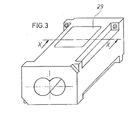
- a housing segment with a filling opening 29, as used in the extruder 20, is shown in perspective.
- FIG. 4 shows the cross section through the housing segment 28 shown in FIG. 3 along the section line X-X.
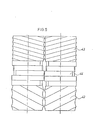
- 5 is a section of the twin screw of the Extruder 20 shown. It shows screw segments 42, 43 with different pitch to promote the polymer melt and a kneading block 44.
- thermoplastic molding compositions either pure ⁇ -caprolactam or mixtures of ⁇ -caprolactam and other lactams such as capryllactam, önanthlactam or laurolactam are used, furthermore ⁇ -caprolactam with other polyamide formers such as 11-amino-undecanoic acid or diamines such as hexamethylenediamine, decam Dodecamethylene diamine, ethylene diamine, 2-methylhexamethylene diamine, trimethyl hexamethylene diamine, 1,4-xylylenediamine, bis (4-amino-cyclohexyl) methane, 1,4-diaminicyclohexane with the equivalent amount of dicarboxylic acid such as adipic acid, suberic acid, azelaic acid, sebazamide -dicarboxylic acid, heptadecanedicarboxylic acid 2,2,4- or 2,4,4-trimethyl
- the melt which is largely freed from volatile components, reaches a twin-shaft Ex via a metering pump 19 truder 20 with different screw and housing segments.
- a polycaprolactam with a relative solution viscosity (the relative solution viscosity is determined on 1 percent solutions of polycaprolactam in 90 percent formic acid at 20 ° C. according to DIN 53 727) of 2.3 to 4.2 and a content of monomeric and dimeric caprolactam of 0.4 to 10% can be obtained.
- the proportion of monomeric and oligomeric capro. lactam is determined by extraction with methanol according to DIN 53 738.
- the low molecular weight portions removed from the polymer melt by the vacuum are deposited in a condenser 40 and fed back to the next batch.
- the extract contents, the relative solution viscosities and some characteristic property values are listed in Tab. 1.
- Example 1 The procedure is first as in Example 1. All necessary additives such as lubricants, heat stabilizers, pigments, fillers such as glass balls, glass fibers, mineral fillers are placed in the deactamized polycaprolactam melt by means of synchronously switched metering belt scales in the housing part 32 of the extruder with an opening 33 upwards and a side pocket (see FIG. 4) optionally polymers that form an alloy formation are capable of being added specifically.
- the pressure is then reduced to 1 bar within 1 to 2 hours and the temperature is reduced from 275 to 245 ° C.
- the degassed melt is, as described in example 1, pumped into an intermediate container, by applying a vacuum of 40 to 60 hPa, the melt viscosity is brought to a desired level. (The melt viscosity is determined with a rotary viscometer.)
- the copolyamide melt is pumped into a 2-screw extruder. There the volatile components are removed and condensed in a first degassing stage at 55 to 60 hPa and in a second degassing stage at 30 to 35 hPa at 250 to 260 ° C product temperature.
- the melt freed from monmers is metered in the extruder by metering in 3% color batch, 15% stacked glass fiber and 25% of an aluminum minium silicates kneaded into a polycaprolactam-containing molding composition, extruded in the form of a strand, quenched and granulated.
- the product obtained has the property values given in Table 2.
- the melt is kept at 225 to 230 ° C and freed from the volatile at this temperature by three degassing zones.
- the negative pressure at the degassing nozzle 1 is 55 to 60 hPa, at the degassing nozzle 2 35 to 40 hPa and the negative pressure at the third degassing nozzle 10 to 15 hPa.
- the melt which has been degassed in this way is then conveyed into a second section of the extruder which is flanged over a corner and has the same screw diameter but with a separate drive.
- 40% of glass fibers are added to the housing part 32.
- the screw speed is twice as high as in the extruder section flanged in front to compensate for the increase in volume due to the additives.
- the remaining volatile components are outgassed in the housing segment 34.
- the glass fiber-reinforced melt of the graft polymer containing polycaprolactam is extruded, quenched and granulated in a strand-like manner by the spray head 36.
- the property values of the product obtained are listed in Table 3.
Landscapes
- Chemical & Material Sciences (AREA)
- Health & Medical Sciences (AREA)
- Chemical Kinetics & Catalysis (AREA)
- Medicinal Chemistry (AREA)
- Polymers & Plastics (AREA)
- Organic Chemistry (AREA)
- Polyamides (AREA)
- Extrusion Moulding Of Plastics Or The Like (AREA)
Applications Claiming Priority (2)
| Application Number | Priority Date | Filing Date | Title |
|---|---|---|---|
| DE3516434 | 1985-05-08 | ||
| DE19853516434 DE3516434A1 (de) | 1985-05-08 | 1985-05-08 | Verfahren und vorrichtung zur herstellung von polycaprolactamhaltigen formmassen |
Publications (2)
| Publication Number | Publication Date |
|---|---|
| EP0204123A1 true EP0204123A1 (fr) | 1986-12-10 |
| EP0204123B1 EP0204123B1 (fr) | 1990-06-27 |
Family
ID=6270067
Family Applications (1)
| Application Number | Title | Priority Date | Filing Date |
|---|---|---|---|
| EP86105640A Expired - Lifetime EP0204123B1 (fr) | 1985-05-08 | 1986-04-23 | Procédé et appareillage pour la production de masse à mouler contenant du polycaprolactame |
Country Status (3)
| Country | Link |
|---|---|
| EP (1) | EP0204123B1 (fr) |
| DE (2) | DE3516434A1 (fr) |
| ES (2) | ES8704994A1 (fr) |
Cited By (6)
| Publication number | Priority date | Publication date | Assignee | Title |
|---|---|---|---|---|
| WO1998034975A1 (fr) * | 1997-02-12 | 1998-08-13 | The University Of North Carolina At Chapel Hill | Synthese de polyamides dans du co2 liquide et supercritique |
| WO2002094908A1 (fr) * | 2001-05-21 | 2002-11-28 | Bayer Aktiengesellschaft | Procede et dispositif d'extraction de polyamide |
| EP1225191A3 (fr) * | 2001-01-18 | 2004-04-07 | Mitsubishi Gas Chemical Company, Inc. | Procédé de fabrication de polyamide |
| CN108608594A (zh) * | 2018-07-09 | 2018-10-02 | 东莞市绿志节能科技有限公司 | 一种高分子材料生产设备 |
| WO2020043320A1 (fr) * | 2018-08-28 | 2020-03-05 | Technip Zimmer Gmbh | Méthode et dispositif de production de polyamide 6 à faible teneur en extrait |
| CN117162314A (zh) * | 2022-05-26 | 2023-12-05 | 海阳科技股份有限公司 | 一种低挥发物的玻纤增强pa6复合材料及制备方法 |
Families Citing this family (2)
| Publication number | Priority date | Publication date | Assignee | Title |
|---|---|---|---|---|
| DE102007057189A1 (de) | 2007-11-28 | 2009-06-04 | Automatik Plastics Machinery Gmbh | Verfahren und Vorrichtung zur Herstellung von Polyamid |
| JP7229065B2 (ja) * | 2019-03-27 | 2023-02-27 | 住友重機械工業株式会社 | 射出成形機 |
Citations (1)
| Publication number | Priority date | Publication date | Assignee | Title |
|---|---|---|---|---|
| DD4735A (fr) * |
Family Cites Families (5)
| Publication number | Priority date | Publication date | Assignee | Title |
|---|---|---|---|---|
| DE1720661A1 (de) * | 1967-05-27 | 1971-06-16 | Bayer Ag | Verfahren zur Herstellung von monomerenarmer Polycaprolactam-Schmelze |
| US3813366A (en) * | 1973-03-21 | 1974-05-28 | Allied Chem | Method to prepare nylon 6 prepolymer providing a final shaped article of low oligomer content |
| DE2503308C2 (de) * | 1975-01-28 | 1983-03-10 | Bayer Ag, 5090 Leverkusen | Verfahren zur Herstellung von monomerenarmer Polycaprolactam-Schmelze |
| DD134772A1 (de) * | 1978-01-18 | 1979-03-21 | Heinz Viehweg | Verfahren und vorrichtung zur kontinuierlichen entmonomerisierung von polyamid-6-schmelze |
| DE2821686A1 (de) * | 1978-05-18 | 1979-11-22 | Bayer Ag | Verfahren zur herstellung von monomer- und dimerarmen polyamiden |
-
1985
- 1985-05-08 DE DE19853516434 patent/DE3516434A1/de not_active Withdrawn
-
1986
- 1986-04-23 EP EP86105640A patent/EP0204123B1/fr not_active Expired - Lifetime
- 1986-04-23 DE DE8686105640T patent/DE3672259D1/de not_active Expired - Fee Related
- 1986-05-07 ES ES554713A patent/ES8704994A1/es not_active Expired
- 1986-10-21 ES ES557141A patent/ES8704995A1/es not_active Expired
Patent Citations (1)
| Publication number | Priority date | Publication date | Assignee | Title |
|---|---|---|---|---|
| DD4735A (fr) * |
Cited By (9)
| Publication number | Priority date | Publication date | Assignee | Title |
|---|---|---|---|---|
| WO1998034975A1 (fr) * | 1997-02-12 | 1998-08-13 | The University Of North Carolina At Chapel Hill | Synthese de polyamides dans du co2 liquide et supercritique |
| US6025459A (en) * | 1997-02-12 | 2000-02-15 | The University Of North Carolina At Chapel Hill | Synthesis of polyamides in liquid and supercritical CO2 |
| EP1225191A3 (fr) * | 2001-01-18 | 2004-04-07 | Mitsubishi Gas Chemical Company, Inc. | Procédé de fabrication de polyamide |
| WO2002094908A1 (fr) * | 2001-05-21 | 2002-11-28 | Bayer Aktiengesellschaft | Procede et dispositif d'extraction de polyamide |
| CN108608594A (zh) * | 2018-07-09 | 2018-10-02 | 东莞市绿志节能科技有限公司 | 一种高分子材料生产设备 |
| WO2020043320A1 (fr) * | 2018-08-28 | 2020-03-05 | Technip Zimmer Gmbh | Méthode et dispositif de production de polyamide 6 à faible teneur en extrait |
| KR20210036970A (ko) * | 2018-08-28 | 2021-04-05 | 테크닙 짐머 게엠베하 | 저 추출물 함량을 갖는 폴리아미드 6의 제조방법 및 그를 위한 장치 |
| US11066518B2 (en) | 2018-08-28 | 2021-07-20 | Technip Zimmer Gmbh | Method and device for the production of polyamide 6 with low extract content |
| CN117162314A (zh) * | 2022-05-26 | 2023-12-05 | 海阳科技股份有限公司 | 一种低挥发物的玻纤增强pa6复合材料及制备方法 |
Also Published As
| Publication number | Publication date |
|---|---|
| ES8704994A1 (es) | 1987-04-16 |
| DE3516434A1 (de) | 1986-11-13 |
| ES554713A0 (es) | 1987-04-16 |
| ES557141A0 (es) | 1987-04-16 |
| ES8704995A1 (es) | 1987-04-16 |
| EP0204123B1 (fr) | 1990-06-27 |
| DE3672259D1 (de) | 1990-08-02 |
Similar Documents
| Publication | Publication Date | Title |
|---|---|---|
| US5169582A (en) | Method and apparatus for the production of thermoplastic caprolactam containing molding compositions | |
| EP2160431B1 (fr) | Procédé de production de polyamides dans des extrudeuses | |
| DE2552804C2 (de) | Polyamidharzmasse | |
| DE1769425A1 (de) | Verfahren zur Herstellung von dickwandigen Formteilen aus Polyaethylenterephthalat | |
| DD232715A5 (de) | Verfahren zur kontinuierlichen entmonomerisierung und nachpolymerisierung von polyamid 6 und vorrichtung zur durchfuehrung des verfahrens | |
| DE102006023354B4 (de) | Verfahren und Vorrichtung zur Wiederverwertung von Polyestermaterial | |
| EP1034208B1 (fr) | Procede pour l'extraction en continu de polyamide | |
| EP0204123B1 (fr) | Procédé et appareillage pour la production de masse à mouler contenant du polycaprolactame | |
| EP1917128B1 (fr) | Procede et dispositif pour reduire la teneur en acetaldehyde d'un granulat de polyester | |
| EP0020946A1 (fr) | Procédé continu de préparation de polycaprolactame ainsi qu'un dispositif pour la mise en oeuvre de ce procédé | |
| DE60225953T2 (de) | Verfahren zur Herstellung von Polyamid | |
| DE3407492A1 (de) | Verfahren zur herstellung von copolyamiden aus adipinsaeure, terephthalsaeure und hexamethylendiamin | |
| EP0005466A1 (fr) | Procédé de préparation de polyamides exempts de monomères et de dimères | |
| EP0288893B1 (fr) | Polyamides à base de diamines/diacides modifiés par de l'alpha-amino-epsilon-caprolactame | |
| DE2447368A1 (de) | Verfahren zur kontinuierlichen herstellung von thermoplastischen polyurethan-elastomeren | |
| DE910593C (de) | Verfahren zur Depolymerisation und Wiedergewinnung von synthetischen linearen Polymeren, insbesondere von Polyamiden | |
| DE1469053A1 (de) | Verfahren zur Herstellung von Faeden und anderen Formkoerpern | |
| EP0288894B1 (fr) | Polyamides modifiés par de l'alpha-amino-epsilon-caprolactame | |
| DE1595143A1 (de) | Verfahren zur Herstellung von geformten Erzeugnissen | |
| EP0608454A1 (fr) | Procédé et appareil pour la fabrication de polyamide-6 à partir de déchets de polyamide | |
| DE2357568C2 (fr) | ||
| DE19605474C2 (de) | Verfahren zur Herstellung von teilaromatischen Copolyamiden aus aromatischen Dicarbonsäureestern | |
| DE60107359T2 (de) | Verfahren zur Herstellung von Polyamid | |
| EP1058576A1 (fr) | Procede d'extraction de particules de polyamide | |
| DE1187372B (de) | Verfahren zur Herstellung von Polyamiden |
Legal Events
| Date | Code | Title | Description |
|---|---|---|---|
| PUAI | Public reference made under article 153(3) epc to a published international application that has entered the european phase |
Free format text: ORIGINAL CODE: 0009012 |
|
| AK | Designated contracting states |
Kind code of ref document: A1 Designated state(s): BE CH DE FR GB IT LI NL SE |
|
| 17P | Request for examination filed |
Effective date: 19870406 |
|
| 17Q | First examination report despatched |
Effective date: 19881031 |
|
| ITF | It: translation for a ep patent filed | ||
| GRAA | (expected) grant |
Free format text: ORIGINAL CODE: 0009210 |
|
| AK | Designated contracting states |
Kind code of ref document: B1 Designated state(s): BE CH DE FR GB IT LI NL SE |
|
| REF | Corresponds to: |
Ref document number: 3672259 Country of ref document: DE Date of ref document: 19900802 |
|
| GBT | Gb: translation of ep patent filed (gb section 77(6)(a)/1977) | ||
| ET | Fr: translation filed | ||
| PLBE | No opposition filed within time limit |
Free format text: ORIGINAL CODE: 0009261 |
|
| STAA | Information on the status of an ep patent application or granted ep patent |
Free format text: STATUS: NO OPPOSITION FILED WITHIN TIME LIMIT |
|
| 26N | No opposition filed | ||
| PGFP | Annual fee paid to national office [announced via postgrant information from national office to epo] |
Ref country code: CH Payment date: 19910715 Year of fee payment: 6 |
|
| REG | Reference to a national code |
Ref country code: FR Ref legal event code: TP |
|
| PG25 | Lapsed in a contracting state [announced via postgrant information from national office to epo] |
Ref country code: LI Effective date: 19920430 Ref country code: CH Effective date: 19920430 |
|
| REG | Reference to a national code |
Ref country code: CH Ref legal event code: AUV Free format text: DAS OBENGENANNTE PATENT IST, MANGELS BEZAHLUNG DER 7. JAHRESGEBUEHR GELOESCHT WORDEN. Ref country code: CH Ref legal event code: PL |
|
| ITTA | It: last paid annual fee | ||
| EAL | Se: european patent in force in sweden |
Ref document number: 86105640.6 |
|
| PGFP | Annual fee paid to national office [announced via postgrant information from national office to epo] |
Ref country code: GB Payment date: 20010316 Year of fee payment: 16 |
|
| PGFP | Annual fee paid to national office [announced via postgrant information from national office to epo] |
Ref country code: NL Payment date: 20010329 Year of fee payment: 16 |
|
| PGFP | Annual fee paid to national office [announced via postgrant information from national office to epo] |
Ref country code: SE Payment date: 20010402 Year of fee payment: 16 |
|
| PGFP | Annual fee paid to national office [announced via postgrant information from national office to epo] |
Ref country code: BE Payment date: 20010409 Year of fee payment: 16 |
|
| PGFP | Annual fee paid to national office [announced via postgrant information from national office to epo] |
Ref country code: FR Payment date: 20010410 Year of fee payment: 16 |
|
| PGFP | Annual fee paid to national office [announced via postgrant information from national office to epo] |
Ref country code: DE Payment date: 20010421 Year of fee payment: 16 |
|
| REG | Reference to a national code |
Ref country code: GB Ref legal event code: IF02 |
|
| PG25 | Lapsed in a contracting state [announced via postgrant information from national office to epo] |
Ref country code: GB Free format text: LAPSE BECAUSE OF NON-PAYMENT OF DUE FEES Effective date: 20020423 |
|
| PG25 | Lapsed in a contracting state [announced via postgrant information from national office to epo] |
Ref country code: SE Free format text: LAPSE BECAUSE OF NON-PAYMENT OF DUE FEES Effective date: 20020424 |
|
| PG25 | Lapsed in a contracting state [announced via postgrant information from national office to epo] |
Ref country code: BE Free format text: LAPSE BECAUSE OF NON-PAYMENT OF DUE FEES Effective date: 20020430 |
|
| PG25 | Lapsed in a contracting state [announced via postgrant information from national office to epo] |
Ref country code: NL Free format text: LAPSE BECAUSE OF NON-PAYMENT OF DUE FEES Effective date: 20021101 Ref country code: DE Free format text: LAPSE BECAUSE OF NON-PAYMENT OF DUE FEES Effective date: 20021101 |
|
| EUG | Se: european patent has lapsed |
Ref document number: 86105640.6 |
|
| GBPC | Gb: european patent ceased through non-payment of renewal fee |
Effective date: 20020423 |
|
| PG25 | Lapsed in a contracting state [announced via postgrant information from national office to epo] |
Ref country code: FR Free format text: LAPSE BECAUSE OF NON-PAYMENT OF DUE FEES Effective date: 20021231 |
|
| NLV4 | Nl: lapsed or anulled due to non-payment of the annual fee |
Effective date: 20021101 |
|
| REG | Reference to a national code |
Ref country code: FR Ref legal event code: ST |
|
| PG25 | Lapsed in a contracting state [announced via postgrant information from national office to epo] |
Ref country code: IT Free format text: LAPSE BECAUSE OF NON-PAYMENT OF DUE FEES;WARNING: LAPSES OF ITALIAN PATENTS WITH EFFECTIVE DATE BEFORE 2007 MAY HAVE OCCURRED AT ANY TIME BEFORE 2007. THE CORRECT EFFECTIVE DATE MAY BE DIFFERENT FROM THE ONE RECORDED. Effective date: 20050423 |