EP0205261A2 - In dünnen Filmen von U.V.-vernetzbaren Polymeren dispergierte Flüssigkristalltröpfchen - Google Patents
In dünnen Filmen von U.V.-vernetzbaren Polymeren dispergierte Flüssigkristalltröpfchen Download PDFInfo
- Publication number
- EP0205261A2 EP0205261A2 EP86303742A EP86303742A EP0205261A2 EP 0205261 A2 EP0205261 A2 EP 0205261A2 EP 86303742 A EP86303742 A EP 86303742A EP 86303742 A EP86303742 A EP 86303742A EP 0205261 A2 EP0205261 A2 EP 0205261A2
- Authority
- EP
- European Patent Office
- Prior art keywords
- liquid crystal
- film
- dispersed
- mixture
- crystal material
- Prior art date
- Legal status (The legal status is an assumption and is not a legal conclusion. Google has not performed a legal analysis and makes no representation as to the accuracy of the status listed.)
- Granted
Links
Images
Classifications
-
- C—CHEMISTRY; METALLURGY
- C08—ORGANIC MACROMOLECULAR COMPOUNDS; THEIR PREPARATION OR CHEMICAL WORKING-UP; COMPOSITIONS BASED THEREON
- C08J—WORKING-UP; GENERAL PROCESSES OF COMPOUNDING; AFTER-TREATMENT NOT COVERED BY SUBCLASSES C08B, C08C, C08F, C08G or C08H
- C08J5/00—Manufacture of articles or shaped materials containing macromolecular substances
- C08J5/18—Manufacture of films or sheets
-
- C—CHEMISTRY; METALLURGY
- C09—DYES; PAINTS; POLISHES; NATURAL RESINS; ADHESIVES; COMPOSITIONS NOT OTHERWISE PROVIDED FOR; APPLICATIONS OF MATERIALS NOT OTHERWISE PROVIDED FOR
- C09K—MATERIALS FOR MISCELLANEOUS APPLICATIONS, NOT PROVIDED FOR ELSEWHERE
- C09K19/00—Liquid crystal materials
- C09K19/52—Liquid crystal materials characterised by components which are not liquid crystals, e.g. additives with special physical aspect: solvents, solid particles
- C09K19/54—Additives having no specific mesophase characterised by their chemical composition
- C09K19/542—Macromolecular compounds
- C09K19/544—Macromolecular compounds as dispersing or encapsulating medium around the liquid crystal
-
- C—CHEMISTRY; METALLURGY
- C09—DYES; PAINTS; POLISHES; NATURAL RESINS; ADHESIVES; COMPOSITIONS NOT OTHERWISE PROVIDED FOR; APPLICATIONS OF MATERIALS NOT OTHERWISE PROVIDED FOR
- C09K—MATERIALS FOR MISCELLANEOUS APPLICATIONS, NOT PROVIDED FOR ELSEWHERE
- C09K3/00—Materials not provided for elsewhere
Definitions
- This invention relates to optical films incorporating liquid crystal materials. More specifically, this invention relates to thin films of ultraviolet radiation (UV) cured polymers incorporating a dispersion of microdroplets of liquid crystal materials.
- UV ultraviolet radiation
- liquid crystal materials and liquid epoxy polymer precursors can be mixed together, the liquid mixture cast into a film, and the epoxy precursor materials allowed to react and cure.
- the product is an epoxy film that contains dispersed therein, or encapsulated therein, many very small drops of liquid crystal material.
- the film may be opaque at room temperature. However, when the film is heated or subjected to an electrical or magnetic field across its thickness, the treated portions of the film may become transparent.
- Dispersion of liquid crystal material in a cured epoxy polymer matrix film is a convenient package for working with the liquid crystals.
- the epoxy precursors must be handled in two parts to avoid premature curing. Commonly used liquid crystal materials usually cannot tolerate high temperature.
- the epoxy precursors must be chosen to be curable at about room temperature. Once all ingredients are mixed, the cure starts. It is relatively slow, and there is little chance to control the size or size distribution of the liquid crystal droplets. Further, the slow cure may lead to aging problems in the epoxy film.
- the resultant film may be free-standing or supported by one or two substrates, at least one of which is optically clear.
- the film can be made in any size or shape and is flexible and yet durable.
- a liquid mixture of polymer precursors comprising triallyl isocyanurate, pentaerythritol tetrakis (2-mercapto-propanoate), and benzophenone is prepared in the molar proportions of approximately 55:41:4.
- a small volume of these polymer precursors is mixed with a slightly smaller volume of a commonly known biphenyl type liquid crystal material that displays the nematic mesophase.
- the mixing was accomplished by hand stirring.
- the liquid mixture may be allowed to stand as long as desired before cure is initiated to permit the separation or formation of suitably sized microdroplets of liquid crystal material. Then the liquid mixture is spread between two thin glass plates and exposed to high intensity ultraviolet radiation.
- the polymer precursors react quickly, in a matter of seconds, to form a cured polymeric matrix.
- the polymer portion is substantially transparent to visible light at room temperature and has an index of refraction fairly closely matching that of the isotropic phase of the biphenyl type liquid crystal materials.
- the liquid crystal material is dispersed as extremely small droplets, of the order of a few tenths of a micrometre in diameter, in the polymer matrix. If a liquid crystal composition has been selected that is in its mesophase at room temperature, the film will be milky-white opaque when prepared as described above provided that the ordinary and extraordinary indices of refraction of the liquid crystal are sufficiently different from each other. However, if the film is heated to a temperature above that at which the material becomes an isotropic liquid, the composite film becomes transparent.
- the film may also be made to undergo transition from opaque to transparent by subjecting it to a relatively low electrical potential, either a DC potential or a relatively low frequency alternating current potential or even a magnetic field.
- the liquid crystal should have positive dielectric anisotropy and positive diamagnetic anisotropy.
- new requirements as to the relative values of the indices of refraction of the liquid crystal and the polymer will clearly apply in order to optimize the effects.
- a fundamental aspect of the present invention is the discovery of a suitable UV-curable polymeric precursor family in which liquid crystal material may be dispersed as microdroplets.
- liquid crystal material may be dispersed as microdroplets.
- Different types of liquid crystal materials may be employed in the practice of the present invention. Such materials displaying nematic, cholesteric and smectic mesophases have been successfully used.
- the proportions of the triallyl isocyanurate and the polythiol are selected as to be substantially chemically equivalent so as to produce a relatively high molecular weight polymer.
- a suitable photo-initiator is employed. Benzophenone is preferred for this purpose.
- a commercially available optical adhesive material was employed as the UV-curable polymeric precursor composition.
- the material consisted of about 55 mole percent triallyl isocyanurate, 41 mole percent pentaerythritol tetrakis(2-mercapto-propanoate), and 4 mole percent benzophenone.
- a liquid crystal mixture employed was mixture E8 supplied by E M Chemicals, Hawthorne, New York.
- That mixture of nematic materials consisted of, by weight percent, 4'n-pentyl-4-cyanobiphenyl (5CB), 43 wt%; 4'-n-propoxy-4-cyanobiphenyl (30CB), 17 wt%; 4'-n-pentoxy-4-cyanobiphenyl (50CB), 13 wt%; 4'-n-octyloxy-4-cyanobiphenyl (80CB), 17 wt%, and 4'-n-pentyl-4-cyanoterphenyl (5CT), 10 wt%. Seventy-five parts by volume of the polymer precursor mixture were mixed with 50 parts by volume of the liquid crystal mixture using a spatula. Several glass slide sandwiches were prepared as follows.
- a small portion of the mixture was placed on a thin flat rectangular glass plate.
- the glass plate had a thin conductive layer of tin oxide on the surface to which the liquid crystal mixture was applied.
- a like glass plate was laid over the mixture and spacers and pressed down to form a thin film of the mixture about 20 micrometres thick.
- the mixture in each slide assembly was then cured under a UV lamp (Fusion Systems Corporation, Rockville, Maryland) having a 300 Watt/inch bulb.
- the slide assemblies were passed under the lamp at a distance of 7.62 - 10.16cm (3-4 inches) on a belt at a speed of 3.048 metres per minute (ten feet per minute) using several of the prepared films. It was determined that three passages, or a total exposure time of about six seconds, was adequate to achieve a suitable cure.
- the commercially available mixture E8 of liquid crystal material is a mixture capable of displaying a nematic mesophase at about normal room temperature.
- the films prepared by the above-described practice were milky-white opaque at room temperature. However, when the films were heated to the nematic-isotropic phase transition temperature near 80°C, they abruptly became clear and transparent. The films remained clear at temperatures above about 80°C but returned to a milky-opaque condition when cooled below that temperature.
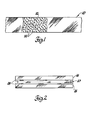
- the film is represented schematically (greatly enlarged) in Figure 1 at 10. It comprises a UV-cured polymer matrix 12 containing a dispersion of many liquid crystal microdroplets 14.
- Figure 2 illustrates the film 10 between two glass plates 16. Each plate bears a transparent conductive coating 18 lying against film 10.
- the film is opaque at room temperature but could readily be converted to a transparent film by the application of heat or of a suitable electrical potential.
- indices of refraction of the polymer and the liquid crystal via dissolving suitable materials one can optimize the temperature-driven effects or the electric or magnetic-driven effects. Obviously such a film could be adapted as a display, a light shutter or a temperature-sensing device.
- Another set of films were prepared using 75 parts by volume of the same polymer precursor mixture and 50 parts by volume of a single substantially pure liquid crystal material, 4-n-heptyl-4'-cyanobiphenyl (7CB).
- the two liquids were mixed together by hand using a spatula and a film formed between glass plates having transparent conductive electrodes as described above.
- the film was milky-opaque at room temperature but quickly became clear and transparent when heated to a temperature of about 45°C. Upon cooling below that -temperature, the film again became opaque. This practice could be repeated indefinitely.
- the films of this example could also be converted from opaque to transparent by the application of an electrical potential of 50 volts rms across the 20 micrometre thick film. The transparent film became opaque again when the electrical potential was removed.
- Films like the first set of films of Example 2 were prepared between two flat slabs of plexiglass. These films could be easily separated from the slabs as free standing films of a few micrometres in thickness. This method provides free standing films that are flexible and tough and can be adapted for use as temperature sensors or light shutters to be easily made or cut to any size, shape or configuration. Clearly any other of the films described in Examples 1 and 2 could be prepared the same way.
- liquid crystal films have been developed in which microdroplets of liquid crystal materials are dispersed in a UV-cured polymer based on triallyl isocyanurate and suitable polythiols. It has been found that these films are particularly useful when employing nematic, cholesteric or smectic liquid crystal materials. Where it is desired to colour the films, suitable dyes may be incorporated therein.
- the liquid materials are mixed together. At this stage it is not easy to tell how many liquid phases, if there are more than one, are present. However, the mixture can be cast as a film and allowed to stand as long as desired before the UV curing is initiated. After curing, the film may be examined, for example, by scanning electron microscopy (SEM), to determine the size of the droplets and the size range of the droplets of liquid crystal material dispersed in the polymer matrix. Preferably the droplets have of a dimension or diameter of about 0.2 to 1 micrometres when the film is to be used for display or for the control of visible light. It may be desirable to have slightly larger dispersed particles if the film is to be used for applications involving infra-red radiation.
- the droplet size characteristics of the finished product may be correlated with the mixing time and/or standing time of the preceding process for purposes of determining suitable mixing and standing parameters to make a given liquid crystal film.
Landscapes
- Chemical & Material Sciences (AREA)
- Engineering & Computer Science (AREA)
- Materials Engineering (AREA)
- Organic Chemistry (AREA)
- Manufacturing & Machinery (AREA)
- Crystallography & Structural Chemistry (AREA)
- Health & Medical Sciences (AREA)
- Chemical Kinetics & Catalysis (AREA)
- Medicinal Chemistry (AREA)
- Polymers & Plastics (AREA)
- Liquid Crystal (AREA)
- Liquid Crystal Substances (AREA)
Applications Claiming Priority (2)
| Application Number | Priority Date | Filing Date | Title |
|---|---|---|---|
| US74298385A | 1985-06-10 | 1985-06-10 | |
| US742983 | 1985-06-10 |
Publications (3)
| Publication Number | Publication Date |
|---|---|
| EP0205261A2 true EP0205261A2 (de) | 1986-12-17 |
| EP0205261A3 EP0205261A3 (en) | 1987-03-25 |
| EP0205261B1 EP0205261B1 (de) | 1990-09-19 |
Family
ID=24987042
Family Applications (1)
| Application Number | Title | Priority Date | Filing Date |
|---|---|---|---|
| EP86303742A Expired - Lifetime EP0205261B1 (de) | 1985-06-10 | 1986-05-16 | In dünnen Filmen von U.V.-vernetzbaren Polymeren dispergierte Flüssigkristalltröpfchen |
Country Status (7)
| Country | Link |
|---|---|
| EP (1) | EP0205261B1 (de) |
| JP (1) | JPS622231A (de) |
| KR (1) | KR890002935B1 (de) |
| AU (1) | AU576961B2 (de) |
| CA (1) | CA1273192A (de) |
| DE (1) | DE3674256D1 (de) |
| ES (1) | ES8801045A1 (de) |
Cited By (20)
| Publication number | Priority date | Publication date | Assignee | Title |
|---|---|---|---|---|
| WO1989006264A1 (en) * | 1987-12-28 | 1989-07-13 | Hughes Aircraft Company | Dispersion of liquid crystal droplets in a photopolymerized matrix, and devices made therefrom |
| EP0238626A4 (de) * | 1985-09-17 | 1989-07-26 | Univ Kent State Ohio | Flüssigkristalline, licht-modulierende materialien. |
| EP0272585A3 (de) * | 1986-12-23 | 1989-11-29 | Asahi Glass Company Ltd. | Optische Flüssigkristall-Vorrichtung und Verfahren zu ihrer Herstellung. |
| EP0282963A3 (en) * | 1987-03-16 | 1990-07-18 | Hoechst Celanese Corporation | A microdisperse polymer/liquid crystal composite |
| WO1990013340A1 (en) * | 1989-04-28 | 1990-11-15 | Mulder, Harmina | Sports floor with line marking |
| WO1991005029A1 (de) * | 1989-10-02 | 1991-04-18 | MERCK Patent Gesellschaft mit beschränkter Haftung | Elektrooptisches flüssigkristallsystem |
| WO1992012219A1 (en) * | 1991-01-11 | 1992-07-23 | Minnesota Mining And Manufacturing Company | Polymer-dispersed liquid crystal device having an ultraviolet-polymerizable matrix and a variable optical transmission and a method for preparing the same |
| EP0503834A3 (en) * | 1991-03-08 | 1992-10-07 | Imperial Chemical Industries Plc | Liquid crystal display device |
| EP0569922A1 (de) * | 1992-05-15 | 1993-11-18 | Matsushita Electric Industrial Co., Ltd. | Flüssigkristalltafel und Flüssigkristall-Projektions-Fernsehempfänger |
| EP0669548A1 (de) * | 1994-02-23 | 1995-08-30 | Fuji Xerox Co., Ltd. | Optisches Bauelement und Verfahren zu dessen Herstellung |
| WO1995025776A1 (en) | 1994-03-24 | 1995-09-28 | Philips Electronics N.V. | Optical temperature indicator |
| WO1995027017A1 (en) * | 1994-03-31 | 1995-10-12 | Raychem Corporation | Amphiphilic telomers |
| WO1995029966A1 (en) * | 1994-04-29 | 1995-11-09 | Minnesota Mining And Manufacturing Company | Light modulating device having a matrix prepared from allyl reactants |
| EP0747461A1 (de) * | 1995-06-09 | 1996-12-11 | Sniaricerche S.C.P.A. | Polymerstabilisierte Flüssigkristalle und flexible Vorrichtungen die sie verwenden |
| US5695594A (en) * | 1996-01-05 | 1997-12-09 | Raychem Corporation | Method of making a liquid crystal light valve |
| US6667357B2 (en) | 2000-12-15 | 2003-12-23 | The College Of William And Mary | Organic thiol metal-free stabilizers and plasticizers for halogen-containing polymers |
| US6747081B2 (en) | 2000-12-15 | 2004-06-08 | The College Of William And Mary | Organic thiol metal-free stabilizers and plasticizers for halogen-containing polymers |
| US6927247B2 (en) | 2000-12-15 | 2005-08-09 | The College Of William And Mary | Organic thiol metal-free stabilizers and plasticizers for halogen-containing polymers |
| US7312266B2 (en) | 2000-12-15 | 2007-12-25 | The College Of William And Mary | Organic thiol metal-free stabilizers and plasticizers for halogen-containing polymers |
| US20200165520A1 (en) * | 2018-11-27 | 2020-05-28 | Lawrence Livermore National Security, Llc | Matrix formulation for polymer dispersed liquid crystal displays in low power direct current (dc) electromagnetic field application |
Families Citing this family (9)
| Publication number | Priority date | Publication date | Assignee | Title |
|---|---|---|---|---|
| JPS6295516A (ja) * | 1985-10-22 | 1987-05-02 | Nippon Signal Co Ltd:The | 磁気応答型表示体 |
| JPS63137211A (ja) * | 1986-11-28 | 1988-06-09 | Takiron Co Ltd | 調光材及びその製造方法 |
| JPH0833559B2 (ja) * | 1988-04-21 | 1996-03-29 | 旭硝子株式会社 | 液晶光学素子の製造方法 |
| JPH02104322U (de) * | 1989-02-07 | 1990-08-20 | ||
| JPH0316127U (de) * | 1989-06-29 | 1991-02-18 | ||
| DE69123207T2 (de) * | 1990-08-17 | 1997-04-24 | Dainippon Ink & Chemicals | Flüssigkristallvorrichtung und ihr Herstellungsverfahren |
| US5498450A (en) * | 1992-11-18 | 1996-03-12 | Fuji Xerox Co., Ltd. | Liquid crystal-polymer composite film, electro-optical element using the same, and process for producing electro-optical element |
| JP3362900B2 (ja) * | 1993-03-09 | 2003-01-07 | 富士通株式会社 | 面発光装置 |
| KR100445025B1 (ko) * | 1997-09-03 | 2004-12-17 | 삼성에스디아이 주식회사 | 반사형 액정 표시 장치 및 그 제조 방법 |
Family Cites Families (3)
| Publication number | Priority date | Publication date | Assignee | Title |
|---|---|---|---|---|
| FR1601599A (de) * | 1968-02-23 | 1970-08-31 | ||
| US4030812A (en) * | 1975-06-16 | 1977-06-21 | Minnesota Mining And Manufacturing Company | Lyotropic birefringent films |
| US4182700A (en) * | 1976-07-20 | 1980-01-08 | Benton William J | Elastomeric polyurethane film containing dispersed discrete aggregates of liquid crystal and method of making the same |
-
1986
- 1986-03-21 CA CA000504753A patent/CA1273192A/en not_active Expired - Lifetime
- 1986-05-16 DE DE8686303742T patent/DE3674256D1/de not_active Expired - Lifetime
- 1986-05-16 EP EP86303742A patent/EP0205261B1/de not_active Expired - Lifetime
- 1986-05-23 AU AU57882/86A patent/AU576961B2/en not_active Expired
- 1986-06-09 ES ES555855A patent/ES8801045A1/es not_active Expired
- 1986-06-09 KR KR1019860004559A patent/KR890002935B1/ko not_active Expired
- 1986-06-10 JP JP61132909A patent/JPS622231A/ja active Granted
Cited By (29)
| Publication number | Priority date | Publication date | Assignee | Title |
|---|---|---|---|---|
| EP0238626A4 (de) * | 1985-09-17 | 1989-07-26 | Univ Kent State Ohio | Flüssigkristalline, licht-modulierende materialien. |
| EP0272585A3 (de) * | 1986-12-23 | 1989-11-29 | Asahi Glass Company Ltd. | Optische Flüssigkristall-Vorrichtung und Verfahren zu ihrer Herstellung. |
| EP0282963A3 (en) * | 1987-03-16 | 1990-07-18 | Hoechst Celanese Corporation | A microdisperse polymer/liquid crystal composite |
| WO1989006264A1 (en) * | 1987-12-28 | 1989-07-13 | Hughes Aircraft Company | Dispersion of liquid crystal droplets in a photopolymerized matrix, and devices made therefrom |
| US4891152A (en) * | 1987-12-28 | 1990-01-02 | Hughes Aircraft Company | Dispersion of liquid crystal droplets in a photopolymerized matrix and devices made therefrom |
| WO1990013340A1 (en) * | 1989-04-28 | 1990-11-15 | Mulder, Harmina | Sports floor with line marking |
| WO1991005029A1 (de) * | 1989-10-02 | 1991-04-18 | MERCK Patent Gesellschaft mit beschränkter Haftung | Elektrooptisches flüssigkristallsystem |
| WO1992012219A1 (en) * | 1991-01-11 | 1992-07-23 | Minnesota Mining And Manufacturing Company | Polymer-dispersed liquid crystal device having an ultraviolet-polymerizable matrix and a variable optical transmission and a method for preparing the same |
| EP0503834A3 (en) * | 1991-03-08 | 1992-10-07 | Imperial Chemical Industries Plc | Liquid crystal display device |
| US5387445A (en) * | 1991-03-08 | 1995-02-07 | Zeneca Limited | Liquid crystal display device |
| EP0569922A1 (de) * | 1992-05-15 | 1993-11-18 | Matsushita Electric Industrial Co., Ltd. | Flüssigkristalltafel und Flüssigkristall-Projektions-Fernsehempfänger |
| EP0669548A1 (de) * | 1994-02-23 | 1995-08-30 | Fuji Xerox Co., Ltd. | Optisches Bauelement und Verfahren zu dessen Herstellung |
| US5670083A (en) * | 1994-02-23 | 1997-09-23 | Fuji Xerox Co., Ltd. | Optical element and process for producing the same |
| WO1995025776A1 (en) | 1994-03-24 | 1995-09-28 | Philips Electronics N.V. | Optical temperature indicator |
| US5686153A (en) * | 1994-03-24 | 1997-11-11 | U.S. Philips Corporation | Optical temperature indicator |
| WO1995027017A1 (en) * | 1994-03-31 | 1995-10-12 | Raychem Corporation | Amphiphilic telomers |
| WO1995029966A1 (en) * | 1994-04-29 | 1995-11-09 | Minnesota Mining And Manufacturing Company | Light modulating device having a matrix prepared from allyl reactants |
| US5641426A (en) * | 1994-04-29 | 1997-06-24 | Minnesota Mining And Manufacturing Company | Light modulating device having a vinyl ether-based matrix |
| EP0747461A1 (de) * | 1995-06-09 | 1996-12-11 | Sniaricerche S.C.P.A. | Polymerstabilisierte Flüssigkristalle und flexible Vorrichtungen die sie verwenden |
| US6049366A (en) * | 1995-06-09 | 2000-04-11 | Sniaricerche S.C.P.A. | Polymer stabilized liquid crystals and flexible devices thereof |
| US5695594A (en) * | 1996-01-05 | 1997-12-09 | Raychem Corporation | Method of making a liquid crystal light valve |
| US6667357B2 (en) | 2000-12-15 | 2003-12-23 | The College Of William And Mary | Organic thiol metal-free stabilizers and plasticizers for halogen-containing polymers |
| US6747081B2 (en) | 2000-12-15 | 2004-06-08 | The College Of William And Mary | Organic thiol metal-free stabilizers and plasticizers for halogen-containing polymers |
| US6762231B2 (en) * | 2000-12-15 | 2004-07-13 | The College Of William And Mary | Organic thiol metal-free stabilizers and plasticizers for halogen-containing polymers |
| US6927247B2 (en) | 2000-12-15 | 2005-08-09 | The College Of William And Mary | Organic thiol metal-free stabilizers and plasticizers for halogen-containing polymers |
| US7250457B2 (en) | 2000-12-15 | 2007-07-31 | The College Of William And Mary | Organic thiol metal-free stabilizers and plasticizers for halogen-containing polymers |
| US7312266B2 (en) | 2000-12-15 | 2007-12-25 | The College Of William And Mary | Organic thiol metal-free stabilizers and plasticizers for halogen-containing polymers |
| US20200165520A1 (en) * | 2018-11-27 | 2020-05-28 | Lawrence Livermore National Security, Llc | Matrix formulation for polymer dispersed liquid crystal displays in low power direct current (dc) electromagnetic field application |
| US12291663B2 (en) * | 2018-11-27 | 2025-05-06 | Lawrence Livermore National Security, Llc | Matrix formulation for polymer dispersed liquid crystal displays in low power direct current (DC) electromagnetic field application |
Also Published As
| Publication number | Publication date |
|---|---|
| CA1273192A (en) | 1990-08-28 |
| DE3674256D1 (de) | 1990-10-25 |
| JPH055338B2 (de) | 1993-01-22 |
| ES8801045A1 (es) | 1987-12-01 |
| EP0205261A3 (en) | 1987-03-25 |
| EP0205261B1 (de) | 1990-09-19 |
| KR890002935B1 (ko) | 1989-08-12 |
| ES555855A0 (es) | 1987-12-01 |
| AU5788286A (en) | 1986-12-18 |
| JPS622231A (ja) | 1987-01-08 |
| AU576961B2 (en) | 1988-09-08 |
| KR870000372A (ko) | 1987-02-18 |
Similar Documents
| Publication | Publication Date | Title |
|---|---|---|
| EP0205261B1 (de) | In dünnen Filmen von U.V.-vernetzbaren Polymeren dispergierte Flüssigkristalltröpfchen | |
| US4728547A (en) | Liquid crystal droplets dispersed in thin films of UV-curable polymers | |
| JP2721497B2 (ja) | 光変調性物質の製造方法 | |
| West | Phase separation of liquid crystals in polymers | |
| US4971719A (en) | Polymer dispersed liquid crystal films formed by electron beam curing | |
| CA2143200C (en) | Directly formed polymer dispersed liquid crystal light shutter displays | |
| US5240636A (en) | Light modulating materials comprising a liquid crystal microdroplets dispersed in a birefringent polymeric matri method of making light modulating materials | |
| US5683622A (en) | Optical elements having color-selective and polarization-selective reflection containing LC pigments, and the production of these elements | |
| AU6400886A (en) | Liquid crystal light-modulating materials | |
| ITMI951226A1 (it) | Cristalli liquidi stabilizzati con polimeri (pslc) e dispositivi flessibili di essi | |
| EP0400098B1 (de) | Licht modulierende materialien enthaltend flüssigkristallmikrotröpfen dispergiert in einer polymermatritze | |
| US5021188A (en) | Polymer dispersed liquid crystal films formed by electron beam curing | |
| JP2925731B2 (ja) | 高分子に分散した液晶を含む光変調材料 | |
| JPH06504387A (ja) | 紫外線重合性マトリックス及び可変性の光透過率を有する高分子分散型液晶素子及びその調製方法 | |
| US5830385A (en) | Method of making liquid crystal composite | |
| Vaz | Polymer-dispersed liquid crystal films: materials and applications | |
| EP0724006A1 (de) | Flüssigkristallepoxyharze in P.D.L.C. Kompositen | |
| Maschke et al. | Influence of liquid crystal concentration on the electro-optical behavior of polymer dispersed liquid crystal films prepared by electron beam processing | |
| JP2725283B2 (ja) | 液晶デバイス及びその製造方法 | |
| JPH05502263A (ja) | 液晶混合物 | |
| EP0787782A2 (de) | Verfahren und Stoffe für hochtransparente dispersionspolymere Flüssigkristalle | |
| Klosowicz | Optimization of nematic LC mixtures for PDLC devices | |
| Pane et al. | Liquid crystal properties modulation for high performance PDLC films | |
| JPH0229487A (ja) | 液晶デバイス | |
| JPH0229488A (ja) | 液晶デバイス |
Legal Events
| Date | Code | Title | Description |
|---|---|---|---|
| PUAI | Public reference made under article 153(3) epc to a published international application that has entered the european phase |
Free format text: ORIGINAL CODE: 0009012 |
|
| 17P | Request for examination filed |
Effective date: 19860528 |
|
| AK | Designated contracting states |
Kind code of ref document: A2 Designated state(s): CH DE FR GB IT LI |
|
| PUAL | Search report despatched |
Free format text: ORIGINAL CODE: 0009013 |
|
| AK | Designated contracting states |
Kind code of ref document: A3 Designated state(s): CH DE FR GB IT LI |
|
| 17Q | First examination report despatched |
Effective date: 19890103 |
|
| ITF | It: translation for a ep patent filed | ||
| GRAA | (expected) grant |
Free format text: ORIGINAL CODE: 0009210 |
|
| AK | Designated contracting states |
Kind code of ref document: B1 Designated state(s): CH DE FR GB IT LI |
|
| ET | Fr: translation filed | ||
| REF | Corresponds to: |
Ref document number: 3674256 Country of ref document: DE Date of ref document: 19901025 |
|
| PLBE | No opposition filed within time limit |
Free format text: ORIGINAL CODE: 0009261 |
|
| STAA | Information on the status of an ep patent application or granted ep patent |
Free format text: STATUS: NO OPPOSITION FILED WITHIN TIME LIMIT |
|
| 26N | No opposition filed | ||
| ITTA | It: last paid annual fee | ||
| REG | Reference to a national code |
Ref country code: GB Ref legal event code: IF02 |
|
| PGFP | Annual fee paid to national office [announced via postgrant information from national office to epo] |
Ref country code: GB Payment date: 20050511 Year of fee payment: 20 |
|
| PGFP | Annual fee paid to national office [announced via postgrant information from national office to epo] |
Ref country code: FR Payment date: 20050517 Year of fee payment: 20 |
|
| PGFP | Annual fee paid to national office [announced via postgrant information from national office to epo] |
Ref country code: CH Payment date: 20050520 Year of fee payment: 20 |
|
| PGFP | Annual fee paid to national office [announced via postgrant information from national office to epo] |
Ref country code: IT Payment date: 20050528 Year of fee payment: 20 |
|
| REG | Reference to a national code |
Ref country code: GB Ref legal event code: PE20 |
|
| PGFP | Annual fee paid to national office [announced via postgrant information from national office to epo] |
Ref country code: DE Payment date: 20050630 Year of fee payment: 20 |
|
| PG25 | Lapsed in a contracting state [announced via postgrant information from national office to epo] |
Ref country code: GB Free format text: LAPSE BECAUSE OF EXPIRATION OF PROTECTION Effective date: 20060515 |
|
| REG | Reference to a national code |
Ref country code: CH Ref legal event code: PL |