EP0205709A2 - Procédé d'enrichissement d'un mélange gazeux d'un de ses constituants - Google Patents
Procédé d'enrichissement d'un mélange gazeux d'un de ses constituants Download PDFInfo
- Publication number
- EP0205709A2 EP0205709A2 EP85308711A EP85308711A EP0205709A2 EP 0205709 A2 EP0205709 A2 EP 0205709A2 EP 85308711 A EP85308711 A EP 85308711A EP 85308711 A EP85308711 A EP 85308711A EP 0205709 A2 EP0205709 A2 EP 0205709A2
- Authority
- EP
- European Patent Office
- Prior art keywords
- stream
- air
- adsorbent
- oxygen
- enriched
- Prior art date
- Legal status (The legal status is an assumption and is not a legal conclusion. Google has not performed a legal analysis and makes no representation as to the accuracy of the status listed.)
- Withdrawn
Links
Images

Classifications
-
- B—PERFORMING OPERATIONS; TRANSPORTING
- B01—PHYSICAL OR CHEMICAL PROCESSES OR APPARATUS IN GENERAL
- B01D—SEPARATION
- B01D53/00—Separation of gases or vapours; Recovering vapours of volatile solvents from gases; Chemical or biological purification of waste gases, e.g. engine exhaust gases, smoke, fumes, flue gases, aerosols
- B01D53/02—Separation of gases or vapours; Recovering vapours of volatile solvents from gases; Chemical or biological purification of waste gases, e.g. engine exhaust gases, smoke, fumes, flue gases, aerosols by adsorption, e.g. preparative gas chromatography
-
- B—PERFORMING OPERATIONS; TRANSPORTING
- B01—PHYSICAL OR CHEMICAL PROCESSES OR APPARATUS IN GENERAL
- B01D—SEPARATION
- B01D53/00—Separation of gases or vapours; Recovering vapours of volatile solvents from gases; Chemical or biological purification of waste gases, e.g. engine exhaust gases, smoke, fumes, flue gases, aerosols
- B01D53/02—Separation of gases or vapours; Recovering vapours of volatile solvents from gases; Chemical or biological purification of waste gases, e.g. engine exhaust gases, smoke, fumes, flue gases, aerosols by adsorption, e.g. preparative gas chromatography
- B01D53/06—Separation of gases or vapours; Recovering vapours of volatile solvents from gases; Chemical or biological purification of waste gases, e.g. engine exhaust gases, smoke, fumes, flue gases, aerosols by adsorption, e.g. preparative gas chromatography with moving adsorbents, e.g. rotating beds
-
- B—PERFORMING OPERATIONS; TRANSPORTING
- B01—PHYSICAL OR CHEMICAL PROCESSES OR APPARATUS IN GENERAL
- B01D—SEPARATION
- B01D2253/00—Adsorbents used in seperation treatment of gases and vapours
- B01D2253/10—Inorganic adsorbents
- B01D2253/102—Carbon
-
- B—PERFORMING OPERATIONS; TRANSPORTING
- B01—PHYSICAL OR CHEMICAL PROCESSES OR APPARATUS IN GENERAL
- B01D—SEPARATION
- B01D2253/00—Adsorbents used in seperation treatment of gases and vapours
- B01D2253/10—Inorganic adsorbents
- B01D2253/116—Molecular sieves other than zeolites
-
- B—PERFORMING OPERATIONS; TRANSPORTING
- B01—PHYSICAL OR CHEMICAL PROCESSES OR APPARATUS IN GENERAL
- B01D—SEPARATION
- B01D2253/00—Adsorbents used in seperation treatment of gases and vapours
- B01D2253/25—Coated, impregnated or composite adsorbents
-
- B—PERFORMING OPERATIONS; TRANSPORTING
- B01—PHYSICAL OR CHEMICAL PROCESSES OR APPARATUS IN GENERAL
- B01D—SEPARATION
- B01D2257/00—Components to be removed
- B01D2257/10—Single element gases other than halogens
- B01D2257/104—Oxygen
-
- B—PERFORMING OPERATIONS; TRANSPORTING
- B01—PHYSICAL OR CHEMICAL PROCESSES OR APPARATUS IN GENERAL
- B01D—SEPARATION
- B01D2259/00—Type of treatment
- B01D2259/40—Further details for adsorption processes and devices
- B01D2259/40011—Methods relating to the process cycle in pressure or temperature swing adsorption
- B01D2259/40077—Direction of flow
- B01D2259/40081—Counter-current
-
- B—PERFORMING OPERATIONS; TRANSPORTING
- B01—PHYSICAL OR CHEMICAL PROCESSES OR APPARATUS IN GENERAL
- B01D—SEPARATION
- B01D2259/00—Type of treatment
- B01D2259/40—Further details for adsorption processes and devices
- B01D2259/40083—Regeneration of adsorbents in processes other than pressure or temperature swing adsorption
- B01D2259/40088—Regeneration of adsorbents in processes other than pressure or temperature swing adsorption by heating
- B01D2259/4009—Regeneration of adsorbents in processes other than pressure or temperature swing adsorption by heating using hot gas
-
- B—PERFORMING OPERATIONS; TRANSPORTING
- B01—PHYSICAL OR CHEMICAL PROCESSES OR APPARATUS IN GENERAL
- B01D—SEPARATION
- B01D2259/00—Type of treatment
- B01D2259/40—Further details for adsorption processes and devices
- B01D2259/406—Further details for adsorption processes and devices using more than four beds
- B01D2259/4068—Further details for adsorption processes and devices using more than four beds using more than ten beds
-
- B—PERFORMING OPERATIONS; TRANSPORTING
- B01—PHYSICAL OR CHEMICAL PROCESSES OR APPARATUS IN GENERAL
- B01D—SEPARATION
- B01D53/00—Separation of gases or vapours; Recovering vapours of volatile solvents from gases; Chemical or biological purification of waste gases, e.g. engine exhaust gases, smoke, fumes, flue gases, aerosols
- B01D53/02—Separation of gases or vapours; Recovering vapours of volatile solvents from gases; Chemical or biological purification of waste gases, e.g. engine exhaust gases, smoke, fumes, flue gases, aerosols by adsorption, e.g. preparative gas chromatography
- B01D53/04—Separation of gases or vapours; Recovering vapours of volatile solvents from gases; Chemical or biological purification of waste gases, e.g. engine exhaust gases, smoke, fumes, flue gases, aerosols by adsorption, e.g. preparative gas chromatography with stationary adsorbents
- B01D53/0462—Temperature swing adsorption
Definitions
- the present invention relates to a process for enhancing the concentration of one component contained in a multi-component gas and, more particularly, to a process for enriching air by increasing the concentration of oxygen therein.
- Oxygen-enriched air as opposed to pure oxygen, is often sought by industry in order to improve combustion or, more recently, to enhance processes in biotechnology.
- oxygen-enriched air has been obtained by either mixing air with pure oxygen produced by well known cryogenic techniques or, alternatively, by pressure-swing adsorption techniques.
- air under pressure is passed through a fixed bed adsorption system.
- an adsorbent such as a molecular sieve is used, the sieve preferentially adsorbing nitrogen.
- the gas discharged from the bed is thus higher in oxygen content than that being fed into the bed.
- the pressure is reduced to atmospheric or even sub-atmospheric levels, and the nitrogen is desorbed from the bed.
- the bed is then returned to the nitrogen adsorption cycle.
- Another object of this invention is to provide a process for enriching air which makes it possible to divide a stream of oxygen-enriched air into two separate streams and to then strip the oxygen from the first stream for simultaneous and continuous loading into the second stream so as to obtain a product air stream having an even greater concentration of oxygen.
- Yet another object of this invention to provide a process for enriching air which may be carried out with virtually any volume of air at relatively low pressures i.e., below four atmospheres thus making it satisfactory regardless of the process requirements.
- a further object of this invention is to provide a process which utilizes a thermal swing approach to regenerate the adsorbent bed which improves the versatility of this technique.
- an Advanced Separation Device which comprises a plurality of adsorbent filled chambers which move about a circular path in periodic fluid communication with a plurality of fixed feed ports and fixed discharge ports at an end of the chambers opposite to that of the fixed feed ports. Since materials being discharged from the fixed discharge ports are readily purged from the system, recirculated to another feed port, or a combination of both, it is possible by virtue of the ASD to:
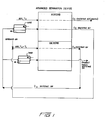
- Fig. 1 The overall process concept of the present invention is described in Fig. 1.
- ambient air at a temperature T i is supplied to the ASD where the oxygen contained therein will come into contact with and be adsorbed by a suitable adsorbent.
- the air exhaust, now being 0 2 depleted, is expelled from the ASD as waste.
- a second stream of air which may contain some recycled air from later stages, is then supplied to the ASD for delivery to the oxygen loaded adsorbent.
- the second stream is at a temperature T 2 , which is greater than the temperature T 1 of the first stream and thereby effects desorption of the previously loaded 0 2 from the adsorbent.
- the exiting stream is thus oxygen enriched.
- the oxygen enriched stream leaving the ASD is then divided into two separate streams.
- the first stream is cooled and then delivered to the ASD where the oxygen contained therein is loaded onto the adsorbent.
- the other oxygen-enriched stream is heated and then delivered to the ASD whefe oxygen loaded onto the adsorbent by the other oxygen enriched stream will be stripped so as to produce a doubly enriched stream of air.
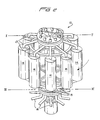
- the ASD 10 comprises a plurality of fixed feed ports 12, to each of which may be supplied various feed materials.
- those materials include ambient air as well as recycled streams of oxygen enriched and oxygen depleted air.
- each fixed feed port 12 Moving about a circular path in periodic fluid communication with each of the above-described fixed feed ports 12 are a plurality of chambers 14 filled with an adsorbent which is capable of adsorbing oxygen, or any other component for which enrichment is desired.
- the rotating chambers 14 are connected to the fixed feed ports 12 via the conduits 13, which themselves rotate along with the chambers.
- the rotating chambers 14 are connected to the fixed discharge ports 16 via the conduits 15, which themselves rotate.
- each fixed feed port 12 will have a corresponding fixed discharge port 16.
- the feed materials are supplied continuously to their respective feed ports for periodic interaction with the adsorbent in each of the chambers 14. As material is discharged from the rotating chambers 14 through one of the fixed discharge ports 16, it may be purged from the system, recirculated back to a selected feed port, or a combination of both.
- the size and number of chambers 14 is strictly a matter of design choice dependent upon the degree of enrichment sought, the type of adsorbent used, and the volume of enriched air required. At a minimum, there should be at least about 25-30% more rotating chambers than fixed beds to avoid dead spots. Thus, it is within the ambit of this invention to provide 10-15 fixed feed ports and up to 60 rotating chambers. The system is effectively operated in a thermal swing mode at pressures between about 1 and about 4 atmospheres.
- adsorbent used is entirely dependent on the gaseous component enriched.
- adsorbents such as activated carbon molecular sieves and hexacyano molecular sieves such as those developed by Union Carbide and described in U.S. Patent No. 4,477,418 may be used.
- an adsorbent such as activated carbon would be suitable.
- the adsorbent may be used in conjunction with the presently claimed process.
- the tempera-0 380C ture of the feed being adsorbed can range 0-38°C from about 32°F to about 100°F), the upper limit being the more critical since higher temperatures disfavor gaseous adsorption.
- the materials fed to 66 to 149°C the desorption stage can typically ranger from 150°F to 300°F), the temperature being dependent primarily on the nature of the adsorbent.
- one or more additional feed ports may be provided in order to supply a stream of cooling air to the adsorbent after the desorption stage.
- This additional stream would act to decrease the temperature of the adsorbent from the at least 66°C(150°F) employed during desorption to the maximum of about 38°C (100°F)employed for adsorption.
- the additional cooling feed ports are not provided, the adsorbent will typically be cooled by an excess of air fed through the adsorption stage feed ports.
- the rotational speed of the adsorbent-filled chambers is highly dependent on the construction of the ASD used i.e., the diameter of the chambers; the properties of the adsorbent i.e., its loading capacity; the depth of the adsorbent in the chambers and the material flow rates.
- the present process enables air to be enriched to contain in excess of 30% by volume of oxygen in contrast to the 21% normally found.
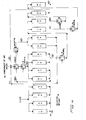
- FIG. 3 the process for enriching the oxygen content of air is illustrated.
- the particular embodiment illustrated utilizes fourteen fixed feed and discharge ports as well as twenty rotating chambers.
- the fixed feed ports 1F-14F as well as the fixed discharge ports 1D-14D are depicted in Fig. 3.
- the general process is illustrated schematically in Fig. 4.
- Figure 4 should be viewed as illustrating the fixed feed and discharge ports.
- the rotating adsorbent-filled chambers can be viewed as a continuous or "infinite" bed.
- ambient air (I) is supplied to fixed feed ports 1F to 4F for delivery to the adsorbent-filled chambers where oxygen is loaded onto the adsorbent and the stream of air (II), which is now oxygen depleted, is expelled out of the system through fixed discharge ports 1 D to 4D.
- the temperature of the entering air (I) is no greater than 38oC abouti(100 * F)to insure adequate adsorption of the oxygen onto the adsorbent.
- the stream (VII) is fed into the ASD in order to strip the adsorbent of the 0 2 loaded while the chambers were being fed by cool air through ports 1F to 4F, the stream must be at a temperature greater than that of the ambient air feed stream 66 to 149°C (I). Generally, temperatures ranging from 66 to 149°C(150 to 300°F) are found satisfactory. The upper limit is dependent on the nature of the adsorbent.
- the stream (VII) fed into ports 5F-8F thus strips the oxygen from the adsorbent and is discharged from the ASD as two separate oxygen-enriched streams namely, stream (VIII) which originates from ports 5D and 6D and stream (IX), which originates from ports 7D and 8D.
- Stream (VIII) containing oxygen-enriched air is then cooled and supplied to fixed ports 9F and 10F where it is then delivered to chambers 14 where the higher levels of 0 2 contained therein are loaded onto the adsorbent. As depicted in F ig. 4, stream (VIII) is cooled by heat exchange with stream (VII).
- Stream (IX) which also contains oxygen-enriched air is heated and supplied to fixed ports 11F and 12F where it is delivered to the chambers containing adsorbent loaded with the 0 2 by oxygen-enriched stream (VIII). In this manner, the oxygen present in the first oxygen-enriched stream (VIII) is transferred to the second oxygen-enriched stream (IX) to produce double enriched streams of air (X) and (XI).
- a triple-enriched stream of air is obtained. More specifically, the double enriched stream (XI) is cooled and delivered to fixed port 13F for loading of the oxygen contained therein onto the adsorbent. The stream (X) of double enriched air is then heated and delivered to feed port 14F where it desorbs the oxygen deposited onto the adsorbent by stream (XI) to produce a triple-enriched stream of air.
- the oxygen depleted stream (IV) being discharged from port 13D is then recycled, as previously indicated, and combined with streams (III) and (V) for delivery to fixed ports 5F to 8F.
- the present process enables air to be enriched to contain in excess of 30% by volume of oxygen in contrast to the 21% normally found.
- Example shown is based on a so-called “single-pass" system to produce 0.462 m 3 /s, at standard temperature and pressure (60,000 SCFH)of 30% by volume oxygen enriched air.
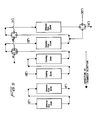
- a single pass oxygen enrichment system is shown in Fig. 5.
- the single pass concept illustrates the technique of continuous 0 2 adsorption/desorption using the ASD system. Any number of stages with intrastage heating and cooling can be utilized depending on the gases being processed, the adsorbent used and the degree of recovery or enrichment desired for the end use.
- ambient air is introduced in a two- stage counter-current fashion into the adsorption zone of the 0.462 m 3 s ASD.
- L 60,000 standard cubic feet per hour
- 30% oxygen enriched air is the desired end product.
- the ASD consists of multiple feed ports and uses 20 chambers one foot in diameter by three feet in height, containing a depth of two feet of molecular sieve type carbon.
- the rotational speed of the ASD is between 20 and 30 minutes per revolution.
- the entire system is operated at a pressure of 2 atmospheres (202.65 kPa).
- the ambient air (stream I') passes through the adsorption zone wherein a portion of the contained oxygen is adsorbed onto the carbon.
- Depleted air (II I ) exits the ASD and is discharged.
- Ambient air (III') is passed in a 0.154 to 0.193 m 3 /s counter-current fashion through the cooling zone. Approximately 0.154 to 0.193 m 3 /s(20,000 to 25,000 standard cubic feet per hour)are utilized in this step.
- This air is combined with preheated ambient air originating in stream (VII') and the mixture passes through heat exchanger Hl where the temperature is elevated to 93°C (200°F) or greater. The heated air leaves the exchanger and passes into the desorption zone where it removes residual oxygen from the sieving carbon.
- the discharged partially enriched air from this zone passes through a second heat exchanger H2 where the temperature of the gas is increased to 149°C (300°F) or greater depending on the limitation of the carbon or adsorbent. Heating of the air is accomplished in counter-current heat exchangers and hot combustion gas originating from any standard source (V') is used as the heating medium. Other techniques such as thermal fluid heat transfer, waste heat recovery and the like can be used to achieve this heating stage.
- the hot gas from the second heat exchanger H2 passes through the activated carbon to produce an enriched air at 149°C approximately (300°F) or above, again depending on the adsorbent, 0. 4 62 m3/s and at a rate of about/(60,000 standard cubic feet per hour).
- This enriched air is passed through a third heat exchanger H3 (preheater) in order to reclaim a portion of the heat and minimize thermal energy costs associated with the process.
- the final enriched air (VI') contains approximately 30% oxygen and is sent on to further procesing or to the end use.
- the enriched air contained in stream 6 can be sent to additional adsorption zones as indicated in Fig. 4. In this manner a bootstrap technique is utilized to build up the final concentration of oxygen.
Landscapes
- Chemical & Material Sciences (AREA)
- Engineering & Computer Science (AREA)
- Analytical Chemistry (AREA)
- General Chemical & Material Sciences (AREA)
- Oil, Petroleum & Natural Gas (AREA)
- Chemical Kinetics & Catalysis (AREA)
- Separation Of Gases By Adsorption (AREA)
- Oxygen, Ozone, And Oxides In General (AREA)
- Solid-Sorbent Or Filter-Aiding Compositions (AREA)
Applications Claiming Priority (2)
| Application Number | Priority Date | Filing Date | Title |
|---|---|---|---|
| US747434 | 1985-06-21 | ||
| US06/747,434 US4612022A (en) | 1985-06-21 | 1985-06-21 | Process for increasing the concentration of one component in a multi-component _gaseous mixture |
Publications (2)
| Publication Number | Publication Date |
|---|---|
| EP0205709A2 true EP0205709A2 (fr) | 1986-12-30 |
| EP0205709A3 EP0205709A3 (fr) | 1988-05-25 |
Family
ID=25005044
Family Applications (1)
| Application Number | Title | Priority Date | Filing Date |
|---|---|---|---|
| EP85308711A Withdrawn EP0205709A3 (fr) | 1985-06-21 | 1985-11-29 | Procédé d'enrichissement d'un mélange gazeux d'un de ses constituants |
Country Status (10)
| Country | Link |
|---|---|
| US (1) | US4612022A (fr) |
| EP (1) | EP0205709A3 (fr) |
| JP (1) | JPS6291224A (fr) |
| KR (1) | KR870000093A (fr) |
| CN (1) | CN1005253B (fr) |
| AU (1) | AU570904B2 (fr) |
| CA (1) | CA1290706C (fr) |
| ES (1) | ES8702158A1 (fr) |
| IL (1) | IL77060A0 (fr) |
| IN (1) | IN164708B (fr) |
Cited By (2)
| Publication number | Priority date | Publication date | Assignee | Title |
|---|---|---|---|---|
| EP0301090A4 (fr) * | 1987-02-09 | 1990-01-23 | Rad Systems Inc | Systeme adsorbeur dynamique regenerateur et procede d'extraction de substances contaminantes. |
| EP0368435A3 (fr) * | 1988-11-02 | 1991-02-27 | Colortronic Co., Ltd. | Générateur d'air sec employant un adsorbant |
Families Citing this family (27)
| Publication number | Priority date | Publication date | Assignee | Title |
|---|---|---|---|---|
| JPS6126647U (ja) * | 1984-07-23 | 1986-02-17 | トヨタ自動車株式会社 | 室内鏡取付構造 |
| US4778492A (en) * | 1987-02-19 | 1988-10-18 | Advanced Separation Technologies Incorporated | Continuous gas treatment method and apparatus for adsorption processes |
| AT389822B (de) * | 1988-07-08 | 1990-02-12 | Andritz Ag Maschf | Verfahren zum kontinuierlichen reinigen von gasen von mitgefuehrten beladestoffen sowie vorrichtung zu seiner durchfuehrung |
| US4999033A (en) * | 1989-05-31 | 1991-03-12 | Bry-Air, Inc. | Integrally valved, low friction indexing desiccant bed dehumidifier |
| US4948392A (en) * | 1989-07-25 | 1990-08-14 | Institute Of Gas Technology | Heat input for thermal regenerative desiccant systems |
| FR2667801B1 (fr) * | 1990-10-11 | 1992-12-04 | Air Liquide | Procede et equipement de separation par adsorption d'au moins un constituant d'un melange gazeux. |
| LU88160A1 (fr) * | 1992-08-18 | 1993-10-27 | Fernande Schartz | Procede et dispositif de separation de gaz par adsorption selective a pression variable |
| US5487775A (en) * | 1994-05-09 | 1996-01-30 | The Boc Group, Inc. | Continuous pressure difference driven adsorption process |
| FR2722426B1 (fr) * | 1994-07-18 | 1996-08-23 | Air Liquide | Procede de separation d'azote d'un melange gazeux par adsorption |
| EP0757970A4 (fr) * | 1995-02-06 | 1998-08-12 | Nippon Oxygen Co Ltd | Procede d'enrichissement en ozone |
| US5676826A (en) * | 1995-04-19 | 1997-10-14 | Advanced Separation Technologies Incorporated | Fluid-solid contacting apparatus |
| US5672197A (en) * | 1995-10-11 | 1997-09-30 | Rothchild; Ronald D. | Gas separation by continuous pressure-swing chromatography |
| US6905535B2 (en) * | 1998-12-16 | 2005-06-14 | Questair Technologies Inc. | Gas separation with split stream centrifugal turbomachinery |
| EP1148927B1 (fr) | 1998-12-16 | 2005-10-05 | Questair Technologies, Inc. | Separation de gaz avec turbomachines centrifuges a courant separe |
| CA2274388A1 (fr) | 1999-06-10 | 2000-12-10 | Bowie Keefer | Adsorbateur de surtension de regulation de debit pour adsorption modulee en pression |
| CA2274390A1 (fr) * | 1999-06-10 | 2000-12-10 | Questor Industries Inc. | Methode et appareil de separation chimique multietagee utilisant l'adsorption modulee en pression |
| US6431202B1 (en) | 1999-12-01 | 2002-08-13 | Calgon Carbon Corporation | Fluid-directing multiport rotary valve |
| US6630012B2 (en) * | 2001-04-30 | 2003-10-07 | Battelle Memorial Institute | Method for thermal swing adsorption and thermally-enhanced pressure swing adsorption |
| US6517610B1 (en) * | 2001-11-13 | 2003-02-11 | The United States Of America As Represented By The Secretary Of The Navy | Microelectromechanical gas concentrator |
| US7108789B2 (en) * | 2002-07-29 | 2006-09-19 | Calgon Carbon Corporation | High performance continuous reaction/separation process using a continuous liquid-solid contactor |
| US20040099605A1 (en) * | 2002-07-29 | 2004-05-27 | Chen-Chou Chiang | High performance continuous reaction/separation process using a continuous liquid-solid contactor |
| FR2895272B1 (fr) * | 2005-12-22 | 2008-06-06 | Inst Francais Du Petrole | Procede et dispositif de production en continu d'un gaz riche en oxygene a partir d'un gaz d'alimentation contenant de l'oxygene |
| US10744448B2 (en) * | 2015-07-02 | 2020-08-18 | Solvay Sa | Gas separation unit comprising a rotor with a plurality of sectors and a stator |
| US10201775B2 (en) * | 2015-07-13 | 2019-02-12 | Nuvera Fuel Cells, LLC | Regulating flow of pressure swing adsorbers |
| EP3345672A1 (fr) * | 2017-01-05 | 2018-07-11 | Solvay SA | Unité de séparation de gaz comprenant un rotor avec une pluralité de secteurs et un stator |
| EP3821968A4 (fr) | 2018-07-09 | 2022-03-23 | Shanghai Shencheng Environmental Protection Equipment & Engineering Co., Ltd. | Appareil d'adsorption et de séparation de gaz et ses applications |
| CN109529527A (zh) * | 2018-11-06 | 2019-03-29 | 威海威高海盛医用设备有限公司 | 一种用于空气吸附分离的非等温颗粒床模型 |
Family Cites Families (19)
| Publication number | Priority date | Publication date | Assignee | Title |
|---|---|---|---|---|
| US2630191A (en) * | 1946-10-28 | 1953-03-03 | Jefferson Lake Sulphur Co | Cyclic adsorption process |
| US2771964A (en) * | 1953-04-13 | 1956-11-27 | Jefferson Lake Sulphur Co | Method of recovering h2s from natural gas |
| US2739670A (en) * | 1954-01-26 | 1956-03-27 | Jefferson Lake Sulphur Co | Cyclic adsorption process |
| US2784804A (en) * | 1955-05-06 | 1957-03-12 | Jefferson Lake Sulphur Co | Cyclic adsorption process for removing h2s from natural gas |
| US2799360A (en) * | 1956-01-16 | 1957-07-16 | Jefferson Lake Sulphur Co | Cyclic adsorption process for the recovery of ethane from a gaseous mixture consisting of methane and ethane |
| US2799361A (en) * | 1956-10-05 | 1957-07-16 | Jefferson Lake Sulphur Co | Cyclic adsorption process for removal and/or recovery of h2s from natural gas |
| US2799362A (en) * | 1956-10-19 | 1957-07-16 | Jefferson Lake Sulphur Co | Cyclic adsorption process |
| US2799363A (en) * | 1956-11-05 | 1957-07-16 | Jefferson Lake Sulphur Co | Cyclic adsorption process |
| US2799364A (en) * | 1956-11-23 | 1957-07-16 | Jefferson Lake Sulphur Co | Cyclic adsorption process |
| US2823764A (en) * | 1957-02-08 | 1958-02-18 | Jefferson Lake Sulphur Co | Cyclic adsorption processes for removal and/or recovery of condensable hydrocarbons from natural gas |
| US2861651A (en) * | 1957-10-07 | 1958-11-25 | Jefferson Lake Sulphur Co | Cyclic adsorption processes for recovery of h2s from natural gas employing two activation cycles |
| US2877861A (en) * | 1957-12-23 | 1959-03-17 | Jefferson Lake Sulphur Co | Method of and system for recovering hs from natural gas containing a high percentage of hs |
| DE1181674B (de) * | 1959-01-05 | 1964-11-19 | Dr Josef Heyes | Vorrichtung zur Trennung von Gas- oder Fluessigkeitsgemischen |
| US3080692A (en) * | 1960-07-11 | 1963-03-12 | Nat Tank Co | Adsorption process and apparatus for gas dehydration and hydrocarbon recovery |
| DE1544036C3 (de) * | 1966-03-11 | 1978-08-31 | Graeff, Roderich Wilhelm, Dr.-Ing., 6100 Darmstadt | Verfahren zur selektiven Adsorption von Bestandteilen eines Gas- oder Flüssigkeitsgemisches und Vorrichtung mit Adsorptionskammern zur Durchführung des Verfahrens |
| DE2025205C3 (de) * | 1970-05-23 | 1984-09-20 | Gräff, Roderich W., Dr.-Ing., 6100 Darmstadt | Verfahren und Vorrichtung zur Adsorption von Wasserdampf aus Gasen, vorzugsweise Luft |
| DE2652486C2 (de) * | 1976-11-18 | 1987-01-08 | Bergwerksverband Gmbh, 4300 Essen | Verfahren zur Gewinnung von stickstoffreichen Gasen aus neben N↓2↓ wenigstens O↓2↓ enthaltenden Gasen, wie z.B. Luft |
| US4477418A (en) * | 1983-08-23 | 1984-10-16 | Union Carbide Corporation | Process for adsorption |
| US4522726A (en) * | 1984-07-30 | 1985-06-11 | Progress Equities Incorporated | Advanced separation device and method |
-
1985
- 1985-06-21 US US06/747,434 patent/US4612022A/en not_active Expired - Lifetime
- 1985-11-14 IL IL77060A patent/IL77060A0/xx unknown
- 1985-11-15 CA CA000495480A patent/CA1290706C/fr not_active Expired - Fee Related
- 1985-11-20 IN IN976/DEL/85A patent/IN164708B/en unknown
- 1985-11-21 ES ES549132A patent/ES8702158A1/es not_active Expired
- 1985-11-27 KR KR1019850008856A patent/KR870000093A/ko not_active Ceased
- 1985-11-28 CN CN85108746.9A patent/CN1005253B/zh not_active Expired
- 1985-11-29 JP JP60267573A patent/JPS6291224A/ja active Granted
- 1985-11-29 EP EP85308711A patent/EP0205709A3/fr not_active Withdrawn
- 1985-12-02 AU AU50549/85A patent/AU570904B2/en not_active Ceased
Cited By (2)
| Publication number | Priority date | Publication date | Assignee | Title |
|---|---|---|---|---|
| EP0301090A4 (fr) * | 1987-02-09 | 1990-01-23 | Rad Systems Inc | Systeme adsorbeur dynamique regenerateur et procede d'extraction de substances contaminantes. |
| EP0368435A3 (fr) * | 1988-11-02 | 1991-02-27 | Colortronic Co., Ltd. | Générateur d'air sec employant un adsorbant |
Also Published As
| Publication number | Publication date |
|---|---|
| CA1290706C (fr) | 1991-10-15 |
| CN85108746A (zh) | 1987-02-04 |
| IN164708B (fr) | 1989-05-13 |
| AU5054985A (en) | 1986-12-24 |
| EP0205709A3 (fr) | 1988-05-25 |
| KR870000093A (ko) | 1987-02-16 |
| IL77060A0 (en) | 1986-04-29 |
| JPS6291224A (ja) | 1987-04-25 |
| JPH0244571B2 (fr) | 1990-10-04 |
| CN1005253B (zh) | 1989-09-27 |
| AU570904B2 (en) | 1988-03-24 |
| ES549132A0 (es) | 1986-12-16 |
| US4612022A (en) | 1986-09-16 |
| ES8702158A1 (es) | 1986-12-16 |
Similar Documents
| Publication | Publication Date | Title |
|---|---|---|
| EP0205709A2 (fr) | Procédé d'enrichissement d'un mélange gazeux d'un de ses constituants | |
| US4614525A (en) | Pressure swing process for the adsorptive separation of gaseous mixtures | |
| EP0769319A2 (fr) | Procédé d'adsorption duplex | |
| US4406675A (en) | RPSA Process | |
| EP0248510B1 (fr) | Tamis moléculaire d'adsorption à pression alternée avec lit auxiliaire | |
| JPS62502682A (ja) | オゾン製造方法および設備 | |
| US4566881A (en) | Process and apparatus for producing oxygen with a low proportion of argon from air | |
| US6878186B2 (en) | Pure vacuum swing adsorption system and apparatus | |
| AU753144B2 (en) | High temperature adsorption process | |
| US5944874A (en) | Solid electrolyte ionic conductor systems for the production of high purity nitrogen | |
| KR20000029194A (ko) | 산소-부화 가스의 생성을 위한 압력 순환식 흡착 방법 | |
| EP0114911A1 (fr) | Repressurisation pour un système d'adsorption avec pression oscillante | |
| KR100263941B1 (ko) | 혼합가스의 분리방법 및 그에 이용하는 장치 | |
| JPS6213047B2 (fr) | ||
| JPS61222905A (ja) | 酸素富化空気の製法 | |
| US3498025A (en) | Adsorption process and apparatus | |
| CN114917724B (zh) | 一种全温程模拟旋转移动床变压吸附FTrSRMPSA的空气富氧工艺 | |
| US2968160A (en) | Method and apparatus for separating gaseous mixtures including high boiling point impurities | |
| JPS6272504A (ja) | 高純度窒素の製造方法 | |
| GB2281229A (en) | An adsorber vessel | |
| US3355859A (en) | Selective adsorption of gases at low temperature | |
| Sircar | Air fractionation by adsorption | |
| US5672197A (en) | Gas separation by continuous pressure-swing chromatography | |
| US3445990A (en) | Separation of gaseous mixtures | |
| JPH0952703A (ja) | ゼオライトによつて圧力振り子吸着を使用してガス混合物から窒素を吸着するための方法 |
Legal Events
| Date | Code | Title | Description |
|---|---|---|---|
| PUAI | Public reference made under article 153(3) epc to a published international application that has entered the european phase |
Free format text: ORIGINAL CODE: 0009012 |
|
| AK | Designated contracting states |
Kind code of ref document: A2 Designated state(s): AT CH DE FR GB IT LI NL SE |
|
| RAP1 | Party data changed (applicant data changed or rights of an application transferred) |
Owner name: ADVANCED SEPARATION TECHNOLOGIES INCORPORATED |
|
| PUAL | Search report despatched |
Free format text: ORIGINAL CODE: 0009013 |
|
| AK | Designated contracting states |
Kind code of ref document: A3 Designated state(s): AT CH DE FR GB IT LI NL SE |
|
| 17P | Request for examination filed |
Effective date: 19881119 |
|
| 17Q | First examination report despatched |
Effective date: 19890322 |
|
| STAA | Information on the status of an ep patent application or granted ep patent |
Free format text: STATUS: THE APPLICATION IS DEEMED TO BE WITHDRAWN |
|
| 18D | Application deemed to be withdrawn |
Effective date: 19900623 |
|
| RIN1 | Information on inventor provided before grant (corrected) |
Inventor name: BERRY, W. WES |