EP0206254A2 - Elektrisch isolierende, gut wärmeleitende, mit einem Füllstoff versehene Kunststoffmasse - Google Patents
Elektrisch isolierende, gut wärmeleitende, mit einem Füllstoff versehene Kunststoffmasse Download PDFInfo
- Publication number
- EP0206254A2 EP0206254A2 EP86108343A EP86108343A EP0206254A2 EP 0206254 A2 EP0206254 A2 EP 0206254A2 EP 86108343 A EP86108343 A EP 86108343A EP 86108343 A EP86108343 A EP 86108343A EP 0206254 A2 EP0206254 A2 EP 0206254A2
- Authority
- EP
- European Patent Office
- Prior art keywords
- plastic
- composition according
- filler
- fibers
- plastic composition
- Prior art date
- Legal status (The legal status is an assumption and is not a legal conclusion. Google has not performed a legal analysis and makes no representation as to the accuracy of the status listed.)
- Withdrawn
Links
Images
Classifications
-
- C—CHEMISTRY; METALLURGY
- C08—ORGANIC MACROMOLECULAR COMPOUNDS; THEIR PREPARATION OR CHEMICAL WORKING-UP; COMPOSITIONS BASED THEREON
- C08J—WORKING-UP; GENERAL PROCESSES OF COMPOUNDING; AFTER-TREATMENT NOT COVERED BY SUBCLASSES C08B, C08C, C08F, C08G or C08H
- C08J5/00—Manufacture of articles or shaped materials containing macromolecular substances
- C08J5/04—Reinforcing macromolecular compounds with loose or coherent fibrous material
-
- H—ELECTRICITY
- H01—ELECTRIC ELEMENTS
- H01B—CABLES; CONDUCTORS; INSULATORS; SELECTION OF MATERIALS FOR THEIR CONDUCTIVE, INSULATING OR DIELECTRIC PROPERTIES
- H01B3/00—Insulators or insulating bodies characterised by the insulating materials; Selection of materials for their insulating or dielectric properties
- H01B3/18—Insulators or insulating bodies characterised by the insulating materials; Selection of materials for their insulating or dielectric properties mainly consisting of organic substances
- H01B3/30—Insulators or insulating bodies characterised by the insulating materials; Selection of materials for their insulating or dielectric properties mainly consisting of organic substances plastics; resins; waxes
-
- H—ELECTRICITY
- H01—ELECTRIC ELEMENTS
- H01B—CABLES; CONDUCTORS; INSULATORS; SELECTION OF MATERIALS FOR THEIR CONDUCTIVE, INSULATING OR DIELECTRIC PROPERTIES
- H01B3/00—Insulators or insulating bodies characterised by the insulating materials; Selection of materials for their insulating or dielectric properties
- H01B3/18—Insulators or insulating bodies characterised by the insulating materials; Selection of materials for their insulating or dielectric properties mainly consisting of organic substances
- H01B3/30—Insulators or insulating bodies characterised by the insulating materials; Selection of materials for their insulating or dielectric properties mainly consisting of organic substances plastics; resins; waxes
- H01B3/44—Insulators or insulating bodies characterised by the insulating materials; Selection of materials for their insulating or dielectric properties mainly consisting of organic substances plastics; resins; waxes vinyl resins; acrylic resins
-
- H—ELECTRICITY
- H05—ELECTRIC TECHNIQUES NOT OTHERWISE PROVIDED FOR
- H05B—ELECTRIC HEATING; ELECTRIC LIGHT SOURCES NOT OTHERWISE PROVIDED FOR; CIRCUIT ARRANGEMENTS FOR ELECTRIC LIGHT SOURCES, IN GENERAL
- H05B3/00—Ohmic-resistance heating
- H05B3/10—Heating elements characterised by the composition or nature of the materials or by the arrangement of the conductor
-
- C—CHEMISTRY; METALLURGY
- C08—ORGANIC MACROMOLECULAR COMPOUNDS; THEIR PREPARATION OR CHEMICAL WORKING-UP; COMPOSITIONS BASED THEREON
- C08J—WORKING-UP; GENERAL PROCESSES OF COMPOUNDING; AFTER-TREATMENT NOT COVERED BY SUBCLASSES C08B, C08C, C08F, C08G or C08H
- C08J2363/00—Characterised by the use of epoxy resins; Derivatives of epoxy resins
Definitions
- the invention relates to an electrically insulating, good heat-conducting plastic compound provided with a filler.
- the thermal conductivity of unfilled, non-foamed plastics is between about 0.2 and 0.5 W / m.K.
- values of around 2 W / m.K are achieved by adding approx. 70% by weight quartz.
- Plastics with higher conductivity can be produced in such a way that electrically insulated metal particles are suitably incorporated as filler.
- German patent application P 34 42 031.1 A plastic mass in which a relatively high thermal conductivity is achieved with good insulation has been proposed, for example, in German patent application P 34 42 031.1.
- a filler which consists of metal grains which are packed as densely as possible and which are provided with a plastic covering produced on all sides by crosslinking.
- German patent application P 34 21 105 proposes a thermoplastic with the properties mentioned at the outset, which contains aluminum powder particles which are coated on their surface with crosslinked polyolefins.
- plastics just mentioned can be used in the case of electrical voltages which are usually found in electronics (approximately 100 V); with suitable processing also in the 220 V range. At higher voltages, however, their dielectric strength is not sufficient, since electrically conductive grains are only separated by thin insulation layers.
- the object of the invention is therefore to provide a filler of an electrically insulating, good heat-conducting plastic compound, with which it is possible to achieve dielectric strengths at voltages above 220 V with good thermal conductivity.
- the filler of the plastic composition mentioned at the outset consists of ultra-highly oriented polymer fibers.
- the polymer fibers in the polymer matrix of the plastic are aligned in the direction in which the heat dissipation is to take place.
- the polymer fibers are in a parallel arrangement.
- the invention is based on the idea that the thermal conductivity in polymers, that is to say electrical insulators, is brought about only by lattice vibrations. Fully amorphous polymers therefore conduct poorly; in the semi-crystalline, the thermal conductivity increases with the proportion of crystal. In addition to the crystal part plays but also the size of the crystals matter.
- the largest contiguous crystalline areas can be found in ultra-highly oriented polymers, in which a parallelization of the chain molecules generated by suitable methods leads to extreme values of the tensile modulus and strength, but also to a very high thermal conductivity (approximately 10 W / mK) - but only anisotropically Chain direction.
- All polymers that can be suitably oriented are suitable as fillers. These are e.g. the polyolefins, polyoxymethylene, isotactic polystyrene, and mixtures and copolymers of these substances.
Landscapes
- Chemical & Material Sciences (AREA)
- Physics & Mathematics (AREA)
- Spectroscopy & Molecular Physics (AREA)
- Health & Medical Sciences (AREA)
- Manufacturing & Machinery (AREA)
- Materials Engineering (AREA)
- Engineering & Computer Science (AREA)
- Chemical Kinetics & Catalysis (AREA)
- Medicinal Chemistry (AREA)
- Polymers & Plastics (AREA)
- Organic Chemistry (AREA)
- Compositions Of Macromolecular Compounds (AREA)
- Reinforced Plastic Materials (AREA)
Abstract
Description
- Die Erfindung betrifft eine elektrisch isolierende, gut wärmeleitende, mit einem Füllstoff versehene Kunststoffmasse.
- Zur Ableitung von Verlustwärme, die in elektronischen und elektrischen Bauelementen, Schaltungen und Geräten entsteht, werden Kunststoffe benötigt, die zugleich elektrisch isolieren und eine relativ hohe Wärmeleitfähigkeit von mindestens 2 W/m.K (= Watt/meter Kelvin) besitzen. Bei zahlreichen Anwendungen wird dabei Isolation gegen Spannungen von 220 V und mehr gefordert.
- Die Wärmeleitfähigkeit ungefüllter, nicht geschäumter Kunststoffe liegt zwischen etwa 0,2 und 0,5 W/m.K. Bei duroplastischen Preß- oder Vergußmassen werden durch Zugabe von ca. 70 Gew.% Quarz Werte um 2 W/m.K erreicht. Kunststoffe mit höherer Leitfähigkeit können so hergestellt werden, daß als Füllstoff geeignet elektrisch isolierte Metallteilchen eingearbeitet werden.
- Eine Kunststoffmasse, bei der eine relativ hohe Wärmeleitfähigkeit bei guter Isolation erreicht wird, ist beispielsweise in der deutschen Patentanmeldung P 34 42 031.1 vorgeschlagen worden. Dabei wird ein Füllstoff verwendet, der aus in möglichst dichter Packung vorliegenden Metallkörnern besteht, die mit einer allseitig durch Vernetzen hergestellten Kunststoffumhüllung versehen sind. Edt 1 Sti/14.06.1985 In der deutschen Patentanmeldung P 34 21 105 wird ein Thermoplast mit den eingangs genannten Eigenschaften vorgeschlagen, der Aluminiumpulverpartikel enthält, die an ihrer Oberfläche mit vernetzten Polyolefinen umhüllt sind.
- Die eben genannten Kunststoffe können bei elektrischen Spannungen, wie sie in der Elektronik üblicherweise vorkommen (ungefähr 100 V) eingesetzt werden; bei geeigneter Verarbeitung auch im 220 V-Bereich. Bei höheren Spannungen reicht aber ihre Durchschlagsfestigkeit nicht aus, da immerhin elektrisch leitende Körner nur durch dünne Isolationsschichten getrennt sind.
- Aufgabe der Erfindung ist es daher, einen Füllstoff einer elektrisch isolierenden, gut wärmeleitenden Kunststoffmasse anzugeben, mit dem es möglich ist, bei guter Wärmeleitfähigkeit auch Durchschlagsfestigkeiten bei Spannungen über 220 V zu erreichen.
- Gelöst wird die erfindungsgemäße-Aufgabe dadurch, daß der Füllstoff der eingangs genannten Kunststoffmasse aus ultrahochorientierten Polymerfasern besteht. Dabei ist in einer Weiterbildung des Erfindungsgedankens vorgesehen, daß die Polymerfasern in der Polymermatrix des Kunststoffes in der Richtung ausgerichtet sind, in der die Wärmeableitung erfolgen soll. Gemäß einem Ausführungsbeispiel nach der Lehre der Erfindung liegen die Polymerfasern in paralleler Anordnung vor.
- Die Erfindung geht von dem Gedanken aus, daß die Wärmeleitfähigkeit in Polymeren, also elektrischen Isolatoren, nur durch Gitterschwingungen bewirkt wird. Vollständig amorphe Polymere leiten daher schlecht; bei den teilkristallinen nimmt die Wärmeleitfähigkeit mit dem Kristallanteil zu. Neben dem Kristallanteil spielt aber auch die Größe der Kristalle eine Rolle. Die größten zusammenhängenden kristallinen Bereiche findet man in ultrahochorientierten Polymeren, bei denen eine durch geeignete Methoden erzeugte Parallelisierung der Kettenmoleküle zu extremen Werten des Zugmoduls und der Festigkeit, aber auch zu einer sehr hohen Wärmeleitfähigkeit (ungefähr 10 W/m.K) führt - allerdings anisotrop nur in Kettenrichtung.
- Aus ultrahochorientierten Polymermaterialien können nicht beliebig geformte Teile gefertigt werden; der Orientierungsprozeß führt notwendigerweise zu Fäden oder dünnen Profilen. Diese Tatsache nützt die Erfindung aus.
- Bei in einer Polymermatrix aus Duroplasten oder geeigneten Thermoplasten eingearbeiteten ultrahochorientierten Polymerfasern nach der Erfindung ist die Haftung zwischen Faser und Matrix wegen der chemischen Ähnlichkeit sehr gut; beachtet werden muß nur, daß die Fasern bei Annäherung an ihren Schmelzpunkt ihre besonderen Eigenschaften verlieren. Da nur isolierende Materialien bei Füllstoff und Matrix gemäß der Lehre der Erfindung zum Einsatz kommen, ist die elektrische Durchschlagsfestigkeit hoch.
- Als Füllstoffe kommen alle Polymere in Frage, die geeignet orientierbar sind. Es sind dies z.B. die Polyolefine, Polyoxymethylen, isotaktisches Polystyrol, sowie Mischungen und Copolymere dieser Stoffe.
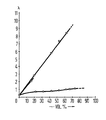
- Anhand von Ausführungsbeispielen und dem in der Zeichnung vorliegenden Diagramm, in dem die Abhängigkeit der Wärmeleitfähigkeit A in W/m.K vom zugesetzten Faseranteil in Vol % eingetragen ist, wird nachfolgend die Erfindung noch näher erläutert. Dabei zeigt die mit dem Kreissymbol gekennzeichnete Kurve die Werte für ungerichtete Polyäthylenfäden in Epoxidharz an, während die mit den Vierecksymbolen gekennzeichnete Kurve für die Werte der in Epoxidharz gerichtet angeordneten Polyäthylenfäden steht.
- l. Polyäthylenfäden, nach dem von Pennings in Makromol. Chem., Suppl. 2 (1979), S.99-142 beschriebenen Verfahren durch Kristallisation aus orientierter Lösung an einem Rotor (sog. surface growth method) hergestellt, werden in Fasern von einer Länge von etwa 1 mm zerschnitten und regellos in Epoxidharz eingemischt. Wie aus dem anliegenden Diagramm zu entnehmen ist, beträgt die Wärmeleitfähigkeit bei ca. 60 Vol % Faseranteil 1 W/m.K.
- 2. Polyäthylenfäden, hergestellt und zerschnitten wie oben beschrieben, werden parallel ausgerichtet in Epoxidharz eingeführt. Wie aus dem Diagramm zu entnehmen ist, ergibt ein Volumenanteil von 20 % Fasern eine Wärmeleitfähigkeit λ von ca. 3 W/m.K, ein Volumenanteil von 40 % Fasern Werte im Bereich von 5,5 W/m.K'; bei 60 % Faseranteil wurden schließlich λ-Werte von 8 W/m.K erreicht.
- 1 Figur 8 Patentansprüche
Claims (8)
Applications Claiming Priority (2)
| Application Number | Priority Date | Filing Date | Title |
|---|---|---|---|
| DE3522108 | 1985-06-20 | ||
| DE3522108 | 1985-06-20 |
Publications (2)
| Publication Number | Publication Date |
|---|---|
| EP0206254A2 true EP0206254A2 (de) | 1986-12-30 |
| EP0206254A3 EP0206254A3 (de) | 1987-05-13 |
Family
ID=6273752
Family Applications (1)
| Application Number | Title | Priority Date | Filing Date |
|---|---|---|---|
| EP86108343A Withdrawn EP0206254A3 (de) | 1985-06-20 | 1986-06-19 | Elektrisch isolierende, gut wärmeleitende, mit einem Füllstoff versehene Kunststoffmasse |
Country Status (2)
| Country | Link |
|---|---|
| EP (1) | EP0206254A3 (de) |
| JP (1) | JPS61296068A (de) |
Cited By (4)
| Publication number | Priority date | Publication date | Assignee | Title |
|---|---|---|---|---|
| EP0375851A3 (en) * | 1988-10-03 | 1990-11-28 | E.I. Du Pont De Nemours And Company | Encapsulated electrical or electronic device |
| EP0403688A1 (de) * | 1988-10-03 | 1990-12-27 | E.I. Du Pont De Nemours And Company | Thermisch leitendes Material |
| EP0322979A3 (de) * | 1987-12-28 | 1991-04-03 | Dsm N.V. | Verbundwerkstoff zur Energieabsorption |
| US6261481B1 (en) * | 1998-03-19 | 2001-07-17 | Hitachi, Ltd | Insulating composition |
Families Citing this family (5)
| Publication number | Priority date | Publication date | Assignee | Title |
|---|---|---|---|---|
| WO2002094905A1 (en) | 2001-05-18 | 2002-11-28 | Hitachi, Ltd. | Cured thermosetting resin product |
| US8946335B2 (en) | 2008-10-30 | 2015-02-03 | Kaneka Corporation | Highly thermally conductive thermoplastic resin composition and thermoplastic resin |
| KR101717449B1 (ko) | 2009-09-16 | 2017-03-17 | 카네카 코포레이션 | 유기 열전도성 첨가제,수지 조성물,및 경화제 |
| CN102858843B (zh) | 2010-04-19 | 2014-09-03 | 株式会社钟化 | 高导热性热塑性树脂 |
| WO2011132390A1 (ja) | 2010-04-19 | 2011-10-27 | 株式会社カネカ | 高熱伝導性熱可塑性樹脂 |
Family Cites Families (4)
| Publication number | Priority date | Publication date | Assignee | Title |
|---|---|---|---|---|
| AT291606B (de) * | 1966-12-20 | 1971-07-26 | Mancar Trust | Verfahren zur Herstellung von Formkörpern aus mit Füllstoffen sowie mit Glasfasern verstärkten Kunststoffen mit reduziertem Glasfaseranteil |
| EP0102159B1 (de) * | 1982-07-28 | 1988-01-27 | Imperial Chemical Industries Plc | Verfahren zur Herstellung von mit Fäden verstärkten Zusammensetzungen |
| DE3375486D1 (en) * | 1982-07-28 | 1988-03-03 | Ici Plc | Method of producing fibre-reinforced composition |
| LU85462A1 (fr) * | 1984-07-11 | 1986-02-12 | Univ Louvain | Nouvelles compositions polymeres,procedes pour leur production et leurs applications |
-
1986
- 1986-06-16 JP JP13994286A patent/JPS61296068A/ja active Pending
- 1986-06-19 EP EP86108343A patent/EP0206254A3/de not_active Withdrawn
Cited By (4)
| Publication number | Priority date | Publication date | Assignee | Title |
|---|---|---|---|---|
| EP0322979A3 (de) * | 1987-12-28 | 1991-04-03 | Dsm N.V. | Verbundwerkstoff zur Energieabsorption |
| EP0375851A3 (en) * | 1988-10-03 | 1990-11-28 | E.I. Du Pont De Nemours And Company | Encapsulated electrical or electronic device |
| EP0403688A1 (de) * | 1988-10-03 | 1990-12-27 | E.I. Du Pont De Nemours And Company | Thermisch leitendes Material |
| US6261481B1 (en) * | 1998-03-19 | 2001-07-17 | Hitachi, Ltd | Insulating composition |
Also Published As
| Publication number | Publication date |
|---|---|
| JPS61296068A (ja) | 1986-12-26 |
| EP0206254A3 (de) | 1987-05-13 |
Similar Documents
| Publication | Publication Date | Title |
|---|---|---|
| DE69925528T2 (de) | Wärmeleitfähige, elektrisch nicht leitende Zusammensetzung | |
| DE112008002566B4 (de) | Wärmeleitfähige Lage und Verfahren zum Herstellen derselben, und Leistungsmodul | |
| DE69528833T2 (de) | Verfahren zur herstellung von ein- und mehrschicht-schutzvorrichtungen gegen veränderliche spannung | |
| DE2940339C2 (de) | ||
| DE2541670A1 (de) | Spule mit kunstharzpackung | |
| DE2652683B2 (de) | Anisotroper elektrisch leitender platten-oder folienförmiger Körper und Verfahren zu seiner Herstellung | |
| DE2854080A1 (de) | Druckempfindliches widerstandselement | |
| DE2536361A1 (de) | Elektrisch leitender klebstoff | |
| EP0206254A2 (de) | Elektrisch isolierende, gut wärmeleitende, mit einem Füllstoff versehene Kunststoffmasse | |
| EP1229514A2 (de) | Bauteil mit schwingungsdämpfenden Eigenschaften sowie Material und Verfahren zur Herstellung eines derartigen Bauteils | |
| WO2017089207A1 (de) | Elektrische vorrichtung mit einer umhüllmasse | |
| DE69509110T2 (de) | Leitfähige tinte mit metallischen perlen von abweichenden schmelzpunkten | |
| DE19650948A1 (de) | Interne Abstufung von Generatorstatorstäben mit elektrisch leitenden thermoplastischen Anstrichen | |
| DE2422914A1 (de) | Elektrisches kabel, insbesondere hochoder hoechstspannungskabel, sowie verfahren zu seiner herstellung | |
| DE3522084A1 (de) | Elektrisch isolierende, gut waermeleitende kunststoffmasse mit als fuellstoff enthaltenen aluminiumpulverpartikeln sowie ein verfahren zu ihrer herstellung | |
| EP1371124B1 (de) | Verfahren zum herstellen eines leiterstabes | |
| DE2042099C3 (de) | Verfahren zum Speichern eines elektrischen Signals | |
| EP1813419A1 (de) | Elektroisoliermaterial | |
| EP0144600A1 (de) | Verfahren zur Herstellung eines Kunststoffes | |
| WO1995011272A1 (de) | Halogenfreie harzmischung, ein diese harzmischung enthaltendes, selbstverlöschendes prepreg sowie dessen verwendung | |
| DE4426906C2 (de) | Elektrisch leitfähiger Faser-Verbundwerkstoff aus Kunststoff sowie Herstellungsverfahren | |
| DE102013009234B4 (de) | Verfahren zur Herstellung elektrisch leitender Verbindungen zwischen Fügepartnern sowie eine Verwendung eines Polymers oder Polymergemischs | |
| DE2056559A1 (de) | Magnetspeicherplatte und Verfahren zu deren Herstellung | |
| DE3218081A1 (de) | Elektretvorrichtung | |
| EP3517283A1 (de) | Thermisch leitfähiges schaummaterial |
Legal Events
| Date | Code | Title | Description |
|---|---|---|---|
| PUAI | Public reference made under article 153(3) epc to a published international application that has entered the european phase |
Free format text: ORIGINAL CODE: 0009012 |
|
| AK | Designated contracting states |
Kind code of ref document: A2 Designated state(s): AT BE DE FR GB IT LU SE |
|
| PUAL | Search report despatched |
Free format text: ORIGINAL CODE: 0009013 |
|
| AK | Designated contracting states |
Kind code of ref document: A3 Designated state(s): AT BE DE FR GB IT LU SE |
|
| 17P | Request for examination filed |
Effective date: 19871106 |
|
| 17Q | First examination report despatched |
Effective date: 19880331 |
|
| STAA | Information on the status of an ep patent application or granted ep patent |
Free format text: STATUS: THE APPLICATION HAS BEEN WITHDRAWN |
|
| 18W | Application withdrawn |
Withdrawal date: 19880803 |
|
| RIN1 | Information on inventor provided before grant (corrected) |
Inventor name: NICKLES, RALF, DIPL.-ING. (FH) Inventor name: LEUTE, ULRICH, DR. |