EP0206871B1 - Stabilisiertes und entaluminiertes Zeolith-Omega - Google Patents
Stabilisiertes und entaluminiertes Zeolith-Omega Download PDFInfo
- Publication number
- EP0206871B1 EP0206871B1 EP86401138A EP86401138A EP0206871B1 EP 0206871 B1 EP0206871 B1 EP 0206871B1 EP 86401138 A EP86401138 A EP 86401138A EP 86401138 A EP86401138 A EP 86401138A EP 0206871 B1 EP0206871 B1 EP 0206871B1
- Authority
- EP
- European Patent Office
- Prior art keywords
- zeolite
- weight
- catalyst
- zeolites
- cations
- Prior art date
- Legal status (The legal status is an assumption and is not a legal conclusion. Google has not performed a legal analysis and makes no representation as to the accuracy of the status listed.)
- Expired
Links
Classifications
-
- C—CHEMISTRY; METALLURGY
- C10—PETROLEUM, GAS OR COKE INDUSTRIES; TECHNICAL GASES CONTAINING CARBON MONOXIDE; FUELS; LUBRICANTS; PEAT
- C10G—CRACKING HYDROCARBON OILS; PRODUCTION OF LIQUID HYDROCARBON MIXTURES, e.g. BY DESTRUCTIVE HYDROGENATION, OLIGOMERISATION, POLYMERISATION; RECOVERY OF HYDROCARBON OILS FROM OIL-SHALE, OIL-SAND, OR GASES; REFINING MIXTURES MAINLY CONSISTING OF HYDROCARBONS; REFORMING OF NAPHTHA; MINERAL WAXES
- C10G11/00—Catalytic cracking, in the absence of hydrogen, of hydrocarbon oils
- C10G11/02—Catalytic cracking, in the absence of hydrogen, of hydrocarbon oils characterised by the catalyst used
- C10G11/04—Oxides
- C10G11/05—Crystalline alumino-silicates, e.g. molecular sieves
-
- B—PERFORMING OPERATIONS; TRANSPORTING
- B01—PHYSICAL OR CHEMICAL PROCESSES OR APPARATUS IN GENERAL
- B01J—CHEMICAL OR PHYSICAL PROCESSES, e.g. CATALYSIS OR COLLOID CHEMISTRY; THEIR RELEVANT APPARATUS
- B01J29/00—Catalysts comprising molecular sieves
- B01J29/04—Catalysts comprising molecular sieves having base-exchange properties, e.g. crystalline zeolites
- B01J29/06—Crystalline aluminosilicate zeolites; Isomorphous compounds thereof
- B01J29/70—Crystalline aluminosilicate zeolites; Isomorphous compounds thereof of types characterised by their specific structure not provided for in groups B01J29/08 - B01J29/65
- B01J29/7011—MAZ-type, e.g. Mazzite, Omega, ZSM-4 or LZ-202
-
- B—PERFORMING OPERATIONS; TRANSPORTING
- B01—PHYSICAL OR CHEMICAL PROCESSES OR APPARATUS IN GENERAL
- B01J—CHEMICAL OR PHYSICAL PROCESSES, e.g. CATALYSIS OR COLLOID CHEMISTRY; THEIR RELEVANT APPARATUS
- B01J35/00—Catalysts, in general, characterised by their form or physical properties
- B01J35/60—Catalysts, in general, characterised by their form or physical properties characterised by their surface properties or porosity
-
- B—PERFORMING OPERATIONS; TRANSPORTING
- B01—PHYSICAL OR CHEMICAL PROCESSES OR APPARATUS IN GENERAL
- B01J—CHEMICAL OR PHYSICAL PROCESSES, e.g. CATALYSIS OR COLLOID CHEMISTRY; THEIR RELEVANT APPARATUS
- B01J2229/00—Aspects of molecular sieve catalysts not covered by B01J29/00
- B01J2229/10—After treatment, characterised by the effect to be obtained
- B01J2229/16—After treatment, characterised by the effect to be obtained to increase the Si/Al ratio; Dealumination
-
- B—PERFORMING OPERATIONS; TRANSPORTING
- B01—PHYSICAL OR CHEMICAL PROCESSES OR APPARATUS IN GENERAL
- B01J—CHEMICAL OR PHYSICAL PROCESSES, e.g. CATALYSIS OR COLLOID CHEMISTRY; THEIR RELEVANT APPARATUS
- B01J2229/00—Aspects of molecular sieve catalysts not covered by B01J29/00
- B01J2229/30—After treatment, characterised by the means used
- B01J2229/36—Steaming
-
- B—PERFORMING OPERATIONS; TRANSPORTING
- B01—PHYSICAL OR CHEMICAL PROCESSES OR APPARATUS IN GENERAL
- B01J—CHEMICAL OR PHYSICAL PROCESSES, e.g. CATALYSIS OR COLLOID CHEMISTRY; THEIR RELEVANT APPARATUS
- B01J2229/00—Aspects of molecular sieve catalysts not covered by B01J29/00
- B01J2229/30—After treatment, characterised by the means used
- B01J2229/37—Acid treatment
-
- B—PERFORMING OPERATIONS; TRANSPORTING
- B01—PHYSICAL OR CHEMICAL PROCESSES OR APPARATUS IN GENERAL
- B01J—CHEMICAL OR PHYSICAL PROCESSES, e.g. CATALYSIS OR COLLOID CHEMISTRY; THEIR RELEVANT APPARATUS
- B01J35/00—Catalysts, in general, characterised by their form or physical properties
- B01J35/60—Catalysts, in general, characterised by their form or physical properties characterised by their surface properties or porosity
- B01J35/64—Pore diameter
- B01J35/643—Pore diameter less than 2 nm
-
- B—PERFORMING OPERATIONS; TRANSPORTING
- B01—PHYSICAL OR CHEMICAL PROCESSES OR APPARATUS IN GENERAL
- B01J—CHEMICAL OR PHYSICAL PROCESSES, e.g. CATALYSIS OR COLLOID CHEMISTRY; THEIR RELEVANT APPARATUS
- B01J35/00—Catalysts, in general, characterised by their form or physical properties
- B01J35/60—Catalysts, in general, characterised by their form or physical properties characterised by their surface properties or porosity
- B01J35/64—Pore diameter
- B01J35/647—2-50 nm
Definitions
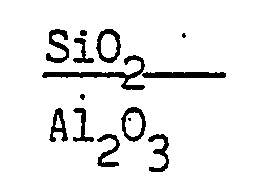
- the present invention relates to a new improved catalyst for cracking heavy petroleum fractions, based on stabilized and dealuminated omega zeolite. More precisely, this catalyst is characterized by the presence, for example, at a rate of 3 to 50% by weight, of an omega zeolite very depleted in alkali ions, whose overall molecular ratio Si0 2 / A1 2 0 3 is higher or equal to 10, diluted in a matrix based on amorphous silica-alumina and / or clay for example.
- This new catalyst exhibits, with comparable conversion and with comparable coke production, a selectivity in middle distillates (LO) greater than that of most of the catalysts of the prior art.
- LO middle distillates
- the zeolite X (Faujasite structure characterized by a Si0 2 / A1 2 0 3 molar ratio between 2 and 3 was the first used. Strongly exchanged with rare earth ions, it had a high activity and a high thermal and hydrothermal resistance Towards the end of the 1960s, this zeolite was gradually replaced by the Y zeolite which had a tendency to produce slightly less coke and above all a very improved thermal and hydrothermal resistance.
- a large majority of the catalysts proposed (probably more than 90%) contain a Y zeolite exchanged with rare earth ions and / or ammonium ions.
- the current tendency is not only to seek less selective coke catalysts but also to push the regeneration of the catalyst to leave as little coke as possible after combustion and this leads, in certain processes, to an increase in the temperature of the regenerator.
- the zeolite which is the main active agent of the catalyst can rapidly lose a significant part of its activity as a result of the irreversible degradation of its structure.
- the various technical tips developed in recent years to limit the temperature of the regenerator (adding coils to eliminate calories by steam production or intermediate cooling of the catalyst) or to limit the water vapor content at high temperature it is necessary that the zeolite presented in the cracking catalyst has excellent thermal and hydrothermal stability.
- the stabilized and dealuminated omega zeolite used in the catalysts of the present invention is characterized by a Si0 2 / A1 2 0 3 molar ratio greater than 10, a sodium content less than 0.3% by weight and preferably less than 0, 01% by weight.
- the stabilized and dealuminated solid retains the X-ray diffraction spectrum of the zeolite a with crystal parameters a and c less than or equal to 1.814 nm and 0.760 nm respectively.
- the solid obtained by the invention has a network of secondary pores whose radii are between 1.5 nm and 14 nm, and preferably between 2 nm and 6 nm.
- the volume of the secondary pores represents 5 to 50% of the total pore volume of the zeolite.
- the procedure for preparing the product described above is based on alternating ion exchanges with ammonium cations, acid attacks and / or heat treatments in the presence or absence of water vapor. These treatments have been used in the prior art to stabilize various zeolites. However, the ⁇ zeolite is recognized as being very unstable. The preparation of stabilized and dealuminated ⁇ zeolites in particular by the treatments mentioned above has not been successful to date. The decationization and dealumination treatments described in the invention considerably improve the acid properties of zeolite a which can then be used as catalyst or catalyst support in reactions such as cracking and hydrocracking.
- the OMEGA zeolite (called ZSM-4 by the company MOBIL) is the synthetic analog of MAZ-ZITE which is a natural zeolite.
- Q zeolite is synthesized in the presence of sodium cations and organic cations, generally the TMA (tetrapropylammonium) (Netherlands Patent No. 6710729, US-A 4,241,036).
- the Na / TMA molar ratio is generally close to 4 (T. WEEKS, D. KIMAK, R. BUJALSKI and A. BOLTON, JCS Farad Trans 1, 72, (1976), 57); F. LEACH and C. MARSDEN, Catalysis by Zeolites, B. IMELIK ed, 1980, p.
- the molar ratio Si0 2 / A1 2 0 3 is in the range 5 to 10 (US-A 4 241 036; T. WEEKS, D. KIMAK, R. BUJALSKI and A. BOLTON, JCS Farad Trans 1, 72, 1976, 57, F. LEACH and C. MARSDEN, Catalysis by Zeolites, B. IMELIK ed., 1980, p. 141, Elsevier Amsterdam; A. ARAYA, T. BARBER, B. LOWE, D SINCLAIR and A. VARMA, Zeolites, 4, (1984), 263).
- the zeolite ⁇ crystallizes in the hexagonal system with parameters at and vs neighbors of 1.82 nm and 0.76 nm (T. WEEKS, D. KIMAK, R. BUJALSKI and A. BOLTON, JCS Farad Trans 1, 72, (1976), 57, R. BARRER and H. VILLIGER, Chem Comm. (1969 ), 65).
- the structure of zeolite 0 is formed by the arrangement of gmelinite cages linked together along the axis c (W. MEIER, D. OLSON, Atlas of Zeolites Structures Types, DRUCK + VERLAG AG, Switzerland, 1978).
- the particular arrangement of the gmelinite cages in the Q zeolite provides in the structure a network of 12-sided channels with a diameter close to 0.74 nm and parallel to the axis
- the zeolite belongs to the category of zeolites with a large porous opening, which makes it particularly attractive for reactions such as cracking and hydrocracking.
- catalytic performances of the ⁇ zeolite have been little explored. Only a limited number of reactions, such as the isomerization of substituted cyclopropanes (F. LEACH and C. MARSDEN, Catalysis by Zeolites, B. IMELIK ed, 1980, p. 141, Elsevier Amsterdam) or the cracking of n-heptane have been studied (A. Perrota et al., Catal 55, 1978, 240).
- US-A 4,297,335 proposes a dealumination technique by treatment with gaseous fluorine at high temperature applicable to several zeolites but which causes in the case of the ⁇ zeolite a degradation of the crystal structure.
- EP-A 100 544 the dealumination of many zeolites, including the ⁇ zeolite, by calcination in the presence of SiC1 4 at temperatures below 200 ° C is described despite the fact that it is moreover established that higher temperatures high are necessary to dealuminate zeolites by this technique (BEYER et al catalysis by zeolites, (1980) p.203).
- An omega zeolite according to the invention can be obtained from a synthetic omega zeolite, containing alkali cations and organic cations, and whose molar ratio SlO 2 / Al 2 O 3 is between 6.5 and 10, the preparation process being characterized in that (a) in a first step eg, the synthetic zeolite is subjected between 0 and 150 ° C. to a treatment for removing most of the organic cations, while lowering the alkali content between 400 and 900 ° C., and (b) in a second stage, the solid obtained in the preceding stage is subjected to at least one calcination, then to at least one acid attack between 0 and 150 ° C.
- the product obtained at the end of these various treatment stages has an X-ray diffraction spectrum which is that of zeolite II (Table 1).
- the crystalline parameters have the following dimensions: at is preferably in the range 1.814 nm to 1.794 nm, vs is preferably in the range 0.760 nm to 0.749 nm.
- the porous network is no longer solely made up of micropores but includes a network of mesopores whose radii measured by the BJH method (see below) are located between 1.5 nm and 14 nm and more particularly between 2 and 6 nm.
- the volume of the mesopores corresponds to approximately 5 to 50% of the total pore volume of the zeolite.
- the equipment used includes: a PHILIPS PW 1130 generator (35 mA, 35kV), a PHILIPS PW 1050 goniometer, a Cu tube (fine focus), a rear graphite crystal monochromator, an automatic sample changer.
- the ratios of each treated sample are then compared with respect to a standard reference of the same series as the sample and containing an amount less than or equal to 3% by weight of sodium.
- degree of crystallinity is expressed as a percentage relative to a reference taken arbitrarily at 100.
- the crystalline parameters were calculated by the method of least squares from the formula (hexagonal mesh):
- the starting Q zeolite is obtained by synthesis. It contains alkaline cations (usually Na +) and organic cations (usually TMA or TPA).
- alkaline cations usually Na +
- organic cations usually TMA or TPA.
- the report is generally in the range 1.0 and 0.50 and the molar ratio is located between 6.5 and 10.
- the method used in the present invention to obtain a dealuminated and stabilized ⁇ zeolite is as follows:
- the solid is not dealuminated and contains less than 0.3% and preferably less than 0.01% of sodium by weight.
- the zeolite ⁇ is subjected to at least one acid attack at a temperature between 0 and 150 ° C.
- the acids used can be mineral (hydrochloric, nitric, hydrobromic, sulfuric acid , perchloric) or organic (acetic or benzoic for example).
- the normality of the acid is generally between 0.1 and 10 N (preferably between 0.5 and 2.0 N) with a volume / weight ratio expressed in cm 3 g- 1 between 2 and 10.
- the duration of the treatment is greater than one half hour. It is preferable to carry out the acid attack under controlled conditions to avoid the possible degradation of the solid. Thus we can first put the zeolite in suspension in distilled water and then add the acid gradually.
- the omega zeolite must, in order to be used as a cracking catalyst, be dispersed within an amorphous matrix.
- All the matrices known and used for the cracking catalysts of the prior art can be suitable. Preferably, they will be based on silica-aluminas and clays and may also contain small amounts of various oxides such as alumina for example.
- the stabilized and dealuminated omega zeolite can be introduced into the matrix in hydrogen form or after having been exchanged with me ions.
- This omega zeolite thus stabilized, dealuminated and optionally exchanged with the various aforementioned cations, can be added as a complementary active agent within the matrix of a conventional catalyst already containing one or more other zeolites of different structures, in particular zeolites of faujasite structure.
- X or Y or pentasil type such as ZSM5 or ZSM11.
- the faujasite structures which are most suitable for the catalysts containing the dealuminated omega zeolite as second zeolitic structure mention will be made in particular of the stabilized Y zeolite, commonly called ultrastable or USY, either in hydrogen form or in form exchanged with alkaline-earth cations and especially rare earths.
- Example No. 1 Preparation of a stabilized and dealuminated ⁇ zeolite with a ratio
- the zeolite is exchanged three times in 200 cm 3 of NH 4 NO 3 4N solution at 100 ° C for 4 hours.
- the product obtained, referenced OM1 has a sodium content of less than 0.1% by weight.
- the solid referenced OM2 by all of these treatments has an X diffraction spectrum of the ⁇ zeolite. Its physicochemical properties are as follows:
- the OM2 zeolite presents a network of secondary mesopores created by the treatments it has undergone. These mesopores are centered around 4 nm in radius (60% of the pores at around 4nm, the res te between 2 and 14 nm) Total pore volume: 0.3 g / cc; Secondary pore volume: 63% of the total pore volume.
- table 2 on page 21 gives the characteristics of the X-ray diffraction diagram of an omega zeolite.
- Example 2 Preparation of a stabilized and dealuminated ⁇ zeolite with a ratio
- the solid obtained by the preceding treatments, referenced OM3 has an X-ray diffraction spectrum typical of the ⁇ zeolite as well as a network of secondary mesopores centered around 4 nm in radius.
- the main physicochemical characteristics of the ⁇ OM3 zeolite are as follows:
- Example 3 Comparative example. Preparation of a zeolite ⁇ hydrogen form of ratio
- the solid is exchanged three times in 500 cm 3 of a solution of NH 4 NO 3 6N at 100 ° C for 4 hours.
- the zeolite obtained is referenced OM4. It has an X diffraction spectrum typical of the zeolite ⁇ . Its physicochemical characteristics are as follows:
- the non dealuminated zeolite OM4 does not have a secondary mesoporous network.
- the solid is treated in 500 cm 3 of a 1N hydrochloric acid solution at 100 ° C for 4 hours.
- the solid obtained at the end of these various stages is a zeolite HY whose physicochemical characteristics are given below.
- Example 5 Preparation of a dealuminated ⁇ zeolite with a ratio
- a dealuminated zeolite ⁇ is prepared and stabilized SiO 2 / Al 2 O 3 equal to 20 according to Example No. 2; we therefore obtain a zeolite Q whose physicochemical characteristics are those of OM3 (example n ° 2).
- a rare earth ⁇ zeolite Re a is obtained, the total rare earth content of which is 4.8%.
- the solid thus exchanged retains the SiO 2 / Al 2 O 3 ratio of OM3 as well as the X diffraction spectrum of the zeolite n, it is referenced OM5.
- Example 6 Tests hydrothermal aging and measure catalytic performance microunit.
- the various zeolites obtained in examples 1 to 5 are pelletized and then reduced to small aggregates using a crushing machine. The fraction between 40 ⁇ m and 200 ⁇ m is then collected by sieving.
- Each of the powders thus obtained is subjected to the following hydrothermal treatment: 8 hours at 750 ° C. under 1 bar of partial pressure of water vapor.
- the purpose of this example is simply to simulate industrial aging on a new zeolite.
- Table 2 presents them for the 6 catalysts used.
Landscapes
- Chemical & Material Sciences (AREA)
- Engineering & Computer Science (AREA)
- Chemical Kinetics & Catalysis (AREA)
- Organic Chemistry (AREA)
- Crystallography & Structural Chemistry (AREA)
- Oil, Petroleum & Natural Gas (AREA)
- Materials Engineering (AREA)
- General Chemical & Material Sciences (AREA)
- Catalysts (AREA)
- Production Of Liquid Hydrocarbon Mixture For Refining Petroleum (AREA)
- Silicates, Zeolites, And Molecular Sieves (AREA)
Claims (9)

Priority Applications (1)
| Application Number | Priority Date | Filing Date | Title |
|---|---|---|---|
| AT86401138T ATE40533T1 (de) | 1985-06-19 | 1986-05-29 | Stabilisiertes und entaluminiertes zeolith-omega. |
Applications Claiming Priority (6)
| Application Number | Priority Date | Filing Date | Title |
|---|---|---|---|
| FR8509432A FR2583654B1 (fr) | 1985-06-19 | 1985-06-19 | Zeolithe omega stabilisee et desaluminee |
| FR8509432 | 1985-06-19 | ||
| FR8510529A FR2584385B1 (fr) | 1985-07-08 | 1985-07-08 | Procede de fabrication d'une zeolithe omega stabilisee et desaluminee |
| FR8510529 | 1985-07-08 | ||
| FR8510990A FR2585029B1 (fr) | 1985-07-16 | 1985-07-16 | Procede de craquage catalytique en presence d'un catalyseur a base d'une zeolithe omega stabilisee et desaluminee |
| FR8510990 | 1985-07-16 |
Publications (2)
| Publication Number | Publication Date |
|---|---|
| EP0206871A1 EP0206871A1 (de) | 1986-12-30 |
| EP0206871B1 true EP0206871B1 (de) | 1989-02-01 |
Family
ID=27251289
Family Applications (1)
| Application Number | Title | Priority Date | Filing Date |
|---|---|---|---|
| EP86401138A Expired EP0206871B1 (de) | 1985-06-19 | 1986-05-29 | Stabilisiertes und entaluminiertes Zeolith-Omega |
Country Status (5)
| Country | Link |
|---|---|
| US (1) | US4724067A (de) |
| EP (1) | EP0206871B1 (de) |
| JP (1) | JPH0738946B2 (de) |
| CN (1) | CN1012800B (de) |
| DE (1) | DE3661989D1 (de) |
Families Citing this family (25)
| Publication number | Priority date | Publication date | Assignee | Title |
|---|---|---|---|---|
| FR2582665B1 (fr) * | 1985-06-04 | 1988-08-05 | Inst Francais Du Petrole | Procede de craquage catalytique |
| DE3661990D1 (en) * | 1985-09-04 | 1989-03-09 | Inst Francais Du Petrole | Omega structure zeolite |
| EP0258127B1 (de) * | 1986-08-13 | 1990-03-21 | Institut Français du Pétrole | Entkationisiertes, entaluminisiertes und stabilisiertes Zeolith-L und seine Anwendungen |
| FR2605642B1 (fr) * | 1986-10-24 | 1989-06-16 | Inst Francais Du Petrole | Procede de craquage de coupes petrolieres en presence d'un catalyseur a base d'une zeolite l stabilisee et desaluminee |
| JPS63162520A (ja) * | 1986-12-26 | 1988-07-06 | Tosoh Corp | 合成マザイトの製造方法 |
| FR2614220B1 (fr) * | 1987-04-24 | 1989-07-21 | Inst Francais Du Petrole | Catalyseur de craquage de charges hydrocarbonees comprenant une mordenite desaluminee, une zeolithe y et une matrice. |
| US4968406A (en) * | 1988-10-29 | 1990-11-06 | Mobil Oil Corporation | Increasing feed volume throughput in FCC process |
| US4980328A (en) * | 1989-09-12 | 1990-12-25 | Amoco Corporation | Hydrocracking catalyst |
| US4925546A (en) * | 1989-09-12 | 1990-05-15 | Amoco Corporation | Hydrocracking process |
| ZA918623B (en) * | 1990-12-04 | 1992-08-26 | Grace W R & Co | Dual zeolite fluid cracking catalyst composition for improved gasoline octane |
| US5230790A (en) * | 1990-12-17 | 1993-07-27 | Uop | Hydrocarbon conversion processes using modified zeolite Omega |
| US5139761A (en) * | 1990-12-17 | 1992-08-18 | Uop | Modified zeolite omega and processes for preparing and using same |
| AU643908B1 (en) * | 1990-12-17 | 1993-11-25 | Uop | Modified zeolite omega and methods for preparing and for using same |
| US6171568B1 (en) * | 1991-05-27 | 2001-01-09 | Degussa-H{umlaut over (u)}ls Aktiengesellschaft | Method for the purification of exhaust air and/or effluents by contact with moulded bodies containing dealuminated zeolite Y |
| US5192727A (en) * | 1991-08-19 | 1993-03-09 | Uop | Process for modifying the pore system of zeolite LZ-202 |
| US5210356A (en) * | 1991-12-16 | 1993-05-11 | Fina Technology, Inc. | Toluene disproportionation employing modified omega zeolite catalyst |
| FR2690856B1 (fr) * | 1992-05-06 | 1995-01-06 | Inst Francais Du Petrole | Catalyseur à base de zéolithe omega renfermant au moins un métal des groupes IIA, IVB, IIB ou IVA et son utilisation en isomérisation d'une coupe C8 aromatique. |
| FR2698862B1 (fr) * | 1992-12-08 | 1995-01-13 | Elf Aquitaine | Procédé de synthèse d'un aluminosilicate cristallin enrichi en silice, ayant la structure de la mazzite, l'aluminosilicate obtenu et son utilisation comme catalyseur de transformation des hydrocarbures. |
| FR2715163B1 (fr) * | 1994-01-18 | 1996-04-05 | Total Raffinage Distribution | Procédé de craquage catalytique en lit fluidisé d'une charge d'hydrocarbures, notamment d'une charge à forte teneur en composés azotés basiques. |
| US5849258A (en) * | 1996-06-06 | 1998-12-15 | Intevep, S.A. | Material with microporous crystalline walls defining a narrow size distribution of mesopores, and process for preparing same |
| FR2749577B1 (fr) * | 1996-06-06 | 1998-07-31 | Elf Aquitaine | Mazzite activee enrichie en silice, procede d'obtention et application |
| FR2755958B1 (fr) * | 1996-11-19 | 1999-01-08 | Inst Francais Du Petrole | Zeolithe nu-86 desaluminee et son utilisation en conversion des hydrocarbures |
| US6124228A (en) * | 1998-06-04 | 2000-09-26 | Phillips Petroleum Company | Mazzite supported catalyst |
| US20110230333A1 (en) * | 2010-03-16 | 2011-09-22 | Uop Llc | Olefin Cracking Catalyst and Manufacturing Process |
| CN109304222B (zh) * | 2017-07-28 | 2021-09-28 | 中国石油天然气股份有限公司 | 一种裂化焦化蜡油多产液化气的催化裂化催化剂及其制备方法 |
Citations (1)
| Publication number | Priority date | Publication date | Assignee | Title |
|---|---|---|---|---|
| EP0214042A1 (de) * | 1985-09-04 | 1987-03-11 | Institut Français du Pétrole | Zeolith mit Zusammensetzung omega |
Family Cites Families (19)
| Publication number | Priority date | Publication date | Assignee | Title |
|---|---|---|---|---|
| AT281764B (de) * | 1966-08-03 | 1970-06-10 | Union Carbide Corp | Verfahren zur Herstellung eines neuen kristallinen zeolithischen Molekularsiebes |
| US3812199A (en) * | 1968-07-02 | 1974-05-21 | Mobil Oil Corp | Disproportionation of paraffin hydrocarbons |
| US3835027A (en) * | 1972-04-17 | 1974-09-10 | Union Oil Co | Hydrogenative conversion processes and catalyst for use therein |
| US3944482A (en) * | 1973-08-08 | 1976-03-16 | Gulf Research & Development Company | Process for the cracking of high metals content feedstocks |
| US4241036A (en) * | 1975-10-23 | 1980-12-23 | Union Carbide Corporation | Synthetic crystalline zeolite and process for preparing same |
| US4093560A (en) * | 1976-05-20 | 1978-06-06 | Mobil Oil Corporation | Ultra high silicon-content zeolites and preparation thereof |
| GB1599874A (en) * | 1977-06-01 | 1981-10-07 | Ici Ltd | Hydrocarbon conversion and catalyst |
| US4228036A (en) * | 1979-06-18 | 1980-10-14 | Gulf Research & Development Company | Alumina-aluminum phosphate-silica-zeolite catalyst |
| US4297335A (en) * | 1980-03-25 | 1981-10-27 | Union Carbide Corporation | Aluminum deficient zeolite compositions and process for preparing same |
| US4331643A (en) * | 1980-12-15 | 1982-05-25 | Mobil Oil Corporation | Use of diazobicyclooctane (DABCO) as a template in zeolite synthesis |
| US4481104A (en) * | 1981-10-26 | 1984-11-06 | Mobil Oil Corporation | Use of low acidity high silica to alumina ratio large pore zeolites for distillate production in catalytic cracking |
| US4384161A (en) * | 1982-03-15 | 1983-05-17 | Mobil Oil Corporation | Heterogeneous isoparaffin/olefin alkylation |
| US4430200A (en) * | 1982-08-09 | 1984-02-07 | Mobil Oil Corporation | Hydrocarbon conversion process |
| JPS59150539A (ja) * | 1983-02-16 | 1984-08-28 | Res Assoc Residual Oil Process<Rarop> | 炭化水素転化触媒 |
| JPS59227715A (ja) * | 1983-06-09 | 1984-12-21 | Toyo Soda Mfg Co Ltd | 高シリカフオ−ジヤサイト型ゼオライトの製造法 |
| DE3402842A1 (de) * | 1984-01-27 | 1985-08-08 | Süd-Chemie AG, 8000 München | Verfahren zur herstellung von kristallinen zeolithischen alumosilicaten |
| FR2563445B1 (fr) * | 1984-04-26 | 1986-08-14 | Pro Catalyse Ste Fse Prod Cata | Nouveau catalyseur d'hydrocraquage destine a la production de distillats moyens |
| US4591576A (en) * | 1984-10-03 | 1986-05-27 | Union Carbide Corporation | Process for preparing catalytic cracking catalysts |
| US4588496A (en) * | 1985-01-03 | 1986-05-13 | Union Oil Company Of California | Process for the catalytic cracking of metals-containing feedstocks |
-
1986
- 1986-05-29 EP EP86401138A patent/EP0206871B1/de not_active Expired
- 1986-05-29 DE DE8686401138T patent/DE3661989D1/de not_active Expired
- 1986-06-19 CN CN86104177A patent/CN1012800B/zh not_active Expired
- 1986-06-19 US US06/876,146 patent/US4724067A/en not_active Expired - Lifetime
- 1986-06-19 JP JP61144655A patent/JPH0738946B2/ja not_active Expired - Fee Related
Patent Citations (1)
| Publication number | Priority date | Publication date | Assignee | Title |
|---|---|---|---|---|
| EP0214042A1 (de) * | 1985-09-04 | 1987-03-11 | Institut Français du Pétrole | Zeolith mit Zusammensetzung omega |
Also Published As
| Publication number | Publication date |
|---|---|
| US4724067A (en) | 1988-02-09 |
| EP0206871A1 (de) | 1986-12-30 |
| CN1012800B (zh) | 1991-06-12 |
| JPH0738946B2 (ja) | 1995-05-01 |
| JPS61291043A (ja) | 1986-12-20 |
| CN86104177A (zh) | 1987-04-29 |
| DE3661989D1 (de) | 1989-03-09 |
Similar Documents
| Publication | Publication Date | Title |
|---|---|---|
| EP0206871B1 (de) | Stabilisiertes und entaluminiertes Zeolith-Omega | |
| EP0214042B1 (de) | Zeolith mit Zusammensetzung omega | |
| FR2782727A1 (fr) | Abaissement de la teneur en souffre de l'essence lors du craquage cathalytique fluide | |
| FR2582665A1 (fr) | Procede de craquage catalytique | |
| EP0190949B1 (de) | Verfahren zur Herstellung von synthetischem siliziumreichem Offretit und Anwendung derselben zur Herstellung von Kohlenwasserstoffen, welche reich sind an leichten Olefinen durch Umsetzung von Methanol und/oder Dimethylether | |
| EP0855369B1 (de) | CON-typ phosphorhaltiger Zeolith und dessen Anwendung im katalytischen Crackverfahren | |
| EP0855435B1 (de) | Katalytisches Krackverfahren von Kohlenwasserstoffeinsätzen mit einem Katalysator, der einen IM-5 Zeolit enthäle, der eventuel entaluminiert kann sein | |
| CA2041905C (fr) | Catalyseur de craquage de charges hydrocarbonees comprenant une zeolithe beta, une zeolithe y et une matrice | |
| FR2794116A1 (fr) | Zeolithe im-5 au phosphore, composition catalytique, sa preparation et son utilisation en craquage catalytique | |
| FR3085004A1 (fr) | Tamis moléculaire de type Y modifié, catalyseur de craquage catalytique comprenant celui-ci, leur préparation et leur application | |
| FR2958297A1 (fr) | Procede de valorisation d'essence | |
| EP0278839B1 (de) | Ein einen Offretit, einen Zeolith und eine Matrix enthaltender Kohlenwasserstoffkrackkatalysator | |
| FR3085007A1 (fr) | Tamis moléculaire de type Y modifié, catalyseur de craquage catalytique comprenant celui-ci, leur préparation et leur application | |
| EP0476119B1 (de) | Faujasit-katalysator und dessen anwendung | |
| CA1306231C (fr) | Zeolithel decationisee, desaluminee et stabilisee et ses utilisations | |
| EP0480026B1 (de) | Zeolithkatalysator mit hexagonaler struktur und dessen anwendung | |
| FR2758567A1 (fr) | Procede de craquage de charges hydrocarbonees a l'aide d'un catalyseur comprenant une zeolithe nu-86 desaluminee | |
| FR2583654A1 (fr) | Zeolithe omega stabilisee et desaluminee | |
| FR2584385A1 (fr) | Procede de fabrication d'une zeolithe omega stabilisee et desaluminee | |
| FR2585029A1 (fr) | Procede de craquage catalytique en presence d'un catalyseur a base d'une zeolithe omega stabilisee et desaluminee | |
| FR2610538A1 (fr) | Catalyseur de craquage de charges hydrocarbonees comprenant une offretite, une zeolithe et une matrice | |
| EP0323784B1 (de) | Anwendung eines einen Zeoliten aus der Erionitfamilie enthaltenden Katalysators in einem Krackverfahren, das zumindest eine Regenerationszone enthält | |
| FR2758566A1 (fr) | Procede de craquage de charges hydrocarbonees a l'aide d'un catalyseur comprenant une zeolithe de type structural nes desaluminee | |
| FR2614220A1 (fr) | Catalyseur de craquage de charges hydrocarbonees comprenant une mordenite desaluminee, une zeolithe y et une matrice. | |
| FR2586669A1 (fr) | Zeolite de structure omega et son utilisation dans les reactions d'hydroconversion d'hydrocarbures |
Legal Events
| Date | Code | Title | Description |
|---|---|---|---|
| PUAI | Public reference made under article 153(3) epc to a published international application that has entered the european phase |
Free format text: ORIGINAL CODE: 0009012 |
|
| AK | Designated contracting states |
Kind code of ref document: A1 Designated state(s): AT BE DE GB IT NL |
|
| 17P | Request for examination filed |
Effective date: 19870203 |
|
| 17Q | First examination report despatched |
Effective date: 19871130 |
|
| ITF | It: translation for a ep patent filed | ||
| GRAA | (expected) grant |
Free format text: ORIGINAL CODE: 0009210 |
|
| AK | Designated contracting states |
Kind code of ref document: B1 Designated state(s): AT BE DE GB IT NL |
|
| REF | Corresponds to: |
Ref document number: 40533 Country of ref document: AT Date of ref document: 19890215 Kind code of ref document: T |
|
| REF | Corresponds to: |
Ref document number: 3661989 Country of ref document: DE Date of ref document: 19890309 |
|
| GBT | Gb: translation of ep patent filed (gb section 77(6)(a)/1977) | ||
| PLBE | No opposition filed within time limit |
Free format text: ORIGINAL CODE: 0009261 |
|
| STAA | Information on the status of an ep patent application or granted ep patent |
Free format text: STATUS: NO OPPOSITION FILED WITHIN TIME LIMIT |
|
| 26N | No opposition filed | ||
| ITTA | It: last paid annual fee | ||
| REG | Reference to a national code |
Ref country code: GB Ref legal event code: IF02 |
|
| PGFP | Annual fee paid to national office [announced via postgrant information from national office to epo] |
Ref country code: GB Payment date: 20030422 Year of fee payment: 18 |
|
| PGFP | Annual fee paid to national office [announced via postgrant information from national office to epo] |
Ref country code: AT Payment date: 20030520 Year of fee payment: 18 |
|
| PGFP | Annual fee paid to national office [announced via postgrant information from national office to epo] |
Ref country code: BE Payment date: 20030526 Year of fee payment: 18 |
|
| PGFP | Annual fee paid to national office [announced via postgrant information from national office to epo] |
Ref country code: NL Payment date: 20030530 Year of fee payment: 18 |
|
| PGFP | Annual fee paid to national office [announced via postgrant information from national office to epo] |
Ref country code: DE Payment date: 20030610 Year of fee payment: 18 |
|
| PG25 | Lapsed in a contracting state [announced via postgrant information from national office to epo] |
Ref country code: GB Free format text: LAPSE BECAUSE OF NON-PAYMENT OF DUE FEES Effective date: 20040529 Ref country code: AT Free format text: LAPSE BECAUSE OF NON-PAYMENT OF DUE FEES Effective date: 20040529 |
|
| PG25 | Lapsed in a contracting state [announced via postgrant information from national office to epo] |
Ref country code: BE Free format text: LAPSE BECAUSE OF NON-PAYMENT OF DUE FEES Effective date: 20040531 |
|
| BERE | Be: lapsed |
Owner name: *INSTITUT FRANCAIS DU PETROLE Effective date: 20040531 |
|
| PG25 | Lapsed in a contracting state [announced via postgrant information from national office to epo] |
Ref country code: NL Free format text: LAPSE BECAUSE OF NON-PAYMENT OF DUE FEES Effective date: 20041201 Ref country code: DE Free format text: LAPSE BECAUSE OF NON-PAYMENT OF DUE FEES Effective date: 20041201 |
|
| GBPC | Gb: european patent ceased through non-payment of renewal fee | ||
| NLV4 | Nl: lapsed or anulled due to non-payment of the annual fee |
Effective date: 20041201 |
|
| PG25 | Lapsed in a contracting state [announced via postgrant information from national office to epo] |
Ref country code: IT Free format text: LAPSE BECAUSE OF NON-PAYMENT OF DUE FEES;WARNING: LAPSES OF ITALIAN PATENTS WITH EFFECTIVE DATE BEFORE 2007 MAY HAVE OCCURRED AT ANY TIME BEFORE 2007. THE CORRECT EFFECTIVE DATE MAY BE DIFFERENT FROM THE ONE RECORDED. Effective date: 20050529 |