EP0207066A2 - Procédé et dispositif de fabrication de lingots - Google Patents
Procédé et dispositif de fabrication de lingots Download PDFInfo
- Publication number
- EP0207066A2 EP0207066A2 EP86890177A EP86890177A EP0207066A2 EP 0207066 A2 EP0207066 A2 EP 0207066A2 EP 86890177 A EP86890177 A EP 86890177A EP 86890177 A EP86890177 A EP 86890177A EP 0207066 A2 EP0207066 A2 EP 0207066A2
- Authority
- EP
- European Patent Office
- Prior art keywords
- mold
- cooled
- attachment
- melt
- electrode
- Prior art date
- Legal status (The legal status is an assumption and is not a legal conclusion. Google has not performed a legal analysis and makes no representation as to the accuracy of the status listed.)
- Granted
Links
- 238000000034 method Methods 0.000 title claims abstract description 15
- 238000004519 manufacturing process Methods 0.000 title claims abstract description 8
- 239000002893 slag Substances 0.000 claims abstract description 23
- 239000002184 metal Substances 0.000 claims abstract description 15
- 238000007711 solidification Methods 0.000 claims abstract description 13
- 230000008023 solidification Effects 0.000 claims abstract description 13
- 239000000155 melt Substances 0.000 claims abstract description 6
- 239000000203 mixture Substances 0.000 claims abstract description 4
- 238000009413 insulation Methods 0.000 claims description 9
- 229910000831 Steel Inorganic materials 0.000 claims description 4
- 239000010959 steel Substances 0.000 claims description 4
- 239000007788 liquid Substances 0.000 claims description 3
- 230000003111 delayed effect Effects 0.000 claims description 2
- 239000000161 steel melt Substances 0.000 abstract description 2
- 230000001934 delay Effects 0.000 abstract 1
- 238000005204 segregation Methods 0.000 description 9
- 238000002844 melting Methods 0.000 description 5
- 230000008018 melting Effects 0.000 description 5
- 238000001816 cooling Methods 0.000 description 4
- 238000005242 forging Methods 0.000 description 4
- 230000007547 defect Effects 0.000 description 3
- 238000010521 absorption reaction Methods 0.000 description 2
- 238000005266 casting Methods 0.000 description 2
- 230000000694 effects Effects 0.000 description 2
- 230000017525 heat dissipation Effects 0.000 description 2
- 238000012360 testing method Methods 0.000 description 2
- 238000002604 ultrasonography Methods 0.000 description 2
- 239000010425 asbestos Substances 0.000 description 1
- 230000001174 ascending effect Effects 0.000 description 1
- 238000010276 construction Methods 0.000 description 1
- 239000002826 coolant Substances 0.000 description 1
- 239000000498 cooling water Substances 0.000 description 1
- 239000012530 fluid Substances 0.000 description 1
- 239000007789 gas Substances 0.000 description 1
- 238000010438 heat treatment Methods 0.000 description 1
- 238000007654 immersion Methods 0.000 description 1
- 229910052500 inorganic mineral Inorganic materials 0.000 description 1
- 229910001338 liquidmetal Inorganic materials 0.000 description 1
- 238000005272 metallurgy Methods 0.000 description 1
- 239000011707 mineral Substances 0.000 description 1
- 239000011490 mineral wool Substances 0.000 description 1
- 229910052895 riebeckite Inorganic materials 0.000 description 1
- 239000002689 soil Substances 0.000 description 1
- 239000000126 substance Substances 0.000 description 1
- 229910052902 vermiculite Inorganic materials 0.000 description 1
- 239000010455 vermiculite Substances 0.000 description 1
- 235000019354 vermiculite Nutrition 0.000 description 1
- XLYOFNOQVPJJNP-UHFFFAOYSA-N water Substances O XLYOFNOQVPJJNP-UHFFFAOYSA-N 0.000 description 1
Images
Classifications
-
- B—PERFORMING OPERATIONS; TRANSPORTING
- B22—CASTING; POWDER METALLURGY
- B22D—CASTING OF METALS; CASTING OF OTHER SUBSTANCES BY THE SAME PROCESSES OR DEVICES
- B22D27/00—Treating the metal in the mould while it is molten or ductile ; Pressure or vacuum casting
- B22D27/04—Influencing the temperature of the metal, e.g. by heating or cooling the mould
- B22D27/06—Heating the top discard of ingots
-
- B—PERFORMING OPERATIONS; TRANSPORTING
- B22—CASTING; POWDER METALLURGY
- B22D—CASTING OF METALS; CASTING OF OTHER SUBSTANCES BY THE SAME PROCESSES OR DEVICES
- B22D7/00—Casting ingots, e.g. from ferrous metals
- B22D7/06—Ingot moulds or their manufacture
- B22D7/10—Hot tops therefor
Definitions
- the invention relates to a method and an apparatus for the production of blocks, in which a metallic melt, e.g. Steel melt is introduced into a one-part or multi-part mold with an attachment, whereupon the block is allowed to solidify with the addition of heat.
- a metallic melt e.g. Steel melt
- Typical defects are the negatively segregated bottom cone, in many cases also contaminated with non-metallic inclusions, shrinkage cavities, connected with V segregations in the block axis, in the block crest the positive segregation with enrichments of C, S and P, and finally the A or h segregations with enrichments of S and P. There is currently no generally accepted theory for the origin of these segregations.
- a water-cooled ring is inserted into a conventional forging block mold, the mold is filled with steel, and a layer of metallurgically active slag is placed on the steel, into which an electrode is immersed.
- the slag bath is heated so strongly that the electrode melts and compensates for shrinkage cavities in the block during the solidification process.
- the solidification can also be influenced by targeted variation of the energy supply. Blocks produced by this method have no negative soil segregation with the associated disadvantages, no V segregation and hardly any shrinkage cavities. This has been demonstrated on several thousand forging blocks that were manufactured using this method.
- the object of the present invention is now to create a method and a device which also make it possible to reliably avoid substitute error sizes by 1 mm, at the same time requiring no increased or no significantly increased effort both on the energy side and for the devices should be.
- a metallic melt e.g. Melting steel
- an attachment in particular a water-cooled hood, preferably to below the attachment
- an electrically conductive slag preferably liquefied hot slag
- the melt heat and optionally further melt is fed consists essentially in that the mold in its upper region and thus the solidifying block below the cap retards heat, in particular solidification heat, and / or is dissipated, preferably the lower part of the mold, in particular the base plate, is cooled, preferably fluid-cooled, while heat and, if appropriate, molten metal is supplied via the electrode during the solidifying block.
- heat is supplied to the slag with a power density of 0.4 to 2.0, in particular 0.5 to 2.0 kW / cm 2 and a current density of 8 to 25 A / cm 2 in each case Electrode. It can be achieved that two superimposed forces occur in the slag, the thermally induced force causing a bath movement in such a way that the slag rises below the electrode, moves on the surface to the outside of the hood and then the cooled slag to the Surface of the molten metal comes and cools down.
- the advantageous slag movement which is caused by the preferably larger Lorenz force, runs approximately in the opposite direction into the block, namely the hot slag sinks below the electrode to the metal surface, releases its heat to the metal mirror and then moves to the edge of the attachment , rises up there along the wall and the cooled slag moves back to the electrode on the surface of the slag level.
- This also creates a lid made of solidified slag, which is also desirable because thermal insulation is achieved.
- the inventive device for producing metallic blocks having a Kokillearranged multi-part mold which comprises an optionally liquid cooled articles, in which a particular severzehrenoe electrode projects, which is p with a pole of an S coupled annungsouelle, while a further electrode and / or the bottom area , especially the Bottom plate of the mold is connected to another pole of the voltage source, consists essentially in that the mold is thermally insulating in its upper region below the attachment, in particular has thermal insulation, preferably on the outer wall of the mold, which is preferably over a third the height of the mold extends without an attachment and that preferably the base plate can be cooled, in particular fluid-cooled.
- the mold has a greater wall thickness towards its lower region, in particular one assigned to the base plate, than towards its upper region.
- the higher wall thickness in the lower area results in a higher heat absorption capacity due to the higher mass, in addition the contact area with the base plate is increased, while the lower wall thickness in the upper area results in a reduced heat absorption capacity.
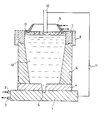
- the device for producing blocks shown schematically in the drawing has a base plate 1, which is supplied with cooling water via water supply and discharge lines 2, 3, cooling with another fluid, e.g. Liquid metal, gases or the like can also be made.
- a base plate 1 which is supplied with cooling water via water supply and discharge lines 2, 3, cooling with another fluid, e.g. Liquid metal, gases or the like can also be made.
- On the base plate there is a lower part 4 of the mold, which has a recess 5 into which the pouring channel opens for an increasing casting.
- the middle part 6 of the mold has a slightly conical cross section that opens upwards.
- an upper mold part 7 is placed, which carries on its outside thermal insulation 8, which is filled with mineral insulation, for example mineral wool, vermiculite or asbestos, and has a sheet metal jacket for protection against mechanical damage.
- a water-cooled attachment 9 is provided, in which a melting electrode 10 is arranged. Both the base plate 1 and the electrode 10 are connected to a voltage source 11, shown schematically.
- the melt was then across the electrode in the course of solidification of 1 0 hours heat and indeed initially with a procedurecichte of 1.33 kW / cm 2 and a current density of 12 amperes / cm 2 at the electrode.
- the block solidified completely after 16 hours, whereupon both the coolant supply to the base plate and to the attachment was interrupted, and at the same time no further heat was supplied via the melting electrode.
- the block thus obtained was examined with ultrasound and showed no inclusions with substitute defect sizes of around 1 mm in the foot, in the center or in the head.
- Example 2 The procedure was analogous to Example 1, but the device had no thermal insulation in the upper third of the mold.
- the block did not have a negatively inclined bottom cone with partially coarse non-metallic inclusions, had hardly any lambda or shadow stripes, and there were no V-segregations and hardly any shrinkage cavities, but non-metallic inclusions with substitute error sizes of around 1 mm were found during the ultrasound test.
Landscapes
- Engineering & Computer Science (AREA)
- Mechanical Engineering (AREA)
- Furnace Details (AREA)
- Manufacture And Refinement Of Metals (AREA)
- Treatment Of Steel In Its Molten State (AREA)
Applications Claiming Priority (2)
| Application Number | Priority Date | Filing Date | Title |
|---|---|---|---|
| AT1828/85 | 1985-06-19 | ||
| AT0182885A AT395296B (de) | 1985-06-19 | 1985-06-19 | Verfahren und vorrichtung zur herstellung von bloecken |
Publications (3)
| Publication Number | Publication Date |
|---|---|
| EP0207066A2 true EP0207066A2 (fr) | 1986-12-30 |
| EP0207066A3 EP0207066A3 (en) | 1989-03-29 |
| EP0207066B1 EP0207066B1 (fr) | 1991-01-09 |
Family
ID=3521861
Family Applications (1)
| Application Number | Title | Priority Date | Filing Date |
|---|---|---|---|
| EP86890177A Expired - Lifetime EP0207066B1 (fr) | 1985-06-19 | 1986-06-17 | Procédé et dispositif de fabrication de lingots |
Country Status (6)
| Country | Link |
|---|---|
| EP (1) | EP0207066B1 (fr) |
| JP (1) | JPS61291912A (fr) |
| KR (1) | KR870000120A (fr) |
| AT (1) | AT395296B (fr) |
| BR (1) | BR8602815A (fr) |
| DE (1) | DE3676748D1 (fr) |
Family Cites Families (13)
| Publication number | Priority date | Publication date | Assignee | Title |
|---|---|---|---|---|
| DE855151C (de) * | 1950-11-11 | 1954-04-08 | Gussstahlwerk Bochumer Ver Ag | Giessform und Verfahren zur Herstellung von Stahlbloecken |
| CH351719A (de) * | 1956-02-22 | 1961-01-31 | Bochumer Verein Fuer Gussstahl | Verfahren und Vorrichtung zur Erzeugung von schweren Stahlblöcken, z.B. Schmiedeblöcken, mit guten mechanischen Eigenschaften im Innern |
| GB948161A (en) * | 1959-09-11 | 1964-01-29 | British Oxygen Co Ltd | Manufacture of steel ingots or castings |
| AT287215B (de) * | 1968-01-09 | 1971-01-11 | Boehler & Co Ag Geb | Verfahren und Vorrichtung zum Elektroschlackenumschmelzen von Metallen, insbesondere von Stählen |
| AT297959B (de) * | 1968-06-28 | 1972-04-25 | Boehler & Co Ag Geb | Verfahren zum Elektroschlackeumschmelzen von Metallen und Legierungen |
| US3820587A (en) * | 1969-01-20 | 1974-06-28 | Boehler & Co Ag Geb | Apparatus for making metal ingots |
| AT295061B (de) * | 1969-09-18 | 1971-12-27 | Boehler & Co Ag Geb | Verfahren und Vorrichtungen zum Elektroschlackenumschmelzen von Metallen, insbesondere von Stählen |
| JPS51149824A (en) * | 1975-06-18 | 1976-12-23 | Nippon Kokan Kk | Downwardly divergent mold |
| IT1040998B (it) * | 1975-07-23 | 1979-12-20 | Centro Speriment Metallurg | Materozza per la produzione di lingotti fusi sotto elettroscoria |
| DE2604817A1 (de) * | 1976-02-07 | 1977-08-11 | Ver Edelstahlwerke Ag | Verfahren und vorrichtung zur herstellung von bloecken |
| DE2654834C2 (de) * | 1976-12-03 | 1984-05-30 | Vereinigte Edelstahlwerke AG (VEW) Wien AT Niederlassung Vereinigte Edelstahlwerke AG (VEW) Verkaufsniederlassung Büderich, 4005 Meerbusch | Verfahren zur Blockkopfbeheizung |
| DE2655602C2 (de) * | 1976-12-08 | 1982-12-02 | Vereinigte Edelstahlwerke AG (VEW) Wien AT Niederlassung Vereinigte Edelstahlwerke AG (VEW) Verkaufsniederlassung Büderich, 4005 Meerbusch | Verfahren und Vorrichtung zur Herstellung von Blöcken |
| IT1077822B (it) * | 1977-02-04 | 1985-05-04 | Terni Ind Elettr | Dispositivo per l'alimentazione di metallo fuso durante la solidificazione dei lingotti |
-
1985
- 1985-06-19 AT AT0182885A patent/AT395296B/de not_active IP Right Cessation
-
1986
- 1986-06-12 JP JP61135068A patent/JPS61291912A/ja active Pending
- 1986-06-17 EP EP86890177A patent/EP0207066B1/fr not_active Expired - Lifetime
- 1986-06-17 DE DE8686890177T patent/DE3676748D1/de not_active Expired - Lifetime
- 1986-06-18 BR BR8602815A patent/BR8602815A/pt not_active IP Right Cessation
- 1986-06-19 KR KR1019860004882A patent/KR870000120A/ko not_active Ceased
Also Published As
| Publication number | Publication date |
|---|---|
| AT395296B (de) | 1992-11-10 |
| ATA182885A (de) | 1992-04-15 |
| JPS61291912A (ja) | 1986-12-22 |
| KR870000120A (ko) | 1987-02-16 |
| BR8602815A (pt) | 1987-02-10 |
| DE3676748D1 (de) | 1991-02-14 |
| EP0207066A3 (en) | 1989-03-29 |
| EP0207066B1 (fr) | 1991-01-09 |
Similar Documents
| Publication | Publication Date | Title |
|---|---|---|
| EP0786531B2 (fr) | Procédé et dispositif pour la refusion de métaux sous forme de barres | |
| DE812211C (de) | Verfahren zur Herstellung des unteren Teiles des Tiegels von Zellen zur schmelzfluessigen Elektrolyse und nach diesem Verfahren her-gestellte Zelle fuer die Schmelzflusselektrolyse | |
| EP1253986B1 (fr) | Procede et dispositif de fabrication de corps coules en metal | |
| DE2609949C3 (de) | Verfahren und Vorrichtung zur Herstellung eines Gußstücks aus in einer Richtung erstarrter Metallegierung | |
| DE3421488A1 (de) | Verfahren zum herstellen von legierungspulver und vorrichtung zur durchfuehrung des verfahrens | |
| DE2655602C2 (de) | Verfahren und Vorrichtung zur Herstellung von Blöcken | |
| DE2241894B2 (de) | Verfahren und Vorrichtung zum Herstellen eines hohlen Metallgegenstands mit sphärisch ausgebildeter Schale | |
| DE220035C (fr) | ||
| EP0207066B1 (fr) | Procédé et dispositif de fabrication de lingots | |
| DE2816569C2 (de) | Verfahren zur Herstellung von mit Boden versehenen hohlen metallischen Gußstücken zur Bildung von Behältern o.dgl. | |
| DE2400578A1 (de) | Verfahren zur instandsetzung schwerer eisengegenstaende | |
| DE2941849A1 (de) | Verfahren zur herstellung von konstruktionsteilen durch elektro- schlacke-schweissen | |
| DE2001256B2 (de) | Vorrichtung zur herstellung von bloecken | |
| DE2339979C3 (de) | Verfahren und Vorrichtung zur Herstellung eines Metallgegenstandes | |
| AT395389B (de) | Verfahren zur herstellung von block- und formgussstuecken sowie vorrichtung zur herstellung derselben | |
| DE19710887C2 (de) | Verwendung einer Kokille zum Herstellen von Barren aus Leichtmetall oder einer Leichtmetallegierung, insbesondere aus Magnesium oder einer Magnesiumlegierung | |
| DD251517A5 (de) | Verfahren und vorrichtung zur herstellung von bloecken | |
| DE2632863C2 (de) | Einrichtung zur Herstellung von großtonnagigen Metallblöcken durch Elektroschlackenumschmelzen | |
| EP0229589B1 (fr) | Dispositif et procédé de coulée continue de métaux | |
| DE1608069C (de) | Verfahren zur Herstellung von Metall gußblocken durch Elektroschlackeumschmelzen und Anlage zur Durchfuhrung des Verfahrens | |
| EP0846510B1 (fr) | Utilisation d'une coquille pour fabrication de bars en métal léger ou alliage léger, notamment de magnésium ou d'alliage de magnésium | |
| AT282845B (de) | Verfahren zur Herstellung von Blöcken | |
| DE2319982C3 (de) | Einrichtung zur Elektroschlacke-Erschmelzung von Metallhohlblöcken | |
| DE2143445C3 (de) | Verfahren und Vorrichtung zum Herstellen von metallischen Blöcken | |
| AT46150B (de) | Verfahren zum Gießen von dichten Brammen, Blöcken oder anderen Gußstücken. |
Legal Events
| Date | Code | Title | Description |
|---|---|---|---|
| PUAI | Public reference made under article 153(3) epc to a published international application that has entered the european phase |
Free format text: ORIGINAL CODE: 0009012 |
|
| AK | Designated contracting states |
Kind code of ref document: A2 Designated state(s): BE CH DE FR GB IT LI SE |
|
| 17P | Request for examination filed |
Effective date: 19870520 |
|
| PUAL | Search report despatched |
Free format text: ORIGINAL CODE: 0009013 |
|
| RAP1 | Party data changed (applicant data changed or rights of an application transferred) |
Owner name: BOEHLER GESELLSCHAFT M.B.H. |
|
| AK | Designated contracting states |
Kind code of ref document: A3 Designated state(s): BE CH DE FR GB IT LI SE |
|
| 17Q | First examination report despatched |
Effective date: 19891020 |
|
| ITF | It: translation for a ep patent filed | ||
| GRAA | (expected) grant |
Free format text: ORIGINAL CODE: 0009210 |
|
| AK | Designated contracting states |
Kind code of ref document: B1 Designated state(s): BE CH DE FR GB IT LI SE |
|
| REF | Corresponds to: |
Ref document number: 3676748 Country of ref document: DE Date of ref document: 19910214 |
|
| GBT | Gb: translation of ep patent filed (gb section 77(6)(a)/1977) | ||
| ET | Fr: translation filed | ||
| PLBE | No opposition filed within time limit |
Free format text: ORIGINAL CODE: 0009261 |
|
| STAA | Information on the status of an ep patent application or granted ep patent |
Free format text: STATUS: NO OPPOSITION FILED WITHIN TIME LIMIT |
|
| 26N | No opposition filed | ||
| PGFP | Annual fee paid to national office [announced via postgrant information from national office to epo] |
Ref country code: GB Payment date: 19920507 Year of fee payment: 7 |
|
| PGFP | Annual fee paid to national office [announced via postgrant information from national office to epo] |
Ref country code: DE Payment date: 19920516 Year of fee payment: 7 |
|
| PGFP | Annual fee paid to national office [announced via postgrant information from national office to epo] |
Ref country code: CH Payment date: 19920518 Year of fee payment: 7 Ref country code: BE Payment date: 19920518 Year of fee payment: 7 |
|
| PGFP | Annual fee paid to national office [announced via postgrant information from national office to epo] |
Ref country code: FR Payment date: 19920520 Year of fee payment: 7 |
|
| PGFP | Annual fee paid to national office [announced via postgrant information from national office to epo] |
Ref country code: SE Payment date: 19920525 Year of fee payment: 7 |
|
| PG25 | Lapsed in a contracting state [announced via postgrant information from national office to epo] |
Ref country code: GB Effective date: 19930617 |
|
| PG25 | Lapsed in a contracting state [announced via postgrant information from national office to epo] |
Ref country code: SE Effective date: 19930618 |
|
| PG25 | Lapsed in a contracting state [announced via postgrant information from national office to epo] |
Ref country code: LI Effective date: 19930630 Ref country code: CH Effective date: 19930630 Ref country code: BE Effective date: 19930630 |
|
| BERE | Be: lapsed |
Owner name: BOHLER G.M.B.H. Effective date: 19930630 |
|
| GBPC | Gb: european patent ceased through non-payment of renewal fee |
Effective date: 19930617 |
|
| PG25 | Lapsed in a contracting state [announced via postgrant information from national office to epo] |
Ref country code: FR Effective date: 19940228 |
|
| REG | Reference to a national code |
Ref country code: CH Ref legal event code: PL |
|
| PG25 | Lapsed in a contracting state [announced via postgrant information from national office to epo] |
Ref country code: DE Effective date: 19940301 |
|
| REG | Reference to a national code |
Ref country code: FR Ref legal event code: ST |
|
| EUG | Se: european patent has lapsed |
Ref document number: 86890177.8 Effective date: 19940110 |
|
| PG25 | Lapsed in a contracting state [announced via postgrant information from national office to epo] |
Ref country code: IT Free format text: LAPSE BECAUSE OF NON-PAYMENT OF DUE FEES;WARNING: LAPSES OF ITALIAN PATENTS WITH EFFECTIVE DATE BEFORE 2007 MAY HAVE OCCURRED AT ANY TIME BEFORE 2007. THE CORRECT EFFECTIVE DATE MAY BE DIFFERENT FROM THE ONE RECORDED. Effective date: 20050617 |