EP0207483A2 - Neue Benzimidazole, Verfahren zu ihrer Herstellung und diese Verbindungen enthaltende Arzneimittel sowie Zwischenprodukte - Google Patents
Neue Benzimidazole, Verfahren zu ihrer Herstellung und diese Verbindungen enthaltende Arzneimittel sowie Zwischenprodukte Download PDFInfo
- Publication number
- EP0207483A2 EP0207483A2 EP86108886A EP86108886A EP0207483A2 EP 0207483 A2 EP0207483 A2 EP 0207483A2 EP 86108886 A EP86108886 A EP 86108886A EP 86108886 A EP86108886 A EP 86108886A EP 0207483 A2 EP0207483 A2 EP 0207483A2
- Authority
- EP
- European Patent Office
- Prior art keywords
- group
- alkyl
- amino
- methyl
- mercapto
- Prior art date
- Legal status (The legal status is an assumption and is not a legal conclusion. Google has not performed a legal analysis and makes no representation as to the accuracy of the status listed.)
- Granted
Links
- 0 C*C(*c1c2)=Nc1cc1c2nc(*I)[n]1 Chemical compound C*C(*c1c2)=Nc1cc1c2nc(*I)[n]1 0.000 description 4
Classifications
-
- C—CHEMISTRY; METALLURGY
- C07—ORGANIC CHEMISTRY
- C07D—HETEROCYCLIC COMPOUNDS
- C07D263/00—Heterocyclic compounds containing 1,3-oxazole or hydrogenated 1,3-oxazole rings
- C07D263/52—Heterocyclic compounds containing 1,3-oxazole or hydrogenated 1,3-oxazole rings condensed with carbocyclic rings or ring systems
- C07D263/54—Benzoxazoles; Hydrogenated benzoxazoles
- C07D263/58—Benzoxazoles; Hydrogenated benzoxazoles with hetero atoms or with carbon atoms having three bonds to hetero atoms with at the most one bond to halogen, e.g. ester or nitrile radicals, directly attached in position 2
-
- A—HUMAN NECESSITIES
- A61—MEDICAL OR VETERINARY SCIENCE; HYGIENE
- A61P—SPECIFIC THERAPEUTIC ACTIVITY OF CHEMICAL COMPOUNDS OR MEDICINAL PREPARATIONS
- A61P9/00—Drugs for disorders of the cardiovascular system
- A61P9/04—Inotropic agents, i.e. stimulants of cardiac contraction; Drugs for heart failure
-
- A—HUMAN NECESSITIES
- A61—MEDICAL OR VETERINARY SCIENCE; HYGIENE
- A61P—SPECIFIC THERAPEUTIC ACTIVITY OF CHEMICAL COMPOUNDS OR MEDICINAL PREPARATIONS
- A61P9/00—Drugs for disorders of the cardiovascular system
- A61P9/12—Antihypertensives
-
- C—CHEMISTRY; METALLURGY
- C07—ORGANIC CHEMISTRY
- C07D—HETEROCYCLIC COMPOUNDS
- C07D413/00—Heterocyclic compounds containing two or more hetero rings, at least one ring having nitrogen and oxygen atoms as the only ring hetero atoms
- C07D413/02—Heterocyclic compounds containing two or more hetero rings, at least one ring having nitrogen and oxygen atoms as the only ring hetero atoms containing two hetero rings
- C07D413/12—Heterocyclic compounds containing two or more hetero rings, at least one ring having nitrogen and oxygen atoms as the only ring hetero atoms containing two hetero rings linked by a chain containing hetero atoms as chain links
-
- C—CHEMISTRY; METALLURGY
- C07—ORGANIC CHEMISTRY
- C07D—HETEROCYCLIC COMPOUNDS
- C07D417/00—Heterocyclic compounds containing two or more hetero rings, at least one ring having nitrogen and sulfur atoms as the only ring hetero atoms, not provided for by group C07D415/00
- C07D417/02—Heterocyclic compounds containing two or more hetero rings, at least one ring having nitrogen and sulfur atoms as the only ring hetero atoms, not provided for by group C07D415/00 containing two hetero rings
- C07D417/12—Heterocyclic compounds containing two or more hetero rings, at least one ring having nitrogen and sulfur atoms as the only ring hetero atoms, not provided for by group C07D415/00 containing two hetero rings linked by a chain containing hetero atoms as chain links
-
- C—CHEMISTRY; METALLURGY
- C07—ORGANIC CHEMISTRY
- C07D—HETEROCYCLIC COMPOUNDS
- C07D487/00—Heterocyclic compounds containing nitrogen atoms as the only ring hetero atoms in the condensed system, not provided for by groups C07D451/00 - C07D477/00
- C07D487/02—Heterocyclic compounds containing nitrogen atoms as the only ring hetero atoms in the condensed system, not provided for by groups C07D451/00 - C07D477/00 in which the condensed system contains two hetero rings
- C07D487/04—Ortho-condensed systems
-
- C—CHEMISTRY; METALLURGY
- C07—ORGANIC CHEMISTRY
- C07D—HETEROCYCLIC COMPOUNDS
- C07D513/00—Heterocyclic compounds containing in the condensed system at least one hetero ring having nitrogen and sulfur atoms as the only ring hetero atoms, not provided for in groups C07D463/00, C07D477/00 or C07D499/00 - C07D507/00
- C07D513/02—Heterocyclic compounds containing in the condensed system at least one hetero ring having nitrogen and sulfur atoms as the only ring hetero atoms, not provided for in groups C07D463/00, C07D477/00 or C07D499/00 - C07D507/00 in which the condensed system contains two hetero rings
- C07D513/04—Ortho-condensed systems
Definitions
- the invention also relates to the optically active forms and racemic mixtures of these compounds.
- These new compounds of the present invention have valuable pharmacological properties, in particular they increase heart strength and / or lower blood pressure and / or influence platelet function and improve microcirculation.
- Means R a heterocyclic five-membered ring with 1-4 heteroatoms or a heterocyclic six-membered ring with 1-5 heteroatoms, where the heteroatoms of the aforementioned five-membered or six-membered rings can be the same or different and denote nitrogen, oxygen or sulfur and optionally on one or more nitrogen atoms May carry oxygen, in this sense the pyrrole, furan, thiophene, pyrazole, imidazole, thiazole, isothiazole, oxazole, isoxazole, triazole, tetrazole, thiadiazole, oxadiazole, Pyrazine, N, N-dioxy-pyrazine, pyrimidine, N, N-dioxy-pvrimidine, pyridazine, oxazine, thiazine, triazine, tetrazine, pyridyl and the N-oxypyridyl residue.
- Alkyl, alkoxy and alkyl mercapto substituents in the heterocyclic five and six-membered rings can contain 1-6, preferably 1-4 carbon atoms.
- the methyl, ethyl, methoxy, ethoxy, methylmercapto and ethyl mercapto radical is preferred.
- Halogen is to be understood as fluorine, chlorine and bromine, preferably chlorine.
- R is a phenyl ring of the general formula I I
- the alkyl part of the substituents mentioned for R 3 , R 4 and R s can contain 1-5 carbon atoms, preferably 1-4 carbon atoms.
- R 3 is hydrogen, an alkylsulphonyloxy, trifluoromethylsulphonyloxy, Alkylsulfenylmethyl-, Alkylsulfinylmethyl-, Alkylsulfonylmethyl-, alkylsulfonylamino, N-alkyl-alkylsulphonylamino, N-alkyl-or Trifluormethylsulfonylamino- trifluormethylsulfonylamino distr, a by a hydroxy, alkoxy, amino , Alkylamino or dialkylamino group substituted carbonyl group or a sulfonyl group substituted by an amino, dialkylamino or morpholino group, where each of the above-mentioned alkyl parts may contain 1 or 2 carbon atoms, a nitro, cyano or alkylaminosulfonyl group with 1-4 carbon atoms, an alkylcarbonylamino , Amin
- the phenyl part can carry 1 to 3 of the substituents mentioned.
- Preferred mono-substituted compounds are the hydroxy, Ci-C3 alkyl, trifluoromethyl, C 1 -C 3 alkoxy, allyloxy, propargyloxy, Cyanmethyloxy-, methoxycarbonylmethoxy, halogen, N itro-, amino, aminocarbonyl , Methoxycarbonyl, C 1 -C 3 dialkylamino, C, -C 3 alkylmercapto, C 1 -C 3 alkylsulfinyl, C 1 -C 3 alkylsulfonyl, C, -C 3 alkylsulfonyloxy and the 1-imidazolyl compounds, where the substituent can be in the 2-, 3- or 4-position.
- Preferred disubstituted compounds contain, as substituents, an alkanesulfonyloxy-, trifluoromethylsulfonyloxy-, alkylsulfonylmethyl-, alkylsulfinylmethyl-, alkylsulfonylmethyl-, alkylsulfonylamino-, N-alkyl-alkylsulfonylamino-, trifluoromethylsulfonylamonylamino- or n-methyl-n-methyl-n-methyl- or n-methyl- Amino, alkylamino or dialkylamino group substituted carbonyl group or a sulfonyl group substituted by an amino, dialkylamino or morpholino group, an alkylaminosulfonyl, alkylcarbonylamino, aminocarbonylamino or N-alkylamino carbonylamino group, a hydroxy, allyloxy, alkoxy
- X is a valence line
- X the valence line, a methylene, ethylene or the vinylene group is preferred.
- A is preferably an oxygen atom, a sulfur atom or a group , in which for R 6 hydrogen, the
- Methyl, ethyl, propyl, isopropyl, butyl, 2-butyl, and 2- (2-methyl) propyl group is preferred.
- R 2 are preferably a hydrogen atom, the methyl, ethyl, propyl, butyl, 2-propyl, 2-butyl and the 2- (2-methyl) propyl group, the hydroxyl, amino, mercapto , C 1 -C 3 alkylcarbonylamino, C 1 -C 3 alkylaminocarbonyl groups, the aminocarbonylamino, the pyridylcarbonylamino group, or a C i -C 3 alkyl mercapto group.
- compounds of the general formula I can also be prepared by direct reaction of compounds of the general formula XII with compounds of the general formula VIII, where R, X, Z, A and R 2 have the meanings given above.
- the reaction to the Schiff base with compounds of the general formula XII preferably takes place in an alcoholic medium
- the subsequent cyclization and oxidation to the compounds of the general formula I ' is carried out by heating the reaction mixture to reflux in the presence of atmospheric oxygen and catalytic amounts of acids, such as Toluenesulfonic acid.
- the reaction with compounds of the general formulas IV, V and XII to give the amide takes place in the presence of a dehydrating agent, preferably in polyphosphoric acid at temperatures between 50 and 250 ° C., preferably between 100 and 200 ° C instead.
- a dehydrating agent preferably in polyphosphoric acid at temperatures between 50 and 250 ° C., preferably between 100 and 200 ° C instead.
- the reaction with compounds of the general formulas IV, V and XII to the amide takes place in inert solvents, preferably in methylene chloride or pyridine, and the subsequent cyclization to give compounds of the general formula I 'is carried out after prior hydrogenation the nitro group in compounds of the formula X and XI, in compounds of the formula IX with simultaneous elimination of Hal, in a solvent or solvent mixture such as ethanol, isopropanol, glacial acetic acid, benzene, chlorobenzene, glycol, diethylene glycol dimethyl ether, sulfolane or dimethylformamide at temperatures between 0 ° and 250 ° C, but preferably at the boiling point of the reaction mixture, optionally in the presence of a condensing agent such as phosphorus oxychloride, thionyl chloride, p-toluenesulfonic acid, hydrochloric acid, sulfuric acid, phosphoric acid, phosphoric acid, phosphoric acid, phosphoric
- the above-mentioned hydrogenation of the nitro group is preferably carried out in a solvent such as water, ethanol, glacial acetic acid, ethyl acetate or dimethylformamide, advantageously with hydrogen in the presence of a hydrogenation catalyst such as Raney nickel, platinum or palladium / carbon, with metals such as iron, tin or zinc in the presence of a Acid, with salts such as iron (II) sulfate, tin (II) chloride, sodium sulfide, sodium hydrogen sulfide or sodium dithionite, or with hydrazine in the presence of Raney nickel at temperatures between 0 and 250 ° C., but preferably at room temperature.
- a hydrogenation catalyst such as Raney nickel, platinum or palladium / carbon
- metals such as iron, tin or zinc
- a Acid with salts such as iron (II) sulfate, tin (II) chloride, sodium sulfide, sodium hydrogen
- the compounds III, IV, V, VI and XII are known from the literature or can be easily prepared by processes known from the literature.
- the compounds VII, IX, X and XI are new and also the subject of the invention.
- reaction are preferably carried out in a solvent or solvent mixture such as benzene, toluene, chlorobenzene, dimethylformamide, methylene chloride or aqueous hydrochloric acid at temperatures between -20 ° C and 100 ° C, preferably at room temperature.
- a solvent or solvent mixture such as benzene, toluene, chlorobenzene, dimethylformamide, methylene chloride or aqueous hydrochloric acid at temperatures between -20 ° C and 100 ° C, preferably at room temperature.
- the oxidation is preferably carried out in a solvent or solvent mixture, e.g. in water, water / pyridine, acetone, glacial acetic acid, dilute sulfuric acid or trifluoroacetic acid, depending on the oxidizing agent used, conveniently carried out at temperatures between -80 and 100 ° C.
- a solvent or solvent mixture e.g. in water, water / pyridine, acetone, glacial acetic acid, dilute sulfuric acid or trifluoroacetic acid, depending on the oxidizing agent used, conveniently carried out at temperatures between -80 and 100 ° C.
- an alkylsulfinyl or alkylsulfinylmethyl compound of general formula I the oxidation is conveniently carried out with one equivalent of the oxidizing agent used, e.g. with hydrogen peroxide in glacial acetic acid, trifluoroacetic acid or formic acid at 0 to 20 ° C or in acetone at 0 to 60 ° C, with a persic acid such as performic acid in glacial acetic acid or trifluoroacetic acid at 0 to 50 ° C or with m-chloroperbenzoic acid in methylene chloride or chloroform at - 20 to 60 ° C, with sodium metaperiodate in aqueous methanol or ethanol at -15 to 25 ° C, with bromine in glacial acetic acid or aqueous acetic acid, with N-bromosuccinimide in ethanol, with tert-butyl hypochlorite in methanol at -80 ° to -30 ° C
- the oxidation is expediently carried out using one or two or more equivalents of the oxidizing agent used, for example hydrogen peroxide in glacial acetic acid, trifluoroacetic acid or in formic acid at 20 to 100 ° C.
- the oxidizing agent used for example hydrogen peroxide in glacial acetic acid, trifluoroacetic acid or in formic acid at 20 to 100 ° C.
- a peracid such as performic acid or m-chloroperbenzoic acid in glacial acetic acid, trifluoroacetic acid, methylene chloride or chloroform at temperatures between 0 and 60 ° C, with nitric acid in glacial acetic acid at 0 to 20 ° C , with chromic acid or potassium permanganate in glacial acetic acid, water / Sulfuric acid or in acetone at 0 to 20 ° C.
- a peracid such as performic acid or m-chloroperbenzoic acid in glacial acetic acid, trifluoroacetic acid, methylene chloride or chloroform at temperatures between 0 and 60 ° C, with nitric acid in glacial acetic acid at 0 to 20 ° C , with chromic acid or potassium permanganate in glacial acetic acid, water / Sulfuric acid or in acetone at 0 to 20 ° C.
- R 2 , A, R 4 , R 5 and X are as defined in the introduction and R 3 represents a hydroxyl, amino or N-alkylamino group with 1-3 carbon atoms in the alkyl part, with a sulfonic acid of the general formula XVIII in the
- R 7 represents an alkyl group with 1-3 carbon atoms or a trifluoromethyl group, in the presence of a dehydrating agent and / or the acid or the amine activating agent or with their reactive derivatives.
- reaction is conveniently carried out in a solvent or solvent mixture such as methylene chloride, ether, tetrahydrofuran, dioxane or benzene, optionally in the presence of an acid-binding agent such as sodium carbonate, triethylamine or pyridine, the latter two also being able to be used simultaneously as solvents, in the presence of an acid-activating agent or dehydrating agents such as thionyl chloride or phosphorus pentachloride, but preferably with a reactive derivative of a compound of general formula XVIII, for example with their anhydride or halide such as methanesulfonic acid chloride or ethanesulfonic acid chloride, preferably at temperatures between 0 and 100 ° C, e.g. at temperatures between room temperature and 50 ° C.
- a solvent or solvent mixture such as methylene chloride, ether, tetrahydrofuran, dioxane or benzene
- an acid-binding agent such as
- R, and R 9 which may be the same or different, represent hydrogen atoms or alkyl groups with 1-5 carbon atoms, or with a reactive derivative thereof, if R 3 "'represents the carboxyl or hydroxysulfonyl group.
- reaction is conveniently carried out in a solvent or solvent mixture such as methylene chloride, ethanol, chloroform, carbon tetrachloride, ether, tetrahydrofuran, dioxane, benzene, toluene, acetonitrile or dimethylformamide, optionally in the presence of an acid-activating agent or a dehydrating agent, e.g. in the presence of ethyl chloroformate, thionyl chloride, phosphorus trichloride, phosphorus pentoxide, N'N-dicyclohexylcarbodiimide / N-hydroxysuccinimide, N-N'-carbonyldiimidazole
- a solvent or solvent mixture such as methylene chloride, ethanol, chloroform, carbon tetrachloride, ether, tetrahydrofuran, dioxane, benzene, toluene, acetonitrile or dimethylformamide
- a desiccant such as magnesium sulfate or molecular sieve.
- reaction in a corresponding halide e.g. the carboxylic acid or sulfonic acid chloride, and hydrazine or a corresponding amine, which can simultaneously serve as solvents, and at temperatures between 0 and 50 ° C.
- a compound of the general formula I in which R 3 represents the cyano group, this can then be converted into a corresponding compound by means of alcoholysis and / or hydrolysis, in which R 3 is an alkoxycarbonyl group with a total of 2-5 carbon atoms, the aminocarbonyl or carboxyl group and / or R 4 an alkoxycarbonyl group with a total of 2-4 carbon atoms, which represent aminocarbonyl or carboxyl group, are converted and / or a compound of the general formula I, in which R 3 represents the carboxy group, by esterification into a corresponding compound of the general formula I, in which R 3 represents an alkoxycarbonyl group with a total of 2-5 carbon atoms, are converted.
- the subsequent alcoholysis and / or hydrolysis is conveniently carried out either in the presence of an acid such as salt acid, sulfuric acid, phosphoric acid or trichloroacetic acid or in the presence of a base such as sodium hydroxide or potassium hydroxide in a suitable solvent such as water, water / methanol, ethanol, water / ethanol, water / isopropanol or water / dioxane at temperatures between -10 and 120 ° C, For example, at temperatures between room temperature and the boiling point of the reaction mixture.
- an acid such as salt acid, sulfuric acid, phosphoric acid or trichloroacetic acid
- a base such as sodium hydroxide or potassium hydroxide
- a suitable solvent such as water, water / methanol, ethanol, water / ethanol, water / isopropanol or water / dioxane at temperatures between -10 and 120 ° C, For example, at temperatures between room temperature and the boiling point of the reaction mixture.
- the subsequent esterification is conveniently carried out in a suitable solvent, e.g. in a corresponding alcohol, pyridine, toluene, methylene chloride, tetrahydrofuran or dioxane, in the presence of an acid-activating and / or dehydrating agent such as thionyl chloride, ethyl chloroformate, N, N'-dicyclohexylcarbodiimide or its isourea ethers, optionally in the presence of a reaction accelerator or copper chlorine accelerator by transesterification, e.g. with an appropriate carbonic acid diester, at temperatures between 0 and 100 ° C, but preferably at temperatures between 20 ° C and the boiling point of the solvent in question.
- a suitable solvent e.g. in a corresponding alcohol, pyridine, toluene, methylene chloride, tetrahydrofuran or dioxane
- an acid-activating and / or dehydrating agent such as thi
- reaction is carried out according to methods known from the literature with a reagent which transfers the sulfur atom, such as, for example, phosphorus pentasulfide, expediently reacting 1-5 mol of P 2 S 5, but preferably 1 mol, in a suitable solvent.
- a suitable solvent are tetrahydrofuran, dioxane, benzene, toluene or pyridine at temperatures between 25 and 125 ° C.
- reaction time 1-10 hours, preferably 5 hours, depending on the reaction partner.
- the compounds of general formula I obtained can then, if desired, be converted into their physiologically compatible acid addition salts with inorganic or organic acids.
- Suitable acids include, for example, hydrochloric acid, hydrobromic acid, sulfuric acid, phosphoric acid, fumaric acid, succinic acid, tartaric acid, citric acid, lactic acid, maleic acid or methanesulfonic acid.
- the new compounds of the general formula I, their tautomers and their physiologically tolerable acid addition salts have superior pharmacological properties over a long period of action, in particular an antihypertensive and / or positive inotropic effect and / or they influence the platelet function and improve the microcirculation .
- the substances of the general formula I are mixed in a manner known per se with suitable pharmaceutical carrier substances, flavorings, flavors and colors and shaped, for example, as tablets or dragées or with the addition of appropriate auxiliaries in water or oil, such as e.g. Olive oil, suspended or dissolved.
- the new substances of the general formula I according to the invention and their salts can be administered enterally or parenterally in liquid or solid form.
- Water is preferably used as the injection medium, which contains the additives which are customary in injection solutions, such as stabilizing agents, solubilizers or buffers.
- Such additions are e.g. Tartrate and citrate buffers, ethanol, complexing agents (such as ethylenediaminetetraacetic acid and its non-toxic salts) and high molecular weight polymers (such as liquid polyethylene oxide) for viscosity regulation.
- Solid carrier materials are e.g. Starch, lactose, mannitol, methyl cellulose, talc, highly disperse silica, high molecular weight fatty acids (such as stearic acid), gelatin, agar-agar, calcium phosphate, magnesium stearate, animal and vegetable fats and solid high molecular weight polymers (such as polyethylene glycols).
- Preparations suitable for oral administration can optionally contain flavorings and sweeteners.
- the compounds according to the invention are usually applied in amounts of 10-500 mg per day based on 75 kg of body weight. It is preferred to administer 1-2 tablets with an active ingredient content of 5-200 mg 2-3 times a day. The tablets can also be delayed, which means that 1-2 tablets with 10-500 mg of active ingredient only have to be given once a day. The active ingredient can also be given by injection 1-8 times a day or by continuous infusion, with amounts of 5-200 mg / day usually being sufficient.
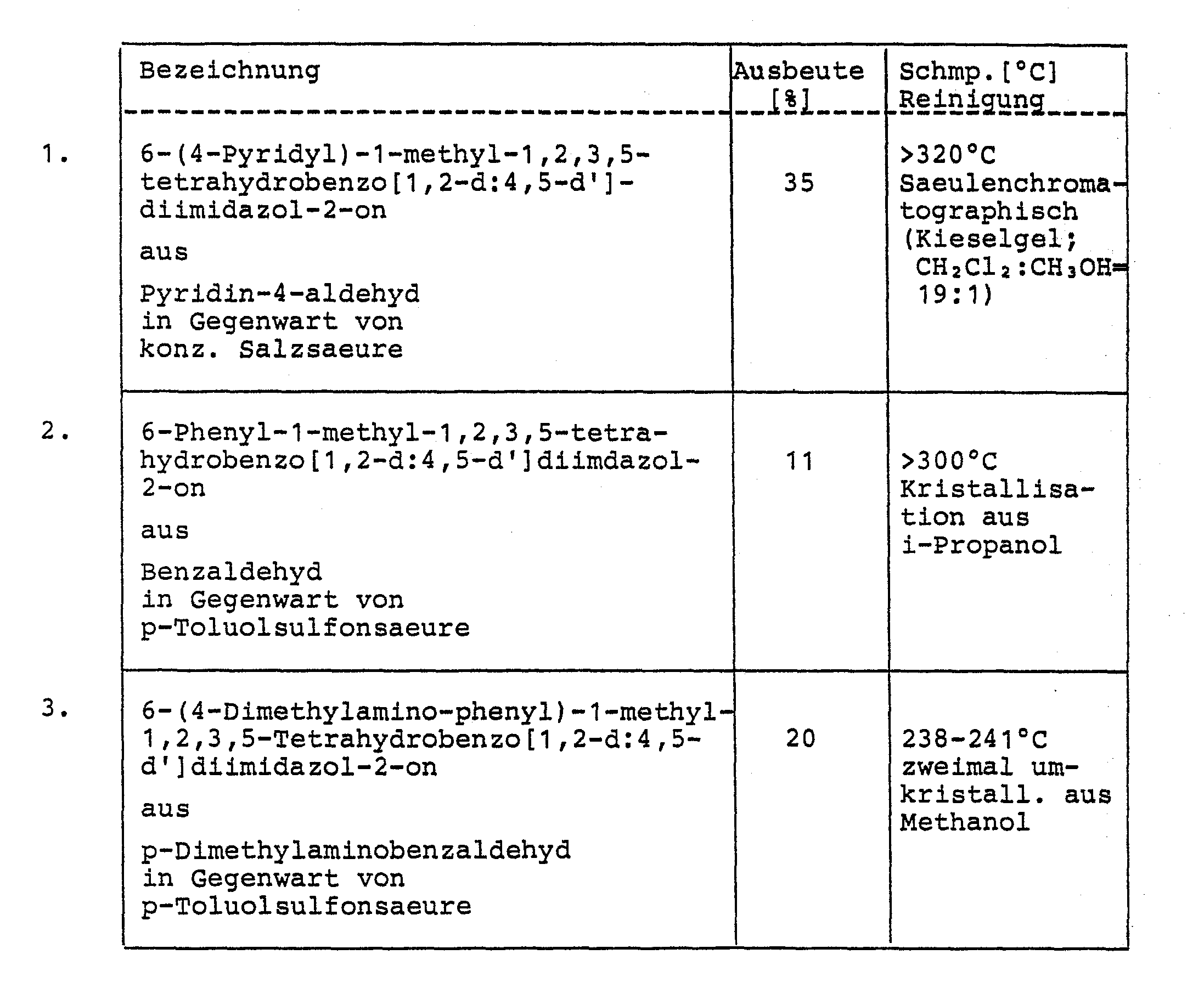
- Example 4 b With solutions of 5,6-diamino-1-methyl-benzimidazol-2-one obtained analogously to Example 4 a and the specified aldehydes in the presence of catalytic amounts of the specified acids, the following compounds were prepared analogously to Example 4 b: The following were also shown analogously to Example 4:
- Example 9 c there is obtained from 3.5 g 5,6-D iAmino-1-methyl-benzimidazolin-2-one in 70 ml of 2 N hydrochloric acid to effetstuendigem introducing phosgene and standing at room temperature night1-methyl-1,2, 3,5,6,7-hexahydro [1,2-d: 4,5-d '] diimidazole-2,6-dione with mp> 300 ° C.
- Example 12 210 mg of the compound obtained in Example 12 were stirred for four days at 50 ° C. in 20 ml of acetic anhydride. 7 mg of sodium acetate are added, and the mixture is distilled to dryness in a high vacuum after two hours.
Landscapes
- Chemical & Material Sciences (AREA)
- Organic Chemistry (AREA)
- Health & Medical Sciences (AREA)
- Engineering & Computer Science (AREA)
- Bioinformatics & Cheminformatics (AREA)
- Cardiology (AREA)
- Nuclear Medicine, Radiotherapy & Molecular Imaging (AREA)
- Veterinary Medicine (AREA)
- General Chemical & Material Sciences (AREA)
- Medicinal Chemistry (AREA)
- Heart & Thoracic Surgery (AREA)
- Chemical Kinetics & Catalysis (AREA)
- Pharmacology & Pharmacy (AREA)
- Life Sciences & Earth Sciences (AREA)
- Animal Behavior & Ethology (AREA)
- General Health & Medical Sciences (AREA)
- Public Health (AREA)
- Hospice & Palliative Care (AREA)
- Pharmaceuticals Containing Other Organic And Inorganic Compounds (AREA)
- Plural Heterocyclic Compounds (AREA)
- Nitrogen Condensed Heterocyclic Rings (AREA)
- Heterocyclic Carbon Compounds Containing A Hetero Ring Having Nitrogen And Oxygen As The Only Ring Hetero Atoms (AREA)
- Nitrogen And Oxygen Or Sulfur-Condensed Heterocyclic Ring Systems (AREA)
Abstract


Description
- Die vorliegende Erfindung betrifft neue Benzimidazole der allgemeinen Formel I

- Ri einen heterocyclischen Fuenfring mit 1-4 Heteroatomen oder einen heterocyclischen Sechsring mit 1-5 Heteroatomen darstellt, wobei die Heteroatome der vorgenannten Fuenf- und Sechsring gleich oder verschieden sein koennen und Stickstoff, Sauerstoff oder Schwefel bedeuten und gegebenenfalls an einem oder mehreren Stickstoffatomen ein Sauerstoffatom tragen koennen, und die vorgenannten Fuenf- und Sechsringe gegebenenfalls durch eine oder mehrere Alkyl-, Alkoxy-, Alkylmercapto-, Hydroxy-, Nitro-, Amino-, Halogen- oder Cyangruppen substituiert sein koennen, oder einen Phenylring der allgemeinen Formel II darstellt,

- X ein Valenzstrich, eine C1-C4-Alkylengruppe oder die Vinylengruppe sein kann,
- A ein Sauerstoffatom, ein Schwefelatom, oder die Gruppe N-R6 bedeutet, wobei R6 ein Wasserstoffatom oder eine Alkylgruppe darstellt,
- R2 ein Wasserstoffatom, eine Alkyl-, eine Hydroxy-, eine Mercapto-, Alkylmercapto-, eine Aminogruppe, eine Alkyl- carbonylamino-, N-Alkyl-alkyl-carbonylamino-, Alkylaminocarbonylamino-, Dialkylaminocarbonylamino-, Aminocarbonylamino- oder eine Pyridylcarbonylaminogruppe darstellt, deren Tautomere und deren physiologisch vertraegliche Salze. anorganischer und organischer Saeuren und Verfahren zu ihrer Herstellung, sowie diese Verbindungen enthaltende Arzneimittel.
- Fuer den Fall, daß Verbindungen der allgemeinen Formel I hergestellt wurden, die ein asymmetrisches Atom enthalten, sind auch Gegenstand der Erfindung die optisch aktiven Formen und racemischen Gemische dieser Verbindungen.
- Diese neuen Verbindungen der vorliegenden Erfindung weisen wertvolle pharmakologische Eigenschaften auf, insbesondere steigern sie die Herzkraft und/oder wirken blutdrucksenkend und/oder beeinflussen die Thrombozytenfunktion und verbessern die Mikrozirkulation.
- Bedeutet R, einen heterocyclischen Fuenfring mit 1-4 Heteroatomen oder einen heterocyclischen Sechsring mit 1-5 Heteroatomen, wobei die Heteroatome der vorgenannten Fuenf- oder Sechsringe gleich oder verschieden sein koennen und Stickstoff, Sauerstoff oder Schwefel bedeuten und gegebenenfalls an einem oder mehreren Stickstoffatomen ein Sauerstoff tragen koennen, so sind in diesem Sinne bevorzugt der Pyrrol-, Furan-, Thiophen-, Pyrazol-, Imidazol-, Thiazol-, Isothiazol-, Oxazol-, Isoxazol-, Triazol-, Tetrazol-, Thiadiazol-, Oxadiazol-, Pyrazin-, N,N-Dioxy-pyrazin, Pyrimidin-, N,N-Dioxy-pvri- midin-, Pyridazin-, Oxazin-, Thiazin-, Triazin-, Tetrazin-, Pyridyl- und der N-Oxy-pyridylrest.
- Alkyl-, Alkoxy- und Alkylmercapto-Substituenten in den'heterocyclischen Fuenf- und Sechsring koennen 1-6, vorzugsweise 1-4 Kohlenstoffatome enthalten. Bevorzugt ist der Methyl-, Ethyl-, Methoxy-, Ethoxy-, Methylmercapto- und Ethylmercaptorest. Unter Halogen ist Fluor, Chlor und Brom, vorzugsweise Chlor zu verstehen.
- Bedeutet R, einen Phenylring der allgemeinen Formel II, so kann der Alkylteil der bei R3, R4 und Rs genannten Substituenten 1-5 Kohlenstoffatome, vorzugsweise 1-4 Kohlenstoffatome enthalten. Bevorzugt in diesem Sinne sind beispielsweise die Methansulfonyloxy-, Ethansulfonyloxy-, n-Propansulfonyloxy-, Isopropansulfonyloxy-, Trifluormethansulfonyloxy-, Methylsulfenylmethyl-, Ethylsulfenylmethyl-, n-Propylsulfenylmethyl-, Methylsulfinylmethyl-, Ethylsulfinylmethyl-, n-Propylsulfinylmethyl-, Methylsulfonylmethyl-, Ethylsulfonylmethyl-, n-Propylsulfonylmethyl-, Methansulfonylamino-, Ethansulfonylamino-, n-Propansulfonylamino-, Trifluormethansulfonylamino-, N-Methyl-methansulfonylamino-, N-Ethyl-methansulfonylamino-, N-Methyl-ethansulfonylamino-, N-Ethyl-ethansulfonylamino-, N-Isopropyl-ethansulfonylamino-, N-Methyl-n-propansulfonylamino-, N-Ethyl-n-propansulfonylamino-, N-n-Propyl-n-propansulfonylamino-, N-Methyl-trifluormethansulfonylamino-, N-Ethyltrifluormethansulfonylamino-, N-Isopropyl-trifluormethansulfonylamino-, Methoxycarbonyl-, Ethoxycarbonyl-, Propoxycarbonyl-, Isopropoxycarbonyl-, Methylaminocarbonyl-, Ethylaminocarbonyl-, Dimethylaminocarbonyl-, Di-n-propylaminocarbonyl-, N-Methyl-ethylaminocarbonyl-, Trifluormethyl-, Methylaminosulfonyl-, Ethylaminosulfonyl-, n-Propylaminosulfonyl-, n-Butylaminosulfonyl-, n-Pentylaminosulfonyl-, Dimethylaminosulfonyl-, Diethylaminosulfonyl-, Di-n-propylaminosulfonyl-, N-Methyl-isopropylaminosulfonyl-, Acetylamino-, Propionylamino-, Methylaminocarbonylamino-, Ethylaminocarbonylamino-, Propylaminocarbonylaminogruppe, eine Methyl-, Ethyl-, Propyl-, Methoxy-, Ethoxy-, Propoxygruppe, eine Allyloxy-, 2-Butenyloxy-, 3-Butenyloxy-, 2-Pentenyloxy-, Propargyloxy-, 2-Butinyloxy-, 3-Butinyloxy-, Cyanmethyloxy-, Cyanethyloxy-, Methoxycarbonylmethoxy-, Methoxycarbonylethoxygruppe, eine Methylmercapto-, Ethylmercapto-, eine Methylsulfinyl-, Ethylsulfinyl-, Methylsulfonyl- und Ethylsulfonylgruppe, eine Dimethylaminocarbonylamino-, Diethylaminocarbonylamino-, N-Methyl-methylcarbonylamino-, N-Ethylmethylcarbonylamino-, N-Methyl-ethylcarbonylamino- und N-Ethylethylcarbonylaminogruppe, eine Methoxysulfonyl- und Ethoxysulfonylgruppe.
- Bei Sulfonyl- und Carbonylgruppen, die durch cyclische Iminogruppen substituiert sein koennen, sind bevorzugt die Morpholino-, Pyrrolidino-, Piperidino- und Hexamethyleniminosulfonylgruppen.
- Insbesondere sind bevorzugt fuer
- R3 Wasserstoff, eine Alkylsulfonyloxy-, Trifluormethylsulfonyloxy-, Alkylsulfenylmethyl-, Alkylsulfinylmethyl-, Alkylsulfonylmethyl-, Alkylsulfonylamino-, N-Alkyl-alkylsulfonylamino-, Trifluormethylsulfonylamino- oder N-Alkyl-trifluormethylsulfonylaminogruppe, eine durch eine Hydroxy-, Alkoxy-, Amino-, Alkylamino oder Dialkylaminogruppe substituierte Carbonylgruppe oder eine durch eine Amino-, Dialkylamino-oder Morpholinogruppe substituierte Sulfonylgruppe, wobei jeder der vorstehend genannten Alkylteile 1 oder 2 Kohlenstoffatome enthalten kann, eine Nitro-, Cyan- oder Alkylaminosulfonylgruppe mit 1-4 Kohlenstoffatomen, eine Alkylcarbonylamino-, Aminocarbonylamino- oder N-Alkyl-aminocarbonylaminogruppe, eine Alkylmercapto-, Alkylsulfinyl- oder Alkylsulfonylgruppe, wobei jeder der vorgenannten Alkylteile 1 oder 2 Kohlenstoffatome enthalten kann, eine Halogen-, Amino-, Hydroxy-, Dialkylamino-, Alkyl-, Alkoxy-, Alkenyloxy- oder Alkinyloxygruppe vorzugsweise mit 1-3 Kohlenstoffatomen, eine Cyanmethoxy- oder Methoxycarbonylmethoxygruppe, die Trifluormethylgruppe oder die 1-Imidazolylgruppe, fuer R4 Wasserstoff, eine Alkylgruppe mit 1-3 Kohlenstoffatomen, eine Alkoxy- oder Dialkylaminogruppe mit 1 oder 2 Kohlenstoffatomen in jedem Alkylteil oder ein Halogenatom, fuer R5 Wasserstoff oder die Methoxygruppe.
- Der Phenylteil kann 1 bis 3 der genannten Substituenten tragen.
- Bevorzugte monosubstituierte Verbindungen sind die Hydroxy-, Ci-C3 Alkyl-, Trifluormethyl-, C1-C3 Alkoxy-, Allyloxy-, Propargyloxy-, Cyanmethyloxy-, Methoxycarbonylmethoxy-, Halogen-, Nitro-, Amino-, Aminocarbonyl-, Methoxycarbonyl-, C1-C3 Dialkylamino-, C,-C3 Alkylmercapto-, C1-C3 Alkylsulfinyl-, C1-C3 Alkylsulfonyl-, C,-C3 Alkylsulfonyloxy- und die 1-Imidazolylverbindungen, wobei der Substituent in 2-, 3-oder 4-Stellung stehen kann.
- Bevorzugte disubstituierte Verbindungen enthalten als Substituenten eine Alkansulfonyloxy-, Trifluormethylsulfonyloxy-, Alkylsulfenylmethyl-, Alkylsulfinylmethyl-, Alkylsulfonylmethyl-, Alkylsulfonylamino-, N-Alkyl-alkylsulfonylamino-, Trifluormethylsulfonylamino- oder N-Alkyl-trifluormethylsulfonylaminogruppe, eine durch eine Hydroxy-, Alkoxy-, Amino-, Alkylamino- oder Dialkylaminogruppe substituierte Carbonylgruppe oder eine durch eine Amino-, Dialkylamino-oder Morpholinogruppe substituierte Sulfonylgruppe, eine Alkylaminosulfonyl-, Alkylcarbonylamino-, Aminocarbonylamino- oder N-Alkyl-aminocarbonylaminogruppe, eine Hydroxy-, Alkyl-, Alkoxy-, Allyloxy-, Propargyloxy-, Cyanmethyloxy-, Methoxycarbonylmethyloxy-, Cyan-, Halogen-, Nitro-, Amino-, Dialkylamino-, Alkylmercapto-, Alkylsulfinyl-, Alkylsulfonyl-oder eine 1-Imidazolylgruppe, wobei die beiden Substituenten gleich oder verschieden sein koennen und in 2,3- 2,4-, 2,5-, 2,6-, 3,4- und 3,5-Stellung bevorzugt jedoch in 2,4-, 2,5-und 3,4-Stellung stehen koennen und die vorgenannten Alkylreste, allein oder in Kombination mit anderen Resten, 1-3 C-Atome aufweisen koennen. Bevorzugter trisubstituierter Phenylrest ist 3,4,5-Trimethoxyphenyl.
- Fuer den Fall, daß X einen Valenzstrich bedeutet, sind neben den oben genannten Gruppen fuer R1 auch bevorzugt das Wasserstoffatom, Alkylgruppen mit 1 bis 8 Kohlenstoffatomen, Alkenyl- oder Alkinylgruppen mit 2 bis 8 Kohlenstoffatomen, Cycloalkylgruppen mit 3 bis 7 Kohlenstoffatomen, Cycloalkenylgruppen mit 5 oder 6 Kohlenstoffatomen, C,-C3 Alkylmercapto-, C1-C4 Carboxyalkylgruppen, Alkoxycarbonylalkyl- und Alkoxyalkylgruppen mit 1 bis 4 Kohlenstoffatomen in jedem der genannten Alkylteile, Hydroxy-, Mercapto-, Amino-, Pyridylcarbonylamino- und die Trifluormethylgruppe. Besonders bevorzugt in diesem Sinne sind die Methyl-, Ethyl-, n-Propyl-, Isopropyl-, Pentyl-, Hexyl-, sek.-Butyl-, tert.-Butyl-, 1-Propenyl-, 1-Propinyl-, 2-Propenyl-, Cyclopropyl-, Cyclobutyl-, Cyclopentyl-, Cyclohexyl-, 1-Cyclopentenyl-, Methoxymethyl-, Ethoxycarbonylethyl-, Carboxyethyl-, Hydroxy-, Mercapto-, Methylmercapto-, Ethylmercapto-, n-Propylmercapto-, Amino-, Pyridylcarbonylamino- und die Trifluormethylgruppe.
- Fuer X ist der Valenzstrich, eine Methylen-, Ethylen- oder die Vinylengruppe bevorzugt.
- Fuer A ist bevorzugt ein Sauerstoffatom, ein Schwefelatom oder eine Gruppe

- Methyl-, Ethyl-, Propyl-, Isopropyl-, Butyl-, 2-Butyl-, und 2-(2-Methyl)propylgruppe bevorzugt ist.
- Fuer R2 sind bevorzugt eine Wasserstoffatom, die Methyl-, Ethyl-, Propyl-, Butyl-, 2-Propyl-, 2-Butyl- und die 2-(2-Methyl)propylgruppe, die Hydroxy-, Amino-, Mercapto-, C1-C3 Alkylcarbonylamino-, C1-C3 Alkylaminocarbonylgruppen, die Aminocarbonylamino-, die Pyridylcarbonylaminogruppe, oder eine Ci-C3 Alkylmercaptogruppe.
- Besonders bevorzugte Verbindungen sind Verbindungen der allgemeinen Formel I, in der
- R1 den Pyrrol-, Furan-, Thiophen-, Pyrazol-, Imidazol-, Thiazol-, Isothiazol-, Oxazol-, Isoxazol-, Triazol-, Tetrazol-, Thia- diazol-, Oxadiazol-, Pyridin-, N-Oxy-Pyridin-, Pyrazin-, N,N-Dioxy-pyrazin-, Pyrimidin-, N,N-Dioxypyrimidin-, Pyridazin-, Oxazin-, Thiazin-, Triazin-, Tetrazinrest darstellt, sowie deren Methyl-, Ethyl-, Methoxy-, Ethoxy-, Methylmercapto-, Ethylmercapto- und chlorsubstituierten Derivate, oder den Phenylrest der allgemeinen Formel II, in der
- R3 ein Wasserstoff, die Methansulfonyloxy-, Trifluormethansulfonyloxy-, Methansulfonylamino-, Trifluormethansulfonylamino-, Methansulfonyl-methylamino-, Trifluormethansulfonylmethylamino-, Methylsulfenylmethyl-, Methylsulfinylmethyl-, Methylsulfonylmethyl-, Aminocarbonyl-, Aminosulfonyl-, Methylaminosulfonyl-, Dimethylaminosulfonyl-, Acetylamino-, Methylmercapto-, Methylsulfonyl-, Hydroxy-, Methyl-, Methoxy-, Propargyloxy-, Cyanmethoxy-, Methoxycarbonylmethoxy-, Cyan-, Chlor-, Nitro-, Amino-, Dimethylamino-, Trifluormethyl-, oder die 1-Imidazolylgruppe darstellt,
- R4 Wasserstoff, die Methyl-, Methoxy-, Dimethylamino- oder Chlorgruppe bedeutet und
- R5 Wasserstoff oder die Methoxygruppe ist, oder in der
- R, fuer den Fall, daß X einen Valenzstrich bedeutet, neben den oben genannten Gruppen auch ein Wasserstoffatom, eine Methyl-, Ethyl-, Propyl-, Isopropyl-, Butyl-, 2-Butyl-, tert.-Butyl-, Pentyl-, Hexyl-, 2-Propenyl-, 1-Propenyl-, 1-Propinyl-, Cyclopropyl-, Cyclobutyl-, Cyclopentyl-, 1-Cyclopentenyl-, Methoxymethyl-, Ethoxycarbonylethyl-, Carboxyethyl-, Hydroxy-, Mercapto-, Methylmercapto-, Amino-, Pyridylcarbonylamino- und die Trifluormethylgruppe bedeutet,
- X einen Valenzstrich, eine Alkylengruppe mit 1 oder 2 Kohlenstoffatomen oder die Vinylengruppe bedeutet,
- A ein Sauerstoff- oder Schwefelatom oder die Gruppe NR6 ist, in der R6 Wasserstoff, die Methyl-, Ethyl-, Propyl-, Isopropylgruppe ist,
- R2 Wasserstoff, Methyl-, Ethyl-, Propyl-, Butyl-, Isopropyl-, 2-Butyl-, tert.-Butyl-, Hydroxy-, Amino-, Mercapto-, Methylmercapto-, Methylcarbonylamino-, Pyridylcarbonylamino-, Methylaminocarbonylamino-, oder eine Aminocarbonylaminogruppe ist.
- Die Verbindungen der allgemeinen Formel I koennen nach den folgenden Schemata 1-4 hergestellt werden.
- Wie aus Schema 1 ersichtlich kann man Verbindungen der allgemeinen Formel III und V: durch Nitrierung in Verbindungen der allgemeinen Formel X und XI ueberfuehren, welche nach Reduktion der Nitrogruppe und Ringschluß die Verbindungen der allgemeinen Formel I' liefern, wobei A, X und R2 die oben angegebenen Bedeutungen besitzen und in welcher
- R1 einen heterocyclischen Fuenfring mit 1-4 Heteroatomen oder einen heterocyclischen Sechsring mit 1-5 Heteroatomen darstellt, wobei die Heteroatome der vorgenannten Fuenf- und Sechsringe gleich oder verschieden sein koennen und Stickstoff, Sauerstoff oder Schwefel bedeuten und gegebenenfalls an einem oder mehreren Stickstoffatomen ein Sauerstoffatom tragen koennen, und die vorgenannten Fuenf- und Sechsringe gegebenenfalls durch eine oder mehrere Alkyl-, Alkoxy-, Alkylmercapto-, Hydroxy-, Nitro-, Amino-, Halogen- oder Cyangruppen substituiert sein koennen, oder einen Phenylring der allgemeinen Formel II darstellt,


- In manchen Faellen ist es zweckmaeßig, eine reaktive Position im Phenylteil der Verbindungen III zu schuetzen durch Herstellung der Verbindungen der allgemeinen Formel VII, wobei R1, X, R2 und A die angegebene Bedeutung besitzen und Hal eine Halogenidgruppe, vorzugsweise Bromid, darstellt. Nach Nitrierung erhaelt man Verbindungen der allg. Formel IX, die nach Reduktion der Nitrogruppe unter gleichzeitiger Abspaltung von Hal die Verbindungen der allgemeinen Formel I' liefern.
- Die als Zwischenprodukte wichtigen Verbindungen X und XI koennen auch aus den Verbindungen IV und V durch Umsetzung mit Verbindungen der Formel VIII erhalten werden, wobei Rt, X, A und R2 die oben angegebene Bedeutung besitzen und Z eine leicht abspaltbare Gruppe darstellt.
- Verbindungen der allgemeinen Formel I'koennen schließlich auch durch direkte Umsetzung von Verbindungen der allgemeinen Formel XII mit Verbindungen der allg. Formel VIII hergestellt werden, wobei R;, X, Z, A und R2 die oben angegebenen Bedeutungen besitzen.
- Insbesondere versteht man unter den Verbindungen der allgemeinen Formel VIII Aldehyde, sowie Saeurehalogenide wie Saeurechloride, Carbonsaeureester wie Methyl- und Ethylester und andere aktivierte Carbonsaeurederivate, wie z.B. Anhydride, sowie die Carbonsaeuren selbst.
- Ist die Verbindung der Formel VIII ein Aldehyd findet die Umsetzung zur Schiffschen Base mit Verbindungen der allgemeinen Formel XII vorzugsweise in alkoholischem Medium statt, die anschließende Cyclisierung und Oxidation zu den Verbindungen der allgemeinen Formel I' erfolgt durch Erwaermen des Reaktionsansatzes zum Rueckfluß in Gegenwart von Luftsauerstoff und katalytischen Mengen Saeure, wie z.B. Toluolsulfonsaeure.
- Ist die Verbindung der allgemeinen Formel VIII eine Carbonsaeure, so findet die Umsetzung mit Verbindungen der allgemeinen Formeln IV, V und XII zum Amid in Gegenwart eines wasserentziehenden Mittels, vorzugsweise in Polyphosphorsaeure bei Temperaturen zwischen 50 und 250°C, vorzugsweise zwischen 100 und 200°C statt.
- Ist die Verbindung der allgemeinen Formel VIII ein Carbonsaeurederivat, findet die Umsetzung mit Verbindungen der allgemeinen Formeln IV, V und XII zum Amid in inerten Loesungsmitteln, vorzugsweise in Methylenchlorid oder Pyridin statt und die anschließende Cyclisierung zu Verbindungen der allgemeinen Formel I' wird nach vorheriger Hydrierung der Nitrogruppe in Verbindungen der Formel X und XI, in Verbindungen der Formel IX unter.gleichzeitiger Abspaltung von Hal, in einem Loesungsmittel oder Loesungsmittelgemisch wie Ethanol, Isopropanol, Eisessig, Benzol, Chlorbenzol, Glycol, Diethylenglycoldimethylether, Sulfolan oder Dimethylformamid bei Temperaturen zwischen 0° und 250°C, vorzugsweise jedoch bei der Siedetemperatur des Reaktionsgemisches, gegebenenfalls in Gegenwart eines Kondensationsmittels wie Phosphoroxychlorid, Thionylchlorid, p-Toluolsulfonsaeure, Salzsaeure, Schwefelsaeure, Phosphorsaeure, Polyphosphorsaeure oder ge- gebenenfalls auch in Gegenwart einer Base wie Natriumhydroxyd, Kaliummethylat oder Kalium-tert.-butylat durchgefuehrt. Die Cyclisierung kann jedoch auch ohne Loesungsmittel und/oder Kondensationsmittel durchgefuehrt werden.
- Die oben erwaehnte Hydrierung der Nitrogruppe wird vorzugsweise in einem Loesungsmittel wie Wasser, Ethanol, Eisessig, Essigsaeureethylester oder Dimethylformamid zweckmaeßigerweise mit Wasserstoff in Gegenwart eines Hydrierungskatalysators wie Raney-Nickel, Platin oder Palladium/Kohle, mit Metallen wie Eisen, Zinn oder Zink in Gegenwart einer Saeure, mit Salzen wie Eisen(II)sulfat, Zinn(II)chlorid, Natriumsulfid, Natriumhydrogensulfid oder Natriumdithionit, oder mit Hydrazin in Gegenwart von Raney-Nickel bei Temperaturen zwischen 0 und 250°C, vorzugsweise jedoch bei Raumtemperatur, durchgefuehrt.
- Die Verbindungen III, IV, V, VI und XII sind literaturbekannt oder lassen sich nach literaturbekannten Verfahren leicht herstellen. Die Verbindungen VII, IX, X und XI sind neu und ebenfalls Gegenstand der Erfindung.
- Wie aus Schema 2 ersichtlich, lassen sich Verbindungen der allgemeinen Formel I", in der R2 und A die angegebenen Bedeutungen besitzen und R7 eine Hydroxy-, Mercapto-, oder Aminogruppe bedeutet, nach literaturbekannten Verfahren herstellen durch Ringschluß von Verbindungen der allgemeinen Formel XII mit Reagenzien wie Harnstoff, Phosgen, Thiophosgen, Carbonyldiimidazol oder Bromcyan.
- Schema 2:

- (Vergleiche hierzu: E.S. Schipper und A.R. Day in R.C. Elderfield (Ed.), Heterocyclic Compounds, Vol. 5, John Wiley and Sons, New York 1957, S. 284; J.W. Cornforth, ebenda, S. 439; J.M. Sprague, A.H. Land, ebenda, S. 548).
- Diese Reaktionen werden vorzugsweise in einem Loesungsmittel oder Loesungsmittelgemisch wie Benzol, Toluol, Chlorbenzol, Dimethylformamid, Methylenchlorid oder waessriger Salzsaeure bei Temperaturen zwischen -20°C und 100°C, vorzugsweise bei Raumtemperatur vorgenommen.
- Die in Schema 2 dargestellten Ringschlueße sind gleichermaßen auch auf Verbindungen der allgemeinen Formel XIII anwendbar, wobei Verbindungen der allgemeinen Formel I"' entstehen, in denen R1, X und A die oben angegebenen Bedeutungen besitzen und R2 eine Hydroxy-, Mercapto- oder Aminogruppe bedeutet (Schema 3):
- Schema 3:

- Wie aus Schema 4 ersichtlich, lassen sich Verbindungen der allgemeinen Formel I"", in der R1, X und A die angegebenen Bedeutungen besitzen und R2 ein Wasserstoffatom oder eine Alkylgruppe bedeutet, herstellen durch Umsetzung von Verbindungen der allgemeinen Formel XIII mit Verbindungen der allgemeinen Formel XIV, in der R2 ein Wasserstoffatom oder eine Alkylgruppe und Y einen leicht abspaltbaren Rest darstellt.
- (Vergleiche: E.S. Schipper und A.R. Day, in R.C. Elderfield (Ed.), Heterocyclic Compounds, Vol. 5, J. Wiley and Sons, N.Y. 1957, S. 274; J.W. Cornforth, ebenda S. 418; J.M. Sprague, A.H. Land, ebenda, S. 506).
- Schema 4:

- a) fuer die Oxidation eines Fuenf- oder Sechsringes mit einem oder mehreren Stickstoffatomen zu den entsprechenden N-Oxiden. Die Oxidation wird zweckmaeßig mit einem oder mehreren Aequivalenten des verwendeten Oxidationsmittels durchgefuehrt, z.B. mit Wasserstoffperoxid in Eisessig, Trifluoressigsaeure oder in Ameisensaeure bei 20 - 100°C oder'in Aceton bei 0 - 60°C, mit einer Persaeure wie Perameisensaeure oder m-Chlorperbenzoesaeure in Eisessig, Trifluoressigsaeure, Methylenchlorid oder Chloroform bei Temperaturen zwischen 0 und 60°C.
- b) fuer die Hydrierung einer Vinylenverbindung (X = -CH=CH-) in eine entsprechende Ethylenverbindung (X = -CH2-CH2-). Die Hydrierung wird vorzugsweise in einem Loesungsmittel wie Wasser, Wasser/Ethanol, Methanol, Eisessig, Essigaeeureethylester oder Dimethylformamid zweckmaeßigerweise mit Wasserstoff in Gegenwart eines Hydrierungskatalysators wie Raney-Nickel, Platin oder Palladium/Kohle durchgefuehrt.
- c) fuer die Herstellung von Verbindungen der allgemeinen Formel I, in der R3 eine Alkylsulfinyl-, Alkylsulfonyl-, Alkylsulfinylmethyl- oder Alkylsulfonylmethylgruppe darstellt, durch nachtraegliche Oxidation einer Verbindung der allgemeinen Formel XVI
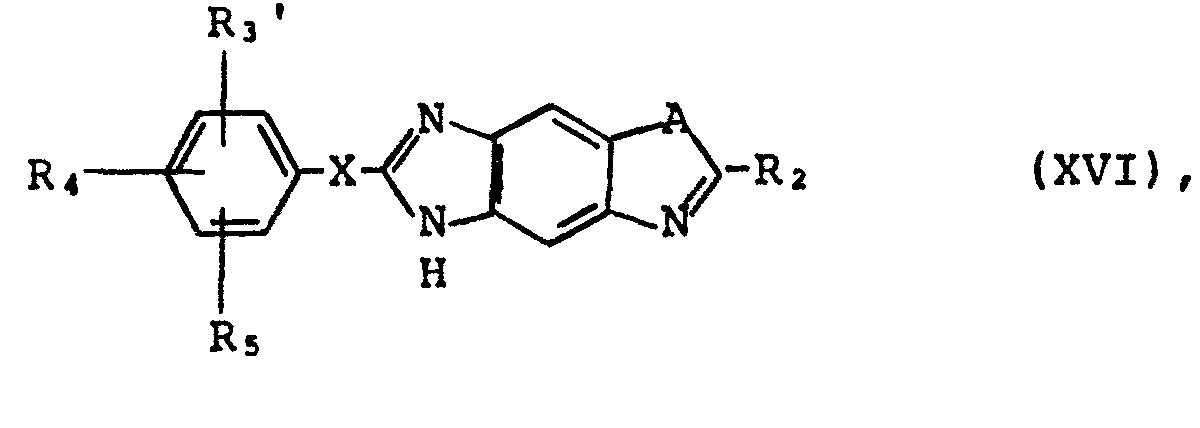
- R2, A, R4, R5 und X wie eingangs definiert sind und R3' eine Alkylmercapto-, Alkylsulfinyl-, Alkylsulfinylmethyl-oder Alkylsulfenylmethylgruppe mit jeweils 1-3 Kohlenstoffatomen im Alkylteil ist.
- Die Oxidation wird vorzugsweise in einem Loesungsmittel oder Loesungsmittelgemisch, z.B. in Wasser, Wasser/Pyridin, Aceton, Eisessig, verduennter Schwefelsaeure oder Trifluoressigsaeure, je nach dem verwendeten Oxidationsmittel zweckmaeßigerweise bei Temperaturen zwischen -80 und 100°C durchgefuehrt.
- Zur Herstellung einer Alkylsulfinyl- oder Alkylsulfinylmethylverbindung der allgemeinen Formel I wird die Oxidation zweckmaeßigerweise mit einem Aequivalent des verwendeten Oxidationsmittel durchgefuehrt, z.B. mit Wasserstoffperoxid in Eisessig, Trifluoressigsaeure oder Ameisensaeure bei 0 bis 20°C oder in Aceton bei 0 bis 60°C, mit einer Persaeure wie Perameisensaeure in Eisessig oder Trifluoressigsaeure bei 0 bis 50°C oder mit m-Chlorperbenzoesaeure in Methylenchlorid oder Chloroform bei -20 bis 60°C, mit Natriummetaperjodat in waessrigem Methanol oder Ethanol bei -15 bis 25°C, mit Brom in Eisessig oder waessriger Essigsaeure, mit N-Brom-succinimid in Ethanol, mit tert.-Butylhypochlorit in Methanol bei -80° bis -30°C, mit Jodbenzodichlorid in waessrigem Pyridin bei 0 bis 50°C, mit Salpetersaeure in Eisessig bei 0 bis 20°C, mit Chromsaeure in Eisessig oder in Aceton bei 0 bis 20°C und mit Sulfurylchlorid in Methylenchlorid bei -70°C, der hierbei erhaltene Thioether-Chlor-Komplex wird zweckmaeßigerweise mit waessrigem Ethanol hydrolysiert.
- Zur Herstellung einer Alkylsulfonyl- oder Alkylsulfonylmethylverbindung der allgemeinen Formel I wird die Oxidation zweckmae8igerweise mit einem bzw. mit zwei oder mehr Aequivalenten des verwendeten Oxidationsmittels durchgefuehrt, z.B. Wasserstoffperoxid in Eisessig, Trifluoressigsaeure oder in Ameisensaeure bei 20 bis 100°C oder in Aceton bei 0 bis 60°C, mit einer Persaeure wie Perameisensaeure oder m-Chlorperbenzoesaeure in Eisessig, Trifluoressigsaeure, Methylenchlorid oder Chloroform bei Temperaturen zwischen 0 und 60°C, mit Salpetersaeure in Eisessig bei 0 bis 20°C, mit Chromsaeure oder Kaliumpermanganat in Eisessig, Wasser/ Schwefelsaeure oder in Aceton bei 0 bis 20°C.
- Die Herstellung von Verbindungen der allgemeinen Formel I, in der R3 eine Alkansulfonyloxy-, Trifluormethansulfonyloxy-, Alkansulfonylamino-, N-Alkyl-alkansulfonylamino-, Trifluormethansulfonylamino-, oder N-Alkyl-trifluormethansulfonylaminogruppe darstellt, wird erreicht durch die nachtraegliche Umsetzung einer Verbindung der allgemeinen Formel XVII

- R2, A, R4, R5 und X wie eingangs definiert sind und R3 eine Hydroxy-, Amino- oder N-Alkylaminogruppe mit 1-3 Kohlenstoffatomen im Alkylteil darstellt, mit einer Sulfonsaeure der allgemeinen Formel XVIII

- R7 eine Alkylgruppe mit 1-3 Kohlenstoffatomen oder eine Trifluormethylgruppe darstellt, in Gegenwart eines wasserentziehenden und/oder die Saeure oder das Amin aktivierenden Mittels oder mit deren reaktionsfaehigen Derivaten.
- Die Umsetzung wird zweckmaeßigerweise in einem Loesungsmittel oder Loesungsmittelgemisch wie Methylenchlorid, Ether, Tetrahydrofuran, Dioxan oder Benzol gegebenenfalls in Gegenwart eines saeurebindenden Mittels wie Natriumcarbonat, Triethylamin oder Pyridin, wobei die beiden letzteren gleichzeitig auch als Loesungsmittel verwendet werden koennen, in Gegenwart eines die Saeure aktivierenden oder wasserentziehenden Mittels wie Thionylchlorid oder Phosphorpentachlorid, vorzugsweise jedoch mit einem reaktionsfaehigen Derivat einer Verbindung der allgemeinen Formel XVIII, z.B. mit deren Anhydrid oder Halogenid wie Methansulfonsaeurechlorid oder Ethansulfonsaeurechlorid, vorzugsweise bei Temperaturen zwischen 0 und 100°C, z.B. bei Temperaturen zwischen Raumtemperatur und 50°C, durchgefuehrt.
- Die Herstellung von Verbindungen der allgemeinen Formel I, in der R3 eine durch eine Amino-, Alkylamino-, Dialkylamino-oder Hydrazinogruppe substituierte Carbonyl- oder Sulfonylgruppe darstellt, wird erreicht durch die nachtraegliche Umsetzung einer Verbindung der allgemeinen Formel XIX

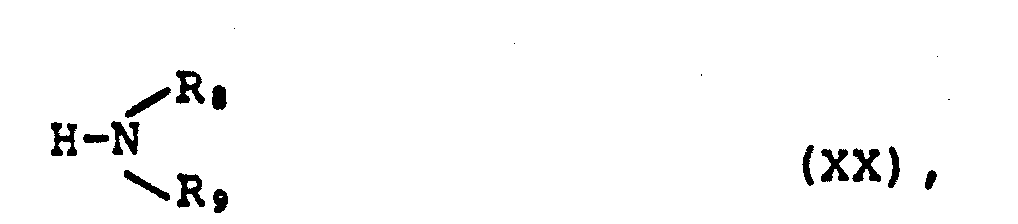
- R, und R9, die gleich oder verschieden sein koennen, Wasserstoffatome oder Alkylgruppen mit 1-5 Kohlenstoffatomen darstellen, oder mit einem reaktionsfaehigen Derivat hiervon, falls R3"' die Carboxyl- oder Hydroxysulfonylgruppe darstellt.
- Die Umsetzung wird zweckmaeßigerweise in einem Loesungsmittel oder Loesungsmittelgemisch wie Methylenchlorid, Ethanol, Chloroform, Tetrachlorkohlenstoff, Ether, Tetrahydrofuran, Dioxan, Benzol, Toluol, Acetonitril oder Dimethylformamid, gegebenenfalls in Gegenwart eines die Saeure aktivierenden Mittels oder eines wasserentziehenden Mittels, z.B. in Gegenwart von Chlorameisensaeureethylester, Thionylchlorid, Phosphortrichlorid, Phosphorpentoxid, N'N-Dicyclo- hexylcarbodiimid/N-Hydroxysuccinimid, N-N'-Carbonyldiimidazol
- oder N,N'-Thionyldiimidazol oder Triphenylphosphin/Tetrachlorkohlenstoff, oder eines die Hydrazino- oder Aminogruppe aktivierenden Mittels, z.B. Phosphortrichlorid, und gegebenenfalls in Gegenwart einer anorganischen Base wie Natriumcarbonat oder einer tertiaeren organischen Base wie Triethylamin oder Pyridin, welche gleichzeitig als Loesungsmittel dienen koennen, bei Temperaturen zwischen -25 und 250°C, vorzugsweise jedoch bei Temperaturen zwischen -10°C und der Siedetemperatur des verwendeten Loesungsmittels durchgefuehrt werden, desweiteren kann waehrend der Umsetzung entstehendes Wasser durch azeotrope Destillation, z.B. durch Erhitzen mit Toluol am Wasserabscheider, oder durch Zugabe eines Trockenmittels wie Magnesiumsulfat oder Molekularsieb abgetrennt werden.
- Besonders vorteilhaft wird jedoch die Umsetzung in einem entsprechenden Halogenid, z.B. dem Carbonsaeure- oder Sulfonsaeurechlorid, und Hydrazin oder einem entsprechenden Amin, wobei diese gleichzeitig als Loesungsmittel dienen koennen, und bei Temperaturen zwischen 0 und 50°C durchgefuehrt.
- Erhaelt man eine Verbindung der allgemeinen Formel I, in der R3 die Cyangruppe darstellt, so kann diese anschließend mittels Alkoholyse und/oder Hydrolyse in eine entsprechende Verbindung, in der R3 eine Alkoxycarbonylgruppe mit insgesamt 2-5 Kohlenstoffatomen, die Aminocarbonyl- oder Carboxylgruppe und/oder R4 eine Alkoxycarbonylgruppe mit insgesamt 2-4 Kohlenstoffatomen, die Aminocarbonyl- oder Carboxylgruppe darstellen, ueberfuehrt werden und/oder eine Verbindung der allgemeinen Formel I, in der R3 die Carboxygruppe darstellt, mittels Veresterung in eine entsprechende Verbindung der allgemeinen Formel I, in der R3 eine Alkoxycarbonylgruppe mit insgesamt 2-5 Kohlenstoffatomen darstellt, ueberfuehrt werden.
- Die nachtraegliche Alkoholyse und/oder Hydrolyse wird zweckmaeßigerweise entweder in Gegenwart einer Saeure wie Salzsaeure, Schwefelsaeure, Phosphorsaeure oder Trichloressigsaeure oder in Gegenwart einer Base wie Natriumhydroxid oder Kaliumhydroxid in einem geeigneten Loesungsmittel wie Wasser, Wasser/Methanol, Ethanol, Wasser/Ethanol, Wasser/Isopropanol oder Wasser/Dioxan bei Temperaturen zwischen -10 und 120°C, z.B., bei Temperaturen zwischen Raumtemperatur und der Siedetemperatur des Reaktionsgemisches, durchgefuehrt.
- Die nachtraegliche Veresterung wird zweckmaeßigerweise in einem geeigneten Loesungsmittel, z.B. in einem entsprechenden Alkohol, Pyridin, Toluol, Methylenchlorid, Tetrahydrofuran oder Dioxan, in Gegenwart eines saeureaktivierenden und/oder wasserentziehenden Mittels wie Thionylchlorid, Chlorameisensaeureethylester, N,N'-Dicyclohexylcarbodiimid oder dessen Isoharnstoffethern, gegebenenfalls in Gegenwart eines Reaktionsbeschleunigers wie Kupfer-chlorid, oder durch Umesterung, z.B. mit einem entsprechenden Kohlensaeurediester, bei Temperaturen zwischen 0 und 100°C, vorzugsweise jedoch bei Temperaturen zwischen 20°C und der Siedetemperatur des betreffenden Loesungsmittels, durchgefuehrt.
-
- d) fuer die Umsetzung einer Verbindung der allgemeinen Formel I, in der R2 die Hydroxygruppe, oder X eine Bindung und R1 die Hydroxygruppe, oder in der sowohl R1 als auch R2 eine Hydroxygruppe und X eine Bindung darstellt, zu einer anderen Verbindung der allgemeinen Formel I, in der R, und/oder R2 die Mercaptogruppe bedeutet.
- Die Umsetzung wird nach literaturbekannten Verfahren mit einem das Schwefelatom uebertragenden Reagenz, wie z.B. Phosphorpentasulfid durchgefuehrt, wobei man zweckmaeßigerweise 1-5 Mol P2S5 vorzugsweise jedoch 1 Mol in einem geeigneten Loesungsmittel umsetzt. Als Loesungsmittel kommen Tetrahydrofuran, Dioxan, Benzol, Toluol oder Pyridin bei Temperaturen zwischen 25 und 125°C in Betracht.
- Bevorzugt ist jedoch bei einer Raektionsdauer von 1-10 Stunden, vorzugsweise 5 Stunden in Abhaengigkeit vom Reaktionspartner.
-
- e) fuer die Umsetzung einer Verbindung der allgemeinen Formel I, in der R2 eine Aminogruppe bedeutet, oder in der R, eine Aminogruppe bedeutet (waehrend X eine Bindung darstellt), oder in der X eine Bindung und sowohl R, als auch R2 eine Aminogruppe darstellen, mit aktivierten Saeurederivaten wie Anhydriden oder Saeurehalogeniden, zu Alkylcarbonylamino- oder Pyridylcarbonylaminoderivaten. Die Umsetzungen werden vorzugsweise in inerten Loesungsmitteln wie Methylenchlorid oder Pyridin bei Temperaturen zwischen 0°C und 250°C, vorzugsweise jedoch bei der Siedetemperatur des Loesungsmittels durchgefuehrt.
- f) fuer die nachtraegliche Alkylierung von Verbindungen der allgemeinen Formel I, in der R2 die Mercaptogruppe, oder in der R, die Mercaptogruppe und X eine Bindung, oder in der X eine Bindung und sowohl R1 als auch R2 eine Mercaptogruppe darstellen zu den entsprechenden Alkylmercaptoverbindungen. Die Reaktionen werden vorzugsweise in einem Loesungsmittel wie Aceton, Ether, Benzol, Toluol, Dimethylformamid bei Temperaturen zwischen -30°C und +100°C, vorzugsweise bei Raumtemperatur, in Gegenwart einer Base wie Kaliumcarbonat oder Natriumhydrid und eines Alkylierungsmittels wie Alkylhalogeniden oder Alkylsulfaten durchgefuehrt.
- Ferner koennen die erhaltenen Verbindungen der allgemeinen Formel I anschließend gewuenschtenfalls in ihre physiologisch vertraeglichen Saeureadditionssalze mit anorganischen oder organischen Saeuren ueberfuehrt werden. Als Saeuren kommen hierfuer beispielsweise Salzsaeure, Bromwasserstoffsaeure, Schwefelsaeure, Phosphorsaeure, Fumarsaeure, Bernsteinsaeure, Weinsaeure, Zitronensaeure, Milchsaeure, Maleinsaeure oder Methansulfonsaeure in Betracht.
- Wie bereits eingangs erwaehnt weisen die neuen Verbindungen der allgemeinen Formel I, deren Tautomere und deren physiologisch vertraegliche Saeureadditionssalze bei einer langen Wirkungsdauer ueberlegene pharmakologische Eigenschaften auf, insbesondere eine blutdrucksenkende und/oder positiv-inotrope Wirkung und/oder beeinflussen sie die Thrombozytenfunktion und verbessern die Mikrozirkulation.
- Zur Herstellung von Arzneimitteln werden die Substanzen der allgemeinen Formel I in an sich bekannnter Weise mit geeigneten pharmazeutischen Traegersubstanzen, Aroma-, Geschmacks-und Farbstoffen gemischt und beispielsweise als Tabletten oder Dragees ausgeformt oder unter Zugabe entsprechender Hilfsstoffe in Wasser oder Oel, wie z.B. Olivenoel, suspendiert oder geloest.
- Die erfindungsgemaeßen neuen Substanzen der allgemeinen Formel I und ihre Salze koennen in fluessiger oder fester Form enteral oder parenteral appliziert werden. Als Injektionsmedium kommt vorzugsweise Wasser zur Anwendung, welches die bei Injektionsloesungen ueblichen Zusaetze wie Stabilisierungsmittel, Loesungsvermittler oder Puffer enthaelt.
- Derartige Zusaetze sind z.B. Tartrat- und Citratpuffer, Ethanol, Komplexbildner (wie Ethylendiamintetraessigsaeure und deren nicht toxische Salze) und hochmolekulare Polymere (wie fluessiges Polyethylenoxid) zur Viskositaetsregulierung. Feste Traegerstoffe sind z.B. Staerke, Lactose, Mannit, Methylcellulose, Talkum, hochdisperse Kieselsaeuren, hochmolekulare Fettsaeuren (wie Staerinsaeure), Gelatine, Agar-Agar, Calciumphosphat, Magnesiumstearat, tierische und pflanzliche Fette und feste hochmolekulare Polymere (wie Polyethylenglykole). Fuer orale Applikation geeignete Zubereitungen koennen gewuenschtenfalls Geschmacks- und Sueßstoffe enthalten.
- Die erfindungsgemaeßen Verbindungen werden ueblicherweise in Mengen von 10-500 mg pro Tag bezogen auf 75 kg Koerpergewicht appliziert. Bevorzugt ist es, 2-3 mal pro Tag 1-2 Tabletten mit einem Wirkstoffgehalt von 5-200 mg zu verabreichen. Die Tabletten koennen auch retardiert sein, wodurch nur noch 1mal pro Tag 1-2 Tabletten mit 10-500 mg Wirkstoff gegeben werden muß. Der Wirkstoff kann auch durch Injektion 1-8mal pro Tag bzw. durch Dauerinfusion gegeben werden, wobei Mengen von 5-200 mg/Tag normalerweise ausreichen.
- Bevorzugt im Sinne der vorliegenden Erfindung sind außer den in den Beispielen genannten Verbindungen die folgenden und deren Tautomere.
- 6-(4-Methoxyphenyl)-1-methyl-1,2,3,5-tetrahydrobenzo[1,2-d: 4,5-d']diimidazol-2-on
- 6-(4-Nitrophenyl)-1-methyl-1,2,3,5-tetrahydrobenzo[1,2-d: 4,5-d']diimidazol-2-on
- 6-(4-Aminophenyl)-1-methyl-1,2,3,5-tetrahydrobenzo[1,2-d: 4,5-d']diimidazol-2-on
- 6-(4-Acetylaminophenyl)-1-methyl-1,2,3,5-tetrahydrobenzo-[1,2-d:4,5-d']diimidazol-2-on
- 6-(4-Hydroxyphenyl)-1-methyl-1,2,3,5-tetrahydrobenzo[1,2-d: 4,5-d']diimidazol-2-on
- 6-(4-Chlorphenyl)-1-methyl-1,2,3,5-tetrahydrobenzo[1,2-d: 4,5-d']diimidazol-2-on
- 6-(4-Methylsulfenyl-2-methoxyphenyl)-1-methyl-1,2,3,5-tetra- hydrobenzo[1,2-d:4,5-d']diimidazol-2-on
- 6-(4-Methylsulfinyl-2-methoxyphenyl)-1-methyl-1,2,3,5-tetra- hydrobenzo[1,2-d:4,5-d']dilmidazol-2-on
- 6-(4-Methylsulfonyl-2-methoxyphenyl)-1-methyl-1,2,3,5-tetra- hydrobenzo[1,2-d:4,5-d']diimidazol-2-on
- 6-(4-Methylsulfonyloxy-2-methoxyphenyl)-1-methyl-1,2,3,5-tetrahydrobenzo[1,2-d:4,5-d']diimidazol-2-on
- 6-(4-Aminosulfonyl-2-methoxyphenyl)-1-methyl-1,2,3,5-tetra- hydrobenzo[1,2-d:4,5-d']diimidazol-2-on
- 6-(4-Methylsulfenylmethyl-2-methoxyphenyl)-1-methyl-1,2,3,5-tetrahydrobenzo[1,2-d:4,5-d']diimidazol-2-on
- 6-(4-Methylsulfinylmethyl-2-methoxyphenyl)-1-methyl-1,2,3,5-tetrahydrobenzo[1,2-d:4,5-d']diimidazol-2-on
- 6-(4-Methylsulfonylmethyl-2-methoxyphenyl)-1-methyl-1,2,3,5-tetrahydrobenzo[1,2-d:4,5-d']diimidazol-2-on
- 6-(N-oxy-4-pyridyl)-1-methyl-1,2,3,5-tetrahydrobenzo[1,2-d: 4,5-d']diimidazol-2-on
- 6-(N-oxy-3-pyridyl)-1-methyl-1,2,3,5-tetrahydrobenzo[1,2-d: 4,5-d']diimidazol-2-on
- 6-(2-Chlor-4-pyridyl)-1-methyl-1,2,3,5-tetrahydrobenzo-[1,2-d:4,5-d']diimidazol-2-on
- 6-(2-Hydroxy-4-pyridyl)-1-methyl-1,2,3,5-tetrahydrobenzo-[1,2-d:4,S-d']diimidazol-2-on
- 6-(2-Methyl-4-pyridyl)-1-methyl-1,2,3,5-tetrahydrobenzo-[1,2-d:4,5-d']diimidazol-2-on
- 6-((4-Pyridyl)-2-ethyl)-1-methyl-1,2,3,5-tetrahydrobenzo-[1,2-d:4,5-d']diimidazol-2-on
- 6-((4-Pyridyl)-2-ethenyl)-1-methyl-1,2,3,5-tetrahydrobenzo-[1,2-d:4,5-d']diimidazol-2-on
- 6-(1,2,5-Thiadiazolyl)-1-methyl-1,2,3,5-tetrahydrobenzo-[1,2-d:4,5-d']dimidazol-2-on
- 6-(1,3,4-Thiadiazolyl)-1-methyl-1,2,3,5-tetrahydrobenzo-[1,2-d:4,5-d']diimidazol-2-on
- 6-Propyl-1-methyl-1,2,3,5-tetrahydrobenzo-[1,2-d:4,5-d']-diimidazol-2-on
- 6-Trifluormethyl-1-methyl-1,2,3,5-tetrahydrobenzo-[1,2-d: 4,5-d']diimidazöl-2-on
- 6-Hexyl-1-methyl-1,2,3,5-tetrahydrobenzo-[1,2-d:4,5-d']-diimidazol-2-on
- 6-(2-Propyl)-1-methyl-1,2,3,5-tetrahydrobenzo-[1,2-d:4,5-d']-diimidazol-2-on
- 6-(2-Propenyl)-1-methyl-1,2,3,5-tetrahydrobenzo[1,2-d:4,5-d']diimidazol-2-on
- 6-Cyclopropyl-1-methyl-1,2,3,5-tetrahydrobenzo[1,2-d:4,5-d']-diimidazol-2-on
- 6-Cyclohexyl-1-methyl-1,2,3,5-tetrahydrobenzo(1,2-d:4,5-d']-diimidazol-2-on
- 6-Cyclopentenyl-1-methyl-1,2,3,5-tetrahydrobenzo(1,2-d:4,5-d']diimidazol-2-on
- 6-Mercapto-1-methyl-1,2,3,5-tetrahydrobenzo[1,2-d:4,5-d']-diimidazol-2-on
- 6-Methylmercapto-1-methyl-1,2,3,5-tetrahydrobenzo[1,2-d: 4,5-d']diimidazol-2-on
- 6-Amino-1-methyl-1,2,3,5-tetrahydrobenzo[1,2-d:4,5-d']-diimidazol-2-on
- 6-(4-Pyridyl-carbonylamino)-1-methyl-1,2,3,5-tetrahydrobenzo-[1,2-d:4,5-d']diimidazol-2-on
- 6-(2-Carboxyethyl)-1-methyl-1,2,3,5-tetrahydrobenzo[1,2-d: 4,5-d']diimidazol-2-on
- 6-(2-Ethoxycarbonyl-ethyl)-1-methyl-1,2,3,5-tetrahydrobenzo-[1,2-d:4,5-d']diimidazol-2-on
- 6-Methoxymethyl-1-methyl-1,2,3,5-tetrahydrobenzo[1,2-d:4,5-d']diimidazol-2-on
- 6-(2-Pyridyl)-1-ethyl-1,2,3,5-tetrahydrobenzo[1,2-d:4,5-d']-diimidazol-2-on
- 6-(N-oxy-4-pyridyl)-1-ethyl-1,2,3,5-tetrahydrobenzo[1,2-d: 4,5-d']diimidazol-2-on
- 6-i3-Pyridazinyl)-1-ethyl-1,2,3,5-tetrahydrobenzo[1,2-d: 4,5-d']diimidazol-2-on
- 6-(1,2,5-Thiadiazol-3-yl)-1-ethyl-1,2,3,5-tetrahydrobenzo-[1,2-d:4,5-d']diimidazol-2-on
- 6-(1,3,4-Thiadiazol-2-yl)-1-ethyl-1,2,3,5-tetrahydrobenzo-[1,2-d:4,5-d']diimidazol-2-on
- 6-Phenyl-l-ethyl-1,2,3,5-tetrahydrobenzo[1,2-d:4,5-d']-diimidazol-2-on
- 6-(2-Dimethylamino-4-nitrophenyl)-1-ethyl-1,2,3,5-tetra- hydrobenzo[1,2-d:4,5-dl]diimidazol-2-on
- 6-(4-Trifluormethylsulfonyloxy-2-methoxyphenyl)-1-ethyl- 1,2,3,5-tetrahydrobenzo[1,2-d:4,5-d']diimidazol-2-on
- 6-(4-(4-Morpholinylsulfonyl)-2-methoxyphenyl)-1-ethyl-1,2,3, 5-tetrahydrobenzo[1,2-d:4,5-d']diimidazol-2-on
- 6-(4-Carboxy-2-methoxyphenyl)-1-ethyl-1,2,3,5-tetrahydro- benzo[1,2-d:4,5-d']diimidazol-2-on
- 6-(4-Ethoxycarbonyl-2-methoxyphenyl)-1-ethyl-1,2,3,5-tetra- hydrobenzo[1,2-d:4,5-d']diimidazol-2-on
- 6-(4-Aminocarbonyl-2-methoxyphenyl)-1-ethyl-1,2,3,5-tetra- hydrobenzo[1,2-d:4,5-d']diimidazol-2-on
- 6-(4-Cyano-2-methoxyphenyl)-1-ethyl-1,2,3,5-tetrahydrobenzo-[1,2-d:4,5-d']diimidazol-2-on
- 6-(3,4,5-Trimethoxyphenyl)-1-ethyl-1,2,3,5-tetrahydrobenzo-[1,2-d:4,5-d']diimidazol-2-on
- 6-(2-Furyl)-1-methyl-1,2,3,5-tetrahydrobenzo[1,2-d:4,5-d']-diimidazol-2-on
- 6-(2-Thienyl)-1-methyl-1,2,3,5-tetrahydrobenzo[1,2-d:4,5-d']-diimidazol-2-on
- 6-(2-Pyrrolyl)-1-methyl-1,2,3,5-tetrahydrobenzo[1,2-d: 4,5-d']diimidazol-2-on
- 6-(4-Imidazolyl)-1-methyl-1,2,3,5-tetrahydrobenzo[1,2-d: 4,5-d']diimidazol-2-on
- 6-(4-Pyrimidinyl)-1-methyl-1,2,3,5-tetrahydrobenzo[1,2-d: 4,5-d']diimidazol-2-on
- 6-(5-Pyrimidinyl)-1-methyl-1,2,3,5-tetrahydrobenzo[1,2-d: 4,5-d']diimidazol-2-on
- 6-(1,2,4-Triazol-3-yl)-1-methyl-1,2,3,5-tetrahydrobenzo-[1,2-d:4,5-d']diimidazol-2-on
- 6-(1,2,4,5-Tetrazin-3-yl)-1-methyl-1,2,3,5-tetrahydrobenzo-[1,2-d:4,5-d']diimidazol-2-on
- 6-(2-Methyl-5-pyrimidinyl)-1-methyl-1,2,3,5-tetrahydro- benzo[1,2-d:4,5-d']diimidazol-2-on
- 6-(2-Hydroxy-5-pyrimidinyl)-1-methyl-1,2,3,5-tetrahydro- benzo[1,2-d:4,5-d']diimidazol-2-on
- 6-(1,2-Dihydro-1-methyl-2-oxo-5-pyrimidinyl)-1-methyl-1,2,3,5-tetrahydrobenzo[1,2-d:4,5-d']diimidazol-2-on
- 6-(6-Methyl-4-pyrimidinyl)-1-methyl-1,2,3,5-tetrahydrobenzo-[1,2-d:4,5-d']diimidazol-2-on
- 6-(3-Hydroxy-6-pyridazinyl)-1-methyl-1,2,3,5-tetrahydro- benzo[1,2-d:4,5-d']diimidazol-2-on
- 6-(5,6-Dimethyl-1,2,4-triazin-3-yl)-1-methyl-1,2,3,5-tetra- hydrobenzo[1,2-d:4,5-d']diimidazol-2-on
- 6-(3-Methyl-5-pyrazolyl)-1-methyl-1,2,3,5-tetrahydrobenzo-[1,2-d:4,5-d']diimidazol-2-on
- 6-(2-Methyl-4-oxazolyl)-1-methyl-1,2,3,5-tetrahydrobenzo-[1,2-d:4,5-d']diimidazol-2-on
- 6-(2,6-Dihydroxy-4-pyrimidinyl)-1-methyl-1,2,3,5-tetrahydro- benzo[1,2-d:4,5-d']diimidazol-2-on
- 6-(2-Pyrrolyl)-1-propyl-1,2,3,5-tetrahydrobenzo[1,2-d:4,5-d'jdiimidazol-2-on
- 6-(3-Pyridyl)-1-propyl-1,2,3,5-tetrahydrobenzo[1,2-d:4,5-d']diimidazol-2-on
- 6-Phenyl-1-propyl-1,2,3,5-tetrahydrobenzo[1,2-d:4,5-d']-diimidazol-2-on
- 6-(4-Methylaminocarbonylamino-2-methoxyphenyl)-1-propyl-1,2,3,5-tetrahydrobenzo[1,2-d:4,5-d']diimidazol-2-on
- 6-(4-Aminocarbonylamino-2-methoxyphenyl)-1-propyl-1,2,3,5-tetrahydrobenzo[1,2-d:4,5-d']diimidazol-2-on
- 6-(4-Methylaminocarbonylamino-2-methoxyphenyl)-1-propyl-1,2,3,5-tetrahydrobenzo[1,2-d:4,5-d']diimidazol-2-on
- 6-(4-Pyridyl)-1-methyl-1,2,3,5-tetrahydrobenzo[1,2-d:4,5-d']-diimidazol-2-thion
- 6-(4-Pyridyl)-2-methyl-1,5-dihydrobenzo[1,2-d:4,5-d']-diimidazol
- 6-(4-Pyridyl)-1,2-dimethyl-1,5-dihydrobenzo[1,2-d:4,5-d']-diimidazol
- 6-(4-Pyridyl)-5H-imidazo-[4,5-f]benzoxazol
- 6-(5-Pyrimidinyl)-2,3-dihydro-5H-imidazo[4,5-f]benzoxazol-2-on
- 6-(2-Chlor-4-pyridyl)-2,3-dihydro-5H-imidazo[4,5-f]-benzoxazol-2-on
- 6-(4-Cyanophenyl)-2,3-dihydro-5H-imidazol[4,5-f]benzoxazol-2-on
- 6-(1,2,5-Thiadiazolyl)-2,3-dihydro-5H-imidazo[4,5-f]-benzoxazol-2-on
- 6-(1,3,4-Thiadiazolyl)-2,3-dihydro-5H-imidazo[4,5-f]-benzoxazol-2-on
- 6-Ethyl-2,3-dihydro-5H-imidazo[4,5-f]benzoxazol-2-on
- 6-Butyl-2,3-dihydro-5H-imidazo[4,5-f]benzoxazol-2-on
- 6-Hexyl-2,3-dihydro-5H-imidazo[4,5-f]benzoxazol-2-on
- 6-(2-Proypl)-2,3-dihydro-5H-imidazo[4,5-f]benzoxazol-2-on
- 6-(2-Propenyl)-2,3-dihydro-5H-imidazo[4,5-f]benzoxazol-2-on
- 6-Cyclopropyl-2,3-dihydro-5H-imidazo[4,5-f]benzoxazol-2-on
- 6-Cyclohexyl-2,3-dihydro-5H-imidazo[4,5-f]benzoxazol-2-on
- 6-Cyclopentyl-2,3-dihydro-5H-imidazo[4,5-f]benzoxazol-2-on
- 6-Mercapto-2,3-dihydro-5H-imidazo[4,5-f]benzoxazol-2-on
- 6-Methylmercapto-2,3-dihydro-5H-imidazo[4,5-f]benzoxazol-2-on
- 6-Amino-2,3-dihydro-5H-imidazo[4,5-f]benxoxazol-2-on
- 6-(4-Pyridylcarbonylamino)-2,3-dihydro-5H-imidazo[4,5-f]-benzoxazol-2-on
- 6-(2-Carboxyethyl)-2,3-dihydro-5H-imidazo[4,5-f]benzoxazol-2-on
- 6-(2-Ethoxycarbonyl-ethyl)-2,3-dihydro-5H-imidazo[4,5-f]-benzoxazol-2-on
- 6-Methoxymethyl-2,3-dihydro-5H-imidazo[4,5-f]benzoxazol-2-on
- 6-(4-Pyridyl)-2,3-dihydro-5H-imidazo[4,5-f]benzoxazol-2-thion
- 6-(4-Pyridyl)-2-methyl-5H-imidazo[4,5-f]benzoxazol
- 6-(4-Pyridyl)-5H-imidazo[4,5-f]benzthiazol
- 6-(4-Pyridyl)-2,3-dihydro-5H-imidazo[4,5-f]benzthiazol-2-thion
- 6-(3-Pyridyl)-2-methyl-5H-imidazo[4,5-f]benzthiazol
- 6-(5-Isoxazolyl)-1-methyl-1,2,3,5-tetrahydrobenzo[1,2-d: 4,5-d']diimidazol-2-on
- 6-(5-Isothiazolyl)-1-methyl-1,2,3,5-tetrahydrobenzo[1,2-d: 4,5-d']diimidazol-2-on
- 6-(5-Isoxazolyl)-2,3-dihydro-5H-imidazo[4,5-f]benzoxazol-2-on
- 6-(5-Isothiazolyl)-2,3-dihydro-5H-imidazo[4,5-f]benzoxazol-2-on
- 6-(5-Isoxazolyl)-2,3-dihydro-5H-imidazo/4,5-f7benzothiazol-2-on
- 6-(5-Isothiazolyl)-2,3-dihydro-5H-imidazo[4,5-f]benzothiazol-2-on
- 6-(1,2,5-Thiadiazol-3-yl)-2,3-dihydro-5H-imidazo[4,5-f]-benzothiazol-2-on
- Neue Verbindungen der allgemeinen Formel IX, X und XI sind außer den in den Beispielen genannten die folgenden
- 6-Nitro-5-(4-pyridylcarbonylamino)benzoxazolinon
- 6-Nitro-5-(3-pyridylcarbonylamino)benzoxazolinon
- 6-Nitro-5-phenylcarbonylamino-benzoxazolinon
- 6-Nitro-5-(2-thienylcarbonylamino)benzoxazolinon
- 6-Nitro-5-(2-furylcarbonylamino)benzoxazolinon
- 6-Nitro-5-(4-pyridazinylcarbonylamino)benzoxazolinon
- 5-Nitro-6-(4-pyridylcarbonylamino)benzoxazolinon
- 5-Nitro-6-(3-pyridylcarbonylamino)benzoxazolinon
- 5-Nitro-6-phenylcarbonylamino-benzoxazolinon
- 5-Nitro-6-(2-methoxyphenyl-carbonylamino)benzoxazolinon
- 5-Nitro-6-(2-methylmercaptophenyl-carbonylamino)-benzoxazolinon
- 5-Nitro-6-(4-cyanophenyl-carbonylamino)benzoxazolinon
- 5-Nitro-6-(2-furyl-carbonylamino)benzoxazolinon
- 5-Nitro-6-(2-thienyl-carbonylamino)benzoxazolinon
- 5-Nitro-6-(3-thienyl-carbonylamino)-benzoxazolinon
- 5-Nitro-6-(4-pyridazinyl-carbonylamino)benzoxazolinon 5-Nitro-6-(5-pyrimidinyl-carbonylamino)benzoxazolinon
- 5-Nitro-6-(5-pyrazinyl-carbonylamino)benzoxazolinon
- 5-Nitro-6-(2-methyl-4-pyridinyl-carbonylamino)- . benzoxazolinon
- 5-Nitro-6-(2-chlor-4-pyridinyl-carbonylamino)benzoxazolinon
- 7-Brom-2-methyl-6-(4-pyridyl-carbonylamino)benzoxazol
- 7-Brom-2-methyl-6-(3-pyridyl-carbonylamino)benzoxazol
- 7-Brom-2-methyl-6-phenylcarbonylamino-benzoxazol
- 7-Brom-2-methyl-6-(2-methoxyphenyl-carbonylamino)-benzoxazol
- 7-Brom-2-methyl-6-(2-methylmercaptophenyl-carbonylamino)-benzoxazol
- 7-Brom-2-methyl-6-(4-cyanophenyl-carbonylamino)benzoxazol
- 7-Brom-2-methyl-6-(3-pyridyl-carbonylamino)benzthiazol
- 7-Brom-2-methyl-6-phenylcarbonylamino-benzthiazol
- 7-Brom-2-methyl-6-(2-thienyl-carbonylamino)benzthiazol
- 7-Brom-2-methyl-6-(3-thienyl-carbonylamino)benzthiazol
- 7-Brom-2-methyl-6-(2-furyl-carbonylamino)benzthiazol
- 7-Brom-2-methyl-6-(4-pyridazinyl-carbonylamino)-benzthiazol
- 7-Brom-2-methyl-6-(5-pyrimidinyl-carbonylamino)benzthiazol
- 7-Brom-2-methyl-6-(5-pyrazinyl-carbonylamino)benzthiazol
- 7-Brom-2-methyl-6-(2-methyl-4-pyridinylcarbonylamino)-benzthiazol
- 7-Brom-2-methyl-6-(2-methoxyphenyl-carbonylamino)benzthiazol
- 7-Brom-2-methyl-6-(2-methylmercaptophenyl-carbonylamino)-benzthiazol
- 7-Brom-6-(4-pyridyl-carbonylamino)benzoxazol
- 7-Brom-6-(4-pyridyl-carbonylamino)benzthiazol
- 14.8 g (100 mmol) 5,6-Diaminobenzimidazol, 10.7 g (100 mmol) Pyridin-4-aldehyd und 5 ml konzentrierte Salzsaeure in 500 ml Ethanol werden eine Stunde unter Rueckfluß zum Sieden erhitzt. Nach Klaeren der Loesung mit Aktivkohle wird eingeengt und der Rueckstand mit wenig Wasser digeriert. Nach Absaugen und Trocknen erhaelt man 6.98 g (29 %) der Titelverbindung als Hydrochlorid. Fp. >280°C, farblose Kristalle.
-
- a) Zu einer Loesung von 16.0 g (76.9 mmol) 5,6-Dinitrobenzimidazol in 500 ml DMF werden 80 ml 1 M Natriummethylatloesung gegeben und im Vakuum auf ca. 150 ml eingeengt. Nach Zugabe von 15 ml (241 mmol) Methyliodid wird 1 Tag bei 40°C geruehrt. Die Loesung gießt man auf 1.5 Liter Eiswasser. Der ausgefallene Niederschlag wird abgesaugt und getrocknet. 10 g (58 %) 1-Methyl-5,6-dinitrobenzimidazol, Fp. 238-240°C farblose Kristalle.
- b) 4.40 g (20.0 mmol) 1-Methyl-5,6-dinitrobenzimidazol und 0.5 g Adams Katalysator in 250 ml Ethanol werden 4 Stunden bei 40°C mit 4 bar H2 Druck hydriert. Der Katalysator wird abfiltriert und das Filtrat nach Zusatz von 2.10 g (20.0 mmol) Pyridin-4-aldehyd und 3 ml konzentrierter Salzsaeure unter Rueckfluß zum Sieden erhitzt.
- Nach chromatographischer Reinigung (Kieselgel), Essigester-Methanol 1:1, v/v) ergibt Einengen der entsprechenden Fraktionen 1.1 g (21 %) farblose Kristalle mit Fp. >280°C (Semihydrochlorid der Titelverbindung).
-
- a) 2.20 g (9.2 mmol) 5,6-Dinitro-1-methyl-benzimidazol-2-on wurde in Gegenwart von 0.44 g Platindioxid in 730 ml Methanol bei 60°C und 100 bar drei Stunden lang hydriert. Die so erhaltenen Loesung von 5,6-Diamino-1-methylbenzimidazol-2-on wurde nach Filtration ohne weitere Reinigung eingesetzt.
- b) 0.98 g (9.2 mmol) Pyridin-3-aldehyd und 73 mg p-Toluolsulfonsaeure wurden vorgelegt und die unter a) hergestellte Loesung dazugegeben. Man erhitzte zwei Stunden unter Rueckfluß, entfernte das Loesungsmittel im Vakuum, nahm den Rueckstand in Wasser auf und neutralisierte mit 2 N Ammoniakloesung. Der ausgefallene Niederschlag wurde abgesaugt und aus Isopropanol kristallisiert. Man erhielt 450 mg (20 %) der Titelverbindung mit Fp. >300°C.
- Mit analog Beispiel 4 a erhaltenen Loesungen von 5,6-Diamino-1-methyl-benzimidazol-2-on und den angegebenen Aldehyden in Gegenwart katalytischer Mengen der angegebenen Saeuren wurden analog Beispiel 4 b die folgenden Verbindungen dargestellt:


-
- a) 3.35 g (17.2 mmol) 6-Amino-5-nitrobenzoxazolinon werden in 120 ml Methanol in Gegenwart von 0.5 g 10 % Palladium auf Kohle bei Normaldruck hydriert. Nach 1 h wird der Katalysator abfiltriert und die Loesung im Vakuum eingeengt. Der Rueckstand wird ohne Reinigung weiter umgesetzt.
- b) Eine Mischung aus 0.5 g 5,6-Diamino-benzoxazolin-2-on und 0.41 g Pyridazin-4-carbonsaeure mit 5.4 g warmer Polyphosphorsaeure hielt man eine Stunde in einem auf 150°C vorgeheiztem Bad, loeste den Ansatz nach dem Erkalten in 30 ml Eiswasser, neutralisierte mit waessriger Ammoniakloesung, saugte die erhaltene Faellung ab, wusch mit Wasser und erhielt so 0.38 g Rohprodukt. Dieses suspendierte man in Wasser, gab bis zur klaren Loesung waessrige Kalilauge zu, behandelte mit Aktivkohle, saugte ab, neutralisierte das Filtrat, saugte die erhaltene Faellung ab, wusch mit Wasser und erhielt so 0.22 g der Titelverbindung als Monohydrat mit Schmp. >330°C.
- Analog dem Beispiel 5 erhielt man die folgenden Verbindungen:


- 1 g rohes 5,6-Diamino-benzoxazolin-2-on (erhalten durch Hydrierung des 6-Amino-5-nitro-benzoxazolinons analog Beisp. 5 a) suspendierte man in 30 ml Methylenchlorid und 1.82 g Triethylamin, tropfte bei Eiskuehlung rasch 1.26 g Benzoylchlorid zu, ließ die entstandene Loesung 15 min bei 10°C nachruehren, tropfte erneut bei ca. 0°C 0.91 g Triethylamin und dann 0.5 ml Benzoylchlorid zu, ließ 30 min bei 10°C und 15 min bei Raumtemp. nachruehren, dampfte dann im Vacuum ein, rieb den Eindampfrueckstand mit Eiswasser an (ca. 30 ml) und erhielt so 2.2 g festes rohes Produkt, welches ohne weitere Reinigung in der folgenden Reaktionsstufe eingesetzt wurde.
- 1.9 g davon kochte man mit 82 ml Ethanol und 11 ml konz. HCl 5 h unter Rueckfluß, gab dann erneut 11 ml konz. Salzsaeure zu, kochte weitere 4 h unter Rueckfluß, saugte nach dem Erkalten ueber Nacht das erhaltene Kristallisat ab, wusch mit Ethanol und Ether und erhielt so 0.62 g HCl-Salz der Titelverbindung; Fp. ca. 350°C, Zers.
- 0.1 g davon lieferte nach Neutralisation mit waessrigem Ammoniak in waesseriger Suspension (bis etwa pH 9) 0.08 g der Titelverbindung als freie Base mit 1 mol H20 pro mol der gewuenschten Substanz, Fp. 298/300°C.
- Analog Beispiel 6 erhielt man die folgenden Verbindungen:


-
- a) 4.9 g 6-Amino-benzoxazolin-2-on (Fp. 190/192°C) suspendierte man in 112 ml Acetanhydrid, ruehrte 3 h bei Raumtemp., goß dann den Ansatz in 150 ml Eiswasser, ruehrte 30 min nach, saugte ab, wusch mit Wasser und erhielt so 5.7 g 6-Acetamido-benzoxazolinon-2 vom Fp. 330/332°C (Aufsch.).
- b) 2.85 g davon trug man portionsweise in 17 ml konz. H2SO4 ein, ruehrte ca. 1.5 h bis Lsg. eintrat. Bei -10°C tropfte man dazu eine Lsg. von 0.65 ml HN03 (D 1.51) in 5 ml konz. H2SO4 von 0°C, ruehrte 5 min bei -10°C weiter, goß dann in 100 ml Wasser + Eis, saugte nach 30 min die ungeloeste Substanz ab, wusch mit H20 und erhielt so 3 g 6-Acetamido-5-nitro- benzoxazolin-2-on vom Fp. 213°C, nach Umkristallisation aus 300 ml Methanol war der Fp. 244/246°C. Man erhielt so insgesamt 2.7 g.
- c) 0.95 g davon in 280 ml Methanol geloest (warm) hydrierte man mit 0.32 g Pd-C-Katalysator (10proz.) 1 h bei Raumtemp., saugte dann ab, wusch mit Methanol, dampfte das Filtrat im Vac. ein und erhielt so 0.7 g 6-Acetamido-5-amino-benzoxazolin-2-on, Fp. >320°C.
- Diese so erhaltenen 0.7 g suspendierte man in 14 ml Eisessig, brachte den Ansatz in ein 100°C warmes Bad, hielt 1 h diese Temperatur, dampfte dann im Vacuum ein, loeste den Eindampfrueckstand in 40 ml Wasser bei ca. 50°C, behandelte mit Kohle, neutralisierte mit Ammoniak bis ca. pH 8, saugte nach 20 min Stehen ab, wusch mit Wasser und erhielt so 0.45 g der Titelverbindung , Fp. 355°C, Zers..
- Analog dem Beispiel 7 erhielt man aus 5-Acetylamino-6-nitro-1-methyl-benzimidazol-2-on mit 66 % Ausbeute 1,6-Dimethyl-1,2,3,5-tetrahydrobenzo[1,2-d:4,5-d']di- imidazol-2-on mit dem Fp. >300°C nach Kristallisation aus Isopropanol.
-
- a) 13.2 g (80.0 mmol) 6-Amino-2-methylbenzthiazol und 22.2 ml (160 mmol) Triethylamin werden in 120 ml Dichlormethan geloest. Unter Eiskuehlung werden 14.3 g (80.0 mmol) 4-Pyridincarbonylchlorid-Hydrochlorid zugesetzt. Das Loesungsmittel wird im Vacuum entfernt, der Rueckstand mit Wasser digeriert. Nach Kristallisation aus Ethanol erhaelt man 17.0 g (79 %) farblose Kristalle mit Fp. 209-210°C.
- b) 15.9 g (59.0 mmol) 2-Methyl-6-(4-pyridyl-carbonylamino)benzthiazol werden in 60 ml Eisessig geloest. Nach Zugabe von 5 ml Wasser tropft man 3.4 ml (65.0 mmol) Brom zu. Nach Zugabe von 18.4 g (59.0 mmol) Silbersulfat ruehrt man 2 h bei Raumtemperatur. Das Silbersulfat wird abfiltriert und mit wenig Eisessig gewaschen. Das Filtrat wird mit Ammoniak neutralisiert und der ausgefallene Niederschlag abgesaugt. Nach Kristallisation aus Ethanol erhaelt man 12.5 g (61 %) farblose Kristalle mit Fp. 194-196°C.
- c) 12.5 g (36.0 mmol) 7-Brom-2-methyl-6-(4-pyridylcarbonylamino)benzthiazol werden in eine -10°C kalte Mischung aus 1.7 ml (40.0 mmol) rauchender Salpetersaeure und 30 ml konzentrierter Schwefelsaeure unter Ruehren eingetragen. Nach 8 h Ruehren bei Raumtemperatur gießt man die Loesung auf Eiswasser und saugt den Niederschlag ab. Nach Kristallisation aus Ethanol erhaelt man 7.3 g (52 %) Kristalle mit Fp. 251-253°C.
- d) 5.0 g (12.7 mmol) 7-Brom-2-methyl-5-nitro-6-(4-pyridylcarbonylamino)benzthiazol und 2.1 ml (15.2 mmol) Triethylamin werden in 200 ml Methanol geloest. In Gegenwart von 1.0 g 10 % Palladium auf Kohle hydriert man bei Normaldruck und Raumtemperatur. Nach Filtration des Katalysators und Entfernen des Loesungsmittels im Vacuum versetzt man den Rueckstand mit 4 ml konzentrierter Salzsaeure und ruehrt 3 Stunden bei 60°C. Man neutralisiert die Loesung mit 2 N Natronlauge, saugt den Niederschlag ab und reinigt ueber eine kurze Kieselgelsaeule. Nach Kristallisation aus Isopropanol erhaelt man 2.55 g (75 %) der Titelverbindung mit Fp. >300°C.
-
- a) 10.0 g (59.0 mmol) Nitro-2,4,5-triaminobenzol und 20 ml Triethylamin werden in 500 ml Dichlormethan geloest und 11.6 g (65.0 mmol) Pyridin-4-carbonylchlorid-hydrochlorid portionsweise zugesetzt. Nach 5 h Ruehren bei Raumtemperatur wird das Loesungsmittel im Vacuum entfernt und der Rueckstand mit Wasser digeriert. Der Rueckstand wird in 500 ml Ethanol und 80 ml konzentrierter Salzsaeure 36 h unter Rueckfluß zum Sieden erhitzt. Das Loesungsmittel wird im Vacuum entfernt, der Rueckstand mit waessriger Ammoniakloesung digeriert und abgesaugt. Man erhaelt 12.0 g (80 %) 5-Amino-6-nitro-2-(4-pyridyl)-benzimidazol, das ohne weitere Reinigung eingesetzt wird.
- b) 5 g des obigen Rueckstandes wird in 300 ml Methanol in Gegenwart von 0.4 g 10 % Palladium auf Kohle bei Normaldruck und Raumtemperatur hydriert. Der Katalysator wird abgesaugt, das Filtrat im Vacuum zur Trockene eingeengt und der Rueckstand (3 g 5,6-Diamino-2-(4-pyridyl)-benzimidazol)ohne weitere Reinigung eingesetzt.
- c) 3.00 g (13.3 mmol) des obigen Rueckstandes werden in 120 ml 2 N Salzsaeure geloest und Phosgen durch die Loesung geleitet. Der ausgefallene Niederschlag wird mit waessriger Ammoniakloesung digeriert und abgesaugt. Nach Kristallisation aus Methanol/Dichlormethan (4:1 v/v) erhaelt man 0.72 g (22 %) der Titelverbindung mit Fp. >300°C.
- Analog dem Beispiel 9 c erhaelt man aus 3.5 g 5,6-Diamino-1-methyl-benzimidazolin-2-on in 70 ml 2 N Salzsaeure nach vierstuendigem Einleiten von Phosgen und Stehen bei Raumtemperatur ueber Nacht1-Methyl-1,2,3,5,6,7-hexahydro[1,2-d: 4,5-d']diimidazol-2,6-dion mit Fp. >300°C.
- 3.3 g (0.02 mol) 5,6-Diaminobenzoxazolin-2-on und 5.5 g (0.034 mol) 1,1'-Carbonyldiimidazol loeste man in 150 ml Dioxan und erhitzte drei Stunden zum Sieden. Nach Abkuehlen auf Raumtemperatur saugte man die braeunliche kristalline Substanz ab, kochte mit Dimethylformamid aus, saugte ab, und wusch mit Methanol. Man erhielt 65 % der Titelverbindung mit Fp. >360°C.
- 1.9 g (7.5 mmol) 6-(4-Pyridyl)-1,2-dihydro-5H-imidazo-[4,5-f]benzoxazol-2-on suspendierte man in 20 ml Eisessig und gab 6 ml 30 % H202 zu. Nach drei Wochen ruehrte man die Suspension in Wasser ein und saugte den Niederschlag ab. Die Reinigung erfolgte durch Saeulenchromatographie an Kieselgel mit einem Butanol-Essigsaeure-WasserGemisch. Die entsprechenden Fraktionen wurden im Vakuum eingeengt, der Rueckstand in 2 N Natronlauge geloest, ungeloeste Bestandteile filtriert und die Loesung mit Salzsaeure angesaeuert. Der ausgefallene Niederschlag wurde abgesaugt, mit Wasser gewaschen und bei 120°C getrocknet. Man erhielt 0.6 g (30 %) der Titelverbindung mit Fp. >360°C.
- 2.9 g 5,6-Diamino-2-(4-pyridyl)benzimidazol und 1.3 g Bromcyan wurden unter Feuchtigkeitsausschluß zwei Stunden bei 85°C geruehrt. Nach Abkuehlen auf Raumtemperatur wurde mit Aktivkohle behandelt, filtriert und das Filtrat zur Trockene eingeengt. Den Rueckstand suspendierte man in Wasser, stellte mit waessriger Ammoniakloesung einen pH-Wert von 8.5 ein und saugte ab. Der Rueckstand (1.47 g) zog man auf 15 g Kieselgel 60 auf, gab auf eine Saeule mit 150 Kieselgel 60 und eluierte mit einer Mischung aus Methylcnchlorid und ammoniakalischem Methanol (95:5 bis 92:8). Die entsprechenden Fraktionen wurden zur Trockene eingeengt und der Rueckstand in Methanol geloest. Man gab Isopropanol bis zur Truebung zu und ließ Kristallisieren. Man erhielt 0.52 g der Titelverbindung mit dem Fp. >320°C.
- 210 mg der in Beispiel 12 erhaltenen Verbindung ruehrte man vier Tage bei 50°C in 20 ml Essigsaeureanhydrid. Man versetzt mit 7 mg Natriumacetat und destillierte nach zwei Stunden im Hochvacuum zur Trockene. Der Rueckstand (160 mg) wurde saeulenchromatographisch gereinigt (Kieselgel; Methylenchlorid:ammoniakal. Methanol = 98:2 bis 92:8). Die entsprechenden Fraktionen wurden vereinigt und zur Trockene destilliert. Der Rueckstand wurde aus Methanol kristallisiert. Man erhielt 105 mg der Titelverbindung mit dem Fp. > 330°C.
Claims (11)





Priority Applications (1)
| Application Number | Priority Date | Filing Date | Title |
|---|---|---|---|
| AT86108886T ATE73807T1 (de) | 1985-07-05 | 1986-06-30 | Neue benzimidazole, verfahren zu ihrer herstellung und diese verbindungen enthaltende arzneimittel sowie zwischenprodukte. |
Applications Claiming Priority (2)
| Application Number | Priority Date | Filing Date | Title |
|---|---|---|---|
| DE19853524067 DE3524067A1 (de) | 1985-07-05 | 1985-07-05 | Neue benzimidazole, verfahren zu ihrer herstellung und diese verbindungen enthaltende arzneimittel sowie zwischenprodukte |
| DE3524067 | 1985-07-05 |
Publications (3)
| Publication Number | Publication Date |
|---|---|
| EP0207483A2 true EP0207483A2 (de) | 1987-01-07 |
| EP0207483A3 EP0207483A3 (en) | 1988-03-16 |
| EP0207483B1 EP0207483B1 (de) | 1992-03-18 |
Family
ID=6275042
Family Applications (1)
| Application Number | Title | Priority Date | Filing Date |
|---|---|---|---|
| EP86108886A Expired - Lifetime EP0207483B1 (de) | 1985-07-05 | 1986-06-30 | Neue Benzimidazole, Verfahren zu ihrer Herstellung und diese Verbindungen enthaltende Arzneimittel sowie Zwischenprodukte |
Country Status (5)
| Country | Link |
|---|---|
| US (1) | US4831032A (de) |
| EP (1) | EP0207483B1 (de) |
| JP (1) | JPS6210090A (de) |
| AT (1) | ATE73807T1 (de) |
| DE (2) | DE3524067A1 (de) |
Cited By (2)
| Publication number | Priority date | Publication date | Assignee | Title |
|---|---|---|---|---|
| EP0275888A3 (en) * | 1987-01-17 | 1989-09-27 | Boehringer Mannheim Gmbh | Tricyclic benzimidazoles, process for their preparation and use as medicaments |
| EP0318902A3 (de) * | 1987-12-03 | 1990-12-12 | Roche Diagnostics GmbH | Verwendung linear anellierter Tricyclen als Hemmer der Erythrozytenaggregation |
Families Citing this family (4)
| Publication number | Priority date | Publication date | Assignee | Title |
|---|---|---|---|---|
| DE4027592A1 (de) * | 1990-08-31 | 1992-03-05 | Beiersdorf Ag | Neue pyrrolobenzimidazole, imidazobenzoxazinone und imidazochinolone, verfahren zu ihrer herstellung und ihre verwendung sowie die verbindungen enthaltende zubereitungen |
| WO2008001883A1 (en) * | 2006-06-29 | 2008-01-03 | Nissan Chemical Industries, Ltd. | α-AMINO ACID DERIVATIVE AND PHARMACEUTICAL COMPRISING THE SAME AS ACTIVE INGREDIENT |
| JP2010001281A (ja) * | 2008-05-23 | 2010-01-07 | Fujitsu Ltd | 配位子、該配位子を含む金属錯体化合物及びその製造方法、並びに分子デバイスの製造方法 |
| JP5479378B2 (ja) * | 2011-01-17 | 2014-04-23 | Jfeケミカル株式会社 | 高分子化合物およびその合成法と使用法 |
Family Cites Families (4)
| Publication number | Priority date | Publication date | Assignee | Title |
|---|---|---|---|---|
| GB270606A (en) * | 1927-01-15 | 1927-05-12 | Charles Fischer | Improvements in or relating to hangers for wardrobes |
| DE3017977A1 (de) * | 1980-05-10 | 1981-11-19 | Dr. Karl Thomae Gmbh, 7950 Biberach | Neue substituierte 2(3h)-benzothiazolone |
| JPS5777676A (en) * | 1980-10-31 | 1982-05-15 | Otsuka Pharmaceut Co Ltd | Carbostyril derivative |
| GR851085B (de) * | 1984-05-12 | 1985-11-25 | Boehringer Mannheim Gmbh |
-
1985
- 1985-07-05 DE DE19853524067 patent/DE3524067A1/de not_active Withdrawn
-
1986
- 1986-06-30 AT AT86108886T patent/ATE73807T1/de not_active IP Right Cessation
- 1986-06-30 DE DE8686108886T patent/DE3684367D1/de not_active Expired - Lifetime
- 1986-06-30 EP EP86108886A patent/EP0207483B1/de not_active Expired - Lifetime
- 1986-07-02 JP JP61154300A patent/JPS6210090A/ja active Pending
- 1986-07-03 US US06/881,983 patent/US4831032A/en not_active Expired - Fee Related
Cited By (2)
| Publication number | Priority date | Publication date | Assignee | Title |
|---|---|---|---|---|
| EP0275888A3 (en) * | 1987-01-17 | 1989-09-27 | Boehringer Mannheim Gmbh | Tricyclic benzimidazoles, process for their preparation and use as medicaments |
| EP0318902A3 (de) * | 1987-12-03 | 1990-12-12 | Roche Diagnostics GmbH | Verwendung linear anellierter Tricyclen als Hemmer der Erythrozytenaggregation |
Also Published As
| Publication number | Publication date |
|---|---|
| DE3524067A1 (de) | 1987-01-08 |
| EP0207483A3 (en) | 1988-03-16 |
| US4831032A (en) | 1989-05-16 |
| ATE73807T1 (de) | 1992-04-15 |
| JPS6210090A (ja) | 1987-01-19 |
| DE3684367D1 (de) | 1992-04-23 |
| EP0207483B1 (de) | 1992-03-18 |
Similar Documents
| Publication | Publication Date | Title |
|---|---|---|
| EP0275888B1 (de) | Neue tricyclische Benzimidazole, Verfahren zu ihrer Herstellung und Verwendung als Arzneimittel | |
| DE3935514A1 (de) | Neue bicyclo-imidazole, verfahren zu ihrer herstellung und diese verbindungen enthaltende arzneimittel | |
| EP0189103B1 (de) | Neue Pyrrolo-Benzimidazole, Verfahren zu ihrer Herstellung und diese Verbindungen enthaltende Arzneimittel sowie Zwischenprodukte | |
| DE3932953A1 (de) | Neue 2-bicyclo-benzimidazole, verfahren zu ihrer herstellung und diese verbindungen enthaltende arzneimittel | |
| EP0966454A1 (de) | Disubstituierte bicyclische heterocyclen, ihre herstellung und ihre verwendung als arzneimittel | |
| EP0266558A2 (de) | 5-Alkylbenzimidazole, Verfahren zu ihrer Herstellung und diese enthaltende Arzneimittel | |
| EP0209707A2 (de) | Neue 2-Arylimidazole, diese Verbindungen enthaltende Arzneimittel und Verfahren zu ihrer Herstellung | |
| EP0271040A2 (de) | Neue Pyrrolobenzimidazole, Verfahren zu ihrer Herstellung, sowie Arzneimittel | |
| EP0263352A1 (de) | Neue Imidazo-benzoxazinone, ihre Herstellung und diese Verbindungen enthaltende Arzneimittel | |
| EP0186010B1 (de) | Neue Pyrrolo-Benzimidazole, Verfahren zu ihrer Herstellung und diese Verbindungen enthaltende Arzneimittel | |
| EP0216165B1 (de) | Neue Benzodipyrrole, Verfahren zu ihrer Herstellung und diese Verbindungen enthaltende Arzneimittel | |
| DD255344A5 (de) | Heteroaryl-oxy-beta-carbolinderivate, ihre herstellung und ihre verwendung als arzneimittel | |
| EP0261478B1 (de) | Neue Derivate von 4,5-Dihydro-oxazolen, Verfahren zu ihrer Herstellung und ihre Verwendung | |
| EP0207483B1 (de) | Neue Benzimidazole, Verfahren zu ihrer Herstellung und diese Verbindungen enthaltende Arzneimittel sowie Zwischenprodukte | |
| JPS6259279A (ja) | 新規のピロロ−ベンゾイミダゾ−ル・ピロロ−ベンゾオキサゾ−ル及びピロロ−ベンゾチアゾ−ル、その製法並びに該化合物を含有する心臓−及び循環系疾患の治療−及び/又は予防剤 | |
| EP0148431A1 (de) | Neue Benzimidazole, ihre Herstellung und diese Verbindungen enthaltende Arzneimittel | |
| EP0473963A1 (de) | Neue Pyrrolobenzimidazole, Imidazobenzoxazinone und Imidazochinolone, Verfahren zu ihrer Herstellung und ihre Verwendung sowie die Verbindungen enthaltende Zubereitungen | |
| EP0240026A1 (de) | Heterocyclisch substituierte Benzimidazole, Verfahren zu ihrer Herstellung sowie Arzneimittel, die diese Verbindungen enthalten | |
| EP0334289B1 (de) | Heterocyclisch substituierte 5,7-Dihydro-pyrrolo[3,2-f]benzoxazol-6-one, Verfahren zu ihrer Herstellung sowie diese Verbindungen enthaltende Arzneimittel | |
| EP0268178A1 (de) | Neue Pyrrolo-benzimidazole, diese Verbindungen enthaltende Arzneimittel und Verfahren zu ihrer Herstellung | |
| WO1992022549A1 (de) | 3-ARYL- ODER 3-HETARYL-β-CARBOLINE, DEREN HERSTELLUNG UND VERWENDUNG IN ARZNEIMITTELN | |
| DE19751939A1 (de) | Disubstituierte bicyclische Heterocyclen, ihre Herstellung und ihre Verwendung als Arzneimittel |
Legal Events
| Date | Code | Title | Description |
|---|---|---|---|
| PUAI | Public reference made under article 153(3) epc to a published international application that has entered the european phase |
Free format text: ORIGINAL CODE: 0009012 |
|
| 17P | Request for examination filed |
Effective date: 19860630 |
|
| AK | Designated contracting states |
Kind code of ref document: A2 Designated state(s): AT BE CH DE FR GB IT LI LU NL SE |
|
| PUAL | Search report despatched |
Free format text: ORIGINAL CODE: 0009013 |
|
| AK | Designated contracting states |
Kind code of ref document: A3 Designated state(s): AT BE CH DE FR GB IT LI LU NL SE |
|
| 17Q | First examination report despatched |
Effective date: 19891214 |
|
| GRAA | (expected) grant |
Free format text: ORIGINAL CODE: 0009210 |
|
| AK | Designated contracting states |
Kind code of ref document: B1 Designated state(s): AT BE CH DE FR GB IT LI LU NL SE |
|
| PG25 | Lapsed in a contracting state [announced via postgrant information from national office to epo] |
Ref country code: IT Free format text: LAPSE BECAUSE OF FAILURE TO SUBMIT A TRANSLATION OF THE DESCRIPTION OR TO PAY THE FEE WITHIN THE PRE;WARNING: LAPSES OF ITALIAN PATENTS WITH EFFECTIVE DATE BEFORE 2007 MAY HAVE OCCURRED AT ANY TIME BEFORE 2007. THE CORRECT EFFECTIVE DATE MAY BE DIFFERENT FROM THE ONE RECORDED.SCRIBED TIME-LIMIT Effective date: 19920318 Ref country code: FR Effective date: 19920318 Ref country code: GB Effective date: 19920318 Ref country code: NL Effective date: 19920318 Ref country code: SE Effective date: 19920318 Ref country code: BE Effective date: 19920318 |
|
| REF | Corresponds to: |
Ref document number: 73807 Country of ref document: AT Date of ref document: 19920415 Kind code of ref document: T |
|
| REF | Corresponds to: |
Ref document number: 3684367 Country of ref document: DE Date of ref document: 19920423 |
|
| PG25 | Lapsed in a contracting state [announced via postgrant information from national office to epo] |
Ref country code: LI Effective date: 19920630 Ref country code: LU Free format text: LAPSE BECAUSE OF NON-PAYMENT OF DUE FEES Effective date: 19920630 Ref country code: AT Effective date: 19920630 Ref country code: CH Effective date: 19920630 |
|
| EN | Fr: translation not filed | ||
| NLV1 | Nl: lapsed or annulled due to failure to fulfill the requirements of art. 29p and 29m of the patents act | ||
| GBV | Gb: ep patent (uk) treated as always having been void in accordance with gb section 77(7)/1977 [no translation filed] | ||
| PLBE | No opposition filed within time limit |
Free format text: ORIGINAL CODE: 0009261 |
|
| STAA | Information on the status of an ep patent application or granted ep patent |
Free format text: STATUS: NO OPPOSITION FILED WITHIN TIME LIMIT |
|
| REG | Reference to a national code |
Ref country code: CH Ref legal event code: PL |
|
| PG25 | Lapsed in a contracting state [announced via postgrant information from national office to epo] |
Ref country code: DE Effective date: 19930302 |
|
| 26N | No opposition filed |