EP0207654A1 - Verfahren zur kontinuierlichen Herstellung von gebrannten Pellets - Google Patents
Verfahren zur kontinuierlichen Herstellung von gebrannten Pellets Download PDFInfo
- Publication number
- EP0207654A1 EP0207654A1 EP86304404A EP86304404A EP0207654A1 EP 0207654 A1 EP0207654 A1 EP 0207654A1 EP 86304404 A EP86304404 A EP 86304404A EP 86304404 A EP86304404 A EP 86304404A EP 0207654 A1 EP0207654 A1 EP 0207654A1
- Authority
- EP
- European Patent Office
- Prior art keywords
- pellets
- iron ore
- green pellets
- zone
- firing
- Prior art date
- Legal status (The legal status is an assumption and is not a legal conclusion. Google has not performed a legal analysis and makes no representation as to the accuracy of the status listed.)
- Granted
Links
Images

Classifications
-
- C—CHEMISTRY; METALLURGY
- C22—METALLURGY; FERROUS OR NON-FERROUS ALLOYS; TREATMENT OF ALLOYS OR NON-FERROUS METALS
- C22B—PRODUCTION AND REFINING OF METALS; PRETREATMENT OF RAW MATERIALS
- C22B1/00—Preliminary treatment of ores or scrap
- C22B1/14—Agglomerating; Briquetting; Binding; Granulating
- C22B1/24—Binding; Briquetting ; Granulating
- C22B1/2406—Binding; Briquetting ; Granulating pelletizing
-
- C—CHEMISTRY; METALLURGY
- C22—METALLURGY; FERROUS OR NON-FERROUS ALLOYS; TREATMENT OF ALLOYS OR NON-FERROUS METALS
- C22B—PRODUCTION AND REFINING OF METALS; PRETREATMENT OF RAW MATERIALS
- C22B1/00—Preliminary treatment of ores or scrap
- C22B1/14—Agglomerating; Briquetting; Binding; Granulating
Definitions
- the present invention relates to a method for continuously manufacturing fired pellets, which comprises the steps of adding a powdery flux to raw materials comprising an iron ore fine (including dust mainly comprising iron oxides; the same applies thereafter) to form a mixture, forming the mixture into green pellets, and firing the thus formed green pellets in an endless travelling grate type firing furnace into fired pellets.
- fired pellets As a raw material for blast furnace or direct-reduction ironmaking.
- Fired pellets are usually manufactured as follows: adding a powdery flux to raw materials comprising an iron ore fine to form a mixture, forming the mixture into green pellets, and firing the thus formed green pellets into fired pellets.
- Many studies have been made to improve the quality of the fired pellets. For example, a method for continuously manufacturing fired pellets is disclosed in Japanese Patent Provisional Publication No.58-9,936 dated January 20, 1983, which comprises the steps of:
- the prior art 1 has the following problems:
- a method for manufacturing lumpy fired pellets in which a plurality of fired pellets are combined into a lump is disclosed in Japanese Patent Publication N o.58-53,697 dated November 30, 1983, which comprises the steps of:
- the lumpy fired pellets manufactured according to the prior art 3 in which a plurality of fired pellets are combined into a lump, are charged into a blast furnace, the lumpy fired pellets have an advantage of not impairing smooth passage of a reducing gas because the lumpy fired pellets never flow preferentially into the center portion of the blast furnace and gaps are produced between the lumpy fired pellets.
- the prior art 3 has the following problem: the fired pellets manufactured according to the prior art 3 are combined into a lump by means of fayalite having a low reducibility. The lumpy fired pellets have therefore a low reducibility.
- An object of the present invention is therefore to provide a method for economically and continuously manufacturing fired pellets at a high yield, which have a high strength and an excellent reducibility, and do not impair smooth passage of a reducing gas in the blast furnace, and wherein green pellets do not disintegrate during transferring and firing thereof.
- the first iron ore fine comprises an iron ore fine of from 50 to 80 wt.% having a particle size of up to 0.044 mm and an iron ore fine of from 50 to 20 wt.% having a particle size of from over 0.044 mm up to 0.5 mm for the following reason.
- the iron ore fine having a particle size of up to 0.044 mm is under 50 wt.%, and the percentage of the iron ore fine having a particle size of from over 0.044 mm up to 0.5 mm is over 50 wt.%, the iron ore fine is hard to combine together when forming the green pellets. As a result, there occurs the problem of disintegration of the green pellets during transferring and firing thereof.
- the particle size of the first iron ore fine is over 0.5 mm, the iron ore fine is hard to combine together when forming the green pellets. As a result, there occurs the problem of disintegration of the green pellets during transferring and firing thereof.
- the second iron ore fine comprises an iron ore fine of from 40 to 70 wt.% having a particle size of from over 0.5 mm up to 8 mm and an iron ore fine of from 60 to 30 wt.% having a particle size of up to 0.5 mm for the following reason.
- the bulk density of the green pellets becomes higher.
- steam-bursting of the green pellets occurs, thus causing the problem of disintegration of the green pellets.
- reducibility of the fired pellets charged into a blast furnace degrades, and the cores of the fired pellets remaining unreduced cause degradation of high-temperature property under load of the fired pellets.
- the iron ore fine is hard to combine together when forming the green pellets.
- the problem of disintegration of the green pellets during transferring and firing thereof.
- much iron ore fine remaining unfired in the fired pellets causes the problem of degradation of reducibility of the fired pellets charged into a blast furnace.
- the particle size of the second iron ore fine is over 8 mm, the iron ore fine is hard to combine together when forming the green pellets, as described above, resulting in disintegration of the green pellets, and much iron ore fine remaining unfired in the fired pellets causes the problem of degradation of reducibility of the fired pellets.
- the raw materials comrpise the first iron ore fine of from 30 to 70 wt.% and the second iron ore fine of from 70 to 30 wt..% for the following reason.
- the iron ore fine is hard to combine together when forming the green pellets. As a result, there occurs the problem of disintegration of the green pellets during transferring and firing thereof.
- the bulk density of the green pellets becomes higher.
- steam-bursting of the green pellets occurs, thus causing the problem of disintegration of the green pellets.
- the number of macro-pores in the fired pellets decreases, reducibility of the fired pellets charged into a blast furnace degrades, and the cores of the fired pellets remaining unreduced cause degradation of high-temperature property under load of the fired pellets.
- the surfaces of the green pellets and the surfaces of the fired pellets obtained by firing the green pellets become smooth without irregularities.
- the fired pellets having such surfaces are charged into the blast furnace, the fired pellets flow preferentially into the center portion of the blast furnace and gaps between the fired pellets decrease, so that there occurs the problem of impairing smooth passage of a reducing gas in the blast furnace.
- the powdery flux to be added to the above-mentioned raw materials comprises at least one of quick lime, slaked lime, limestone and dolomite, and the amount of addition thereof is determined on the basis of the amount of silica contained in the iron ore fine as the raw materials.
- quick lime and slaked lime have at the same time the function as a binder.
- a powdery solid fuel comprising at least one of coke breeze, coal fine, char fine and powdery petroleum coke may be added to the raw materials.
- the particle size of the green pellets is limited within the range of from 3 to 12 mm for the following reason.
- the particle size of the green pellets is under 3 mm, smooth passage of the high-temperature firing gas is impaired when firing the green pellets into the fired pellets in the endless travelling grate type firing furnace, resulting in the problem of a lower productivity of the fired pellets.
- the particle size of the fired pellets is also under 3 mm, the fired pellets with such a small particle size, if charged into the blast furnace, lead to impairing of smooth passage of the reducing gas. As a result, scaffolds and slips are produced in the blast furnace, causing the problem of unstable blast furnace operations.
- the particle size of the green pellets is over 12 mm, impact resistance of the green pellets decreases, so that, when transferring the green pellets into the endless travelling grate type firing furnace, there causes the problem of disintegration of the green pellets.
- the particle size of the fired pellets is also over 12 mm, when the fired pellets with such a large particle size are charged into the blast furnace, it takes much time for a reducing gas to penetrate up to the center portions of the fired pellets. As a result, reducibility of the fired pellets in the blast furnace decreases, and the cores of the fired pellets remaining unreduced cause the problem of degradation of high-temperature property under load of the fired pellets.
- the green pellets should preferably have a particle size of from 5 to 10 mm.
- the surfaces of the green pellets are covered with a powdery solid fuel in an amount of from 2.5 to 4.0 wt.% relative to the total amount of the raw materials and the powdery flux for the following reason.
- the covering amount of the powdery solid fuel is under 2.5 wt.% relative to the total amount of the raw materials and the powdery flux, a desired effect as described above cannot be obtained.
- the covering amount of the powdery solid fuel is over 4.0 wt.% relative to the total amount of the raw materials and the powdery flux, the temperature of the green pellets during firing in the endless travelling grate type firing furnace becomes excessively high. As a result, the structure of the fired pellets becomes excessively dense, thus causing the problem of degradation of reducibility of the fired pellets charged into the blast furnace.
- At least one of coke breeze, coal fine, char fine and powdery petroleum coke is used as the powdery solid fuel.
- the surfaces of the green pellets may be covered with a mixture of the powdery solid fuel and the powdery flux. By covering the surfaces of the green pellets with the mixture of the powdery solid fuel and the powdery flux, the fired pellets are easily combined into a large slab-shaped mass when firing the green pellets into the fired pellets.
- firing of the green pellets is carried out by the use of an endless travelling grate type firing furnace comprising a drying zone, an ignition zone following the drying zone, a firing zone following the ignition zone and an endless travelling grate passing sequentially through these zones.
- the thickness of the green pellets fed onto the inlet side of the endless travelling grate is limited within the range of from 300 to 1,500 mm for the following reason.
- a thickness of the green pellets of under 300 mm draft resistance becomes smaller when firing the green pellets into the fired pellets in the firing zone.
- the flow rate of a combustion waste gas as a firing gas sucked downwardly through the green pellets in the firing zone becomes higher. Therefore, combustion of the powdery solid fuel covering the surfaces of the green pellets comes prematurely to an end, thus causing the problem of insufficient firing of the green pellets.
- drying of the green pellets is carried out by blowing a drying gas at a temperature of from 150 to 350°C downwardly from above into the drying zone.
- the purpose of drying of the green pellets is to prevent the green pellets from bursting and disintegrating under the effect of heat shock when igniting the powdery solid fuel on the surfaces of the green pellets in the ignition zone. Therefore, it suffices to dry only the surface portions of the green pellets fed onto the endless travelling grate.
- the conventional practice to fully dry the green pellets fed onto the endless travelling grate by providing a first drying zone and a second drying zone in the endless travelling grate type firing furnace, subjecting the green pellets to the primary drying in the first drying zone, and then subjecting the green pellets to the secondary drying in the second drying zone.
- it suffices, in the present invention to dry only the surface portions of the green pellets fed onto the endless travelling grate for the following reason.
- the green pellets have a relatively small particle size and the raw materials include the iron ore fine having a particle size of from over 0.5 mm up to 8 mm in a prescribed amount. Therefore, when firing the green pellets into the fired pellets, steam-bursting does not occur and the green pellets never disintegrate.
- the temperature of the drying gas is limited within the range of from 150 to 350°C for the following reason.
- a temperature of the drying gas of under 150°C cannot give a desired effect of drying. If the temperature of the drying gas is over 350°C, on the other hand, steam-bursting of the green pellets occurs, thus causing the problem of disintegration of the green pellets when drying the green pellets.
- the combustion waste gas sucked in the downstream of the firing zone is adapted to be used as a drying gas. It is therefore desirable for the effective utilization of waste heat to use the combustion waste gas as the drying gas.
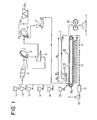
- Fig. 1 is a schematic process diagram illustrating an embodiment of the method of the present invention.
- the first iron ore fine and the second iron ore fine having the above-mentioned particle size distributions are stored in storage tanks la, lb and lc.
- a powdery flux is stored in a storage tank ld, and a powdery solid fuel is stored in a storage tank le.
- the first iron ore fine in a prescribed amount and the second iron ore fine in a prescribed amount discharged from the storage tanks la, lb and lc, the powdery flux in a prescribed amount discharged from the storage tank ld and the powdery solid fuel in a prescribed amount discharged as required from the storage tank le are fed to a mixer 2 and are mixed in the mixer 2 rotating at prescribed revolutions to form a mixture.
- the mixture formed in the mixer 2 is fed to a first pelletizer 3 of the disk type, and water in a prescribed amount is added to the mixture in the first pelletizer 3.
- the mixture thus added with water is formed into green pellets having a particle size of from 3 to 12 mm by means of the first pelletizer 3 rotating at prescribed revolutions.
- the water content in the mixture should preferably be up to 5 wt.%.
- the green pellets formed by means of the first pelletizer 3 are sieved through a screen 4.
- the green pellets on the screen are fed to a second pelletizer 5 of the disk type, and the green pellets under the screen are fed back to the first pelletizer 3.
- Another powdery solid fuel for covering the surfaces of the green pellets is stored in a storage tank 6a and another powdery flux is stored in a storage tank 6b.
- the another powdery solid fuel in a prescribed amount discharged from the storage tank 6a and the another powdery flux in a prescribed amount discharged as required from the storage tank 6b are fed to the second pelletizer 5.
- the second pelletizer 5 rotating at prescribed revolutions, the surfaces of the green pellets fed from the first pelletizer 3 to the second pelletizer 5 are covered with the powdery solid fuel in a prescribed amount or with a mixture of the powdery solid fuel and the powdery flux in prescribed amounts.
- the first pelletizer 3 and the second pelletizer 5 are not limited to the disk type, but may be of the drum type as well.
- the green pellets, of which the surfaces are covered with the powdery solid fuel or with the mixture of the powdery solid fuel and the powdery flux as described above, are transferred through a feeder 7 to an endless travelling grate type firing furnace 8.
- the endless travelling grate type firing furnace 8 comprises a drying zone 8a, an ignition zone 8b following the drying zone 8a, a firing zone 8c following the ignition zone 8b, and an endless travelling grate 10 passing sequentially through these zones.
- Reference numerals 9a and 9b indicate a pair of pulleys for causing the endless travelling grate 10 to travel.
- the drying zone 8a is provided with a drying oven 11 having a drying gas blowing port directed downwardly. The drying oven 11 blows a drying gas at a temperature of from 150 to 350°C downwardly from above into the drying zone 8a to dry the green pellets in this zone.
- the ignition zone 8b is provided with an ignition oven 12 having an ignition gas blowing port directed downwardly for igniting the powdery solid fuel on the surfaces of the green pellets.
- the ignition oven 12 blows an igniting gas upwardly from below into the ignition zone 8b to ignite the powdery solid fuel on the surfaces of the green pellets in this zone.
- Fig. 1, 13 are a pluarlity of first wind boxes provided below the endless travelling grate 10 travelling in the upstream of the endless travelling grate type firing furnace 8
- 14 are a plurality of second wind boxes provided below the endless travelling grate 10 travelling in the downstream of the endless travelling grate type firing furnace 8.
- the drying gas blown into the drying zone 8a, the ignition gas blown into the ignition zone 8b, and part of the combustion waste gas produced by combustion of the powdery solid fuel on the surfaces of the green pellets in the firing zone 8c are sucked by a first blower 16 through the plurality of first wind boxes 13 and a dust collector 15, and released to open air.
- the remaining part of the combustion waste gas produced by combustion of the powdery solid fuel on the surfaces of the green pellets in the firing zone 8c is sucked by a second blower 17 through the plurality of second wind boxes 14, and blown into the drying oven 11 of the drying zone 8a as the drying gas.
- Fig. 1 18 is a crusher arranged near the downstream end of the endless travelling grate 10.
- the crusher 18 crushes a large slab-shaped mass of the fired pellets discharged from the downstream end of the endless travelling grate 10.
- Fig. 1 19 is a storage tank arranged near the upstream end of the endless travelling grate 10. A hearth layer ore to be fed onto the endless travelling grate 10 is stored in the storage tank 19.
- the green pellets of which the surfaces are covered with the powdery solid fuel or with the mixture of the powdery solid fuel and the powdery flux, are fed with a thickness of from 300 to 1,500 mm onto the hearth layer ore on the endless travelling grate 10, and are caused to travel, on the endless travelling grate 10, sequentially through the drying zone 8a, the ignition zone 8b and the firing zone 8c in this order.
- the drying gas at a temperature of from 150 to 350°C is blown downwardly from above through the drying oven 11 into the drying zone 8a to dry the green pellets in this zone.
- a high-temperature combustion waste gas produced for example through combustion of a fuel such as a coke oven gas is blown as the ignition gas downwardly from above through the ignition oven 12 into the ignition zone 8b to ignite the powdery solid fuel on the surfaces of the green pellets in this zone.
- the high-temperature combustion waste gas produced by combustion of the powdery solid fuel on the surfaces of the green pellets is sucked by the first blower 16 and the second blower 17 downwardly through the green pellets in the firing zone 8c to heat the green pellets in this zone to a firing temperature, thereby firing the green pellets into the fired pellets.
- the firing step as described above in the firing zone 8c at least one of calcium ferrite and slag excellent in reducibility is formed on the surface portions of the fired pellets, which combines the fired pellets into a large slab-shaped mass.
- the thus formed large slab-shaped mass of the fired pellets is discharged from the downstream end of the endless travelling grate 10, crushed by means of the crusher 18, and sieved through a screen not shown. Pieces of the firtzd pellets under the screen having a particle size of under 3 mm are transferred to a storage tank for storing a return ore.
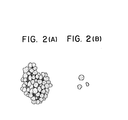
- Figs. 2(A) and 2(B) are schematic views of the fired pellets manufactured according to the method of the present invention.
- Fig. 2(A) illustrates lumpy fired pellets in which a plurality of fired pellets are combined into a lump by at least one of calcium ferrite and slag formed on the surfaces of the fired pellets, obtained by crushing the large slab-shaped mass by means of the crusher 18.
- Fig. 2(B) illustrates the individual fired pellets, obtained by crushing the large slab-shaped mass by means of the crusher 18.
- the fired pellets manufactured according to the method of the present invention have an irregular shape not only in the form of a lump but also in the form of a single pellet. When charged into a blast furnace, therefore, the fired pellets do not flow preferentially into the center portion of the blast furnace, and in addition, smooth passage of a reducing gas is not impaired because gaps are produced between the fired pellets.
- the fired pellets manufactured according to the method of the present invention have an irregular shape as described above because of an irregular shape of the green pellets formed from the raw materials comprising the first iron ore fine including an iron ore fine of from 50 to 80 wt.% having a particle size of up to 0.044 mm and the second iron ore fine including an iron ore fine of from 40 to 70 wt.% having a particle size of from over 0.5 mm up to 8 mm.
- the fired pellets manufactured according to the method of the present invention have an excellent reducibility.
- the lumpy fired pellets manufactured according to the method of the present invention in which a plurality of fired pellets are combined into a lump, even if integrating under the impact during transferring, are only separated into individual fired pellets as shown in Fig. 2(B). Therefore, disintegration of the lumpy fired pellets as mentioned above never impairs satisfactory use as the fired pellets.
- Fig. 3 is a microphotograph (five magnifications) showing the structure of the lurtpy fired pellets manufactured acoor- ding to the method of the present invention in which a plurality of fired pellets are combined into a lump;
- Fig. 4 is a microphotograph (five magnifications) showing the structure of the conventional sinter; and
- Fig. 5 is a microphotograph (five magnifications) showing the structure of the fired pellet manufactured according to the conventional method, using the raw materials including an iron ore of over 80 wt.% having a particle size of up to 0.044 mm. As shown in Fig.
- the lumpy fired pellets manufactured according to the method of the present invention are higher in porosity and comprise the smaller individual fired pellets as compared with the conventional sinter shown in Fig. 4 and the conventional fired pellet shown in Fig. 5, and contain smaller melted structure portions (white portions) and smaller portions with unreduced iron ore fine (portions marked by "O") as compared with the conventional sinter shown in Fig. 4. Therefore, the lumpy fired pellets manufactured according to the method of the present invention have a higher reducibility in the blast furnace than the conventional sinter and the conventional fired pellet.
- Raw materials comprising a first iron ore fine in an amount of 40 wt.% having a particle size distribution as shown in Table 1 and a chemical composition as shown in Table 2, and a second iron ore fine in an amount of 60 wt.% having a particle size distribution as shown in Table 3 and a chemical composition as shown in Table 4 were used.
- the mixture formed in the mixer 2 was fed to the first pelletizer 3, and water was added to the mixture in the first pelletizer 3.
- the mixture thus added with water was formed into green pellets having a particle size distribution as shown in Table 6 and having a water content of.8 wt.% by the first pelletizer 3 rotating at prescribed revolutions.
- the thus formed green pellets were fed to the second pelletizer 5, and coke breeze having a particle size distribution as shown in Table 5 stored in the storage tank 6a and quick lime fine having a particle size distribution as shown in Table 5 stored in the storage tank 6b were fed to the second pelletizer 5.
- the amount of fed coke breeze was 2.7 wt.% relative to the total amount of the raw materials, the quick lime fine and the coke breeze composing the green pellets, and the amount of fed quick lime fine was 3.3 wt.% relative to the above-mentioned total amount.
- the surfaces of the green pellets in the second pelletizer 5 were covered with a mixture of the coke breeze and the quick lime fine by means of the second pelletizer 5 rotating at prescribed revolutions.
- Table 7 shows conditions of the first pelletizer 3 and the second pelletizer 5.
- Hearth layer ore stored in the storage tank 19 was fed with a thickness of 50 mm onto the endless travelling grate 10 at the inlet side thereof. Then, the green pellets, of which the surfaces were covered with the mixture of quick lime fine and coke breeze, were fed with a thickness of 400 mm onto the hearth layer ore on the endless travelling grate 10 on the inlet side thereof. The green pellets were caused to travel, on the endless travelling grate 10, sequentially through the drying zone 8a, the ignition zone 8b and the firing zone 8c in this order.
- a drying gas at a temperature of about 250°C was blown downwardly from above into the drying zone 8a to dry the green pellets travelling through this zone. Then, a combustion waste gas at a temperature of about 1,100°C obtained by combustion of coke oven gas was blown, as an ignition gas, downwardly from above into the ignition zone 8b to ignite coke breeze on the surfaces of the green pellets travelling through this zone.
- the travelling periods of time of the green pellets through the drying zone 8a, the ignition zone 8b and the firing zone 8c were 3 minutes, 1 minute and 18 minutes, respectively.
- part of the above-mentioned firing gas was sucked by the second blower 17 through the plurality of wind boxes 14, and blown into the drying zone 8a as the drying gas.
- the mixture formed in the mixer 2 was fed to the first pelletizer 3, and water was added to the mixture in the first pelletizer 3.
- the mixture thus added with water was formed into green pellets having a water content of 9 wt.%, with a particle size distribution as shown in Table 9, by the first pelletizer 3 rotating at prescribed revolutions.
- the thus formed green pellets were fed to the second pelletizer 5, and coke breeze having a particle size distribution as shown in Table 10 stored in the storage tank 6a was fed to the second pelletizer 5.
- the amount of fed coke breeze was 3.9 wt.% relative to the total amount of the raw materials and the quick lime fine composing the green pellets.
- the surfaces of the green pellets in the pelletizer 5 were covered with the coke breeze by means of the second pelletizer 5 rotating at prescribed revolutions.
- the conditions of the first pelletizer 3 and the second pelletizer 5 were the same as those in Example 1.
- hearth layer ore stored in the storage tank 19 was fed with a thickness of 50 mm onto the endless travelling grate 10 at the inlet side thereof.
- the green pellets, of which the surfaces were covered with coke breeze were fed with a thickness of 400 mm onto the hearth layer ore on the endless travelling grate 10 at the inlet side thereof.
- the green pellets were caused to travel, on the endless travelling grate 10, sequentially through the drying zone 8a, the ignition zone 8b and the firing zone 8c in this order.
- Example 1 the drying gas at a temperature of about 250°C was blown into the drying zone 8a to dry the green pellets travelling through this zone, then the ignition gas was blown into the ignition zone 8b to ignite coke breeze on the surfaces of the green pellets travelling through this zone, and then, high-temperature combustion waste gas produced by combustion of coke breeze on the surfaces of the green pellets was sucked, as the firing gas, through the green pellets travelling through the firing zone 8c to heat the green pellets travelling through this zone to a firing temperature of about 1,400°C, thereby firing the green pellets into the firing pellets.
- Example 1 large slab-shaped masses of the fired pellets thus obtained were discharged from the downstream end of the endless travelling grate 10 and crushed by means of the crusher 18.
- the lumpy fired pellets having a maximum particle size of 50 mm in which a plurality of fired pellets were combined into a lump as shown in Fig. 2(A), and the individual fired pellets having a particle size of from 3 to 12 mm were manufactured.
- the fired pellets high in reduction index and shatter index and low in reduction degradation index and swelling index can be manufactured at a high yield.
- the method of the present invention it is possible to manufacture economically and continuously the fired pellets at a high yield, which have a high strength and an excellent reducibility, and do not impair smooth passage of a reducing gas in the blast furnace, and it is also possible to prevent the green pellets from disintegration during transferring and firing thereof, thus providing industrially useful effects.
Landscapes
- Engineering & Computer Science (AREA)
- Chemical & Material Sciences (AREA)
- Manufacturing & Machinery (AREA)
- Geochemistry & Mineralogy (AREA)
- Geology (AREA)
- General Life Sciences & Earth Sciences (AREA)
- Life Sciences & Earth Sciences (AREA)
- Environmental & Geological Engineering (AREA)
- Materials Engineering (AREA)
- Mechanical Engineering (AREA)
- Metallurgy (AREA)
- Organic Chemistry (AREA)
- Manufacture And Refinement Of Metals (AREA)
Applications Claiming Priority (2)
| Application Number | Priority Date | Filing Date | Title |
|---|---|---|---|
| JP138996/85 | 1985-06-27 | ||
| JP60138996A JPS6237325A (ja) | 1985-06-27 | 1985-06-27 | 焼成塊成鉱およびその製造方法 |
Publications (2)
| Publication Number | Publication Date |
|---|---|
| EP0207654A1 true EP0207654A1 (de) | 1987-01-07 |
| EP0207654B1 EP0207654B1 (de) | 1988-12-28 |
Family
ID=15235043
Family Applications (1)
| Application Number | Title | Priority Date | Filing Date |
|---|---|---|---|
| EP86304404A Expired EP0207654B1 (de) | 1985-06-27 | 1986-06-10 | Verfahren zur kontinuierlichen Herstellung von gebrannten Pellets |
Country Status (9)
| Country | Link |
|---|---|
| US (1) | US4723995A (de) |
| EP (1) | EP0207654B1 (de) |
| JP (1) | JPS6237325A (de) |
| KR (1) | KR900006102B1 (de) |
| AU (1) | AU584429B2 (de) |
| BR (1) | BR8602965A (de) |
| CA (1) | CA1259493A (de) |
| DE (1) | DE3661543D1 (de) |
| IN (1) | IN167409B (de) |
Cited By (6)
| Publication number | Priority date | Publication date | Assignee | Title |
|---|---|---|---|---|
| EP0415146A1 (de) * | 1989-08-23 | 1991-03-06 | Nkk Corporation | Verfahren zum Herstellen von Agglomeraten aus gesinterten Pellets |
| EP0578253A1 (de) * | 1986-12-15 | 1994-01-12 | Nippon Kokan Kabushiki Kaisha | Verfahren zum Herstellen von Briketts aus gebrannten Pellets |
| NL9301053A (nl) * | 1993-06-17 | 1995-01-16 | Hoogovens Groep Bv | Werkwijze voor het vervaardigen van gebrande ijzerertspellets. |
| WO2014135222A1 (en) * | 2013-03-08 | 2014-09-12 | Outotec (Finland) Oy | System for the treatment of pellet fines and/or lump ore and/or indurated pellets |
| CN104204242A (zh) * | 2012-03-22 | 2014-12-10 | 杰富意钢铁株式会社 | 烧结矿用原料粉的调整方法和烧结矿用原料粉 |
| EP4560033A4 (de) * | 2022-09-01 | 2026-04-01 | Jfe Steel Corp | Eisenerzpelletherstellungsverfahren |
Families Citing this family (18)
| Publication number | Priority date | Publication date | Assignee | Title |
|---|---|---|---|---|
| JPS62290841A (ja) * | 1986-06-10 | 1987-12-17 | Nippon Kokan Kk <Nkk> | 含クロム銑の製造方法 |
| JPH0796689B2 (ja) * | 1989-06-20 | 1995-10-18 | 日本鋼管株式会社 | 非焼成ペレットの製造方法 |
| AUPR678301A0 (en) * | 2001-08-02 | 2001-08-23 | Commonwealth Scientific And Industrial Research Organisation | Iron ore briquetting |
| AT412401B (de) * | 2003-07-16 | 2005-02-25 | Voest Alpine Ind Anlagen | Verfahren zur herstellung von erz mit einem feinanteil enthaltenden grün-agglomeraten |
| KR101525068B1 (ko) * | 2012-03-22 | 2015-06-02 | 제이에프이 스틸 가부시키가이샤 | 소결광용 원료분의 조정 방법 및 소결광용 원료분 |
| KR101723444B1 (ko) | 2014-12-22 | 2017-04-05 | 주식회사 포스코 | 소성 펠렛 및 이의 제조 방법 |
| KR20160076255A (ko) | 2014-12-22 | 2016-06-30 | 주식회사 포스코 | 소성 펠렛 제조 방법 |
| WO2017150428A1 (ja) | 2016-03-04 | 2017-09-08 | Jfeスチール株式会社 | 焼結鉱の製造方法 |
| CN111235385B (zh) * | 2020-03-24 | 2024-10-15 | 河北鑫达钢铁集团有限公司 | 一种利用干法除尘灰生产球团的工艺和装置 |
| CN111850291B (zh) * | 2020-07-07 | 2022-02-18 | 鞍钢股份有限公司 | 一种烧结固体燃料的预处理方法及烧结混合料制备方法 |
| BR102021004299B1 (pt) * | 2021-03-08 | 2023-05-16 | Vale S.A | Processo de produção de pelotas queimadas em um forno de pelotização |
| JP7616523B2 (ja) | 2022-06-03 | 2025-01-17 | Jfeスチール株式会社 | 焼結用造粒原料の製造方法および焼結鉱の製造方法 |
| CN119677882A (zh) | 2022-08-01 | 2025-03-21 | 杰富意钢铁株式会社 | 还原用烧成球团及其制造方法 |
| CN119630820A (zh) | 2022-08-01 | 2025-03-14 | 杰富意钢铁株式会社 | 还原用非烧成球团及其制造方法 |
| WO2024047951A1 (ja) * | 2022-09-02 | 2024-03-07 | Jfeスチール株式会社 | 鉄鉱石ペレットの製造方法 |
| AU2023341034A1 (en) * | 2022-09-16 | 2025-02-13 | Jfe Steel Corporation | Method of producing iron ore pellets |
| WO2024070135A1 (ja) * | 2022-09-28 | 2024-04-04 | Jfeスチール株式会社 | 鉄鉱石ペレットの製造方法 |
| CN116121533B (zh) * | 2022-12-07 | 2025-08-29 | 中冶长天国际工程有限责任公司 | 一种铁矿粉复合造块上料方法及系统 |
Citations (9)
| Publication number | Priority date | Publication date | Assignee | Title |
|---|---|---|---|---|
| FR1335860A (fr) * | 1962-10-10 | 1963-08-23 | Metallgesellschaft Ag | Procédé pour faire fonctionner des fours destinés à la fabrication de l'acier |
| FR1462309A (fr) * | 1964-10-09 | 1966-04-15 | Metallgesellschaft Ag | Procédé pour la préparation d'éponge de fer |
| GB1036366A (en) * | 1963-09-18 | 1966-07-20 | Metallgesellschaft Ag | Process for the production of hard-burnt pellets having good abrasive strength |
| AU435114B2 (en) * | 1968-02-09 | 1973-04-27 | Fuji Iron & Steel Company Limited | Sintering material from iron-containing dry dust and preparing method thereof |
| GB1364150A (en) * | 1972-09-26 | 1974-08-21 | Wienert F O | Pellets and their production |
| US3969103A (en) * | 1974-02-25 | 1976-07-13 | Canadian Patents And Development Limited | Method of producing ball agglomerated particulate material |
| US4231797A (en) * | 1976-03-03 | 1980-11-04 | Kobe Steel, Limited | Fired iron-ore pellets having macro pores |
| US4372779A (en) * | 1979-10-09 | 1983-02-08 | Kobe Steel, Ltd. | Iron ore pellets containing coarse ore particles |
| US4504306A (en) * | 1981-07-10 | 1985-03-12 | Nippon Kokan Kabushiki Kaisha | Method of producing agglomerates |
Family Cites Families (8)
| Publication number | Priority date | Publication date | Assignee | Title |
|---|---|---|---|---|
| US3027251A (en) * | 1958-12-23 | 1962-03-27 | Metallgesellschaft Ag | Method of processing sulphidic concentrates |
| GB1139373A (en) * | 1967-02-02 | 1969-01-08 | Mcdowell Wellman Eng Co | System for producing carbonized and prereduced iron ore pellets |
| JPS5527607A (en) * | 1978-08-18 | 1980-02-27 | Toshiba Corp | Semiconductor device manufacturing method |
| US4432788A (en) * | 1981-04-23 | 1984-02-21 | Nippon Kokan Kabushiki Kaisha | Method for manufacturing non-fired iron-bearing pellet |
| JPS57200529A (en) * | 1981-06-02 | 1982-12-08 | Nippon Steel Corp | Preparation of sintered ore having iron ore fine powder highly compounded therein |
| JPS5853697A (ja) * | 1981-09-24 | 1983-03-30 | Hayashi Kakoki Seisakusho:Kk | 遠心ポンプの漏液防止装置 |
| JPS6017811A (ja) * | 1983-07-09 | 1985-01-29 | 住友電気工業株式会社 | 連結押出機による発泡体の押出方法 |
| JPS61106728A (ja) * | 1984-10-31 | 1986-05-24 | Nippon Kokan Kk <Nkk> | 塊成鉱及びその製造方法 |
-
1985
- 1985-06-27 JP JP60138996A patent/JPS6237325A/ja active Granted
-
1986
- 1986-06-04 US US06/870,730 patent/US4723995A/en not_active Expired - Lifetime
- 1986-06-05 IN IN437/MAS/86A patent/IN167409B/en unknown
- 1986-06-05 CA CA000510905A patent/CA1259493A/en not_active Expired
- 1986-06-05 AU AU58391/86A patent/AU584429B2/en not_active Expired
- 1986-06-10 DE DE8686304404T patent/DE3661543D1/de not_active Expired
- 1986-06-10 EP EP86304404A patent/EP0207654B1/de not_active Expired
- 1986-06-20 KR KR8604947A patent/KR900006102B1/ko not_active Expired
- 1986-06-26 BR BR8602965A patent/BR8602965A/pt not_active IP Right Cessation
Patent Citations (9)
| Publication number | Priority date | Publication date | Assignee | Title |
|---|---|---|---|---|
| FR1335860A (fr) * | 1962-10-10 | 1963-08-23 | Metallgesellschaft Ag | Procédé pour faire fonctionner des fours destinés à la fabrication de l'acier |
| GB1036366A (en) * | 1963-09-18 | 1966-07-20 | Metallgesellschaft Ag | Process for the production of hard-burnt pellets having good abrasive strength |
| FR1462309A (fr) * | 1964-10-09 | 1966-04-15 | Metallgesellschaft Ag | Procédé pour la préparation d'éponge de fer |
| AU435114B2 (en) * | 1968-02-09 | 1973-04-27 | Fuji Iron & Steel Company Limited | Sintering material from iron-containing dry dust and preparing method thereof |
| GB1364150A (en) * | 1972-09-26 | 1974-08-21 | Wienert F O | Pellets and their production |
| US3969103A (en) * | 1974-02-25 | 1976-07-13 | Canadian Patents And Development Limited | Method of producing ball agglomerated particulate material |
| US4231797A (en) * | 1976-03-03 | 1980-11-04 | Kobe Steel, Limited | Fired iron-ore pellets having macro pores |
| US4372779A (en) * | 1979-10-09 | 1983-02-08 | Kobe Steel, Ltd. | Iron ore pellets containing coarse ore particles |
| US4504306A (en) * | 1981-07-10 | 1985-03-12 | Nippon Kokan Kabushiki Kaisha | Method of producing agglomerates |
Non-Patent Citations (5)
| Title |
|---|
| CHEMICAL ABSTRACTS, vol. 92, 1980, page 223, abstract no. 80023x, Columbus, Ohio, US; & JP-A-54 117 301 (KOBE STEEL LTD.) 12-09-1979 * |
| CHEMICAL ABSTRACTS, vol. 96, 1982, page 229, abstract no. 166284c, Columbus, Ohio, US; & JP-A-56 163 225 (NIPPON KOKAN K.K.) 15-12-1981 * |
| PATENT ABSTRACTS OF JAPAN, vol. 7, no. 139 (C-171)[1284], 17th June 1983; & JP-A-58 052 447 (SUMITOMO KINZOKU KOGYO K.K.) 28-03-1983 * |
| PATENT ABSTRACTS OF JAPAN, vol. 7, no. 77 (C-159)[1222], 30th March 1983; & JP-A-58 009 937 (NIPPON KOKAN K.K.) 20-01-1983 * |
| PATENT ABSTRACTS OF JAPAN, vol. 8, no. 241 (C-250)[1678], 6th November 1984; & JP-A-59 123 728 (KOBE SEIKOSHO K.K.) 17-07-1984 * |
Cited By (9)
| Publication number | Priority date | Publication date | Assignee | Title |
|---|---|---|---|---|
| EP0578253A1 (de) * | 1986-12-15 | 1994-01-12 | Nippon Kokan Kabushiki Kaisha | Verfahren zum Herstellen von Briketts aus gebrannten Pellets |
| EP0415146A1 (de) * | 1989-08-23 | 1991-03-06 | Nkk Corporation | Verfahren zum Herstellen von Agglomeraten aus gesinterten Pellets |
| NL9301053A (nl) * | 1993-06-17 | 1995-01-16 | Hoogovens Groep Bv | Werkwijze voor het vervaardigen van gebrande ijzerertspellets. |
| CN104204242A (zh) * | 2012-03-22 | 2014-12-10 | 杰富意钢铁株式会社 | 烧结矿用原料粉的调整方法和烧结矿用原料粉 |
| CN104204242B (zh) * | 2012-03-22 | 2016-08-24 | 杰富意钢铁株式会社 | 烧结矿用原料粉的调整方法和烧结矿用原料粉 |
| WO2014135222A1 (en) * | 2013-03-08 | 2014-09-12 | Outotec (Finland) Oy | System for the treatment of pellet fines and/or lump ore and/or indurated pellets |
| AU2013380646B2 (en) * | 2013-03-08 | 2016-09-08 | Metso Metals Oy | System for the treatment of pellet fines and/or lump ore and/or indurated pellets |
| EA028098B1 (ru) * | 2013-03-08 | 2017-10-31 | Оутотек (Финлэнд) Ой | Устройство для переработки мелкозернистых фракций окатышей и/или кусковой руды и/или упрочненных окатышей |
| EP4560033A4 (de) * | 2022-09-01 | 2026-04-01 | Jfe Steel Corp | Eisenerzpelletherstellungsverfahren |
Also Published As
| Publication number | Publication date |
|---|---|
| AU584429B2 (en) | 1989-05-25 |
| IN167409B (de) | 1990-10-20 |
| DE3661543D1 (en) | 1989-02-02 |
| BR8602965A (pt) | 1987-02-17 |
| KR870000439A (ko) | 1987-02-18 |
| JPS6237325A (ja) | 1987-02-18 |
| KR900006102B1 (en) | 1990-08-22 |
| EP0207654B1 (de) | 1988-12-28 |
| CA1259493A (en) | 1989-09-19 |
| US4723995A (en) | 1988-02-09 |
| AU5839186A (en) | 1987-01-08 |
| JPH024658B2 (de) | 1990-01-30 |
Similar Documents
| Publication | Publication Date | Title |
|---|---|---|
| EP0207654B1 (de) | Verfahren zur kontinuierlichen Herstellung von gebrannten Pellets | |
| KR101068600B1 (ko) | 철광석의 단광 방법 | |
| US4504306A (en) | Method of producing agglomerates | |
| AU2002322154A1 (en) | Iron ore briquetting | |
| CA1246343A (en) | Agglomerated ores and a producing method therefor | |
| CA1149617A (en) | Porous iron ore pellets and process for manufacturing same | |
| CA2560085C (en) | Layered agglomerated iron ore pellets and balls | |
| CN1248636A (zh) | 炼铁用球团烧结矿的制造方法 | |
| KR101526451B1 (ko) | 소결광 제조 방법 | |
| EP0053139B1 (de) | Agglomerate, verfahren zu deren herstellung und verwendung | |
| JP2001262241A (ja) | 含炭焼結鉱の製造方法 | |
| JP7227053B2 (ja) | 焼結鉱の製造方法 | |
| JP6885386B2 (ja) | 炭材内装粒子の製造方法および炭材内装焼結鉱の製造方法 | |
| JPH08199250A (ja) | 焼結鉱の製造方法 | |
| KR0118997B1 (ko) | 소결광 제조방법 및 장치 | |
| EP4286546A1 (de) | Verfahren zur herstellung von sintergranulat | |
| JP6992734B2 (ja) | 炭材内装粒子の製造方法および炭材内装焼結鉱の製造方法 | |
| JPS6221055B2 (de) | ||
| JPH0633151A (ja) | 焼成塊成鉱の製造方法 | |
| JP6988778B2 (ja) | 炭材内装焼結鉱の製造方法および炭材内装焼結鉱の製造設備 | |
| JP6809446B2 (ja) | 炭材内装粒子の製造方法および炭材内装焼結鉱の製造方法 | |
| CA1195505A (en) | Manufacture of a product to be sintered from fine- grain iron-oxide material | |
| JPS60114526A (ja) | 焼結鉱製造法 | |
| KR20010058082A (ko) | 분소성백운석을 이용한 소결광 제조방법 | |
| JPH0688141A (ja) | 焼成塊成鉱の製造方法 |
Legal Events
| Date | Code | Title | Description |
|---|---|---|---|
| PUAI | Public reference made under article 153(3) epc to a published international application that has entered the european phase |
Free format text: ORIGINAL CODE: 0009012 |
|
| AK | Designated contracting states |
Kind code of ref document: A1 Designated state(s): BE DE FR GB SE |
|
| 17P | Request for examination filed |
Effective date: 19870107 |
|
| 17Q | First examination report despatched |
Effective date: 19880321 |
|
| GRAA | (expected) grant |
Free format text: ORIGINAL CODE: 0009210 |
|
| AK | Designated contracting states |
Kind code of ref document: B1 Designated state(s): BE DE FR GB SE |
|
| REF | Corresponds to: |
Ref document number: 3661543 Country of ref document: DE Date of ref document: 19890202 |
|
| ET | Fr: translation filed | ||
| PLBE | No opposition filed within time limit |
Free format text: ORIGINAL CODE: 0009261 |
|
| STAA | Information on the status of an ep patent application or granted ep patent |
Free format text: STATUS: NO OPPOSITION FILED WITHIN TIME LIMIT |
|
| 26N | No opposition filed | ||
| EAL | Se: european patent in force in sweden |
Ref document number: 86304404.6 |
|
| PGFP | Annual fee paid to national office [announced via postgrant information from national office to epo] |
Ref country code: GB Payment date: 19980601 Year of fee payment: 13 |
|
| PGFP | Annual fee paid to national office [announced via postgrant information from national office to epo] |
Ref country code: FR Payment date: 19980609 Year of fee payment: 13 |
|
| PGFP | Annual fee paid to national office [announced via postgrant information from national office to epo] |
Ref country code: SE Payment date: 19980616 Year of fee payment: 13 |
|
| PGFP | Annual fee paid to national office [announced via postgrant information from national office to epo] |
Ref country code: DE Payment date: 19980622 Year of fee payment: 13 |
|
| PGFP | Annual fee paid to national office [announced via postgrant information from national office to epo] |
Ref country code: BE Payment date: 19980813 Year of fee payment: 13 |
|
| PG25 | Lapsed in a contracting state [announced via postgrant information from national office to epo] |
Ref country code: GB Free format text: LAPSE BECAUSE OF NON-PAYMENT OF DUE FEES Effective date: 19990610 |
|
| PG25 | Lapsed in a contracting state [announced via postgrant information from national office to epo] |
Ref country code: SE Free format text: THE PATENT HAS BEEN ANNULLED BY A DECISION OF A NATIONAL AUTHORITY Effective date: 19990629 |
|
| PG25 | Lapsed in a contracting state [announced via postgrant information from national office to epo] |
Ref country code: FR Free format text: THE PATENT HAS BEEN ANNULLED BY A DECISION OF A NATIONAL AUTHORITY Effective date: 19990630 Ref country code: BE Free format text: LAPSE BECAUSE OF NON-PAYMENT OF DUE FEES Effective date: 19990630 |
|
| BERE | Be: lapsed |
Owner name: NIPPON KOKAN K.K. Effective date: 19990630 |
|
| GBPC | Gb: european patent ceased through non-payment of renewal fee |
Effective date: 19990610 |
|
| EUG | Se: european patent has lapsed |
Ref document number: 86304404.6 |
|
| PG25 | Lapsed in a contracting state [announced via postgrant information from national office to epo] |
Ref country code: DE Free format text: LAPSE BECAUSE OF NON-PAYMENT OF DUE FEES Effective date: 20000503 |
|
| REG | Reference to a national code |
Ref country code: FR Ref legal event code: ST |