EP0209018A2 - Procédé et/ou appareil pour l'amélioration des images immobiles - Google Patents
Procédé et/ou appareil pour l'amélioration des images immobiles Download PDFInfo
- Publication number
- EP0209018A2 EP0209018A2 EP86109157A EP86109157A EP0209018A2 EP 0209018 A2 EP0209018 A2 EP 0209018A2 EP 86109157 A EP86109157 A EP 86109157A EP 86109157 A EP86109157 A EP 86109157A EP 0209018 A2 EP0209018 A2 EP 0209018A2
- Authority
- EP
- European Patent Office
- Prior art keywords
- pixels
- correlation
- signals
- die
- der
- Prior art date
- Legal status (The legal status is an assumption and is not a legal conclusion. Google has not performed a legal analysis and makes no representation as to the accuracy of the status listed.)
- Granted
Links
Images


Classifications
-
- H—ELECTRICITY
- H04—ELECTRIC COMMUNICATION TECHNIQUE
- H04N—PICTORIAL COMMUNICATION, e.g. TELEVISION
- H04N5/00—Details of television systems
- H04N5/76—Television signal recording
- H04N5/91—Television signal processing therefor
- H04N5/92—Transformation of the television signal for recording, e.g. modulation, frequency changing; Inverse transformation for playback
-
- H—ELECTRICITY
- H04—ELECTRIC COMMUNICATION TECHNIQUE
- H04N—PICTORIAL COMMUNICATION, e.g. TELEVISION
- H04N9/00—Details of colour television systems
- H04N9/79—Processing of colour television signals in connection with recording
- H04N9/87—Regeneration of colour television signals
- H04N9/877—Regeneration of colour television signals by assembling picture element blocks in an intermediate memory
Definitions
- the invention relates to a method and / or a device for still image improvement according to the preamble of patent claim 1.
- the object of the invention is to provide a method which eliminates the field flickering and / or vertical and / or horizontal brightness and / or color shifts between two fields during a still picture reproduction without the interlacing being switched off.
- page 154 shows television receivers that have digital memories for image storage. These memories are slowly filled up over a channel of limited bandwidth, a telephone channel, and are used to compile the slowly arriving signals into one frame.
- the invention consists in digitizing external signals and temporarily storing them in an electronic memory.
- this electronic memory the field flickering or vertical and / or horizontal brightness and / or color shifts between two fields caused by movement can be eliminated by correction.
- Fig. 1 shows a magnetic head 1 which scans a magnetic tape, not shown, on which video signals are recorded.
- the sampled video signals pass from the magnetic head 1 via an amplifier 2 to a high-pass filter 3 and to a low-pass filter 4.
- the luminance signal of the video signal is filtered out and supplied to the demodulator 5.
- ADC analog-digital converter
- the digitized luminance signal is temporarily stored in an electronic memory 8, hereinafter called image memory.
- the chrominance signal of the video signal is filtered out in the low-pass filter 4 and supplied to the color electronics 6.
- the chrominance signal passes from the color electronics 6 via an ADC 7 to the image memory 8.
- the chrominance signal is converted back into an analog signal and fed to the mixer 10, in which the chrominance signal and the luminance signal are mixed.
- the CVBS signal can be made visible on a display screen 12 as a television picture.
- Fig. 2 shows an antenna 13 which receives television signals.
- the television signals are fed to a demodulator 14.
- the CVBS signal originating from the demodulator 14 is broken down into its luminance or chrominance component in a 4.43 MHz block 15 and a 4.43 MHz bandpass 16.
- the luminance signal passes from the lock 15 to an ADC 7 and from there to an image memory 8, where the signal is buffered.
- the digitized luminance signal in the DAU 9 is converted back into an analog signal and modulated in the modulator 17.
- the chrominance signal is digitized in the ADC 7 and fed to an image memory 8.
- the digitized chrominance signal arrives at the DAU 9 from the image memory 8 and is converted back there into an analog signal.
- the chrominance signal is modulated with a lowered carrier and from there it is fed to a mixer 19.
- the modulated chrominance and the modulated luminance signal are mixed and fed to a video head 1.
- the branch with the blocks 7,8,9,15 and 17 forms the luminance branch
- the branch with the blocks 7,8,9,16,18 forms the chrominance branch.
- Parallel processing of the chrominance and luminance signals is shown here, but multiplex processing would also be conceivable.
- the storage spaces for the parallel image memories 8 for the chrominance or for the luminance signal can be the same size, but a size ratio of 2: 3 is also conceivable (two parts chroma and three parts luminance).
- One picture has about 720 columns and 576 lines, which makes 414 720 pixels.
- each pixel is encoded with 8 bits. This results in 3.4 Mbit memory space for a full image.
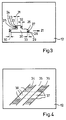
- FIG. 3 shows a viewing screen 12 with an object 20 which is moved in the horizontal direction 21.
- Object 20 is shown on eight lines 22-29. Lines 22, 24, 26 and 28 belong to a first field, lines 23, 25, 27 and 29 belong to a second field. Object 20 is shown distorted over regions 30-33. The image flickering caused by the movement in the areas 30 - 33 is perceived as disturbing for an observer. If line segments of the second field in the areas 30-33 of the brightness and / or color are adapted to the lines of the first field, the image flickering or movement flickering is eliminated.
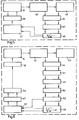
- FIG. 4 shows a viewing screen 12 with two diagonal dark stripes 34 and 36 and a light stripe 35.
- a buffer 42 stores digitized color and brightness signals from three line sections lying one above the other.
- the number of pixels contained in a line segment corresponds approximately to the maximum possible distortion correction for moving objects, in practice this is approximately 15 pixels.
- the mean value of the digitized color or brightness signals is in the mean value generator 43 neighboring pixels are formed. Noise can be identified and suppressed by averaging. Noise means small differences in brightness and / or color, in contrast, distortions or shifts mean the number of pixels where there are large differences in brightness and / or color, such as occur when moving a dark object against a light background .
- FIG. 6 shows a preferred embodiment of a still image improvement.
- a filter 50 is added, which takes pixels from the center of the line section into account more than pixels located at the edge of the line section.
- f (j) (1 + cos /pi.j / (L + 1) /) / 2 with the current index j from (-L + 1) to (+ L-1 ) and L as the number of pixels.
- an interpolation circuit 51 which calculates intermediate values between sampling points and thus interpolates and recognizes such peaks. This corresponds to oversampling.
- a maximum of four extreme values and their location are stored in the local circuit 52. Two extreme values result from the comparison of a line above it to a current line and two extreme values from a line below it to a current line. The location corresponds to the distortion or displacement, and the location is marked by a displacement vector.
- All four extreme values are supplied to the threshold circuit 46, the extreme values below a threshold S1 are not taken into account, extreme values between two thresholds S1 and S2 are evaluated or multiplied by a factor between 0 and 1, and extreme values above the threshold S2 are multiplied by the factor 1.
- the factor between 0 and 1 is calculated from a linear function between SI and S2.
- the noise in the signals which are a measure of the nature of pixels of the images, can be given in a mean correlation value.
- S1 is slightly below, S2 slightly above the mean correlation value.
- a new location or a displacement vector is calculated in the plausibility circuit 53, which indicates a location between the two extreme values.
- the location of the location between the two extreme values corresponds to the difference between the extreme values. The smaller the difference, the less signals are adapted.
- the plausibility circuit 53 if the correlation values of two adjacent pixels are approximately the same size (two extreme values lie next to one another) and a peak is recognized by the interpolation circuit 51 in the middle of both pixels, one or more of the two pixels which are marked by the location vector Assigned signals that express the same brightness and / or color. This circumstance is the signal path between the interpolation circuit 52 and the plausibility circuit 53 represents e-g represents.
- the mean value generator 47 the shift of the vectors between the one above it and the current one below it averaged to the current line. If there is an average between two natural numbers, which corresponds to a sampling point between two neighboring pixels, then one or more signals are assigned to both pixels, which express the same brightness and / or color.
- vo is then compared with vu and checked for plausibility. If vo is greater than zero and vu is less than zero or vice versa, then v (total) is set to zero.
- the digital image memory 8 with still image enhancement can advantageously be used in a digital video recorder.
- Fig. 8 shows the highly simplified block diagram of a digital video recorder.
- the magnetic head 1 scans a magnetic tape (not shown) and feeds scanned signals to a demodulator 55.
- a Decoder a demultiplexer or a unit from all three units mentioned can be arranged.
- the demodulator 55 outputs digital signals to an inverse quantizer 56 and to a controller 57.
- the controller 57 controls the inverse quantizer 56 and the inverse transformer 58.
- the inverse quantizer 56 supplies digital data to the inverse transformer 58.
- Digital signals are fed to the image memory 8 from the inverse transformer 58.
- Still images according to the invention (FIGS. 5-7) can be improved in the image memory 8.
- a converter 59 converts the digital data coming from the image memory 8 into a video signal or into a CVBS or NTSC signal and feeds it to a display screen 12.
- Noise is suppressed by averaging, subtraction and threshold circuit 46.
- the threshold circuit 46 decides whether digital signals are adapted.
- a second averaging 47 is provided.
- the second averaging 47 eliminates distortion of a current line to a line above and below it.
- a buffer 42 is used for three lines one above the other.
- a buffer 42 is used for one column.
- Digital chrominance and luminance signals are processed in parallel.
- a filter 50 is used after the correlator 45. The filter 50 takes pixels from the center of a line section into account more than pixels located at the edge of a line section.
- An interpolation circuit 51 is provided in front of the correlator 50. The interpolation circuit 51 interpolates intermediate values between sampling points of a luminance or chrominance signal.
- the interpolation circuit 51 recognizes color and / or brightness peaks. Due to the interpolation circuit 51, two adjacent pixels 38 are assigned two signals which are approximately the same size. If there is a correlation between a current and an adjacent line, one or more extreme values can be determined. The difference in the extreme values is a measure of the distortion.
Landscapes
- Multimedia (AREA)
- Signal Processing (AREA)
- Engineering & Computer Science (AREA)
- Processing Of Color Television Signals (AREA)
- Non-Silver Salt Photosensitive Materials And Non-Silver Salt Photography (AREA)
- Picture Signal Circuits (AREA)
- Television Signal Processing For Recording (AREA)
- Photosensitive Polymer And Photoresist Processing (AREA)
- Closed-Circuit Television Systems (AREA)
- Color Television Image Signal Generators (AREA)
- Two-Way Televisions, Distribution Of Moving Picture Or The Like (AREA)
- Investigating Or Analyzing Materials By The Use Of Magnetic Means (AREA)
- Solid State Image Pick-Up Elements (AREA)
Priority Applications (1)
| Application Number | Priority Date | Filing Date | Title |
|---|---|---|---|
| AT86109157T ATE80967T1 (de) | 1985-07-13 | 1986-07-04 | Verfahren und/oder einrichtung zur standbildverbesserung. |
Applications Claiming Priority (2)
| Application Number | Priority Date | Filing Date | Title |
|---|---|---|---|
| DE3525049 | 1985-07-13 | ||
| DE19853525049 DE3525049A1 (de) | 1985-07-13 | 1985-07-13 | Verfahren und/oder einrichtung zur standbildverbesserung |
Publications (3)
| Publication Number | Publication Date |
|---|---|
| EP0209018A2 true EP0209018A2 (fr) | 1987-01-21 |
| EP0209018A3 EP0209018A3 (en) | 1989-03-08 |
| EP0209018B1 EP0209018B1 (fr) | 1992-09-23 |
Family
ID=6275692
Family Applications (1)
| Application Number | Title | Priority Date | Filing Date |
|---|---|---|---|
| EP86109157A Expired - Lifetime EP0209018B1 (fr) | 1985-07-13 | 1986-07-04 | Procédé et/ou appareil pour l'amélioration des images immobiles |
Country Status (8)
| Country | Link |
|---|---|
| EP (1) | EP0209018B1 (fr) |
| JP (1) | JPS6218175A (fr) |
| KR (1) | KR950009675B1 (fr) |
| AT (1) | ATE80967T1 (fr) |
| DE (2) | DE3525049A1 (fr) |
| ES (1) | ES8707065A1 (fr) |
| HK (1) | HK120794A (fr) |
| SG (1) | SG120194G (fr) |
Families Citing this family (2)
| Publication number | Priority date | Publication date | Assignee | Title |
|---|---|---|---|---|
| JPH0385025U (fr) * | 1989-12-22 | 1991-08-28 | ||
| DE102020122605B4 (de) | 2020-08-28 | 2025-04-24 | Abberior Instruments Gmbh | Verfahren, Bildverarbeitungseinheit und Laserscanningmikroskop zum hintergrundreduzierten Abbilden einer Struktur in einer Probe |
Family Cites Families (13)
| Publication number | Priority date | Publication date | Assignee | Title |
|---|---|---|---|---|
| DE2435265C2 (de) * | 1974-07-23 | 1982-07-01 | Robert Bosch Gmbh, 7000 Stuttgart | System zur digitalen Übertragung von Farbfernsehsignalen |
| DE2809216A1 (de) * | 1976-04-27 | 1978-11-02 | Marconi Co Ltd | Einrichtung zur herabsetzung des rauschens in einem elektrischen eingangssignal |
| US4064530A (en) * | 1976-11-10 | 1977-12-20 | Cbs Inc. | Noise reduction system for color television |
| JPS5527787A (en) * | 1978-08-19 | 1980-02-28 | Ricoh Co Ltd | Picture noise processing method |
| GB2031686B (en) * | 1978-09-14 | 1983-02-02 | Micro Consultants Ltd | Movement detection |
| US4339769A (en) * | 1979-06-25 | 1982-07-13 | Toppan Printing Co., Ltd. | Photography apparatus for television picture |
| DE3001588A1 (de) * | 1980-01-15 | 1981-07-23 | Goodyear Aerospace Corp., Akron, Ohio | Digital-videokorrelator |
| GB2098021B (en) * | 1981-05-06 | 1985-06-19 | Sony Corp | Digital television apparatuses |
| FR2510854A1 (fr) * | 1981-07-28 | 1983-02-04 | Thomson Csf | Procede et dispositif de reconstitution d'une image de television a partir d'une trame d'un signal composite numerise |
| JPS58137377A (ja) * | 1982-02-09 | 1983-08-15 | Victor Co Of Japan Ltd | デイジタルビデオ信号伝送装置 |
| JPS5985571A (ja) * | 1982-11-09 | 1984-05-17 | Toshiba Corp | デ−タ処理装置 |
| JPS59153379A (ja) * | 1983-02-21 | 1984-09-01 | Matsushita Electric Ind Co Ltd | デイジタル輪郭補償回路 |
| JPS60253368A (ja) * | 1983-11-10 | 1985-12-14 | Dainippon Screen Mfg Co Ltd | 複製画像記録表示等に於けるjag除去方法 |
-
1985
- 1985-07-13 DE DE19853525049 patent/DE3525049A1/de not_active Ceased
-
1986
- 1986-06-24 ES ES556522A patent/ES8707065A1/es not_active Expired
- 1986-06-30 KR KR1019860005252A patent/KR950009675B1/ko not_active Expired - Fee Related
- 1986-07-04 EP EP86109157A patent/EP0209018B1/fr not_active Expired - Lifetime
- 1986-07-04 DE DE8686109157T patent/DE3686791D1/de not_active Expired - Fee Related
- 1986-07-04 AT AT86109157T patent/ATE80967T1/de not_active IP Right Cessation
- 1986-07-11 JP JP61162197A patent/JPS6218175A/ja active Pending
-
1994
- 1994-08-20 SG SG120194A patent/SG120194G/en unknown
- 1994-11-03 HK HK120794A patent/HK120794A/xx not_active IP Right Cessation
Also Published As
| Publication number | Publication date |
|---|---|
| HK120794A (en) | 1994-11-11 |
| ES556522A0 (es) | 1987-07-16 |
| EP0209018A3 (en) | 1989-03-08 |
| KR870001743A (ko) | 1987-03-17 |
| ES8707065A1 (es) | 1987-07-16 |
| DE3686791D1 (de) | 1992-10-29 |
| SG120194G (en) | 1994-11-25 |
| DE3525049A1 (de) | 1987-01-15 |
| EP0209018B1 (fr) | 1992-09-23 |
| ATE80967T1 (de) | 1992-10-15 |
| JPS6218175A (ja) | 1987-01-27 |
| KR950009675B1 (ko) | 1995-08-25 |
Similar Documents
| Publication | Publication Date | Title |
|---|---|---|
| AT391967B (de) | Farbfernsehwiedergabegeraet | |
| AT394798B (de) | Schaltungsanordnung zur erzeugung einer darstellung eines bildes | |
| DE3244808C2 (fr) | ||
| DE3650665T2 (de) | Kompatibilität von Fernsehübertragungen mit vergrössertem und normalem Bildformat | |
| DE69219011T2 (de) | Kopierschutz | |
| DE69221744T2 (de) | Videorauschverminderungssystem mit Verwendung mehrerer Frequenzbänder | |
| DE3233882C2 (fr) | ||
| EP0176674B1 (fr) | Méthode pour augmenter la définition d'un système de télévision compatible | |
| EP0564957B1 (fr) | Méthode et dispositif de conversion entrelacé-progressif | |
| DE3313050A1 (de) | Anordnung zur trennung von leuchtdichte- und farbinformation eines farbfernsehsignals | |
| DE3717330C2 (de) | Video-Signalverarbeitungsschaltung | |
| DE2724170A1 (de) | Festkoerperfarbkamera | |
| DE69120770T2 (de) | Fortlaufendes Fernsehen für Mehrfarbnormen | |
| DE68927597T2 (de) | Schaltung zur Verarbeitung eines Videosignals | |
| DE3103214C2 (fr) | ||
| DE3739812A1 (de) | Anordnung zur verarbeitung von fernsignalen unter anpassung an bildbewegungen | |
| DE2230348A1 (de) | Schaltungsanordnung zum empfang von fernsehbildern | |
| DE3442889A1 (de) | Fernsehsystem mit einer uebertragung zusaetzlicher der fernseh-vertikal-abtastrichtung zugeordneter information und dazu geeigneter informationsgeber und -empfaenger | |
| DE3821398A1 (de) | Einrichtung zum trennen von leuchtdichte- und farbsignal eines farbfernsehsignalgemisches | |
| EP0318760A2 (fr) | Récepteur de télévision avec un dispositif de suppression des perturbations de scintillement | |
| DE3782814T2 (de) | Verbesserungen bezueglich des fernsehens. | |
| DE3348373C2 (fr) | ||
| EP0209018B1 (fr) | Procédé et/ou appareil pour l'amélioration des images immobiles | |
| DE3941122C2 (fr) | ||
| DE69227559T2 (de) | Verfahren und Vorrichtung zur Bewegungsaperturkorrektur |
Legal Events
| Date | Code | Title | Description |
|---|---|---|---|
| PUAI | Public reference made under article 153(3) epc to a published international application that has entered the european phase |
Free format text: ORIGINAL CODE: 0009012 |
|
| AK | Designated contracting states |
Kind code of ref document: A2 Designated state(s): AT BE CH DE FR GB IT LI LU NL SE |
|
| PUAL | Search report despatched |
Free format text: ORIGINAL CODE: 0009013 |
|
| AK | Designated contracting states |
Kind code of ref document: A3 Designated state(s): AT BE CH DE FR GB IT LI LU NL SE |
|
| 17P | Request for examination filed |
Effective date: 19890610 |
|
| 17Q | First examination report despatched |
Effective date: 19910425 |
|
| GRAA | (expected) grant |
Free format text: ORIGINAL CODE: 0009210 |
|
| ITF | It: translation for a ep patent filed | ||
| AK | Designated contracting states |
Kind code of ref document: B1 Designated state(s): AT BE CH DE FR GB IT LI LU NL SE |
|
| REF | Corresponds to: |
Ref document number: 80967 Country of ref document: AT Date of ref document: 19921015 Kind code of ref document: T |
|
| REF | Corresponds to: |
Ref document number: 3686791 Country of ref document: DE Date of ref document: 19921029 |
|
| GBT | Gb: translation of ep patent filed (gb section 77(6)(a)/1977) | ||
| ET | Fr: translation filed | ||
| PG25 | Lapsed in a contracting state [announced via postgrant information from national office to epo] |
Ref country code: AT Effective date: 19930704 |
|
| PG25 | Lapsed in a contracting state [announced via postgrant information from national office to epo] |
Ref country code: SE Effective date: 19930705 |
|
| PLBE | No opposition filed within time limit |
Free format text: ORIGINAL CODE: 0009261 |
|
| STAA | Information on the status of an ep patent application or granted ep patent |
Free format text: STATUS: NO OPPOSITION FILED WITHIN TIME LIMIT |
|
| PG25 | Lapsed in a contracting state [announced via postgrant information from national office to epo] |
Ref country code: LU Free format text: LAPSE BECAUSE OF NON-PAYMENT OF DUE FEES Effective date: 19930731 Ref country code: LI Effective date: 19930731 Ref country code: CH Effective date: 19930731 Ref country code: BE Effective date: 19930731 |
|
| 26N | No opposition filed | ||
| BERE | Be: lapsed |
Owner name: DEUTSCHE THOMSON-BRANDT G.M.B.H. Effective date: 19930731 |
|
| REG | Reference to a national code |
Ref country code: CH Ref legal event code: PL |
|
| EUG | Se: european patent has lapsed |
Ref document number: 86109157.7 Effective date: 19940210 |
|
| PGFP | Annual fee paid to national office [announced via postgrant information from national office to epo] |
Ref country code: GB Payment date: 19960625 Year of fee payment: 11 |
|
| PGFP | Annual fee paid to national office [announced via postgrant information from national office to epo] |
Ref country code: FR Payment date: 19960716 Year of fee payment: 11 |
|
| PGFP | Annual fee paid to national office [announced via postgrant information from national office to epo] |
Ref country code: NL Payment date: 19960723 Year of fee payment: 11 |
|
| PGFP | Annual fee paid to national office [announced via postgrant information from national office to epo] |
Ref country code: DE Payment date: 19960920 Year of fee payment: 11 |
|
| PG25 | Lapsed in a contracting state [announced via postgrant information from national office to epo] |
Ref country code: GB Free format text: LAPSE BECAUSE OF NON-PAYMENT OF DUE FEES Effective date: 19970704 |
|
| PG25 | Lapsed in a contracting state [announced via postgrant information from national office to epo] |
Ref country code: NL Free format text: LAPSE BECAUSE OF NON-PAYMENT OF DUE FEES Effective date: 19980201 |
|
| GBPC | Gb: european patent ceased through non-payment of renewal fee |
Effective date: 19970704 |
|
| PG25 | Lapsed in a contracting state [announced via postgrant information from national office to epo] |
Ref country code: FR Free format text: LAPSE BECAUSE OF NON-PAYMENT OF DUE FEES Effective date: 19980331 |
|
| NLV4 | Nl: lapsed or anulled due to non-payment of the annual fee |
Effective date: 19980201 |
|
| PG25 | Lapsed in a contracting state [announced via postgrant information from national office to epo] |
Ref country code: DE Free format text: LAPSE BECAUSE OF NON-PAYMENT OF DUE FEES Effective date: 19980401 |
|
| REG | Reference to a national code |
Ref country code: FR Ref legal event code: ST |
|
| PG25 | Lapsed in a contracting state [announced via postgrant information from national office to epo] |
Ref country code: IT Free format text: LAPSE BECAUSE OF NON-PAYMENT OF DUE FEES;WARNING: LAPSES OF ITALIAN PATENTS WITH EFFECTIVE DATE BEFORE 2007 MAY HAVE OCCURRED AT ANY TIME BEFORE 2007. THE CORRECT EFFECTIVE DATE MAY BE DIFFERENT FROM THE ONE RECORDED. Effective date: 20050704 |