EP0209183A2 - Hydrogenierte Block-Copolymere und Verfahren zu ihrer Herstellung - Google Patents
Hydrogenierte Block-Copolymere und Verfahren zu ihrer Herstellung Download PDFInfo
- Publication number
- EP0209183A2 EP0209183A2 EP86201184A EP86201184A EP0209183A2 EP 0209183 A2 EP0209183 A2 EP 0209183A2 EP 86201184 A EP86201184 A EP 86201184A EP 86201184 A EP86201184 A EP 86201184A EP 0209183 A2 EP0209183 A2 EP 0209183A2
- Authority
- EP
- European Patent Office
- Prior art keywords
- process according
- carried out
- comprised
- polymerization
- range
- Prior art date
- Legal status (The legal status is an assumption and is not a legal conclusion. Google has not performed a legal analysis and makes no representation as to the accuracy of the status listed.)
- Withdrawn
Links
Images

Classifications
-
- C—CHEMISTRY; METALLURGY
- C08—ORGANIC MACROMOLECULAR COMPOUNDS; THEIR PREPARATION OR CHEMICAL WORKING-UP; COMPOSITIONS BASED THEREON
- C08F—MACROMOLECULAR COMPOUNDS OBTAINED BY REACTIONS ONLY INVOLVING CARBON-TO-CARBON UNSATURATED BONDS
- C08F297/00—Macromolecular compounds obtained by successively polymerising different monomer systems using a catalyst of the ionic or coordination type without deactivating the intermediate polymer
- C08F297/02—Macromolecular compounds obtained by successively polymerising different monomer systems using a catalyst of the ionic or coordination type without deactivating the intermediate polymer using a catalyst of the anionic type
- C08F297/04—Macromolecular compounds obtained by successively polymerising different monomer systems using a catalyst of the ionic or coordination type without deactivating the intermediate polymer using a catalyst of the anionic type polymerising vinyl aromatic monomers and conjugated dienes
- C08F297/044—Macromolecular compounds obtained by successively polymerising different monomer systems using a catalyst of the ionic or coordination type without deactivating the intermediate polymer using a catalyst of the anionic type polymerising vinyl aromatic monomers and conjugated dienes using a coupling agent
Definitions
- the block copolymers of type AB-(BA) i . io wherein A is a hard phase, and B a soft base, have become of considerable interest because of their valuable properties: in fact, at room temperature, they have characteristics of elasticity close to those of vulcanized rubbers, but can be fabricated by the techniques typical for the fabrication of thermoplastic materials, the step of vulcanization being eliminated.
- Their networks are in fact thermoreversible, and the stability of such networks depends on the nature of the hard phase used, and more particularly on the glass transition temperature (for the glass phases), or on the melting temperature (for the crystalline phases) of the phases used.
- Poly-a-methylstyrene which has a Tg of -180°C is suitable to the purpose, as well as so are also other monomers which give rise to still more high-transient hard phases (e.g., isopropenylnaphthalene).
- the dienic soft phase be not contaminated by the presence of hard phase ("pure” and not “tapered” structure), to the purpose of achieving a satisfactory separation between the phases, and consequently, improved technological properties.
- the purpose of the present invention is obtaining block copolymers of "pure" type, containing a hard phase on the basis of a-methylstyrene and/or similar monomers, yielding high-transient phases; and a soft phase of dienic type (butadiene, isoprene), which can be hydrogenated to yield ther- moelastomers which display at the same time, relatively to the traditional styrene-based ther- moelastomers, both high operating temperature - (because of the presence of the high-transient hard phase) and excellent resistance to oxidation (thanks to the presence of a saturated elastomeric soft phase).
- This soft phase has been synthetized under such operating conditions, in order not to pollute such a phase by the presence of even very small aliquots of hard phase.
- U.K. patent 1,302,111 to Shell relates to block copolymers A-B-(B-A) 1-10 , wherein both the block A and the block B are partially hydrogenated; in block A (hard phase) a hydrogenation of 10-40% of the original unsaturations, and in block B (soft phase) a hydrogenation of at least 85% of the original unsaturations is provided.
- the end product shows different properties, such as, e.g., poor elastic properties, and reduced “rubbery plateau", which make it suitable to uses different from those our product is intended for.
- An object of the present invention are hence block copolymers A-B-(A-B) 1-10 , wherein block A is not hvdroaenated, and in block B a hydrogenation of at least 90% of the original unsaturations is provided.
- a second object of the present invention is a multistep process for the synthesis of the block copolymers described above, such steps being ex- emplifiable as foll lows:
- a detailed disclosure of the process provides in the first step the polymerization in bulk, and/or in concentrated solutions, of a-methylstyrene, and/or similar monomers.
- a-MS is the preferred monomer, because of its availability and low cost; however, other similar monomers can be used, such as: a-methyl-4-butylstyrene, ⁇ -methyl-3,5-di-tert.butylstyrene, a-methyl-4-phenyl-styrene, a-methyl-4-cyclohexylstyrene, isopropenylnaphthalene, and so forth.
- the polymerization of a-methylstyrene and/or similar monomers is carried out in the absence, or substantial absence, of diluents or solvents (in case in which a monomer solid at room temperature, such as, e.g., isopropenylnaphthalene, is polymerized, the same is dissolved in an amount of solvent as small as possible, such a solvent being selected among aromatic, aliphatic and cycloaliphatic hydrocarbons, such as, e.g., toluene, either alone or in mixture).
- diluents or solvents in case in which a monomer solid at room temperature, such as, e.g., isopropenylnaphthalene, is polymerized, the same is dissolved in an amount of solvent as small as possible, such a solvent being selected among aromatic, aliphatic and cycloaliphatic hydrocarbons, such as, e.g., toluene, either alone or in mixture).
- the polymerization in the absence or substantial absence of diluents or solvents of a-methylstyrene and/or similar monomers is carried out with or without the presence of polar activators, at a temperature comprised within the range of from -80 to +80 ° C, but preferably comprised within the range of from + 10 to +30 ° C when the process is carried out in the absence of diluent or solvent, and of from -50 to 50°C when the process is carried out in the presence of a diluent or solvent.
- the polar activator used must be not contraindicated for the good performance of the subsequent steps, and in particular, it must not favour the randomization of the excess of a-methylstyrene (as it shall be more clearly evidenced in the disclosure of the 3rd step): due to this reason, K-tert.butoxide, or other activators of this type cannot be used.
- K-tert.butoxide, or other activators of this type cannot be used.
- the conversion of a-methylstyrene, and hence the molecular weight can be controlled as desired, but (under experimental conditions of practical interest) the total conversion is not reached, some a-methylstyrene remaining hence in the not-polymerized state.
- the molecular weight can be furthermore regulated by adopting a suitable monomer-to-initiator ratio.
- the initiators used are typical initiators of the anionic polymerization: monolithium-derivatives of formula RLi are preferably used, wherein R is an aliphatic, cycloalifatic and aromatic hydrocarbon radical; more frequently, aliphatic monolithium-derivatives are used.
- Typical examples are: Li-n.butyl, Li-sec.butyl, Li-n.decyl, Li-phenyl and Li-cyelohexyl.
- a small amount of diene is added in bulk to the poly-a-methylstyrenic carbanion, said amount being such that the ratio of diene to the anionic polymerization initiator be ;;:10: the reaction is very rapid, and within a short time, the complete transformation occurs into the dienic carbanion.
- the polymerization of the diene is carried out under very controlled conditions, so to obtain the desired 1-2 microstructure (this, because the polymer must be subsequently hydrogenated), but without the a-methylstyrene monomer still present as residue from the first step being assembled into the dienic phase. So, the amount of solvent sufficient to lower the viscosity of the solution is added, up to obtain a solution at 8% by weight, such a solution being hence suitable to be properly stirred.
- Suitable solvents comprise aliphatic, cycloaliphatic and aromatic hydrocarbons generally used for this particular type of polmeriza- tion, either alone, or mixed with each other. Cyclohexane is the preferred solvent.
- THF tetrahydrofuran
- activator agents having the same capabilities: by varying the concentration of THF, varying as desired the dienic structure has been possible: Controlling the amount of 1,2-microstructure has resulted possible also by varying the polymerization temperature.
- THF tetramethylenediamine
- the amount of activator agent used has been varied within the range of from 150 ppm to 2000 ppm.
- the polymerization has been carried out at temperatures comprised within the range of from +20 to +120°C, but preferably of from 60 to 80°C
- the conjugated dienes used are those containing from 4 to 12 carbon atoms, of type: 1,3-butadiene and isoprene (the preferred ones), but also 1,3-pentadiene (piperylene), 2,3-dimethyl-1,3-butadiene, 2-methyl-1.3-pentadiene, 2,3-dimethyl-1,3-pentadiene, 2-methyl-3-ethyl,3-pentadiene, 2-phenyl-1,3-butadiene, and so forth, either alone or mixed with each other, can be used.
- 1,3-butadiene and isoprene the preferred ones
- 1,3-pentadiene piperylene
- 2,3-dimethyl-1,3-butadiene 2-methyl-1.3-pentadiene
- 2,3-dimethyl-1,3-pentadiene 2-methyl-3-ethyl,3-pentadiene
- 2-phenyl-1,3-butadiene and so forth, either alone or
- the living polymeric car- banions have been terminated by coupling agents, to yield products of type AB-(BA) 1 . 10 , as a function of the functionality of the coupling agent used.
- reaction has been carried out by adding the above-listed agents in the suitable stoichiometric ratio (see the functionality) to accomplish the linear and/or stellar product desired.
- the reaction has been generally carried out at the same temperature at which the polymerization has been carried out, for times comprised within the range of from a few minutes to one hour, as a function of the type of agent used, and of the experimental conditions adopted, according to a methodology known.
- the hydrogenation of the so obtained products has been carried out in a pressurized reactor, by adding to the polymeric solution to be hydrogenated the catalyst and the co-catalyst in the optimum ratio, and by operating under the suitable hydrogen pressure.
- the catalyst such derivatives of cobalt, nickel, etc., as alkoxides, naphthenates, and so forth, have been used; preferably, cobalt 2-ethylhexanoate as been used.
- co-catalyst lithium-alkyls, aluminum-alkyls, polyiminohalanes, and so forth, have been used; preferably, lithium-alkyls have been used, operating with a U-Co ratio of -3.
- the pressure under which this step has been carried out varied within the range of from 1 atmosphere to 50 atmospheres, and the temperature was comprised wihin the range of 20-25°C to 180°C; preferably, the operating conditions have been: temperature of 100-140°C and pres-sure of 12-20 atm.
- Viscoelastic measurements in the solid state have been carried out by the Rheovibron, at the frequency of 110 Hz, tensile measurements have been carried out according to DIN 53504 Standard, and, above all, measurements of thermo-oxidative ageing in oven with forced air circulation and ageing tests in Weather-O-Meter with full-light cycle, and temperature of the black screen of 65°C have been carried out.
- a small sample of polymer is drawn and sent to G.P.C. analysis.
- the coupling yield is greater than 95%.
- the polymeric solution is purified by washing with H,O-acid, ionol is added as antioxidizer, and the solvent is removed by steam-distillation, the copolymer being finally dried under high vacuum, at 80°C for -15 hours.
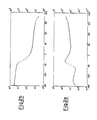
- the stress-strain curve of this product shows the high strengthening effect at high strains, typical of the block copolymers of AB-BA type.
- D.S.C. curve is in compliance with the performance expected on the basis of the data of composition of the dienic phase (vinyl content) before the hydrogenation.
- thermo-oxidative ageing and the ageing tests on Weather-O-Meter have shown the considerable stability of the hydrogenated relatively to the not-hydrogenated product.
- the ultimate tensile strength and the ultimate elongation remain practically unchanged
- a consi de- rable reduction in ultimate elongation and an extreme reduction in ultimate tensile strength can even be observed.
- the test is carried out as described in the preceding Example, with the only difference that a-methylstyrene is polymerized for 50 minutes, and in the subsequent polymerization of butadiene, a lower amount of THF (0.43 g) is charged, to the purpose of achieving a polymer with lower vinyl structure.
- the tensile data referring to the hydrogenated product evidences a strengthening action slightly lower than that of preceding sample, due to the lower content of hard phase, and an extremely good elastic response.
- Example 1 is repeated with the only differences that, as the coupling agent, silicon tetrachloride in suitable stoichiometric ratio (1/4 of Li value) is used, and that in lieu of butadiene, isoprene is used, a product being obtained which shows molecular and technological properties in compliance with the expected ones.
- silicon tetrachloride in suitable stoichiometric ratio (1/4 of Li value) is used, and that in lieu of butadiene, isoprene is used, a product being obtained which shows molecular and technological properties in compliance with the expected ones.
- Example 1 is repeated with the only difference that the hydrogenation reaction is carried out by using a nickel naphthenate as the catalyst, aluminum-trialkyl as the co-catalyst, at 65°C, under a hydrogen pressure of -20 atm.
Landscapes
- Chemical & Material Sciences (AREA)
- Inorganic Chemistry (AREA)
- Health & Medical Sciences (AREA)
- Chemical Kinetics & Catalysis (AREA)
- Medicinal Chemistry (AREA)
- Polymers & Plastics (AREA)
- Organic Chemistry (AREA)
- Addition Polymer Or Copolymer, Post-Treatments, Or Chemical Modifications (AREA)
- Polyethers (AREA)
- Polyoxymethylene Polymers And Polymers With Carbon-To-Carbon Bonds (AREA)
Applications Claiming Priority (2)
| Application Number | Priority Date | Filing Date | Title |
|---|---|---|---|
| IT21510/85A IT1186752B (it) | 1985-07-10 | 1985-07-10 | Copolimeri a blocchi idrogenati e loro processo di sintesi |
| IT2151085 | 1985-07-10 |
Publications (2)
| Publication Number | Publication Date |
|---|---|
| EP0209183A2 true EP0209183A2 (de) | 1987-01-21 |
| EP0209183A3 EP0209183A3 (de) | 1989-03-22 |
Family
ID=11182878
Family Applications (1)
| Application Number | Title | Priority Date | Filing Date |
|---|---|---|---|
| EP86201184A Withdrawn EP0209183A3 (de) | 1985-07-10 | 1986-07-07 | Hydrogenierte Block-Copolymere und Verfahren zu ihrer Herstellung |
Country Status (3)
| Country | Link |
|---|---|
| EP (1) | EP0209183A3 (de) |
| IT (1) | IT1186752B (de) |
| ZA (1) | ZA865037B (de) |
Cited By (4)
| Publication number | Priority date | Publication date | Assignee | Title |
|---|---|---|---|---|
| GB2225330A (en) * | 1988-11-25 | 1990-05-30 | Enichem Elastomers | Linear alternating-block copolymers |
| US7449518B2 (en) | 2006-03-24 | 2008-11-11 | Kraton Polymers U.S. Llc | High temperature block copolymers and process for making same |
| US7782190B1 (en) | 2004-04-19 | 2010-08-24 | Advanced Neuromodulation Systems, Inc. | Implantable device and system and method for wireless communication |
| CN112313257A (zh) * | 2018-07-24 | 2021-02-02 | 日本瑞翁株式会社 | 嵌段共聚物及其制造方法、嵌段共聚物氢化物、聚合物组合物以及成型体 |
Family Cites Families (2)
| Publication number | Priority date | Publication date | Assignee | Title |
|---|---|---|---|---|
| US3595942A (en) * | 1968-12-24 | 1971-07-27 | Shell Oil Co | Partially hydrogenated block copolymers |
| BE747591A (fr) * | 1969-04-01 | 1970-09-21 | Shell Int Research | Blokcopolymeren met eindstandige statistische copolymeerblokkenvan styreen en alfa-methylstyreen |
-
1985
- 1985-07-10 IT IT21510/85A patent/IT1186752B/it active
-
1986
- 1986-07-07 ZA ZA865037A patent/ZA865037B/xx unknown
- 1986-07-07 EP EP86201184A patent/EP0209183A3/de not_active Withdrawn
Cited By (7)
| Publication number | Priority date | Publication date | Assignee | Title |
|---|---|---|---|---|
| GB2225330A (en) * | 1988-11-25 | 1990-05-30 | Enichem Elastomers | Linear alternating-block copolymers |
| GB2225330B (en) * | 1988-11-25 | 1992-07-15 | Enichem Elastomers | Linear alternating-block copolymers |
| US5164455A (en) * | 1988-11-25 | 1992-11-17 | Enichem Elastomeri S.P.A. | Linear alternating-block copolymers |
| US7782190B1 (en) | 2004-04-19 | 2010-08-24 | Advanced Neuromodulation Systems, Inc. | Implantable device and system and method for wireless communication |
| US7449518B2 (en) | 2006-03-24 | 2008-11-11 | Kraton Polymers U.S. Llc | High temperature block copolymers and process for making same |
| CN112313257A (zh) * | 2018-07-24 | 2021-02-02 | 日本瑞翁株式会社 | 嵌段共聚物及其制造方法、嵌段共聚物氢化物、聚合物组合物以及成型体 |
| EP3828212A4 (de) * | 2018-07-24 | 2022-05-11 | Zeon Corporation | Blockcopolymer, verfahren zu seiner herstellung, hydriertes blockcopolymer, polymerzusammensetzung und formkörper |
Also Published As
| Publication number | Publication date |
|---|---|
| IT8521510A0 (it) | 1985-07-10 |
| EP0209183A3 (de) | 1989-03-22 |
| IT1186752B (it) | 1987-12-16 |
| ZA865037B (en) | 1987-02-25 |
Similar Documents
| Publication | Publication Date | Title |
|---|---|---|
| US4248986A (en) | Selective cyclization of block copolymers | |
| US5610227A (en) | Lithium amino magnesiate polymerization initiators and elastomers having reduced hysteresis | |
| CA2058562C (en) | Tin containing elastomers and products having reduced hysteresis properties | |
| US4879349A (en) | Selective hydrogenation process | |
| TWI452052B (zh) | 具有苯乙烯梯度之苯乙烯-丁二烯聚合物及其製備方法 | |
| US4152370A (en) | Preparation, composition, and use of block polymers | |
| JPH02276838A (ja) | 改良された耐押出性を有するエラストマー配合物及びその製造方法 | |
| JPH08277306A (ja) | アリル−およびキシリル−アミン含有エラストマーおよび減じられたヒステリシスを有する生成物 | |
| US4168286A (en) | Tetrablock polymers and their hydrogenated analogs | |
| EP0391692A1 (de) | Verfahren zur Herstellung von konjugierten Dien-(Co)Polymeren mit hohem Transgehalt und niedrigem Vinylgehalt | |
| EP0014947B1 (de) | Blockcopolymerisate von Dien mit endständigen statistischen Copolymerisatblöcken von Styrol oder Alkylstyrol und Alpha-Methylstyrol und ihre Herstellung | |
| JPH10237120A (ja) | コンパンドにした時に低いヒステリシス特性を示す大環状ポリマー類の合成 | |
| JPS62148503A (ja) | オレフイン系ベンゾシクロブテンポリマ−及びその製法 | |
| US5585443A (en) | Block copolymer | |
| JPH03177408A (ja) | テーパーブロックコポリマーおよびその製造方法 | |
| EP0250015B1 (de) | Anionische Polymerisationsverfahren | |
| US4242471A (en) | Selectively cyclized block copolymers | |
| EP0209183A2 (de) | Hydrogenierte Block-Copolymere und Verfahren zu ihrer Herstellung | |
| US3755269A (en) | Production of mercaptan-terminated polymers | |
| CN119173567A (zh) | 包含热塑性弹性体的弹性体基质 | |
| US4134928A (en) | Tetrablock polydienes | |
| JP2712622B2 (ja) | 共役ジエン系重合体の製造方法 | |
| US6777499B2 (en) | Multiblock interpolymers and processes for the preparation thereof | |
| US6800689B2 (en) | Process for producing polymer rubber and oil extended polymer rubber | |
| EP2113002B1 (de) | Verfahren zur herstellung gummihaltiger polymerer zusammensetzungen und zusammensetzungen |
Legal Events
| Date | Code | Title | Description |
|---|---|---|---|
| PUAI | Public reference made under article 153(3) epc to a published international application that has entered the european phase |
Free format text: ORIGINAL CODE: 0009012 |
|
| AK | Designated contracting states |
Kind code of ref document: A2 Designated state(s): AT BE CH DE FR GB LI LU NL SE |
|
| PUAL | Search report despatched |
Free format text: ORIGINAL CODE: 0009013 |
|
| AK | Designated contracting states |
Kind code of ref document: A3 Designated state(s): AT BE CH DE FR GB LI LU NL SE |
|
| STAA | Information on the status of an ep patent application or granted ep patent |
Free format text: STATUS: THE APPLICATION IS DEEMED TO BE WITHDRAWN |
|
| 18D | Application deemed to be withdrawn |
Effective date: 19890923 |
|
| RIN1 | Information on inventor provided before grant (corrected) |
Inventor name: ROGGERO, ARNALDO Inventor name: GANDINI, ALBERTO |