EP0209207B1 - Verfahren und Vorrichtung zum Befestigen elastischer Bänder an absorbierenden Wegwerfartikeln - Google Patents
Verfahren und Vorrichtung zum Befestigen elastischer Bänder an absorbierenden Wegwerfartikeln Download PDFInfo
- Publication number
- EP0209207B1 EP0209207B1 EP86300339A EP86300339A EP0209207B1 EP 0209207 B1 EP0209207 B1 EP 0209207B1 EP 86300339 A EP86300339 A EP 86300339A EP 86300339 A EP86300339 A EP 86300339A EP 0209207 B1 EP0209207 B1 EP 0209207B1
- Authority
- EP
- European Patent Office
- Prior art keywords
- strands
- sheet
- setting adhesive
- zones
- elastic
- Prior art date
- Legal status (The legal status is an assumption and is not a legal conclusion. Google has not performed a legal analysis and makes no representation as to the accuracy of the status listed.)
- Expired
Links
- 238000000034 method Methods 0.000 title claims description 24
- 230000002745 absorbent Effects 0.000 title description 8
- 239000002250 absorbent Substances 0.000 title description 8
- 239000000853 adhesive Substances 0.000 claims description 95
- 230000001070 adhesive effect Effects 0.000 claims description 95
- 239000000463 material Substances 0.000 claims description 8
- 239000012530 fluid Substances 0.000 claims description 4
- 239000004831 Hot glue Substances 0.000 claims description 2
- XLYOFNOQVPJJNP-UHFFFAOYSA-N water Substances O XLYOFNOQVPJJNP-UHFFFAOYSA-N 0.000 claims 1
- 239000003292 glue Substances 0.000 description 10
- 239000003795 chemical substances by application Substances 0.000 description 7
- 238000004519 manufacturing process Methods 0.000 description 3
- 239000002131 composite material Substances 0.000 description 2
- 238000010586 diagram Methods 0.000 description 2
- 239000012943 hotmelt Substances 0.000 description 2
- 230000000737 periodic effect Effects 0.000 description 2
- 239000004698 Polyethylene Substances 0.000 description 1
- 230000003467 diminishing effect Effects 0.000 description 1
- 238000007599 discharging Methods 0.000 description 1
- 230000000694 effects Effects 0.000 description 1
- 239000012634 fragment Substances 0.000 description 1
- -1 polyethylene Polymers 0.000 description 1
- 229920000573 polyethylene Polymers 0.000 description 1
- 230000002250 progressing effect Effects 0.000 description 1
- 238000007789 sealing Methods 0.000 description 1
Images
Classifications
-
- A—HUMAN NECESSITIES
- A61—MEDICAL OR VETERINARY SCIENCE; HYGIENE
- A61F—FILTERS IMPLANTABLE INTO BLOOD VESSELS; PROSTHESES; DEVICES PROVIDING PATENCY TO, OR PREVENTING COLLAPSING OF, TUBULAR STRUCTURES OF THE BODY, e.g. STENTS; ORTHOPAEDIC, NURSING OR CONTRACEPTIVE DEVICES; FOMENTATION; TREATMENT OR PROTECTION OF EYES OR EARS; BANDAGES, DRESSINGS OR ABSORBENT PADS; FIRST-AID KITS
- A61F13/00—Bandages or dressings; Absorbent pads
- A61F13/15—Absorbent pads, e.g. sanitary towels, swabs or tampons for external or internal application to the body; Supporting or fastening means therefor; Tampon applicators
- A61F13/15577—Apparatus or processes for manufacturing
- A61F13/15585—Apparatus or processes for manufacturing of babies' napkins, e.g. diapers
- A61F13/15593—Apparatus or processes for manufacturing of babies' napkins, e.g. diapers having elastic ribbons fixed thereto; Devices for applying the ribbons
Definitions
- This invention pertains to a method and apparatus for securing elastic strands in disposable diapers where the strands impart an elasticized characteristic to the margins of the diapers and produce a sealing effect on the body so fluids will not leak out.
- the Buell patent teaches how to fabricate disposable diapers which are elasticized in the crotch and leg contacting region of the diaper so it fits snugly around the legs of an infant.
- a method suggested in this patent involves feeding a continuous moisture impervious sheet and a continuous stretched elastic strand toward a diaper assembly station.
- a quick setting glue is applied periodically over zones on the strand which are caused to adhere to the sheet in a region that will coincide with the crotch of the infant.
- a pad of an absorbent material is deposited on the backing sheet and it is overlayed with a nonwoven sheet whose edges are glued to what will become the edges of the finished diaper.
- the elastic strands When the web is cut into individual diapers, since the elastic strands are stretched where they extend from one diaper to another and are without adhesive in that region, the strands snap back into the diaper where they snarl or tangle undesirably. There are four unattached snapped back elastic strand ends each of which commonly exhibits a different bunched up and tangled configuration which by no means enhances the aesthetic quality of the diaper. Some diaper manufacturers avoid this problem by applying glue continuously to the stretched elastic strand such that when the glue on the strand sets in the diaper web and the web is cut into individual diapers the strand, being set, cannot snap back into the diaper. The problem with this is that the diaper is not only elasticized in the crotch region of an infant but also up into the waist region where elasticity is not needed nor desirable.
- U.S. Patent No. 4 353 762 issued in the name of F. J. Bouda on October 12, 1982, teaches applying glue continuously to the rubber strand while the strand is stretched. But the parts of the strand extending beyond the crotch region in the diaper have the glue on them deactivated by a release agent which prevents the ends of the glue coated elastic strand from sticking to the diaper backing or facing sheets. However, it is apparent when the web is cut into individual diapers, the unattached ends of the strands which extend from diaper to diaper snap back into the diaper where they can bunch up at random.
- EP-A-0 170 922 describes a method for attaching elastic strips to the backing sheet of a diaper involving the steps of continuously feeding the sheet, continuously applying an adhesive onto the sheet and concurrently feeding with the sheet an elastic strip under stretched condition toward an assembly station. Before the elastic strip is assembled into the diaper web, a release agent is applied intermittently to selected portions of the elastic strip while it is in a stretched condition.
- the stretched elastic strip which has been treated with intermittently applied release agents is applied to the moving sheet on which the adhesive is applied so that the elastic strip is fixed to the sheet in zones along the sheet only where the release agent has not been applied.
- the problem with this method is that when the elastic strips are cut in the region where the release agent was applied and are completely unadhered, the elastic strips snap toward the next adjacent adhered zone on the elastic strip resulting in a free unadhered and tangled free end of the elastic strip in the diaper, thus diminishing the aesthetic quality of the diaper as was the case in U.S.-A-4 081 301 discussed above.
- a pair of elastic strands are fed in parallel to a disposable diaper assembly station.
- a quick setting adhesive is applied at regular periodicity to the strands so they have first zones of predetermined length with adhesive on them alternating with second zones having no adhesive.
- a web of inelastic material is fed concurrently to the assembly station and at the same time a relatively slower setting adhesive is applied to it at regular periodicity and in phase with the zones on the strands that are without adhesive.
- the web is cut into individual diapers.
- the slow setting adhesive is designed to set after tension in the strand is relieved in the slow setting adhesive zone.
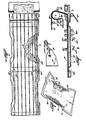
- the diaper shown in FIG. 1 is elaticized in selected regions by following the method described herein although, on first impression, the diaper appears to be conventional. It is conventional to the extent that it is comprised of a backing sheet or web of a flexible fluid impervious sheet of a material such as polyethylene.
- the backing sheet 10 is on the side of the diaper remote from the observer.
- the diaper is cut away along its side margins so as to have an hourglass shape.
- An absorbent pad having substantially the same configuration but smaller in dimensions in all directions is imposed directly on backing sheet 10. The pad is marked 11 and extends nearly to the sides and ends of the backing sheet.
- the cut away regions 12 of the diaper reside in the crotch region when applied to an infant.
- a sheet of nonwoven material 13 is imposed over absorbent pad 11 and extends to the edges of backing sheet 10.
- Two elastic strands 14 and 15 are shown adhered to backing sheet 10 and between porous nonwoven facing sheet 13 and backing sheet 10.
- the mid regions of the elastic strands are wrinkled as is typical as the result of their being allowed to contract to a relaxed state, causing shirring of the diaper.
- the end regions 16 and 17 of the strands are adhered to the backing sheet in this example but they are in a completely relaxed state, that is, without tension so the end portions do not have a tendency to pull down the front and rear waist regions of the diaper when it is applied to an infant.
- FIG. 5 shows how a typical elastic strand 14 is treated in accordance with the invention.
- the elastic strand is stretched and coated with quick setting adhesive in first zones such as 20 and 22 of predetermined length at regular periodicity.
- First zones alternate with second zones such as those marked 24 and 26 on which there is no adhesive.
- Applying adhesive periodically to elastic strands is known per se.
- the backing sheet or continuous web 10 of fluid impermeable material shown in FIG. 6 is concurrently coated with the apparatus in FIG. 2 with a slower setting adhesive in first zones of predetermined length such as those marked 28 and 30.
- the first periodic adhesive coated zones 28 and 30 on backing sheet 10 alternate with zones such as those marked 32 and 34 which are not coated with adhesive.
- zones such as 20 and 22 on the strands having the quick setting adhesive are interfaced with the zones such as 32 and 34 on the backing sheet 10 to which adhesive has not yet been applied.
- the second zones such as 24 and 26 on the stretched elastic strand are interfaced with the first zones such as 28 and 30 on the backing sheet having the slower setting adhesive applied.
- Adhesives that can be characterized as quick setting and suitable for obtaining a permanent bond substantially upon contact between a stretched elastic strand and the backing sheet or a diaper facing sheet are well known by those involved in producing disposable diapers.
- Quick setting adhesives are generally of the hot melt type.
- a commonly used quick setting adhesive is identified as No. 995-336 and is available from Findley Adhesives Inc., Elm Grove, Wl.
- the relatively slow setting adhesives are usually cold water-base types although there are some commercially available hot melt types which set slowly enough to fulfill the requirements of the invention. The slow setting adhesive must remain unset at least until such time that the elastic strands are cut and the end portions have contracted to a relaxed position.
- the maximum setting time for the slow setting adhesive can extend beyond the time when the diapers are severed from the web all the way to the time that the diapers are packaged at the end of the production line and, even, after they are packaged.
- a suitable hot melt adhesive conforming to the requirements of a slow setting adhesive is one known as type X999-375-01 available from Findley Adhesives, Inc.
- a typical cold water-base slow setting adhesive would be one comparable to the well known type X8141-381-01 available from the same source.
- FIG. 2 is a diagram of those parts of a diaper making machine involved in installing elastic strands in diapers in accordance with the invention.
- the absorbent pads 11 are fed to the diaper assembly region on an input conveyor belt 36.
- the fabricated diaper web is pulled longitudinally in a known fashion by means of pull rolls 38 toward an output station, not shown, at which the diapers severed from the webs are packaged. There are some additional sets of pull rolls, not shown, downstream in the diaper fabrication line. The pull rolls keep the web in tension until the individual diapers are severed from the web.
- the moisture impermeable backing sheet 10 for the diapers is fed from a parent roll, not shown, past a pair of laterally spaced apart glue discharging nozzles, one of which 40 is visible in FIG. 2.
- nozzles 40 apply the relatively slow setting adhesive periodically along the lines on the backing sheet web 10 as previously described in connection with FIG. 6.
- a pair of elastic strands 14 are withdrawn from a dispenser box or spool, not shown, and pass over some metering rolls, not shown, which resist having the strand drawn into the diaper fabricating machine to thereby stretch and keep the strands in tension as they pass into the machine.
- a suitable metering arrangement is shown in FIG. 1 of U.S. Patent No. 4,081,301.
- periodic zones such as 20 and 22 in FIG. 5 are coated with the quick setting adhesive by means of a pair of nozzles, one of which 42 is visible in FIG. 2.
- the quick setting adhesive coated zones such as 20 and 22 on the strands 14, 15 contact uncoated zones 32 and 34 on the backing sheet and the uncoated zones 24 and 26 on the strand contact the slow setting adhesive in the zones 28 and 30 with the result that the strands are adhered continuously onto the backing sheet.
- the zones on the strand having the quick setting adhesive bond tenaciously and permanently in an instant.
- the zones on the strand which interface with the slow setting adhesive result in the two sticking together but the bond is tentative, that is, the adhesive will not set until at least some short time after the web is cut into individual diapers.
- the composite passes a row of nozzles, one of which 48 is visible in FIG. 2.
- the nozzles 48 apply several parallel fine lines of glue on the backing sheet such as the lines marked 50 in FIG. 4.
- the lines of quick setting glue 50 adhere the absorbent pads to the backing sheet so that the positions of the pads are fixed relative to the edges of the backing sheet.
- the sheet of nonwoven material 13 which interfaces with the body of the infant wearing the diaper is fed in as shown in FIG. 2 and is adhered to backing sheet 10 around the perimeter of absorbent pad 11 by means of adhesive lines 50.
- a rotating bar 54 is located next to pull rolls 38. It presses down on the nonwoven facing sheet 13 to cause it to bond onto the backing sheet 10 in the regions 56 where the individual diapers will be severed from the web. The bar presses against a rotating anvil 55.
- a transverse cut is made across the web between consecutive diapers with a cross cut blade, not shown, located shortly after the diapers reach a folder station, not shown, which folds the left and right edges inwardly before the diapers are severed.
- the quick setting adhesive is set before the diapers are severed so the zones such as 20 and 22 on the stretched strand will impart elasticity to the diaper in the crotch region. In accordance with the invention, however, when the diapers are severed, the slow setting adhesive has not set as yet.
- pre-cutting the strands can begin contracting while the web is still under tension. This minimizes the possibility of the diapers skewing after being cut off as a result of the elastic on one side contracting at a faster rate than the elastic on the opposite side. Recognize, however, that precutting the strands requires use of an even quicker setting quick setting adhesive, since the cut-off point will be much closer to the adhesive application zone in most diaper making machines.
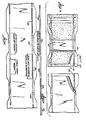
- FIG. 7 shows what happens immediately after the individual diapers are severed from the web in a case where the elastic strands are installed in the diaper by the method of the present invention.
- the quick setting adhesive zone 20 of the elastic strand that imparts elasticity to the mid region of the diaper is set already.
- the part of the strand 26 that was placed in contact with the slow setting adhesive will be allowed to contract to the condition in which it is shown.
- the elastic strand zones 26 creep along the tentatively adhered slow setting adhesive coated zones 30 before the slow setting adhesive has enough time to set.
- the end zone 26 of the strand will be totally relaxed and unstretched but permanently fixed in a straight line with the remainder of the strand.
Landscapes
- Health & Medical Sciences (AREA)
- Engineering & Computer Science (AREA)
- Vascular Medicine (AREA)
- Epidemiology (AREA)
- Biomedical Technology (AREA)
- Heart & Thoracic Surgery (AREA)
- Manufacturing & Machinery (AREA)
- Life Sciences & Earth Sciences (AREA)
- Animal Behavior & Ethology (AREA)
- General Health & Medical Sciences (AREA)
- Public Health (AREA)
- Veterinary Medicine (AREA)
- Absorbent Articles And Supports Therefor (AREA)
Claims (8)
Applications Claiming Priority (2)
| Application Number | Priority Date | Filing Date | Title |
|---|---|---|---|
| US746838 | 1985-06-20 | ||
| US06/746,838 US4634482A (en) | 1985-06-20 | 1985-06-20 | Method for securing elastic strands to disposable absorbent articles |
Publications (2)
| Publication Number | Publication Date |
|---|---|
| EP0209207A1 EP0209207A1 (de) | 1987-01-21 |
| EP0209207B1 true EP0209207B1 (de) | 1990-05-23 |
Family
ID=25002563
Family Applications (1)
| Application Number | Title | Priority Date | Filing Date |
|---|---|---|---|
| EP86300339A Expired EP0209207B1 (de) | 1985-06-20 | 1986-01-17 | Verfahren und Vorrichtung zum Befestigen elastischer Bänder an absorbierenden Wegwerfartikeln |
Country Status (5)
| Country | Link |
|---|---|
| US (1) | US4634482A (de) |
| EP (1) | EP0209207B1 (de) |
| CA (1) | CA1236056A (de) |
| DE (1) | DE3671364D1 (de) |
| ES (1) | ES8704336A1 (de) |
Families Citing this family (76)
| Publication number | Priority date | Publication date | Assignee | Title |
|---|---|---|---|---|
| SE446939B (sv) * | 1983-05-24 | 1986-10-20 | Duni Bila Ab | Inkontinensbloja samt forfarande for fixering av elastiska band vid en dylik bloja |
| WO1987004117A1 (en) * | 1986-01-02 | 1987-07-16 | Weyerhaeuser Company | Method of adhering elastic to garments |
| US4711683A (en) * | 1987-03-09 | 1987-12-08 | Paper Converting Machine Company | Method and apparatus for making elastic diapers |
| ZA92308B (en) | 1991-09-11 | 1992-10-28 | Kimberly Clark Co | Thin absorbent article having rapid uptake of liquid |
| USH1420H (en) * | 1992-04-30 | 1995-02-07 | Richardson; James W. | Method for attaching discrete, stretched elastic strands to predetermined isolated portions of disposable absorbent products |
| US6087550A (en) * | 1995-11-09 | 2000-07-11 | H. B. Fuller Licensing & Financing, Inc. | Non-woven application for water dispersable copolyester |
| US6020535A (en) * | 1997-12-31 | 2000-02-01 | Kimberly-Clark Worldwide, Inc. | Extensible absorbent article including a release agent |
| US6491776B2 (en) * | 2001-04-23 | 2002-12-10 | Bostik Findley, Inc. | Dual adhesive application for laminating elastic webs |
| US20040068246A1 (en) * | 2002-10-02 | 2004-04-08 | Kimberly-Clark Worldwide, Inc. | Disposable garments with improved elastic filament placement control and methods of producing same |
| US8417374B2 (en) * | 2004-04-19 | 2013-04-09 | Curt G. Joa, Inc. | Method and apparatus for changing speed or direction of an article |
| US7703599B2 (en) * | 2004-04-19 | 2010-04-27 | Curt G. Joa, Inc. | Method and apparatus for reversing direction of an article |
| US7374627B2 (en) * | 2004-04-19 | 2008-05-20 | Curt G. Joa, Inc. | Method of producing an ultrasonically bonded lap seam |
| US7303708B2 (en) * | 2004-04-19 | 2007-12-04 | Curt G. Joa, Inc. | Super absorbent distribution system design for homogeneous distribution throughout an absorbent core |
| US7708849B2 (en) * | 2004-04-20 | 2010-05-04 | Curt G. Joa, Inc. | Apparatus and method for cutting elastic strands between layers of carrier webs |
| US20050230449A1 (en) * | 2004-04-20 | 2005-10-20 | Curt G. Joa, Inc. | Apparatus and method of increasing web storage in a dancer |
| US20050230037A1 (en) * | 2004-04-20 | 2005-10-20 | Curt G. Joa, Inc. | Staggered cutting knife |
| US7640962B2 (en) * | 2004-04-20 | 2010-01-05 | Curt G. Joa, Inc. | Multiple tape application method and apparatus |
| US7638014B2 (en) * | 2004-05-21 | 2009-12-29 | Curt G. Joa, Inc. | Method of producing a pants-type diaper |
| US7537215B2 (en) | 2004-06-15 | 2009-05-26 | Curt G. Joa, Inc. | Method and apparatus for securing stretchable film using vacuum |
| US8277430B2 (en) * | 2004-12-28 | 2012-10-02 | Kimberly-Clarl Worldwide, Inc. | Absorbent garment with strand coated adhesive components |
| US20060137810A1 (en) * | 2004-12-28 | 2006-06-29 | Beck Scott A | Method of making an elastic laminate using direct contact thermal rolls for controlling web contraction |
| US7452436B2 (en) * | 2005-03-09 | 2008-11-18 | Curt G. Joa, Inc. | Transverse tape application method and apparatus |
| US7811403B2 (en) * | 2005-03-09 | 2010-10-12 | Curt G. Joa, Inc. | Transverse tab application method and apparatus |
| US8007484B2 (en) * | 2005-04-01 | 2011-08-30 | Curt G. Joa, Inc. | Pants type product and method of making the same |
| US20060258249A1 (en) * | 2005-05-11 | 2006-11-16 | Fairbanks Jason S | Elastic laminates and process for producing same |
| US7533709B2 (en) * | 2005-05-31 | 2009-05-19 | Curt G. Joa, Inc. | High speed vacuum porting |
| US7618513B2 (en) * | 2005-05-31 | 2009-11-17 | Curt G. Joa, Inc. | Web stabilization on a slip and cut applicator |
| US7398870B2 (en) * | 2005-10-05 | 2008-07-15 | Curt G. Joa, Inc | Article transfer and placement apparatus |
| US7770712B2 (en) * | 2006-02-17 | 2010-08-10 | Curt G. Joa, Inc. | Article transfer and placement apparatus with active puck |
| US20070250032A1 (en) * | 2006-03-08 | 2007-10-25 | Curt G. Joa, Inc. | Refastenable tab for disposable pant and methods for making same |
| US7780052B2 (en) | 2006-05-18 | 2010-08-24 | Curt G. Joa, Inc. | Trim removal system |
| US9622918B2 (en) | 2006-05-18 | 2017-04-18 | Curt G. Joe, Inc. | Methods and apparatus for application of nested zero waste ear to traveling web |
| US10456302B2 (en) | 2006-05-18 | 2019-10-29 | Curt G. Joa, Inc. | Methods and apparatus for application of nested zero waste ear to traveling web |
| US8172977B2 (en) | 2009-04-06 | 2012-05-08 | Curt G. Joa, Inc. | Methods and apparatus for application of nested zero waste ear to traveling web |
| US8016972B2 (en) | 2007-05-09 | 2011-09-13 | Curt G. Joa, Inc. | Methods and apparatus for application of nested zero waste ear to traveling web |
| US9433538B2 (en) | 2006-05-18 | 2016-09-06 | Curt G. Joa, Inc. | Methods and apparatus for application of nested zero waste ear to traveling web and formation of articles using a dual cut slip unit |
| US20080050531A1 (en) * | 2006-08-28 | 2008-02-28 | Curt G. Joa, Inc. | Apparatus and method for wetting a continuous web |
| US20080169373A1 (en) * | 2007-01-12 | 2008-07-17 | Curt G. Joa, Inc. | Apparatus and methods for minimizing waste during web splicing |
| CA2622049C (en) * | 2007-02-21 | 2015-04-21 | Curt G. Joa, Inc. | Single transfer insert placement method and apparatus |
| US9944487B2 (en) | 2007-02-21 | 2018-04-17 | Curt G. Joa, Inc. | Single transfer insert placement method and apparatus |
| US9550306B2 (en) | 2007-02-21 | 2017-01-24 | Curt G. Joa, Inc. | Single transfer insert placement and apparatus with cross-direction insert placement control |
| US9387131B2 (en) | 2007-07-20 | 2016-07-12 | Curt G. Joa, Inc. | Apparatus and method for minimizing waste and improving quality and production in web processing operations by automated threading and re-threading of web materials |
| US8398793B2 (en) * | 2007-07-20 | 2013-03-19 | Curt G. Joa, Inc. | Apparatus and method for minimizing waste and improving quality and production in web processing operations |
| US8182624B2 (en) | 2008-03-12 | 2012-05-22 | Curt G. Joa, Inc. | Registered stretch laminate and methods for forming a registered stretch laminate |
| JP6026742B2 (ja) | 2008-08-06 | 2016-11-16 | インヴィスタ テクノロジーズ エスアエルエル | 使い捨て衛生用製品および衣料品の構成材に有用な、弾性の複合構造物の製造方法 |
| US8182627B2 (en) * | 2009-01-30 | 2012-05-22 | The Procter & Gamble Company | Method for high-speed continuous application of a strip material to a substrate along an application path on the substrate |
| US8171972B2 (en) | 2009-01-30 | 2012-05-08 | The Procter & Gamble Company | Strip guide for high-speed continuous application of a strip material to a moving sheet-like substrate material at laterally shifting locations |
| US20100193138A1 (en) * | 2009-01-30 | 2010-08-05 | Joseph Allen Eckstein | System for High-Speed Continuous Application of a Strip Material to a Moving Sheet-Like Substrate Material at Laterally Shifting Locations |
| US20100193135A1 (en) * | 2009-01-30 | 2010-08-05 | Joseph Allen Eckstein | System and Method for High-Speed Continuous Application of a Strip Material to a Moving Sheet-Like Substrate Material at Laterally Shifting Locations |
| US8673098B2 (en) * | 2009-10-28 | 2014-03-18 | Curt G. Joa, Inc. | Method and apparatus for stretching segmented stretchable film and application of the segmented film to a moving web |
| US9089453B2 (en) | 2009-12-30 | 2015-07-28 | Curt G. Joa, Inc. | Method for producing absorbent article with stretch film side panel and application of intermittent discrete components of an absorbent article |
| US8460495B2 (en) * | 2009-12-30 | 2013-06-11 | Curt G. Joa, Inc. | Method for producing absorbent article with stretch film side panel and application of intermittent discrete components of an absorbent article |
| US8663411B2 (en) | 2010-06-07 | 2014-03-04 | Curt G. Joa, Inc. | Apparatus and method for forming a pant-type diaper with refastenable side seams |
| US9603752B2 (en) | 2010-08-05 | 2017-03-28 | Curt G. Joa, Inc. | Apparatus and method for minimizing waste and improving quality and production in web processing operations by automatic cuff defect correction |
| US9566193B2 (en) | 2011-02-25 | 2017-02-14 | Curt G. Joa, Inc. | Methods and apparatus for forming disposable products at high speeds with small machine footprint |
| US8656817B2 (en) | 2011-03-09 | 2014-02-25 | Curt G. Joa | Multi-profile die cutting assembly |
| USD684613S1 (en) | 2011-04-14 | 2013-06-18 | Curt G. Joa, Inc. | Sliding guard structure |
| US8820380B2 (en) | 2011-07-21 | 2014-09-02 | Curt G. Joa, Inc. | Differential speed shafted machines and uses therefor, including discontinuous and continuous side by side bonding |
| ES2561754T3 (es) | 2012-02-20 | 2016-02-29 | Curt G. Joa, Inc. | Método para formar uniones entre componentes discretos de artículos desechables |
| US9050213B2 (en) | 2012-03-30 | 2015-06-09 | The Procter & Gamble Company | Apparatuses and methods for making absorbent articles |
| US8440043B1 (en) | 2012-03-30 | 2013-05-14 | The Procter & Gamble Company | Absorbent article process and apparatus for intermittently deactivating elastics in elastic laminates |
| US20130255861A1 (en) | 2012-03-30 | 2013-10-03 | Uwe Schneider | Apparatuses and Methods for Making Absorbent Articles |
| US9028632B2 (en) * | 2012-03-30 | 2015-05-12 | The Procter & Gamble Company | Apparatuses and methods for making absorbent articles |
| US9039855B2 (en) | 2012-03-30 | 2015-05-26 | The Procter & Gamble Company | Apparatuses and methods for making absorbent articles |
| US9809414B2 (en) | 2012-04-24 | 2017-11-07 | Curt G. Joa, Inc. | Elastic break brake apparatus and method for minimizing broken elastic rethreading |
| EP2866753A1 (de) | 2012-06-29 | 2015-05-06 | The Procter & Gamble Company | System und verfahren für kontinuierliche hochgeschwindigkeitsanwendung eines streifenmaterials auf ein bewegtes blattförmiges substratmaterial |
| US9283683B2 (en) | 2013-07-24 | 2016-03-15 | Curt G. Joa, Inc. | Ventilated vacuum commutation structures |
| USD703247S1 (en) | 2013-08-23 | 2014-04-22 | Curt G. Joa, Inc. | Ventilated vacuum commutation structure |
| USD704237S1 (en) | 2013-08-23 | 2014-05-06 | Curt G. Joa, Inc. | Ventilated vacuum commutation structure |
| USD703711S1 (en) | 2013-08-23 | 2014-04-29 | Curt G. Joa, Inc. | Ventilated vacuum communication structure |
| USD703248S1 (en) | 2013-08-23 | 2014-04-22 | Curt G. Joa, Inc. | Ventilated vacuum commutation structure |
| USD703712S1 (en) | 2013-08-23 | 2014-04-29 | Curt G. Joa, Inc. | Ventilated vacuum commutation structure |
| US9289329B1 (en) | 2013-12-05 | 2016-03-22 | Curt G. Joa, Inc. | Method for producing pant type diapers |
| CA2991328C (en) | 2015-07-24 | 2021-10-26 | Curt G. Joa, Inc. | Vacuum commutation apparatus and methods |
| US11737930B2 (en) | 2020-02-27 | 2023-08-29 | Curt G. Joa, Inc. | Configurable single transfer insert placement method and apparatus |
| TW202204462A (zh) | 2020-03-25 | 2022-02-01 | 英商萊卡英國有限公司 | 彈性化非織造層合物 |
Family Cites Families (8)
| Publication number | Priority date | Publication date | Assignee | Title |
|---|---|---|---|---|
| US4081301A (en) * | 1975-10-30 | 1978-03-28 | The Procter & Gamble Company | Method and apparatus for continuously attaching discrete, stretched elastic strands to predetermined isolated portions of disposable abosrbent products |
| US4405397A (en) * | 1979-10-16 | 1983-09-20 | Riegel Textile Corporation | Process for manufacturing elastic leg disposable diapers |
| US4300967A (en) * | 1979-11-15 | 1981-11-17 | Kimberly-Clark Corporation | Methods and apparatus for elasticizing discrete areas of conformable garments |
| US4333782A (en) * | 1980-02-11 | 1982-06-08 | Johnson & Johnson Baby Products Company | Method of making laminated structures having gathered and ungathered marginal portions |
| US4353762A (en) * | 1980-11-19 | 1982-10-12 | Bouda Francis J | Method and apparatus for continuously attaching elastic strands to disposable absorbent products |
| US4360398A (en) * | 1981-03-09 | 1982-11-23 | Sabee Products, Inc. | Method for applying elastic bands to webs |
| JPS6134202A (ja) * | 1984-07-20 | 1986-02-18 | 花王株式会社 | シ−トに弾性材を取付ける方法 |
| US4547243A (en) * | 1984-10-09 | 1985-10-15 | Whitestone Products | Method and apparatus for continuously attaching elastic strands to disposable absorbent products |
-
1985
- 1985-06-20 US US06/746,838 patent/US4634482A/en not_active Expired - Lifetime
-
1986
- 1986-01-02 CA CA000498851A patent/CA1236056A/en not_active Expired
- 1986-01-17 EP EP86300339A patent/EP0209207B1/de not_active Expired
- 1986-01-17 DE DE8686300339T patent/DE3671364D1/de not_active Expired - Fee Related
- 1986-06-19 ES ES556254A patent/ES8704336A1/es not_active Expired
Also Published As
| Publication number | Publication date |
|---|---|
| EP0209207A1 (de) | 1987-01-21 |
| ES556254A0 (es) | 1987-04-01 |
| CA1236056A (en) | 1988-05-03 |
| ES8704336A1 (es) | 1987-04-01 |
| US4634482A (en) | 1987-01-06 |
| DE3671364D1 (de) | 1990-06-28 |
Similar Documents
| Publication | Publication Date | Title |
|---|---|---|
| US4634482A (en) | Method for securing elastic strands to disposable absorbent articles | |
| US4525229A (en) | Method for attaching elastic band to sanitary articles | |
| CA1072872A (en) | Method and apparatus for continuously attaching discrete, stretched elastic strands to disposable absorbent products | |
| EP0396800B1 (de) | Wegwerfwindel mit einem elastischen Taillenband | |
| US5213645A (en) | Method for attachment of elastic members around leg-holes of disposable garments | |
| US4543141A (en) | Method of making elastic diapers, apparatus therefor, and product | |
| US4147580A (en) | Method of bonding a porous fibrous web to a substrate | |
| US4968313A (en) | Diaper with waist band elastic | |
| US4409049A (en) | Method and apparatus for effecting intermittent securement of a stretched elastic member to a moving web | |
| US4425173A (en) | Apparatus and method for producing an elasticized garment | |
| CA1133866A (en) | Method and apparatus for making diapers with elastic bands | |
| US4285747A (en) | Method for manufacturing a product having elastic means disposed in the transverse direction | |
| CN1146145A (zh) | 制作短衬裤型尿布或卫生短衬裤的方法以及这样的吸收件 | |
| US4240866A (en) | Apparatus for manufacturing a product having elastic means disposed in the transverse direction | |
| KR20000010993A (ko) | 한쌍의 탄성화된 레그 개구부를 갖는 팬티형 속옷의 연속적 고속 제조방법u | |
| JPH07184958A (ja) | ウェストバンド付き使い捨ておむつの製造方法と装置 | |
| US4488923A (en) | Method for producing a fabric having unsecured elastic in areas intermittently disposed along an edge thereof | |
| US4572043A (en) | Method and apparatus for forming elastic elements under tension from a continuous elastic web, particularly for manufacturing sanitary products such as disposable diapers and the like | |
| EP0091316B1 (de) | Vorrichtung zur Befestigung eines elastischen Streifens an einer Einwegwindel | |
| HUT66280A (en) | Method for continuous manufacturing of sanitary products e. g. diapers and the product made by said method | |
| US4547243A (en) | Method and apparatus for continuously attaching elastic strands to disposable absorbent products | |
| EP0170922A1 (de) | Verfahren zum Anbringen eines elastischen Elements an ein Blatt | |
| US4642109A (en) | Method of making elastic diapers and product | |
| JPS6087040A (ja) | 弾性バンドを衛生物品に取付ける方法 | |
| JPH0415052A (ja) | 弾性部材の間欠的貼着方法 |
Legal Events
| Date | Code | Title | Description |
|---|---|---|---|
| PUAI | Public reference made under article 153(3) epc to a published international application that has entered the european phase |
Free format text: ORIGINAL CODE: 0009012 |
|
| AK | Designated contracting states |
Kind code of ref document: A1 Designated state(s): CH DE FR GB IT LI SE |
|
| 17P | Request for examination filed |
Effective date: 19870403 |
|
| 17Q | First examination report despatched |
Effective date: 19881227 |
|
| GRAA | (expected) grant |
Free format text: ORIGINAL CODE: 0009210 |
|
| AK | Designated contracting states |
Kind code of ref document: B1 Designated state(s): CH DE FR GB IT LI SE |
|
| REF | Corresponds to: |
Ref document number: 3671364 Country of ref document: DE Date of ref document: 19900628 |
|
| ET | Fr: translation filed | ||
| ITF | It: translation for a ep patent filed | ||
| ITTA | It: last paid annual fee | ||
| PLBE | No opposition filed within time limit |
Free format text: ORIGINAL CODE: 0009261 |
|
| STAA | Information on the status of an ep patent application or granted ep patent |
Free format text: STATUS: NO OPPOSITION FILED WITHIN TIME LIMIT |
|
| 26N | No opposition filed | ||
| PGFP | Annual fee paid to national office [announced via postgrant information from national office to epo] |
Ref country code: SE Payment date: 19920115 Year of fee payment: 7 Ref country code: GB Payment date: 19920115 Year of fee payment: 7 |
|
| PGFP | Annual fee paid to national office [announced via postgrant information from national office to epo] |
Ref country code: FR Payment date: 19920121 Year of fee payment: 7 Ref country code: CH Payment date: 19920121 Year of fee payment: 7 |
|
| PGFP | Annual fee paid to national office [announced via postgrant information from national office to epo] |
Ref country code: DE Payment date: 19920221 Year of fee payment: 7 |
|
| PG25 | Lapsed in a contracting state [announced via postgrant information from national office to epo] |
Ref country code: GB Effective date: 19930117 |
|
| PG25 | Lapsed in a contracting state [announced via postgrant information from national office to epo] |
Ref country code: SE Effective date: 19930118 |
|
| PG25 | Lapsed in a contracting state [announced via postgrant information from national office to epo] |
Ref country code: LI Effective date: 19930131 Ref country code: CH Effective date: 19930131 |
|
| GBPC | Gb: european patent ceased through non-payment of renewal fee |
Effective date: 19930117 |
|
| PG25 | Lapsed in a contracting state [announced via postgrant information from national office to epo] |
Ref country code: FR Effective date: 19930930 |
|
| REG | Reference to a national code |
Ref country code: CH Ref legal event code: PL |
|
| PG25 | Lapsed in a contracting state [announced via postgrant information from national office to epo] |
Ref country code: DE Effective date: 19931001 |
|
| REG | Reference to a national code |
Ref country code: FR Ref legal event code: ST |
|
| EUG | Se: european patent has lapsed |
Ref document number: 86300339.8 Effective date: 19930810 |
|
| PG25 | Lapsed in a contracting state [announced via postgrant information from national office to epo] |
Ref country code: IT Free format text: LAPSE BECAUSE OF NON-PAYMENT OF DUE FEES;WARNING: LAPSES OF ITALIAN PATENTS WITH EFFECTIVE DATE BEFORE 2007 MAY HAVE OCCURRED AT ANY TIME BEFORE 2007. THE CORRECT EFFECTIVE DATE MAY BE DIFFERENT FROM THE ONE RECORDED. Effective date: 20050117 |