EP0209383A2 - Méthode de communication - Google Patents
Méthode de communication Download PDFInfo
- Publication number
- EP0209383A2 EP0209383A2 EP86305496A EP86305496A EP0209383A2 EP 0209383 A2 EP0209383 A2 EP 0209383A2 EP 86305496 A EP86305496 A EP 86305496A EP 86305496 A EP86305496 A EP 86305496A EP 0209383 A2 EP0209383 A2 EP 0209383A2
- Authority
- EP
- European Patent Office
- Prior art keywords
- stations
- station
- time
- real
- communications network
- Prior art date
- Legal status (The legal status is an assumption and is not a legal conclusion. Google has not performed a legal analysis and makes no representation as to the accuracy of the status listed.)
- Granted
Links
Images
Classifications
-
- H—ELECTRICITY
- H04—ELECTRIC COMMUNICATION TECHNIQUE
- H04L—TRANSMISSION OF DIGITAL INFORMATION, e.g. TELEGRAPHIC COMMUNICATION
- H04L12/00—Data switching networks
- H04L12/64—Hybrid switching systems
-
- H—ELECTRICITY
- H04—ELECTRIC COMMUNICATION TECHNIQUE
- H04L—TRANSMISSION OF DIGITAL INFORMATION, e.g. TELEGRAPHIC COMMUNICATION
- H04L12/00—Data switching networks
- H04L12/28—Data switching networks characterised by path configuration, e.g. LAN [Local Area Networks] or WAN [Wide Area Networks]
- H04L12/42—Loop networks
- H04L12/427—Loop networks with decentralised control
- H04L12/43—Loop networks with decentralised control with synchronous transmission, e.g. time division multiplex [TDM], slotted rings
Definitions
- the present invention relates to communication networks and in particular to communication networks of the type comprising a plurality of stations and a link for communicating between the stations wherein encoded information is carried in frames.
- Communication networks for carrying data are known in various forms based on a ring, bus or star in which stations are connected to said ring, bus or star at nodes.
- the recent trend has been towards providing an integrated service which is capable of carrying real-time information (speech and video etc) for which delays must not exceed a maximum limit once a call has been accepted.
- An optical ring operating with a 125 micro second frame period is shown in European Patent Application NO 118 767.
- Each frame is divided into two sub frames allowing two different transmission protocols to operate simultaneously. Real-time calls are therefore carried in one portion of each frame and data packets are carried in another portion.
- the data portion of a hybrid system may be used to carry signalling information for setting up a real-time call. Once a call has been set up then all the stations must be able to tell which time slots are in use and which time slots, if any, are available for seizure.
- European Patent Application No 79426 discloses a local area network for carrying real-time calls in which each eight bit time slot of each frame has an associated bit within the frame which indicates whether the time slot is in use of available. These bits are collectively known as a bit map and may be carried within the frame as shown in 79426; or may be carried by a separate link between the stations.
- a problem with the bit map technique is that errors may be introduced to the information carried by the bit map. These errors may exist for some time, thus reducing the efficiency of the system, or they may cause calls to be lost during transmission.
- Noise on the link or a fault in a component may cause a bit to be set (indicating seizure of its associated time slot) when the time slot has not been seized and is free for use.
- This time slot is now excluded from use as there is no call to be cleared down and hence no means for resetting the associated bit.
- a bit may be reset in error wile a call via the associated time slot is in progress. It is now possible for another station to seize this time slot which may result in two calls being lost.
- a communication network comprising a plurality of stations and a link for communication between the stations in which encoded information is carried in frames; each of said frames having a real-time portion with time slots for real-time calls, and a data portion for signalling information: characterised in that a bit map is transferred between the stations indicating whether each real-time time slot is free or in use; and said frames are transmitted in cycles consisting of one or more frames, said cycles comprising a refresh cycle during which new seizures of real-time slots are prevented, said bit map is reset and stations transmitting real-time calls sequentially reclaim previously seized slots, and a bidding cycle in which stations are allowed to sequentially set up new real-time calls by seizing free time slots in said real time portion.
- An advantage of the above invention is that an error in the bit map cannot propagate from station to station for long before a refresh cycle resets every bit and each station engaged in a call must again set the bit associated with the time slot it is using to make the call.
- the ideal time for a bidding cycle to occur is therefore immediately after a refresh cycle therefore giving minimum opportunity for errors to be generated.
- each station includes means for detecting a priority error which occurs when no station has priority status or when two or more stations have priority status, including means for resetting the system.
- the first station to detect a priority error may disable the other stations and then assume priority status after a predetermined delay period.
- a bidding cycle is followed by one or more ordinary cycles during which calls are transmitted but slots are not seized. Calls may be halted during the refresh and bidding cycles but preferably calls continue to be made during all of the cycles ensuring maximum use of the available bandwidth. Preferably the number of ordinary cycles following a bidding cycle is randomly viable. This ensures that a priority error in which two stations assume priority will always be detected for any number of stations present in the network.
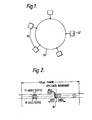
- Figure 1 shows a ring 11 having several stations 12 at nodes on the ring, one of which, 12', acts as a monitor station using well-known protocols.
- One station is elected monitor on start up, but should this station fail, one of the other stations takes over the monitor function.
- the stations 12 may incorporate many forms of digital based devices such as data processing equipment, video devices, facsimile or telephone equipment, and access may be provided to the public switched telephone network.
- the monitor station 12 1 generates a fixed length frame every 125 microseconds (for public network compatibility) which circulates around the ring. Each frame comprises an integer number of bytes or slots.
- An elastic store in the monitor is used to ensure a total ring delay of an integer number of frames. In this example, the number of frames accommodated on the ring is 4.
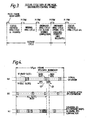
- a typical frame is shown in Figure 2.
- Each frame has a fixed boundary 15 which creates a division between real-time services, RTS, (eg speech and low bit rate video) and non-time sensitive data services.
- RTS real-time services
- Slots for real-time services are seized according to the real-time needs of the stations on the ring and at busy times all slots in the RTS portion of the frame may be full.
- One of the stations is designated priority station and has the first opportunity to seize slots according to its needs.
- each frame The two portions of each frame are essentially independent.
- the data part of each frame can operate according to standard protocols for data transmission: for example stations may be permitted to send one or more fixed or variable length packets, carrying source and destination address information and data.
- Token passing or slotted ring protocols for example could be used, as desired.
- the RTS portions of the frames are effectively transparent to the protocols and a token, for example, may be spread across the data portions of two or more frames, being periodically interrupted or suspended by the RTS portion.
- time division multiplexed (TDM) signals are transmitted between stations.
- TDM time division multiplexed
- messages are sent using the data portions of the frames. These messages are sent only at set up and clear down, as once slot(s) have been designated for an RTS call between two stations, the same slot(s) in each frame are reserved for the duration of the call.
- a sequence of cycles occurs, as shown in Figure 3, to allow stations to seize the number of slots necessary for their RTS calls in a fair manner.
- Other stations on the ring must be able to know which slots are already occupied. They also, in standard manner using high level protocols in the data portions of the frames, receive information on which slots contain bytes of information intended for them.
- each frame in this example is 125 microseconds; 4 frames are on the ring simultaneously and these constitute a multi-frame, or cycle.
- the period for a complete cycle is therefore 0.5 milliseconds and this is the propagation delay for the ring.
- a multi-frame alignment word is issued every 4 frames by the monitor station 12'. This is a readily identified field or flag of one or more bytes put into the first slot or slots of the first frame of each set of 4 frames in a multiframe.
- Each of the following three frames of the cycle commences with a starter flag, or frame alignment word, of similar form to the multi-frame word.
- the multi-frame and frame alignment words serve as alignment signals for timing purposes.
- the multi-frame alignment word may also be modified in certain circumstances as described below to indicate which of three possible types of cycle is to take place next.
- a number of slots at the beginning of each frame are reserved for use as a bit map to indicate which RTS slots are empty and which are full.
- the bit map is divided between the 4 frames following each multi-frame word, so that a complete bit map is on the ring during every cycle. Thus several bytes at the beginning of each frame are devoted to the bit map which consists of a 2 bit indicator for each slot:
- a station may only seize unoccupied slots and an error indicator is taken as an "occupied" indication. Thus a double error must occur before there can be false re-assignment of a slot.
- a station finding one of its seized slots already occupied on subsequent cycles would assume its seizure abandoned and re-establish another slot seizure.
- Each slot of 8 bits therefore carries an overhead of 2 bits used for the bit map per 4 frames, so the bit map incurs an overhead of 2 in every 34 bits.
- the following sequence of cycles occurs: status refresh cycle; bidding cycle; ordinary (or transmission) cycle; a possible further ordinary cycle (probability 0.5); status refresh cycle etc.
- Each new cycle is initiated and controlled by the station currently acting as priority station, which modifies the multi-frame word to indicate which cycle is taking place.
- the data part of the frame is used for the transfer of data messages between stations independently of the RTS cycles.
- each station marks up in the bit map the slots it already has control of (ie which it has seized during previous cycles and not yet released). This is necessary because the complete bit map is not stored in a central controller or in the individual stations; the bit map therefore needs to be regenerated on the ring on each new cycle. Complete regeneration has the advantage that errors in the bit map are not perpetuated.
- each station fills the slots it has previously seized in each of the 4 frames which circulate during the status refresh cycle, thereby using these slots for carrying user real-time services.
- the bidding ring cycle next occurs, during which slots are seized for the setting up of new calls.
- Calls are set up between a source station and a destination station on the ring using the data part of one or more frames to send signalling information including the identity of source and destination nodes and of the slots seized for the call.
- a single 64 kbit/sec voice call between two stations will need to send eight bits, ie one slot of information, every 125 microseconds.
- the voice call will therefore need a single slot.
- the first empty slot in the frame (according to the bit map) is seized by altering the bit map for the relevant slot. Throughout the duration of the call this same slot in all frames is used for the pcm 1Ut signals for that call. Therefore the initial exchange of information used in setting up the call and identifying slot(s) used is all that need be sent for the call in the data part of the frames until call clear-down.
- the third cycle is an ordinary, or transmission, ring cycle, in which the bit map remains unaltered, thereby allowing the complete bit map (as updated during the bidding cycle) to pass all the ring nodes.
- Information is sent in all seized slots (including those seized during the bidding cycle) and the portions of the frames to the right of the boundary continue to be available for data.
- the priority station then passes the priority status to the next station by modifying the multi-frame word to indicate priority rotation.
- the next station to receive the multi-frame word converts the multi-frame word to initiate the next status refresh cycle.
- Rotation of priority status gives each station an equal opportunity to seize the bandwidth it needs over the full priority cycle time. For N stations -each station acts as priority station once in 1.75 N msec on average. When traffic on the ring is heavy, a station spaced around the ring from the priority station may be unable to set up new calls, but it should be able to do so when it acquires priority status or when it is close to, but downstream of the priority station.
- Calls from stations downstream of a video station can therefore gain access to the ring within 1.75N msec provided there is enough free capacity on the ring.
- any station should be able to seize any RTS bandwidth in 3.5 N ring cycles except during very busy periods when little bandwidth is available for seizure.
- one station When all stations have completed timeout t, one station, on receipt of the "initialise" multi-frame word, assumes priority status and normal ring operation is resumed. If two or more priority stations exist, at least some of them will send the next priority station on the ring unexpected multi-frame word modifier sequences and hence allow the cleardown sequence described above to start; the one exception to this is where there are 3N+1 stations each modifying the received multi-frame word to satisfy the expected sequence of the next. As explained above, this chain is broken by the random inclusion of a fourth cycle in the sequence. If there is no priority station, a sequence error will be detected on the ring (an unmodified or invalid multi-frame word will circulate) and the restart sequence will begin.
- boundary 15 In the ring described above, the position of boundary 15 is fixed, so the respective bandwidths available to RTS and data services are constant.
- the boundary may conveniently be pre-set in each station before or at system start up.
- Figure 4 shows a frame at three different instants for an alternative embodiment where the position of the frame boundary may be altered according to conditions on the ring.
- the data part of the frame carries data packets or tokens of varying length according to standard token passing protocols. These protocols are essentially transparent to the RTS portion of the frame and a data packet may be spread across two or more frames.
- the frame of Figure 4 has a boundary 15' which is movable. It has an extreme position 21, which is the maximum boundary position so as to reserve a portion of the frame for data, and for signalling messages for RTS services. Position 21 is pre-programmed data stored at monitor station 12' and all other stations 12 whilst the current position of boundary 15' is broadcast to all stations by means of a modification to each frame and multi-frame word initiated by the monitor station 12'.
- Figure 4(a) shows a typical situation, where some RTS slots 17 are busy and some are empty. Note that boundary 15' is next to a busy slot. If there are now some new call arrivals, slots are seized by the stations concerned (as described above for the fixed boundary example) starting with idle slots at the beginning of the frame. Gradually, all slots up to the existing boundary may be seized. If calls continue to arrive, then the boundary 15' may be moved towards its maximum position 21, as follows.
- the monitor station 12' performs an adaptation of frame boundary 15' on receipt of the data protocol token.
- the monitor station 12' suspends normal token protocol operation and transmits idle bit patterns in the data part of the frame.
- the generation of idle bit patterns continues until at least one multi-frame word indicating an ordinary cycle with the following multi-frame word indicating a refresh cycle are identified by the monitor station 12'. This ensures that there is no active data transmission on the ring and that the data portion of each frame is fully occupied by idle bit patterns.
- the monitor station On detection of the refresh cycle multi-frame word the monitor station updates the position of the frame boundary by modifying each frame and multi-frame word arriving at the monitor station.
- the modified word indicates the identity of the highest slot bid for during the last bidding cycle.
- the boundary was located at (ie immediately after) slot n.
- stations have been bidding for slots beyond the nth slot.
- bidding for slots beyond the nth slot is allowed, but such slots are not made available for RTS traffic and the bit map for those slots is not altered. Stations denied slots they have bid for must bid again on the next bidding cycle.
- the boundary position is updated according to the bidding during the latest cycle and the multi-frame and frame words are modified accordingly to broadcast this to all stations.
- the boundary is therefore relocated to the furthest slot seized during the last bidding cycle (see Figure 4(b)), provided this is not . beyond the maximum boundary position 21. If during the next interval between adaptations, there are more cleardowns than call arrivals, it may be possible to move the boundary 15' to the left on the next adaptation. This will depend on whether the slot adjacent the boundary is released. In the situation shown in Figure 4(c), there are six idle slots to the left of the boundary, which can therefore shift to the left by six slots.
- boundary 15' may remain at the maximum boundary position 21 preserving a minimum bandwidth for data.
- Boundary adaptation has been described above for a token passing data protocol; adaptation may also occur where there is a slotted ring data protocol. Adaptation occurs in a very similar manner, except that data transmission during adaptation is halted differently.
- the slotted ring data protocol has supervision facilities for each data packet to allow the monitor station to mark a packet as "unavailable" for one complete ring cycle, ie until data transmission has ceased. In the "unavailable" state, stations can receive data carried by such packets, but they cannot be used for transmission of data.
- the monitor marks all packets unavailable.
- the position of the frame boundary is updated as described above.
- the monitor ensures that all the data slots in the data portions of the frames are correctly formatted for the slotted ring protocol (ie as empty) as each frame with a new boundary is issued, until normal data transfer operation is resumed. Hence a single multi-frame is used to cleardown data transmission.
- the systems described are hybrid systems for real-time and data services. For real-time services, overassignment of slots to calls can never occur and overload strategies are therefore not required. There is distributed control amongst the stations on the ring, and no concentrations of signalling at a central controller station are required to establish slot seizure. No reliance need therefore be placed upon a central controller for the slot seizure function. Call set-up is also established node to node without a central controller by higher level protocols and bandwidth may be seized after only a relatively short delay. Each station is suitably dimensioned to cope with its own traffic and consequently the complete system can easily be expanded to accommodate additional stations. Priority for slot seizure is given to all stations in turn thus equalising slot seizure opportunities.
- the data portions of the frames may use token or slotted ring protocols.
- the protocol used does not affect the real-time part of the frame (although the stations will need to use the data protocol for setting up and clearing down RTS calls).
- the data parts of the frames are effectively transparent to the real-time parts and vice versa. For example, suppose 40X of a 100 Mbit/sec frame is used for speech and the remaining 601 for data. This is equivalent to around 38 Mbit/sec in continuous time for speech and 56 Mbit/sec for data, the remaining 6 Mbit/sec being devoted to the bit map, which is concentrated at the front of each frame following the frame or multi-frame alignment word.
- the frame boundary can be specified in single packet slot quanta equal to one data packet.
- approximately 50 packet slots of 40 bytes per frame could be supported, and the boundary would move in 2% increments of capacity, which offers relatively fine manipulation of the boundary.
- the RTS portion of a frame may have up to 39 empty single byte slots next to the boundary; the boundary will shift 40 slots to the left on release of the 40th slot.
- a slotted ring protocol would allow only a much coarser manipulation of the boundary position, unless larger frame periods are used.
- token ring data protocol Under a token ring data protocol, data packets may extend across one or more frames, and token ring operation would therefore remain unaffected by boundary position (except of course insofar as the data rate available varies according to the portion of frames available for data if the frame boundary is movable).
- the bit map for real-time services is concentrated at the front of each frame and shared across the four frames constituting a cycle.
- the bit map may be distributed across the whole of the multi-frame (including the data part of the frame) by adding, for example, a ninth bit before each alternate slot.
- the system described effectively stores the bit map on the ring and no storage of the complete bit map is required at the stations on the ring, although each station must record its own slot seizures.
- the bit map could, instead, be stored temporarily at the originating station (ie the current priority station). This bit map could then be distributed over a number of frames independent of the number of frames equal to the ring delay.
- the slot seizure process would then proceed as described above, except that the priority node would need to store at least that part of the bit map not accommodated by the frames stored by the ring delay, or possibly the complete returning bit map after each cycle before re-issuing it for the next cycle.
- bit map of 2 bits per slot
- 1 bit per slot could be used although alternative means for error protection may be desirable.
- Smaller or larger multi-frames may be used, depending on delay requirements. Obviously multi-frames with large numbers of frames would have a reduced bit map overhead if the bit map is spread across the multi-frame as described in the above examples. Note also that the ring delay (0.5 msec in the examples, with four 125 microsecond frames) need not be the same as the period of the bit map.
- Slot and frame sizes may not be the same for all slots and frames on the ring. Variable slot sizes are possible if the slot sizes are predefined in all stations. Under some circumstances it may be convenient for frames to comprise a non-integer number of slots, although integral numbers are generally easier to implement.
Landscapes
- Engineering & Computer Science (AREA)
- Computer Networks & Wireless Communication (AREA)
- Signal Processing (AREA)
- Small-Scale Networks (AREA)
- Exchange Systems With Centralized Control (AREA)
- Two-Way Televisions, Distribution Of Moving Picture Or The Like (AREA)
- Circuits Of Receivers In General (AREA)
- Oscillators With Electromechanical Resonators (AREA)
Priority Applications (1)
| Application Number | Priority Date | Filing Date | Title |
|---|---|---|---|
| AT86305496T ATE83107T1 (de) | 1985-07-18 | 1986-07-16 | Kommunikationsverfahren. |
Applications Claiming Priority (2)
| Application Number | Priority Date | Filing Date | Title |
|---|---|---|---|
| GB8518133 | 1985-07-18 | ||
| GB858518133A GB8518133D0 (en) | 1985-07-18 | 1985-07-18 | Communications network |
Publications (3)
| Publication Number | Publication Date |
|---|---|
| EP0209383A2 true EP0209383A2 (fr) | 1987-01-21 |
| EP0209383A3 EP0209383A3 (en) | 1988-11-17 |
| EP0209383B1 EP0209383B1 (fr) | 1992-12-02 |
Family
ID=10582460
Family Applications (1)
| Application Number | Title | Priority Date | Filing Date |
|---|---|---|---|
| EP86305496A Expired EP0209383B1 (fr) | 1985-07-18 | 1986-07-16 | Méthode de communication |
Country Status (8)
| Country | Link |
|---|---|
| US (1) | US4718061A (fr) |
| EP (1) | EP0209383B1 (fr) |
| JP (1) | JPH0716189B2 (fr) |
| AT (1) | ATE83107T1 (fr) |
| AU (1) | AU586265B2 (fr) |
| CA (1) | CA1264877A (fr) |
| DE (1) | DE3687190T2 (fr) |
| GB (1) | GB8518133D0 (fr) |
Cited By (2)
| Publication number | Priority date | Publication date | Assignee | Title |
|---|---|---|---|---|
| EP0470072A4 (en) * | 1989-04-28 | 1993-08-04 | First Pacific Networks, Inc. | Distributed intelligence network using time and frequency multiplexing |
| US5487066A (en) * | 1988-03-21 | 1996-01-23 | First Pacific Networks, Inc. | Distributed intelligence network using time and frequency multiplexing |
Families Citing this family (30)
| Publication number | Priority date | Publication date | Assignee | Title |
|---|---|---|---|---|
| GB8417910D0 (en) * | 1984-07-13 | 1984-08-15 | British Telecomm | Communications network |
| GB8526620D0 (en) * | 1985-10-29 | 1985-12-04 | British Telecomm | Communications network |
| IT1203544B (it) * | 1986-03-05 | 1989-02-15 | Cselt Centro Studi Lab Telecom | Procedimento di accesso a una rete locale con linea di trasmissione unidirezionale ad anello e rete locale utilizzante tale procedimento di accesso |
| GB8618118D0 (en) * | 1986-07-24 | 1986-09-03 | British Telecomm | Communications system |
| US4852089A (en) * | 1987-10-01 | 1989-07-25 | Data General Corporation | Methods and apparatus for allocating time slots and fragments on communications lines between adjacent nodes in a high granularity switching system |
| DE68916231T2 (de) * | 1989-03-23 | 1995-02-02 | Ibm | Verfahren und Vorrichtung zum Vielfachzugriff mit verteilten Warteschlangen in einem Kommunikationssystem. |
| AU630876B2 (en) * | 1989-06-23 | 1992-11-12 | Alcatel N.V. | Communication system |
| JP2523882B2 (ja) * | 1989-07-13 | 1996-08-14 | 株式会社東芝 | デ―タ伝送装置 |
| US4998244A (en) * | 1989-07-17 | 1991-03-05 | Racal Data Communications Inc. | High speed module interconnection bus |
| US5079763A (en) * | 1989-10-31 | 1992-01-07 | Bell Communications Research, Inc. | Customer premises network node access protocol |
| US5124981A (en) * | 1990-03-09 | 1992-06-23 | International Business Machines Corporation | Access control method for dqdb network |
| US5267243A (en) * | 1992-04-06 | 1993-11-30 | At&T Bell Laboratories | Access scheme for a data communications network |
| US5351242A (en) * | 1992-04-14 | 1994-09-27 | Marian Kramarczyk | Method and apparatus for configuring and maintaining token ring networks |
| US5539727A (en) * | 1992-04-14 | 1996-07-23 | Kramarczyk; Marian | Method and apparatus for configuring and maintaining token ring networks |
| US5400331A (en) * | 1993-04-28 | 1995-03-21 | Allen-Bradley Company, Inc. | Communication network interface with screeners for incoming messages |
| US5553095A (en) * | 1993-04-28 | 1996-09-03 | Allen-Bradley Company, Inc. | Method and apparatus for exchanging different classes of data during different time intervals |
| US5493571A (en) * | 1993-04-28 | 1996-02-20 | Allen-Bradley Company, Inc. | Apparatus and method for digital communications with improved delimiter detection |
| US5537549A (en) * | 1993-04-28 | 1996-07-16 | Allen-Bradley Company, Inc. | Communication network with time coordinated station activity by time slot and periodic interval number |
| US5471461A (en) * | 1993-04-28 | 1995-11-28 | Allen-Bradley Company, Inc. | Digital communication network with a moderator station election process |
| US5491531A (en) * | 1993-04-28 | 1996-02-13 | Allen-Bradley Company, Inc. | Media access controller with a shared class message delivery capability |
| US5699356A (en) * | 1995-07-17 | 1997-12-16 | Mci Communication | System and method for personal communication system dynamic channel allocation |
| EP0765056A1 (fr) * | 1995-09-20 | 1997-03-26 | Philips Communication D'entreprise | Réseau fédérateur et mécanisme d'allocation de ressources d'un tel réseau |
| DE19742123A1 (de) * | 1997-09-24 | 1999-04-08 | Siemens Ag | Verfahren zum Verwalten von partitionierten Ressourcen in einem Kommunikationsnetz |
| AU5910399A (en) * | 1998-09-11 | 2000-04-03 | Sharewave, Inc. | Method and apparatus for accessing a computer network communication channel |
| DE19908424C2 (de) | 1999-02-26 | 2001-01-25 | Siemens Ag | Verfahren zur Steuerung der Aufteilung von Übertragungsraten in einem zellularen Funk-Telekommunikationssystem |
| DE19924127A1 (de) * | 1999-05-26 | 2000-12-14 | Ackermann Albert Gmbh Co | Kommunikationsnetzwerk für den Pflegebereich |
| EP1134944A3 (fr) * | 2000-03-17 | 2006-04-19 | Lucent Technologies Inc. | Réseau de communication, méthode et protocole pour opérer ce réseau |
| WO2002030047A2 (fr) * | 2000-10-04 | 2002-04-11 | Vitesse Semiconductor Corporation | Commutateur de réseau de communication de données à structure en anneau systolique |
| US6824064B2 (en) | 2000-12-06 | 2004-11-30 | Mobile-Mind, Inc. | Concurrent communication with multiple applications on a smart card |
| US7167913B2 (en) * | 2002-06-05 | 2007-01-23 | Universal Electronics Inc. | System and method for managing communication links |
Citations (2)
| Publication number | Priority date | Publication date | Assignee | Title |
|---|---|---|---|---|
| EP0079426A1 (fr) | 1981-07-31 | 1983-05-25 | Hitachi, Ltd. | Système de communication de données |
| EP0118767A2 (fr) | 1983-02-11 | 1984-09-19 | Siemens Aktiengesellschaft | Procédé pour un central de télécommunications, en particulier un central téléphonique privé avec un système de transmission de données en boulle, en particulier avec un système de transmission de données en boulle optique |
Family Cites Families (7)
| Publication number | Priority date | Publication date | Assignee | Title |
|---|---|---|---|---|
| CA977476A (en) * | 1971-04-15 | 1975-11-04 | Giancarlo Monti | Digital voice interpolation system for pcm systems |
| US4154983A (en) * | 1978-03-13 | 1979-05-15 | Bell Telephone Laboratories, Incorporated | Loop carrier system for telecommunication and data services |
| US4251880A (en) * | 1979-07-31 | 1981-02-17 | Bell Telephone Laboratories, Incorporated | Digital loop switch for controlling data information having differing transmission characteristics |
| US4538147A (en) * | 1982-03-05 | 1985-08-27 | Burroughs Corp. | Bandwidth allocation in a token controlled loop communications network |
| FR2533789B1 (fr) * | 1982-09-24 | 1987-10-23 | France Etat | Reseau local hybride de communication en modes circuit et paquet a boucle portant un multiplex temporel |
| US4569041A (en) * | 1983-03-17 | 1986-02-04 | Nec Corporation | Integrated circuit/packet switching system |
| GB2139852B (en) * | 1983-05-13 | 1986-05-29 | Standard Telephones Cables Ltd | Data network |
-
1985
- 1985-07-18 GB GB858518133A patent/GB8518133D0/en active Pending
-
1986
- 1986-07-07 US US06/882,715 patent/US4718061A/en not_active Expired - Fee Related
- 1986-07-16 AU AU60210/86A patent/AU586265B2/en not_active Ceased
- 1986-07-16 DE DE8686305496T patent/DE3687190T2/de not_active Expired - Fee Related
- 1986-07-16 EP EP86305496A patent/EP0209383B1/fr not_active Expired
- 1986-07-16 CA CA000513898A patent/CA1264877A/fr not_active Expired
- 1986-07-16 AT AT86305496T patent/ATE83107T1/de not_active IP Right Cessation
- 1986-07-18 JP JP61169634A patent/JPH0716189B2/ja not_active Expired - Lifetime
Patent Citations (2)
| Publication number | Priority date | Publication date | Assignee | Title |
|---|---|---|---|---|
| EP0079426A1 (fr) | 1981-07-31 | 1983-05-25 | Hitachi, Ltd. | Système de communication de données |
| EP0118767A2 (fr) | 1983-02-11 | 1984-09-19 | Siemens Aktiengesellschaft | Procédé pour un central de télécommunications, en particulier un central téléphonique privé avec un système de transmission de données en boulle, en particulier avec un système de transmission de données en boulle optique |
Cited By (2)
| Publication number | Priority date | Publication date | Assignee | Title |
|---|---|---|---|---|
| US5487066A (en) * | 1988-03-21 | 1996-01-23 | First Pacific Networks, Inc. | Distributed intelligence network using time and frequency multiplexing |
| EP0470072A4 (en) * | 1989-04-28 | 1993-08-04 | First Pacific Networks, Inc. | Distributed intelligence network using time and frequency multiplexing |
Also Published As
| Publication number | Publication date |
|---|---|
| ATE83107T1 (de) | 1992-12-15 |
| AU6021086A (en) | 1987-01-22 |
| EP0209383B1 (fr) | 1992-12-02 |
| GB8518133D0 (en) | 1985-08-21 |
| DE3687190T2 (de) | 1993-04-01 |
| JPS6223257A (ja) | 1987-01-31 |
| DE3687190D1 (de) | 1993-01-14 |
| AU586265B2 (en) | 1989-07-06 |
| JPH0716189B2 (ja) | 1995-02-22 |
| CA1264877A (fr) | 1990-01-23 |
| EP0209383A3 (en) | 1988-11-17 |
| US4718061A (en) | 1988-01-05 |
Similar Documents
| Publication | Publication Date | Title |
|---|---|---|
| EP0209383B1 (fr) | Méthode de communication | |
| US4713807A (en) | Intelligence transmission system of the local area network type | |
| US4507778A (en) | Digital transmission system | |
| US5377189A (en) | Hybrid data communications systems | |
| EP0122765B1 (fr) | Protocole de réseau pour intégrer le trafic synchrone et asynchrone sur un bus de série commun | |
| EP0972410B1 (fr) | Procede et systeme de retablissement de reseau de telecommunications reparti | |
| US5487066A (en) | Distributed intelligence network using time and frequency multiplexing | |
| US5295012A (en) | Ring-type communication network | |
| EP0100662B1 (fr) | Système de communication numérique | |
| US4586175A (en) | Method for operating a packet bus for transmission of asynchronous and pseudo-synchronous signals | |
| CA1269770A (fr) | Systemes de communication | |
| US4661952A (en) | Method for transmitting data in a telecommunications exchange | |
| AU740868B2 (en) | A method for packet switched data transmission | |
| EP0258604A2 (fr) | Procédé de passage de jeton dans un anneau de communication | |
| JPH0552118B2 (fr) | ||
| EP0241529B1 (fr) | Reseau de communications | |
| JP2648443B2 (ja) | 非同期転送モードで動作する通信システムにおける交換技術上の資源を割当てる方法 | |
| RU2144734C1 (ru) | Способ передачи сообщений между подвижными станциями и сотовой коммутационной системой | |
| JPS59204338A (ja) | ル−プ伝送システムのチヤンネル割当方法 | |
| Sharrock et al. | A framed movable-boundry protocol for integrated voice/data in a LAN | |
| JP2795179B2 (ja) | Pama方式による動的割り込みスロット予約方法 | |
| GB2125254A (en) | Telecommunications digital switchblock | |
| EP0269423A2 (fr) | Réseau local | |
| AU657176B2 (en) | Method and circuit for controlling access to an asynchronously oeprated network | |
| EP0474698A1 (fr) | Systeme hybride de communication de donnees. |
Legal Events
| Date | Code | Title | Description |
|---|---|---|---|
| PUAI | Public reference made under article 153(3) epc to a published international application that has entered the european phase |
Free format text: ORIGINAL CODE: 0009012 |
|
| AK | Designated contracting states |
Kind code of ref document: A2 Designated state(s): AT BE CH DE FR GB IT LI LU NL SE |
|
| PUAL | Search report despatched |
Free format text: ORIGINAL CODE: 0009013 |
|
| AK | Designated contracting states |
Kind code of ref document: A3 Designated state(s): AT BE CH DE FR GB IT LI LU NL SE |
|
| 17P | Request for examination filed |
Effective date: 19890508 |
|
| RAP3 | Party data changed (applicant data changed or rights of an application transferred) |
Owner name: BRITISH TELECOMMUNICATIONS PUBLIC LIMITED COMPANY |
|
| 17Q | First examination report despatched |
Effective date: 19910618 |
|
| GRAA | (expected) grant |
Free format text: ORIGINAL CODE: 0009210 |
|
| AK | Designated contracting states |
Kind code of ref document: B1 Designated state(s): AT BE CH DE FR GB IT LI LU NL SE |
|
| PG25 | Lapsed in a contracting state [announced via postgrant information from national office to epo] |
Ref country code: LI Effective date: 19921202 Ref country code: CH Effective date: 19921202 Ref country code: AT Effective date: 19921202 |
|
| REF | Corresponds to: |
Ref document number: 83107 Country of ref document: AT Date of ref document: 19921215 Kind code of ref document: T |
|
| ITF | It: translation for a ep patent filed | ||
| REF | Corresponds to: |
Ref document number: 3687190 Country of ref document: DE Date of ref document: 19930114 |
|
| ET | Fr: translation filed | ||
| REG | Reference to a national code |
Ref country code: CH Ref legal event code: PL |
|
| ITTA | It: last paid annual fee | ||
| PG25 | Lapsed in a contracting state [announced via postgrant information from national office to epo] |
Ref country code: LU Free format text: LAPSE BECAUSE OF NON-PAYMENT OF DUE FEES Effective date: 19930731 |
|
| PLBE | No opposition filed within time limit |
Free format text: ORIGINAL CODE: 0009261 |
|
| STAA | Information on the status of an ep patent application or granted ep patent |
Free format text: STATUS: NO OPPOSITION FILED WITHIN TIME LIMIT |
|
| 26N | No opposition filed | ||
| PGFP | Annual fee paid to national office [announced via postgrant information from national office to epo] |
Ref country code: FR Payment date: 19940609 Year of fee payment: 9 |
|
| PGFP | Annual fee paid to national office [announced via postgrant information from national office to epo] |
Ref country code: SE Payment date: 19940615 Year of fee payment: 9 |
|
| PGFP | Annual fee paid to national office [announced via postgrant information from national office to epo] |
Ref country code: GB Payment date: 19940620 Year of fee payment: 9 Ref country code: BE Payment date: 19940620 Year of fee payment: 9 |
|
| PGFP | Annual fee paid to national office [announced via postgrant information from national office to epo] |
Ref country code: DE Payment date: 19940627 Year of fee payment: 9 |
|
| PGFP | Annual fee paid to national office [announced via postgrant information from national office to epo] |
Ref country code: NL Payment date: 19940731 Year of fee payment: 9 |
|
| EAL | Se: european patent in force in sweden |
Ref document number: 86305496.1 |
|
| PG25 | Lapsed in a contracting state [announced via postgrant information from national office to epo] |
Ref country code: GB Effective date: 19950716 |
|
| PG25 | Lapsed in a contracting state [announced via postgrant information from national office to epo] |
Ref country code: SE Effective date: 19950717 |
|
| PG25 | Lapsed in a contracting state [announced via postgrant information from national office to epo] |
Ref country code: BE Effective date: 19950731 |
|
| BERE | Be: lapsed |
Owner name: BRITISH TELECOMMUNICATIONS P.L.C. Effective date: 19950731 |
|
| PG25 | Lapsed in a contracting state [announced via postgrant information from national office to epo] |
Ref country code: NL Effective date: 19960201 |
|
| GBPC | Gb: european patent ceased through non-payment of renewal fee |
Effective date: 19950716 |
|
| NLV4 | Nl: lapsed or anulled due to non-payment of the annual fee |
Effective date: 19960201 |
|
| PG25 | Lapsed in a contracting state [announced via postgrant information from national office to epo] |
Ref country code: DE Effective date: 19960402 |
|
| EUG | Se: european patent has lapsed |
Ref document number: 86305496.1 |
|
| PG25 | Lapsed in a contracting state [announced via postgrant information from national office to epo] |
Ref country code: FR Effective date: 19960430 |
|
| REG | Reference to a national code |
Ref country code: FR Ref legal event code: ST |
|
| REG | Reference to a national code |
Ref country code: FR Ref legal event code: ST |
|
| REG | Reference to a national code |
Ref country code: FR Ref legal event code: ST |
|
| PG25 | Lapsed in a contracting state [announced via postgrant information from national office to epo] |
Ref country code: IT Free format text: LAPSE BECAUSE OF NON-PAYMENT OF DUE FEES;WARNING: LAPSES OF ITALIAN PATENTS WITH EFFECTIVE DATE BEFORE 2007 MAY HAVE OCCURRED AT ANY TIME BEFORE 2007. THE CORRECT EFFECTIVE DATE MAY BE DIFFERENT FROM THE ONE RECORDED. Effective date: 20050716 |