EP0209441B1 - Verfahren zur Umkodierung eines Bildschirmtextbildes zur Erreichung der Kompatibilität mit verschiedenen Bildschirmtextsystemen - Google Patents
Verfahren zur Umkodierung eines Bildschirmtextbildes zur Erreichung der Kompatibilität mit verschiedenen Bildschirmtextsystemen Download PDFInfo
- Publication number
- EP0209441B1 EP0209441B1 EP19860401469 EP86401469A EP0209441B1 EP 0209441 B1 EP0209441 B1 EP 0209441B1 EP 19860401469 EP19860401469 EP 19860401469 EP 86401469 A EP86401469 A EP 86401469A EP 0209441 B1 EP0209441 B1 EP 0209441B1
- Authority
- EP
- European Patent Office
- Prior art keywords
- code
- videographic
- codes
- language
- data item
- Prior art date
- Legal status (The legal status is an assumption and is not a legal conclusion. Google has not performed a legal analysis and makes no representation as to the accuracy of the status listed.)
- Expired - Lifetime
Links
- 238000000034 method Methods 0.000 title claims description 25
- 230000008569 process Effects 0.000 claims description 10
- 238000012800 visualization Methods 0.000 description 7
- 230000005540 biological transmission Effects 0.000 description 6
- 230000006870 function Effects 0.000 description 5
- 230000007704 transition Effects 0.000 description 3
- 230000009471 action Effects 0.000 description 2
- 230000008859 change Effects 0.000 description 2
- 238000004891 communication Methods 0.000 description 2
- 230000000873 masking effect Effects 0.000 description 2
- 238000006677 Appel reaction Methods 0.000 description 1
- 241001080024 Telles Species 0.000 description 1
- 240000008042 Zea mays Species 0.000 description 1
- 239000003086 colorant Substances 0.000 description 1
- 238000012217 deletion Methods 0.000 description 1
- 230000037430 deletion Effects 0.000 description 1
- 230000000694 effects Effects 0.000 description 1
- 230000002452 interceptive effect Effects 0.000 description 1
- 230000004044 response Effects 0.000 description 1
- 238000012163 sequencing technique Methods 0.000 description 1
Images

Classifications
-
- H—ELECTRICITY
- H04—ELECTRIC COMMUNICATION TECHNIQUE
- H04M—TELEPHONIC COMMUNICATION
- H04M11/00—Telephonic communication systems specially adapted for combination with other electrical systems
- H04M11/08—Telephonic communication systems specially adapted for combination with other electrical systems specially adapted for optional reception of entertainment or informative matter
- H04M11/085—Telephonic communication systems specially adapted for combination with other electrical systems specially adapted for optional reception of entertainment or informative matter using a television receiver, e.g. viewdata system
-
- H—ELECTRICITY
- H03—ELECTRONIC CIRCUITRY
- H03M—CODING; DECODING; CODE CONVERSION IN GENERAL
- H03M7/00—Conversion of a code where information is represented by a given sequence or number of digits to a code where the same, similar or subset of information is represented by a different sequence or number of digits
Definitions
- the present invention relates to a method of transcoding an image of a videotex system to make it compatible with several videotex systems. More specifically, the invention relates to a method for transcoding a primary video message describing a primary image in a first video language into a secondary video message describing a secondary image in said first video language and a secondary image in at least one other language. videographic.
- the object of the invention is to obtain a secondary video message producing secondary images essentially identical to the primary image, that is to say secondary images which contain the essential features of the primary image. , especially in the shape, size and color of the objects in this image, which may only differ in the representation of details.
- videography designates a telecommunication method making it possible to present alphanumeric or graphic messages to a user on a display screen.
- broadcast videography or teletex the messages are systematically broadcast by a television network and the user can choose from these messages.
- interactive videography or videotex a telecommunication network ensures the transmission of user requests and messages obtained in response.
- French TELETEL system registered trademark
- English PRESTEL system registered trademark
- German BILDSCHIRMTEXT system registered trademark
- FIG. 1 The architecture of a videotex system is shown diagrammatically in FIG. 1.
- This system is a network comprising a server 2, a transmission network 4, which can be the telephone network, and a set of videotex terminals 6.
- Each videotex terminal 6 has at its input a modem 8 to which a telephone 10 is connected to enter into communication with the server, a keyboard 12 allowing the user to compose and send requests to the server, and a circuit 14 connected to a television screen 16.
- THE circuit consists of a decoder 18 receiving, through the modem 8, the videographic messages transmitted by the server, a page memory 20, a character generator 22 and a display generator 24 delivering a video signal to the television screen 16.
- a time base 26 ensures the sequencing of the signals between the different means of the circuit 14.
- Each videotex system is defined by a videographic language, that is to say a set of character codes and control codes, and by a transmission protocol for transmitting these codes from the server to the videotex terminal.
- a videographic language that is to say a set of character codes and control codes
- a transmission protocol for transmitting these codes from the server to the videotex terminal.
- TCD 6-1 of CEPT European Commission of Posts and Telecommunications.
- Videotex systems such as PRESTEL, TELETEL and BILDSCHIRMTEXT are sub-standards defining three different levels of this standard.
- Each video language includes a list of alphanumeric characters, a list of semi-graphic characters, a list of commands, and a list of viewing attributes. These elements of language are represented in the videotex system by codes, that is to say a particular numerical value. This is usually a byte of binary data. It is important not to confuse the numerical value which is a binary number independent of the videographer language and the code which associates an element of the videographic language with a numerical value, and which therefore has meaning only for a given videographic language.
- the different video languages are not compatible with each other, on the one hand, because a given numerical value can correspond to different codes in different video languages, and on the other hand, because the viewing attributes are not treated from the same way in all videotex systems, see for example IBM TECHNICAL DISCLOSURE BULLETIN, vol. 26, no. 10B, March 1984, pages 5588-5592, New York, US; C. CODRAI et al .: "Multiple line videotex adapter".
- the display attributes are in series in the PRESTEL system - they occupy a character location in the screen memory - while they are in parallel in the TELETEL system - they occupy a memory location in a memory plane arranged in parallel with the screen memory plane.
- the display attributes can be in series or in parallel.
- the object of the invention is to remove this limitation. This is achieved by a transcoding method which converts a videographic message, corresponding to the coding of an image according to a first videotex system, into another videographic message which, interpreted by terminals of different videotex systems, produced on each of these terminals an image essentially identical to the image corresponding to the initial videographic message.
- This transcoding process consists in analyzing each datum of the starting videographic message and in producing, depending on the nature of this datum and the meaning of the code associated with this datum in the originating videographic language, another datum or a series of data interpretable by several videotex systems, the associated code or series of codes of which has a meaning similar to that of the code associated with the data of the initial videographic message.
- a code of the primary video message is transcodable if the function it represents exists in the secondary video language. In the latter language, this function can be represented by a single code or can only be represented by a series of codes. To facilitate transcoding of the primary video message, all of the transcodable codes can be contained in a table. consulting this table allows you to quickly know if a code is transcodable.
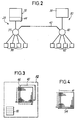
- FIG. 2 a first videotex system 28 and a second videotex system 30 are shown.
- Each system includes a server center 32, 38, a transmission network 34, 40 and terminals 36, 42.
- Each terminal can send requests and receive messages from its server center.
- the transmission networks are telephone networks
- these networks are interconnected. This is symbolized in the figure by a link 43.
- This link which may exist in videotex systems according to the prior art, however, is not sufficient to allow a terminal of a videotex system to communicate with the server center of the other videotex system.
- This communication is made possible according to the invention by the addition between this server center and its transmission network of a means 44 which performs transcoding of the videographic messages delivered by this server center and which thus produces videographic messages which can be interpreted by the terminals. of each of the two teletex systems.
- the means 44 has been shown on the first videotex system 28, which allows the terminals 36 of the second teletex system 30 to communicate with the server center 32 of the first teletex system 28.
- the center server 38 could also be equipped with means similar to means 44.
- the terminals 36 of the first videotex system 28 could then communicate with the server center 38 of the second videotex system 30.
- the first videotex system is the TELETEL system and where the second videotex system is the PRESTEL system.
- the videographic language of the TELETEL system is described in particular in the booklet "Minitel M1, Technical specifications for use", Sept. 1984 published by the French Ministry of Posts and Telecommunications and in the journal RadiodiffusionTélevision, no182, "Didon-Antiope, Technical specifications", from Telecommunicationdiffusion De France; the video language of the PRESTEL system is described in particular in "PRESTEL terminal specification". 1980 published by the British Post Office.
- the method of the invention transcodes a primary video message describing a primary image in the video language of the TELETEL system into a secondary video message describing a secondary image in this video language and a secondary image in the video language of the PRESTEL system .
- a videographic message is a series of data each having, for example, a length of one byte.
- This data is a value associated with the bit profile of the byte and is represented by a set of two hexadecimal numbers, such as 5/15.
- the code term designates the couple consisting of an element of a videographic language and of a data representing this element.
- a videographic language is defined by a set of character codes, control codes and codes, or attributes, of display.
- the incompatibility between two videotex systems results from the fact that the same data can correspond to different codes in the videographic languages of these videotex systems.
- the invention proposes to replace each of these data by another data or by a series of data which is compatible with the two videotex systems, that is to say which is interpretable by these two systems and which produces on the screens of the terminals of these systems of essentially identical images.
- the codes constituting the videographic languages of the TELETEL and PRESTEL systems are shown respectively in Tables 1 to V and in Tables VI to VIII.
- Tables 1 to V and Tables VI to VIII the codes constituting the videographic languages of the TELETEL and PRESTEL systems are shown respectively in Tables 1 to V and in Tables VI to VIII.
- the number of the column and the number of the line at the intersection of which a code is found respectively constitute the upper part and the lower part of the data representing this code.
- the columns are numbered from 0 to 7 using the bits b 7 , bs and b 5 , the rows from 0 to 15 using the bits b 4 , b 3 , b 2 and b 1 .
- the most significant bit b s of a datum is a parity bit.
- the boxes in the table that do not correspond to any code are shown in gray.
- the only data corresponding to identical codes in the PRESTEL and TELETEL systems are 4/0 to 4/9, 4/12 and 4/13.
- FIG. 3 shows the image memory of a TELETEL terminal. It comprises a first memory area 46, or screen memory for storing 25 lines of 40 characters which constitute the displayed image, a second area 48 of the same size as the memory area 46 and storing the state of the parallel attributes of display, and a memory area 50 organized in a stack composed of four bytes for storing the serial attributes. These serial attributes are those defining the background color, the lineage, the masking and the transparent background.
- FIG. 4 represents the structure of an image memory of a PRESTEL terminal.
- This memory 52 consists of 24 lines of 40 character locations. These character locations contain either a character code or a display attribute.
- This incom patibility is lifted thanks to the transcoding method of the invention which makes it possible, for example, to translate a primary video message describing a primary image in the video language of the TELETEL videotex system into a secondary video message describing a secondary image in the video language of the TELETEL videotex system and a secondary image in the videographic language of the PRESTEL videotex system, these secondary images being essentially identical to the primary image.
- the transcoding method of the invention consists in analyzing each datum of the primary videographic message and in producing a secondary videographic message in which each datum of the primary videographic message is preserved or replaced by another datum or by a series of data.
- the data of the primary video message corresponds to the same code in the video languages of the TELETEL and PRESTEL systems
- this data is copied into the secondary video message.
- the data of the primary videographic message represents a character code of the main set G0, with the exception of a very limited number of codes (see tables and VI), when the data represents a character code of the semi-graphic set G1 (table II) or when the data represents a cursor movement control code (data 0/8 to 0/13, 1/1, 1/4), the escape code (1/11 ) or the reset code 1/14), or when the data represents one of the display codes (Tables V and VIII): 4/0 to 4/9, 4/12, 4/13, 5 / 8 and 5/13.
- the transcoding of this data depends on the nature of the code associated with this data.
- the data of the primary videographic message is replaced by another data which is chosen from the set of data representing the same character code in the videographic languages of the TELETEL and PRESTEL systems.
- This replacement data can be for example the 2/0 space code.
- the first operation of the transcoding process consists in determining whether the function represented by the video language code of the TELETEL system associated with the data can be expressed by means of '' a code or a series of codes of the videographic language of the PRESTEL system. If this is not possible, the data is deleted or is replaced by another data having an identical meaning for the two videographic languages. This other datum can be for example the command code "null" (0/0) or a datum representing an inactive code for each of the two videographic languages.
- the transcoding method of the invention consists in writing a series of data into the secondary videographic message. such that the TELETEL system videographic language code sequence and the PRESTEL system videographic language code sequence associated with this data sequence have a meaning essentially identical to that of the code associated with the data of the primary videographic message.
- a TELETEL video image cannot therefore be transcoded into a video image compatible with the PRESTEL and TELETEL systems and identical to the original image unless the latter contains none of the codes indicated above.
- the primary image of the TELETEL system includes characters from the G2 set, it is not possible to produce a secondary image essentially identical to the primary image, since this secondary image, to be compatible with the PRESTEL system , must not contain characters from this G2 set.
- the non-transcodable code of the primary image is for example the display attribute "lineage”
- the deletion of this attribute in the secondary image may not fundamentally modify its appearance. It remains possible in this case to produce a secondary image essentially identical to the primary image.
- the code SO (“shift out”) allows the transition to semi-graphic or mosaic mode. This mode ends with the SI code (shift in) to return to the main game G0. Any character code placed between the SO and SI codes designates semi-graphic characters.
- the data 0/14 representing the SO code in the primary video message is replaced, in the secondary video message, by the following data: 0/14, 5/2, 5/0, 4/2, 0/13, 0/9, ..., 0/9.
- This data sequence has an identical effect on the TELETEL and PRESTEL terminals. It controls the transition to semi-graphic mode on a black background and specifies the color of the line. In the example chosen, the line color is green (this is indicated by the second and fourth data in the following); any other color can be selected. If a background color other than black is desired, it suffices to follow this data sequence with the data sequence corresponding to the change in background color which will be described later.
- the data series 0/14, 5/2, 5/0 and 4/2 corresponds for a TELETEL terminal to successive odes: switching to mosaic mode, background color green, background color black and color of green outline.
- This suite includes a command code followed by three attributes for viewing in parallel which do not modify the position of the cursor, it remains in the location of the character with coordinates (i, j).
- This same series of data received by a PRESTEL terminal includes the unique code "switch to green mosaic" (5/2), the other data which does not correspond to any code being ignored.
- This code is a serial display attribute. It moves the cursor one character location to the right. The cursor is then in the coordinate character location (i + 1, j).
- the sequence of the first four data of the secondary video message therefore produces the same function on a TELETEL terminal and on a PRESTEL terminal, but does not move the cursor in the same way because certain codes correspond to parallel attributes of TELETEL (without action on the cursor) and to serial attributes of PRESTEL (moving the cursor).
- the correct repositioning of the cursor in the location of the coordinate character (i + i, j) is ensured subsequently by data 0/13, 0/9, ..., 0/9. These data correspond to identical codes for the TELETEL and PRESTEL terminals.
- the code 0/13 (“carriage return”) brings the cursor back to the location of the character with coordinates (0, j).
- Each 0/9 code (“horizontal tab”) moves the cursor one character location to the right.
- the secondary video message includes a series of i + 1 codes 0/9.
- the code SI (“shift in”) allows to go back from the G1 set of semi-graphic character codes to the main set GO of the alphanumeric character codes.
- Data 0/15 of the primary video message is transcoded into the secondary video message using the following data: 0/15, 4/2, 0/13, 0/9, ..., 0/9.
- This data sequence controls the transition to alphanumeric mode and specifies the color of the plot (second data in the sequence).
- the line color is green; any other color can be selected.
- the first two data correspond respectively, for a TELETEL terminal, to the GO game return code and to the green trace color. This data has no action on the cursor.
- the data 0/15 is ignored and the data 4/2 means color of the green trace in alphanumeric mode. This code moves the cursor one character location.
- the data sequence 0/13, 0/9, ..., 0/9 realizes a repositioning of the cursor similar to that of the transcoding of the SO code.
- this repetition code is followed by a numeric argument indicating the number of times the code preceding this repetition code must be repeated.
- This repetition code does not exist in the videographic language of the PRESTEL system, it is replaced, in the secondary videographic message, by the explicit repetition of the code which precedes it.
- This code allows direct positioning of the cursor in the TELETEL system. It is followed by two arguments respectively indicating the line number and the column number of the new cursor position. This code does not exist in the video language of the PRESTEL system. It is therefore replaced, in the secondary video message, by a relative positioning based on the current address, which is always memorized, by means of a series of cursor positioning codes (data 0/8 to 0/13).
- the background color can be defined directly by the codes 5/0 to 5/7. This possibility does not exist for a PRESTEL terminal which can only modify the background color by the code 5/12 (black background) or by the code 5/13 (new background) which defines the color of the background as new background color. current route.
- the first repositioning includes a series of codes to return the cursor to the location of the coordinate character (i, j) and the second repositioning to return the cursor to the location of the character to coordinate (i + 3, j).
- the second data in the sequence (5/4 in the example chosen), and the first and third data following the first repositioning (4/4 and 4/3) define the background color and the color of the path selected. Any combination can be defined, with the exception of the black line color which is impossible in the PRESTEL system.
- the series of data representing, in the secondary video message, the code for changing the background color is remarkable in that it contains data which correspond to codes different from the video languages of the TELETEL and PRESTEL systems.
- a simple solution to solve this difficulty consists in rewriting, in the secondary videographic message the value of the attributes of the visualization after each passage to the line and after the code US (1/15) of direct positioning of the cursor.
Landscapes
- Engineering & Computer Science (AREA)
- Theoretical Computer Science (AREA)
- Signal Processing (AREA)
- Television Systems (AREA)
- Controls And Circuits For Display Device (AREA)
Claims (5)
Applications Claiming Priority (2)
| Application Number | Priority Date | Filing Date | Title |
|---|---|---|---|
| FR8510417A FR2584511B1 (fr) | 1985-07-08 | 1985-07-08 | Procede de transcodage d'une image videotex pour la rendre compatible avec plusieurs systemes videotex |
| FR8510417 | 1985-07-08 |
Publications (2)
| Publication Number | Publication Date |
|---|---|
| EP0209441A1 EP0209441A1 (de) | 1987-01-21 |
| EP0209441B1 true EP0209441B1 (de) | 1990-01-31 |
Family
ID=9321067
Family Applications (1)
| Application Number | Title | Priority Date | Filing Date |
|---|---|---|---|
| EP19860401469 Expired - Lifetime EP0209441B1 (de) | 1985-07-08 | 1986-07-02 | Verfahren zur Umkodierung eines Bildschirmtextbildes zur Erreichung der Kompatibilität mit verschiedenen Bildschirmtextsystemen |
Country Status (5)
| Country | Link |
|---|---|
| EP (1) | EP0209441B1 (de) |
| DE (1) | DE3668744D1 (de) |
| FR (1) | FR2584511B1 (de) |
| IE (1) | IE57443B1 (de) |
| PT (1) | PT82913B (de) |
-
1985
- 1985-07-08 FR FR8510417A patent/FR2584511B1/fr not_active Expired
-
1986
- 1986-07-02 DE DE8686401469T patent/DE3668744D1/de not_active Expired - Lifetime
- 1986-07-02 EP EP19860401469 patent/EP0209441B1/de not_active Expired - Lifetime
- 1986-07-03 PT PT8291386A patent/PT82913B/pt not_active IP Right Cessation
- 1986-07-07 IE IE181786A patent/IE57443B1/en unknown
Also Published As
| Publication number | Publication date |
|---|---|
| IE861817L (en) | 1987-01-08 |
| IE57443B1 (en) | 1992-09-09 |
| PT82913A (fr) | 1986-08-01 |
| PT82913B (pt) | 1992-07-31 |
| FR2584511B1 (fr) | 1987-09-25 |
| EP0209441A1 (de) | 1987-01-21 |
| DE3668744D1 (de) | 1990-03-08 |
| FR2584511A1 (fr) | 1987-01-09 |
Similar Documents
| Publication | Publication Date | Title |
|---|---|---|
| US5995093A (en) | Method and device for configuring a multimedia message for presentation | |
| FR2465281A1 (fr) | Dispositif de transmission numerique et d'affichage de graphismes et/ou de caracteres sur un ecran | |
| US4546383A (en) | Method and apparatus for visual telecommunications, in particular for use by the deaf | |
| JPS58500779A (ja) | 動的定義可能な文字集合の端末発生 | |
| KR19990071820A (ko) | 가속된텍스트문자및선기술생성의영상그래픽다운로딩 | |
| FR2620889A1 (fr) | Systeme de communication video interactif | |
| FR2517152A1 (fr) | Controle de l'image pour visualisation de caracteres graphiques sur l'ecran d'un televiseur | |
| WO1999037105A2 (en) | Graphic image message generation | |
| CN106898351B (zh) | 一种大屏幕的控制方法及装置 | |
| FR2765983A1 (fr) | Signal de donnees de modification d'une scene graphique, procede et dispositif correspondants | |
| EP1193965B1 (de) | Vorrichtung und Verfahren zur Bildübertragung und Darstellung | |
| JP4444623B2 (ja) | 動画像変換装置および方法、動画像配信装置、メール中継装置並びにプログラム | |
| EP0055167B1 (de) | Verfahren und Einrichtung zur Anzeige von Nachrichten auf einem nach dem Rasterverfahren arbeitenden Sichtgerät, z.B. dem Bildschirm einer Kathodenstrahlröhre, mittels eines in Blöcke unterteilten Speichers | |
| EP0209441A1 (de) | Verfahren zur Umkodierung eines Bildschirmtextbildes zur Erreichung der Kompatibilität mit verschiedenen Bildschirmtextsystemen | |
| EP0809385B1 (de) | Benutzerschnittstelle für ein Telefonendgerät | |
| US20010011297A1 (en) | Operation screen simple-creating system for a remote control terminal | |
| US20100194760A1 (en) | Method and Apparatus Producing Text Patterning Data Correspondence To Image Data and Reconstructing Image Data Using the Text Patterning Data | |
| KR20010093190A (ko) | 폰트 대체 시스템 | |
| EP1098293B1 (de) | Vorrichtung zum Anzeigen von wenigstens zwei verschiedenen Zeichensätzen, welche in Form eines Datenstroms empfangen werden | |
| Dawkins et al. | Interactive Videotex | |
| Mett | How to Communicate | |
| Bown et al. | Canadian videotex system | |
| Nakajima et al. | Advanced CAPTAIN System and an Approach to Commercial Service | |
| EP1006480B1 (de) | Verfahren und Vorrichtung zur Verarbeitung eines digitalen Bildes | |
| Richards et al. | The interactive island. Singapore's teleview system |
Legal Events
| Date | Code | Title | Description |
|---|---|---|---|
| PUAI | Public reference made under article 153(3) epc to a published international application that has entered the european phase |
Free format text: ORIGINAL CODE: 0009012 |
|
| AK | Designated contracting states |
Kind code of ref document: A1 Designated state(s): BE DE GB IT NL SE |
|
| 17P | Request for examination filed |
Effective date: 19870629 |
|
| 17Q | First examination report despatched |
Effective date: 19890524 |
|
| GRAA | (expected) grant |
Free format text: ORIGINAL CODE: 0009210 |
|
| AK | Designated contracting states |
Kind code of ref document: B1 Designated state(s): BE DE GB IT NL SE |
|
| REF | Corresponds to: |
Ref document number: 3668744 Country of ref document: DE Date of ref document: 19900308 |
|
| GBT | Gb: translation of ep patent filed (gb section 77(6)(a)/1977) | ||
| ITF | It: translation for a ep patent filed | ||
| PLBE | No opposition filed within time limit |
Free format text: ORIGINAL CODE: 0009261 |
|
| STAA | Information on the status of an ep patent application or granted ep patent |
Free format text: STATUS: NO OPPOSITION FILED WITHIN TIME LIMIT |
|
| 26N | No opposition filed | ||
| PGFP | Annual fee paid to national office [announced via postgrant information from national office to epo] |
Ref country code: NL Payment date: 19910731 Year of fee payment: 6 |
|
| PGFP | Annual fee paid to national office [announced via postgrant information from national office to epo] |
Ref country code: DE Payment date: 19920629 Year of fee payment: 7 |
|
| PGFP | Annual fee paid to national office [announced via postgrant information from national office to epo] |
Ref country code: BE Payment date: 19920702 Year of fee payment: 7 |
|
| PGFP | Annual fee paid to national office [announced via postgrant information from national office to epo] |
Ref country code: GB Payment date: 19920708 Year of fee payment: 7 |
|
| PGFP | Annual fee paid to national office [announced via postgrant information from national office to epo] |
Ref country code: SE Payment date: 19920710 Year of fee payment: 7 |
|
| ITTA | It: last paid annual fee | ||
| PG25 | Lapsed in a contracting state [announced via postgrant information from national office to epo] |
Ref country code: NL Effective date: 19930201 |
|
| NLV4 | Nl: lapsed or anulled due to non-payment of the annual fee | ||
| PG25 | Lapsed in a contracting state [announced via postgrant information from national office to epo] |
Ref country code: GB Effective date: 19930702 |
|
| PG25 | Lapsed in a contracting state [announced via postgrant information from national office to epo] |
Ref country code: SE Effective date: 19930703 |
|
| PG25 | Lapsed in a contracting state [announced via postgrant information from national office to epo] |
Ref country code: BE Effective date: 19930731 |
|
| BERE | Be: lapsed |
Owner name: NAHON GEORGES Effective date: 19930731 |
|
| GBPC | Gb: european patent ceased through non-payment of renewal fee |
Effective date: 19930702 |
|
| PG25 | Lapsed in a contracting state [announced via postgrant information from national office to epo] |
Ref country code: DE Effective date: 19940401 |
|
| EUG | Se: european patent has lapsed |
Ref document number: 86401469.1 Effective date: 19940210 |
|
| PG25 | Lapsed in a contracting state [announced via postgrant information from national office to epo] |
Ref country code: IT Free format text: LAPSE BECAUSE OF NON-PAYMENT OF DUE FEES;WARNING: LAPSES OF ITALIAN PATENTS WITH EFFECTIVE DATE BEFORE 2007 MAY HAVE OCCURRED AT ANY TIME BEFORE 2007. THE CORRECT EFFECTIVE DATE MAY BE DIFFERENT FROM THE ONE RECORDED. Effective date: 20050702 |