EP0210331A1 - Water soluble mono and disazo compounds, process for their preparation and their use as dyestuffs - Google Patents
Water soluble mono and disazo compounds, process for their preparation and their use as dyestuffs Download PDFInfo
- Publication number
- EP0210331A1 EP0210331A1 EP86104443A EP86104443A EP0210331A1 EP 0210331 A1 EP0210331 A1 EP 0210331A1 EP 86104443 A EP86104443 A EP 86104443A EP 86104443 A EP86104443 A EP 86104443A EP 0210331 A1 EP0210331 A1 EP 0210331A1
- Authority
- EP
- European Patent Office
- Prior art keywords
- group
- carbon atoms
- general formula
- substituted
- sulfo
- Prior art date
- Legal status (The legal status is an assumption and is not a legal conclusion. Google has not performed a legal analysis and makes no representation as to the accuracy of the status listed.)
- Granted
Links
- 125000000664 diazo group Chemical group [N-]=[N+]=[*] 0.000 title claims abstract description 12
- 238000000034 method Methods 0.000 title claims description 29
- 238000002360 preparation method Methods 0.000 title claims description 4
- XLYOFNOQVPJJNP-UHFFFAOYSA-N water Substances O XLYOFNOQVPJJNP-UHFFFAOYSA-N 0.000 title abstract description 15
- -1 phenylazophenyl Chemical group 0.000 claims abstract description 91
- 125000004432 carbon atom Chemical group C* 0.000 claims abstract description 75
- 125000000020 sulfo group Chemical group O=S(=O)([*])O[H] 0.000 claims abstract description 47
- 238000004043 dyeing Methods 0.000 claims abstract description 37
- 125000000217 alkyl group Chemical group 0.000 claims abstract description 30
- 238000005859 coupling reaction Methods 0.000 claims abstract description 27
- 230000008878 coupling Effects 0.000 claims abstract description 22
- 238000010168 coupling process Methods 0.000 claims abstract description 22
- 125000004435 hydrogen atom Chemical group [H]* 0.000 claims abstract description 22
- 125000003545 alkoxy group Chemical group 0.000 claims abstract description 21
- 239000000463 material Substances 0.000 claims abstract description 20
- 229910052801 chlorine Inorganic materials 0.000 claims abstract description 19
- ZAMOUSCENKQFHK-UHFFFAOYSA-N Chlorine atom Chemical compound [Cl] ZAMOUSCENKQFHK-UHFFFAOYSA-N 0.000 claims abstract description 17
- 239000002657 fibrous material Substances 0.000 claims abstract description 15
- 239000000460 chlorine Substances 0.000 claims abstract description 13
- 125000001424 substituent group Chemical group 0.000 claims abstract description 13
- CIUQDSCDWFSTQR-UHFFFAOYSA-N [C]1=CC=CC=C1 Chemical class [C]1=CC=CC=C1 CIUQDSCDWFSTQR-UHFFFAOYSA-N 0.000 claims abstract description 9
- 125000002887 hydroxy group Chemical group [H]O* 0.000 claims abstract description 9
- 125000005521 carbonamide group Chemical group 0.000 claims abstract description 7
- 125000000391 vinyl group Chemical group [H]C([*])=C([H])[H] 0.000 claims abstract description 4
- 125000000547 substituted alkyl group Chemical group 0.000 claims abstract description 3
- 150000001875 compounds Chemical class 0.000 claims description 69
- 239000002253 acid Substances 0.000 claims description 19
- 125000005236 alkanoylamino group Chemical group 0.000 claims description 18
- 125000003178 carboxy group Chemical group [H]OC(*)=O 0.000 claims description 17
- 125000000751 azo group Chemical group [*]N=N[*] 0.000 claims description 16
- 125000002496 methyl group Chemical group [H]C([H])([H])* 0.000 claims description 16
- 239000000975 dye Substances 0.000 claims description 13
- 125000001495 ethyl group Chemical group [H]C([H])([H])C([H])([H])* 0.000 claims description 13
- 125000000043 benzamido group Chemical group [H]N([*])C(=O)C1=C([H])C([H])=C([H])C([H])=C1[H] 0.000 claims description 12
- VEXZGXHMUGYJMC-UHFFFAOYSA-N Hydrochloric acid Chemical compound Cl VEXZGXHMUGYJMC-UHFFFAOYSA-N 0.000 claims description 10
- 125000001997 phenyl group Chemical group [H]C1=C([H])C([H])=C(*)C([H])=C1[H] 0.000 claims description 8
- 125000004656 alkyl sulfonylamino group Chemical group 0.000 claims description 7
- 125000003277 amino group Chemical group 0.000 claims description 7
- SODQFLRLAOALCF-UHFFFAOYSA-N 1lambda3-bromacyclohexa-1,3,5-triene Chemical compound Br1=CC=CC=C1 SODQFLRLAOALCF-UHFFFAOYSA-N 0.000 claims description 6
- 239000011230 binding agent Substances 0.000 claims description 6
- 125000001309 chloro group Chemical group Cl* 0.000 claims description 6
- 150000001989 diazonium salts Chemical class 0.000 claims description 4
- IXCSERBJSXMMFS-UHFFFAOYSA-N hydrogen chloride Substances Cl.Cl IXCSERBJSXMMFS-UHFFFAOYSA-N 0.000 claims description 4
- 229910000041 hydrogen chloride Inorganic materials 0.000 claims description 4
- RJSYPKWVIJGNLO-UHFFFAOYSA-N CCOClOC Chemical compound CCOClOC RJSYPKWVIJGNLO-UHFFFAOYSA-N 0.000 claims description 3
- 125000004181 carboxyalkyl group Chemical group 0.000 claims description 3
- 238000004040 coloring Methods 0.000 claims description 3
- 125000004966 cyanoalkyl group Chemical group 0.000 claims description 3
- 230000008030 elimination Effects 0.000 claims description 3
- 238000003379 elimination reaction Methods 0.000 claims description 3
- 125000002768 hydroxyalkyl group Chemical group 0.000 claims description 3
- 125000003884 phenylalkyl group Chemical group 0.000 claims description 3
- 125000004964 sulfoalkyl group Chemical group 0.000 claims description 3
- 150000001412 amines Chemical class 0.000 claims description 2
- PAYRUJLWNCNPSJ-UHFFFAOYSA-N Aniline Chemical compound NC1=CC=CC=C1 PAYRUJLWNCNPSJ-UHFFFAOYSA-N 0.000 abstract description 14
- 229920003043 Cellulose fiber Polymers 0.000 abstract description 14
- 239000000985 reactive dye Substances 0.000 abstract description 12
- RUFPHBVGCFYCNW-UHFFFAOYSA-N 1-naphthylamine Chemical compound C1=CC=C2C(N)=CC=CC2=C1 RUFPHBVGCFYCNW-UHFFFAOYSA-N 0.000 abstract description 6
- KJCVRFUGPWSIIH-UHFFFAOYSA-N 1-naphthol Chemical compound C1=CC=C2C(O)=CC=CC2=C1 KJCVRFUGPWSIIH-UHFFFAOYSA-N 0.000 abstract 1
- QAOWNCQODCNURD-UHFFFAOYSA-L sulfate group Chemical group S(=O)(=O)([O-])[O-] QAOWNCQODCNURD-UHFFFAOYSA-L 0.000 abstract 1
- 239000000243 solution Substances 0.000 description 22
- UHOVQNZJYSORNB-UHFFFAOYSA-N Benzene Chemical compound C1=CC=CC=C1 UHOVQNZJYSORNB-UHFFFAOYSA-N 0.000 description 21
- 150000003254 radicals Chemical class 0.000 description 16
- 238000006243 chemical reaction Methods 0.000 description 15
- MGNCLNQXLYJVJD-UHFFFAOYSA-N cyanuric chloride Chemical compound ClC1=NC(Cl)=NC(Cl)=N1 MGNCLNQXLYJVJD-UHFFFAOYSA-N 0.000 description 11
- CDBYLPFSWZWCQE-UHFFFAOYSA-L Sodium Carbonate Chemical compound [Na+].[Na+].[O-]C([O-])=O CDBYLPFSWZWCQE-UHFFFAOYSA-L 0.000 description 10
- QAOWNCQODCNURD-UHFFFAOYSA-N Sulfuric acid Chemical compound OS(O)(=O)=O QAOWNCQODCNURD-UHFFFAOYSA-N 0.000 description 10
- 125000000738 acetamido group Chemical group [H]C([H])([H])C(=O)N([H])[*] 0.000 description 10
- 239000007858 starting material Substances 0.000 description 10
- QTBSBXVTEAMEQO-UHFFFAOYSA-N Acetic acid Chemical compound CC(O)=O QTBSBXVTEAMEQO-UHFFFAOYSA-N 0.000 description 9
- HEMHJVSKTPXQMS-UHFFFAOYSA-M Sodium hydroxide Chemical compound [OH-].[Na+] HEMHJVSKTPXQMS-UHFFFAOYSA-M 0.000 description 9
- 239000000835 fiber Substances 0.000 description 8
- 150000003839 salts Chemical class 0.000 description 8
- WKBOTKDWSSQWDR-UHFFFAOYSA-N Bromine atom Chemical compound [Br] WKBOTKDWSSQWDR-UHFFFAOYSA-N 0.000 description 7
- 229920000742 Cotton Polymers 0.000 description 7
- 229910052783 alkali metal Inorganic materials 0.000 description 7
- 238000006482 condensation reaction Methods 0.000 description 7
- 239000000725 suspension Substances 0.000 description 7
- UIIMBOGNXHQVGW-UHFFFAOYSA-M Sodium bicarbonate Chemical compound [Na+].OC([O-])=O UIIMBOGNXHQVGW-UHFFFAOYSA-M 0.000 description 6
- 239000003929 acidic solution Substances 0.000 description 6
- 230000002378 acidificating effect Effects 0.000 description 6
- 239000003792 electrolyte Substances 0.000 description 6
- 230000007935 neutral effect Effects 0.000 description 6
- OJGMBLNIHDZDGS-UHFFFAOYSA-N N-Ethylaniline Chemical compound CCNC1=CC=CC=C1 OJGMBLNIHDZDGS-UHFFFAOYSA-N 0.000 description 5
- 239000004952 Polyamide Substances 0.000 description 5
- 239000003513 alkali Substances 0.000 description 5
- 125000003118 aryl group Chemical group 0.000 description 5
- 230000015572 biosynthetic process Effects 0.000 description 5
- 229920002647 polyamide Polymers 0.000 description 5
- 229910000029 sodium carbonate Inorganic materials 0.000 description 5
- 235000017550 sodium carbonate Nutrition 0.000 description 5
- 238000003786 synthesis reaction Methods 0.000 description 5
- VOWZNBNDMFLQGM-UHFFFAOYSA-N 2,5-dimethylaniline Chemical compound CC1=CC=C(C)C(N)=C1 VOWZNBNDMFLQGM-UHFFFAOYSA-N 0.000 description 4
- JJYPMNFTHPTTDI-UHFFFAOYSA-N 3-methylaniline Chemical compound CC1=CC=CC(N)=C1 JJYPMNFTHPTTDI-UHFFFAOYSA-N 0.000 description 4
- DGAQECJNVWCQMB-PUAWFVPOSA-M Ilexoside XXIX Chemical compound C[C@@H]1CC[C@@]2(CC[C@@]3(C(=CC[C@H]4[C@]3(CC[C@@H]5[C@@]4(CC[C@@H](C5(C)C)OS(=O)(=O)[O-])C)C)[C@@H]2[C@]1(C)O)C)C(=O)O[C@H]6[C@@H]([C@H]([C@@H]([C@H](O6)CO)O)O)O.[Na+] DGAQECJNVWCQMB-PUAWFVPOSA-M 0.000 description 4
- FAPWRFPIFSIZLT-UHFFFAOYSA-M Sodium chloride Chemical compound [Na+].[Cl-] FAPWRFPIFSIZLT-UHFFFAOYSA-M 0.000 description 4
- 239000007864 aqueous solution Substances 0.000 description 4
- 239000003795 chemical substances by application Substances 0.000 description 4
- 125000000956 methoxy group Chemical group [H]C([H])([H])O* 0.000 description 4
- 229910052757 nitrogen Inorganic materials 0.000 description 4
- RNVCVTLRINQCPJ-UHFFFAOYSA-N o-toluidine Chemical compound CC1=CC=CC=C1N RNVCVTLRINQCPJ-UHFFFAOYSA-N 0.000 description 4
- 229910052708 sodium Inorganic materials 0.000 description 4
- 239000011734 sodium Substances 0.000 description 4
- LPXPTNMVRIOKMN-UHFFFAOYSA-M sodium nitrite Chemical compound [Na+].[O-]N=O LPXPTNMVRIOKMN-UHFFFAOYSA-M 0.000 description 4
- 239000000758 substrate Substances 0.000 description 4
- CBCKQZAAMUWICA-UHFFFAOYSA-N 1,4-phenylenediamine Chemical compound NC1=CC=C(N)C=C1 CBCKQZAAMUWICA-UHFFFAOYSA-N 0.000 description 3
- JVMSQRAXNZPDHF-UHFFFAOYSA-N 2,4-diaminobenzenesulfonic acid Chemical compound NC1=CC=C(S(O)(=O)=O)C(N)=C1 JVMSQRAXNZPDHF-UHFFFAOYSA-N 0.000 description 3
- FENJKTQEFUPECW-UHFFFAOYSA-N 3-anilinopropanenitrile Chemical compound N#CCCNC1=CC=CC=C1 FENJKTQEFUPECW-UHFFFAOYSA-N 0.000 description 3
- FOINSAWEWXUXPQ-UHFFFAOYSA-N 4-acetamido-2-aminobenzenesulfonic acid Chemical compound CC(=O)NC1=CC=C(S(O)(=O)=O)C(N)=C1 FOINSAWEWXUXPQ-UHFFFAOYSA-N 0.000 description 3
- KYARBIJYVGJZLB-UHFFFAOYSA-N 7-amino-4-hydroxy-2-naphthalenesulfonic acid Chemical compound OC1=CC(S(O)(=O)=O)=CC2=CC(N)=CC=C21 KYARBIJYVGJZLB-UHFFFAOYSA-N 0.000 description 3
- ZMXDDKWLCZADIW-UHFFFAOYSA-N N,N-Dimethylformamide Chemical compound CN(C)C=O ZMXDDKWLCZADIW-UHFFFAOYSA-N 0.000 description 3
- KWYUFKZDYYNOTN-UHFFFAOYSA-M Potassium hydroxide Chemical compound [OH-].[K+] KWYUFKZDYYNOTN-UHFFFAOYSA-M 0.000 description 3
- 150000001340 alkali metals Chemical class 0.000 description 3
- 150000001555 benzenes Chemical class 0.000 description 3
- 125000001951 carbamoylamino group Chemical group C(N)(=O)N* 0.000 description 3
- 229910052799 carbon Inorganic materials 0.000 description 3
- 229920002678 cellulose Polymers 0.000 description 3
- 239000001913 cellulose Substances 0.000 description 3
- 239000012954 diazonium Substances 0.000 description 3
- 125000001301 ethoxy group Chemical group [H]C([H])([H])C([H])([H])O* 0.000 description 3
- 125000003754 ethoxycarbonyl group Chemical group C(=O)(OCC)* 0.000 description 3
- 239000005457 ice water Substances 0.000 description 3
- 125000000250 methylamino group Chemical group [H]N(*)C([H])([H])[H] 0.000 description 3
- 125000000449 nitro group Chemical group [O-][N+](*)=O 0.000 description 3
- 239000000843 powder Substances 0.000 description 3
- 229910000030 sodium bicarbonate Inorganic materials 0.000 description 3
- 235000017557 sodium bicarbonate Nutrition 0.000 description 3
- 235000011121 sodium hydroxide Nutrition 0.000 description 3
- 159000000000 sodium salts Chemical class 0.000 description 3
- 210000002268 wool Anatomy 0.000 description 3
- ZNXSFVXZQBETRJ-UHFFFAOYSA-N (3-aminophenyl)urea Chemical compound NC(=O)NC1=CC=CC(N)=C1 ZNXSFVXZQBETRJ-UHFFFAOYSA-N 0.000 description 2
- YHYKLKNNBYLTQY-UHFFFAOYSA-N 1,1-diphenylhydrazine Chemical class C=1C=CC=CC=1N(N)C1=CC=CC=C1 YHYKLKNNBYLTQY-UHFFFAOYSA-N 0.000 description 2
- WZCQRUWWHSTZEM-UHFFFAOYSA-N 1,3-phenylenediamine Chemical compound NC1=CC=CC(N)=C1 WZCQRUWWHSTZEM-UHFFFAOYSA-N 0.000 description 2
- VVAKEQGKZNKUSU-UHFFFAOYSA-N 2,3-dimethylaniline Chemical compound CC1=CC=CC(N)=C1C VVAKEQGKZNKUSU-UHFFFAOYSA-N 0.000 description 2
- NAZDVUBIEPVUKE-UHFFFAOYSA-N 2,5-dimethoxyaniline Chemical compound COC1=CC=C(OC)C(N)=C1 NAZDVUBIEPVUKE-UHFFFAOYSA-N 0.000 description 2
- MKARNSWMMBGSHX-UHFFFAOYSA-N 3,5-dimethylaniline Chemical compound CC1=CC(C)=CC(N)=C1 MKARNSWMMBGSHX-UHFFFAOYSA-N 0.000 description 2
- PNPCRKVUWYDDST-UHFFFAOYSA-N 3-chloroaniline Chemical compound NC1=CC=CC(Cl)=C1 PNPCRKVUWYDDST-UHFFFAOYSA-N 0.000 description 2
- DDTSAWOMRVLTPT-UHFFFAOYSA-N 4-acetamido-5-hydroxynaphthalene-1-sulfonic acid Chemical compound C1=CC(O)=C2C(NC(=O)C)=CC=C(S(O)(=O)=O)C2=C1 DDTSAWOMRVLTPT-UHFFFAOYSA-N 0.000 description 2
- ZUQOBHTUMCEQBG-UHFFFAOYSA-N 4-amino-5-hydroxynaphthalene-1,7-disulfonic acid Chemical compound OS(=O)(=O)C1=CC(O)=C2C(N)=CC=C(S(O)(=O)=O)C2=C1 ZUQOBHTUMCEQBG-UHFFFAOYSA-N 0.000 description 2
- APRRQJCCBSJQOQ-UHFFFAOYSA-N 4-amino-5-hydroxynaphthalene-2,7-disulfonic acid Chemical compound OS(=O)(=O)C1=CC(O)=C2C(N)=CC(S(O)(=O)=O)=CC2=C1 APRRQJCCBSJQOQ-UHFFFAOYSA-N 0.000 description 2
- PQCBPYCZUKRQRA-UHFFFAOYSA-N 4-benzamido-5-hydroxynaphthalene-1-sulfonic acid Chemical compound C=12C(O)=CC=CC2=C(S(O)(=O)=O)C=CC=1NC(=O)C1=CC=CC=C1 PQCBPYCZUKRQRA-UHFFFAOYSA-N 0.000 description 2
- ACQRFVQLQGDPQU-UHFFFAOYSA-N 4-hydroxy-5-(propanoylamino)naphthalene-1,7-disulfonic acid Chemical compound C1=CC(O)=C2C(NC(=O)CC)=CC(S(O)(=O)=O)=CC2=C1S(O)(=O)=O ACQRFVQLQGDPQU-UHFFFAOYSA-N 0.000 description 2
- IGPAFXXHESLCHN-UHFFFAOYSA-N 4-hydroxy-6-(propanoylamino)naphthalene-2-sulfonic acid Chemical compound C1=C(S(O)(=O)=O)C=C(O)C2=CC(NC(=O)CC)=CC=C21 IGPAFXXHESLCHN-UHFFFAOYSA-N 0.000 description 2
- FYAMLMRFODXWCZ-UHFFFAOYSA-N 4-hydroxy-7-(propanoylamino)naphthalene-2-sulfonic acid Chemical compound OC1=CC(S(O)(=O)=O)=CC2=CC(NC(=O)CC)=CC=C21 FYAMLMRFODXWCZ-UHFFFAOYSA-N 0.000 description 2
- REYYBFGYIAAOCT-UHFFFAOYSA-N 4-hydroxy-8-(propanoylamino)naphthalene-2-sulfonic acid Chemical compound C1=C(S(O)(=O)=O)C=C2C(NC(=O)CC)=CC=CC2=C1O REYYBFGYIAAOCT-UHFFFAOYSA-N 0.000 description 2
- LKNVGTGFMARPNQ-UHFFFAOYSA-N 5-benzamido-4-hydroxynaphthalene-1,7-disulfonic acid Chemical compound C=12C(O)=CC=C(S(O)(=O)=O)C2=CC(S(O)(=O)=O)=CC=1NC(=O)C1=CC=CC=C1 LKNVGTGFMARPNQ-UHFFFAOYSA-N 0.000 description 2
- LBPHSQSBTZZQFT-UHFFFAOYSA-N 5-hydroxy-4-(propanoylamino)naphthalene-1-sulfonic acid Chemical compound C1=CC(O)=C2C(NC(=O)CC)=CC=C(S(O)(=O)=O)C2=C1 LBPHSQSBTZZQFT-UHFFFAOYSA-N 0.000 description 2
- YKVBYISUDGOVDM-UHFFFAOYSA-N 6-acetamido-4-hydroxynaphthalene-2-sulfonic acid Chemical compound C1=C(S(O)(=O)=O)C=C(O)C2=CC(NC(=O)C)=CC=C21 YKVBYISUDGOVDM-UHFFFAOYSA-N 0.000 description 2
- KKAMNIDZQVXDJV-UHFFFAOYSA-N 7-acetamido-4-hydroxynaphthalene-2-sulfonic acid Chemical compound OC1=CC(S(O)(=O)=O)=CC2=CC(NC(=O)C)=CC=C21 KKAMNIDZQVXDJV-UHFFFAOYSA-N 0.000 description 2
- JHLSTODBISZUTL-UHFFFAOYSA-N 8-acetamido-4-hydroxynaphthalene-2-sulfonic acid Chemical compound C1=C(S(O)(=O)=O)C=C2C(NC(=O)C)=CC=CC2=C1O JHLSTODBISZUTL-UHFFFAOYSA-N 0.000 description 2
- GGZZISOUXJHYOY-UHFFFAOYSA-N 8-amino-4-hydroxynaphthalene-2-sulfonic acid Chemical compound C1=C(S(O)(=O)=O)C=C2C(N)=CC=CC2=C1O GGZZISOUXJHYOY-UHFFFAOYSA-N 0.000 description 2
- CSCPPACGZOOCGX-UHFFFAOYSA-N Acetone Chemical group CC(C)=O CSCPPACGZOOCGX-UHFFFAOYSA-N 0.000 description 2
- UFHFLCQGNIYNRP-UHFFFAOYSA-N Hydrogen Chemical compound [H][H] UFHFLCQGNIYNRP-UHFFFAOYSA-N 0.000 description 2
- AFBPFSWMIHJQDM-UHFFFAOYSA-N N-methylaniline Chemical compound CNC1=CC=CC=C1 AFBPFSWMIHJQDM-UHFFFAOYSA-N 0.000 description 2
- NBIIXXVUZAFLBC-UHFFFAOYSA-N Phosphoric acid Chemical compound OP(O)(O)=O NBIIXXVUZAFLBC-UHFFFAOYSA-N 0.000 description 2
- WCUXLLCKKVVCTQ-UHFFFAOYSA-M Potassium chloride Chemical compound [Cl-].[K+] WCUXLLCKKVVCTQ-UHFFFAOYSA-M 0.000 description 2
- JUJWROOIHBZHMG-UHFFFAOYSA-N Pyridine Chemical compound C1=CC=NC=C1 JUJWROOIHBZHMG-UHFFFAOYSA-N 0.000 description 2
- 229910052784 alkaline earth metal Inorganic materials 0.000 description 2
- 150000001342 alkaline earth metals Chemical class 0.000 description 2
- MDFFNEOEWAXZRQ-UHFFFAOYSA-N aminyl Chemical compound [NH2] MDFFNEOEWAXZRQ-UHFFFAOYSA-N 0.000 description 2
- 239000012736 aqueous medium Substances 0.000 description 2
- ISAOCJYIOMOJEB-UHFFFAOYSA-N benzoin Chemical compound C=1C=CC=CC=1C(O)C(=O)C1=CC=CC=C1 ISAOCJYIOMOJEB-UHFFFAOYSA-N 0.000 description 2
- 239000012928 buffer substance Substances 0.000 description 2
- 239000007795 chemical reaction product Substances 0.000 description 2
- 238000001816 cooling Methods 0.000 description 2
- 238000006193 diazotization reaction Methods 0.000 description 2
- 125000002147 dimethylamino group Chemical group [H]C([H])([H])N(*)C([H])([H])[H] 0.000 description 2
- AFOSIXZFDONLBT-UHFFFAOYSA-N divinyl sulfone Chemical class C=CS(=O)(=O)C=C AFOSIXZFDONLBT-UHFFFAOYSA-N 0.000 description 2
- 229910052739 hydrogen Inorganic materials 0.000 description 2
- NCBZRJODKRCREW-UHFFFAOYSA-N m-anisidine Chemical compound COC1=CC=CC(N)=C1 NCBZRJODKRCREW-UHFFFAOYSA-N 0.000 description 2
- 239000002609 medium Substances 0.000 description 2
- 150000007522 mineralic acids Chemical class 0.000 description 2
- 239000000203 mixture Substances 0.000 description 2
- WIZPXOPYSTZZQZ-UHFFFAOYSA-N n-(2-aminophenyl)-n-phenylnitramide Chemical compound NC1=CC=CC=C1N([N+]([O-])=O)C1=CC=CC=C1 WIZPXOPYSTZZQZ-UHFFFAOYSA-N 0.000 description 2
- SJWQCBCAGCEWCV-UHFFFAOYSA-N n-(3-amino-4-methoxyphenyl)acetamide Chemical compound COC1=CC=C(NC(C)=O)C=C1N SJWQCBCAGCEWCV-UHFFFAOYSA-N 0.000 description 2
- RBQWGHBZCHFUQU-UHFFFAOYSA-N n-(3-amino-4-methylphenyl)acetamide Chemical compound CC(=O)NC1=CC=C(C)C(N)=C1 RBQWGHBZCHFUQU-UHFFFAOYSA-N 0.000 description 2
- PEMGGJDINLGTON-UHFFFAOYSA-N n-(3-aminophenyl)acetamide Chemical compound CC(=O)NC1=CC=CC(N)=C1 PEMGGJDINLGTON-UHFFFAOYSA-N 0.000 description 2
- IRFCTHNJIWUUJZ-UHFFFAOYSA-N n-(3-aminophenyl)benzamide Chemical compound NC1=CC=CC(NC(=O)C=2C=CC=CC=2)=C1 IRFCTHNJIWUUJZ-UHFFFAOYSA-N 0.000 description 2
- VMPITZXILSNTON-UHFFFAOYSA-N o-anisidine Chemical compound COC1=CC=CC=C1N VMPITZXILSNTON-UHFFFAOYSA-N 0.000 description 2
- 150000007524 organic acids Chemical class 0.000 description 2
- 239000003960 organic solvent Substances 0.000 description 2
- WXWCDTXEKCVRRO-UHFFFAOYSA-N para-Cresidine Chemical compound COC1=CC=C(C)C=C1N WXWCDTXEKCVRRO-UHFFFAOYSA-N 0.000 description 2
- 229920002635 polyurethane Polymers 0.000 description 2
- 239000004814 polyurethane Substances 0.000 description 2
- 229910052700 potassium Inorganic materials 0.000 description 2
- BWHMMNNQKKPAPP-UHFFFAOYSA-L potassium carbonate Chemical compound [K+].[K+].[O-]C([O-])=O BWHMMNNQKKPAPP-UHFFFAOYSA-L 0.000 description 2
- 159000000001 potassium salts Chemical class 0.000 description 2
- 239000002243 precursor Substances 0.000 description 2
- 125000002924 primary amino group Chemical group [H]N([H])* 0.000 description 2
- 239000011780 sodium chloride Substances 0.000 description 2
- 235000010288 sodium nitrite Nutrition 0.000 description 2
- 238000010025 steaming Methods 0.000 description 2
- 230000001180 sulfating effect Effects 0.000 description 2
- NAWXUBYGYWOOIX-SFHVURJKSA-N (2s)-2-[[4-[2-(2,4-diaminoquinazolin-6-yl)ethyl]benzoyl]amino]-4-methylidenepentanedioic acid Chemical compound C1=CC2=NC(N)=NC(N)=C2C=C1CCC1=CC=C(C(=O)N[C@@H](CC(=C)C(O)=O)C(O)=O)C=C1 NAWXUBYGYWOOIX-SFHVURJKSA-N 0.000 description 1
- KEQGZUUPPQEDPF-UHFFFAOYSA-N 1,3-dichloro-5,5-dimethylimidazolidine-2,4-dione Chemical compound CC1(C)N(Cl)C(=O)N(Cl)C1=O KEQGZUUPPQEDPF-UHFFFAOYSA-N 0.000 description 1
- RYHBNJHYFVUHQT-UHFFFAOYSA-N 1,4-Dioxane Chemical compound C1COCCO1 RYHBNJHYFVUHQT-UHFFFAOYSA-N 0.000 description 1
- SUNBEAQEQVGQAE-UHFFFAOYSA-N 1-(2-chloro-5-nitrophenyl)-2-[2-(2-chloro-5-nitrophenyl)-2-hydroxyethyl]sulfonylethanol Chemical compound C=1C([N+]([O-])=O)=CC=C(Cl)C=1C(O)CS(=O)(=O)CC(O)C1=CC([N+]([O-])=O)=CC=C1Cl SUNBEAQEQVGQAE-UHFFFAOYSA-N 0.000 description 1
- BFCFYVKQTRLZHA-UHFFFAOYSA-N 1-chloro-2-nitrobenzene Chemical class [O-][N+](=O)C1=CC=CC=C1Cl BFCFYVKQTRLZHA-UHFFFAOYSA-N 0.000 description 1
- CYUZLAGSDDQHTL-UHFFFAOYSA-N 1-hydroxy-7-(methylamino)-2h-naphthalene-1-sulfonic acid Chemical compound C1=CCC(O)(S(O)(=O)=O)C2=CC(NC)=CC=C21 CYUZLAGSDDQHTL-UHFFFAOYSA-N 0.000 description 1
- BAHPQISAXRFLCL-UHFFFAOYSA-N 2,4-Diaminoanisole Chemical compound COC1=CC=C(N)C=C1N BAHPQISAXRFLCL-UHFFFAOYSA-N 0.000 description 1
- QGNJPFLIBOTDKU-UHFFFAOYSA-N 2,5-diaminobenzene-1,3-disulfonic acid Chemical compound NC1=CC(S(O)(=O)=O)=C(N)C(S(O)(=O)=O)=C1 QGNJPFLIBOTDKU-UHFFFAOYSA-N 0.000 description 1
- VOPSFYWMOIKYEM-UHFFFAOYSA-N 2,5-diaminobenzene-1,4-disulfonic acid Chemical compound NC1=CC(S(O)(=O)=O)=C(N)C=C1S(O)(=O)=O VOPSFYWMOIKYEM-UHFFFAOYSA-N 0.000 description 1
- QQLILYBIARWEIF-UHFFFAOYSA-N 2-(2-hydroxyethylsulfonyl)ethanol Chemical class OCCS(=O)(=O)CCO QQLILYBIARWEIF-UHFFFAOYSA-N 0.000 description 1
- HYVGFUIWHXLVNV-UHFFFAOYSA-N 2-(n-ethylanilino)ethanol Chemical compound OCCN(CC)C1=CC=CC=C1 HYVGFUIWHXLVNV-UHFFFAOYSA-N 0.000 description 1
- OJPDDQSCZGTACX-UHFFFAOYSA-N 2-[n-(2-hydroxyethyl)anilino]ethanol Chemical compound OCCN(CCO)C1=CC=CC=C1 OJPDDQSCZGTACX-UHFFFAOYSA-N 0.000 description 1
- GWIAAIUASRVOIA-UHFFFAOYSA-N 2-aminonaphthalene-1-sulfonic acid Chemical compound C1=CC=CC2=C(S(O)(=O)=O)C(N)=CC=C21 GWIAAIUASRVOIA-UHFFFAOYSA-N 0.000 description 1
- OBCSAIDCZQSFQH-UHFFFAOYSA-N 2-methyl-1,4-phenylenediamine Chemical compound CC1=CC(N)=CC=C1N OBCSAIDCZQSFQH-UHFFFAOYSA-N 0.000 description 1
- VNWVMZDJPMCAKD-UHFFFAOYSA-N 3-amino-5-hydroxynaphthalene-2,7-disulfonic acid Chemical compound C1=C(S(O)(=O)=O)C=C2C=C(S(O)(=O)=O)C(N)=CC2=C1O VNWVMZDJPMCAKD-UHFFFAOYSA-N 0.000 description 1
- ZAJAQTYSTDTMCU-UHFFFAOYSA-N 3-aminobenzenesulfonic acid Chemical compound NC1=CC=CC(S(O)(=O)=O)=C1 ZAJAQTYSTDTMCU-UHFFFAOYSA-N 0.000 description 1
- ZFRBZRZEKIOGQI-UHFFFAOYSA-N 4-amino-5-hydroxynaphthalene-1,3-disulfonic acid Chemical compound C1=CC(O)=C2C(N)=C(S(O)(=O)=O)C=C(S(O)(=O)=O)C2=C1 ZFRBZRZEKIOGQI-UHFFFAOYSA-N 0.000 description 1
- LRDIEHDJWYRVPT-UHFFFAOYSA-N 4-amino-5-hydroxynaphthalene-1-sulfonic acid Chemical compound C1=CC(O)=C2C(N)=CC=C(S(O)(=O)=O)C2=C1 LRDIEHDJWYRVPT-UHFFFAOYSA-N 0.000 description 1
- ZCNCWYFISJTFHB-UHFFFAOYSA-N 4-hydroxy-7-(methylamino)naphthalene-2-sulfonic acid Chemical compound OC1=CC(S(O)(=O)=O)=CC2=CC(NC)=CC=C21 ZCNCWYFISJTFHB-UHFFFAOYSA-N 0.000 description 1
- UWPJYQYRSWYIGZ-UHFFFAOYSA-N 5-aminonaphthalene-2-sulfonic acid Chemical compound OS(=O)(=O)C1=CC=C2C(N)=CC=CC2=C1 UWPJYQYRSWYIGZ-UHFFFAOYSA-N 0.000 description 1
- ORLGPUVJERIKLW-UHFFFAOYSA-N 5-chlorotriazine Chemical group ClC1=CN=NN=C1 ORLGPUVJERIKLW-UHFFFAOYSA-N 0.000 description 1
- HBZVNWNSRNTWPS-UHFFFAOYSA-N 6-amino-4-hydroxynaphthalene-2-sulfonic acid Chemical compound C1=C(S(O)(=O)=O)C=C(O)C2=CC(N)=CC=C21 HBZVNWNSRNTWPS-UHFFFAOYSA-N 0.000 description 1
- JMHFPMBTFUVBCF-UHFFFAOYSA-N 7-amino-1-hydroxy-2h-naphthalene-1-sulfonic acid Chemical compound C1=CCC(O)(S(O)(=O)=O)C2=CC(N)=CC=C21 JMHFPMBTFUVBCF-UHFFFAOYSA-N 0.000 description 1
- CYJJLCDCWVZEDZ-UHFFFAOYSA-N 8-aminonaphthalene-1-sulfonic acid Chemical compound C1=CC(S(O)(=O)=O)=C2C(N)=CC=CC2=C1 CYJJLCDCWVZEDZ-UHFFFAOYSA-N 0.000 description 1
- DLFVBJFMPXGRIB-UHFFFAOYSA-N Acetamide Chemical compound CC(N)=O DLFVBJFMPXGRIB-UHFFFAOYSA-N 0.000 description 1
- USFZMSVCRYTOJT-UHFFFAOYSA-N Ammonium acetate Chemical compound N.CC(O)=O USFZMSVCRYTOJT-UHFFFAOYSA-N 0.000 description 1
- 239000005695 Ammonium acetate Substances 0.000 description 1
- 240000008564 Boehmeria nivea Species 0.000 description 1
- OYPRJOBELJOOCE-UHFFFAOYSA-N Calcium Chemical compound [Ca] OYPRJOBELJOOCE-UHFFFAOYSA-N 0.000 description 1
- 244000025254 Cannabis sativa Species 0.000 description 1
- 235000012766 Cannabis sativa ssp. sativa var. sativa Nutrition 0.000 description 1
- 235000012765 Cannabis sativa ssp. sativa var. spontanea Nutrition 0.000 description 1
- BTBXQZKDOSYRDX-UHFFFAOYSA-N Cc1nc(Cl)nc(N)n1 Chemical compound Cc1nc(Cl)nc(N)n1 BTBXQZKDOSYRDX-UHFFFAOYSA-N 0.000 description 1
- KZBUYRJDOAKODT-UHFFFAOYSA-N Chlorine Chemical compound ClCl KZBUYRJDOAKODT-UHFFFAOYSA-N 0.000 description 1
- 240000000491 Corchorus aestuans Species 0.000 description 1
- 235000011777 Corchorus aestuans Nutrition 0.000 description 1
- 235000010862 Corchorus capsularis Nutrition 0.000 description 1
- 241000196324 Embryophyta Species 0.000 description 1
- LFQSCWFLJHTTHZ-UHFFFAOYSA-N Ethanol Chemical compound CCO LFQSCWFLJHTTHZ-UHFFFAOYSA-N 0.000 description 1
- IAYPIBMASNFSPL-UHFFFAOYSA-N Ethylene oxide Chemical compound C1CO1 IAYPIBMASNFSPL-UHFFFAOYSA-N 0.000 description 1
- WHXSMMKQMYFTQS-UHFFFAOYSA-N Lithium Chemical compound [Li] WHXSMMKQMYFTQS-UHFFFAOYSA-N 0.000 description 1
- SECXISVLQFMRJM-UHFFFAOYSA-N N-Methylpyrrolidone Chemical compound CN1CCCC1=O SECXISVLQFMRJM-UHFFFAOYSA-N 0.000 description 1
- IOVCWXUNBOPUCH-UHFFFAOYSA-M Nitrite anion Chemical compound [O-]N=O IOVCWXUNBOPUCH-UHFFFAOYSA-M 0.000 description 1
- 229920000571 Nylon 11 Polymers 0.000 description 1
- 229920001007 Nylon 4 Polymers 0.000 description 1
- 229920002292 Nylon 6 Polymers 0.000 description 1
- 229920002302 Nylon 6,6 Polymers 0.000 description 1
- REYJJPSVUYRZGE-UHFFFAOYSA-N Octadecylamine Chemical compound CCCCCCCCCCCCCCCCCCN REYJJPSVUYRZGE-UHFFFAOYSA-N 0.000 description 1
- ZLMJMSJWJFRBEC-UHFFFAOYSA-N Potassium Chemical compound [K] ZLMJMSJWJFRBEC-UHFFFAOYSA-N 0.000 description 1
- 229920000297 Rayon Polymers 0.000 description 1
- PMZURENOXWZQFD-UHFFFAOYSA-L Sodium Sulfate Chemical compound [Na+].[Na+].[O-]S([O-])(=O)=O PMZURENOXWZQFD-UHFFFAOYSA-L 0.000 description 1
- VMHLLURERBWHNL-UHFFFAOYSA-M Sodium acetate Chemical compound [Na+].CC([O-])=O VMHLLURERBWHNL-UHFFFAOYSA-M 0.000 description 1
- UIIMBOGNXHQVGW-DEQYMQKBSA-M Sodium bicarbonate-14C Chemical compound [Na+].O[14C]([O-])=O UIIMBOGNXHQVGW-DEQYMQKBSA-M 0.000 description 1
- 239000004280 Sodium formate Substances 0.000 description 1
- 244000028419 Styrax benzoin Species 0.000 description 1
- 235000000126 Styrax benzoin Nutrition 0.000 description 1
- 235000008411 Sumatra benzointree Nutrition 0.000 description 1
- SAQSTQBVENFSKT-UHFFFAOYSA-M TCA-sodium Chemical compound [Na+].[O-]C(=O)C(Cl)(Cl)Cl SAQSTQBVENFSKT-UHFFFAOYSA-M 0.000 description 1
- 238000010521 absorption reaction Methods 0.000 description 1
- 150000007513 acids Chemical class 0.000 description 1
- 150000008044 alkali metal hydroxides Chemical class 0.000 description 1
- 150000001447 alkali salts Chemical class 0.000 description 1
- 125000003282 alkyl amino group Chemical group 0.000 description 1
- 229910000147 aluminium phosphate Inorganic materials 0.000 description 1
- 235000019257 ammonium acetate Nutrition 0.000 description 1
- 229940043376 ammonium acetate Drugs 0.000 description 1
- BFNBIHQBYMNNAN-UHFFFAOYSA-N ammonium sulfate Chemical compound N.N.OS(O)(=O)=O BFNBIHQBYMNNAN-UHFFFAOYSA-N 0.000 description 1
- 229910052921 ammonium sulfate Inorganic materials 0.000 description 1
- 235000011130 ammonium sulphate Nutrition 0.000 description 1
- 150000001448 anilines Chemical class 0.000 description 1
- 239000002152 aqueous-organic solution Substances 0.000 description 1
- 150000004982 aromatic amines Chemical class 0.000 description 1
- 125000004429 atom Chemical group 0.000 description 1
- 229960002130 benzoin Drugs 0.000 description 1
- 238000009835 boiling Methods 0.000 description 1
- GDTBXPJZTBHREO-UHFFFAOYSA-N bromine Substances BrBr GDTBXPJZTBHREO-UHFFFAOYSA-N 0.000 description 1
- 229910052794 bromium Inorganic materials 0.000 description 1
- 229910052791 calcium Inorganic materials 0.000 description 1
- 239000011575 calcium Substances 0.000 description 1
- 235000009120 camo Nutrition 0.000 description 1
- 235000005607 chanvre indien Nutrition 0.000 description 1
- XTHPWXDJESJLNJ-UHFFFAOYSA-N chlorosulfonic acid Substances OS(Cl)(=O)=O XTHPWXDJESJLNJ-UHFFFAOYSA-N 0.000 description 1
- 238000010014 continuous dyeing Methods 0.000 description 1
- 230000001419 dependent effect Effects 0.000 description 1
- IJGRMHOSHXDMSA-UHFFFAOYSA-O diazynium Chemical compound [NH+]#N IJGRMHOSHXDMSA-UHFFFAOYSA-O 0.000 description 1
- BNIILDVGGAEEIG-UHFFFAOYSA-L disodium hydrogen phosphate Chemical compound [Na+].[Na+].OP([O-])([O-])=O BNIILDVGGAEEIG-UHFFFAOYSA-L 0.000 description 1
- 239000012153 distilled water Substances 0.000 description 1
- 239000003651 drinking water Substances 0.000 description 1
- 235000020188 drinking water Nutrition 0.000 description 1
- 125000000031 ethylamino group Chemical group [H]C([H])([H])C([H])([H])N([H])[*] 0.000 description 1
- 238000001704 evaporation Methods 0.000 description 1
- 230000008020 evaporation Effects 0.000 description 1
- 239000004744 fabric Substances 0.000 description 1
- 238000005562 fading Methods 0.000 description 1
- 235000019382 gum benzoic Nutrition 0.000 description 1
- 210000004209 hair Anatomy 0.000 description 1
- 238000009998 heat setting Methods 0.000 description 1
- 238000010438 heat treatment Methods 0.000 description 1
- 239000011487 hemp Substances 0.000 description 1
- 239000001257 hydrogen Substances 0.000 description 1
- 238000010409 ironing Methods 0.000 description 1
- 238000002955 isolation Methods 0.000 description 1
- 239000010985 leather Substances 0.000 description 1
- 239000007788 liquid Substances 0.000 description 1
- 229910052744 lithium Inorganic materials 0.000 description 1
- 238000004519 manufacturing process Methods 0.000 description 1
- NYGZLYXAPMMJTE-UHFFFAOYSA-M metanil yellow Chemical group [Na+].[O-]S(=O)(=O)C1=CC=CC(N=NC=2C=CC(NC=3C=CC=CC=3)=CC=2)=C1 NYGZLYXAPMMJTE-UHFFFAOYSA-M 0.000 description 1
- UZKWTJUDCOPSNM-UHFFFAOYSA-N methoxybenzene Substances CCCCOC=C UZKWTJUDCOPSNM-UHFFFAOYSA-N 0.000 description 1
- 229910000403 monosodium phosphate Inorganic materials 0.000 description 1
- 235000019799 monosodium phosphate Nutrition 0.000 description 1
- 150000002790 naphthalenes Chemical group 0.000 description 1
- 125000004433 nitrogen atom Chemical group N* 0.000 description 1
- 235000005985 organic acids Nutrition 0.000 description 1
- 229920000137 polyphosphoric acid Polymers 0.000 description 1
- 229920006306 polyurethane fiber Polymers 0.000 description 1
- 229920002451 polyvinyl alcohol Polymers 0.000 description 1
- 235000019422 polyvinyl alcohol Nutrition 0.000 description 1
- 239000011591 potassium Substances 0.000 description 1
- 229910000027 potassium carbonate Inorganic materials 0.000 description 1
- 235000011181 potassium carbonates Nutrition 0.000 description 1
- 239000001103 potassium chloride Substances 0.000 description 1
- 235000011164 potassium chloride Nutrition 0.000 description 1
- 150000003112 potassium compounds Chemical class 0.000 description 1
- 235000011118 potassium hydroxide Nutrition 0.000 description 1
- 235000019353 potassium silicate Nutrition 0.000 description 1
- 239000002244 precipitate Substances 0.000 description 1
- 238000001556 precipitation Methods 0.000 description 1
- 239000000047 product Substances 0.000 description 1
- UMJSCPRVCHMLSP-UHFFFAOYSA-N pyridine Natural products COC1=CC=CN=C1 UMJSCPRVCHMLSP-UHFFFAOYSA-N 0.000 description 1
- 239000012429 reaction media Substances 0.000 description 1
- 239000011541 reaction mixture Substances 0.000 description 1
- 238000004045 reactive dyeing Methods 0.000 description 1
- 239000004627 regenerated cellulose Substances 0.000 description 1
- 230000000717 retained effect Effects 0.000 description 1
- 239000013535 sea water Substances 0.000 description 1
- 239000001632 sodium acetate Substances 0.000 description 1
- 235000017281 sodium acetate Nutrition 0.000 description 1
- AJPJDKMHJJGVTQ-UHFFFAOYSA-M sodium dihydrogen phosphate Chemical compound [Na+].OP(O)([O-])=O AJPJDKMHJJGVTQ-UHFFFAOYSA-M 0.000 description 1
- HLBBKKJFGFRGMU-UHFFFAOYSA-M sodium formate Chemical compound [Na+].[O-]C=O HLBBKKJFGFRGMU-UHFFFAOYSA-M 0.000 description 1
- 235000019254 sodium formate Nutrition 0.000 description 1
- 239000001488 sodium phosphate Substances 0.000 description 1
- NTHWMYGWWRZVTN-UHFFFAOYSA-N sodium silicate Chemical compound [Na+].[Na+].[O-][Si]([O-])=O NTHWMYGWWRZVTN-UHFFFAOYSA-N 0.000 description 1
- 229910052938 sodium sulfate Inorganic materials 0.000 description 1
- 235000011152 sodium sulphate Nutrition 0.000 description 1
- AKHNMLFCWUSKQB-UHFFFAOYSA-L sodium thiosulfate Chemical compound [Na+].[Na+].[O-]S([O-])(=O)=S AKHNMLFCWUSKQB-UHFFFAOYSA-L 0.000 description 1
- 235000019345 sodium thiosulphate Nutrition 0.000 description 1
- 239000007787 solid Substances 0.000 description 1
- 238000001694 spray drying Methods 0.000 description 1
- 238000003860 storage Methods 0.000 description 1
- 238000005670 sulfation reaction Methods 0.000 description 1
- 239000004753 textile Substances 0.000 description 1
- RYFMWSXOAZQYPI-UHFFFAOYSA-K trisodium phosphate Chemical compound [Na+].[Na+].[Na+].[O-]P([O-])([O-])=O RYFMWSXOAZQYPI-UHFFFAOYSA-K 0.000 description 1
- 229910000406 trisodium phosphate Inorganic materials 0.000 description 1
- 235000019801 trisodium phosphate Nutrition 0.000 description 1
- WFKWXMTUELFFGS-UHFFFAOYSA-N tungsten Chemical compound [W] WFKWXMTUELFFGS-UHFFFAOYSA-N 0.000 description 1
- 229910052721 tungsten Inorganic materials 0.000 description 1
- 239000010937 tungsten Substances 0.000 description 1
- 238000005406 washing Methods 0.000 description 1
Classifications
-
- C—CHEMISTRY; METALLURGY
- C09—DYES; PAINTS; POLISHES; NATURAL RESINS; ADHESIVES; COMPOSITIONS NOT OTHERWISE PROVIDED FOR; APPLICATIONS OF MATERIALS NOT OTHERWISE PROVIDED FOR
- C09B—ORGANIC DYES OR CLOSELY-RELATED COMPOUNDS FOR PRODUCING DYES, e.g. PIGMENTS; MORDANTS; LAKES
- C09B62/00—Reactive dyes, i.e. dyes which form covalent bonds with the substrates or which polymerise with themselves
-
- C—CHEMISTRY; METALLURGY
- C09—DYES; PAINTS; POLISHES; NATURAL RESINS; ADHESIVES; COMPOSITIONS NOT OTHERWISE PROVIDED FOR; APPLICATIONS OF MATERIALS NOT OTHERWISE PROVIDED FOR
- C09B—ORGANIC DYES OR CLOSELY-RELATED COMPOUNDS FOR PRODUCING DYES, e.g. PIGMENTS; MORDANTS; LAKES
- C09B62/00—Reactive dyes, i.e. dyes which form covalent bonds with the substrates or which polymerise with themselves
- C09B62/44—Reactive dyes, i.e. dyes which form covalent bonds with the substrates or which polymerise with themselves with the reactive group not directly attached to a heterocyclic ring
- C09B62/4401—Reactive dyes, i.e. dyes which form covalent bonds with the substrates or which polymerise with themselves with the reactive group not directly attached to a heterocyclic ring with two or more reactive groups at least one of them being directly attached to a heterocyclic system and at least one of them being directly attached to a non-heterocyclic system
- C09B62/4403—Reactive dyes, i.e. dyes which form covalent bonds with the substrates or which polymerise with themselves with the reactive group not directly attached to a heterocyclic ring with two or more reactive groups at least one of them being directly attached to a heterocyclic system and at least one of them being directly attached to a non-heterocyclic system the heterocyclic system being a triazine ring
- C09B62/4411—Azo dyes
Definitions
- the invention is in the technical field of fiber-reactive dyes.
- a sulfo group is a group corresponding to the general formula -SO 3 M, a carboxy group a group corresponding to the general formula -COOM, a thiosulfato group is a group corresponding to the general formula -S-SO 3 M.
- a phosphato group a group according to the general formula -OPO 3 M 2 and a sulfato group a group according to the general formula -OSO 3 M, where M is a hydrogen atom or alkali metal, such as sodium. Potassium or lithium, or the equivalent of an alkaline earth metal such as calcium; M is preferably a hydrogen atom and in particular an alkali metal.
- the azo compounds according to the invention can be in the form of their free acid and preferably in the form of their salt. in particular neutral salts; the alkali metal salts in particular should be mentioned as salts.
- the new compounds are preferably used in the form of these salts for dyeing and printing fiber material containing hydroxyl and / or carbonamide groups.
- the formula residue E preferably does not contain a group of the general formula -SO 2 -Y.
- Substituents of substituted alkanoylamino groups of 2 to 5 carbon atoms are, for example, chlorine, bromine, sulfo, sulfato, carboxy, hydroxy, carbomethoxy and carbethoxy.
- the nitrogen atom of the alkanoylamino group can also be substituted by an alkyl group of 1 to 4 carbon atoms, preferably methyl group.
- the alkanoylamino group is preferably an acetylamine or propionylamino group which is not substituted.
- Substituents in the benzoin of substituted benzoylamino groups are, for example, sulfo. Carboxy and methyl groups.
- Alkyl groups of 1 to 4 carbon atoms which are substituted are, for example, those which are substituted by one or two, preferably one, substituent from the group of acetylamino, hydroxy, sulfato, alkoxy of 1 to 4 carbon atoms, sulfo and carboxy .
- radicals R ' are preferably a hydrogen atom or an alkyl group of 1 to 4 carbon atoms, such as in particular the methyl or ethyl group.
- Z is preferably a radical Z 'of the general formula (2a) in which R, R 'and Y have the abovementioned meanings and the group -SO 2 -Y and the nitro group are bonded to one another in the meta position on the benzene nucleus, but both are not simultaneously ortho-standing to the amino group, and in particular a radical Z 2 of the general formula - (2b) in which Y has the abovementioned meaning and the group -SO 2 -Y and the nitro group are bonded to one another at the benzene nucleus, but neither are at the same time ortho-constant to the amino group.
- the formula radical ZD- is particularly preferably a radical of the formula (4a), (4b), (4c), (4d) or - (4e)
- Z is preferably the radical of the general formula (2a) or in particular of the general formula (2b) defined above.
- the formula member E is preferably the 1,4-phenylene radical which is formed by an alkanoylamino group of 2 to 5 carbon atoms, such as acetylamino group, a methyl, ethyl, carboxy, sulfo or ureido group or a chlorine atom or by one of these substituents and by a methyl, ethyl, methoxy, ethoxy or sulfo group or a chlorine atom, or a 1,4-naphthylene radical which can be substituted by one or two sulfo groups.
- an alkanoylamino group of 2 to 5 carbon atoms such as acetylamino group, a methyl, ethyl, carboxy, sulfo or ureido group or a chlorine atom or by one of these substituents and by a methyl, ethyl, methoxy, ethoxy or sulfo group or a
- the present invention further relates to processes for the preparation of the azo compounds of the general formula (1).
- These can be prepared according to the invention by using a compound of the general formula (5a) or (5b) (in which D, E, k and R 'and R "have the abovementioned meanings and K, the radical mentioned for K if R" stands for Z), which in a manner which is customary per se and known is the coupling of the corresponding diazo and coupling components can be prepared with a dichlorotriazine compound of the general formula - (6) in which R 1 , R and Y have the meanings mentioned above.
- the aromatic amino compound or amino-azo compound of the general formula (9) containing the fiber-reactive grouping of the formula (2) is diazotized in a manner which is customary per se, such as in aqueous, acidic, in particular hydrochloric acid, medium using an alkali nitrite and a temperature between -5 ° C and + 15 ° C.
- the coupling reaction with the compound of the general formula HKR "with K and R" of the abovementioned meaning is then likewise preferably carried out in an aqueous medium in accordance with conventional coupling reaction procedures, for example at a temperature between 0 and 30 ° C., preferably between 5 and 20 ° C, and at a pH between 4 and 7, preferably between 5 and 6.5.
- Coupling components of the general formula HKZ are, for example, compounds of the general formula (10) in which M and Z have the meanings given above and n denotes the number 1 or 2.
- the process variant according to the invention of reacting a compound of the general formula (5a) or (5b) with a compound of the general formula (6) can be carried out in aqueous-organic me be performed; it is preferably carried out in aqueous solution.
- the reaction temperature is generally between 0 and 50 ° C, preferably between 25 and 45 ° C, in particular between 35 and 40 ° C.
- a pH between 4 and 8, preferably between 5 and 7, is maintained.
- the condensation reaction of the reaction of an amino-azo compound of the general formula - (5a) with cyanuric chloride to give the starting compound - (7) is usually carried out in aqueous, neutral to acidic solution at a temperature between - 10 ° C and +20 ° C, preferably at a temperature between 5 and 10 ° C. and a pH of 4 to 6.
- the condensation reaction according to the invention of the reaction of the dichlorotriazine azo compound of the general formula (7) with the aminodiphenylamine compound of the general formula (8) usually takes place subsequently, preferably without further isolation of the previously prepared compound (7) from the reaction mixture, in aqueous-organic solution, preferably aqueous, neutral to acidic solution, generally at a temperature between 0 and 50 ° C., preferably between 10 and 40 ° C., and preferably at a pH between 3 and 7, in particular between 6 and 6.5.
- Coupling components of the general formula HK-NHR 'with K and R' of the abovementioned meaning which can be used to prepare the starting compounds of the general formula (5) or the formula (7) are, for example, compounds of the general formula (12a), (12b) and (12c) in which M, R 'and n have the meanings given above.
- Preferred mono- and disazo compounds of the general formula (1) result from combinations of the above-mentioned diazo components corresponding to the general formulas (13) and the aforementioned coupling components of the general formulas (11).
- the starting compounds of the general formulas (9) or (10) can be obtained in a conventional manner from the aminonaphthalene and aniline compounds in which the amino group is in the formulas (9) and (10) instead of the formula radical Z.
- the compounds of the general formula ZD-NH 2 are synthesized by reacting a compound of the general formula NR 1 ND-NH 2 with a dichlorotriazinylamino-diphenylamine compound of the general formula (8) in an aqueous-organic or preferably aqueous medium in a Temperature between 10 and 20 ° C and at a pH between 6 and 6.5.
- the coupling component HKZ can be synthesized.
- the proportionate organic solvent is preferably acetone, dioxane and dimethylformamide.
- One of the amino-diphenylamine compounds of the general formula (8) serving as starting compounds is known in the form of its ⁇ -hydroxyethylsulfonyl precursor (see German Auslegeschrift 1 179 317, Example 5).
- Amino-dirphenylamine compounds of the formula (8) can be easily prepared via this ⁇ -hydroxyethylsulfone precursor in an analogous manner with the aid of the corresponding isomeric acylamino-aniline and ( ⁇ -hydroxyethylsulfonyl) nitro-chlorobenzene compounds.
- 4-amino-2 '- ( ⁇ -hydroxyethylsulfonyl) -5'-nitro-diphenylamine is obtained by reacting 1,4-phenylenediamine and 2-chloro-5-nitro-phenyl- ( ⁇ -hydroxyethyl) sulfone in methanolic solution at a temperature between 50 and 70 ° C within a few hours, which precipitates in crystalline form from the reaction solution after cooling to room temperature and addition of ice water.
- the fiber-reactive starting compounds of the general formula (8) can be synthesized from these ⁇ -hydroxyethylsulfonyl-substituted aminodiphenylamine starting compounds in the manner customary for the synthesis of fiber-reactive groups of the vinylsulfone series. They are preferably first converted into their sulfato derivatives by reaction with a sulfating agent analogously to known procedures.
- Sulfating agents are, for example, sulfuric acid or chlorosulfonic acid in an organic solvent, such as pyridine or N-methyl-pyrrolidone.
- Analogous sulfation reactions of this type are known, for example, from DE-AS 1 179 317 already mentioned, and from British Patent No.
- the ⁇ -hydroxyethylsulfonyl starting compound is preferably sulfated to give the corresponding compound of the general formula (8), in which Y represents the ⁇ -sulfatoethyl group, in 100% strength sulfuric acid at temperatures between 10 and 30 ° C.
- the sulfato compound soluble in sulfuric acid can be isolated from this after the sulfuric acid solution has been introduced into ice water.
- the compounds of the general formula (8) in which Y represents the ⁇ -phosphatoethyl group can be prepared in an analogous manner by reaction with a suitable and customary phosphating agent, such as phosphoric acid, polyphosphoric acid.
- a suitable and customary phosphating agent such as phosphoric acid, polyphosphoric acid.
- the corresponding vinylsulfonyl compounds (with Y equal to the vinyl group in formula (8)) are obtained from the ⁇ -sulfatoethylsulfonyl compounds of the general formula (8) by reaction with an alkali in aqueous solution, for example by making a solution of the sulfato compound in alkaline -Aqueous solution treated at a pH between 8 and 10 and at a temperature between about 40 and 60 ° C for a short time.
- the corresponding ⁇ -thiosulfatoethylsulfonyl compounds can be prepared from these vinylsulfonyl compounds of the general formula (8) by reaction with an alkali metal thiosulfate, for example by reaction of the vinylsulfonyl compound of the formula (8) with sodium thiosulfate, advantageously in excess, as in 21 up to 40% excess, in aqueous weakly acidic solution at a temperature between 30 and 80 ° C.
- Amino-diphenylamine starting compounds of the general formula (8) are, for example, 1-nitro-2- (4'-aminophenylamino) -5- ( ⁇ -sulfatoethylsulfonyl) benzene, 1 -nitro-4- (4'-amino- phenylamino) -5- (ß-sulfatoethylsulfonyl) benzene, 1-nitro-2- (3'-amino-phenylaminor5- ( ⁇ -sulfatoethylsulfonyl) -benzene, 1-nitro-2- (4'-amino-3'- sulfo-phenylamino) -5- ( ⁇ -sulfatoethylsulfonyl) benzene and 1-nitro-2- (4'-amino-2'-sulfo-phenylamino) -5- ( ⁇ -sulfatoethylsulfonyl) benzene.
- Aromatic amines of the general formula H, ND-NH which can serve as diazo components for the synthesis of the compounds according to the invention are, for example, 1,4-diamino-benzene, 1,3-diamino-benzene, 1,4-diamino-benzene.
- Compounds corresponding to the general formula HE-NH or HE 1 (-SO 2 -Y) -NH 2 which can be used to prepare the disazo compounds according to the invention are, for example, aniline, 3-methylaniline, 3-chloroaniline, 2,5- Dimethylaniline, 2,5-dimethoxyaniline, 3-methoxyaniline, 3-methyl-6-methoxyaniline, 3-aminophenylurea, 3-acetylamino-6-methylaniline, 2-amino-4-acetylamino benzene-1-sulfonic acid, 1,3- Diaminobenzene, 1,3-diamino-4-methyl- or -methoxybenzene, 1,3-diamino-benzene-4-sulfonic acid, 1-aminonaphthalene, 1-aminonaphthalene-6-or -7-sulfonic acid, 3-acetylaminoaniline, 2- Methylaniline, 2-methoxyaniline, 3-benzo
- Coupling components which, according to the invention, can be used to prepare the azo compounds of the general formula (1) and which correspond to the general formula HKZ are, for example, the following aminonaphthol sulfonic acids, on the amino or methylamino group of which the fiber-reactive radical Z 2 of the general formula (2c ) in which Y has the abovementioned meaning and the group -SO 2 -Y and the nitro group are bonded to one another in the meta position on the benzene nucleus.
- the formula radical Y is particularly preferably a ⁇ -sulfatoethyl group.
- the compounds of general formula (1) prepared according to the invention can be separated and isolated from the synthesis solutions by generally known methods, for example either by precipitation from the reaction medium by means of electrolytes, such as sodium chloride or potassium chloride, or by evaporation of the reaction solution, for example spray drying.
- a buffer substance can be added to this reaction solution.
- the compounds of the general formula (1) according to the invention have fiber-reactive properties and very good dye properties. They can therefore be used for dyeing (including printing) materials containing hydroxy groups and / or carbonamide groups.
- the solutions obtained in the synthesis of the compounds according to the invention if appropriate after adding a buffer substance and optionally also after concentration, can be used directly as a liquid preparation for dyeing.
- the present invention therefore also relates to the use of the compounds of the general formula - (1) according to the invention for dyeing (including printing) materials containing hydroxyl and / or carbonamide groups and processes for their use on these substrates.
- the materials are preferably used in the form of fiber materials, in particular in the form of textile fibers, such as yarns, bobbins and fabrics. This can be done analogously to known procedures.
- Materials containing hydroxyl groups are of natural or synthetic origin, such as cellulose fiber materials or their regenerated products and polyvinyl alcohols.
- Cellulose fiber materials are preferably cotton, but also other plant fibers, such as linen, hemp, jute and ramie fibers; Regenerated cellulose fibers are, for example, cellulose and viscose rayon.
- Materials containing carbonamide groups are, for example, synthetic and natural polyamides and polyurethanes, in particular in the form of fibers, for example wool and other animal hair, silk, leather, polyamide-6,6, polyamide-6, polyamide-11 and polyamide-4.
- the compounds of the formula (1) according to the invention can, according to the application according to the invention, be applied and fixed on the substrates mentioned, in particular on the fiber materials mentioned, by the application techniques known for water-soluble dyes, in particular fiber-reactive dyes, for example by Applying azo compound of general formula (1) in dissolved form to the substrate or introducing it into it and fixing it on or in this substrate, optionally by exposure to heat and / or optionally by the action of an alkaline agent.
- Such dyeing and fixing methods are known in the literature described in numerous.
- Dyeing is preferably carried out in an aqueous bath at temperatures between 40 and 105 ° C., if appropriate at temperatures up to 130 ° C. under pressure, and if appropriate in the presence of customary dyeing auxiliaries.
- aqueous bath at temperatures between 40 and 105 ° C., if appropriate at temperatures up to 130 ° C. under pressure, and if appropriate in the presence of customary dyeing auxiliaries.
- the neutrate salts which accelerate the removal of the dye can also be added to the bath only after the actual dyeing temperature has been reached.
- cellulose fibers which are single-phase, for example by printing with a printing paste containing the compound according to the invention and sodium bicarbonate or another acid-binding agent, and then steaming at 100 to 103 ° C. or two-phase.
- a printing paste containing the compound according to the invention and sodium bicarbonate or another acid-binding agent for example by printing using a neutral or weakly acidic printing paste containing the compound according to the invention and then fixing the compound according to the invention either by passing the printed material through a hot alkali-containing and electrolyte-containing bath or by padding with an alkaline electrolyte-containing pad liquor and then lingering this block-sealed material or vapors or treatment with dry heat, you get strong colored prints with good shape of the contours and a clear white background. The failure of the prints is only slightly dependent on changing fixing conditions. The degrees of fixation obtained with the compounds according to the invention are very high both in the dyeing and in the printing works.
- Hot air from 120 to 200 ° C is used for fixing with dry heat using the usual heat-setting processes.
- superheated steam and pressure steam from temperatures up to 160 ° C can be used for fixation with water vapor.
- the acid-binding agents and the fixation of the compound of formula (1) on the cellulose fibers are, for example, water-soluble basic salts of alkali metals and alkaline earth metals of organic or inorganic acids or compounds which release alkali in the heat.
- the alkali metal hydroxides and alkali metal salts of weakly to moderately strong inorganic or organic acids should be mentioned, preferably their sodium and potassium compounds.
- Examples of such acid-binding agents are sodium hydroxide, potassium hydroxide, sodium carbonate, sodium bicarbonate, potassium carbonate, sodium formate, sodium dihydrogen phosphate, disodium hydrogen phosphate, sodium trichloroacetate, water glass and trisodium phosphate.
- the compounds (dyes) according to the invention By treating the compounds (dyes) according to the invention with the acid-binding agents, if appropriate with the action of heat. these are chemically bound to the cellulose fiber;
- the cellulose dyeings show excellent wet fastness properties after the usual aftertreatment by rinsing to remove unfixed dye components, especially since unfixed dye components can be washed out because of their good solubility in cold water.
- the dyeings and prints on cellulose materials produced with the compounds (dyes) according to the invention have a high color strength, good light fastness and good to very good wet fastnesses, such as, for example, good to very good wash fastnesses at 60 to 95 ° C., even in the presence of perborates, acidic and alkaline walk, over-dyeing and perspiration fastness, good to very good acidic and alkaline perspiration fastness, high steam resistance, good to very good alkali, acid, water and seawater fastness, furthermore good pleating fastness, ironing fastness and rubbing fastness. They also have very good resistance to acid storage ("acid fading") when storing colored material which still contains acetic acid (see German Auslegeschrift No. 23 22 236).
- the dyes according to the invention are surprisingly superior to the initially mentioned known and constitutionally closest comparable fiber-reactive dyes, which also contain a monochlorotriazine residue and a fiber-reactive group from the vinylsulfone series as a reactive group.
- the dyeings on polyurethane fibers or natural or synthetic polyamide fibers are usually carried out from an acidic environment.
- acetic acid and / or ammonium sulfate, sodium acetate and / or ammonium acetate can be added to the dyebath in order to obtain the desired pH.
- conventional leveling aids such as, for example, based on a reaction product of cyanuric chloride with three times the molar amount of an aminobenzenesulfonic acid and / or an aminonaphthalenesulfonic acid or on the basis of a reaction product of, for example, stearylamine with ethylene oxide.
- the material to be dyed is introduced into the bath at a temperature of approx. 40 ° C, agitated there for some time, the dyebath is then adjusted to the desired weakly acidic, preferably weakly acetic acid, pH value and the actual dyeing at one Temperature between 60 and 98 ° C carried out.
- the dyeings can also be carried out at boiling temperature or at temperatures up to 120 ° C (under pressure).
- the process of dyeing on wool is carried out in the customary and known manner of dyeing, in that the fiber-reactive compound of the general formula (1) is preferably first subjected to the exhaust process from an acid dyebath with a pH of about 3.5 to 5.5 while checking the pH and towards the end of the dyeing time the pH value is shifted to a neutral and possibly weakly alkaline range up to a pH value of 8.5, in order to achieve the full reactive bond between this dye of the formula (in particular if high color depths are desired) 1) and bring about the fiber. At the same time, the non-reactive dye component is removed.
- the procedure described here also applies to the production of dyeings on fiber materials made from other natural polyamides or from synthetic polyamides and polyurethanes.
- the dyeings are carried out at temperatures from 60 to 100 ° C, but they can also be carried out in closed dyeing machines at temperatures up to 106 ° C. Since the water solubility of the compounds of the general formula (1) is very good, they can also be used advantageously in conventional continuous dyeing processes.
- the color strength of the compounds of the general formula (1) according to the invention is very high high. They have strong, true dyeings on the fiber materials, especially when reactive dyeing wool. When using dyeing temperatures of 100 to 106 ° C a high bath exhaustion can be determined.
- an otherwise usual ammoniacal aftertreatment of the dyed goods can be dispensed with. They show a very good color structure, whereby the brilliant shade is retained in deep tones. In addition, they are with other fiber-reactive wall dyes, which enables surprisingly level dyeing of the fiber. Likewise, material made of tungsten fibers of different origins can be dyed with the compound according to the invention.
- a conventional leveling aid such as N-methyttaurine, can optionally be added to improve leveling.
- the following examples serve to illustrate the invention.
- the parts are weight axes.
- the percentages are percentages by weight, unless otherwise noted. Parts by weight relate to parts by volume, like kilogrum to liters.
- the compounds in the form described in these examples are given in the form of the free acids; generally they are produced and isolated in the form of their sodium or potassium salts and used in the form of their salts for dyeing.
- the starting compounds and components mentioned in the form of the free acid in the examples below, in particular table examples, as such or in the form of their salts, preferably alkali metal salts. such as sodium or potassium salts, are used in the synthesis.
- the azo compound according to the invention is isolated in a conventional manner. It becomes a dark red electrolyte powder of the sodium salt of the compound of the formula obtained, which has very good fiber-reactive dye properties, shows an absorption maximum at 509 nm in aqueous solution and, according to the customary application and fixing methods, on the materials mentioned in the description, in particular on cellulose fiber materials, such as cotton, strong yellowish red dyeings and prints with good fastness to washing properties delivers.
- the diazonium suspension obtained in Example la) is placed in a weakly acidic solution of 22 parts of 1-naphthylamine-6-sulfonic acid in 100 parts of water.
- the pH is adjusted to 5, and the coupling reaction is completed while maintaining this pH using aqueous sodium carbonate solution at a temperature of 5 to 10 ° C.
- the solution is then acidified with 30 parts of a 31% aqueous hydrochloric acid and the diazotization reaction is carried out in the usual manner with an aqueous 1N sodium nitrite solution.
- the diazonium salt suspension thus obtained is placed in a weakly acidic solution of 40 parts of 1-acetylamino-8-naphthol-3,6-disulfonic acid in 100 parts of water.
- the pH is adjusted to 6 and the coupling reaction is completed at a temperature of 5 to 10 ° C. while maintaining the pH using aqueous sodium carbonate solution.
- the disazo compound according to the invention is isolated in a conventional manner. It becomes a black electrolyte powder of the sodium salt of the compound of the formula received, which gives bright reddish navy blue, real dyeings on cotton.
- They can be prepared in the manner according to the invention, for example analogously to embodiment 22 above, from the components evident from the formula (such as the aromatic diamino compound, cyanuric chloride and the amino-nitro-diphenylamine compound HZ 3 according to the general formula (8) mentioned in the description , the middle component and the coupling component according to the general formula HK,). They have very good fiber-reactive dye properties and deliver on the materials mentioned in the description, such as in particular cellulose fiber materials, according to the application methods customary in industry, preferably according to the application and application methods customary for fiber-reactive dyes Fixing methods, strong dyeings and prints with good fastness to cotton in the color specified in the respective table example.
- a suspension of 36.1 parts of 1-acetylamino-8-naphthol-3,6-disulfonic acid in 100 parts of water are added to 27.7 parts of diazotized 3-acetylamino-6-sulfo-aniline at 5 ° C.
- the coupling takes place at a pH of 6.
- the acetylamino group of the azo compound obtained is at a pH of 14 (after addition of 60 parts of a 33% strength aqueous sodium hydroxide solution) at a temperature of 95 ° C. within 2 Hours hydrolyzed.
- the solution is then cooled to 5 ° C. and a pH of 4.5 is established using 29 parts of 98% sulfuric acid.
- the disazo compound according to the invention is isolated in a conventional manner. It becomes a dark red, electrolyte-containing powder of the sodium salt of the compound of the formula that gives bright red, real dyeings on cotton.
- fiber-reactive dyes have very good fiber-reactive dye properties and, on the materials mentioned in the description, such as, in particular, cellulose fiber materials, deliver strong-colored dyeings and prints with good fastness properties in accordance with the application methods customary in industry, preferably the application and fixing methods customary for fiber-reactive dyes in the given color example on cotton.
Landscapes
- Chemical & Material Sciences (AREA)
- Organic Chemistry (AREA)
- Coloring (AREA)
Abstract
Wasserlösliche Mono-und Disazoverbindungen nit faserreaktiven Farbstoffeigenschaften, die zum Färben von carbonamid-und/oder hydroxygruppen- haltigen Materialien, insbesondere Cellulosefaserma- terialien, geeignet sind und als Kupplungskomponente diejenige eines Naphthols, Amino-naphthalins oder Aminobenzols besitzen sowie als Diazokomponente einen gegebenenfalls durch Chlor, Alkyl, AIkoxy und/oder Suffo substituierten Phenylrest oder einen gegebenenfalls substituierten Phenylazophenyl-oder Phenylazonaphthyl-Rest mit der faserreaktiven Gruppe der allgemeinen Fomnel

Description
Die Erfindung liegt auf dem technischen Gebiet der faserreaktiven Farbstoffe.The invention is in the technical field of fiber-reactive dyes.
Mit der vorliegenden Erfindung wurden neue wertvolle wasserlösliche Azoverbindungen gefunden, die der allgemeinen Formel (1)

Z ist ein Rest der allgemeinen Formel (2)

- R' für ein Wasserstoffatom oder eine gegebenenfalls substituierte Alkylgruppe von 1 bis 4 C-Atomen steht, wobei beide R' zueinander gleiche oder voneinander verschiedene Bedeutungen besitzen können,
- R ein Wasserstoffatom oder eine Sulfogruppe be-deutet und
- Y die Vinylgruppe oder eine β-Thiosulfatoethyl-, β-Phosphatoethyl-, β-Chlorethyl-oder bevorzugt eine β-Sulfatoethyl-Gruppe ist;
- k ist die Zahl Null oder 1;
- D ist eine Gruppe der allgemeinen Formel (3)

- R2 ein Wasserstoffatom, eine Alkylgruppe von 1 bis 4 C-Atomen, wie die Ethylgruppe und insbesondere die Methylgruppe, eine Alkoxygruppe von 1 bis 4 C-Atomen, wie die Ethoxygruppe und insbesondere die Methoxygruppe, ein Chloratom oder eine Sulfogruppe bedeutet und R3 ein Wasserstoffatom oder eine Sulfogruppe ist,
- wobei R2 und R3 zueinander gleich oder voneinander verschieden sein können;
- E ist der Rest einer kupplungsfähigen und diazotierbaren Verbindung, die beim Aufbau der Verbindungen (1) zunächst als Kupplungskomponente, dann als Diazokomponente dient, und
- einen Phenylenrest, bevorzugt 1,4-Phenylenrest, darstellt, der durch einen oder zwei Substituenten substituiert sein kann, die aus der Menge von 2 Alkyl von 1 bis 4 C-Atomen, 2 Alkoxy von 1 bis 4 C-Atomen, 1 Chlor, 1 Brom, 1 Alkanoylamino von 2 bis 5 C-Atomen, das substituiert sein kann, wie hiervon bevorzugt Acetylamino, 1 Benzoylamino, 1 Sulfo, 1 Carboxy, 1 Ureido, 1 Phenylureido und 1 Alkylsulfonylamino von 1 bis 4 C-Atomen ausgewählt sind,
oder einen Naphthylenrest, wie beispielsweise den t,4-Naphthylenrest, bedeutet, der durch 1 oder 2 Sulfogruppen oder die angegebene Gruppe -SO2-Y oder durch 1 Sulfogruppe und die angegebene Gruppe -SO2-Y substituiert sein kann, wobei Y die obengenannte Bedeutung hat und beide Y zueinander gleiche oder voneinander verschiedene Bedeutungen besitren können,
- R" ist ein Wasserstoffatom oder ein Chlortriazinylamino-Rest der obengenannten und definierten allgemeinen Formel (2), die beide zueinander gleiche oder voneinander verschiedene Bedeutungen besitzen können;
- K ist im Falle, daß R" einen Rest der allgemeinen Formel (2) bedeutet, ein 1-Hydroxy-naphthylen-Flest, der in 2-Stellung die Azogruppe gebunden enthält, oder ist ein 2-Hydroxy-naphthylen-Rest, der in 1-Stellung die Azogruppe gebunden enthält, die beide bevorzugt durch 1 oder 2 Sulfogruppen substituiert sind, oder ist ein 1,4-Naphthylenrest, der durch 1 oder 2 Sulfogruppen substituiert sein loann, oder ist ein Phenylenrest, wie der 1,4-Phenylenrest, der durch 1 oder 2 Substihaenten substitulert sein kann, die aus der Gruppe von 2 Alkyl von 1 bis 4 C-Atomen, 2 Alkoxy von 1 bis 4 C-Atomen, 2 Chlor, 1 Brom, 1 Alkanoylamino von 2 bis 5 C-Atomen. das substituiert sein kann, hiervon bevorzugt Acetylamino, 1 Benzoylarmino, 1 Sulfo, 1 Carboxy, 1 Ureido, 1 Phenylureido und 1 Alkylsulfonylarnino von 1 bis 4 C-Atomen ausgewählt sind. oder
- K-R" mit R" einem Wasserstoffatom ist der 1-Hydroxy-naphthyl-Rest, der in 2-Stellung die Azogruppe gebunden enthält, oder der 2-htydroxynaphthyl-Rest, der in 1-Stellung die Azogruppe gebunden enthält, die durch 1 oder 2 Sulfogruppen substituiert sein können, bevorzugt substituiert sind, oder die durch eine gegebenenfalls substituierte Alkanoylaminogruppe von 2 bis 5 C-Atomen oder eine gegebenenfalls substituierte Benzoylaminogruppe oder bevorzugt durch eine oder zwei Sulfogruppen und eine gegebenenfalls substituierte Alkanoylaminogruppe von 2 bis 5 C-Atomen oder eine gegebenenfalls substituierte Benmylaminogruppe substituiert sein können, oder
- K-R" mit R" einem Wasserstoff ist ein Phenylrest. der, bevorzugt in p-Stellung, durch eine mono-oder disubstituierte Aminogruppe substituiert ist, deren Substituenten aus der Gruppe der Substituenten Alkyl von 1 bis 4 C-Atomen, Hydroxyalkyl von 1 bis 4 C-Atomen, Carboxyalkyl von 2 bis 5 C-Atomen, Sulfoalkyl von 1 bis 4 C-Atomen, Sulfatoalkyl von 1 bis 4 C-Atomen, Cyanoalkyl von 2 bis 5 C-Atomen. Carbalkoxyalkyl mit Alkylresten von jeweils 1 bis 4 C-Atomen, Phenylalkyl mit einem Alkylrest von 1 bis 4 C-Atomen, wobei dessen Phenylrest durch Methyl, Ethyl, Methoxy, Ethoxy, Chlor. Carboxy und/oder Sulfo substituiert sein kann. Phenyl und durch Alkyl von 1 bis 4 C-Atomen, Alkoxy von 1 bis 4 C-Atomen, Chlor, Carboxy und/oder Sulfo substituiertes Phenyl ausgewählt sind, wie Alkyiamino von 1 bis 4 C-Atomen, wie Methylamino und Ethy-Iamino, und N,N-Dialkylamino mit Alkylgruppen von jeweils 1 bis 4 C-Atomen, wie Dimethylamino und Diethylarnino, und der zusätzlich durch 1 oder 2 Substituenten substituiert sein kann. die aus der Gruppe von 2 Alkyl von 1 bis 4 C-Atomen, 2 Alkoxy von 1 bis 4 C-Atomen. 2 Chlor, 1 Brom. 1 Alkcanoylamino von 2 bis 5 C-Atomen, das substituiert sein kann, hiervon bevorzugt Acetylamino, 1 Benzoylamino, 1 Sulfo, 1 Carboxy, 1Ureido. 1 Phenylureido und 1 Alkylsulfonylamino von 1 bis 4 C-Atomen ausgewählt sind.
- R 'represents a hydrogen atom or an optionally substituted alkyl group of 1 to 4 carbon atoms, where both R' may have meanings which are the same or different from one another,
- R represents a hydrogen atom or a sulfo group and
- Y is the vinyl group or a β-thiosulfatoethyl, β-phosphatoethyl, β-chloroethyl or preferably a β-sulfatoethyl group;
- k is the number zero or 1;
- D is a group of the general formula (3)
- R 2 represents a hydrogen atom, an alkyl group of 1 to 4 C atoms, such as the ethyl group and in particular the methyl group, an alkoxy group of 1 to 4 C atoms, such as the ethoxy group and in particular the methoxy group, a chlorine atom or a sulfo group and R 3 is a hydrogen atom or a sulfo group,
- wherein R 2 and R 3 may be the same or different from one another;
- E is the remainder of a couplable and diazotizable compound, which serves first as a coupling component, then as a diazo component when building up the compounds (1), and
- represents a phenylene radical, preferably 1,4-phenylene radical, which may be substituted by one or two substituents, which are selected from the amount of 2 alkyl of 1 to 4 carbon atoms, 2 alkoxy of 1 to 4 carbon atoms, 1 chlorine, 1 bromine, 1 alkanoylamino of 2 to 5 carbon atoms, which can be substituted, as preferred thereof acetylamino, 1 benzoylamino, 1 sulfo, 1 carboxy, 1 ureido, 1 phenylureido and 1 alkylsulfonylamino of 1 to 4 carbon atoms are selected,
or a naphthylene radical, such as, for example, the t, 4-naphthylene radical, which can be substituted by 1 or 2 sulfo groups or the specified group -SO 2 -Y or by 1 sulfo group and the specified group -SO 2 -Y, where Y is the has the abovementioned meaning and both Y can have meanings which are identical or different from one another,
- R "is a hydrogen atom or a chlorotriazinylamino radical of the above-mentioned and defined general formula (2), both of which may have meanings which are identical to or different from one another;
- In the case where R "denotes a radical of the general formula (2), it is a 1-hydroxy-naphthylene radical which contains the azo group in the 2-position, or is a 2-hydroxy-naphthylene radical which is in 1-position contains the azo group bonded, both of which are preferably substituted by 1 or 2 sulfo groups, or is a 1,4-naphthylene radical which can be substituted by 1 or 2 sulfo groups, or is a phenylene radical, such as the 1,4-phenylene radical , which can be substituted by 1 or 2 substituents selected from the group of 2 alkyl of 1 to 4 carbon atoms, 2 alkoxy of 1 to 4 carbon atoms, 2 chlorine, 1 bromine, 1 alkanoylamino of 2 to 5 carbon atoms. Atoms, which can be substituted, of which preferably acetylamino, 1 benzoylarmino, 1 sulfo, 1 carboxy, 1 ureido, 1 phenylureido and 1 alkylsulfonylarnino of 1 to 4 carbon atoms are selected or
- KR "with R" is a hydrogen atom is the 1-hydroxy-naphthyl radical, which contains the azo group bound in the 2-position, or the 2-h-hydroxynaphthyl radical, which contains the azo group bound in the 1-position, by 1 or 2 Sulfo groups can be substituted, preferably substituted, or by an optionally substituted alkanoylamino group of 2 to 5 carbon atoms or an optionally substituted benzoylamino group or preferably by one or two sulfo groups and an optionally substituted alkanoylamino group of 2 to 5 carbon atoms or an optionally substituted benmylamino group can be substituted, or
- KR "with R" a hydrogen is a phenyl radical. which, preferably in the p-position, is substituted by a mono- or disubstituted amino group whose substituents from the group of the substituents alkyl of 1 to 4 carbon atoms, hydroxyalkyl of 1 to 4 carbon atoms, carboxyalkyl of 2 to 5 carbon atoms Atoms, sulfoalkyl from 1 to 4 carbon atoms, sulfatoalkyl from 1 to 4 carbon atoms, cyanoalkyl from 2 to 5 carbon atoms. Carbalkoxyalkyl with alkyl radicals of 1 to 4 carbon atoms each, phenylalkyl with an alkyl radical of 1 to 4 carbon atoms, the phenyl radical of which is methyl, ethyl, methoxy, ethoxy, chlorine. Carboxy and / or sulfo can be substituted. Phenyl and phenyl substituted by alkyl of 1 to 4 carbon atoms, alkoxy of 1 to 4 carbon atoms, chlorine, carboxy and / or sulfo, such as alkylamino of 1 to 4 carbon atoms, such as methylamino and ethylamino, and N, N-dialkylamino with alkyl groups each of 1 to 4 carbon atoms, such as dimethylamino and diethylarnino, and which can additionally be substituted by 1 or 2 substituents. those from the group of 2 alkyl of 1 to 4 carbon atoms, 2 alkoxy of 1 to 4 carbon atoms. 2 chlorine, 1 bromine. 1 alkcanoylamino of 2 to 5 carbon atoms, which may be substituted, preferably acetylamino, 1 benzoylamino, 1 sulfo, 1 carboxy, 1urido. 1 phenylureido and 1 alkylsulfonylamino of 1 to 4 carbon atoms are selected.
Eine Sulfogruppe ist eine Gruppe entsprechend der allgemeinen Formel -SO3M, eine Carboxygruppe eine Gruppe entsprechand der allgemeinen Formel -COOM, eine Thiosulfatogruppe eine Gruppe entsprechend der allgemeinen Formel -S-SO3M . eine Phosphatogruppe eine Gruppe entsprechend der allgemeinen Formel -OPO3M2 und eine Sulfatogruppe eine Gruppe entsprechend der allgemeinen Formel -OSO3M, wobei M ein Wasserstoffatom oder Alkalimetall, wie Natrium. Kalium oder Lithium, oder das Äquivalent eines Erdalkalimetalls, wie des Calciums, bedeutet; bevorzugt ist M ein Wasserstoffatom und insbesondere ein Alkalimetall.A sulfo group is a group corresponding to the general formula -SO 3 M, a carboxy group a group corresponding to the general formula -COOM, a thiosulfato group is a group corresponding to the general formula -S-SO 3 M. a phosphato group a group according to the general formula -OPO 3 M 2 and a sulfato group a group according to the general formula -OSO 3 M, where M is a hydrogen atom or alkali metal, such as sodium. Potassium or lithium, or the equivalent of an alkaline earth metal such as calcium; M is preferably a hydrogen atom and in particular an alkali metal.
Die erfindungsgemäßen Azoverbindungen können in Form ihrer freien Säure und bevorzugt in Form ihrer Salz. insbesondere neutralen Salze, vorliegen; als Salze sind insbesondere die Alkalimetallsalze zu nennen. Die neuen Verbindungen finden bevorzugt in Form dieser Saize ihre Verwendung zum Färben und Bedrucken von hydroxy-und/oder carbonamidgruppenhaltigem Fasermaterial.The azo compounds according to the invention can be in the form of their free acid and preferably in the form of their salt. in particular neutral salts; the alkali metal salts in particular should be mentioned as salts. The new compounds are preferably used in the form of these salts for dyeing and printing fiber material containing hydroxyl and / or carbonamide groups.
Bevorzugt enthält der Formelresf E keine Gruppe der allgemeinen Formel -SO2-Y.The formula residue E preferably does not contain a group of the general formula -SO 2 -Y.
Substituenten von substituierten Alkanoylaminogruppen von 2 bis 5 C-Atomen sind beispielsweise Chlor, Brom, Sulfo, Sulfato, Carboxy, Hydroxy, Carbomethoxy und Carbethoxy. Das Stickstoffatom der Alkanoylaminogruppe kann auch durch eine Alkylgruppe von 1 bis 4 C-Atomen, bevorzugt Methylgruppe, substituiert sein. Bevorzugt ist die Alkanoylaminogruppe eine Acetylamina-oder Propionylaminogruppe, die nicht substituiert ist.Substituents of substituted alkanoylamino groups of 2 to 5 carbon atoms are, for example, chlorine, bromine, sulfo, sulfato, carboxy, hydroxy, carbomethoxy and carbethoxy. The nitrogen atom of the alkanoylamino group can also be substituted by an alkyl group of 1 to 4 carbon atoms, preferably methyl group. The alkanoylamino group is preferably an acetylamine or propionylamino group which is not substituted.
Substituenten im Benzoikem von substituierten Benzoylaminogruppen sind beispielsweise Sulfo-. Carboxy-und Methylgruppen.Substituents in the benzoin of substituted benzoylamino groups are, for example, sulfo. Carboxy and methyl groups.
Alkylgruppen von 1 bis 4 C-Atomen, die substituiert sind, sind beispielsweise solche, die durch einen oder zwei, bevorzugt einen, Substituenten aus der Gruppe Acetylamino, Hydroxy, Sulfato, Alkoxy von 1 bis 4 C-Atomen, Sulfo und Carboxy substituiert sind.Alkyl groups of 1 to 4 carbon atoms which are substituted are, for example, those which are substituted by one or two, preferably one, substituent from the group of acetylamino, hydroxy, sulfato, alkoxy of 1 to 4 carbon atoms, sulfo and carboxy .
Bevorzugt sind die Formelreste R' ein Wasserstoffatom oder eine Alkylgruppe von 1 bis 4 C-Atomen, wie insbesondere die Methyl-oder Ethylgruppe.The formula radicals R 'are preferably a hydrogen atom or an alkyl group of 1 to 4 carbon atoms, such as in particular the methyl or ethyl group.
Bevorzugt ist Z ein Rest Z' der allgemeinen Formel (2a)
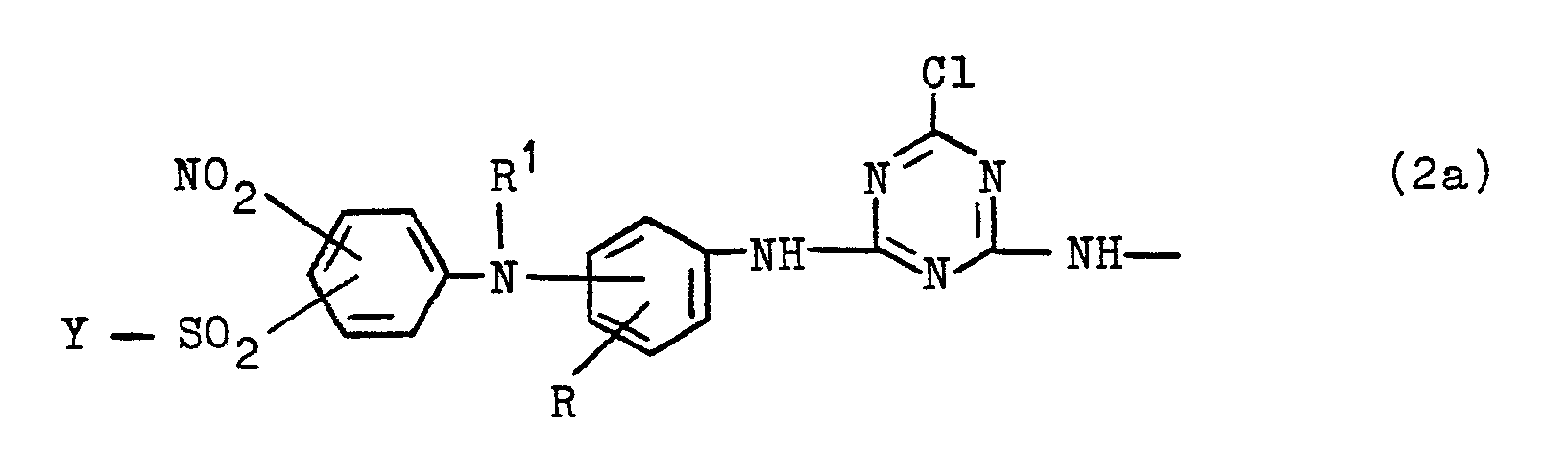

Insbesondere bevorzugt ist der Formelrest Z-D-ein Rest der Formel (4a), (4b), (4c), (4d) oder - (4e)


in welchen M und Z die obengenannten Bedeutungen besitzen, Z jedoch bevorzugt der oben definierte Rest der allgemeinen Formel (2a) oder insbesondere der allgemeinen Formel (2b) ist.in which M and Z have the meanings given above, but Z is preferably the radical of the general formula (2a) or in particular of the general formula (2b) defined above.
Sofern k für die Zahl 1 steht, ist das Formelglied E bevorzugt der 1,4-Phenylenrest, der durch eine Alkanoylaminogruppe von 2 bis 5 C-Atomen, wie Acetylaminogruppe, eine Methyl-, Ethyl-, Carboxy-, Sulfo-oder Ureidogruppe oder ein Chloratom oder durch eine dieser Substituenten und durch eine Methyl-, Ethyl-, Methoxy-, Ethoxy-oder Sulfogruppe oder ein Chloratom substituiert sein kann, oder ein 1,4-Naphthylenrest, der durch eine oder zwei Sulfogruppen substituiert sein kann.If k stands for the number 1, the formula member E is preferably the 1,4-phenylene radical which is formed by an alkanoylamino group of 2 to 5 carbon atoms, such as acetylamino group, a methyl, ethyl, carboxy, sulfo or ureido group or a chlorine atom or by one of these substituents and by a methyl, ethyl, methoxy, ethoxy or sulfo group or a chlorine atom, or a 1,4-naphthylene radical which can be substituted by one or two sulfo groups.
Die vorliegende Erfindung betrifft weiterhin Verfahren zur Herstallung der Azoverbindungen der allgemeinen Formel (1). Diese können erfindungsgemäß hergestellt werden, indem man eine Verbindung der allgemeinen Formel (5a) oder (5b)


Die Diazotierung der die faserreaktive Gruppierung der Formel (2) enthaltenden aromatischen Aminoverbindung bzw. Amino-Azoverbindung der allgemeinen Formel (9) erfolgt in an und für sich üblicher Weise, wie in wäßrigem, saurem, wie insbesondere salzsaurem, Medium mittels einem AIkalinitrit und bei einer Temperatur zwischen -5°C und +15°C. Die Kupplungsreaktion mit der Verbindung der allgemeinen Formel H-K-R" mit K und R" der obengenannten Bedeutung erfolgt anschließend ebenfalls bevorzugt in wäßrigem Medium gemäß an und für sich üblichen Verfahrensweisen von Kupplungsreaktionen, so bei einer Temperatur zwischen 0 und 30°C, bevorzugt zwischen 5 und 20°C, und bei einem pH-Wert zwischen 4 und 7, bevorzugt zwischen 5 und 6,5.The aromatic amino compound or amino-azo compound of the general formula (9) containing the fiber-reactive grouping of the formula (2) is diazotized in a manner which is customary per se, such as in aqueous, acidic, in particular hydrochloric acid, medium using an alkali nitrite and a temperature between -5 ° C and + 15 ° C. The coupling reaction with the compound of the general formula HKR "with K and R" of the abovementioned meaning is then likewise preferably carried out in an aqueous medium in accordance with conventional coupling reaction procedures, for example at a temperature between 0 and 30 ° C., preferably between 5 and 20 ° C, and at a pH between 4 and 7, preferably between 5 and 6.5.
Kupplungskomponenten der allgemeinen Formel H-K-Z sind beispielsweise Verbindungen der allgemeinen Formel (10)

Bevorzugt sind jedoch Kupplungskomponenten der allgemeinen Formel H-K-R" , in denen R" ein Wasserstoffatom bedeutet. Bevorzugt sind hiervon insbesondere durch Alkanoylamino-oder Benzoylamino-Gruppen substituierte 1-Naphthoisulfonsäure-Verbindungen der allgemeinen Formel (11 a)

- R4 für eine Alkylgruppe von 1 bis 4 C-Atomen, bevorzugt die Methyl-oder Ethylgruppe, oder für die Phenylgruppe steht.
- n die Zahl 1 oder 2 ist und
- M die obengenannte Bedeutung besitzt, so beispielsweise das 3.6-Disulfo-8-acetytamino-1-naphthol. das 3,6-DisuNo-8-propianylamino-1-naphthol, das 3,6sulfo-8-benzoylamino-1-naphthol, das 4,6-Disutfo-8-acetylamino-1-naphthol, das 4,6-Disulfo-8-propionylamino-l-naphthol. das 4,6-Disulfo-8-benzoylamino-1-naphthol, das 3-Sulfo-7- acetylamino-1-naphthol, das 3-Sulfo-7-propionylamino-1-naphthol, das 3-Sulfo-6- acetylamino-1-naphthol, das 3-Sulfo-6-propionylamino-1-naphthol, das 3-Sulfo-5- acetylamino-1-naphthol, das 3-Sulfo-5-propionylamino-1-naphthol, das 3,5-Disulfo-6- acetytamino-1-naphthol, das 3,5-Disulfo-6-propianylamino-1-naphthol, das 5-Sulfo-8- acetylamino-1-naphthol, das 5-Sulfo-8-propionylamino-1-naphthol und das 5-Sulfo-8-benzoylamino-1-naphthol, ebenso Verbindungen entsprechend den allgemeinen Formeln (11b),-(11c) und (11d)

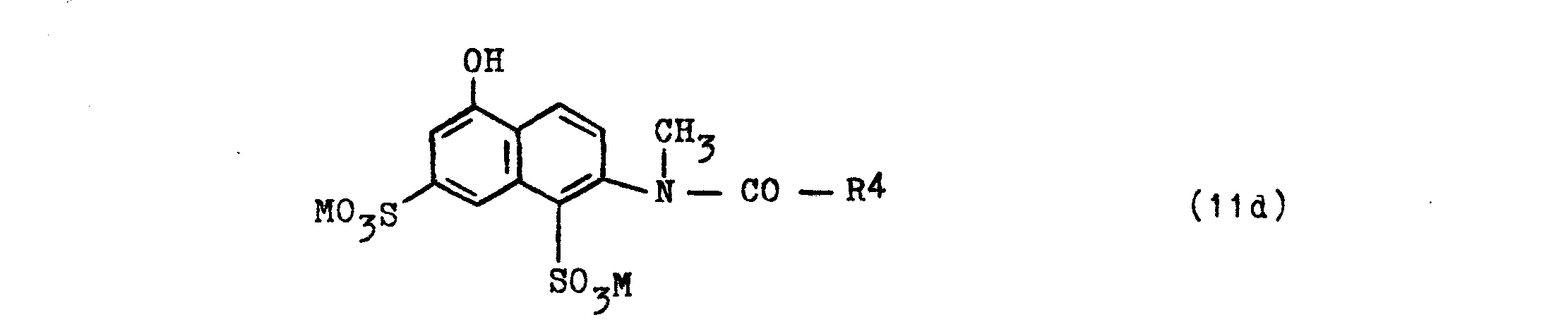
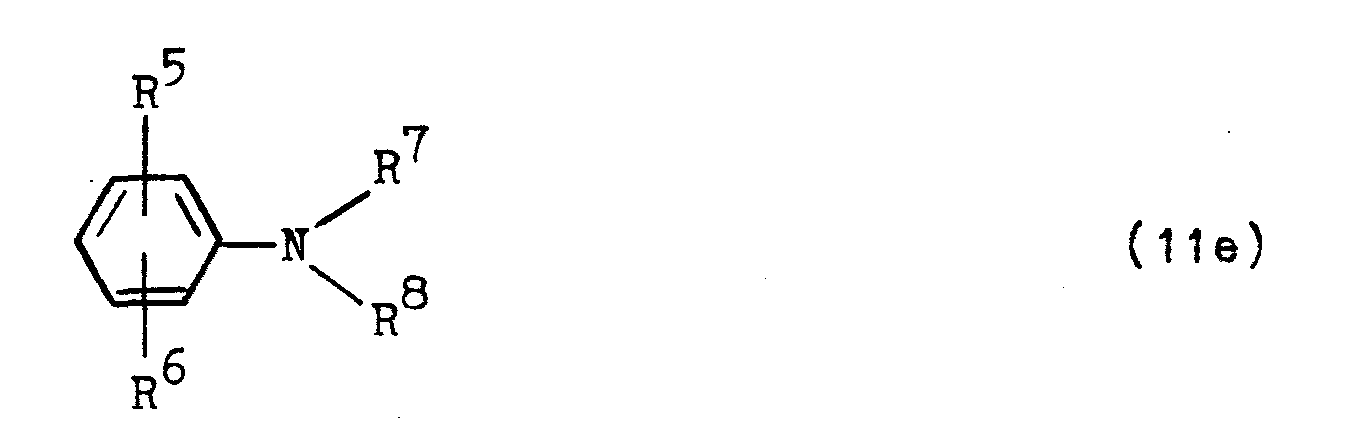
- R6 ein Wasserstoffatom, eine Sulfogruppe, eine Alkylgruppe von 1 bis 4 C-Atomen, wie die Ethyigruppen und insbesondere die Methylgruppe, eine Alkoxygruppe von 1 bis 4 C-Atomen, wie die Ethoxygruppe und insbesondere Methoxygruppe, ein Chloratom oder ein Bromatom ist,
- R6 ein Wasserstoffatom, eine Sulfogruppe, eine Alkylgruppe von 1 bis 4 C-Atomen, wie die Ethylgruppe und insbesondere Methylgruppe, eine Alkoxygruppe von 1 bis 4 C-Atomen, wie die Ethoxygruppe und insbesondere Methoxygruppe, ein Chloratom, ein Bromatom, eine Alkanoylaminogruppe, wie die Acetylaminogruppe, die Ureidogruppe oder eine Alkylsulfonylaminogruppe von 1 bis 4 C-Atomen bedeutet,
- R7 ein Wasserstoffatom oder eine Alkylgruppe von 1 bis 4 C-Atomen ist, die durch eine Hydroxy-, Cyano-, Carboxy-, Sulfo-, Suifato-, Carbomethoxy-oder Carbethoxygruppe oder ein Phenylrest substituiert sein kann, oder ein Phenylrest ist, der durch Alkyl von 1 bis 4 C-Atomen, Alkoxy von 1 bis 4 C-Atomen, Chlor und/oder Sulfo substituiert sein kann, und
- R' eine Alkylgruppe von 1 bis 4 C-Atomen ist, die durch eine Hydroxy-, Cyano-, Carboxy-, Sulfo-, Sulfato-, Carbomethoxy-oder Carbethoxygruppe oder ein Phenylrest substituiert sein kann, oder ein Phenylrest ist, der durch Alkyl von 1 bis 4 C-Atomen, Alkoxy von 1 bis 4 C-Atomen, Chlor und/oder Sulfo substituiert sein kann,
wobei RS, R6, R' und R' zueinander gleich oder voneinander verschieden sein können,
so beispielsweise das N-(β-Cyanoethyl)-anilin, das N-Ethyl-N-(ß-sulfoethyl)-anilin, das N-Ethylanilin, das N,N-Di-(ß-sulfoethyl)-anilin, das N-Ethyl-N-(ß- hydroxyethyl)-anilin, das N-(ß-Sulfoethyl)-anilin, das 3-Chlor-N,N-di-(β-sulfatoethyl)-anilin und das N,N-Bis-(ß-hydroxyethyl)-anilin.However, coupling components of the general formula HKR "in which R" denotes a hydrogen atom are preferred. Of these, 1-naphthoisulfonic acid compounds of the general formula (11a) substituted by alkanoylamino or benzoylamino groups are preferred
- R 4 represents an alkyl group of 1 to 4 carbon atoms, preferably the methyl or ethyl group, or the phenyl group.
- n is the number 1 or 2 and
- M has the meaning given above, for example 3,6-disulfo-8-acetytamino-1-naphthol. the 3,6-disuNo-8-propianylamino-1-naphthol, the 3,6sulfo-8-benzoylamino-1-naphthol, the 4,6-disutfo-8-acetylamino-1-naphthol, the 4,6-disulfo- 8-propionylamino-l-naphthol. the 4,6-disulfo-8-benzoylamino-1-naphthol, the 3-sulfo-7-acetylamino-1-naphthol, the 3-sulfo-7-propionylamino-1-naphthol, the 3-sulfo-6-acetylamino 1-naphthol, the 3-sulfo-6-propionylamino-1-naphthol, the 3-sulfo-5-acetylamino-1-naphthol, the 3-sulfo-5-propionylamino-1-naphthol, the 3,5-disulfo- 6-acetytamino-1-naphthol, 3,5-disulfo-6-propianylamino-1-naphthol, 5-sulfo-8-acetylamino-1-naphthol, 5-sulfo-8-propionylamino-1-naphthol and that 5-sulfo-8-benzoylamino-1-naphthol, as well as compounds corresponding to the general formulas (11b), - (11c) and (11d)
- R 6 is a hydrogen atom, a sulfo group, an alkyl group of 1 to 4 carbon atoms, such as the ethyl groups and in particular the methyl group, an alkoxy group of 1 to 4 carbon atoms, such as the ethoxy group and in particular methoxy group, a chlorine atom or a bromine atom,
- R 6 is a hydrogen atom, a sulfo group, an alkyl group of 1 to 4 carbon atoms, such as the ethyl group and in particular methyl group, an alcohol xy group of 1 to 4 carbon atoms, such as the ethoxy group and in particular methoxy group, a chlorine atom, a bromine atom, an alkanoylamino group, such as the acetylamino group, the ureido group or an alkylsulfonylamino group of 1 to 4 carbon atoms,
- R 7 is a hydrogen atom or an alkyl group of 1 to 4 carbon atoms, which may be substituted by a hydroxyl, cyano, carboxy, sulfo, suifato, carbomethoxy or carbethoxy group or a phenyl radical, or is a phenyl radical, which can be substituted by alkyl of 1 to 4 carbon atoms, alkoxy of 1 to 4 carbon atoms, chlorine and / or sulfo, and
- R 'is an alkyl group of 1 to 4 carbon atoms which can be substituted by a hydroxyl, cyano, carboxy, sulfo, sulfato, carbomethoxy or carbethoxy group or a phenyl radical, or is a phenyl radical which is substituted by alkyl from 1 to 4 carbon atoms, alkoxy from 1 to 4 carbon atoms, chlorine and / or sulfo,
where R S , R 6 , R 'and R' can be identical to or different from one another,
for example, the N- (β-cyanoethyl) aniline, the N-ethyl-N- (ß-sulfoethyl) aniline, the N-ethylaniline, the N, N-di- (ß-sulfoethyl) aniline, the N -Ethyl-N- (ß-hydroxyethyl) aniline, the N- (ß-sulfoethyl) aniline, the 3-chloro-N, N-di- (β-sulfatoethyl) aniline and the N, N-bis- (ß-hydroxyethyl) aniline.
Die erfindungsgemäße Verfahrensvariante der Umsetzung einer Verbindung der allgemeinen Formel (5a) oder (5b) mit einer Verbindung der allgemeinen Formel (6) kann in wäßrigorganischem Me
dium durchgeführt werden; bevorzugt erfolgt sie in wäßriger Lösung. Die Reaktionstemperatur liegt in der Regel zwischen 0 und 50°C, bevorzugt zwischen 25 und 45°C, insbesondere zwischen 35 und 40°C. In der Regel wird ein pH-Wert zwischen 4 und 8, bevorzugt zwischen 5 und 7, eingehalten.The process variant according to the invention of reacting a compound of the general formula (5a) or (5b) with a compound of the general formula (6) can be carried out in aqueous-organic me
be performed; it is preferably carried out in aqueous solution. The reaction temperature is generally between 0 and 50 ° C, preferably between 25 and 45 ° C, in particular between 35 and 40 ° C. As a rule, a pH between 4 and 8, preferably between 5 and 7, is maintained.
Die Kondensationsreaktion der Umsetzung einer Amino-Azoverbindung der allgemeinen Formel - (5a) mit Cyanurchlorid zur Ausgangsverbindung - (7) erfolgt in der Regel in wäßriger, neutraler bis saurer Lösung bei einer Temperatur zwischen - 10°C und +20°C, vorzugsweise bei einer Temperatur zwischen 5 und 10°C und einem pH-Wert von 4 bis 6. Die erfindungsgemäße Kondensationsreaktion der Umsetzung der Dichlortriazin-Azoverbindung der allgemeinen Formel (7) mit der Aminodiphenylamin-Verbindung der allgemeinen Formel (8) erfolgt in der Regel anschließend, bevorzugt ohne weitere Isolierung der zuvor hergestellten Verbindung (7) aus dem Reaktionsansatz, in wäßrig-organischer Lösung, bevorzugt wäßriger, neutraler bis saurer Lösung in der Regel bei einer Temperatur zwischen 0 und 50°C, bevorzugt zwischen 10 und 40°C, und bevorzugt bei einem pH-Wert zwischen 3 und 7, insbesondere zwischen 6 und 6,5.The condensation reaction of the reaction of an amino-azo compound of the general formula - (5a) with cyanuric chloride to give the starting compound - (7) is usually carried out in aqueous, neutral to acidic solution at a temperature between - 10 ° C and +20 ° C, preferably at a temperature between 5 and 10 ° C. and a pH of 4 to 6. The condensation reaction according to the invention of the reaction of the dichlorotriazine azo compound of the general formula (7) with the aminodiphenylamine compound of the general formula (8) usually takes place subsequently, preferably without further isolation of the previously prepared compound (7) from the reaction mixture, in aqueous-organic solution, preferably aqueous, neutral to acidic solution, generally at a temperature between 0 and 50 ° C., preferably between 10 and 40 ° C., and preferably at a pH between 3 and 7, in particular between 6 and 6.5.
Kupplungskomponenten der allgemeinen Formel H-K-NHR' mit K und R' der obengenannten Bedeutung, die zur Herstellung der Ausgangsverbindungen der allgemeinen Formel (5) oder der Formel (7) dienen können, sind beispielsweise Verbindungen der allgemeinen Formel (12a), (12b) und (12c)


Die zur Herstellung der Verbindungen der allgemeinen Formel (1) dienenden Diazokomponenten entsprechend einer allgemeinen Formel Z-D-NH2 und Z-D-N=N-E-NH2 sind beispielsweise Verbindungen der allgemeinen Formeln (13a) bis - (13c)


- in welchen M, R2, R3, R5, R6 und Z' die obengenannten Bedeutungen haben und
- p die Zahl Null, 1 oder 2 ist.
- in which M, R 2 , R 3 , R 5 , R 6 and Z 'have the meanings given above and
- p is the number zero, 1 or 2.
Aus Kombinationen der oben genannten Diazokomponenten entsprechend den allgemeinen Formeln (13) und der zuvor erwähnten Kupplungskomponenten der allgemeinen - Formeln (11) ergeben sich bevorzugte Mono-und Disazoverbindungen der allgemeinen Formel (1).Preferred mono- and disazo compounds of the general formula (1) result from combinations of the above-mentioned diazo components corresponding to the general formulas (13) and the aforementioned coupling components of the general formulas (11).
Die Ausgangsverbindungen der allgemeinen Formeln (9) oder (10) lassen sich in an und für sich üblicher Weise aus den Aminonaphthalin-und Anilinverbindungen, in denen anstelle des Formelrestes Z in den Formeln (9) bzw. (10) die Aminogruppe steht, mit Cyanurchlorid und der Aminadiphenylamin-Verbindung der allgemeinen Formel (8) herstellen. So erfolgt beispielsweise die Synthese der Verbindungen der allgemeinen Formel Z-D-NH2 durch Umsetzung einer Verbindung der allgemeinen Formel NR1N-D-NH2 mit einer Dichlortriazinylamino-diphenylamin-Verbindung der allgemeinen Formel (8) in wäßrig-organischem oder bevorzugt wäßrigem Medium bei einer Temperatur zwischen 10 und 20°C und bei einem pH-Wert zwischen 6 und 6.5. Ähnlich kann die Kupplungskomponente H-K-Z synthetisiert werden.The starting compounds of the general formulas (9) or (10) can be obtained in a conventional manner from the aminonaphthalene and aniline compounds in which the amino group is in the formulas (9) and (10) instead of the formula radical Z. Prepare cyanuric chloride and the aminadiphenylamine compound of the general formula (8). For example, the compounds of the general formula ZD-NH 2 are synthesized by reacting a compound of the general formula NR 1 ND-NH 2 with a dichlorotriazinylamino-diphenylamine compound of the general formula (8) in an aqueous-organic or preferably aqueous medium in a Temperature between 10 and 20 ° C and at a pH between 6 and 6.5. Similarly, the coupling component HKZ can be synthesized.
Sofern die oben erwähnten Kondensationsreaktionen zwischen den Aminoverbindungen und Cyanurchlorid oder einer Dichlortriazinylamino-Verbindung und einer Aminoverbindung in wäßrig-organischem Medium erfolgt, ist das anteilige organische Lösemittel bevorzugt Aceton, Dioxan und Dimethylformamid. Eine der als Ausgangsverbindungen dienenden Amino-diphenylamin-Verbindungen der allgemeinen Formel (8) ist in Form ihrer β-Hydroxyethylsulfonyl-Vorstufe bekannt (s. Deutsche Auslegeschrift 1 179 317, Beispiel 5). Andere Amino-dirphenylamin-Verbindungen der Formel (8) lassen sich über diese β-Hydroxyethylsulfon-Vorstufe in analoger Weise mit Hilfe der entsprechenden isomeren Acylamino-anilin-und (ß-Hydroxye- thylsulfonyl)-nitro-chlorbenzol-Verbindungen leicht herstellen. So erhält man beispielsweise das 4-Amino-2'-(β-hydroxyethylsulfonyl)-5'-nitro- diphenylamin durch Umsetzung von 1,4-Phenylendiamin und 2-Chlor-5-nitro-phenyl-(β-hydroxyethyl)-sulfon in methanolischer Lösung bei einer Temperatur zwischen 50 und 70°C innerhalb weniger Stunden, das sich aus der Reaktionslösung nach Abkühlen auf Raumtemperatur und Zugabe von Eiswasser kristallin in hoher Ausbeute abscheidet.If the above-mentioned condensation reactions between the amino compounds and cyanuric chloride or a dichlorotriazinylamino compound and an amino compound take place in an aqueous-organic medium, the proportionate organic solvent is preferably acetone, dioxane and dimethylformamide. One of the amino-diphenylamine compounds of the general formula (8) serving as starting compounds is known in the form of its β-hydroxyethylsulfonyl precursor (see German Auslegeschrift 1 179 317, Example 5). Other Amino-dirphenylamine compounds of the formula (8) can be easily prepared via this β-hydroxyethylsulfone precursor in an analogous manner with the aid of the corresponding isomeric acylamino-aniline and (β-hydroxyethylsulfonyl) nitro-chlorobenzene compounds. For example, 4-amino-2 '- (β-hydroxyethylsulfonyl) -5'-nitro-diphenylamine is obtained by reacting 1,4-phenylenediamine and 2-chloro-5-nitro-phenyl- (β-hydroxyethyl) sulfone in methanolic solution at a temperature between 50 and 70 ° C within a few hours, which precipitates in crystalline form from the reaction solution after cooling to room temperature and addition of ice water.
Aus diesen β-hydroxyethylsulfonyl-substituierten Aminodiphenylamin-Ausgangsverbindungen lassen sich die faserreaktiven Ausgangsverbindungen der allgemeinen Formel (8) in der für die Synthese von faserreaktiven Gruppen der Vinylsulfonreihe üblichen Weise synthetisieren. Bevorzugt werden sie zunächst in deren Sulfatoderivate durch Umsetzung mit einem Sulfatierungsmittel analog bekannten Verfahrensweisen, übergeführt. Sulfatierungsmittel sind bspw. Schwefelsäure oder Chlorsulfonsäure in einem organischen Lösemittel, wie Pyridin oder N-Methyl-pyrrolidon. Analoge Sulfatierungsreaktionen dieser Art sind beispielsweise aus der bereits genannten DE-AS 1 179 317 sowie aus der britischen Patentschrift Nr. 1 540 566 und der europäischen Patentanmeldungs-Veröffentlichung Nr. 0 036 383 bekannt. Bevorzugt erfolgt die Sulfatierung der β-Hydroxyethylsulfonyl-Ausgangsverbindung zur entsprechenden Verbindung der allgemeinen Formel (8), in welcher Y für die ß-Sulfatoethyl-Gruppe steht, in 100%iger Schwefelsäure bei Tempera turen zwischen 10 und 30°C. Hieraus läßt sich die in Schwefelsäure lösliche Sulfatoverbindung nach Eintragen der Schwefelsäure-Lösung in Eiswasser isolieren.The fiber-reactive starting compounds of the general formula (8) can be synthesized from these β-hydroxyethylsulfonyl-substituted aminodiphenylamine starting compounds in the manner customary for the synthesis of fiber-reactive groups of the vinylsulfone series. They are preferably first converted into their sulfato derivatives by reaction with a sulfating agent analogously to known procedures. Sulfating agents are, for example, sulfuric acid or chlorosulfonic acid in an organic solvent, such as pyridine or N-methyl-pyrrolidone. Analogous sulfation reactions of this type are known, for example, from DE-AS 1 179 317 already mentioned, and from British Patent No. 1 540 566 and European Patent Application Publication No. 0 036 383. The β-hydroxyethylsulfonyl starting compound is preferably sulfated to give the corresponding compound of the general formula (8), in which Y represents the β-sulfatoethyl group, in 100% strength sulfuric acid at temperatures between 10 and 30 ° C. The sulfato compound soluble in sulfuric acid can be isolated from this after the sulfuric acid solution has been introduced into ice water.
In analoger Weise lassen sich die Verbindungen der allgemeinen Formel (8), in welchen Y für die β-Phosphatoethyl-Gruppe steht, durch Umsetzung mit einem geeigneten und hierfür üblichen Phosphatierungsmittel, wie Phosphorsäure, Polyphosphorsäure, herstellen.The compounds of the general formula (8) in which Y represents the β-phosphatoethyl group can be prepared in an analogous manner by reaction with a suitable and customary phosphating agent, such as phosphoric acid, polyphosphoric acid.
Aus den β-Sulfatoethylsulfonyl-Verbindungen der allgemeinen Formel (8) erhält man die entsprechenden Vinylsulfonyl-Verbindungen (mit Y gleich der Vinylgruppe in Formel (8)) durch Umsetzung mit einem Alkali in wäßriger Lösung, beispielsweise indem man eine Lösung der Sulfatoverbindung in alkalisch-wäßriger Lösung bei einem pH-Wert zwischen 8 und 10 und bei einer Temperatur zwischen etwa 40 und 60°C für kurze Zeit behandelt.The corresponding vinylsulfonyl compounds (with Y equal to the vinyl group in formula (8)) are obtained from the β-sulfatoethylsulfonyl compounds of the general formula (8) by reaction with an alkali in aqueous solution, for example by making a solution of the sulfato compound in alkaline -Aqueous solution treated at a pH between 8 and 10 and at a temperature between about 40 and 60 ° C for a short time.
Aus diesen Vinylsulfonyl-Verbindungen der allgemeinen Formel (8) lassen sich die entsprechenden β-Thiosulfatoethylsulfonyl-Verbindungen durch Umsetzung mit einem Alkalithiosulfat herstellen, so beispielsweise durch Umsetzung der Vinylsulfonyl-Verbindung der Formel (8) mit Natriumthiosulfat, vorteilhaft im Überschuß, wie in 21 bis 40%igem Überschuß, in wäßriger schwach saurer Lösung bei einer Temperatur zwischen 30 und 80°C.The corresponding β-thiosulfatoethylsulfonyl compounds can be prepared from these vinylsulfonyl compounds of the general formula (8) by reaction with an alkali metal thiosulfate, for example by reaction of the vinylsulfonyl compound of the formula (8) with sodium thiosulfate, advantageously in excess, as in 21 up to 40% excess, in aqueous weakly acidic solution at a temperature between 30 and 80 ° C.
Amino-diphenylamin-Ausgangsverbindungen der allgemeinen Formel (8) sind beispielsweise 1-Nitro-2-(4'-amino-phenylamino)-5-(β-sulfatoethylsulfonyl)-benzol, 1 -Nitro-4-(4'-amino- phenylamino)-5-(ß-sulfatoethylsulfonyl)-benzol, 1-Nitro-2-(3'-amino-phenylaminor5-(β-sulfatoethylsulfonyl)-benzol, 1-Nitro-2-(4'-amino-3'-sulfo-phenylamino)-5-(β-sulfatoethylsulfonyl)-benzol und 1-Nitro-2-(4'-amino-2'-sulfo-phenylamino)-5-(β-sulfatoethylsulfonyl)-benzol.Amino-diphenylamine starting compounds of the general formula (8) are, for example, 1-nitro-2- (4'-aminophenylamino) -5- (β-sulfatoethylsulfonyl) benzene, 1 -nitro-4- (4'-amino- phenylamino) -5- (ß-sulfatoethylsulfonyl) benzene, 1-nitro-2- (3'-amino-phenylaminor5- (β-sulfatoethylsulfonyl) -benzene, 1-nitro-2- (4'-amino-3'- sulfo-phenylamino) -5- (β-sulfatoethylsulfonyl) benzene and 1-nitro-2- (4'-amino-2'-sulfo-phenylamino) -5- (β-sulfatoethylsulfonyl) benzene.
Aromatische Amine der allgemeinen Formel H, N-D-NH, , die als Diazokomponenten zur Synthese der erfindungsgemäßen Verbindungen dienen können, sind bspw. 1,4-Diamino-benzol, 1,3-Diamino-benzol, 1,4-Diamino-benzol-2-sulfonsäure, 1,3-Diamino-benzol-4-sulfonsäure, 1,4-Diamino- benzol-2,5-disulfonsäure, 1,3-Diamino-benzol-4,6- disuffonsäure, 1,4-Diamino-benzol-2,6-disulfonsäure, 1,4-Diamino-3-methyl-benzol, 1,3-Diamino-4-methoxy-benzol.Aromatic amines of the general formula H, ND-NH, which can serve as diazo components for the synthesis of the compounds according to the invention are, for example, 1,4-diamino-benzene, 1,3-diamino-benzene, 1,4-diamino-benzene. 2-sulfonic acid, 1,3-diamino-benzene-4-sulfonic acid, 1,4-diamino-benzene-2,5-disulfonic acid, 1,3-diamino-benzene-4,6-disuffonic acid, 1,4-diamino- benzene-2,6-disulfonic acid, 1,4-diamino-3-methyl-benzene, 1,3-diamino-4-methoxy-benzene.
Verbindungen entsprechend der allgemeinen Formel H-E-NH, bzw. H-E1(-SO2-Y)-NH2, die zur Herstellung der erfindungsgemäßen Disazoverbindungen dienen können, sind bspw. Anilin, 3-Methylanilin, 3-Chloranilin, 2,5-Dimethylanilin, 2,5-Dimethoxyanilin, 3-Methoxyanilin, 3-Methyl-6-methoxyanilin, 3-Aminophenylharnstoff, 3-Acetylamino-6-methylanilin, 2-Amino-4-acetyl-aminobenzol-1-sulfonsäure, 1,3-Diaminobenzol, 1,3-Diamino-4-methyl-oder -methoxybenzol, 1,3-Diamino-benzol-4-sulfonsäure, 1-Aminonaphthalin, 1-Aminonaphthalin-6-oder -7-sulfonsäure, 3-Acetylaminoanilin, 2-Methylanilin, 2-Methoxyanilin, 3-Benzoylaminoanilin, 2,3-Dimethylanilin, 3,5-Dimethyianilin, 1-Amino-2-methoxy-5-acetylamino-benzol, ebenso auch 1-Amino-7-sulfo-5-(ß-suffatoethylsulfo- nyl)-naphthalin, 1-Amino-5-(β-sulfatoethylsulfonyl)-naphthalin, 1-Amino-6-(β-sulfatoethylsulfonyl)-naphthalin, 1-Amino-7-(ß-sulfatoethylsulfonyl)-naphthalin, sowie deren entsprechenden ß-Thiosulfatoethylsulfonyl-, β-Phosphatoethylsulfonyl- , β-Chlorethylsulfonyl-und Vinylsulfonyl-Derivate.Compounds corresponding to the general formula HE-NH or HE 1 (-SO 2 -Y) -NH 2 which can be used to prepare the disazo compounds according to the invention are, for example, aniline, 3-methylaniline, 3-chloroaniline, 2,5- Dimethylaniline, 2,5-dimethoxyaniline, 3-methoxyaniline, 3-methyl-6-methoxyaniline, 3-aminophenylurea, 3-acetylamino-6-methylaniline, 2-amino-4-acetylamino benzene-1-sulfonic acid, 1,3- Diaminobenzene, 1,3-diamino-4-methyl- or -methoxybenzene, 1,3-diamino-benzene-4-sulfonic acid, 1-aminonaphthalene, 1-aminonaphthalene-6-or -7-sulfonic acid, 3-acetylaminoaniline, 2- Methylaniline, 2-methoxyaniline, 3-benzoylaminoaniline, 2,3-dimethylaniline, 3,5-dimethyianiline, 1-amino-2-methoxy-5-acetylamino-benzene, as well as 1-amino-7-sulfo-5- (ß -suffatoethylsulfonyl) -naphthalene, 1-amino-5- (β-sulfatoethylsulfonyl) -naphthalene, 1-amino-6- (β-sulfatoethylsulfonyl) -naphthalene, 1-amino-7- (ß-sulfatoethylsulfonyl) -naphthalene, and their corresponding ß-thiosulfatoethylsulfonyl-, β-phosphatoethylsulfonyl-, β-C chloroethylsulfonyl and vinylsulfonyl derivatives.
Weitere Ausgangsverbindungen, die der allgemeinen Formel H-K-NHR' entsprechen, sind beispielsweise Anilin, 3-Methylanilin, 3-Chloranilin, 2,5-Dimethylanilin, 2,5-Dimethoxyanilin, 3-Methoxyanilin, 3-Methyl-6-methoxyanilin, 3-Aminophenylhamstoff, 3-Acetylamino-6-methyl-anilin, 2-Amino-4- acetylamino-benzol-1-sulfonsäure, 1-Aminonaphthalin, 1-Aminonaphthalin-6-oder -7-sulfonsäure, 3-Acetylaminoanilin, 2-Amino-8-naphthol-6-sulfonsäure, 2-Amino-8-naphthol-4,6-disulfonsäure, 2-Amino-5-naphthol-7-sulfonsäure, 3-Amino-5-naphthol-7-sulfonsäure, 1-Amino-5-naphthol-7-sulfonsäure, 1-Amino-naphthalin-8-sulfonsäure, 1-Amino-8-naphthol-3,6-disulfonsäure, 1-Amino-8-naphthol-4,6-disulfonsäure, 2-Methylanilin, 2-Methoxyanilin, 3-Benzoylaminoanilin, 2,3-Dimethylanilin, 3,5-Dimethylanilin, 1-Amino-2-methoxy-5- acetylamino-benzol, N-Methylanilin, 3-Chlor-N-methyl-anilin, N-(β-Cyanoethyl)-anilin und N-Ethylanilin.Further starting compounds which correspond to the general formula HK-NHR 'are, for example, aniline, 3-methylaniline, 3-chloroaniline, 2,5-dimethylaniline, 2,5-dimethoxyaniline, 3-methoxyaniline, 3-methyl-6-methoxyaniline, 3 -Aminophenylurea, 3-acetylamino-6-methyl-aniline, 2-amino-4-acetylamino-benzene-1-sulfonic acid, 1-aminonaphthalene, 1-aminonaphthalene-6-or -7-sulfonic acid, 3-acetylaminoaniline, 2-amino -8-naphthol-6-sulfonic acid, 2-amino-8-naphthol-4,6-disulfonic acid, 2-amino-5-naphthol-7-sulfonic acid, 3-amino-5- naphthol-7-sulfonic acid, 1-amino-5-naphthol-7-sulfonic acid, 1-amino-naphthalene-8-sulfonic acid, 1-amino-8-naphthol-3,6-disulfonic acid, 1-amino-8-naphthol 4,6-disulfonic acid, 2-methylaniline, 2-methoxyaniline, 3-benzoylaminoaniline, 2,3-dimethylaniline, 3,5-dimethylaniline, 1-amino-2-methoxy-5-acetylamino-benzene, N-methylaniline, 3- Chlorine-N-methyl-aniline, N- (β-cyanoethyl) aniline and N-ethylaniline.
Kupplungskomponenten, die erfindungsgemäß zur Herstellung der Azoverbindungen der allgemeinen Formel (1) dienen können und die der aligemeinen Formel H-K-Z entsprechen, sind beispielsweise die nachfolgenden Aminonaphthol-sulfonsäuren, an deren Amino-oder Methylamino-Gruppe der fasarreaktive Rest Z2 der allgemeinen Formel (2c)

Von den erfindungsgemäßen Azoverbindungen der allgemeinen Formel (1) können insbesondere solche Gruppen von Verbin dungen hervorgehoben werden, die den allgemeinen Formeln (14), (15), - (16), (17) und (18) entsprechen:


- M die obengenannte Bedeutung besitzt,
- B ein Rest der allgemeinen Formel (4a), (4b), (4c), (4d) oder (4e) ist, worin Z' bevorzugt die Bedeutung von Z2 hat,
- p die Zahl Null, 1 oder 2 ist,
- R* ein Wasserstoffatom oder eine Sulfogruppe ist,
- R° ein Wasserstoffatom, ein Chlor-oder Bromatom, eine Alkanoylaminogruppe von 2 bis 5 C-Atomen, wie Acetylaminogruppe, eine Sulfo-, Carboxy-, Methyl-, Ethyl-, Methoxy-oder Ureidogruppe ist und
- R' hier die Methyl-, Ethyl-oder Phenylgruppe bedeutet.
- M has the meaning given above,
- B is a radical of the general formula (4a), (4b), (4c), (4d) or (4e), in which Z 'preferably has the meaning of Z 2 ,
- p is the number zero, 1 or 2,
- R * is a hydrogen atom or a sulfo group,
- R ° is a hydrogen atom, a chlorine or bromine atom, an alkanoylamino group of 2 to 5 carbon atoms, such as acetylamino group, a sulfo, carboxy, methyl, ethyl, methoxy or ureido group and
- R 'here denotes the methyl, ethyl or phenyl group.
Insbesondere bevorzugt ist in diesen Verbindungen der Formelrest Y eine β-Sulfatoethyl-Gruppe.In these compounds, the formula radical Y is particularly preferably a β-sulfatoethyl group.
Von den Verbindungen der allgemeinen Formel (14) bis (18) sind insbesondere diejenigen bevorzugt, bei denen eine Sulfogruppe im Formelrest B in ortho-Stellung zur Azogruppe an den Benzol- bzw. Naphthalinkern gebunden ist.Of the compounds of the general formula (14) to (18), those are particularly preferred in which a sulfo group in the formula radical B is bonded to the benzene or naphthalene nucleus in the ortho position to the azo group.
Die Abscheidung und Isolierung der erfindungsgemäß hergestellten Verbindungen der allgemeinen Formel (1) aus den Syntheselösungen kann nach allgemein bekannten Methoden erfolgen, so beispielsweise entweder durch Ausfällen aus dem Reaktionsmedium mittels Elektrolyten, wie beispielsweise Natriumchlorid oder Kaliumchlorid, oder durch Eindampfen der Reaktionslösung, beispielsweise Sprühtrocknung, wobei dieser Reaktionslösung eine Puffersubstanz zugefügt werden kann.The compounds of general formula (1) prepared according to the invention can be separated and isolated from the synthesis solutions by generally known methods, for example either by precipitation from the reaction medium by means of electrolytes, such as sodium chloride or potassium chloride, or by evaporation of the reaction solution, for example spray drying. a buffer substance can be added to this reaction solution.
Die erfindungsgemäßen Verbindungen der allgemeinen Formel (1) haben faserreaktive Eigenschaften und besitzen sehr gute Farbstoffeigenschaften. Sie können deshalb zum Färben (einschließlich Bedrucken) von hydroxygruppenhaltigen und/oder carbonamidgruppenhaltigen MaterIalien verwendet werden. Auch können die bei der Synthese der erfindungsgemäßen Verbindungen anfallenden Lösungen, gegebenen falls nach Zusatz einer Puffersubstanz und gegebenenfalls auch nach Konzentrierung, direkt als Flüssigpräparation der färberischen Verwendung zugeführt werden.The compounds of the general formula (1) according to the invention have fiber-reactive properties and very good dye properties. They can therefore be used for dyeing (including printing) materials containing hydroxy groups and / or carbonamide groups. The solutions obtained in the synthesis of the compounds according to the invention, if appropriate after adding a buffer substance and optionally also after concentration, can be used directly as a liquid preparation for dyeing.
Gegenstand der vorliegenden Erfindung ist deshalb auch die Verwendung der erfindungsgemäßen Verbindungen der allgemeinen Formel - (1) zum Färben (einschließlich Bedrucken) von hydroxy-und/oder carbonamidgruppenhaltigen Materialien bzw. Verfahren zu deren Anwendung auf diesen Substraten. Eingeschlossen ist hierbei Massefärbung, wie bspw. von Folien aus Polyamid. Bevorzugt kommen die Materialien in Form von Fasermaterialien zur Anwendung, insbesondere in Form von Textilfasern, wie Garnen, Wickelkörpem und Geweben. Hierbei kann man analog bekannten Verfahrensweisen vorgehen.The present invention therefore also relates to the use of the compounds of the general formula - (1) according to the invention for dyeing (including printing) materials containing hydroxyl and / or carbonamide groups and processes for their use on these substrates. This includes mass coloring, for example of polyamide films. The materials are preferably used in the form of fiber materials, in particular in the form of textile fibers, such as yarns, bobbins and fabrics. This can be done analogously to known procedures.
Hydroxygruppenhaltige Materialien sind solche natürlichen oder synthetischen Ursprungs, wie beispielsweise Cellulosefasermaterialien oder deren Regeneratprodukte und Polyvinylalkohole. Cellulosafasermaterialien sind vorzugsweise Baumwolle, aber auch andere Pflanzenfasern, wie Leinen, Hanf, Jute und Ramiefasem; regenerierte Cellulosefasern sind beispielsweise Zellwolle und Viskosekunstseide.Materials containing hydroxyl groups are of natural or synthetic origin, such as cellulose fiber materials or their regenerated products and polyvinyl alcohols. Cellulose fiber materials are preferably cotton, but also other plant fibers, such as linen, hemp, jute and ramie fibers; Regenerated cellulose fibers are, for example, cellulose and viscose rayon.
Carbonamidgruppenhattige Materialien sind beispielsweise synthetische und natürliche Polyamide und Polyurethane, insbesondere in Form von Fasem, beispielsweise Wolle und andere Tierhaare, Seide, leder, Polyamid-6,6, Polyamid-6, Polyamid-11 und Polyamid-4.Materials containing carbonamide groups are, for example, synthetic and natural polyamides and polyurethanes, in particular in the form of fibers, for example wool and other animal hair, silk, leather, polyamide-6,6, polyamide-6, polyamide-11 and polyamide-4.
Die erfindungsgemäBen Verbindungen der Formel (1) lassen sich, gemäß der erfindungsgemäßen Anwendung, auf den genannten Substraten, insbesondere auf den genannten Fasermaterialien, nach den für wasserlösliche Farbstoffe, insbesondere faserreaktive Farbstoffe, bekannten Anwendungstech niken applizieren und fixieren, so beispielsweise, indem man die Azoverbindung der allgemeinen Formel (1) in gelöster Form auf das Substrat aufbringt oder sie darin einbringt und sie auf diesem oder in diesem, gegebenenfalls durch Hitzeeinwirkung und/oder gegebenenfalls durch Einwirkung eines alkalisch wirkenden Mittels, fixiert Solche Färbe-und Fixierweisen sind in der Literatur zahlreich beschrieben.The compounds of the formula (1) according to the invention can, according to the application according to the invention, be applied and fixed on the substrates mentioned, in particular on the fiber materials mentioned, by the application techniques known for water-soluble dyes, in particular fiber-reactive dyes, for example by Applying azo compound of general formula (1) in dissolved form to the substrate or introducing it into it and fixing it on or in this substrate, optionally by exposure to heat and / or optionally by the action of an alkaline agent. Such dyeing and fixing methods are known in the literature described in numerous.
So erhält man mit ihnen auf Cellutosefasern nach den Ausziehverfahren aus langer Flotte unter Verwendung von varschiedensten säurebindenden Mitteln und gegebenenfalls neutralen Salzen, wie Natriumchlorid oder Natriumsulfat, sehr gute Farbausbeuten sowie einen ausgezeichneten Farbaufbau. Man färbt bevorzugt in wäßrigem Bad bei Temperaturen zwischen 40 und 105°C, gegebenenfalls bei Temperaturen bis zu 130°C unter Druck, und gegebenenfalls in Gegenwart von üblichen Färbereihilfsmitteln. Man kann dabei so vorgehen, daß man das Material in das warme Bad einbringt und dieses allmählich auf die gewünschte Färbetemperatur erwärmt und den FärbeprozeB bei dieser Tamperatur zu Ende führt. Die das Ausziehen des Farbstoffes beschleunigenden Neutratsalze können dem Bade gewünschtenfalls auch erst nach Erreichen der eigentlichen Färbetemperatur zugesetzt werden.They give you very good color yields and excellent color build-up on cellulose fibers using the exhaust process from a long liquor using a wide variety of acid-binding agents and optionally neutral salts such as sodium chloride or sodium sulfate. Dyeing is preferably carried out in an aqueous bath at temperatures between 40 and 105 ° C., if appropriate at temperatures up to 130 ° C. under pressure, and if appropriate in the presence of customary dyeing auxiliaries. One can proceed in such a way that the material is introduced into the warm bath and this is gradually heated to the desired dyeing temperature and the dyeing process is completed at this temperature. If desired, the neutrate salts which accelerate the removal of the dye can also be added to the bath only after the actual dyeing temperature has been reached.
Nach den Klotzverfahran werden auf Cellulosefasern ebenfalls gute Farbausbeuten und ein guter Farbaufbau erhalten. wobei durch Verweilen bei Raumtemperatur oder erhöhter Tamperatur. beispietsweise bis zu etwa 60°C, durch Dämpfen oder mit Trockenhitze in üblicher Weise fixiert werden kann.After the block process, good color yields and a good color build-up are also obtained on cellulose fibers. by staying at room temperature or increased temperature. example up to about 60 ° C, can be fixed in the usual way by steaming or with dry heat.
Ebenfalls nach den üblichen Druckverfahren für Celluiosafasern, die einphasig, beispielsweise durch Bedrucken mittals einer die erfindungsgemäße Verbindung und Natriumbi carbonat oder ein anderes säurebindandas Mittel enthaltenden Druckpaste und anschließendes Dämpfen bei 100 bis 103°C. oder zweiphasig. beispielsweise durch Bedrucken mittels einer die erfindungsgemäße Verbindung enthaltenden neutralen oder schwach sauren Druckpaste und anschließendes Fixieren der erfindungsgemäßen Verbindung entweder durch Hindurchführen des bedruckten Materials durch ein heißes alkali-und elektrolythaltiges Bad oder durch Überklotzen mit einer alkalischen elektrolythaltigen Klotzflotte und anschließendes Verweilen dieses übarklotzten Materials oder Dämpfen oder Behandlung mit Trockenhitze, durchgeführt werden können, erhält man farbstarke Drucke mit gutem Stand der Konturen und einem klaren Weißfond. Der Ausfall der Drucke ist von wechselnden Fixierbedingungen nur wenig abhängig. Sowohl in der Färberei als auch in der Druckerei sind die mit den erfindungsgemäßen Verbindungen erhaltenen Fixiergrade sehr hoch.Also according to the usual printing processes for cellulose fibers, which are single-phase, for example by printing with a printing paste containing the compound according to the invention and sodium bicarbonate or another acid-binding agent, and then steaming at 100 to 103 ° C. or two-phase. for example by printing using a neutral or weakly acidic printing paste containing the compound according to the invention and then fixing the compound according to the invention either by passing the printed material through a hot alkali-containing and electrolyte-containing bath or by padding with an alkaline electrolyte-containing pad liquor and then lingering this block-sealed material or vapors or treatment with dry heat, you get strong colored prints with good shape of the contours and a clear white background. The failure of the prints is only slightly dependent on changing fixing conditions. The degrees of fixation obtained with the compounds according to the invention are very high both in the dyeing and in the printing works.
Bei der Fixierung mittels Trockenhitze nach den üblichen Thermofixierverfahren verwendet man Heißluft von 120 bis 200°C. Bei der Fixierung mittels Wasserdampf kann neben dem üblichen Wasserdampf von 101 bis 103°C auch überhitzter Dampf und Druckdampf von Temperaturen bis zu 160°C eingesetzt werden.Hot air from 120 to 200 ° C is used for fixing with dry heat using the usual heat-setting processes. In addition to the usual steam from 101 to 103 ° C, superheated steam and pressure steam from temperatures up to 160 ° C can be used for fixation with water vapor.
Die säurebindenden und die Fixierung der Verbindung der Formel (1) auf den Cellulosefasem bewirkenden Mittel sind beispielsweise wasserlösliche basische Salze der Alkalimetalle und Erdalkalimetalle von organischen oder anorganischen Säuren oder Verbindungen, die in der Hitze Alkali freisetzen. Insbesondere sind die Alkalimetallhydroxide und Alkalimetallsalze von schwach bis mittelstarken anorganischen oder organischen Säuren zu nennen, vorzugsweise deren Natrium-und Kaliumverbindungen. Solche säurebindenden Mittel sind beispielsweise Natriumhydroxid, Kaliumhydroxid, Natriumcarbonat, Natriumbicarbonat, Kaliumcarbonat, Natriumformiat, Natriumdihydrogenphosphat, Dinatriumhydrogenphosphat, Natriumtrichloracetat, Wasserglas und Trinatriumphosphat.The acid-binding agents and the fixation of the compound of formula (1) on the cellulose fibers are, for example, water-soluble basic salts of alkali metals and alkaline earth metals of organic or inorganic acids or compounds which release alkali in the heat. In particular, the alkali metal hydroxides and alkali metal salts of weakly to moderately strong inorganic or organic acids should be mentioned, preferably their sodium and potassium compounds. Examples of such acid-binding agents are sodium hydroxide, potassium hydroxide, sodium carbonate, sodium bicarbonate, potassium carbonate, sodium formate, sodium dihydrogen phosphate, disodium hydrogen phosphate, sodium trichloroacetate, water glass and trisodium phosphate.
Durch die Behandlung der erfindungsgemäßen Verbindungen (Farbstoffe) mit den säurebindenden Mitteln, gegebenenfalls unter Wärmeeinwirkung. werden diese chemisch an die Cellulosefaser gebunden; insbesondere die Cellulosefärbungen zeigen nach der üblichen Nachbehandlung durch Spülen zur Entfernung von nicht fixierten Farbstoffanteilen ausgezeichnete Naßechtheiten, zumal sich nicht fixierte Farbstoffanteile wegen ihrer guten Kattwasserlöslichkeit auswaschen lassen.By treating the compounds (dyes) according to the invention with the acid-binding agents, if appropriate with the action of heat. these are chemically bound to the cellulose fiber; In particular, the cellulose dyeings show excellent wet fastness properties after the usual aftertreatment by rinsing to remove unfixed dye components, especially since unfixed dye components can be washed out because of their good solubility in cold water.
Die mit den erfindungsgemäßen Verbindungen (Farbstoffen) hergestellten Färbungen und Drucke auf Cellulosematerialien besitzen eine hohe Farbstärke, gute Lichtechtheiten und gute bis sehr gute Naßechtheiten, wie beispielsweise gute bis sehr gute Waschechtheiten bei 60 bis 95°C, auch in Gegenwart von Perboraten, saure und alkalische Walk-, Überfärbe-und SchweiBechtheiten, gute bis sehr gute saure und alkalische Schweißechtheiten, eine hohe Dampfbeständigkeit, gute bis sehr gute Alkali-, Säure-, Wasser-und Seewasserechtheiten, desweiteren eine gute Plissierechtheit, Bügelechtheit und Reibechtheit. Ebenso besitzen sie eine sehr gute Säurelagerbeständigkeit ("acid fading") beim Lagern von feuchten, noch Essigsäure enthaltendem gefärbtem Material (s. hierzu deutsche Auslegeschrift Nr. 23 22 236).The dyeings and prints on cellulose materials produced with the compounds (dyes) according to the invention have a high color strength, good light fastness and good to very good wet fastnesses, such as, for example, good to very good wash fastnesses at 60 to 95 ° C., even in the presence of perborates, acidic and alkaline walk, over-dyeing and perspiration fastness, good to very good acidic and alkaline perspiration fastness, high steam resistance, good to very good alkali, acid, water and seawater fastness, furthermore good pleating fastness, ironing fastness and rubbing fastness. They also have very good resistance to acid storage ("acid fading") when storing colored material which still contains acetic acid (see German Auslegeschrift No. 23 22 236).
Besonders hervorzuheben sind die guten Naßlichtechtheiten der mit destilliertem Wasser oder Trinkwasser befeuchteten Färbungen und Drucke auf Cellulosefasermaterialien sowie deren alkalische Schweißlichtechtheit. Diesbezüglich sind die erfindungsgemäßen Farbstoffe den anfangs erwähnten bekannten und konstitutionell nächst vergleichbaren faserreaktiven Farbstoffen, die als Reaktivgruppe ebenfalls einen Monochlortriazin-Rest und eine faserreaktive Gruppe der Vinylsulfon-Reihe enthalten, in überraschender Weise überlegen.Of particular note are the good wet fastness properties of the dyeings and prints moistened with distilled water or drinking water on cellulose fiber materials, as well as their alkaline perspiration fastness properties. In this regard, the dyes according to the invention are surprisingly superior to the initially mentioned known and constitutionally closest comparable fiber-reactive dyes, which also contain a monochlorotriazine residue and a fiber-reactive group from the vinylsulfone series as a reactive group.
Die Färbungen auf Polyurethanfasem oder natürlichen oder synthetischen Polyamidfasern werden üblicherweise aus saurem Milieu ausgeführt. So kann man beispielsweise dem Färbebad Essigsäure und/oder Ammoniumsulfat, Natriumacetat und/oder Ammoniumacetat zufügen, um den gewünschten pH-Wert zu erhalten. Zwecks Erreichung einer brauchbaren Egalität der Färbung empfiehlt sich ein Zusatz an üblichen Egalisierhilfsmitteln, wie beispielsweise auf Basis eines Umsetzungsproduktes von Cyanurchlorid mit der dreifach molaren Menge einer Aminobenzolsulfonsäure und/oder einer Aminonaphthalinsulfonsäure oder auf Basis eines Umsetzungsproduktes von beispielsweise Stearylamin mit Ethylenoxid. In der Regel wird das zu färbende Material bei einer Temperatur von etwa 40°C in das Bad eingebracht, dort einige Zeit darin bewegt, das Färbebad dann auf den gewünschten schwach sauren, vorzugsweise schwach essigsauren, pH-Wert nachgestellt und die eigentliche Färbung bei einer Temperatur zwischen 60 und 98°C durchgeführt. Die Färbungen können aber auch bei Siedetemperatur oder bei Temperaturen bis zu 120°C (unter Druck) ausgeführt werden.The dyeings on polyurethane fibers or natural or synthetic polyamide fibers are usually carried out from an acidic environment. For example, acetic acid and / or ammonium sulfate, sodium acetate and / or ammonium acetate can be added to the dyebath in order to obtain the desired pH. In order to achieve a useful levelness of coloration, it is advisable to add conventional leveling aids, such as, for example, based on a reaction product of cyanuric chloride with three times the molar amount of an aminobenzenesulfonic acid and / or an aminonaphthalenesulfonic acid or on the basis of a reaction product of, for example, stearylamine with ethylene oxide. As a rule, the material to be dyed is introduced into the bath at a temperature of approx. 40 ° C, agitated there for some time, the dyebath is then adjusted to the desired weakly acidic, preferably weakly acetic acid, pH value and the actual dyeing at one Temperature between 60 and 98 ° C carried out. The dyeings can also be carried out at boiling temperature or at temperatures up to 120 ° C (under pressure).
Das Verfahren des Färbens auf Wolle erfolgt hierbei in üblicher und bekannter Färbeweise, indem die faserreaktive Verbindung der allgemeinen Formel (1) bevorzugt zunächst aus saurem Färbebad mit einem pH von etwa 3,5 bis 5,5 unter Kontrolle des pH-Wertes dem Ausziehprozeß unterworfen wird und gegen Ende der Färbezeit der pH-Wert in den neutralen und gegebenenfalls schwach alkalischen Bereich bis zu einem pH-Wert von 8,5 verschoben wird, um besonders bei einer erwünschten Erzielung von hohen Farbtiefen die volle reaktive Bindung zwischen diesem Farbstoff der Formel (1) und der Faser herbeizuführen. Gleichzeitig wird der nicht reaktiv gebundene Farbstoffanteil abgelöst.The process of dyeing on wool is carried out in the customary and known manner of dyeing, in that the fiber-reactive compound of the general formula (1) is preferably first subjected to the exhaust process from an acid dyebath with a pH of about 3.5 to 5.5 while checking the pH and towards the end of the dyeing time the pH value is shifted to a neutral and possibly weakly alkaline range up to a pH value of 8.5, in order to achieve the full reactive bond between this dye of the formula (in particular if high color depths are desired) 1) and bring about the fiber. At the same time, the non-reactive dye component is removed.
Die hier beschriebene Verfahrensweise gilt auch zur Herstellung von Färbungen auf Fasermaterialien aus anderen natürlichen Polyamiden oder aus synthetischen Polyamiden und Polyurethanen. Die Färbungen werden bei Temperaturen von 60 bis 100°C durchgeführt, jedoch können sie auch in geschlossenen Färbeapparaturen bei Temperaturen bis zu 106°C erfolgen. Da die Wasserlöslichkeit der Verbindungen der allgemeinen Formel (1) sehr gut ist, lassen sie sich auch mit Vorteil bei üblichen kontinuierlichen Färbeverfahren einsetzen. Die Farbstärke der erfindungsgemäßen Verbindungen der allgemeinen Formel (1) ist sehr hoch. Sie hefem auf den Fasermaterialien, insbesondere beim reaktiven Färben von Wolle, farbstarke, echte Färbungen. Bei Anwendung von Färbetemperaturen von 100 bis 106°C ist eine hohe Baderschöpfung festzustellen.The procedure described here also applies to the production of dyeings on fiber materials made from other natural polyamides or from synthetic polyamides and polyurethanes. The dyeings are carried out at temperatures from 60 to 100 ° C, but they can also be carried out in closed dyeing machines at temperatures up to 106 ° C. Since the water solubility of the compounds of the general formula (1) is very good, they can also be used advantageously in conventional continuous dyeing processes. The color strength of the compounds of the general formula (1) according to the invention is very high high. They have strong, true dyeings on the fiber materials, especially when reactive dyeing wool. When using dyeing temperatures of 100 to 106 ° C a high bath exhaustion can be determined.
Bei den mit den erfindungsgemäßen Verbindungen der allgemeinen Formel (1) erhältlichen Färbungen kann auf eine ansonsten übliche ammoniakalische Nachbehandlung der gefärbten Ware verzichtet werden. Sie zeigen einen sehr guten Farbaufbau, wobei die brillante Nuance in tiefen Tönen erhalten bleibt. Darüber hinaus sind sie mit anderen faserreaktive Wallfarbstoffen, was ein überraschend egales Färben der Faser ermöglicht. Ebenso läßt sich Material aus Woltfasern unterschiedlicher Provenienz mit der erfindungsgemäßen Verbindung egal färben. Zur Verbesserung des Egalisisrverhattens kann gegebenenfalls ein übliches Egalisierhilfsmittel, wie beispielsweise N-Methyttaurin, zugesetzt werden.In the dyeings obtainable with the compounds of the general formula (1) according to the invention, an otherwise usual ammoniacal aftertreatment of the dyed goods can be dispensed with. They show a very good color structure, whereby the brilliant shade is retained in deep tones. In addition, they are with other fiber-reactive wall dyes, which enables surprisingly level dyeing of the fiber. Likewise, material made of tungsten fibers of different origins can be dyed with the compound according to the invention. A conventional leveling aid, such as N-methyttaurine, can optionally be added to improve leveling.
Die nachstehenden Beispiele dienen zur Erläuterung der Erfindung. Die Teile sind Gewichtsbeile. die Prozentangaben stellen Gewichtsprozente dar. sofern nicht anders vermerkt. Gewichtsteile beziehen sich zur Volumenteilen wie Kilogrum zu Liter.The following examples serve to illustrate the invention. The parts are weight axes. the percentages are percentages by weight, unless otherwise noted. Parts by weight relate to parts by volume, like kilogrum to liters.
Die in diesen Beispielen formekmäßig beschnebenen Verbindungen sind in Form der freien Säuren angegeben; im allgerneinen werden sie in Form ihrer Natrium-oder Kaliumsalze hergestellt und isoliert und in Form ihrer Salze zum Färben verwendet. Ebenso können die in den nachfolgenden Beispieien, insbesondere Tabellenbeispielen, in Form der freien Säure genannten Ausgangsverbindungen und Komponenten als solche oder in Form ihrer Salze, vorzugsweise Alkaiimeisllsaize. wie Natrium-oder Kaliumsalze, in die Synthese eingesetzt werden.The compounds in the form described in these examples are given in the form of the free acids; generally they are produced and isolated in the form of their sodium or potassium salts and used in the form of their salts for dyeing. Likewise, the starting compounds and components mentioned in the form of the free acid in the examples below, in particular table examples, as such or in the form of their salts, preferably alkali metal salts. such as sodium or potassium salts, are used in the synthesis.
(a) Eine Lösung von 18 Teilen 1,3-Diaminobenzol-4-sulfonsäure in einem Gemisch aus 20 Teilen Wasser und 18 Volumenteilen einer wäßrigen 5n-Natronlauge wird unter Rühren bei einem pH-Wert zwischen 4 und 5 allmählich in eine Suspension von 18 Teilen Cyanurchlorid in 80 Teilen Eiswasser gegeben; die Reaktionstemperatur wird durch Außenkühlung bei 5 bis 10°C gahalten. Es wird unter diesen Reaktionsbedingungen noch zwei Stunden nachgerührt. Sodann gibt man unter Einhaltung eines pH-Wertes von 8 mittels verdünnter wäßriger Natriumcarbonatlösung eine Suspension von 42 Teilen 1-Nitro-2-(4'-aminophe- nylamino)-5-(β-sulfatoethylsulfonyl)-benzol in 50 Teilen Wasser hinzu, wobei man die Reaktionstemperatur allmählich auf 25°C erhöht. Nach beendeter Kondensationsreaktion wird die erhaltene Lösung mit 18 Teilen einer 31%igen wäßrigen Salzsäure sauer gestellt und durch Zugabe von Eis auf eine Temperatur von 0 bis 5°C abgekühlt; die Diazotierungsreaktion wird in üblicher Weise mit einer wäßrigen 1n-Natriumnitritlösung durchgeführt.(a) A solution of 18 parts of 1,3-diaminobenzene-4-sulfonic acid in a mixture of 20 parts of water and 18 parts by volume of an aqueous 5N sodium hydroxide solution is gradually stirred into a suspension of 18 with a pH between 4 and 5 Parts of cyanuric chloride in 80 parts of ice water; the reaction temperature is kept at 5 to 10 ° C. by external cooling. The mixture is stirred for a further two hours under these reaction conditions. Then, while maintaining a pH value of 8, a suspension of 42 parts of 1-nitro-2- (4'-aminophenylamino) -5- (β-sulfatoethylsulfonyl) benzene in 50 parts of water is added by means of dilute aqueous sodium carbonate solution, gradually increasing the reaction temperature to 25 ° C. After the condensation reaction has ended, the solution obtained is acidified with 18 parts of a 31% aqueous hydrochloric acid and cooled to a temperature of 0 to 5 ° C. by adding ice; the diazotization reaction is carried out in the usual way with an aqueous 1N sodium nitrite solution.
b) Die unter a) erhaltene Diazoniumsalz-Suspension wird in eine schwach saure Lösung von 41 Teilen 1-Acetylamino-8-naphthol-3,6-disulfonsäure in 50 Teilen Wasser gegeben. Der pH-Wert wird auf 8 gestellt, und die Kupplungsreaktion wird unter Einhaltung dieses pH-Wertes mittels verdünnter wäßriger Natriumcarbonatlösung und bei einer Temperatur zwischen 8 und 10°C zu Ende geführt.b) The diazonium salt suspension obtained under a) is placed in a weakly acidic solution of 41 parts of 1-acetylamino-8-naphthol-3,6-disulfonic acid in 50 parts of water. The pH is adjusted to 8 and the coupling reaction is completed while maintaining this pH using dilute aqueous sodium carbonate solution and at a temperature between 8 and 10 ° C.
Die erfindungsgemäße Azoverbindung wird in üblicher Weise isoliert. Es wird ein dunkelrotes elektrolythaitiges Pulver des Natriumsalzes der Verbindung der Formel
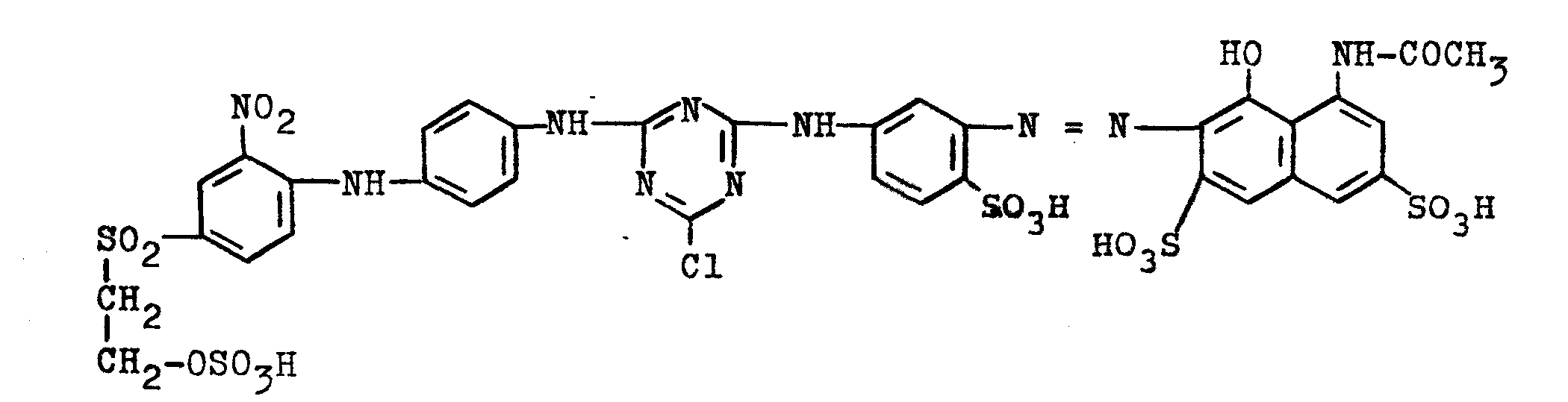
In den nachfolgenden Tabellenbeispielen sind weitere erfindungsgemäße Monoazoverbindungen entsprechend einer allgemeinen Formel (A)

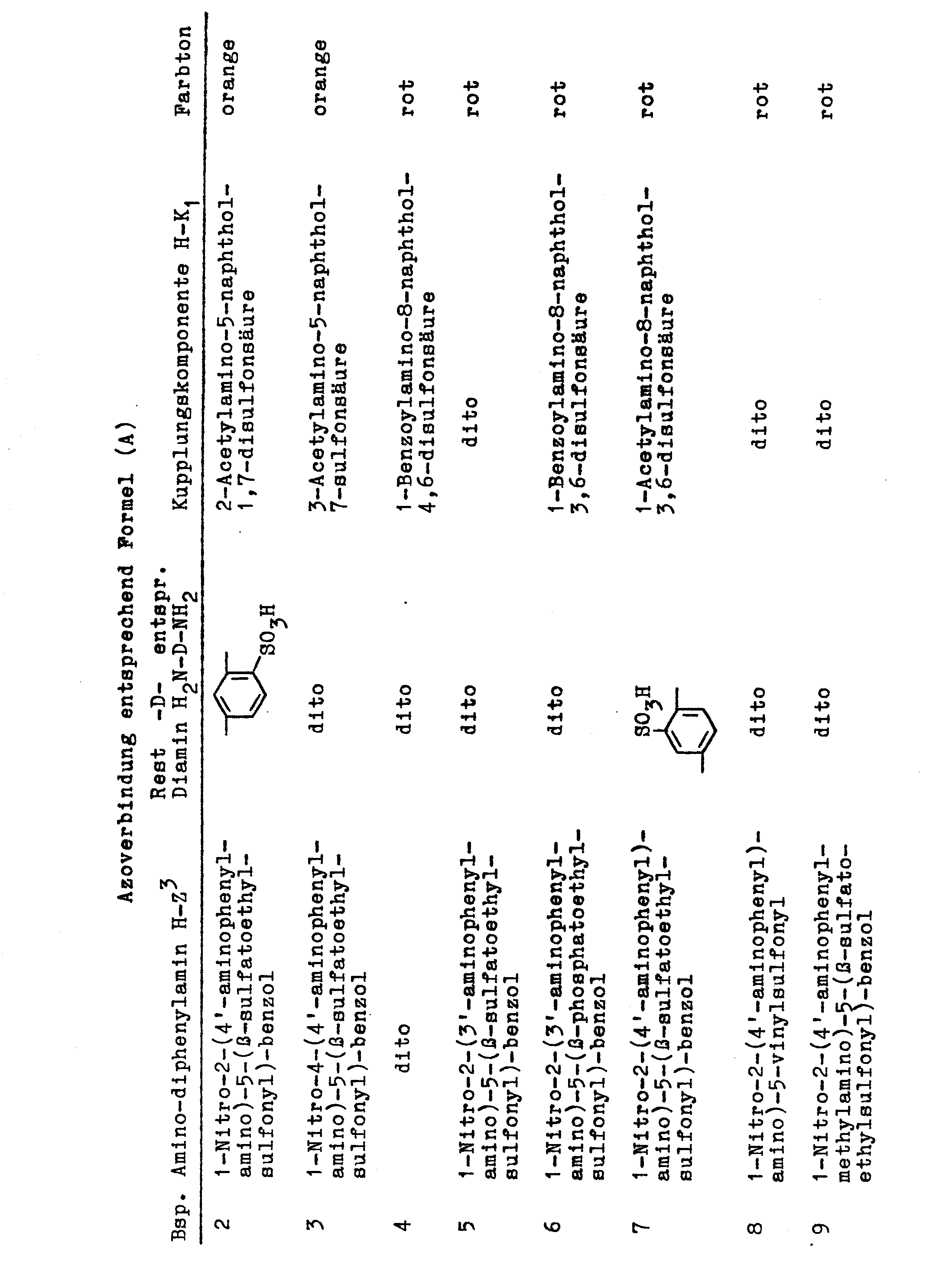


Die in Beispiel la) erhaltene Diazoniumsuspension wird in eine schwach saure Lösung von 22 Teilen 1-Naphthylamin-6-sulfonsäure in 100 Teilen Wasser gegeben. Der pH-Wert wird auf 5 gestellt, und die Kupplungsreaktion wird unter Einhaltung dieses pH-Wertes mittels wäßriger Natriumcarbonatlösung bei einer Temperatur von 5 bis 10°C zu Ende gefuhrt. Anschließend wird die Lösung mit 30 Teilen einer 31%igen wäßrigen Salzsäure sauer gestellt und die Diazotierungsreaktion in üblicher Weise mit einer wäßrigen 1n-Natriumnitritlösung durchgeführt.The diazonium suspension obtained in Example la) is placed in a weakly acidic solution of 22 parts of 1-naphthylamine-6-sulfonic acid in 100 parts of water. The pH is adjusted to 5, and the coupling reaction is completed while maintaining this pH using aqueous sodium carbonate solution at a temperature of 5 to 10 ° C. The solution is then acidified with 30 parts of a 31% aqueous hydrochloric acid and the diazotization reaction is carried out in the usual manner with an aqueous 1N sodium nitrite solution.
Die so erhaltene Diazoniumsalzsuspension wird in eine schwach saure Lösung von 40 Teilen 1-Acetylamino-8-naphthol-3,6-disulfonsäure in 100 Teilen Wasser gegeben. Der pH-Wert wird auf 6 gestellt und die Kupplungsreaktion unter Einhaltung des pH-Wertes mittels wäßriger Natriumcarbonatlösung bei einer Temperatur von 5 bis 10°C zu Ende geführt.The diazonium salt suspension thus obtained is placed in a weakly acidic solution of 40 parts of 1-acetylamino-8-naphthol-3,6-disulfonic acid in 100 parts of water. The pH is adjusted to 6 and the coupling reaction is completed at a temperature of 5 to 10 ° C. while maintaining the pH using aqueous sodium carbonate solution.
Die erfindungsgemäße Disazoverbindung wird in üblicher Weise isoliert. Es wird ein schwarzes elektrolythaltiges Pulver des Natriumsalzes der Verbindung der Formel
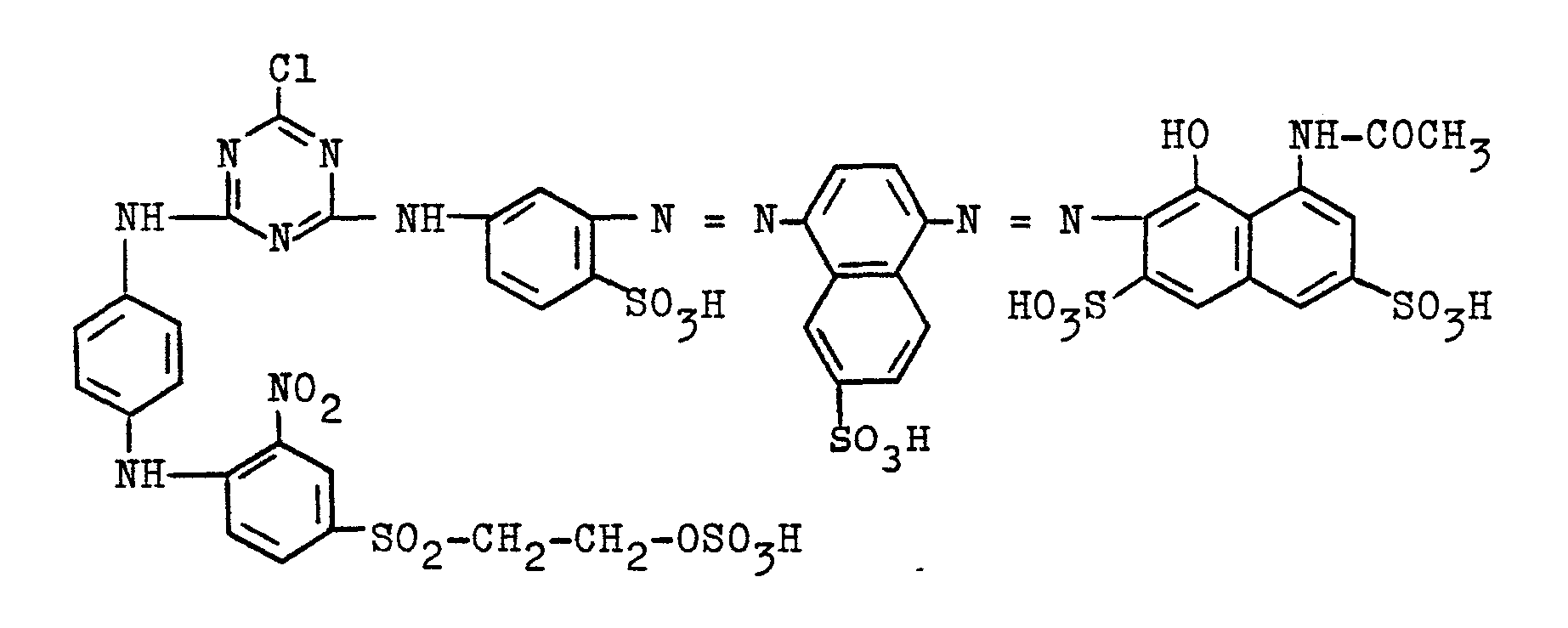
In den nachfolgenden Tabellenbeispielen sind weitere erfindungsgemäße Disazoverbindungen entsprechend einer allgemeinen Formel (B)



Zu 27,7 Teilen satzsauer diazotiertem 3-Acetylamino-6-sulfo-anilin werden bei 5°C eine Suspension von 36,1 Teilen 1-Acetylamino-8-naphthol-3,6-disulfonsäure in 100 Teilen Wasser gegeben. Die Kupplung erfolgt bei einem pH-Wert von 6. Nach beendeter Kupplung wird die Acetylaminogruppe der erhaltenen Azoverbindung bei einem pH-Wert von 14 (nach Zugabe von 60 Teilen einer 33%igen wäßrigen Natronlauge) bei einer Temperatur von 95°C innerhalb von 2 Stunden hydrolysiert. Anschlisßend kühlt man die Lösung auf 5°C ab und stellt mit 29 Teilen einer 98%igen Schwefelsäure einen pH-Wert von 4,5 ein. Sodann werden 37 Teile festes Cyanurchlorid langsam hinzugegeben; die Kondensationsreaktion führt man bei einem pH-Wert von 4,5 unter Einhaltung dieses pH-Wertes mittels verdünnter wäßriger Natriumhydrogencarbonatlösung durch. Nach beendeter Kondensationsreaktion gibt man zu diesem Ansatz eine Suspension von 84 Teilen 1-Nitro-2-(4'-aminophe- nylamino)-5-(ß-sulfatoethylsulfonyl)-benzol in 150 Teilen Wasser und stellt einen pH-Wert von 6,5 mittels einer verdünnten wäßrigen Natriumhydrogencarbonatlösung ein; unter allmählicher Erwärmung erhöht man die Reaktionstemperatur auf 45°C unter Einhaltung dieses pH-Wertes von 6,5 und führt auf diese Weise die zweite Kondensationsreaktion zu Ende.A suspension of 36.1 parts of 1-acetylamino-8-naphthol-3,6-disulfonic acid in 100 parts of water are added to 27.7 parts of diazotized 3-acetylamino-6-sulfo-aniline at 5 ° C. The coupling takes place at a pH of 6. After the coupling has ended, the acetylamino group of the azo compound obtained is at a pH of 14 (after addition of 60 parts of a 33% strength aqueous sodium hydroxide solution) at a temperature of 95 ° C. within 2 Hours hydrolyzed. The solution is then cooled to 5 ° C. and a pH of 4.5 is established using 29 parts of 98% sulfuric acid. Then 37 parts of solid cyanuric chloride are slowly added; the condensation reaction is carried out at a pH value of 4.5 while maintaining this pH value by means of dilute aqueous sodium hydrogen carbonate solution. After the condensation reaction has ended, a suspension of 84 parts of 1-nitro-2- (4'-aminophenylamino) -5- (β-sulfatoethylsulfonyl) benzene in 150 parts of water is added to this batch and the pH is brought to 6. 5 using a dilute aqueous sodium bicarbonate solution; with gradual heating, the reaction temperature is raised to 45 ° C. while maintaining this pH value of 6.5, and the second condensation reaction is brought to an end in this way.
Die erfindungsgemäße Disazoverbindung wird in üblicher Weise isoliert. Es wird ein dunkelrotes elektrolythaltiges Pulver des Natriumsalzes der Verbindung der Formel

In den nachfolgenden Tabellenbeispielen sind weitere erfindungsgemäße Azoverbindungen entsprechend einer allgemeinen Formel (C)


Claims (5)

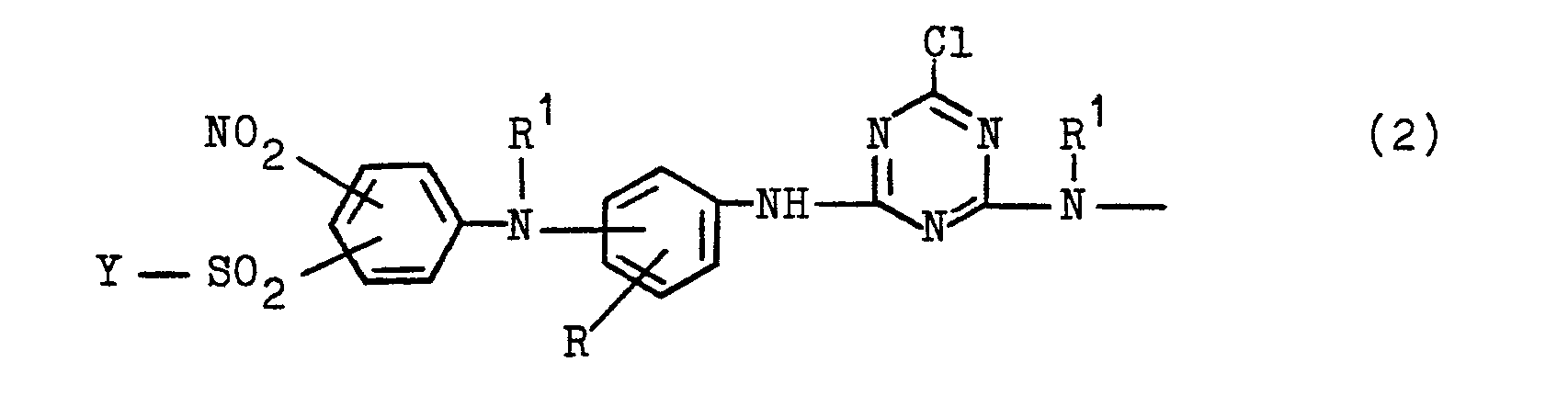

oder einen Naphthylenrest, bedeutet, der durch 1 oder 2 Sulfogruppen oder die angegebene Gruppe -SO2-Y oder durch 1 Sulfogruppe und die angegebene Gruppe -SO2-Y substituiert sein kann, wobei Y die obengenannte Bedeutung hat und beide Y zueinander gleiche oder voneinander verschiedene Bedeutungen haben,
or a naphthylene radical, which can be substituted by 1 or 2 sulfo groups or the specified group -SO 2 -Y or by 1 sulfo group and the specified group -SO 2 -Y, where Y has the abovementioned meaning and both Y are identical to one another or have different meanings from each other,


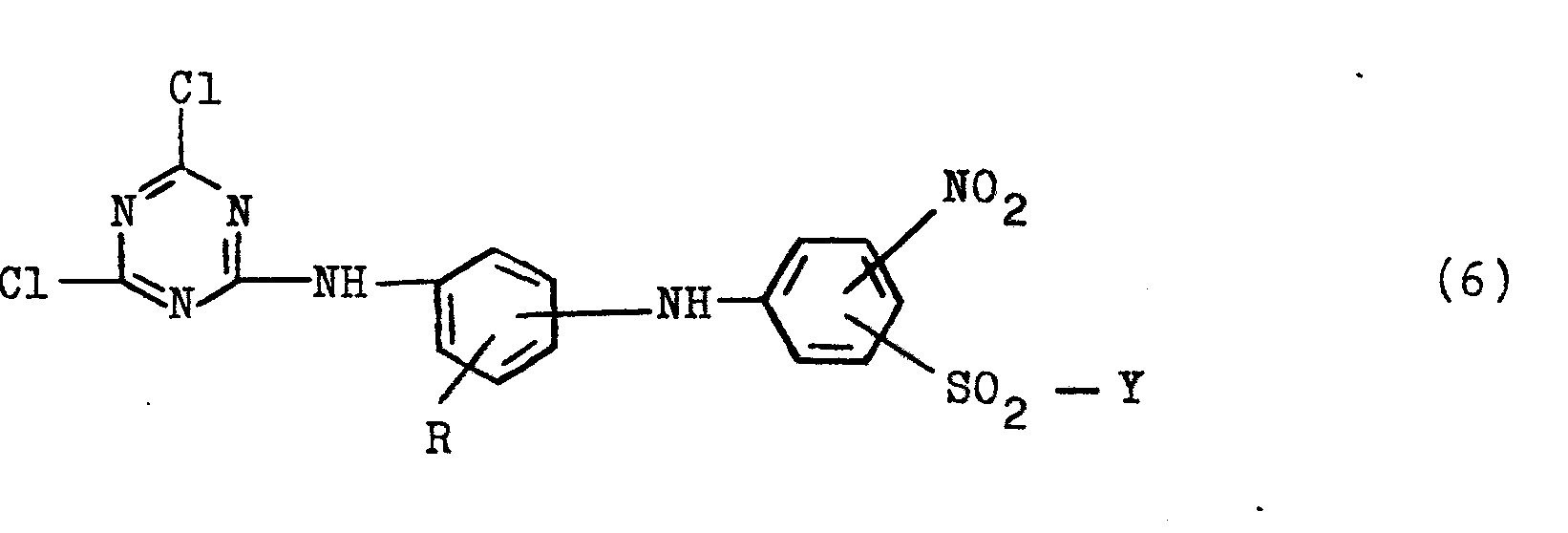
oder daß man eine Verbindung der allgemeinen Formel (7)


oder daß man eine Diazoniumverbindung eines Amins der allgemeinen Formel (9)

or that a compound of the general formula (7)
or that a diazonium compound of an amine of the general formula (9)
Applications Claiming Priority (2)
| Application Number | Priority Date | Filing Date | Title |
|---|---|---|---|
| DE19853517755 DE3517755A1 (en) | 1985-05-17 | 1985-05-17 | WATER-SOLUBLE MONO AND DISAZO COMPOUNDS, METHOD FOR THE PRODUCTION THEREOF AND THEIR USE AS DYES |
| DE3517755 | 1985-05-17 |
Publications (2)
| Publication Number | Publication Date |
|---|---|
| EP0210331A1 true EP0210331A1 (en) | 1987-02-04 |
| EP0210331B1 EP0210331B1 (en) | 1989-02-15 |
Family
ID=6270957
Family Applications (1)
| Application Number | Title | Priority Date | Filing Date |
|---|---|---|---|
| EP86104443A Expired EP0210331B1 (en) | 1985-05-17 | 1986-04-01 | Water soluble mono and disazo compounds, process for their preparation and their use as dyestuffs |
Country Status (7)
| Country | Link |
|---|---|
| US (1) | US4703111A (en) |
| EP (1) | EP0210331B1 (en) |
| JP (1) | JPS61266467A (en) |
| KR (1) | KR860009081A (en) |
| BR (1) | BR8601588A (en) |
| DE (2) | DE3517755A1 (en) |
| IN (1) | IN165204B (en) |
Families Citing this family (4)
| Publication number | Priority date | Publication date | Assignee | Title |
|---|---|---|---|---|
| JPH089693B2 (en) * | 1986-11-14 | 1996-01-31 | 住友化学工業株式会社 | Triazine compound and method for dyeing or printing fiber material using the same |
| DE3643014A1 (en) * | 1986-12-17 | 1988-06-30 | Hoechst Ag | WATER-SOLUBLE COLORED COMPOUNDS, METHOD FOR THE PRODUCTION THEREOF AND THEIR USE AS DYES |
| DE3800690A1 (en) * | 1988-01-13 | 1989-07-27 | Hoechst Ag | WATER-SOLUBLE 2-NAPHTHOL-AZO COMPOUNDS, METHOD FOR THE PRODUCTION THEREOF AND THEIR USE AS DYES |
| WO2002066730A1 (en) * | 2001-02-22 | 2002-08-29 | Toa Kasei Co., Ltd. | Method for dyeing cellulose fiber containing material and cellulose fiber containing article dyed by said dyeing method |
Citations (3)
| Publication number | Priority date | Publication date | Assignee | Title |
|---|---|---|---|---|
| DE1179317B (en) * | 1960-03-05 | 1964-10-08 | Hoechst Ag | Process for the preparation of water-soluble phthalocyanine dyes |
| GB1013442A (en) * | 1960-12-01 | 1965-12-15 | Hoechst Ag | Organic dyestuffs containing ethionylamino groups and process for their manufacture |
| EP0094020A1 (en) * | 1982-05-08 | 1983-11-16 | Hoechst Aktiengesellschaft | Water-soluble disazo compounds, process for their preparation and their use as dyestuffs |
Family Cites Families (2)
| Publication number | Priority date | Publication date | Assignee | Title |
|---|---|---|---|---|
| GB2055880B (en) * | 1979-06-27 | 1983-03-23 | Ciba Geigy Ag | Reactive dyes their preparation and use |
| DE3132917A1 (en) * | 1981-08-20 | 1983-03-03 | Hoechst Ag, 6000 Frankfurt | WATER-SOLUBLE MONOAZO-PYRAZOLONE COMPOUNDS, METHOD FOR THE PRODUCTION THEREOF AND THEIR USE AS DYES |
-
1985
- 1985-05-17 DE DE19853517755 patent/DE3517755A1/en not_active Withdrawn
-
1986
- 1986-04-01 DE DE8686104443T patent/DE3662107D1/en not_active Expired
- 1986-04-01 IN IN261/CAL/86A patent/IN165204B/en unknown
- 1986-04-01 EP EP86104443A patent/EP0210331B1/en not_active Expired
- 1986-04-07 US US06/849,066 patent/US4703111A/en not_active Expired - Fee Related
- 1986-04-09 BR BR8601588A patent/BR8601588A/en unknown
- 1986-04-15 KR KR1019860002878A patent/KR860009081A/en not_active Ceased
- 1986-05-15 JP JP61109729A patent/JPS61266467A/en active Pending
Patent Citations (3)
| Publication number | Priority date | Publication date | Assignee | Title |
|---|---|---|---|---|
| DE1179317B (en) * | 1960-03-05 | 1964-10-08 | Hoechst Ag | Process for the preparation of water-soluble phthalocyanine dyes |
| GB1013442A (en) * | 1960-12-01 | 1965-12-15 | Hoechst Ag | Organic dyestuffs containing ethionylamino groups and process for their manufacture |
| EP0094020A1 (en) * | 1982-05-08 | 1983-11-16 | Hoechst Aktiengesellschaft | Water-soluble disazo compounds, process for their preparation and their use as dyestuffs |
Also Published As
| Publication number | Publication date |
|---|---|
| DE3662107D1 (en) | 1989-03-23 |
| IN165204B (en) | 1989-08-26 |
| EP0210331B1 (en) | 1989-02-15 |
| US4703111A (en) | 1987-10-27 |
| KR860009081A (en) | 1986-12-20 |
| JPS61266467A (en) | 1986-11-26 |
| DE3517755A1 (en) | 1987-01-15 |
| BR8601588A (en) | 1986-12-09 |
Similar Documents
| Publication | Publication Date | Title |
|---|---|---|
| EP0040806B1 (en) | Water-soluble, coloured compounds, process for their preparation and their use as dyestuffs | |
| EP0094055B1 (en) | Monoazo compounds, process for their preparation and their use as dyestuffs | |
| EP0065732B1 (en) | Water soluble disazo compounds, process for their preparation and their use as dyestuffs | |
| EP0218131B1 (en) | Water soluble azo compounds, process for their preparation and their use as dyestuffs | |
| EP0169457B1 (en) | Water soluble pyridone-monoazo compounds, process for their preparation and their use as dyestuffs | |
| EP0112285B1 (en) | Reactive dyes, their preparation and their use | |
| EP0201868B1 (en) | Water soluble disazo compounds, process for their preparation and their use as dyestuffs | |
| EP0219080B1 (en) | Water soluble disazo compounds, process for their preparation and their use as dyestuffs | |
| EP0079563B1 (en) | Water soluble 1:2 metal complex azo compounds, process for their preparation and their use as dyestuffs | |
| EP0073406B1 (en) | Water-soluble monoazo pyrazolone compounds, process for their preparation and their use as dyestuffs | |
| EP0094020B1 (en) | Water-soluble disazo compounds, process for their preparation and their use as dyestuffs | |
| EP0210331B1 (en) | Water soluble mono and disazo compounds, process for their preparation and their use as dyestuffs | |
| EP0196536B1 (en) | Water soluble azo compounds, process for their preparation and their use as dyestuffs | |
| EP0078009B1 (en) | Water-soluble pyridone azo compounds; process for their preparation and their use as dyestuffs | |
| EP0197366B1 (en) | Water soluble mono and disazo compounds, process for their preparation and their use as dyestuffs | |
| EP0279351B1 (en) | Water soluble azo compounds, process for their preparation and their use as dyestuffs | |
| EP0071985B1 (en) | Water-soluble mono-azo compounds, process for their preparation and their use as dyestuffs | |
| EP0072557B1 (en) | Water-soluble azo compounds, process for their preparation and their use as dyestuffs | |
| DE60124018T2 (en) | BLACK COLOR MIXTURES OF FIBROUS REACTIVE AZOFIN MATERIALS, A METHOD OF PREPARING THEM AND THE USE THEREOF FOR DYING HYDROXY AND / OR CARBOXAMIDOGROUPPED FASER MATERIAL | |
| EP0078024B1 (en) | Water-soluble pyridone azo compounds, process for their preparation and their use as dyestuffs | |
| EP0103156B1 (en) | Copper complex of water soluble disazo compounds, process for their preparation and their use as dyestuffs | |
| EP0069376A2 (en) | Copper complexes of monoazo compounds, process for their preparation and their use as dyestuffs | |
| DE3204259A1 (en) | Water-soluble coloured compounds having fibre-reactive properties, process for their preparation and their use as dyes | |
| CH626649A5 (en) | Process for preparing fibre-reactive azo dyes | |
| WO1990015107A1 (en) | Water soluble, fibre-reactive dyes, process for manufacturing them and their use |
Legal Events
| Date | Code | Title | Description |
|---|---|---|---|
| PUAI | Public reference made under article 153(3) epc to a published international application that has entered the european phase |
Free format text: ORIGINAL CODE: 0009012 |
|
| AK | Designated contracting states |
Kind code of ref document: A1 Designated state(s): CH DE FR GB IT LI |
|
| 17P | Request for examination filed |
Effective date: 19870317 |
|
| 17Q | First examination report despatched |
Effective date: 19871222 |
|
| GRAA | (expected) grant |
Free format text: ORIGINAL CODE: 0009210 |
|
| AK | Designated contracting states |
Kind code of ref document: B1 Designated state(s): CH DE FR GB IT LI |
|
| ITF | It: translation for a ep patent filed | ||
| REF | Corresponds to: |
Ref document number: 3662107 Country of ref document: DE Date of ref document: 19890323 |
|
| GBT | Gb: translation of ep patent filed (gb section 77(6)(a)/1977) | ||
| ET | Fr: translation filed | ||
| PLBE | No opposition filed within time limit |
Free format text: ORIGINAL CODE: 0009261 |
|
| STAA | Information on the status of an ep patent application or granted ep patent |
Free format text: STATUS: NO OPPOSITION FILED WITHIN TIME LIMIT |
|
| 26N | No opposition filed | ||
| ITTA | It: last paid annual fee | ||
| PGFP | Annual fee paid to national office [announced via postgrant information from national office to epo] |
Ref country code: DE Payment date: 19920611 Year of fee payment: 7 |
|
| PGFP | Annual fee paid to national office [announced via postgrant information from national office to epo] |
Ref country code: FR Payment date: 19930315 Year of fee payment: 8 |
|
| PGFP | Annual fee paid to national office [announced via postgrant information from national office to epo] |
Ref country code: CH Payment date: 19930317 Year of fee payment: 8 |
|
| PGFP | Annual fee paid to national office [announced via postgrant information from national office to epo] |
Ref country code: GB Payment date: 19930319 Year of fee payment: 8 |
|
| PG25 | Lapsed in a contracting state [announced via postgrant information from national office to epo] |
Ref country code: DE Effective date: 19940101 |
|
| PG25 | Lapsed in a contracting state [announced via postgrant information from national office to epo] |
Ref country code: GB Effective date: 19940401 |
|
| PG25 | Lapsed in a contracting state [announced via postgrant information from national office to epo] |
Ref country code: LI Effective date: 19940430 Ref country code: CH Effective date: 19940430 |
|
| GBPC | Gb: european patent ceased through non-payment of renewal fee |
Effective date: 19940401 |
|
| PG25 | Lapsed in a contracting state [announced via postgrant information from national office to epo] |
Ref country code: FR Effective date: 19941229 |
|
| REG | Reference to a national code |
Ref country code: CH Ref legal event code: PL |
|
| REG | Reference to a national code |
Ref country code: FR Ref legal event code: ST |
|
| PG25 | Lapsed in a contracting state [announced via postgrant information from national office to epo] |
Ref country code: IT Free format text: LAPSE BECAUSE OF NON-PAYMENT OF DUE FEES;WARNING: LAPSES OF ITALIAN PATENTS WITH EFFECTIVE DATE BEFORE 2007 MAY HAVE OCCURRED AT ANY TIME BEFORE 2007. THE CORRECT EFFECTIVE DATE MAY BE DIFFERENT FROM THE ONE RECORDED. Effective date: 20050401 |