EP0210543A2 - Radardrehkopplung - Google Patents
Radardrehkopplung Download PDFInfo
- Publication number
- EP0210543A2 EP0210543A2 EP86109759A EP86109759A EP0210543A2 EP 0210543 A2 EP0210543 A2 EP 0210543A2 EP 86109759 A EP86109759 A EP 86109759A EP 86109759 A EP86109759 A EP 86109759A EP 0210543 A2 EP0210543 A2 EP 0210543A2
- Authority
- EP
- European Patent Office
- Prior art keywords
- circular
- mode
- waveguide
- circular waveguide
- rotary joint
- Prior art date
- Legal status (The legal status is an assumption and is not a legal conclusion. Google has not performed a legal analysis and makes no representation as to the accuracy of the status listed.)
- Granted
Links
Images


Classifications
-
- H—ELECTRICITY
- H01—ELECTRIC ELEMENTS
- H01P—WAVEGUIDES; RESONATORS, LINES, OR OTHER DEVICES OF THE WAVEGUIDE TYPE
- H01P1/00—Auxiliary devices
- H01P1/06—Movable joints, e.g. rotating joints
- H01P1/062—Movable joints, e.g. rotating joints the relative movement being a rotation
- H01P1/066—Movable joints, e.g. rotating joints the relative movement being a rotation with an unlimited angle of rotation
- H01P1/067—Movable joints, e.g. rotating joints the relative movement being a rotation with an unlimited angle of rotation the energy being transmitted in only one line located on the axis of rotation
Definitions
- This invention relates to radars and more particularly to a rotary joint applicable for all frequencies and to millimeter wavelengths, in particuiar.
- Rotary joints provide a continuous microwave transmission path between rotating and stationary sections of a mechanically scanned antenna system. They must operate over the scan range of the radar system with minimum distortion of the microwave signal. To do this, the voltage standing wave ratio (VSWR) (reflection) and insertion loss of a rotary joint needs to be minimized and have minimal variation with rotation over the desired frequency band.
- VSWR voltage standing wave ratio
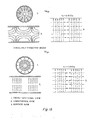
- Microwave energy propagates in waveguide only in particular modes (Fig. 1).
- rectangular waveguide used for transmission paths in most radar systems, the energy propagates in the dominant TE 10 (transverse electric wave).
- this energy must first be converted to a circularly symmetric mode and waveguide (circular tube or coaxial line).
- a circularly symmetric mode implies that the orientation of the E (electric) and H (magnetic) field patterns in the waveguide make the modes independent of rotation.
- a break between rotating and stationary parts of the rotary joint can be made with a small gap RF choke providing electrical continuity at the break.
- a conversion back to the TE 10 mode in rectangular waveguide is needed.
- Those persons skilled in the art desiring more information about a rotary joint with a small gap RF choke are referred to "Radiation Laboratory Series #9 - Microwave Transmission Circuits", George L. Ragan, pp. 193-199.
- rotary Joints have used a right angle transition from the TE 10 mode in rectangular waveguide to the TM 01 mode in circular waveguide.
- a circular hole has been cut in the broad wall of the rectangular waveguide the same diameter as the desired circular waveguide and the two waveguides are attached.
- the size of the circular waveguide is chosen to propagate the TM mode at the design frequency but small enough to 01 be in the non-prooagating region of any higher order modes.
- Shorting stubs are inserted in the open ends of the rectangular waveguides.
- millimeter wave rotary joint The same fabrication techniques and design principles used at lower frequencies can not be used to build an inexpensive millimeter wave rotary joint. Most millimeter wave components are made out of expensive coin-silver or plated materials which are necessary to keep losses low at these high frequencies. Intricate components can be made using electro-forming, casting, or other similar techniques, but all are expensive processes and some final machining operations would still be necessary for rotary joint parts.
- Another object of the invention is to provide a rotary joint which is capable of operation at substantially all microwave frequencies.
- a further object of the invention is to provide a compact, easy to manufacture rotary joint having low production costs.
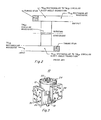
- the rotary joint of this invention includes converting the TE mode in rectangular waveguide to the TE mode in a stationary circular waveguide, converting the TE mode to the TM mode in a 11 01 rotating circular waveguide and converting the TM back to the TE 10 mode in a rectangular waveguide.
- Figures la and 1b show the rectangular and circular waveguide modes (TE 10 , TE 11 and TM ) used in rotary joints. These modes are those referred to throughout the Following description.
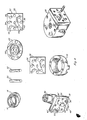
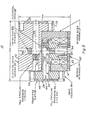
- the rotary joint 10 (Fig. 3) comprises an outer bearing housing 12 in which is mounted ball bearing races 14 and 16 (Fig. 4).
- An inner housing 18 (Fig.s 3 & 4) has an inner bearing housing portion 20 (Fig. 4) which coacts with the outer bearing housing and bearing retaining member 22 attached to the outer end of the inner bearing housing and bearing retaining member 24 attached to the outer end of outer bearing housing 12 to retain the bearing races 14 and 16 between the outer bearing housing 12 and inner housing portion 20 of inner housing 18.
- An electrical outer housing 26 is rigidly attached to the bearing outer housing 12.
- Transition irises 28 and 30 (Fig.s 3 & 4) are connected, respectively, to outer ends of the inner housing 18 and outer housing 26 to complete the rotary joint.
- the outer ends of the inner and outer housings and transition irises are configured to match rectangular waveguide sections.
- the transition irises 28 and 30 are identical in construction; therefore, only one need be described.
- the transition irises include a 0.700 inch square aluminum plate 32 having a 0.038 inch thickness, four 0.116 inch diameter holes 34 and four 0.067 inch diameter holes 36, 38, 40 and 42 for accommodating mechanical connector means hereinafter described.
- the iris 44 consists of an 0.082 inch diameter center hole and two 0.052 inch diameter holes having centers positioned 0.031 inches horizontally left and right of the center point of the center hole to form the iris shaped as shown in Figure 4.
- the inner housing 18, which is preferably an aluminum housing, (Fig. 4) has a square flange block 46 which corresponds to the transition iris 28 in that it has four 0.116 inch diameter holes 48 which are threaded to receive rectangular waveguide connecting bolts and four 0.067 inch holes 36'. 38', 40' and 42'. Holes 38' and 42' contain connecting dowels 50 and 52 and holes 36' and 40' are adapted to receive corresponding dowels of the rectangular waveguide (not shown).
- a 0.116 inch diameter center hole 54 forms the entrance to TE circular 11 waveguide section 56.
- the circular waveguide section 56 (Fig. 5) includes a tubular portion 58 forming a 0.116 inch diameter horizontally disposed passage 60 and a tubular portion 62 forming a corresponding vertically (90 degrees) disposed circular passage 64.
- the passages 60 and 64 intersect.
- Circular tuning stubs 66 and 68 having flat ends are provided adjacent the intersection of the passages 60 and 64 and are properly adjusted for RF tuning.
- the outer surface tubular portion 62 is recessed to form a seat for the roller bearing races 14 and 16 (Fig. 4).
- the electrical outer housing 26 (Fig.s 4 & 5) is preferably an aluminum, truncated circular block 70.
- the flat or truncated surface is integral with a square transition iris supporting block 72.
- Block 72 has a portion depending from the circular block 70.
- Block 70 has a horizontal 0.116 inch diameter circular passage 74 intersecting at right angles a vertical 0.116 inch diameter circular passage 76.
- Circular, flat ended tuning stubs 78 and 80 are selectively positioned, respectively, in passages 74 and 76 adjacent to the intersection for RF tuning of the energy passing through in the TM mode.
- Passage 76 terminates in a choke 82 01 formed in block 70 in a position corresponding to the end of passage 64 of the inner housing 18.
- Passage 74 terminates at the iris of transition iris 30.
- the dominant TE 11 mode in circular waveguide is analogous to the TE mode in rectangular waveguide and 10 that a right angle transition between two circular waveguides would convert the TE mode into the TM 01 mode.
- An abrupt junction has about a 2:1 VSWR, although the TE mode is excited.
- To improve the VSWR a quarter wavelength thick matching iris is provided at both ends of the rotary joint for efficient modal transitions.
- the iris is an improvement over known irises as it combines small size with the easy to build features necessary at millimeter wavelengths.
- the first circular waveguide is inline with the rectangular waveguide and converts the TE 10 mode in the rectangular waveguide to the TE mode in the first circular waveguide.
- the right angle transition to the second circular waveguide converts the TE mode of the 11 first circular waveguide to the TM mode in the second 01 circular waveguide, and the second iris converts the TE mode to the TE 10 mode for the rectangular waveguide.
- the duplex bearing pair is mounted outside the rotary joint. This physically limits the rotary joint to a scan angle of 140 degrees.
- the RF choke between rotating and stationary parts is a groove shaped and dimensioned as to impede the passage of guided waves with the 94 GHz range.
- the tuning stubs are flattened circular plugs with radial chokes to minimize contact loss and RF leakage.
- the insertion loss of the rotary joint is very sensitive to the tuning stub positions, and the best case VSWR positions do not coincide exactly with the positions for minimum insertion loss.
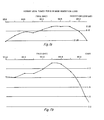
- the VSWR was tuned to less than 1.2 over a 2 GHz bandwidth (2%) (Fig.s 6a and 6b). At this VSWR the insertion loss was not minimal.
- the tuning stubs were moved slightly to get minimum insertion loss with some degradation in VSWR.
- the rotary joint is constructed of aluminum with an interior coating of a chromate conversion coating (such as Allodine 1500 sold by Amchem Products Incorporated) rather than coin-silver waveguide because the difference in insertion loss is minimal. Operation over a 1.5% bandwidth should be achievable with less than 0.5 dB insertion loss across the band.
- a chromate conversion coating such as Allodine 1500 sold by Amchem Products Incorporated
- the tuning stubs can be threaded to enable tuning with a screwdriver.
Landscapes
- Waveguide Connection Structure (AREA)
- Control Of Motors That Do Not Use Commutators (AREA)
- Waveguide Aerials (AREA)
Applications Claiming Priority (2)
| Application Number | Priority Date | Filing Date | Title |
|---|---|---|---|
| US06/761,718 US4654613A (en) | 1985-08-02 | 1985-08-02 | Radar rotary joint |
| US761718 | 2004-01-20 |
Publications (3)
| Publication Number | Publication Date |
|---|---|
| EP0210543A2 true EP0210543A2 (de) | 1987-02-04 |
| EP0210543A3 EP0210543A3 (en) | 1988-08-17 |
| EP0210543B1 EP0210543B1 (de) | 1994-03-02 |
Family
ID=25063066
Family Applications (1)
| Application Number | Title | Priority Date | Filing Date |
|---|---|---|---|
| EP86109759A Expired - Lifetime EP0210543B1 (de) | 1985-08-02 | 1986-07-16 | Radardrehkopplung |
Country Status (3)
| Country | Link |
|---|---|
| US (1) | US4654613A (de) |
| EP (1) | EP0210543B1 (de) |
| DE (2) | DE3689676T2 (de) |
Families Citing this family (7)
| Publication number | Priority date | Publication date | Assignee | Title |
|---|---|---|---|---|
| GB8812091D0 (en) * | 1988-05-21 | 1988-06-22 | Gen Electric Co Plc | Waveguide apparatus |
| US6927654B2 (en) * | 2003-02-26 | 2005-08-09 | Raytheon Company | Corrosion resistant waveguide system and method |
| KR100597207B1 (ko) * | 2004-04-20 | 2006-07-06 | 주식회사 액티패스 | 원형 도파관 변환기를 이용한 도파관 회전 연결체의 구조 |
| US7446623B2 (en) * | 2005-07-14 | 2008-11-04 | X-Ether, Inc. | Mode transducer structure |
| JP5446552B2 (ja) * | 2009-07-30 | 2014-03-19 | ソニー株式会社 | 無線通信装置、回転構造体、電子機器 |
| IT1401404B1 (it) | 2010-08-03 | 2013-07-26 | G E M Elettronica S R L | Giunto rotante di potenza a microonde funzionante su due bande distinte. |
| EP2796902B1 (de) * | 2013-04-23 | 2017-06-14 | Spinner GmbH | Millimeterwellen-Scan-Bildgebungssystem |
Family Cites Families (7)
| Publication number | Priority date | Publication date | Assignee | Title |
|---|---|---|---|---|
| GB582088A (en) * | 1942-08-14 | 1946-11-05 | Edward Cecil Cork | Improvements in or relating to electromagnetic wave guides |
| US2632806A (en) * | 1945-09-18 | 1953-03-24 | William M Preston | Mode filter |
| US2709242A (en) * | 1950-04-25 | 1955-05-24 | Raytheon Mfg Co | Wave guide structures |
| FR1142076A (fr) * | 1956-02-01 | 1957-09-13 | Comp Generale Electricite | Perfectionnement aux dispositifs de franchissement des coudes par les ondes électromagnétiques du type te circulaire |
| DE1071168B (de) * | 1957-08-29 | |||
| GB1080596A (en) * | 1963-08-23 | 1967-08-23 | Ass Elect Ind | Improvements relating to waveguide couplers |
| US3715688A (en) * | 1970-09-04 | 1973-02-06 | Rca Corp | Tm01 mode exciter and a multimode exciter using same |
-
1985
- 1985-08-02 US US06/761,718 patent/US4654613A/en not_active Expired - Lifetime
-
1986
- 1986-07-16 DE DE3689676T patent/DE3689676T2/de not_active Expired - Fee Related
- 1986-07-16 EP EP86109759A patent/EP0210543B1/de not_active Expired - Lifetime
- 1986-07-16 DE DE198686109759T patent/DE210543T1/de active Pending
Also Published As
| Publication number | Publication date |
|---|---|
| US4654613A (en) | 1987-03-31 |
| DE3689676D1 (de) | 1994-04-07 |
| DE210543T1 (de) | 1987-06-11 |
| EP0210543B1 (de) | 1994-03-02 |
| EP0210543A3 (en) | 1988-08-17 |
| DE3689676T2 (de) | 1994-07-14 |
Similar Documents
| Publication | Publication Date | Title |
|---|---|---|
| US9960495B1 (en) | Integrated single-piece antenna feed and circular polarizer | |
| US5517203A (en) | Dielectric resonator filter with coupling ring and antenna system formed therefrom | |
| US8013687B2 (en) | Ortho-mode transducer with TEM probe for coaxial waveguide | |
| US4491810A (en) | Multi-port, multi-frequency microwave combiner with overmoded square waveguide section | |
| EP1014470B1 (de) | Übergang zwischen einem dielektrischen Wellenleiter und einem Hohlleiter, sowie Oszillator und Sender unter Verwendung dieses Überganges | |
| US6639566B2 (en) | Dual-polarized shaped-reflector antenna | |
| US7064726B2 (en) | Antenna device and transmitting/receiving device | |
| US4301347A (en) | Feed system for microwave oven | |
| US5083102A (en) | Dual mode dielectric resonator filters without iris | |
| US7821356B2 (en) | Ortho-mode transducer for coaxial waveguide | |
| JPH0677723A (ja) | 連続横断スタブ素子装置およびその製造方法 | |
| EP0657954B1 (de) | Verbessertes dielektrisches Filter mit mehreren Resonatoren | |
| US4868575A (en) | Phase slope equalizer for satellite antennas | |
| US4199764A (en) | Dual band combiner for horn antenna | |
| EP1732158A1 (de) | Mikrowellenfilter mit einem stirnwandgekoppelten Koaxialresonator | |
| US4298850A (en) | Double ridge waveguide rotary joint | |
| JP3303757B2 (ja) | 非放射性誘電体線路部品およびその集積回路 | |
| US4654613A (en) | Radar rotary joint | |
| JP3279242B2 (ja) | 異種非放射性誘電体線路変換部構造およびその装置 | |
| US4754241A (en) | 3dB directional coupler | |
| JP3498611B2 (ja) | 方向性結合器、アンテナ装置および送受信装置 | |
| US4039975A (en) | E plane folded hybrid with coaxial difference port | |
| US12341250B1 (en) | Offset-fed reflector parallel plate antenna apparatus | |
| KR102692966B1 (ko) | 대각 아이리스(Iris) 결합을 이용한 기판 집적형 도파관(SIW, Substrate Integrated Waveguide)형 합차 모드 비교기 및 유전체 공진기 안테나 | |
| US5463358A (en) | Multiple channel microwave rotary polarizer |
Legal Events
| Date | Code | Title | Description |
|---|---|---|---|
| PUAI | Public reference made under article 153(3) epc to a published international application that has entered the european phase |
Free format text: ORIGINAL CODE: 0009012 |
|
| AK | Designated contracting states |
Kind code of ref document: A2 Designated state(s): DE GB IT SE |
|
| ITCL | It: translation for ep claims filed |
Representative=s name: BARZANO' E ZANARDO ROMA S.P.A. |
|
| DET | De: translation of patent claims | ||
| PUAL | Search report despatched |
Free format text: ORIGINAL CODE: 0009013 |
|
| AK | Designated contracting states |
Kind code of ref document: A3 Designated state(s): DE GB IT SE |
|
| 17P | Request for examination filed |
Effective date: 19890126 |
|
| 17Q | First examination report despatched |
Effective date: 19911108 |
|
| GRAA | (expected) grant |
Free format text: ORIGINAL CODE: 0009210 |
|
| ITF | It: translation for a ep patent filed | ||
| AK | Designated contracting states |
Kind code of ref document: B1 Designated state(s): DE GB IT SE |
|
| REF | Corresponds to: |
Ref document number: 3689676 Country of ref document: DE Date of ref document: 19940407 |
|
| ITTA | It: last paid annual fee | ||
| PLBE | No opposition filed within time limit |
Free format text: ORIGINAL CODE: 0009261 |
|
| STAA | Information on the status of an ep patent application or granted ep patent |
Free format text: STATUS: NO OPPOSITION FILED WITHIN TIME LIMIT |
|
| EAL | Se: european patent in force in sweden |
Ref document number: 86109759.0 |
|
| 26N | No opposition filed | ||
| REG | Reference to a national code |
Ref country code: GB Ref legal event code: 732E |
|
| REG | Reference to a national code |
Ref country code: GB Ref legal event code: 732E |
|
| PGFP | Annual fee paid to national office [announced via postgrant information from national office to epo] |
Ref country code: GB Payment date: 19990722 Year of fee payment: 14 |
|
| PGFP | Annual fee paid to national office [announced via postgrant information from national office to epo] |
Ref country code: SE Payment date: 19990726 Year of fee payment: 14 |
|
| PGFP | Annual fee paid to national office [announced via postgrant information from national office to epo] |
Ref country code: DE Payment date: 19990928 Year of fee payment: 14 |
|
| PG25 | Lapsed in a contracting state [announced via postgrant information from national office to epo] |
Ref country code: GB Free format text: LAPSE BECAUSE OF NON-PAYMENT OF DUE FEES Effective date: 20000716 |
|
| PG25 | Lapsed in a contracting state [announced via postgrant information from national office to epo] |
Ref country code: SE Free format text: LAPSE BECAUSE OF NON-PAYMENT OF DUE FEES Effective date: 20000717 |
|
| GBPC | Gb: european patent ceased through non-payment of renewal fee |
Effective date: 20000716 |
|
| EUG | Se: european patent has lapsed |
Ref document number: 86109759.0 |
|
| PG25 | Lapsed in a contracting state [announced via postgrant information from national office to epo] |
Ref country code: DE Free format text: LAPSE BECAUSE OF NON-PAYMENT OF DUE FEES Effective date: 20010501 |
|
| PG25 | Lapsed in a contracting state [announced via postgrant information from national office to epo] |
Ref country code: IT Free format text: LAPSE BECAUSE OF NON-PAYMENT OF DUE FEES;WARNING: LAPSES OF ITALIAN PATENTS WITH EFFECTIVE DATE BEFORE 2007 MAY HAVE OCCURRED AT ANY TIME BEFORE 2007. THE CORRECT EFFECTIVE DATE MAY BE DIFFERENT FROM THE ONE RECORDED. Effective date: 20050716 |