EP0210851A2 - Mischungen aus Polyamidimiden, die 3,4'-Diaminodiphenylether als Diaminkomponente enthalten, und einem Weichmacher. - Google Patents
Mischungen aus Polyamidimiden, die 3,4'-Diaminodiphenylether als Diaminkomponente enthalten, und einem Weichmacher. Download PDFInfo
- Publication number
- EP0210851A2 EP0210851A2 EP86305754A EP86305754A EP0210851A2 EP 0210851 A2 EP0210851 A2 EP 0210851A2 EP 86305754 A EP86305754 A EP 86305754A EP 86305754 A EP86305754 A EP 86305754A EP 0210851 A2 EP0210851 A2 EP 0210851A2
- Authority
- EP
- European Patent Office
- Prior art keywords
- formula
- unit
- polyimide
- polyamideimide
- proportion
- Prior art date
- Legal status (The legal status is an assumption and is not a legal conclusion. Google has not performed a legal analysis and makes no representation as to the accuracy of the status listed.)
- Granted
Links
- 0 CC(C1)=*[Cn]c2c1ccc([Cn]c1ccc(CN(*3)c4cc(C(c5cc(C)ccc5)=O)ccc4)c3c1)c2 Chemical compound CC(C1)=*[Cn]c2c1ccc([Cn]c1ccc(CN(*3)c4cc(C(c5cc(C)ccc5)=O)ccc4)c3c1)c2 0.000 description 4
- FSTHTYPQTZNBPR-UHFFFAOYSA-N CN(C1)Cc2c1ccc(C(c1cc(CN(C)C3O)c3cc1)=C)c2 Chemical compound CN(C1)Cc2c1ccc(C(c1cc(CN(C)C3O)c3cc1)=C)c2 FSTHTYPQTZNBPR-UHFFFAOYSA-N 0.000 description 1
Images


Classifications
-
- C—CHEMISTRY; METALLURGY
- C08—ORGANIC MACROMOLECULAR COMPOUNDS; THEIR PREPARATION OR CHEMICAL WORKING-UP; COMPOSITIONS BASED THEREON
- C08L—COMPOSITIONS OF MACROMOLECULAR COMPOUNDS
- C08L79/00—Compositions of macromolecular compounds obtained by reactions forming in the main chain of the macromolecule a linkage containing nitrogen with or without oxygen or carbon only, not provided for in groups C08L61/00 - C08L77/00
- C08L79/04—Polycondensates having nitrogen-containing heterocyclic rings in the main chain; Polyhydrazides; Polyamide acids or similar polyimide precursors
- C08L79/08—Polyimides; Polyester-imides; Polyamide-imides; Polyamide acids or similar polyimide precursors
-
- C—CHEMISTRY; METALLURGY
- C08—ORGANIC MACROMOLECULAR COMPOUNDS; THEIR PREPARATION OR CHEMICAL WORKING-UP; COMPOSITIONS BASED THEREON
- C08G—MACROMOLECULAR COMPOUNDS OBTAINED OTHERWISE THAN BY REACTIONS ONLY INVOLVING UNSATURATED CARBON-TO-CARBON BONDS
- C08G73/00—Macromolecular compounds obtained by reactions forming a linkage containing nitrogen with or without oxygen or carbon in the main chain of the macromolecule, not provided for in groups C08G12/00 - C08G71/00
- C08G73/06—Polycondensates having nitrogen-containing heterocyclic rings in the main chain of the macromolecule
- C08G73/10—Polyimides; Polyester-imides; Polyamide-imides; Polyamide acids or similar polyimide precursors
- C08G73/1046—Polyimides containing oxygen in the form of ether bonds in the main chain
- C08G73/105—Polyimides containing oxygen in the form of ether bonds in the main chain with oxygen only in the diamino moiety
-
- C—CHEMISTRY; METALLURGY
- C08—ORGANIC MACROMOLECULAR COMPOUNDS; THEIR PREPARATION OR CHEMICAL WORKING-UP; COMPOSITIONS BASED THEREON
- C08G—MACROMOLECULAR COMPOUNDS OBTAINED OTHERWISE THAN BY REACTIONS ONLY INVOLVING UNSATURATED CARBON-TO-CARBON BONDS
- C08G73/00—Macromolecular compounds obtained by reactions forming a linkage containing nitrogen with or without oxygen or carbon in the main chain of the macromolecule, not provided for in groups C08G12/00 - C08G71/00
- C08G73/06—Polycondensates having nitrogen-containing heterocyclic rings in the main chain of the macromolecule
- C08G73/10—Polyimides; Polyester-imides; Polyamide-imides; Polyamide acids or similar polyimide precursors
- C08G73/1067—Wholly aromatic polyimides, i.e. having both tetracarboxylic and diamino moieties aromatically bound
- C08G73/1071—Wholly aromatic polyimides containing oxygen in the form of ether bonds in the main chain
-
- C—CHEMISTRY; METALLURGY
- C08—ORGANIC MACROMOLECULAR COMPOUNDS; THEIR PREPARATION OR CHEMICAL WORKING-UP; COMPOSITIONS BASED THEREON
- C08G—MACROMOLECULAR COMPOUNDS OBTAINED OTHERWISE THAN BY REACTIONS ONLY INVOLVING UNSATURATED CARBON-TO-CARBON BONDS
- C08G73/00—Macromolecular compounds obtained by reactions forming a linkage containing nitrogen with or without oxygen or carbon in the main chain of the macromolecule, not provided for in groups C08G12/00 - C08G71/00
- C08G73/06—Polycondensates having nitrogen-containing heterocyclic rings in the main chain of the macromolecule
- C08G73/10—Polyimides; Polyester-imides; Polyamide-imides; Polyamide acids or similar polyimide precursors
- C08G73/14—Polyamide-imides
-
- H—ELECTRICITY
- H05—ELECTRIC TECHNIQUES NOT OTHERWISE PROVIDED FOR
- H05K—PRINTED CIRCUITS; CASINGS OR CONSTRUCTIONAL DETAILS OF ELECTRIC APPARATUS; MANUFACTURE OF ASSEMBLAGES OF ELECTRICAL COMPONENTS
- H05K1/00—Printed circuits
- H05K1/02—Details
- H05K1/03—Use of materials for the substrate
- H05K1/0313—Organic insulating material
- H05K1/032—Organic insulating material consisting of one material
- H05K1/0346—Organic insulating material consisting of one material containing N
-
- H—ELECTRICITY
- H05—ELECTRIC TECHNIQUES NOT OTHERWISE PROVIDED FOR
- H05K—PRINTED CIRCUITS; CASINGS OR CONSTRUCTIONAL DETAILS OF ELECTRIC APPARATUS; MANUFACTURE OF ASSEMBLAGES OF ELECTRICAL COMPONENTS
- H05K3/00—Apparatus or processes for manufacturing printed circuits
- H05K3/38—Improvement of the adhesion between the insulating substrate and the metal
- H05K3/386—Improvement of the adhesion between the insulating substrate and the metal by the use of an organic polymeric bonding layer, e.g. adhesive
Definitions
- This invention relates to polyimides and polyamideimides obtained by using 3,4'-diaminodiphenylether as a diamine component.
- Polyimides gained commercial acceptance as typical thermally stable resins in the early 1960s and have been used in various applications.
- a typical polyimide is poly-4,4'-ox- ydiphenylenepyromellitimide of the following formula.
- This polyimide has excellent thermal stability, heat resistance and flexibility, and is commercially available from E. I. du Pont de Nemours & Co. as a film under a registered trademark Kapton®.
- this polyimide having the structure shown above has the difficulty that because it is insoluble and infusible, it can be fabricated only by sintering its powder at high temperatures and pressures as is the case with ceramics.
- a polyadduct i.e. polyamic acid
- polyamic acid obtained by reacting the starting pyromellitc dianhydride with 4.4'-hyroxydianiline at room temperature or below is soluble in polar solvents such as N-methylpyr- roIidone.
- the polyamic acid is dry-or wet-shaped, and dehydrocyclized by the action of a cyclizing agent and/or heat-treatment during or after shaping to convert it into the polyimide having the above formula.
- This method generally requires heating for a long period of time during or after shaping, and warter formed as a by-product by the cyclization reaction should be released out of the reaction system.
- This method can be applied to the formation of articles having a high specific surface area such as films or fibers, but is difficult to apply to the production of adhesives, matrix resins for composite materials, heat melt-shaping resins, etc. which are used in a form in which the by-product water can be taken out easily out of the system.
- U. S. Patent No. 3,890,274 discfoses phthatonitrite-terminated aromatic polyimides having an orthodicyanoaromatic radical at both ends of the polymer chain.
- the patent describes that when the polyimides are heated to about 180 to 300°C, or reacted with polyvalent metals, high molecular, infusible, insoluble polymers are produced.
- British Patent No. 1,457,191 discloses that a polyimide, or its obvious poly(amic acid) equiv- containing, including the repeating unit wherein X is -(CH 2 )- n or mixture of ( ⁇ CF 2 ) ⁇ n and -CO-, n is an integer from 2 to 8, and R represents divalent aromatic groups having the formula wherein Y is a divalent linking atom or group, together with a. proportion of arsenic thioarsenate, provides an adhesive composition.
- U. S. Patent No. 3,996,196 a divisional of U. S. Patent No. 3,890,274, discloses a polyimide- metallo-phthalocyanine in such a form that the aforesaid phthalonitrile-terminated aromatic polyimides are bonded by polyvalent metals.
- U. S. Patent No. 4,197,397 discloses polyimides represented by the following formula wherein Ar' is a tetravalent aromatic organic radical, Ar is an n-valent aromatic organic radical, and n is a positive integer of at least 2, and the corresponding polyimide-polyamic acid.
- U. S. Patent No. 4,220,750 discloses enyne polyimides lightly crosslilnkable on thermal treatment including the unit wherein R is S, 50 2 , CO or a divalent aromatic aliphatic or perfluoroaliphatic radical.
- U. S. Patent No. 4,320,217 discloses polyimides having terminal acetylenic amide groups. The patent describes that these polyimides give crosslinked, insoluble, infusible polymers.
- Japanese Laid-Open Patent Publication No. 3603/1983 discloses a process for produding a dry separation membrane of polyimide, which comprises wetting a wet coagulated membrane prepared from a dope of an aromatic polyamic acid or an aromatic polyimide with an organic solvent having a solubility parameter of 5 to 9.4, and then drying the membrane.
- Japanese Laid-Open Patent Publication No. 8513/1983 and its corresponding U. S. Patent No. 4,528,004 disclose a process for producing a composite separation membrane of polyimide, which comprises coating a dilute solution composed of a halogenated hydrocarbon, a phenol and a soluble polyimide on a microporous membrane of an aromatic polyimide, and then drying the coated membrane.
- Japanese Laid-Open Patent Publication No. 11003/1983 and its correspnding U. S. Patent No. 4,474,858 disclose a polyimide gas separation membrane effective for the separation of hydrogen gas and carbon monoxide from each other and the separation of nitrogen gas and oxygen gas from each other.
- Japanese Laid-Open Patent Publication No. 11006/1983 and its corresponding U. S. Patent No. 4,528,004 disclose a process for producing a gas separation membrane of polyimide having the properties described in the above-cited Japanese Laid-Open Patent Publication No. 11003/1983.
- Japanese Laid-Open Patent Publication No. 95029/1986 and its corresponding European Laid-Open Patent Application No. 0179604 disclose "the polyimide powder for adhesion and/or coat forming, which comprises the polyimide powder being obtained by chemically imidizing a polyamic-acid having recurring units of the formula (I):
- Japanese Laid-Open Patent Publication No. 95030/1986 disclose a process forproducing a film of a polyimide composed substanially of recurring units represented by the same formula as formula - (II) in the above-cited Japanese Laid-Open Patent Publication No. 95029/1986, which comprises casting a solution prepared by mixing a de- hydroimidization agent to an organic solvent solution of a polyamic acid having recurring units represented by the same formula as formula (I) disclosed in Japanese Laid-Open Patent Publication No. 95029/1986 on a support, chemically imidizing the polymer, and molding the resulting product.
- Japanese Laid-Open Patent Publication No. 95031/1986 discloses a process for producing a film which is the same as the process described in the above-cited Japaneese Laid-Open Patent Pub- licition No. 95030/1986 except that an organic solvent solution of the polyamic acid is cast on a support and then reacted with- a dehydroimidizing agent.
- the latter polyimides when heated to temperatures before the fusing temperature, have reduced strength and are likely to undergo fracture.
- they have the advantage that they can be molded to cured resin articles by melt- fusing within short periods of time, and they are essentially high-molecular-weight linear polymers and have excellent flexibility. Hence, they can be used preferably in applications requiring flexibility, for example as adhesives.
- NR150 of E. I. du Pont de Nemours & Co., polyimide 2080 of Up-John Co. and LARC-TPI developed by NASA may be cited as resins falling within the polyamides (b) above.
- NR150 has a structure represented by the following formula Since it uses a special. fluorine-containing tetracarboxylic dianhydride, its price becomes very high.
- Polyimide 2080 is considered to be obtained by the reaction of benzophenonetetracarboxylic acid dianhydride, 4,4'-diphenylmethane diisocyanate and tolylene diisocyanate. It is said that this polyimide is inexpensive, but since it has methylene and methyl groups in the main and side chains, it is unstable to oxidation and has inferior thermal stability.
- LARC-TPI has a structure of the following formula: It has excellent heat melt-adhesion. It has been pointed out however that since it starts from 3,3'-diaminobenzophenone, a special diamine, as a starting material and is composed of considerably rigid benzophenone bonds alone, it has insufficient flexibilty in certain applications.
- Japanese Laid-Open Patent Publication No. 18032/1983 discloses a process for producing an aromatic polyamideimide from the aforesaid acid component and an aromatic diamine in the presence of a dehydration catalyst using a solvent containing sulfolane.
- Example 4 of this patent document describes that 20g (0.1 mle) of 3,4'-diaminodiphenylether and 19.2g (0.1 mole) of trimellitic anhydride were polycondensed in a large amount of solvent (160 ml of sulfolane) to give pale yellow polyamideimide having a reduced viscosity of 1.056 dl/g in a yield of 97.6%.
- Japanese Laid-Open Patent Publications Nos. 160140/1984 and 42424/1985 and corresponding European Laid-Open Patent Application No. 119,719 disclose a radiation-sensitive composition characterized by comprising: (1) a polymer [I] containing repeating units
- Another object of this invention is to provide a novel high-molecular-weight polyimide having the aforesaid composition and excellent heat mett-adhesion property and flexibility.
- Still another object of this invention is to provide an intimate mixture of a polyamideimide containing 3,4'-diaminodiphenylether as a diamine component and trimellitic acid anhydride as an acid component and a plasticizing material for the polyamideimide.
- Yet another object of this invention is to provide a process for producing an intimate mixture of the above composition shapable directly at relatively low temperatures as a reaction mixture afte]r performing a polymerization reaction for the production of the above polyamideimide.
- a polyimide capable of forming a self-supporting film comprising a unit represented by the following formula (I) and a unit represented by the following formula (II) as main units forming the molecular chains of the polyimide.
- the total proportion of the units of formula (I) and the unit of formula (II) is at least 50% of the entire units forming the polyimide molecular chains.
- the proportion of the unit of formula (I) and the unit of formula (II) directly bonded to each other is at least 50% of the total proportion of the unit of formual (I and the unit of wherein Z is -0-, -CO-or -SO 2 -, and n is 0 or 1, and unit selected from the group consisting of formula (II).
- the total proportion of the units of formula (1) and the unit of formula (II) directly bonded to each other is at least 50% of the entire units forming the polyimide molecular chains.
- the polyimide of this invention comprises the units of formulae (1) and (II) as main units and other minor units.
- Examples of such other units are a unit represented by the following formula (III) and
- the unit of formula (II) is contained in a smaller proportion than the unit represented by formula (II), and the unit represented by the latter three formulae are contained in smaller proportions than the unit of formula (I).
- the polyimide of this unvention can be produced by using 3,4'-diaminodiphenyl ether and benzophenonetetracarboxylic acid dianhydride or derivatives thereof as main monomeric components. All methods proposed for the production of wholly aromatic polyimides can be applied to the production of such a polyimide.
- the temperature in thermal cyclization is elevated stepwise in order to remove the solvent and simultaneously cyclize the polyamic acid.
- the final temperature can reach a point close to 300°C
- the cyclization promoter is used in order to lower such a cyclization temperature.
- promoters such as acetic anhydride, a combination of acetic anhydride and pyridine, and N-acetylimidazolide may be used as the cyclization promoter.
- the promoter may be incorporated in advance in the solution before shaping, or may be introduced by contact with the polyamide acid after shaping.
- thermal cyclization is most preferred in this invention.
- the thermal cyclization is carried out in vacuum or in various atmospheres such as an inert gas (e.g., nitrogen), and air. Theoretically, it is preferred to carry it out in vacuum or in an inert atmosphere. However, if the cyclization time is below a certain limit, the polymer does not lose its heat melt-adhesion property when thermally cyclized even in air. Thus, it is not particularly necessary to restrict the atmosphere in which thermal cyclization is carried out.
- an inert gas e.g., nitrogen
- the polyimide of this invention may also be obtained directly as a powdery polyimide without taking out the polyamide acid during the reaction.
- the polyimide may be obtained as a powdery precipitate by thermally polymerizing a half ester of the aforesaid dianhydride obtained by ring-opening it with a lower alkyl alcohol and the aforesaid diamine in a high-boiling solvent optionally in the presence of a catalsyt.
- less than 50 mole%, preferably less than 30 mole%, of benzophenonetetracarboxylic dianhydride or its derivative and less than 50 mole%, preferably less than 30 mole%, of 3,4'-diaminodiphenyl ether or its derivative may respectively be replaced by a diamine represented by the following formula (III)' wherein Z° is -CH,-, -CO-, -SO 2 -, -0-or a single bond, and n is 0 or 1, provided the two bonds from each benzene ring is para or meta to each other in any case and the above formula does not embrace 3,4'-diaminodiphenyl ether, and, for example, trimellitic anhydride, pyromellitic dianhydride or 3,3',4,4'-biphenyltetracarboxylic dianhydride.
- Examples of-the aromatic diamine represented by formula (III)' are p-phenylenediamine, m-phenylenediamine, 4,4'-diaminodiphenylmethane, 3,3'-diaminodiphenylsulfone and 4,4'-dia- minodiphenyisulfone.
- the imide linkage unit of formula (I) is formed as a result of the reaction of benzophenonetetracarboxylic dianhydride or its derivative with the diamine, and the unit of formula (II) is formed from 3,4'-diaminodiphenylether.
- the unit of formula (III) is derived from the diamine of formula (111)' in which Z° is -0-, -CO-or -S0 2 -, n is 0 or 1, and the two bonds from each benzene ring are meta to each other, and the three units shown by formulae next to the formula (III) above each result from the reaction of trimellitic anhydride, pyromellitic dianhydride and 3,3',4,4'-biphenyltetracarboxylic dianhydride with the diamine.
- the polyimide of this invention has such a molecular weight as to enable formation of a self-supporting film.
- the polyimide of the invention has an inherent viscosity (i inh ), measured at 30°C in N-methylpyrrolidone of preferably at least 0.1 dl/g, more preferably at least 0.3 dl/g, especially preferably at least 0.5 dl/g.
- the polyimide of the invention has a glass transition point of preferably 200 to 300°C.
- the glass transition point is measured by the TMA penetration method.
- the polyimide of the invention preferably has a softening point of 250 to 350°C.
- the softening point is measured by the TMA pulling method.
- the polyimide of he invention has a heat decomposition temperature of usually 400 to 500°C. This considerable difference between the softening point and the heat decomposition temperature is the reason why the polyimide of the invention can exhibit good heat melt-adhesion property.
- the polyimide of this invention can be used as an adhesive for high temperatures (hot-melt adhesives), a laminated structure, a matrix resin for composite materials, or a thermal press-forming resins.
- the polyimide of the invention is especially suitable for use as an adhesive.
- the polyimide may, for example, be used as a film adhesive shaped in a film form in advance. It may also be impregnated as a polyamic acid varnish into a heat-resistant thin mat of glass fibers or the like and heat-treated to amidate it, and used as a fiber-reinforced film adhesive (suitable as a metal adhesive). Alternatively, it may be used as a dry adhesive by press-bonding the powdery polyimide.
- a polyamide acid varnish on adherends, dry the coating to convert the polyamic acid to a polyimide, contact the coated surfaces of the adherends to each other, and melt-bond them to each other by heating.
- adherends such as paper or cloth, which are porous and are not affected by volatile components released from the adhesive, it is possible to bond them while the polymer is in the stage of polyamic-acid, and then heat-treat the bonded article to convert the polyamic acid to a polyimide.
- the adherends are preferably those having a polar surface and being capable of withstanding the melt-adhesion temperature, and include, for example, metals such as iron, copper, titanium and aluminum, high-melting (infusible) polymers such as poly(4,4'-oxydiphenylene pyromellitimide) and polybenzimidazole, and inorganic materials such as graphite and ceramics.
- metals such as iron, copper, titanium and aluminum
- high-melting (infusible) polymers such as poly(4,4'-oxydiphenylene pyromellitimide) and polybenzimidazole
- inorganic materials such as graphite and ceramics.
- the polyimide of this invention may suitably be used as an adhesive in advanced technological fields such as aerospace, electronics and energy industries, for example the bonding of aluminum plates, steel plates, titanium plates, etc. for use in aircraft, the bonding of ceramics to metals for use in IC circuit boards, and the bonding of a copper foil to a polyimide film, etc. for use in flexible printed base boards.
- advanced technological fields such as aerospace, electronics and energy industries, for example the bonding of aluminum plates, steel plates, titanium plates, etc. for use in aircraft, the bonding of ceramics to metals for use in IC circuit boards, and the bonding of a copper foil to a polyimide film, etc. for use in flexible printed base boards.
- the polyimide of this invention may also be used for preparation of prepregs by coating a polyamic acid varnish on reinforcing fibers such as carbon fibers, glass fibers, alumina fibers, silicon- carbide fibers, aramide fibers, polyazole fibers and steel fibers, or woven cloths thereof and imidizing the coated polyamide acid.
- a polyamic acid varnish on reinforcing fibers such as carbon fibers, glass fibers, alumina fibers, silicon- carbide fibers, aramide fibers, polyazole fibers and steel fibers, or woven cloths thereof and imidizing the coated polyamide acid.
- Such prepregs may be formed into laminated plates, fabric-reinforced boards or other draw.-molded articles by the same processing methods as for prepregs of thermoplastic resins, and be utilized in advanced technological fields such as aerospace technology by utilizing their high specific strength, specific Young's modulus and heat resistance.
- a melt-bonded compact shaped article can be easily obtained.
- chopped strands of glass fibers, silicon carbide wiskers, asbestos, various ceramic powders, etc. chopped strands of glass fibers, silicon carbide wiskers, asbestos, various ceramic powders, etc., the Young's modulus and surface hardness of the shaped articles may be improved.
- the polyimide of the invention will be able to be shaped by extrusion or injection molding.
- the polyimide of the invention can also be shaped into a film having good thermal stability, and be used as a film. This is advantageous especially when the melt-adhesion property of the polyimide can be utilized.
- polyimide of this invention in the various uses mentioned above, its properties may further be promoted by blending it with a stabilizer or another polymer, or adding a lubricant, etc.
- the total proportion of the unit of formula (IV) and the unit of formula - (II) is preferably at least 50% based on the entire units forming the polyamideimide molecular chains.
- the proportion of the unit of formula (IV) and the unit of formula (II) directly bonded to each other is at least 50% based on the total proportion of the unit of formula (IV) and the unit of formula (II).
- the total proportion of the unit of formula (IV) and the unit of formula (II) directly bonded to each other be at least 50% based on the entire units forming the polyamideimide molecular chains.
- the polyamideimide (a) may comprise the units of formulae (IV) and (II) as main units and other minor units.
- the minor other unit is at least one unit selected from the group consisting of a unit represented by the following formula (V)
- Examples of the aromatic groups having 6 to 20 carbon atoms represented by Ar' to Ar' in formulae (V) to (VIII) are a benzene ring and 2 or 3 benzene rings bonded to each other directly or via carbon, oxygen, sulfur, etc. More specifically, groups of the following formulae are suitable.
- a polyamideimide having higher heat resistance can be formed, for example, by introducing the unit of formula (VII) in which Ar' is or
- Polyamideimides having higher alkali resistance or mechanical properties can be formed, for example, by introducing the unit of formula (V) in which Ar' is or the unit of formula (VI) in which Ar 3 is
- Ar 6 in formula (VIII) in which Ar 6 is can also be introduced Ar 2 in formula (V) and Ar4 in formula (VII) may be a 3,4' -dipheny sticksher group or another aromatic group, but Ar' in formula (VIII) is an aromatic group other than 3,4'-diphenyl ether group.
- Such other aromatic groiups are derived from diamines such as m-phenylenediamine, p-phenylenediamine, 4,4'-diaminodiphenylether, 3,3'-diaminodiphenylsulfone, 4,4'-diaminodiphenylsulfone, 3,3'-diaminobenzophenone, 4,4'-diaminobenzophenone, bis(m-or p-aminophenoxy)-1,3-benzene. and bis(m-or p-aminophenoxy)-1,4-benzene.
- diamines such as m-phenylenediamine, p-phenylenediamine, 4,4'-diaminodiphenylether, 3,3'-diaminodiphenylsulfone, 4,4'-diaminodiphenylsulfone, 3,3'-diaminobenzophenone, 4,
- the above polyamideimide has an inherent viscosity [ ⁇ inh], measured at 30°C in N-methylpyrrolidone, of preferably at least 0.2, more preferably at least 0.3, especially preferably 0.4 to 1.5.
- a polyamideimide having an inherent viscosity of less than about 0.2 does not give a self-supporting film, but even such a low-molecular-weight polyamideimide gives a flexible film by forming a film from it and then treating the film under heat or otherwise to induce after-polymerization or after- curing.
- Polyamideimides which can be suitabely used in this invention have a glass transition point of 150 to 300°C.
- the glass transition point is measured by the TMA penetration method.
- the plasticizing material which constitutes the other component of the intimate mixture of this invention is a component which plasticizes the above polyamideimide.
- a low-molecular weight organic compound which has a boiling point of at least 300°C and a molecular weight of not more than 1,000 and is compatible, but substantially non-reactive, with the polyamideimide, for examples, can be preferably used as the plasticizing material.
- plasticizing low-molecular-weight organic compound examples include imide compounds represented by the following formula - (l)-a
- examples of the divalent aromatic radical represented by A' are 1,2-phenylene, 1,2-, 2,3-or 1,3-naphthylene, and 5,6,7,8-tetrahydro-1,2-or 2,3-naphthylene groups. These groups may be substituted by substituents which are non-reactive with the polyamideimide. Examples of the substituents are lower alkyl groups such as methyl and ethyl, lower alkoxy groups such as methoxy and ethoxy, halogen atoms such as chlorine and bromine, a nitro group, a phenyl group, a phenoxy group and a cyclohexyl group which may be substituted by a methyl group.
- R' may be substi tuted by the same substituents as described above with regard to A'.
- R' is preferably the aromatic radical rather than the aliphatic radical in view of the performance and heat resistance of the imide compounds as a molding aid.
- examples of preferred tetravalent aromatic radical for A 2 are monocyclic, fused ring and polycyclic tetravalent aromatic groups represented by the following formula. (Z is as defined hereinabove).
- Eamples of the monovalent alkyl group for R 3 in formula (1)-c are linear alkyl groups having 1 to 10 carbon atoms such as methyl, ethyl, propyl, butyl, hexyl, octyl and decyl.
- alkylene group for A 3 in formula (1)-d are linear alkylene groups having 2 to 4 carbon atoms such as ethylene, trimethylene and tetramethylene.
- a 3 is preferably -0-, -S 2 -and -CO-.
- Examples of the imide compounds of formula - (1)-a include those in which n is 1, such as
- the imide compounds represented by formula (1 )-a may be produced by a known method from the corresponding acid anhydrides and organic amines.
- Examples of the compounds represented by formula (1 )-c are triethyl isocyanurate, tributyl isocyanurate, trihexyl isocyanurate and trioctyl isocyanurate.
- Examples of the compounds represented by formula (1)-d include diphenylsulfone, 4,4'-diphenoxydiphenylsulfone, 4,4'-bis(4-or 3-or 3-chlorophenoxy)diphenylsulfone, 4,4'-bis(4-or 3-or 2-phenylphenoxy)diphenylsulfone, 4,4'-bis(4-or 3-or 2-t-butylphenoxy)diphenylsulfone, 4,4'-bis(4-or 3-or 2-octylphenoxy)diphenylsulfone, and 4,4'-bis(alpha-or beta-naphthyloxy)diphenylsulfone.
- the intimate mixture of this invention preferably contains the polyamideimide (A) in a proportion of 40 to 90% by weight, more prreferably 50 to 80% by weight, especially preferably 60 to 80% by weight, based on the total amount of the polyamideimide (A) and the plasticizing material - (B).
- the intimate mixture of this invention can be produced by thermally condensing an acid component composed mainly of trimellitic acid and/or trimellitic anhydride and a diamine component composed mainly of 3,4'-diaminodiphenyl ether and/or its lower aliphatic carboxylic acid amide in the presence of the plasticizer described above.
- the plasticizer is used in such a proportion that the concentration of the resulting polymer is preferably at last 50% by weight, more preferably at least 60% by weight, especially preferably at least 70% by weight.
- the thermal condensation is carried out usually at 200 to 350°C, preferably 250 to 320°C, especially preferably 260 to 310°C.
- the thermal condensation is carried out under atmospheric pressure to elevated pressure, and as required, under such reduced pressures as not to cause evaporation of the plasticizing material. It is carried out in an atmosphere of an inert gas such as nitrogen or argon.
- the thermal condensation reaction is desirably carried out in the presence of a small amount of a catalyst for promoting the reaction between the aromatic amino group and the carboxyl group, such as phosphorus compounds, boron compounds, or heteropolyacids.
- a catalyst for promoting the reaction between the aromatic amino group and the carboxyl group such as phosphorus compounds, boron compounds, or heteropolyacids.
- the phosphorus compounds are trimethyl phosphite, triethyl phosphite, triphenyl phosphite, phosphoric acid, triphenylphosphine, polyphosphoric acid, phosphoric acid, phosphorous acid and hypophosphorous acid.
- Boric acid is an example of the boron.
- condensing agent which participates in the condensation reaction between the aromatic amino acid and the carboxyl group and itself changes to promote the amide- forming reaction.
- condensing agent examples include a combination of triphenylphosphine and pyridine, diphenyl sulfite, diphenyl carbonate, diaryl esters of dicarboxylic acids such as diphenyl terephthalate, and compounds represented by the following formula wherein R 4 represents an aromatic group having 6 to 20 carbon atoms, aliphatic groups having 2 to 10 carbon atoms, or a bond, and the two lactam rings are 5-to 7-membered, such as
- the condensing agent is preferably added in such an amount that after removing water formed as a result of imidization, it induces reaction of the 4-carboxyl group of the trimellitic acid residue with all remaining amino groups.
- the polyamideimide is obtained as an intimate mixture with a plasticizing material therefor.
- This intimate mixture is characterized by being shapable at temperature considerably lower, for example about 100°C lower, than the temperature at which the polyamideimide alone can be shaped.
- the plasticizing material can be removed by the treating shaped article or if required, small masses of the product before shaping with a solvent capable of dissolving the plasticized product but incapable of dissolving the . polyamideimide.
- Examples of preferred solvents used for this purpose include aromatic hydrocarbons, halogenated aliphatic hydrocarbons, aliphatic ketones, aliphatic esters, and cyclic ethers. Specific examples are toluene, xylene, methylene chloride, chloroform, acetone, methyl ethyl ketone, methyl acetate, ethyl acetate and dioxane.
- the polyamideimide used in this invention can be one which when undergoing heat-treatment after shaping, locally permits introduction of a crosslinked structure.
- Introduction of a crosslinked structure increases the heat resistance of the polymer in use.
- the easiest and most effective method of introducing such a crosslinked structure is to add an aromatic triamine or tetramine to the reaction mixture in the final stage of the polymerization reaction or to the resulting polymer, shape the polymer in the non-crosslinked state and heat-treat the shaped product thereby to introduce a crosslinked structure by reaction with the terminal groups.
- Examples of such a triamine or tetramine are 2,4,4'-triaminodiphenyl ether, 1,3,5-or 1,2,4- triaminobenzene, and . 3,3',4,4'-tetraminodiphenyl ether.
- the reactive amino groups of the polymer are blocked by adding a highly reactive mono-functional compound such as a monoaryl carboxylate (e.g., phenyl benzoate), N-benzoyl caprolactone, or a dicarboxylic acid anhydride - (e.g., phthalic anhydride) in the last stage of polymerization or during the molding of the polymer, the thermal stability of the polymer can be increased while inhibiting coloration.
- a highly reactive mono-functional compound such as a monoaryl carboxylate (e.g., phenyl benzoate), N-benzoyl caprolactone, or a dicarboxylic acid anhydride - (e.g., phthalic anhydride)
- the polyamideimide constituting the intimate mixture of this invention may be used in a wide range of applications, for example as a varnish, an adhesive, a film, fibers, a matrix resin for fiber-reinforced corn posite materials, and a molding resin for compression molding, extrusion, injection molding, etc.
- the polyamideimide is used as a solution in N-methylpyrrolidone or cresol as a main solvent as an enamelling varnish for wires and cables, and as an enamel for aluminum utensils.
- the polymer in powder form may be used for coating a metallic surface by applying the powdery polymer to the surface and then baking it.
- Films and fibers may be shaped from a solution of the polymer by the wet or dry method. They can be used for electrical insulation and as protective apparel by utilizing the good heat resistance and fire retardancy of the polymer.
- the polyamideimide may be used as a dry film adhesive, or as a solution adhesive to be coated on an adhrend, dried and then thermally meft-bonded.
- the adherend may, for example, be metals, especially iron, aluminum, stainless steel and copper.
- the polymer in the form of a solution or a powder fluidized layer is applied to the surface of reinforcing fibers to form strands, unidirectional prepregs, etc, and molded articles can be obtained from them by various techniques such as autoclave molding, press-forming, or filament winding.
- molding compounds are prepared together with various additives, and shaped by compression molding, extrusion, injection molding, etc.
- the molded articles described above have a well balanced combination of heat resistance, mechanical properties and chemical resistance, and can be widely used in advanced technological fields as functional component parts of various transporting machines such as aircraft, spacecraft, automobiles and ships, electrical, electronic and automation instruments and appliances and sporting goods.
- the polymers may be used as blends with various additives and other polymers.
- a 500 ml three-necked flask equipped with a stirrer, a thermometer and a nitrogen introducing inlet was completely dried and charged with 25.14 g of 3,4'-DAPE (3,4'-diaminodiphenyl ether) and 150 g of NMP (N-methylpyrrolidone) dehydrated with molecular sieves.
- the 3,4'-DAPE was dissolved in the solvent, and the solution was cooled to -10°C
- 40.55g of BTDA (3,3',4,4'-benzophenonetetracarboxylic anhydride) was gradually added over the course of 30 minutes.
- the mixture was further stirred for more than 3 hours to prepare a polyamic acid solution.
- 40g' of NMP was added two times as the viscosity of the polymerization reaction system rises so as to adjust the viscosity of the solution.
- the resulting polyamic acid solution was diluted with NMP to a concentration of 0.5 g/dl.
- the solution had an inherent viscosity, measured at 30°C, of 0.56.
- the polyamide acid solution obtained in Example 1 was cast on a glass plate by a doctor knife - (400 micrometers), and imidized in a hot air dryer under the following conditions.
- Teh infrared absorption spectrum of the resulting film showed absoprtions at 1781, 719 and 629 cm-' assigned to the polyimide linkage.
- Figure 1 shows the infrared absorption spectrum of a 5 micrometer-thick film obtained by carrying out the same temperarture elevating schedule as shown in the above table.
- a polyamic acid solution was prepared in the same way as in Example 1, and mixed by agitation with 17.27g of acetic anhydride and 14.91g of pyridine (equivalent to an amount required to chemically cyclize 75 mole% of the polyamide acid residue) together with 20g of NMP.
- the resulting reaction mixture was cast on a glass plate by a doctor knife (400 micrometers), and imidized under the following conditions by a hot air dryer.
- the resulting film had the following dynamical properties.
- Thickness 15 micrometers
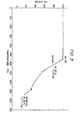
- TMA chart and therrmogravimetric analysis (TGA) chart of the film are shown in Figures 2 and 3, respectively.
- the polyimide film obtained in Example 3 was inserted between two Kapton films (a thermally stable film of Du Pont; thickness 150 micrometers) having a width of 25 mm with an adhering area of 25 mm wide and 12.5 mm long, and the assembly was compressed at 290 to 310°C for 10 minutes.
- the resulting laminated sample was subjected to a tensile test (at room temperature).
- the Kapton film was broken at 32.lkg (not at the bonded surface).
- a reactor equipped with a stirrer, a nitrogen gas introducing opening and a distillation opening was charged with 20.0g of 3,4'-diaminodiphenyl ether, 19.2g of trimellitic anhydride, 0.2g of triphenyl phosphate, and 15.3g of diphenylsulfone.
- the reaction was carried out at 280°C for 2 hours in a stream of nitrogen gas while water formed was distilled out of the reaction system.
- the resulting composition was transparent.
- the composition was then pulverized to a size of 10 to 20 mesh, immersed in acetone and extracted under heat.
- the resulting polymer had an inherent visosity, measured at 30°C in NMP in a concentration of 0.5 g/dl, of 0.64.
- Example 5 The same reaction as in Example 5. was carried out except that 4,4'-diaminodiphenyl ether was used instead of 3,4'-diaminodiphenyl ether. In about 30 minutes after the start of the reaction, the reaction system solidified and became unable to be stirred uniformly.
- Example 5 was repeated except that a predetermined amount of each of he compounds shown in Table 1 bwlow was used instead of 15.3 g of diphenylsulfone, and the reaction was carried out under the reaction conditions ahown in Table 1.
- the resulting compositions were transparent.
- the compostions were each extracted with acetone on the same way as in Example 5, and the resulting polymers had the inherent viscosities shown in Table 1.
- Example 5 The same reactor as used in Example 5 was charged with the material shown in Table 2, 15.3g of diphenylsulfone and 0.5g of triphenyl phosphite, and the same reaction and extraction as in Example 5 were carried out.
- the intrinsic viscosities of the resulting polymers are shown in Table 2.
- Example 5 The same reactor as in Example 5 was charged with 20.0g of 3,4'-diaminodiphenyl ether, 19.0g of trimellitic anhydride, 23.7g of diphenylsulfone and 0.2g of triphenyl phosphite, and they were reacted at 270°C for 1 hour in a stream of nitrogen gas. At this point, part of the polymer composition was sampled and extracted, and its inherent viscosity was measured. It was 0.29. Then, 2g of N,N'-terephthaloyl biscaprolactam was added, and the mixture was reacted for 30 minutes. After the extracting treatment, the polymer had an inherent viscosity of 0.67.
- Example 5 The same polyamideimide (inherent viscosity 0.61) as obtained in Example 5 and a mixture of the polyamideimide with 30% by weight of glass fibers were each injection-molded at a cylinder temperature of 280 to 310°C and a mold temperature of 165°C.
- the resulting molded articles had the properties shwon in Table 3.
- a 500 ml three-necked flask equipped with a stirrer, a thermometer and a nitrogen gas introducing inlet was completely dried, and charged with 3,4'-DAPE.
- 3,4'-DAPE was dissolved.
- the solution was cooled to -10°C, and a mixture of ETDA (3,3'-benzophenonetetracarboxylic dianhydride) and PMDA (pyromellitic dianhydride) in each of the mole ratios indicated in Table 4 below was added in a substantially equimolar proportion to the diamine.
- the mixture was further stirred] at room temperature for more than 3 hours to give a viscous polyamide acid solution.
- the resulting poiyamide acid solution was diluted with NMP to a concentration of 0.5 g/di and its inherent viscosity was measured at 30°C The results are shown in Table 4.
- the infrared absorption spectrum of the resulting film showed absorptions at 1781, 719 and 620 cm-' which are considered to be ascribable to the polyimide.
- the polyamide "acid solution obtained in Example 15 was mixed by agitation with acetic anhydride and pyridine in an amount equivalent to the amount required to chemically cyclize 50 mole% of the polyamide acid residue) together with 20 ml of NMP.
- the resulting reaction mixture was formed into a film under the same temperature-time conditions as in Example 19.
- the resulting film had the following dynamical properties.
- the polyamide acid solution obtained in Example 15 was cast on a glass plate by a doctor knife - (400 micrometers), and imidized under the following conditions in a hot air dryer.
- Thickness 23 micrometgers
- the polyimide film obtained in Example 20 was inserted between two Kapton films (a thermally stable film of Du Pont; thickness 150 micrometers) having a width of 25 mm having an adhering area of 25 mm wide and 12.5 mm long, and the assembly was compressed at 290 to 310°C for 10 minutes.
- the resulting laminated sample was subjected to a tensile test (at room temperature).
- the Kapton film was broken at 33 kg (not at the bonded surface).
Landscapes
- Chemical & Material Sciences (AREA)
- Health & Medical Sciences (AREA)
- Chemical Kinetics & Catalysis (AREA)
- Medicinal Chemistry (AREA)
- Polymers & Plastics (AREA)
- Organic Chemistry (AREA)
- Macromolecular Compounds Obtained By Forming Nitrogen-Containing Linkages In General (AREA)
Applications Claiming Priority (4)
| Application Number | Priority Date | Filing Date | Title |
|---|---|---|---|
| JP16386485A JPS6225125A (ja) | 1985-07-26 | 1985-07-26 | 熱融着性を有するポリイミド及びそれを用いる耐熱性接着剤 |
| JP163864/85 | 1985-07-26 | ||
| JP20432185A JPS6264829A (ja) | 1985-09-18 | 1985-09-18 | 芳香族ポリアミドイミドエ−テル |
| JP204321/85 | 1985-09-18 |
Publications (3)
| Publication Number | Publication Date |
|---|---|
| EP0210851A2 true EP0210851A2 (de) | 1987-02-04 |
| EP0210851A3 EP0210851A3 (en) | 1988-03-02 |
| EP0210851B1 EP0210851B1 (de) | 1992-03-18 |
Family
ID=26489181
Family Applications (1)
| Application Number | Title | Priority Date | Filing Date |
|---|---|---|---|
| EP86305754A Expired - Lifetime EP0210851B1 (de) | 1985-07-26 | 1986-07-25 | Mischungen aus Polyamidimiden, die 3,4'-Diaminodiphenylether als Diaminkomponente enthalten, und einem Weichmacher. |
Country Status (2)
| Country | Link |
|---|---|
| EP (1) | EP0210851B1 (de) |
| DE (1) | DE3684378D1 (de) |
Cited By (5)
| Publication number | Priority date | Publication date | Assignee | Title |
|---|---|---|---|---|
| US9976063B2 (en) | 2016-03-11 | 2018-05-22 | The Boeing Company | Polyarylether ketone imide sulfone adhesives |
| US10011685B2 (en) | 2016-03-11 | 2018-07-03 | The Boeing Company | Polyarylether ketone imide adhesives |
| CN114573812A (zh) * | 2020-12-29 | 2022-06-03 | 深圳市研一新材料有限责任公司 | 一种锂离子电池用粘结剂及其制备方法 |
| CN116230937A (zh) * | 2023-02-22 | 2023-06-06 | 天目湖先进储能技术研究院有限公司 | 一种用于电极中的粘结剂 |
| CN117986581A (zh) * | 2024-02-05 | 2024-05-07 | 广东硕成科技股份有限公司 | 一种由4,4′-二氨基二苯醚制备得到的聚酰胺酰亚胺及其制备方法和应用 |
Family Cites Families (6)
| Publication number | Priority date | Publication date | Assignee | Title |
|---|---|---|---|---|
| FR1420021A (fr) * | 1963-12-26 | 1965-12-03 | Thomson Houston Comp Francaise | Nouvelles résines synthétiques |
| US3860559A (en) * | 1973-02-22 | 1975-01-14 | Toray Industries | Method of preparing a soluble high molecular weight aromatic polyamide imide composition |
| US4094862A (en) * | 1974-03-05 | 1978-06-13 | The United States Of America As Represented By The Administrator Of The National Aeronautics And Space Administration | Process for preparing thermoplastic aromatic polyimides |
| US4448907A (en) * | 1981-03-30 | 1984-05-15 | Ashland Oil, Inc. | Process for casting lightweight metals |
| US4524171A (en) * | 1984-08-20 | 1985-06-18 | Gulf Oil Corporation | Preparation of an aromatic polyimide acid by solution polymerization using propylene glycol methyl ether |
| US4687836A (en) * | 1984-10-15 | 1987-08-18 | Mitsui Toatsu Chemicals, Inc. | Polyimide adhesives, coats and prepreg |
-
1986
- 1986-07-25 EP EP86305754A patent/EP0210851B1/de not_active Expired - Lifetime
- 1986-07-25 DE DE8686305754T patent/DE3684378D1/de not_active Expired - Lifetime
Cited By (9)
| Publication number | Priority date | Publication date | Assignee | Title |
|---|---|---|---|---|
| US9976063B2 (en) | 2016-03-11 | 2018-05-22 | The Boeing Company | Polyarylether ketone imide sulfone adhesives |
| US10011685B2 (en) | 2016-03-11 | 2018-07-03 | The Boeing Company | Polyarylether ketone imide adhesives |
| US10465046B2 (en) | 2016-03-11 | 2019-11-05 | The Boeing Company | Polyarylether ketone imide adhesives |
| US10501665B2 (en) | 2016-03-11 | 2019-12-10 | The Boeing Company | Polyarylether ketone imide sulfone adhesives |
| US11098162B2 (en) | 2016-03-11 | 2021-08-24 | The Boeing Company | Polyarylether ketone imide adhesives |
| CN114573812A (zh) * | 2020-12-29 | 2022-06-03 | 深圳市研一新材料有限责任公司 | 一种锂离子电池用粘结剂及其制备方法 |
| CN114573812B (zh) * | 2020-12-29 | 2023-06-09 | 深圳市研一新材料有限责任公司 | 一种锂离子电池用粘结剂及其制备方法 |
| CN116230937A (zh) * | 2023-02-22 | 2023-06-06 | 天目湖先进储能技术研究院有限公司 | 一种用于电极中的粘结剂 |
| CN117986581A (zh) * | 2024-02-05 | 2024-05-07 | 广东硕成科技股份有限公司 | 一种由4,4′-二氨基二苯醚制备得到的聚酰胺酰亚胺及其制备方法和应用 |
Also Published As
| Publication number | Publication date |
|---|---|
| EP0210851A3 (en) | 1988-03-02 |
| EP0210851B1 (de) | 1992-03-18 |
| DE3684378D1 (de) | 1992-04-23 |
Similar Documents
| Publication | Publication Date | Title |
|---|---|---|
| US3651012A (en) | Novel bis-imide compositions and polymers therefrom | |
| EP0276922B1 (de) | Schmelzformbares kristallines Polyimid | |
| US5689004A (en) | Diamines containing pendent phenylethynyl groups | |
| EP0163518B1 (de) | Polyamidsäuren, Polyimide, Poly(esterimide) | |
| US6133401A (en) | Method to prepare processable polyimides with reactive endgroups using 1,3-bis (3-aminophenoxy) benzene | |
| US5208318A (en) | Phosphazene-containing amine as curing agent for phthalonitrile-base polymer | |
| US4904758A (en) | Low-melting polyimide copolymer and method for preparing the same | |
| KR101558621B1 (ko) | 폴리이미드 필름 | |
| US4624888A (en) | Acetylene (ethynyl) terminated polyimide siloxane and process for preparation thereof | |
| JPH0447692B2 (de) | ||
| US3803075A (en) | Soluble polyimides from 2,6-diamino-s-triazines and dianhydrides | |
| EP0393638B1 (de) | Warmhärtende Harzzusammensetzung und warmhärtender trockener Film | |
| EP0210851A2 (de) | Mischungen aus Polyamidimiden, die 3,4'-Diaminodiphenylether als Diaminkomponente enthalten, und einem Weichmacher. | |
| US5866676A (en) | Copolyimides prepared from 3,4'-oxydianiline and 1,3-bis(3-aminophenoxy) benzene with 3,3', 4, 4'-biphenylcarboxylic dianhydride | |
| EP0456515B1 (de) | Polyimide und diese enthaltende wärmehärtbare Harzzusammensetzungen | |
| JPH05179224A (ja) | 耐熱性接着剤 | |
| EP0342912A1 (de) | Zusammensetzung für wärmehärtbares Harz | |
| US4902740A (en) | Polyamideimides containing 3,4'-diamino-diphenylether as diamine component, with plasticizer | |
| KR910003512B1 (ko) | 폴리에테르이미드/에폭시이미드 수지 조성물 및 그의 제조방법 | |
| US3526610A (en) | Aromatic polyimides containing both acetamide and carboxylic acid radicals and cross-linked polymers of same | |
| US3886119A (en) | Epoxy end-capped aromatic polyimides | |
| US6166174A (en) | Method to prepare processable polyimides with non-reactive endgroups using 1,3-bis(3-aminophenoxy) benzene | |
| JPH0312592B2 (de) | ||
| US3642696A (en) | Method of preparing polybenzimidazole-amides | |
| JP2595038B2 (ja) | 熱硬化性樹脂組成物 |
Legal Events
| Date | Code | Title | Description |
|---|---|---|---|
| PUAI | Public reference made under article 153(3) epc to a published international application that has entered the european phase |
Free format text: ORIGINAL CODE: 0009012 |
|
| AK | Designated contracting states |
Kind code of ref document: A2 Designated state(s): DE FR GB |
|
| PUAL | Search report despatched |
Free format text: ORIGINAL CODE: 0009013 |
|
| AK | Designated contracting states |
Kind code of ref document: A3 Designated state(s): DE FR GB |
|
| 17P | Request for examination filed |
Effective date: 19880607 |
|
| 17Q | First examination report despatched |
Effective date: 19900412 |
|
| GRAA | (expected) grant |
Free format text: ORIGINAL CODE: 0009210 |
|
| AK | Designated contracting states |
Kind code of ref document: B1 Designated state(s): DE FR GB |
|
| PG25 | Lapsed in a contracting state [announced via postgrant information from national office to epo] |
Ref country code: FR Effective date: 19920318 |
|
| REF | Corresponds to: |
Ref document number: 3684378 Country of ref document: DE Date of ref document: 19920423 |
|
| EN | Fr: translation not filed | ||
| PLBE | No opposition filed within time limit |
Free format text: ORIGINAL CODE: 0009261 |
|
| STAA | Information on the status of an ep patent application or granted ep patent |
Free format text: STATUS: NO OPPOSITION FILED WITHIN TIME LIMIT |
|
| 26N | No opposition filed | ||
| PGFP | Annual fee paid to national office [announced via postgrant information from national office to epo] |
Ref country code: GB Payment date: 19930621 Year of fee payment: 8 |
|
| PGFP | Annual fee paid to national office [announced via postgrant information from national office to epo] |
Ref country code: DE Payment date: 19930930 Year of fee payment: 8 |
|
| PG25 | Lapsed in a contracting state [announced via postgrant information from national office to epo] |
Ref country code: GB Effective date: 19940725 |
|
| GBPC | Gb: european patent ceased through non-payment of renewal fee |
Effective date: 19940725 |
|
| PG25 | Lapsed in a contracting state [announced via postgrant information from national office to epo] |
Ref country code: DE Effective date: 19950401 |