EP0210860A2 - Coussin et procédé de fabrication - Google Patents
Coussin et procédé de fabrication Download PDFInfo
- Publication number
- EP0210860A2 EP0210860A2 EP86305790A EP86305790A EP0210860A2 EP 0210860 A2 EP0210860 A2 EP 0210860A2 EP 86305790 A EP86305790 A EP 86305790A EP 86305790 A EP86305790 A EP 86305790A EP 0210860 A2 EP0210860 A2 EP 0210860A2
- Authority
- EP
- European Patent Office
- Prior art keywords
- pad
- opening
- front surface
- cushion
- backing
- Prior art date
- Legal status (The legal status is an assumption and is not a legal conclusion. Google has not performed a legal analysis and makes no representation as to the accuracy of the status listed.)
- Withdrawn
Links
- 238000000034 method Methods 0.000 title claims description 25
- 238000003825 pressing Methods 0.000 claims description 4
- 239000000463 material Substances 0.000 description 7
- 239000000853 adhesive Substances 0.000 description 6
- 230000001070 adhesive effect Effects 0.000 description 6
- 239000004677 Nylon Substances 0.000 description 5
- 230000005465 channeling Effects 0.000 description 5
- 239000004744 fabric Substances 0.000 description 5
- 239000006260 foam Substances 0.000 description 5
- 238000004519 manufacturing process Methods 0.000 description 5
- 229920001778 nylon Polymers 0.000 description 5
- 238000009958 sewing Methods 0.000 description 4
- 239000010985 leather Substances 0.000 description 3
- 238000009732 tufting Methods 0.000 description 3
- 235000001674 Agaricus brunnescens Nutrition 0.000 description 2
- JOYRKODLDBILNP-UHFFFAOYSA-N Ethyl urethane Chemical compound CCOC(N)=O JOYRKODLDBILNP-UHFFFAOYSA-N 0.000 description 2
- 235000015895 biscuits Nutrition 0.000 description 2
- 238000005065 mining Methods 0.000 description 2
- 229920004934 Dacron® Polymers 0.000 description 1
- 238000005520 cutting process Methods 0.000 description 1
- 230000001419 dependent effect Effects 0.000 description 1
- 230000000694 effects Effects 0.000 description 1
- 229920001821 foam rubber Polymers 0.000 description 1
- 230000002452 interceptive effect Effects 0.000 description 1
- 238000012986 modification Methods 0.000 description 1
- 230000004048 modification Effects 0.000 description 1
- 239000004033 plastic Substances 0.000 description 1
- 229920003023 plastic Polymers 0.000 description 1
- 239000005020 polyethylene terephthalate Substances 0.000 description 1
- 230000002028 premature Effects 0.000 description 1
- 125000000391 vinyl group Chemical group [H]C([*])=C([H])[H] 0.000 description 1
- 229920002554 vinyl polymer Polymers 0.000 description 1
- 239000002023 wood Substances 0.000 description 1
Images


Classifications
-
- A—HUMAN NECESSITIES
- A47—FURNITURE; DOMESTIC ARTICLES OR APPLIANCES; COFFEE MILLS; SPICE MILLS; SUCTION CLEANERS IN GENERAL
- A47C—CHAIRS; SOFAS; BEDS
- A47C31/00—Details or accessories for chairs, beds, or the like, not provided for in other groups of this subclass, e.g. upholstery fasteners, mattress protectors, stretching devices for mattress nets
- A47C31/02—Upholstery attaching means
- A47C31/026—Upholstery attaching means passing through the upholstery, e.g. upholstery nails or buttons
-
- Y—GENERAL TAGGING OF NEW TECHNOLOGICAL DEVELOPMENTS; GENERAL TAGGING OF CROSS-SECTIONAL TECHNOLOGIES SPANNING OVER SEVERAL SECTIONS OF THE IPC; TECHNICAL SUBJECTS COVERED BY FORMER USPC CROSS-REFERENCE ART COLLECTIONS [XRACs] AND DIGESTS
- Y10—TECHNICAL SUBJECTS COVERED BY FORMER USPC
- Y10S—TECHNICAL SUBJECTS COVERED BY FORMER USPC CROSS-REFERENCE ART COLLECTIONS [XRACs] AND DIGESTS
- Y10S297/00—Chairs and seats
- Y10S297/01—Foam
-
- Y—GENERAL TAGGING OF NEW TECHNOLOGICAL DEVELOPMENTS; GENERAL TAGGING OF CROSS-SECTIONAL TECHNOLOGIES SPANNING OVER SEVERAL SECTIONS OF THE IPC; TECHNICAL SUBJECTS COVERED BY FORMER USPC CROSS-REFERENCE ART COLLECTIONS [XRACs] AND DIGESTS
- Y10—TECHNICAL SUBJECTS COVERED BY FORMER USPC
- Y10S—TECHNICAL SUBJECTS COVERED BY FORMER USPC CROSS-REFERENCE ART COLLECTIONS [XRACs] AND DIGESTS
- Y10S297/00—Chairs and seats
- Y10S297/06—Hook and loop type fastener
-
- Y—GENERAL TAGGING OF NEW TECHNOLOGICAL DEVELOPMENTS; GENERAL TAGGING OF CROSS-SECTIONAL TECHNOLOGIES SPANNING OVER SEVERAL SECTIONS OF THE IPC; TECHNICAL SUBJECTS COVERED BY FORMER USPC CROSS-REFERENCE ART COLLECTIONS [XRACs] AND DIGESTS
- Y10—TECHNICAL SUBJECTS COVERED BY FORMER USPC
- Y10S—TECHNICAL SUBJECTS COVERED BY FORMER USPC CROSS-REFERENCE ART COLLECTIONS [XRACs] AND DIGESTS
- Y10S5/00—Beds
- Y10S5/922—Beds with hook and loop type fastener
- Y10S5/923—Bedclothing
Definitions
- This invention relates to methods for making cushions of the type used on various types of furniture or as pillows, and to the structures of such cushions.
- Cushions of the type including a resiliently compressible pad and an enclosure assembly surrounding the pad are commonly used on furniture or as pillows.
- techniques for forming surface contours on such cushions made by high volume production techniques have generally been restricted to sewing patterns in or quilting the cover assembly, or applying ties between the front and back surface of the cushion with buttons on their ends, both of which techniques add significantly to the time required to manufacture the cushions and thus increase their costs.
- the present invention provides a method for making cushions of the type used on various types of furniture or as pillows that significantly broadens the ability of a designer to incorporate decorative and functional surface contours in the cushion.
- a cushion comprising a resiliently compressible pad (e.g., foam rubber or urethane foam) having a major front surface, at least one opening extending at about a right angle to and opening through the front surface, an enclosure assembly surrounding and compressing the pad and comprising a flexible front cover overlaying the front surface of the pad and having a part extending into the opening, and engaged fastener means for retaining the part of the front cover in the opening including one fastener portion attached within the opening in a position spaced from the front surface of the pad, and another fastener portion attached to the part of the cover in the opening.
- a resiliently compressible pad e.g., foam rubber or urethane foam
- One of the fastener portions can include a backing, stems projecting from the backing, and heads at the ends of the stems opposite the backing (e.g., preferably a fastener portion having heads with hook like parts projecting along the stems toward the backing made in accordance with the teachings in U.S. Patent No. 4,454,183 incorporated herein by reference such as Scotchmate® brand Treble Lock SJ-3446 available from Minnesota Mining and Manufacturing Company, St. Paul, Minnesota); and the other fastener portion can have a backing and a multiplicity of projecting loops engaged around the heads of the first fastener portion (e.g., the Scotchmate® brand woven nylon loop No. SJ-3401 available from Minnesota Mining and Manufacturing Company, St. Paul, Minnesota).
- the present invention provides a novel method for forming such a cushion comprising (1) providing the flexible pad with its opening, the enclosure assembly and the fastener portions; (2) attaching one fastener portion to the inner surface of a part of the cover that will overlay the opening when the pad is received in the enclosure assembly; (3) attaching the other fastener portion within the opening and spaced from the front surface; and (4) pressing the part of the cover to which the second fastener portion is fastened into the opening in the pad to compress the cushion and engage the fastener portions.
- the fastener portion within the opening can be attached to the pad or the cover assembly with its backing at a right angle with respect to the front surface of the pad which places forces tending to separate the fastener portions parallel to their backings and provides extremely high holding forces.
- the fastener portion within the opening is attached to the enclosure assembly with the backing of that fastener portion generally parallel to the front surface of the pad, which can also provide adequate holding power between the fastener portions, and affords some very decorative effects.
- the opening can be elongate and either linear or arcuate with the first and second fastener portions extending along essentially the entire length of the opening; or the pad can have or define a plurality of through openings, and the cover can have a plurality of parts extending into the through openings with the cushion comprising separate fastening means for retaining the parts of the cover in each of the openings.
- the depth of the opening measured from the front surface of the uncompressed pad can be two, four, or even over twelve inches deep without interfering with easy assembly of the cushion.
- cushion structure and method of assembly according to the present invention afford far greater varieties of cushion design for furniture or pillows produced by high volume production techniques than has been practical with prior cushion structures and assembly methods.
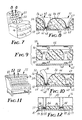
- FIG. 1 there is illustrated a chair 10 incorporating similar seat and back cushions 12 and 14 having arcuate channeling 15 on their surfaces that illustrate a first embodiment of a cushion according to the present invention.
- the cushion 12 comprises a resiliently compressible pad 16 having major front and back surfaces 18 and 20, a through opening 22 in the form of an elongate arcuate slot extending at about a right angle between those surfaces 18 and 20, an enclosure assembly 24 surrounding the pad 16 and comprising a back cover 25 in the form of a wooden sheet 25 and a strong flexible cloth front cover 26 overlaying the front surface 18 of the pad and having a part 28 extending into the through opening 22, and fastener means for retaining the part 28 of the front cover 26 in the through opening 22.
- the fastener means comprises a first fastener portion 30 including a backing, stems projecting from the backing, and heads at the ends of the stems opposite the backing having hook like portions projecting along the stems toward the backing (e.g., the Scotchmate® brand Treble Lock SJ-3446), and a second fastener portion 31 having a backing with front and back surfaces and a multiplicity of loops projecting from the front surface engaged around the hook like portions of the first fastener portion 30 (e.g., the Scotchmate® brand woven nylon loop No. SJ-3401).
- the first fastener portion 30 is attached by an adhesive to the pad 16 adjacent the junction between the through opening 22 and the back surface 20 of the pad 16 with its backing disposed generally at a right angle with respect to the front and back surfaces 18 and 20, whereas the second fastener portion 31 is attached by being sewn along one edge to the part 28 of the front cover 26 in the through opening 22 so that its backing is also disposed at a right angle with respect to the front and back surfaces 18 and 20 of the pad 16, thereby causing the forces that tend to separate the fastener portions 30 and 31 to be applied generally parallel to their backings which affords extremely firm engagement between the fastener portions 30 and 31.
- FIGs 3 and 4 The method according to the present invention by which a person can assemble the cushions 12 and 14 is illustrated in Figures 3 and 4.
- the pad 16 with its through opening 22 is provided, as by cutting a block of urethane foam with an appropriate saw or knife, together with the other parts of the cushion 12 described above.
- the second fastener portion 31 is attached by being sewn by a sewing machine 32 along one longitudinal edge to that part 28 of the inner surface of the front cover 26 that will project into the opening 22 when the cushion 12 is assembled.
- the first fastener portion 30 is attached by an appropriate adhesive 33 to the pad 16 at a position adjacent the junction between the through opening 22 and the back surface 20 of the pad 16, and preferably has an open needled layer on its side opposite its projecting head that receives the adhesive to insure firm bonding to the pad 16.
- the person then adheres the pad 16 to the back cover 25 in an appropriate position, places the front cover 26 over the pad 16 and, as illustrated in Figure 4, uses his hand 34 to press the part 28 of the front cover 26 to which the second fastener portion 31 is fastened into the through opening 22 in the pad 16 to engage the fastener portions 30 and 31 along their entire length, which requires moving his hand 34 along the full length of the opening 22. He then attaches the periphery of the front cover 26 to the periphery of the back cover 25 as by tacking the edges of the front cover 26 thereto in a conventional manner to slightly compress the pad 16, and the cushion 12 is completed.
- a second embodiment 35 of the cushion according to the present invention illustrated in Figure 5 that provides parallel rows of linear channeling can also be made by a method similar to that described above to produce the cushions 12 and 14.
- the cushion 35 comprises a resiliently compressible pad 36 having major front and back surfaces 37 and 38, openings 39 in the form of two elongate linear slots extending at about a right angle between those surfaces 37 and 38, an enclosure assembly 40 surrounding the pad 36 and comprising a rigid (e.g., wooden) back cover 41 and a flexible coth front cover 42 overlaying the front surface 37 of the pad 36 and having parts 43 extending into the openings 39, and fastener means for retaining the parts 43 of the front cover 42 in the openings 39 comprising first and second fastener portions 44 and 45 identical to the fastening portions 30 and 31 in the cushion 12, and attached in the same way.
- the parts of the pad 36 defining the openings 39 are of differing heights as illustrated, however they may be of the same height if desired.
- Figure 6 illustrates a chair 47 incorporating cushions made in a manner similar to that described above to provide the channeling 48.
- the channeling provided in the chair 47 is not only decorative, but also holds its outer cover 49 along the concave outer surface of its seat and back pads.
- the cushion 52 comprises a resiliently compressible pad 54 having major front and back surfaces 56 and 58, a plurality of through cylindrical regularly spaced openings 60 extending at about a right angle between those surfaces 56 and 58, an enclosure assembly 62 surrounding the pad 54 and comprising a back cover 64 in the form of a wooden sheet and a strong flexible cloth or leather front cover 66 overlaying the front surface 56 of the pad 54 and having a plurality of parts 67 extending into the through openings 60, and fastener means for retaining the parts 67 of the front cover 66 in the through openings 60.
- the fastener means comprises a first fastener portion 68 including a backing, stems projecting from the backing, and heads at the ends of the stems opposite the backing having hook like portions projecting along the stems toward the backing (e.g., the Scotchmate® brand Treble Lock SJ-3446), and a second fastener portion 69 having a backing with front and back surfaces and a multiplicity of loops projecting from the front surface engaged around the hook like portions of the first fastener portion 30 (e.g., the Scotchmate® brand woven nylon loop No. SJ-3401).
- the first fastener portions 68 are attached as by staples or adhesive to the back cover 64 adjacent the junctions between the through openings 60 and the back surface 58 of the pad 54 with the backings of the fastener portion 68 disposed generally parallel to the front and back surfaces 56 and 58, whereas the second fastener portions 69 are attached by being sewn along their centerlines to the parts 67 of the front cover 66 in the through openings 60 so that the backings of the second fastener portion 69 are also disposed generally at a right angle with respect to the front and back surfaces 56 and 58 of the pad 54, thereby causing the forces that tend to separate the fastener portions 68 and 69 to be applied generally at right angles to their backings, but allowing the second fastener portions 69 to bend around their lines of attachment and place in shear some of the engagement between the fastener portions 68 and 69.
- FIG. 9 The method according to the present invention by which a person can assemble the cushion 52 is illustrated in Figures 9 and 10.
- the second fastener portions 69 are attached by being sewn by a sewing machine along their centerliner to the parts 67 of the inner surface of the front cover 66 that will be positioned in the openings 60 when the cushion 52 is assembled, and the other fastener portion 68 is attached by tacks or an appropriate adhesive to the back cover 64 at positions adjacent the junctions between the through openings 60 and the back surface 58 of the pad 54 for the assembled cushion 52.
- the cushion 76 comprises a resiliently compressible pad 77 formed from a plurality of rectangular foam blocks having major front and back surfaces 78 and 79, and defining a plurality of through regularly spaced openings 80 between their adjacent corner edges extending at about a right angle between those surfaces 78 and 79, an enclosure assembly 81 surrounding the pad 77 and comprising a back cover 82 in the form of a wooden sheet and a strong flexible leather or cloth front cover 83 overlaying the front surface 78 of the pad 77 and having a plurality of parts 84 extending into the through openings 80, and fastener means for retaining the parts 84 of the front cover 83 in the through openings 80.
- the fastener means comprises a first fastener portion 85 including a backing, stems projecting from the backing, and heads at the ends of the stems opposite the backing having hook like portions projecting along the stems toward the backing (e.g., the Scotchmate® brand Treble Lock SJ-3446), and a second fastener portion 86 having a backing with front and back surfaces and a multiplicity of loops projecting from the front surface engaged around the hook like portions of the first fastener portion 30 (e.g., the Scotchmate® brand woven nylon loop No. SJ-3401).
- the first fastener portions 85 are attached as by staples or adhesive to the back cover 82 adjacent the junctions between the through openings 80 and the back surface 78 of the pad 77 with their backing disposed generally parallel to the front and back surfaces 78 and 79, whereas the second fastener portions 86 are attached by being sewn along their centerliner to the parts 84 of the front cover 83 in the through openings 80 so that their backings are also disposed at about a right angle with respect to the front and back surface 78 and 79 of the pad 77, thereby causing the forces that tend to separate the fastener portions 85 and 86 to be applied generally at right angles to their backings, but allowing the second fastener portions 86 to bend along their liner of attachment and place in shear some of the engagement between the fastener portions 85 and 86.
- the method according to the present invention for assembling the cushion 76 is essentially the same as that described above for assembling the cushion 52 illustrated in Figures 9 and 10, except that during such assembly portions of the front cover 83 will be pulled into the slots between the adjacent rectangular foam blocks forming the pad 77 to form the biscuit tufting around these blocks.
- FIG. 13 and 14 there is shown a pillow 90 illustrating a fifth embodiment of a cushion according to the present invention having arcuate channeling along both of its major surfaces.
- the pillow 90 comprises a resiliently compressible pad 91 having major front and back surfaces 92 and 93, two through openings 94 in the form of elongate arcuate slots extending generally at right angles between those surfaces 92 and 93, an enclosure assembly 95 surrounding the pad 91 and comprising strong flexible cloth front and back covers 97 and 96 overlaying the front and rear surfaces 92 and 93 of the pad 91 respectively, both of which covers 96 and 97 have parts 98 and 99 respectively extending into the through openings 94, and fastener means for retaining the parts 98 and 99 in the through opening 94.
- the fastener means comprises a first fastener portion 100 including a backing, stems projecting from the backing, and heads at the ends of the stems opposite the backing having hook like portions projecting along the stems toward the backing (e.g., the Scotchmate® brand Treble Lock SJ-3446), and a second fastener portion 101 having a backing with front and back surfaces and a multiplicity of loops projecting from the front surface engaged around the hook like portions of the first fastener portion 30 (e.g., the Scotchmate® brand woven nylon loop No. SJ-3401).
- first fastener portion 100 including a backing, stems projecting from the backing, and heads at the ends of the stems opposite the backing having hook like portions projecting along the stems toward the backing
- a second fastener portion 101 having a backing with front and back surfaces and a multiplicity of loops projecting from the front surface engaged around the hook like portions of the first fastener portion 30 (e.g., the Scotchmate® brand woven nylon loop
- the first and second fastener portions 100 and 101 are attached to the back and front covers 97 and 96 respectively with their backings disposed generally at right angles with respect to the front and back surfaces 92 and 93 of the pad 91, by being sewn along one edge to the parts 98 and 99 of the covers 96 and 97 in the through openings 94 so that their backings are also disposed at right angles with respect to the front and back surfaces 92 and 93 of the pad 91, thereby causing the forces that tend to separate the fastener portions 100 and 101 to be applied generally parallel to their backings which affords extremely firm engagement therebetween.
- the heads of the fastener portion 100 may be initially covered with a length of tape 102 to prevent premature engagement of the fastener, which tape is manually peeled away during attachment of the fastener portions 100 and 101.
- the remaining unattached edges of the front and rear covers are attached together in a conventional manner as with stitching or a pre-attached zipper (not shown).
- pillows similar to the pillow 90 may have one or more straight or arcuate openings in their pad that extend for any length along the pillow, may be made by the method described above.
- the pad in the cushions may be of any material used for that purpose, and may be formed of two materials such as a layer of resiliently compressible material and an outer layer such as of dacron wrap that is sometimes used to help shape the outer cover.
- the outer cover may be of any conventional upholstery material such as cloth, vinyl, leather, etc. and the back cover may also be of such materials or of more rigid materials such as wood or plastic sheeting or strips.
- the fastener portions with the headed projections are preferably made in accordance with U.S. Patent No.
Landscapes
- Mattresses And Other Support Structures For Chairs And Beds (AREA)
Applications Claiming Priority (2)
| Application Number | Priority Date | Filing Date | Title |
|---|---|---|---|
| US06/761,000 US4679851A (en) | 1985-07-31 | 1985-07-31 | Cushion and method |
| US761000 | 1991-09-17 |
Publications (2)
| Publication Number | Publication Date |
|---|---|
| EP0210860A2 true EP0210860A2 (fr) | 1987-02-04 |
| EP0210860A3 EP0210860A3 (fr) | 1987-06-16 |
Family
ID=25060815
Family Applications (1)
| Application Number | Title | Priority Date | Filing Date |
|---|---|---|---|
| EP86305790A Withdrawn EP0210860A3 (fr) | 1985-07-31 | 1986-07-28 | Coussin et procédé de fabrication |
Country Status (2)
| Country | Link |
|---|---|
| US (1) | US4679851A (fr) |
| EP (1) | EP0210860A3 (fr) |
Cited By (5)
| Publication number | Priority date | Publication date | Assignee | Title |
|---|---|---|---|---|
| DE3737878A1 (de) * | 1987-11-07 | 1988-05-05 | Daimler Benz Ag | Vorrichtung zur befestigung eines bezugsabschnittes eines vollschaum-sitzteiles |
| FR2684532A1 (fr) * | 1991-12-04 | 1993-06-11 | Revelut Daniel | Coussin a housse amovible. |
| US5236243A (en) * | 1992-03-30 | 1993-08-17 | General Motors Corporation | Serge thread loop fastener for trim cover |
| GB2321594A (en) * | 1997-02-03 | 1998-08-05 | Osullivan Ind Inc | Upholstery to furniture fastening system |
| EP1129895A2 (fr) | 2000-03-01 | 2001-09-05 | Bayerische Motoren Werke Aktiengesellschaft | Fixation d'un revêtement de rembourrage, en particulier d'un siège de véhicule |
Families Citing this family (20)
| Publication number | Priority date | Publication date | Assignee | Title |
|---|---|---|---|---|
| AU614939B2 (en) * | 1987-09-29 | 1991-09-19 | Tachi-S Co., Ltd. | Automotive seat |
| US4772070A (en) * | 1987-12-03 | 1988-09-20 | Leto Jr James | Contoured seat covering for automotive vehicle bench seat |
| US5101539A (en) * | 1990-02-06 | 1992-04-07 | Velcro Industries B.V. | Foamed seat cushion |
| US5732531A (en) * | 1995-10-30 | 1998-03-31 | Hoechst Celanese Corporation | Reusable bale wrap kit for compressed, resilient fibers |
| US5733001A (en) * | 1996-11-19 | 1998-03-31 | Roberts; Clifford D. | Seat cover retainer apparatus and method of using same |
| WO1998022307A1 (fr) * | 1996-11-20 | 1998-05-28 | F.S. Fehrer Gmbh & Co. Kg | Element de rembourrage relie a sa housse par un systeme a boucles et crochets |
| US6047421A (en) * | 1997-04-21 | 2000-04-11 | Barone; Dana A. | No-sew upholstery system |
| DE29923897U1 (de) * | 1999-12-18 | 2001-05-31 | Gottlieb Binder GmbH & Co, 71088 Holzgerlingen | Vorrichtung zum Befestigen eines Bezuges an einem Schaumkörperteil, insbesondere einem Polsterschaumteil für einen Flug- oder Fahrgastsitz |
| US6668429B2 (en) | 2002-05-03 | 2003-12-30 | Ykk Corporation Of America | Deep-groove fastener |
| US7065809B1 (en) | 2003-05-07 | 2006-06-27 | Milsco Manufacturing Company | Recessed cushion ornament |
| JP4156449B2 (ja) * | 2003-06-12 | 2008-09-24 | 株式会社クラレ | シートの係止連結部材、該部材を有するシート、該部材を用いた成形体及びその製造方法 |
| US7636987B2 (en) * | 2004-10-22 | 2009-12-29 | Tama Plastic Industry | Wrapping material with fastener |
| US20100088859A1 (en) * | 2005-11-29 | 2010-04-15 | Tama Plastic Industry | Wrapping materal with fastener |
| AU2005338771B2 (en) | 2005-11-29 | 2010-09-23 | Tama Plastic Industry | A wrapping material with fastener |
| US8512851B2 (en) * | 2008-05-01 | 2013-08-20 | Tama Plastic Industry | Wrapping material with opposing adhesive means |
| JP6771857B2 (ja) * | 2014-12-25 | 2020-10-21 | 株式会社タチエス | 車両用シート |
| JP6491897B2 (ja) * | 2015-02-03 | 2019-03-27 | 株式会社タチエス | シートカバー用表皮材及びシートカバー並びに車両用シート |
| US10259194B2 (en) | 2015-03-18 | 2019-04-16 | 3M Innovative Properties Company | Mounting system |
| KR20170131582A (ko) | 2015-03-27 | 2017-11-29 | 쓰리엠 이노베이티브 프로퍼티즈 컴파니 | 캔버스 장착 장치 |
| JP2026018298A (ja) | 2024-07-25 | 2026-02-05 | スリーエム イノベイティブ プロパティズ カンパニー | 二酸化炭素直接空気回収用モジュールおよび二酸化炭素直接空気回収装置 |
Family Cites Families (9)
| Publication number | Priority date | Publication date | Assignee | Title |
|---|---|---|---|---|
| FR1320876A (fr) * | 1962-01-31 | 1963-03-15 | Faure Bertrand Ets | Perfectionnements apportés aux ensembles, comprenant des housses amovibles, pour revêtir des coussins de sièges |
| DE1909235A1 (de) * | 1969-02-25 | 1970-09-10 | Opel Adam Ag | Abheftvorrichtung fuer Federkissen,insbesondere von Kraftfahrzeugsitzen |
| US3603639A (en) * | 1969-05-19 | 1971-09-07 | Betty A Wilson | Detachable seat pad for snowmobiles and the like |
| US3807800A (en) * | 1972-09-08 | 1974-04-30 | Knoll International | Upholstered item of furniture and cushion assembly |
| FR2205063A5 (fr) * | 1972-10-27 | 1974-05-24 | Faure Bertrand Ets | |
| US4040881A (en) * | 1976-03-22 | 1977-08-09 | General Engineering & Manufacturing Corporation | Method of forming tufted cushion elements |
| DE2644592A1 (de) * | 1976-10-02 | 1978-04-06 | Keiper Recaro Gmbh Co | Polster fuer einen sitz, insbesondere einen fahrzeugsitz |
| US4534595A (en) * | 1981-12-29 | 1985-08-13 | Tachikawa Spring Co., Ltd. | Vehicle seat |
| US4454183A (en) * | 1982-02-26 | 1984-06-12 | Minnesota Mining And Manufacturing Company | Strip material with heat-formed hooked heads |
-
1985
- 1985-07-31 US US06/761,000 patent/US4679851A/en not_active Expired - Fee Related
-
1986
- 1986-07-28 EP EP86305790A patent/EP0210860A3/fr not_active Withdrawn
Cited By (7)
| Publication number | Priority date | Publication date | Assignee | Title |
|---|---|---|---|---|
| DE3737878A1 (de) * | 1987-11-07 | 1988-05-05 | Daimler Benz Ag | Vorrichtung zur befestigung eines bezugsabschnittes eines vollschaum-sitzteiles |
| FR2684532A1 (fr) * | 1991-12-04 | 1993-06-11 | Revelut Daniel | Coussin a housse amovible. |
| US5236243A (en) * | 1992-03-30 | 1993-08-17 | General Motors Corporation | Serge thread loop fastener for trim cover |
| GB2321594A (en) * | 1997-02-03 | 1998-08-05 | Osullivan Ind Inc | Upholstery to furniture fastening system |
| GB2321594B (en) * | 1997-02-03 | 2000-08-16 | Osullivan Ind Inc | Upholstery to furniture fastener system |
| EP1129895A2 (fr) | 2000-03-01 | 2001-09-05 | Bayerische Motoren Werke Aktiengesellschaft | Fixation d'un revêtement de rembourrage, en particulier d'un siège de véhicule |
| EP1129895A3 (fr) * | 2000-03-01 | 2002-12-04 | Bayerische Motoren Werke Aktiengesellschaft | Fixation d'un revêtement de rembourrage, en particulier d'un siège de véhicule |
Also Published As
| Publication number | Publication date |
|---|---|
| EP0210860A3 (fr) | 1987-06-16 |
| US4679851A (en) | 1987-07-14 |
Similar Documents
| Publication | Publication Date | Title |
|---|---|---|
| US4679851A (en) | Cushion and method | |
| US5236243A (en) | Serge thread loop fastener for trim cover | |
| US5614045A (en) | Method of manufacturing a fastener assembly | |
| US4040881A (en) | Method of forming tufted cushion elements | |
| US7424762B2 (en) | Mattress assembly and manufacturing process for a mattress using adhesive patches | |
| US5067772A (en) | Foam seat with insert | |
| US5003664A (en) | Automobile mat and securing clip | |
| US3896531A (en) | Upholstery system method and apparatus | |
| JPH0133684B2 (fr) | ||
| TW200934720A (en) | Furniture with decorative fasteners | |
| US6409264B1 (en) | Interchangeable furniture cover system | |
| US5017413A (en) | Method of and devices for attaching covering layers to supporting structures | |
| US4400422A (en) | Laminated fabric having integral raised areas formed therein and method of making same | |
| US20080295251A1 (en) | Mattress Having Foam Encasement and Method of Making the Same | |
| US2533786A (en) | Fastening strip | |
| US3737929A (en) | Mattress assembly | |
| US5520021A (en) | Fastener tape with loops for use as part of hook-and-loop fastener assembly | |
| US4037296A (en) | Method and article for tufting upholstery and the like, and the resulting article of manufacture | |
| US2238795A (en) | Cover for dining room chairs | |
| US5820212A (en) | Automotive seat | |
| GB1592435A (en) | Strip form element for attaching covering material to a support | |
| JPH07124350A (ja) | 車両用シート | |
| US6496992B2 (en) | Reversible gusset bedcovering | |
| US5226468A (en) | Kits including gripping bands for attaching pieces of fabric and batting in order to produce decorative articles | |
| JPH0569489A (ja) | 凹面シートカバー構造 |
Legal Events
| Date | Code | Title | Description |
|---|---|---|---|
| PUAI | Public reference made under article 153(3) epc to a published international application that has entered the european phase |
Free format text: ORIGINAL CODE: 0009012 |
|
| AK | Designated contracting states |
Kind code of ref document: A2 Designated state(s): DE FR GB IT NL |
|
| PUAL | Search report despatched |
Free format text: ORIGINAL CODE: 0009013 |
|
| AK | Designated contracting states |
Kind code of ref document: A3 Designated state(s): DE FR GB IT NL |
|
| 17P | Request for examination filed |
Effective date: 19871214 |
|
| 17Q | First examination report despatched |
Effective date: 19890217 |
|
| STAA | Information on the status of an ep patent application or granted ep patent |
Free format text: STATUS: THE APPLICATION IS DEEMED TO BE WITHDRAWN |
|
| 18D | Application deemed to be withdrawn |
Effective date: 19900522 |
|
| RIN1 | Information on inventor provided before grant (corrected) |
Inventor name: PYLE, GODFREY J.C/O MINNESOTA MINING AND Inventor name: SOLIE, O.B.C/O MINNESOTA MINING AND |