EP0211302A2 - Wickel- und Bandantrieb für eine Magnetbandkassette - Google Patents
Wickel- und Bandantrieb für eine Magnetbandkassette Download PDFInfo
- Publication number
- EP0211302A2 EP0211302A2 EP86109955A EP86109955A EP0211302A2 EP 0211302 A2 EP0211302 A2 EP 0211302A2 EP 86109955 A EP86109955 A EP 86109955A EP 86109955 A EP86109955 A EP 86109955A EP 0211302 A2 EP0211302 A2 EP 0211302A2
- Authority
- EP
- European Patent Office
- Prior art keywords
- drive
- slip clutch
- drive according
- winding
- threading
- Prior art date
- Legal status (The legal status is an assumption and is not a legal conclusion. Google has not performed a legal analysis and makes no representation as to the accuracy of the status listed.)
- Granted
Links
Images
Classifications
-
- G—PHYSICS
- G11—INFORMATION STORAGE
- G11B—INFORMATION STORAGE BASED ON RELATIVE MOVEMENT BETWEEN RECORD CARRIER AND TRANSDUCER
- G11B15/00—Driving, starting or stopping record carriers of filamentary or web form; Driving both such record carriers and heads; Guiding such record carriers or containers therefor; Control thereof; Control of operating function
- G11B15/18—Driving; Starting; Stopping; Arrangements for control or regulation thereof
- G11B15/26—Driving record carriers by members acting directly or indirectly thereon
- G11B15/32—Driving record carriers by members acting directly or indirectly thereon through the reels or cores on to which the record carrier is wound
-
- G—PHYSICS
- G11—INFORMATION STORAGE
- G11B—INFORMATION STORAGE BASED ON RELATIVE MOVEMENT BETWEEN RECORD CARRIER AND TRANSDUCER
- G11B15/00—Driving, starting or stopping record carriers of filamentary or web form; Driving both such record carriers and heads; Guiding such record carriers or containers therefor; Control thereof; Control of operating function
- G11B15/60—Guiding record carrier
- G11B15/66—Threading; Loading; Automatic self-loading
- G11B15/665—Threading; Loading; Automatic self-loading by extracting loop of record carrier from container
- G11B15/6653—Threading; Loading; Automatic self-loading by extracting loop of record carrier from container to pull the record carrier against drum
- G11B15/6656—Threading; Loading; Automatic self-loading by extracting loop of record carrier from container to pull the record carrier against drum using two-sided extraction, i.e. "M-type"
-
- G—PHYSICS
- G11—INFORMATION STORAGE
- G11B—INFORMATION STORAGE BASED ON RELATIVE MOVEMENT BETWEEN RECORD CARRIER AND TRANSDUCER
- G11B15/00—Driving, starting or stopping record carriers of filamentary or web form; Driving both such record carriers and heads; Guiding such record carriers or containers therefor; Control thereof; Control of operating function
- G11B15/18—Driving; Starting; Stopping; Arrangements for control or regulation thereof
- G11B15/44—Speed-changing arrangements; Reversing arrangements; Drive transfer means therefor
- G11B15/444—Speed-changing arrangements; Reversing arrangements; Drive transfer means therefor reversing arrangements
-
- G—PHYSICS
- G11—INFORMATION STORAGE
- G11B—INFORMATION STORAGE BASED ON RELATIVE MOVEMENT BETWEEN RECORD CARRIER AND TRANSDUCER
- G11B15/00—Driving, starting or stopping record carriers of filamentary or web form; Driving both such record carriers and heads; Guiding such record carriers or containers therefor; Control thereof; Control of operating function
- G11B15/18—Driving; Starting; Stopping; Arrangements for control or regulation thereof
- G11B15/46—Controlling, regulating, or indicating speed
- G11B15/50—Controlling, regulating, or indicating speed by mechanical linkage, e.g. clutch
Definitions
- Video and audio recorders preferably store the information on magnetic tape, which is housed in a cassette on two adjacent bobbins.
- the cassette is inserted in such a way that the bobbins engage non-positively in corresponding mandrels of the drive mechanisms of the playback device.
- the winding plate is driven by a further motor, which can also be designed as a capstan motor, this drive being effected, for example, via a swivel wheel which is coupled to the pulling winding plate, while the unwinding plate maintains the required belt tension via a friction brake. Because a uniform tape tension is necessary for the entire length of tape is scanned by a B andzugnerler the respective tape tension and implemented depending on the position of the probe in an adjusted braking effect for the Abwickelteller.
- the drive of both the magnetic tape takes place ie, the capstan drive and the drive of the reel disc by a motor, the pillars p for different Bandgeschwidieren example when Ums or even in the picture search mode without staging of additional intermediate wheels takes over the drive.
- the winding plate is driven via the drive side of the slip clutch with the aid of a swivel wheel which is driven by a belt, whereas the capstan shaft is also a motor shaft, i.e. the capstan is driven directly .
- the operating modes stop, rewinding, threading and unthreading, play (play), picture search forwards and backwards are controlled by a threading motor. This is done with the help of a cam wheel, in which a control slide engages, which triggers the individual operating modes through its respective position within the device chassis.
- the main brake is released during the rewinding process, while the ratchet wheels on the slip clutches of both winding plates are engaged.
- the torque is therefore not transmitted via the slip clutches but via the locking wheels bridging the clutch. This ensures that the necessary full torque is applied to the winding plates.
- the ratchet wheels have a basic friction torque to prevent belt loops.
- the control slide is in a position in which the ratchet wheel no longer lies against the unwinding plate, while the ratchet wheel on the winding plate still bridges the clutch.
- a pawl is effective in this position of the control slide, by means of which the ratchet wheel is locked on the take-up plate. This means that the magnetic tape can only be threaded in or out on the unwinding plate.
- the advantage of this arrangement is that a high repeat accuracy for a certain band point is achieved even during the threading process.
- both locking wheels are released from the slip clutches by the control slide and the pressure roller for the capstand drive is brought into engagement.
- the brake cable sensor is placed on the magnetic tape by the threading motor. It controls the unwinding plate via a band brake.
- the winding plates are driven by means of a swivel wheel via the slip clutches, which ensures a constant speed with different winding diameters at the same time and also a torque limitation.
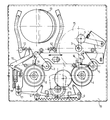
- the control slide 1 is in a position in which the ratchet wheel 3 on the unwinding plate 2 is no longer engaged, while the ratchet wheel 5 on the winding plate 4 bridges both parts of the slip clutch. In addition, the ratchet wheel 5 is locked by the pawl 14.
- the pressure roller 6 for the capstan drive is lifted off the capstan shaft 7. This assignment of the individual drive parts caused by the control slide 1 represents the threading operation.
- the magnetic tape is pulled out of the cassette by the threading carriage 12 and placed around the head drum 13, or returned to the cassette when the swivel wheel 8 is driven by the capstan and winding plate drive acting motor 15 is placed on the unwinding plate 2.
- the threading carriage 12 is driven via a threading channel (not shown) as well as the control slide 1 and the tape tension guide 10 by a threading motor via a cam wheel.
- the cam wheel and thread motor are arranged below the chassis board 16 and are therefore not shown.
- the control slide 1 For play mode, the control slide 1 is brought into its right stop position indicated by the arrow. This position is only reached when the magnetic tape is placed around the head drum by the threading process and the tape tension sensor 10 is engaged.
- the locking wheels 3 and 5 are lifted off the couplings of the winding plate by the lugs 18 which are firmly connected to the control slide 1.
- the pressure roller 6 is guided against the capstan shaft 7 for the magnetic tape transport.
- the winding plates 3 and 5 are driven by the swivel wheel 8 via the slip clutches integrated in the winding plates.
- the unwinding plate 2 For tape advance both with normal speed and with a changed image search speed, the unwinding plate 2 is braked by means of a tape tension brake, not shown, which is controlled by the tape tension sensor 10. Since the unwinding plate 2 is driven backwards by the swivel wheel 8 in the image search mode, the tape tension sensor and thus the tape brake are inoperative in this operating mode.
Landscapes
- Tension Adjustment In Filamentary Materials (AREA)
- Registering, Tensioning, Guiding Webs, And Rollers Therefor (AREA)
- Advancing Webs (AREA)
- Magnetic Record Carriers (AREA)
- Feeding And Guiding Record Carriers (AREA)
Abstract
Description
- Video- und Audiorecorder speichern die Information vorzugsweise auf Magnetband, das in einer Kassette auf zwei nebeneinanderliegenden Wickelkörpern untergebracht ist. Die Kassette ist dabei so eingelegt, daß die Wickelkörper kraftschlüssig in entsprechende Dorne der Antriebsmechanismen des Abspielgerätes einrasten.
- Bei handelsüblichen Videorecordern mit einer rotierenden Kopftrommel ist es erforderlich, das Magnetband durch eine Mechanik aus der Kassette herauszuziehen und mit Hilfe von Führungen an den Umfang der Kopftrommel anzulegen. Dieser Fädelvorgang wird durch einen Motor, auch Fääelmotor genannt, bewirkt, der das Magnetband mit über Kurvenscheiben angetriebenen Fädelwagen in seine Spielposition bringt.
- Durch einen weiteren Motor, der auch gleichzeitig als Capstan-Motor ausgebildet sein kann werden die Wickelteller angetrieben, wobei dieser Antrieb z.B. über ein Schwenkrad erfolgt, das jeweils an den ziehenden Wickelteller angekoppelt wird, während der Abwickelteller über eine Reibungsbremse die geforderte Bandspannung aufrechterhält. Weil eine gleichmäßige Bandspannung über die gesamte Bandlänge notwendig ist, wird durch einen Bandzugfühler die jeweilige Bandspannung abgetastet und je nach Stellung des Fühlers in eine angepaßte Bremswirkung für den Abwickelteller umgesetzt.
- Es ist bekannt, die Wickelteller von einem Wickelmotor, der gleichzeitig die Tonwelle treibt, über ein Schwenkrad anzutreiben, wobei jeder Wickelteller mit einer Rutschkupplung versehen ist. Der Antrieb erfolgt an der Antriebsseite der Rutschkupplung. Eine gleichmäßige Bandspannung wird über diese Kupplungen in Verbindung mit einer Umschlingungsbremse erreicht, die durch den Bandzugfühler gesteuert, am Kupplungsteil des Abwickeltellers angreift. Für veränderte Geschwindigkeit der Wickelteller z.B. bei Bildsuchlauf ist es üblich, das Schwenkrad über ein oder mehrere Zwischenräder anzutreiben, die z.B. mit Hilfe einer Kulissensteuerung in Eingriff gebracht werden. Bei Bandstillstand, also z.B. bei ausgeschaltetem Gerät, werden die Wickel mit Hilfe einer Bremse blockiert, die durch einen Zugmagneten im Spielbetrieb gelöst wird.
- Es ist Aufgabe der Erfindung, einen Wickel- und Bandantrieb für eine Magnetbandkassette mit einem gemeinsamen Motor aufzuzeigen, der eine Vereinfachung der Steuerung der einzelnen Funktionen sowie der Brems- als auch der Antriebsmechanik aufzeigt.
- Diese Aufgabe wird durch die im Anspruch 1 beschriebene Erfindung gelöst. Vorteilhafte Weiterbildungen der Erfindung sind in den Unteransprüchen beschrieben.
- Im Prinzip erfolgt der Antrieb sowohl des Magnetbandes d.h. der Capstan-Antrieb als auch der Antrieb der Wickelteller von einem Motor, der auch für unterschiedliche Bandgeschwidigkeiten z.B. beim Umspulen oder auch im Bildsuchlaufbetrieb ohne Zuschalten zusätzlicher Zwischenräder den Antrieb übernimmt. Dabei wird im Normalbetrieb, d.h. bei der durch die Systemnorm vorgeschriebenen Sollgeschwindigkeit der Antrieb der Wickelteller über die Antriebsseite der Rutschkupplung mit Hilfe eines Schwenkrades vorgenommen, welches über einen Riemen angetrieben wird, wogegen die Capstan-Welle gleichzeitig Motorwelle ist, d.h. der Capstan wirc direkt angetrieben.
- Von einem Fädelmotor werden die Betriebsarten Stop, Umspulen, Ein- und Ausfädeln, Abspielen (Play), Bildsuchlauf vorwärts und rückwärts gesteuert. Dieses geschieht mit Hilfe eines Kurvenrades, in welches ein Steuerschieber eingreift, der durch seine jeweilige Postition innerhalb des Gerätechassis die einzelnen Betriebsarten auslöst.
- Im Stop-Betrieb sind über die Steuerschieber die kupplungsübergreifenden Sperräder an Ab- und Aufwickelteller mit beiden Teilen der Rutschkupplung in Eingriff. In dieser Betriebsart ist auch die Hauptbremse direkt an den beiden Wickeltellern im Eingriff, wodurch das stillstehende Magnetband in seiner Lage fixiert wird. Diese Bremse wird ebenfalls vom Fädelmotor über eine zusätzliche Rutschkupplung direkt gesteuert.
- Während des Umspulvorganges ist die Hauptbremse gelöst, während die Sperräder an den Rutschkupplungen beider Wickelteller im Eingriff sind. Das Drehmoment wird also nicht über die Rutschkupplungen sondern über die die Kupplung überbrückenden Sperrräder übertragen. Dadurch wird erreicht, daß das notwendige volle Drehmoment an den Wickeltellern aufgebracht wird. Die Sperräder weisen ein Grundreibmoment auf, um Bandschlaufen zu verhindern.
- Für den Fädelvorgang ist der Steuerschieber in einer Position, bei der das Sperrad am Abwickelteller nicht mehr anliegt, während das Sperrad am Aufwickelteller noch die Kupplung überbrückt. Zusätzlich ist in dieser Stellung des Steuerschiebers eine Sperrklinke wirksam, durch die das Sperrad am Aufwickelteller arretiert wird. Dadurch kann das Magnetband nur am Abwickelteller ein- oder ausgefädelt werden. Der Vorteil dieser Anordnung besteht darin, daß eine große Wiederkehraenauigkeit für eine bestimmte Bandstelle auch beim Fädelvorgang erreicht wird.
- Im Play-Betrieb, d.h. bei Aufnahme und Wiedergabe und auch im Suchlaufbetrieb vorwärts sind durch den Steuerschieber beide Sperräder von den Rutschkupplungen gelöst und die Andruckrolle für den Capstand-Antrieb wird in Eingriff gebracht. Außerdem wird der Bremszugfühler vom Fädelmotor an das Magnetband angelegt. Er steuert über eine Bandbremse den abwickelseitigen Teller. Der Antrieb der Wickelteller erfolgt mittels Schwenkrad über die Rutschkupplungen, wodurch eine konstante Drehzahl bei gleichzeitig unterschiedlichen Wickeldurchmessern und außerdem eine Drehmomentbegrenzung erreicht wird.
- Im Bildsuchlaufbetrieb rückwärts wird im Gegensatz zum Play-Betrieb der Bandzugfühler ausgeschwenkt, da in diesem Falle der Abwickelteller über das Schwenkrad angetrieben wird.
- Anhand der Figur soll die Erfindung beispielhaft näher erläutert werden. Sie zeigt in einer Draufsicht den Wickelantrieb mit Steuerschieber und Sperrädern für eine Magnetbandkassette.
- Der Steuerschieber 1 befindet sich in einer Position, bei der das Sperrad 3 am Abwickelteller 2 nicht mehr in Eingriff ist, während das Sperrad 5 am Aufwickelteller 4 beide Teile der Rutschkupplung überbrückt. Zusätzlich ist das Sperrad 5 durch die Sperrklinke 14 arretiert. Die Andruckrolle 6 für den Capstan- antrieb ist von der Capstanwelle 7 abgehoben. Diese durch den Steuerschieber 1 bewirkte Zuordnung der einzelnen Antriebsteile stellt den Fädelbetrieb dar. Das Magnetband wird dabei von den Fädelwagen 12 aus der Kassette herausgezogen und um die Kopftrommel 13 gelegt, oder in die Kassette zurückgeführt, wenn das Schwenkrad 8 durch den Capstan- und Wickeltellerantrieb wirkenden Motor 15 an den Abwickelteller 2 gelegt ist. Die Fädelwagen 12 werden über nicht dargestellte Fädelrinne ebenso wie der Steuerschieber 1 und der Bandzugführer 10 von einem Fädelmotor über ein Kurvenrad angetrieben. Kurvenrad und Fädelmotor sind unterhalb der Chassisplatine 16 angeordnet und daher nicht dargestellt. Durch das Arretieren des Sperrades 5 während eines Fädelvorganges wird erreicht, daß das Magnetband durch den Vorgang in seiner Zuordnung zur Kopftrommel 13 nicht verschoben wird.
- Die Hauptbremse 9, welche von einer Rutschkupplung 11 über einen Hebel 17 betätigt wird, ist in dieser Betriebsart nicht in Eingriff. Auch sie wird vom Fädelmotor über das Kurvenrad gesteuert und wirkt im Stop-Betrieb direkt auf die Wickelteller. Außerdem ist im Stop-Betrieb der Schieber 1 soweit in Pfeilrichtung nach links verschoben, daß auch das Sperrad 3 die Kupplung vom Wickelteller 2 überbrückt, wobei die Sperrklinke 14 das Sperrad 5 freigibt. Für den Umspulbetrieb gilt mit Ausnahme der gelösten Hauptbremse 9 die gleiche Zuordnung von Steuerschieber 1 und Sperrädern 3 und 5 wie bei Stop-Betrieb. Der Antrieb der Wickelteller erfolgt vom Motor 15 über einen unterhalb der Chassisplatine 16 befindlichen Treibriemen auf das Schwenkrad 8, welches am Antriebsteil der Rutschkupplung des jeweiligen Wickeltellers in Eingriff ist. Da jedoch über die Rutschkupplung nicht das volle erforderliche Drehmoment für den Umspulbetrieb übertragen werden kann, übernehmen in dieser Betriebsart die die Kupplungen überbrückenden Sperräder 3 bzw. 5 diese Aufgabe. Um einen guten Kraftschluß zu erreichen, sind Rutschkupplungsaußendurchmesser, Sperrad und Schwenkrad als Zahnräder mit gleichem Modul ausgebildet. Durch das Grundreibmoment, welches jedes Sperrad z.B. durch Zwischenlage eines Filzplättchens am führenden Mittelbolzen aufweist, ist auch im Umspulbetrieb für gute Bandspannung gesorgt.
- Für den Play-Betrieb wird der Steuerschieber 1 in seine durch den Pfeil angedeutete rechte Anschlagstellung gebracht. Diese Stellung wird erst dann erreicht, wenn das Magnetband durch den Fäéelvorganœ um die Kopftrommel gelegt ist und der Bandzugfühler 10 in Eingriff ist. Durch die fest mit Steuerschieber 1 verbundenen Nasen 18 werden die Sperräder 3 und 5 von den Kupplungen der Wickelteller abgehoben. Die Andruckrolle 6 wird für den Magnetbandtransport gegen die Capstanwelle 7 geführt. Der Antrieb der Wickelteller 3 bzw. 5 geschieht durch das Schwenkrad 8 über die in den Wickeltellern integrierten Rutschkupplungen. Für Bandvorlauf sowohl mit Normalgeschwindigkeit als auch veränderter Bildsuchlaufgeschwindigkeit wird der Abwickelteller 2 mittels einer nicht dargestellten Bandzugbremse, die vom Bandzugfühler 10 gesteuert ist, gebremst. Da im Bildsuchlaufbetrieb rückwärts der Abwickelteller 2 vom Schwenkrad 8 angetrieben wird, ist in dieser Betriebsart der Bandzugsfühler und damit die Bandbremse ohne Funktion.
-
- 1 Steuerschieber
- 2 Abwickelteller
- 3 Sperrad
- 4 Aufwickelteller
- 5 Sperrad
- 6 Andruckrolle
- 7 Capstanwelle
- 8 Schwenkrad
- 9 Hauptbremse
- 10 Bandzugfühler
- 11 Rutschkupplung
- 12 Fädelwagen
- 13 Kopftrommel
- 14 Sperrklinke
- 15 Motor
- 16 Chassisplatine
- 17 Hebel
- 18 Nase
Claims (11)
Priority Applications (1)
| Application Number | Priority Date | Filing Date | Title |
|---|---|---|---|
| AT86109955T ATE69662T1 (de) | 1985-07-31 | 1986-07-19 | Wickel- und bandantrieb fuer eine magnetbandkassette. |
Applications Claiming Priority (2)
| Application Number | Priority Date | Filing Date | Title |
|---|---|---|---|
| DE3527358 | 1985-07-31 | ||
| DE19853527358 DE3527358A1 (de) | 1985-07-31 | 1985-07-31 | Wickel- und bandantrieb fuer eine magnetbandkassette |
Publications (3)
| Publication Number | Publication Date |
|---|---|
| EP0211302A2 true EP0211302A2 (de) | 1987-02-25 |
| EP0211302A3 EP0211302A3 (en) | 1988-05-11 |
| EP0211302B1 EP0211302B1 (de) | 1991-11-21 |
Family
ID=6277225
Family Applications (1)
| Application Number | Title | Priority Date | Filing Date |
|---|---|---|---|
| EP86109955A Expired - Lifetime EP0211302B1 (de) | 1985-07-31 | 1986-07-19 | Wickel- und Bandantrieb für eine Magnetbandkassette |
Country Status (5)
| Country | Link |
|---|---|
| EP (1) | EP0211302B1 (de) |
| JP (1) | JPS6233355A (de) |
| KR (1) | KR870001570A (de) |
| AT (1) | ATE69662T1 (de) |
| DE (2) | DE3527358A1 (de) |
Cited By (4)
| Publication number | Priority date | Publication date | Assignee | Title |
|---|---|---|---|---|
| EP0263444A3 (en) * | 1986-10-07 | 1989-09-06 | Deutsche Thomson-Brandt Gmbh | Winding and tape drive for a magnetic-tape cassette |
| DE4140229A1 (de) * | 1990-12-06 | 1992-06-11 | Gold Star Co | Bremsenbetaetigungsvorrichtung fuer ein bandgeraet |
| WO1993016470A1 (en) * | 1992-02-10 | 1993-08-19 | Funai Electric Co., Ltd. | Device for exchanging tape-reel speed |
| US10920176B2 (en) | 2015-09-17 | 2021-02-16 | Henkel Ag & Co. Kgaa | Transparent liquids, in particular fabric treatment agents, comprising perfume and microcapsules with an odor modulator compound |
Families Citing this family (1)
| Publication number | Priority date | Publication date | Assignee | Title |
|---|---|---|---|---|
| KR930003968Y1 (ko) * | 1990-12-10 | 1993-06-25 | 주식회사 금성사 | 릴 구동장치 |
Family Cites Families (9)
| Publication number | Priority date | Publication date | Assignee | Title |
|---|---|---|---|---|
| BE537502A (de) * | 1954-04-20 | |||
| DE1168665B (de) * | 1963-02-14 | 1964-04-23 | Telefunken Patent | Gewichtsabhaengige Friktionskupplung fuer die Wickelteller von Magnettongeraeten |
| DE1202591B (de) * | 1963-12-18 | 1965-10-07 | Telefunken Patent | Sicherheitsreibungskupplung, insbesondere fuer Magnettongeraete |
| US3310251A (en) * | 1964-05-14 | 1967-03-21 | Eastman Kodak Co | Reel drive mechanism |
| DE2006156A1 (de) * | 1970-02-11 | 1971-08-19 | Kamenev V | |
| JPS5815854B2 (ja) * | 1977-04-19 | 1983-03-28 | 日本ビクター株式会社 | テ−プ駆動装置 |
| BE859810A (fr) * | 1977-10-17 | 1978-02-15 | Staar Sa | Perfectionnement aux appareils pour la reproduction des sons |
| DE3032807A1 (de) * | 1980-08-30 | 1982-04-15 | Philips Patentverwaltung Gmbh, 2000 Hamburg | Antriebsvorrichtung fuer ein auf spulen wechselweise auf- und abwickelbares speicherband |
| JPS6224343Y2 (de) * | 1980-09-30 | 1987-06-22 |
-
1985
- 1985-07-31 DE DE19853527358 patent/DE3527358A1/de not_active Withdrawn
-
1986
- 1986-07-16 KR KR1019860005740A patent/KR870001570A/ko not_active Ceased
- 1986-07-19 EP EP86109955A patent/EP0211302B1/de not_active Expired - Lifetime
- 1986-07-19 AT AT86109955T patent/ATE69662T1/de not_active IP Right Cessation
- 1986-07-19 DE DE8686109955T patent/DE3682546D1/de not_active Expired - Fee Related
- 1986-07-31 JP JP61179018A patent/JPS6233355A/ja active Pending
Cited By (6)
| Publication number | Priority date | Publication date | Assignee | Title |
|---|---|---|---|---|
| EP0263444A3 (en) * | 1986-10-07 | 1989-09-06 | Deutsche Thomson-Brandt Gmbh | Winding and tape drive for a magnetic-tape cassette |
| DE4140229A1 (de) * | 1990-12-06 | 1992-06-11 | Gold Star Co | Bremsenbetaetigungsvorrichtung fuer ein bandgeraet |
| WO1993016470A1 (en) * | 1992-02-10 | 1993-08-19 | Funai Electric Co., Ltd. | Device for exchanging tape-reel speed |
| GB2271213A (en) * | 1992-02-10 | 1994-04-06 | Funai Electric Co | Device for exchanging tape-reel speed |
| GB2271213B (en) * | 1992-02-10 | 1995-10-25 | Funai Electric Co | Device for exchanging tape-reel speed |
| US10920176B2 (en) | 2015-09-17 | 2021-02-16 | Henkel Ag & Co. Kgaa | Transparent liquids, in particular fabric treatment agents, comprising perfume and microcapsules with an odor modulator compound |
Also Published As
| Publication number | Publication date |
|---|---|
| ATE69662T1 (de) | 1991-12-15 |
| EP0211302A3 (en) | 1988-05-11 |
| DE3527358A1 (de) | 1987-02-12 |
| EP0211302B1 (de) | 1991-11-21 |
| DE3682546D1 (de) | 1992-01-02 |
| JPS6233355A (ja) | 1987-02-13 |
| KR870001570A (ko) | 1987-03-14 |
Similar Documents
| Publication | Publication Date | Title |
|---|---|---|
| DE2722713C3 (de) | Bandzugsvorrichtung für ein Magnetbandkassettengerät | |
| EP0211302B1 (de) | Wickel- und Bandantrieb für eine Magnetbandkassette | |
| EP0502881B1 (de) | Verfahren zur einstellung der bandspannung | |
| DE68925592T2 (de) | Bremsgerät für ein Magnetband mit hoher Geschwindigkeit | |
| DE1524962C3 (de) | Vorrichtung zum Transport eines bandförmigen Aufzeichnungsträgers von einer Abwickelspule an einem Übertragerkopf vorbei zu einer Aufwickelspule | |
| EP0257597B1 (de) | Wickel- und Bandantrieb | |
| DE834594C (de) | Antriebsanordnung fuer die Auf- und Abwickelteller von mit bandfoermigen Phonogrammtraegern arbeitenden Tongeraeten, insbesondere Magnetton-Geraeten | |
| DE2313007A1 (de) | Kassettenrekorder | |
| EP0467911B1 (de) | Recorder mit einem wickel- und bandantrieb | |
| EP0263444B1 (de) | Wickel- und Bandantrieb für eine Magnetbandkassette | |
| EP0759203B1 (de) | Kassettenrecorder zur wahlweisen aufnahme von kassetten verschiedener grösse | |
| DE4320155A1 (de) | Bremsvorrichtung für magnetische Aufzeichnungs- und Wiedergabegeräte | |
| DE4403911B4 (de) | Kopftrommel- und Bandtransport-Antriebsvorrichtung für einen Videorecorder | |
| EP0195226B1 (de) | Kassette für Datenaufzeichnung | |
| DE69429217T2 (de) | Aufnahme- und Wiedergabegerät | |
| DE2112029C3 (de) | Einrichtung zum bidirektionalen Antrieb und Spannen eines Aufzeichnungsbandes | |
| EP0202429A2 (de) | Vorrichtung zur betätigung einer bandandruckrolle in einem video-Magnetbandgerät | |
| DE69322182T2 (de) | Antriebsvorrichtung einer Spule für Bandaufzeichnungsgerät | |
| EP0216087B1 (de) | Einrichtung zur Steuerung eines Tonbandgerätes | |
| DE2009485C (de) | Kassette mit auf eine Spule gewickeltem Aufzeichnungsträger sowie Aufzeichnungs- und/oder Wiedergabegerät hierfür | |
| DE3417424A1 (de) | Wickelantrieb fuer eine magnetbandkassette | |
| EP0121596A2 (de) | Vorrichtung zur Regelung des Bandzuges eines Magnetbandes bei Bildaufzeichnungs- und -wiedergabegeräten | |
| DE2215295C3 (de) | Laufwerk für Magnetbandgeräte, insbesondere für Lehrzwecke | |
| DE3118708A1 (de) | Laufwerk fuer ein magnetbandgeraet, insbesondere einen videorecorder | |
| DE4021601A1 (de) | Spulenantriebsvorrichtung fuer ein magnetbandgeraet |
Legal Events
| Date | Code | Title | Description |
|---|---|---|---|
| PUAI | Public reference made under article 153(3) epc to a published international application that has entered the european phase |
Free format text: ORIGINAL CODE: 0009012 |
|
| AK | Designated contracting states |
Kind code of ref document: A2 Designated state(s): AT BE CH DE FR GB IT LI LU NL SE |
|
| PUAL | Search report despatched |
Free format text: ORIGINAL CODE: 0009013 |
|
| AK | Designated contracting states |
Kind code of ref document: A3 Designated state(s): AT BE CH DE FR GB IT LI LU NL SE |
|
| 17P | Request for examination filed |
Effective date: 19881001 |
|
| 17Q | First examination report despatched |
Effective date: 19900515 |
|
| GRAA | (expected) grant |
Free format text: ORIGINAL CODE: 0009210 |
|
| AK | Designated contracting states |
Kind code of ref document: B1 Designated state(s): AT BE CH DE FR GB IT LI LU NL SE |
|
| REF | Corresponds to: |
Ref document number: 69662 Country of ref document: AT Date of ref document: 19911215 Kind code of ref document: T |
|
| GBT | Gb: translation of ep patent filed (gb section 77(6)(a)/1977) | ||
| REF | Corresponds to: |
Ref document number: 3682546 Country of ref document: DE Date of ref document: 19920102 |
|
| ITF | It: translation for a ep patent filed | ||
| ET | Fr: translation filed | ||
| PGFP | Annual fee paid to national office [announced via postgrant information from national office to epo] |
Ref country code: GB Payment date: 19920508 Year of fee payment: 7 |
|
| PGFP | Annual fee paid to national office [announced via postgrant information from national office to epo] |
Ref country code: LU Payment date: 19920618 Year of fee payment: 7 |
|
| PGFP | Annual fee paid to national office [announced via postgrant information from national office to epo] |
Ref country code: SE Payment date: 19920630 Year of fee payment: 7 |
|
| PGFP | Annual fee paid to national office [announced via postgrant information from national office to epo] |
Ref country code: FR Payment date: 19920722 Year of fee payment: 7 |
|
| PGFP | Annual fee paid to national office [announced via postgrant information from national office to epo] |
Ref country code: CH Payment date: 19920729 Year of fee payment: 7 Ref country code: BE Payment date: 19920729 Year of fee payment: 7 |
|
| PGFP | Annual fee paid to national office [announced via postgrant information from national office to epo] |
Ref country code: NL Payment date: 19920731 Year of fee payment: 7 Ref country code: AT Payment date: 19920731 Year of fee payment: 7 |
|
| PLBE | No opposition filed within time limit |
Free format text: ORIGINAL CODE: 0009261 |
|
| STAA | Information on the status of an ep patent application or granted ep patent |
Free format text: STATUS: NO OPPOSITION FILED WITHIN TIME LIMIT |
|
| PGFP | Annual fee paid to national office [announced via postgrant information from national office to epo] |
Ref country code: DE Payment date: 19920929 Year of fee payment: 7 |
|
| EPTA | Lu: last paid annual fee | ||
| 26N | No opposition filed | ||
| PG25 | Lapsed in a contracting state [announced via postgrant information from national office to epo] |
Ref country code: LU Free format text: LAPSE BECAUSE OF NON-PAYMENT OF DUE FEES Effective date: 19930719 Ref country code: GB Effective date: 19930719 Ref country code: AT Effective date: 19930719 |
|
| PG25 | Lapsed in a contracting state [announced via postgrant information from national office to epo] |
Ref country code: SE Effective date: 19930720 |
|
| PG25 | Lapsed in a contracting state [announced via postgrant information from national office to epo] |
Ref country code: LI Effective date: 19930731 Ref country code: CH Effective date: 19930731 Ref country code: BE Effective date: 19930731 |
|
| BERE | Be: lapsed |
Owner name: DEUTSCHE THOMSON-BRANDT G.M.B.H. Effective date: 19930731 |
|
| PG25 | Lapsed in a contracting state [announced via postgrant information from national office to epo] |
Ref country code: NL Effective date: 19940201 |
|
| GBPC | Gb: european patent ceased through non-payment of renewal fee |
Effective date: 19930719 |
|
| NLV4 | Nl: lapsed or anulled due to non-payment of the annual fee | ||
| PG25 | Lapsed in a contracting state [announced via postgrant information from national office to epo] |
Ref country code: FR Effective date: 19940331 |
|
| REG | Reference to a national code |
Ref country code: CH Ref legal event code: PL |
|
| PG25 | Lapsed in a contracting state [announced via postgrant information from national office to epo] |
Ref country code: DE Effective date: 19940401 |
|
| REG | Reference to a national code |
Ref country code: FR Ref legal event code: ST |
|
| EUG | Se: european patent has lapsed |
Ref document number: 86109955.4 Effective date: 19940210 |
|
| PG25 | Lapsed in a contracting state [announced via postgrant information from national office to epo] |
Ref country code: IT Free format text: LAPSE BECAUSE OF NON-PAYMENT OF DUE FEES;WARNING: LAPSES OF ITALIAN PATENTS WITH EFFECTIVE DATE BEFORE 2007 MAY HAVE OCCURRED AT ANY TIME BEFORE 2007. THE CORRECT EFFECTIVE DATE MAY BE DIFFERENT FROM THE ONE RECORDED. Effective date: 20050719 |