EP0211323A2 - Herstellung von Illustrationstiefdruckfarben - Google Patents
Herstellung von Illustrationstiefdruckfarben Download PDFInfo
- Publication number
- EP0211323A2 EP0211323A2 EP86110090A EP86110090A EP0211323A2 EP 0211323 A2 EP0211323 A2 EP 0211323A2 EP 86110090 A EP86110090 A EP 86110090A EP 86110090 A EP86110090 A EP 86110090A EP 0211323 A2 EP0211323 A2 EP 0211323A2
- Authority
- EP
- European Patent Office
- Prior art keywords
- formula
- compounds
- alkyl
- toluene
- denotes
- Prior art date
- Legal status (The legal status is an assumption and is not a legal conclusion. Google has not performed a legal analysis and makes no representation as to the accuracy of the status listed.)
- Withdrawn
Links
Classifications
-
- C—CHEMISTRY; METALLURGY
- C09—DYES; PAINTS; POLISHES; NATURAL RESINS; ADHESIVES; COMPOSITIONS NOT OTHERWISE PROVIDED FOR; APPLICATIONS OF MATERIALS NOT OTHERWISE PROVIDED FOR
- C09D—COATING COMPOSITIONS, e.g. PAINTS, VARNISHES OR LACQUERS; FILLING PASTES; CHEMICAL PAINT OR INK REMOVERS; INKS; CORRECTING FLUIDS; WOODSTAINS; PASTES OR SOLIDS FOR COLOURING OR PRINTING; USE OF MATERIALS THEREFOR
- C09D11/00—Inks
- C09D11/02—Printing inks
- C09D11/03—Printing inks characterised by features other than the chemical nature of the binder
- C09D11/037—Printing inks characterised by features other than the chemical nature of the binder characterised by the pigment
-
- C—CHEMISTRY; METALLURGY
- C09—DYES; PAINTS; POLISHES; NATURAL RESINS; ADHESIVES; COMPOSITIONS NOT OTHERWISE PROVIDED FOR; APPLICATIONS OF MATERIALS NOT OTHERWISE PROVIDED FOR
- C09B—ORGANIC DYES OR CLOSELY-RELATED COMPOUNDS FOR PRODUCING DYES, e.g. PIGMENTS; MORDANTS; LAKES
- C09B47/00—Porphines; Azaporphines
- C09B47/04—Phthalocyanines abbreviation: Pc
- C09B47/08—Preparation from other phthalocyanine compounds, e.g. cobaltphthalocyanineamine complex
- C09B47/24—Obtaining compounds having —COOH or —SO3H radicals, or derivatives thereof, directly bound to the phthalocyanine radical
-
- C—CHEMISTRY; METALLURGY
- C09—DYES; PAINTS; POLISHES; NATURAL RESINS; ADHESIVES; COMPOSITIONS NOT OTHERWISE PROVIDED FOR; APPLICATIONS OF MATERIALS NOT OTHERWISE PROVIDED FOR
- C09B—ORGANIC DYES OR CLOSELY-RELATED COMPOUNDS FOR PRODUCING DYES, e.g. PIGMENTS; MORDANTS; LAKES
- C09B47/00—Porphines; Azaporphines
- C09B47/04—Phthalocyanines abbreviation: Pc
- C09B47/08—Preparation from other phthalocyanine compounds, e.g. cobaltphthalocyanineamine complex
- C09B47/24—Obtaining compounds having —COOH or —SO3H radicals, or derivatives thereof, directly bound to the phthalocyanine radical
- C09B47/26—Amide radicals
Definitions
- the invention relates to a method for producing gravure inks using phthalocyanine dyes.
- gravure inks e.g. are used to print illustrated magazines and mail-order catalogs, they are low-viscosity liquids, which preferably consist of 5 to 10% pigment, 25 to 40% resin and solvent (see Ullmanns Encyklopadie der Technische Chemie, 4th edition, volume 10 p. 196; Verlag Chemie, Weinheim 1973). These gravure inks dry by evaporation of the solvents, leaving the resin and pigment on the print medium.
- the pigment remains on the surface of the print carrier as far as possible, since penetration of the coloring agent into the print carrier leads to a reduction in the apparent color intensity.
- penetration of the coloring agent can even lead to streaking down to the back of the Paper come, which affects both color strength and gloss and also makes it difficult to cleanly print on the back.
- the pigment particles are retained on or near the surface due to the filtering effect of the absorbent substrate, although due to the low viscosity of the printing inks and the resulting rapid penetration, breakdown phenomena can also occur here.
- the soluble dye can penetrate particularly easily and deeply. This is the reason why hitherto soluble colorants have only been used to a very limited extent in the gravure printing process, for example as so-called finishing dyes together with a predominant proportion of pigments. A larger amount of soluble dyes would cause bleed through and show through, particularly on thin and absorbent papers.
- the dyes of the formula I show only a slight tendency to break through and furthermore have a higher color strength than the pigments which are usually used.
- Ar preferably denotes a phenylene radical.
- the hydrocarbon radical Z is preferably an alkyl such as C 1 -C 20 alkyl, alkenyl such as C 2 -C 20 alkenyl, cycloalkyl or C 3 -C 7 cycloalkyl, aryl or phenyl and naphthyl, aralkyl such as phenyl-C 1 -C 4 -alkyl and naphthyl-C 1 -C 4 -alkyl radical.
- the aliphatic radicals Z and X are preferably alkyl such as C 1 -C 20 alkyl, alkenyl such as C 2 -C 20 alkenyl and cycloalkyl such as C 3 -C 7 cycloalkyl radicals.
- alkyl, alkenyl and cycloalkyl radicals X, Z can be substituted, for example, by C 1 -C 6 alkoxy; the aryl and aralkyl radicals Z can be substituted, for example, on the aromatic ring by C I -C 6 alkyl, C 1 -C 6 alkoxy, -OH and halogen such as F, C1, Br.
- Cu-Pc, T, Ar, R 1 , R 2 and p have the meanings given for formula I and
- Z 1 is C 6 - C 20 denotes alkyl.
- Cu-Pc, T, T ', X, Z, p and q have the meanings given for formula I.
- Z 1 and Z mean, for example, hexyl, heptyl, octyl, nonyl, decyl, dodecyl, octadecyl.
- the preparation of the dyes of the formula I is e.g. from the patent publications DE-OS 2 025 480, DE-OS 2 224 063, DE-OS 2 244 262, DE-OS 2 301 479, DE-OS 2 434 215, CH 364 573, JP 7 323 665, JP 67 059 586, FR 1 347 550 and FR 1 560 478 or the dyes can be prepared analogously to processes known from the literature.
- the colorant can also be a mixture of different dyes of the formula I and in particular also a mixture of at least one dye of the formula I and at least one pigment suitable for illustration gravure inks.
- the last-mentioned mixtures can contain up to 90% by weight, preferably up to 50% by weight, of pigment.
- Pigments that are suitable for producing mixtures of the above-mentioned phthalocyanine dyes with pigments are preferably blue pigments such as C.I. Pigment Blue 15 and 27.
- mixtures with pigments with a different shade can also be used to produce special shades, e.g. C.I. Pigment Yellow 12, 13, 14, 17, 74 and 83, C.I. Pigment Orange 5 and 34, C.I. Pigment Red 2, 53, 57: 1, 112, 122, 146 and 148, C.I. Pigment Violet 19, C.I. Pigment Green 7 and 36 and C.I. Pigment Black 7.
- the phthalocyanine dyes can also be used to shade the pigments mentioned.
- Suitable resins are e.g. Gilsonite asphalt, rosin-modified resins, e.g. Lime, zinc and magnesium salts of resin acids and their conversion products, resin esters, maleate resins, rosin-modified phenolic resins, hydrocarbon resins, ketone resins, chlorinated rubber, nitrocellulose, polyamide resins, shellac, vinyl resins and others.
- Gilsonite asphalt rosin-modified resins
- rosin-modified resins e.g. Lime
- zinc and magnesium salts of resin acids and their conversion products resin esters, maleate resins, rosin-modified phenolic resins, hydrocarbon resins, ketone resins, chlorinated rubber, nitrocellulose, polyamide resins, shellac, vinyl resins and others.
- Suitable types are e.g. in Karsten, Lackrohstoffabellen, 7th edition, Curt R. Vincentz Verlag, listed.
- Aromatic and aliphatic hydrocarbons such as light petrol, C 5 -C 8 aliphatic hydrocarbons, xylene and particularly preferably toluene are suitable as solvents. Mixtures of aliphatic and aromatic hydrocarbons can also be used.
- the present invention preferably relates to the use of dyes of the formula 1 in the production of illustration gravure inks based on toluene.
- the dyes of the formula I are incorporated in the printing ink batches in a customary manner.
- finely dispersed inorganic additives with a BET specific surface area of at least 50 m 2 / g, preferably at least 100 m 2 / g, particularly preferably at least 200 m 2 / g can be added to the dye of the formula I.
- additives are preferably used in amounts of 0.2 to 2% by weight, based on the ink weight, particularly preferably 0.4 to 0.9% by weight.
- the finely dispersed silicas preferably used are predominantly amorphous, more or less crosslinked, finely divided silicas with the above-mentioned. specific surfaces.
- Such silicas are e.g. known from Ullmanns Encyklopadie der Technische Chemie, 4th edition, volume 21, pp. 451-476.
- the silicas can e.g. obtained by precipitation from solutions or by pyrogenic processes; in addition to predominantly silica, they can also contain other metal oxides and hydroxides, e.g. those of aluminum and titanium.
- the silicas must be dispersed in the gravure ink. This dispersion can take place in the finished gravure ink or in a concentrate. However, it is also possible first to prepare a dispersion in the solvent used for the gravure printing ink, optionally also in a higher concentration, it being possible to add some or all of the resin. Suitable dispersing units include: stirrers, high-speed stirrers, dissolvers, bead mills and ball mills, or a combination of these units.
- wetting and dispersing agents for the silicas in addition to them.
- Particularly suitable dispersants are the salts of strong organophilic acids with aliphatic amines and polyamines, which may contain hydroxyl groups.
- Examples of these are: ethanolamine, di- and triethanolamine, tris- [2- (2-hydroxyethoxy) ethyl] amine, bis (2-hydroxyethyl) methyl, ethyl, propyl or butylamine , 2- (2-aminoethylamino) ethanol, 2-hydroxyethyl) bis (2-hydroxypropyl) amine, tris (2-hydroxypropyl) amine, 3- [bis (2-hydroxyethyl) amino] propylamine , Pentahydroxyethyl-diethylenetriamine, 2,3-dihydroxypropylamine; the reaction products of coconut fatty amine, tallow fatty amine, stearylamine and Oleyiamin with 2 moles of ethylene oxide or of tallow fat propylene diamine with 3 moles of ethylene oxide.
- These dispersants are added in amounts between 10 and 200% by weight, preferably 50 and 100% by weight, based on the silica.
- finely dispersed additives are, for example, finely dispersed aluminum hydroxides or the largely X-ray amorphous aluminum hydroxide gels, as can be obtained, for example, by precipitation from acidic aluminum salt solutions with bases or by the process of flame hydrolysis.
- Preferred aluminum hydroxides have a BET specific surface area of at least about 50 m 2 / g. They can be dispersed in the same way and with the addition of the same dispersants as described above for the silicas. Mixtures of finely dispersed aluminum hydroxides and silicas can also be used according to the invention.
- the penetration or streaking of a printing ink can be checked by showing through or streaking through a print or spread of the printing ink on the printing material, e.g. a paper from the back visually or colorimetrically assessed.
- Strikethrough is particularly important for the increasingly used, inexpensive paper qualities with a paper weight of 42 g / m 2 or less.
- the paste obtained is stirred into a solution of 85 g of dodecylamine in 350 g of diethylene glycol monoethyl ether. With the aid of dilute sodium hydroxide solution, the pH of the reaction mixture is kept at 9.5 to 10 until the reaction has ended. For working up, the mixture is diluted with methanol, filtered off with suction, stirred with water, suctioned off again and dried. 114 g of the dye of the formula are obtained which has excellent solubility in toluene.
- Dürner rotogravure hand pressure device rotogravure paper printed e whereby color-rich turquoise-blue prints are obtained.
- the printing ink already has a very good penetration behavior. Only on very light papers is a somewhat poorer strike-through behavior found compared to printing inks of the same viscosity that are produced exclusively with the aid of pigments.
- Toluene gravure inks with similar properties are obtained if, instead of the dye mentioned above, the dyes are used which are obtained when the copper phthalocyanine sulfonyl chlorides mentioned in column 2 of the table below are reacted with the amines mentioned in column 3.
- the proportions between the Erkazit resin and toluene have to vary somewhat.
- Aerosil 380 Aerosil 300, Aerosil 200 or HDKT 40
- a finely dispersed silica from Wacker Chemie, can also be used.
- the silicas mentioned have BET specific surface areas of 380, 300, 200 and 400 m 2 / g.
- the turquoise dyes mentioned in Example 1, Table 1 can also be converted, as described in paragraph 1, into toluene gravure printing inks which have good penetration behavior in printing, the amounts of Erkazit 899 and toluene having to be varied somewhat, depending on the solubility of the dye.
- the paste obtained is placed in a solution of 85 g of 2-phenyl-2- (4-hydroxyphenyl) propane, 16 g of sodium hydroxide and 800 g of water.
- the temperature of the reaction mixture is raised to 25 ° C., the mixture is stirred at this temperature for a few hours and at 45 to 50 ° C. for some time to complete the conversion.
- the reaction product is filtered off, washed with water, methanol and again with water and dried.
- the turquoise-blue dye of the formula is obtained in almost quantitative yield which has excellent solubility in toluene.
- a toluene gravure printing ink which has a viscosity which corresponds to a run-out time of 23 seconds in a DIN 3 cup according to DIN 53 211.
- This printing ink is used to print gravure paper on a Dürner rotogravure hand-held printing device, with strong turquoise-blue prints.
- the printing ink already has a very good penetration behavior. Only on light papers is a somewhat poorer punch-through behavior found compared to printing inks of the same viscosity produced exclusively with the aid of pigments.
- the penetration behavior of the printing ink can be improved if 0.8 g of Aerosil 380, a finely dispersed silica from Degussa, is added to the printing ink as described in Example 2 and finely dispersed in the dye solution.
- Aerosil 380 Aerosil 300, Aerosil 200 or HDKT 40, a finely dispersed silica from Wacker Chemie, can also be used.
- the dye mentioned in paragraph 2 can be replaced with similar success by the dyes obtained when the copper phthalocyanine sulfonyl chlorides mentioned in column 2 of the table below are reacted with the phenols mentioned in column 3.
- the proportions between the Erkazit resin and toluene may have to be varied somewhat.
- the mixture is left to react at this temperature for 8 hours, cooled and methanol is added to the reaction mixture, the product is filtered off with suction, washed briefly with methanol and dried.
- the turquoise blue dye obtained essentially corresponds to the formula and has good solubility in toluene.
- Printing dyes with similar properties are obtained if the propanolamine mentioned in paragraph 1 is obtained by equimolar amounts of ethanolamine, butanolamine or diethylamine, or the 2-ethylhexylamine used in paragraph 1 is obtained by equimolecular amounts of dodecylamine, oleylamine, 3-amino-5- methyl-l-phenylhexane or 2'-ethylhexoxypropylamine or the oleic acid mentioned there is replaced by undecylenic acid, lauric acid, myristic acid, palmitic acid or stearic acid.
Landscapes
- Chemical & Material Sciences (AREA)
- Organic Chemistry (AREA)
- Chemical Kinetics & Catalysis (AREA)
- General Chemical & Material Sciences (AREA)
- Life Sciences & Earth Sciences (AREA)
- Engineering & Computer Science (AREA)
- Materials Engineering (AREA)
- Wood Science & Technology (AREA)
- Inks, Pencil-Leads, Or Crayons (AREA)
- Nitrogen Condensed Heterocyclic Rings (AREA)
Abstract
Description
- Die Erfindung betrifft ein Verfahren zur Herstellung von Illustrationstiefdruckfarben unter Verwendung von Phthalocyaninfarbstoffen.
- Bei Illustrationstiefdruckfarben, die z.B. zum Bedrucken von illustrierten Zeitschriften und Versandkatalogen dienen, handelt es sich um niedrigviskose Flüssigkeiten, die vorzugsweise aus 5 bis 10 % Pigment, 25 bis 40 % Harz und Lösungsmittel bestehen (siehe Ullmanns Encyklopädie der technischen Chemie, 4. Auflage, Band 10. S. 196; Verlag Chemie, Weinheim 1973). Diese Tiefdruckfarben trocknen durch Verdunsten der Lösungsmittel, wobei das Harz und das Pigment auf dem Druckträger zurückbleiben.
- Es ist wichtig, daß dabei das Pigment möglichst auf der Oberfläche des Druckträgers verbleibt, da ein zu tiefes Eindringen des farbgebenden Mittels in den Druckträger zu einer Verminderung der scheinbaren Farbintensität führt. Beim Bedrucken von dünnen und ungestrichenen Papieren kann es durch zu tiefes Eindringen des farbgebenden Mittels sogar zu einem Durchschlagen bis auf die Rückseite des Papiers kommen, wodurch sowohl Farbstärke als auch Glanz beeinträchtigt werden und außerdem ein sauberes Bedrucken der Rückseite erschwert wird. Durch Verwendung von Spezialpigmenten bei der Herstellung von Illustrationstiefdruckfarben werden bedingt durch die Filterwirkung des saugfähigen Untergrunds die Pigmentteilchen auf oder nahe der Oberfläche zurückgehalten, wobei jedoch wegen der niedrigen Viskosität der Druckfarben und das dadurch bedingte rasche Eindringen auch hier Durchschlagserscheinuncen auftreten können. Um so mehr ist mit diesen Schwierigkeiten zu rechnen, wenn man anstelle von Pigmenten lösliche Farbstoffe bei der Herstellung von Illustrationstiefdruckfarben verwendet. Da hierbei die Filterwirkung des Druckträgers entfällt, kann der lösliche Farbstoff besonders leicht und tief eindringen. Dies ist der Grund dafür, daß bisher lösliche Farbmittel beim Illustrationstiefdruckverfahren nur sehr beschränkt Verwendung gefunden haben, z.B. als sogenannte Schönungsfarbstoffe zusammen mit einem überwiegenden Anteil an Pigmenten. Eine größere Menge an löslichen Farbstoffen würde insbesondere auf dünnen und saugfähigen Papieren das Durchschlagen und Durchscheinen verursachen.
- Es wurde nun überraschenderweise gefunden, daß sich auch Phthalocyaninfarbstoffe der Formel


- Z für den Fall, daß Y = -0- ist, einen gegebenenfalls substituierten Kohlenwasserstoffrest mit 1 bis 20 C-Atomen, und für den Fall, daß Y

- Ar einen Arylenrest,
- T,T' Wasserstoff, C1-C4-Alkyl, Hydroxy-C1-C4-alkyl,
- X einen gegebenenfalls substituierten aliphatischen Rest mit 1 bis 20 C-Atomen, der frei von wasserlöslich machenden Gruppen, insbesondere frei von Carboxylat- und Sulfonatgruppen ist, und dessen Kohlenstoffkette durch -O-, -O-CO-, -NH-CO-, -NH-SO2- unterbrochen sein kann,
- p 2 bis 4, vorzugsweise 2 oder 3, bzw. 2 bis 3,
- n, q 0 bis 1,
- R1, R2 Wasserstoff, Methyl, Ethyl bezeichnen, mit der Maßgabe, daß, falls Y für
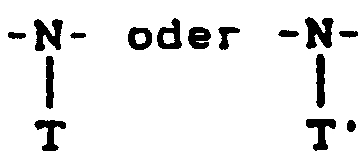
- n = 0 ist, R1 = R2 = Wasserstoff sein müssen,
- Überraschenderweise zeigen die Farbstoffe der Formel I nur geringe Durchschlagsneigung und zeigen weiterhin eine höhere Farbstärke als die üblicherweise verwendeten Pigmente.
- Ar bezeichnet vorzugsweise einen Phenylenrest.
- Beim Kohlenwasserstoffrest Z handelt es sich bevorzugt um einen Alkyl- wie C1-C20-Alkyl-, Alkenyl- wie C2-C20 Alkenyl-, Cycloalkyl-, wie C3-C7-Cycloalkyl-, Aryl- wie Phenyl- und Naphthyl-, Aralkyl- wie Phenyl-C1-C4-alkyl-und Naphthyl-C1-C4-alkyl-Rest.
- Bei den aliphatischen Resten Z und X handelt es sich bevorzugt um Alkyl- wie C1-C20-Alkyl-, Alkenyl- wie C2-C20-Alkenyl- und Cycloalkyl- wie C3-C7-Cycloalkyl-Reste.
- Die Alkyl-, Alkenyl- und Cycloalkyl-Reste X, Z können beispielsweise durch C1-C6-Alkoxy substituiert sein; die Aryl- und Aralkylreste Z können beispielsweise am aromatischen Ring durch CI-C6-Alkyl, C1-C6-Alkoxy, -OH und Halogen wie F, C1, Br, substituiert sein.
- Vorzugsweise eingesetzt werden folgende Verbindungen:
- Verbindungen der Formel:

- Z1 C6-C20-Alkyl bezeichnet.
- Verbindungen der Formel:

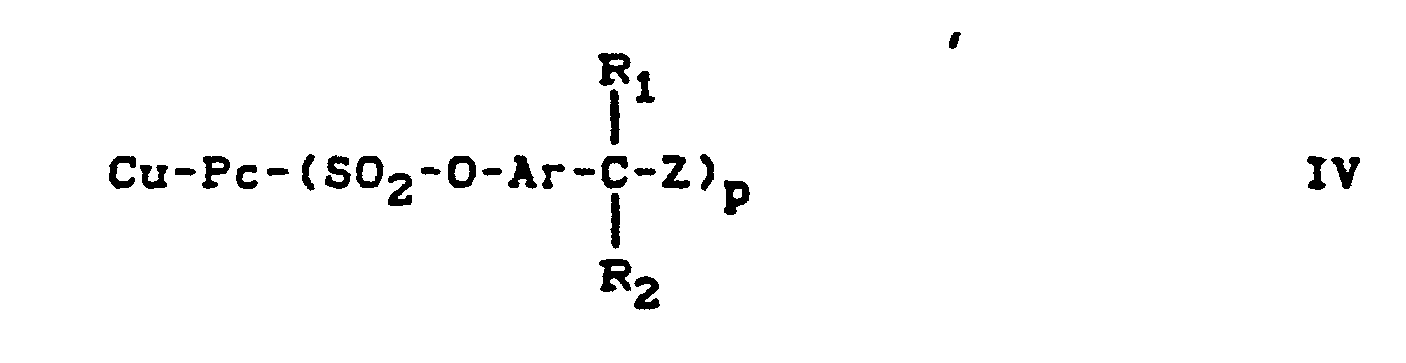
- Cu-Pc, T, Ar, R1, R2 und p die zu Formel I angegebenen Bedeutungen haben und
- Z1 C 6-C 20-Alkyl bezeichnet.
- Verbindungen der Fcrmel:

- Cu-Pc, Ar, R1, R2, Z und p die zu Formel I angegebenen Bedeutungen haben.
- Verbindungen der Formel:

- Cu-Pc, T, T', X, Z, p und q die zu Formel I angegebenen Bedeutungen haben.
- Weitere bevorzugte Verbindungen entsprechen den Formeln:



- Cu-Pc, T, Ar, n, R1, R2, X und Z die zu Formel I angegebenen Bedeutungen haben und
- p' 2 oder 3, bzw. 2-3,
- p" 2-2,8 und
- q' 0,2-1 bezeichnen.
- In den Formeln II bis VIII bedeuten Z1 und Z z.B. Hexyl, Heptyl, Octyl, Nonyl, Decyl, Dodecyl, Octadecyl.
- Die Herstellung der Farbstoffe der Formel I ist z.B. aus den Patentveröffentlichungen DE-OS 2 025 480, DE-OS 2 224 063, DE-OS 2 244 262, DE-OS 2 301 479, DE-OS 2 434 215, CH 364 573, JP 7 323 665, JP 67 059 586, FR 1 347 550 und FR 1 560 478 bekannt oder die Farbstoffe können in Analogie zu literaturbekannten Verfahren hergestellt werden.
- Die unter Verwendung der Farbstoffe der Formel I hergestellten Illustrationstiefdruckfarben enthalten bezogen auf das Gewicht der Komponenten A), B) und C), vorzugsweise
- A) etwa 2 bis etwa 20 Gew.-X Farbmittel,
- B) etwa 10 bis etwa 40 Gew.-X Harz und
- C) etwa 80 bis etwa 50 Gew.-X Lösungsmittel.
- Das Farbmittel kann auch ein Gemisch verschiedener Farbstoffe der Formel I sowie insbesondere auch ein Gemisch aus mindestens einem Farbstoff der Formel I und mindestens einem für Illustrationstiefdruckfarben geeigneten Pigment sein. Die letztgenannten Mischungen können bis zu 90 Gew.-% bevorzugt bis zu 50 Gew.-X Pigment enthalten.
- Bei Pigmenten, die sich zur Herstellung von Mischungen der genannten Phthalocyaninfarbstoffe mit Pigmenten eignen, handelt es sich bevorzugt um Blaupigmente wie C.I. Pigment Blue 15 und 27. Daneben kommen zur Erzeugung von besonderen Nuancen auch Mischungen mit Pigmenten mit anderem Farbton infrage, z.B. C.I. Pigment Yellow 12, 13, 14, 17, 74 und 83, C.I. Pigment Orange 5 und 34, C.I. Pigment Red 2, 53, 57:1, 112, 122, 146 und 148, C.I. Pigment Violet 19, C.I. Pigment Green 7 und 36 sowie C.I. Pigment Black 7. Die Phthalocyaninfarbstoffe können auch zum Nuancieren der genannten Pigmente verwendet werden.
- Geeignete Harze sind z.B. Gilsonite-Asphalt, kolophoniummodifizierte Harze, z.B. Kalk-, Zink- und Magnesiumsalze von Harzsäuren und ihren Umwandlungsprodukten, Harzester, Maleinatharze, kolophoniummodifizierte Phenolharze, Kohlenwasserstoffharze, Ketonharze, Chlorkautschuk, Nitrocellulose, Polyamidharze, Schellack, Vinylharze u.a.
- Geeignete Typen werden z.B. in Karsten, Lackrohstofftabellen, 7. Aufl., Curt R. Vincentz Verlag, aufgeführt.
- Als Lösungsmittel kommen aromatische und aliphatische Kohlenwasserstoffe wie Leichtbenzinsorten, C5-C8-aliphatische Kohlenwasserstoffe, Xylol und besonders bevorzugt Toluol in Betracht. Es können auch Mischungen von aliphatischen und aromatischen Kohlenwasserstoffen eingesetzt werden. Die vorliegende Erfindung betrifft bevorzugt die Verwendung von Farbstoffen der Formel 1 bei der Herstellung von Illustrationstiefdruckfarben auf Toluolbasis.
- Zur Herstellung der Illustrationstiefdruckfarben werden die Farbstoffe der Formel I, gegebenenfalls im Gemisch mit Pigmenten, in üblicher Weise in die Druckfarbenansätze eingearbeitet.
- Vorteilhafterweise können beim erfindungsgemäßen Verfahren zur Herstellung von Illustrationstiefdruckfarben dem Farbstoff der Formel I feindisperse anorganische Zuschlagstoffe mit einer spezifischen Oberfläche nach BET von mindestens 50 m2/g, bevorzugt mindestens 100 m2/g, besonders bevorzugt mindestens 200 m2 /g zugesetzt werden.
- Als Zuschlagstoffe haben sich insbesondere Aluminiumhydroxide und ganz besonders Kieselsäure bewährt. Die Zuschlagstoffe werden vorzugsweise in Mengen von 0,2 bis 2 Gew.-X, bezogen auf das Druckfarbengewicht, besonders bevorzugt 0,4 bis 0,9 Gew.-X eingesetzt.
- Durch diese Zusätze gelingt es, die Durchschlagsneigung der Farbstoffe weiter zu verringern, wobei Ergebnisse erzielt werden, wie sie sonst nur bei der alleinigen Verwendung von Pigmenten erreicht werden können.
- Bei den vorzugsweise eingesetzten feindispersen Kieselsäuren handelt es sich um überwiegend amorphe, mehr oder weniger vernetzte, feinteilige Kieselsäuren mit den o.a. spezifischen Oberflächen. Solche Kieselsäuren sind z.B. aus Ullmanns Encyklopädie der technischen Chemie, 4. Auflage, Band 21, S. 451-476 bekannt. Die Kieselsäuren können z.B. durch Fällung aus Lösungen oder nach pyrogenen Verfahren erhalten werden; sie können neben überwiegend Kieselsäure auch noch andere Metalloxide und -hydroxide enthalten, z.B. solche des Aluminiums und Titans.
- Die Kieselsäuren müssen in der Tiefdruckfarbe dispergiert sein. Diese Dispergierung kann in der fertigen Tiefdruckfarbe oder in einem Konzentrat erfolgen. Es ist jedoch auch möglich, zunächst eine Dispersion in dem für die Tiefdruckfarbe verwendeten Lösungsmittel gegebenenfalls auch in höherer Konzentration herzustellen, wobei man bereits einen Teil oder auch das gesamte Harz zusetzen kann. Geeignete Dispergieraggregate sind z.B.: Rührer, Schnellrührer, Dissolver, Perlmühlen und Kugelmühlen oder eine Kombination dieser Aggregate.
- Weiterhin kann es vorteilhaft sein, zusätzlich zu den Kieselsäuren noch Netz- und Dispergiermittel für diese zuzusetzen. Besonders geeignete Dispergiermittel sind die Salze starker organophiler Säuren mit aliphatischen Aminen und Polyaminen, die gegebenenfalls Hydroxylgruppen enthalten.
- Starke orgamophile Säuren sind z.B.:
- C10-C20-Alkansulfonsäuren, Alkylarylsulfonsäuren wie Dodecylbenzolsulfonsäure, Di-tert.-butylnaphthalinsulfon- säuren, Schwefelsäuremonoester oder Phosphorsäuremono-oder -diester von Alkanolen oder deren Umsetzungsprodukte mit Ethylenoxid. Solche Alkanole sind z.B. gesättigte oder ungesättigte, geradkettige oder verzweigte C4-C22-aliphatische Alkohole wie Butanol, 2-Ethylhexanol, Dodecanol, Tetra-, Hexa- und Octadecylalkohol, Oleylalkohol sowie die Umsetzungsprodukte dieser Alkohole mit 1 bis 20 mol Ethylen- oder Propylenoxid.
- Geeignete aliphatische Amine sind z.B.:
- Ethylendiamin, Amine der Formel H2N(CH2CH2NH)nH, mit n = 2-6, Propylendiamin, Dipropylendiamin, Talgfettpropylendiamin. Als hydroxylgruppenhaltige Amine kommen z.B. solche infrage, wie sie bei der Umsetzung von Ammoniak oder CI-C20-Alkylmono-, -di- oder -polyaminen mit Ethylen- oder Propylenoxid oder mit Epichlorhydrin entstehen.
- Beispiele hierfür sind: Ethanolamin, Di- und Triethanolamin, Tris-[2-(2-hydroxyethoxy)-ethyl]-amin, Bis-(2-hy- droxyehyl)-methyl-, -ethyl-, -propyl- oder -butylamin, 2-(2-Aminoethylamino)-ethanol, 2-Hydroxyethyl)-bis-(2-hydroxypropyl)-amin, Tris-(2-hydroxypropyl)-amin, 3-[Bis-(2-hydroxyethyl)amino]-propylamin, Pentahydroxyethyl-diethylentriamin, 2,3-Dihydroxypropylamin; die Umsetzungsprodukte von Kokosfettamin, Talgfettamin, Stearylamin und Oleyiamin mit 2 mol Ethylenoxid oder von Talgfettpropylendiamin mit 3 mol Ethylenoxid.
- Diese Dispergiermittel werden in Mengen zwischen 10 und 200 Gew.-%, bevorzugt 50 und 100 Gew.-X, bezogen auf die Kieselsäure zugesetzt.
- Als weitere feindisperse Zusatzstoffe kommen z.B. feindisperse Aluminiumhydroxide oder die weitgehend röntgenamorphen Aluminiumhydroxidgele infrage, wie sie z.B. durch Fällen aus sauren Aluminiumsalzlösungen mit Basen oder nach dem Verfahren der Flammenhydrolyse erhalten werden können. Bevorzugte Aluminiumhydroxide habn eine spezifische Oberfläche nach BET von wenigstens ca. 50 m2 /g. Sie können auf gleiche Weise und unter Zusatz der gleichen Dispergiermittel dispergiert werden wie es vorstehend für die Kieselsäuren beschrieben wurde. Auch Mischungen aus feindispersen Aluminiumhydroxiden und Kieselsäuren können erfindungsgemäß verwendet werden.
- Das Eindringen bzw. Durchschlagen einer Druckfarbe kann man prüfen, indem man das Durchscheinen oder Durchschlagen eines Druckes oder Aufstriches der Druckfarbe auf dem Bedruckstoff z.B. einem Druckpapier von der Rückseite visuell oder farbmetrisch beurteilt.
- Das Durchschlagen fällt besonders ins Gewicht bei den zunehmend verwendete, preiswerten Papierqualitäten mit einem Papiergewicht von 42 g/m2 oder weniger.
- 57,5 g Kupferphthalocyanin werden in 308 g Chlorsulfonsäure so lange bei 108 bis 110°C gerührt bis im Mittel 2,8 Sulfonsäure- oder Sulfonsäurechlorid-Gruppen in das Phthalocyanin-Molekül eingetreten sind. Anschließend werden bei 85°C allmählich 60 g Thionylchlorid eingerührt und so lange bei 90°C nachgerührt bis alle Sulfonsäure-Gruppen in Sulfonsäurechlorid-Gruppen übergeführt sind. Nach dem Abkühlen wird die Schmelze auf Eis ausgetragen, das Kupferphthalocyaninsulfonsäurechlorid abgesaugt und mit Eiswasser gewaschen.
- Die erhaltene Paste wird in eine Lösung von 85 g Dodecylamin in 350 g Diethylenglykolmonoethylether eingerührt. Mit Hilfe von verdünnter Natronlauge hält man den pH-Wert der Reaktionsmischung bis zur Beendigung der Reaktion auf 9,5 bis 10. Zur Aufarbeitung wird mit Methanol verdünnt, abgesaugt, mit Wasser ausgerührt, wieder abgesaugt und getrocknet. Man erhält 114 g des Farbstoffes der Formel

- 6 g des obigen Farbstoffes werden zusammen mit 26 g Erkazit 899, einem Calciumresinat der Firma Lackharzwerke Robert Krämer, in 68 g Toluol gelöst. Man erhält eine Toluol-Tiefdruckfarbe mit einer Viskosität, die einer Anlaufzeit von 23 Sekunden im DIN 3 Becher nach DIN 53 211 entspricht. Mit dieser Druckfarbe werden auf einem
- Dürner Tiefdruck Handandruckgerät Tiefdruckpapiers bedruckte wobei farbstarke türkisblaue Drucke erhalten werden. Beim Beurteilen dieser Drucke zeigt sich, daß die Druckfarbe bereits ein recht gutes Durchschlagverhalten aufweist. Lediglich auf sehr leichten Papieren wird ein gegenüber ausschließlich mit Hilfe von Pigmenten hergestellen Druckfarben gleicher Viskosität ein etwas schlechteres Durchschlagverhalten gefunden.
- Zu Toluol-Tiefdruckfarben mit ähnlichen Eigenschaften gelangt man, wenn man anstelle des obengenannten Farbstoffes die Farbstoffe einsetzt, die man erhält, wenn man die in der Spalte 2 der nachfolgenden Tabelle genannten Kupferphthalocyaninsulfonsäurechloride mit den in Spalte 3 genannten Aminen umsetzt. Bei der Herstellung der Toluol-Druckfarben muß man, um die gewünschte Viskosität von 23 Sekunden im DIN 3 Becher nach DIN 53 211 zu erhalten, die Mengenverhältnisse zwischen dem Erkazit-Harz und Toluol etwas variieren.
-

- 6 g des Farbstoffes, den man nach Beispiel 1, Absatz 2 erhält, werden zusammen mit 25,2 g Erkazit 899, einem Calciumresinat der Firma Lackharzwerke Robert Krämer, in 68 g Toluol gelost. In diese Lösung werden 0,8 g Aerosil 380, einer fein dispersen Kieselsäure der Firma Degussa eingerührt und auf mechanische Weise (z.B. in einem Red Devil) fein dispergiert. Die Druckfarbe entspricht in ihren Eigenschaften weitgehend der Druckfarbe, die nach Beispiel 1 erhalten wurde, zeigt jedoch beim Bedrucken von Papieren mit niedrigem Flächengewicht ein noch-besseres Durchschlagsverhalten.
- Anstelle von Aerosil 380 können auch Aerosil 300, Aerosil 200 oder HDKT 40, eine fein disperse Kieselsäure der Firma Wacker Chemie, eingesetzt werden. Die genannten Kieselsäuren haben spezifische Oberflächen nach BET von 380, 300, 200 bzw. 400 m2 /g.
- Auch die in Beispiel 1, Tabelle 1 genannten Türkisfarbstoffe können wie in Absatz 1 beschrieben in Toluol-Tiefdruckfarben übergeführt werden, die im Druck ein gutes Durchschlagsverhalten aufweisen, wobei-je nach Löslichkeit des Farbstoffes die Mengen von Erkazit 899 und Toluol etwas variiert werden müssen.
- 57,5 g Kupferphthalocyanin werden in 308 g Chlorsulfonsäure so lange bei 108 bis 1100C gerührt bis im Mittel 3 Sulfonsäure- oder Sulfonsäurechlorid-Gruppen in das Phthalocyanin-Molekül eingetreten sind. Anschließend werden bei 85°C allmählich 60 g Thionylchlorid eingerührt und so lange bei 90°C nachgerührt bis alle Sulfonsäure-Gruppen in Sulfonsäurechlorid-Gruppen übergeführt sind. Nach dem Abkühlen wird die Schmelze auf Eis ausgatragen, das Kupferphthalocyaninsulfonsäurechlorid abgesaugt und mit Eiswasser gewaschen.
- Die erhaltene Paste wird in eine Lösung von 85 g 2-Phenyl-2-(4-hydroxyphenyl)-propan, 16 g Natriumhydroxyd und 800 g Wasser gegeben. Man steigert die Temperatur des Reaktionsgemisches auf 25°C, rührt einige Stunden bei dieser Temperatur und zur Vervollständigung des Umsatzes noch einige Zeit bei 45 bis 50°C. Nach dem Abkühlen wird das Reaktionsprodukt abgesaugt, mit Wasser, Methanol und nochmals mit Wasser gewaschen und getrocknet. Man erhält in nahezu quantitativer Ausbeute den türkisblauen Farbstoff der Formel

- 6 g des obigen Farbstoffes werden zusammen mit 29 g Erkazit 899, einem Calciumresinat der Firma Lackharzwerke Robert Krämer in 65 g Toluol gelöst. Man erhält eine Toluol-Tiefdruckfarbe mit einer Viskosität, die einer Auslaufzeit von 23 Sekunden im DIN 3 Becher nach DIN 53 211 entspricht. Mit dieser Druckfarbe werden auf einem Dürner Tiefdruck Handdruckgerät Tiefdruckpapiere bedruckt, wobei farbstarke türkisblaue Drucke erhalten werden. Die Druckfarbe weist bereits ein recht gutes Durchschlagsverhalten auf. Lediglich auf leichten Papieren wird ein gegenüber ausschließlich mit Hilfe von Pigmenten hergestellten Druckfarben gleicher Viskosität ein etwas schlechteres Durchschlagsverhalten gefunden.
- Das Durchschlagsverhalten der Druckfarbe kann verbessert werden, wenn man der Druckfarbe, wie in Beispiel 2 beschrieben, 0,8 g Aerosil 380, eine feindisperse Kieselsäure der Firma Degussa, zusetzt und in der Farbstofflösung fein dispergiert. Anstelle von Aerosil 380 können auch Aerosil 300, Aerosil 200 oder HDKT 40, eine fein disperse Kieselsäure der Firma Wacker Chemie, eingesetzt werden.
- Mit ähnlichem Erfolg kann man den in Absatz 2 genannten Farbstoff durch die Farbstoffe ersetzen, die man erhält, wenn man die in Spalte 2 der nachfolgenden Tabelle genannten Kupferphthalocyaninsulfonsäurechloride mit den in Spalte 3 genannten Phenolen umsetzt. Bei der Herstellung der Toluol-Druckfarben muß man, um die gewünschte Viskosität von 23 Sekunden im DIN 3 Becher nach DIN 53 211 zu erhalten, gegebenenfalls die Mengenverhältnisse zwischen dem Erkazit-Harz und Toluol etwas variieren.

- 21,8 g des Kupferphthalocyaninsulfonsäureamid-Derivates, das man erhält, wenn man das nach Beispiel 3, Absatz 1 erhaltene Kupferphthalocyaninsulfonsäurechlorid mit 7,5 g Propanolamin und 26 g 2-Ethylhexylamin unter Verwendung von Natriumhydroxyd als säurebindendes Mittel umsetzt, werden in 40 g Toluol zusammen mit 5,6 g Ölsäure und 0,1 g Methansulfonsäure zum Sieden erhitzt. Das sich bildende Veresterungswasser wird mit Hilfe eines Wasserabscheiders abgetrennt und dabei das Toluol so weit abdestilliert, daß ein Siedepunkt von 120°C bis 130°C erreicht wird. Man läßt 8-Stunden bei dieser Temperatur reagieren, kühlt ab und versetzt das Reaktionsgemisch mit Methanol, saugt ab, wäscht kurz mit Methanol und trocknet. Der erhaltene türkisblaue Farbstoff entspricht im wesentlichen der Formel

- 7 g des obigen Farbstoffes werden zusammen mit 25 g Erkazit 899, einem Calciumresinat der Firma Lackharzwerke Robert Krämer, in 68 g Toluol gelöst. Man erhält eine Toluol-Tiefdruckfarbe, mit der auf einem Dürner Tiefdruck Handandruckgerät Tiefdruckpapiere türkisblau bedruckt werden können. Die Druckfarbe weist bereits ein recht guten
- Durchschlagsverhalten auf. Lediglich auf sehr leichten Papieren wird ein gegenüber ausschließlich mit Hilfe von Pigmenten hergestellten Druckfarben gleicher Viskosität ein etwas schlechteres Durchschlagsverhalten gefunden.
- Zu Druckfarbstoffen mit ähnlichen Eigenschaften gelangt man, wenn man das in Absatz 1 genannte Propanolamin durch äquimolare Mengen von Ethanolamin, Butanolamin oder Diethylamin, bzw, das in Absatz 1 verwendete 2-Ethylhexylamin durch äquimolekulare Mengen von Dodecylamin, Oleylamin, 3-Amino-5-methyl-l-phenylhexan oder 2'-Ethylhexoxypropylamin bzw. die dort genannte Ölsäure durch Undecylensäure, Laurinsäure, Myristinsäure, Palmitinsäure oder Stearinsäure ersetzt.
zur Herstellung von Illustrationstiefdruckfarben eignen.
Claims (10)




Applications Claiming Priority (4)
| Application Number | Priority Date | Filing Date | Title |
|---|---|---|---|
| DE3528423 | 1985-08-08 | ||
| DE3528423 | 1985-08-08 | ||
| DE19863600348 DE3600348A1 (de) | 1985-08-08 | 1986-01-09 | Herstellung von illustrationstiefdruckfarben |
| DE3600348 | 1986-01-09 |
Publications (2)
| Publication Number | Publication Date |
|---|---|
| EP0211323A2 true EP0211323A2 (de) | 1987-02-25 |
| EP0211323A3 EP0211323A3 (de) | 1987-09-30 |
Family
ID=25834840
Family Applications (1)
| Application Number | Title | Priority Date | Filing Date |
|---|---|---|---|
| EP86110090A Withdrawn EP0211323A3 (de) | 1985-08-08 | 1986-07-23 | Herstellung von Illustrationstiefdruckfarben |
Country Status (2)
| Country | Link |
|---|---|
| EP (1) | EP0211323A3 (de) |
| DE (1) | DE3600348A1 (de) |
Cited By (1)
| Publication number | Priority date | Publication date | Assignee | Title |
|---|---|---|---|---|
| EP0649881A1 (de) * | 1993-10-21 | 1995-04-26 | Bayer Ag | Neue Kupferphthalocyanin-Farbstoffe und deren Verwendung |
Family Cites Families (1)
| Publication number | Priority date | Publication date | Assignee | Title |
|---|---|---|---|---|
| CH611922A5 (de) * | 1975-07-03 | 1979-06-29 | Ciba Geigy Ag |
-
1986
- 1986-01-09 DE DE19863600348 patent/DE3600348A1/de not_active Withdrawn
- 1986-07-23 EP EP86110090A patent/EP0211323A3/de not_active Withdrawn
Cited By (2)
| Publication number | Priority date | Publication date | Assignee | Title |
|---|---|---|---|---|
| EP0649881A1 (de) * | 1993-10-21 | 1995-04-26 | Bayer Ag | Neue Kupferphthalocyanin-Farbstoffe und deren Verwendung |
| US5501710A (en) * | 1993-10-21 | 1996-03-26 | Bayer Aktiengesellschaft | Copper phthalocyanine dyestuffs and their use |
Also Published As
| Publication number | Publication date |
|---|---|
| EP0211323A3 (de) | 1987-09-30 |
| DE3600348A1 (de) | 1987-02-19 |
Similar Documents
| Publication | Publication Date | Title |
|---|---|---|
| EP0538784B1 (de) | Pigmentzubereitungen | |
| EP0084645B1 (de) | Hochkonzentrierte, nichtstaubende, feste und leicht verteilbare Pigmentpräparation und deren Verwendung | |
| EP0395988B1 (de) | Pigmentzubereitungen und deren Verwendung | |
| EP0403917B1 (de) | Hochkonzentrierte feste Pigmentpräparationen | |
| DE102004011347A1 (de) | Druckfarben für den Offset- und/oder Hochdruck mit NIR-Absorbern sowie in Offset- und/oder Hochdruckfarben lösliche NIR-Absorber | |
| DE2103030C3 (de) | Verfahren zur Pigmentbehandlung | |
| EP0211326B1 (de) | Herstellung von Illustrationstiefdruckfarben | |
| EP0492501B1 (de) | Grenzflächenaktive Triazinverbindungen, Verfahren zu ihrer Herstellung und ihre Verwendung | |
| DE2914299C3 (de) | Pigmentpräparate, Verfahren zu ihrer Herstellung und ihre Verwendung | |
| DE2206611C2 (de) | Farbstoffe, Verfahren zu deren Herstellung und ihre Verwendung als Dispergiermittel für die Herstellung von Dispersionen von Pigmenten in organischen Flüssigkeiten, für Druckfarben und Färbepräparate | |
| DE3873252T2 (de) | Pigment von hoher staerke zur verwendung in drucktinten. | |
| DE3026127A1 (de) | Bisphenolderivate, verfahren zu ihrer herstellung und ihre verwendung als tenside | |
| CH630946A5 (de) | Phthalocyaninpigmentpraeparate und verfahren zu deren herstellung. | |
| DE3037494C2 (de) | Verfahren zur Herstellung eines Isoindolinonpigments | |
| EP0017189A1 (de) | Wasserlösliche Oxalkylierungsprodukte, Verfahren zu deren Herstellung und ihre Verwendung | |
| EP0211323A2 (de) | Herstellung von Illustrationstiefdruckfarben | |
| EP0087713B1 (de) | Neue Zubereitungen von Phthalocyaninen und deren Verwendung | |
| EP0513782B1 (de) | Stickstoffhaltige, grenzflächenaktive Mittel, abgeleitet aus Harzsäuren | |
| EP0211324A2 (de) | Herstellung von Illustrationstiefdruckfarben | |
| EP0212361A2 (de) | Pigmentpräparationen | |
| DE2017040A1 (de) | Pigment zusammensetzungen | |
| DE4134079C2 (de) | Pigmentpräparation, Verfahren zu ihrer Herstellung und ihre Verwendung | |
| EP0074559B1 (de) | Beta-Ketoamide und diese Amide enthaltende Pigmentzubereitungen | |
| EP0193022A1 (de) | Mischungen aus Disazopigmenten und löslichen Farbstoffen | |
| EP0138104B1 (de) | Azopigmentpräparationen |
Legal Events
| Date | Code | Title | Description |
|---|---|---|---|
| PUAI | Public reference made under article 153(3) epc to a published international application that has entered the european phase |
Free format text: ORIGINAL CODE: 0009012 |
|
| 17P | Request for examination filed |
Effective date: 19860731 |
|
| AK | Designated contracting states |
Kind code of ref document: A2 Designated state(s): CH DE FR GB LI |
|
| PUAL | Search report despatched |
Free format text: ORIGINAL CODE: 0009013 |
|
| AK | Designated contracting states |
Kind code of ref document: A3 Designated state(s): CH DE FR GB LI |
|
| STAA | Information on the status of an ep patent application or granted ep patent |
Free format text: STATUS: THE APPLICATION HAS BEEN WITHDRAWN |
|
| 17Q | First examination report despatched |
Effective date: 19890213 |
|
| 18W | Application withdrawn |
Withdrawal date: 19890311 |
|
| RIN1 | Information on inventor provided before grant (corrected) |
Inventor name: LORENZ, MANFRED, DR. Inventor name: GROLL, MANFRED, DR. Inventor name: HAUS, ARTUR, DR. |