EP0211406A2 - Photopolymerisierbares Gemisch mit Polyvinylacetal als Bindemittel und daraus hergestelltes Aufzeichnungsmaterial - Google Patents
Photopolymerisierbares Gemisch mit Polyvinylacetal als Bindemittel und daraus hergestelltes Aufzeichnungsmaterial Download PDFInfo
- Publication number
- EP0211406A2 EP0211406A2 EP86110605A EP86110605A EP0211406A2 EP 0211406 A2 EP0211406 A2 EP 0211406A2 EP 86110605 A EP86110605 A EP 86110605A EP 86110605 A EP86110605 A EP 86110605A EP 0211406 A2 EP0211406 A2 EP 0211406A2
- Authority
- EP
- European Patent Office
- Prior art keywords
- weight
- proportion
- acrylic
- mixture
- methacrylic acid
- Prior art date
- Legal status (The legal status is an assumption and is not a legal conclusion. Google has not performed a legal analysis and makes no representation as to the accuracy of the status listed.)
- Withdrawn
Links
- 239000000203 mixture Substances 0.000 title claims abstract description 108
- 239000011230 binding agent Substances 0.000 title claims abstract description 25
- 239000000463 material Substances 0.000 title claims description 12
- 229920002554 vinyl polymer Polymers 0.000 title abstract description 7
- DHKHKXVYLBGOIT-UHFFFAOYSA-N acetaldehyde Diethyl Acetal Natural products CCOC(C)OCC DHKHKXVYLBGOIT-UHFFFAOYSA-N 0.000 title description 3
- 125000002777 acetyl group Chemical class [H]C([H])([H])C(*)=O 0.000 title 1
- 238000007650 screen-printing Methods 0.000 claims abstract description 15
- 125000004435 hydrogen atom Chemical group [H]* 0.000 claims abstract description 10
- SMZOUWXMTYCWNB-UHFFFAOYSA-N 2-(2-methoxy-5-methylphenyl)ethanamine Chemical compound COC1=CC=C(C)C=C1CCN SMZOUWXMTYCWNB-UHFFFAOYSA-N 0.000 claims abstract description 8
- CERQOIWHTDAKMF-UHFFFAOYSA-N Methacrylic acid Chemical class CC(=C)C(O)=O CERQOIWHTDAKMF-UHFFFAOYSA-N 0.000 claims abstract description 8
- 125000000217 alkyl group Chemical group 0.000 claims abstract description 4
- 150000001875 compounds Chemical class 0.000 claims description 21
- 229920000642 polymer Polymers 0.000 claims description 18
- NIXOWILDQLNWCW-UHFFFAOYSA-N acrylic acid group Chemical group C(C=C)(=O)O NIXOWILDQLNWCW-UHFFFAOYSA-N 0.000 claims description 14
- 125000005397 methacrylic acid ester group Chemical group 0.000 claims description 8
- 239000007795 chemical reaction product Substances 0.000 claims description 6
- 125000005442 diisocyanate group Chemical group 0.000 claims description 6
- 239000000470 constituent Substances 0.000 claims description 4
- XLYOFNOQVPJJNP-UHFFFAOYSA-N water Substances O XLYOFNOQVPJJNP-UHFFFAOYSA-N 0.000 abstract description 52
- IMROMDMJAWUWLK-UHFFFAOYSA-N Ethenol Chemical compound OC=C IMROMDMJAWUWLK-UHFFFAOYSA-N 0.000 abstract description 36
- 238000007639 printing Methods 0.000 abstract description 30
- XTXRWKRVRITETP-UHFFFAOYSA-N Vinyl acetate Chemical compound CC(=O)OC=C XTXRWKRVRITETP-UHFFFAOYSA-N 0.000 abstract description 2
- 239000007864 aqueous solution Substances 0.000 abstract description 2
- 239000000243 solution Substances 0.000 description 74
- LFQSCWFLJHTTHZ-UHFFFAOYSA-N Ethanol Chemical compound CCO LFQSCWFLJHTTHZ-UHFFFAOYSA-N 0.000 description 52
- VEXZGXHMUGYJMC-UHFFFAOYSA-N Hydrochloric acid Chemical compound Cl VEXZGXHMUGYJMC-UHFFFAOYSA-N 0.000 description 32
- BDERNNFJNOPAEC-UHFFFAOYSA-N propan-1-ol Chemical compound CCCO BDERNNFJNOPAEC-UHFFFAOYSA-N 0.000 description 30
- 229920001577 copolymer Polymers 0.000 description 28
- 239000000178 monomer Substances 0.000 description 25
- 229920000728 polyester Polymers 0.000 description 25
- LENSOMXELNSPGU-UHFFFAOYSA-N C1(=C(C=CC=C1)N1NC(=CC(=N1)C(Cl)(Cl)Cl)C(Cl)(Cl)Cl)C=CC1=CC=CC=C1 Chemical compound C1(=C(C=CC=C1)N1NC(=CC(=N1)C(Cl)(Cl)Cl)C(Cl)(Cl)Cl)C=CC1=CC=CC=C1 LENSOMXELNSPGU-UHFFFAOYSA-N 0.000 description 22
- 239000002904 solvent Substances 0.000 description 20
- 125000002887 hydroxy group Chemical group [H]O* 0.000 description 19
- -1 vinyl acetal Chemical class 0.000 description 19
- IKHGUXGNUITLKF-UHFFFAOYSA-N Acetaldehyde Chemical compound CC=O IKHGUXGNUITLKF-UHFFFAOYSA-N 0.000 description 18
- 229920002451 polyvinyl alcohol Polymers 0.000 description 18
- 239000007787 solid Substances 0.000 description 18
- CERQOIWHTDAKMF-UHFFFAOYSA-M Methacrylate Chemical compound CC(=C)C([O-])=O CERQOIWHTDAKMF-UHFFFAOYSA-M 0.000 description 17
- 229910052782 aluminium Inorganic materials 0.000 description 16
- XAGFODPZIPBFFR-UHFFFAOYSA-N aluminium Chemical compound [Al] XAGFODPZIPBFFR-UHFFFAOYSA-N 0.000 description 16
- 150000001241 acetals Chemical class 0.000 description 14
- 239000002253 acid Substances 0.000 description 14
- 238000004519 manufacturing process Methods 0.000 description 14
- 229920005989 resin Polymers 0.000 description 14
- 239000011347 resin Substances 0.000 description 14
- 239000004372 Polyvinyl alcohol Substances 0.000 description 13
- 125000004386 diacrylate group Chemical group 0.000 description 12
- XNWFRZJHXBZDAG-UHFFFAOYSA-N 2-METHOXYETHANOL Chemical compound COCCO XNWFRZJHXBZDAG-UHFFFAOYSA-N 0.000 description 11
- 125000004036 acetal group Chemical group 0.000 description 11
- 239000000047 product Substances 0.000 description 11
- 238000003756 stirring Methods 0.000 description 11
- 239000011550 stock solution Substances 0.000 description 10
- NBBJYMSMWIIQGU-UHFFFAOYSA-N Propionic aldehyde Chemical compound CCC=O NBBJYMSMWIIQGU-UHFFFAOYSA-N 0.000 description 9
- 238000012360 testing method Methods 0.000 description 9
- MYWOJODOMFBVCB-UHFFFAOYSA-N 1,2,6-trimethylphenanthrene Chemical compound CC1=CC=C2C3=CC(C)=CC=C3C=CC2=C1C MYWOJODOMFBVCB-UHFFFAOYSA-N 0.000 description 8
- NIXOWILDQLNWCW-UHFFFAOYSA-M Acrylate Chemical compound [O-]C(=O)C=C NIXOWILDQLNWCW-UHFFFAOYSA-M 0.000 description 8
- ZCZFEIZSYJAXKS-UHFFFAOYSA-N [3-hydroxy-2,2-bis(hydroxymethyl)propyl] prop-2-enoate Chemical compound OCC(CO)(CO)COC(=O)C=C ZCZFEIZSYJAXKS-UHFFFAOYSA-N 0.000 description 8
- 239000011541 reaction mixture Substances 0.000 description 8
- KTALPKYXQZGAEG-UHFFFAOYSA-N 2-propan-2-ylthioxanthen-9-one Chemical compound C1=CC=C2C(=O)C3=CC(C(C)C)=CC=C3SC2=C1 KTALPKYXQZGAEG-UHFFFAOYSA-N 0.000 description 7
- DGAQECJNVWCQMB-PUAWFVPOSA-M Ilexoside XXIX Chemical compound C[C@@H]1CC[C@@]2(CC[C@@]3(C(=CC[C@H]4[C@]3(CC[C@@H]5[C@@]4(CC[C@@H](C5(C)C)OS(=O)(=O)[O-])C)C)[C@@H]2[C@]1(C)O)C)C(=O)O[C@H]6[C@@H]([C@H]([C@@H]([C@H](O6)CO)O)O)O.[Na+] DGAQECJNVWCQMB-PUAWFVPOSA-M 0.000 description 7
- 150000001299 aldehydes Chemical class 0.000 description 7
- 150000002009 diols Chemical class 0.000 description 7
- 238000000034 method Methods 0.000 description 7
- 229940113115 polyethylene glycol 200 Drugs 0.000 description 7
- JOYRKODLDBILNP-UHFFFAOYSA-N urethane group Chemical group NC(=O)OCC JOYRKODLDBILNP-UHFFFAOYSA-N 0.000 description 7
- ZWEHNKRNPOVVGH-UHFFFAOYSA-N 2-Butanone Chemical compound CCC(C)=O ZWEHNKRNPOVVGH-UHFFFAOYSA-N 0.000 description 6
- YEJRWHAVMIAJKC-UHFFFAOYSA-N 4-Butyrolactone Chemical compound O=C1CCCO1 YEJRWHAVMIAJKC-UHFFFAOYSA-N 0.000 description 6
- NBIIXXVUZAFLBC-UHFFFAOYSA-N Phosphoric acid Chemical compound OP(O)(O)=O NBIIXXVUZAFLBC-UHFFFAOYSA-N 0.000 description 6
- QAOWNCQODCNURD-UHFFFAOYSA-N Sulfuric acid Chemical compound OS(O)(=O)=O QAOWNCQODCNURD-UHFFFAOYSA-N 0.000 description 6
- WYURNTSHIVDZCO-UHFFFAOYSA-N Tetrahydrofuran Chemical compound C1CCOC1 WYURNTSHIVDZCO-UHFFFAOYSA-N 0.000 description 6
- HVVWZTWDBSEWIH-UHFFFAOYSA-N [2-(hydroxymethyl)-3-prop-2-enoyloxy-2-(prop-2-enoyloxymethyl)propyl] prop-2-enoate Chemical compound C=CC(=O)OCC(CO)(COC(=O)C=C)COC(=O)C=C HVVWZTWDBSEWIH-UHFFFAOYSA-N 0.000 description 6
- INXWLSDYDXPENO-UHFFFAOYSA-N [2-(hydroxymethyl)-3-prop-2-enoyloxy-2-[[3-prop-2-enoyloxy-2,2-bis(prop-2-enoyloxymethyl)propoxy]methyl]propyl] prop-2-enoate Chemical compound C=CC(=O)OCC(COC(=O)C=C)(CO)COCC(COC(=O)C=C)(COC(=O)C=C)COC(=O)C=C INXWLSDYDXPENO-UHFFFAOYSA-N 0.000 description 6
- 125000004432 carbon atom Chemical group C* 0.000 description 6
- 230000000052 comparative effect Effects 0.000 description 6
- 239000003960 organic solvent Substances 0.000 description 6
- CDBYLPFSWZWCQE-UHFFFAOYSA-L sodium carbonate Substances [Na+].[Na+].[O-]C([O-])=O CDBYLPFSWZWCQE-UHFFFAOYSA-L 0.000 description 6
- WHXSMMKQMYFTQS-UHFFFAOYSA-N Lithium Chemical compound [Li] WHXSMMKQMYFTQS-UHFFFAOYSA-N 0.000 description 5
- DAKWPKUUDNSNPN-UHFFFAOYSA-N Trimethylolpropane triacrylate Chemical compound C=CC(=O)OCC(CC)(COC(=O)C=C)COC(=O)C=C DAKWPKUUDNSNPN-UHFFFAOYSA-N 0.000 description 5
- 239000010408 film Substances 0.000 description 5
- 150000003254 radicals Chemical class 0.000 description 5
- 239000011734 sodium Substances 0.000 description 5
- 229910052708 sodium Inorganic materials 0.000 description 5
- HEMHJVSKTPXQMS-UHFFFAOYSA-M sodium hydroxide Inorganic materials [OH-].[Na+] HEMHJVSKTPXQMS-UHFFFAOYSA-M 0.000 description 5
- QTBSBXVTEAMEQO-UHFFFAOYSA-N Acetic acid Chemical group CC(O)=O QTBSBXVTEAMEQO-UHFFFAOYSA-N 0.000 description 4
- IJGRMHOSHXDMSA-UHFFFAOYSA-N Atomic nitrogen Chemical compound N#N IJGRMHOSHXDMSA-UHFFFAOYSA-N 0.000 description 4
- 239000004375 Dextrin Substances 0.000 description 4
- 229920001353 Dextrin Polymers 0.000 description 4
- ZLMJMSJWJFRBEC-UHFFFAOYSA-N Potassium Chemical compound [K] ZLMJMSJWJFRBEC-UHFFFAOYSA-N 0.000 description 4
- WNLRTRBMVRJNCN-UHFFFAOYSA-N adipic acid Chemical compound OC(=O)CCCCC(O)=O WNLRTRBMVRJNCN-UHFFFAOYSA-N 0.000 description 4
- 238000004458 analytical method Methods 0.000 description 4
- ZTQSAGDEMFDKMZ-UHFFFAOYSA-N butyric aldehyde Natural products CCCC=O ZTQSAGDEMFDKMZ-UHFFFAOYSA-N 0.000 description 4
- 239000011248 coating agent Substances 0.000 description 4
- 238000000576 coating method Methods 0.000 description 4
- 239000003086 colorant Substances 0.000 description 4
- 235000019425 dextrin Nutrition 0.000 description 4
- UHESRSKEBRADOO-UHFFFAOYSA-N ethyl carbamate;prop-2-enoic acid Chemical compound OC(=O)C=C.CCOC(N)=O UHESRSKEBRADOO-UHFFFAOYSA-N 0.000 description 4
- LYCAIKOWRPUZTN-UHFFFAOYSA-N ethylene glycol Natural products OCCO LYCAIKOWRPUZTN-UHFFFAOYSA-N 0.000 description 4
- JARKCYVAAOWBJS-UHFFFAOYSA-N hexanal Chemical compound CCCCCC=O JARKCYVAAOWBJS-UHFFFAOYSA-N 0.000 description 4
- 239000004014 plasticizer Substances 0.000 description 4
- 229910052700 potassium Inorganic materials 0.000 description 4
- 239000011591 potassium Substances 0.000 description 4
- 230000000087 stabilizing effect Effects 0.000 description 4
- JOXIMZWYDAKGHI-UHFFFAOYSA-N toluene-4-sulfonic acid Chemical compound CC1=CC=C(S(O)(=O)=O)C=C1 JOXIMZWYDAKGHI-UHFFFAOYSA-N 0.000 description 4
- PUPZLCDOIYMWBV-UHFFFAOYSA-N (+/-)-1,3-Butanediol Chemical compound CC(O)CCO PUPZLCDOIYMWBV-UHFFFAOYSA-N 0.000 description 3
- OMIGHNLMNHATMP-UHFFFAOYSA-N 2-hydroxyethyl prop-2-enoate Chemical compound OCCOC(=O)C=C OMIGHNLMNHATMP-UHFFFAOYSA-N 0.000 description 3
- IAYPIBMASNFSPL-UHFFFAOYSA-N Ethylene oxide Chemical compound C1CO1 IAYPIBMASNFSPL-UHFFFAOYSA-N 0.000 description 3
- WSFSSNUMVMOOMR-UHFFFAOYSA-N Formaldehyde Chemical compound O=C WSFSSNUMVMOOMR-UHFFFAOYSA-N 0.000 description 3
- OFOBLEOULBTSOW-UHFFFAOYSA-N Malonic acid Chemical compound OC(=O)CC(O)=O OFOBLEOULBTSOW-UHFFFAOYSA-N 0.000 description 3
- 235000008098 Oxalis acetosella Nutrition 0.000 description 3
- 239000004698 Polyethylene Substances 0.000 description 3
- KWYUFKZDYYNOTN-UHFFFAOYSA-M Potassium hydroxide Chemical compound [OH-].[K+] KWYUFKZDYYNOTN-UHFFFAOYSA-M 0.000 description 3
- DNIAPMSPPWPWGF-UHFFFAOYSA-N Propylene glycol Chemical compound CC(O)CO DNIAPMSPPWPWGF-UHFFFAOYSA-N 0.000 description 3
- 244000126309 Trifolium dubium Species 0.000 description 3
- CQHKDHVZYZUZMJ-UHFFFAOYSA-N [2,2-bis(hydroxymethyl)-3-prop-2-enoyloxypropyl] prop-2-enoate Chemical compound C=CC(=O)OCC(CO)(CO)COC(=O)C=C CQHKDHVZYZUZMJ-UHFFFAOYSA-N 0.000 description 3
- 150000007513 acids Chemical class 0.000 description 3
- 229910000147 aluminium phosphate Inorganic materials 0.000 description 3
- QVGXLLKOCUKJST-UHFFFAOYSA-N atomic oxygen Chemical compound [O] QVGXLLKOCUKJST-UHFFFAOYSA-N 0.000 description 3
- 230000008901 benefit Effects 0.000 description 3
- WPYMKLBDIGXBTP-UHFFFAOYSA-N benzoic acid group Chemical group C(C1=CC=CC=C1)(=O)O WPYMKLBDIGXBTP-UHFFFAOYSA-N 0.000 description 3
- 238000011161 development Methods 0.000 description 3
- 229910003460 diamond Inorganic materials 0.000 description 3
- 239000010432 diamond Substances 0.000 description 3
- 238000001035 drying Methods 0.000 description 3
- 239000004744 fabric Substances 0.000 description 3
- XXMIOPMDWAUFGU-UHFFFAOYSA-N hexane-1,6-diol Chemical compound OCCCCCCO XXMIOPMDWAUFGU-UHFFFAOYSA-N 0.000 description 3
- IQPQWNKOIGAROB-UHFFFAOYSA-N isocyanate group Chemical group [N-]=C=O IQPQWNKOIGAROB-UHFFFAOYSA-N 0.000 description 3
- 229910052744 lithium Inorganic materials 0.000 description 3
- 229910052751 metal Inorganic materials 0.000 description 3
- 239000002184 metal Substances 0.000 description 3
- 239000001301 oxygen Substances 0.000 description 3
- 229910052760 oxygen Inorganic materials 0.000 description 3
- 239000000049 pigment Substances 0.000 description 3
- 229920000573 polyethylene Polymers 0.000 description 3
- 229920000036 polyvinylpyrrolidone Polymers 0.000 description 3
- 239000001267 polyvinylpyrrolidone Substances 0.000 description 3
- 235000013855 polyvinylpyrrolidone Nutrition 0.000 description 3
- 230000005855 radiation Effects 0.000 description 3
- 229910000029 sodium carbonate Inorganic materials 0.000 description 3
- 239000001488 sodium phosphate Substances 0.000 description 3
- 239000011877 solvent mixture Substances 0.000 description 3
- YLQBMQCUIZJEEH-UHFFFAOYSA-N tetrahydrofuran Natural products C=1C=COC=1 YLQBMQCUIZJEEH-UHFFFAOYSA-N 0.000 description 3
- 239000000080 wetting agent Substances 0.000 description 3
- YTLYLLTVENPWFT-UPHRSURJSA-N (Z)-3-aminoacrylic acid Chemical compound N\C=C/C(O)=O YTLYLLTVENPWFT-UPHRSURJSA-N 0.000 description 2
- ARXJGSRGQADJSQ-UHFFFAOYSA-N 1-methoxypropan-2-ol Chemical compound COCC(C)O ARXJGSRGQADJSQ-UHFFFAOYSA-N 0.000 description 2
- VWCGSMURTSZNCW-UHFFFAOYSA-N 2-methylprop-2-enoic acid prop-2-enoic acid Chemical compound C(C(=C)C)(=O)O.C(C=C)(=O)O.C(C=C)(=O)O.C(C=C)(=O)O.C(C=C)(=O)O.C(C=C)(=O)O VWCGSMURTSZNCW-UHFFFAOYSA-N 0.000 description 2
- CSCPPACGZOOCGX-UHFFFAOYSA-N Acetone Chemical compound CC(C)=O CSCPPACGZOOCGX-UHFFFAOYSA-N 0.000 description 2
- LSNNMFCWUKXFEE-UHFFFAOYSA-M Bisulfite Chemical compound OS([O-])=O LSNNMFCWUKXFEE-UHFFFAOYSA-M 0.000 description 2
- UFHFLCQGNIYNRP-UHFFFAOYSA-N Hydrogen Chemical compound [H][H] UFHFLCQGNIYNRP-UHFFFAOYSA-N 0.000 description 2
- BDJRBEYXGGNYIS-UHFFFAOYSA-N Nonanedioid acid Natural products OC(=O)CCCCCCCC(O)=O BDJRBEYXGGNYIS-UHFFFAOYSA-N 0.000 description 2
- 206010034972 Photosensitivity reaction Diseases 0.000 description 2
- 239000004115 Sodium Silicate Substances 0.000 description 2
- 244000028419 Styrax benzoin Species 0.000 description 2
- 235000000126 Styrax benzoin Nutrition 0.000 description 2
- TYFQFVWCELRYAO-UHFFFAOYSA-N Suberic acid Natural products OC(=O)CCCCCCC(O)=O TYFQFVWCELRYAO-UHFFFAOYSA-N 0.000 description 2
- 235000008411 Sumatra benzointree Nutrition 0.000 description 2
- ZJCCRDAZUWHFQH-UHFFFAOYSA-N Trimethylolpropane Chemical compound CCC(CO)(CO)CO ZJCCRDAZUWHFQH-UHFFFAOYSA-N 0.000 description 2
- 229920004890 Triton X-100 Polymers 0.000 description 2
- 239000013504 Triton X-100 Substances 0.000 description 2
- APZPSKFMSWZPKL-UHFFFAOYSA-N [3-hydroxy-2,2-bis(hydroxymethyl)propyl] 2-methylprop-2-enoate Chemical compound CC(=C)C(=O)OCC(CO)(CO)CO APZPSKFMSWZPKL-UHFFFAOYSA-N 0.000 description 2
- 238000005299 abrasion Methods 0.000 description 2
- 230000001070 adhesive effect Effects 0.000 description 2
- 239000001361 adipic acid Substances 0.000 description 2
- 235000011037 adipic acid Nutrition 0.000 description 2
- 150000001298 alcohols Chemical class 0.000 description 2
- 125000001931 aliphatic group Chemical group 0.000 description 2
- 125000002947 alkylene group Chemical group 0.000 description 2
- 239000012298 atmosphere Substances 0.000 description 2
- 230000004888 barrier function Effects 0.000 description 2
- RWCCWEUUXYIKHB-UHFFFAOYSA-N benzophenone Chemical compound C=1C=CC=CC=1C(=O)C1=CC=CC=C1 RWCCWEUUXYIKHB-UHFFFAOYSA-N 0.000 description 2
- 239000012965 benzophenone Substances 0.000 description 2
- 230000015572 biosynthetic process Effects 0.000 description 2
- 238000009835 boiling Methods 0.000 description 2
- OUWGYAHTVDEVRZ-UHFFFAOYSA-N butane-1,3-diol;prop-2-enoic acid Chemical compound OC(=O)C=C.CC(O)CCO OUWGYAHTVDEVRZ-UHFFFAOYSA-N 0.000 description 2
- WERYXYBDKMZEQL-UHFFFAOYSA-N butane-1,4-diol Chemical compound OCCCCO WERYXYBDKMZEQL-UHFFFAOYSA-N 0.000 description 2
- 229930188620 butyrolactone Natural products 0.000 description 2
- 239000012876 carrier material Substances 0.000 description 2
- 230000003197 catalytic effect Effects 0.000 description 2
- 239000003795 chemical substances by application Substances 0.000 description 2
- KBLWLMPSVYBVDK-UHFFFAOYSA-N cyclohexyl prop-2-enoate Chemical compound C=CC(=O)OC1CCCCC1 KBLWLMPSVYBVDK-UHFFFAOYSA-N 0.000 description 2
- 239000000975 dye Substances 0.000 description 2
- 239000007789 gas Substances 0.000 description 2
- 159000000011 group IA salts Chemical class 0.000 description 2
- 235000019382 gum benzoic Nutrition 0.000 description 2
- LNMQRPPRQDGUDR-UHFFFAOYSA-N hexyl prop-2-enoate Chemical compound CCCCCCOC(=O)C=C LNMQRPPRQDGUDR-UHFFFAOYSA-N 0.000 description 2
- 229910052500 inorganic mineral Inorganic materials 0.000 description 2
- 239000007788 liquid Substances 0.000 description 2
- 239000011707 mineral Substances 0.000 description 2
- 238000006386 neutralization reaction Methods 0.000 description 2
- 229910052757 nitrogen Inorganic materials 0.000 description 2
- NUJGJRNETVAIRJ-UHFFFAOYSA-N octanal Chemical compound CCCCCCCC=O NUJGJRNETVAIRJ-UHFFFAOYSA-N 0.000 description 2
- 150000002924 oxiranes Chemical class 0.000 description 2
- 230000036211 photosensitivity Effects 0.000 description 2
- 229920000570 polyether Polymers 0.000 description 2
- 229920000151 polyglycol Polymers 0.000 description 2
- 239000010695 polyglycol Substances 0.000 description 2
- 238000006116 polymerization reaction Methods 0.000 description 2
- 229920002689 polyvinyl acetate Polymers 0.000 description 2
- 239000011118 polyvinyl acetate Substances 0.000 description 2
- BWHMMNNQKKPAPP-UHFFFAOYSA-L potassium carbonate Chemical compound [K+].[K+].[O-]C([O-])=O BWHMMNNQKKPAPP-UHFFFAOYSA-L 0.000 description 2
- 238000001556 precipitation Methods 0.000 description 2
- 230000001681 protective effect Effects 0.000 description 2
- 150000003839 salts Chemical class 0.000 description 2
- CXMXRPHRNRROMY-UHFFFAOYSA-N sebacic acid Chemical compound OC(=O)CCCCCCCCC(O)=O CXMXRPHRNRROMY-UHFFFAOYSA-N 0.000 description 2
- 229940067741 sodium octyl sulfate Drugs 0.000 description 2
- NTHWMYGWWRZVTN-UHFFFAOYSA-N sodium silicate Chemical compound [Na+].[Na+].[O-][Si]([O-])=O NTHWMYGWWRZVTN-UHFFFAOYSA-N 0.000 description 2
- 229910052911 sodium silicate Inorganic materials 0.000 description 2
- WFRKJMRGXGWHBM-UHFFFAOYSA-M sodium;octyl sulfate Chemical compound [Na+].CCCCCCCCOS([O-])(=O)=O WFRKJMRGXGWHBM-UHFFFAOYSA-M 0.000 description 2
- 239000007858 starting material Substances 0.000 description 2
- 239000010409 thin film Substances 0.000 description 2
- 231100000331 toxic Toxicity 0.000 description 2
- 230000002588 toxic effect Effects 0.000 description 2
- LWIHDJKSTIGBAC-UHFFFAOYSA-K tripotassium phosphate Chemical compound [K+].[K+].[K+].[O-]P([O-])([O-])=O LWIHDJKSTIGBAC-UHFFFAOYSA-K 0.000 description 2
- RYFMWSXOAZQYPI-UHFFFAOYSA-K trisodium phosphate Chemical compound [Na+].[Na+].[Na+].[O-]P([O-])([O-])=O RYFMWSXOAZQYPI-UHFFFAOYSA-K 0.000 description 2
- 229910000406 trisodium phosphate Inorganic materials 0.000 description 2
- 235000019801 trisodium phosphate Nutrition 0.000 description 2
- 239000002351 wastewater Substances 0.000 description 2
- MRIKSZXJKCQQFT-UHFFFAOYSA-N (3-hydroxy-2,2-dimethylpropyl) prop-2-enoate Chemical compound OCC(C)(C)COC(=O)C=C MRIKSZXJKCQQFT-UHFFFAOYSA-N 0.000 description 1
- BNGXYYYYKUGPPF-UHFFFAOYSA-M (3-methylphenyl)methyl-triphenylphosphanium;chloride Chemical compound [Cl-].CC1=CC=CC(C[P+](C=2C=CC=CC=2)(C=2C=CC=CC=2)C=2C=CC=CC=2)=C1 BNGXYYYYKUGPPF-UHFFFAOYSA-M 0.000 description 1
- DNIAPMSPPWPWGF-GSVOUGTGSA-N (R)-(-)-Propylene glycol Chemical compound C[C@@H](O)CO DNIAPMSPPWPWGF-GSVOUGTGSA-N 0.000 description 1
- LBEIMMBCZCHOHK-UHFFFAOYSA-N 1,2-diisocyanato-3-methylcyclohexane Chemical compound CC1CCCC(N=C=O)C1N=C=O LBEIMMBCZCHOHK-UHFFFAOYSA-N 0.000 description 1
- ZTNJGMFHJYGMDR-UHFFFAOYSA-N 1,2-diisocyanatoethane Chemical compound O=C=NCCN=C=O ZTNJGMFHJYGMDR-UHFFFAOYSA-N 0.000 description 1
- ZGDSDWSIFQBAJS-UHFFFAOYSA-N 1,2-diisocyanatopropane Chemical compound O=C=NC(C)CN=C=O ZGDSDWSIFQBAJS-UHFFFAOYSA-N 0.000 description 1
- OHTRJOZKRSVAOX-UHFFFAOYSA-N 1,3-diisocyanato-2-methylcyclohexane Chemical compound CC1C(N=C=O)CCCC1N=C=O OHTRJOZKRSVAOX-UHFFFAOYSA-N 0.000 description 1
- OVBFMUAFNIIQAL-UHFFFAOYSA-N 1,4-diisocyanatobutane Chemical compound O=C=NCCCCN=C=O OVBFMUAFNIIQAL-UHFFFAOYSA-N 0.000 description 1
- SYENVBKSVVOOPS-UHFFFAOYSA-N 2,2-bis(hydroxymethyl)butyl prop-2-enoate Chemical compound CCC(CO)(CO)COC(=O)C=C SYENVBKSVVOOPS-UHFFFAOYSA-N 0.000 description 1
- NFAOATPOYUWEHM-UHFFFAOYSA-N 2-(6-methylheptyl)phenol Chemical compound CC(C)CCCCCC1=CC=CC=C1O NFAOATPOYUWEHM-UHFFFAOYSA-N 0.000 description 1
- AJKXDPSHWRTFOZ-UHFFFAOYSA-N 2-ethylhexane-1,6-diol Chemical compound CCC(CO)CCCCO AJKXDPSHWRTFOZ-UHFFFAOYSA-N 0.000 description 1
- ZTGKHKPZSMMHNM-UHFFFAOYSA-N 3-(2-phenylethenyl)benzene-1,2-disulfonic acid Chemical compound OS(=O)(=O)C1=CC=CC(C=CC=2C=CC=CC=2)=C1S(O)(=O)=O ZTGKHKPZSMMHNM-UHFFFAOYSA-N 0.000 description 1
- QZPSOSOOLFHYRR-UHFFFAOYSA-N 3-hydroxypropyl prop-2-enoate Chemical compound OCCCOC(=O)C=C QZPSOSOOLFHYRR-UHFFFAOYSA-N 0.000 description 1
- AXDJCCTWPBKUKL-UHFFFAOYSA-N 4-[(4-aminophenyl)-(4-imino-3-methylcyclohexa-2,5-dien-1-ylidene)methyl]aniline;hydron;chloride Chemical compound Cl.C1=CC(=N)C(C)=CC1=C(C=1C=CC(N)=CC=1)C1=CC=C(N)C=C1 AXDJCCTWPBKUKL-UHFFFAOYSA-N 0.000 description 1
- YKXAYLPDMSGWEV-UHFFFAOYSA-N 4-hydroxybutyl 2-methylprop-2-enoate Chemical compound CC(=C)C(=O)OCCCCO YKXAYLPDMSGWEV-UHFFFAOYSA-N 0.000 description 1
- 229910000838 Al alloy Inorganic materials 0.000 description 1
- QGZKDVFQNNGYKY-UHFFFAOYSA-O Ammonium Chemical compound [NH4+] QGZKDVFQNNGYKY-UHFFFAOYSA-O 0.000 description 1
- 239000005711 Benzoic acid Substances 0.000 description 1
- LCFVJGUPQDGYKZ-UHFFFAOYSA-N Bisphenol A diglycidyl ether Chemical compound C=1C=C(OCC2OC2)C=CC=1C(C)(C)C(C=C1)=CC=C1OCC1CO1 LCFVJGUPQDGYKZ-UHFFFAOYSA-N 0.000 description 1
- 239000004215 Carbon black (E152) Substances 0.000 description 1
- 229920013683 Celanese Polymers 0.000 description 1
- MQIUGAXCHLFZKX-UHFFFAOYSA-N Di-n-octyl phthalate Natural products CCCCCCCCOC(=O)C1=CC=CC=C1C(=O)OCCCCCCCC MQIUGAXCHLFZKX-UHFFFAOYSA-N 0.000 description 1
- 239000005977 Ethylene Substances 0.000 description 1
- DHMQDGOQFOQNFH-UHFFFAOYSA-N Glycine Chemical compound NCC(O)=O DHMQDGOQFOQNFH-UHFFFAOYSA-N 0.000 description 1
- 239000005057 Hexamethylene diisocyanate Substances 0.000 description 1
- 239000005058 Isophorone diisocyanate Substances 0.000 description 1
- 240000003183 Manihot esculenta Species 0.000 description 1
- 235000016735 Manihot esculenta subsp esculenta Nutrition 0.000 description 1
- SECXISVLQFMRJM-UHFFFAOYSA-N N-Methylpyrrolidone Chemical compound CN1CCCC1=O SECXISVLQFMRJM-UHFFFAOYSA-N 0.000 description 1
- GRYLNZFGIOXLOG-UHFFFAOYSA-N Nitric acid Chemical compound O[N+]([O-])=O GRYLNZFGIOXLOG-UHFFFAOYSA-N 0.000 description 1
- 229910019142 PO4 Inorganic materials 0.000 description 1
- OAICVXFJPJFONN-UHFFFAOYSA-N Phosphorus Chemical compound [P] OAICVXFJPJFONN-UHFFFAOYSA-N 0.000 description 1
- 241001315609 Pittosporum crassifolium Species 0.000 description 1
- 239000004952 Polyamide Substances 0.000 description 1
- GOOHAUXETOMSMM-UHFFFAOYSA-N Propylene oxide Chemical compound CC1CO1 GOOHAUXETOMSMM-UHFFFAOYSA-N 0.000 description 1
- 229920002125 Sokalan® Polymers 0.000 description 1
- JUDXBRVLWDGRBC-UHFFFAOYSA-N [2-(hydroxymethyl)-3-(2-methylprop-2-enoyloxy)-2-(2-methylprop-2-enoyloxymethyl)propyl] 2-methylprop-2-enoate Chemical compound CC(=C)C(=O)OCC(CO)(COC(=O)C(C)=C)COC(=O)C(C)=C JUDXBRVLWDGRBC-UHFFFAOYSA-N 0.000 description 1
- MPIAGWXWVAHQBB-UHFFFAOYSA-N [3-prop-2-enoyloxy-2-[[3-prop-2-enoyloxy-2,2-bis(prop-2-enoyloxymethyl)propoxy]methyl]-2-(prop-2-enoyloxymethyl)propyl] prop-2-enoate Chemical compound C=CC(=O)OCC(COC(=O)C=C)(COC(=O)C=C)COCC(COC(=O)C=C)(COC(=O)C=C)COC(=O)C=C MPIAGWXWVAHQBB-UHFFFAOYSA-N 0.000 description 1
- 238000010521 absorption reaction Methods 0.000 description 1
- 238000006359 acetalization reaction Methods 0.000 description 1
- 150000008062 acetophenones Chemical class 0.000 description 1
- 150000001251 acridines Chemical class 0.000 description 1
- 150000001252 acrylic acid derivatives Chemical class 0.000 description 1
- 239000012190 activator Substances 0.000 description 1
- 239000000853 adhesive Substances 0.000 description 1
- 229910045601 alloy Inorganic materials 0.000 description 1
- 239000000956 alloy Substances 0.000 description 1
- 150000001412 amines Chemical class 0.000 description 1
- 150000003863 ammonium salts Chemical class 0.000 description 1
- PYKYMHQGRFAEBM-UHFFFAOYSA-N anthraquinone Natural products CCC(=O)c1c(O)c2C(=O)C3C(C=CC=C3O)C(=O)c2cc1CC(=O)OC PYKYMHQGRFAEBM-UHFFFAOYSA-N 0.000 description 1
- 150000004056 anthraquinones Chemical class 0.000 description 1
- DMLAVOWQYNRWNQ-UHFFFAOYSA-N azobenzene Chemical compound C1=CC=CC=C1N=NC1=CC=CC=C1 DMLAVOWQYNRWNQ-UHFFFAOYSA-N 0.000 description 1
- 235000010233 benzoic acid Nutrition 0.000 description 1
- 229960002130 benzoin Drugs 0.000 description 1
- 150000008366 benzophenones Chemical class 0.000 description 1
- 150000004054 benzoquinones Chemical class 0.000 description 1
- BJQHLKABXJIVAM-UHFFFAOYSA-N bis(2-ethylhexyl) phthalate Chemical compound CCCCC(CC)COC(=O)C1=CC=CC=C1C(=O)OCC(CC)CCCC BJQHLKABXJIVAM-UHFFFAOYSA-N 0.000 description 1
- JRPRCOLKIYRSNH-UHFFFAOYSA-N bis(oxiran-2-ylmethyl) benzene-1,2-dicarboxylate Chemical compound C=1C=CC=C(C(=O)OCC2OC2)C=1C(=O)OCC1CO1 JRPRCOLKIYRSNH-UHFFFAOYSA-N 0.000 description 1
- ZXOATMQSUNJNNG-UHFFFAOYSA-N bis(oxiran-2-ylmethyl) benzene-1,3-dicarboxylate Chemical compound C=1C=CC(C(=O)OCC2OC2)=CC=1C(=O)OCC1CO1 ZXOATMQSUNJNNG-UHFFFAOYSA-N 0.000 description 1
- NEPKLUNSRVEBIX-UHFFFAOYSA-N bis(oxiran-2-ylmethyl) benzene-1,4-dicarboxylate Chemical compound C=1C=C(C(=O)OCC2OC2)C=CC=1C(=O)OCC1CO1 NEPKLUNSRVEBIX-UHFFFAOYSA-N 0.000 description 1
- 229910052799 carbon Inorganic materials 0.000 description 1
- 238000006243 chemical reaction Methods 0.000 description 1
- 239000007799 cork Substances 0.000 description 1
- 239000013078 crystal Substances 0.000 description 1
- ZXJXZNDDNMQXFV-UHFFFAOYSA-M crystal violet Chemical compound [Cl-].C1=CC(N(C)C)=CC=C1[C+](C=1C=CC(=CC=1)N(C)C)C1=CC=C(N(C)C)C=C1 ZXJXZNDDNMQXFV-UHFFFAOYSA-M 0.000 description 1
- KQWGXHWJMSMDJJ-UHFFFAOYSA-N cyclohexyl isocyanate Chemical compound O=C=NC1CCCCC1 KQWGXHWJMSMDJJ-UHFFFAOYSA-N 0.000 description 1
- 238000006705 deacetalization reaction Methods 0.000 description 1
- 230000007423 decrease Effects 0.000 description 1
- 230000003247 decreasing effect Effects 0.000 description 1
- 125000002704 decyl group Chemical group [H]C([H])([H])C([H])([H])C([H])([H])C([H])([H])C([H])([H])C([H])([H])C([H])([H])C([H])([H])C([H])([H])C([H])([H])* 0.000 description 1
- 238000005238 degreasing Methods 0.000 description 1
- 230000032798 delamination Effects 0.000 description 1
- 238000000586 desensitisation Methods 0.000 description 1
- ISAOCJYIOMOJEB-UHFFFAOYSA-N desyl alcohol Natural products C=1C=CC=CC=1C(O)C(=O)C1=CC=CC=C1 ISAOCJYIOMOJEB-UHFFFAOYSA-N 0.000 description 1
- 150000001991 dicarboxylic acids Chemical class 0.000 description 1
- KORSJDCBLAPZEQ-UHFFFAOYSA-N dicyclohexylmethane-4,4'-diisocyanate Chemical compound C1CC(N=C=O)CCC1CC1CCC(N=C=O)CC1 KORSJDCBLAPZEQ-UHFFFAOYSA-N 0.000 description 1
- SZXQTJUDPRGNJN-UHFFFAOYSA-N dipropylene glycol Chemical compound OCCCOCCCO SZXQTJUDPRGNJN-UHFFFAOYSA-N 0.000 description 1
- 239000006185 dispersion Substances 0.000 description 1
- MOTZDAYCYVMXPC-UHFFFAOYSA-N dodecyl hydrogen sulfate Chemical compound CCCCCCCCCCCCOS(O)(=O)=O MOTZDAYCYVMXPC-UHFFFAOYSA-N 0.000 description 1
- 229940043264 dodecyl sulfate Drugs 0.000 description 1
- 239000000428 dust Substances 0.000 description 1
- 229920001971 elastomer Polymers 0.000 description 1
- 239000003792 electrolyte Substances 0.000 description 1
- 239000000839 emulsion Substances 0.000 description 1
- YQGOJNYOYNNSMM-UHFFFAOYSA-N eosin Chemical compound [Na+].OC(=O)C1=CC=CC=C1C1=C2C=C(Br)C(=O)C(Br)=C2OC2=C(Br)C(O)=C(Br)C=C21 YQGOJNYOYNNSMM-UHFFFAOYSA-N 0.000 description 1
- 239000008187 granular material Substances 0.000 description 1
- 239000004519 grease Substances 0.000 description 1
- 230000036541 health Effects 0.000 description 1
- 238000010438 heat treatment Methods 0.000 description 1
- RRAMGCGOFNQTLD-UHFFFAOYSA-N hexamethylene diisocyanate Chemical compound O=C=NCCCCCCN=C=O RRAMGCGOFNQTLD-UHFFFAOYSA-N 0.000 description 1
- 229930195733 hydrocarbon Natural products 0.000 description 1
- 239000001257 hydrogen Substances 0.000 description 1
- 229910052739 hydrogen Inorganic materials 0.000 description 1
- 239000000852 hydrogen donor Substances 0.000 description 1
- 230000007062 hydrolysis Effects 0.000 description 1
- 238000006460 hydrolysis reaction Methods 0.000 description 1
- 229920001477 hydrophilic polymer Polymers 0.000 description 1
- WGCNASOHLSPBMP-UHFFFAOYSA-N hydroxyacetaldehyde Natural products OCC=O WGCNASOHLSPBMP-UHFFFAOYSA-N 0.000 description 1
- 238000007654 immersion Methods 0.000 description 1
- 230000002401 inhibitory effect Effects 0.000 description 1
- 229910017053 inorganic salt Inorganic materials 0.000 description 1
- NIMLQBUJDJZYEJ-UHFFFAOYSA-N isophorone diisocyanate Chemical compound CC1(C)CC(N=C=O)CC(C)(CN=C=O)C1 NIMLQBUJDJZYEJ-UHFFFAOYSA-N 0.000 description 1
- 150000002576 ketones Chemical class 0.000 description 1
- 229910003002 lithium salt Inorganic materials 0.000 description 1
- 159000000002 lithium salts Chemical class 0.000 description 1
- QSHDDOUJBYECFT-UHFFFAOYSA-N mercury Chemical compound [Hg] QSHDDOUJBYECFT-UHFFFAOYSA-N 0.000 description 1
- 229910052753 mercury Inorganic materials 0.000 description 1
- 150000002739 metals Chemical class 0.000 description 1
- AYLRODJJLADBOB-QMMMGPOBSA-N methyl (2s)-2,6-diisocyanatohexanoate Chemical compound COC(=O)[C@@H](N=C=O)CCCCN=C=O AYLRODJJLADBOB-QMMMGPOBSA-N 0.000 description 1
- CXKWCBBOMKCUKX-UHFFFAOYSA-M methylene blue Chemical compound [Cl-].C1=CC(N(C)C)=CC2=[S+]C3=CC(N(C)C)=CC=C3N=C21 CXKWCBBOMKCUKX-UHFFFAOYSA-M 0.000 description 1
- 229960000907 methylthioninium chloride Drugs 0.000 description 1
- 229910000403 monosodium phosphate Inorganic materials 0.000 description 1
- 235000019799 monosodium phosphate Nutrition 0.000 description 1
- VXLFYNFOITWQPM-UHFFFAOYSA-N n-phenyl-4-phenyldiazenylaniline Chemical compound C=1C=C(N=NC=2C=CC=CC=2)C=CC=1NC1=CC=CC=C1 VXLFYNFOITWQPM-UHFFFAOYSA-N 0.000 description 1
- 125000001971 neopentyl group Chemical group [H]C([*])([H])C(C([H])([H])[H])(C([H])([H])[H])C([H])([H])[H] 0.000 description 1
- 229910017604 nitric acid Inorganic materials 0.000 description 1
- 125000004433 nitrogen atom Chemical group N* 0.000 description 1
- 239000003921 oil Substances 0.000 description 1
- RPQRDASANLAFCM-UHFFFAOYSA-N oxiran-2-ylmethyl prop-2-enoate Chemical compound C=CC(=O)OCC1CO1 RPQRDASANLAFCM-UHFFFAOYSA-N 0.000 description 1
- FZUGPQWGEGAKET-UHFFFAOYSA-N parbenate Chemical compound CCOC(=O)C1=CC=C(N(C)C)C=C1 FZUGPQWGEGAKET-UHFFFAOYSA-N 0.000 description 1
- NBIIXXVUZAFLBC-UHFFFAOYSA-K phosphate Chemical compound [O-]P([O-])([O-])=O NBIIXXVUZAFLBC-UHFFFAOYSA-K 0.000 description 1
- 239000010452 phosphate Substances 0.000 description 1
- 229910052698 phosphorus Inorganic materials 0.000 description 1
- 239000011574 phosphorus Substances 0.000 description 1
- XNGIFLGASWRNHJ-UHFFFAOYSA-L phthalate(2-) Chemical compound [O-]C(=O)C1=CC=CC=C1C([O-])=O XNGIFLGASWRNHJ-UHFFFAOYSA-L 0.000 description 1
- IEQIEDJGQAUEQZ-UHFFFAOYSA-N phthalocyanine Chemical compound N1C(N=C2C3=CC=CC=C3C(N=C3C4=CC=CC=C4C(=N4)N3)=N2)=C(C=CC=C2)C2=C1N=C1C2=CC=CC=C2C4=N1 IEQIEDJGQAUEQZ-UHFFFAOYSA-N 0.000 description 1
- 229920002432 poly(vinyl methyl ether) polymer Polymers 0.000 description 1
- 239000004584 polyacrylic acid Substances 0.000 description 1
- 229920002647 polyamide Polymers 0.000 description 1
- 229920005906 polyester polyol Polymers 0.000 description 1
- 239000002952 polymeric resin Substances 0.000 description 1
- 229920000056 polyoxyethylene ether Polymers 0.000 description 1
- 229940051841 polyoxyethylene ether Drugs 0.000 description 1
- 229920005606 polypropylene copolymer Polymers 0.000 description 1
- 229920001451 polypropylene glycol Polymers 0.000 description 1
- XAEFZNCEHLXOMS-UHFFFAOYSA-M potassium benzoate Chemical class [K+].[O-]C(=O)C1=CC=CC=C1 XAEFZNCEHLXOMS-UHFFFAOYSA-M 0.000 description 1
- 235000010235 potassium benzoate Nutrition 0.000 description 1
- 229910000027 potassium carbonate Inorganic materials 0.000 description 1
- 229910000160 potassium phosphate Inorganic materials 0.000 description 1
- 235000011009 potassium phosphates Nutrition 0.000 description 1
- 230000002028 premature Effects 0.000 description 1
- 238000002360 preparation method Methods 0.000 description 1
- 239000003755 preservative agent Substances 0.000 description 1
- 230000002335 preservative effect Effects 0.000 description 1
- 230000008569 process Effects 0.000 description 1
- 238000012545 processing Methods 0.000 description 1
- QQONPFPTGQHPMA-UHFFFAOYSA-N propylene Natural products CC=C QQONPFPTGQHPMA-UHFFFAOYSA-N 0.000 description 1
- 125000004805 propylene group Chemical group [H]C([H])([H])C([H])([*:1])C([H])([H])[*:2] 0.000 description 1
- 230000002829 reductive effect Effects 0.000 description 1
- PYWVYCXTNDRMGF-UHFFFAOYSA-N rhodamine B Chemical compound [Cl-].C=12C=CC(=[N+](CC)CC)C=C2OC2=CC(N(CC)CC)=CC=C2C=1C1=CC=CC=C1C(O)=O PYWVYCXTNDRMGF-UHFFFAOYSA-N 0.000 description 1
- 229920006395 saturated elastomer Polymers 0.000 description 1
- 229910052710 silicon Inorganic materials 0.000 description 1
- 239000010703 silicon Substances 0.000 description 1
- WXMKPNITSTVMEF-UHFFFAOYSA-M sodium benzoate Chemical compound [Na+].[O-]C(=O)C1=CC=CC=C1 WXMKPNITSTVMEF-UHFFFAOYSA-M 0.000 description 1
- 235000010234 sodium benzoate Nutrition 0.000 description 1
- 239000004299 sodium benzoate Substances 0.000 description 1
- AJPJDKMHJJGVTQ-UHFFFAOYSA-M sodium dihydrogen phosphate Chemical compound [Na+].OP(O)([O-])=O AJPJDKMHJJGVTQ-UHFFFAOYSA-M 0.000 description 1
- 239000010935 stainless steel Substances 0.000 description 1
- 229910001220 stainless steel Inorganic materials 0.000 description 1
- 239000000126 substance Substances 0.000 description 1
- 239000000758 substrate Substances 0.000 description 1
- 230000009044 synergistic interaction Effects 0.000 description 1
- 238000003786 synthesis reaction Methods 0.000 description 1
- 229920003002 synthetic resin Polymers 0.000 description 1
- MUTNCGKQJGXKEM-UHFFFAOYSA-N tamibarotene Chemical compound C=1C=C2C(C)(C)CCC(C)(C)C2=CC=1NC(=O)C1=CC=C(C(O)=O)C=C1 MUTNCGKQJGXKEM-UHFFFAOYSA-N 0.000 description 1
- 239000008399 tap water Substances 0.000 description 1
- 235000020679 tap water Nutrition 0.000 description 1
- 238000012546 transfer Methods 0.000 description 1
- WYXIGTJNYDDFFH-UHFFFAOYSA-Q triazanium;borate Chemical compound [NH4+].[NH4+].[NH4+].[O-]B([O-])[O-] WYXIGTJNYDDFFH-UHFFFAOYSA-Q 0.000 description 1
- 150000003918 triazines Chemical class 0.000 description 1
- SOBHUZYZLFQYFK-UHFFFAOYSA-K trisodium;hydroxy-[[phosphonatomethyl(phosphonomethyl)amino]methyl]phosphinate Chemical compound [Na+].[Na+].[Na+].OP(O)(=O)CN(CP(O)([O-])=O)CP([O-])([O-])=O SOBHUZYZLFQYFK-UHFFFAOYSA-K 0.000 description 1
- 238000001291 vacuum drying Methods 0.000 description 1
- JEVGKYBUANQAKG-UHFFFAOYSA-N victoria blue R Chemical compound [Cl-].C12=CC=CC=C2C(=[NH+]CC)C=CC1=C(C=1C=CC(=CC=1)N(C)C)C1=CC=C(N(C)C)C=C1 JEVGKYBUANQAKG-UHFFFAOYSA-N 0.000 description 1
- 238000001238 wet grinding Methods 0.000 description 1
- 239000002023 wood Substances 0.000 description 1
- 150000007964 xanthones Chemical class 0.000 description 1
Classifications
-
- G—PHYSICS
- G03—PHOTOGRAPHY; CINEMATOGRAPHY; ANALOGOUS TECHNIQUES USING WAVES OTHER THAN OPTICAL WAVES; ELECTROGRAPHY; HOLOGRAPHY
- G03F—PHOTOMECHANICAL PRODUCTION OF TEXTURED OR PATTERNED SURFACES, e.g. FOR PRINTING, FOR PROCESSING OF SEMICONDUCTOR DEVICES; MATERIALS THEREFOR; ORIGINALS THEREFOR; APPARATUS SPECIALLY ADAPTED THEREFOR
- G03F7/00—Photomechanical, e.g. photolithographic, production of textured or patterned surfaces, e.g. printing surfaces; Materials therefor, e.g. comprising photoresists; Apparatus specially adapted therefor
- G03F7/004—Photosensitive materials
- G03F7/027—Non-macromolecular photopolymerisable compounds having carbon-to-carbon double bonds, e.g. ethylenic compounds
- G03F7/032—Non-macromolecular photopolymerisable compounds having carbon-to-carbon double bonds, e.g. ethylenic compounds with binders
- G03F7/033—Non-macromolecular photopolymerisable compounds having carbon-to-carbon double bonds, e.g. ethylenic compounds with binders the binders being polymers obtained by reactions only involving carbon-to-carbon unsaturated bonds, e.g. vinyl polymers
Definitions
- the present invention relates to a photopolymerizable mixture which is suitable for the production of reproduction materials which can be developed with aqueous developers, such as planographic printing plates or screen printing stencils.
- the mixture can be easily processed into layers with good adhesive properties, which are particularly suitable for the production of planographic printing plates.
- Copolymers of vinyl acetate, vinyl acetal and vinyl alcohol, generally referred to as polyvinyl acetals, are known from US Pat. No. 2,179,051. When using these resins for the production of light-sensitive materials, developers containing organic solvents are required for development.
- the binder of the mixture should ensure good developer solubility of the photosensitive layer, with the result that redeposition of dispersed layer parts on the surface of the material is excluded.
- the resin should also enable the production of a photopolymerizable material which is characterized by high photosensitivity, image resolution and print run and which is also compatible with the other solutions which are normally used in the production and processing of printing plates.
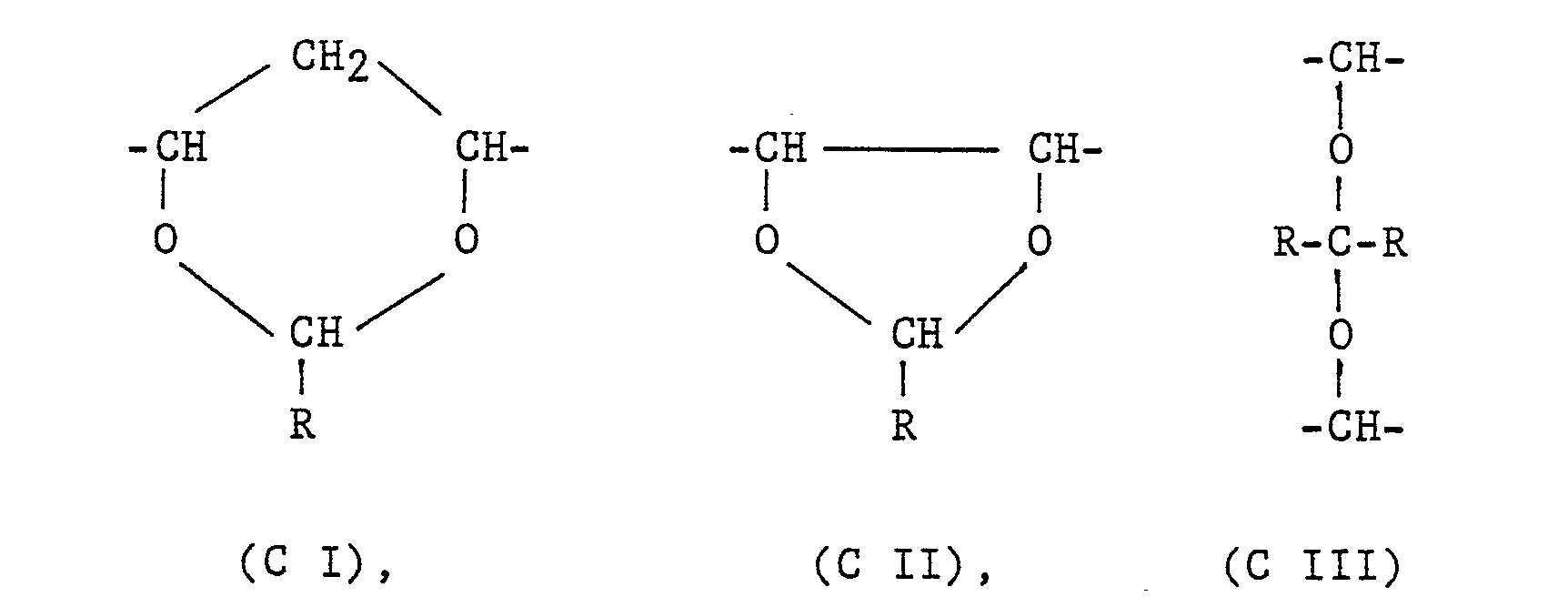
- the invention relates to a photopolymerizable mixture which contains as essential constituents a photoinitiator, a polymerizable acrylic or methacrylic acid derivative with one or more unsaturated groups and a polymeric binder composed of units of the general types A, B and C, where A in a proportion of 5 up to 20 wt .-% and the formula corresponds, B is present in a proportion of 4 to 30% by weight and the formula corresponds and C is present in a proportion of 50 to 91% by weight.
- the invention also relates to a photopolymerizable recording material with a support and a photopolymerizable layer which consists of the mixture defined above.
- lower alkyl group denotes a saturated straight-chain or branched-chain hydrocarbon radical having 1 to 8 carbon atoms.
- the vinyl alcohol / vinyl acetate copolymers which are suitable as starting material in the preparation of the polymeric binders are hydrolyzed to 75 to 80% by weight and have an average molecular weight (M) of 5,000 to 100,000. In this description the hydrolyzed fraction is given in percent by weight and not in mole percent. Suitable copolymers can be easily prepared using known synthetic processes or are commercially available.
- copolymer used as the starting material depends on the later use of the polymer produced therefrom. If the polymer is used, for example, for the production of planographic printing plates, copolymers with higher molecular weights (approximately 50,000 to 100,000) are preferably selected. If the polymer is to be used in the production of screen printing stencils, copolymers with lower molecular weights (approximately 5,000 to 30,000) are preferably used. However, these preferred areas do not necessarily have to be observed.
- the copolymer is first dissolved in a mixture of water and a solvent containing hydroxyl groups.
- the hydroxyl-containing solvent must be miscible with water and must be suitable as a solvent both for the copolymer and for the polymer obtained as the end product.
- the hydroxyl-containing solvent is preferably an aliphatic alcohol, which has in particular 1 to 4 carbon atoms, for. B. ethanol.
- a reaction solution is prepared by dissolving the vinyl alcohol / vinyl acetate copolymer in a solvent mixture of water and a solvent containing hydroxyl groups. This step is usually carried out over a period of at least 12 hours at a temperature which, depending on the molecular weight of the copolymer, is between 20 ° C. and the boiling point of the solution.
- the temperature of the solution is then set to at least 50 ° C., and a catalytically active amount, preferably about 1.0 to 1.5% by weight, of an acid is added. This amount is not sufficient for hydrolysis.
- An aliphatic aldehyde is slowly added to the acidified mixture over a period of several hours. The amount of aldehyde is chosen so that the degree of acetalization is between 50 and 91% by weight.
- the reaction mixture is preferably stirred vigorously during all of the process steps described above.
- the acid is then preferably evaporated or the mixture is neutralized.
- Acetaldehyde or propionaldehyde is preferred as the aldehyde.
- the choice of the respective aldehyde also depends on the intended use of the resin according to the invention. Propionaldehyde is preferred for the production of planographic printing plates, while acetaldehyde is preferred for the production of a screen printing stencil.
- the amount of aldehyde added is preferably 25 to 100% by weight, in particular 28 to 67% by weight, in each case based on the weight of the copolymer.
- a catalytic amount of an acid must be present during the aldehyde addition to form the acetal groups. It is preferably a mineral acid, e.g. As hydrochloric acid, sulfuric acid or phosphoric acid, or an organic sulfonic acid, e.g. B. p-toluenesulfonic acid or stilbene disulfonic acid. Hydrochloric acid is particularly preferred.
- the reaction mixture is preferably neutralized; this is done by adding an alkaline salt, thereby avoiding possible deacetalization.
- the pH of the reaction mixture is adjusted to 6.5 to 7.5, preferably to 7.0, by the neutralization.
- Suitable alkaline salts are, for example, sodium and potassium carbonate, sodium carbonate being particularly preferred.
- Sodium and potassium hydroxide are also suitable.
- reaction mixture is preferably, but not necessarily, cooled to room temperature (22-25 ° C.) and then water or another suitable agent, such as acetone or methyl ethyl ketone, is slowly added.
- water or another suitable agent such as acetone or methyl ethyl ketone
- the mixture is still stirred vigorously in order to cause the reaction product to precipitate.
- the precipitated product is washed with water to remove the residues of acid, aldehyde and unreacted copolymer and is then dried with warm air until the water content is at most 1%.
- a solvent which is compatible with all constituents of the light-sensitive mixture is usually used to prepare the coating mixture.
- suitable solvents are water, tetrahydrofuran, butyrolactone, glycol ethers, such as propylene glycol monomethyl ether and ethylene glycol monomethyl ether, alcohols, such as ethanol and n-propanol, and ketones, such as methyl ethyl ketone, and mixtures of the solvents listed.
- a mixture of tetrahydrofuran, propylene glycol monomethyl ether and butyrolactone is preferably used as the solvent. The finished mixture is applied to the substrate and the solvent is evaporated.
- the proportion of the polymeric binder in the light-sensitive mixture is preferably 20 to 75% by weight, in particular 30 to 65% by weight, and very particularly preferably 35 to 50% by weight, in each case based on the solids content of the mixture.
- Radical photoinitiators with an absorption range from 320 to 400 nm for.
- acetophenones, benzophenones, triazines, benzoins, benzoin ethers, xanthones, thioxanthones, acridines and benzoquinones the 2-aryl-4,6-bis-trichloromethyl-triazines and the thioxanthones being particularly preferred.
- the proportion of the photoinitiator in the light-sensitive mixture is preferably 1.5 to more than 8% by weight, in particular 2.0 to 6.0% by weight, and very particularly preferably 3.0 to 4.0% by weight, in each case based on the solids content of the mixture.
- the polymerizable constituent of the mixture according to the invention is an acrylic or methacrylic acid derivative with one or more unsaturated groups, preferably an acrylic or Methacrylic acid ester. It can be in solid or liquid form and preferably has a viscosity of more than 700 mPa • s at 25 ° C, in particular of more than 2000 mPa • s at 25 ° C and particularly preferably of more than 4000 mPa • s at 25 ° C .
- the compounds which are suitable as monomers include, for example, trimethylolpropane triacrylate and methacrylate and their ethoxylated or propoxylated derivatives, pentaerythritol triacrylate and methacrylate, dipentaerythritol monohydroxypentaacrylate and methacrylate, dipentaerythritol hexaacrylate and methacrylate, pentacrylate and methacrylate, pentaerythritol acrylate, pentacrylate methacrylate, pentaerythritol methacrylate, pentaerythritol methacrylate and pentacrylate methacrylate, Cyclohexyl acrylate and methacrylate, n-hexyl acrylate and methacrylate, glycidyl acrylate and methacrylate. Dipentaerythritol monohydroxypentaacrylate is preferably used, but a combination of various suitable monomers can also be used
- the proportion of the monomer is preferably 20 to 70% by weight, in particular 30 to 60% by weight, and very particularly preferably 30 to 50% by weight, in each case based on the solids content of the mixture according to the invention.
- the mixture according to the invention contains a polyfunctional acrylic monomer with two or more unsaturated groups and an oligomer containing urethane groups.
- the oligomeric component of the photopolymerizable mixture according to the invention is a light-curable oligomer or polymer which is obtained by firstly one mole of an essentially linear polymeric compound which carries an active hydrogen atom at each end with at least two moles of a diisocyanate compound reacted so that a prepolymer is formed which has an isocyanate residue at both ends. The prepolymer is then reacted with at least two moles of an ethylenically unsaturated compound having an active hydrogen atom, so that the prepolymer receives an unsaturated residue at both ends.
- the oligomer preferably has a polyester backbone composed of an aliphatic dicarboxylic acid and an aliphatic diol.
- a linear dicarboxylic acid having 2 to 8 carbon atoms is preferably used.
- a symmetrical compound with terminal hydroxyl groups is used as the polyester.
- Production processes for compounds of this type are known and are described, for example, by Sandler and Karo in "Polymer Synthesis", Vol. 2, Academic Press, 1977, pp. 140-167.
- the polyester polyol is then preferably reacted with an aliphatic diisocyanate having 2 to 15 carbon atoms, in particular with a cycloaliphatic diisocyanate, in such a way that one of the two isocyanate groups reacts with the terminal hydroxyl group of the polyester skeleton.
- the other isocyanate group is then reacted with an acrylic or methacrylic acid ester containing hydroxyl groups.
- 1,6-hexanediol is reacted with adipic acid to give a polyester, the molar ratio being greater than 1: 1, and the polyester is then reacted with dicyclohexylmethane-4,4'-bis-diisocyanate, the molar ratio of diisocyanate to polyester Is 2: 1.
- the product obtained is reacted with 2-hydroxyethyl acrylate to give an unsaturated oligomer, the molar ratio of acrylate to the diisocyanate-polyester reaction product being 2: 1.
- R'Compounds which are suitable as R' groups are e.g. Hydroxyl-terminated polyesters; Polyethers obtained by reacting a diol with an alkylene oxide, the molar ratio of diol to alkylene oxide having to be greater than 1: 1 in order to obtain a symmetrical polymer with terminal hydroxyl groups; and epoxides obtained by reacting a symmetrical diglycidyl compound with a diol, the molar ratio of diol to diglycidyl compound must be greater than 1: 1 in order to obtain a symmetrical polymer with terminal hydroxyl groups.
- Suitable polyesters are, for example, from the dicarboxylic acids oxalic, malonic, amber, glutaric, adipic, pimeline, cork, azelaic or sebacic acid and the diols ethylene, diethylene, neopentyl, propylene and dipropylene glycol, 1,3-butanediol, 1,4-butanediol, 1,6-hexanediol or 2-ethyl-1,6-hexanediol.
- Suitable polyethers are produced, for example, from the diols mentioned above and ethylene oxide, propylene oxide or tetrahydrofuran.
- Suitable epoxides are prepared, for example, from the diols and diglycidyl isophthalate, diglycidyl terephthalate, diglycidyl phthalate or bisphenol A diglycidyl ether mentioned above.
- Suitable diisocyanates are e.g. B. ethylene diisocyanate, propylene diisocyanate, tetramethylene diisocyanate, dicydohexylmethane-4,4'-diisocyanate, hexamethylene diisocyanate, 1-methyl-2,3-diisocyanato-cyclohexane, 1-methyl-2,6-diisocyanato-cyclohexane, lysine diisocyanate, 4,4'- Ethylene bis (cyclohexyl isocyanate) and isophorone diisocyanate.
- Suitable ethylenically unsaturated compounds with active hydrogen atoms are e.g. B. hydroxyethyl acrylate and methacrylate, hydroxypropyl acrylate and methacrylate, 1,3-butanediol acrylate and methacrylate, 2,4-butanediol acrylate, 1,4-butanediol methacrylate, neopentyl glycol acrylate and methacrylate, pentaerythritol triacrylate and - trimethacrylate, as well as the monoacrylates of polyethylene and monomethacrylates , Polypropylene glycol and copolymers of ethylene glycol and propylene glycol.
- the oligomers with a molecular weight of approximately 1500 to 4000, in particular of approximately 2000 to 3500, are preferably used. Oligomers whose molecular weight is approximately 3000 are very particularly preferably used.
- the oligomer is advantageously in solid or semi-solid form, i.e. its viscosity at 25 ° C is greater than about 480 Pa.s.
- the preferred proportion of the mixture of oligomers is about 10 to 35% by weight, in particular about 15 to 30% by weight, and very particularly preferably about 15 to 25% by weight, in each case based on the total solids content. A detailed description of such oligomers is contained in EP-A 184 725.
- the polymerizable component consists of a mixture of a polyglycol diacrylate, e.g. B. a diacrylate of a polyethoxylated diol, and an aminodiacrylate.
- the mixture preferably also contains a polyfunctional acrylate monomer and an oligomeric urethane acrylate.
- a compound of the formula is preferably used as the polyethoxylated diacrylate which is suitable according to the invention used (polyethylene glycol 200 diacrylate, commercially as Photomer 4050).
- This diacrylate is preferably contained in the mixture according to the invention in an amount of 14 to 24% by weight, in particular 16 to 23% by weight, and very particularly preferably 18 to 21% by weight.
- This compound can be prepared by known methods and is commercially available under the name Celrad 7100 (manufactured by Celanese Specialty Resins, Louisville, Kentucky).
- the aminodiacrylate in the mixture according to the invention is preferably in an amount of 11.5 to 24% by weight, in particular 16 to 23% by weight, and very particularly preferably 18 to 21% by weight contain.
- the weight ratio of polyglycol diacrylate to aminodiacrylate in the mixture according to the invention is preferably about 1: 1.
- the oligomeric aminodiacrylate in the photopolymer mixture serves both as an oligomer and as an activator for the photoinitiator, since it is a hydrogen donor because of its relatively high proportion of tertiary nitrogen atoms.
- the combination of polyunsaturated acrylic acid derivative and aminoacrylate in the mixture according to the invention gives the screen printing stencils produced with the mixture increased mechanical stability and abrasion resistance.
- the multifunctional acrylic monomer preferably has two or more unsaturated groups such as trimethylolpropane triacrylate.
- the polyvalent acrylate monomer is still ethoxylated, such as trimethylolpropane polyethylene oxytriacrylate, which is commercially available under the name Photomer 4149 (from Diamond Shamrock Corporation) or SR-454 (from Sartomer Company).
- Further polyfunctional acrylate monomers suitable according to the invention are e.g. B.
- a hexafunctional polyester acrylate which is commercially available under the name Photomer 5007 (manufacturer: Diamond Shamrock Corporation), a tetrafunctional polyester acrylate, which is commercially available under the name Photomer 5018 (manufacturer: Diamond Shamrock Corporation), pentaerythritol triacrylate, pentaerythritol tetraacrylate and Dipentaerythritol monohydroxypentaacrylate.
- the polyfunctional acrylate monomer is optionally present in the mixture in an amount of up to 18% by weight, preferably from 9 to 16% by weight, and in particular from 10 to 14% by weight.
- the oligomeric urethane acrylate is optionally present in the mixture in an amount of up to 18% by weight, preferably in an amount of 9 to 16% by weight, and in particular 10 to 14% by weight.
- the polyfunctional acrylic monomer and the oligomeric urethane acrylate, if present, are preferably contained in the photopolymer mixture in an approximate ratio of 1: 1.
- One of the outstanding features of this embodiment of the invention is that, owing to the new combination of photoinitiator, aminodiacrylate and other monomers, it is no longer absolutely necessary to apply an oxygen barrier layer or to work in a nitrogen protective gas atmosphere.
- the mixture according to the invention is particularly suitable for the production of screen printing stencils.
- the ratio of resinous binder to monomer mixture is preferably about 1: 2.
- the proportion of the resinous binder in the screen printing mixture according to the invention is preferably 28 to 38% by weight, in particular 30 to 36% by weight, and very particularly preferably 32 to 34% by weight.
- a thioxanthone compound in particular 2-isopropyl-9H-thioxanthen-9-one, is preferably used as the photoinitiator.
- the proportion of the photoinitiator in the screen printing mixture is preferably 0.1 to 1.0% by weight, in particular 0.2 to 0.8% by weight, and very particularly preferably 0.2 to 0.4% by weight.
- the monomer mixture and the photoinitiator are first dissolved in a suitable solvent, so that a solution is obtained whose solids content is preferably 55 to 56%.
- suitable solvents are, for example, alcohols with 1 to 4 carbon atoms, ⁇ -butyrolactone, N-methylpyrrolidone and mixtures of these solvents with one another or with water. Ethanol is preferred as the solvent.
- the solution polymerizable compounds and photoinitiator are then combined with the solution of the resinous binder to form a clear, viscous solution.
- a fabric of the desired thread thickness, number of stitches and composition is first stretched until the desired tension is reached.
- the stretching is preferably carried out mechanically over a suitable frame.
- Suitable materials for the fabrics are polyester, polyamide and stainless steel, the frames can be made of wood or metal, especially aluminum.
- the stretched fabric is attached to the frame; this can be done with adhesives (for wooden or metal frames), with staples (for wooden frames) or mechanically (for self-tightening frames).
- the sieve prepared in this way is degreased in order to remove all dirt, dust, grease and oil residues which could impair the adhesion of the coating mixture to the mesh.
- the sieve is then coated with the mixture according to the invention; a number of known methods are suitable for this.
- the mixture can be applied directly to both sides of the sieve in several operations using a doctor blade and then dried; however, it can also be applied to a transfer film and dried first and then transferred to the screen in the form of a film either before or after exposure and development; a combination of these two methods is also possible.
- the photopolymerizable mixture according to the invention contains a polyfunctional acrylic monomer with at least two unsaturated radicals and a monofunctional acrylic monomer with an unsaturated radical.
- the polyfunctional acrylic monomer has already been described above.
- the monofunctional monomer is preferably a compound with an acrylic or methacrylic acid ester group. It is preferably in the form of a liquid whose viscosity at 25 ° C. is between 1 and 25 mPa • s.
- the monofunctional monomers suitable according to the invention include, for example, trimethylolpropane monoacrylate and methacrylate and their ethoxylated or propoxylated derivatives, pentaerythritol acrylate and methacrylate, tetrahydrofurfuryl acrylate and methacrylate, cyclohexyl acrylate and methacrylate, n-hexyl acrylate and methacrylate, and gly.
- Pentaerythritol acrylate is preferably used, but a combination of different monomers has also proven to be advantageous.
- the proportion of the polyfunctional monomer in the photopolymerizable mixture of these two monomers should be at least 50%, preferably 65 to 99% and in particular 80 to 97.5%. The rest of the photopolymerizable mixture then forms the monofunctional monomer.
- One of the particular advantages of this embodiment of the invention is that the three-dimensionally cross-linked structure of the polymerization products of the polyfunctional monomer provides good image strength and thus a tough image, while the linear polymerization of the monofunctional monomer achieves high photosensitivity.
- the light-sensitive mixtures according to the invention can be developed with a developer in which organic solvents need not necessarily be present and which only requires a small proportion of salts and wetting agents.
- organic solvents represents a considerable cost factor.
- the waste water with these solvents is toxic and harmful to health.
- the photosensitive mixture according to the invention can also contain other components, e.g. B. contain stabilizing acids, exposure indicators, plasticizers, photoactivators and colorants.
- Stabilizing acids suitable according to the invention are, for example, phosphorus, citric, benzoic, m-nitro-benzoic, p- (p-anilinophenylazo) benzene sulfone, 4,4'-dinitro-2,2'-stilbene disulfone, itacone -, Wine and p-toluenesulfonic acid, and mixtures of these acids.
- Phosphoric acid is preferably used as the stabilizing acid.
- the proportion of the stabilizing acid optionally added is preferably about 0.3 to 2.0%, in particular about 0.75 to 1.5%.
- Suitable exposure indicators include a. 4-phenyiazodiphenyiamine, eosin, azobenzene, calcozine, fuchsin dyes, crystal violet and methylene blue. 4-phenylazodiphenylamine is preferred.
- the proportion of the optionally added exposure indicator in the mixture is preferably approximately 0.001 to 0.35% by weight, in particular approximately 0.002 to 0.3% by weight, and very particularly preferably approximately 0.005 to 0.2% by weight.
- the photoactivator which may be present in the mixture should be an amino compound whose synergistic interaction with the radical photoinitiator extends the half-life of the photoinitiator radicals, which is normally about 10- 'to 10-' s seconds.
- suitable photoactivators are 4-dimethylamino-benzoic acid 2- (n-butoxy) ethyl ester, 2- (dimethylamino) aminobenzoate and acrylated amines. Ethyl 4-dimethylaminobenzoate is preferred.
- the proportion of photoactivator in the mixture according to the invention is preferably 1 to 4% by weight.
- the mixture according to the invention can also contain a plasticizer.
- Suitable plasticizers include, for example, tributyl phthalate, triaryl phosphate and, preferably, dioctyl phthalate and their substituted derivatives.
- the proportion of plasticizer in the mixture is preferably about 0.5 to 1.25% by weight.
- Suitable colorants include a. Rhodamine, calcozin, Victoria blue, methyl violet and pigments such as anthraquinone and phthalocyanine.
- the colorant is in the form of a pigment dispersion which contains one or more pigments and / or dyes which have been dispersed in a suitable solvent or solvent mixture.
- the proportion of the optionally added colorant in the mixture according to the invention is preferably about 1.5 to 4.0% by weight, in particular about 1.75 to 3.0% by weight, and very particularly preferably about 2.0 to 2.75 % By weight.
- the carrier materials which are suitable for coating with the mixture according to the invention for the production of planographic printing plates include, for example, transparent films, for. B. of polyester, aluminum and its alloys, other metals, silicon and similar substances known from the prior art.
- Aluminum is preferably used as the carrier material.
- the carrier is optionally first roughened and / or etched and / or anodized with the aid of a customary method and can also additionally, for. B. with polyvinylphosphonic acid, sodium silicate or other hydrophilizing agents.
- a layer support based on aluminum is first preferably in a known manner, for example by wire brushes, wet grinding or by electrochemical means, for. B. in a hydrochloric acid electrolyte, roughened.
- the roughened plate is then preferably anodized in a known manner, e.g. B. in sulfuric or phosphoric acid.
- the roughened and optionally anodized surface is then preferably subjected to a hydrophilizing aftertreatment, e.g. B. with polyvinylphosphonic acid, sodium silicate or the like.
- the after-treatment is also carried out in a known manner.
- the plate prepared in this way is coated with the mixture according to the invention and then dried.
- the layer weight is preferably about 0.6 to 2.5 g / m 2 , in particular about 0.8 to 2.0 g / M 2 , and very particularly preferably about 1.2 to 1.5 g / M 2 . however, it is not critical to the present invention.
- the plate can then be provided with a cover layer made of an aqueous solution of a film-forming polymeric resin and dried again.
- the weight of this layer is preferably 0.5 to 6.0 g / m 2 , in particular 0.75 to 4.0 g / m 2 , and very particularly preferably 1.0 to 2.5 g / m 2 .
- the polymers that are suitable for forming a top layer include, for example, polyvinyl alcohol, polyvinyl alcohol / polyvinyl acetate copolymers, polyvinyl pyrrolidone, polyvinyl pyrrolidone / polyvinyl acetate copolymers, polyacrylic acid, butadiene-maleic acid copolymers and polyvinyl methyl ether.
- the developed plate is usually treated with a preservative, e.g. B. a hydrophilic polymer such as cold water soluble dextrin and / or polyvinylpyrrolidone; can be a nonionic wetting agent, a dampening solution, an inorganic salt or water, as is apparent from US-A-4 213 887.
- a preservative e.g. B. a hydrophilic polymer such as cold water soluble dextrin and / or polyvinylpyrrolidone; can be a nonionic wetting agent, a dampening solution, an inorganic salt or water, as is apparent from US-A-4 213 887.
- the print run achievable with a plate produced in this way can be increased further by heat treatment of the exposed and developed printing plate.
- the printing plate is first treated with a solution which prevents a loss of hydrophilicity in the background areas of the image during baking.
- a solution suitable for this is described, for example, in US Pat. No. 4,355,096.
- the plate is treated at a temperature between 180 ° C and the deformation temperature of the support, preferably at about 240 ° C.
- the duration of this stoving treatment is inversely proportional to the temperature and varies between about 2 and 15 minutes. At 240 ° C it is about 7 minutes.
- the product obtained is examined using standard analysis methods. The following composition results: 13.6% acetate groups. 9.8% hydroxyl groups and 76.6% acetal groups. Of the acetal groups, 80% are six-ring acetals, 4% five-ring acetals and 16% intermolecular acetals.
- the product obtained is examined using standard analysis methods. The following composition results: 15.2% acetate groups, 7.6% hydroxyl groups and 77.2% acetal groups. Of the acetal groups, 80% are six-ring acetals, 4% five-ring acetals and 16% intermolecular acetals.
- the plate is then dried.
- a polyvinyl alcohol solution prepared as described in Example 1 is spun onto the dried plate.
- the coated and dried plate is exposed, developed and preserved according to the instructions in Example 1.
- the product obtained is examined using standard analysis methods. The following composition results: 17.2% acetate groups, 13.6% hydroxyl groups and 69.2% acetal groups. Of the acetal groups, 80% are six-ring acetals, 4% five-ring acetals and 16% intermolecular acetals.
- the plate is then dried.
- a polyvinyl alcohol solution prepared as described in Example 1 is spun onto the dried plate.
- the coated and dried plate is exposed, developed and preserved according to the instructions in Example 1.
- the coated and dried plate is exposed to actinic radiation through a negative test template so that a fully covered step 7 is obtained on a 21-step Stauffer wedge.
- the plate can be completely developed and desensitized with tap water. The mixture described in Example 1 is then preserved. In the printing test under the conditions of Example 1, the plate gives 280,000 good prints.
- the coated and dried plate is exposed, developed and preserved according to the instructions in Example 1.
- the coated and dried plate is exposed, developed and preserved according to the instructions in Example 1.
- a degreased, colored monofilament polyester sieve (mesh size 0.05 mm) is coated with the solution described in Example 4 and then dried.
- the screen is exposed to UV light of 24 mJ / cm 'using a 5 kW high-pressure mercury lamp through a photomask and then developed with water.
- the screen printing stencil obtained is characterized in the printing test by high image resolution (up to line widths from 100 to 150 ⁇ m) and abrasion resistance.
- Gelvatol 20-30 a vinyl alcohol-vinyl acetate copolymer with a vinyl alcohol unit content of about 75 to 80% by weight and an average molecular weight of 10,000
- Gelvatol 20-30 a vinyl alcohol-vinyl acetate copolymer with a vinyl alcohol unit content of about 75 to 80% by weight and an average molecular weight of 10,000
- 1.5 g of hydrochloric acid (37% strength) are then added with vigorous stirring and the temperature is set to 60.degree. 12.2 g of acetaldehyde are slowly added to the reaction mixture and stirring is continued for 6 hours.
- a degreased, colored polyester sieve with a mesh size of 0.05 mm is coated with this solution and dried.
- the coated screen is exposed as described in Example 7. However, it cannot be developed with water.
- a degreased, colored polyester sieve with a mesh size of 0.05 mm is coated with the solution obtained and dried.
- the exposure is then carried out as in Example 7.
- no visible image is obtained; finally both the exposed and the unexposed areas are washed out.
- a degreased, colored polyester sieve with a mesh size of 0.05 mm is coated with the coating solution described in Example 5 and dried.
- the exposure takes place in a NuArc flip-top device, which is equipped with a soft rubber blanket for the vacuum exposure of sieves.
- the screen is exposed by means of an autotype exposure machine set to 100 exposure units, with which the exposure of a screen can take place at 1, 0.7, 0.5-0.33 and 0.25 times the full exposure energy.
- the exposed screen is developed with water, whereby a screen printing stencil with good resolution (up to line widths of 100-150 ⁇ m) is obtained. Based on the automatic exposure device used, an optimal exposure energy of less than 25 units is required.
- a degreased, colored polyester sieve with a mesh size of 0.05 mm is coated with this solution and then dried. It is then developed as in Example 7. When developing with water, a very weak image is created; finally both the exposed and the unexposed areas are washed out. This shows the need to add an oligomeric aminodiacrylate.
- a polyvinyl acetal solution is prepared as described in Example 6. A portion of the solution is dried to a thin film as described in Example 4.
- a clear solution is obtained with which a degreased, colored polyester sieve with a mesh size of 0.05 mm is coated and then dried.
- the screen is exposed in a NuArc flip-top device by means of an autotype exposure machine and developed with water, the unexposed areas being removed and a screen printing stencil having good image resolution (up to line widths of 100-150 ⁇ m) being obtained.
- the diacrylated urethane oligomer is obtained by reacting 1,6-hexanediol and adipic acid to a polyester, the molar ratio being greater than 1: 1, and then reacting the polyester with dicyclohexylmethane-4,4'-diisocyanate, the molar ratio of diisocyanate to polyester Is 2: 1. The resulting product is included. 2-Hydroxyethyl acrylate implemented, the molar ratio of acrylate to diisocyanate polyester product being 2: 1.
- the coated and dried plate is coated with polyvinyl alcohol as in Example 1 and dried again. It is then exposed, developed and preserved as in Example 1. Under the conditions of Example 1, the plate gives 475,000 good prints.
- a planographic printing plate is prepared and processed as described in Example 16 except that the diacrylated urethane oligomer is omitted.
- the plate produced in this way delivers 245,000 good prints.
- a planographic printing plate is produced according to the instructions in Example 16 and. processed with the exception that the dipentaerythritol monohydroxypentaacrylate is omitted.
- the plate produced in this way delivers 260,000 good prints.
- a planographic printing plate is prepared and processed as described in Example 16, except that the polyvinyl alcohol top layer is omitted.
- the plate thus produced does not give a usable printing form, i. H. it cannot print images.
- a planographic printing plate is prepared and processed as described in Example 16, except that the 2-stilbenyl-4,6-bis (trichloromethyl) triazine is omitted.
- the plate produced in this way does not provide a usable printing result.
- the coated and dried plate is coated with the polyvinyl alcohol solution from Example 1 and dried again. It is then developed and preserved as in Example 1. Under the conditions of Example 1, 490,000 good prints are obtained.
- the coated and dried plate is coated with polyvinyl alcohol as in Example 1 and dried again. It is then exposed, developed and preserved as in Example 1.
- Formvar 12/85 is a polyvinyl formal, manufactured by Monsanto Corp., St. Louis, Missouri, USA, manufactured in accordance with US Pat. No. 2,179,051. A sample of this is examined using standard analytical methods, which lead to the following result: The product has a average molecular weight of 32,000 and consists of 23.5% acetate groups, 5.7% hydroxyl groups and 70.8%. from acetal groups. Of the acetal groups, 90 to 95% are six-ring acetals, 0% five-ring acetals and 5-10% intermolecular acetals.
- the coated and dried plate is coated with polyvinyl alcohol as in Example 1 and dried again. It is then exposed as in Example 1; then an attempt is made to develop it according to the instructions in Example 1. It turns out that the plate cannot be developed. There are no signs of delamination or desensitization.
- the coated and dried plate is coated with polyvinyl alcohol as in Example 1 and dried again. It is then exposed, developed and preserved as in Example 1. Under the conditions of Example 1, the plate gives 460,000 good prints.
- a planographic printing plate is prepared and processed as described in Example 24, except that the pentaerythritol acrylate is omitted.
- the plate produced in this way delivers 195,000 good prints.
- a planographic printing plate is prepared and processed as described in Example 24 with the exception that the 2-stilbenyl-4,6-bis (trichloromethyl) triazine is omitted.
- the plate produced in this way does not provide a usable printing result.
- Example 1 The coated and dried plate is coated as in Example 1 with a polyvinyl alcohol layer. It is then exposed, developed and preserved as in Example 1. Under the conditions of Example 1, the plate gives 465,000 good prints.
- the coated and dried plate is coated with polyvinyl alcohol as in Example 1 and dried again. It is then exposed, developed and preserved as in Example 1. Under the conditions of Example 1, 470,000 good prints are obtained.
Landscapes
- Physics & Mathematics (AREA)
- Chemical & Material Sciences (AREA)
- Chemical Kinetics & Catalysis (AREA)
- Spectroscopy & Molecular Physics (AREA)
- General Physics & Mathematics (AREA)
- Photosensitive Polymer And Photoresist Processing (AREA)
Abstract
Description
- Die vorliegende Erfindung betrifft ein photopolymerisierbares Gemisch, das zur Herstellung von mit wäßrigen Entwicklern entwickelbaren Reproduktionsmaterialien, wie Flachdruckplatten oder Siebdruckschablonen, geeignet ist. Das Gemisch läßt sich leicht zu Schichten mit guten Hafteigenschaften verarbeiten, die insbesondere für die Herstellung von Flachdruckplatten geeignet sind.
- Es sind zahlreiche Polymere bekannt, die allgemein für die Herstellung von lichtempfindlichen Materialien geeignet sind. Die Einsatzmöglichkeiten der meisten dieser Harze sind jedoch eingeschränkt, da zum Entwickeln der mit ihnen hergestellten lichtempfindlichen Materialien beträchtliche Mengen organischer Lösemittel benötigt werden. Derartige Entwickler sind jedoch unerwünscht, da ihre Abwässer und Dämpfe toxisch und umweltschädlich und die Lösemittel teuer sind.
- Mischpolymere aus Vinylacetat, Vinylacetal und Vinylalkohol, im allgemeinen als Polyvinylacetale bezeichnet, sind aus der US-A 2 179 051 bekannt. Bei Verwendung dieser Harze zur Herstellung von lichtempfindlichen Materialien werden.zum Entwickeln Entwickler mit einem Gehalt an organischen Lösemitteln benötigt.
- Es ist Aufgabe der vorliegenden Erfindung, ein photopolymerisierbares Gemisch vorzuschlagen, das zur Herstellung eines photopolymerisierbaren Materials geeignet ist, für dessen Entwicklung eine Lösung verwendet werden kann, die keine organischen Lösemittel und nur geringe Mengen an Salzen und Netzmitteln enthält.
- Das Bindemittel des Gemischs sollte eine gute Entwicklerlöslichkeit der lichtempfindlichen Schicht gewährleisten, wobei eine Wiederablagerung von dispergierten Schichtteilen auf der Oberfläche des Materials ausgeschlossen wird. Das Harz sollte ferner die Herstellung eines photopolymerisierbaren Materials ermöglichen, das sich durch hohe Lichtempfindlichkeit, Bildauflösung und Druckauflage auszeichnet und das außerdem mit den übrigen Lösungen verträglich ist, die normalerweise bei der Herstellung und bei der Verarbeitung von Druckplatten verwendet werden.
- Gegenstand der Erfindung ist ein photopolymerisierbares Gemisch, das als wesentliche Bestandteile einen Photoinitiator, ein polymerisierbares Acryl-oder Methacrylsäurederivat mit einer oder mehreren ungesättigten Gruppen und ein polymeres Bindemittel aus Einheiten der allgemeinen Typen A, B und C enthält, wobei A in einem Mengenanteil von 5 bis 20 Gew.-% vorliegt und der Formel


- Das erfindungsgemäße Gemisch ist dadurch gekennzeichnet, daß die Einheiten C aus Einheiten der Formel C I, C II und C III

- R ein Wasserstoffatom oder eine niedere Alkylgruppe ist
- und worin die Einheiten C I in einem Anteil von 75 bis 85 Gew.-%, die Einheiten C II in einem Anteil von 3 bis 5 Gew.-% und die Einheiten C III in einem Anteil von 10 bis 22 Gew.-%, bezogen auf das Gesamtgewicht der Einheiten C, vorliegen.
- Die in dem photopolymerisierbaren Gemisch enthaltenen polymeren Bindemittel sind neue Verbindungen. Sie werden in der gleichzeitig eingereichten Patentanmeldung ........... (Hoe 85/K109K) ausführlich beschrieben. Ihre Herstellung erfolgt, indem man
- a) ein VinylalkoholNinylacotat-Copolymeres mit einem Gehalt von 75 bis 80 Gew.-% Vinylalkoholeinheiten in einem Gemisch von Wasser und einem Hydroxylgruppen enthaltenden organischen Lösemittel auflöst,
- b) die Lösung auf eine Temperatur zwischen 50°C und ihrem Siedepunkt erwärmt und eine katalytische Menge einer organischen Sulfonsäure oder einer Mineralsäure zusetzt und
- c) einen niederen aliphatischen Aldehyd in solcher Menge zusetzt, daß 50 bis 91 Gew.-% der Hydroxylgruppen acetalisiert werden.
- Gegenstand der Erfindung ist außerdem ein photopolymerisierbares Aufzeichnungsmaterial mit einem Schichtträger und einer photopolymerisierbaren Schicht, die aus dem vorstehend definierten Gemisch besteht.
- Im Rahmen der vorliegenden Erfindung bezeichnet der Ausdruck "niedere Alkylgruppe" einen gesättigten gerad-oder verzweigtkettigen Kohlenwasserstoffrest mit 1 bis 8 Kohlenstoffatomen.
- Die Vinylalkohol/Vinylacetatcopolymeren, die bei der Herstellung der polymeren Bindemittel als Ausgangsmaterial geeignet sind, sind zu 75 bis 80 Gew.-% hydrolysiert und haben ein durchschnittliches Molekulargewicht (M) von 5.000 bis 100.000. In dieser Beschreibung wird der hydrolysierte Anteil in Gewichtsprozent und nicht in Molprozent angegeben. Geeignete Copolymere können mittels bekannter Syntheseverfahren leicht hergestellt werden, bzw. sind im Handel erhältlich. Dazu gehören beispielsweise Vinol 523 ( M = 70.000) und Vinol 205 (
M = 26.000), Hersteller Air Products Co., Allentown, Pennsylvania; Elvanol 52-22 (M = 72.000) Hersteller Du Pont, Wilmington, Delaware; und Gelvatol 20-60 (M = 60.000) und Gelvatol 20-90 ( M = 90.000) Hersteller Monsanto Co., St. Louis, Missouri. - Die Auswahl des als Ausgangsmaterial jeweils eingesetzten Copolymeren hängt von der späteren Verwendung des daraus hergestellten Polymeren ab. Wenn das Polymere beispielsweise zur Herstellung von Flachdruckplatten dient, werden bevorzugt Copolymere mit höheren Molekulargewichten (etwa 50.000 bis 100.000) gewählt. Soll das Polymere bei der Herstellung von Siebdruckschablonen verwendet werden, werden bevorzugt Copolymere mit niedrigeren Molekulargewichten (etwa 5.000 bis 30.000) eingesetzt. Diese bevorzugten Bereiche müssen jedoch nicht zwingend eingehalten werden.
- Zur Herstellung des Acetalgruppen enthaltenden Polymeren wird das Copolymere zunächst in einem Gemisch aus Wasser und einem hydroxylgruppenhaltigen Lösemittel gelöst. Das hydroxylgruppenhaltige Lösemittel muß mit Wasser mischbar und sowohl für das Copolymere als auch für das als Endprodukt erhaltene Polymere als Lösemittel geeignet sein. Bevorzugt ist das hydroxylgruppenhaltige Lösemittel ein aliphatischer Alkohol, der insbesondere 1 bis 4 C-Atome besitzt, z. B. Ethanol.
- In einem ersten Verfahrensschritt wird durch Lösen des Vinylalkohol/ Vinylacetat-Copolymeren in einem Lösemittelgemisch aus Wasser und einem hydroxylgruppenhaltigen Lösemittel eine Reaktionslösung hergestellt. Dieser Schritt wird üblicherweise über eine Zeitdauer von mindestens 12 Stunden durchgeführt bei einer Temperatur, die je nach dem Molekulargewicht des Copolymeren zwischen 20° C und dem Siedepunkt der Lösung liegt. Anschließend wird die Temperatur der Lösung auf mindestens 50° C eingestellt, und es wird eine katalytisch wirkende Menge, bevorzugt etwa 1,0 bis 1,5 Gew.-%, einer Säure zugegeben. Diese Menge reicht nicht zur Hydrolyse aus. Innerhalb eines Zeitraums von mehreren Stunden wird dem mit der Säure versetzten Gemisch langsam ein aliphatischer Aldehyd beigemischt. Die Menge des Aldehyds wird so gewählt, daß der Acetalisierungsgrad zwischen 50 und 91 Gew.-% liegt. Das Reaktionsgemisch wird bevorzugt während aller vorstehend beschriebener Verfahrensstufen kräftig gerührt. Vorzugsweise wird die Säure anschließend verdampft oder das Gemisch neutral gestellt.
- Als Aldehyd wird Acetaldehyd oder Propionaldehyd bevorzugt. Die Wahl des jeweiligen Aldehyds hängt auch vom Verwendungszweck des erfindungsgemäßen Harzes ab. Für die Herstellung von Flachdruckplatten wird Propionaldehyd bevorzugt, während für die Herstellung einer Siebdruckschablone Acetaldehyd bevorzugt wird. Die Menge des zugesetzten Aldehyds beträgt vorzugsweise 25 bis 100 Gew.-%, insbesondere 28 bis 67 Gew.-%, jeweils bezogen auf das Gewicht des Copolymeren.
- Da die Bildung der Acetalgruppen auf Kosten des Hydroxylgruppengehalts des Copolymeren erfolgt, nimmt die Wasserlöslichkeit ab. Um eine vorzeitige Ausfällung des Reaktionsproduktes zu verhindern, wird zusammen mit dem Aldehyd eine zusätzliche Menge des in dem Lösemittelgemisch enthaltenen hydroxylgruppenhaltigen Lösemittels zudosiert und so die abnehmende Wasserlöslichkeit und zunehmende Lösemittellöslichkeit des Produktes ausgeglichen.
- Für die Bildung der Acetalgruppen muß während der Aldehydzugabe eine katalytische Menge einer Säure anwesend sein. Dabei handelt es sich bevorzugt um eine Mineralsäure, z. B. Salzsäure, Schwefelsäure oder Phosphorsäure, oder um eine organische Sulfonsäure, z. B. p-Toluolsulfonsäure oder Stilbendisulfonsäure. Salzsäure wird besonders bevorzugt.
- Nach Beendigung der Zugabe wird das Reaktionsgemisch bevorzugt neutral gestellt; dies geschieht durch Zugabe eines alkalischen Salzes, wodurch eine mögliche Deacetalisierung vermieden wird. Durch die Neutralisation wird der pH-Wert des Reaktionsgemischs auf 6,5 bis 7,5, bevorzugt auf 7,0 eingestellt. Geeignete alkalische Salze sind beispielsweise Natrium-und Kaliumcarbonat, wobei Natriumcarbonat besonders bevorzugt wird. Auch Natrium-und Kaliumhydroxid sind geeignet.
- Im Anschluß an die Neutralisation wird das Reaktionsgemisch bevorzugt, jedoch nicht zwingend, auf Raumtemperatur (22-25° C) abgekühlt und danach langsam mit Wasser oder einem anderen geeigneten Mittel, wie Aceton oder Methylethylketon, versetzt. Dabei wird das Gemisch weiterhin stark gerührt, um die Ausfällung des Reaktionsproduktes zu bewirken. Das ausgefällte Produkt wird mit Wasser gewaschen, um die Reste an Säure, Aldehyd und nicht umgesetztem Copolymeren zu entfernen, und wird anschließend mit Warmluft getrocknet, bis der Wasseranteil maximal 1 % beträgt.
- Für die Herstellung des Beschichtungsgemmischs wird gewöhnlich ein Lösemittel eingesetzt, das mit allen Bestandteilen des lichtempfindlichen Gemisches verträglich ist. Als Beispiele für geeignete Lösemittel seien Wasser, Tetrahydrofuran, Butyrolacton, Glykolether, wie Propylenglykolmonomethylether und Ethylenglykolmonomethylether, Alkohole, wie Ethanol und n-Propanol, und Ketone, wie Methylethylketon, sowie Mischungen der aufgeführten Lösemittel genannt. Bevorzugt wird als Lösemittel ein Gemisch aus Tetrahydrofuran, Propylenglykolmonomethylether und Butyrolacton verwendet. Das fertige Gemisch wird auf den Schichtträger aufgetragen, und das Lösemittel wird verdampft.
- Der Anteil des polymeren Bindemittels am lichtempfindlichen Gemisch beträgt vorzugsweise 20 bis 75 Gew.-%, insbesondere 30 bis 65 Gew.-%, und ganz besonders bevorzugt 35 bis 50 Gew.-%, jeweils bezogen auf den Feststoffgehalt des Gemischs.
- Als Photoinitiatoren eignen sich erfindungsgemäß bevorzugt radikalische Photoinitiatoren mit einem Absorptionsbereich von 320 bis 400 nm, z. B. Acetophenone, Benzophenone, Triazine, Benzoine, Benzoinether, Xanthone, Thioxanthone, Acridine und Benzochinone, wobei die 2-Aryl-4,6-bis- trichlormethyl-triazine und die Thioxanthone besonders bevorzugt werden.
- Der Anteil des Photoinitiators am lichtempfindlichen Gemisch beträgt bevorzugt 1,5 bis über 8 Gew.-%, insbesondere 2,0 bis 6,0 Gew.-%, und ganz besonders bevorzugt 3,0 bis 4,0 Gew.-%, jeweils bezogen auf den Feststoffgehalt des Gemischs.
- Der polymerisierbare Bestandteil des erfindungsgemäßen Gemischs ist ein Acryl-oder Methacrylsäurederivat mit einer oder mehreren ungesättigten Gruppen, bevorzugt ein Acryl-oder Methacrylsäureester. Er kann in fester oder flüssiger Form vorliegen und hat vorzugsweise eine Viskosität von mehr als 700 mPa•s bei 25° C, insbesondere von mehr als 2000 mPa•s bei 25° C und besonders bevorzugt von mehr als 4000 m Paes bei 25° C.
- Zu den Verbindungen, die als Monomere geeignet sind, zählen beispielsweise Trimethylolpropantriacrylat und -methacrylat und deren ethoxylierte oder propoxylierte Derivate, Pentaerythrittriacrylat und -methacrylat, Dipentaerythritmonohydroxypentaacrylat und -methacrylat, Dipentaerythrithexaacrylat und -methacrylat, Pentaerythrittetraacrylat und -methacrylat, Pentaerythritmethacrylat, Tetrahydrofurfurylacrylat und - methacrylat, Cyclohexylacrylat und -methacrylat, n-Hexylacrylat und -methacrylat, Glycidylacrylat und -methacrylat. Bevorzugt wird Dipentaerythritmonohydroxypentaacrylat eingesetzt, doch kann auch eine Kombination verschiedener geeigneter Monomerer mit Vorteil eingesetzt werden.
- Der Anteil des Monomeren beträgt bevorzugt 20 bis 70 Gew.-%, insbesondere 30 bis 60 Gew.- %, und ganz besonders bevorzugt 30 bis 50 Gew.- %, jeweils bezogen auf den Feststoffgehalt des erfindungsgemäßen Gemischs.
- In besonderer Ausführungsform enthält das erfindungsgemäße Gemisch ein polyfunktionelles Acrylmonomeres mit zwei oder mehr ungesättigten Gruppen und ein Urethangruppen enthaltendes Oligomeres.
- Bei der oligomeren Komponente des erfindungsgemäßen photopolymerisierbaren Gemischs handelt es sich um ein lichthärtbares Oligomeres bzw. Polymeres, das erhalten wird, indem man zunächst ein mol einer im wesentlichen linearen polymeren Verbindung, die an jedem Ende ein aktives Wasserstoffatom trägt, mit mindestens zwei mol einer Diisocyanatverbindung umsetzt, so daß ein Präpolymeres entsteht, das an beiden Enden einen Isocyanatrest trägt. Anschließend wird das Präpolymere mit mindestens zwei mol einer ethylenisch ungesättigten Verbindung mit einem aktiven Wasserstoffatom umgesetzt, so daß das Präpolymere an beiden Enden einen ungesättigten Rest erhält. Bevorzugt besitzt das Oligomere ein Polyestergerüst aus einer aliphatischen Dicarbonsäure und einem aliphatischen Diol. Bevorzugt wird eine lineare Dicarbonsäure mit 2 bis 8 Kohlenstoffatomen verwendet. Als Polyester wird eine symmetrische Verbindung mit endständigen Hydroxygruppen verwendet. Herstellungsverfahren für Verbindungen dieses Typs sind bekannt und beispiels weise von Sandler und Karo in "Polymer Synthesis", Bd. 2, Academic Press, 1977, S.140-167, beschrieben. Das Polyesterpolyol wird sodann bevorzugt mit einem aliphatischen Diisocyanat mit 2 bis 15 C-Atomen, insbesondere mit einem cycloaliphatischen Diisocyanat, umgesetzt, und zwar derart, daß eine der beiden Isocyanatgruppen mit der endständigen Hydroxygruppe des Polyestergerüsts reagiert. Die andere Isocyanatgruppe wird anschließend mit einem Hydroxygruppen enthaltenden Acryl-oder Methacrylsäureester umgesetzt. Beispielsweise wird 1,6-Hexandiol mit Adipinsäure zu einem Polyester umgesetzt, wobei das Molverhältnis größer als 1:1 ist, und der Polyester anschließend mit Dicyclohexylmethan-4,4'- bis-diisocyanat zur Reaktion gebracht, wobei das Molverhältnis von Diisocyanat zu Polyester 2:1 beträgt. Das erhaltene Produkt wird mit 2-Hydroxyethylacrylat zu einem ungesättigten Oligomeren umgesetzt, wobei das Molverhältnis von Acrylat zu dem Diisocyanat-Polyester-Reaktionsprodukt 2:1 beträgt.
- Das Oligomere kann anhand der folgenden Formel dargestellt werden:

- R' der Rest einer im wesentlichen linearen poly- - meren Verbindung ist, die 2 Endgruppen mit einem aktiven Wasserstoffatom besitzt,
- D der Rest einer Diisocyanatverbindung ist und
- U der Rest einer ethylenisch ungesättigten Verbindung mit einem aktiven Wasserstoff ist.
- 'Verbindungen, die als R'-Gruppen geeignet sind, sind z.B. Polyester mit endständigen Hydroxylgruppen; Polyether, die durch Umsetzung eines Diols mit einem Alkylenoxid erhalten werden, wobei das Molverhältnis von Diol zu Alkylenoxid größer als 1:1 sein muß, damit ein symmetrisches Polymeres mit endständigen Hydroxylgruppen erhalten wird; und Epoxide, die durch Umsetzung einer symmetrischen Diglycidylverbindung mit einem Diol erhalten werden, wobei das Molverhältnis von Diol zu Diglycidylverbindung größer als 1:1 sein muß, damit ein symmetrisches Polymeres mit endständigen Hydroxylgruppen erhalten wird.
- Geeignete Polyester werden zum Beispiel aus den Dicarbonsäuren Oxal-, Malon-, Bernstein-, Glutar-, Adipin-, Pimelin-, Kork-, Azelain-oder Sebacinsäure und den Diolen Ethylen-, Diethylen-, Neopentyl-, Propylen-und Dipropylenglykol, 1,3-Butandiol, 1,4-Butandiol, 1,6-Hexandiol oder 2-Ethyl-1,6-hexandiol hergestellt.
- Geeignete Polyether werden zum Beispiel aus den obengenannten Diolen und Ethylenoxid, Propylenoxid oder Tetrahydrofuran hergestellt.
- Geeignete Epoxide werden zum Beispiel aus den obengenannten Diolen und Diglycidylisophthalat, Diglycidylterephthalat, Diglycidylphthalat oder Bisphenol-A-diglycidylether hergestellt.
- Geeignete Diisocyanate sind z. B. Ethylendiisocyanat, Propylendiisocyanat, Tetramethylendiisocyanat, Dicydohexylmethan-4,4'-diisocyanat, Hexamethylendiisocyanat, 1-Methyl-2,3-diisocyanato-cyclohexan, 1-Methyl-2,6-diisocyanato-cyclohexan, Lysindiisocyanat, 4,4'-Ethylen-bis-(cyclohexylisocyanat) und Isophorondiisocyanat.
- Geeignete ethylenisch ungesättigte Verbindungen mit aktiven Wasserstoffatomen sind z. B. Hydroxyethylacrylat und -methacrylat, Hydroxypropylacrylat und -methacrylat, 1,3-Butandiolacrylat und -methacrylat, 2,4-Butandiolacrylat, 1,4-Butandiolmethacrylat, Neopentylglycolacrylat und -methacrylat, Pentaerythrittriacrylat und - trimethacrylat, sowie die Monoacrylate und Monomethacrylate von Polyethylenglykol, Polypropylenglykol und von Copolymeren von Ethylenglykol und Propylenglykol.
- Im Rahmen der vorliegenden Erfindung werden bevorzugt die Oligomeren mit einem Molekulargewicht von etwa 1500 bis 4000, insbesondere von etwa 2000 bis 3500, eingesetzt. Ganz besonders bevorzugt werden Oligomere verwendet, deren Molekulargewicht etwa 3000 beträgt. Vorteilhafterweise liegt das Oligomere in fester oder halbfester Form vor, d.h., seine Viskosität bei 25° C ist größer als etwa 480 Pa.s. Der bevorzugte Anteil des Gemischs an Oligomerem beträgt etwa 10 bis 35 Gew.-%, insbesondere etwa 15 bis 30 Gew.-%, und ganz besonders bevorzugt etwa 15 bis 25 Gew.-%, jeweils bezogen auf den Gesamtfeststoffgehalt. Eine detaillierte Beschreibung solcher Oligomerer ist in der EP-A 184 725 enthalten.
- Gemäß einer anderen Ausführungsform der Erfindung besteht die polymerisierbare Komponente aus einem Gemisch aus einem Polyglykoldiacrylat, z. B. einem Diacrylat eines polyethoxylierten Diols, und einem Aminodiacrylat. Außerdem enthält das Gemisch bevorzugt noch ein polyfunktionelles Acrylatmonomeres und ein oligomeres Urethanacrylat.
- Als erfindungsgemäß geeignetes polyethoxyliertes Diacrylat wird bevorzugt eine Verbindung der Formel

- Als Aminodiacrylat wird im erfindungsgemäßen Gemisch bevorzugt eine Triaminoverbindung eingesetzt, die z. B. der allgemeinen Formel


- R2 ein Wasserstoffatom, eine Hydroxylgruppe oder die Gruppe -(CH2)mOH bedeutet, wobei m eine Zahl von 1 bis 4 ist.
- Diese Verbindung kann nach bekannten Verfahren hergestellt werden und ist im Handel unter der Bezeichnung Celrad 7100 erhältlich (Herst. Celanese Specialty Resins, Louisville, Kentucky). Das Aminodiacrylat ist in dem erfindungsgemäßen Gemisch bevorzugt in einer Menge von 11,5 bis 24 Gew.-%, insbesondere von 16 bis 23 Gew.-%, und ganz besonders bevorzugt von 18 bis 21 Gew.-% enthalten. Vorzugsweise beträgt das Gewichtsverhältnis von Polyglykoldiacrylat zu Aminodiacrylat im erfindungsgemäßen Gemisch etwa 1:1.
- Zu den besonderen Merkmalen der vorliegenden Erfindung zählt, daß das oligomere Aminodiacrylat in dem Photopolymergemisch sowohl als Oligomeres als auch als Aktivator für den Photoinitiator dient, da es wegen seines relativ hohen Anteils an tertiären Stickstoffatomen ein Wasserstoffdonator ist.
- Durch die Kombination von mehrfach ungesättigtem Acrylsäurederivat und Aminoacrylat in dem erfindungsgemäßen Gemisch erhalten die mit dem Gemisch hergestellten Siebdruckschablonen erhöhte mechanische Stabilität und Abriebfestigkeit.
- Das multifunktionelle Acrylmonomere hat bevorzugt zwei oder mehrere ungesättigte Reste, wie Trimethylolpropantriacrylat. Insbesondere ist das mehrwertige Acrylatmonomere noch ethoxyliert, wie Trimethylolpropanpolyethylenoxytriacrylat, das unter der Bezeichnung Photomer 4149 (Herst. Diamond Shamrock Corporation) oder SR-454 (Herst. Sartomer Company) im Handel erhältlich ist. Weitere erfindungsgemäß geeignete polyfunktionelle Acrylatmonomere sind z. B. ein hexafunktionelles Polyesteracrylat, das unter der Bezeichnung Photomer 5007 (Herst. Diamond Shamrock Corporation) im Handel erhältlich ist, ein tetrafunktionelles Polyesteracrylat, das unter der Bezeichnung Photomer 5018 (Herst. Diamond Shamrock Corporation) im Handel erhältlich ist, Pentaerythrittriacrylat, Pentaerythrittetraacrylat und Dipentaerythritmonohydroxypentaacrylat. Das polyfunktionelle Acrylatmonomere ist in dem Gemisch gegebenenfalls in einer Menge bis zu 18 Gew.-%, bevorzugt von 9 bis 16 Gew.-%, und insbesondere von 10 bis 14 Gew.-% enthalten.
- Das oligomere Urethanacrylat, das ferner im beschriebenen Photopolymergemisch enthalten sein kann, entspricht vorzugsweise der allgemeinen Formel

- R3 und R6 gleich sind und

- R4 und Rs gleich sind und -C6H3R7 bedeuten,
- wobei R7 = -CH3 oder -H ist.
- Verbindungen dieser Art sind unter der Bezeichnung Purelast 155A (Herst. Polymer Systems Corporation, East Brunswick, New Jersey) im Handel erhältlich. Das oligomere Urethanacrylat ist in dem Gemisch gegebenenfalls in einer Menge bis zu 18 Gew.-%, bevorzugt in einer Menge von 9 bis 16 Gew.-%, und insbesondere von 10 bis 14 Gew.- % enthalten. Das polyfunktionelle Acrylmonomere und das oligomere Urethanacrylat sind, soweit vorhanden, in dem Photopolymergemisch vorzugsweise etwa im Verhältnis 1:1 enthalten.
- Zu den hervorragenden Merkmalen dieser Ausführungsform der Erfindung zählt, daß es aufgrund der neuen Kombination von Photoinitiator, Aminodiacrylat und übrigen Monomeren nicht mehr unbedingt erforderlich ist, eine Sauerstoffsperrschicht aufzubringen oder in einer Stickstoffschutzgasatmosphäre zu arbeiten.
- Das erfindungsgemäße Gemisch ist besonders für die Herstellung von Siebdruckschablonen geeignet. Dabei beträgt das Verhältnis von harzartigem Bindemittel zu Monomerengemisch vorzugsweise etwa 1:2.
- Der Anteil des harzartigen Bindemittels am erfindungsgemäßen Siebdruckgemisch beträgt bevorzugt 28 bis 38 Gew.-%, insbesondere 30 bis 36 Gew.-%, und ganz besonders bevorzugt 32 bis 34 Gew.-%.
- Bei dieser Ausführungsform der Erfindung wird als Photoinitiator vorzugsweise eine Thioxanthonverbindung, insbesondere 2-lsopropyl-9H-thioxanthen-9-on, eingesetzt. Der Anteil des Photoinitiators am Siebdruckgemisch beträgt bevorzugt 0,1 bis 1,0 Gew.-%, insbesondere 0,2 bis 0,8 Gew.-%, und ganz besonders bevorzugt 0,2 bis 0,4 Gew.-%.
- Zur Herstellung des erfindungsgemäßen Siebdruckgemischs werden das Monomerengemisch und der Photoinitiator zunächst in einem geeigneten Lösemittel gelöst, so daß eine Lösung erhalten wird, deren Feststoffgehalt vorzugsweise 55 bis 56 % beträgt. Geeignete Lösemittel sind beispielsweise Alkohole mit 1 bis 4 C-Atomen, -y-Butyrolacton, N-Methylpyrrolidon und Gemische dieser Lösemittel untereinander oder mit Wasser. Ethanol wird als Lösemittel bevorzugt. Die Lösung aus polymerisierbaren Verbindungen und Photoinitiator wird sodann mit der Lösung des harzartigen Bindemittels zu einer klaren, viskosen Lösung vereinigt.
- Die Tatsache, daß das erfindungsgemäße Gemisch in der beschriebenen Ausführungsform als Lösung vorliegt, stellt einen weiteren Vorteil der Erfindung dar, da Lösungen eine bessere Lagerfähigkeit besitzen als die üblicherweise verwendeten Emulsionen und vom Anwender vor Gebrauch nicht nochmals homogenisiert werden müssen.
- Zus Herstellung einer Siebdruckschablone mit dem erfindungsgemäßen Gemisch wird. ein Gewebe der gewünschten Fadendicke, Maschenzahl und Zusammensetzung zunächst gestreckt, bis die gewünschte Spannung erreicht ist. Die Streckung erfolgt bevorzugt auf mechanischem Weg über einem geeigneten Rahmen. Geeignete Materialien für die Gewebe sind Polyester, Polyamid und Edelstahl, die Rahmen können aus Holz oder Metall, insbesondere Aluminium, sein. Das gespannte Gewebe wird am Rahmen befestigt; dies kann mit Klebstoffen (bei Holz-oder Metallrahmen), mit Heftklammern (bei Holzrahmen) oder mechanisch (bei selbstspannenden Rahmen) erfolgen. Das solchermaßen vorbereitete Sieb wird entfettet, um alle Schmutz-, Staub-, Fett-und Ölreste zu entfernen, die die Haftung des Beschichtungsgemischs an den Maschen beeinträchtigen könnten.
- Anschließend wird das Sieb mit dem erfindungsgemäßen Gemisch beschichtet; dafür sind eine Reihe bekannter Verfahren geeignet. Beispielsweise kann das Gemisch mit Hilfe einer Rakel in mehreren Arbeitsgängen direkt auf beide Seiten des Siebs aufgetragen und anschließend getrocknet werden; es kann aber auch zunächst auf eine Übertragungsfolie aufgebracht und getrocknet werden und dann entweder vor oder nach dem Belichten und Entwickeln in Form eines Films auf das Sieb übertragen werden; auch eine Kombination dieser beiden Verfahren ist möglich.
- In einer weiteren speziellen Ausführungsform enthält das erfindungsgemäße photopolymerisierbare Gemisch ein polyfunktionelles Acrylmonomeres mit mindestens zwei ungesättigten Resten und ein monofunktionelles Acrylmonomeres mit einem ungesättigten Rest.
- Das polyfunktionelle Acrylmonomere wurde vorstehend bereits beschrieben.
- Das monofunktionelle Monomere ist bevorzugt eine Verbindung mit einer Acryl-oder Methacrylsäureestergruppe. Es liegt bevorzugt in Form einer Flüssigkeit vor, deren Viskosität bei 25° C zwischen 1 und 25 mPa•s beträgt.
- Zu den erfindungsgemäß geeigneten monofunktionellen Monomeren zählen beispielsweise Trimethylolpropanmonoacrylat und -methacrylat und deren ethoxylierte oder propoxylierte Derivate, Pentaerythritacrylat und -methacrylat, Tetrahydrofurfurylacrylat und -methacrylat, Cyclohexylacrylat und -methacrylat, n-Hexylacrylat und -methacrylat, sowie Glycidylacrylat und - methacrylat. Bevorzugt wird Pentaerythritacrylat verwendet, doch hat sich auch eine Kombination verschiedener Monomerer als vorteilhaft erwiesen.
- Im photopolymerisierbaren Gemisch aus diesen beiden Monomeren sollte der Anteil des polyfunktionellen Monomeren mindestens 50 %, bevorzugt 65 bis 99 % und insbesondere 80 bis 97,5 % betragen. Den Rest des photopolymerisierbaren Gemischs bildet dann das monofunktionelle Monomere.
- Einer der besonderen Vorteile dieser Ausführungsform der Erfindung besteht darin, daß durch die dreidimensional vernetzte Struktur der Polymerisationsprodukte des polyfunktionellen Monomeren eine gute Festigkeit der Bildstellen und somit ein zähes Bild erzielt wird, während durch die lineare Polymerisation des monofunktionellen Monomeren eine hohe Lichtempfindlichkeit erreicht wird.
- Auch bei dieser Ausführungsform ist das Aufbringen einer Sauerstoffsperrschicht bzw. das Arbeiten in einer Stickstoffschutzgasatmosphäre nicht erforderlich.
- Zu den entscheidenden Vorteilen, die die vorliegende Erfindung mit sich bringt, zählt, daß die erfindungsgemäßen lichtempfindlichen Gemische mit einem Entwickler entwickelt werden können, in dem organische Lösemittel nicht zwingend vorhanden sein müssen, und der lediglich einen geringen Anteil an Salzen und Netzmitteln benötigt. Der Einsatz organischer Lösemittel stellt einen erheblichen Kostenfaktor dar. Überdies sind die Abwässer mit diesen Lösemitteln giftig und gesundheitsschädlich.
- Außerdem kann das erfindungsgemäße lichtempfindliche Gemisch noch andere Bestandteile, z. B. stabilisierende Säuren, Belichtungsindikatoren, Weichmacher, Photoaktivatoren und Farbmittel enthalten.
- Erfindungsgemäß geeignete stabilisierende Säuren sind zum Beispiel Phosphor-, Citronen-, Benzoe-, m-Nitro-benzoe-, p-(p-Anilinophenylazo)-benzolsulfon-, 4,4'-Dinitro-2,2'-stilbendisulfon-, Itacon-, Wein-und p-Toluolsulfonsäure, sowie Gemische aus diesen Säuren. Phosphorsäure wird bevorzugt als stabilisierende Säure verwendet. Der Anteil der gegebenenfalls zugesetzten stabilisierenden Säure beträgt vorzugsweise etwa 0,3 bis 2,0 %, insbesondere etwa 0,75 bis 1,5 %.
- Zu den geeigneten Belichtungsindikatoren zählen u. a. 4-Phenyiazodiphenyiamin, Eosin, Azobenzol, Calcozine, Fuchsin-Farbstoffe, Kristallviolett und Methylenblau. 4-Phenylazodiphenylamin wird bevorzugt. Der Anteil des gegebenenfalls zugesetzten Belichtungsindikators am Gemisch beträgt vorzugsweise etwa 0,001 bis 0,35 Gew.-%, insbesondere etwa 0,002 bis 0,3 Gew.-%, und ganz besonders bevorzugt etwa 0,005 bis 0,2 Gew.-%.
- Der im Gemisch gegebenenfalls enthaltene Photoaktivator sollte eine Aminoverbindung sein, durch deren synergistisches Zusammenwirken mit dem radikalischen Photoinitiator die Halbwertzeit der Photoinitiatorradikale, die normalerweise bei etwa 10-' bis 10-'S Sekunden liegt, ausgedehnt wird. Beispiele geeigneter Photoaktivatoren sind 4-Dimethylamino-benzoesäure-2-(n-butoxy)-ethylester, 2-(Dimethylamino)-aminobenzoat und acrylierte Amine. Ethyl-4-dimethylaminobenzoat wird bevorzugt. Der Anteil an Photoaktivator im erfindungsgemäßen Gemisch liegt bevorzugt bei 1 bis 4 Gew.-%.
- Das erfindungsgemäße Gemisch kann ferner einen Weichmacher enthalten. Zu den geeigneten Weichmachern zählen zum Beispiel Tributylphthalat, Triarylphosphat und, bevorzugt, Dioctylphthalat, sowie deren substituierte Derivate. Der Anteil an Weichmacher im Gemisch liegt vorzugsweise bei etwa 0,5 bis 1,25 Gew.-%.
- Zu den geeigneten Farbmitteln zählen u. a. Rhodamin, Calcozin, Viktoriablau, Methylviolett und Pigmente wie Anthrachinon und Phthalocyanin. Im allgemeinen liegt das Farbmittel in Form einer Pigmentdispersion vor, die ein oder mehrere Pigmente und/oder Farbstoffe enthält, die in einem geeigneten Lösemittel oder Löse mittelgemisch dispergiert wurden. Der Anteil des gegebenenfalls zugesetzten Farbmittels am erfindungsgemäßen Gemisch beträgt vorzugsweise etwa 1,5 bis 4,0 Gew.-%, insbesondere etwa 1,75 bis 3,0 Gew.-%, und ganz besonders bevorzugt etwa 2,0 bis 2,75 Gew.-%.
- Zu den Trägermaterialien, die für die Beschichtung mit dem erfindungsgemäßen Gemisch zur Herstellung von Flachdruckplatten geeignet sind, zählen beispielsweise transparente Folien, z. B. aus Polyester, Aluminium und seine Legierungen, andere Metalle, Silicium und ähnliche aus dem Stand der Technik bekannte Stoffe. Aluminium wird bevorzugt als Trägermaterial eingesetzt. Der Träger wird gegebenenfalls zunächst mit Hilfe eines üblichen Verfahrens aufgerauht und/oder geätzt und/oder anodisiert und kann außerdem zusätzlich z. B. mit Polyvinylphosphonsäure, Natriumsilikat oder anderen hydrophilierend wirkenden Mitteln behandelt werden.
- Zur Herstellung von Flachdruckplatten wird ein Schichtträger auf Basis von Aluminium zunächst vorzugsweise in bekannter Weise, z.B. durch Drahtbürsten, Naßschleifen oder auf elektrochemischem Weg, z. B. in einem Salzsäureelektrolyten, aufgerauht. Die aufgerauhte Platte wird danach vorzugsweise auf bekannte Weise anodisch oxydiert, z. B. in Schwefel-oder Phosphorsäure. Die aufgerauhte und gegebenenfalls anodisch oxydierte Oberfläche wird anschließend bevorzugt noch einer hydrophilierenden Nachbehandlung unterworfen, z. B. mit Polyvinylphosphonsäure, Natriumsilikat oder dergleichen. Die Nachbe handlung erfolgt ebenfalls in bekannter Weise. Die solchermaßen vorbereitete Platte wird mit dem erfindungsgemäßen Gemisch beschichtet und anschließend getrocknet. Das Schichtgewicht beträgt vorzugsweise etwa 0,6 bis 2,5 g/m2, insbesondere etwa 0,8 bis 2,0 g/M 2, und ganz besonders bevorzugt etwa 1,2 bis 1,5 g/M 2. es ist jedoch im Rahmen der vorliegenden Erfindung nicht von entscheidender Bedeutung.
- Gegebenenfalls kann die Platte anschließend noch mit einer Deckschicht aus einer wäßrigen Lösung eines filmbildenden polymeren Harzes versehen und nochmals getrocknet werden. Das Gewicht dieser Schicht beträgt vorzugsweise 0,5 bis 6,0 g/m2, insbesondere 0,75 bis 4,0 g/m2, und ganz besonders bevorzugt 1,0 bis 2,5 g/m2.
- Zu den Polymeren, die für die Bildung einer Deckschicht geeignet sind, zählen beispielsweise Polyvinylalkohol, Polyvinylalkohol/Polyvinylacetat-Copolymere, Polyvinylpyrrolidon, Polyvinylpyrrolidon/Polyvinylacetat-Copolymere, Polyacrylsäure, Butadien-Maleinsäure-Copolymere und Polyvinylmethylether.
- Bei der oben beschriebenen Kombination von Photoinitiator, Aminoacrylat und weiteren Monomeren ist häufig eine sauerstoffhemmende Deckschicht nicht erforderlich
- Die so hergestellte Druckplatte wird bevorzugt durch eine negative Testvorlage mittels aktinischer Strahlung belichtet. Die belichtete Platte wird mit einem geeigneten wäßrigen Entwicklergemisch entwickelt, z. B. mit einem Entwickler, der eine oder mehrere der folgenden Verbindungen enthält:
- a) ein Natrium-, Kalium-oder Lithiumsalz von Monooctyl-, -decyl-oder -dodecylsulfat,
- b) ein Natrium-, Lithium-, Kalium-oder Ammoniummetasilikat,
- c) ein Lithium-, Kalium-, Natrium-oder Ammoniumborat,
- d) eine aliphatische Dicarbonsäure mit 2 bis 6 C-Atomen oder eines ihrer Natrium-, Kalium-oder Ammoniumsalze und
- e) Mono-, Di-oder Trinatrium oder -kaliumphosphat.
- Auch Entwickler mit einem Gehalt an Wasser und Benzoesäure oder Natrium-, Lithium-oder Kaliumbenzoaten oder deren Hydroxylgruppen tragenden Derivaten sowie die in der US-A 4 436 807 beschriebenen Entwickler sind geeignet.
- Die entwickelte Platte wird üblicherweise noch mit einem Konservierungsmittel behandelt, das z. B. ein hydrophiles Polymeres, wie in kaltem Wasser lösliches Dextrin und/oder Polyvinylpyrrolidon; ein nichtionisches Netzmittel, ein Feuchtmittel, ein anorganisches Salz oder Wasser sein kann, wie aus der US-A 4 213 887 hervorgeht.
- Es ist bekannt, daß die mit einer so hergestellten Platte erzielbare Druckauflage durch eine Wärmebehandlung der belichteten und entwickelten Druckplatte noch gesteigert werden kann. Dabei wird die Druckplatte zunächst mit einer Lösung behandelt, durch die eine Hydrophilieeinbuße der Bildhintergrundstellen beim Einbrennen verhindert wird. Eine hierfür geeignete Lösung wird beispielsweise in der US-A 4 355 096 beschrieben. Nach dieser vorbereitenden Behandlung wird die Platte bei einer Temperatur zwischen 180° C und der Verformungstemperatur des Trägers, bevorzugt bei etwa 240° C, behandelt. Die Dauer dieser Einbrennbehandlung ist umgekehrt proportional zur Temperatur und schwankt zwischen etwa 2 und 15 Minuten. Bei 240° C beträgt sie etwa 7 Minuten.
- Eine 20 X 63 cm große Platte aus einer für Druckzwecke geeigneten Aluminiumlegierung des Typs 1100 wird mit einer wäßrig-alkalischen Entfettungslösung entfettet und in einem Medium aus Salpetersäure und Aluminiumnitrat mit Wechselstrom von 900 Coulomb elektrochemisch aufgerauht. Die aufgerauhte Platte wird gut abgespült und in einem Schwefelsäurebad anodisch oxydiert. Die Stromstärke und Spannung wird so gewählt, daß eine Oxidschicht von 2,8 g/m' erhalten wird. Danach wird die Platte nochmals abgespült und durch eine Tauchbehandlung in einer Polyvinylphosphonsäurelösung hydrophiliert. Nach einem letzten Spülgang wird die Platte getrocknet und anschließend mit einer Lösung der folgenden Zusammensetzung schleuderbeschichtet:
- 4,54 Gew.-% des unten beschriebenen Bindemittels,
- 4,02 Gew.-% Pentaerythrittetraacrylat,
- 0,32 Gew.-% 2-Stilbenyl-4,6-bis-(trichlormethyl)-triazin und
- 91,12 Gew.-% Ethylenglykolmonomethylether
- Das Bindemittel wird wie folgt hergestellt:
- Bei einer Temperatur von 70° C werden im Lauf von 16 Stunden 75 g Vinol 523 (ein VinylalkoholNinylacetat-Copolymeres mit einem Anteil an Vinylalkoholeinheiten von etwa 75 bis 80 Gew.-% und einem durchschnittlichen Molekulargewicht von 70.000) in einer Lösung aus 225 g Wasser und 200 g Ethanol gelöst. Anschließend werden unter starkem Rühren 10,13 g Salzsäure - (37 %ig) hinzugefügt und die Temperatur auf 60° C eingestellt. 37,66 g Propionaldehyd werden langsam zu dem Reaktionsgemisch gegeben. Gleichzeitig erfolgt die langsame Zugabe von 250 g Ethanol. Anschließend wird das Gemisch durch Versetzen mit einem Natriumcarbonat/Natriumhydroxidgemisch (50:50) auf einen pH-Wert von 7,0 eingestellt. Das Reaktionsprodukt wird durch Ausfällen mit Wasser in Form eines Granulats isoliert. Es folgt eine Trocknung, in deren Verlauf der Feuchtigkeitsgehalt des Produkts auf maximal 1 % gesenkt wird. Die Ausbeute beträgt 107 g oder 96 %. Das durchschnittliche Molekulargewicht beträgt 90.000.
- Das erhaltene Produkt wird mit Hilfe üblicher Analyseverfahren untersucht. Es ergibt sich folgende Zusammensetzung: 13,6 % Acetatgruppen. 9,8 % Hydroxylgruppen und 76,6 % Acetalgruppen. Von den Acetalgruppen sind 80 % Sechsringacetale, 4 % Fünfringacetale und 16 % intermolekulare Acetale.
- Nach dem Trocknen wird auf die beschichtete Platte die folgende Lösung aufgeschleudert:
- 2 Gew.-% Polyvinylalkohol,
- 45 Gew.-% Ethanol und
- 53 Gew.-% Wasser
- Die beschichtete und getrocknete Platte wird mittels aktinischer Strahlung durch eine Negativ-Testvorlage so belichtet, daß Stufe 7 eines 21-Stufen-Stauffer-Keils voll gedeckt ist. Die Platte wird mit einem Gemisch aus
- 6,9 Gew.-% Natriumbenzoat,
- 3,0 Gew.-% Natriumoctylsulfat,
- 2,8 Gew.-% Trinatriumphosphat,
- 1,5 Gew.-% Mononatriumphosphat und
- 85,8 Gew.-% Wasser, dessen pH-Wert 7,3 beträgt, entwickelt und mit einem Gemisch aus
- 5,52 Gew.-% Dextrin (hydrolysiertes Tapiokadextrin),
- 1,61 Gew.-% Natriumoctylsulfat,
- 1,00 Gew.-% Triton X-100 - (Isooctylphenolpolyoxyethylenether; 4,5 mol Ethylenoxid),
- 0,05 Gew.-% 1,4-Dimethyl-6-acetoxydioxan,
- 2,37 Gew.-% H1P04 und
- 89,45 Gew.-% Wasser konserviert. Von der fertigen Druckplatte wird auf einer Solna-Bogenoffsetmaschine, die mit einem Dahlgren-Feuchtwerk ausgestattet ist, mit stark abreibender Druckfarbe und bei großer Belastung in der Maschine so lange gedruckt, bis die Platte unbrauchbar wird. Es werden 225.000 gute Drucke erhalten.
- Eine nach den Angaben von Beispiel 1 ausgewählte und vorbehandelte Aluminiumplatte wird mit einer Lösung der folgenden Zusammensetzung schleuderbeschichtet:
- 4,54 Gew.-% des unten beschriebenen Bindemittels,
- 4,02 Gew.-% Dipentaerythritmonohydroxypentaacrylat,
- 0,32 Gew.-% 2-Stilbenyl-4,6-bis-(trichlormethyl)-triazin und
- 91,12 Gew.-% Ethylenglykolmonomethylether.
- Das Bindemittel wird wie folgt hergestellt:
- Bei einer Temperatur von 70° C werden im Lauf von 16 Stunden 40 g Gelvatol 20-60 (ein VinylalkoholNinylacetat-Copolymeres mit einem Anteil an Vinylalkoholeinheiten von 75-80 Gew.-% und einem durchschnittlichen Molekulargewicht von 60.000) in einer Lösung aus 120 g Wasser und 120 g Ethanol gelöst. Anschließend werden unter starkem Rühren 10,13 g Salzsäure (37 %ig) und 27,41 g Hexanal hinzugefügt; dabei wird die Temperatur auf 60° C eingestellt.
- Das erhaltene Produkt wird mit Hilfe üblicher Analyseverfahren untersucht. Es ergibt sich folgende Zusammensetzung: 15,2 % Acetatgruppen, 7,6 % Hydroxylgruppen und 77,2 % Acetalgruppen. Von den Acetalgruppen sind 80% Sechsringacetale, 4 % Fünfringacetale und 16 % intermolekulare Acetale.
- Anschließend wird die Platte getrocknet. Auf die getrocknete Platte wird eine nach den Angaben von Beispiel 1 hergestellte Polyvinylalkohollösung aufgeschleudert.
- Die beschichtete und getrocknete Platte wird nach den Angaben von Beispiel 1 belichtet, entwickelt und konserviert.
- Im Druckversuch unter den in Beispiel 1 angegebenen Bedingungen liefert die Platte 240.000 gute Drucke.
- Eine nach den Angaben von Beispiel 1 ausgewählte und vorbehandelte Aluminiumplatte wird mit einer Lösung der folgenden Zusammensetzung schleuderbeschichtet:
- 4,54 Gew.-% des unten beschriebenen Bindemittels,
- 4,02 Gew.-% Pentaerythritacrylat,
- 0,32 Gew.-% 2-Stilbenyl-4,6-bis-(trichlormethyl)-triazin und
- 91,12 Gew.-% Ethylenglykolmonomethylether
- Das verwendete Bindemittel wird wie folgt hergestellt:
- Bei einer Temperatur von 70° C werden im Lauf von 16 Stunden 75 g Elvanol 52-22 (ein VinylalkoholNinylacetat-Copolymeres mit einem Anteil an Vinylalkoholeinheiten von 75-80 Gew.-% und einem durchschnittlichen Molekulargewicht von 90.000) in einer Lösung aus 225 g Wasser und 200 g Ethanol gelöst. Anschließend werden unter starkem Rühren 10,13g Salzsäure (37 %ig) und 28,62 g Acetaldehyd hinzugefügt; dabei wird die Temperatur auf 60° C eingestellt.
- Das erhaltene Produkt wird mit Hilfe üblicher Analyseverfahren untersucht. Es ergibt sich folgende Zusammen-setzung: 17,2 % Acetatgruppen, 13,6 % Hydroxylgruppen und 69,2 % Acetalgruppen. Von den Acetalgruppen sind 80% Sechsringacetale, 4 % Fünfringacetale und 16 % intermolekulare Acetale.
- Anschließend wird die Platte getrocknet. Auf die getrocknete Platte wird eine nach den Angaben von Beispiel 1 hergestellte Polyvinylalkohollösung aufgeschleudert.
- Die beschichtete und getrocknete Platte wird nach den Angaben von Beispiel 1 belichtet, entwickelt und konserviert.
- Im Druckversuch unter den in Beispiel 1 angegebenen Bedingungen liefert die Platte 240.000 gute Drucke.
- Eine nach den Angaben von Beispiel 1 vorbehandelte Aluminiumplatte wird mit einer Lösung der folgenden Zusammensetzung schleuderbeschichtet:
- 27,6 g der unten beschriebenen Harzlösung (Feststoffanteil 4,42 g) werden mit 14,5 g der folgenden Stammlösung versetzt:
- 17,2 g Polyethylenglykol-200-diacrylat,
- 17,2 g Celrad 7100,
- 10,3 g Trimethylolpropantriacrylat,
- 10,3 g Purelast 155A,
- 0,2 g 2-Isopropyl-9H-thioxanthen-9-on und
- 43,1 g Ethanol.
- Die Harzlösung wird wie folgt erhalten:
- Bei einer Temperatur von 70° C werden im Lauf von 14 Stunden 40 g Vinol 523 in einer Lösung aus 150 g Wasser und 120 g n-Propanol gelöst. Anschließend wird die Temperatur auf 60° C eingestellt, und unter starkem Rühren werden 1,5 g Salzsäure (37 %ig) hinzugefügt, und 11,8 g Acetaldehyd werden langsam zu dem Reaktionsgemisch gegeben, das noch 6 Stunden nachgerührt wird.
- Die beschichtete und getrocknete Platte wird mittels aktinischer Strahlung durch eine Negativ-Testvorlage so belichtet, daß auf einem 21-Stufen-Stauffer-Keil eine vollgedeckte Stufe 7 erhalten wird.
- Die Platte läßt sich mit Leitungswasser vollständig entwickeln und desensibilisieren. Anschließend wird mit dem in Beispiel 1 beschriebenen Gemisch konserviert. Im Druckversuch unter den Bedingungen von Beispiel 1 ergibt die Platte 280.000 gute Drucke.
- Eine nach den Angaben von Beispiel 1 vorbehandelte Aluminiumplatte wird mit einer Lösung der folgenden Zusammensetzung schleuderbeschichtet:
- Bei einer Temperatur von 70° C werden im Lauf von 14 Stunden 40 g Vinol 523 in einem Gemisch aus 135 g Wasser und 135 g n-Propanol gelöst. Dann wird die Temperatur auf 60° C eingestellt, und 1,5 g Salzsäure werden eingerührt. Anschließend werden 11,8 g Acetaldehyd zugegeben, und es wird weitere sechs Stunden kräftig weitergerührt. Ein Teil der so erhaltenen Harzlösung wird über Nacht (ca. 16 Std.) im Abzug zu einem dünnen Film getrocknet; anschließend wird der Trocknungsvorgang in einem Vakuumtrockenschrank bei 55° C beendet.
- 5 g des erhaltenen Films (etwa 80 % Feststoffgehalt) werden in einem Gemisch aus 11 g Wasser und 11 g n-Propanol gelöst. Die erhaltene Lösung wird mit einer Stammlösung der folgenden Zusammensetzung versetzt:
- 17,2 g Polyethylenglykol-200-diacrylat,
- 17,2 g Celrad 7100,
- 10,3 g Trimethylolpropanpolyethylenoxytriacrylat,
- 10,3 g Purelast 155A,
- 1,7 g 2-lsopropyl-9H-thioxanthen-9-on und
- 43,1 g Ethanol.
- Die beschichtete und getrocknete Platte wird nach den Angaben von Beispiel 1 belichtet, entwickelt und konserviert.
- Im Druckversuch unter den im Beispiel 1 angegebenen Bedingungen liefert die Platte 305.000 gute Drucke.
- Eine nach den Angaben von Beispiel 1 vorbehandelte Aluminiumplatte wird mit einer Lösung der im folgenden angegebenen Zusammensetzung schleuderbeschichtet:
- Bei einer Temperatur von 70° C werden im Lauf von 16 Stunden 80 g Gelvatol 20-30 (ein VinylalkoholNinylacetat-Copolymeres mit einem Anteil an Vinylalkoholeinheiten von etwa 75 bis 80 Gew.-% und einem durchschnittlichen Molekulargewicht von 10.000) in einer Lösung aus 200 g Wasser und 160 g n-Propanol gelöst. Die Temperatur wird 16 Stunden auf 70° C gehalten und dann auf 60° C eingestellt. Unter starkem Rühren werden 1,5 g Salzsäure (37 %ig) hinzugefügt, und 24,3 g Acetaldehyd werden innerhalb von 5 Stunden zu dem Reaktionsgemisch gegeben. Ein Teil der Harzlösung wird wie in Beispiel 5 getrocknet.
- 4,5 g des erhaltenen Polymeren (etwa 4 g Feststoffgehalt) werden in einem Gemisch aus 11 g Wasser und 11 g n-Propanol gelöst. Die erhaltene Lösung wird mit 14,5 g einer Stammlösung der folgenden Zusammensetzung versetzt:
- 27,6 g Polyethylenglykol-200-diacrylat,
- 27,6 g Celrad 7100,
- 1,7 g 2-lsopropyl-9H-thioxanthen-9-on und
- 43,1 g Ethanol.
- Die beschichtete und getrocknete Platte wird nach den Angaben von Beispiel 1 belichtet, entwickelt und konserviert.
- Im Druckversuch unter den im Beispiel 1 angegebenen Bedingungen liefert die Platte 295.000 gute Drucke.
- Ein entfettetes, gefärbtes einfädiges Polyestersieb (lichte Maschenweite 0,05 mm) wird mit der in Beispiel 4 beschriebenen Lösung beschichtet und anschließend getrocknet. Das Sieb wird mittels einer 5 kW Quecksilberhochdrucklampe durch eine Photomaske mit UV-Licht von 24 mJ/cm' belichtet und anschließend mit Wasser entwickelt. Die erhaltene Siebdruckschablone zeichnet sich im Druckversuch durch hohe Bildauflösung (bis zu Linienbreiten von 100 bis 150u.m) und Abriebfestigkeit aus.
- Bei einer Temperatur von 70° C werden im Lauf von 16 Stunden 40,0 g Gelvatol 20-30 (ein VinylalkoholNinylacetat-Copolymeres mit einem Anteil an Vinylalkoholeinheiten von etwa 75 bis 80 Gew.-% und einem durchschnittlichen Molekulargewicht von 10.000) in einer Lösung aus 100 g Wasser und 80 g Ethanol gelöst. Anschließend werden unter starkem Rühren 1,5 g Salzsäure (37 %ig) hinzugefügt und die Temperatur auf 60° C eingestellt. 12,2 g Acetaldehyd werden langsam zu dem Reaktionsgemisch gegeben, und es wird weitere 6 Stunden gerührt.
- 19,6 g der erhaltenen Harzlösung - (Feststoffgehalt 4,37 g) werden mit 14,5 g der Stammlösung von Beispiel 4 versetzt, wobei eine klare Lösung entsteht. Mit dieser Lösung wird ein entfettetes, eingefärbtes Polyestersieb mit 0,05 mm lichter Maschenweite beschichtet und anschließend getrocknet. Das beschichtete Sieb wird wie in Beispiel 7 belichtet und entwickelt. Die erhaltene Siebdruckschablone zeichnet sich durch eine gute Bildauflösung aus (bis zu Linienbreiten von 100-150u.m).
- Zum Vergleich werden bei einer Temperatur von 70° C im Lauf von 16 Stunden 40 g eines VinylalkoholNinylacetat-Copolymeren mit einem Anteil an Vinylalkoholeinheiten von 75-80 Gew.-% und einem durchschnittlichen Molekulargewicht von 70.000 in einer Lösung aus 100 g Wasser und 160 g n-Propanol gelöst. Anschließend werden unter starkem Rühren während 5 Stunden 1,5 g Salzsäure und 15,4 g Propionaldehyd hinzugefügt; dabei wird die Temperatur auf 60° C eingestellt. Dann werden weitere 50 g Wasser und 80 g n-Propanol zugesetzt.
- 35,1 Gt der erhaltenen Harzlösung - (Feststoffgehalt 6,1 g) werden mit 14,5 g der Stammlösung von Beispiel 4 versetzt. Mit der resultierenden klaren Lösung wird ein entfettetes, eingefärbtes Polyestersieb mit 0,05 mm lichter Maschenweite beschichtet und anschließend getrocknet. Das beschichtete Sieb wird wie in Beispiel 7 belichtet. Es kann jedoch nicht mit Wasser entwickelt werden.
- Zum Vergleich werden bei einer Temperatur von 70° C im Lauf von 14 Stunden 40 g eines VinylalkoholNinylacetat-Copolymeren mit einem Anteil an Vinylalkoholeinheiten von 75-80 Gew.-% und einem durchschnittlichen Molekulargewicht von 26.000 in einer Lösung aus 150 g Wasser und 120 g n-Propanol gelöst. Anschließend werden unter starkem Rühren während 6 Stunden 1,5 g Salzsäure und 11,8 g Formaldehyd hinzugefügt; dabei wird die Temperatur auf 60° C eingestellt.
- 21,2 g der erhaltenen Harzlösung - (Feststoffgehalt 4,42g) werden mit 14,5 g der Stammlösung von Beispiel 4 versetzt, wobei ein unbrauchbares Gel erhalten wird.
- Zum Vergleich werden bei einer Temperatur von 70° C im Lauf von 14 Stunden 40 g eines VinylalkoholNinylacetat-Copolymeren mit einem Anteil an Vinylalkoholeinheiten von 75-80 Gew.-% und einem durchschnittlichen Molekulargewicht von 10.000 in einer Lösung aus 150 g Wasser und 120 g n-Propanol gelöst. Anschließend werden unter starkem Rühren während 5 Stunden 1,5 g Salzsäure und 11,8 g Caprylaldehyd hinzugefügt; dabei wird die Temperatur auf 60° C eingestellt.
- 16,4 g der erhaltenen Harzlösung - (Feststoffgehalt 4,42 g) werden mit 20,75 g einer Stammlösung aus
- 19,3 g Polyethylenglykol-200-diacrylat,
- 19,3 g Celrad 7100,
- 1,2 g 2-lsopropyl-9H-thioxanthen-9-on und
- 52,4 g Ethanol
- versetzt, wobei eine klare Lösung entsteht.
- Mit dieser Lösung wird ein entfettetes, eingefärbtes Polyestersieb mit 0,05 mm lichter Maschenweite beschichtet und getrocknet. Das beschichtete Sieb wird nach den Angaben von Beispiel 7 belichtet. Es läßt sich mit Wasser jedoch nicht entwickeln.
- Zum Vergleich werden 20 g der Harzlösung aus Beispiel 8 (4,37 g Feststoffgehalt) mit 14,5 g der folgenden Stammlösung versetzt:
- 17,5 g Polyethylenglykol-200-diacrylat,
- 17,5 g Celrad 7100,
- 10,5 g Trimethylolpropantriacrylat,
- 10,5 g Purelast 155A,
- 1,76 g Benzophenon und
- 43,9 g Ethanol.
- Mit der erhaltenen Lösung wird ein entfettetes, eingefärbtes Polyestersieb mit 0,05 mm lichter Maschenweite beschichtet und getrocknet. Anschließend wird wie in Beispiel 7 belichtet. Beim Entwickeln mit Wasser erhält man kein sichtbares Bild; schließlich werden sowohl die belichteten, als auch die unbelichteten Stellen ausgewaschen.
- Mit der in Beispiel 5 beschriebenen Beschichtungslösung wird ein entfettetes, eingefärbtes Polyestersieb mit 0,05 mm lichter Maschenweite beschichtet und getrocknet. Die Belichtung erfolgt in einem NuArc Flip-top-Gerät, das mit einem weichen Gummituch für die Vakuumbelichtung von Sieben ausgerüstet ist. Das Sieb wird mittels eines auf 100 Belichtungseinheiten eingestellten Autotypie-Belichtungsautomaten belichtet, mit dem die Belichtung eines Siebs mit dem 1- , 0,7-, 0,5-0,33-und 0,25-fachen der vollen Belichtungsenergie erfolgen kann. Das belichtete Sieb wird mit Wasser entwickelt, wobei eine Siebdruckschablone mit guter Auflösung (bis zu Linienbreiten von 100-150um) erhalten wird. Bezogen auf den verwendeten Belichtungsautomaten wird eine optimale Belichtungsenergie von weniger als 25 Einheiten benötigt.
- Zum Vergleich werden 20 g der Polymerlösung von Beispiel8 (Feststoffgehalt 4,37 g) mit 14,5 g der folgenden Stammlösung versetzt:
- 24,8 g Polyethylenglykol-200-diacrylat,
- 15,2 g Trimethylolpropantriacrylat,
- 15,2 g Purelast 155 A,
- 1,7 g 2-lsopropyl-9H-thioxanthen-9-on und
- 43,1 g Ethanol.
- Mit dieser Lösung wird ein entfettetes, eingefärbtes Polyestersieb mit 0,05 mm lichter Maschenweite beschichtet und anschließend getrocknet. Darauf wird wie in Beispiel 7 entwickelt. Beim Entwickeln mit Wasser entsteht ein sehr - schwaches Bild; schließlich werden sowohl die belichteten als auch die unbelichteten Stellen ausgewaschen. Hieraus wird die Notwendigkeit der Zugabe eines oligomeren Aminodiacrylats ersichtlich.
- Nach den Angaben von Beispiel 6 wird eine Polyvinylacetallösung hergestellt. Ein Teil der Lösung wird nach den Angaben von Beispiel 4 zu einem dünnen Film getrocknet.
- 4,5 g des erhaltenen Polymeren - (Feststoffgehalt 4 g) werden in einem Gemisch aus 11 g Wasser und 11 g n-Propanol gelöst und mit 14,5 g der Stammlösung von Beispiel 6 versetzt.
- Es wird eine klare Lösung erhalten, mit der ein entfettetes, eingefärbtes Polyestersieb mit 0,05 mm lichter Maschenweite beschichtet und anschließend getrocknet wird. Das Sieb wird in einem NuArc Flip-top-Gerät mittels eines Autotypie-Belichtungsautomaten belichtet und mit Wasser entwickelt, wobei die unbelichteten Stellen entfernt werden und eine Siebdruckschablone mit guter Bildauflösung (bis zu Linienbreiten von 100-150u.m) erhalten wird.
- Eine nach den Angaben von Beispiel 1 ausgewählte und vorbehandelte Aluminiumplatte wird mit einer Lösung der folgenden Zusammensetzung schleuderbeschichtet:
- 4,54 Gew.-% des in Beispiel 1 beschriebenen Bindemittels,
- 2,01 Gew.-% Dipentaerythritmonohydroxypentaacrylat,
- 2,01 Gew.-% des unten angegebenen diacrylierten Urethanoligomeren,
- 0,32 Gew.-% 2-Stilbenyl-4,6-bis-(trichlormethyl)-triazin und
- 91,12 Gew.-% Ethylenglykolmonomethylether.
- Das diacrylierte Urethanoligomere wird erhalten durch Umsetzen von 1,6-Hexandiol und Adipinsäure zu einem Polyester, wobei das Molverhältnis größer als 1:1 ist, und anschließendes Umsetzen des Polyesters mit Dicyclohexylmethan-4,4'diisocyanat, wobei das Molverhältnis von Diisocyanat zu Polyester 2:1 beträgt. Das entstandene Produkt wird mit. 2-Hydroxyethylacrylat umgesetzt, wobei das Molverhältnis von Acrylat zu Diisocyanat-Polyester-Produkt 2:1 beträgt.
- Die beschichtete und getrocknete Platte wird wie in Beispiel 1 mit Polyvinylalkohol beschichtet und erneut getrocknet. Sie wird dann wie in Beispiel 1 belichtet, entwickelt und konserviert. Unter den Bedingungen von Beispiel 1 ergibt die Platte 475.000 gute Drucke.
- Eine Flachdruckplatte wird nach den Angaben von Beispiel 16 hergestellt und verarbeitet mit der Ausnahme, daß das diacrylierte Urethanoligomere weggelassen wird. Die so hergestellte Platte liefert 245.000 gute Drucke.
- Eine Flachdruckplatte wird nach den Angaben von Beispiel 16 hergestellt und. verarbeitet mit der Ausnahme, daß das Dipentaerythritmonohydroxypentaacrylat weggelassen wird. Die so hergestellte Platte liefert 260.000 gute Drucke.
- Eine Flachdruckplatte wird nach den Angaben von Beispiel 16 hergestellt und verarbeitet mit der Ausnahme, daß die Polyvinylalkohol-Deckschicht weggelassen wird. Die so hergestellte Platte ergibt kine brauchbare Druckform, d. h. es können damit keine Bilder gedruckt werden.
- Eine Flachdruckplatte wird nach den Angaben von Beispiel 16 hergestellt und verarbeitet mit der Ausnahme, daß das 2-Stilbenyl-4,6-bis-(trichlormethyl)-triazin weggelassen wird. Die so hergestellte Platte liefert kein brauchbares Druckergebnis.
- Eine nach den Angaben von Beispiel 1 ausgewählte und vorbehandelte Aluminiumplatte wird mit einer Lösung der folgenden Zusammensetzung schleuderbeschichtet:
- 4,54 Gew.-% des in Beispiel 3 beschriebenen Bindemittels,
- 2,01 Gew.-% Pentaerythrittetraacrylat,
- 2,01 Gew.-% des diacrylierten Urethanoligomeren aus Beispiel 16,
- 0,32 Gew.-% 2-Stilbenyl-4,6-bis-(trichlormethyl)-triazin und
- 91,12 Gew.-% Ethylenglykolmonomethylether
- Die beschichtete und getrocknete Platte wird mit der Polyvinylalkohollösung von Beispiel 1 beschichtet und erneut getrocknet. Sie wird dann wie in Beispiel 1 entwickelt und konserviert. Unter den Bedingungen von Beispiel 1 werden 490.000 gute Drucke erhalten.
- Eine nach den Angaben von Beispiel 1 ausgewählte und vorbehandelte Aluminiumplatte wird mit einer Lösung der folgenden Zusammensetzung schleuderbeschichtet:
- 4,54 Gew.-% des in Beispiel 2 beschriebenen Bindemittels,
- 2,01 Gew.-% Pentaerythrittetraacrylat,
- 2,01 Gew.-% des diacrylierten Urethanoligomeren aus Beispiel 16,
- 0,32 Gew.-% 2-Stilbenyl-4,6-bis-(trichlormethyl)-triazin und
- 91,12 Gew.-% Ethylenglykolmonomethylether.
- Die beschichtete und getrocknete Platte wird wie in Beispiel 1 mit Polyvinylalkohol beschichtet und erneut getrocknet. Sie wird dann wie in Beispiel 1 belichtet, entwickelt undekonserviert.
- Unter den Bedingungen von Beispiel 1 ergibt die Platte 450.000 gute Drucke.
- Eine nach den Angaben von Beispiel 1 ausgewählte und vorbehandelte Aluminiumplatte wird mit einer Lösung der folgenden Zusammensetzung schleuderbeschichtet:
- 4,54 Gew.-% des Bindemittels Formvar 12/85
- 2,01 Gew.-% Pentaerythrittetraacrylat,
- 2,01 Gew.-% des diacrylierten Urethanoligomeren aus Beispiel 16,
- 0,32 Gew.-% 2-Stilbenyl-4,6-bis-(trichlormethyl)-triazin und
- 91,12 Gew.-% Ethylenglykolmonomethylether
- Formvar 12/85 ist ein Polyvinylformal, Hersteller Monsanto Corp., St. Louis, Missouri, USA, hergestellt nach US-A 2 179 051. Eine Probe davon wird mit Hilfe üblicher Analyseverfahren untersucht, die zu folgendem Ergebnis führen: Das Produkt hat ein durchschnittliches Molekulargewicht von 32.000 und besteht zu 23,5 % aus Acetatgruppen, zu 5,7 % aus Hydroxylgruppen und zu 70,8 %. aus Acetalgruppen. Von den Acetalgruppen sind 90 bis 95 % Sechsringacetale, 0 % Fünfringacetale und 5-10 % intermolekulare Acetale.
- Die beschichtete und getrocknete Platte wird wie in Beispiel 1 mit Polyvinylalkohol beschichtet und erneut getrocknet. Sie wird dann wie in Beispiel 1 belichtet; anschließend wird versucht, sie nach den Angaben von Beispiel 1 zu entwickeln. Dabei stellt sich heraus, daß sich die Platte nicht entwickeln läßt. Keinerlei Anzeichen von Entschichtung oder Desensibilisierung können festgestellt werden.
- Eine nach den Angaben von Beispiel 1 ausgewählte und vorbehandelte Aluminiumplatte wird mit einer Lösung der folgenden Zusammensetzung schleuderbeschichtet:
- 4,54 Gew.-% des in Beispiel 1 beschriebenen Bindemittels,
- 2,85 Gew.-% Pentaerythrittetraacrylat,
- 0,86 Gew.-% Pentaerythrittriacrylat,
- 0,19 Gew.-% Pentaerythritdiacrylat,
- 0,12 Gew.-% Pentaerythritacrylat,
- 0,32 Gew.-% 2-Stilbenyl-4,6-bis-(trichlormethyl)-triazin,
- Rest Ethylenglykolmonomethylether.
- Die beschichtete und getrocknete Platte wird wie in Beispiel 1 mit Polyvinylalkohol beschichtet und erneut getrocknet. Sie wird dann wie in Beispiel 1 belichtet, entwickelt und konserviert. Unter den Bedingungen von Beispiel 1 ergibt die Platte 460.000 gute Drucke.
- Eine Flachdruckplatte wird nach den Angaben von Beispiel 24 hergestellt und verarbeitet mit der Ausnahme, daß das Pentaerythritacrylat weggelassen wird. Die so hergestellte Platte liefert 195.000 gute Drucke.
- Eine Flachdruckplatte wird nach den Angaben von Beispiel 24 hergestellt und verarbeitet mit der Ausnahme, daß das 2-Stilbenyl-4,6-bis-(trichlormethyl)triazin weggelassen wird. Die so hergestellte Platte liefert kein brauchbares Druckergebnis.
- Eine nach den Angaben von Beispiel 1 ausgewählte und vorbehandelte Aluminiumplatte wird mit einer Lösung der folgenden Zusammensetzung schleuderbeschichtet:
- 4,54 Gew.-% des in Beispiel 2 beschriebenen Bindemittels,
- 2,85 Gew.-% Pentaerythrittetraacrylat,
- 0,86 Gew.-% Pentaerythrittriacrylat,
- 0,19 Gew.-% Pentaerythritdiacrylat,
- 0,12 Gew.-% Pentaerythritacrylat,
- 0,32 Gew.-% 2-Stilbenyl-4,6-bis-(trichlormethyl)-triazin,
- Die beschichtete und getrocknete Platte wird wie in Beispiel 1 mit einer Polyvinylalkoholschicht überzogen. Sie wird dann wie in Beispiel 1 belichtet, entwickelt und konserviert. Unter den Bedingungen von Beispiel 1 ergibt die Platte 465.000 gute Drucke.
- Eine nach den Angaben von Beispiel 1 ausgewählte und vorbehandelte Aluminiumplatte wird mit einer Lösung der folgenden Zusammensetzung schleuderbeschichtet:
- 4,54 Gew.-% des in Beispiel 3 beschriebenen Bindemittels,
- 2,85 Gew.-% Pentaerythrittetraacrylat,
- 0,86 Gew.-% Pentaerythrittriacrylat,
- 0,19 Gew.-% Pentaerythritdiacrylat,
- 0,12 Gew.-% Pentaerythritacrylat,
- 0,32 Gew.-% 2-Stilbenyl-4,6-bis-(trichlormethyl)-triazin,
- Die beschichtete und getrocknete Platte wird wie in Beispiel 1 mit Polyvinylalkohol beschichtet und erneut getrocknet. Sie wird dann wie in Beispiel 1 belichtet, entwickelt und konserviert. Unter den Bedingungen von Beispiel 1 werden 470.000 gute Drucke erhalten.
Claims (11)


Applications Claiming Priority (10)
| Application Number | Priority Date | Filing Date | Title |
|---|---|---|---|
| US76208085A | 1985-08-02 | 1985-08-02 | |
| US76208885A | 1985-08-02 | 1985-08-02 | |
| US762088 | 1985-08-02 | ||
| US762080 | 1985-08-02 | ||
| US06/762,091 US4652604A (en) | 1985-08-02 | 1985-08-02 | Radiation-polymerizable composition and element containing a photopolymer composition |
| US06/762,010 US4780392A (en) | 1985-08-02 | 1985-08-02 | Radiation-polymerizable composition and element containing a photopolymerizable acrylic monomer |
| US762090 | 1985-08-02 | ||
| US06/762,090 US4772538A (en) | 1985-08-02 | 1985-08-02 | Water developable lithographic composition |
| US762091 | 1991-09-18 | ||
| US762010 | 1996-12-11 |
Publications (2)
| Publication Number | Publication Date |
|---|---|
| EP0211406A2 true EP0211406A2 (de) | 1987-02-25 |
| EP0211406A3 EP0211406A3 (de) | 1988-08-17 |
Family
ID=27542175
Family Applications (1)
| Application Number | Title | Priority Date | Filing Date |
|---|---|---|---|
| EP86110605A Withdrawn EP0211406A3 (de) | 1985-08-02 | 1986-07-31 | Photopolymerisierbares Gemisch mit Polyvinylacetal als Bindemittel und daraus hergestelltes Aufzeichnungsmaterial |
Country Status (1)
| Country | Link |
|---|---|
| EP (1) | EP0211406A3 (de) |
Cited By (6)
| Publication number | Priority date | Publication date | Assignee | Title |
|---|---|---|---|---|
| EP0838478A1 (de) * | 1996-10-25 | 1998-04-29 | Sun Chemical Corporation | Amidosubstituierte Acetalpolymere und Verwendung derselben in photoempfindlichen Zusammensetzungen und lithographischen Druckplatten |
| EP1204000A1 (de) | 2000-11-06 | 2002-05-08 | Fuji Photo Film Co., Ltd. | Lichtempfindliche Flachdruckplatte |
| EP1216830A3 (de) * | 2000-11-22 | 2003-11-05 | Fuji Photo Film Co., Ltd. | Negativ arbeitende licht- oder wärmeempfindliche lithographische Druckplatte |
| US6777155B2 (en) | 2000-10-03 | 2004-08-17 | Fuji Photo Film Co., Ltd. | Photosensitive lithographic printing plate |
| US7176257B2 (en) | 2000-01-19 | 2007-02-13 | Sekisui Chemical Co., Ltd. | Polyvinyl acetal resin for heat-developable photosensitive material and heat-developable photosensitive material |
| EP1384732B1 (de) * | 2001-03-28 | 2016-11-09 | Sekisui Chemical Co., Ltd. | Polyvinylacetalharz für beschichtungen und tinten und beschichtungs- und tintenzusammensetzungen |
Family Cites Families (4)
| Publication number | Priority date | Publication date | Assignee | Title |
|---|---|---|---|---|
| BE560154A (de) * | 1956-08-27 | |||
| JPS5911096B2 (ja) * | 1974-03-06 | 1984-03-13 | 富士写真フイルム株式会社 | 樹脂凸版用感光性組成物 |
| US4304923A (en) * | 1979-02-27 | 1981-12-08 | Minnesota Mining And Manufacturing Company | Photopolymerizable oligomer |
| DE3567294D1 (en) * | 1984-12-06 | 1989-02-09 | Hoechst Celanese Corp | Light-sensitive composition |
-
1986
- 1986-07-31 EP EP86110605A patent/EP0211406A3/de not_active Withdrawn
Cited By (7)
| Publication number | Priority date | Publication date | Assignee | Title |
|---|---|---|---|---|
| EP0838478A1 (de) * | 1996-10-25 | 1998-04-29 | Sun Chemical Corporation | Amidosubstituierte Acetalpolymere und Verwendung derselben in photoempfindlichen Zusammensetzungen und lithographischen Druckplatten |
| US7176257B2 (en) | 2000-01-19 | 2007-02-13 | Sekisui Chemical Co., Ltd. | Polyvinyl acetal resin for heat-developable photosensitive material and heat-developable photosensitive material |
| US6777155B2 (en) | 2000-10-03 | 2004-08-17 | Fuji Photo Film Co., Ltd. | Photosensitive lithographic printing plate |
| EP1204000A1 (de) | 2000-11-06 | 2002-05-08 | Fuji Photo Film Co., Ltd. | Lichtempfindliche Flachdruckplatte |
| EP1216830A3 (de) * | 2000-11-22 | 2003-11-05 | Fuji Photo Film Co., Ltd. | Negativ arbeitende licht- oder wärmeempfindliche lithographische Druckplatte |
| US6794116B2 (en) | 2000-11-22 | 2004-09-21 | Fuji Photo Film Co., Ltd. | Negative photosensitive lithograhic printing plate |
| EP1384732B1 (de) * | 2001-03-28 | 2016-11-09 | Sekisui Chemical Co., Ltd. | Polyvinylacetalharz für beschichtungen und tinten und beschichtungs- und tintenzusammensetzungen |
Also Published As
| Publication number | Publication date |
|---|---|
| EP0211406A3 (de) | 1988-08-17 |
Similar Documents
| Publication | Publication Date | Title |
|---|---|---|
| DE2725762C2 (de) | Verfahren zur Herstellung einer lithographischen Druckform | |
| DE2924294C2 (de) | Lichtempfindliche lithographische Druckplatte | |
| EP0135026B1 (de) | Lichthärtbares Gemisch und daraus hergestelltes lichtempfindliches Aufzeichnungsmaterial | |
| EP0048876A1 (de) | Lichthärtbares Gemisch und damit hergestelltes lichtempfindliches Kopiermaterial | |
| DE10255667A1 (de) | Strahlungsempfindliche Elemente mit ausgezeichneter Lagerbeständigkeit | |
| EP0071881B1 (de) | Verfahren zur Herstellung von Flachdruckformen aus einem lichtempfindlichen Material auf Basis von Diazoniumsalz-Polykondensationsprodukten | |
| DE3928825A1 (de) | Pfropfpolymerisat mit ungesaettigten seitenketten, dieses enthaltendes lichtempfindliches gemisch sowie daraus hergestelltes aufzeichnungsmaterial | |
| EP0216083B1 (de) | Polyvinylacetal und dieses enthaltendes lichtempfindliches Gemisch | |
| EP0272550A2 (de) | Lichtempfindliches Aufzeichnungsmaterial mit einer lichtempfindlichen Zwischenschicht | |
| EP1292860A2 (de) | Verwendung von carboxylgruppenhaltigen acetalpolymeren in lichtempfindlichen zusammensetzungen und lithographischen druckplatten | |
| EP0406600B1 (de) | Lichthärtbares Gemisch und daraus hergestelltes lichthärtbares Aufzeichnungsmaterial | |
| EP0244748B1 (de) | Lichtempfindliches Gemisch und daraus hergestelltes lichtempfindliches Aufzeichnungsmaterial | |
| EP0838478A1 (de) | Amidosubstituierte Acetalpolymere und Verwendung derselben in photoempfindlichen Zusammensetzungen und lithographischen Druckplatten | |
| DE3605717A1 (de) | Durch strahlung polymerisierbares gemisch | |
| EP0184725B1 (de) | Lichtempfindliches Gemisch | |
| DE69401574T2 (de) | Lithographische druckplatten mit photoreaktiven polymeren bindemitteln | |
| DE10255664B4 (de) | Für lithographische Druckplatten geeignete Photopolymerzusammensetzung | |
| EP0410276B1 (de) | Pfropfpolymerisat mit ungesättigten Seitenketten, dieses enthaltendes lichtempfindliches Gemisch sowie daraus hergestelltes Aufzeichnungsmaterial | |
| DE69718003T2 (de) | Wasserlösliche, sauerstoffundurchlässige polymerschichten | |
| DE3644163A1 (de) | Lichtempfindliches gemisch auf basis eines diazoniumsalz-polykondensationsprodukts und daraus hergestelltes lichtempfindliches aufzeichnungsmaterial | |
| EP0244749B1 (de) | Lichtempfindliches Gemisch und daraus hergestelltes lichtempfindliches Aufzeichnungsmaterial | |
| DE69518107T2 (de) | Lichtempfindliche lithographische Druckplatte | |
| DE69718998T2 (de) | Trocken flachdruckplatte | |
| EP0405246B1 (de) | Lichtempfindliches Gemisch und daraus hergestelltes Aufzeichnungsmaterial | |
| EP0406599B1 (de) | Photopolymerisierbares Gemisch und daraus hergestelltes Aufzeichnungsmaterial |
Legal Events
| Date | Code | Title | Description |
|---|---|---|---|
| PUAI | Public reference made under article 153(3) epc to a published international application that has entered the european phase |
Free format text: ORIGINAL CODE: 0009012 |
|
| AK | Designated contracting states |
Kind code of ref document: A2 Designated state(s): DE FR GB |
|
| RAP1 | Party data changed (applicant data changed or rights of an application transferred) |
Owner name: HOECHST CELANESE CORPORATION |
|
| PUAL | Search report despatched |
Free format text: ORIGINAL CODE: 0009013 |
|
| AK | Designated contracting states |
Kind code of ref document: A3 Designated state(s): DE FR GB |
|
| 17P | Request for examination filed |
Effective date: 19881215 |
|
| 17Q | First examination report despatched |
Effective date: 19900709 |
|
| STAA | Information on the status of an ep patent application or granted ep patent |
Free format text: STATUS: THE APPLICATION HAS BEEN WITHDRAWN |
|
| 18W | Application withdrawn |
Withdrawal date: 19900831 |
|
| R18W | Application withdrawn (corrected) |
Effective date: 19900831 |
|
| RIN1 | Information on inventor provided before grant (corrected) |
Inventor name: TELLECHEA, CARLOS, DIPL.-CHEM. Inventor name: DHILLON, MAJOR S., DIPL.-CHEM. Inventor name: WALLS, JOHN E., DIPL.-CHEM. Inventor name: PAGANO, FRANK C., DIPL.-CHEM. |