EP0211509A2 - Verfahren zum Drucken eines Farbbildes - Google Patents
Verfahren zum Drucken eines Farbbildes Download PDFInfo
- Publication number
- EP0211509A2 EP0211509A2 EP86304997A EP86304997A EP0211509A2 EP 0211509 A2 EP0211509 A2 EP 0211509A2 EP 86304997 A EP86304997 A EP 86304997A EP 86304997 A EP86304997 A EP 86304997A EP 0211509 A2 EP0211509 A2 EP 0211509A2
- Authority
- EP
- European Patent Office
- Prior art keywords
- color
- black
- black ink
- ink
- area
- Prior art date
- Legal status (The legal status is an assumption and is not a legal conclusion. Google has not performed a legal analysis and makes no representation as to the accuracy of the status listed.)
- Granted
Links
Images




Classifications
-
- H—ELECTRICITY
- H04—ELECTRIC COMMUNICATION TECHNIQUE
- H04N—PICTORIAL COMMUNICATION, e.g. TELEVISION
- H04N1/00—Scanning, transmission or reproduction of documents or the like, e.g. facsimile transmission; Details thereof
- H04N1/46—Colour picture communication systems
- H04N1/56—Processing of colour picture signals
- H04N1/60—Colour correction or control
- H04N1/6016—Conversion to subtractive colour signals
- H04N1/6022—Generating a fourth subtractive colour signal, e.g. under colour removal, black masking
-
- H—ELECTRICITY
- H04—ELECTRIC COMMUNICATION TECHNIQUE
- H04N—PICTORIAL COMMUNICATION, e.g. TELEVISION
- H04N1/00—Scanning, transmission or reproduction of documents or the like, e.g. facsimile transmission; Details thereof
- H04N1/46—Colour picture communication systems
- H04N1/52—Circuits or arrangements for halftone screening
Definitions
- This invention relates to a method for recording a color image and, in particular, a method for recording a full-color image in a color reproduction apparatus using black ink.
- a thermal color printing system records a color image by superimposing a plurality of color inks on a recording medium.
- This system uses a color sequential recording technique, according to which a first color separation image is printed on the recording medium with a yellow ink, a second color separation image on the resultant image with a magenta ink and subsequently a third color separation image on the resultant image with a cyan ink.
- a full color image thus printed contains areas printed with a single color ink and areas in which two or three color inks are superimposed. Particularly, black is represented by superimposing all three color inks. Since, however, light-transparent inks are used for thermal printing, it is not possible to realize a perfect black.
- a UCR (under color removal) method for a color printing technique using a separate black ink.
- black areas that would result from the superimposition of the reference color inks is predicted, and the predicted areas are printed simply by black ink.
- a pixel must be represented as black if these portions are equal in area to each other. For this reason, the portion indicated as Abk in F ig. 7 is printed with black ink. According to this method it is possible to use an inexpensive black ink for printing.
- a black portion is not isolated in a colorless background. Namely, the black portion is in intimate contact with other color portions.
- three color inks are properly superimposed on portions other than black portions, and the black portions remain as yet unprinted. The blank ink is then transferred onto those portions of a recording medium which have been left as unprinted.
- a color image with the three-colors of ink is formed before the transfer of the black ink, thus resulting in a rise of a portion on which color inks are transferred relative to a portion where no ink transfer is made or the surface of a recording medium.
- Black ink is less easily transferred due to the creation of such a rise, meaning that a phenomenon occurs where the black ink remains unprinted on the portions intended to be printed.
- the image contrast is improved due to the addition of black ink.
- a printed color image becomes adversely darkened, resulting in the degradation of color balance.
- An object of this invention is to provide an improved full color image printing method.
- Another object of this invention is to provide a four color-based color image printing method which can suppress the lowering of the color saturation and the color balance due to the additional use of a black ink.
- a color reproduction apparatus includes a glass plate 12 on which a color document 11 to be copied is placed.
- a black reference plate 13 and white reference plate 14 are placed at one end of glass plate 12.
- Image information on color document 11 is read out by an image readout section 15 which is disposed below glass plate 12 and which is movable in a direction indicated by an arrow in Fig. 1.
- Image readout section 15 comprises light sources 16, 17, located below glass plate 2 in a parallel array to illuminate the document, rod lens array 18 placed between light sources 16 and 17, solid image sensor 20 equipped with a color filter array 19 for converting light beams reflected from the color document through rod lens array 18 to electrical signals, amplifier 21 amplifying an output signal from the image sensor, and A/D converter 22 converting an output signal of the amplifier to a digital signal.
- image readout section 15 is moved to a position of black reference plate 13 to read out a light beam reflected from black reference plate 13.
- light sources 16 and 17 may or may not be lit up.
- Color filter array 19 comprises color filter elements of R (red), G (green), and B (blue), or Y (yellow), G (green) and C (cyan).
- a black reference signal Bi corresponding to the light beam reflected from black reference plate 13 is read out of image readout section 15 and supplied to a normalization circuit 25 where it is held to normalize color signals.
- light sources 16 and 17 are extinguished at this time, they are lighted up and image readout section 15 is moved to a position corresponding to white reference plate 14 where it reads out a light beam reflected from white reference plate 14.
- a white reference signal Wi is supplied to normalization circuit 25 where it is held for normalizing color signals. After this preparatory stage, color document 11 is read out.
- Normalization circuit 25 normalizes a read image signal Si to compensate for a light distribution of light sources 16, 17, a variation in the characteristic of color filter array 19 and a variation in the sensitivity of solid image sensor 20.
- the normalized signal Xi from normalization circuit 25 is supplied to a matrix circuit 26 to be converted to a brightness signal I and color difference signals Cl and C2. These signals I, Cl and C2 are supplied to a color conversion circuit 27.
- Color conversion circuit 27 provides ink amount signals Qy, Qc, Om and Qbk showing amounts of inks for yellow, cyan, magenta and black, respectively, which are employed to print each pixel of a color image.
- the respective ink amount signal shows a density level of ink printed in a unit pixel.
- the density of ink is represented as the number of ink dots-in a unit pixel. That is, the ink amount is converted to an area factor of an ink corresponding to the number of ink dots within the unit pixel, noting that the area factor of ink is defined as a ratio of the area occupied by the ink to the area (unity) of a unit pixel.
- a conversion from the ink amount to the area ratio is achieved by a dither circuit 28.
- a respective color other than the reference colors (Y, M, C) is expressed as the superimposition of the reference colors.
- Color conversion circuit 27 evaluates the area ratios Y, M, C of inks for yellow, magenta and cyan in the respective pixels from the brightness signal I and color differences signals Cl and C2 according to the Neugebaner equation and then evaluates amount signals Qy, Qm, Qc, and Qbk of inks proportional to the aformentioned area ratios Y, M and C. For this reason, color conversion circuit 27 may be comprised of ROMs storing data tables which are previously calculated to provide respective ink amount signals at a time from the brightness signal I and color difference signals Cl and C2. The respective ink amount signal has one of, for example, 32 (i.e., 0 to 31) levels.
- a black ink amount signal Qbk is compensated for, in accordance with a procedure as set forth below.
- the black ink is printed at a portion where the three color inks are superimposed.
- a portion printed with the black ink may be a portion indicated by Abk' in Fig. 2.
- the black ink is printed on a smaller area Abk than the aforementioned area Abk' due to the compensation for the black ink area ratio.
- the area ratio BK for the black ink can be evaluated with the use of, for example, the Neugebauer equation.
- Equations (2) and (3) can be reduced to: where 0 ⁇ y 9 1 0 ⁇ M ⁇ 1 0 9 C ⁇ 1 From this equation it is possible to directly evaluate the area ratio for the area-compensated black.
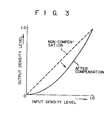
- Fig. 3 is a view showing a relation of an output density level to an input density level before and after the back area compensation.
- the broken line denotes a black gradation characteristic before the compensation and solid line shows a black gradation characteristic after the compensation.
- the compensation is effected such that the lower the input density level, the lower the output density level.
- the right-hand term of Equation (3) may be multiplied by a proper coefficient, as required.
- Respective ink amount signals Qy, Qc, Qm, and Qbk thus found are supplied to a bi-level quantizing dither circuit 28.
- the dither circuit effects bi-level quantizing of the ink amount signals Qy, Qc, Qm, and Qbk on the basis of their predetermined dither matrix patterns and delivers dithered dot data Dy, Dc, Dm, and Dbk to printer 29- which reproduces a full color image.
- the black ink amount signal Qbk can be found from the following equation: where Oo represents a saturation ink amount signal with the maximum level (3lst level).
- a high density black area is printed with the same amount of black ink as in the conventional manner and a low density black area is printed with a suppressed amount of black ink, thus preventing a lowering of the saturation in a printed image without impairing any sharpness of, for example, black characters or lines.
- This method has an advantage over a "UCR" method.
- this invention is suitable for application to an printing system such as a thermal transfer printing system, which would cause an ink transfer failure due to the thickness of printed color inks when using the UCR method.
- an adverse effect would result, in which a chromatic color may be turbid.
- the adverse effect due to the black ink transfer displacement would be reduced.
- the version of a chromatic color to chromatic color can be prevented so that a perfect black may be output.
- this invention since a portion into which black ink is to be printed is set smaller than in the conventional method, three color inks need not be printed in that portion without causing any difficulty in the black ink transfer.
- This invention is not restricted to the aforementioned embodiment.
- the area ratio of a portion where the respective inks for yellow, magenta, and cyan are superimposed is evaluated through the Neugebauer equation, and then the result of this evaluation is compensated to provide a black ink amount.
- the black ink amount may be evaluated from, for example, the number of dots in a pixel which are common to yellow, magenta, and cyan after dither conversion.
- a resultant pattern output will be as indicated by Dbk.
- the black ink area ratio BK' before compensation can be evaluated by an equation given by where m x m stands for the size of the dither matrix.
- the transformation of BK' to BK may be carried out on the basis of Equation (3). In this embodiment the amount of black ink can be evaluated more accurately than in the aforementioned case.
- Fig. 5 shows an arrangement for carrying out the operation shown in Fig. 4 and described above.
- a color conversion circuit 29a is responsive to brightness signal I and color difference signals Cl and C2 to produce ink amount signals Qy, Om, and Qc for yellow, magenta, and cyan.
- ROMs 51, 52 and 53 are provided which store dither threshold data in matrix patterns as shown in Fig. 4, for yellow, magenta, and cyan, respectively.
- ROMs 51, 52, and 53 are accessed by address counters 54, 55, and 56, respectively, to read out sequentially dither threshold data Dty, Dtm, and Dtc stored therein.
- Ink amount signals Qy, Qm, and Qc are respectively applied to comparators 57, 58, and 59 to which are respectively applied the dither threshold data Dty, Dtm, and Dtc from ROMs 51, 52, and 53, so that the dithered outputs Dy, Dm, and Dc for yellow, magenta, and cyan inks are obtained as shown in Fig. 4.
- the dithered outputs Dy, Dm, Dc for yellow, magenta, and cyan inks are applied through pulse width setting circuits 61, 62, 63 to bi-level color printer (thermal printer) 29 which comprises a driver and thermal head.
- Pulse width setting circuits 61, 62, 63 are arranged to set the pulse widths of drive pulses applied to thermal head, which determine the density of a printed image.
- the dithered outputs Dy, Dm, and Dc of comparators 57, 58, and 59 are also applied to an AND gate 60 to produce the black ink signal D'bk as shown in F ig. 4, which is in turn applied through a pulse width setting circuit 64 to color printer 29.
- Pulse width setting circuit 64 is arranged to set the pulse width of a drive pulse to half that of the drive pulses set by pulse width setting circuits 61, 62, and 63, so that the black gradation compensation is effected.
- the black area printed with the black ink is effectively reduced by setting the pulse width of the drive pulse for printing the black ink to half the pulse width of the drive pulses for printing the yellow, magenta, and cyan inks.
- color conversion circuit 27 is composed of a ROM table which stores ink amounts of four colors previously calculated. Alternatively, three color ink amounts may be obtained from a ROM table and then a black ink amount may be found from the three color ink amounts using a hardware.
- color conversion circuit 27 is comprised of color conversion table 31, black ink amount calculation section 32, and black area factor compensation circuit 33.
- Brightness signal I and color difference signals Cl and C2 from matrix circuit 26 are supplied to color conversion table 31 to be converted to three color ink amounts Qy, Qm, and Qc.
- color conversion table 31 evaluates the dither output patterns for the respective colors from the respective color ink amounts Qy, Qm, and Qc to deliver respective outputs signals.
- black ink amount calculation section 32 evaluates from the color ink amount signals Qy, Qm, and Qc the corresponding black ink amount signal before black area factor compensation. This ink amount signal is compensated for by black area factor compensation (nonlinear) circuit 33 and supplied to dither circuit 28 where it is possible to obtain a full color image with the black gradation compensated.
- color conversion circuit 27, binary dither circuit 28, etc. can be embodied in the form of a ROM while retaining the advantage of the invention.
- This invention can be variously modified by varying the kinds and number of inks.
Landscapes
- Engineering & Computer Science (AREA)
- Multimedia (AREA)
- Signal Processing (AREA)
- Color Image Communication Systems (AREA)
- Facsimile Image Signal Circuits (AREA)
- Ink Jet (AREA)
- Dot-Matrix Printers And Others (AREA)
- Color, Gradation (AREA)
- Fax Reproducing Arrangements (AREA)
Applications Claiming Priority (2)
| Application Number | Priority Date | Filing Date | Title |
|---|---|---|---|
| JP60142150A JPH0783423B2 (ja) | 1985-06-28 | 1985-06-28 | 多階調カラー画像記録方法 |
| JP142150/85 | 1985-06-28 |
Publications (3)
| Publication Number | Publication Date |
|---|---|
| EP0211509A2 true EP0211509A2 (de) | 1987-02-25 |
| EP0211509A3 EP0211509A3 (en) | 1988-10-05 |
| EP0211509B1 EP0211509B1 (de) | 1991-05-29 |
Family
ID=15308522
Family Applications (1)
| Application Number | Title | Priority Date | Filing Date |
|---|---|---|---|
| EP86304997A Expired EP0211509B1 (de) | 1985-06-28 | 1986-06-27 | Verfahren zum Drucken eines Farbbildes |
Country Status (4)
| Country | Link |
|---|---|
| US (1) | US4803496A (de) |
| EP (1) | EP0211509B1 (de) |
| JP (1) | JPH0783423B2 (de) |
| DE (1) | DE3679467D1 (de) |
Cited By (1)
| Publication number | Priority date | Publication date | Assignee | Title |
|---|---|---|---|---|
| EP0456832A4 (en) * | 1989-12-05 | 1992-10-14 | Shaken Co., Ltd. | Method and apparatus for color image processing |
Families Citing this family (13)
| Publication number | Priority date | Publication date | Assignee | Title |
|---|---|---|---|---|
| JPH0798404B2 (ja) * | 1987-06-29 | 1995-10-25 | 松下電器産業株式会社 | カラ−記録方法 |
| US5227873A (en) * | 1988-02-24 | 1993-07-13 | Mitsubishi Denki Kabushiki Kaisha | Signal processing device for video printer |
| US5024989A (en) * | 1990-04-25 | 1991-06-18 | Polaroid Corporation | Process and materials for thermal imaging |
| GB2258783A (en) * | 1991-08-14 | 1993-02-17 | Dataproducts Corp | Colour printer data signals with undercolour removal |
| JPH05336373A (ja) * | 1992-06-04 | 1993-12-17 | Toshiba Corp | 画像記録装置 |
| JP3034446B2 (ja) * | 1995-03-14 | 2000-04-17 | 株式会社東芝 | カラー画像記録装置 |
| US5960161A (en) * | 1997-03-28 | 1999-09-28 | Xerox Corporation | Circuit for adapting 4-color image signals to an 8-color digital printing apparatus |
| JP4255526B2 (ja) * | 1997-11-06 | 2009-04-15 | ソニー株式会社 | 画像処理装置および方法、並びに伝送媒体 |
| US6848768B2 (en) * | 1999-11-12 | 2005-02-01 | Canon Kabushiki Kaisha | Color ink model processes for printers |
| AU756133B2 (en) * | 1999-11-12 | 2003-01-02 | Canon Kabushiki Kaisha | Colour ink model processes for printers |
| DE60126128T2 (de) * | 2000-11-29 | 2007-11-15 | Ricoh Co., Ltd. | Druckgerät und druckverarbeitungsverfahren |
| US20050036057A1 (en) * | 2003-07-24 | 2005-02-17 | Matsushita Electric Industrial Co., Ltd. | Image pickup device integrated with lens, method and apparatus for manufacturing the same |
| US8508801B2 (en) | 2008-08-15 | 2013-08-13 | Adobe Systems Incorporated | Using reflectance properties |
Family Cites Families (7)
| Publication number | Priority date | Publication date | Assignee | Title |
|---|---|---|---|---|
| US3555262A (en) * | 1968-05-07 | 1971-01-12 | Dainippon Screen Mfg | Apparatus for production of color separation records |
| JPS5648869A (en) * | 1979-09-28 | 1981-05-02 | Kaneshichi Kk | Production of fish meat paste product broiled at high temperature |
| JPS56135842A (en) * | 1980-03-26 | 1981-10-23 | Toppan Printing Co Ltd | Method and apparatus for removing ground color |
| JPS5799644A (en) * | 1980-12-11 | 1982-06-21 | Matsushita Electric Ind Co Ltd | Color ink jet recorder |
| DE3265413D1 (en) * | 1982-05-29 | 1985-09-19 | Hell Rudolf Dr Ing Gmbh | Method for tone-value-dependent colour removal in four color printing |
| US4683492A (en) * | 1983-03-08 | 1987-07-28 | Canon Kabushiki Kaisha | Method and apparatus for recording a full-color image with a plurality of colorants on the basis of a set of area factors for the colorants selected from a plurality of sets of area factors calculated from a plurality of sets of equations |
| JPH069371B2 (ja) * | 1984-06-29 | 1994-02-02 | キヤノン株式会社 | カラ−画像処理方法 |
-
1985
- 1985-06-28 JP JP60142150A patent/JPH0783423B2/ja not_active Expired - Lifetime
-
1986
- 1986-06-27 EP EP86304997A patent/EP0211509B1/de not_active Expired
- 1986-06-27 DE DE8686304997T patent/DE3679467D1/de not_active Expired - Lifetime
- 1986-06-30 US US06/879,943 patent/US4803496A/en not_active Expired - Lifetime
Cited By (1)
| Publication number | Priority date | Publication date | Assignee | Title |
|---|---|---|---|---|
| EP0456832A4 (en) * | 1989-12-05 | 1992-10-14 | Shaken Co., Ltd. | Method and apparatus for color image processing |
Also Published As
| Publication number | Publication date |
|---|---|
| JPH0783423B2 (ja) | 1995-09-06 |
| JPS622776A (ja) | 1987-01-08 |
| EP0211509B1 (de) | 1991-05-29 |
| EP0211509A3 (en) | 1988-10-05 |
| US4803496A (en) | 1989-02-07 |
| DE3679467D1 (de) | 1991-07-04 |
Similar Documents
| Publication | Publication Date | Title |
|---|---|---|
| EP0168818B1 (de) | Farbbildkopiergerät | |
| US4060829A (en) | Method of color correction | |
| US5107332A (en) | Method and system for providing closed loop color control between a scanned color image and the output of a color printer | |
| US5463471A (en) | Method and system of color halftone reproduction | |
| US5734800A (en) | Six-color process system | |
| EP0720351B1 (de) | Verfahren zur Erzeugung von Farbprobeabzügen | |
| US7345798B2 (en) | Method of and apparatus for correcting color of print medium, and proofer used therein | |
| US5787193A (en) | System for converting color image signals from RGB to CMY color spaces through look-up tables | |
| EP0211509B1 (de) | Verfahren zum Drucken eines Farbbildes | |
| US4672433A (en) | Color signal processing apparatus with a signal interpolation function for use in a color copier | |
| US5497180A (en) | Image recording apparatus for representing a halftone by use of a plurality of recorded dots | |
| JPH0515105B2 (de) | ||
| US5296947A (en) | System for softproofing a color reproduction | |
| US5781709A (en) | Method of and apparatus for generating proof | |
| EP0562596A2 (de) | Verfahren und Vorrichtung zur Verarbeitung von Farbbildern | |
| JPS6338155B2 (de) | ||
| JP3360358B2 (ja) | 印刷色材量決定方法 | |
| US5381246A (en) | Image processing system for converting a full color image into a pseudo-color CMY dot representation | |
| US5016097A (en) | Method of obtaining monochromatic image from color original through color image recorder | |
| US5585833A (en) | Tone control method for thermal transfer type color printer | |
| EP0446914A2 (de) | Verfahren zur elektronischen Farbverarbeitung | |
| US5729362A (en) | Method for determining color data | |
| JP2932277B2 (ja) | カラー画像記録装置 | |
| JP2990361B2 (ja) | 画像処理方法 | |
| JPH0767130B2 (ja) | 網点面積率決定装置 |
Legal Events
| Date | Code | Title | Description |
|---|---|---|---|
| PUAI | Public reference made under article 153(3) epc to a published international application that has entered the european phase |
Free format text: ORIGINAL CODE: 0009012 |
|
| AK | Designated contracting states |
Kind code of ref document: A2 Designated state(s): DE GB IT NL |
|
| 17P | Request for examination filed |
Effective date: 19880208 |
|
| PUAL | Search report despatched |
Free format text: ORIGINAL CODE: 0009013 |
|
| AK | Designated contracting states |
Kind code of ref document: A3 Designated state(s): DE GB IT NL |
|
| 17Q | First examination report despatched |
Effective date: 19900911 |
|
| GRAA | (expected) grant |
Free format text: ORIGINAL CODE: 0009210 |
|
| AK | Designated contracting states |
Kind code of ref document: B1 Designated state(s): DE GB IT NL |
|
| PG25 | Lapsed in a contracting state [announced via postgrant information from national office to epo] |
Ref country code: NL Effective date: 19910529 |
|
| PGFP | Annual fee paid to national office [announced via postgrant information from national office to epo] |
Ref country code: NL Payment date: 19910630 Year of fee payment: 6 |
|
| REF | Corresponds to: |
Ref document number: 3679467 Country of ref document: DE Date of ref document: 19910704 |
|
| ITF | It: translation for a ep patent filed | ||
| NLV1 | Nl: lapsed or annulled due to failure to fulfill the requirements of art. 29p and 29m of the patents act | ||
| PLBE | No opposition filed within time limit |
Free format text: ORIGINAL CODE: 0009261 |
|
| STAA | Information on the status of an ep patent application or granted ep patent |
Free format text: STATUS: NO OPPOSITION FILED WITHIN TIME LIMIT |
|
| 26N | No opposition filed | ||
| REG | Reference to a national code |
Ref country code: GB Ref legal event code: 746 Effective date: 19981010 |
|
| REG | Reference to a national code |
Ref country code: GB Ref legal event code: IF02 |
|
| PGFP | Annual fee paid to national office [announced via postgrant information from national office to epo] |
Ref country code: GB Payment date: 20050622 Year of fee payment: 20 |
|
| PGFP | Annual fee paid to national office [announced via postgrant information from national office to epo] |
Ref country code: DE Payment date: 20050623 Year of fee payment: 20 |
|
| PGFP | Annual fee paid to national office [announced via postgrant information from national office to epo] |
Ref country code: IT Payment date: 20050627 Year of fee payment: 20 |
|
| REG | Reference to a national code |
Ref country code: GB Ref legal event code: PE20 |
|
| PG25 | Lapsed in a contracting state [announced via postgrant information from national office to epo] |
Ref country code: GB Free format text: LAPSE BECAUSE OF EXPIRATION OF PROTECTION Effective date: 20060626 |