EP0211865B2 - Detection de tonalites de supervision - Google Patents
Detection de tonalites de supervision Download PDFInfo
- Publication number
- EP0211865B2 EP0211865B2 EP86900970A EP86900970A EP0211865B2 EP 0211865 B2 EP0211865 B2 EP 0211865B2 EP 86900970 A EP86900970 A EP 86900970A EP 86900970 A EP86900970 A EP 86900970A EP 0211865 B2 EP0211865 B2 EP 0211865B2
- Authority
- EP
- European Patent Office
- Prior art keywords
- tone
- frequency
- supervisory
- tones
- communication channel
- Prior art date
- Legal status (The legal status is an assumption and is not a legal conclusion. Google has not performed a legal analysis and makes no representation as to the accuracy of the status listed.)
- Expired - Lifetime
Links
Images


Classifications
-
- H—ELECTRICITY
- H04—ELECTRIC COMMUNICATION TECHNIQUE
- H04Q—SELECTING
- H04Q1/00—Details of selecting apparatus or arrangements
- H04Q1/18—Electrical details
- H04Q1/30—Signalling arrangements; Manipulation of signalling currents
- H04Q1/44—Signalling arrangements; Manipulation of signalling currents using alternate current
- H04Q1/442—Signalling arrangements; Manipulation of signalling currents using alternate current with out-of-voice band signalling frequencies
Definitions
- This invention relates to methods of and apparatus for detecting at least one of a plurality of supervisory tones.
- supervision is the process of detecting customer initiated changes in the switch-hook state of a telephone.
- ST signaling tone
- SAT supervisory audio tone
- Three SAT's are set aside at 5970, 6000, and 6030 Hz; any one is used at a given cell site.
- a mobile unit receives a SATfrom a cell site and returns it to the cell site. It is important for the cell site to compute reliably the SAT returned from the mobile unit within a predetermined period.
- the prior art typically relied on phase lock loops.
- the problem with phase lock loops is that it becomes unlocked during fades or other types of signal interruption.
- the problem with methods based on analog filters is that the fi Iters were excessively sensitive to tolerances and the like in view of the excessively high selectivity, or Q required.
- a typical prior art tone detection system for detecting the presence of a predetermined frequency in multifrequency PCM signals is disclosed in French patent 299 769.
- Another type of tone detection system is disclosed in British patent 1,482,629 for detecting tones of one particular frequency. Such systems lack the capability of detecting multiple frequency tones rapidly and concurrently without requiring additional hardware.
- An advantage of the present invention is that it provides reliable detection of SAT in a fading channel.
- An advantage of an embodiment of the present invention as disclosed is that the digital nature of the implementation allows it to be effectively multiplexed, by sampling received signals discontinuously over several antenna faces thus encountering a type of interruption, or by sampling continuously with apparent concurrency over several discrete channels.
- distinct parallel equipment including receivers for each antenna face would be required if the signal detection were done by phase lock loops.
- a further advantage of an embodiment of the present invention is that by nature of the digital implementation under stored program control, parameters of the detection process such as selectivity may be dynamically altered in real time.
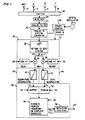
- FIG. 1 there is shown apparatus for receiving and detecting the presence of supervisory audio tones (SAT's) from a mobile unit. More particularly, omnidirectional antenna 10, and directional antennas 12, 14 and 16 receive signals from a mobile telephone unit (not shown). Although only four antennas are described, it is clear that this number may be changed. As stated in the background of this application, omnidirectional antennas are used to receive signals from all directions. Butwhen a system grows, the omnidirectional antenna configuration is augmented by three directional antennas: alpha, beta, and gamma; each antenna serving a separate region of angular width 120 degrees. Switch 18 switches each of the aforesaid antennas in turn to receiver 20. After being filtered by element 21, analog signals are converted to digital signals in converter 22. A crystal oscillator 24 drives a bindary counter 26 which provides clock signals at different synchronous sub- rates to the various elements and will not be described in detail because such technology is well known.
- SAT's supervisory audio tones
- the digital signal from converter 22 is fed to a read only memory (ROM) 30 comprising limiter 32 for reducing spurious signals.
- Limiter 32 is a return to zero limiter of the type disclosed in U.S. patent No. 4596024.
- the frequency of the received signal is extracted by conceptually feeding the output from limiter 32 to two multiplication circuits 34 and 36.
- circuit 36 has two inputs: the output from limiter 32 and cos (met).
- the output signals from circuit 34 are numerically integrated in element 42 of quadrature accumulator40 and the output signals from circuit 36 are likewise numerically integrated in element 44 of data accumulator 46.
- the aforesaid signals from the multiplier circuits 34 and 36 are integrated over an interval from O to T (approximately one millisecond). That is, the first integrator 42, in cooperation with processor 50 performs a discrete approximation to the analog operation: and the second integrator 44, again cooperating with processor 50, likewise performs a discrete approximation to the analog operation:
- Each integral is over T seconds and is repeated every T k seconds.
- the integration time T is approximately one millisecond and the time between integrations, T k , is (66.6 over 8) milliseconds.
- Each of these integrals over T seconds comprises twelve subintegrals which are computed in hardware accumulators 42 and 44. The output signals from accumulators 42 and 44 are combined by processor 50 in the manner described hereinbelow.
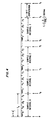
- Each of these subintegrals comprise sixty-four samples and extend for one half-cycle of the 6KHz signal, that is, for of a second. Equivalently, each subintegral formed by summing sixty-four consecutive output signals from multipliers 34 and 36 at a spacing of of a second, that is, 1.302 microseconds, and so have a duration of seconds.
- DFT discrete Fourier transform
- the method of calculating the maximum F(i) follows hereinbelow.
- the method is clearly not restricted to a single frequency and, for example, multiple SAT's could be assigned and amplitude and/or phase relations between them determine in a manner similar to that described herein.
- T acts as a scaling factor; the greater the T, the greater the sensitivity and selectivity; is a phase factor and is ignored in this frequency analysis; and is a distortion factor.
- the distortioon factor is approximately one, so that it can be neglected.
- N complex numbers can be obtained which correspond to N discrete points of Aej ⁇ o t, where each point is separated in time by T k ; that is:
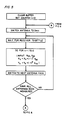
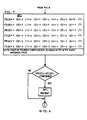
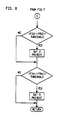
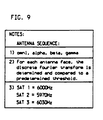
- processor 50 The steps taken by processor 50 is computing the complex numbers received from quadrature accumulator 40 is shown in FIGS. 5 through 9. These steps are sufficiently detailed and are not repeated here.
- the goal is to determine eight complex numbers.
- the real component corresponds to the cos (w t) component and the imaginary part corresponds to the sin (mt) component.
- Each complex number is determined by entering numbers, the aforementioned subintegrals, from both data accumulator 40 and from quadrature accumulator 46 twelve times into corresponding processor registers. Each time a number is entered from aforesaid accumulators, it is either added to or subtracted from a running sum which is maintained in two corresponding processor data and quadrature registers.
- a lookup table located in an integrated circuit comprising the multiplier circuit 34 and 36 has half cycle information. In order to obtain information spanning a whole cycle, it is necessary to invert the sign of data from alternate half cycles. The use of lookup tables is well known and will not be further described.
- the output is sent over path 57 to a cell site controller (not shown).
- Each of the aforesaid complex numbered samples is maintained as thirty-two bits: sixteen bits by way of the real part and sixteen bits by way of the imaginary part.
- the real part x k is given by and the imaginary part y k is given by where, p nk is the nth sample from data accumulator 46, and q nk is the nth sample from the quadrature accumulator 40 during the kth time interval.
- Each of the p's and q's is the sum of the sixty-four products of s(t) with cosine computed in data accumulator 46 and sixty-four products of s(t) with sine computed in quadrature accumulator 40 over the same half cycle of the 6KHz clock.
- the DFT is defined by the expression:
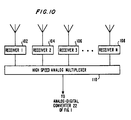
- FIG. 10 there is shown apparatus for concurrently monitoring SAT on a plurality of active voice channels.
- separate radios exist for each channel and are not switched at the antennas so that there is no need for waiting for receiver settling time as in the previously described embodiment.
- High speed analog multiplexor 110 is placed advantageously at the output of each receiver and interleaved samples taken for each channel at a rate, typically, 48 KHz.
- the output from multiplexor 110 is fed to an analog- to-digital converter, such as element 22 in FIG. 1, the rest of the circuit remaining the same.
- the data and quad accumulators are partitioned accordinag to the original signal source or channel and serve as multiplexed integrators serving multiple channels.
- Subsequent data and quadrature processing proceeds concurrently for all channels.
- all channels may be processed in parallel and results for all channels will be available at the same time in individual buffers for each channel.
- the aforesaid method of signal detection can be used in related fields where signal detection in the presence of noise is a major consideration.
Landscapes
- Engineering & Computer Science (AREA)
- Computer Networks & Wireless Communication (AREA)
- Mobile Radio Communication Systems (AREA)
- Digital Transmission Methods That Use Modulated Carrier Waves (AREA)
- Complex Calculations (AREA)
Abstract
Claims (10)


Applications Claiming Priority (3)
| Application Number | Priority Date | Filing Date | Title |
|---|---|---|---|
| US698095 | 1985-02-04 | ||
| US06/698,095 US4698769A (en) | 1985-02-04 | 1985-02-04 | Supervisory audio tone detection in a radio channel |
| PCT/US1986/000110 WO1986004762A1 (fr) | 1985-02-04 | 1986-01-23 | Detection de tonalites de supervision dans un canal radio |
Publications (3)
| Publication Number | Publication Date |
|---|---|
| EP0211865A1 EP0211865A1 (fr) | 1987-03-04 |
| EP0211865B1 EP0211865B1 (fr) | 1990-07-18 |
| EP0211865B2 true EP0211865B2 (fr) | 1994-11-30 |
Family
ID=24803881
Family Applications (1)
| Application Number | Title | Priority Date | Filing Date |
|---|---|---|---|
| EP86900970A Expired - Lifetime EP0211865B2 (fr) | 1985-02-04 | 1986-01-23 | Detection de tonalites de supervision |
Country Status (6)
| Country | Link |
|---|---|
| US (1) | US4698769A (fr) |
| EP (1) | EP0211865B2 (fr) |
| JP (1) | JP2721498B2 (fr) |
| CA (1) | CA1250024A (fr) |
| DE (1) | DE3672711D1 (fr) |
| WO (1) | WO1986004762A1 (fr) |
Families Citing this family (17)
| Publication number | Priority date | Publication date | Assignee | Title |
|---|---|---|---|---|
| US4791600A (en) * | 1986-07-28 | 1988-12-13 | Tektronix, Inc. | Digital pipelined heterodyne circuit |
| US4965761A (en) * | 1988-06-03 | 1990-10-23 | General Dynamics Corporation, Pomona Div. | Fast discrete fourier transform apparatus and method |
| FI87026C (fi) * | 1989-12-01 | 1992-11-10 | Nokia Mobile Phones Ltd | Pao en digital faslaosningskrets baserad frekvensdetektor |
| US5001742A (en) * | 1990-01-29 | 1991-03-19 | At&T Bell Laboratories | Baseband signal processing unit and method of operating the same |
| US5367539A (en) * | 1991-12-31 | 1994-11-22 | At&T Bell Laboratories | Digital block processor for processing a plurality of transmission channels in a wireless radiotelephony system |
| CA2101501A1 (fr) * | 1992-09-21 | 1994-03-22 | Robert Chuenlin Wang | Methode et appareil pour detecter un signal par tonalite audio de controle |
| US5953660A (en) * | 1995-11-22 | 1999-09-14 | Telefonaktiebolaget Lm Ericsson | Supervisory audio tone detection using digital signal processing |
| US6181739B1 (en) * | 1995-11-22 | 2001-01-30 | Telefonaktiebolaget Lm Ericsson (Publ) | Signal-to-noise ratio determination using digital signal processing |
| US6236838B1 (en) * | 1997-06-03 | 2001-05-22 | Texas Instruments Incorporated | System for superresolution based estimation of control signals in a communications system |
| CA2225231C (fr) * | 1997-12-19 | 2004-03-02 | Rui R. Wang | Detection de frequence utilisant des techniques de transformation fourier discretes |
| DE10055375A1 (de) * | 2000-11-08 | 2002-05-23 | Infineon Technologies Ag | Auswerteschaltung für Wechselspannungsimpulse |
| US6965068B2 (en) * | 2000-12-27 | 2005-11-15 | National Instruments Corporation | System and method for estimating tones in an input signal |
| US6775629B2 (en) * | 2001-06-12 | 2004-08-10 | National Instruments Corporation | System and method for estimating one or more tones in an input signal |
| US6721673B2 (en) | 2001-06-12 | 2004-04-13 | National Instruments Corporation | Estimating a plurality of tones in an input signal |
| US7437396B2 (en) * | 2004-03-31 | 2008-10-14 | Intel Corporation | Apparatus and method for generating transforms |
| US8438204B2 (en) * | 2008-12-18 | 2013-05-07 | Lsi Corporation | Apparatus for calculating an N-point discrete fourier transform |
| KR101551346B1 (ko) * | 2014-05-13 | 2015-09-08 | 주식회사 이노와이어리스 | 인접 셀 간에 사이드 로브 신호 제거를 위한 적응적 간섭 제거 장치 |
Family Cites Families (14)
| Publication number | Priority date | Publication date | Assignee | Title |
|---|---|---|---|---|
| FR2147770B1 (fr) * | 1971-04-27 | 1974-06-21 | Thomson Csf | |
| CH553523A (de) * | 1972-12-22 | 1974-08-30 | Baumann Ernst | Verfahren und einrichtung zum empfang von mehrfrequenzcodesignalen. |
| GB1482629A (en) * | 1973-09-11 | 1977-08-10 | Trend Communications Ltd | Tone detectors |
| FR2299769A1 (fr) * | 1975-01-31 | 1976-08-27 | Telecommunications Sa | Procede d'application |
| US4021653A (en) * | 1975-10-14 | 1977-05-03 | Motorola, Inc. | Digital programmable tone detector |
| US4025853A (en) * | 1976-02-12 | 1977-05-24 | Bell Telephone Laboratories, Incorporated | Method and apparatus for radio system cochannel interference suppression |
| US4075630A (en) * | 1976-09-01 | 1978-02-21 | Raytheon Company | Signal processor |
| US4310722A (en) * | 1978-11-09 | 1982-01-12 | Bell Telephone Laboratories, Incorporated | Mobile radiotelephone station two-way ranging system |
| US4266279A (en) * | 1979-03-29 | 1981-05-05 | Motorola, Inc. | Memory system for a Doppler radar incorporating a fast Fourier transform computer |
| US4302817A (en) * | 1980-02-14 | 1981-11-24 | Motorola, Inc. | Digital Pseudo continuous tone detector |
| DE3118473C2 (de) * | 1981-05-09 | 1987-02-05 | Felten & Guilleaume Fernmeldeanlagen GmbH, 8500 Nürnberg | Verfahren zur Aufbereitung elektrischer Signale mit einer digitalen Filteranordnung |
| US4519084A (en) * | 1982-09-29 | 1985-05-21 | At&T Bell Laboratories | Matched filter for combating multipath fading |
| US4535417A (en) * | 1982-12-23 | 1985-08-13 | Standard Oil Company | Method and apparatus for digital time-variant filtering |
| US4534043A (en) * | 1983-06-27 | 1985-08-06 | Racal Data Communications, Inc. | Test tone detector apparatus and method modem using same |
-
1985
- 1985-02-04 US US06/698,095 patent/US4698769A/en not_active Expired - Lifetime
-
1986
- 1986-01-23 JP JP61500771A patent/JP2721498B2/ja not_active Expired - Lifetime
- 1986-01-23 DE DE8686900970T patent/DE3672711D1/de not_active Expired - Lifetime
- 1986-01-23 WO PCT/US1986/000110 patent/WO1986004762A1/fr not_active Ceased
- 1986-01-23 EP EP86900970A patent/EP0211865B2/fr not_active Expired - Lifetime
- 1986-01-31 CA CA000500864A patent/CA1250024A/fr not_active Expired
Also Published As
| Publication number | Publication date |
|---|---|
| EP0211865B1 (fr) | 1990-07-18 |
| US4698769A (en) | 1987-10-06 |
| WO1986004762A1 (fr) | 1986-08-14 |
| JPS62501669A (ja) | 1987-07-02 |
| DE3672711D1 (de) | 1990-08-23 |
| JP2721498B2 (ja) | 1998-03-04 |
| CA1250024A (fr) | 1989-02-14 |
| EP0211865A1 (fr) | 1987-03-04 |
Similar Documents
| Publication | Publication Date | Title |
|---|---|---|
| EP0211865B1 (fr) | Detection de tonalites de supervision | |
| CA2081535C (fr) | Methode et dispositif pour la detection des signaux de commande | |
| EP0008160B1 (fr) | Détecteur digital programmable pour signaux à fréquences acoustiques | |
| CA1289281C (fr) | Detecteur de tonalites dtmf numeriques | |
| EP0041536B1 (fr) | Recepteur de tonalite a multifrequence programmable | |
| US4669114A (en) | Digital tone detector | |
| EP0872122B1 (fr) | Systeme et procede de detection multifrequence en code 2 pour seuillage statique et dynamique | |
| US4185172A (en) | Method of and means for detecting digitized multi frequency-coded signals | |
| WO1981002353A1 (fr) | Detecteur de tonalite numerique pseudo continu | |
| CA1155985A (fr) | Combine recepteur-emetteur numerique a boutons-poussoirs | |
| US6782095B1 (en) | Method and apparatus for performing spectral processing in tone detection | |
| CA1090492A (fr) | Systeme de communication blu-mrf derive d'un groupe de filtrage passe-bande digital complexe | |
| US4109109A (en) | Method and apparatus for detecting the presence of signal components of predetermined frequency in multifrequency pcm signal | |
| EP0622962A1 (fr) | Procédé de détection de tonalités de progrès d'appel | |
| US4614909A (en) | Apparatus for identifying digital multi-frequency signals | |
| GB1492310A (en) | Digital multifrequency signals receiver | |
| Gopinath et al. | A Touch‐Tone® Receiver‐Generator With Digital Channel Filters | |
| Park et al. | Signal detection and analysis of DTMF receiver with quick Fourier transform | |
| Selman et al. | Comparative analysis of methods used in the design of DTMF tone detectors | |
| KR930006544B1 (ko) | 디지틀 신호처리기를 이용한 dtmf 수신방법 | |
| US3692953A (en) | Multiplex multifrequency signal receiver | |
| CA1145848A (fr) | Detection de tonalites dans des signaux echantillonnes | |
| SU1169199A1 (ru) | Цифровой приемник многочастотной сигнализации | |
| KR100384286B1 (ko) | 교환 시스템의 디 티 엠 에프 신호 검출방법 | |
| KR100463845B1 (ko) | 교환 시스템에서 디 티 엠 에프 신호 검출방법 |
Legal Events
| Date | Code | Title | Description |
|---|---|---|---|
| PUAI | Public reference made under article 153(3) epc to a published international application that has entered the european phase |
Free format text: ORIGINAL CODE: 0009012 |
|
| AK | Designated contracting states |
Kind code of ref document: A1 Designated state(s): DE FR GB NL SE |
|
| 17P | Request for examination filed |
Effective date: 19870114 |
|
| 17Q | First examination report despatched |
Effective date: 19890526 |
|
| GRAA | (expected) grant |
Free format text: ORIGINAL CODE: 0009210 |
|
| AK | Designated contracting states |
Kind code of ref document: B1 Designated state(s): DE FR GB NL SE |
|
| PG25 | Lapsed in a contracting state [announced via postgrant information from national office to epo] |
Ref country code: SE Effective date: 19900718 Ref country code: NL Effective date: 19900718 Ref country code: FR Effective date: 19900718 |
|
| REF | Corresponds to: |
Ref document number: 3672711 Country of ref document: DE Date of ref document: 19900823 |
|
| EN | Fr: translation not filed | ||
| NLV1 | Nl: lapsed or annulled due to failure to fulfill the requirements of art. 29p and 29m of the patents act | ||
| PLBI | Opposition filed |
Free format text: ORIGINAL CODE: 0009260 |
|
| 26 | Opposition filed |
Opponent name: TELENORMA GMBH Effective date: 19910328 |
|
| RAP4 | Party data changed (patent owner data changed or rights of a patent transferred) |
Owner name: AT&T CORP. |
|
| PUAH | Patent maintained in amended form |
Free format text: ORIGINAL CODE: 0009272 |
|
| STAA | Information on the status of an ep patent application or granted ep patent |
Free format text: STATUS: PATENT MAINTAINED AS AMENDED |
|
| 27A | Patent maintained in amended form |
Effective date: 19941130 |
|
| AK | Designated contracting states |
Kind code of ref document: B2 Designated state(s): DE FR GB NL SE |
|
| EN3 | Fr: translation not filed ** decision concerning opposition | ||
| REG | Reference to a national code |
Ref country code: GB Ref legal event code: IF02 |
|
| PGFP | Annual fee paid to national office [announced via postgrant information from national office to epo] |
Ref country code: GB Payment date: 20050111 Year of fee payment: 20 |
|
| PGFP | Annual fee paid to national office [announced via postgrant information from national office to epo] |
Ref country code: DE Payment date: 20050207 Year of fee payment: 20 |
|
| PG25 | Lapsed in a contracting state [announced via postgrant information from national office to epo] |
Ref country code: GB Free format text: LAPSE BECAUSE OF EXPIRATION OF PROTECTION Effective date: 20060122 |
|
| REG | Reference to a national code |
Ref country code: GB Ref legal event code: PE20 |