EP0212038B1 - Vorrichtung zur Regeneration von elektroanalytischen Sonden - Google Patents
Vorrichtung zur Regeneration von elektroanalytischen Sonden Download PDFInfo
- Publication number
- EP0212038B1 EP0212038B1 EP85810387A EP85810387A EP0212038B1 EP 0212038 B1 EP0212038 B1 EP 0212038B1 EP 85810387 A EP85810387 A EP 85810387A EP 85810387 A EP85810387 A EP 85810387A EP 0212038 B1 EP0212038 B1 EP 0212038B1
- Authority
- EP
- European Patent Office
- Prior art keywords
- probe
- electrode
- regenerator
- regeneration
- electrolyte
- Prior art date
- Legal status (The legal status is an assumption and is not a legal conclusion. Google has not performed a legal analysis and makes no representation as to the accuracy of the status listed.)
- Expired
Links
- 239000000523 sample Substances 0.000 title claims description 84
- 230000008929 regeneration Effects 0.000 title claims description 47
- 238000011069 regeneration method Methods 0.000 title claims description 47
- 239000003792 electrolyte Substances 0.000 claims description 47
- OKTJSMMVPCPJKN-UHFFFAOYSA-N Carbon Chemical compound [C] OKTJSMMVPCPJKN-UHFFFAOYSA-N 0.000 claims description 5
- 239000010439 graphite Substances 0.000 claims description 4
- 229910002804 graphite Inorganic materials 0.000 claims description 4
- 238000007789 sealing Methods 0.000 claims description 3
- 239000004020 conductor Substances 0.000 claims description 2
- 230000001172 regenerating effect Effects 0.000 claims description 2
- 239000011244 liquid electrolyte Substances 0.000 claims 2
- 210000004027 cell Anatomy 0.000 description 16
- 230000004044 response Effects 0.000 description 15
- 230000000694 effects Effects 0.000 description 14
- 239000012528 membrane Substances 0.000 description 12
- QVGXLLKOCUKJST-UHFFFAOYSA-N atomic oxygen Chemical compound [O] QVGXLLKOCUKJST-UHFFFAOYSA-N 0.000 description 10
- 238000000034 method Methods 0.000 description 10
- 239000001301 oxygen Substances 0.000 description 10
- 229910052760 oxygen Inorganic materials 0.000 description 10
- 229910052751 metal Inorganic materials 0.000 description 8
- 239000002184 metal Substances 0.000 description 8
- 229910000510 noble metal Inorganic materials 0.000 description 7
- XLYOFNOQVPJJNP-UHFFFAOYSA-N water Substances O XLYOFNOQVPJJNP-UHFFFAOYSA-N 0.000 description 7
- 239000000470 constituent Substances 0.000 description 6
- 239000007789 gas Substances 0.000 description 6
- BASFCYQUMIYNBI-UHFFFAOYSA-N platinum Chemical group [Pt] BASFCYQUMIYNBI-UHFFFAOYSA-N 0.000 description 6
- 238000012360 testing method Methods 0.000 description 6
- 239000012212 insulator Substances 0.000 description 5
- 239000000463 material Substances 0.000 description 5
- 229910045601 alloy Inorganic materials 0.000 description 4
- 239000000956 alloy Substances 0.000 description 4
- 230000015572 biosynthetic process Effects 0.000 description 4
- 150000001768 cations Chemical class 0.000 description 4
- 229910052737 gold Inorganic materials 0.000 description 4
- 239000010931 gold Substances 0.000 description 4
- 239000001257 hydrogen Substances 0.000 description 4
- 229910052739 hydrogen Inorganic materials 0.000 description 4
- 150000002739 metals Chemical class 0.000 description 4
- 230000036962 time dependent Effects 0.000 description 4
- UFHFLCQGNIYNRP-UHFFFAOYSA-N Hydrogen Chemical compound [H][H] UFHFLCQGNIYNRP-UHFFFAOYSA-N 0.000 description 3
- 239000002253 acid Substances 0.000 description 3
- 238000004458 analytical method Methods 0.000 description 3
- 210000003850 cellular structure Anatomy 0.000 description 3
- 230000008859 change Effects 0.000 description 3
- 238000004140 cleaning Methods 0.000 description 3
- 230000006866 deterioration Effects 0.000 description 3
- 239000007788 liquid Substances 0.000 description 3
- 238000005259 measurement Methods 0.000 description 3
- 229910052697 platinum Inorganic materials 0.000 description 3
- 229910052709 silver Inorganic materials 0.000 description 3
- QGZKDVFQNNGYKY-UHFFFAOYSA-N Ammonia Chemical compound N QGZKDVFQNNGYKY-UHFFFAOYSA-N 0.000 description 2
- 229910019142 PO4 Inorganic materials 0.000 description 2
- HCHKCACWOHOZIP-UHFFFAOYSA-N Zinc Chemical compound [Zn] HCHKCACWOHOZIP-UHFFFAOYSA-N 0.000 description 2
- 150000007513 acids Chemical class 0.000 description 2
- 230000032683 aging Effects 0.000 description 2
- 150000001450 anions Chemical class 0.000 description 2
- 230000009286 beneficial effect Effects 0.000 description 2
- 239000000356 contaminant Substances 0.000 description 2
- -1 cyanide anions Chemical class 0.000 description 2
- 238000000354 decomposition reaction Methods 0.000 description 2
- 239000007772 electrode material Substances 0.000 description 2
- 239000012530 fluid Substances 0.000 description 2
- PCHJSUWPFVWCPO-UHFFFAOYSA-N gold Chemical compound [Au] PCHJSUWPFVWCPO-UHFFFAOYSA-N 0.000 description 2
- 229910001385 heavy metal Inorganic materials 0.000 description 2
- 239000012535 impurity Substances 0.000 description 2
- 230000007774 longterm Effects 0.000 description 2
- 238000012423 maintenance Methods 0.000 description 2
- 230000001473 noxious effect Effects 0.000 description 2
- 230000000737 periodic effect Effects 0.000 description 2
- 235000021317 phosphate Nutrition 0.000 description 2
- 238000007747 plating Methods 0.000 description 2
- 230000000607 poisoning effect Effects 0.000 description 2
- 238000011084 recovery Methods 0.000 description 2
- 230000002441 reversible effect Effects 0.000 description 2
- 230000035945 sensitivity Effects 0.000 description 2
- 230000035939 shock Effects 0.000 description 2
- 239000004332 silver Substances 0.000 description 2
- 239000000243 solution Substances 0.000 description 2
- UMGDCJDMYOKAJW-UHFFFAOYSA-N thiourea Chemical compound NC(N)=S UMGDCJDMYOKAJW-UHFFFAOYSA-N 0.000 description 2
- 229910052725 zinc Inorganic materials 0.000 description 2
- 239000011701 zinc Substances 0.000 description 2
- QGZKDVFQNNGYKY-UHFFFAOYSA-O Ammonium Chemical compound [NH4+] QGZKDVFQNNGYKY-UHFFFAOYSA-O 0.000 description 1
- BVKZGUZCCUSVTD-UHFFFAOYSA-M Bicarbonate Chemical class OC([O-])=O BVKZGUZCCUSVTD-UHFFFAOYSA-M 0.000 description 1
- 229920004943 Delrin® Polymers 0.000 description 1
- 101100117236 Drosophila melanogaster speck gene Proteins 0.000 description 1
- 229920001774 Perfluoroether Polymers 0.000 description 1
- 229930182556 Polyacetal Natural products 0.000 description 1
- 239000004952 Polyamide Substances 0.000 description 1
- 239000004809 Teflon Substances 0.000 description 1
- 229920006362 Teflon® Polymers 0.000 description 1
- XSQUKJJJFZCRTK-UHFFFAOYSA-N Urea Natural products NC(N)=O XSQUKJJJFZCRTK-UHFFFAOYSA-N 0.000 description 1
- 229910052783 alkali metal Inorganic materials 0.000 description 1
- 150000008044 alkali metal hydroxides Chemical class 0.000 description 1
- 150000001340 alkali metals Chemical class 0.000 description 1
- 229910052784 alkaline earth metal Inorganic materials 0.000 description 1
- 150000001342 alkaline earth metals Chemical class 0.000 description 1
- 229910021529 ammonia Inorganic materials 0.000 description 1
- 230000008901 benefit Effects 0.000 description 1
- 238000009835 boiling Methods 0.000 description 1
- 229910052799 carbon Inorganic materials 0.000 description 1
- 150000004649 carbonic acid derivatives Chemical class 0.000 description 1
- 238000001311 chemical methods and process Methods 0.000 description 1
- 238000006243 chemical reaction Methods 0.000 description 1
- 239000003153 chemical reaction reagent Substances 0.000 description 1
- 239000011248 coating agent Substances 0.000 description 1
- 238000000576 coating method Methods 0.000 description 1
- 239000008139 complexing agent Substances 0.000 description 1
- 238000007796 conventional method Methods 0.000 description 1
- 230000007850 degeneration Effects 0.000 description 1
- 238000005238 degreasing Methods 0.000 description 1
- 238000001514 detection method Methods 0.000 description 1
- 230000001627 detrimental effect Effects 0.000 description 1
- 238000007598 dipping method Methods 0.000 description 1
- 238000002845 discoloration Methods 0.000 description 1
- 238000000840 electrochemical analysis Methods 0.000 description 1
- 238000004070 electrodeposition Methods 0.000 description 1
- 238000005868 electrolysis reaction Methods 0.000 description 1
- 230000008030 elimination Effects 0.000 description 1
- 238000003379 elimination reaction Methods 0.000 description 1
- 238000005516 engineering process Methods 0.000 description 1
- 239000003344 environmental pollutant Substances 0.000 description 1
- 230000001747 exhibiting effect Effects 0.000 description 1
- NBVXSUQYWXRMNV-UHFFFAOYSA-N fluoromethane Chemical compound FC NBVXSUQYWXRMNV-UHFFFAOYSA-N 0.000 description 1
- 238000011010 flushing procedure Methods 0.000 description 1
- 230000008014 freezing Effects 0.000 description 1
- 238000007710 freezing Methods 0.000 description 1
- 238000000227 grinding Methods 0.000 description 1
- 150000004820 halides Chemical class 0.000 description 1
- 150000002431 hydrogen Chemical class 0.000 description 1
- 150000004679 hydroxides Chemical class 0.000 description 1
- 238000003780 insertion Methods 0.000 description 1
- 230000037431 insertion Effects 0.000 description 1
- 229910000765 intermetallic Inorganic materials 0.000 description 1
- 238000011835 investigation Methods 0.000 description 1
- 150000002500 ions Chemical class 0.000 description 1
- WABPQHHGFIMREM-UHFFFAOYSA-N lead(0) Chemical compound [Pb] WABPQHHGFIMREM-UHFFFAOYSA-N 0.000 description 1
- 230000000670 limiting effect Effects 0.000 description 1
- 238000004811 liquid chromatography Methods 0.000 description 1
- 230000002101 lytic effect Effects 0.000 description 1
- 238000001465 metallisation Methods 0.000 description 1
- 230000000813 microbial effect Effects 0.000 description 1
- 150000002823 nitrates Chemical class 0.000 description 1
- 230000006911 nucleation Effects 0.000 description 1
- 238000010899 nucleation Methods 0.000 description 1
- 238000005457 optimization Methods 0.000 description 1
- 229920000620 organic polymer Polymers 0.000 description 1
- 229910052762 osmium Inorganic materials 0.000 description 1
- 230000001590 oxidative effect Effects 0.000 description 1
- 229910052763 palladium Inorganic materials 0.000 description 1
- NBIIXXVUZAFLBC-UHFFFAOYSA-K phosphate Chemical compound [O-]P([O-])([O-])=O NBIIXXVUZAFLBC-UHFFFAOYSA-K 0.000 description 1
- 239000010452 phosphate Substances 0.000 description 1
- 150000003013 phosphoric acid derivatives Chemical class 0.000 description 1
- 239000004033 plastic Substances 0.000 description 1
- 231100000572 poisoning Toxicity 0.000 description 1
- 238000005498 polishing Methods 0.000 description 1
- 231100000719 pollutant Toxicity 0.000 description 1
- 229920002647 polyamide Polymers 0.000 description 1
- 229920000642 polymer Polymers 0.000 description 1
- 229920006324 polyoxymethylene Polymers 0.000 description 1
- 230000002035 prolonged effect Effects 0.000 description 1
- 230000009467 reduction Effects 0.000 description 1
- 230000002829 reductive effect Effects 0.000 description 1
- 238000011160 research Methods 0.000 description 1
- 238000012552 review Methods 0.000 description 1
- 229910052703 rhodium Inorganic materials 0.000 description 1
- 229910052707 ruthenium Inorganic materials 0.000 description 1
- 150000003839 salts Chemical class 0.000 description 1
- 229920006395 saturated elastomer Polymers 0.000 description 1
- 229940100890 silver compound Drugs 0.000 description 1
- 150000003379 silver compounds Chemical class 0.000 description 1
- 239000006104 solid solution Substances 0.000 description 1
- 239000010935 stainless steel Substances 0.000 description 1
- 229910001220 stainless steel Inorganic materials 0.000 description 1
- 238000010561 standard procedure Methods 0.000 description 1
- 150000003467 sulfuric acid derivatives Chemical class 0.000 description 1
- 239000004094 surface-active agent Substances 0.000 description 1
- 239000008399 tap water Substances 0.000 description 1
- 235000020679 tap water Nutrition 0.000 description 1
- DHCDFWKWKRSZHF-UHFFFAOYSA-L thiosulfate(2-) Chemical compound [O-]S([S-])(=O)=O DHCDFWKWKRSZHF-UHFFFAOYSA-L 0.000 description 1
- 238000011179 visual inspection Methods 0.000 description 1
Images
Classifications
-
- G—PHYSICS
- G01—MEASURING; TESTING
- G01N—INVESTIGATING OR ANALYSING MATERIALS BY DETERMINING THEIR CHEMICAL OR PHYSICAL PROPERTIES
- G01N27/00—Investigating or analysing materials by the use of electric, electrochemical, or magnetic means
- G01N27/26—Investigating or analysing materials by the use of electric, electrochemical, or magnetic means by investigating electrochemical variables; by using electrolysis or electrophoresis
- G01N27/28—Electrolytic cell components
- G01N27/30—Electrodes, e.g. test electrodes; Half-cells
- G01N27/38—Cleaning of electrodes
Definitions
- Electroanalytical methods and probes have always been looked at with the expectation that they offer an avenue to quick and effective analysis of constituents, or constituent concentrations, in ambient media of vital interest, such as water and air; however, it was only the advent of the membrane-enclosed amperometric cell, also termed "Clark Cell” because of Leland C. Clark Jr., the inventor of U.S. Patent 2,913,386 (issued 1959), that caused an effective break-through.
- Electrode poisoning typically by sulphurous gases, such as H 2 S or S0 2
- electrode plating typically by electrodeposition of metal from the counter electrode on the working electrode.
- MEAC sensitivity has been increased to the extent that trace amounts of typical electroactive species of interest including oxygen and hydrogen in the ppb (10- 9 ) range have become detectable and continuously surveyable by routine analysis methods.
- Increased MEAC sensitivity while leading to new fields of application, also and inevitably has the side effect of pointing up new problems that could not have been detected with less sensitive methods and which may reside in the particularities of a novel field of application, such as microbial growth problems in bio-technological fields, or in the specifics of the measuring instrument proper.
- ppb-measurement with MEACs entails measurement of currents in the Microampere to Picoampere range
- very minor changes indeed such as aging of polymers with concurrent change of electrical properties, or long-term creep strength of structural materials may become observable and have an influence upon the measuring method or the measured results, and it is possible that time-dependent "degeneration" of a probe's behavior will be caused by a variety of effects, some of which may involve small and hardly detectable surface changes induced by sorptive or chemical processes at the electrode surface.
- “Sluggish response” means that the probe response to a predetermined change of EASI concentration becomes slower with continued length of operation and may be determined, for example, by exposing an oxygen sensing MEAC to normal air, then dipping it into an oxygen-free probe medium, measuring the time interval required to reach a substantially constant "zero-current” and comparing such results in dependence upon the time length of MEAC operation.
- the main object of the present invention is to provide for regeneration of membrane-enclosed amperometric cells and similar electroanalytical probes (EAP hereinafter) with the beneficial effect of eliminating or substantially reducing time-related change of the probe behaviour including, but not restricted to, sluggish response and noisy current output of MEACs and similar EAPs.
- EAP electroanalytical probes
- recovery is intended to indicate a complete or nearly complete (say at least 75% of an original value) recovery of at least one operational property that has deteriorated as a consequence of a more or less prolonged operation, or an operation causing accelerated deterioration of an operational probe property, said recovery being achieved without replacement of main cell components other than electrolyte and membrane, and substantially without loss of material such as would be incurred as a consequence of grinding or other drastic ways of materially removing a deteriorated electrode surface.
- electrolytical degreasing is conventional since almost a century,-and that electroana.lytical probes of the MEAC type have been in use since two and a half decades; yet, electrolytical cleaning has never been proposed, to applicant's knowledge, as a treatment for such membrane-enclosed electroanalytical probes.
- US-A-4.,496,454 and GB-A-1,603,013 relate to electroanalytical devices of the type where the sample fluid, such as an effluent stream from a liquid chromatography apparatus or a phosphate solution used in metal coating, contacts the sensing electrode.
- the sample fluid such as an effluent stream from a liquid chromatography apparatus or a phosphate solution used in metal coating
- electrode fouling upon operation is a normal consequence and periodic removal of contaminants is a recognized necessity; thus, specific electrical pulsing methods applied to the sensing electrode in the presence of the sample liquid resulting in an electrolytical removal of impurities as disclosed in these documents serve to restore operability.
- a liquid and generally non-polluting and non-aggressive aqueous electrolyte (regeneration electrolyte for short) is used to expose one or more electrodes of the MEAC to the effect of a current density that is substantially and typically 100 to 1000 times higher than the maximum current densities that occur when the probe is used for electroanalytical operation.
- a suitable regeneration electrolyte is one which under the operating conditions of the regeneration including temperature, regeneration time, applied current density and voltage will neither attack the probe (e.g. as evidenced by the absence of dissolved electrode material in the electrolyte after regeneration) nor deposit any noxious constituents or products on the electrode surface. Specific and preferred examples will be given below.
- An electrolyte constituent is regard as "noxious” herein if its presence causes a deterioration of probe performance.
- Operating conditions of the inventive regeneration device include temperatures in the range from just above the freezing point of the electrolyte to just below its boiling point; a temperature range between 10 and 50°C is preferred and a range between 15 and 40°C is particularly preferred. Temperatures below 15°C are not normally preferred because longer treatment times may be required to achieve a given degree of regeneration (e.g. measured in terms of a defined response time or current "noise"); temperatures above 50°C are less preferred as they might damage, endanger, or deteriorate one or more cell components. Generally, the temperature during regeneration treatment as measured in the electrolyte should be within the "normal operative temperature range" of the electroanalytical probe (term defined, e.g. in EP 0 085 450) that is regenerated according to the invention.
- the time normally required for optimum regeneration with a device according to the invention will be in the range of from a few seconds, say 5 seconds, to a few hours, say up to 5 hours; typical preferred times at temperatures between 20 to 30°C will be in the range of 20 seconds to 200 minutes, when the electrode surfaces consist of nobel metals and if current densities and voltages are within their preferred ranges as well.
- current densities (expressed herein as L tA/cm 2 or mA/cm 2 ) that are operable in the inventive regeneration device must be substantially higher than the maximum current density at which the probe is used for electroanalytical operation.
- the current density for regeneration will be at least ten times and, typically at least a hundred times higher than those of analytical probe operation.
- typical probes of the MEAC type for determination of oxygen, hydrogen and similar EASI will operate with a working electrode having an electrolyte-exposed surface of gold, platinum-group metal or alloys thereof at current densities, at the working electrode (cathode or anode, respectively), of less than 100 ⁇ A/cm 2 , e.g.
- the regeneration current density at the working electrode should be above 1 mA/cm 2 , preferably above 10 mAlcm 2 and typically in the range of from 10 to 1000 mAlcm 2 , a range of from 50 to 800 mA/cm 2 being preferred for many purposes.
- the upper current density limit is not believed to be critical per se as regards regeneration and current densities above 1000 mA/cm 2 could be used if the probe structure (e.g. diameter of lead wires, soldered connections, etc.) is capable to absorb the Joulean heat caused by such currents without damage.
- the voltage applied between the probe's electrode and the external regenerator electrode should generally be above 1.2 V, e.g. in the range of from 1.5 to 15 V; a preferred upper limit of the voltage range is 4.5 V.
- Electroanalytical probes for regeneration with a device according to the invention have at least one working electrode ("sensing electrode”) and at least one counter electrode (frequently a "consumable” electrode); the probe may further have a so-called guard electrode (cf. DE Patent 2 851 447) and one or more of these probe electrodes can be involved in the inventive regeneration.
- sensing electrode working electrode
- counter electrode frequently a "consumable” electrode
- guard electrode cf. DE Patent 2 851 447
- regeneration of the working electrode is of primary importance but regeneration of the other electrodes may also be quite desirable; since the inventive device when used as disclosed herein as no detrimental effect regardless of which probe electrode is regenerated, a typical regeneration made e.g. in the course of normal EAP maintenance will involve all probe electrodes.
- the probe electrodes may be regenerated one after the other or simultaneously.
- current control may be required, notably in simultaneous regeneration of several probe electrodes; for individual or sequential probe electrode regeneration with the preferred current sources disclosed herein particular current control is not required when standard EAPs are regenerated.
- the electrolyte-exposed surface of the probe electrodes consists of Ag, Au, a platinum group metal, an alloy of the mentioned metals or of a stainless steel, e.g. 316 grade or equivalent high grade alloys that are resistant to the normal operating conditions of the probe.
- the counter electrode preferably consists of silver or a conventional combination of silver and a silver compound, e.g. an Ag/AgCI combination.
- electrolytes suitable for use in the inventive device the requirements of being “non-polluting” (reference is working electrode) and “non-aggressive” imply that the aqueous electrolyte should be substantially free of water-insoluble or water-immiscible constituents as well as of metal-dissolving, metal-reacting and metal-complexing constituents, such as zinc and any heavy metal cations and cyanide anions; further, the presence of organic surfactants is not normally preferred.
- a resistivity in the range from about 10 to about 10,000 Ohm - cm is typical for the electrolyte.
- a first group of electrolytes preferred for the inventive regeneration device includes those aqueous electrolytes that are normally used in the EAP or MEAC for normal electroanalytical operation, i.e. when the electrolyte within the cell is covered by the semipermeable membrane; it will be understood in this context that the membrane will not be mounted when the EAP is treated with the inventive device.
- the electrolyte for regeneration may include cations selected from alkali metals, alkaline earth metals and ammonium, while suitable anions can be selected from hydroxides, carbonates, bicarbonates, phosphates and halides; sulphates and nitrates are suitable but less preferred. Cations of metals that are capable of forming intermetallic compounds or solid solutions with the noble metal of the working electrode, such as zinc and heavy metals, should be avoided in the electrolyte.
- Typical concentrations of any given anion or cation are generally below about 2 M and a total concentration of dissolved electrolyte of not substantially above 20%, by weight of the electrolyte, is preferred.
- concentrations should be sufficiently low to preclude damage to cell components; acid salts and acids, e.g. hydrohalide acids, may be used under the same precaution but are less preferred for typical regeneration.
- Buffered electrolytes may be used but are not normally required. More specific examples will be given in the working examples.
- a "reversal of polarity" may, but need not, be involved when using the inventive regeneration device, e.g. that a probe electrode that is the cathode (anode) in normal analytical probes will be the anode (cathode) in the regeneration, i.e. vis-a-vis the external or regenerator electrode.
- the essential parameter when using the inventive device is the increased current density in the presence of the aqueous electrolyte; polarity may be reversed but non-reversal may be preferred for a number of important embodiments, notably regeneration of the (normally cathodic) working electrode of oxygen sensors and of the working electrodes of (normally anodic) hydrogen sensors.
- Non-noble metals should be made cathodic.
- Direct current is preferred but a pulsing DC is suitable as well and periodic or aperiodic reversal of polarity may be of use for special purposes.
- a typical and preferred current source for using with the inventive device notably under field conditions, is an optionally rechargeable 3 to 4.5 V battery of the type used for flash-lights and similar purposes if its capacity is sufficient to supply the current densities required for regeneration and a voltage sufficient for electrolytical decomposition of water, i.e. at least about 1.2 V.
- the regenerator electrode external to the MEAC or similar EAP should be made of an electrically conductive material that will not produce or introduce contaminants when used under operating conditions of the inventive device; noble metals of the type suitable for the working electrode are generally suitable for the regenerator electrode, at least in those portions thereof that are in electrolytical contact with the aqueous electrolyte.
- regenerator electrode etectricatty conductive carbon, e.g. in the form of graphite, is a preferred material for the external regenerator electrode herein.
- An advantage of the regenerating device according to the invention is that a very small amount of regeneration electrolyte will normally be sufficient for regeneration of a probe and that, as a rule, the regeneration electrolyte will automatically be discarded after regeneration so as to preclude recontamination effects.
- the regenerator electrode e.g. made of graphite, is situated for contact with an electrolyte that is introduced into the sleeve after the lower end thereof is closed by the probe.
- one end of a current source is connected with the regenerator electrode while the other is connected with at least one electrode of the probe.
- the regenerator thus mounted will be capable to cause a current density of 50 to 800 mAlcm 2 at the probe electrodes. After a period of from typically 30 seconds to 60 minutes the probe is regenerated as evidenced by the quick response and lack of current noise which is characteristic for a new probe in "virgin" condition.
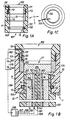
- the regenerator 1 shown in all Figures is formed by an enclosure or sleeve 10 having a tubular body portion 11 made of a structural plastic such as a polyacetal (e.g. Delrin, reg. trademark), a teflon-type fluorocarbon, a polyamide or the like cell insulator material of the type disclosed in U.S. Patent 4,096,047 for MEACs.
- a structural plastic such as a polyacetal (e.g. Delrin, reg. trademark), a teflon-type fluorocarbon, a polyamide or the like cell insulator material of the type disclosed in U.S. Patent 4,096,047 for MEACs.
- the lower end 101 of body 11 is dimensioned to receive the sensing end of an EAP as explained below; a sealing means 13 is formed for engagement with the end portion of the EAP and comprises an annular recess 131 that holds an 0-ring 132 or the like sealing member.
- the upper end 102 of the enclosure 10 is formed by an annular mounting member or ring 111 connected with body 11 by a thread 113 or the like connection.
- a passage 112 is provided in ring 111 for a lead wire 151, e.g. of platinum, that provides for an electrical connection of regenerator electrode 15 with an electrical source 19 via connection 193.
- the regenerator electrode 15 is an annular structure made of graphite inserted into recess 114 and securely held in body 11 by ring 111.
- the end face 103 or similar end portion or shoulder serves as a stop means for positioning a probe as explained below.
- Figure 1 B shows the regenerator 1 of Figure 1A and 1 C in an enlarged presentation with a conventional MEAC as probe 12 including an optional guard electrode 18 in addition to a working electrode 14 and counter electrode 16, depicted in a diagrammatic representation.
- a shoulder 123 or the like edge of probe 12 acts as a second stop means to cooperate with the first stop means 103 at the lower end 101 of regenerator 10 so that the sensing face 121 (membrane removed prior to insertion) extends into the electrolyte receiving space 105 formed within regenerator 1 in the vicinity of the regenerator electrode 15.
- Probe 12 comprises a sensing electrode 14 having an exposed circular surface 140 made of Au or Pt. Electrode 14 is enclosed by an insulator 142 and is electrically connected with a lead or connector 141.
- the guard electrode 18 having an exposed surface 180 extends around the sensing electrode in a concentric manner and has a connector 181 at the outlet end of probe 12.
- Another insulator layer 162 is arranged between guard electrode 18 and counter electrode 16 having an exposed surface 160 and a connector 161 at the outlet of probe 12.
- the housing 122 of probe 12 normally consists of an insulator material and extends into a cylindrical end portion 124.
- the second outlet end 192 of DC source 19 will be connected via a connection 194 with at least one probe electrode 14,16,18, e.g. by a distributor or switch 195 serving to connect source 19 alternatingly as shown (or simultaneously with appropriate current control if desired) with the connector ends 141, 161, 181 of the probe electrodes by appropriate lines 196, 197, 198.
- electrolyte 17 will be poured out through end 102 and switch 195 is moved in non-connecting position; flushing of regenerator 1 and probe 12 with electrolyte and/or water in connected position is optional.
- Switch 195 may be automated for providing predetermined regeneration periods of the probe electrodes.
- probe 12 is withdrawn from regenerator 1 and is ready for use after receiving the required electrolyte and membrane in conventional manner, e.g. as disclosed in European Patent 0 043 611. Specific examples of such regeneration operations will be given below; general parameters of the examples are as follows:
- response time is used as a summary criterion for overall probe performance here.
- the response time test is a standard method for testing probes that leave the factory in "virgin” condition. Generally, a response time of 10 minutes or less is regarded as indicating acceptable operation of a new probe when fitted with a 25 pm thick perfluoro alkoxy membrane (PFA); the test includes an "oxygen concentration step" (exposure to air or air-saturated water, on the one hand, and submersion in a medium known to be free of elemental oxygen) and measurement of the time from the application of the concentration step to the moment when the instrument for electroanalytical operation indicates a value of 10 ppb (per billion, 10 9 ). The oxygen levels in the particular test correspond to 8 ppm (per million) before and zero ppb (per billion) after the step.
- PFA perfluoro alkoxy membrane
- a used MEAC as probe 12 exhibiting a response time of 21 minutes was regenerated in the device shown in Figure 1A using 3 ml of a standard electrolyte (56 g KOH and 74 g KCI per liter of water) for electroanalytical operation.
- Regenerator electrode 15 was connected with the positive output of a 3 V DC power supply.
- Probe electrodes 14, 16, 18 were connected successively, each for 30 seconds, with the negative output of the DC supply.
- Probe 12 was withdrawn from regenerator 1, washed with tap water, filled with the standard electrolyte and provided with a standard 25 pm membrane of a teflon (PFA).
- the regenerated probe exhibited a response time of less than 5 minutes. All values measured were taken at room temperature (20-25°C).
- the MEAC was an oxygen sensor, Model 2110, Orbisphere Laboratories, Geneva, Switzerland).
- Example 1 The method of Example 1 was repeated; response times before and after regeneration were recorded and various electrolytes were used; the details are summarized in the following table:
Landscapes
- Chemical & Material Sciences (AREA)
- Life Sciences & Earth Sciences (AREA)
- Health & Medical Sciences (AREA)
- Physics & Mathematics (AREA)
- Chemical Kinetics & Catalysis (AREA)
- Electrochemistry (AREA)
- Molecular Biology (AREA)
- Analytical Chemistry (AREA)
- Biochemistry (AREA)
- General Health & Medical Sciences (AREA)
- General Physics & Mathematics (AREA)
- Immunology (AREA)
- Pathology (AREA)
- Electrolytic Production Of Non-Metals, Compounds, Apparatuses Therefor (AREA)
Claims (6)
Priority Applications (3)
| Application Number | Priority Date | Filing Date | Title |
|---|---|---|---|
| DE8585810387T DE3567106D1 (en) | 1985-08-26 | 1985-08-26 | Device for regeneration of electroanalytical probes |
| EP85810387A EP0212038B1 (de) | 1985-08-26 | 1985-08-26 | Vorrichtung zur Regeneration von elektroanalytischen Sonden |
| US06/890,155 US4830713A (en) | 1985-08-25 | 1986-07-28 | Regeneration method and device |
Applications Claiming Priority (1)
| Application Number | Priority Date | Filing Date | Title |
|---|---|---|---|
| EP85810387A EP0212038B1 (de) | 1985-08-26 | 1985-08-26 | Vorrichtung zur Regeneration von elektroanalytischen Sonden |
Publications (2)
| Publication Number | Publication Date |
|---|---|
| EP0212038A1 EP0212038A1 (de) | 1987-03-04 |
| EP0212038B1 true EP0212038B1 (de) | 1988-12-28 |
Family
ID=8194652
Family Applications (1)
| Application Number | Title | Priority Date | Filing Date |
|---|---|---|---|
| EP85810387A Expired EP0212038B1 (de) | 1985-08-25 | 1985-08-26 | Vorrichtung zur Regeneration von elektroanalytischen Sonden |
Country Status (3)
| Country | Link |
|---|---|
| US (1) | US4830713A (de) |
| EP (1) | EP0212038B1 (de) |
| DE (1) | DE3567106D1 (de) |
Cited By (1)
| Publication number | Priority date | Publication date | Assignee | Title |
|---|---|---|---|---|
| EP4028727B1 (de) * | 2019-10-23 | 2025-01-29 | Lonza Biologics Inc. | Sensorschirm |
Families Citing this family (23)
| Publication number | Priority date | Publication date | Assignee | Title |
|---|---|---|---|---|
| US4986271A (en) * | 1989-07-19 | 1991-01-22 | The University Of New Mexico | Vivo refillable glucose sensor |
| US5985129A (en) * | 1989-12-14 | 1999-11-16 | The Regents Of The University Of California | Method for increasing the service life of an implantable sensor |
| EP0505442B1 (de) * | 1989-12-14 | 1997-02-05 | The Regents Of The University Of California | Verfahren zur erhöhung der funktionslebensdauer eines implantierbaren fühlers |
| ZA938555B (en) * | 1992-11-23 | 1994-08-02 | Lilly Co Eli | Technique to improve the performance of electrochemical sensors |
| US5466605A (en) * | 1993-03-15 | 1995-11-14 | Arizona Board Of Regents | Method for detection of chemical components |
| US5985673A (en) * | 1994-12-22 | 1999-11-16 | Arizona Baord Of Regents | Method for regeneration of a sensor |
| DE19644757C2 (de) * | 1996-10-29 | 2001-04-12 | Bosch Gmbh Robert | Meßeinrichtung |
| GB9808517D0 (en) * | 1998-04-23 | 1998-06-17 | Aea Technology Plc | Electrical sensor |
| RU2207558C2 (ru) * | 1999-01-29 | 2003-06-27 | Государственное унитарное предприятие "Уральский научно-исследовательский химический институт с опытным заводом" | Способ очистки измерительного электрода |
| WO2004013624A1 (de) * | 2002-08-06 | 2004-02-12 | Sentec Ag | Vorrichtung und verfahren zum vorbereiten eines elektrochemischen sensors |
| DE10309022A1 (de) * | 2003-03-01 | 2004-09-09 | Dr. A. Kuntze Gmbh | Verfahren zum Reinigen von Elektrodenoberflächen sowie Vorrichtung zur Durchführung des Verfahrens |
| DE102007061806A1 (de) * | 2007-12-19 | 2009-06-25 | Mettler-Toledo Ag | Verfahren zur Regeneration amperometrischer Sensoren |
| DE102008020802A1 (de) * | 2008-04-23 | 2009-11-05 | Universität Rostock | Verfahren zur elektrochemischen Behandlung einer Sensorvorrichtung |
| EP3906842A1 (de) | 2011-07-26 | 2021-11-10 | Glysens Incorporated | Gewebeimplantierbarer sensor mit hermetisch versiegeltem gehäuse |
| US10660550B2 (en) | 2015-12-29 | 2020-05-26 | Glysens Incorporated | Implantable sensor apparatus and methods |
| US10561353B2 (en) | 2016-06-01 | 2020-02-18 | Glysens Incorporated | Biocompatible implantable sensor apparatus and methods |
| US10638962B2 (en) | 2016-06-29 | 2020-05-05 | Glysens Incorporated | Bio-adaptable implantable sensor apparatus and methods |
| US10638979B2 (en) | 2017-07-10 | 2020-05-05 | Glysens Incorporated | Analyte sensor data evaluation and error reduction apparatus and methods |
| US11278668B2 (en) | 2017-12-22 | 2022-03-22 | Glysens Incorporated | Analyte sensor and medicant delivery data evaluation and error reduction apparatus and methods |
| US11255839B2 (en) | 2018-01-04 | 2022-02-22 | Glysens Incorporated | Apparatus and methods for analyte sensor mismatch correction |
| DE102018004448A1 (de) | 2018-06-05 | 2019-12-05 | Ecm Gmbh | Durchflusselement |
| DE102018004450A1 (de) | 2018-06-05 | 2019-12-05 | Ecm Gmbh | Verfahren zur Aktivhaltung und Reaktivierung von elektrochemischen Sensoren und eine Vorrichtung zur Durchführung des Verfahrens |
| DE102019003994A1 (de) * | 2019-06-07 | 2020-12-10 | Dräger Safety AG & Co. KGaA | Elektrochemische Brennstoffzelle, Verfahren zum Warten einer elektrochemischen Brennstoffzelle und Atemalkoholmessgerät |
Family Cites Families (6)
| Publication number | Priority date | Publication date | Assignee | Title |
|---|---|---|---|---|
| GB1152794A (en) * | 1966-03-21 | 1969-05-21 | Emilio Volpe | Apparatus for Electrochemical Analyses |
| GB1603013A (en) * | 1978-05-24 | 1981-11-18 | Ici Ltd | Process control |
| JPS55158554A (en) * | 1979-05-28 | 1980-12-10 | Nissan Eng Kk | Apparatus for measuring concentration of oxidating and reducing substance |
| GB2140563B (en) * | 1983-04-27 | 1987-03-04 | Critikon Inc | Method and apparatus for zero calibration of oxygen-sensing polarographic devices |
| US4496454A (en) * | 1983-10-19 | 1985-01-29 | Hewlett-Packard Company | Self cleaning electrochemical detector and cell for flowing stream analysis |
| US4566949A (en) * | 1983-10-19 | 1986-01-28 | Hewlett-Packard Company | Method of operating a self cleaning electrochemical detector |
-
1985
- 1985-08-26 EP EP85810387A patent/EP0212038B1/de not_active Expired
- 1985-08-26 DE DE8585810387T patent/DE3567106D1/de not_active Expired
-
1986
- 1986-07-28 US US06/890,155 patent/US4830713A/en not_active Expired - Lifetime
Cited By (1)
| Publication number | Priority date | Publication date | Assignee | Title |
|---|---|---|---|---|
| EP4028727B1 (de) * | 2019-10-23 | 2025-01-29 | Lonza Biologics Inc. | Sensorschirm |
Also Published As
| Publication number | Publication date |
|---|---|
| US4830713A (en) | 1989-05-16 |
| DE3567106D1 (en) | 1989-02-02 |
| EP0212038A1 (de) | 1987-03-04 |
Similar Documents
| Publication | Publication Date | Title |
|---|---|---|
| US4830713A (en) | Regeneration method and device | |
| Talvitie | Electrodeposition of actinides for. alpha. spectrometric determination | |
| US4772375A (en) | Antifouling electrochemical gas sensor | |
| Ateya et al. | On the nature of electrochemical reactions at a crack tip during hydrogen charging of a metal | |
| Tercier et al. | In situ voltammetric measurement of trace elements in lakes and oceans | |
| Gustavsson | Determination of mercury in sea water by stripping voltammetry | |
| Wang et al. | Dual coulometric-voltammetric cells for on-line stripping analysis | |
| US4317705A (en) | Method for measuring concentration of oxidant or reductant | |
| Wang | Electrochemical preconcentration | |
| Delahay et al. | Structure of the double layer and electrode processes. II. Effect of the nature of the electrode and application of the thallium-amalgam electrode | |
| GB1576984A (en) | Monitoring of the concentration of heavy metals in aqueous liquors | |
| Ciszkowska et al. | Pulse voltammetric techniques at microelectrodes in pure solvents | |
| Yoon et al. | Simultaneous detection of Cd (II), Pb (II), Cu (II), and Hg (II) ions in dye waste water using a boron doped diamond electrode with DPASV | |
| Nyholm et al. | Stability of preplated mercury coated platinum and carbon fibre microelectrodes | |
| Wang et al. | Improved online stripping voltammetry using a large volume wall-jet detector | |
| Komorsky-Lovrić | Direct determination of bismuth (III) in sea water by square-wave anodic stripping voltammetry at a glassy-carbon rotating-disk electrode | |
| Ahmed et al. | Voltammetric determination of mercury levels in tuna fish | |
| Chittleborough et al. | The determination of zinc, cadmium, lead and copper in human hair by differential pulse anodic stripping voltammetry at a hanging mercury drop electrode after nitrate fusion | |
| US4829007A (en) | Process for detecting a plateable metal in an aqueous fluid | |
| US5481181A (en) | Real-time toxic metals monitor device and method | |
| Pletcher et al. | Towards a microelectrode sensor for the determination of oxygen in waters | |
| Baranski et al. | Voltammetric determination of surface active compounds at Au and Pt ultramicroelectrodes in flowing solutions | |
| Bailey | Electrochemical sensors for process stream monitoring | |
| US4612094A (en) | Electrical conditioning of a platinum electrode useful in measurement in hypochlorite | |
| CA2087801C (en) | Method and apparatus for on-line monitoring the quality of a purified metal sulphate solution |
Legal Events
| Date | Code | Title | Description |
|---|---|---|---|
| PUAI | Public reference made under article 153(3) epc to a published international application that has entered the european phase |
Free format text: ORIGINAL CODE: 0009012 |
|
| 17P | Request for examination filed |
Effective date: 19860626 |
|
| AK | Designated contracting states |
Kind code of ref document: A1 Designated state(s): AT BE CH DE FR GB IT LI LU NL SE |
|
| RBV | Designated contracting states (corrected) |
Designated state(s): BE CH DE FR GB IT LI NL SE |
|
| 17Q | First examination report despatched |
Effective date: 19871116 |
|
| GRAA | (expected) grant |
Free format text: ORIGINAL CODE: 0009210 |
|
| AK | Designated contracting states |
Kind code of ref document: B1 Designated state(s): BE CH DE FR GB IT LI NL SE |
|
| PG25 | Lapsed in a contracting state [announced via postgrant information from national office to epo] |
Ref country code: IT Free format text: LAPSE BECAUSE OF FAILURE TO SUBMIT A TRANSLATION OF THE DESCRIPTION OR TO PAY THE FEE WITHIN THE PRESCRIBED TIME-LIMIT;WARNING: LAPSES OF ITALIAN PATENTS WITH EFFECTIVE DATE BEFORE 2007 MAY HAVE OCCURRED AT ANY TIME BEFORE 2007. THE CORRECT EFFECTIVE DATE MAY BE DIFFERENT FROM THE ONE RECORDED. Effective date: 19881228 Ref country code: SE Effective date: 19881228 Ref country code: BE Effective date: 19881228 Ref country code: NL Effective date: 19881228 |
|
| REF | Corresponds to: |
Ref document number: 3567106 Country of ref document: DE Date of ref document: 19890202 |
|
| ET | Fr: translation filed | ||
| NLV1 | Nl: lapsed or annulled due to failure to fulfill the requirements of art. 29p and 29m of the patents act | ||
| PLBE | No opposition filed within time limit |
Free format text: ORIGINAL CODE: 0009261 |
|
| STAA | Information on the status of an ep patent application or granted ep patent |
Free format text: STATUS: NO OPPOSITION FILED WITHIN TIME LIMIT |
|
| 26N | No opposition filed | ||
| REG | Reference to a national code |
Ref country code: GB Ref legal event code: IF02 |
|
| PGFP | Annual fee paid to national office [announced via postgrant information from national office to epo] |
Ref country code: GB Payment date: 20040803 Year of fee payment: 20 |
|
| PGFP | Annual fee paid to national office [announced via postgrant information from national office to epo] |
Ref country code: FR Payment date: 20040804 Year of fee payment: 20 |
|
| PGFP | Annual fee paid to national office [announced via postgrant information from national office to epo] |
Ref country code: CH Payment date: 20040824 Year of fee payment: 20 |
|
| PGFP | Annual fee paid to national office [announced via postgrant information from national office to epo] |
Ref country code: DE Payment date: 20040909 Year of fee payment: 20 |
|
| PG25 | Lapsed in a contracting state [announced via postgrant information from national office to epo] |
Ref country code: GB Free format text: LAPSE BECAUSE OF EXPIRATION OF PROTECTION Effective date: 20050825 |
|
| REG | Reference to a national code |
Ref country code: GB Ref legal event code: PE20 |
|
| REG | Reference to a national code |
Ref country code: CH Ref legal event code: PL |