EP0212100A1 - Vorrichtung mit zwei miteinander zu vermischenden Lösungen - Google Patents
Vorrichtung mit zwei miteinander zu vermischenden Lösungen Download PDFInfo
- Publication number
- EP0212100A1 EP0212100A1 EP19860107567 EP86107567A EP0212100A1 EP 0212100 A1 EP0212100 A1 EP 0212100A1 EP 19860107567 EP19860107567 EP 19860107567 EP 86107567 A EP86107567 A EP 86107567A EP 0212100 A1 EP0212100 A1 EP 0212100A1
- Authority
- EP
- European Patent Office
- Prior art keywords
- container
- rigid container
- liquids
- flexible
- infusion
- Prior art date
- Legal status (The legal status is an assumption and is not a legal conclusion. Google has not performed a legal analysis and makes no representation as to the accuracy of the status listed.)
- Granted
Links
- 239000007788 liquid Substances 0.000 claims abstract description 55
- 238000001802 infusion Methods 0.000 claims abstract description 48
- 239000000725 suspension Substances 0.000 claims abstract description 6
- 239000003978 infusion fluid Substances 0.000 claims description 12
- 229920003023 plastic Polymers 0.000 claims description 11
- 239000004033 plastic Substances 0.000 claims description 11
- 239000011521 glass Substances 0.000 claims description 8
- 238000009423 ventilation Methods 0.000 claims description 3
- 210000001015 abdomen Anatomy 0.000 claims 1
- 238000013022 venting Methods 0.000 claims 1
- 229920002457 flexible plastic Polymers 0.000 abstract description 8
- 239000003182 parenteral nutrition solution Substances 0.000 abstract 1
- 239000000243 solution Substances 0.000 description 42
- 150000001413 amino acids Chemical class 0.000 description 16
- 239000000203 mixture Substances 0.000 description 8
- WQZGKKKJIJFFOK-GASJEMHNSA-N Glucose Natural products OC[C@H]1OC(O)[C@H](O)[C@@H](O)[C@@H]1O WQZGKKKJIJFFOK-GASJEMHNSA-N 0.000 description 7
- 239000008103 glucose Substances 0.000 description 7
- 230000001681 protective effect Effects 0.000 description 7
- 235000000346 sugar Nutrition 0.000 description 3
- QVGXLLKOCUKJST-UHFFFAOYSA-N atomic oxygen Chemical compound [O] QVGXLLKOCUKJST-UHFFFAOYSA-N 0.000 description 2
- 235000020776 essential amino acid Nutrition 0.000 description 2
- 239000003797 essential amino acid Substances 0.000 description 2
- 239000011888 foil Substances 0.000 description 2
- 238000003780 insertion Methods 0.000 description 2
- 230000037431 insertion Effects 0.000 description 2
- 229910052760 oxygen Inorganic materials 0.000 description 2
- 239000001301 oxygen Substances 0.000 description 2
- 229930091371 Fructose Natural products 0.000 description 1
- RFSUNEUAIZKAJO-ARQDHWQXSA-N Fructose Chemical compound OC[C@H]1O[C@](O)(CO)[C@@H](O)[C@@H]1O RFSUNEUAIZKAJO-ARQDHWQXSA-N 0.000 description 1
- 239000005715 Fructose Substances 0.000 description 1
- 206010041953 Staring Diseases 0.000 description 1
- 125000003277 amino group Chemical group 0.000 description 1
- 239000000470 constituent Substances 0.000 description 1
- 239000012530 fluid Substances 0.000 description 1
- -1 for example Chemical class 0.000 description 1
- HNDVDQJCIGZPNO-UHFFFAOYSA-N histidine Natural products OC(=O)C(N)CC1=CN=CN1 HNDVDQJCIGZPNO-UHFFFAOYSA-N 0.000 description 1
- 125000002887 hydroxy group Chemical group [H]O* 0.000 description 1
- 230000036512 infertility Effects 0.000 description 1
- 230000003993 interaction Effects 0.000 description 1
- 208000017169 kidney disease Diseases 0.000 description 1
- 238000004519 manufacturing process Methods 0.000 description 1
- 239000000463 material Substances 0.000 description 1
- 235000016236 parenteral nutrition Nutrition 0.000 description 1
- 238000005192 partition Methods 0.000 description 1
- 230000000149 penetrating effect Effects 0.000 description 1
- 239000002985 plastic film Substances 0.000 description 1
- 239000004800 polyvinyl chloride Substances 0.000 description 1
- 229920000915 polyvinyl chloride Polymers 0.000 description 1
- 230000002028 premature Effects 0.000 description 1
- 150000008163 sugars Chemical class 0.000 description 1
- 229920001169 thermoplastic Polymers 0.000 description 1
- 239000012815 thermoplastic material Substances 0.000 description 1
Images

Classifications
-
- A—HUMAN NECESSITIES
- A61—MEDICAL OR VETERINARY SCIENCE; HYGIENE
- A61J—CONTAINERS SPECIALLY ADAPTED FOR MEDICAL OR PHARMACEUTICAL PURPOSES; DEVICES OR METHODS SPECIALLY ADAPTED FOR BRINGING PHARMACEUTICAL PRODUCTS INTO PARTICULAR PHYSICAL OR ADMINISTERING FORMS; DEVICES FOR ADMINISTERING FOOD OR MEDICINES ORALLY; BABY COMFORTERS; DEVICES FOR RECEIVING SPITTLE
- A61J1/00—Containers specially adapted for medical or pharmaceutical purposes
- A61J1/14—Details; Accessories therefor
- A61J1/20—Arrangements for transferring or mixing fluids, e.g. from vial to syringe
- A61J1/2089—Containers or vials which are to be joined to each other in order to mix their contents
-
- B—PERFORMING OPERATIONS; TRANSPORTING
- B01—PHYSICAL OR CHEMICAL PROCESSES OR APPARATUS IN GENERAL
- B01F—MIXING, e.g. DISSOLVING, EMULSIFYING OR DISPERSING
- B01F35/00—Accessories for mixers; Auxiliary operations or auxiliary devices; Parts or details of general application
- B01F35/71—Feed mechanisms
- B01F35/712—Feed mechanisms for feeding fluids
-
- B—PERFORMING OPERATIONS; TRANSPORTING
- B01—PHYSICAL OR CHEMICAL PROCESSES OR APPARATUS IN GENERAL
- B01F—MIXING, e.g. DISSOLVING, EMULSIFYING OR DISPERSING
- B01F35/00—Accessories for mixers; Auxiliary operations or auxiliary devices; Parts or details of general application
- B01F35/71—Feed mechanisms
- B01F35/717—Feed mechanisms characterised by the means for feeding the components to the mixer
- B01F35/718—Feed mechanisms characterised by the means for feeding the components to the mixer using vacuum, under pressure in a closed receptacle or circuit system
-
- A—HUMAN NECESSITIES
- A61—MEDICAL OR VETERINARY SCIENCE; HYGIENE
- A61J—CONTAINERS SPECIALLY ADAPTED FOR MEDICAL OR PHARMACEUTICAL PURPOSES; DEVICES OR METHODS SPECIALLY ADAPTED FOR BRINGING PHARMACEUTICAL PRODUCTS INTO PARTICULAR PHYSICAL OR ADMINISTERING FORMS; DEVICES FOR ADMINISTERING FOOD OR MEDICINES ORALLY; BABY COMFORTERS; DEVICES FOR RECEIVING SPITTLE
- A61J1/00—Containers specially adapted for medical or pharmaceutical purposes
- A61J1/05—Containers specially adapted for medical or pharmaceutical purposes for collecting, storing or administering blood, plasma or medical fluids ; Infusion or perfusion containers
- A61J1/10—Bag-type containers
-
- A—HUMAN NECESSITIES
- A61—MEDICAL OR VETERINARY SCIENCE; HYGIENE
- A61J—CONTAINERS SPECIALLY ADAPTED FOR MEDICAL OR PHARMACEUTICAL PURPOSES; DEVICES OR METHODS SPECIALLY ADAPTED FOR BRINGING PHARMACEUTICAL PRODUCTS INTO PARTICULAR PHYSICAL OR ADMINISTERING FORMS; DEVICES FOR ADMINISTERING FOOD OR MEDICINES ORALLY; BABY COMFORTERS; DEVICES FOR RECEIVING SPITTLE
- A61J1/00—Containers specially adapted for medical or pharmaceutical purposes
- A61J1/14—Details; Accessories therefor
- A61J1/1462—Containers with provisions for hanging, e.g. integral adaptations of the container
-
- A—HUMAN NECESSITIES
- A61—MEDICAL OR VETERINARY SCIENCE; HYGIENE
- A61J—CONTAINERS SPECIALLY ADAPTED FOR MEDICAL OR PHARMACEUTICAL PURPOSES; DEVICES OR METHODS SPECIALLY ADAPTED FOR BRINGING PHARMACEUTICAL PRODUCTS INTO PARTICULAR PHYSICAL OR ADMINISTERING FORMS; DEVICES FOR ADMINISTERING FOOD OR MEDICINES ORALLY; BABY COMFORTERS; DEVICES FOR RECEIVING SPITTLE
- A61J1/00—Containers specially adapted for medical or pharmaceutical purposes
- A61J1/14—Details; Accessories therefor
- A61J1/1475—Inlet or outlet ports
-
- A—HUMAN NECESSITIES
- A61—MEDICAL OR VETERINARY SCIENCE; HYGIENE
- A61J—CONTAINERS SPECIALLY ADAPTED FOR MEDICAL OR PHARMACEUTICAL PURPOSES; DEVICES OR METHODS SPECIALLY ADAPTED FOR BRINGING PHARMACEUTICAL PRODUCTS INTO PARTICULAR PHYSICAL OR ADMINISTERING FORMS; DEVICES FOR ADMINISTERING FOOD OR MEDICINES ORALLY; BABY COMFORTERS; DEVICES FOR RECEIVING SPITTLE
- A61J1/00—Containers specially adapted for medical or pharmaceutical purposes
- A61J1/14—Details; Accessories therefor
- A61J1/20—Arrangements for transferring or mixing fluids, e.g. from vial to syringe
- A61J1/2003—Accessories used in combination with means for transfer or mixing of fluids, e.g. for activating fluid flow, separating fluids, filtering fluid or venting
- A61J1/2006—Piercing means
- A61J1/201—Piercing means having one piercing end
-
- A—HUMAN NECESSITIES
- A61—MEDICAL OR VETERINARY SCIENCE; HYGIENE
- A61J—CONTAINERS SPECIALLY ADAPTED FOR MEDICAL OR PHARMACEUTICAL PURPOSES; DEVICES OR METHODS SPECIALLY ADAPTED FOR BRINGING PHARMACEUTICAL PRODUCTS INTO PARTICULAR PHYSICAL OR ADMINISTERING FORMS; DEVICES FOR ADMINISTERING FOOD OR MEDICINES ORALLY; BABY COMFORTERS; DEVICES FOR RECEIVING SPITTLE
- A61J1/00—Containers specially adapted for medical or pharmaceutical purposes
- A61J1/14—Details; Accessories therefor
- A61J1/20—Arrangements for transferring or mixing fluids, e.g. from vial to syringe
- A61J1/2003—Accessories used in combination with means for transfer or mixing of fluids, e.g. for activating fluid flow, separating fluids, filtering fluid or venting
- A61J1/2006—Piercing means
- A61J1/2013—Piercing means having two piercing ends
-
- A—HUMAN NECESSITIES
- A61—MEDICAL OR VETERINARY SCIENCE; HYGIENE
- A61J—CONTAINERS SPECIALLY ADAPTED FOR MEDICAL OR PHARMACEUTICAL PURPOSES; DEVICES OR METHODS SPECIALLY ADAPTED FOR BRINGING PHARMACEUTICAL PRODUCTS INTO PARTICULAR PHYSICAL OR ADMINISTERING FORMS; DEVICES FOR ADMINISTERING FOOD OR MEDICINES ORALLY; BABY COMFORTERS; DEVICES FOR RECEIVING SPITTLE
- A61J1/00—Containers specially adapted for medical or pharmaceutical purposes
- A61J1/14—Details; Accessories therefor
- A61J1/20—Arrangements for transferring or mixing fluids, e.g. from vial to syringe
- A61J1/2003—Accessories used in combination with means for transfer or mixing of fluids, e.g. for activating fluid flow, separating fluids, filtering fluid or venting
- A61J1/2048—Connecting means
- A61J1/2058—Connecting means having multiple connecting ports
-
- A—HUMAN NECESSITIES
- A61—MEDICAL OR VETERINARY SCIENCE; HYGIENE
- A61M—DEVICES FOR INTRODUCING MEDIA INTO, OR ONTO, THE BODY; DEVICES FOR TRANSDUCING BODY MEDIA OR FOR TAKING MEDIA FROM THE BODY; DEVICES FOR PRODUCING OR ENDING SLEEP OR STUPOR
- A61M5/00—Devices for bringing media into the body in a subcutaneous, intra-vascular or intramuscular way; Accessories therefor, e.g. filling or cleaning devices, arm-rests
- A61M5/14—Infusion devices, e.g. infusing by gravity; Blood infusion; Accessories therefor
- A61M5/1414—Hanging-up devices
- A61M5/1417—Holders or handles for hanging up infusion containers
Definitions
- the invention relates to a device for storing two liquids to be mixed with one another immediately before administration, such as parenteral infusion solutions, which have a first container in the form of a flexible plastic bag for holding the one liquid, which has a suspension device and a Stopper closure is provided, and a second container for receiving the second liquid, which is also provided with a stopper closure, wherein both containers are held together and their interiors can be connected to each other for sterile mixing of the liquids contained therein.
- the two solutions have been administered separately in such cases, for example. It is also known to accommodate the two solutions in a double bag made of plastic, which has two or more container parts initially sealed off from one another via a tearable connection for receiving the individual solutions (DE-32 38 649 A1). Before the administration, the connection between the individual container parts is torn open in order to be able to mix the liquids in the container parts with one another. To the For this purpose, the bag has to be tumbled, for example, by hand in order to achieve a reasonably uniform mixing of the solutions. Complete mixing can hardly be achieved.
- the object of the invention is to provide a device in which two solutions are stored completely separately and without the risk of undesired premature mixing, but can be mixed intensively and uniformly before administration without the need for additional mechanical influence.
- the second container closes a separate, vacuum-tight is rigid rigid container with a volume corresponding to both liquids and that a piercing spike of an infusion set can be pierced through the stopper closures of both containers, which has a ventable flexible connecting tube, at one end of which one of the piercing spikes is located.
- the device according to the invention essentially consists of three parts, namely a flexible bag, a separate rigid container and a special infusion set, with the aid of which the flexible bag and the rigid container can be connected to one another before the start of administration, this infusion set not only for Establishes a connection between the bag and the container, but also how a conventional infusion set can be used to administer the infusion solution.
- the rigid container which can be closed in a vacuum-tight manner, has a sufficiently large volume to accommodate the two solutions to be mixed and dispensed as a mixture, ie the liquid or solution in the flexible bag is used for mixing with the other liquid or solution in the rigid container transferred.
- the rigid container is evacuated after the filling of a liquid or solution and closed in a vacuum-tight manner, so that the liquid in the flexible bag is sucked into the rigid container by the negative pressure prevailing in the rigid container as soon as a connection between the flexible is made with the special infusion set according to the invention Bag and the rigid container has been manufactured.
- the negative pressure prevailing in the rigid container not only ensures that the liquid is completely sucked out of the flexible container, but also that the two liquids or solutions are mixed in the rigid container, which then functions as usual Infusion bottle can be hung upside down to administer the infusion solution formed in it in the usual way to a patient.
- both the flexible bag and the rigid container are sterile closed, sterile mixing of the two liquids is possible immediately before administration. Accordingly, two liquids, for example to be administered parenterally, can be sterile mixed with one another without cumbersome mechanical measures such as squeezing or flexing plastic bags, breaking or tearing open partition walls, lifting and shaking containers and the like. This also gives the possibility of deciding which solutions or solution components are to be mixed with one another immediately before mixing, because the flexible bag and the rigid container of the device according to the invention are only finally connected to one another when the infusion set is in its stopper. Closures have been inserted.
- the invention is described in connection with the mixing of two liquids into a solution, more than two liquids can also be mixed with one another, the rigid container which can be opened in a vacuum-tight manner having a sufficient volume for holding all the partial liquids, which are of a corresponding number of flexible Bags are kept sterile.
- the rigid container is preferably a glass bottle, as is often used for infusions, while the flexible bag is made of thermoplastic material such as polyvinyl chloride.
- the device according to the invention is particularly suitable for glucose solutions and amino acid solutions to be mixed with one another into an infusion solution. It is known to prepare infusion solutions from such constituents, and it is also known that glucose solutions and amino acid solutions must be stored separately from one another before administration, in order to avoid the so-called Maillard reaction between the hydroxyl groups of glucose or possibly other sugars such as, for example, fructose on the one hand and to avoid the amino groups of the amino acids.
- the amino acid solutions usually consist of mixtures of different amino acids necessary for the organism, depending on the type of treatment of the patient.
- the amino acid solutions generally contain at least the so-called essential amino acids, and g e g e-appropriate, histidine (eg kidney disease).
- the amino acid solution can also contain the so-called semi / essential / or non-essential amino acids.
- the concentration of the amino acids in the amino acid solution is generally in the range from about 0.5 to 30 g per 100 ml of solution. The lower limit is often around 3 g per 100 ml and the upper limit around 20 g per 100 ml.
- the concentration of the sugar solution is usually in the range from about 5 to 90 g per 100 ml of the sugar solution.
- the lower limit is typically about 20 g per 100 ml and the upper limit is about 85 g per 100 ml, with solutions in the order of about 70 to 80 g per 100 ml glucose being preferred.
- the amino acid solution is filled into the rigid container, preferably the glass bottle, since it has been found that amino acid solutions cannot be stored in plastic bags because there is a risk of amino acid solutions be changed by the plastic and / or penetrating atmospheric oxygen.
- the rigid container preferably a noble glass infusion bottle
- the rigid container has such a volume that it can hold the entire liquid mixture. It is generally filled slightly more than half with one of the solution components such as the amino acid solution under sterile conditions, evacuated and sealed, because generally a smaller amount of glucose solution has to be mixed with a larger amount of amino acid solution.
- the volume of the rigid container can be somewhat larger than the volume of the liquid mixture in order to ensure problem-free and uniform mixing of the liquid components after the connection between the containers holding the individual liquid components has been established.
- the rigid container for example the infusion bottle, can be shaken after the liquid components have been brought together to improve the mixture. It is generally sufficient if the rigid container is tipped over after the liquid components have been brought together and suspended in the upturned position, as is the case with infusion bottles Administration of an infusion is common.
- the piercing pins of the infusion set according to the invention are provided, for example, with protective caps in order to be able to keep them sterile until use. By removing the protective caps immediately prior to insertion into one of the stopper closures of the device, it is ensured that the connection between the two containers of the device is also established under sterile conditions.
- the flexible plastic bag can be placed on the rigid container in such a way that the two together form a transportable unit without their interiors being able to come into contact with one another before such a connection is not established with the aid of the infusion set according to the invention.
- the flexible bag is preferably designed so that, like a backpack, it can be "piggybacked” on the rigid container such as the infusion bottle.
- the plastic bag can additionally have a flap which serves as a handle in order to be able to lift the infusion bottle with the attached plastic bag with the outlet opening facing downwards and, for example, to hang it on a hook for the infusion time.
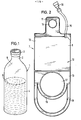
- the rigid container 1 shown in Fig. 1 is a glass infusion bottle with a narrowed neck 2, on which a closure 3 is attached, which closes the infusion bottle airtight and vacuum-tight, but from a piercing pin of an infusion set, as explained below, can be pierced.
- a little more than half of the container 1 is filled with a liquid 4.
- the one shown in Fig. 1 Upright position of the container 1 is above the liquid level 5 in the container 1, a cavity 6 which is evacuated after filling the liquid 4 and has a volume sufficient to accommodate the second liquid stored in the flexible plastic bag, so that the two Liquids are mixed together and, for example, form an infusion solution.
- the flexible bag 7 shown in FIG. 2 consists of two thermoplastic plastic films 8 and 9 which are permanently connected to one another along weld seams 10.
- the bag 7 is divided into three main sections 11, 12 and 13 by the weld seams 10.
- the section 11 is designed as a tongue-shaped tab which contains an opening 14 which fits onto the narrowed neck 2 of the rigid container 1.
- the middle section 12 of the bag 7 serves to hold the second liquid, which can be filled through a hose 15.
- a closure 16 is attached, which, like the closure 3 of the container 3, can be pierced by a piercing pin of an infusion set, in order to bring the liquid filled into the central section 12 of the bag 7 into the rigid container 1 for the production of the deliver the desired solution for infusion.
- the third section 13 is again designed as a tab and contains an opening 17 which fits onto the main section of the container 1 and surrounds it with an annular web 18.
- the tab. like section 13 provided with an arcuate loop 19 which serves as a handle and as a suspension device.
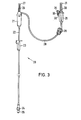
- the infusion set 20 shown in FIG. 3 has a drip chamber 21, an infusion tube 22 connected to it with a drip regulator 23 attached to it, and a needle adapter 24 attached to the infusion tube 13, which is sterile covered according to FIG. 3 by means of a removable protective cap 25.
- a spike 26 is connected to the drip chamber 21, which is sterile covered according to FIG. 3 by a removable protective cap 27.
- a further flexible hose 28 is connected to the drip chamber 21, at the outer end of which a closable air inlet filter 29 is provided.
- a further piercing mandrel 30 On the outside of the air inlet filter 29 there is a further piercing mandrel 30, which is sterile covered according to FIG. 3 by means of a removable protective cap 31.
- the air inlet filter 29 is provided with a lateral opening 32 which can be closed airtight by means of a stopper cap 33 which is held captively at the lower end of the piercing mandrel 30 by means of a tab 34.
- a customary flow regulator 35 is attached to the tube 28 and can clamp the tube 28 to a greater or lesser extent in order to possibly reduce its clear flow cross section and thus to be able to throttle the flow of fluid.
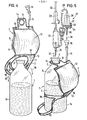
- FIG. 4 and 5 From Figs. 4 and 5 it can be seen how the flexible bag 7 is attached to the rigid container 1.
- the section 11 is pushed onto the neck 2 of the container 1, so that the neck protrudes through the opening 14 and the section 11 lies below the closure 3 of the container 1, as shown in FIG. 5.
- the bag 7 is attached to the bottle-like container 1 like a backpack or piggyback.
- the opening 17 in the tab-like section 13 of the bag 7 is dimensioned such that it fits tightly on the main part la of the container 1 and firmly encloses it in an annular manner.
- the frictional connection between the container 1 and the tab-like section 13 or its web 18, even if the container 1 is a glass bottle, is sufficiently firm to prevent the container 1 from slipping relative to the bag. Rather, you can carry the container 1 with the bag 7 attached to it in reverse, by using the loop 19 as a handle.
- the opening 14 only fits onto the narrowed neck 2 of the container 1 and, accordingly, the container cannot slide further through this opening.
- Fig. 5 shows that container 1 and bag 7 form a relatively compact unit, the bag section 12 being filled with a liquid which can be transferred into the container 1 with the aid of the infusion set 20 in the manner described below.
- the container 1 with the bag 7 attached to it is set up in the position shown in FIG. 5. Then you remove the piercing pins 26 and 30 Protective caps in order to pierce the piercing mandrels into the plug closure 3 of the container 1 or the closure 16 of the hose 15 according to the arrows 37 and 38 indicated in FIG. 5. This creates a connection between the interior of the container 1 and the bag 7. Because of the negative pressure or vacuum prevailing in the cavity 6 of the container 1, the liquid in the bag section 12 is sucked into the container 1 through the connecting tube 28 until the bag 7 is practically empty. A mixing takes place between the liquid 4 located in the container 1 and the sucked-in liquid.
- the device can now be used to administer an infusion. For this purpose, it is gripped with the loop 19 and attached to a hook 39, which is located on a stand, not shown in the drawing, or is fastened elsewhere. The device is turned upside down, so to speak, so that the two liquids in the container 1 are mixed further.
- the protective cap 25 can now be removed from the needle adapter 24 and an infusion needle can be connected, which is attached to the patient in the usual way. Then only the air inlet filter 29 needs to be opened, for which purpose the cover 33 is released from the opening 32, as shown in FIG. 6. As a result, the negative pressure prevailing in the system up to that point is eliminated, so that the infusion liquid can drip out of the container 1 and pass through the drip chamber 21 into the infusion tube 22 '.
- the infusion rate can be controlled.
- the device according to the invention it is possible to mix two or more liquids homogeneously with one another immediately before administration and to use the container used for the mixing directly as an infusion container or administration container without having to disconnect the hose from the flexible bag and having to insert a separate infusion set, which could pose sterility problems.
- the flexible bag 7 is approximately rectangular and preferably consists of two flexible plastic foils welded together at the edges, further transverse weld seams delimiting the individual sections of the bag.
- the capacity of the central section 12 of the bag 7 is approximately 250 to 300 ml.
- the tabs and suspension devices are made of the same material as the central section 12 of the bag and, in the exemplary embodiment shown, are extensions or parts of the foils welded to one another.
- the device according to the invention can be used in such a way that the two liquids are practically mixed together in a sequence and then administered to a patient in the form of an infusion solution.
- the infusion tube 22 is closed by means of the flow regulator 23.
- This flow regulator 23 is only opened after the ventilation valve 29 has been opened and the administration of the infusion liquid is to begin.
Landscapes
- Health & Medical Sciences (AREA)
- Chemical Kinetics & Catalysis (AREA)
- Chemical & Material Sciences (AREA)
- Veterinary Medicine (AREA)
- General Health & Medical Sciences (AREA)
- Public Health (AREA)
- Animal Behavior & Ethology (AREA)
- Life Sciences & Earth Sciences (AREA)
- Pharmacology & Pharmacy (AREA)
- Medical Preparation Storing Or Oral Administration Devices (AREA)
- Package Specialized In Special Use (AREA)
- External Artificial Organs (AREA)
- Detergent Compositions (AREA)
Abstract
Description
- Die Erfindung betrifft eine Vorrichtung zum Aufbewahren von zwei unmittelbar vor dem Verabreichen steril mit--einander zu vermischenden Flüssigkeiten wie parenteral zu verabreichende Infusionslösungen, die einen ersten Behälter in Form eines flexiblen Beutels aus Kunststoff zur Aufnahme der einen Flüssigkeit, welcher mit einer Aufhängeeinrichtung und einem Stopfen-Verschluß versehen ist, und einen zweiten Behälter zur Aufnahme der zweiten Flüssigkeit, der ebenfalls mit einem Stopfen-Verschluß versehen ist, aufweist, wobei beide Behälter aneinander gehalten sind und ihre Innenräume zum sterilen Vermischen der in ihnen enthaltenen Flüssigkeiten miteinander verbunden werden können.
- "Häufig ist es notwendig, parenteral zu verabreichende Lösungen, beispielsweise Infusionslösungen, erst unmittelbar vor der Verabreichung miteinander zu vermischen, da einerseits manche Mischungen nicht über längere Zeit lagerbeständig sind und andererseits häufig der Arzt erst entscheidet, welche Mischungen im einzelnen Fall verabreicht werden sollen.
- Bisher hat man in solchen Fällen die beiden Lösungen beispielsweise getrennt verabreicht. Auch ist es bekannt, die beiden Lösungen in einem Doppelbeutel aus Kunststoff unterzubringen, der zwei oder mehr über eine aufreißbare Verbindung zunächst voneinander abgeschottete Behälterteile zur Aufnahme der einzelnen Lösungen aufweist (DE- 32 38 649 Al). Vor der Verabreichung wird die Verbindung zwischen den einzelnen Behälterteilen aufgerissen, um die in den Behälterteilen befindlichen Flüssigkeiten miteinander vermischen zu können. Zu diesem Zweck muß der Beutel beispielsweise von Hand gewalkt werden, um eine auch nur einigermaßen gleichförmige Durchmischung der Lösungen zu erzielen. Eine vollständige Durchmischung ist kaum zu erreichen.
- Das getrennte Verabreichen von zwei Lösungen erfordert _eben so wie das Vermischen von in einem Doppelbeutel untergebrachten Flüssigkeiten mechanische Maßnahmen, die aufwendig sind, jedoch nicht zu einer völlig gleichförmigen Mischung führen. Hingegen besteht beispielsweise im Falle einer Infusion die Gefahr, daß das Infusionsbesteck durch die mechanische Vermischbewegung verrutschen kann. Bei Verwendung von Glasrohrverbindungen besteht zudem die Gefahr, daß Glasbruch in die zu verabreichende Lösung gelangt.
- Manche parenteral zu verabreichende Lösungen können nicht in Kunststoffbehältern und dementsprechend nicht in flexiblen Kunststoffbeuteln aufbewahrt werden, da eine Wechselwirkung zwischen dem Kunststoff des Behältnisses oder dem vom Kunststoff durchgelassenen Luftsauerstoff und den Wirkbestandteilen der Lösung eintreten kann. Dies ist beispielsweise bei Aminosäurelösungen der Fall.
- Aufgabe der Erfindung ist es, eine Vorrichtung zu schaffen, in der zwei Lösungen völlig getrennt und ohne die Gefahr einer unerwünschten vorzeitigen Vermischung aufbewahrt, jedoch vor dem Verabreichen ohne die Notwendigkeit zusätzlicher mechanischer Beeinflussung intensiv und gleichförmig miteinander vermischt werden können.
- Diese Aufgabe wird erfindungsgemäß bei einer Vorrichtung der eingangs genannten Gattung dadurch gelöst, daß der zweite Behälter ein separater, vakuumdicht verschließbarer starrer Behälter mit einem beiden Flüssigkeiten entsprechenden Volumen ist und daß durch die Stopfen-Verschlüsse beider Behälter je ein Anstechdorn eines Infusionsbesteckes durchstechbar ist, das einen lüftbaren flexiblen Verbindungsschlauch aufweist, an dessen einem Ende sich einer der Anstechdorne befindet.
- Die erfindungsgemäße Vorrichtung besteht also im wesentlichen aus drei Teilen, nämlich einem flexiblen Beutel, einem separaten starren Behälter und einem speziellen Infusionsbesteck, mit dessen Hilfe der flexible Beutel und der starre Behälter vor Beginn der Verabreichung miteinander verbunden werden können, wobei dieses Infusionsbesteck nicht nur zum Herstellen einer Verbindung zwischen Beutel und Behälter dient, sondern zugleich auch wie ein übliches Infusionsbesteck zum Verabreichen der Infusionslösung benutzt werden kann. Der vakuumdicht verschließbare starre Behälter --hat ein ausreichend großes Volumen, um die beiden miteinander zu vermischenden und als Gemisch abzugebenden Lösungen aufzunehmen, d.h. die in dem flexiblen Beutel befindliche Flüssigkeit bzw. Lösung wird zum Vermischen mit der anderen Flüssigkeit oder Lösung in den starren Behälter überführt. Der starre Behälter wird nach dem Einfüllen der einen Flüssigkeit oder Lösung evakuiert und vakuumdicht verschlossen, so daß die im flexiblen Beutel befindliche Flüssigkeit von dem im starren Behälter herrschenden Unterdruck in den starren Behälter eingesaugt wird, sobald mit dem erfindungsgemäßen speziellen Infusionsbesteck eine Verbindung zwischen dem flexiblen Beutel und dem starren Behälter hergestellt worden ist. Der im starren Behälter herrschende Unterdruck sorgt nicht nur für ein vollständiges Einsaugen der Flüssigkeit aus-dem flexiblen Behälter, sondern auch für ein Vermischen der beiden Flüssigkeiten oder Lösungen im starren Behälter, der dann wie eine übliche Infusionsflasche umgekehrt aufgehängt werden kann, um die in ihm gebildete Infusionslösung in üblicher Weise einem Patienten zu verabreichen.
- Da sowohl der flexible Beutel als auch der starre Behälter steril verschlossen sind, ist ein steriles Ver--mischen der beiden Flüssigkeiten unmittelbar vor dem Verabreichen möglich. Dementsprechend kann man in einfacher Weise zwei beispielsweise parenteral zu verabreichende Flüssigkeiten ohne umständliche mechanische Maßnahmen wie Quetschen oder Walken von Kunststoffbeuteln, Zerbrechen oder Aufreißen von Trennwänden, Anheben und Schütteln von Behältern und dergleichen steril miteinander vermischen. Dabei ergibt sich auch die Möglichkeit, erst unmittelbar vor dem Vermischen zu entscheiden, welche Lösungen bzw. Lösungsbestandteile miteinander vermischt werden sollen, weil der flexible Beutel und der starre Behälter der erfindungsgemäßen Vorrichtung erst dann endgültig miteinander verbunden werden, wenn das Infusionsbesteck in deren Stopfen-Verschlüsse eingesteckt worden ist.
- Obwohl die Erfindung in Verbindung mit dem Vermischen von zwei Flüssigkeiten zu einer Lösung beschrieben ist, können auch mehr als zwei Flüssigkeiten miteinander vermischt werden, wobei der vakuumvdicht erschließbare starre Behälter ein ausreichendes Volumen zur Aufnahme aller Teilflüssigkeiten aufweisen muß, die in einer entsprechenden Anzahl von flexiblen Beuteln steril aufbewahrt werden.
- Vorzugsweise ist der starre Behälter eine Glasflasche, wie sie für Infusionen vielfach verwendet wird, während der flexible Beutel.aus thermoplastischem Kunststoff wie beispielsweise Polyvinylchlorid besteht.
- Die erfindungsgemäße Vorrichtung ist besonders für miteinander zu einer Infusionslösung zu vermischende Glucoselösungen und Aminosäurelösungen geeignet. Es ist bekannt, aus derartigen Bestandteilen Infusionslösungen herzustellen, wobei auch bekannt ist, daß Glucoselösungen und Aminosäurelösungen vor der Ver- .abreichung voneinander getrennt gelagert werden müssen, um die sogenannte Maillard-Reaktion zwischen den Hydroxylgruppen der Glucose oder eventuell anderer Zucker wie zum Beispiel Fructose einerseits und den Aminogruppen der Aminosäuren zu vermeiden.
- Die Aminosäurelösungen bestehen in der Regel aus Gemischen verschiedener für den Organismus notwendiger Aminosäuren gemäß der Art der Behandlung des Patienten. Die Aminosäurelösungen enthalten in der Regel wenigstens die sogenannten essentiellen Aminosäuren sowie gege-benenfalls Histidin (z.B. bei Nierenerkrankungen). Bei einer totalen parenteralen Versorgung kann die Aminosäurelösung aber auch die sogenannten halb/essentiellen/oder nicht-essentiellen Aminosäuren enthalten. Die Konzentration der Aminosäuren in der Aminosäurelösung liegt im allgemeinen im Bereich von etwa 0,5 bis 30 g pro 100 ml Lösung. Die untere Grenze liegt häufig bei etwa 3 g pro 100 ml und die obere bei etwa 20 g pro 100 ml.
- Die Konzentration der Zuckerlösung, insbesondere GlucoseLösung, liegt in der Regel im Bereich von etwa 5 bis 90 g pro 100 ml der Zuckerlösung. Die untere Grenze liegt in der Regel bei etwa 20 g pro 100 ml und die obere bei etwa 85 g pro 100 ml, wobei Lösungen mit einem Gehalt in der Größenordnung von etwa 70 bis 80 g pro 100 ml Glucose bevorzugt sind.
- Dies ist dem Fachmann grundsätzlich bekannt (vgl.Total .Parenteral Nutrition in the Hospital and at Home; K.N. Jeejeebhoy, CRC Press Inc. Boca Raton, Florida, USA (1983)).
- Bei Verwendung der erfindungsgemäßen Vorrichtung zum Aufbewahren und Vermischen von Glucoselösungen und .Aminosäurelösungen wird die Aminosäurelösung in den vakuumdicht verschließbaren starren Behälter, vorzugsweise die Glasflasche, eingefüllt, da gefunden wurde, daß Aminosäurelösungen nicht in Kunststoffbeuteln aufbewahrt werden können, weil die Gefahr besteht, daß Aminosäurelösungen durch den Kunststoff und/oder eindringenden Luftsauerstoff verändert werden.
- Der starre Behälter, vorzugsweisedle aus Glas bestehende Infusionsflasche, hat ein derartiges Volumen, daß er das gesamte Flüssigkeitsgemisch aufnehmen kann. Er wird im allgemeinen etwas mehr als zur Hälfte mit einer der Lösungskomponenten wie der Aminosäurelösung unter sterilen Bedingungen gefüllt, evakuiert und verschlossen, weil im allgemeinen eine kleinere Menge Glucoselösung mit einer größeren Menge Aminosäurelösung zu vermischen ist. Dabei kann das Volumen des starren Behälters etwas größer als das Volumen des Flüssigkeitsgemisches sein, um eine problemlose und gleichförmige Durchmischung der Flüssigkeitskomponenten zu gewährleisten, nachdem die Verbindung zwischen den die einzelnen Flüssigkeitskomponenten aufnehmenden Behältnissen hergestellt worden ist. Zusätzlich kann der starre Behälter, nämlich beispielsweise die Infusionsflasche, nach Zusammenführen der Flüssigkeitskomponenten geschüttelt werden, um die Mischung zu verbessern. Dabei reicht es im allgemeinen aus, wenn der starre Behälter nach dem Zusammenführen der Flüssigkeitskomponenten umgekippt und in der umgekippten Position aufgehängt wird, wie dies bei Infusionsflaschen zum Verabreichen einer Infusion üblich ist.
- Die Anstechdorne des erfindungsgemäßen Infusionsbesteckes sind beispielsweise mit Schutzkappen versehen, um sie bis zur Benutzung steril halten zu können. Durch das Abnehmen der Schutzkappen unmittelbar vor dem Einstechen in einen der Stopfen-Verschlüsse der Vorrichtung ist gewährleistet, daß auch die Verbindung zwischen den beiden Behältnissen der Vorrichtung unter sterilen Bedingungen hergestellt wird.
- Nach einem weiteren Merkmal der Erfindung ist der flexible Kunststoffbeutel derart auf den starren Behälter aufsetzbar, daß beide zusammen eine transportable Einheit bilden, ohne daß ihre Innenräume in Verbindung miteinander kommen könnten, bevor eine solche Verbindung nicht mit Hilfe des erfindungsgemäßen Infusionsbesteckes hergestellt wird.
- Dabei ist der flexible Beutel vorzugsweise so ausgebildet, daß er ähnlich wie ein Rucksack sozusagen "huckepack" auf den starren Behälter wie die Infusionsflasche aufgesteckt werden kann. Der Kunststoffbeutel kann zusätzlich eine Lasche aufweisen, die als Handgriff dient, um die Infusionsflasche mit aufgestecktem Kunststoffbeutel mit der Auslaßöffnung nach unten hochheben und beispielsweise an einen Haken für die Infusionszeit anhängen zu können.
- In der Zeichnung ist ein Ausführungsbeispiel der erfindungsgemäßen Vorrichtung dargestellt, und zwar zeigt
- Fig. 1 eine schaubildliche Ansicht einer den starren Behälter der Vorrichtung bildenden Infusions- 'flasche, die mit einer der miteinander zu vermischenden Flüssigkeiten teilweise gefüllt ist,
- Fig. 2 eine Draufsicht auf den für eine zweite Flüssigkeit bestimmten flexiblen Kunststoff-Beutel,
- Fig. 3 eine Ansicht des speziellen Infusionsbesteckes der erfindungsgemäßen Vorrichtung,
- Fig. 4 eine Ansicht, aus der erkennbar ist, wie der mit der einen Flüssigkeit gefüllte Kunststoff- Beutel auf die mit der anderen Flüssigkeit teilweise gefüllte Infusionsflasche aufgesteckt wird,
- Fig. 5 eine schaubildliche Ansicht der Infusionsflasche mit dem huckepack auf dieser angebrachten flexiblen Kunststoff-Beutel, wobei zu erkennen ist, wie das erfindungsgemäße Infusionsbesteck an die Infusionsflasche und den flexiblen Beutel angeschlossen wird, und
- Fig. 6 eine schaubildliche Ansicht der erfindungsgemäßen Vorrichtung in der Betriebsstellung, in der die in der Infusionsflasche gemischte Infusionslösung einem Patienten verabreicht wird.
- Der in Fig. 1 dargestellte starre Behälter 1 ist eine aus Glas bestehende Infusionsflasche mit einem verengten Hals 2, auf dem ein Verschluß 3 angebracht ist, der die Infusionsflasche luft- und vakuumdicht verschließt, jedoch von einem Anstechdorn eines Infusionsbesteckes, wie weiter unten erläutert, durchstochen werden kann.
- Der Behälter 1 ist zu etwas mehr als der Hälfte mit einer Flüssigkeit 4 gefüllt. Bei der in Fig. 1 gezeigten aufrechten Position des Behälters 1 befindet sich oberhalb des Flüssigkeitsspiegels 5 im Behälter 1 ein Hohlraum 6, der nach Einfüllen der Flüssigkeit 4 evakuiert wird und ein Volumen aufweist, das ausreicht, um die in dem flexiblen Kunststoff-Beutel aufbewahrte zweite Flüssigkeit aufzunehmen, damit die beiden Flüssigkeiten miteinander vermischt werden und beispielsweise eine Infusionslösung bilden.
- Der in Fig. 2 gezeigte flexible Beutel 7 besteht aus zwei thermoplastischen Kunststoff-Folien 8 und 9, die entlang Schweißnähten 10 dauerhaft miteinander verbunden sind. Durch die Schweißnähte 10 ist der Beutel 7 in drei Hauptabschnitte 11, 12 und 13 unterteilt.
- Der Abschnitt 11 ist als zungenförmige Lasche ausgebildet, die eine Öffnung 14 enthält, welche auf den verengten Hals 2 des starren Behälters 1 paßt.
- Der mittlere Abschnitt 12 des Beutels 7 dient zur Aufnahme der zweiten Flüssigkeit, die durch einen Schlauch 15 eingefüllt werden kann. Am äußeren Ende des Schlauches 15 ist ein Verschluß 16 angebracht, der ähnlich wie der Verschluß 3 des Behälters 3 von einem Anstechdorn eines Infusionsbesteckes durchstochen werden kann, um die in den mittleren Abschnitt 12 des Beutels 7 eingefüllte Flüssigkeit in den starren Behälter 1 zum Herstellen der gewünschten Infusionslösung zu überführen.
- Der dritte Abschnitt 13 ist wiederum als Lasche ausgebildet und enthält eine Öffnung 17, die auf den Hauptabschnitt des Behälters 1 paßt und diesen mit einem ringförmigen Steg 18 umfaßt. Außerdem ist der laschen-. artige Abschnitt 13 mit einer bogenförmigen Schlaufe 19 versehen, die als Handgriff und als Aufhängeeinrichtung dient. - Das in Fig. 3 dargestellte Infusionsbesteck 20 weist eine Tropfkammer 21, einen an diese angeschlossenen Infusionsschlauch 22 mit darauf aufgebrachtem Tropfregler 23 und einen an dem Infusionsschlauch 13 angebrachten Nadeladapter 24 auf, der gemäß Figur 3 mittels einer abnehmbaren Schutzkappe 25 steril abgedeckt ist.
- An dem dem Infusionsschlauch 22 gegenüberliegenden Ende ist an die Tropfkammer 21 ein Einstechdorn 26 angeschlossen, der gemäß Fig. 3 von einer abnehmbaren Schutzkappe 27 steril abgedeckt ist.
- An die Tropfkammer 21 ist ein weiterer flexibler Schlauch 28 angeschlossen, an dessen äußeren Ende ein verschließbares Lufteinlaßfilter 29 vorgesehen ist. An der Außenseite des Lufteinlaßfilters 29 befindet sich ein weiterer Einstechdorn 30, der gemäß Fig. 3 mittels einer abnehmbaren Schutzkappe 31 steril abgedeckt ist.
- Das Lufteinlaßfilter 29 ist mit einer seitlichen Öffnung 32 versehen, die mittels einer Stopfen-Kappe 33 luftdicht zu verschließen ist, welche mittels einer Lasche 34 unverlierbar am unteren Ende des Einstechdornes 30 gehalten ist.
- Auf dem Schlauch 28 ist ein üblicher Strömungsregler 35 angebracht, der den Schlauch 28 mehr oder weniger stark zusammenklemmen kann , um dessen lichten Strömungsquerschnitt gegebenenfalls zu reduzieren und damit den Strömungsmitteldurchstrom drosseln zu können.
- Aus Fig. 4 und 5 istverkennen, wie der flexible Beutel 7 auf den starren Behälter 1 angebracht wird. Zunächst zieht man dem laschenartigen Abschnitt 13 des Beutels 7 in Richtung der Pfeile 36 von oben über den Hals 2 des Behälters 1 derart, daß die Öffnung 17 über den verengten Hals 2 des Behälters 1 hinweg nach unten auf den Hauptteil la des Behälters 1 gelangt und diesen schließlich mit dem Steg 18 ringförmig bzw. kragenförmig umschließt. Dann wird der Abschnitt 11 auf den Hals 2 des Behälters 1 aufgesteckt, so daß der Hals durch die Öffnung 14 hindurchragt und der Abschnitt 11 unterhalb des Verschlusses 3 des Behälters 1 liegt, wie Fig. 5 zeigt.
- Aus Fig. 5 ist erkennbar, daß der Beutel 7 rucksackartig oder huckepack auf dem flaschenartigen Behälter 1 angebracht ist. Die Öffnung 17 im laschenartigen Abschnitt 13 des Beutels 7 ist so bemessen, daß sie mit engem Sitz auf den Hauptteil la des Behälters 1 paßt und diesen ringförmig fest umschließt. Der Reibungsschluß zwischen Behälter 1 und dem laschenartigen Abschnitt 13 bzw. dessen Steg 18 ist , selbst wenn der Behälter 1 eine Glasflasche ist, aureichend fest, um ein Verrutschen des Behälters 1 gegenüber dem Beutel zu verhindern. Vielmehr kann man den Behälter 1 mit daran angebrachtem Beutel 7 auch umgekehrt tragen, indem man die Schlaufe 19 als Handgriff benutzt. Hinzu kommt, daß die Öffnung 14 lediglich auf den verengten Hals 2 des Behälters 1 paßt und der Behälter dementsprechend durch diese Öffnung nicht weiter hindurchrutschen kann.
- Fig. 5 zeigt, daß Behälter 1 und Beutel 7 eine verhältnismäßig kompakte Einheit bilden, wobei der Beutelabschnitt 12 mit einer Flüssigkeit gefüllt ist, die mit Hilfe des Infusionsbesteckes 20 in der nachstehend beschriebenen Weise in den Behälter 1 übergeleitet werden kann.
- Der Behälter 1 mit dem daran angebrachten Beutel 7 wird in der in Fig. 5 dargestellten Position aufgestellt. Dann entfernt man von den Anstechdornen 26 und 30 die Schutzkappen, um die Anstechdorne in den Stopfen-Verschluß 3 des Behälters 1 bzw. den Verschluß 16 des Schlauches 15 gemäß den in Fig. 5 angedeuteten Pfeilen 37 und 38 einzustechen. Dadurch wird eine Verbindung zwischen den Innenräumen des Behälters 1 und des Beutels 7 hergestellt. Wegen des im Hohlraum 6 des Behälters 1 herrschenden Unterdruckes bzw. Vakuums wird die im Beutelabschnitt 12 befindliche Flüssigkeit durch den die Verbindung herstellenden Schlauch 28 in den Behälter 1 eingesaugt, bis der Beutel 7 praktisch leer ist. Dabei erfolgt eine Vermischung zwischen der im Behälter 1 befindlichen Flüssigkeit 4 und der eingesaugten Flüssigkeit.
- Nunmehr kann die Vorrichtung zum Verabreichen einer Infusion benutzt werden. Zu diesem Zweck wird sie mit der Schlaufe 19 ergriffen und an einem Haken 39 angehängt, der sich an einem in der Zeichnung nicht dargestellten Ständer befindet oder an anderer Stelle befestigt ist. Dabei wird die Vorrichtung sozusagen auf den Kopf gestellt, wodurch eine weitere Durchmischung der beiden im Behälter 1 befindlichen Flüssigkeiten erfolgt.
- Nun kann die Schutzkappe 25 von dem Nadeladapter 24 abgenommen und eine Infusionsnadel angeschlossen werden, die man am Patienten in üblicher Weise anbringt. Dann braucht nur noch das Lufteinlaßfilter 29 geöffnet werden, wozu man den Deckel 33 von der Öffnung 32. löst, wie in Fig. 6 dargestellt. Dadurch wird der bis dahin im System herrschende Unterdruck aufgehoben, so daß die Infusionsflüssigkeit aus dem Behälter 1 austropfen und durch die Tropfkammer 21 in den Infusionsschlauch 22 gelangen' kann.
- Mit Hilfe des Tropfreglers 23 läßt sich die Infusionsgeschwindigkeit steuern.
- Mit der erfindungsgemäßen Vorrichtung ist es möglich, zwei oder auch mehr Flüssigkeiten unmittelbar vor Verabreichung homogen miteinander zu vermischen und den zum Mischen benutzten Behälter direkt als Infusionsbehälter bzw. Verabreichungsbehälter zu verwenden, ohne die Schlauchverbindung zum flexiblen Beutel lösen und ein separates Infusionsbesteck einführen zu müssen, was Sterilitätsprobleme aufwerfen könnte.
- Der flexible Beutel 7 ist etwa rechteckig ausgebildet und besteht vorzugsweise aus zwei an den Kanten miteinander verschweißten flexiblen Kunststoff-Folien, wobei weitere querverlaufende Schweißnähte die einzelnen Abschnitte des Beutels begrenzen. Das Fassungsvermögen des mittleren Abschnittes 12 des Beutels 7 beträgt bei einer Ausführungsform der Erfindung etwa 250 bis 300 ml. Die Laschen und Aufhängeeinrichtungen bestehen aus demselben Material wie der mittlere Abschnitt 12 des Beutels und sind beim dargestellten Ausführungsbeispiel Verlängerungen bzw. Teile der miteinander verschweißten Folien.
- Die erfindungsgemäße Vorrichtung kann derart benutzt werden, daß praktisch in einer Folge die beiden Flüssigkeiten miteinander vermischt und dann in Form einer Infusionslösung einem Patienten verabreicht werden. Während des Einstechens der Anstechdorne in die Stopfen-Verschlüsse ist der Infusionsschlauch 22 mittels des Strömungsreglers 23 verschlossen. Dieser Strömungsregler 23 wird erst geöffnet, nachdem das Belüftungsventil 29 geöffnet worden ist und die Verabreichung der Infusionsflüssigkeit beginnen soll.
Claims (10)
Priority Applications (1)
| Application Number | Priority Date | Filing Date | Title |
|---|---|---|---|
| AT86107567T ATE51755T1 (de) | 1985-06-25 | 1986-06-04 | Vorrichtung mit zwei miteinander zu vermischenden loesungen. |
Applications Claiming Priority (2)
| Application Number | Priority Date | Filing Date | Title |
|---|---|---|---|
| DE3522645 | 1985-06-25 | ||
| DE19853522645 DE3522645A1 (de) | 1985-06-25 | 1985-06-25 | Verfahren und vorrichtung zum sterilen vermischen von parenteral zu verabreichenden fluessigkeiten |
Publications (2)
| Publication Number | Publication Date |
|---|---|
| EP0212100A1 true EP0212100A1 (de) | 1987-03-04 |
| EP0212100B1 EP0212100B1 (de) | 1990-04-11 |
Family
ID=6274101
Family Applications (1)
| Application Number | Title | Priority Date | Filing Date |
|---|---|---|---|
| EP19860107567 Expired - Lifetime EP0212100B1 (de) | 1985-06-25 | 1986-06-04 | Vorrichtung mit zwei miteinander zu vermischenden Lösungen |
Country Status (9)
| Country | Link |
|---|---|
| US (1) | US4715851A (de) |
| EP (1) | EP0212100B1 (de) |
| JP (1) | JPS625350A (de) |
| CN (1) | CN1005454B (de) |
| AT (1) | ATE51755T1 (de) |
| CA (1) | CA1249979A (de) |
| DE (1) | DE3522645A1 (de) |
| JO (1) | JO1556B1 (de) |
| ZA (1) | ZA864350B (de) |
Cited By (1)
| Publication number | Priority date | Publication date | Assignee | Title |
|---|---|---|---|---|
| WO1994029011A1 (en) * | 1993-06-10 | 1994-12-22 | Ecolab Inc. | Concentrated product dilution system |
Families Citing this family (9)
| Publication number | Priority date | Publication date | Assignee | Title |
|---|---|---|---|---|
| US5490848A (en) * | 1991-01-29 | 1996-02-13 | The United States Of America As Represented By The Administrator Of The National Aeronautics And Space Administration | System for creating on site, remote from a sterile environment, parenteral solutions |
| US5378232A (en) * | 1991-08-28 | 1995-01-03 | Orion Therapeutic Systems, Inc. | Injection/activation apparatus |
| US5533973A (en) * | 1995-01-13 | 1996-07-09 | Abbott Laboratories | Alteration of nutritional product during enteral tube feeding |
| US6474375B2 (en) | 2001-02-02 | 2002-11-05 | Baxter International Inc. | Reconstitution device and method of use |
| US6948522B2 (en) * | 2003-06-06 | 2005-09-27 | Baxter International Inc. | Reconstitution device and method of use |
| CN100388955C (zh) * | 2004-03-18 | 2008-05-21 | 湖南千山制药机械股份有限公司 | 混药嘴具有穿刺功能的输液袋 |
| CN100430304C (zh) * | 2006-03-31 | 2008-11-05 | 上海武彬包装制品有限公司 | 一种粉液袋容器及其生产方法 |
| IT1403334B1 (it) * | 2010-11-09 | 2013-10-17 | Maffei | Dispositivo per il trasferimento ed il dosaggio di fluidi biomedicali tra recipienti ospedalieri |
| CN112439352B (zh) * | 2020-12-03 | 2022-08-19 | 山东本草药业有限公司 | 一种药剂生产用摇匀设备 |
Citations (8)
| Publication number | Priority date | Publication date | Assignee | Title |
|---|---|---|---|---|
| GB911277A (en) * | 1961-08-23 | 1962-11-21 | Ceeco Products Pty Ltd | A bottle carrier |
| US3459182A (en) * | 1966-08-08 | 1969-08-05 | Reese Res Found | Blood administration method |
| US3788369A (en) * | 1971-06-02 | 1974-01-29 | Upjohn Co | Apparatus for transferring liquid between a container and a flexible bag |
| US4233973A (en) * | 1978-05-12 | 1980-11-18 | Shukla Vishnu S | Apparatus for administering intravenous drugs |
| DE2951106A1 (de) * | 1979-12-19 | 1981-06-25 | Gerhard 7166 Sulzbach-Laufen Hansen | Geraet zum zusammenfuehren zweier fluessigkeiten, insbesondere fuer eine tropfinfusion |
| AT373150B (de) * | 1979-04-26 | 1983-12-27 | Transcodan | Infusions- und transfusionsgeraet mit tropfkammer |
| DE3238649A1 (de) * | 1982-10-19 | 1984-04-19 | Hagen Dr. 8520 Erlangen Theuer | Mehrkompartimentbeutel fuer mischinfusionsloesungen |
| US4458733A (en) * | 1982-04-06 | 1984-07-10 | Baxter Travenol Laboratories, Inc. | Mixing apparatus |
Family Cites Families (5)
| Publication number | Priority date | Publication date | Assignee | Title |
|---|---|---|---|---|
| DE1946761A1 (de) * | 1969-09-16 | 1971-03-18 | Behringwerke Ag | Behaelter aus Kunststoff fuer Blut und Infusionsloesungen |
| US4336802A (en) * | 1980-07-28 | 1982-06-29 | Baxter Travenol Laboratories, Inc. | Parenteral solution container for aseptic mixing |
| DE3139084C2 (de) * | 1981-10-01 | 1984-08-16 | Gerhard 7166 Sulzbach-Laufen Hansen | Verschluß für einen Behälter, insbesondere für eine Flasche |
| US4410321A (en) * | 1982-04-06 | 1983-10-18 | Baxter Travenol Laboratories, Inc. | Closed drug delivery system |
| EP0123659A1 (de) * | 1983-03-21 | 1984-10-31 | Jan Ingemar Näslund | Vorrichtung zur Bereitung von Lösungen aus gefährlichen Substanzen |
-
1985
- 1985-06-25 DE DE19853522645 patent/DE3522645A1/de active Granted
-
1986
- 1986-06-04 AT AT86107567T patent/ATE51755T1/de not_active IP Right Cessation
- 1986-06-04 EP EP19860107567 patent/EP0212100B1/de not_active Expired - Lifetime
- 1986-06-10 ZA ZA864350A patent/ZA864350B/xx unknown
- 1986-06-11 US US06/872,863 patent/US4715851A/en not_active Expired - Fee Related
- 1986-06-12 CA CA000511414A patent/CA1249979A/en not_active Expired
- 1986-06-24 JP JP61146303A patent/JPS625350A/ja active Pending
- 1986-06-25 JO JO19861556A patent/JO1556B1/en active
- 1986-06-25 CN CN86104341.3A patent/CN1005454B/zh not_active Expired
Patent Citations (8)
| Publication number | Priority date | Publication date | Assignee | Title |
|---|---|---|---|---|
| GB911277A (en) * | 1961-08-23 | 1962-11-21 | Ceeco Products Pty Ltd | A bottle carrier |
| US3459182A (en) * | 1966-08-08 | 1969-08-05 | Reese Res Found | Blood administration method |
| US3788369A (en) * | 1971-06-02 | 1974-01-29 | Upjohn Co | Apparatus for transferring liquid between a container and a flexible bag |
| US4233973A (en) * | 1978-05-12 | 1980-11-18 | Shukla Vishnu S | Apparatus for administering intravenous drugs |
| AT373150B (de) * | 1979-04-26 | 1983-12-27 | Transcodan | Infusions- und transfusionsgeraet mit tropfkammer |
| DE2951106A1 (de) * | 1979-12-19 | 1981-06-25 | Gerhard 7166 Sulzbach-Laufen Hansen | Geraet zum zusammenfuehren zweier fluessigkeiten, insbesondere fuer eine tropfinfusion |
| US4458733A (en) * | 1982-04-06 | 1984-07-10 | Baxter Travenol Laboratories, Inc. | Mixing apparatus |
| DE3238649A1 (de) * | 1982-10-19 | 1984-04-19 | Hagen Dr. 8520 Erlangen Theuer | Mehrkompartimentbeutel fuer mischinfusionsloesungen |
Cited By (2)
| Publication number | Priority date | Publication date | Assignee | Title |
|---|---|---|---|---|
| WO1994029011A1 (en) * | 1993-06-10 | 1994-12-22 | Ecolab Inc. | Concentrated product dilution system |
| US5443094A (en) * | 1993-06-10 | 1995-08-22 | Ecolab Inc. | Concentrated product dilution system |
Also Published As
| Publication number | Publication date |
|---|---|
| CN1005454B (zh) | 1989-10-18 |
| ATE51755T1 (de) | 1990-04-15 |
| DE3522645C2 (de) | 1987-12-03 |
| JPS625350A (ja) | 1987-01-12 |
| CA1249979A (en) | 1989-02-14 |
| EP0212100B1 (de) | 1990-04-11 |
| US4715851A (en) | 1987-12-29 |
| ZA864350B (en) | 1987-02-25 |
| JO1556B1 (en) | 1989-12-16 |
| DE3522645A1 (de) | 1987-01-08 |
| CN86104341A (zh) | 1987-01-07 |
Similar Documents
| Publication | Publication Date | Title |
|---|---|---|
| DE69606415T2 (de) | Beutel für eine sterile medizinische lösung und verfahren zum mischen solcher lösung | |
| DE69610842T2 (de) | Beutel für eine sterile medizinische lösung | |
| DE69215922T2 (de) | Übertragungsansclussstück | |
| DE69412695T2 (de) | Zweikammer Behälter mit Mischvorrichtung | |
| DE69613461T2 (de) | Durchflussregelvorrichtung | |
| EP0757553B1 (de) | Einstückige appliziervorrichtung zur kontaminationsfreien verabreichung von arzneimitteln (zytostatika) | |
| DE3881477T2 (de) | Misch- und Ausgabefläschchen mit zwei Kammern. | |
| DE69626135T2 (de) | Vorrichtung zur applikation einer mehrkomponentenflüssigkeit | |
| DE10348016B4 (de) | Konnektor für medizinische Flüssigkeiten enthaltende Verpackungen und Verpackung für medizinische Flüssigkeiten | |
| DE69723633T2 (de) | Übertragungsvorrichtung mit einem spritzlosen Ventil für Arzneimittelbehälter | |
| DE69009634T2 (de) | Methode und Gerät, einem Patienten ein Medikament zu verabreichen. | |
| EP0390898B1 (de) | Behälter zur getrennten, sterilen aufbewahrung mindestens zweier substanzen und zur vermischung dieser substanzen | |
| DE2624054A1 (de) | Fluessigkeitsbehaelter fuer die medizin | |
| DE1138186B (de) | Infusionsgeraet zum Sammeln und Verabreichen von medizinischen Fluessigkeiten | |
| DE69316732T2 (de) | Behälter für Lösungen mit Verbindungsschlauch aus Kunststoff | |
| EP0212100B1 (de) | Vorrichtung mit zwei miteinander zu vermischenden Lösungen | |
| EP0330130A2 (de) | Behälter für Infusionslösungen | |
| DE69621994T2 (de) | Phiole mit wiederverschliessbarer Verbindungsanordnung mit Membrane und einer Flüssigkeitszugangsvorrichtung mit mehreren Konfigurationen | |
| DE69016350T2 (de) | Arzneimittelabgabe- und Dosiervorrichtung mit einer doppelten Abgabeöffnung. | |
| DE2828283A1 (de) | Behaelter fuer zweikomponentengemische und dessen verwendung | |
| DE9014848U1 (de) | Einrichtung an Inhalationsgeräten mit einer Behälteraufnahme zum Lagern eines Flüssigkeitsbehälters | |
| DE2749951C2 (de) | ||
| EP0315740A2 (de) | System zur Aufbewahrung, Zubereitung und Applikation von Infusionslösungen für die parenterale Ernährung | |
| DE69509508T2 (de) | Vorrichtung und verfahren zum aseptischen vermischen von flüssigkeiten | |
| DE3021911C2 (de) |
Legal Events
| Date | Code | Title | Description |
|---|---|---|---|
| PUAI | Public reference made under article 153(3) epc to a published international application that has entered the european phase |
Free format text: ORIGINAL CODE: 0009012 |
|
| AK | Designated contracting states |
Kind code of ref document: A1 Designated state(s): AT BE CH FR GB IT LI NL SE |
|
| 17P | Request for examination filed |
Effective date: 19870827 |
|
| 17Q | First examination report despatched |
Effective date: 19890322 |
|
| GRAA | (expected) grant |
Free format text: ORIGINAL CODE: 0009210 |
|
| AK | Designated contracting states |
Kind code of ref document: B1 Designated state(s): AT BE CH FR GB IT LI NL SE |
|
| REF | Corresponds to: |
Ref document number: 51755 Country of ref document: AT Date of ref document: 19900415 Kind code of ref document: T |
|
| GBT | Gb: translation of ep patent filed (gb section 77(6)(a)/1977) | ||
| ITF | It: translation for a ep patent filed | ||
| ET | Fr: translation filed | ||
| PLBI | Opposition filed |
Free format text: ORIGINAL CODE: 0009260 |
|
| 26 | Opposition filed |
Opponent name: FRESENIUS AG Effective date: 19910110 |
|
| NLR1 | Nl: opposition has been filed with the epo |
Opponent name: FRESENIUS AG. |
|
| PGFP | Annual fee paid to national office [announced via postgrant information from national office to epo] |
Ref country code: GB Payment date: 19910528 Year of fee payment: 6 |
|
| PGFP | Annual fee paid to national office [announced via postgrant information from national office to epo] |
Ref country code: BE Payment date: 19910530 Year of fee payment: 6 |
|
| PGFP | Annual fee paid to national office [announced via postgrant information from national office to epo] |
Ref country code: FR Payment date: 19910617 Year of fee payment: 6 Ref country code: CH Payment date: 19910617 Year of fee payment: 6 Ref country code: AT Payment date: 19910617 Year of fee payment: 6 |
|
| PGFP | Annual fee paid to national office [announced via postgrant information from national office to epo] |
Ref country code: SE Payment date: 19910625 Year of fee payment: 6 |
|
| ITTA | It: last paid annual fee | ||
| PGFP | Annual fee paid to national office [announced via postgrant information from national office to epo] |
Ref country code: NL Payment date: 19910630 Year of fee payment: 6 |
|
| PLBN | Opposition rejected |
Free format text: ORIGINAL CODE: 0009273 |
|
| STAA | Information on the status of an ep patent application or granted ep patent |
Free format text: STATUS: OPPOSITION REJECTED |
|
| PG25 | Lapsed in a contracting state [announced via postgrant information from national office to epo] |
Ref country code: GB Effective date: 19920604 Ref country code: AT Effective date: 19920604 |
|
| PG25 | Lapsed in a contracting state [announced via postgrant information from national office to epo] |
Ref country code: SE Effective date: 19920605 |
|
| 27O | Opposition rejected |
Effective date: 19920215 |
|
| PG25 | Lapsed in a contracting state [announced via postgrant information from national office to epo] |
Ref country code: LI Effective date: 19920630 Ref country code: CH Effective date: 19920630 Ref country code: BE Effective date: 19920630 |
|
| NLR2 | Nl: decision of opposition | ||
| BERE | Be: lapsed |
Owner name: LABORATORIEN HAUSMANN A.G. Effective date: 19920630 |
|
| PG25 | Lapsed in a contracting state [announced via postgrant information from national office to epo] |
Ref country code: NL Effective date: 19930101 |
|
| GBPC | Gb: european patent ceased through non-payment of renewal fee |
Effective date: 19920604 |
|
| NLV4 | Nl: lapsed or anulled due to non-payment of the annual fee | ||
| PG25 | Lapsed in a contracting state [announced via postgrant information from national office to epo] |
Ref country code: FR Effective date: 19930226 |
|
| REG | Reference to a national code |
Ref country code: CH Ref legal event code: PL |
|
| REG | Reference to a national code |
Ref country code: FR Ref legal event code: ST |
|
| EUG | Se: european patent has lapsed |
Ref document number: 86107567.9 Effective date: 19930109 |
|
| PG25 | Lapsed in a contracting state [announced via postgrant information from national office to epo] |
Ref country code: IT Free format text: LAPSE BECAUSE OF NON-PAYMENT OF DUE FEES;WARNING: LAPSES OF ITALIAN PATENTS WITH EFFECTIVE DATE BEFORE 2007 MAY HAVE OCCURRED AT ANY TIME BEFORE 2007. THE CORRECT EFFECTIVE DATE MAY BE DIFFERENT FROM THE ONE RECORDED. Effective date: 20050604 |
|
| PLAB | Opposition data, opponent's data or that of the opponent's representative modified |
Free format text: ORIGINAL CODE: 0009299OPPO |