EP0212230A2 - Procédé pour la fabrication d'objets poreux - Google Patents
Procédé pour la fabrication d'objets poreux Download PDFInfo
- Publication number
- EP0212230A2 EP0212230A2 EP86109570A EP86109570A EP0212230A2 EP 0212230 A2 EP0212230 A2 EP 0212230A2 EP 86109570 A EP86109570 A EP 86109570A EP 86109570 A EP86109570 A EP 86109570A EP 0212230 A2 EP0212230 A2 EP 0212230A2
- Authority
- EP
- European Patent Office
- Prior art keywords
- foam
- particles
- polymer particles
- porous
- powder
- Prior art date
- Legal status (The legal status is an assumption and is not a legal conclusion. Google has not performed a legal analysis and makes no representation as to the accuracy of the status listed.)
- Withdrawn
Links
- 238000000034 method Methods 0.000 title claims description 26
- 238000004519 manufacturing process Methods 0.000 title claims description 13
- 239000006260 foam Substances 0.000 claims abstract description 27
- 239000002245 particle Substances 0.000 claims abstract description 25
- 239000007789 gas Substances 0.000 claims abstract description 7
- 238000001035 drying Methods 0.000 claims abstract description 3
- 239000000463 material Substances 0.000 claims description 30
- 239000011148 porous material Substances 0.000 claims description 15
- 229920000642 polymer Polymers 0.000 claims description 14
- 239000000843 powder Substances 0.000 claims description 10
- 239000000835 fiber Substances 0.000 claims description 6
- 239000000725 suspension Substances 0.000 claims description 6
- XUMBMVFBXHLACL-UHFFFAOYSA-N Melanin Chemical compound O=C1C(=O)C(C2=CNC3=C(C(C(=O)C4=C32)=O)C)=C2C4=CNC2=C1C XUMBMVFBXHLACL-UHFFFAOYSA-N 0.000 claims description 4
- UFWIBTONFRDIAS-UHFFFAOYSA-N Naphthalene Chemical compound C1=CC=CC2=CC=CC=C21 UFWIBTONFRDIAS-UHFFFAOYSA-N 0.000 claims description 4
- 229910010293 ceramic material Inorganic materials 0.000 claims description 3
- 238000001914 filtration Methods 0.000 claims description 3
- 239000000203 mixture Substances 0.000 claims description 3
- -1 polyethylene Polymers 0.000 claims description 3
- 238000005245 sintering Methods 0.000 claims description 3
- 229910000505 Al2TiO5 Inorganic materials 0.000 claims description 2
- 239000004698 Polyethylene Substances 0.000 claims description 2
- 229910052878 cordierite Inorganic materials 0.000 claims description 2
- JSKIRARMQDRGJZ-UHFFFAOYSA-N dimagnesium dioxido-bis[(1-oxido-3-oxo-2,4,6,8,9-pentaoxa-1,3-disila-5,7-dialuminabicyclo[3.3.1]nonan-7-yl)oxy]silane Chemical compound [Mg++].[Mg++].[O-][Si]([O-])(O[Al]1O[Al]2O[Si](=O)O[Si]([O-])(O1)O2)O[Al]1O[Al]2O[Si](=O)O[Si]([O-])(O1)O2 JSKIRARMQDRGJZ-UHFFFAOYSA-N 0.000 claims description 2
- KZHJGOXRZJKJNY-UHFFFAOYSA-N dioxosilane;oxo(oxoalumanyloxy)alumane Chemical compound O=[Si]=O.O=[Si]=O.O=[Al]O[Al]=O.O=[Al]O[Al]=O.O=[Al]O[Al]=O KZHJGOXRZJKJNY-UHFFFAOYSA-N 0.000 claims description 2
- 238000000465 moulding Methods 0.000 claims description 2
- 229910052863 mullite Inorganic materials 0.000 claims description 2
- 238000012856 packing Methods 0.000 claims description 2
- 229920000573 polyethylene Polymers 0.000 claims description 2
- 239000004848 polyfunctional curative Substances 0.000 claims description 2
- 239000012254 powdered material Substances 0.000 claims description 2
- AABBHSMFGKYLKE-SNAWJCMRSA-N propan-2-yl (e)-but-2-enoate Chemical compound C\C=C\C(=O)OC(C)C AABBHSMFGKYLKE-SNAWJCMRSA-N 0.000 claims description 2
- 238000007493 shaping process Methods 0.000 claims description 2
- 238000002791 soaking Methods 0.000 claims description 2
- 230000001788 irregular Effects 0.000 claims 1
- 238000006116 polymerization reaction Methods 0.000 claims 1
- 239000004071 soot Substances 0.000 abstract description 3
- 239000002994 raw material Substances 0.000 abstract 1
- 239000000919 ceramic Substances 0.000 description 13
- 239000007795 chemical reaction product Substances 0.000 description 4
- 229920005830 Polyurethane Foam Polymers 0.000 description 3
- 239000011496 polyurethane foam Substances 0.000 description 3
- 238000004804 winding Methods 0.000 description 3
- 230000008021 deposition Effects 0.000 description 2
- 238000005470 impregnation Methods 0.000 description 2
- 239000004753 textile Substances 0.000 description 2
- XLYOFNOQVPJJNP-UHFFFAOYSA-N water Substances O XLYOFNOQVPJJNP-UHFFFAOYSA-N 0.000 description 2
- 239000004372 Polyvinyl alcohol Substances 0.000 description 1
- 229910004298 SiO 2 Inorganic materials 0.000 description 1
- 239000001913 cellulose Substances 0.000 description 1
- 229920002678 cellulose Polymers 0.000 description 1
- 239000004744 fabric Substances 0.000 description 1
- 238000011049 filling Methods 0.000 description 1
- 238000010304 firing Methods 0.000 description 1
- 238000010438 heat treatment Methods 0.000 description 1
- 230000008595 infiltration Effects 0.000 description 1
- 238000001764 infiltration Methods 0.000 description 1
- 238000002156 mixing Methods 0.000 description 1
- 229920002635 polyurethane Polymers 0.000 description 1
- 239000004814 polyurethane Substances 0.000 description 1
- 229920002451 polyvinyl alcohol Polymers 0.000 description 1
- 238000009715 pressure infiltration Methods 0.000 description 1
- 238000000197 pyrolysis Methods 0.000 description 1
- 239000000126 substance Substances 0.000 description 1
- 238000003828 vacuum filtration Methods 0.000 description 1
Images

Classifications
-
- C—CHEMISTRY; METALLURGY
- C04—CEMENTS; CONCRETE; ARTIFICIAL STONE; CERAMICS; REFRACTORIES
- C04B—LIME, MAGNESIA; SLAG; CEMENTS; COMPOSITIONS THEREOF, e.g. MORTARS, CONCRETE OR LIKE BUILDING MATERIALS; ARTIFICIAL STONE; CERAMICS; REFRACTORIES; TREATMENT OF NATURAL STONE
- C04B38/00—Porous mortars, concrete, artificial stone or ceramic ware; Preparation thereof
- C04B38/06—Porous mortars, concrete, artificial stone or ceramic ware; Preparation thereof by burning-out added substances by burning natural expanding materials or by sublimating or melting out added substances
- C04B38/0615—Porous mortars, concrete, artificial stone or ceramic ware; Preparation thereof by burning-out added substances by burning natural expanding materials or by sublimating or melting out added substances the burned-out substance being a monolitic element having approximately the same dimensions as the final article, e.g. a porous polyurethane sheet or a prepreg obtained by bonding together resin particles
-
- B—PERFORMING OPERATIONS; TRANSPORTING
- B01—PHYSICAL OR CHEMICAL PROCESSES OR APPARATUS IN GENERAL
- B01D—SEPARATION
- B01D39/00—Filtering material for liquid or gaseous fluids
- B01D39/14—Other self-supporting filtering material ; Other filtering material
- B01D39/20—Other self-supporting filtering material ; Other filtering material of inorganic material, e.g. asbestos paper, metallic filtering material of non-woven wires
- B01D39/2068—Other inorganic materials, e.g. ceramics
- B01D39/2093—Ceramic foam
-
- C—CHEMISTRY; METALLURGY
- C04—CEMENTS; CONCRETE; ARTIFICIAL STONE; CERAMICS; REFRACTORIES
- C04B—LIME, MAGNESIA; SLAG; CEMENTS; COMPOSITIONS THEREOF, e.g. MORTARS, CONCRETE OR LIKE BUILDING MATERIALS; ARTIFICIAL STONE; CERAMICS; REFRACTORIES; TREATMENT OF NATURAL STONE
- C04B38/00—Porous mortars, concrete, artificial stone or ceramic ware; Preparation thereof
- C04B38/06—Porous mortars, concrete, artificial stone or ceramic ware; Preparation thereof by burning-out added substances by burning natural expanding materials or by sublimating or melting out added substances
- C04B38/063—Preparing or treating the raw materials individually or as batches
- C04B38/0635—Compounding ingredients
- C04B38/0645—Burnable, meltable, sublimable materials
- C04B38/067—Macromolecular compounds
-
- C—CHEMISTRY; METALLURGY
- C04—CEMENTS; CONCRETE; ARTIFICIAL STONE; CERAMICS; REFRACTORIES
- C04B—LIME, MAGNESIA; SLAG; CEMENTS; COMPOSITIONS THEREOF, e.g. MORTARS, CONCRETE OR LIKE BUILDING MATERIALS; ARTIFICIAL STONE; CERAMICS; REFRACTORIES; TREATMENT OF NATURAL STONE
- C04B2111/00—Mortars, concrete or artificial stone or mixtures to prepare them, characterised by specific function, property or use
- C04B2111/00474—Uses not provided for elsewhere in C04B2111/00
- C04B2111/00793—Uses not provided for elsewhere in C04B2111/00 as filters or diaphragms
Definitions
- the invention relates to a process for the production of porous objects from high temperature-resistant material, in particular for filtering particles from exhaust gases, in which a support material is mixed with the powdered material provided for the object and heat-treated, the support material being burned out.
- a method of this type is known from EP 0050340 for the production of soot or particle filters for diesel exhaust gases.
- an elastic polyurethane foam body serving as a support material is impregnated with a ceramic slip.
- the mass deposited on the pore walls of the foam body is then dried and fired.
- the polyurethane foam mass is burned out.
- the end product or the reproducibility of the end product strongly depends on the treatment of the foam in the impregnation process. In the case of voluminous articles, it is entirely possible that the ceramic mass does not penetrate sufficiently into the interior of the foam support body, so that the result is an inhomogeneous pore structure of the article produced.
- the invention has for its object to improve the method in such a way that reproducibly homogeneous porous objects can be produced.
- a foam mat or a textile film (cellulose) can be used, which is soaked on a mandrel after soaking.
- a cylinder or a cuboid can be assembled from round or square foam disks.
- a support body of any configuration can be assembled either by forming appropriately shaped individual pieces or by producing a support body in its final shape and then separating it into disks, strips or pieces.
- the process according to the invention has the further advantage that objects with differently sized pores can be produced in a simple manner.
- the method is particularly suitable for the production of ceramic filter bodies for filtering particles Exhaust gas is suitable, since the method enables the filter to be produced to be easily adapted to the space requirement, the configuration, the porosity, etc. without any difficulties. For example, a required homogeneity of the pore size can be reproducibly achieved by the entire filter element.
- the pores of the article to be produced are formed by the polymer particles which are brought out during the heat treatment.
- This method which is suitable for geometrically simple shapes, has the advantage that the molding is formed in one piece in a technically simple manner by merely filling the polymer particles into a negative mold which has the contour of the object to be produced.
- This method has the advantage that an excellent homogeneity of the porous body can be achieved by mixing the support material with the material for the object and that any shape or contour can be realized by shaping the raw body.
- a proppant is used which is flammable at low temperatures, e.g. B. organic substances, polymers such as polyurethane.
- Finely pulverized material, with which the porous body is to be produced, is added to the support material and further processed.
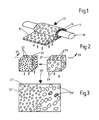
- FIG. 1 shows a foam mat (10) impregnated with the material in suspension and serving as a support body, which is wound around a core (11) to produce a porous tube.
- the moist mass of adjacent layers of the winding body (12) flow into one another, so that continuity of the mass within the winding body (12) is ensured.
- the winding body (12) is fired to harden the mass material.
- the non-temperature-resistant material of the support body _ (10) is burned out, so that a tube (12) with a porous wall made of the temperature-resistant material remains.
- a textile fabric can also be used.
- the support body is composed of corresponding foam parts (20, 21) according to FIG. 2, which have pores (22 and 23) of different sizes.
- the foam parts (20, 21) are immersed separately in the mass and, while still wet, the mass is connected in the direction of the arrow, forming a larger cuboid, and made available for drying or firing.
- the end product results in a porous cuboid, the cross section of which is shown in FIG. 3.
- the body (30) has pores (22) in one half - smaller and in the other half pores (23) - larger in diameter. This pore size corresponds in proportion to the pores (22 or 23) of the support materials (20 or 21).
- the division of the support body into several foam parts (20, 21) also has the effect that in the production of very voluminous porous bodies, there is a guarantee that the structure of the innermost area of the body corresponds to that of the outer area. With small support bodies, reproducible results can be achieved more easily. Care must be taken to ensure that the deposition of the mass on the pore walls of the support body is kept homogeneous and the same can be used to obtain objects of homogeneous and equal porosity. This is particularly important when using additional particles or fibers.
- a cuboid support body (12x8x4 cm) made of polyurethane foam (average pore diameter about 300 ⁇ m) was pressed and kneaded in the ceramic powder-fiber slip until an amount of the slip, which is equal to the volume of the support body, was absorbed in the support body.
- the impregnated support body was then stored at 60 ° C. and then dried at 110 ° C. for a few hours.
- the dried body was first heated to 200 ° C to 250 ° C to decompose the foam and then brought to 600 ° C to 800 ° C to remove the pyrolysis residues, to remove the constitutional water bound in the ceramic material and one Carry out a raw fire of the remaining ceramic foam body.
- the green compact was finally sintered at around 1300 ° C.
- the filter produced in this way has a depth filter effect in that soot particles deposited over the entire pore walls, including inside the filter body, were detectable.
- the foam (40) can be impregnated with the powder material suspension (41) in a device (42) shown in FIG. 4 by a combination of vacuum and pressure infiltration.
- the foam or foam (40) is placed on a perforated plate or sieve plate (43) provided in the device (42) and poured over with the suspension or the slip (41) on which a stamp (44) is placed.
- a water jet pump not shown
- the air is sucked out of the sponge (40) through the holes (46) of the screen plate (43) and the slip (41) infiltrated into the sponge (40).
- FIG. 5 Another method of making porous articles ( Figure 5) is to use polymer particles (50), e.g. B. polyethylene, melanin, naphthalene as a proppant. These particles are placed in a mold (51) which represents the negative shape of the article to be manufactured. The suspension (52), which infiltrates into the spaces between the particles (50), is poured onto the particles (50).
- polymer particles (50) e.g. B. polyethylene, melanin, naphthalene
- the suspension (52) which infiltrates into the spaces between the particles (50), is poured onto the particles (50).
- the infiltration can be supported or accelerated by suctioning off the air or pressurizing it, as in the example according to FIG. 4.
- particles (50) with a diameter between 100 and 1000 ⁇ m are filled into the mold (51) with a packing density of b0 to 95%. They are then infiltrated with ceramic slip (mullite, cordierite, aluminum titanate), dried and fired to burn out the polymer particles.
- ceramic slip mullite, cordierite, aluminum titanate
- cold polymaria powder is mixed with a hardener and fine-grain ceramic powder and brought into the desired shape.
- the polymarisate is burned out and the desired porous object is finally obtained by sintering.
- a Polymarisat with a grain size between 50 and 1000 ⁇ m is used for the production of filters and mixed with ceramic powder in a ratio of 80 - 95 to 20 - 5 Polymarisati ceramic powder.
Landscapes
- Chemical & Material Sciences (AREA)
- Engineering & Computer Science (AREA)
- Ceramic Engineering (AREA)
- Materials Engineering (AREA)
- Structural Engineering (AREA)
- Organic Chemistry (AREA)
- Inorganic Chemistry (AREA)
- Life Sciences & Earth Sciences (AREA)
- Geology (AREA)
- Chemical Kinetics & Catalysis (AREA)
- Filtering Materials (AREA)
- Manufacture Of Porous Articles, And Recovery And Treatment Of Waste Products (AREA)
Applications Claiming Priority (2)
| Application Number | Priority Date | Filing Date | Title |
|---|---|---|---|
| DE19853529075 DE3529075A1 (de) | 1985-08-14 | 1985-08-14 | Verfahren zur herstellung von poroesen gegenstaenden |
| DE3529075 | 1985-08-14 |
Publications (2)
| Publication Number | Publication Date |
|---|---|
| EP0212230A2 true EP0212230A2 (fr) | 1987-03-04 |
| EP0212230A3 EP0212230A3 (fr) | 1988-08-03 |
Family
ID=6278444
Family Applications (1)
| Application Number | Title | Priority Date | Filing Date |
|---|---|---|---|
| EP86109570A Withdrawn EP0212230A3 (fr) | 1985-08-14 | 1986-07-12 | Procédé pour la fabrication d'objets poreux |
Country Status (3)
| Country | Link |
|---|---|
| EP (1) | EP0212230A3 (fr) |
| JP (1) | JPS6239639A (fr) |
| DE (1) | DE3529075A1 (fr) |
Cited By (13)
| Publication number | Priority date | Publication date | Assignee | Title |
|---|---|---|---|---|
| WO2000069542A1 (fr) * | 1999-05-14 | 2000-11-23 | C.R.F. Societa' Consortile Per Azioni | Procede de production d'un filtre a particules pour moteurs diesel utilisant une mousse ceramique haute performance |
| WO2002046122A1 (fr) | 2000-12-07 | 2002-06-13 | L'air Liquide Societe Anonyme A Directoire Et Conseil De Surveillance Pour L'etude Et Exploitation Des Procedes Georges Claude | Procede de preparation d'un materiau ceramique de faible epaisseur a gradient de porosite superficielle controle, materiau ceramique obtenu |
| FR2826956A1 (fr) * | 2001-07-04 | 2003-01-10 | Air Liquide | Procede de preparation d'une composition ceramique de faible epaisseur a deux materiaux, composition obtenue, cellule electrochimique et membrane la comprenant |
| US7025810B2 (en) | 2004-01-13 | 2006-04-11 | Arvin Technologies, Inc. | Method and apparatus for shutting down a fuel-fired burner of an emission abatement assembly |
| US7118613B2 (en) | 2004-01-13 | 2006-10-10 | Arvin Technologies, Inc. | Method and apparatus for cooling the components of a control unit of an emission abatement assembly |
| US7243489B2 (en) | 2004-01-13 | 2007-07-17 | Arvin Technologies, Inc. | Method and apparatus for monitoring engine performance as a function of soot accumulation in a filter |
| US7581389B2 (en) | 2004-01-13 | 2009-09-01 | Emcon Technologies Llc | Method and apparatus for monitoring ash accumulation in a particulate filter of an emission abatement assembly |
| US7628011B2 (en) | 2004-01-13 | 2009-12-08 | Emcon Technologies Llc | Emission abatement assembly and method of operating the same |
| US7685811B2 (en) | 2004-01-13 | 2010-03-30 | Emcon Technologies Llc | Method and apparatus for controlling a fuel-fired burner of an emission abatement assembly |
| US7908847B2 (en) | 2004-01-13 | 2011-03-22 | Emcon Technologies Llc | Method and apparatus for starting up a fuel-fired burner of an emission abatement assembly |
| US8641411B2 (en) | 2004-01-13 | 2014-02-04 | Faureua Emissions Control Technologies, USA, LLC | Method and apparatus for directing exhaust gas through a fuel-fired burner of an emission abatement assembly |
| US8789363B2 (en) | 2007-06-13 | 2014-07-29 | Faurecia Emissions Control Technologies, Usa, Llc | Emission abatement assembly having a mixing baffle and associated method |
| CN115569629A (zh) * | 2022-05-26 | 2023-01-06 | 大连理工大学盘锦产业技术研究院 | 一种利用多孔骨架固定无机吸附剂捕集co2的方法 |
Families Citing this family (3)
| Publication number | Priority date | Publication date | Assignee | Title |
|---|---|---|---|---|
| DE19912542C2 (de) * | 1998-03-26 | 2003-10-16 | Invent Gmbh Entwicklung Neuer Technologien | Verfahren zur Oxidation von rußhaltigen Abgasen einer Wärmekraftmaschine |
| JP4991057B2 (ja) * | 2001-07-05 | 2012-08-01 | 積水化学工業株式会社 | 多孔質セラミックフィルタの製造方法 |
| WO2013080294A1 (fr) * | 2011-11-29 | 2013-06-06 | トヨタ自動車株式会社 | Corps en résine poreuse renforcé par des fibres et son procédé de production |
Family Cites Families (9)
| Publication number | Priority date | Publication date | Assignee | Title |
|---|---|---|---|---|
| US3947363A (en) * | 1974-01-02 | 1976-03-30 | Swiss Aluminium Limited | Ceramic foam filter |
| CA1082894A (fr) * | 1977-02-22 | 1980-08-05 | John C. Yarwood | Methode pour preparer de la mousse poreuse |
| US4265659A (en) * | 1979-10-09 | 1981-05-05 | Swiss Aluminium Ltd. | Molten metal filter |
| US4264346A (en) * | 1979-12-12 | 1981-04-28 | General Motors Corporation | Diesel exhaust particulate traps |
| US4396565A (en) * | 1980-08-21 | 1983-08-02 | Nippon Soken, Inc. | Method for producing a filter |
| EP0050340B2 (fr) * | 1980-10-17 | 1991-01-16 | Bridgestone Tire Company Limited | Dispositif de filtrage pour retenir des particules des gaz d'échappement d'un moteur et procédé pour sa fabrication |
| US4436538A (en) * | 1981-04-22 | 1984-03-13 | Nippon Soken, Inc. | Filter for cleaning exhaust gases from diesel engine |
| US4448833A (en) * | 1981-06-16 | 1984-05-15 | Nippondenso Co., Ltd. | Porous ceramic body and a method of manufacturing the same |
| JPS6144778A (ja) * | 1984-08-03 | 1986-03-04 | 株式会社デンソー | 多孔セラミツク体の製造方法 |
-
1985
- 1985-08-14 DE DE19853529075 patent/DE3529075A1/de not_active Withdrawn
-
1986
- 1986-07-12 EP EP86109570A patent/EP0212230A3/fr not_active Withdrawn
- 1986-08-06 JP JP18498786A patent/JPS6239639A/ja active Pending
Cited By (19)
| Publication number | Priority date | Publication date | Assignee | Title |
|---|---|---|---|---|
| WO2000069542A1 (fr) * | 1999-05-14 | 2000-11-23 | C.R.F. Societa' Consortile Per Azioni | Procede de production d'un filtre a particules pour moteurs diesel utilisant une mousse ceramique haute performance |
| US7258825B2 (en) | 1999-05-14 | 2007-08-21 | Crf Societa Consortile Per Azioni | Method for manufacturing a ceramic foam |
| WO2002046122A1 (fr) | 2000-12-07 | 2002-06-13 | L'air Liquide Societe Anonyme A Directoire Et Conseil De Surveillance Pour L'etude Et Exploitation Des Procedes Georges Claude | Procede de preparation d'un materiau ceramique de faible epaisseur a gradient de porosite superficielle controle, materiau ceramique obtenu |
| FR2817860A1 (fr) * | 2000-12-07 | 2002-06-14 | Air Liquide | Procede de preparation d'un materiau ceramique de faible epaisseur a gradient de porosite superficielle controle, materiau ceramique obtenu, cellule electrochimique et membrane ceramique le comprenant |
| US7223356B2 (en) | 2000-12-07 | 2007-05-29 | L'Air Liquide, Société Anonyme à Directoire et Conseil deSurveillance pour l'Étude et l'Exploitation des Procédés Georges Claude | Method for preparing a thin ceramic material with controlled surface porosity gradient, and resulting ceramic material |
| FR2826956A1 (fr) * | 2001-07-04 | 2003-01-10 | Air Liquide | Procede de preparation d'une composition ceramique de faible epaisseur a deux materiaux, composition obtenue, cellule electrochimique et membrane la comprenant |
| WO2003004439A1 (fr) * | 2001-07-04 | 2003-01-16 | L'air Liquide, Societe Anonyme A Directoire Et Conseil De Surveillance Pour L'etude Et L'exploitation Des Procedes Georges Claude | Procede de preparation d'une composition ceramique de faible epaisseur a deux materiaux, composition obtenue, cellule electrochimique et membrane la comprenant |
| US7332108B2 (en) | 2001-07-04 | 2008-02-19 | L'air Liquide, Societe Anonyme A Directoire Et Conseil De Surveillance Pour L'etude Et L'exploitation Des Procedes Georges Claude | Method of preparing a thin ceramic composition with two materials, the composition thus obtained and the constituent electrochemical cell and membrane |
| US7243489B2 (en) | 2004-01-13 | 2007-07-17 | Arvin Technologies, Inc. | Method and apparatus for monitoring engine performance as a function of soot accumulation in a filter |
| US7118613B2 (en) | 2004-01-13 | 2006-10-10 | Arvin Technologies, Inc. | Method and apparatus for cooling the components of a control unit of an emission abatement assembly |
| US7025810B2 (en) | 2004-01-13 | 2006-04-11 | Arvin Technologies, Inc. | Method and apparatus for shutting down a fuel-fired burner of an emission abatement assembly |
| US7581389B2 (en) | 2004-01-13 | 2009-09-01 | Emcon Technologies Llc | Method and apparatus for monitoring ash accumulation in a particulate filter of an emission abatement assembly |
| US7628011B2 (en) | 2004-01-13 | 2009-12-08 | Emcon Technologies Llc | Emission abatement assembly and method of operating the same |
| US7685811B2 (en) | 2004-01-13 | 2010-03-30 | Emcon Technologies Llc | Method and apparatus for controlling a fuel-fired burner of an emission abatement assembly |
| US7908847B2 (en) | 2004-01-13 | 2011-03-22 | Emcon Technologies Llc | Method and apparatus for starting up a fuel-fired burner of an emission abatement assembly |
| US8641411B2 (en) | 2004-01-13 | 2014-02-04 | Faureua Emissions Control Technologies, USA, LLC | Method and apparatus for directing exhaust gas through a fuel-fired burner of an emission abatement assembly |
| US8789363B2 (en) | 2007-06-13 | 2014-07-29 | Faurecia Emissions Control Technologies, Usa, Llc | Emission abatement assembly having a mixing baffle and associated method |
| US9328640B2 (en) | 2007-06-13 | 2016-05-03 | Faurecia Emissions Control Technologies, Usa, Llc | Emission abatement assembly having a mixing baffle and associated method |
| CN115569629A (zh) * | 2022-05-26 | 2023-01-06 | 大连理工大学盘锦产业技术研究院 | 一种利用多孔骨架固定无机吸附剂捕集co2的方法 |
Also Published As
| Publication number | Publication date |
|---|---|
| EP0212230A3 (fr) | 1988-08-03 |
| JPS6239639A (ja) | 1987-02-20 |
| DE3529075A1 (de) | 1987-02-19 |
Similar Documents
| Publication | Publication Date | Title |
|---|---|---|
| DE3529075A1 (de) | Verfahren zur herstellung von poroesen gegenstaenden | |
| DE2902347C2 (fr) | ||
| DE69622307T2 (de) | Abgasreinigungsfilter und Verfahren zu dessen Herstellung | |
| DE60319756T3 (de) | Wabenkörperfilter zur Abgasreinigung, Kleber, Beschichtungsmaterial und Verfahren zur Herstellung eines solchen Wabenfilterkörpers | |
| DE3043997C2 (fr) | ||
| DE3541372C2 (fr) | ||
| DE2750703C3 (de) | Adsorbensagglomerate | |
| DE202006017357U1 (de) | Filterprodukt | |
| DE69604867T2 (de) | Verfahren zum Verschliessen der Endfläche einer keramischen Wabenstruktur | |
| DD244503A5 (de) | System zur oertlichen aufbringung von zusatzfluessigkeiten fuer ein kontinuierliches zylindrisches produkt | |
| DE112004000457T5 (de) | Wabenstruktur | |
| DE3541444A1 (de) | Poroeser, temperaturbestaendiger koerper und verfahren zu dessen herstellung | |
| WO1991000770A1 (fr) | Corps permeable poreux de traitement de gaz et/ou vapeurs et/ou liquides et son procede de production | |
| DE112021000439B4 (de) | Wabenstruktur und abgasreinigungsvorrichtung | |
| DE3840137C1 (fr) | ||
| DE102020206866A1 (de) | Filter und verfahren zur herstellung des gleichen | |
| DE102021000167A1 (de) | Wabenfilter | |
| DE102020216573A1 (de) | Verbundoxidkatalysator, poröser verbundstoff und verfahren zur herstellung eines verbundoxidkatalysators | |
| CH680788A5 (en) | Filter or catalyst carrier - has structured flow channels and hollow zones for even exhaust gas flow without loss of pressure | |
| DE4125686C2 (de) | Abgasfilter für Brennstoffkraftmaschinen und Verfahren zur Herstellung | |
| DE102019203981A1 (de) | Wabenstruktur | |
| DE1696691B1 (de) | Verfahren zur herstellung geformter hitzebestaendiger aluminiumoxid enthaltender koerper | |
| DE102010018213A1 (de) | Verfahren zur Trockenbeschichtung von Körnern, Verfahren zur Herstellung zumindest eines Filterkörpers sowie gemäß diesem Verfahren hergestellter Filterkörper und Mischvorrichtung zum Trockenbeschichten von Körnern | |
| DE10329229B3 (de) | Flachmembranstapel und Verfahren zur Herstellung einer solchen | |
| DE112021004028T5 (de) | Katalysatorträger und katalysatorsystem mit induktionserwärmung |
Legal Events
| Date | Code | Title | Description |
|---|---|---|---|
| PUAI | Public reference made under article 153(3) epc to a published international application that has entered the european phase |
Free format text: ORIGINAL CODE: 0009012 |
|
| AK | Designated contracting states |
Kind code of ref document: A2 Designated state(s): AT CH DE FR GB IT LI NL SE |
|
| PUAL | Search report despatched |
Free format text: ORIGINAL CODE: 0009013 |
|
| AK | Designated contracting states |
Kind code of ref document: A3 Designated state(s): AT CH DE FR GB IT LI NL SE |
|
| STAA | Information on the status of an ep patent application or granted ep patent |
Free format text: STATUS: THE APPLICATION IS DEEMED TO BE WITHDRAWN |
|
| 18D | Application deemed to be withdrawn |
Effective date: 19890202 |
|
| RIN1 | Information on inventor provided before grant (corrected) |
Inventor name: SCHMIEDECK, WALTER Inventor name: ERBEN, EDWIN |