EP0212385A2 - A CDNA clone encoding an S-locus specific glycoprotein - Google Patents
A CDNA clone encoding an S-locus specific glycoprotein Download PDFInfo
- Publication number
- EP0212385A2 EP0212385A2 EP86110620A EP86110620A EP0212385A2 EP 0212385 A2 EP0212385 A2 EP 0212385A2 EP 86110620 A EP86110620 A EP 86110620A EP 86110620 A EP86110620 A EP 86110620A EP 0212385 A2 EP0212385 A2 EP 0212385A2
- Authority
- EP
- European Patent Office
- Prior art keywords
- base sequence
- dna
- cdna
- fragment
- transfer vector
- Prior art date
- Legal status (The legal status is an assumption and is not a legal conclusion. Google has not performed a legal analysis and makes no representation as to the accuracy of the status listed.)
- Withdrawn
Links
- 101710157078 S-locus-specific glycoprotein Proteins 0.000 title claims abstract description 25
- 239000002299 complementary DNA Substances 0.000 claims abstract description 78
- 108020004414 DNA Proteins 0.000 claims abstract description 75
- 239000013598 vector Substances 0.000 claims abstract description 38
- 108090000623 proteins and genes Proteins 0.000 claims abstract description 33
- 238000000034 method Methods 0.000 claims abstract description 28
- 238000012546 transfer Methods 0.000 claims abstract description 24
- 108020001507 fusion proteins Proteins 0.000 claims abstract description 11
- 102000037865 fusion proteins Human genes 0.000 claims abstract description 11
- 108020004511 Recombinant DNA Proteins 0.000 claims abstract description 8
- 244000005700 microbiome Species 0.000 claims abstract description 7
- 102000003886 Glycoproteins Human genes 0.000 claims abstract description 6
- 108090000288 Glycoproteins Proteins 0.000 claims abstract description 6
- 238000010367 cloning Methods 0.000 claims abstract description 4
- 239000012634 fragment Substances 0.000 claims description 44
- 241000196324 Embryophyta Species 0.000 claims description 29
- 108091032973 (ribonucleotides)n+m Proteins 0.000 claims description 13
- 108020004999 messenger RNA Proteins 0.000 claims description 9
- 102000004169 proteins and genes Human genes 0.000 claims description 6
- 241000219193 Brassicaceae Species 0.000 claims description 5
- 125000003275 alpha amino acid group Chemical group 0.000 claims description 3
- 230000000295 complement effect Effects 0.000 claims 3
- 239000013612 plasmid Substances 0.000 description 25
- 241000219198 Brassica Species 0.000 description 18
- 235000011331 Brassica Nutrition 0.000 description 17
- 238000010369 molecular cloning Methods 0.000 description 12
- 240000007124 Brassica oleracea Species 0.000 description 11
- 241000588724 Escherichia coli Species 0.000 description 10
- 239000000523 sample Substances 0.000 description 10
- 235000011303 Brassica alboglabra Nutrition 0.000 description 9
- 235000011302 Brassica oleracea Nutrition 0.000 description 9
- 239000002773 nucleotide Substances 0.000 description 9
- 125000003729 nucleotide group Chemical group 0.000 description 9
- 101150044929 SLSG gene Proteins 0.000 description 8
- 108091008146 restriction endonucleases Proteins 0.000 description 8
- 230000009466 transformation Effects 0.000 description 8
- 108700028369 Alleles Proteins 0.000 description 7
- 239000000020 Nitrocellulose Substances 0.000 description 6
- 150000001413 amino acids Chemical class 0.000 description 6
- 238000009395 breeding Methods 0.000 description 6
- 230000001488 breeding effect Effects 0.000 description 6
- 239000013613 expression plasmid Substances 0.000 description 6
- 229920001220 nitrocellulos Polymers 0.000 description 6
- 230000005849 recognition of pollen Effects 0.000 description 6
- 230000015572 biosynthetic process Effects 0.000 description 5
- 238000002474 experimental method Methods 0.000 description 5
- 239000013604 expression vector Substances 0.000 description 5
- 238000003786 synthesis reaction Methods 0.000 description 5
- 238000009396 hybridization Methods 0.000 description 4
- 230000008488 polyadenylation Effects 0.000 description 4
- 102000004594 DNA Polymerase I Human genes 0.000 description 3
- 108010017826 DNA Polymerase I Proteins 0.000 description 3
- 238000001712 DNA sequencing Methods 0.000 description 3
- 102000004190 Enzymes Human genes 0.000 description 3
- 108090000790 Enzymes Proteins 0.000 description 3
- 108091028043 Nucleic acid sequence Proteins 0.000 description 3
- 108700026244 Open Reading Frames Proteins 0.000 description 3
- 239000011543 agarose gel Substances 0.000 description 3
- 238000006243 chemical reaction Methods 0.000 description 3
- 238000010276 construction Methods 0.000 description 3
- 230000029087 digestion Effects 0.000 description 3
- 235000013399 edible fruits Nutrition 0.000 description 3
- 238000001962 electrophoresis Methods 0.000 description 3
- 239000000284 extract Substances 0.000 description 3
- 238000001502 gel electrophoresis Methods 0.000 description 3
- 230000002068 genetic effect Effects 0.000 description 3
- 238000003780 insertion Methods 0.000 description 3
- 230000037431 insertion Effects 0.000 description 3
- 238000004519 manufacturing process Methods 0.000 description 3
- 241000894007 species Species 0.000 description 3
- 238000013518 transcription Methods 0.000 description 3
- 230000035897 transcription Effects 0.000 description 3
- 230000014616 translation Effects 0.000 description 3
- 238000013519 translation Methods 0.000 description 3
- 240000002791 Brassica napus Species 0.000 description 2
- 235000011293 Brassica napus Nutrition 0.000 description 2
- 108091026890 Coding region Proteins 0.000 description 2
- 102000053602 DNA Human genes 0.000 description 2
- 101710163270 Nuclease Proteins 0.000 description 2
- 108091036407 Polyadenylation Proteins 0.000 description 2
- 108020004682 Single-Stranded DNA Proteins 0.000 description 2
- 238000000246 agarose gel electrophoresis Methods 0.000 description 2
- 239000000427 antigen Substances 0.000 description 2
- 108091007433 antigens Proteins 0.000 description 2
- 102000036639 antigens Human genes 0.000 description 2
- 235000013339 cereals Nutrition 0.000 description 2
- 238000000338 in vitro Methods 0.000 description 2
- 230000003993 interaction Effects 0.000 description 2
- 238000001155 isoelectric focusing Methods 0.000 description 2
- 238000002955 isolation Methods 0.000 description 2
- 238000002844 melting Methods 0.000 description 2
- 238000002703 mutagenesis Methods 0.000 description 2
- 231100000350 mutagenesis Toxicity 0.000 description 2
- -1 pWR590 and pWR590-2 Substances 0.000 description 2
- 239000013600 plasmid vector Substances 0.000 description 2
- 229920001184 polypeptide Polymers 0.000 description 2
- 238000002360 preparation method Methods 0.000 description 2
- 230000037452 priming Effects 0.000 description 2
- 108090000765 processed proteins & peptides Proteins 0.000 description 2
- 102000004196 processed proteins & peptides Human genes 0.000 description 2
- 230000010076 replication Effects 0.000 description 2
- 238000010839 reverse transcription Methods 0.000 description 2
- HRPVXLWXLXDGHG-UHFFFAOYSA-N Acrylamide Chemical compound NC(=O)C=C HRPVXLWXLXDGHG-UHFFFAOYSA-N 0.000 description 1
- 235000016068 Berberis vulgaris Nutrition 0.000 description 1
- 241000335053 Beta vulgaris Species 0.000 description 1
- 241000167854 Bourreria succulenta Species 0.000 description 1
- 235000005637 Brassica campestris Nutrition 0.000 description 1
- 235000005156 Brassica carinata Nutrition 0.000 description 1
- 244000257790 Brassica carinata Species 0.000 description 1
- 235000003351 Brassica cretica Nutrition 0.000 description 1
- 244000178993 Brassica juncea Species 0.000 description 1
- 235000011332 Brassica juncea Nutrition 0.000 description 1
- 235000014700 Brassica juncea var napiformis Nutrition 0.000 description 1
- 235000011291 Brassica nigra Nutrition 0.000 description 1
- 244000180419 Brassica nigra Species 0.000 description 1
- 235000003899 Brassica oleracea var acephala Nutrition 0.000 description 1
- 235000012905 Brassica oleracea var viridis Nutrition 0.000 description 1
- 241001301148 Brassica rapa subsp. oleifera Species 0.000 description 1
- 235000003343 Brassica rupestris Nutrition 0.000 description 1
- 102000016928 DNA-directed DNA polymerase Human genes 0.000 description 1
- 108010014303 DNA-directed DNA polymerase Proteins 0.000 description 1
- 208000035240 Disease Resistance Diseases 0.000 description 1
- KCXVZYZYPLLWCC-UHFFFAOYSA-N EDTA Chemical compound OC(=O)CN(CC(O)=O)CCN(CC(O)=O)CC(O)=O KCXVZYZYPLLWCC-UHFFFAOYSA-N 0.000 description 1
- 241001131785 Escherichia coli HB101 Species 0.000 description 1
- 241000358326 Genetta genetta Species 0.000 description 1
- 241000132456 Haplocarpha Species 0.000 description 1
- 241000801118 Lepidium Species 0.000 description 1
- 241000227653 Lycopersicon Species 0.000 description 1
- 235000007688 Lycopersicon esculentum Nutrition 0.000 description 1
- 241000218922 Magnoliophyta Species 0.000 description 1
- 244000141359 Malus pumila Species 0.000 description 1
- 241000208125 Nicotiana Species 0.000 description 1
- 108020004485 Nonsense Codon Proteins 0.000 description 1
- 102000003992 Peroxidases Human genes 0.000 description 1
- 240000007377 Petunia x hybrida Species 0.000 description 1
- 241000209504 Poaceae Species 0.000 description 1
- 108010076504 Protein Sorting Signals Proteins 0.000 description 1
- 108091034057 RNA (poly(A)) Proteins 0.000 description 1
- 241000220259 Raphanus Species 0.000 description 1
- 238000012300 Sequence Analysis Methods 0.000 description 1
- 241000207763 Solanum Species 0.000 description 1
- 235000002634 Solanum Nutrition 0.000 description 1
- 241000208122 Solanum peruvianum Species 0.000 description 1
- 235000002558 Solanum peruvianum Nutrition 0.000 description 1
- 244000061456 Solanum tuberosum Species 0.000 description 1
- 235000002595 Solanum tuberosum Nutrition 0.000 description 1
- 238000002105 Southern blotting Methods 0.000 description 1
- 244000223014 Syzygium aromaticum Species 0.000 description 1
- 235000016639 Syzygium aromaticum Nutrition 0.000 description 1
- 239000007983 Tris buffer Substances 0.000 description 1
- 235000009754 Vitis X bourquina Nutrition 0.000 description 1
- 235000012333 Vitis X labruscana Nutrition 0.000 description 1
- 240000006365 Vitis vinifera Species 0.000 description 1
- 235000014787 Vitis vinifera Nutrition 0.000 description 1
- 230000003321 amplification Effects 0.000 description 1
- 238000004458 analytical method Methods 0.000 description 1
- 235000021016 apples Nutrition 0.000 description 1
- 230000010165 autogamy Effects 0.000 description 1
- 230000000903 blocking effect Effects 0.000 description 1
- KGBXLFKZBHKPEV-UHFFFAOYSA-N boric acid Chemical compound OB(O)O KGBXLFKZBHKPEV-UHFFFAOYSA-N 0.000 description 1
- 239000004327 boric acid Substances 0.000 description 1
- 230000015556 catabolic process Effects 0.000 description 1
- 235000019693 cherries Nutrition 0.000 description 1
- 238000004587 chromatography analysis Methods 0.000 description 1
- 238000001514 detection method Methods 0.000 description 1
- 239000005546 dideoxynucleotide Substances 0.000 description 1
- 230000007613 environmental effect Effects 0.000 description 1
- 230000004720 fertilization Effects 0.000 description 1
- 239000004459 forage Substances 0.000 description 1
- 230000005094 fruit set Effects 0.000 description 1
- 230000004927 fusion Effects 0.000 description 1
- 239000000499 gel Substances 0.000 description 1
- 229960000789 guanidine hydrochloride Drugs 0.000 description 1
- PJJJBBJSCAKJQF-UHFFFAOYSA-N guanidinium chloride Chemical compound [Cl-].NC(N)=[NH2+] PJJJBBJSCAKJQF-UHFFFAOYSA-N 0.000 description 1
- 230000000984 immunochemical effect Effects 0.000 description 1
- 230000006872 improvement Effects 0.000 description 1
- 239000007924 injection Substances 0.000 description 1
- 238000002347 injection Methods 0.000 description 1
- 238000009403 interspecific hybridization Methods 0.000 description 1
- BPHPUYQFMNQIOC-NXRLNHOXSA-N isopropyl beta-D-thiogalactopyranoside Chemical compound CC(C)S[C@@H]1O[C@H](CO)[C@H](O)[C@H](O)[C@H]1O BPHPUYQFMNQIOC-NXRLNHOXSA-N 0.000 description 1
- 229920002521 macromolecule Polymers 0.000 description 1
- 238000012423 maintenance Methods 0.000 description 1
- 230000007246 mechanism Effects 0.000 description 1
- 239000012528 membrane Substances 0.000 description 1
- 239000000203 mixture Substances 0.000 description 1
- 230000037230 mobility Effects 0.000 description 1
- 230000004048 modification Effects 0.000 description 1
- 238000012986 modification Methods 0.000 description 1
- 238000007479 molecular analysis Methods 0.000 description 1
- 230000000877 morphologic effect Effects 0.000 description 1
- 235000010460 mustard Nutrition 0.000 description 1
- 238000011587 new zealand white rabbit Methods 0.000 description 1
- 238000003199 nucleic acid amplification method Methods 0.000 description 1
- 108040007629 peroxidase activity proteins Proteins 0.000 description 1
- 235000021018 plums Nutrition 0.000 description 1
- 230000010152 pollination Effects 0.000 description 1
- 235000012015 potatoes Nutrition 0.000 description 1
- 238000001243 protein synthesis Methods 0.000 description 1
- 230000002285 radioactive effect Effects 0.000 description 1
- 230000008439 repair process Effects 0.000 description 1
- 238000011160 research Methods 0.000 description 1
- 230000004044 response Effects 0.000 description 1
- 238000005204 segregation Methods 0.000 description 1
- 230000010153 self-pollination Effects 0.000 description 1
- 238000002415 sodium dodecyl sulfate polyacrylamide gel electrophoresis Methods 0.000 description 1
- 238000000527 sonication Methods 0.000 description 1
- 238000010561 standard procedure Methods 0.000 description 1
- 239000004575 stone Substances 0.000 description 1
- 239000000126 substance Substances 0.000 description 1
- LENZDBCJOHFCAS-UHFFFAOYSA-N tris Chemical compound OCC(N)(CO)CO LENZDBCJOHFCAS-UHFFFAOYSA-N 0.000 description 1
- 235000013311 vegetables Nutrition 0.000 description 1
Images


Classifications
-
- C—CHEMISTRY; METALLURGY
- C07—ORGANIC CHEMISTRY
- C07K—PEPTIDES
- C07K14/00—Peptides having more than 20 amino acids; Gastrins; Somatostatins; Melanotropins; Derivatives thereof
- C07K14/415—Peptides having more than 20 amino acids; Gastrins; Somatostatins; Melanotropins; Derivatives thereof from plants
Definitions
- the present invention relates generally to a novel cloned DNA fragment, and,. in particular, the present invention relates to a cloned DNA fragment having a base sequence coding for an S-locus specific glycoprotein from a self-incompatible plant and to a method for obtaining the cloned DNA.
- the cloned DNA is useful for hybrid seed production.
- Incompatibility systems have been divided into two major groups, the gametophytic systems in which the phenotype of a pollen grain is determined by the haploid pollen genotype, and the sporophytic systems in which pollen phenotype is determined by the genotype of the diploid parental plant.
- the self-incompatible reaction is localized at the stigma surface, and occurs within minutes after the initial contact between the pollen and the papillar cells on the outer surface of the stigma.
- Isolation of a cDNA clone encoding an S-locus specific glycoprotein is of great interest because such a clone would allow for identification of self-incompability genes in breeding stock; identification of stable S-alleles with strong promoters, as well as introduction of self-incompatibility genes into appropriate plant strains by transformation. Additionally, transformed strains carrying the S-alleles can be interplanted with strains carrying different S-alleles so the seed that is harvested is entirely hybrid. Such hybrid varieties are desired because higher yields are produced. Further, such strains are likely to be better suited for introduction of disease resistance and to have better adaptability to extreme environmental growth conditions. For example, in ornamental crops, self-incompatible varieties have a longer shelf life and flower over a longer season.
- one object of the present invention is to facilitate hybrid seed production by more efficient transfer of stable S-alleles into breeding stocks.
- a further object of the present invention is the breakdown of self-incompatibility in fruit trees, resulting in higher yields and better fruit set in the home garden where only one fruit tree is desired.
- An even further object of the invention is to replace maintenance of self-incompatible inbred lines by hand pollination.
- Still another object of the present invention is to promote interspecific hybridization between self-incompatible and self-compatible species to promote a wider gene pool for plant improvement.
- the present invention also provides a substantially pure cDNA sequence corresponding to the mRNA sequence coding for an S-locus specific glycoprotein from a self-incompatible plant; a recombinant DNA transfer vector containing a DNA base sequence coding for an S-locus specific glycoprotein from a self-incompatible plant or containing a cDNA base sequence corresponding to a mRNA sequence coding for an S-locus specific glycoprotein from self-incompatible plants; a microorganism transformed by either of the above-mentioned DNA transfer vectors; a chimeric gene comprising a gene or part thereof for an S-locus specific e glycoprotein and another gene or part tnereof; a fusion protein comprising an S-locus specific glycoprotein or part thereof from self-incompatible plants and another protein or part thereof; and a fusion protein that is capable of reacting with antiserum to S-locus specific glycoprotein from self-incompatible plants.
- This invention further provides a method for cloning a cDNA sequence coding for at least a portion of an S-locus specific glycoprotein from the self-incompatible plant family Brassica.
- a cDNA library according to the present invention can be constructed by preparing cDNA from polyA+ RNA from incompatible stigmas at a time when maximal synthesis of SLSG occurs by priming with oligo(dT)12-18 according to a previously described procedure (Maniatis, T. et al, Molecular Cloning: A Laboratory Manual (1982)).
- suitable plants from natural populations include Lycopersicon peruvianum and solanum.
- suitable plants from breeding programs include vegetable crops such as potatoes, tomatoes, cole crops, beets; ornamental crops such as petunia, nicotiana; cereals and grasses such as rye; stone fruits such as cherries, plums and apples; forage crops such as cloves, kales and mustards; oil seeds such as grape seeds, especially Brassica napus.
- S-homozygotes examples include all stable S-homozygotes among the fifty known ones.
- Preferred homozygotes are the S 6 and S 14 homozygotes from Brassica oleracea.
- PolyA+ RNA can be isolated by known methods such as oligo(dT) chromatography (Aviv, H. et al, Proc. Natl Acad. sci. USA 69, 1408 (1972)).
- the cDNA prepared from polyA+ RNA from incompatible stigmas is treated with S l nuclease and subsequently repaired with the Klenow fragment of E. coli DNA polymerase to generate blunt-ended cDNA.
- the blunt-ended cDNA can be ligated to restriction endonuclease linkers and digested to completion with the restriction endonuclease. (Maniatis, T. et al, Molecular Cloning: A Laboratory Manual (1982)).
- Fragments of cDNA larger than 500 base pairs can be isolated by known means including electrophoresis on an agarose gel, and cloned into the appropriate restriction site of a plasmid. The plasmids are then used to transform cells by any known method such as the method of Hanahan, D., J. Mol. Biol. 166, 557-580 (1983).
- Suitable restriction endonuclease linkers include any linkers containing restriction sites that correspond to unique restriction sites in the plasmid.
- Examples include Eco R 1 linkers; Hin D linkers and Bam H1 linkers and especially preferred restriction endonuclease linkers for Brassica oleracea are Bam H1 linkers.
- Suitable plasmids include any plasmids containing unique restriction sites for insertion of foreign DNA. Examples include pBR322 and pKC7. The plasmid pBR322 is preferred.
- Suitable microorganism host cells include any cells that will support replication of the recombinant plasmids. Examples include E. coli HB101; JM101 and SF8 strains. E. coli SF8 are preferred.
- Stigma and seedling cDNA probes can be prepared by known methods such as random primed reverse transcription of polyA+ RNA (Taylor, J.M. et al, Biochim. Biophys., Acta 442, 324 (1976).
- Stigma probes are prepared from polyA+ RNA purified from self-incompatible stigmas, and seedling probes are prepared from polyA+ RNA purified from etiolated seedlings.
- Recombinant clones can be screened by any known method including the colony hybridization method of Grunstein & Hogness (Grunstein, M. et al, Proc. Natl Acad. Sci. USA 72, 3961 (1975)).
- cDNA library Once the cDNA library is constructed, independent clones can be picked randomly from the library, and DNA from these colonies characterized by known methods such as transferring to each of two nitrocellulose filters, and hybridizing with the appropriate probes. For Brassica, colonies found to hybridize strongly with stigma-derived cDNA probe but to not react with seedling cDNA probe can be selected for further use.
- One such plasmid which has stigma-derived DNA homologous to that from Brassica oleracea is pBOS5 having ATCC accession No. 40191.
- plasmid DNA can be prepared from each of the colonies, and digests with the appropriate restriction endonuclease can be performed such that the cDNA inserts can be separated from the plasmid vector by gel electrophoresis.
- plasmid DNAs can be carried out using standard procedures (Maniatis, T. et al, Molecular Cloning A Laboratory (1982)). Inserts can be separated from the plasmid by digestion with the appropriate restriction endonuclease followed by agarose gel electrophoresis and electroelution (McDonald, M.W. et al, J. Mol. Biol. 110, 119 (1977)).
- Plasmids containing homologous DNA are thus determined.
- restriction endonuclease-generated fragments of the plasmid insert can be subcloned into appropriate vectors and the resulting single-stranded DNAs subjected to sequence analysis by known techniques such as the Sanger technique (1979). Sanger, F. et al, J. Molec. Biol., 143 161-178 (1980).
- vectors for subcloning are readily available and readily known to the those skilled in the art.
- Especially preferred vectors for the pBOS5 insert are M13 vectors mp10 and mpll (Messing, J. et al, Gene 19, 269-2766 (1982)).
- the restriction map was constructed by gel electrophoretic analysis of various single and double enzyme digests of pBOS5.
- the thick line represents the coding region, and the thin line represents the 3'-noncoding region of the cDNA sequence. Arrows below the map indicate the direction and extent of sequences subcloned into M13 vectors and read from each restriction site.
- cDNA sequence does not contain a poly(A) tail, which is usually 11-30 bp from the polyadenylation signal.
- An explanation for the absence of a poly(A) tract is provided by the finding that the BamHl sequences flanking both sides of the cDNA insert do not resemble the BamHl linker sequence used in the construction of the cDNA clone.
- a BamHl recognition site is located in the full-length cDNA sequence between the polyadenylation signal and the poly(A) tail of the messenger, such that this BamH1 site would be inserted into the pBR322 vector in place of the end provided by the linker sequence.
- Appropriate expression vectors are vectors that contain sequences of DNA that are required for the transcription of cloned copies of genes and for the translation of their mRNAs in E. coli. Examples include gt11, puc8, puc9, pWR590, pWR590-1, pWR590-2.
- Preferred vectors for the PBOS5 insert are the three expression vectors pWR590, pWR590-1, and pWR590-2 which have recently been described (Guo, L.H. et al, Gene 29, 251-254 (1984)). In these vectors foreign DNA can be inserted into a polylinker region such that these exogenous sequences can be translated by E.
- E. coli S-galactosidase gene (Guo, L.H. et al, Gene 29, 251-254 (1984) and Figure 5a).
- a fragment of foreign DNA may be joined to the p-galactosidase gene in all three possible translational reading frames.
- fragment L in Figure 3B The presumptive coding region of the cDNA insert from Brassica oleracea is entirely contained within a fragment of DNA (fragment L in Figure 3B) demarcated by recognition sites for the enzymes BamHl (at positions 1-6) and Xho I (nucleotides 740-745).
- fragment L from pBOS5 would theoretically encode a fusion protein containing determinants encoded by the long open reading frame predicted by the DNA sequence data only when inserted into the vector pWR590-1.
- fragment L When placed in either of the remaining two vectors, pWR590 and pWR590-2, fragment L would not be in the correct reading frame with respect to the p-galactosidase gene, and thus would not direct the synthesis of a fusion protein substantially specified by the Brassica DNA.
- Six expression plasmids can thus be constructed, as, for example, the six expression plasmids constructed from the L and S strands of Brassica.
- the resulting six constructs can be individually incorporated into appropriate cells by transformation, and the plasmids in several colonies emerging from each transformation can be examined by digestion with appropriate restriction endonucleases.
- Suitable cells for transformation of the expression plasmid include any strains that allow its replication and translation. Examples include E. coli strains HB101, JM101 and SF8. Especially preferred are E. coli SF8.
- the expected pattern is of two fragments, one corresponding in size to either fragment L or to fragment S, and the other fragment identical in length to the vector.
- Extracts can be prepared from cultures of the selected transformants and fractionated by suitable means such as SDS polyacrylamide gel electrophoresis.
- the proteins analyzed in this manner can be electrophoretically transferred to nitrocellulose filters and probed with antibodies to SLGS by known methods.
- the plasmid containing fragment L linked to the vector that directs the synthesis of SLGS-related polypeptides can be identified by a positive reaction with SLSG antiserum or by any other suitable method.
- the size of the prominent band should be that expected for a fusion protein consisting of the amino acids from the expression plasmid and the polylinker region and 123 amino acids encoded by the Brassica cDNA clone.
- the present invention has numerous uses.
- One such use is to identify S-genes in breeding stock by, for example, Southern blot analysis of genomic DNA.
- Another use is to identify stable S-alleles with strong promoters by, for example, isoelectric focusing or transformation. Additionally, transformed strains carrying the S-alleles can be interplanted with strains carrying different S-alleles so the seed that is harvested is entirely hybrid.
- Further uses include: facilitating hybrid seed production by more efficient transfer of stable S-alleles into breeding stocks by, for example, transformation; breaking down self-incompatibility in fruit trees by, for example, in vitro mutagenesis of S-genes, or by chemical and immunochemical blocking of self-incompatibility inbred lines by, for example, transformation or in vitro mutagenesis.
- Brassica oleracea cDNA was prepared from polyA+ RNA from stigmas at one day prior to anthesis by priming with oligo(dT)12-18 according to a previously described procedure (Maniatis, T. et al, Molecular Cloning a Laboratory Manual (1982)).
- cDNA species larger than 500 bp were isolated by electrophoresis on a 1% low-melting agarose gel, in 0.089 molar Tris-base, 0.089 molar boric acid, 0.002 molar ethylenediaminetetraacetic acid (disodium salt), and cloned into the Bam Hl site of the plasmid pBR322 by known methods (Maniatis, T. et al, Molecular Cloning: A Laboratory Manual (1982)). Transformation of E. coli SF8 cells commonly available was performed according to the method of Hanahan (Hanahan, D., J. Mol. Biol. 166, 557-580 (1982)).
- Stigma and seedling cDNA probes were prepared by random primed reverse transcription of polyA+ RNA (Taylor, J.M. et al, Biochim. Biophys. Acta 442, 324 (1976)).
- Stigma probes were prepared from polyA+ RNA purified from Brassica self-incompatible stigmas and seeling probes were prepared from polyA+ RNA purified from Brassica etiolated seedlings.
- Plasmid DNA was prepared from each of the eight colonies by known methods (Maniatis, T. et al, Molecular Cloning: A Laboratory Manual (1982)).
- the plasmid DNA was digested with restriction endonuclease Bam H1 (Maniatis, T. et al, Molecular Cloning: A Laboratory Manual (1982)).
- the cDNA inserts were separated from the plasmid vector by agarose gel electrophoresis and electroelution (McDonald, M.W. et al, J. Mol. Biol. 110, 119 (1977)) and were labelled with 32 P by nick-translation (Rigby, P.W.J. et al, J. Mol. Biol. 113, 237-251 (1977)).
- the plasmid containing the largest cDNA insertion was designated pBOS5 and has ATCC accession number 40191.
- DNA sequencing was carried out on the resulting single--stranded DNA by the dideoxynucleotide chain-termination method (Sanger, F. et al, J. Mol. Biol. 143, 161-178 (1980)) using synthetic 17-mer as primer (New England Biolabs).
- the 17-mer primer had the following sequence: 5'-GTTTTCCCAGTCACGAC-3'.
- Plasmids pWR590, pwR590-1 are a family of expression vectors designed to express genes in each of the three possible translational frames (Guo, L.H. et al, Gene 29, 251-254 (1984)).
- the 745 bp (L) and the 538 pb (S) Bam Hl-XhoI fragments of pBOS5 were isolated from a 1% low-melting agarose gel having the same composition as described above and were ligated to Bam H1 and Sal I digests of pWR590, pWR590-1 and pWR590-2 by known methods (Maniatis, T.
- Immunolabeling of nitrocellulose blots was prepared as described by Symington, J., "Two-dimensional Electrophresis of Proteins", Academic Press (1983).
- the first stage antiserum was raised in a New Zealand White rabbit by multiple intradermal injections of S 6 -specific glycoprotein purified by preparative isoelectric focusing in granulated beds.
- the second stage probe was peroxidase-conjugated protein A.
- Genomic DNAs isolated from various Brassica species i.e., Brassica oleracea, Brassica campestris, Brassica napus, Brassica juncea, Brassica nigra, and Brassica carinata, and from other genera in the same family of Cruciferae (also known as Brassicaceae) such as Raphanus, Lepidium and Histera were subjected to Southern analyses (Southern, E. J. Mol. Biol., 98, 503-517 (1975)). The nitrocellulose blots of restriction digests of these D N As were probed with 32 P-labelled pBO S 5. In all cases bonds of sequences that hybridize to pBOS5 and that are, therefore, homologous to pBOS5 were detected.
Landscapes
- Chemical & Material Sciences (AREA)
- Organic Chemistry (AREA)
- Health & Medical Sciences (AREA)
- Life Sciences & Earth Sciences (AREA)
- Molecular Biology (AREA)
- Biochemistry (AREA)
- Biophysics (AREA)
- Botany (AREA)
- General Health & Medical Sciences (AREA)
- Medicinal Chemistry (AREA)
- Genetics & Genomics (AREA)
- Proteomics, Peptides & Aminoacids (AREA)
- Gastroenterology & Hepatology (AREA)
- Micro-Organisms Or Cultivation Processes Thereof (AREA)
- Peptides Or Proteins (AREA)
- Preparation Of Compounds By Using Micro-Organisms (AREA)
- Breeding Of Plants And Reproduction By Means Of Culturing (AREA)
Abstract
Description
- This patent was funded in part by National Science Foundation Grant PCM-8118035.
- The present invention relates generally to a novel cloned DNA fragment, and,. in particular, the present invention relates to a cloned DNA fragment having a base sequence coding for an S-locus specific glycoprotein from a self-incompatible plant and to a method for obtaining the cloned DNA. The cloned DNA is useful for hybrid seed production.
- In over 3000 species representing very diverse angiosperm families, self-fertilization is blocked by a mechanism termed "self-incompatibility" (East, E.M. Proc. Am. Phil. Soc. 82, 449-518 (1940)). Following self-pollination, interaction between the stigma or style and pollen elicits a defined morphological response preventing normal pollen tube growth; fertilization is prevented because these pollen tubes are unable to penetrate the full length of the stigma and style. The specificity of this interaction is determined by one or more genetic loci, and requires the identity of alleles carried by the male and female parents.
- Incompatibility systems have been divided into two major groups, the gametophytic systems in which the phenotype of a pollen grain is determined by the haploid pollen genotype, and the sporophytic systems in which pollen phenotype is determined by the genotype of the diploid parental plant. In the sporophytic mode of incompatibility, exemplified by the crucifer Brassica, the self-incompatible reaction is localized at the stigma surface, and occurs within minutes after the initial contact between the pollen and the papillar cells on the outer surface of the stigma. In this genus, self-incompatibility is under the control of a single genetic locus, the S-locus, which is highly polymorphic in that 50 or more alleles have been identified in natural populations (Thompson, K.F. et al, Heredity 21:345-362 (1966); Ockendon, D.J., Heredity 33:159-171 (1974)).
- Perhaps the most experimentally tractable route towards a molecular analysis of the genetic control of incompatibility is suggested by the detection of antigens specific to various S-locus alleles in stigma homogenates from different Brassica strains (Nasrallah, M.E. et al, Heredity 22, 519-527 (1967)). These antigens have been shown to correspond to glycoproteins which may be resolved in various electrophoretic systems (Nasrallah, M.E. et al, Heredity, 25, 23-27 (1970); Nasrallah, M.E. et al, Genet. Rs. 20, 151-160 (1972); Nishio, T. et al, Heredity 38, 391-396 (1977); Nasrallah, M.E. et al, Experientia 40, 279-281 (1984)). Several lines of evidence suggest that these glycoproteins play an important role in incompatibility:
- (1) The mobilities of these molecules vary in stigma extracts derived from Brassica strains with different S-locus alleles.
- (2) These molecules are found exclusively in the stigma and specifically in the surface papillar cells of the stigma, the site of the initial contact between the pollen and stigma.
- (3) An increased rate of synthesis of these S-locus specific glycoproteins ("SLSGs") in the developing stigma correlates well with the onset of the incompatibility reaction in the stigma (Nasrallah, J.B. et al, Experientia 40, 279-281 (1984)).
- (4) Most important, the inheritance of the various forms of SLSG correlates perfectly with the segregation of the S alleles in the F1 and F2 generations, indicating that the gene responsible for this polymorphism must be genetically extremely closely linked to the S-locus (Nasrallah, M.E. Genet. Rs. 20, 151-160 (1972); Hinata, K. et al, Heredity 41, 93-100 (1978)).
- Isolation of a cDNA clone encoding an S-locus specific glycoprotein is of great interest because such a clone would allow for identification of self-incompability genes in breeding stock; identification of stable S-alleles with strong promoters, as well as introduction of self-incompatibility genes into appropriate plant strains by transformation. Additionally, transformed strains carrying the S-alleles can be interplanted with strains carrying different S-alleles so the seed that is harvested is entirely hybrid. Such hybrid varieties are desired because higher yields are produced. Further, such strains are likely to be better suited for introduction of disease resistance and to have better adaptability to extreme environmental growth conditions. For example, in ornamental crops, self-incompatible varieties have a longer shelf life and flower over a longer season.
- Accordingly, one object of the present invention is to facilitate hybrid seed production by more efficient transfer of stable S-alleles into breeding stocks.
- A further object of the present invention is the breakdown of self-incompatibility in fruit trees, resulting in higher yields and better fruit set in the home garden where only one fruit tree is desired.
- An even further object of the invention is to replace maintenance of self-incompatible inbred lines by hand pollination.
- Still another object of the present invention is to promote interspecific hybridization between self-incompatible and self-compatible species to promote a wider gene pool for plant improvement.
- These and other objects have been attained by providing a substantially pure DNA base sequence coding for an S-locus specific glycoprotein from a self-incompatible plant and any fragment of the DNA base sequence which is unique to the DNA base sequence and any functional equivalent of the DNA base sequence or fragment thereof.
- The present invention also provides a substantially pure cDNA sequence corresponding to the mRNA sequence coding for an S-locus specific glycoprotein from a self-incompatible plant; a recombinant DNA transfer vector containing a DNA base sequence coding for an S-locus specific glycoprotein from a self-incompatible plant or containing a cDNA base sequence corresponding to a mRNA sequence coding for an S-locus specific glycoprotein from self-incompatible plants; a microorganism transformed by either of the above-mentioned DNA transfer vectors; a chimeric gene comprising a gene or part thereof for an S-locus specific e glycoprotein and another gene or part tnereof; a fusion protein comprising an S-locus specific glycoprotein or part thereof from self-incompatible plants and another protein or part thereof; and a fusion protein that is capable of reacting with antiserum to S-locus specific glycoprotein from self-incompatible plants.
- This invention further provides a method for cloning a cDNA sequence coding for at least a portion of an S-locus specific glycoprotein from the self-incompatible plant family Brassica.
-
- Figure 1 is a restriction map and DNA sequencing strategy of the Brassica cDNA insert of pBOSS. The restriction map was constructed by gel electrophoretic analysis of single and double enzyme digests of pBOSS. The thick line represents the coding region for the S-locus specific glycoprotein, and the thin line the 3'-noncoding region of the cDNA sequence. Arrows below the map indicate the direction and extent of sequences subcloned into M13 vectors and read from each restriction site.
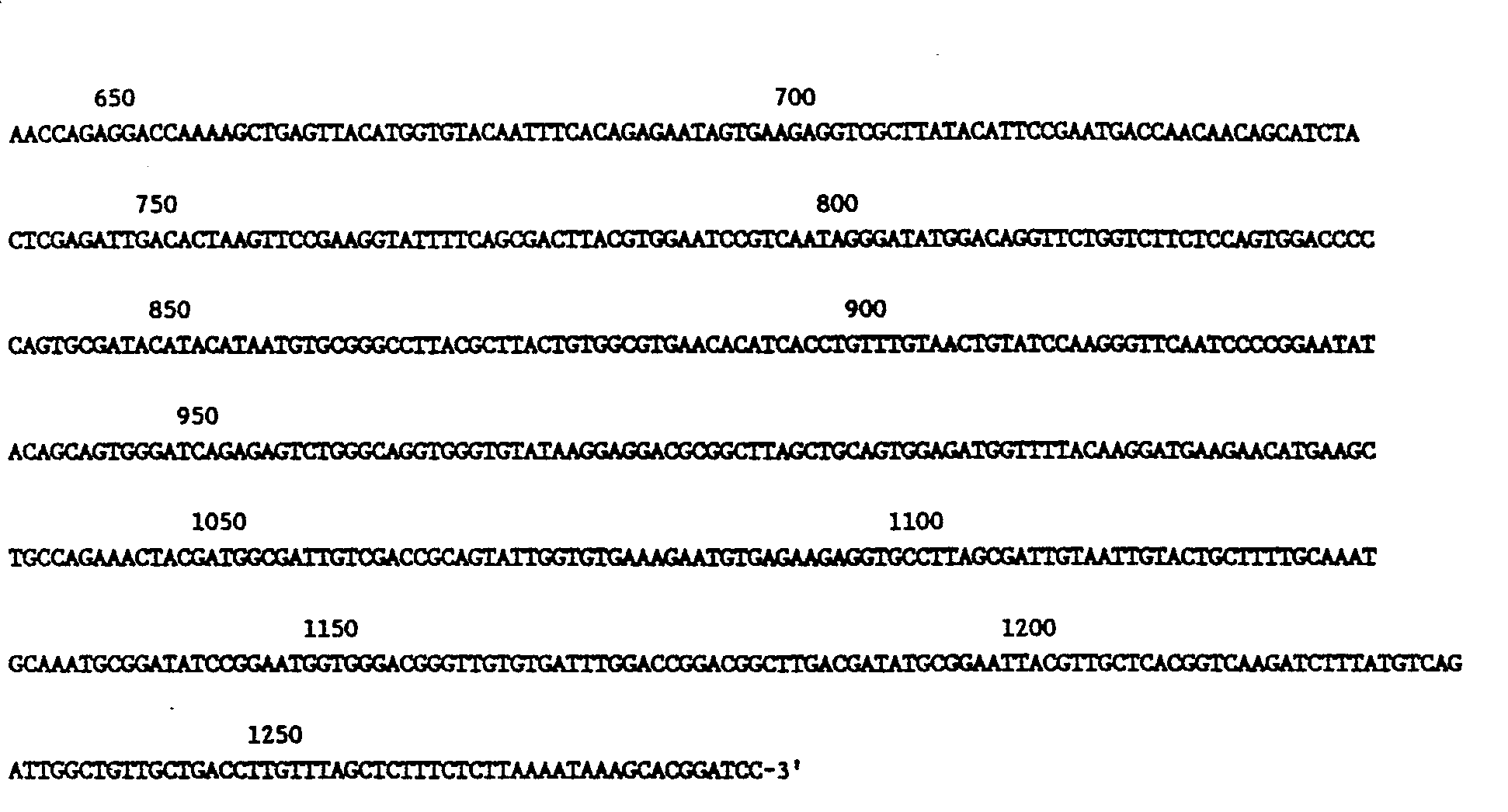
- Figure 2 is a nucleotide and deduced amino acid sequence of the cDNA insert of pBOS5. The restriction sites given in Figure 1 are indicated. The box outlines the polyadenylation signal sequence, 5'-AATAA-3'.
- Figure 3 describes subcloning of the pBOS5 cDNA insert into the pWR590 series of expression vectors in which:
- (A) is the generation of the pBOS5 L and S fragments by Bam H1-XhoI digestion. Arrows indicate the resulting direction of transcription in the chimeric plasmid;
- (B) is the map of pWR590. Arrows indicate the direction of transcription. Lacz' denotes a shortened lacz gene encoding about 590 amino acids. The expanded region following the lacz' gene contains the polylinker sequence; and
- (C) is the nucleotide sequences of the expression vectors at the fusion junctions, and the expected translational products. "nucs" stands for nucleotides, "aas" stands for amino acids.
- The strategy for isolating SLSG-encoding DNA sequences was predicated on the discovery that, in some self-incompatible strains such as Brassica strains, 1-5% of the protein synthesis in the self-incompatible bud stigma is devoted to the synthesis of this macromolecule (Nasrallah, J.B. et al, Experientia 40, 279-281 (1984)). Thus, it seemed likely that a high proportion of clones in a cDNA library constructed with polyA+ RNA from mature, incompatible stigmas would contain SLSG sequences. It had also been previously observed that SLSG molecules appear in the stigma but not in leaf or seedling tissue (Nasrallah, J.B. et al, Experientia 40, 279-281 (1984)). The present inventors, therefore, hypothesized that SLSG cDNA clones would be enriched in that fraction of clones in such a library which would hybridize strongly to radioactive cDNA corresponding to mature stigma mRNA, but not to labeled leaf or seedling-specific cDNA.
- A cDNA library according to the present invention can be constructed by preparing cDNA from polyA+ RNA from incompatible stigmas at a time when maximal synthesis of SLSG occurs by priming with oligo(dT)12-18 according to a previously described procedure (Maniatis, T. et al, Molecular Cloning: A Laboratory Manual (1982)).
- As plant sources for obtaining incompatible stigmas, natural populations and plants resulting from breeding programs at universities, experimental stations and seed companies can be used. Examples of suitable plants from natural populations include Lycopersicon peruvianum and solanum. Examples of suitable plants from breeding programs include vegetable crops such as potatoes, tomatoes, cole crops, beets; ornamental crops such as petunia, nicotiana; cereals and grasses such as rye; stone fruits such as cherries, plums and apples; forage crops such as cloves, kales and mustards; oil seeds such as grape seeds, especially Brassica napus. Especially preferred are self-incompatible Brassica oleracea plants homozygous for various S-alleles such as S6, S13, and S14 and 47 other alleles known to date (Thompson, K.F. et al, Heredity, 21: 345-362 (1966); Ockendon, D.J., Heredity, 33, 159-171 (1974).
- In order to achieve homozygosity of Brassica oleracea, mature pollen can be applied to immature and, therefore, self-compatible stigmas of the same plant.
- Examples of suitable S-homozygotes include all stable S-homozygotes among the fifty known ones. Preferred homozygotes are the S6 and S14 homozygotes from Brassica oleracea.
- PolyA+ RNA can be isolated by known methods such as oligo(dT) chromatography (Aviv, H. et al, Proc. Natl Acad. sci. USA 69, 1408 (1972)).
- The cDNA prepared from polyA+ RNA from incompatible stigmas is treated with Sl nuclease and subsequently repaired with the Klenow fragment of E. coli DNA polymerase to generate blunt-ended cDNA. (Maniatis, T. et al, Molecular Cloning: A Laboratory Manual (1982)). The blunt-ended cDNA can be ligated to restriction endonuclease linkers and digested to completion with the restriction endonuclease. (Maniatis, T. et al, Molecular Cloning: A Laboratory Manual (1982)). Fragments of cDNA larger than 500 base pairs ("bp") can be isolated by known means including electrophoresis on an agarose gel, and cloned into the appropriate restriction site of a plasmid. The plasmids are then used to transform cells by any known method such as the method of Hanahan, D., J. Mol. Biol. 166, 557-580 (1983).
- Suitable restriction endonuclease linkers include any linkers containing restriction sites that correspond to unique restriction sites in the plasmid.
- Examples include Eco R1 linkers; Hin D linkers and Bam H1 linkers and especially preferred restriction endonuclease linkers for Brassica oleracea are Bam H1 linkers.
- Suitable plasmids include any plasmids containing unique restriction sites for insertion of foreign DNA. Examples include pBR322 and pKC7. The plasmid pBR322 is preferred.
- Suitable microorganism host cells include any cells that will support replication of the recombinant plasmids. Examples include E. coli HB101; JM101 and SF8 strains. E. coli SF8 are preferred.
- Stigma and seedling cDNA probes can be prepared by known methods such as random primed reverse transcription of polyA+ RNA (Taylor, J.M. et al, Biochim. Biophys., Acta 442, 324 (1976). Stigma probes are prepared from polyA+ RNA purified from self-incompatible stigmas, and seedling probes are prepared from polyA+ RNA purified from etiolated seedlings.
- Recombinant clones can be screened by any known method including the colony hybridization method of Grunstein & Hogness (Grunstein, M. et al, Proc. Natl Acad. Sci. USA 72, 3961 (1975)).
- Once the cDNA library is constructed, independent clones can be picked randomly from the library, and DNA from these colonies characterized by known methods such as transferring to each of two nitrocellulose filters, and hybridizing with the appropriate probes. For Brassica, colonies found to hybridize strongly with stigma-derived cDNA probe but to not react with seedling cDNA probe can be selected for further use. One such plasmid which has stigma-derived DNA homologous to that from Brassica oleracea is pBOS5 having ATCC accession No. 40191.
- Once the colonies are selected, plasmid DNA can be prepared from each of the colonies, and digests with the appropriate restriction endonuclease can be performed such that the cDNA inserts can be separated from the plasmid vector by gel electrophoresis.
- The amplification and isolation of plasmid DNAs can be carried out using standard procedures (Maniatis, T. et al, Molecular Cloning A Laboratory (1982)). Inserts can be separated from the plasmid by digestion with the appropriate restriction endonuclease followed by agarose gel electrophoresis and electroelution (McDonald, M.W. et al, J. Mol. Biol. 110, 119 (1977)).
- Cross-hydridization experiments can then be performed on these digests to determine if the DNAs from the plasmids are homologous to the DNA from the original plant source.
- Plasmids containing homologous DNA are thus determined.
- In order to determine the nucleotide sequence of the cDNA insert, restriction endonuclease-generated fragments of the plasmid insert can be subcloned into appropriate vectors and the resulting single-stranded DNAs subjected to sequence analysis by known techniques such as the Sanger technique (1979). Sanger, F. et al, J. Molec. Biol., 143 161-178 (1980).
- Appropriate vectors for subcloning are readily available and readily known to the those skilled in the art. Especially preferred vectors for the pBOS5 insert are M13 vectors mp10 and mpll (Messing, J. et al, Gene 19, 269-2766 (1982)).
- The restriction map and DNA sequencing strategy of the Brassica cDNA insert of pBOS5 is shown in Figure 1.
- The restriction map was constructed by gel electrophoretic analysis of various single and double enzyme digests of pBOS5. The thick line represents the coding region, and the thin line represents the 3'-noncoding region of the cDNA sequence. Arrows below the map indicate the direction and extent of sequences subcloned into M13 vectors and read from each restriction site.
- The results of the nucleotide sequence determination on a pBOS5 BamHl insertion subcloned into M13mp10 and M13mpll are presented in Figure 2. Although five of the six possible reading frames are blocked by multiple nonsense codons throughout the entire 1283 base pair ("bp") insert, the remaining reading frame translates into a polypeptide 123 amino acids in length as shown in Figure 2. The nucleotide sequence AATAAA, which has been implicated as a signal for the polyadenylation of mRNA (Proudfoodt, N.J. et al, Nature 263, 211-214 (1976)), is located downstream of the SLSG coding region, 11-16 bp from the end of the cDNA insert presumed to have been derived from the 3' end of the mRNA. The cDNA sequence does not contain a poly(A) tail, which is usually 11-30 bp from the polyadenylation signal. An explanation for the absence of a poly(A) tract is provided by the finding that the BamHl sequences flanking both sides of the cDNA insert do not resemble the BamHl linker sequence used in the construction of the cDNA clone. While not desiring to be bound, it is presumed that a BamHl recognition site is located in the full-length cDNA sequence between the polyadenylation signal and the poly(A) tail of the messenger, such that this BamH1 site would be inserted into the pBR322 vector in place of the end provided by the linker sequence.
- Appropriate expression vectors are vectors that contain sequences of DNA that are required for the transcription of cloned copies of genes and for the translation of their mRNAs in E. coli. Examples include gt11, puc8, puc9, pWR590, pWR590-1, pWR590-2. Preferred vectors for the PBOS5 insert are the three expression vectors pWR590, pWR590-1, and pWR590-2 which have recently been described (Guo, L.H. et al, Gene 29, 251-254 (1984)). In these vectors foreign DNA can be inserted into a polylinker region such that these exogenous sequences can be translated by E. coli cells into a fusion protein, the first 590 amino acids of which are supplied by a truncated E. coli S-galactosidase gene (Guo, L.H. et al, Gene 29, 251-254 (1984) and Figure 5a). By employing all three vectors, a fragment of foreign DNA may be joined to the p-galactosidase gene in all three possible translational reading frames.
- The presumptive coding region of the cDNA insert from Brassica oleracea is entirely contained within a fragment of DNA (fragment L in Figure 3B) demarcated by recognition sites for the enzymes BamHl (at positions 1-6) and Xho I (nucleotides 740-745). Thus, as illustrated in Figure 3C, fragment L from pBOS5 would theoretically encode a fusion protein containing determinants encoded by the long open reading frame predicted by the DNA sequence data only when inserted into the vector pWR590-1. When placed in either of the remaining two vectors, pWR590 and pWR590-2, fragment L would not be in the correct reading frame with respect to the p-galactosidase gene, and thus would not direct the synthesis of a fusion protein substantially specified by the Brassica DNA.
- Six expression plasmids can thus be constructed, as, for example, the six expression plasmids constructed from the L and S strands of Brassica. The resulting six constructs can be individually incorporated into appropriate cells by transformation, and the plasmids in several colonies emerging from each transformation can be examined by digestion with appropriate restriction endonucleases.
- Suitable cells for transformation of the expression plasmid include any strains that allow its replication and translation. Examples include E. coli strains HB101, JM101 and SF8. Especially preferred are E. coli SF8.
- One colony from each experiment was selected which yielded the expected pattern of fragments. From Brassica, the expected pattern is of two fragments, one corresponding in size to either fragment L or to fragment S, and the other fragment identical in length to the vector.
- Extracts can be prepared from cultures of the selected transformants and fractionated by suitable means such as SDS polyacrylamide gel electrophoresis. The proteins analyzed in this manner can be electrophoretically transferred to nitrocellulose filters and probed with antibodies to SLGS by known methods. The plasmid containing fragment L linked to the vector that directs the synthesis of SLGS-related polypeptides can be identified by a positive reaction with SLSG antiserum or by any other suitable method. For Brassica, the size of the prominent band should be that expected for a fusion protein consisting of the amino acids from the expression plasmid and the polylinker region and 123 amino acids encoded by the Brassica cDNA clone.
- As already mentioned, the present invention has numerous uses. One such use is to identify S-genes in breeding stock by, for example, Southern blot analysis of genomic DNA. Another use is to identify stable S-alleles with strong promoters by, for example, isoelectric focusing or transformation. Additionally, transformed strains carrying the S-alleles can be interplanted with strains carrying different S-alleles so the seed that is harvested is entirely hybrid. Further uses include: facilitating hybrid seed production by more efficient transfer of stable S-alleles into breeding stocks by, for example, transformation; breaking down self-incompatibility in fruit trees by, for example, in vitro mutagenesis of S-genes, or by chemical and immunochemical blocking of self-incompatibility inbred lines by, for example, transformation or in vitro mutagenesis.
- The present invention will now be described by reference to specific examples which are not meant to be limiting.
- Brassica oleracea self-incompatible plants homozygous for the S6, S13, and S14 alleles maintained at the State University of New York, Cortland, were used for the following experiment.
- Homozygosity was achieved by applying mature pollen to immature and, therefore, self-compatible, stigmas of the same plant.
- Brassica oleracea cDNA was prepared from polyA+ RNA from stigmas at one day prior to anthesis by priming with oligo(dT)12-18 according to a previously described procedure (Maniatis, T. et al, Molecular Cloning a Laboratory Manual (1982)).
- After treatment with S1 nuclease (Bethesda Research Laboratories, BRL) and subsequent repair with the Klenow fragment of E. coli DNA polymerase I (BRL) (Maniatis, T. et al, Molecular Cloning: A Laboratory Manual (1982)), the blunt-ended cDNA was ligated to Bam H1 linkers (BRL) by known methods and digested to completion with Bam H1 by known methods (Maniatis, T. et al, Molecular Cloning: A Laboratory Manual (1982)). cDNA species larger than 500 bp were isolated by electrophoresis on a 1% low-melting agarose gel, in 0.089 molar Tris-base, 0.089 molar boric acid, 0.002 molar ethylenediaminetetraacetic acid (disodium salt), and cloned into the Bam Hl site of the plasmid pBR322 by known methods (Maniatis, T. et al, Molecular Cloning: A Laboratory Manual (1982)). Transformation of E. coli SF8 cells commonly available was performed according to the method of Hanahan (Hanahan, D., J. Mol. Biol. 166, 557-580 (1982)).
- Approximately 2,000 independent clones were picked randomly from the cDNA library, and DNA from these colonies was then transferred to each of two nitrocellulose filters, and hybridized with stigma cDNA and seedling cDNA probes.
- Stigma and seedling cDNA probes were prepared by random primed reverse transcription of polyA+ RNA (Taylor, J.M. et al, Biochim. Biophys. Acta 442, 324 (1976)). Stigma probes were prepared from polyA+ RNA purified from Brassica self-incompatible stigmas and seeling probes were prepared from polyA+ RNA purified from Brassica etiolated seedlings.
- Recombinant clones were screened by the colony hybridization method of Grunstein & Hogness (Grunstein, M. et al, Proc. Natl Acad. Sci. USA 72, 3961 (1975)).
- Eight colonies were found to hybridize strongly with stigma-derived cDNA probe but not to react with seedling derived cDNA probe.
- Plasmid DNA was prepared from each of the eight colonies by known methods (Maniatis, T. et al, Molecular Cloning: A Laboratory Manual (1982)).
- The plasmid DNA was digested with restriction endonuclease Bam H1 (Maniatis, T. et al, Molecular Cloning: A Laboratory Manual (1982)).
- The cDNA inserts were separated from the plasmid vector by agarose gel electrophoresis and electroelution (McDonald, M.W. et al, J. Mol. Biol. 110, 119 (1977)) and were labelled with 32P by nick-translation (Rigby, P.W.J. et al, J. Mol. Biol. 113, 237-251 (1977)).
- Cross-hybridization experiments between the various isolated plasmids were then performed by known methods (Maniatis, T. et al, Molecular Cloning: A Laboratory Manual (1982)).
- The cross-hybridization experiments indicated that all eight recombinant plasmids were homologous to one another. The plasmid containing the largest cDNA insertion was designated pBOS5 and has ATCC accession number 40191.
- Restriction endonuclease-generated fragments of the pBOS5 insert were subcloned into M13 vectors mp10 and mpll (Messing, J. et al, Gene 19, 269-2766 (1982)) as shown in Figure 1.
- DNA sequencing was carried out on the resulting single--stranded DNA by the dideoxynucleotide chain-termination method (Sanger, F. et al, J. Mol. Biol. 143, 161-178 (1980)) using synthetic 17-mer as primer (New England Biolabs). The 17-mer primer had the following sequence:
5'-GTTTTCCCAGTCACGAC-3'. - The results of the nucleotide sequence determination along with a projected amino acid sequence are presented in Figure 2.
- Plasmids pWR590, pwR590-1 are a family of expression vectors designed to express genes in each of the three possible translational frames (Guo, L.H. et al, Gene 29, 251-254 (1984)). In order to construct expression plasmids of the Brassica cDNA sequence, the 745 bp (L) and the 538 pb (S) Bam Hl-XhoI fragments of pBOS5 were isolated from a 1% low-melting agarose gel having the same composition as described above and were ligated to Bam H1 and Sal I digests of pWR590, pWR590-1 and pWR590-2 by known methods (Maniatis, T. et al, Molecular Cloning: A Laboratory Manual (1982)). The resulting six plasmid constructions designated pWR590-L, pWR590-1L, pWR590-2L, pWR590-S, pWR590-1S and pWRE590-2S were used to transform E. coli SF8 cells.
- Transformed E. coli SF8 strains were grown overnight in the presence of lmM IPTG. Extracts were prepared by sonication in 7 M guanidine hydrochloride (Guo, L.H. et al, Gene 29, 251-254 (1984)), and aliquots equivalent to 500 ul of culture were subjected to electrophoresis on 10% SDS acrylamide gels (Laemnli, U.K., Nature 227, 680-685 (1970)). The separated proteins were electrophoretically transferred to nitrocellulose membranes according to Towbin, H. et al, Proc. Natl Acad. Sci. USA 76, 4350-4354 (1979).
- Immunolabeling of nitrocellulose blots was prepared as described by Symington, J., "Two-dimensional Electrophresis of Proteins", Academic Press (1983). The first stage antiserum was raised in a New Zealand White rabbit by multiple intradermal injections of S6-specific glycoprotein purified by preparative isoelectric focusing in granulated beds. The second stage probe was peroxidase-conjugated protein A.
- Genomic DNAs isolated from various Brassica species, i.e., Brassica oleracea, Brassica campestris, Brassica napus, Brassica juncea, Brassica nigra, and Brassica carinata, and from other genera in the same family of Cruciferae (also known as Brassicaceae) such as Raphanus, Lepidium and Histera were subjected to Southern analyses (Southern, E. J. Mol. Biol., 98, 503-517 (1975)). The nitrocellulose blots of restriction digests of these DNAs were probed with 32P-labelled pBOS5. In all cases bonds of sequences that hybridize to pBOS5 and that are, therefore, homologous to pBOS5 were detected.
- While the invention has been described in detail and with reference to specific embodiments thereof, it will be apparent to one skilled in the art that various changes and modifications can be made therein without departing from the spirit and scope thereof.
Claims (17)




Applications Claiming Priority (2)
| Application Number | Priority Date | Filing Date | Title |
|---|---|---|---|
| US76224585A | 1985-08-05 | 1985-08-05 | |
| US762245 | 1985-08-05 |
Publications (2)
| Publication Number | Publication Date |
|---|---|
| EP0212385A2 true EP0212385A2 (en) | 1987-03-04 |
| EP0212385A3 EP0212385A3 (en) | 1988-03-30 |
Family
ID=25064505
Family Applications (1)
| Application Number | Title | Priority Date | Filing Date |
|---|---|---|---|
| EP86110620A Withdrawn EP0212385A3 (en) | 1985-08-05 | 1986-07-31 | A cdna clone encoding an s-locus specific glycoprotein |
Country Status (5)
| Country | Link |
|---|---|
| EP (1) | EP0212385A3 (en) |
| JP (1) | JPS62143688A (en) |
| DD (2) | DD284691A5 (en) |
| DK (1) | DK371086A (en) |
| PL (1) | PL158548B1 (en) |
Cited By (5)
| Publication number | Priority date | Publication date | Assignee | Title |
|---|---|---|---|---|
| EP0222526A3 (en) * | 1985-10-29 | 1988-03-30 | Lubrizol Genetics Inc. | Self-incompatibility gene |
| AU603778B2 (en) * | 1985-10-30 | 1990-11-29 | University Of Melbourne, The | Self-incompatibility gene |
| EP0332533A3 (en) * | 1988-03-08 | 1991-10-09 | Kingroup Inc. | Method of producing plant cell lines and plant hybrids |
| AU642454B2 (en) * | 1989-12-29 | 1993-10-21 | Ciba-Geigy Ag | Expression of S-locus specific glycoprotein gene in transgenic plants |
| US5821094A (en) * | 1992-03-03 | 1998-10-13 | University Of Guelph | S-locus receptor kinase gene in a self-incompatible brassica napus line |
Family Cites Families (2)
| Publication number | Priority date | Publication date | Assignee | Title |
|---|---|---|---|---|
| DE3485646D1 (en) * | 1983-05-27 | 1992-05-21 | Lubrizol Genetics Inc | SELF-INCOMPATIBILITY GLYCOPROTEIN. |
| NZ217916A (en) * | 1985-10-29 | 1990-03-27 | Lubrizol Genetics Inc | Recombinant vector including a self-incompatibility gametophytic plant gene and relevant dna |
-
1986
- 1986-07-31 EP EP86110620A patent/EP0212385A3/en not_active Withdrawn
- 1986-08-04 DD DD86332136A patent/DD284691A5/en not_active IP Right Cessation
- 1986-08-04 DD DD86293412A patent/DD280787A5/en not_active IP Right Cessation
- 1986-08-04 JP JP61184095A patent/JPS62143688A/en active Pending
- 1986-08-04 DK DK371086A patent/DK371086A/en not_active Application Discontinuation
- 1986-08-05 PL PL1986260930A patent/PL158548B1/en unknown
Cited By (5)
| Publication number | Priority date | Publication date | Assignee | Title |
|---|---|---|---|---|
| EP0222526A3 (en) * | 1985-10-29 | 1988-03-30 | Lubrizol Genetics Inc. | Self-incompatibility gene |
| AU603778B2 (en) * | 1985-10-30 | 1990-11-29 | University Of Melbourne, The | Self-incompatibility gene |
| EP0332533A3 (en) * | 1988-03-08 | 1991-10-09 | Kingroup Inc. | Method of producing plant cell lines and plant hybrids |
| AU642454B2 (en) * | 1989-12-29 | 1993-10-21 | Ciba-Geigy Ag | Expression of S-locus specific glycoprotein gene in transgenic plants |
| US5821094A (en) * | 1992-03-03 | 1998-10-13 | University Of Guelph | S-locus receptor kinase gene in a self-incompatible brassica napus line |
Also Published As
| Publication number | Publication date |
|---|---|
| DK371086A (en) | 1987-02-06 |
| JPS62143688A (en) | 1987-06-26 |
| DD284691A5 (en) | 1990-11-21 |
| DK371086D0 (en) | 1986-08-04 |
| PL158548B1 (en) | 1992-09-30 |
| PL260930A1 (en) | 1987-04-06 |
| DD280787A5 (en) | 1990-07-18 |
| EP0212385A3 (en) | 1988-03-30 |
Similar Documents
| Publication | Publication Date | Title |
|---|---|---|
| JP3156792B2 (en) | DNA sequence showing cytoplasmic male sterility, mitochondrial genome, nuclear genome, mitochondria comprising the sequence, and methods for producing plants and hybrids | |
| Apuya et al. | Restriction fragment length polymorphisms as genetic markers in soybean, Glycine max (L.) Merrill | |
| Murfett et al. | S-RNase expressed in transgenic Nicotiana causes S-allele-specific pollen rejection | |
| Brettell et al. | Variation at the Nor loci in triticale derived from tissue culture | |
| CA2087703C (en) | Binary cryptocytotoxic method of hybrid seed production | |
| CA2087703E (en) | Binary cryptocytotoxic method of hybrid seed production | |
| Beppu et al. | Diversity of S-RNase genes and S-haplotypes in Japanese plum (Prunus salicina Lindl.) | |
| IE84070B1 (en) | DNA sequence imparting cytoplasmic male sterility, mitochondrial genome, nuclear genome, mitochondria and plant containing said sequence and process for the preparation of hybrids | |
| CN108291234B (en) | ploid sporophyte formation gene | |
| CN109112146B (en) | Cloning and breeding application of the gene qSLWA9 controlling silique length and grain weight in Brassica napus | |
| CN105316344A (en) | Gene Ms1 for regulating plant pollen development and protein encoded by gene Ms1 | |
| IE904716A1 (en) | Expression of s-locus specific glycoprotein gene in¹transgenic plants | |
| EP0519869A2 (en) | A receptor protein kinase gene encoded at the self-incompatibility locus | |
| US5684242A (en) | Nuclear restorer genes for hybrid seed production | |
| Chevre et al. | Identification of the different Brassica nigra chromosomes from both sets of B. oleracea-B. nigra and B. napus-B. nigra addition lines with a special emphasis on chromosome transmission and self-incompatibility | |
| AU696895B2 (en) | Nucleotide sequences mediating male fertility and method of using same | |
| EP0212385A2 (en) | A CDNA clone encoding an S-locus specific glycoprotein | |
| CN113943356A (en) | Protein phd11, its encoding genes and their application in breeding maize male sterile lines | |
| Matsumoto et al. | S-RNase like genomic sequences in apple for DNA fingerprinting | |
| KR101026266B1 (en) | CAPS for determining genotypes of genes involved in the recovery of male sterility and methods for determining genotypes of recovery genes using the same | |
| CN116375832A (en) | Use of the protein ZmFIGL1 for regulating maize meiotic crossover formation | |
| CN113980108A (en) | Alleles related to self-compatibility traits in non-heading Chinese cabbage and their applications | |
| Mutschler | USE OF MOLECULAR AND CLASSICAL METHODS TO STUDY TOMATO RIPENING | |
| Zhu et al. | Sequence analysis of a specific fragment associated with ogura cms in kale ('Brassica oleracea'var.'Acephala') | |
| Zhu PengFang et al. | Sequence analysis of a specific fragment associated with Ogura CMS in Kale (Brassica oleracea var. acephala). |
Legal Events
| Date | Code | Title | Description |
|---|---|---|---|
| PUAI | Public reference made under article 153(3) epc to a published international application that has entered the european phase |
Free format text: ORIGINAL CODE: 0009012 |
|
| AK | Designated contracting states |
Kind code of ref document: A2 Designated state(s): CH DE FR GB LI SE |
|
| PUAL | Search report despatched |
Free format text: ORIGINAL CODE: 0009013 |
|
| AK | Designated contracting states |
Kind code of ref document: A3 Designated state(s): CH DE FR GB LI SE |
|
| 17P | Request for examination filed |
Effective date: 19880801 |
|
| 17Q | First examination report despatched |
Effective date: 19900516 |
|
| STAA | Information on the status of an ep patent application or granted ep patent |
Free format text: STATUS: THE APPLICATION HAS BEEN WITHDRAWN |
|
| 18W | Application withdrawn |
Withdrawal date: 19950802 |
|
| APAF | Appeal reference modified |
Free format text: ORIGINAL CODE: EPIDOSCREFNE |
|
| RIN1 | Information on inventor provided before grant (corrected) |
Inventor name: GOLDBERG, MICHAEL L., PROF. Inventor name: NASRALLAH, MIKHAIL E. Inventor name: NASRALLAH, JUNE B., PROF. |