EP0212428B1 - Dihydrobenzo[b]thiophene und als Pilzmittel zu gebrauchendes pharmazeutisches Mittel - Google Patents
Dihydrobenzo[b]thiophene und als Pilzmittel zu gebrauchendes pharmazeutisches Mittel Download PDFInfo
- Publication number
- EP0212428B1 EP0212428B1 EP86110821A EP86110821A EP0212428B1 EP 0212428 B1 EP0212428 B1 EP 0212428B1 EP 86110821 A EP86110821 A EP 86110821A EP 86110821 A EP86110821 A EP 86110821A EP 0212428 B1 EP0212428 B1 EP 0212428B1
- Authority
- EP
- European Patent Office
- Prior art keywords
- compound
- formula
- alkyl
- substituted
- dihydro
- Prior art date
- Legal status (The legal status is an assumption and is not a legal conclusion. Google has not performed a legal analysis and makes no representation as to the accuracy of the status listed.)
- Expired - Lifetime
Links
- 0 CC1(CCC2SC(*)(*)CC2CC1)C1CCCCCCCC1 Chemical compound CC1(CCC2SC(*)(*)CC2CC1)C1CCCCCCCC1 0.000 description 14
- UAFDPKWGFZODRL-UHFFFAOYSA-N N=C=NC(CO)O Chemical compound N=C=NC(CO)O UAFDPKWGFZODRL-UHFFFAOYSA-N 0.000 description 1
Classifications
-
- C—CHEMISTRY; METALLURGY
- C07—ORGANIC CHEMISTRY
- C07D—HETEROCYCLIC COMPOUNDS
- C07D409/00—Heterocyclic compounds containing two or more hetero rings, at least one ring having sulfur atoms as the only ring hetero atoms
- C07D409/02—Heterocyclic compounds containing two or more hetero rings, at least one ring having sulfur atoms as the only ring hetero atoms containing two hetero rings
- C07D409/06—Heterocyclic compounds containing two or more hetero rings, at least one ring having sulfur atoms as the only ring hetero atoms containing two hetero rings linked by a carbon chain containing only aliphatic carbon atoms
-
- C—CHEMISTRY; METALLURGY
- C07—ORGANIC CHEMISTRY
- C07D—HETEROCYCLIC COMPOUNDS
- C07D231/00—Heterocyclic compounds containing 1,2-diazole or hydrogenated 1,2-diazole rings
- C07D231/02—Heterocyclic compounds containing 1,2-diazole or hydrogenated 1,2-diazole rings not condensed with other rings
- C07D231/10—Heterocyclic compounds containing 1,2-diazole or hydrogenated 1,2-diazole rings not condensed with other rings having two or three double bonds between ring members or between ring members and non-ring members
- C07D231/12—Heterocyclic compounds containing 1,2-diazole or hydrogenated 1,2-diazole rings not condensed with other rings having two or three double bonds between ring members or between ring members and non-ring members with only hydrogen atoms, hydrocarbon or substituted hydrocarbon radicals, directly attached to ring carbon atoms
-
- A—HUMAN NECESSITIES
- A61—MEDICAL OR VETERINARY SCIENCE; HYGIENE
- A61P—SPECIFIC THERAPEUTIC ACTIVITY OF CHEMICAL COMPOUNDS OR MEDICINAL PREPARATIONS
- A61P31/00—Antiinfectives, i.e. antibiotics, antiseptics, chemotherapeutics
- A61P31/04—Antibacterial agents
-
- A—HUMAN NECESSITIES
- A61—MEDICAL OR VETERINARY SCIENCE; HYGIENE
- A61P—SPECIFIC THERAPEUTIC ACTIVITY OF CHEMICAL COMPOUNDS OR MEDICINAL PREPARATIONS
- A61P31/00—Antiinfectives, i.e. antibiotics, antiseptics, chemotherapeutics
- A61P31/10—Antimycotics
-
- C—CHEMISTRY; METALLURGY
- C07—ORGANIC CHEMISTRY
- C07D—HETEROCYCLIC COMPOUNDS
- C07D233/00—Heterocyclic compounds containing 1,3-diazole or hydrogenated 1,3-diazole rings, not condensed with other rings
- C07D233/54—Heterocyclic compounds containing 1,3-diazole or hydrogenated 1,3-diazole rings, not condensed with other rings having two double bonds between ring members or between ring members and non-ring members
- C07D233/56—Heterocyclic compounds containing 1,3-diazole or hydrogenated 1,3-diazole rings, not condensed with other rings having two double bonds between ring members or between ring members and non-ring members with only hydrogen atoms or radicals containing only hydrogen and carbon atoms, attached to ring carbon atoms
-
- C—CHEMISTRY; METALLURGY
- C07—ORGANIC CHEMISTRY
- C07D—HETEROCYCLIC COMPOUNDS
- C07D249/00—Heterocyclic compounds containing five-membered rings having three nitrogen atoms as the only ring hetero atoms
- C07D249/02—Heterocyclic compounds containing five-membered rings having three nitrogen atoms as the only ring hetero atoms not condensed with other rings
- C07D249/08—1,2,4-Triazoles; Hydrogenated 1,2,4-triazoles
Definitions
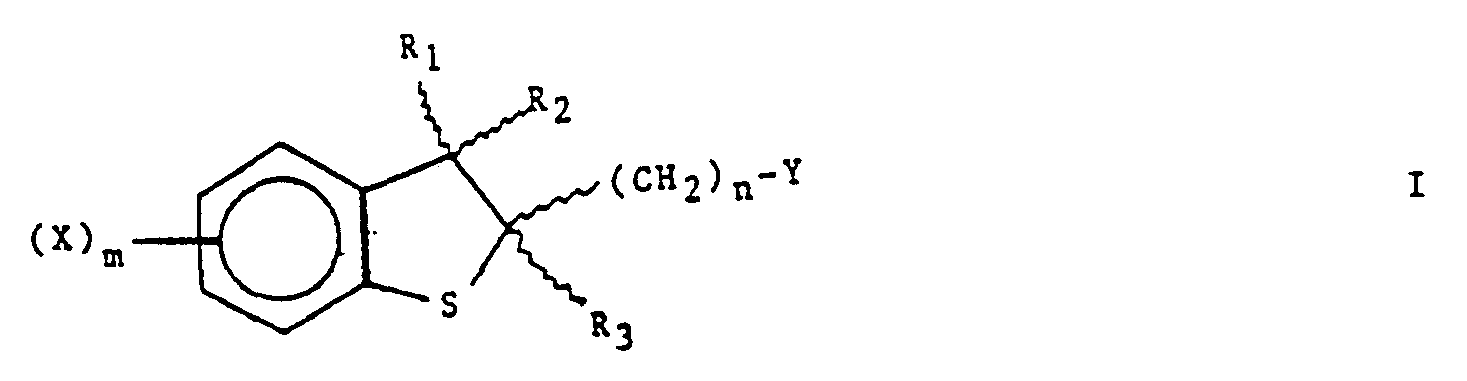
- This invention relates to 2-alkyl-, 2-alkenyl and 2-alkynyl-2,3-dihydro-2-[1H-azolyl(C 1 -C 2 )alkyl]-benzo[b]thiophenes and related derivatives which exhibit antifungal activity, pharmaceutical compositions thereof and methods for their use in treating fungal infections in a host including warm-blooded animals such as humans.
- the compounds of this invention are represented by the following formula I: in racemic or optically active form, or a pharmaceutically acceptable salt thereof wherein
- This invention also provides a pharmaceutical composition
- a pharmaceutical composition comprising an antifungally effective amount of a compound represented by formula I or a pharmaceutically acceptable acid salt thereof, together with a pharmaceutically acceptable carrier or diluent.
- This invention further provides a method of treating susceptible fungal infections which comprises administering to a host, e.g., warm-blooded animals including humans, in need of such treatment an antifungally effective amount of a compound represented by formula I or a pharmaceutical composition comprising such a compound and a pharmaceutically acceptable carrier or diluent.
- halogen means bromine, chlorine or fluorine with chlorine and fluorine being prefered; fluorine is most preferred.
- (lower)alkyl refers to straight and branched chain hydrocarbon groups of 1 to 6 carbon atoms, such as methyl, ethyl, n- and iso-propyl, n-, sec- and tert-butyl, n-, sec-, iso-, tert- and neo-pentyl, n-, sec-, iso- and tert-hexyl.
- (lower)alkanoyl refers to straight and branched chain alkanoyl groups having 2 to 8 carbon atoms such as acetyl, propanoyl, butanoyl, 2-methylpropanoyl, 3-methylpropanoyl, pentanoyl, 2-methylbutanoyl, 3-methylbutanoyl, 4-methylbutanoyl, hexanoyl, 2-methylpentanoyl, 3-methylpentanoyl, 4-methylpentanoyl, 5-methylpentanoyl, heptanoyl, 2-methylheptanoyl, octanoyl, 2-ethylhexanoyl and the like. Acetyl is preferred.
- heterocyclyl refers to five- and six-membered ring systems containing carbon and one to four heteroatoms chosen from N, O and S.
- suitable heterocyclyls include morpholino, piperazino, pyrrolidino, piperidino, imidazolyl, 1,2,4-triazolyl, furanyl, thienyl, thiadiazolyls (especially 1,2,3-thiadiazol-4-yl and 1,2,3-thiadiazol-5-yl), thiomorpholino, and pyridyls.
- the heterocyclyl may be attached via a carbon atom, e.g., N-methylpiperidin-4-yl and N-methylmorpholin-2-yl, or via the nitrogen atom, e.g., piperidin-1-yl (commonly called piperidino), morpholin-4-yl (commonly called morpholino), N-methylpiperazin-4-yl (commonly called N-methylpiperazino), 1H-1-imidazol-1-yl or 4H-1,2,4-triazol-4-yl.
- Azolyls especially 1 H-1-imidazolyl and 1 H-1,2,4-triazolyl
- pyridyls especially 2-pyridyl, and 2- or 3-thienyls are the preferred heterocyclyls.
- Substituted heterocyclyls include (lower)alkyl heterocyclyls especially N-(lower)alkylheterocyclyls such as N-methylmorpholin-4-yl, N-ethylpiperazino, but also 2-methylpyrrolidino, 4-methylpiperidino, 5-methyl-1H-1,2,4-triazol-3-yl, 3-methyl-1-phenyl-1H-1,2,4-triazol-5-yl, and 2-methylpyridyl; (lower)alkanoyl heterocyclyls such as 2-acetylthiophenyl, 2-acetylpyrrolidino; haloheterocyclys such as 2-halo-3-thienyl, 2,5-dihalo-3-thienyl, and 5-halo-2-thienyl; N-(lower)alkanoyl heterocyclyls such as N-acetylpiperazino and 4-acetylpiperidino; and ary
- (lower)alkynyl as used herein is meant straight and branched chain alkynyl radicals of 2 to 8 carbon atoms, such as 1-butynyl.
- phenylalkyl refers to phenyl(lower)alkyl, especially benzyl, a- and ⁇ -phenylethyl and a-, (3-and y-phenylpropyl.
- the preferred phenylalkyl is benzyl.
- Typical suitable aryl groups include phenyl, halo substituted phenyl such as 4-chlorophenyl or 4-fluorophenyl, 2,4-dichloro- or 2,4-difluorophenyl, 2,5-dichloro- or 2,5-difluorophenyl, 2,6-dichloro- or 2,6-difluorophenyl, 2,4,6-trichloro- or 2,4,6-trifluorophenyl and 2,3,4,6-tetrachloro- and 2,3,4,6-tetrafluorophenyl; (lower)alkanoyl substituted phenyl such as 4- acetylphenyl; phenyl substituted by-NR 4 R 5 such as 4-(N,N-dimethylamino)phenyl; phenyl substituted by two different groups such as 4-nitro-3-trifluoromethylphenyl or 3-nitro-4-trifluoromethylphenyl; (lower)al
- arylcarbonyl refers to a carbonyl group bonded to substituted or unsubstituted phenyl or substituted or unsubstituted phenyl(lower)alkyl wherein the substituents comprise one to four of one or more groups selected from halogen, nitro, -NR 4 R s where R 4 and R s are as defined previously, (lower)alkanoyl, (lower)alkyl, and halo(lower)alkyl.
- Preferred OR 4 groups include benzoyloxy, benzyloxy, substituted benzoyloxy and substituted benzyloxy, said benzoyloxy and benzyloxy substituents being one to four of one or more groups selected from halogen, (lower)alkyl, halo(lower)alkyl, nitro, -NR 5 R 6 where R s and R 6 are as defined previously or (lower)alkanoyl and 2- or 5-halo-3-thienyl, 3-halo-2-thienyl or 2,5-dihalo-3-thienyl.
- Typical suitable substituted benzyloxy groups include 4-chlorobenzyloxy, 4-fluorobenzyloxy, 2,4-dichloro- or 2,4-difluorobenzyloxy, 2-chloro-4-fluorobenzyloxy, 2,3-dichloro- or 2,3-difluorobenzyloxy, 2-chloro-3-fluorobenzyloxy, 2,5-dichloro- or 2,5-difluorobenzyloxy, 2-chloro-5-fluorobenzyloxy, 2,6-dichloro-or 2,6-difluorobenzyloxy, 2-chloro-6-fluorobenzyloxy, 2-, 3- or 4-trifluoromethylbenzyloxy, 2-, 3- or 4-methylbenzyloxy, and 2-, 3- or 4-acetylbenzyloxy.
- Halobenzyloxy groups are preferred; 2,6-difluorobenzyloxy and 2,4-difluorobenzyloxy are particularly
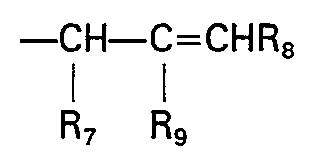
- Typical suitable R 3 groups include 2-propynyl, 2-propenyl, propyl, 1-methyl-2-propenyl, 2-methyl-2-propenyl, 1-methylpropyl, 2-butynyl, 2-butenyl, butyl, 1-methyl-2-butynyl, 1-methyl-2-butenyl, 2-methyl-2-butenyl, 2-ethyl-2-butenyl, 1-phenyl-2-propenyl, 2-phenyl-2-propenyl, 3-phenyl-2-propenyl, 3-phenyl-2-propynyl, 2-(4-fluorophenyl)-2-propenyl, 2-(4-chlorophenyl)-2-propenyl, 2-(2,4-difluorophenyl)-2-butenyl, 2-(2,4-dichlorophenyl)-butyl, 2-(4-nitro-3-trifluoromethyl)-2-propenyl, 2-piperazino-2-propen
- R 3 groups include propyl, 2-propenyl, 2-propynyl, 2-aryl-2-propenyl such as 2-(2,4-difluorophenyl)-2-propenyl and 2-heterocyclyl-2-propenyl such as 2-(N-acetylpiperazino)-2-propenyl.
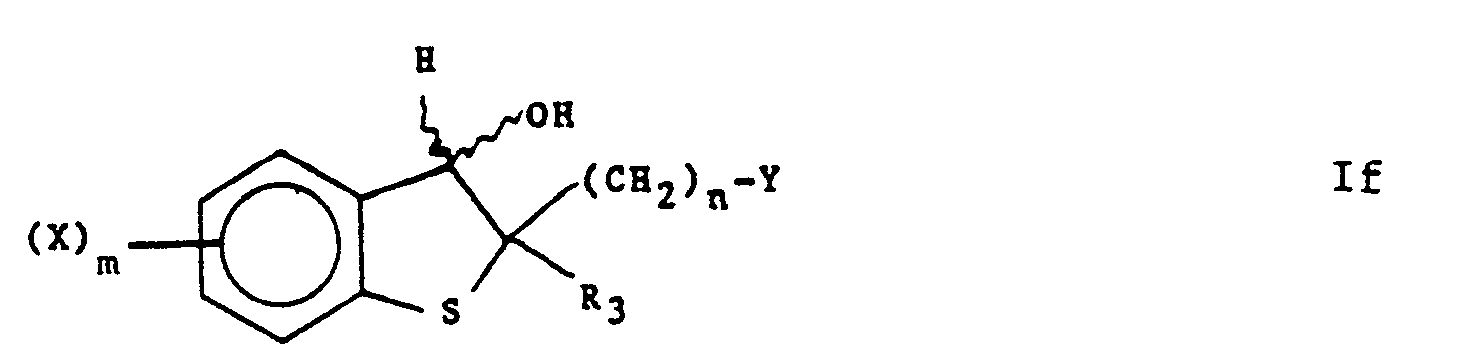
- cis-2,3 the hydroxy and 1 H-imidazolylmethyl groups are both positioned on the same side of the ring.
- the groups are positioned on opposite sides of the ring.
- Both forms are within the scope of the present invention, as are the individual optical isomers, e.g., ( ⁇ )-cis-2,3 and (-)-cis-2,3 which can be obtained by resolution of a racemic mixture [( ⁇ )-cis-2,3] by conventional means well known to those skilled in the art, such as fractional crystallization or chromatography.
- Preferred groups of compounds of this invention include those wherein:
- Preferred compounds include:
- the compounds of the present invention are made by the following process:
- Compounds of formula V may be formed by the following process.
- alkali metal base for example as alkali metal hydroxide especially NaOH or KOH or aqueous solutions thereof, alkali metal hydride, alkali metal amide or alkali metal alcoholate and an allyl compound of formula III, e.g., allyl bromide
- an aprotic organic solvent such as dimethylformamide, (DMF), dimethyl sulfoxide (DMSO), hexamethylphosphoric acid triamide (HMPTA), an ether such as tetrahydrofuran (THF), dioxane or dimethoxyethane, a lower alcohol, or a ketone, e.g. acetone
- PTC phase transfer catalyst
- the oxidation of IV is typically carried out by contacting compounds of formula IV with an oxidizing agent such as a peracid e.g., meta-chloroperbenzoic acid or peracetic acid, or hydrogen peroxide in an organic solvent such as halogenated alkanes, e.g., methylene chloride or chloroform, at about 0°-20°C, preferably 0°-5°C for about 1-4 hours.
- an oxidizing agent such as a peracid e.g., meta-chloroperbenzoic acid or peracetic acid, or hydrogen peroxide in an organic solvent such as halogenated alkanes, e.g., methylene chloride or chloroform, at about 0°-20°C, preferably 0°-5°C for about 1-4 hours.
- the substituted compounds of formula V are heated in a suitable solvent and normally in the presence of an alkanoic acid anhydride for a time sufficient to give the substituted ketone compounds of formula la.
- Typical suitable solvents include aromatic hydrocarbons such as benzene, xylenes, toluene, and halogenated alkanes such as chloroform.
- Typical suitable alkanoic acid anhydrides include acetic anhydride, perchloroacetic anhydride and perfluoroacetic acid anhydride. Temperatures of about 50° to about 100°C for about 1 to 2 hours are normally sufficient.
- the compounds of this invention exhibit broad spectrum antifungal activity, in conventional antifungal screening tests, against human and animal pathogens, such as the following: Aspergillus, Candida, Geotrichum, Microsporum, Monosporium, Rhodotorula, Saccharomyces, Torulopsis and Trichophyton.
- the compounds of this invention exhibit topical fungal activity in in vivo tests in animals that is superior to that for miconazole, a commercial product.
- Candida topical infection model is more potent than miconazole.
- the present invention also provides a pharmaceutical composition
- a pharmaceutical composition comprising an effective antifungal amount of a compound represented by formula I or a pharmaceutically acceptable salt thereof and a pharmaceutically acceptable carrier or diluent.
- the preferred pharmaceutically acceptable salts are nontoxic acid addition salts formed by adding to the compounds of the present invention about a stoichiometric amount of a mineral acid, such as HCI, HBr, H 2 S0 4 or H 3 PO 4 , or of an organic acid, such as acetic, propionic, valeric, oleic, palmitic, stearic, lauric, benzoic, lactic, para-toluene sulfonic, methane sulfonic, citric, maleic, fumaric, succinic and the like.
- a mineral acid such as HCI, HBr, H 2 S0 4 or H 3 PO 4
- an organic acid such as acetic, propionic, valeric, oleic, palmitic, stearic, lauric, benzoic, lactic, para-toluene sulfonic, methane sulfonic, citric, maleic, fumaric, succinic and the like.
- compositions of the present invention may be adapted for oral, parenteral or topical administration. They are formulated by combining the compound of this invention or an equivalent amount of a pharmaceutically acceptable salt thereof with any suitable, inert, pharmaceutically acceptable carrier or diluent.
- the preferred mode of administration is topical.
- compositions for oral administration such as tablets, capsules, pills, powders, granules, solutions, dragees, suspensions or emulsions. They may also be manufactured in the form of sterile solid compositions which can be dissolved in sterile water, physiological saline or some other sterile injectable medium immediately before use.
- Topical dosage forms may be prepared according to procedures well known in the art, and may contain a variety of ingredients, excipients and additives.
- the formulations for topical use include ointments, creams, lotions, powders, aerosols, pessaries and sprays.
- ointments, lotions and creams may contain water, oils, fats, waxes, polyesters, alcohols, or polyols, plus such other ingredients as fragrances, emulsifiers and preservatives.
- Powders are made by mixing the active ingredient with a readily available, inert, pulverous distributing agent, such as talcum, calcium carbonate, tricalcium phosphate, or boric acid. Aqueous suspensions of the above powders may also be made.
- Solutions or emulsions may also be prepared using inert solvents which are preferably nonflammable, odorless, colorless and nontoxic, for example, vegetable oils and isopropanol.
- aerosol or non-aerosol sprays may be prepared using solutions or suspensions in appropriate solvents, e.g., difluorodichloromethane for aerosols.
- Parenteral forms to be injected intravenously, intramuscularly, or subcutanteously are usually in the form of a sterile solution, and may contain salts or glucose to make the solution isotonic.
- the dosages of the compounds of the present invention employed to combat a given fungal infection in animals is generally somewhat less than the dosage requirements of present commercial products such as micoazole.
- the actual preferred dosages of the compounds of the present invention or pharmaceutically acceptable salts thereof will vary according to the particular composition formulated, the mode of application and the particular situs, host and disease being treated. Many factors that modify the action of the drug will be taken into account by the attending clinician, e.g., age, body weight, sex, diet, time of administration, rate of excretion, condition of the host, drug combinations, reaction sensitivities and severity of the disease. Administration can be carried out continuously or periodically within the maximum tolerated dose. Optimal application rates for a given set of conditions can be readily ascertained by the attending clinician using conventional dosage determination tests.
- topical dosage for humans ranges from about 50 mg per day to about 800 mg per day, in single or divided doses, with about 100 mg to about 200 mg per day being preferred. Each dose should be mixed with about 10 g of carrier.
- the oral dosage for human ranges from about 50 mg to about 800 mg per day, in single or divided doses, with about 100 mg to about 400 mg per day being preferred.
- parenteral dosage for humans ranges for about 5 mg per day to about 50 mg per day, in single or divided doses, with about 10 mg per day being preferred.
- Example 3C Following the procedure of Example 3C but substitute an equivalent quantity of the compound of Example 5B for the title compound of Examle 3C to give the corresponding benzo[b]thiophene-3-one which is thereafter treated in accordance with the procedure of Example 3D to provide the mixture of ( ⁇ )-cis and ( ⁇ )-trans-isomers of the title compound of this Example. Fractionally crystallize the mixture to obtain the title compounds of this Example, Part C.
- Example 12 which is similar to that of Example 3, but omit the step that is similar to Step D, Example 3 to yield the title compound of the Example, Part A.
- compositions containing as the active ingredient such as ( ⁇ )-cis-2-allyl-6-chloro-2,3-dihydro-3-hydroxy-2-(1H-1-imidazolylmethyl)benzo[b]thiophene or ( ⁇ )-cis-2-allyl-6-chloro-3-(2-chloro-6-fluorobenzyloxy)-2,3-dihydro-2-(1H-1-imidzolylmethyl)benzo[b]thiophene. It will be appreciated, however, that either of these compounds may be replaced by equally effective quantities of other compounds of this invention.
Landscapes
- Chemical & Material Sciences (AREA)
- Organic Chemistry (AREA)
- Health & Medical Sciences (AREA)
- Chemical Kinetics & Catalysis (AREA)
- Life Sciences & Earth Sciences (AREA)
- General Chemical & Material Sciences (AREA)
- Medicinal Chemistry (AREA)
- Nuclear Medicine, Radiotherapy & Molecular Imaging (AREA)
- Communicable Diseases (AREA)
- Pharmacology & Pharmacy (AREA)
- Oncology (AREA)
- Animal Behavior & Ethology (AREA)
- General Health & Medical Sciences (AREA)
- Public Health (AREA)
- Veterinary Medicine (AREA)
- Pharmaceuticals Containing Other Organic And Inorganic Compounds (AREA)
- Plural Heterocyclic Compounds (AREA)
Claims (13)


dadurch gekennzeichnet, daß




die katalytische Hydrierung einer Verbindung der Formel Ij


Priority Applications (1)
| Application Number | Priority Date | Filing Date | Title |
|---|---|---|---|
| AT86110821T ATE53390T1 (de) | 1985-08-12 | 1986-08-05 | Dihydrobenzo(b>thiophene und als pilzmittel zu gebrauchendes pharmazeutisches mittel. |
Applications Claiming Priority (2)
| Application Number | Priority Date | Filing Date | Title |
|---|---|---|---|
| US764289 | 1985-08-12 | ||
| US06/764,289 US4731364A (en) | 1985-08-12 | 1985-08-12 | Dihydrobenzo(B)thiophenes and pharmaceutical compositions thereof useful as antifungals |
Publications (2)
| Publication Number | Publication Date |
|---|---|
| EP0212428A1 EP0212428A1 (de) | 1987-03-04 |
| EP0212428B1 true EP0212428B1 (de) | 1990-06-06 |
Family
ID=25070267
Family Applications (1)
| Application Number | Title | Priority Date | Filing Date |
|---|---|---|---|
| EP86110821A Expired - Lifetime EP0212428B1 (de) | 1985-08-12 | 1986-08-05 | Dihydrobenzo[b]thiophene und als Pilzmittel zu gebrauchendes pharmazeutisches Mittel |
Country Status (24)
| Country | Link |
|---|---|
| US (1) | US4731364A (de) |
| EP (1) | EP0212428B1 (de) |
| JP (1) | JPS6248683A (de) |
| KR (1) | KR900000673B1 (de) |
| CN (1) | CN1022105C (de) |
| AR (1) | AR244224A1 (de) |
| AT (1) | ATE53390T1 (de) |
| AU (1) | AU585381B2 (de) |
| CA (1) | CA1287634C (de) |
| DE (1) | DE3671748D1 (de) |
| DK (1) | DK370886A (de) |
| ES (1) | ES2001866A6 (de) |
| FI (1) | FI95251C (de) |
| GR (1) | GR862058B (de) |
| HU (1) | HU209302B (de) |
| IE (1) | IE59028B1 (de) |
| IL (1) | IL79598A0 (de) |
| MY (1) | MY101809A (de) |
| NO (1) | NO171066C (de) |
| NZ (1) | NZ217081A (de) |
| OA (1) | OA08374A (de) |
| PH (1) | PH23405A (de) |
| PT (1) | PT83151B (de) |
| ZA (1) | ZA865841B (de) |
Families Citing this family (3)
| Publication number | Priority date | Publication date | Assignee | Title |
|---|---|---|---|---|
| US4695579A (en) * | 1984-12-21 | 1987-09-22 | Schering Corporation | Antifungal 2-azolylmethyl-3-difluorobenzyloxy-2,3-dihydrofluoro-benzo(B) thiophens |
| US4943311A (en) * | 1988-05-09 | 1990-07-24 | Uniroyal Chemical Company, Inc. | Azole derivatives of spiroheterocycles |
| DE4010797A1 (de) * | 1990-04-04 | 1991-10-10 | Hoechst Ag | Substituierte azole, verfahren zu deren herstellung, diese enthaltende mittel und deren verwendung |
Family Cites Families (5)
| Publication number | Priority date | Publication date | Assignee | Title |
|---|---|---|---|---|
| US4431816A (en) * | 1980-12-12 | 1984-02-14 | Schering Corporation | 2,3-Dihydro-2-(imidazolylmethyl)benzo(b)thiophenes |
| US4352808A (en) * | 1980-12-12 | 1982-10-05 | Schering Corporation | 3-Aralkyloxy-2,3-dihydro-2-(imidazolylmethyl)benzo(b)thiophenes and related derivatives, their use as antimicrobials and pharmaceutical formulations useful therefore |
| US4468404A (en) * | 1980-12-12 | 1984-08-28 | Schering Corporation | 3-Aralkyloxy-2,3-dihydro-2-(triazolymethyl)benzo(b)thiophenes |
| ZA825413B (en) * | 1981-08-26 | 1983-06-29 | Pfizer | Thromboxane synthetase inhibitors, processes for their production, and pharmaceutical compositions comprising them |
| US4695579A (en) * | 1984-12-21 | 1987-09-22 | Schering Corporation | Antifungal 2-azolylmethyl-3-difluorobenzyloxy-2,3-dihydrofluoro-benzo(B) thiophens |
-
1985
- 1985-08-12 US US06/764,289 patent/US4731364A/en not_active Expired - Fee Related
-
1986
- 1986-08-04 ZA ZA865841A patent/ZA865841B/xx unknown
- 1986-08-04 IL IL79598A patent/IL79598A0/xx not_active IP Right Cessation
- 1986-08-04 FI FI863168A patent/FI95251C/fi not_active IP Right Cessation
- 1986-08-04 PH PH34103A patent/PH23405A/en unknown
- 1986-08-04 AU AU60854/86A patent/AU585381B2/en not_active Ceased
- 1986-08-04 OA OA58915A patent/OA08374A/xx unknown
- 1986-08-04 ES ES8600837A patent/ES2001866A6/es not_active Expired
- 1986-08-04 NO NO863140A patent/NO171066C/no unknown
- 1986-08-04 DK DK370886A patent/DK370886A/da not_active Application Discontinuation
- 1986-08-04 GR GR862058A patent/GR862058B/el unknown
- 1986-08-04 NZ NZ217081A patent/NZ217081A/xx unknown
- 1986-08-04 AR AR86304795A patent/AR244224A1/es active
- 1986-08-05 AT AT86110821T patent/ATE53390T1/de active
- 1986-08-05 DE DE8686110821T patent/DE3671748D1/de not_active Expired - Lifetime
- 1986-08-05 EP EP86110821A patent/EP0212428B1/de not_active Expired - Lifetime
- 1986-08-06 IE IE210486A patent/IE59028B1/en not_active IP Right Cessation
- 1986-08-06 KR KR1019860006486A patent/KR900000673B1/ko not_active Expired
- 1986-08-06 CN CN86105964A patent/CN1022105C/zh not_active Expired - Fee Related
- 1986-08-06 JP JP61184999A patent/JPS6248683A/ja active Pending
- 1986-08-06 PT PT83151A patent/PT83151B/pt not_active IP Right Cessation
- 1986-08-07 CA CA000515527A patent/CA1287634C/en not_active Expired - Lifetime
- 1986-08-07 HU HU863445A patent/HU209302B/hu not_active IP Right Cessation
-
1987
- 1987-08-10 MY MYPI87001252A patent/MY101809A/en unknown
Also Published As
Similar Documents
| Publication | Publication Date | Title |
|---|---|---|
| US4898954A (en) | Process for the preparation of oxiranes | |
| US4267179A (en) | Heterocyclic derivatives of (4-phenylpiperazin-1-yl-aryloxymethyl-1,3-dioxolan-2-yl)methyl-1H-imidazoles and 1H-1,2,4-triazoles | |
| CA1096873A (en) | Tertiary imidazolyl alcohols, a process for their production and their use as medicaments | |
| US5405861A (en) | Triazole compounds and antifungal compositions thereof | |
| EP0131302A2 (de) | Imidazoliumsalze, Zwischenprodukte für ihre Herstellung sowie ihre Verwendung | |
| KR100413219B1 (ko) | 아포리포프로테인-b합성억제제인신규한트리아졸론 | |
| US4539325A (en) | 1-(2-Aryl-2-halo-1-ethenyl)-1H-azoles, and anticonvulsant use thereof | |
| CA1287634C (en) | Dihydrobenzo¬b|thiophenes and pharmaceutical compositions thereof useful as antifungals | |
| EP0151477B1 (de) | 1H-Imidazol-Derivate, ein Verfahren zu ihrer Herstellung und sie enthaltende pharmazeutische Zusammensetzungen | |
| US4465680A (en) | Combating fungi with azolylvinyldithioacetals | |
| US4737508A (en) | 1-aryl-1-(1H-azol-1-ylalkyl)-1,3-dihydroisobenzofurans, related derivatives and pharmaceutical compositions thereof useful as antifungals | |
| EP0185381B1 (de) | 2-Azolylmethyl-3-difluorobenzyloxy-2,3-dihydrofluorobenzo(b)thiophene, Verfahren zu deren Herstellung und diese enthaltende Zusammensetzungen | |
| US4640918A (en) | Substituted 2-phenyl-1,3-dioxolanes | |
| NO830655L (no) | Diazolylalkanoler, fremgangsmaate til deres fremstilling og deres anvendelse som antimykotisk middel | |
| US4607045A (en) | Azolylmethylcycloacetals, their preparation and their use as drugs | |
| EP1044193B1 (de) | Verfahren zur herstellung von antimykotischen triazol verbindungen | |
| FI65429C (fi) | Foerfarande foer framstaellning av nya terapeutiskt anvaendbara heterocykliska derivat av (4-fenyl-piperazin-1-yl-aryloximetyl-1,3-dioxolan-2-yl)-metyl-1h-imidazoler och 1h-1,2,4-triazoler | |
| PL117988B1 (en) | Process for preparing novel heterocyclic derivatives of /4-phenylpiperazinyl-1-aryloxymethyl-1,3-dioxolanyl-2-/-methyl-1h-imidazoles and 1h-1,2,4-triazolesykh/4-fenilopiperazimilo-1-arilokimetilo-1,3-dioksolanilo-2/-metilo-1kha-imidazola i 1kha-1,2,4-triazola | |
| CS215362B1 (cs) | J-Substituované imidazoly a triazoly a způsob jejich výroby | |
| SI7911478A8 (sl) | Postopek za pridobivanje novih heterocikličnih derivatov azola |
Legal Events
| Date | Code | Title | Description |
|---|---|---|---|
| PUAI | Public reference made under article 153(3) epc to a published international application that has entered the european phase |
Free format text: ORIGINAL CODE: 0009012 |
|
| AK | Designated contracting states |
Kind code of ref document: A1 Designated state(s): AT BE CH DE FR GB IT LI LU NL SE |
|
| 17P | Request for examination filed |
Effective date: 19870606 |
|
| 17Q | First examination report despatched |
Effective date: 19881006 |
|
| GRAA | (expected) grant |
Free format text: ORIGINAL CODE: 0009210 |
|
| AK | Designated contracting states |
Kind code of ref document: B1 Designated state(s): AT BE CH DE FR GB IT LI LU NL SE |
|
| REF | Corresponds to: |
Ref document number: 53390 Country of ref document: AT Date of ref document: 19900615 Kind code of ref document: T |
|
| REF | Corresponds to: |
Ref document number: 3671748 Country of ref document: DE Date of ref document: 19900712 |
|
| ET | Fr: translation filed | ||
| ITF | It: translation for a ep patent filed | ||
| PLBE | No opposition filed within time limit |
Free format text: ORIGINAL CODE: 0009261 |
|
| STAA | Information on the status of an ep patent application or granted ep patent |
Free format text: STATUS: NO OPPOSITION FILED WITHIN TIME LIMIT |
|
| 26N | No opposition filed | ||
| ITTA | It: last paid annual fee | ||
| EPTA | Lu: last paid annual fee | ||
| EAL | Se: european patent in force in sweden |
Ref document number: 86110821.5 |
|
| PGFP | Annual fee paid to national office [announced via postgrant information from national office to epo] |
Ref country code: LU Payment date: 19950701 Year of fee payment: 10 |
|
| PGFP | Annual fee paid to national office [announced via postgrant information from national office to epo] |
Ref country code: FR Payment date: 19950710 Year of fee payment: 10 |
|
| PGFP | Annual fee paid to national office [announced via postgrant information from national office to epo] |
Ref country code: AT Payment date: 19950714 Year of fee payment: 10 |
|
| PGFP | Annual fee paid to national office [announced via postgrant information from national office to epo] |
Ref country code: SE Payment date: 19950717 Year of fee payment: 10 Ref country code: BE Payment date: 19950717 Year of fee payment: 10 |
|
| PGFP | Annual fee paid to national office [announced via postgrant information from national office to epo] |
Ref country code: GB Payment date: 19950718 Year of fee payment: 10 Ref country code: CH Payment date: 19950718 Year of fee payment: 10 |
|
| PGFP | Annual fee paid to national office [announced via postgrant information from national office to epo] |
Ref country code: NL Payment date: 19950721 Year of fee payment: 10 Ref country code: DE Payment date: 19950721 Year of fee payment: 10 |
|
| PG25 | Lapsed in a contracting state [announced via postgrant information from national office to epo] |
Ref country code: LU Free format text: LAPSE BECAUSE OF NON-PAYMENT OF DUE FEES Effective date: 19960805 Ref country code: GB Effective date: 19960805 Ref country code: AT Effective date: 19960805 |
|
| PG25 | Lapsed in a contracting state [announced via postgrant information from national office to epo] |
Ref country code: SE Effective date: 19960806 |
|
| PG25 | Lapsed in a contracting state [announced via postgrant information from national office to epo] |
Ref country code: LI Effective date: 19960831 Ref country code: CH Effective date: 19960831 Ref country code: BE Effective date: 19960831 |
|
| BERE | Be: lapsed |
Owner name: SCHERING CORP. Effective date: 19960831 |
|
| PG25 | Lapsed in a contracting state [announced via postgrant information from national office to epo] |
Ref country code: NL Effective date: 19970301 |
|
| GBPC | Gb: european patent ceased through non-payment of renewal fee |
Effective date: 19960805 |
|
| REG | Reference to a national code |
Ref country code: CH Ref legal event code: PL |
|
| PG25 | Lapsed in a contracting state [announced via postgrant information from national office to epo] |
Ref country code: FR Effective date: 19970430 |
|
| NLV4 | Nl: lapsed or anulled due to non-payment of the annual fee |
Effective date: 19970301 |
|
| PG25 | Lapsed in a contracting state [announced via postgrant information from national office to epo] |
Ref country code: DE Effective date: 19970501 |
|
| EUG | Se: european patent has lapsed |
Ref document number: 86110821.5 |
|
| REG | Reference to a national code |
Ref country code: FR Ref legal event code: ST |
|
| PG25 | Lapsed in a contracting state [announced via postgrant information from national office to epo] |
Ref country code: IT Free format text: LAPSE BECAUSE OF NON-PAYMENT OF DUE FEES Effective date: 20050805 |