EP0212487A2 - Verfahren und Vorrichtung zur Steuerung der vertikalen Abtastgeschwindigkeit - Google Patents
Verfahren und Vorrichtung zur Steuerung der vertikalen Abtastgeschwindigkeit Download PDFInfo
- Publication number
- EP0212487A2 EP0212487A2 EP86110965A EP86110965A EP0212487A2 EP 0212487 A2 EP0212487 A2 EP 0212487A2 EP 86110965 A EP86110965 A EP 86110965A EP 86110965 A EP86110965 A EP 86110965A EP 0212487 A2 EP0212487 A2 EP 0212487A2
- Authority
- EP
- European Patent Office
- Prior art keywords
- vertical scan
- speed
- mode
- buffer memory
- vertical
- Prior art date
- Legal status (The legal status is an assumption and is not a legal conclusion. Google has not performed a legal analysis and makes no representation as to the accuracy of the status listed.)
- Granted
Links
Images




Classifications
-
- H—ELECTRICITY
- H04—ELECTRIC COMMUNICATION TECHNIQUE
- H04N—PICTORIAL COMMUNICATION, e.g. TELEVISION
- H04N1/00—Scanning, transmission or reproduction of documents or the like, e.g. facsimile transmission; Details thereof
- H04N1/04—Scanning arrangements, i.e. arrangements for the displacement of active reading or reproducing elements relative to the original or reproducing medium, or vice versa
- H04N1/17—Scanning arrangements, i.e. arrangements for the displacement of active reading or reproducing elements relative to the original or reproducing medium, or vice versa the scanning speed being dependent on content of picture
Definitions
- This invention relates generally to facsimiles or the like using a redundancy reduction encoding system and having vertical scan means, and more particularly to a method and device for controlling vertical scan speed assuring a reduced number of stops of vertical scan.
- one example of prior art technique divides in advance a vertical scan speed into N stages, reference values M 1 and M 2 are set in advance for a code buffer, acceleration, uniform speed and deceleration are selected in accordance with the number of the buffered code bits, and the vertical scan speed is changed one stage by one in the acceleration and deceleration ranges.
- thermo-sensitive recording system for example, which divides a recording head into a plurality of blocks and applies a current only to the blocks where black pixels exist, no consideration has been paid to the change of a power feed time for recording in the unit of scan lines in accordance with the content of a video signal to be recorded.
- the first characterizing feature of the present invention lies in that a code buffer memory is disposed to store codes corresponding to read or received information signals, a high speed mode (high speed vertical scan mode), a low speed mode (low speed vertical scan mode) and a reference value of the line buffer memory are in advance set, the number of the buffered code bits and the reference value are compared with each other, and the scan mode is switched in accordance with the number of the buffered code bits in order to prevent overflow of the line buffer memory and to reduce the number of stop of the vertical scan at intermediate portions of a page.
- the second characterizing feature of the present invention lies in the use, as the highest speed vertical scan mode, a vertical scan mode, wherein when a vertical scan speed in an (i+l)th recording unit, which is the sum of the acceleration quantity described above and a practical vertical scan speed of an arbitrary ith recording unit, is assumed to be an imaginary vertical scan speed in the (i+l)th recording unit and the vertical scan speeds of the (i+2)th unit and preceding units therefrom are sequentially decelerated by the deceleration quantity described above, the imaginary vertical scan speed is used as the practical scan speed of the (i+l)th unit if there does not exist any recording unit having a vertical scan speed higher than a printing speed; when the practical scanning
- reference numeral 10 represents a document
- 20 is a lens
- 30 is a photo-electric converter for converting optical signals of one scan line in a main scan direction into electric signals
- 40 is a bi-level video signal circuit for converting an analog electric signal into white and black bi-level electric signals (hereinafter called the "video signals")
- 50 is a line buffer memory for storing the video signal
- 60 is an encoding circuit for reducing the redundancy contained in the video signal and converting it into a code
- 70 is a code buffer memory for storing the code
- 80 is a modulator for modulating the code and converting it into a signal that can be transmitted through a telephone network
- 100 is a motor for moving the document 10 and accomplishing vertical scan
- 110 is a rubber roller for supporting the document 10 and transmitting the rotation motion of the pulse motor 100 to the document 10.
- the picture information of the document corresponding to one scan line in the main scan direction are inputted as optical signals into the photoelectric converter 30 through the lens 20 and are converted to analog electric signals by the converter 30.
- the analog electric signal is converted to a bi-level video signal representing black and white by the bi-level video signal circuit 40.
- the picture signal is once stored in the line buffer memory 50 and is then encoded for redundance reduction by the encoding circuit 60 and converted to a code.
- High speed facsimiles of the international standard employ a modified Hafmann code (MH code) as the redundancy reduction code, and the code described above corresponds to this MH code.
- the code is once stored in the code buffer memory 70, is then modulated by the modulator 80 and is thereafter outputted to the telephone circuit.
- a controller 90 receives the stored video signal quantity of the line buffer memory 50 and the number of buffered code bits of the code buffer memory 70, switches the vertical scan modes in accordance with the number of the buffered code bits when a sufficient empty region exists in the line buffer memory 50 (always in this state so long as the empty region exists in the code buffer memory 70 if the encoder has a sufficiently high speed), and accomplishes the vertical scan speed determined by each vertical scan mode by controlling the motor 100.
- the controller 90 controls the motor 100 to accomplish the high speed vertical mode and if the number of the buffered code bits is greater than the reference values, it controls the motor 100 and accomplishes the low speed vertical mode.
- this embodiment provides the effect that non-uniform reading can be reduced because the number of times of stop of vertical scan at the intermediate portions of a page can be reduced.
- the abscissa represents the number of the buffered code bits and the ordinate does the vertical scan mode.
- Symbols M 1 , M 2 , M 3 and M max on the abscissa represent the reference values, and they have the relation m 1 ⁇ M 2 ⁇ M 3 ⁇ M max .
- the vertical scan modes consist of the three kinds of modes, that is, stop, low speed and high speed.
- the state of the facsimile transmitter is positioned at the origin of Fig. 2 at the start of a page.
- the mode shifts to the position of the state line b along the state line a, thereby establishing the high speed vertical scan mode.
- the encoding speed is greater than the code transmission speed (such a condition occurs when a region having a large information quantity is scanned)
- the number of the buffered code bits increases along the state line b and reaches the reference value M 3 .
- the mode shifts to the low speed vertical scan mode of the state line d along the state line c.
- the mode shifts to the high speed vertical scan mode along the state line e. If the encoding speed is greater than the code transmission speed because a region having an extremely large information quantity is scanned in the low speed vertical scan mode, the number of the buffered code bits increases along the state line d. The mode shifts to the stop mode along the state line f when the number of the buffered code bits reaches M max . . In the stop mode, the number of the buffered code bits decreases along the state line g and when it is below the reference value M 2 , the mode shifts to the low speed vertical scan mode along the state line h.
- the number of times of shift of the vertical scan modes can be reduced because hysteresis is provided to the shift of the vertical scan modes. Therefore, variance of the moving quantity of the document 10 due to the acceleration or deceleration of the vertical scan speed can be reduced and scan can be made accurately because the number of times of acceleration and deceleration of the vertical scan speed necessary for the shift of the vertical scan mode can be reduced.
- pulse motor 100 When a pulse motor that has been used widely in many facsimiles is used as the motor 100 for executing vertical scan, feed variance will occur due to disturbance of step response if drastic acceleration or deceleration is made.
- the pulse motors in general have the characteristics such that when the driving frequency is gradually increased, they can be operated synchronously at a frequency higher than the frequency to which they can respond rapidly from the stationary state.
- the ordinate represents the vertical scan speed and 1 lps corresponds to the low speed vertical scan while 50 lps does to the high speed vertical scan mode.
- the abscissa represents the time. Acceleration and deceleration are effected gradually over nine stages in order to shift the modes from the low speed vertical scan control mode to the high speed vertical scan mode and vice versa.
- variance of the moving quantity of the document resulting from the acceleration or deceleration of the vertical scan speed can be reduced and accurate scan can be made.
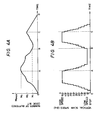
- Fig. 4 shows a timing chart when a certain document is sent by use of the vertical scan control method described above in detail.
- the ordinate of Fig. 4A represents the number of buffered code bits and that of Fig. 4B does the vertical scan speed.
- the abscissa in each of Figs. 4A and 4B represents the time. Since the number of the buffered code bits is small at the start of transmission, the vertical scan speed is gradually accelerated and scan is made in the high speed scan mode of 50 lps. Since scan is made at this high speed, the code generation speed (which varies depending upon the information quantity of the video signal) is generally greater than the code transmission speed (which is constant at 4,800 bps, for example), and the number of the buffered code bits increases gradually.
- the vertical scan speed is gradually decelerated and the mode shifts to the low speed vertical scan mode.
- the encoding speed decreases so that the number of the buffered code bits decreases gradually.
- the vertical scan speed is again accelerated and the mode shifts to the high speed vertical scan mode. Since scan of one page is completed before the point of time C, the vertical scan speed is gradually decelerated and then stopped. After the time C, the number of the buffered code bits decreases in proportion to the code transmission speed and transmission is completed at the time D.
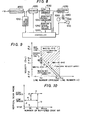
- Fig. 5 is a block diagram showing the circuit construction of one embodiment when the present invention is applied to the facsimile transmitter.
- the circuit portions represented by reference numerals 10 to 110 correspond to those represented by reference numerals 10 to 110 in Fig. 1.
- the controller 90 consists of constituents 91 to 94.
- Reference numeral 91 represents a microcomputer, and 92 is a program memory for storing the program of the microcomputer 91.
- An ROM (Read Only Memory) is generally used for the program memory 92.
- ROM 92 stores therein the program corresponding to the operation flow shown in Figs. 6 and 7.
- Reference numeral 93 represents a working memory for working of the microcomputer 91 and an RAM (Random Access Memory) is generally used for the working memory 93.
- This memory 93 stores information necessary for the operation of the microcomputer 71 such as a present vertical scan speed.
- Reference numeral 94 represents a motor controller which controls the motor 100 and outputs a driving pulse to the motor 100 in accordance with the instruction from the microcomputer 91.
- a CCD Charge Coupled Device
- an image processor is used as the bi-level video signal circuit 40.
- RAMs for example, are used as the line buffer memory 50 and the code buffer memory 70, while a compression/expansion processor is used as the encoding circuit 60.
- the photoelectric converter 30 converts the optical picture information of one scan line obtained by scanning the document 10 in the main scan direction in accordance with the instruction from the microcomputer 91 into the analog electric signal.
- the bi-level video signal circuit 30 corrects distortion and converts the analog electric signal into a black and white binary video signal.
- the video signal is stored in the line buffer memory 50 through a video signal bus 120.
- the encoding circuit 60 reads out the video signals stored in the line buffer memory 50 in accordance with the instruction from the microcomputer 91, effects redundancy reduction encoding and outputs the codes to a microcomputer bus 130.
- the microcomputer 91 lets the code buffer memory 70 store the codes, and outputs the codes stored in the code buffer memory 70 to the modulator 80 in accordance with the demand from the modulator 80.
- the modulator 80 modulates the code and outputs it to the telephone network at a transmission speed of 4,800 pbs, for example.
- the microcomputer decides the next vertical scan speed in accordance with the stored quantity of the line buffer memory 50 and the code buffer memory 70 by employing the vertical scan speed control method of the present invention which is stored in the program 92, and sets the vertical scan speed to the motor control circuit 94.
- the motor control circuit 94 drives the motor 100 in accordance with the instruction from the microcomputer 91 and accomplishes the vertical scan at the vertical scan speed described above.
- Fig. 6 shows the construction of the program stored in ROM 92, which is executed by the microcomputer 91.
- Reference numeral 200 represents a scheduler, which starts each task.
- Reference numeral 300 represents a task which initializes the system and initializes the working memory 93, for example.
- Reference numeral 400 represents a encoding task, which sends encoding instruction to the encoding circuit 60 and transfers the code to the code buffer memory 70.
- Reference numeral 500 is a communication control task, which controls the communication with the receiver and outputs the code to the modulator 80.
- Reference numeral 600 represents a task which executes the vertical scan control of the present invention, which will be explained in further detail with reference to Fig. 7.
- Fig. 7 is a detailed flowchart of the vertical scan speed control task 600.
- This task 600 is started by the scheduler 200.
- the start timing is the end of vertical scan, for example.
- step 601 whether or not the document to be processed exists is judged. If it does not, the flow shifts to the step 602 and it does, the flow shifts to the step 604.
- step 602 whether or not vertical scan stops is judged. If it does, the flows returns to the scheduler 200 and if it does not, the vertical scan speed is decelerated by one stage at the step 603.
- the video signal is stored in the line buffer memory 50 while decelerating the vertical scan speed one stage by one and whether or not a sufficient empty region to prevent the overflow of the line buffer memory 50 exists is judged.
- Fig. 3 for example, when the vertical scan speed is 50 lps, deceleration must be made ten times before the stop; hence, whether or not the empty region capable of storing the video signals of at least ten scanning lines exists in the line buffer memory 50 is judged. If the empty region does not exist, the flow shifts to the step 605.
- step 605 whether or not the scan.is at halt is judged and if it is at halt, the flow returns and if it is not, the flow shifts to the stage 606.
- the vertical scan is effected by decelerating the vertical scan speed by one stage, main scan is then effected by driving the photo-electric converter 30, the video signals are stored in the line buffer memory 50 and thereafter the flow returns to the start.
- the step 607 whether or not the present state is in the high speed vertical scan mode is judged, and if it is, the flow shifts to the step 608 and if not, the flow shifts to the stage 614.
- the start of the page is set to the high speed vertical scan mode by the initialize task 300.
- the step 608 whether or not the number of the buffered code bits exceeds the reference value M 3 is judged, and if it does not, the flow shifts to the step 609 and if it does, the flow shifts to the step 612.
- the step 609 whether or not the present vertical scan speed is equal to the constant speed of the high speed vertical scan mode, that is, 50 lps of Fig. 3 is judged, and if it is, the flow shifts to the step 611 and if it is not, the process shifts to the step 610.
- the vertical scan speed is accelerated by one stage.
- the document 10 is scanned and then flow returns.
- step 614 whether or not the present vertical scan mode is the low speed vertical scan mode is judged, and if it is, the flow shifts to the step 615 and if not, the flow shifts to the step 624 while the mode is judged as the stop mode.
- step 615 whether the number of the buffered code bits is greater than the reference value M 1 but is less than the reference value M max is judged and if it is, the flow shifts to the step 616.and if not, the flow shifts to the step 619.
- step 616 whether or not the present vertical scan speed is equal to the constant speed of the low speed vertical scan mode is judged, and if it is, the flow shifts to the step 618.
- the vertical scan speed is accelerated or decelerated by one stage so that the vertical scan speed comes close to the constant speed.
- the cocument 10 is scanned and the flow returns.
- the step 619 whether or not the number of the buffered code bits is less than the reference value M 1 is judged and if it is, the flow shifts to the step 620 and if not, the number of the buffered code bits is judged as M max and the flow shifts to the step 622.
- the vertical scan speed is accelerated by one stage and the document 10 is scanned.
- the mode is set to the high speed vertical scan mode and the flow returns.
- the vertical scan speed is decelerated by one stage and the document 10 is scanned.
- the mode is set to the step mode, followed then by return.
- step 624 whether or not the number of the buffered code bits is less than M 2 is judged and if it is, the flow shifts to the step 625 and if not, it shifts to the step 627.
- the vertical scan speed is accelerated by one stage and the document 10 is scanned.
- the mode is set to the low speed vertical scan mode, followed then by return.
- the vertical scan speed is decelerated by one stage and the document 10 is scanned, followed then by return.
- reference numeral 1000 represents a demodulator which demodulates a transmission signal sent through a telephone network to a digital signal (which corresponds to the code in the case of a high speed facsimile); 1010 is a code buffer memory for storing the codes; 1020 is a decoder for decoding the codes to the original video signals; 1030 is a line buffer memory for storing the video signals; 1040 is a printing speed detector for calculating a printing speed in the unit of scanning lines corresponding to the number of black pixels in the video signal; 1050 is a printing speed buffer memory for storing the printing speed; 1060 is a controller; 1070 is a recording driver; 1080 is a thermosensitive recording head; 1090 is recording paper; 1100 is a rubber roller; and 1110 is a motor for accomplishing the vertical scan by moving the recording paper in the vertical scan direction.
- 1010 is a code buffer memory for storing the codes
- 1020 is a decoder for decoding the codes to the original video signals
- 1030 is a line buffer
- the transmission signal sent from the facsimile trans- mitter through the telephone network is demodulated to the digital signal by the demodulator 1000.
- the digital signal is the MH code, for example.
- the codes from the demodulator 1000 are once stored in the code buffer memory 1010 and decoded to the original video signal by the decoder 1020.
- the video signal is stored in the line buffer memory 1030 and is sent to the printing speed detector 1040, too.
- the printing speed buffer 1050 stores the printing speed.
- the controller 1060 transfers the video signal stored in the line buffer memory 1030 to the recording driver 1070, applies the power to the recording driver 1070 in accordance with the printing speed stored in the printing speed buffer memory 1050 to drive the thermosensitive recording head 1080, and lets it print the video signals of one scan line in the main scan direction of the recording paper 1090.
- the controller 1060 receives as its input the number of the buffered code bits in the code buffer memory 1010, the number of the buffered video signals in the line buffer memory 1030 and the printing speed of each scan line in the printing speed detector 1050, switches the vertical scan modes in accordance with the number of the buffered code bits in the manner which will be described in detail with reference to Fig.
- Fig. 9 shows a vertical scan speed determination method in the high speed mode in a recording system wherein the printing speed is different for each scanning line unit and both the acceleration quantity and deceleration quantity of the vertical scan speed are set in advance.
- the ordinate represents teh speed (lps) and the abscissa does the scanning line number with the present scanning line number being represented by i.
- the vertical scan speed is divided so that the speed change quantity (between V n-1 and V ; n is a natural number up to N) of one stage is below the acceleration quantity and deceleration quantity that are set in advance (with the proviso that V n-1 ⁇ V n ), and acceleration and deceleration only one stage by one are permitted.
- this embodiment is based on the premise that the practical vertical scan speed in an arbitrary scan line is below the printing speed of the arbitrary scan line.
- V i the imaginary vertical scan speed of the (i + l)th scan line
- V i the vertical scan speeds of the preceding scan lines of and from the (i - 2)th scan line
- the printing speed of the scan line that does not exist in the line buffer memory 1030 is regarded as V 0 (stop). Such a case occurs when the decoding speed of the decoder 1020 is lower than the vertical scan speed or no code exists in the code buffer memory 1010.
- the embodiment described above provides the effect that smooth and high speed vertical scan making the most of the printing speed can be accomplished.
- Fig. 10 shows a vertical scan mode transition diagram with the ordinate representing the vertical scan modes and the abscissa representing the number of the buffered code bits. Symbols M 1 and M 2 (M 1 ⁇ M 2 ) of the abscissa represent the reference values.
- M 1 and M 2 (M 1 ⁇ M 2 ) of the abscissa represent the reference values.
- the low speed vertical scan mode is the mode using, as its vertical scan speed, 5 lps which corresponds to 200 ms/line as the transmission time near the average transmission time necessary for the transfer of a region having a great information quantity of a standard document, for example.
- the state of the facsimile receiver is at the origin of the diagram of Fig. 10.
- the codes are transmitted from the facsimile transmitter, the number of the buffered code bits increases along a state line a.
- the mode shifts from the stop mode to the high speed vertical scan mode along a state line b.
- the number of the buffered code bits increases and descreases along a state line c.
- temporary stop instruction of transmission is sent to the transmitter in order to prevent the overflow of the code buffer memory 1010.
- the over flow does not occur if the high speed vertical scan mode is set to a speed higher than the transmission speed.
- the mode shifts to the low speed vertical scan mode along a state line d. Under this state, the number of the buffered code bits increases and decreases along a state line e. If scan lines having transmission speeds lower than the vertical scan speed (e.g. 5 lps) of the low speed vertical scan mode continue, the number of the buffered code bits descreases along the state line e but generally increases along the state line e.
- teh mode shifts again to the high speed vertical scan mode.
- the mode shifts to the stop mode, and the mode shift described above is repeated. At the time of the mode shift, the vertical scan speed is accelerated and decelerated one stage by one.
- vertical scan is made at a low speed when the number of the buffered code bits becomes small, so that the frequency that the number of the buffered code bits becomes zero can be reduced and hence the occurrence of the stop of recording that occurs when the number of the buffered code bits becomes zero can be reduced. Accordingly, this embodiment provides the effect that the occurrence of non-uniform printing resulting from the stop of vertical scan at intermediate portions of a page can be reduced.
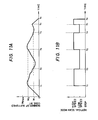
- Fig. 11 shows a timing chart when a certain document is received.
- the ordinate in Fig. llA represents the number of the buffered code bits and the ordinate in Fig. 11B represents the vertical scan mode. Since vertical scan is stopped and recording is not made till the time t 1 from the start of reception, the number of the buffered code bits increases at a constant speed in proportion to the transmission speed.
- the number of the buffered code bits reaches M 2 at the time t l , recording is started in the high speed vertical scan mode. Since the number of the buffered code bits becomes below M 1 at the time t 2 , the mode shifts to the low speed vertical scan mode.
- the mode shifts to the high speed vertical scan mode at the time t 3 and then to the low speed vertical mode at the time t 4 .
- the mode shifts to the high speed vertical scan mode irrelevantly to the number of the buffered code bits. Recording is completed at the time t 8 .
- the mode shifts to the high speed vertical scan mode irrelevantly to the number of the buffred code bits. Accordingly, the time from completion of code reception till completion of recording (the time from t 5 to t 8 in Fig. ll) can be reduced and hence, the recording time of one page (the time from t 1 to t 8 in Fig. 11) can be reduced.
- Fig. 12 is a block diagram showing the circuit construction of the embodiment of the invention when it is applied to the facsimile receiver.
- the circuit portions represented by reference numerals 1000 to 1110 in Fig. 12 correspond to those represented by reference numerals 1000 to 1110 in Fig. 8.
- the controller 1060 consists of constituents 1061 to 1064.
- Reference numeral 1061 represents the microcomputer; 1062 is a memory which stores the program of the microcomputer and uses generally an ROM; 1063 is a working memory of the microcomputer which generally uses an RAM; and 1064 is a recording control circuit which outputs a current feed pulse to a recording driver 1070 and a driving pulse to a motor 1110.
- the analog transmission signal transmitted from the transmitter through the telephone network is converted into the digital signal (codes in this case) by the demodulator 1000 and is stored in the code buffer memory 1010.
- the decoder 1020 receives the code from the code buffer memory 1010 through the microcomputer bus, decodes it to the original video signal and lets the line buffer memory 1030 store the video signal through the bi-level video signal bus.
- the printing speed detector 1040 receives the video signals of one scan line stored in the line buffer memory 1030 through the bi-level video signal bus, detects the printing speed in the unit of scan line by counting the number of black pixels and lets the printing speed buffer memory 1050 store the printing speed through the microcomputer bus.
- the microcomputer 1061 controls each circuit portion in accordance with the task shown in Fig. 13. It transfers the video signals of one scan line inside the line buffer memory 1030 to the recording driver 1070, lets the recording control circuit 1064 feed the power to the recording driver 1070 - in accordance with the printing speed in the printing speed buffer memory 1050, receives the number of the buffered code bits in the code buffer memory 1010, the number of the buffered video signals in the line buffer memory 1030 and the printing speed in the printing speed buffer memory 1050, and instructs the recording control circuit 1064 to drive the motor 1110 in accordance with the vertical scan speed determined by the flows shown in Figs. 14 and 15. Upon receiving the power feed instruction and motor driving instruction from the microcomputer 1061, the recording control circuit 1064 supplies the current to the recording driver 1070 for printing and drives the motor ll10 to accomplish vertical scan.
- Fig. 13 shows the program construction of the facsimile receiver, which is executed by the microcomputer 1061.
- Reference numeral 1200 represents a scheduler, which starts each task.
- Reference numeral 1300 represents a task which initializes the system, and the stop state of the system, for example, is stored in the working memory 1063.
- Reference numeral 1400 represents a communication control task, which controls the communication with the facsimile transmitter, receives the codes, for example, lets the line buffer memory 1010 store the codes and detects its overflow. When the possibility of the overflow occurs, the communication control task instructs the facsimile transmitter to stop transmission by flow control.
- Reference numeral 1500 represents an encoding program task which supplies a decoding instruction to the decoder 1050 when the buffered code exists and the empty region also exists in the line buffer memory 1030.
- Reference numeral 1600 represents a recording control task which is started by the scheduler 1200 in a predetermined interval at the time of completion of one scan line and at the time of stop of recording. Its detail will be explained with reference to Fig. 14.
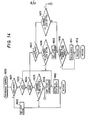
- Fig. 14 is a flowchart of the recording control task.
- the task judges at the step 1601 whether or not the video signal to be recorded that exceeds the signals of one scan line exist in the line buffer memory 1030, and if not, the flow shifts to the step 1602 and if it does, the flow shifts to the step 1603.
- the present state is judged as the stop and the flow returns to the scheduler.
- the step 1603 whether or not the last code of the page is inputted to the line buffer memory 1010 is judged, and if it is, the flow shifts to the step 1650 and if not, to the step 1604.
- step 1604 whether or not the present state is the stop mode is judged, and if it is, the flow shifts to the step 1605 and if not, to the step 1607.
- step 1605 whether or not the number of the buffered code bits is greater than the reference value M 2 is judged, and if it is, the flow shifts to the step 1606 and if not, returns to the start while keeping the stop mode.
- the present state is changed to the high speed mode, and then the flow shifts to the step 1650.
- the step 1650 is a program which effects recording in the high speed vertical scan mode, and its detail will be explained with reference to Fig. 15.
- the flow returns to the start.
- whether or not the present state is the low speed vertical scan mode is judged, and if it is, the flow shifts to the step 1613 and if not, the present state is judged as the high speed vertical scan mode and the flow shifts to the step 1608.
- step 1608 whether or not the number of the buffered code bits is greater than the reference value M 1 is judged and if it is, the flow shifts to the step 1650, recording is effected in the high speed vertical scan mode and then the flow returns to the start. If the number of the buffered code bits is smaller than the reference value M i , the flow shifts to the step 1609, at which the present state is changed to the low speed vertical scan mode. At the step 1610, whether or not the vertical scan speed is in agreement with the speed of the low speed vertical scan mode is judged, and if it is, the flow shifts to the step 1612 and if not, to the step 1611.
- the vertical scan speed is set to a speed which is lower by one stage.
- the video signals of one scan line are transferred from the line buffer memory 1030 to the recording driver 1070, and recording instruction is given to the recording control circuit 1064.
- power is applied to the recording driver 1070 for printing, the driving pulse of a predetermined frequency is outputted to the motor 1110 and the recording paper 1090 is moved at a predetermined vertical scan speed in order to execute recording. Thereafter the flow returns to the start.
- the present state is the low speed vertical scan mode
- whether or not the number of the buffered code bits is greater than the reference value M 2 is judged, and if it is, the flow shifts to the step 1606 and the present state is changed to the high speed vertical scan mode to execute the step 1650. If the number of the buffered code bits is smaller than M 2 , the flow shifts to the step 1610 while keeping the low speed vertical scan mode, and recording is effected in the low speed vertical scan mode.
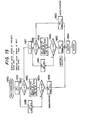
- Fig. 15 is a flowchart when recording is made in the high speed vertical scan mode.
- the present vertical scan speed and the next vertical scan speed are called V i and V next , respectively.
- a variable k is set to 1.
- the printing speed of the scan line which is the k preceding line from the present line is inputted to the variable w. If this printing speed does not exist, w is set to zero.
- the step 1655 is repeatedly executed from the step 1652.
- V next is set to V i-1 (one stage deceleration) and then the flow shifts to the step 1664.
- the steps from 1657 to 1661 are the flows that judge whether or not the speed is uniform.
- the variable is changed to 1 and then the flow shifts to 1658.
- the step 1658 whether or not the value i+2 - k is minus, and if it is, the flow shifts to the step 1663, where acceleration is judged possible and V next is accelerated by one stage to V i+1 .
- the flow shifts to the step 1659, where the printing speed of the kth preceding line is inputted to w, and at the step 1660, whether or not the speed V i+2-k is higher than the printing speed w of the kth preceding line is judged. If it is higher, the speed is judged as uniform and the flow shifts to the step 1662, where V next is set to V . , and if not, the flow returns to the step 1661, where k is incremented by one and the flow returns to the step 1658.
- the next vertical scan speed is determined in the procedures described above, printing is made at the step 1664 and vertical scan is made at the vertical scan speed thus determined, thereby effecting recording. Thereafter, the flow returns to the start.
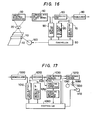
- Fig. 16 shows an example of improvement of the facsimile transmitter shown in Fig. 1.
- Reference numeral 120 in Fig. 16 represents a detector of code bit/sec. Even when the vertical scan speed reaches the level of the predetermined low speed vertical scan mode under the state of the state line d (the low speed vertical scan mode), the vertical scan speed of the low speed vertical saan mode is gradually decreased so that the encoding speed comes close to the transmission speed on the basis of the encoding speeds of the past several lines.
- This embodiment can reduce the number of stops of vertical scan.
- Fig. 17 shows an example of improvement of the facsimile receiver shown in Fig. 8.
- Reference numeral 1120 in Fig. 17 represents a detector of recorded bit/sec. Even when the vertical scan speed reaches the level of the predetermined low speed vertical scan mode under the state of the state line e of Fig. 10 (the low speed vertical scan mode), the vertical scan speed of the low speed vertical scan mode is gradually decreased so that the recorded bit/sec comes close to the transmission speed on the basis of the recorded bit/sec of the past several lines.
- This embodiment can further reduce the number of stops of the vertical scan.
- the present invention can reduce the number of stops of vertical scan at intermediate portions of a page in the facsimile transmitter and receiver, and provides the effect that reading and recording can be made accurately.
Landscapes
- Engineering & Computer Science (AREA)
- Multimedia (AREA)
- Signal Processing (AREA)
- Facsimile Scanning Arrangements (AREA)
- Fax Reproducing Arrangements (AREA)
Applications Claiming Priority (2)
| Application Number | Priority Date | Filing Date | Title |
|---|---|---|---|
| JP177543/85 | 1985-08-14 | ||
| JP60177543A JPS6238658A (ja) | 1985-08-14 | 1985-08-14 | 副走査速度の制御方法 |
Publications (3)
| Publication Number | Publication Date |
|---|---|
| EP0212487A2 true EP0212487A2 (de) | 1987-03-04 |
| EP0212487A3 EP0212487A3 (en) | 1987-12-16 |
| EP0212487B1 EP0212487B1 (de) | 1991-10-23 |
Family
ID=16032784
Family Applications (1)
| Application Number | Title | Priority Date | Filing Date |
|---|---|---|---|
| EP86110965A Expired EP0212487B1 (de) | 1985-08-14 | 1986-08-08 | Verfahren und Vorrichtung zur Steuerung der vertikalen Abtastgeschwindigkeit |
Country Status (4)
| Country | Link |
|---|---|
| US (1) | US4733308A (de) |
| EP (1) | EP0212487B1 (de) |
| JP (1) | JPS6238658A (de) |
| DE (1) | DE3682145D1 (de) |
Cited By (6)
| Publication number | Priority date | Publication date | Assignee | Title |
|---|---|---|---|---|
| WO1992009167A1 (en) * | 1990-11-19 | 1992-05-29 | Eastman Kodak Company | Scanning speed compensation |
| EP0576226A3 (de) * | 1992-06-22 | 1994-02-16 | Fujitsu Ltd | |
| EP0606076A1 (de) | 1993-01-07 | 1994-07-13 | Canon Kabushiki Kaisha | Leser für ein Faksimilegerät |
| WO1999011456A1 (en) * | 1997-09-02 | 1999-03-11 | Ohio Electronic Engravers, Inc. | Intaglio engraving method and apparatus |
| US6525839B1 (en) | 1995-01-23 | 2003-02-25 | Mdc Max Daetwyler Ag | Engraving system and method for engraving intaglio and non-intaglio patterns |
| EP1013075A4 (de) * | 1997-04-01 | 2003-04-02 | Storm Technology Inc | Peripherriebus betriebener scanner |
Families Citing this family (95)
| Publication number | Priority date | Publication date | Assignee | Title |
|---|---|---|---|---|
| GB2175769B (en) * | 1985-04-27 | 1989-12-28 | Sony Corp | Method and apparatus for processing an image signal |
| US7248731B2 (en) | 1992-05-19 | 2007-07-24 | Cummins-Allison Corp. | Method and apparatus for currency discrimination |
| US5633949A (en) * | 1990-02-05 | 1997-05-27 | Cummins-Allison Corp. | Method and apparatus for currency discrimination |
| US6959800B1 (en) | 1995-12-15 | 2005-11-01 | Cummins-Allison Corp. | Method for document processing |
| US5295196A (en) * | 1990-02-05 | 1994-03-15 | Cummins-Allison Corp. | Method and apparatus for currency discrimination and counting |
| US5652802A (en) * | 1990-02-05 | 1997-07-29 | Cummins-Allison Corp. | Method and apparatus for document identification |
| US6311819B1 (en) | 1996-05-29 | 2001-11-06 | Cummins-Allison Corp. | Method and apparatus for document processing |
| US5724438A (en) * | 1990-02-05 | 1998-03-03 | Cummins-Allison Corp. | Method of generating modified patterns and method and apparatus for using the same in a currency identification system |
| US5870487A (en) * | 1990-02-05 | 1999-02-09 | Cummins-Allison Corp. | Method and apparatus for discriminting and counting documents |
| US6539104B1 (en) | 1990-02-05 | 2003-03-25 | Cummins-Allison Corp. | Method and apparatus for currency discrimination |
| US6241069B1 (en) | 1990-02-05 | 2001-06-05 | Cummins-Allison Corp. | Intelligent currency handling system |
| US5815592A (en) * | 1990-02-05 | 1998-09-29 | Cummins-Allison Corp. | Method and apparatus for discriminating and counting documents |
| US5905810A (en) * | 1990-02-05 | 1999-05-18 | Cummins-Allison Corp. | Automatic currency processing system |
| US5966456A (en) * | 1990-02-05 | 1999-10-12 | Cummins-Allison Corp. | Method and apparatus for discriminating and counting documents |
| US5467406A (en) * | 1990-02-05 | 1995-11-14 | Cummins-Allison Corp | Method and apparatus for currency discrimination |
| US5992601A (en) * | 1996-02-15 | 1999-11-30 | Cummins-Allison Corp. | Method and apparatus for document identification and authentication |
| US6636624B2 (en) | 1990-02-05 | 2003-10-21 | Cummins-Allison Corp. | Method and apparatus for currency discrimination and counting |
| US5790693A (en) * | 1990-02-05 | 1998-08-04 | Cummins-Allison Corp. | Currency discriminator and authenticator |
| US5751840A (en) * | 1990-02-05 | 1998-05-12 | Cummins-Allison Corp. | Method and apparatus for currency discrimination |
| US6913130B1 (en) | 1996-02-15 | 2005-07-05 | Cummins-Allison Corp. | Method and apparatus for document processing |
| US5875259A (en) | 1990-02-05 | 1999-02-23 | Cummins-Allison Corp. | Method and apparatus for discriminating and counting documents |
| US5960103A (en) * | 1990-02-05 | 1999-09-28 | Cummins-Allison Corp. | Method and apparatus for authenticating and discriminating currency |
| US5790697A (en) | 1990-02-05 | 1998-08-04 | Cummins-Allion Corp. | Method and apparatus for discriminating and counting documents |
| EP0506410A3 (en) * | 1991-03-26 | 1993-09-01 | Kabushiki Kaisha Toshiba | Scanning optical apparatus |
| ES2133357T3 (es) * | 1992-03-31 | 1999-09-16 | Canon Kk | Aparato para el proceso de imagenes. |
| US6866134B2 (en) * | 1992-05-19 | 2005-03-15 | Cummins-Allison Corp. | Method and apparatus for document processing |
| US5467173A (en) * | 1993-02-05 | 1995-11-14 | Konica Corporation | Speed control circuit for an optical scanning system driving motor for an image forming apparatus |
| US5825512A (en) * | 1994-01-31 | 1998-10-20 | Canon Kabushiki Kaisha | Image reading method and apparatus |
| US6220419B1 (en) | 1994-03-08 | 2001-04-24 | Cummins-Allison | Method and apparatus for discriminating and counting documents |
| US6915893B2 (en) * | 2001-04-18 | 2005-07-12 | Cummins-Alliston Corp. | Method and apparatus for discriminating and counting documents |
| US6980684B1 (en) | 1994-04-12 | 2005-12-27 | Cummins-Allison Corp. | Method and apparatus for discriminating and counting documents |
| US6628816B2 (en) | 1994-08-09 | 2003-09-30 | Cummins-Allison Corp. | Method and apparatus for discriminating and counting documents |
| US5982918A (en) * | 1995-05-02 | 1999-11-09 | Cummins-Allison, Corp. | Automatic funds processing system |
| US6748101B1 (en) | 1995-05-02 | 2004-06-08 | Cummins-Allison Corp. | Automatic currency processing system |
| US6363164B1 (en) | 1996-05-13 | 2002-03-26 | Cummins-Allison Corp. | Automated document processing system using full image scanning |
| US6278795B1 (en) | 1995-12-15 | 2001-08-21 | Cummins-Allison Corp. | Multi-pocket currency discriminator |
| US6880692B1 (en) | 1995-12-15 | 2005-04-19 | Cummins-Allison Corp. | Method and apparatus for document processing |
| US6661910B2 (en) * | 1997-04-14 | 2003-12-09 | Cummins-Allison Corp. | Network for transporting and processing images in real time |
| US8443958B2 (en) | 1996-05-13 | 2013-05-21 | Cummins-Allison Corp. | Apparatus, system and method for coin exchange |
| US7187795B2 (en) | 2001-09-27 | 2007-03-06 | Cummins-Allison Corp. | Document processing system using full image scanning |
| US7232024B2 (en) | 1996-05-29 | 2007-06-19 | Cunnins-Allison Corp. | Currency processing device |
| US6860375B2 (en) | 1996-05-29 | 2005-03-01 | Cummins-Allison Corporation | Multiple pocket currency bill processing device and method |
| US8162125B1 (en) | 1996-05-29 | 2012-04-24 | Cummins-Allison Corp. | Apparatus and system for imaging currency bills and financial documents and method for using the same |
| US7903863B2 (en) * | 2001-09-27 | 2011-03-08 | Cummins-Allison Corp. | Currency bill tracking system |
| US20050276458A1 (en) * | 2004-05-25 | 2005-12-15 | Cummins-Allison Corp. | Automated document processing system and method using image scanning |
| US6026175A (en) * | 1996-09-27 | 2000-02-15 | Cummins-Allison Corp. | Currency discriminator and authenticator having the capability of having its sensing characteristics remotely altered |
| US7584883B2 (en) * | 1996-11-15 | 2009-09-08 | Diebold, Incorporated | Check cashing automated banking machine |
| US7513417B2 (en) * | 1996-11-15 | 2009-04-07 | Diebold, Incorporated | Automated banking machine |
| US6573983B1 (en) | 1996-11-15 | 2003-06-03 | Diebold, Incorporated | Apparatus and method for processing bank notes and other documents in an automated banking machine |
| US5923413A (en) * | 1996-11-15 | 1999-07-13 | Interbold | Universal bank note denominator and validator |
| US7559460B2 (en) * | 1996-11-15 | 2009-07-14 | Diebold Incorporated | Automated banking machine |
| JPH10148893A (ja) * | 1996-11-19 | 1998-06-02 | Brother Ind Ltd | 複写装置 |
| US8478020B1 (en) | 1996-11-27 | 2013-07-02 | Cummins-Allison Corp. | Apparatus and system for imaging currency bills and financial documents and method for using the same |
| CA2288624C (en) | 1997-05-07 | 2003-08-05 | Cummins-Allison Corp. | Intelligent currency handling system |
| US6039645A (en) * | 1997-06-24 | 2000-03-21 | Cummins-Allison Corp. | Software loading system for a coin sorter |
| US5940623A (en) * | 1997-08-01 | 1999-08-17 | Cummins-Allison Corp. | Software loading system for a coin wrapper |
| US6456399B1 (en) | 1998-02-25 | 2002-09-24 | Telenor Satellite Services, Inc. | Buffer overflow and underflow control for facsimile transmission |
| US6493461B1 (en) | 1998-03-17 | 2002-12-10 | Cummins-Allison Corp. | Customizable international note counter |
| CA2371874C (en) | 1999-04-28 | 2005-04-12 | Cummins-Allison Corp. | Currency processing machine with multiple coin receptacles |
| US6637576B1 (en) | 1999-04-28 | 2003-10-28 | Cummins-Allison Corp. | Currency processing machine with multiple internal coin receptacles |
| US20020020603A1 (en) * | 2000-02-11 | 2002-02-21 | Jones, William, J. | System and method for processing currency bills and substitute currency media in a single device |
| US6601687B1 (en) | 2000-02-11 | 2003-08-05 | Cummins-Allison Corp. | Currency handling system having multiple output receptacles |
| US6588569B1 (en) * | 2000-02-11 | 2003-07-08 | Cummins-Allison Corp. | Currency handling system having multiple output receptacles |
| US6843418B2 (en) * | 2002-07-23 | 2005-01-18 | Cummin-Allison Corp. | System and method for processing currency bills and documents bearing barcodes in a document processing device |
| US8701857B2 (en) | 2000-02-11 | 2014-04-22 | Cummins-Allison Corp. | System and method for processing currency bills and tickets |
| US6398000B1 (en) | 2000-02-11 | 2002-06-04 | Cummins-Allison Corp. | Currency handling system having multiple output receptacles |
| TW474097B (en) * | 2000-04-26 | 2002-01-21 | Umax Data Systems Inc | Method for reducing discontinuity in scanning |
| US7000828B2 (en) | 2001-04-10 | 2006-02-21 | Cummins-Allison Corp. | Remote automated document processing system |
| US7647275B2 (en) * | 2001-07-05 | 2010-01-12 | Cummins-Allison Corp. | Automated payment system and method |
| US8437529B1 (en) | 2001-09-27 | 2013-05-07 | Cummins-Allison Corp. | Apparatus and system for imaging currency bills and financial documents and method for using the same |
| US8433123B1 (en) | 2001-09-27 | 2013-04-30 | Cummins-Allison Corp. | Apparatus and system for imaging currency bills and financial documents and method for using the same |
| US8437530B1 (en) | 2001-09-27 | 2013-05-07 | Cummins-Allison Corp. | Apparatus and system for imaging currency bills and financial documents and method for using the same |
| US8944234B1 (en) | 2001-09-27 | 2015-02-03 | Cummins-Allison Corp. | Apparatus and system for imaging currency bills and financial documents and method for using the same |
| US7873576B2 (en) * | 2002-09-25 | 2011-01-18 | Cummins-Allison Corp. | Financial document processing system |
| US8428332B1 (en) | 2001-09-27 | 2013-04-23 | Cummins-Allison Corp. | Apparatus and system for imaging currency bills and financial documents and method for using the same |
| US6896118B2 (en) | 2002-01-10 | 2005-05-24 | Cummins-Allison Corp. | Coin redemption system |
| US7551764B2 (en) * | 2002-03-25 | 2009-06-23 | Cummins-Allison Corp. | Currency bill and coin processing system |
| US7269279B2 (en) * | 2002-03-25 | 2007-09-11 | Cummins-Allison Corp. | Currency bill and coin processing system |
| US7158662B2 (en) * | 2002-03-25 | 2007-01-02 | Cummins-Allison Corp. | Currency bill and coin processing system |
| US8171567B1 (en) | 2002-09-04 | 2012-05-01 | Tracer Detection Technology Corp. | Authentication method and system |
| US8627939B1 (en) | 2002-09-25 | 2014-01-14 | Cummins-Allison Corp. | Apparatus and system for imaging currency bills and financial documents and method for using the same |
| US20040125416A1 (en) * | 2002-12-27 | 2004-07-01 | Gawlik Noah J. | Method of scanning an image with an electronic scanner |
| US20040182675A1 (en) * | 2003-01-17 | 2004-09-23 | Long Richard M. | Currency processing device having a multiple stage transport path and method for operating the same |
| US7016767B2 (en) * | 2003-09-15 | 2006-03-21 | Cummins-Allison Corp. | System and method for processing currency and identification cards in a document processing device |
| US7946406B2 (en) * | 2005-11-12 | 2011-05-24 | Cummins-Allison Corp. | Coin processing device having a moveable coin receptacle station |
| US7980378B2 (en) * | 2006-03-23 | 2011-07-19 | Cummins-Allison Corporation | Systems, apparatus, and methods for currency processing control and redemption |
| US7929749B1 (en) | 2006-09-25 | 2011-04-19 | Cummins-Allison Corp. | System and method for saving statistical data of currency bills in a currency processing device |
| US8417017B1 (en) | 2007-03-09 | 2013-04-09 | Cummins-Allison Corp. | Apparatus and system for imaging currency bills and financial documents and method for using the same |
| US8538123B1 (en) | 2007-03-09 | 2013-09-17 | Cummins-Allison Corp. | Apparatus and system for imaging currency bills and financial documents and method for using the same |
| GB2459223B (en) | 2007-03-09 | 2012-07-11 | Cummins Allison Corp | Document imaging and processing system |
| US8391583B1 (en) | 2009-04-15 | 2013-03-05 | Cummins-Allison Corp. | Apparatus and system for imaging currency bills and financial documents and method for using the same |
| US8467591B1 (en) | 2009-04-15 | 2013-06-18 | Cummins-Allison Corp. | Apparatus and system for imaging currency bills and financial documents and method for using the same |
| US8929640B1 (en) | 2009-04-15 | 2015-01-06 | Cummins-Allison Corp. | Apparatus and system for imaging currency bills and financial documents and method for using the same |
| US8804102B2 (en) * | 2010-05-19 | 2014-08-12 | Materials Solutions | Laser scan speed calibration |
| US9141876B1 (en) | 2013-02-22 | 2015-09-22 | Cummins-Allison Corp. | Apparatus and system for processing currency bills and financial documents and method for using the same |
Family Cites Families (9)
| Publication number | Priority date | Publication date | Assignee | Title |
|---|---|---|---|---|
| JPS54116822A (en) * | 1978-03-02 | 1979-09-11 | Nec Corp | Picture coder |
| JPS5919663A (ja) * | 1982-07-27 | 1984-02-01 | Toyota Motor Corp | 溝部の面取り方法 |
| JPS5978353A (ja) * | 1982-10-28 | 1984-05-07 | Dainippon Screen Mfg Co Ltd | 網目版画像記録装置における網点形成方法 |
| JPS59110268A (ja) * | 1982-12-15 | 1984-06-26 | Hitachi Ltd | 副走査密度切替判定方式 |
| JPS59128864A (ja) * | 1983-01-14 | 1984-07-25 | Hitachi Ltd | 副走査線自動線密度切替方式 |
| CA1209968A (en) * | 1983-11-08 | 1986-08-19 | Gordon Cox | Manipulator transporter |
| JPS60137169A (ja) * | 1983-12-26 | 1985-07-20 | Ricoh Co Ltd | ファクシミリ装置 |
| JPH0783427B2 (ja) * | 1984-04-03 | 1995-09-06 | キヤノン株式会社 | 画像伝送方法 |
| EP0163898A3 (de) * | 1984-04-27 | 1986-03-05 | Siemens Aktiengesellschaft | Verfahren zur Codierung von Faksimiles |
-
1985
- 1985-08-14 JP JP60177543A patent/JPS6238658A/ja active Pending
-
1986
- 1986-08-08 DE DE8686110965T patent/DE3682145D1/de not_active Expired - Lifetime
- 1986-08-08 EP EP86110965A patent/EP0212487B1/de not_active Expired
- 1986-08-08 US US06/894,826 patent/US4733308A/en not_active Expired - Lifetime
Cited By (9)
| Publication number | Priority date | Publication date | Assignee | Title |
|---|---|---|---|---|
| WO1992009167A1 (en) * | 1990-11-19 | 1992-05-29 | Eastman Kodak Company | Scanning speed compensation |
| EP0576226A3 (de) * | 1992-06-22 | 1994-02-16 | Fujitsu Ltd | |
| US5517331A (en) * | 1992-06-22 | 1996-05-14 | Fujitsu Limited | Method and apparatus for reading image of image scanner-reader |
| EP0606076A1 (de) | 1993-01-07 | 1994-07-13 | Canon Kabushiki Kaisha | Leser für ein Faksimilegerät |
| US5446554A (en) * | 1993-01-07 | 1995-08-29 | Canon Kabushiki Kaisha | Reader for a facsimile apparatus which carries out the read apparatus in accordance with a vacant capacity of a buffer |
| US6025921A (en) * | 1995-01-23 | 2000-02-15 | Ohio Electronics Engravers, Inc. | Method and apparatus for engraving a mixed pattern |
| US6525839B1 (en) | 1995-01-23 | 2003-02-25 | Mdc Max Daetwyler Ag | Engraving system and method for engraving intaglio and non-intaglio patterns |
| EP1013075A4 (de) * | 1997-04-01 | 2003-04-02 | Storm Technology Inc | Peripherriebus betriebener scanner |
| WO1999011456A1 (en) * | 1997-09-02 | 1999-03-11 | Ohio Electronic Engravers, Inc. | Intaglio engraving method and apparatus |
Also Published As
| Publication number | Publication date |
|---|---|
| EP0212487A3 (en) | 1987-12-16 |
| US4733308A (en) | 1988-03-22 |
| JPS6238658A (ja) | 1987-02-19 |
| DE3682145D1 (de) | 1991-11-28 |
| EP0212487B1 (de) | 1991-10-23 |
Similar Documents
| Publication | Publication Date | Title |
|---|---|---|
| US4733308A (en) | Control method of vertical scan speed | |
| US3895184A (en) | Facsimile system with buffered transmission and reception | |
| US4302781A (en) | Facsimile system | |
| US4131915A (en) | Facsimile signal transmission system | |
| EP0576226A2 (de) | Verfahren und Vorrichtung zum Lesen von Bildern eines Bildabtasters | |
| JPS63173458A (ja) | 可変速度走査制御方法及び装置 | |
| US4586088A (en) | Transmission control system for facsimile transceiver | |
| EP0083247B1 (de) | Umsetzungssystem für Faksimiledaten | |
| EP0488274B1 (de) | Verfahren und Anordnung zum Dekodieren und Drucken kodierter Bilder | |
| US4090222A (en) | Facsimile signal reception system | |
| US5220437A (en) | Secondary scanning control for use in facsimile equipment having redundancy suppressing coding system | |
| US4713699A (en) | A method of controlling the movement of a medium to be printed | |
| US4918540A (en) | System for encoding or decoding analog video signals | |
| JPH03157052A (ja) | 原稿読取装置 | |
| JP2684653B2 (ja) | ファクシミリ装置の送信制御装置 | |
| FI79218C (fi) | Foerfarande foer mellanlagring av faksimildata. | |
| EP0606076B1 (de) | Leser für ein Faksimilegerät | |
| JP3121120B2 (ja) | 画像処理装置 | |
| JPH041552B2 (de) | ||
| JP2827629B2 (ja) | ファクシミリ装置 | |
| JPS6329333Y2 (de) | ||
| KR950002359A (ko) | 화상 크기 가변 전송기능을 갖는 팩시밀리 장치 및 방법 | |
| JPS6156661B2 (de) | ||
| JPS60214681A (ja) | 画像信号符号化装置 | |
| JPH0576827B2 (de) |
Legal Events
| Date | Code | Title | Description |
|---|---|---|---|
| PUAI | Public reference made under article 153(3) epc to a published international application that has entered the european phase |
Free format text: ORIGINAL CODE: 0009012 |
|
| AK | Designated contracting states |
Kind code of ref document: A2 Designated state(s): DE FR GB |
|
| PUAL | Search report despatched |
Free format text: ORIGINAL CODE: 0009013 |
|
| AK | Designated contracting states |
Kind code of ref document: A3 Designated state(s): DE FR GB |
|
| 17P | Request for examination filed |
Effective date: 19871214 |
|
| 17Q | First examination report despatched |
Effective date: 19900605 |
|
| GRAA | (expected) grant |
Free format text: ORIGINAL CODE: 0009210 |
|
| AK | Designated contracting states |
Kind code of ref document: B1 Designated state(s): DE FR GB |
|
| REF | Corresponds to: |
Ref document number: 3682145 Country of ref document: DE Date of ref document: 19911128 |
|
| ET | Fr: translation filed | ||
| PLBE | No opposition filed within time limit |
Free format text: ORIGINAL CODE: 0009261 |
|
| STAA | Information on the status of an ep patent application or granted ep patent |
Free format text: STATUS: NO OPPOSITION FILED WITHIN TIME LIMIT |
|
| 26N | No opposition filed | ||
| PGFP | Annual fee paid to national office [announced via postgrant information from national office to epo] |
Ref country code: FR Payment date: 19990617 Year of fee payment: 14 |
|
| PGFP | Annual fee paid to national office [announced via postgrant information from national office to epo] |
Ref country code: GB Payment date: 19990625 Year of fee payment: 14 |
|
| PGFP | Annual fee paid to national office [announced via postgrant information from national office to epo] |
Ref country code: DE Payment date: 19990930 Year of fee payment: 14 |
|
| PG25 | Lapsed in a contracting state [announced via postgrant information from national office to epo] |
Ref country code: GB Free format text: LAPSE BECAUSE OF NON-PAYMENT OF DUE FEES Effective date: 20000808 |
|
| GBPC | Gb: european patent ceased through non-payment of renewal fee |
Effective date: 20000808 |
|
| PG25 | Lapsed in a contracting state [announced via postgrant information from national office to epo] |
Ref country code: FR Free format text: LAPSE BECAUSE OF NON-PAYMENT OF DUE FEES Effective date: 20010430 |
|
| PG25 | Lapsed in a contracting state [announced via postgrant information from national office to epo] |
Ref country code: DE Free format text: LAPSE BECAUSE OF NON-PAYMENT OF DUE FEES Effective date: 20010501 |
|
| REG | Reference to a national code |
Ref country code: FR Ref legal event code: ST |