EP0212585A2 - Selektives und anisotropisches trockenes Ätzverfahren - Google Patents
Selektives und anisotropisches trockenes Ätzverfahren Download PDFInfo
- Publication number
- EP0212585A2 EP0212585A2 EP86111282A EP86111282A EP0212585A2 EP 0212585 A2 EP0212585 A2 EP 0212585A2 EP 86111282 A EP86111282 A EP 86111282A EP 86111282 A EP86111282 A EP 86111282A EP 0212585 A2 EP0212585 A2 EP 0212585A2
- Authority
- EP
- European Patent Office
- Prior art keywords
- silicon
- cclf3
- etching
- ammonia
- composition
- Prior art date
- Legal status (The legal status is an assumption and is not a legal conclusion. Google has not performed a legal analysis and makes no representation as to the accuracy of the status listed.)
- Granted
Links
Images


Classifications
-
- H—ELECTRICITY
- H10—SEMICONDUCTOR DEVICES; ELECTRIC SOLID-STATE DEVICES NOT OTHERWISE PROVIDED FOR
- H10P—GENERIC PROCESSES OR APPARATUS FOR THE MANUFACTURE OR TREATMENT OF DEVICES COVERED BY CLASS H10
- H10P50/00—Etching of wafers, substrates or parts of devices
- H10P50/20—Dry etching; Plasma etching; Reactive-ion etching
- H10P50/26—Dry etching; Plasma etching; Reactive-ion etching of conductive or resistive materials
- H10P50/264—Dry etching; Plasma etching; Reactive-ion etching of conductive or resistive materials by chemical means
- H10P50/266—Dry etching; Plasma etching; Reactive-ion etching of conductive or resistive materials by chemical means by vapour etching only
- H10P50/267—Dry etching; Plasma etching; Reactive-ion etching of conductive or resistive materials by chemical means by vapour etching only using plasmas
- H10P50/268—Dry etching; Plasma etching; Reactive-ion etching of conductive or resistive materials by chemical means by vapour etching only using plasmas of silicon-containing layers
Definitions
- This invention relates to compositions and a method for reactive ion etching.
- the manufacturing of semiconductor devices usually involves the patterned etching of specific layers comprising the device.
- This etching can be done in a variety of ways. Formerly, such etching was done with wet chemicals. These processes have a number of disadvantages.
- the etching is isotropic, that is, etching occurs laterally as well as vertically resulting in an etched linewidth which is larger than the resist image.
- the chemicals used are typically very hazardous to personnel and undesirably polluting.
- the etching step must be followed by a rinse and dry step. The additional steps increase processing time and decrease yield.
- More recent processes employ gas plasmas. Because the gases are contained within a sealed reaction chamber there is no hazard to personnel. Much smaller quantities of etchant are used and the gaseous nature of the effluent allows for "scrubbing" to remove pollutants. Not only are the rinse and dry steps removed, but resist removal can be performed in the chamber after completion of the etching. Processing time is decreased and yield is increased.
- etching performed in this way can be anisotropic, that is predominantly vertical.
- the degree of anisotropy is largely determined by the pressure. The lower the pressure the more anisotropic the etching. This is because at low pressures particles in the chamber have a long mean free path. As particles are accelerated toward the surface being etched they are less likely to collide with other particles. Collisions with other particles change the direction of the particle with the result that the vertical surfaces are more likely to be attacked at high pressures than at low pressures.
- selectivity is another factor which must be considered.
- a perfectly selective process would be one in which the overlying layer would etch and the underlying layer would not. In real life this is never achieved.
- Selectivity is expressed as a ratio of the etch rate of the overlying layer to the etch rate of the underlying layer. In general, the lower the pressure the less selective the etching. This is because the particles have high kinetic energy with the result that non-selective physical etching by particle bombardment occurs along with selective chemical etching.
- One area of semiconductor manufacturing in which dry etching has been used is in patterning a layer of polysilicon or refractory metal silicide which overlies an insulating layer such as silicon dioxide, silicon nitride, or silicon oxynitride.
- insulating layer such as silicon dioxide, silicon nitride, or silicon oxynitride.
- a specific example is the definition of polysilicon or polycide gate electrodes in the manufacturing of (MOSFET) devices.
- Many etch formulations have been proposed which vary in their selectivity and anisotropy. Gases which have been tried are CClF3 and CCl2F2.
- CClF3 has been used at relatively high pressures (less than 133 ⁇ bar) to etch polysilicon over silicon dioxide with excellent selectivity, the etching has not been anisotropic.
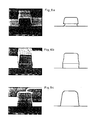
- Fig. 1 shows the etched profiles of N+ polysilicon etched at various pressures in pure CClF3. Excessive undercutting can be seen at 133 ⁇ bar, as well as at much lower pressures. In pure CClF3 at higher pressures there is thought to be an excess of Cl species over unsaturate species, CFx+. These chlorine species are low energy because of the high pressure and reduced mean free path. They diffuse in random directions and attack both vertical and horizontal surfaces of the layer being etched. Therefore, this p rocess produces substantial undercutting and has a poor directionality.
- a low pressure (33.25 ⁇ bar) RIE process has been developed for etching SiO2 with respect to silicon. This involves the addition of molecular hydrogen to CClF3. The addition of molecular hydrogen serves to getter the excess chlorine. This enhances the relative quantity of CFx+ in the ambient. At low pressures, CFx+ etches SiO2 and because there is so little chlorine in the ambient, silicon does not etch.
- a process employing CCl2F2 and argon has been used to etch polysilicon overlying SiO2 at moderate pressure.
- the selectivity of the process is low (7:1) and it is not anisotropic.
- a two-step process has been disclosed for etching layers of molybdenum silicide and polysilicon overlying SiO2. Two different etch formulations are required for the two steps.
- the second etchant which is used to etch the polysilicon comprises CCl2F2 and C2F6.
- mixtures of CClF3 and ammonia or of CCl2F2 and ammonia are employed at moderate pressures in a reactive ion etching chamber to anisotropically etch polysilicon or silicides with excellent selectivity to an underlying layer of an oxide or nitride of silicon.
- Elemental Silicon-containi ng layers this refers to layers containing elemental silicon. These layers may be single crystal or polycrystalline. They may be doped to either conductivity type at any level. Silicon may be contained as part of an intermetallic compound such as a silicide of a refractory metal such as molybdenum, tungsten, titanium or tantalum.
- Covalent Silicon-containing compounds this refers to chemical compounds containing silicon covalently bonded to other elements, such as nitrogen or oxygen. Such compounds include silicon oxide, silicon dioxide, silicon nitride, and silicon oxynitride.
- Plasma etching etching which proceeds by means of a plasma generated by an RF discharge.
- the predominant removal mechanism is chemical reaction.
- Ion Beam Etching etching which proceeds by means of accelerated species bombarding the surface to be etched.
- the predominant removal mechanism is physical momentum transfer. Also called ion milling or sputter etching.
- Reactive Ion Etching etching which proceeds by means of a plasma in which the reactant species are accelerated toward the surface to be etched.
- the removal mechanism is a combination of chemical and physical interactions between the accelerated species and the surface.
- Etch Profile wall configuration produced in an etched structure, which may be: Vertical--straight walls on a plane with the resist edge and perpendicular to the surface of the substrate. Undercut--sloped walls in which some portion of the wall lies under the resist.
- Isotropic etching which proceeds at a uniform rate in all directions (both vertically and laterally). It results in undercutting in which the etched region closest to the resist undercuts to a dimension approximately equal to that of the vertical etch dimension.
- Anisotropic etching which is directional; that is, which proceeds faster in the vertical direction than in the lateral direction. Ideal anisotropic etching produces a vertical etch profile.
- Selectivity the preferential etching of one substance over another which is a result of differences in the rate of chemical reaction between the etchant and each of the substances. It is expressed as the ratio of the etch rates of two adjacent layers (ERR).
- a typical reactive ion etching system is shown in Fig. 2. It comprises etching chamber 10 containing parallel plate electrodes 11 and 12. In this configuration, upper electrode 11 is grounded. Lower electrode 12 is powered by RF generator 13. Either or both electrodes may be water cooled and the distance between them may be adjustable. In a plasma etching system (not shown), the system configuration is similar, but the lower electrode is grounded and the upper electrode is powered.
- Etching chamber 10 is evacuated via exhaust pipe 14 by pumping means (not shown). Etchant gas is supplied to etching chamber 10 through gas inlet 16.
- the system may have multiple gas channels. The flow of the reactive gases can be controlled by pressure and/or flow-rate servo systems.
- a reactive plasma is generated.
- the plasma is characterized by a uniform dark space in the immediate vicinity of cathode 12. Volatile products formed during the etching process are exhausted from chamber 10 via exhaust pipe 14.
- the etchant gas mixture employed according to the present invention comprises:
- Preferred gaseous fluorocarbons are CClF3 and CCl2F2, and the preferred source of hydrogen ions is ammonia.
- the ammonia is employed in an amount effective to increase the selectivity, e.g. in a CClF3: NH3 ra tio or in a CCl2F2: NH3 ratio (v/v) of about 80:20 to about 35:65.
- the unsaturate species, CFx have low energy and coat out as a polymer on all exposed surfaces. The net result is a coating process instead of an etching process.
- the unsaturate species, CFx have high energy.
- the addition of hydrogen to CClF3 for example at low pressure (33.25 ⁇ bar) actually produces a process which can be viewed as the opposite of the present invention, i.e. the process will preferentially etch SiO2 over Si, whereas the process of the present invention will preferentially etch Si over SiO2.
- the CClF3/H2/low pressure process etches SIO2 because of the predominance of high energy CFx species which are SiO2 etchants.
- ammonia is preferred over hydrogen gas as the source of hydrogen ions as the source of hydrogen ions.
- ammonia produces active nitrogen which is a polymer inhibitor. This gives the added benefit of a reduction in polymer formation. Of course, some polymer will still form on exposed surfaces. That which forms on horizontal surfaces will be removed by the chlorine species in a properly balanced mixture. That which forms on the sidewalls will not be attacked by the accelerated chlorine species and will further reduce the lateral etching which results in undercutting.
- an etchant gas mixture containing an inert gas it is sometimes desirable to employ an etchant gas mixture containing an inert gas.
- the ratio of the fluorocarbon to ammonia is kept the same as the composition without inerts.
- Inerts increase etch uniformity and help to cool the chamber. Examples of inerts which may be used are the noble gases, especially helium.
- the process of the present invention is used to etch articles with comprise a substrate (20) with one or more layers thereon.
- the method permits the preferential etching of an elemental silicon-containing layer (24) of doped polysilicon or a refractory metal silicide over a covalent silicon-containing layer (22) such as SiO, SiO2, silicon nitride, or silicon oxynitride.
- a mask (26) of, for instance, a photoresist or electron beam resist material is applied on top of the upper layer.
- the process of the present invention is preferably carried out under vacuum at pressures between about 79.8 and 133 ⁇ bar. Pressures higher than 133 ⁇ bar ordinarily are not employed because they cause an excessive amount of polymer to coat out on the surfaces, as will be discussed hereinafter. Pressures lower than about 79.8 ⁇ bar result in a reduction in selectivity.
- the total flow rate of the gases is generally 15 to 100 SCCM, preferably about 30 to 60 (standard conditions of 25°C and 1.011 bar).
- the RF power supply was operated at a power density between about 0.125 and 0.3 or 0.2 and 0.3 watts/cm2. However, these parameters will be dependent on the apparatus employed.
- etch chamber a parallel plate, radial flow reactor was used. The space bet ween the anode and the cathode was about 9-10 cm. All parts within the etch chamber are constructed of aluminum. RF power at 13.56 MH z is capacitatively coupled to the bottom electrode while the top electrode and chamber wall are well grounded. The power density is 0.22 W/cm2. The etch gases are introduced through a manifold arrangement at the front of the chamber and evacuated at the back. Etch rates are measured from a laser interferometer trace or by measuring film thickness before and after etch on an IBM 3820 Film Thickness Analyzer. Selectivities are calculated from the measured etch rates.
- the substrates are single crystal silicon wafers with ⁇ 100> orientation.
- 25 nm of gate thermal oxide was grown.
- polysilicon was deposited using LPCVD at 625° C.
- the polysilicon was subsequently doped with POCl3.
- the substrates in examples 1, 2 and 3 had 430 nm of polysilicon.
- the substrates in examples 4 and 5 had 170 nm of polysilicon on which 250 nm of tungsten silicide was deposited using co-evaporation.
Landscapes
- Drying Of Semiconductors (AREA)
Applications Claiming Priority (4)
| Application Number | Priority Date | Filing Date | Title |
|---|---|---|---|
| US76964785A | 1985-08-27 | 1985-08-27 | |
| US76983285A | 1985-08-27 | 1985-08-27 | |
| US769832 | 1985-08-27 | ||
| US769647 | 1985-08-27 |
Publications (3)
| Publication Number | Publication Date |
|---|---|
| EP0212585A2 true EP0212585A2 (de) | 1987-03-04 |
| EP0212585A3 EP0212585A3 (en) | 1988-04-27 |
| EP0212585B1 EP0212585B1 (de) | 1991-12-18 |
Family
ID=27118205
Family Applications (1)
| Application Number | Title | Priority Date | Filing Date |
|---|---|---|---|
| EP86111282A Expired EP0212585B1 (de) | 1985-08-27 | 1986-08-14 | Selektives und anisotropisches trockenes Ätzverfahren |
Country Status (2)
| Country | Link |
|---|---|
| EP (1) | EP0212585B1 (de) |
| DE (1) | DE3682976D1 (de) |
Cited By (2)
| Publication number | Priority date | Publication date | Assignee | Title |
|---|---|---|---|---|
| EP0553961A3 (en) * | 1992-01-29 | 1995-09-27 | Applied Materials Inc | Reactive ion etch process including hydrogen radicals |
| FR2765393A1 (fr) * | 1997-06-25 | 1998-12-31 | France Telecom | Procede de gravure d'une couche de si1-xgex polycristallin ou d'un empilement d'une couche de si1-xgex polycristallin et d'une couche de si polycristallin, et son application a la microelectronique |
Family Cites Families (2)
| Publication number | Priority date | Publication date | Assignee | Title |
|---|---|---|---|---|
| GB1417085A (en) * | 1973-05-17 | 1975-12-10 | Standard Telephones Cables Ltd | Plasma etching |
| JPS56158873A (en) * | 1980-05-14 | 1981-12-07 | Hitachi Ltd | Dry etching method |
-
1986
- 1986-08-14 EP EP86111282A patent/EP0212585B1/de not_active Expired
- 1986-08-14 DE DE8686111282T patent/DE3682976D1/de not_active Expired - Lifetime
Cited By (4)
| Publication number | Priority date | Publication date | Assignee | Title |
|---|---|---|---|---|
| EP0553961A3 (en) * | 1992-01-29 | 1995-09-27 | Applied Materials Inc | Reactive ion etch process including hydrogen radicals |
| FR2765393A1 (fr) * | 1997-06-25 | 1998-12-31 | France Telecom | Procede de gravure d'une couche de si1-xgex polycristallin ou d'un empilement d'une couche de si1-xgex polycristallin et d'une couche de si polycristallin, et son application a la microelectronique |
| EP0905759A1 (de) * | 1997-06-25 | 1999-03-31 | France Telecom | Verfahren zum Ätzen einer aus Si1-xGex polykristallinen Schicht oder einer aus polykristallinen Si1-xGex/Si Stapelschicht, und Verwendung in der Herstellung von elektronischen Anordnungen |
| US6271144B1 (en) | 1997-06-25 | 2001-08-07 | France Telecom | Process for etching a polycrystalline Si(1-x)Ge(x) layer or a stack of polycrystalline Si(1-x)Ge(x) layer and of a polycrystalline Si layer, and its application to microelectronics |
Also Published As
| Publication number | Publication date |
|---|---|
| DE3682976D1 (de) | 1992-01-30 |
| EP0212585B1 (de) | 1991-12-18 |
| EP0212585A3 (en) | 1988-04-27 |
Similar Documents
| Publication | Publication Date | Title |
|---|---|---|
| US4734157A (en) | Selective and anisotropic dry etching | |
| US5286344A (en) | Process for selectively etching a layer of silicon dioxide on an underlying stop layer of silicon nitride | |
| US7049244B2 (en) | Method for enhancing silicon dioxide to silicon nitride selectivity | |
| US4713141A (en) | Anisotropic plasma etching of tungsten | |
| JP4579611B2 (ja) | ドライエッチング方法 | |
| US5814563A (en) | Method for etching dielectric using fluorohydrocarbon gas, NH3 -generating gas, and carbon-oxygen gas | |
| EP0482519B1 (de) | Ätzverfahren für Materialien aus Oxid | |
| US5256245A (en) | Use of a clean up step to form more vertical profiles of polycrystalline silicon sidewalls during the manufacture of a semiconductor device | |
| US5180464A (en) | Dry etching method | |
| US4465552A (en) | Method of selectively etching silicon dioxide with SF6 /nitriding component gas | |
| US5024722A (en) | Process for fabricating conductors used for integrated circuit connections and the like | |
| Steinbrüchel et al. | Mechanism of dry etching of silicon dioxide: a case of direct reactive ion etching | |
| US20040072443A1 (en) | Method for plasma etching performance enhancement | |
| US4264409A (en) | Contamination-free selective reactive ion etching or polycrystalline silicon against silicon dioxide | |
| US5453156A (en) | Anisotropic polysilicon plasma etch using fluorine gases | |
| US5880033A (en) | Method for etching metal silicide with high selectivity to polysilicon | |
| US20030092280A1 (en) | Method for etching tungsten using NF3 and Cl2 | |
| US4836886A (en) | Binary chlorofluorocarbon chemistry for plasma etching | |
| US6756314B2 (en) | Method for etching a hard mask layer and a metal layer | |
| US4373990A (en) | Dry etching aluminum | |
| US5536364A (en) | Process of plasma etching silicon | |
| KR20010109187A (ko) | 비-클로로플루오로카본, 불소계 화합물을 이용한 비등방성플라즈마 에칭 방법 | |
| US6069087A (en) | Highly selective dry etching process | |
| US4364793A (en) | Method of etching silicon and polysilicon substrates | |
| EP0212585B1 (de) | Selektives und anisotropisches trockenes Ätzverfahren |
Legal Events
| Date | Code | Title | Description |
|---|---|---|---|
| PUAI | Public reference made under article 153(3) epc to a published international application that has entered the european phase |
Free format text: ORIGINAL CODE: 0009012 |
|
| AK | Designated contracting states |
Kind code of ref document: A2 Designated state(s): DE FR GB |
|
| 17P | Request for examination filed |
Effective date: 19870623 |
|
| PUAL | Search report despatched |
Free format text: ORIGINAL CODE: 0009013 |
|
| RHK1 | Main classification (correction) |
Ipc: H01L 21/31 |
|
| AK | Designated contracting states |
Kind code of ref document: A3 Designated state(s): DE FR GB |
|
| 17Q | First examination report despatched |
Effective date: 19900622 |
|
| GRAA | (expected) grant |
Free format text: ORIGINAL CODE: 0009210 |
|
| AK | Designated contracting states |
Kind code of ref document: B1 Designated state(s): DE FR GB |
|
| ET | Fr: translation filed | ||
| REF | Corresponds to: |
Ref document number: 3682976 Country of ref document: DE Date of ref document: 19920130 |
|
| PLBE | No opposition filed within time limit |
Free format text: ORIGINAL CODE: 0009261 |
|
| STAA | Information on the status of an ep patent application or granted ep patent |
Free format text: STATUS: NO OPPOSITION FILED WITHIN TIME LIMIT |
|
| 26N | No opposition filed | ||
| PGFP | Annual fee paid to national office [announced via postgrant information from national office to epo] |
Ref country code: GB Payment date: 19960724 Year of fee payment: 11 |
|
| PGFP | Annual fee paid to national office [announced via postgrant information from national office to epo] |
Ref country code: FR Payment date: 19960806 Year of fee payment: 11 |
|
| PGFP | Annual fee paid to national office [announced via postgrant information from national office to epo] |
Ref country code: DE Payment date: 19960828 Year of fee payment: 11 |
|
| PG25 | Lapsed in a contracting state [announced via postgrant information from national office to epo] |
Ref country code: GB Free format text: LAPSE BECAUSE OF NON-PAYMENT OF DUE FEES Effective date: 19970814 |
|
| GBPC | Gb: european patent ceased through non-payment of renewal fee |
Effective date: 19970814 |
|
| PG25 | Lapsed in a contracting state [announced via postgrant information from national office to epo] |
Ref country code: FR Free format text: LAPSE BECAUSE OF NON-PAYMENT OF DUE FEES Effective date: 19980430 |
|
| PG25 | Lapsed in a contracting state [announced via postgrant information from national office to epo] |
Ref country code: DE Free format text: LAPSE BECAUSE OF NON-PAYMENT OF DUE FEES Effective date: 19980501 |
|
| REG | Reference to a national code |
Ref country code: FR Ref legal event code: ST |