EP0212765A2 - Verfahren und Vorrichtung zur Herstellung von Sandwichkeksen - Google Patents
Verfahren und Vorrichtung zur Herstellung von Sandwichkeksen Download PDFInfo
- Publication number
- EP0212765A2 EP0212765A2 EP86300392A EP86300392A EP0212765A2 EP 0212765 A2 EP0212765 A2 EP 0212765A2 EP 86300392 A EP86300392 A EP 86300392A EP 86300392 A EP86300392 A EP 86300392A EP 0212765 A2 EP0212765 A2 EP 0212765A2
- Authority
- EP
- European Patent Office
- Prior art keywords
- biscuits
- biscuit
- cookie
- chocolate
- cementitious
- Prior art date
- Legal status (The legal status is an assumption and is not a legal conclusion. Google has not performed a legal analysis and makes no representation as to the accuracy of the status listed.)
- Withdrawn
Links
Images




Classifications
-
- A—HUMAN NECESSITIES
- A21—BAKING; EDIBLE DOUGHS
- A21C—MACHINES OR EQUIPMENT FOR MAKING OR PROCESSING DOUGHS; HANDLING BAKED ARTICLES MADE FROM DOUGH
- A21C15/00—Apparatus for handling baked articles
- A21C15/002—Apparatus for spreading granular material on, or sweeping or coating the surface of baked articles
-
- A—HUMAN NECESSITIES
- A21—BAKING; EDIBLE DOUGHS
- A21C—MACHINES OR EQUIPMENT FOR MAKING OR PROCESSING DOUGHS; HANDLING BAKED ARTICLES MADE FROM DOUGH
- A21C15/00—Apparatus for handling baked articles
- A21C15/02—Apparatus for shaping or moulding baked wafers; Making multi-layer wafer sheets
-
- A—HUMAN NECESSITIES
- A21—BAKING; EDIBLE DOUGHS
- A21D—TREATMENT OF FLOUR OR DOUGH FOR BAKING, e.g. BY ADDITION OF MATERIALS; BAKING; BAKERY PRODUCTS
- A21D13/00—Finished or partly finished bakery products
- A21D13/30—Filled, to be filled or stuffed products
- A21D13/32—Filled, to be filled or stuffed products filled or to be filled after baking, e.g. sandwiches
-
- B—PERFORMING OPERATIONS; TRANSPORTING
- B65—CONVEYING; PACKING; STORING; HANDLING THIN OR FILAMENTARY MATERIAL
- B65G—TRANSPORT OR STORAGE DEVICES, e.g. CONVEYORS FOR LOADING OR TIPPING, SHOP CONVEYOR SYSTEMS OR PNEUMATIC TUBE CONVEYORS
- B65G2201/00—Indexing codes relating to handling devices, e.g. conveyors, characterised by the type of product or load being conveyed or handled
- B65G2201/02—Articles
- B65G2201/0202—Agricultural and processed food products
- B65G2201/0205—Biscuits
Definitions
- a popular type of cookie designated herein as a sandwich cookie, consists of two cookie biscuts with a filling material between them.
- the biscuits may be thick and rounded, with confronting surfaces which are generally parallel and flat, but they may have other shapes as well, for example a simple disk form.
- One machine known in the art for providing the necessary chocolate coating is commonly designated as an enrober, and involves, in effect, floating the cookie biscuits, flat side down, across the surface of a bath of chocolate, with a wire mesh below the biscuits, after which the coated discuits are automatically lifted from the bath and tumbled over so that their coated surfaces are presented upwardly. At this point, while the chocolate is still soft, another biscuit is manually placed on the chocolate layer of each coated biscuit. Upon subsequent cooling to solidify the chocolate, the cookie sandwiches are completed.
- top biscuit is labor intensive and hence costly; in addition it has proved to be rather messy in that, rather quickly, the fingers of the workers and the equipment around the cookie-making line become spattered and coated with the liquid chocolate, requiring frequent clean-up procedures. The time and labor involved in such clean-up add further expense to the production procedure.
- the present invention seeks to provide new and useful method and apparatus for the production of sandwich-type cookies, especially of the type in which the filler material is chocolate, as well as a new and useful cookie made by such method and apparatus.
- the method and apparatus are efficient and reliable, economical to employ, and do not result in the undesired dispersion of filler material, especially chocolate, onto the apparatus or operating personnel.
- these and other aims are achieved by the provision of method and apparatus for producing a sandwich-type cookie in which a heated flowable chocolate material is applied to one side of a first cookie biscuit and subsequently cooled to harden the layer and to bond it to that biscuit; thereafter, a quantity of a cementitious food material is applied to part of the solidified chocolate layer and/or to a part of a second cookie biscuit, and the second cookie biscuit placed against the solidified chocolate layer with the cementitious food material between the chocolate layer and the second biscuit.
- the two halves of the cookie sandwich become appropriately bonded to each other, without any degradation of the filler material.
- the cementitious food material is itself a chocolate material, applied to a part only of the previously solidified chocolate layer, so that the final filler is all of chocolate material and yet the sandwich has been appropriately bonded together by a method which can be completely mechanized.
- apparatus there are preferably provided means for moving a first train of chocolate-cookie biscuits progressively along a conveyor with the hardened chocolate coating of each presented upwardly, means for moving a second train of cookie biscuits along the conveyor, means for dispensing a cementitious food material (preferably additional molten chocolate) upon part of each biscuit in said first train and/or in said second train, and means for applying each of the biscuits of said second train to a corresponding one of the biscuits of the first train while the cementitious material between them is still not completely set, whereby upon subsequent cooling of the cementitious material to set it, the desired bonded sandwich cookies are produced.
- a cementitious food material preferably additional molten chocolate
- the biscuits in said first train are moved through the conveyor with their chocolate-coated sides upward, at least just prior to application of the biscuits of the second train, the applying of the second train to the biscuits of the first train is by means which drop one of each of the biscuits of the second train onto a corresponding biscuit of the first train, and the cementitious material is molten chocolate dispensed onto parts of the solidified chocolate layers on the biscuits of the first train, the dispensed molten chocolate preferably being in the form of one or more stripes.
- a preferred embodiment of apparatus according to the invention also comprises a number of subsidiary features and combinations which contribute to optimum production operation.
- One of these involves use of a particularly effective mechanism for turning the coated biscuits from a coated-side-down position to a coated-side-up position, with reliability and in exact synchronization with the forward motion of the-various cookie biscuits on the conveyor; also preferably employed is an arrangement of reciprocating pusher plates to assist in maintaining the desired phase synchronization between the dispensing of the cementitious chocolate material and the passage of the cookie biscuits beneath the dispenser, operating in combination with an arrangement of lugged conveyor chains for assisting in maintaining proper phase synchronization of cookie motion, properly-timed dispensing of chocolate cementitious material and appropriately timed dropping of the upper biscuits upon the coated bottom cookie biscuits.
- Means are preferably also provided for exerting a slight pressing force to urge the two cookie biscuits of each sandwich toward each other, after the cementitious food material has been applied but before it completely sets or solidifies.
- a sandwich cookie according to the invention comprises a first and a second biscuit cookie at least one of which is coated with a hardened chocolate layer, the first and second cookies being bonded together by a localized cementitious food material positioned between said biscuits; the cementitious material is preferably in the form of chocolate stripes on the herdened chocolate layer.
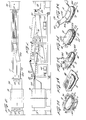
- Figures 1 and 2 show apparatus for receiving successive rows of ten plain, uncoated cookie biscuits such as 10 and 12 and for making each row into five chocolate-filled cookie sandwiches 13.
- a cookie coater 14 often described as an enrober, receives successive sets of five cookie biscuits such as 12 and coats the bottom flat surfaces thereof with molten chocolate. These coated biscuits are passed through a cooler 16 on a cooler conveyor 10A, to cool the coating sufficiently to render it solid and adherent.
- the five biscuits 12 with the solidified chocolate layers on their bottoms are then delivered, five abreast, to lower infeed conveyor 17; the other five biscuits 10 in each row are not coated, and are supplied, five abreast, to an upper infeed conveyor 18, made up of two moving conveyor belts 18A and 18B.
- the upper and lower infeed conveyors supply the two five-biscuit-wide trains of biscuits to two respective stepping conveyors 20,21, which serve to move the biscuits in each train into a predetermined positional phase relation with respect to biscuits in the other train.
- the coated biscuits are then passed through an inverter 22 which turns them so that their chcocolate coated surfaces are presented upwardly.
- coated biscuits 12 in the lower train pass beneath a chocolate dispenser 26, which dispenses molten chocolate from five pairs of laterally spaced-apart nozzles such as 26A onto the upper surface of each previously-coated biscuit passing beneath them, to form a pair of parallel stripes 44 of molten chocolate on each coated biscuit (see Figure 3c).
- the upper and lower biscuit trains are passed through a top aligner 27 and a bottom aligner 28, which act to positively position the upper and lower biscuits in exact vertical alignment with respect to each other, so that when they pass into a succeeding assembler section 29 each of the upper biscuits 10 can be accurately dropped upon the coated and striped top of the corresponding lower biscuit 12.
- the paired biscuits are then passed through a presser 30, which momentarily urges the upper and lower biscuits toward each other, with the still-unset but somewhat squashed chocolate stripes between them.
- the resultant successive sets of five cookie sandwiches are then passed through a final cooler 34, which cools the molten chocolate stripes so that they set and bond together the two biscuits of each sandwich.
- the applied chocolate stripes therefore act as a cementitious food material for accomplishing the bonding together of the two biscuits.
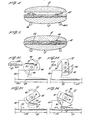
- FIG. 3a depicting the cookie biscuits in different stages of fabrication of a final cookie sandwich.
- Figure 3a there is shown a bottom biscuit 12 being coated with chocolate on its lower surface as it moves along the surface of a chocolate bath 36 in the coater 14. The top biscuits do not dip into the bath and are not coated in the coater, nor elsewhere in the process in this embodiment.
- Fig. 3b there is shown a bottom biscuit after it has passed through the coater 14 and the inverter 22, so that the molten chocolate layer has become a solid adherent chocolate layer 42 covering the flat face of the biscuit and presented upwardly.
- the lower biscuit 12 is shown with the molten chocolate stripes such as 44 being applied thereto from the dispensing nozzles 26a of dispenser 26, at a time approaching that when dispensing will be cut off so as to terminate the stripes at the upstream end of the biscuit.
- the bottom biscuit 12 is being striped it is being pushed along support wires 46,46A by a pair of upstanding pusher lugs 48,48A which, as shown in Figure 3d, at this point also bear against and push the upper biscuit 10 into exact vertical alignment with biscuit 12 by the time the two biscuits have reached the output section of the bottom aligner 28.
- Figure 3d shows the upper and lower biscuits 10 and 12 after the upper biscuit 10 has been pushed from the end of support rods 52,52A on which it has been sliding, so as to fall directly downwardly onto the coated and freshly-striped top of biscuit 12; in Figure 3e, the resultant sandwich has advanced to a position beneath a spring presser 60 bearing against the top of the top biscuit, which provides a force in addition to the weight of the top biscuit to urge the two biscuits gently toward each other.
- This sandwich after cooling, constitutes the final sandwich cookie.
- Figure 4 shows a cross-section of the cookie sandwich as the top biscuit is just dropping against the bottom biscuit
- Figure 5 shows the final sandwich after it has been compressed by the spring presser and cooled in the final cooler 34.
- the thickening of the chocolate filler in the region of the stripes 44 can be seen, as well as the intimate bonding contact between the stripes and the upper biscuit in contrast to the unbonded areas of the two biscuits outside of the striped areas.
- the existence and configuration of these bonded areas can also be determined by successively breaking away those portions of the cookie which are outside of the bonded areas.
- the coater 14 and the cooler 16 may be known conventional devices, and hence are not shown in detail. Their combined function is to provide automatically a suitable thin solidified chocolate layer adhering to the flat undersurface of each of the biscuits 12.
- Commercial enrobers are available to perform the coating function, and suitable coolers are also commercially available.
- successive transverse rows of twenty cookies each are provided, which may be considered as divided into groups of five as follows: two outer sets of five each may be chocolate-coated "bottom” biscuits, while two inner groups of five may be uncoated or "top” biscuits.
- Such apparatus has mirror symmetry about a vertical longitudinal plane through its center, so that the five uncoated "top” biscuits and five coated “bottom” biscuits on one side of that plane are formed into five sandwich cookies, and similarly for the five "top” biscuits and five “bottom” biscuits on the other side of the plane.
- conveyor 21 constitutes a set of horizontal, spaced-apart stationary plates or steps 61A, 61B, 61C and 61D positioned below the downstream exit end of conveyor 17, and an interdigitated set of reciprocable pusher plates 62A, 62B, 62C, which also are horizontal and which are located between the stationary plates.
- infeed conveyors 17, 18A are driven by a chain- drive motor 64, which is electrically synchronized with a main drive motor 68 driving a main line shaft 70.
- the latter shaft mechanically synchronizes the speed and phase of the remainder of the moving elements of the conveyor system.
- the reciprocable pusher plates 62A, 62B, 62C are driven from the main shaft through direction changer 74, crank 75, connecting rod 75A, and appropriate gearing to achieve the desired constant uniform flow of cookie biscuits through the system. This synchronization with the main line shaft is maintained for all moving elements in the conveyor which affect the position of the cookies.
- the function of the stepping conveyors 20 and 21 is to provide accurate control of the exact positional phase of the biscuits 10 in the upper train, relative to those in the lower train.
- the biscuits fall, one by one, onto the top reciprocating pusher plate 62A while it is fully advanced to the position shown in broken line; when the top plate retracts to its full-line position, the biscuit is wiped off the forward end of the pusher plate by stationary plate 61A, onto the next successive stationary plate 61B; when the pusher plate 62A again advances, it pushes the biscuit from stationary plate 61B onto the next-lower pusher plate 62B, and so on, until the biscuit is discharged from the final stationary plate 61D to the inverter 22 and at a predetermined time with respect to the operation of the pusher plates, as desired.
- stepping conveyors 20 and 21 there are preferably employed respective slowly-rotating brushes 84 and 86, the peripheries of which move over the tops of the biscuits along the downstream direction at approximately the speed of the infeed belt, bearing lightly against the underlying biscuit while it is being transferred from the conveyor belt to the first pusher plate so as to control and assure the desired transfer.
- a fixed brush 89 is preferably positioned adjacent the output end of stepping conveyor 21, to lightly brush against the tops of the biscuits passing beneath it, so as to damp the motion of these biscuits and assure that they will remain in contact with the lowest pusher plate as they exit from the stepping conveyor, rather than sliding ahead of it, for example.
- the biscuit inverter 22 Adjacent the output end of the lower stepping conveyor 21 is the biscuit inverter 22, which is not per se the invention of the present applicant, but which cooperates in a novel fashion in the present combination to receive the train of biscuits from the stepping conveyor 21 with their chocolate-coated sides facing downwardly, to invert them, and to discharge them onto the aligning conveyor 28 with their chocolate-coated sides facing upwardly.
- the inverter comprises a plurality of parallel, spaced-apart plates 90 mounted on a rotatable shaft 91 and, a set of stationary stripping plates 92 interposed between and parallel to the bottom portions of the rotatable plates.
- Partitioning plates 93 separate the inverter into five lanes or aisles, one for each of the five-abreast biscuits.
- the rotatable plates are provided with pairs of recesses such as 96 and 98 into which the biscuits of the lower train are delivered synchronously, one in each recess, by the stepping conveyor 21.
- the latter conveyor provides the timing necessary for this transfer to be made, with each recess becoming appropriately aligned with the output of the stepping conveyor at the right time to receive the next biscuit from the stepping conveyor 21 as the plates rotate.
- Figures 8a, 8b, 8c and 8d show the inverter in successive angular positions during a cycle of its rotation; as the inverter plates rotate, each biscuit is held in its corresponding recess and is turned over to lie on its uncoated side, so that its coated side faces upwardly when it falls from the recess onto the aligning conveyor 28.
- the stationary plates 92 serve to assure that the biscuits are always stripped from their recesses at the same predetermined angular phase of the rotating plates, by blocking further rotational motion of the biscuits.
- the aligning conveyor 28 preferably extends somewhat upwardly, and comprises a pair of endless lugged chains such as 100 carrying cross-bars such as 102 which support pairs of lugs such as 104, extending upwardly from the upper run of the chain 100.
- the lugs 104 form the pusher lugs 48, 48A, one pair of lugs for each biscuit which is to be pushed along the conveyor.
- the slight upward tilt of the conveyor assures that the biscuits will remain against the conveyor lugs, rather than at times running slightly ahead of them, thereby assuring exact positioning of the biscuits with respect to the lugs.
- each of them slides upon a pair of underlying wires such as 46, 46A, in response to pushing by the lugs.
- the bottom train of biscuits 12 is moved by the lugs below and past the molten chocolate dispenser 26 (see Figure 14), which contains molten chocolate maintained at an optimum temperature of about 92°, or somewhat less, by means of warm water circulating through an appropriate water jacket in a chamber 105 of the chocolate dispenser 26.
- the latter chamber is provided with the pairs of nozzles 26A, on its lower face, one pair for each row of biscuits passing beneath it, the nozzles of each pair being transversely spaced apart so that, when open, they will dispense molten chocolate in the form of a pair of parallel stripes 44 (Fig. 3c) onto the tops of the underlying biscuits 12.
- valves for turning the nozzles on and off are synchronized with the other elements of the conveyor system by means of cams 106 mounted to a cam shaft 108 (Fig. 6) synchronized with the main line shaft.
- cams 106 mounted to a cam shaft 108 (Fig. 6) synchronized with the main line shaft.
- the striped bottom biscuits are then pushed along by the lugged chain assembly to the sandwich assembler section 29.
- the uncoated top biscuits from the upper stepping conveyor 20 are delivered synchronously onto the upper aligning conveyor 27, which comprises pairs of vertical plates 110 (Fig. 13) forming a track beneath each cookie biscuit, and a plurality of lugs such as 112 mounted on cross-bars such as 114 which extend between a pair of endless chains 116,118; the chains are positioned above the top rows of cookie biscuits, with the lugs on the lower run extending downwardly from above to serve as pushers for the top biscuits.
- Partition plates such as 120,122 serve as side guides defining the lanes through which each train of biscuits is pushed.
- the top aligning conveyor 27 delivers the top biscuits onto a horizontal shelf formed by rods 52,52A, with each top biscuit positioned just ahead of a pair of upstanding lugs 48,48A on the lower set of cross-bars, so that each top biscuit is quickly contacted by such pair of lugs and pushed along in exact vertical alignment with the corresponding lower biscuit. Accordingly, when the upper biscuits reach the ends of rods 52,52A, they fall downward along lugs 48,48A onto the corresponding lower biscuits and are accurately positioned thereon as desired.
- the completed sandwich of upper and lower biscuits is then conveyed by the lower set of lugs through the presser section 30, comprising a plurality of longitudinally-extending strip spring members such as 124, one for each lane of cookies, which pressers apply a slight pressure urging together the upper and lower biscuits as they pass beneath and against the spring members so as to assure good bonding contact between the still-unset chocolate stripes and the biscuits.
- the lugs then discharge the assembled and pressed sandwich cookies over a ramped output slide 126 onto conveyor belt 128 of the final cooler 34, which may be of conventional form, and which provides a sufficiently low temperature to cool the molten chocolate stripes and assure their proper setting, thus bonding the upper and lower biscuits to each other as desired for the final sandwich cookies.
- the ramped output slide 126 assures that the cookies will move out of the way of the pusher lugs, and the lugs therefore will not damage the sandwich cookies, as the cookies leave contact with the lugs at the output of the lower conveyor.
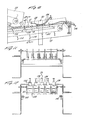
- Figures 15 and 16 show a bridging structure 130, extending across the input end of the infeed conveyor belt 18A and supporting a plurality of vertical rods such as 132, which rods extend downwardly just short of the top of the conveyor. Adjacent rods are laterally spaced from each other by a distance slightly greater than the widths of the cookie biscuits, so as to define the desired five aisles or lanes for the biscuits, and to correct any minor misalignment or mispositioning of the trains of biscuits as they pass between the rods.
- a similar arrangement of rods 134 is preferably used at the input end of the infeed conveyor 17, for similar purposes.
- the molten chocolate for the stripe dispenser may be stored in a heated-chocolate tank 136, and fed through a pump 138 to a chocolate inlet pipe 140 of dispenser 26.
- the heating of the water for the water jacket of the chamber may be accomplished in a tank 142 by means of an appropriate thermostatically-controlled heater (not shown).
- Lane guides 144 in the form of metal rods may also be provided as shown in Figure 7 to assist in guiding the top biscuits 10 from upper conveyor 18B onto the upper stepping conveyor 20.
- Manufacturing speeds of 300 sandwich cookies per minute may be achieved using the method and apparatus described herein.
- both biscuits may be coated with chocolate; the cementitious material may be applied to the top biscuit and/or to both biscuits; and the cementitious material need not always be chocolate.
Landscapes
- Life Sciences & Earth Sciences (AREA)
- Engineering & Computer Science (AREA)
- Food Science & Technology (AREA)
- Bakery Products And Manufacturing Methods Therefor (AREA)
- Confectionery (AREA)
Applications Claiming Priority (2)
| Application Number | Priority Date | Filing Date | Title |
|---|---|---|---|
| US693135 | 1985-01-22 | ||
| US06/693,135 US4622891A (en) | 1985-01-22 | 1985-01-22 | Sandwich cookies, apparatus for making same |
Publications (2)
| Publication Number | Publication Date |
|---|---|
| EP0212765A2 true EP0212765A2 (de) | 1987-03-04 |
| EP0212765A3 EP0212765A3 (de) | 1987-10-07 |
Family
ID=24783459
Family Applications (1)
| Application Number | Title | Priority Date | Filing Date |
|---|---|---|---|
| EP86300392A Withdrawn EP0212765A3 (de) | 1985-01-22 | 1986-01-21 | Verfahren und Vorrichtung zur Herstellung von Sandwichkeksen |
Country Status (2)
| Country | Link |
|---|---|
| US (1) | US4622891A (de) |
| EP (1) | EP0212765A3 (de) |
Families Citing this family (26)
| Publication number | Priority date | Publication date | Assignee | Title |
|---|---|---|---|---|
| FR2706250B1 (fr) * | 1993-06-10 | 1995-08-18 | Brossard Gringoire | Procédé de fabrication de gâteaux chocolatés et barquette pour la mise en Óoeuvre de ce procédé. |
| US6340488B1 (en) | 1996-12-20 | 2002-01-22 | Nestec S.A. | Method for making laced appearing confectioneries |
| FR2759865B1 (fr) * | 1997-02-21 | 1999-05-14 | Fl Concept | Perfectionnement aux procedes et aux installations de fabrication automatique de sandwiches du genre gouters fourres |
| US6251456B1 (en) | 1999-07-23 | 2001-06-26 | Nestec S.A. | Patterned chocolate coatings, methods, and apparatus for preparing same |
| US6689406B2 (en) | 2000-12-05 | 2004-02-10 | Nestec S.A. | Chocolate coating process and device for same |
| USD459853S1 (en) | 2001-10-09 | 2002-07-02 | Recot, Inc. | Snack piece mold |
| US6638553B2 (en) | 2001-10-09 | 2003-10-28 | Recot, Inc. | System and method for monolayer alignment snack chip transfer |
| US6592923B2 (en) | 2001-10-09 | 2003-07-15 | Recot, Inc. | System and method for molding a snack chip |
| US6610344B2 (en) | 2001-10-09 | 2003-08-26 | Recot, Inc. | Process for making a shaped snack chip |
| EP1344457A1 (de) * | 2002-03-14 | 2003-09-17 | Meincke A/S | Verfahren und Vorrichtung zur Herstellung von Sandwichkeksen |
| US20060019014A1 (en) * | 2004-07-08 | 2006-01-26 | General Mills Marketing, Inc. | Biscuit flatbread and method of making same |
| USD525763S1 (en) | 2004-09-01 | 2006-08-01 | Kraft Foods Holdings, Inc. | Sandwich cookie |
| US7582321B2 (en) * | 2004-09-01 | 2009-09-01 | Kraft Foods Holdings, Inc. | Apparatus and method for producing sandwich cookie having dissimilarly-sized base cakes |
| US20060093708A1 (en) * | 2004-11-04 | 2006-05-04 | Cold Standard, Inc. | Ice cream novelty product |
| DE102005010833B4 (de) * | 2005-03-07 | 2015-04-09 | Südzucker Aktiengesellschaft Mannheim/Ochsenfurt | Verfahren zur Herstellung eines glasierten oder gefrosteten Cerealienproduktes mit einem Kern aus Cerealien und einer Beschichtung |
| US8334005B2 (en) * | 2008-11-14 | 2012-12-18 | Kraft Foods Global Brands Llc | Ribbon cutter apparatus and method for making sandwich baked goods |
| PL2281461T3 (pl) * | 2009-06-12 | 2012-05-31 | Intercontinental Great Brands Llc | Produkty w postaci ciasteczek o zwiększonej stabilności |
| USD909007S1 (en) | 2014-03-30 | 2021-02-02 | Intercontinental Great Brands Llc | Thin biscuit sandwich |
| AU358083S (en) | 2014-03-30 | 2014-10-07 | Intercontinental Great Brands Llc | Biscuit |
| EP3250038A4 (de) * | 2014-12-15 | 2018-10-03 | Axis Automation | Glasurmaschine und glasurverfahren |
| US11292706B2 (en) * | 2014-12-30 | 2022-04-05 | Edward Showalter | Apparatus, systems and methods for preparing and dispensing foods |
| CA2997678C (en) * | 2015-09-29 | 2020-08-18 | Illinois Tool Works Inc. | Belt driven sandwiching machine |
| USD808031S1 (en) * | 2016-07-07 | 2018-01-16 | Michael Bredemeier | Smore shaped teething toy for infant |
| CN106665746A (zh) * | 2016-12-12 | 2017-05-17 | 杭州诺丁食品有限公司 | 一种巧克力夹心饼干制作方法及设备 |
| NL2027708B1 (nl) * | 2021-03-04 | 2022-09-23 | B V Machf Houdijk | transportsamenstel voor het vormen van sandwichbiscuits uit twee of meer vlakke baksels |
| CN113261577B (zh) * | 2021-05-27 | 2022-04-29 | 广东汇巢食品实业有限公司 | 一种饼干加工系统及其加工方法 |
Family Cites Families (11)
| Publication number | Priority date | Publication date | Assignee | Title |
|---|---|---|---|---|
| US1434175A (en) * | 1918-04-12 | 1922-10-31 | Westerman Frederick | Depositing machine |
| US1501724A (en) * | 1922-09-23 | 1924-07-15 | Stephen Knight | Apparatus for cooling and chilling hot chocolate and other confectioncovered cakes |
| GB313032A (en) * | 1927-12-30 | 1929-05-30 | Robert French Macfarlane | Improvements in and relating to icing biscuits and the like |
| US2260686A (en) * | 1940-02-08 | 1941-10-28 | Savage Bros Company | Coating machine |
| US2606511A (en) * | 1947-09-11 | 1952-08-12 | Johnson Biscuit Company | Method and apparatus for dipcoating cookies |
| GB723635A (en) * | 1952-11-21 | 1955-02-09 | Harald Norheim | Method of producing clap-bread or the like |
| US2947266A (en) * | 1955-03-29 | 1960-08-02 | Baker Perkins Ltd | Apparatus for making wafer sandwiches |
| US2923257A (en) * | 1957-08-28 | 1960-02-02 | George C Monaco | Apparatus for applying paste to a comestible wafer |
| GB884710A (en) * | 1958-12-15 | 1961-12-13 | Peters Mach Co | Improvements in the manufacture of biscuit and like sandwiches |
| GB1259548A (de) * | 1969-12-06 | 1972-01-05 | ||
| US4513656A (en) * | 1983-06-29 | 1985-04-30 | Fay Rudolph J | Sandwich machine |
-
1985
- 1985-01-22 US US06/693,135 patent/US4622891A/en not_active Expired - Fee Related
-
1986
- 1986-01-21 EP EP86300392A patent/EP0212765A3/de not_active Withdrawn
Also Published As
| Publication number | Publication date |
|---|---|
| US4622891A (en) | 1986-11-18 |
| EP0212765A3 (de) | 1987-10-07 |
Similar Documents
| Publication | Publication Date | Title |
|---|---|---|
| US4622891A (en) | Sandwich cookies, apparatus for making same | |
| US4229484A (en) | Process for the production of center-filled bars of confectionery | |
| EP1341421B1 (de) | Schokoladenüberzugsverfahren und vorichtung dafür | |
| US4454834A (en) | Installation for the coating of individual wafer sheets or the like with a spreading mass | |
| US4427703A (en) | Confectionery articles, and apparatus and processes for producing them | |
| JPH05130833A (ja) | 食品搬送方法およびそれに用いる装置 | |
| AU2002216057A1 (en) | Process and device for applying a patterned chocolate coating | |
| MXPA01000251A (es) | Metodo de fabricacion de barras de reposteria. | |
| US4391832A (en) | Process for making multi-layer cream-filled wafer blocks | |
| US4155689A (en) | Apparatus for producing and processing frozen confections | |
| US3783772A (en) | Sandwich machine | |
| US4925689A (en) | Method for producing frozen confections | |
| US4580489A (en) | Apparatus for continuously making an endless wafer laminate of uniform width, consisting of individual wafer sheet layers and intervening cream layers | |
| JPS6140748A (ja) | 積層化されたシ−ト製品の製造方法及びその装置 | |
| US20070137502A1 (en) | Multiple phase confectionery article and system and method for preparing same | |
| US1761065A (en) | Confection-making machine | |
| US2910017A (en) | Automatic cookie feeder for deposition and sandwiching | |
| US4615890A (en) | Method of constructing a plastic rope to be introduced into a conical roller or similar mechanism in the manufacture of hard bonbons with a stratified core | |
| CN108684916B (zh) | 防潮三明治冰淇淋的生产设备及生产工艺 | |
| CA1247937A (en) | Method and apparatus for producing frozen confections | |
| JPS5847439A (ja) | 合成冷凍菓子製品及びその製造方法並びに製造装置 | |
| GB2120516A (en) | Manufacture of articles such as sandwich biscuits | |
| BE1024632B1 (nl) | IJsje, inrichting en werkwijze voor het vervaardigen van een dergelijk ijsje. | |
| JPH0541950A (ja) | 食品搬送方法およびそれに用いる装置 | |
| US3277863A (en) | Candy-enrobing apparatus |
Legal Events
| Date | Code | Title | Description |
|---|---|---|---|
| PUAI | Public reference made under article 153(3) epc to a published international application that has entered the european phase |
Free format text: ORIGINAL CODE: 0009012 |
|
| AK | Designated contracting states |
Kind code of ref document: A2 Designated state(s): BE DE FR IT |
|
| PUAL | Search report despatched |
Free format text: ORIGINAL CODE: 0009013 |
|
| AK | Designated contracting states |
Kind code of ref document: A3 Designated state(s): BE DE FR IT |
|
| 17P | Request for examination filed |
Effective date: 19880311 |
|
| STAA | Information on the status of an ep patent application or granted ep patent |
Free format text: STATUS: THE APPLICATION HAS BEEN WITHDRAWN |
|
| 18W | Application withdrawn |
Withdrawal date: 19890119 |
|
| RIN1 | Information on inventor provided before grant (corrected) |
Inventor name: CRAMER, CLARENCE W. Inventor name: DE VRIES, ROELOF |