EP0212829B1 - Schaumstoffe mit niedriger Dichte und Verfahren für deren Herstellung - Google Patents
Schaumstoffe mit niedriger Dichte und Verfahren für deren Herstellung Download PDFInfo
- Publication number
- EP0212829B1 EP0212829B1 EP19860305343 EP86305343A EP0212829B1 EP 0212829 B1 EP0212829 B1 EP 0212829B1 EP 19860305343 EP19860305343 EP 19860305343 EP 86305343 A EP86305343 A EP 86305343A EP 0212829 B1 EP0212829 B1 EP 0212829B1
- Authority
- EP
- European Patent Office
- Prior art keywords
- groups
- reactive diluent
- polyorganosiloxane
- vinyl
- mixture
- Prior art date
- Legal status (The legal status is an assumption and is not a legal conclusion. Google has not performed a legal analysis and makes no representation as to the accuracy of the status listed.)
- Expired - Lifetime
Links
- 238000000034 method Methods 0.000 title claims description 25
- 230000008569 process Effects 0.000 title claims description 23
- 238000004519 manufacturing process Methods 0.000 title claims description 5
- 239000004620 low density foam Substances 0.000 title description 3
- 229920000642 polymer Polymers 0.000 claims description 91
- 239000000203 mixture Substances 0.000 claims description 90
- 239000006260 foam Substances 0.000 claims description 64
- 239000003085 diluting agent Substances 0.000 claims description 59
- XLYOFNOQVPJJNP-UHFFFAOYSA-N water Substances O XLYOFNOQVPJJNP-UHFFFAOYSA-N 0.000 claims description 38
- 125000005375 organosiloxane group Chemical group 0.000 claims description 36
- 238000005187 foaming Methods 0.000 claims description 28
- 125000002887 hydroxy group Chemical group [H]O* 0.000 claims description 27
- 239000001257 hydrogen Substances 0.000 claims description 26
- 229910052739 hydrogen Inorganic materials 0.000 claims description 26
- 229920002554 vinyl polymer Polymers 0.000 claims description 26
- 125000000391 vinyl group Chemical group [H]C([*])=C([H])[H] 0.000 claims description 24
- 239000007788 liquid Substances 0.000 claims description 23
- 239000003054 catalyst Substances 0.000 claims description 19
- 125000001997 phenyl group Chemical group [H]C1=C([H])C([H])=C(*)C([H])=C1[H] 0.000 claims description 19
- BASFCYQUMIYNBI-UHFFFAOYSA-N platinum Chemical compound [Pt] BASFCYQUMIYNBI-UHFFFAOYSA-N 0.000 claims description 18
- 229920002323 Silicone foam Polymers 0.000 claims description 17
- 239000011256 inorganic filler Substances 0.000 claims description 17
- 229910003475 inorganic filler Inorganic materials 0.000 claims description 17
- 229920001296 polysiloxane Polymers 0.000 claims description 13
- 125000004178 (C1-C4) alkyl group Chemical group 0.000 claims description 12
- KPUWHANPEXNPJT-UHFFFAOYSA-N disiloxane Chemical class [SiH3]O[SiH3] KPUWHANPEXNPJT-UHFFFAOYSA-N 0.000 claims description 12
- 238000002156 mixing Methods 0.000 claims description 12
- -1 siloxane chain Chemical group 0.000 claims description 12
- 150000002431 hydrogen Chemical group 0.000 claims description 11
- SCPYDCQAZCOKTP-UHFFFAOYSA-N silanol Chemical compound [SiH3]O SCPYDCQAZCOKTP-UHFFFAOYSA-N 0.000 claims description 11
- UFHFLCQGNIYNRP-UHFFFAOYSA-N Hydrogen Chemical compound [H][H] UFHFLCQGNIYNRP-UHFFFAOYSA-N 0.000 claims description 10
- 229910052697 platinum Inorganic materials 0.000 claims description 9
- 125000000217 alkyl group Chemical group 0.000 claims description 8
- 229920002959 polymer blend Polymers 0.000 claims description 8
- 239000011203 carbon fibre reinforced carbon Substances 0.000 claims description 7
- 239000004205 dimethyl polysiloxane Substances 0.000 claims description 7
- 235000013870 dimethyl polysiloxane Nutrition 0.000 claims description 7
- 229920000435 poly(dimethylsiloxane) Polymers 0.000 claims description 7
- 239000013514 silicone foam Substances 0.000 claims description 7
- 150000001875 compounds Chemical class 0.000 claims description 6
- CREMABGTGYGIQB-UHFFFAOYSA-N carbon carbon Chemical compound C.C CREMABGTGYGIQB-UHFFFAOYSA-N 0.000 claims description 5
- 230000009970 fire resistant effect Effects 0.000 claims description 5
- 125000004435 hydrogen atom Chemical group [H]* 0.000 claims description 5
- 125000002496 methyl group Chemical group [H]C([H])([H])* 0.000 claims description 5
- 238000012643 polycondensation polymerization Methods 0.000 claims description 5
- 125000003118 aryl group Chemical group 0.000 claims description 4
- 239000011541 reaction mixture Substances 0.000 claims description 4
- 229910052710 silicon Inorganic materials 0.000 claims description 4
- 239000010703 silicon Substances 0.000 claims description 4
- 239000013516 Fire Resistant Silicone Foam Substances 0.000 claims description 3
- 230000005494 condensation Effects 0.000 claims description 3
- 125000001495 ethyl group Chemical group [H]C([H])([H])C([H])([H])* 0.000 claims description 3
- 238000012644 addition polymerization Methods 0.000 claims description 2
- 239000000376 reactant Substances 0.000 claims description 2
- 238000006243 chemical reaction Methods 0.000 description 21
- 229920005989 resin Polymers 0.000 description 21
- 239000011347 resin Substances 0.000 description 21
- 238000001723 curing Methods 0.000 description 20
- 239000004615 ingredient Substances 0.000 description 9
- VYPSYNLAJGMNEJ-UHFFFAOYSA-N Silicium dioxide Chemical compound O=[Si]=O VYPSYNLAJGMNEJ-UHFFFAOYSA-N 0.000 description 8
- 239000000945 filler Substances 0.000 description 8
- 238000009472 formulation Methods 0.000 description 7
- 238000006116 polymerization reaction Methods 0.000 description 7
- OKKJLVBELUTLKV-UHFFFAOYSA-N Methanol Chemical compound OC OKKJLVBELUTLKV-UHFFFAOYSA-N 0.000 description 6
- 230000000704 physical effect Effects 0.000 description 6
- 238000002360 preparation method Methods 0.000 description 5
- 239000004604 Blowing Agent Substances 0.000 description 4
- 125000000524 functional group Chemical group 0.000 description 4
- 238000004132 cross linking Methods 0.000 description 3
- 230000000694 effects Effects 0.000 description 3
- 239000000047 product Substances 0.000 description 3
- 239000000377 silicon dioxide Substances 0.000 description 3
- 239000000126 substance Substances 0.000 description 3
- 229920003354 Modic® Polymers 0.000 description 2
- GWEVSGVZZGPLCZ-UHFFFAOYSA-N Titan oxide Chemical compound O=[Ti]=O GWEVSGVZZGPLCZ-UHFFFAOYSA-N 0.000 description 2
- 230000009471 action Effects 0.000 description 2
- 239000000654 additive Substances 0.000 description 2
- 230000015572 biosynthetic process Effects 0.000 description 2
- 238000007664 blowing Methods 0.000 description 2
- 229910052918 calcium silicate Inorganic materials 0.000 description 2
- 239000000378 calcium silicate Substances 0.000 description 2
- OYACROKNLOSFPA-UHFFFAOYSA-N calcium;dioxido(oxo)silane Chemical compound [Ca+2].[O-][Si]([O-])=O OYACROKNLOSFPA-UHFFFAOYSA-N 0.000 description 2
- 239000003795 chemical substances by application Substances 0.000 description 2
- 239000006261 foam material Substances 0.000 description 2
- 239000008240 homogeneous mixture Substances 0.000 description 2
- 238000009413 insulation Methods 0.000 description 2
- 239000000123 paper Substances 0.000 description 2
- 229920003023 plastic Polymers 0.000 description 2
- 239000004033 plastic Substances 0.000 description 2
- 230000009467 reduction Effects 0.000 description 2
- 235000012239 silicon dioxide Nutrition 0.000 description 2
- 229920002379 silicone rubber Polymers 0.000 description 2
- 239000004945 silicone rubber Substances 0.000 description 2
- 239000000779 smoke Substances 0.000 description 2
- 239000007921 spray Substances 0.000 description 2
- LPXTXXOUHLCVTF-UHFFFAOYSA-N CCC(C)(CC)C(C)(C)NOC Chemical compound CCC(C)(CC)C(C)(C)NOC LPXTXXOUHLCVTF-UHFFFAOYSA-N 0.000 description 1
- OKTJSMMVPCPJKN-UHFFFAOYSA-N Carbon Chemical compound [C] OKTJSMMVPCPJKN-UHFFFAOYSA-N 0.000 description 1
- LFQSCWFLJHTTHZ-UHFFFAOYSA-N Ethanol Chemical compound CCO LFQSCWFLJHTTHZ-UHFFFAOYSA-N 0.000 description 1
- VGGSQFUCUMXWEO-UHFFFAOYSA-N Ethene Chemical compound C=C VGGSQFUCUMXWEO-UHFFFAOYSA-N 0.000 description 1
- 239000005977 Ethylene Substances 0.000 description 1
- 238000007259 addition reaction Methods 0.000 description 1
- 125000003545 alkoxy group Chemical group 0.000 description 1
- 229910052782 aluminium Inorganic materials 0.000 description 1
- XAGFODPZIPBFFR-UHFFFAOYSA-N aluminium Chemical compound [Al] XAGFODPZIPBFFR-UHFFFAOYSA-N 0.000 description 1
- PNEYBMLMFCGWSK-UHFFFAOYSA-N aluminium oxide Inorganic materials [O-2].[O-2].[O-2].[Al+3].[Al+3] PNEYBMLMFCGWSK-UHFFFAOYSA-N 0.000 description 1
- 150000005840 aryl radicals Chemical class 0.000 description 1
- QVGXLLKOCUKJST-UHFFFAOYSA-N atomic oxygen Chemical compound [O] QVGXLLKOCUKJST-UHFFFAOYSA-N 0.000 description 1
- 230000004888 barrier function Effects 0.000 description 1
- 229920005601 base polymer Polymers 0.000 description 1
- 239000007795 chemical reaction product Substances 0.000 description 1
- 239000003153 chemical reaction reagent Substances 0.000 description 1
- 238000004040 coloring Methods 0.000 description 1
- 238000006482 condensation reaction Methods 0.000 description 1
- 238000001816 cooling Methods 0.000 description 1
- 229920001577 copolymer Polymers 0.000 description 1
- 238000007334 copolymerization reaction Methods 0.000 description 1
- 230000002950 deficient Effects 0.000 description 1
- 230000006866 deterioration Effects 0.000 description 1
- 238000010292 electrical insulation Methods 0.000 description 1
- 230000008030 elimination Effects 0.000 description 1
- 238000003379 elimination reaction Methods 0.000 description 1
- 239000000839 emulsion Substances 0.000 description 1
- 239000003517 fume Substances 0.000 description 1
- 229910021485 fumed silica Inorganic materials 0.000 description 1
- 239000000499 gel Substances 0.000 description 1
- 229910002804 graphite Inorganic materials 0.000 description 1
- 239000010439 graphite Substances 0.000 description 1
- 238000010438 heat treatment Methods 0.000 description 1
- 150000004677 hydrates Chemical class 0.000 description 1
- 238000011065 in-situ storage Methods 0.000 description 1
- UQSXHKLRYXJYBZ-UHFFFAOYSA-N iron oxide Inorganic materials [Fe]=O UQSXHKLRYXJYBZ-UHFFFAOYSA-N 0.000 description 1
- 235000013980 iron oxide Nutrition 0.000 description 1
- VBMVTYDPPZVILR-UHFFFAOYSA-N iron(2+);oxygen(2-) Chemical class [O-2].[Fe+2] VBMVTYDPPZVILR-UHFFFAOYSA-N 0.000 description 1
- 231100000053 low toxicity Toxicity 0.000 description 1
- AMWRITDGCCNYAT-UHFFFAOYSA-L manganese oxide Inorganic materials [Mn].O[Mn]=O.O[Mn]=O AMWRITDGCCNYAT-UHFFFAOYSA-L 0.000 description 1
- PPNAOCWZXJOHFK-UHFFFAOYSA-N manganese(2+);oxygen(2-) Chemical class [O-2].[Mn+2] PPNAOCWZXJOHFK-UHFFFAOYSA-N 0.000 description 1
- 239000000463 material Substances 0.000 description 1
- 238000005259 measurement Methods 0.000 description 1
- 229910044991 metal oxide Inorganic materials 0.000 description 1
- 150000004706 metal oxides Chemical class 0.000 description 1
- 231100000252 nontoxic Toxicity 0.000 description 1
- 230000003000 nontoxic effect Effects 0.000 description 1
- 231100000956 nontoxicity Toxicity 0.000 description 1
- 239000002667 nucleating agent Substances 0.000 description 1
- 239000003921 oil Substances 0.000 description 1
- TWNQGVIAIRXVLR-UHFFFAOYSA-N oxo(oxoalumanyloxy)alumane Chemical compound O=[Al]O[Al]=O TWNQGVIAIRXVLR-UHFFFAOYSA-N 0.000 description 1
- 239000001301 oxygen Substances 0.000 description 1
- 229910052760 oxygen Inorganic materials 0.000 description 1
- 150000002941 palladium compounds Chemical class 0.000 description 1
- 239000002685 polymerization catalyst Substances 0.000 description 1
- 230000002028 premature Effects 0.000 description 1
- 239000010453 quartz Substances 0.000 description 1
- 150000003254 radicals Chemical class 0.000 description 1
- 239000011342 resin composition Substances 0.000 description 1
- 230000000979 retarding effect Effects 0.000 description 1
- 239000000741 silica gel Substances 0.000 description 1
- 150000004760 silicates Chemical class 0.000 description 1
- 229920005573 silicon-containing polymer Polymers 0.000 description 1
- 229920002050 silicone resin Polymers 0.000 description 1
- 239000002904 solvent Substances 0.000 description 1
- 230000003068 static effect Effects 0.000 description 1
- 238000003756 stirring Methods 0.000 description 1
- 238000003860 storage Methods 0.000 description 1
- 125000001424 substituent group Chemical group 0.000 description 1
- 239000004408 titanium dioxide Substances 0.000 description 1
- 231100000419 toxicity Toxicity 0.000 description 1
- 230000001988 toxicity Effects 0.000 description 1
- 150000004684 trihydrates Chemical class 0.000 description 1
- 238000010792 warming Methods 0.000 description 1
Classifications
-
- C—CHEMISTRY; METALLURGY
- C08—ORGANIC MACROMOLECULAR COMPOUNDS; THEIR PREPARATION OR CHEMICAL WORKING-UP; COMPOSITIONS BASED THEREON
- C08J—WORKING-UP; GENERAL PROCESSES OF COMPOUNDING; AFTER-TREATMENT NOT COVERED BY SUBCLASSES C08B, C08C, C08F, C08G or C08H
- C08J9/00—Working-up of macromolecular substances to porous or cellular articles or materials; After-treatment thereof
- C08J9/02—Working-up of macromolecular substances to porous or cellular articles or materials; After-treatment thereof using blowing gases generated by the reacting monomers or modifying agents during the preparation or modification of macromolecules
-
- C—CHEMISTRY; METALLURGY
- C08—ORGANIC MACROMOLECULAR COMPOUNDS; THEIR PREPARATION OR CHEMICAL WORKING-UP; COMPOSITIONS BASED THEREON
- C08J—WORKING-UP; GENERAL PROCESSES OF COMPOUNDING; AFTER-TREATMENT NOT COVERED BY SUBCLASSES C08B, C08C, C08F, C08G or C08H
- C08J2383/00—Characterised by the use of macromolecular compounds obtained by reactions forming in the main chain of the macromolecule a linkage containing silicon with or without sulfur, nitrogen, oxygen, or carbon only; Derivatives of such polymers
- C08J2383/04—Polysiloxanes
Definitions
- This invention relates to flexible synthetic light weight polyorganosiloxane foam materials having small percentages of carbon-carbon bonds in their polymeric chains, and having a high degree of fire resistance along with good mechanical properties, to methods for their preparation, and to component mixtures useful in their preparation.
- Silicone plastics are commonly produced by reacting organosiloxane prepolymers or polymers in the presence of a catalyst.
- the organosiloxane polymer may correspond to the general formula where x is an integer having a suitable value or range of values so that the polymer is a viscous liquid, and whose R, R1, R2 and R3 are organic radicals independently selected from lower alkyl radicals and aryl radicals.
- the terminal hydroxyl groups may be replaced by other functional groups such as lower alkoxy (i.e. alkyl - blocked hydroxy to increase the storage stability or pot life of the polymer), hydrogen, vinyl etc.
- the resulting high molecular weight resins may be derived from a single organosiloxane by homopolymerization thereof, or by copolymerization of two or more organosiloxanes.
- the molecular weight of such silicone resins can vary over a wide range.
- Cross-linked resins may also be formed in this way.
- Silicone foams thus prepared and having this general structure tend to be deficient in mechanical properties, especially tensile strength, flexual Strength and tear strength.
- silicone rubber or silicone foam prepared from a polymer having vinyl functional groups and polymerized with organohydrogen-siloxanes, using platinum or palladium compound catalysts has much improved physical properties, thus: Foams can be prepared from such resins if a small amount of water and a certain excess of the hydrosiloxane (organohydrogensiloxane) is present - this is shown, for example, in U.S.-A-4,189,545 Modic.
- the reaction is generally as follows:
- the siloxane polymeric backbone chain has a natural fire resistance. Organic substituents thereon tend to reduce the fire resistance. Accordingly, it is common to incorporate inorganic filler such as aluminum oxide, silicon dioxide, silicates, etc., into polyorganosiloxanes to obtain improvements in the fire resistance of the flexible foams thereof.
- Prior art silicone foams have been limited in their utility by their relatively high density.
- the minimum density of silicone foam previously achieved has been about 240 kg/m3 (15 pounds per cubic foot (pcf)) and commonly such foams have a density in excess of 320 kg/m3 (20 pcf).
- the invention provides a process for preparing a cured, flexible, fire resistant silicone foam composition of density less than 224 kg/m3, said composition comprising: a polyorganosiloxane having a backbone polymeric structure containing a major proportion (as herein defined) of the silicone structural unit general formula (II) wherein each R, R1, R2 and R3 may be the same or different, and is independently selected from C1-C4 alkyl groups and aryl groups, "n" is an integer from 2 to 100, and having a minor proportion (as herein defined) of the ethylenic structural unit ( ⁇ CH2-CH2) ⁇ linking the above silicone structural units; which process comprises: foaming and curing a multi-component liquid polymer mixture comprising, as part A, a vinyl-terminated polyorganosiloxane and a polydimethyl silanol terminated reactive diluent, the reactive diluent being of lower viscosity than the aforementioned vinyl-terminated polyorganos
- the polyorganosiloxane foam product may suitably be a copolymer of a major proportion of a first organosiloxane polymer having a basic polymer backbone of structural unit and vinyl terminal groups, where R1, R2, R3 and R have the meanings given above; a minor proportion of a second organosiloxane polymer having a basic polymer backbone of structural unit where R, R1, R2, and R3 are independently selected from hydrogen, C1 ⁇ 4 alkyl groups and phenyl groups, said second polymer having internal Si-H bonding; and a minor proportion of a reactive polydimethyl siloxane diluent of viscosity less than that of the polyorganosiloxane polymers, and having a molecular weight from 400 to 2000, having hydroxyl functionality of at least 2.5%, being substantially free from carbon-carbon unsaturation, and corresponding to the general formula (III) in which "m" is an integer suitably chosen to give the desired molecular weight.
- the present invention provides, from one aspect, as novel compositions of matter, extremely light weight polyorganosiloxane foam compositions, having a high degree of fire resistance, the foam compositions having a density of from 64 to 224 kg/m3 (about 4 to about 14 pcf), for example 80 to 224 kg/m3 (5 to 14 pcf), preferably 80-176 kg/m3 (5-11 pcf).
- the foam compositions are cured, and exhibit other physical properties such as tensile strength, flexibility, modulus etc. essentially equivalent to those of prior art silicone foams of much higher density.
- the base polyorganosiloxane polymers from which the major amount of the foam resin according to the invention is derived comprised in part A of the mixture, contain vinyl terminal groups and suitably have a basic structure corresponding to the general formula (IIa) where "n" is an integer from 2 to 100 and R, R1, R2 and R3 are independently selected from alkyl groups (C1-C4) and phenyl groups.
- Part B of the mixture comprises a second polyorganosiloxane which has hydrogen groups directly bonded to silicon in non-terminal positions along the siloxane chain. This second polymer may optionally have some Si-H bonds in chain-termination positions also, but suitably has unreactive lower alkyl groups as its chain termination for the most part.
- the first polymer, in Part A, is suitably used in weight excess of the second polymer, but the amount of Si-H bonds is preferably in molar excess of the amount of vinyl bonds in the polymer mixture.
- "n" is preferably 2 to 50. Foams of resins derived from such polymers, omitting the water and reactive diluent, can be obtained, but the resulting foams are of much higher density, at least 240 kg/m3 (15 pcf).
- the reactive diluent is suitably carefully selected to have a hydroxyl functionality (i.e. weight percent of hydroxyl groups per molecule of reactive diluent) of at least 2.5% (for example 2.5-2.6% or 2.7-3.1%) and a molecular weight in the range of 1100-2000 and optionally lower. It should suitably have a viscosity in the range 3-8 Pa.s (30-80 poise).
- the use of such small amounts of these correctly selected reactive diluents reduces the viscosity of the mixture down to a range from which very low density foams can be blown and cured, at approximately room temperatures, and contributes in other ways to the foaming and curing reaction. For example, it increases the gelling time, so as to allow a greater degree of foam expansion.
- the reactive diluent also provides a structural component of the final resin, however, so that its diluent effect of reducing viscosity is not accompanied by a serious deterioration in physical properties of the resulting resin.
- the presence of the polydimethylsiloxane reactive diluent reduces the viscosity of the composition, increases the degree of foam expansion during polymerization and curing, at least partly due to its action in retarding the gelling reaction, and also participates to some degree in the condensation polymerization reaction, to give a foamed polymer of low density.
- the present invention also provides as a novel starting composition a viscous liquid composition suitable for use in preparing low density foam polyorganosiloxanes in the presence of a suitable polymerization catalyst, the composition comprising an A-part and a B-part corresponding to those similarly named parts of the curable mixture described above, the composition also comprising water and being capable of reaction to foam and cure under the action of a platinum-based catalyst.
- the A-part comprises: at least one first viscous, liquid, uncured organosiloxane polymer having a structure corresponding to the general formula (IIa) given above and having vinyl terminal groups, where R, R1, R2, and R3 are independently selected from alkyl groups (C1-C4) and phenyl groups; and from 3.5-10 parts by weight, per 100 parts by total weight of part A, of a reactive polydimethyl siloxane diluent of viscosity less than that of the polymers and having a molecular weight in the range 1100-2000, the said reactive diluent having hydroxyl functionality of at least 2.5%, substantially free from carbon-carbon unsaturation, and corresponding to the general formula (III) where "m" is an integer suitably chosen to give the desired molecular weight; and water; the composition part A having a viscosity of from 30 to 65 Pa.s (30,000 to 65,000 cps); and the B-part thereof comprises: at least one second viscosity of from 30 to
- the A-part comprises: at least one first, viscous, liquid, uncured organosiloxane polymer having a structure corresponding to the general formula (IIa) given above where "n" is an integer of from 2 to 50 and R, R1, R2 and R3 are independently selected from C1 ⁇ 4 alkyl groups and phenyl groups, and having vinyl terminal groups; and from 2-12 parts by weight, per 100 parts by total weight of said organosiloxane polymers, of at least one reactive polydimethyl siloxane diluent of viscosity less than that of the polymers and having a molecular weight in the range of 1500-2000, the said reactive diluent having hydroxyl functionality of at least 2.5%, substantially free from carbon-carbon unsaturation, and corresponding to the general formula (III) given above where "m” is an integer suitably chosen to provide a compound of the desired molecular weight; and the B-part thereof comprises: at least one second, viscous
- the polymers preferred for use in the present invention are chosen with regard to their chemical composition and structure, to produce a foamable resin mixture of the desired characteristics.
- the siloxane polymer chains therein should be essentially Linear, and that the degree of cross-linking should be relatively low, even after curing. Excessive cross-linking introduces rigidity. Accordingly, it is preferred that the polymers have an essentially linear structure. Branching in the polymer chains can be present, but any such branches should preferably not contain a functional group.
- the second organosiloxane polymer, used in minor amount contains internal Si-H bonds, which will react to create the necessary degree of cross-linking to cure the final foams.
- the groups R, R1, R2 and R3 in the first polymer are suitably methyl, ethyl or phenyl.
- the presence of aryl groups helps to increase the tensile strength of the resultant foam, which is in many cases desirable.
- a significant contribution to the strength properties of the final foam is made by the ethylenic bonds in the polymer chain formed from the vinyl terminal groups. These ethylenic bonds take the form and do not involve oxygen linkages.
- the ethylene linkages are preferably present in an amount sufficient to enhance the mechanical strength of the final resin, but in small enough amounts not to interfere with the inherent silicone nature or the resin, e.g. fire resistance imparted by the backbone. Accordingly, the ethylenic linkages preferably should not exceed 3% molar of the polymer, but should preferably not be less than 0.5% molar.
- One of the significant features of the preferred embodiment of the present invention is the viscosity of the polymer mixture prior to commencing the foaming reaction.
- Suitable viscosity of the mixture results, in qualitative terms, in a reduction in the resistance to foaming expansion experienced within the resin, so that foaming expansion may proceed to a greater degree and produce foams of lower density. This must, however, be balanced by the factor of desirable physical properties such as tensile strength, tear strength and flexibility, in the resultant foam. Too great a degree of foam expansion would be expected to lead to excessive reduction in final strengths.
- the final foamed resin should be homogeneous in structure and composition.
- the desired viscosity range is achieved by adding from 2-12 parts by weight, preferably from 3.5-10 parts by weight, per 100 parts by weight of polymers and inorganic fillers, of reactive diluent, so as to provide a "Part A" of the composition, namely the mixture of first organopolysiloxane, reactive diluent and filler, with a viscosity within the range of 30-65 Pa.s (30,000-65,000 cps).
- the rate of reaction between the hydroxyl groups of the reactive diluent and the silicon-hydrogen groups present in the polymer mixture is relatively slow, in the presence of the platinum-based catalysts used to effect the gelling and curing reactions of the mixture as it foams. This has the effect of reducing the overall rate of the gelling and curing reaction of the mixture, so that the hydrogen generation simultaneously occurring can lead to greater degrees of foam expansion. Once gelling is substantially completed and curing has commenced, further foam expansion of the resin is substantially precluded.
- first siloxane polymer with structural groups of general formula (II) above is a high molecular weight liquid polyorganosiloxane, having a high degree of linearity, essentially difunctional, and having vinyl terminal functional groups.
- Examples of such polymers are shown in U.S.-A-4,189,545 Modic.
- Such a polymer suitably has a major amount of methyl groups and can have a minor amount of phenyl groups as its R, R1 etc. side groups, to impart to the final foam appropriate tensile strength and flexibility.
- Suitable such polymers are known and commercially available. Specific examples are the polymers commercially available from General Electric, compounded with inorganic filler, under the designations RTF-761A and RTF-762A.
- RTF-762A contains water, whereas RTF-761A does not.
- Second organosiloxane polymers, for use as part B of the mixtures for the present invention, are also commercially available from General Electric, as "curatives", under the designations RTF-761B and RTF-762B.
- the compound designated RTF-762A comprises a vinyl-terminated polyorganosiloxane as aforesaid, filled with fire resistant inorganic filler (aluminum, oxide trihydrate, silica powdered quartz, calcium silicate, other metal oxides or the like) in amounts up to about 50 weight percent of polymer, and a proprietary platinum based catalyst. It also contains a small amount of emulsified water. This polymer has an average viscosity at 25°C of around 70 Pa.s (70,000 cps). Mixed with the appropriate amount of reactive diluent, it can constitute "part A" of a composition according to the invention.
- fire resistant inorganic filler aluminum, oxide trihydrate, silica powdered quartz, calcium silicate, other metal oxides or the like
- part B of a foamable composition according to the present invention there is suitably used a hydrogensiloxane polymer having the appropriate amount of Si-H bonds disposed internally along the siloxane polymer chain as previously described.
- General Electric resin RTF-762B referred to in trade literature as a "curing agent” and having a viscosity around 1.2 Pa.s (1200 cps), is a suitable specific example thereof.
- the mixture becomes curable and foamable.
- Foaming and gelling is usually completed in a time of from a few minutes to 1/2 hour, at ambient temperatures. In the absence of the reactive diluent, it produces foams of density 240-320 kg/m3 (15-20 pcf).
- Suitable reactive silanol diluents of formula III above, for the present invention are polymerizable under influence of the same catalysts as the higher viscosity liquid polyorganosiloxane prepolymer.
- An example of a specific such polydimethylsiloxane silanol terminated reactive diluent is that designated PS-340, marketed by Petrarch Systems Inc. This compound has a specific density of 0.95 g/cm3, suitable molecular weight and a low viscosity at room temperature. It can suitably be used in amounts of 3.5-10 parts by weight, most preferably 4.5-7.5 parts by weight, based on 100 parts of filled higher viscosity polyorganosiloxane (e.g.
- RTF-762A part A, and leads to cured, low density silicone foams.
- the reactive diluents for use in the present invention are compatible, from both a physical and chemical point of view, with the basic polymers. They behave as solvents, to reduce the viscosity of the filled basic polymer part A into the desired range, by use of the required small amounts (preferably 4.5-7.5% by weight), so that their presence does not significantly detract from the physical strength properties of the foams derived essentially from the basic polymers.
- they are reactive under influence of the same catalysts, in the presence of vinyl siloxane and hydrogen siloxane polymers.
- they have relatively short silicone chains to ensure low viscosity and acceptable functionality, so as to delay gelling time and increase foaming ability.
- they are unreactive with vinyl terminated basic polymers, but will incorporate chemically into the foam structure on reaction with the hydrogen siloxane, generating hydrogen for foaming purposes.
- water is included in the polymer mixture prior to foaming, to increase hydrogen generation during subsequent reaction.
- the water is suitably used in amounts from 5-12 parts by weight per 100 parts of hydrogen siloxane (second base polymer), preferably from 5-8 parts by weight. Since the water is not compatible with the polymers, it is preferred to emulsify it by high speed mixing with one of the organosiloxane polymers, preferably the vinyl terminated polymer, and add the emulsion so formed.
- the water should be fully and evenly dispersed throughout the resin mixture, to obtain full enhancement of the foaming characteristics thereby.
- Lower alkanols, such as methanol may also be added along with the water, but these are not essential.
- the foamable, curable mixtures according to the preferred embodiments of this invention thus contain vinyl terminated polyorganosiloxanes, Si-H group-containing polyorganosiloxanes, and two sources of reactive hydroxyl groups, namely water and the silanol terminated reactive diluent.
- the following reactions thus take place during the gelling, foaming and curing processes: Reaction (a) is the fastest, but generates no gaseous blowing agent. All three reactions proceed simultaneously to give a cured, foamed product incorporating all of the above reaction products. Reaction (b) generates the greatest amount of gaseous blowing reagent for foaming purposes.
- Reaction (c) also generates gaseous blowing agent, with the reactive diluent incorporating into the cured resin structure.
- hydroxyl groups for the gelling, foaming and curing reactions are derived from both water and the reactive diluent silanol, in molar quantities of for example 85-95% from water and for example 5-15% from silanol, so that these three reactions may proceed in proper balance with one another to produce the foamed resins of the present invention. Otherwise, foams of the prescribed low density and high physical properties are not obtained.
- the viscosity values reported herein are as measured at ambient temperatures (c25°C).
- the required viscosities in the foamable mixtures are obtained by mixing the ingredients at room temperatures.
- compositions according to the invention also preferably include inorganic fillers to enhance the fire resistance of the final flexible foams, or for coloring.
- suitable fillers are incorporated into the polymer mixture before polymerization and foaming is commenced.
- Appropriate such fillers include alumina and hydrates thereof, silica, calcium silicate, manganese oxides and iron oxides, as known in the prior art.
- the filler is suitably present in amounts from about 35-50 parts by weight in 100 parts by weight of total polymers, and is thoroughly dispersed in the mixture.
- additives which may be included in the polymerizable mixture include nucleation agents to assist in foam formation. These materials, which are known in the art, include ultra fine fumed silica gel, finely ground graphite or titanium dioxide and are used in very small amounts.
- the process of preparing the foams of the present invention involves the formation of a substantially homogeneous mixture of the ingredients, including catalyst and foaming polymerization thereof at temperatures preferably in the 18-35°C range. Care should be taken to ensure that the temperature during mixing does not exceed 35°C, or premature gelling and curing may occur. Normally, room temperature polymerization is satisfactory.
- the polymerization may take place in a mold vessel, providing adequate space for foam expansion.
- the mixture may be formed in a spray head and spray applied to a supporting surface, to allow foaming polymerization thereon into slabs or sheets of the desired thickness. It is an advantageous feature of the process of the present invention that the foaming reaction takes place without supply of external heating or cooling, on mixing the ingredients at ambient, room temperatures.
- the only supplied heat is derived from the mixing together of the ingredients, or the chemical reaction.
- the foam is then cured, to a non-tacky, flexible condition. Curing may take place at room temperature, merely by allowing the foam to stand for an appropriate period of time after foaming in covered molds.
- the curing process may, if desired, be accelerated by warming the foam. It is preferred to allow at least the initial curing to proceed at room temperature, or at any rate below 35°C, to improve the homogeneity of the foam.
- the cure is advantageously completed at slightly elevated temperatures (50-70°C) for about 2 hours. Complete curing at room temperatures, to produce a tack free product may take about 72 hours.
- Preferred foams according to the invention have sufficient fire resistance to pass standard oil burner tests for flammability. Fumes and smoke therefrom are substantially non-toxic, sufficient to pass Boeing test BSS 7239 for toxicity and London Underground test for smoke emission.
- Part A - Silicone filled polymer mix RTF-761A, containing proprietary platinum based catalyst (also designated RTV 285-1233A) from General Electric 92.5 parts Low viscosity polydimethylsiloxane silanol PS 340 7.5 parts Aqueous methanol (alcohol:water 1:1) 1.0 parts
- Part B 10 parts of hydrogen-containing siloxane polymer, RTF-761B from General Electric, was thoroughly mixed in. The mixture was poured into an open mold and allowed to foam and gel at ambient temperature (about 25°C). The gelling time was about 26-28 minutes. A sample was placed in an oven at 60°C and cured for 30 minutes. There was produced a flexible, resilient, soft silicone foam, of density 166.4 kg/m3 (10.4 pcf), tensile strength 86.90 kPa (12.5-13 psi) and flame spread index of 21. The foam had a homogeneous structure, with medium-small size cells.
- the foam was produced on a semi-industrial scale, to produce a cured sample of size 60 cm x 55 cm x 14 cm (24" x 22" x 5.5").
- the following formulation was used: Part A: - RTF-762A (General Electric) 94.0 parts PS 340 4.8 parts PS 339.7 1.2 parts
- Part B - Modified RTF-762B containing 8% water 13.0 parts
- the ingredients were blended with an electric hand mixer, the temperature being thereby raised to about 33°C.
- the components of the reactive diluent, PS 340 and PS 339.7 from Petrarch, were pre-mixed in the above 4:1 ratio, giving an average hydroxyl functionality of about 3%.
- the water component of RTF-762B was emulsified therein.
- the cured, foamable mixture was gelled in a covered, insulated mold, over a period of about 18 minutes. Then the mold was opened and placed in an oven at 60-70°C for 15 minutes to cure the foam.
- the resultant flexible foam had good cell structure and a density of 80-83.2 kg/m3 (5-5.2 pcf).
- a laboratory foam sample was made by the procedure of Example 1 from the following formulation: RTF-762A 93.5 parts PS 340 6.5 parts RTF-762B containing 5% water 14.0 parts
- the first two items were mixed and warmed in an oven to 31°C. Then the RTF-762B containing water was added and rapidly blended in. The mixture was poured into an insulated paper mold and covered. The mold was left at ambient temperature and gelling occurred in 13-14 minutes. The foam was cured in the oven at 50°C for 25 minutes. The resultant cured flexible foam had a density of 123.2 kg/m3 (7.7 pcf) and good structure.
- Silicone foams were prepared on a laboratory scale from polymers RTF-761A and B, and and RTF-762A and B, described previously, with various amounts of reactive diluent PS-340 and appropriate catalysts. No additional inorganic filler was used, other than that contained in the polymers as commercially obtained.
- the resin compositions were mixed together in a cardboard, open-topped container of about 250 ml capacity, stirring with a wooden stirrer to form a homogeneous mixture. Then they were poured into paper molds and allowed to foam and cure, to produce foam samples of size about 3.3-5.7 x 10 ⁇ 4 m3 (20-35 cubic inches).
- RTF-761 95 PS-340 5 761 B 10 136-144 (8.5-9.0) 124.8-134.4 (7.8-8.4) 115.2-121.6 (7.2-7.6)
- RTF-762 94 PS-340 6 762 B 11 126.4-147.2 (7.9-9.2) 104-112 (6.5-7.0) 100.8-112 (6.3-7.0)
- RTF-762 93 PS-340 7 762 B 12 121.6-137.6 (7.6-8.6) 83.2-94.4 (5.2-5.9) -
- the above figures are derived from several repeated samples. Some variation in composition and performance is noted between batches of the same commercially available resins.
- Foams were prepared in accordance with the present invention from the commercially available RTF-761A and B, and RTF-762A and B, organosiloxane prepolymers, and reactive diluent PS-340 previously described. Manufacturers' recommended proprietary catalysts for the respective prepolymers were used. Small amounts of water were included in each foaming formulation
Landscapes
- Chemical & Material Sciences (AREA)
- Engineering & Computer Science (AREA)
- Materials Engineering (AREA)
- Health & Medical Sciences (AREA)
- Chemical Kinetics & Catalysis (AREA)
- Medicinal Chemistry (AREA)
- Polymers & Plastics (AREA)
- Organic Chemistry (AREA)
- Manufacture Of Porous Articles, And Recovery And Treatment Of Waste Products (AREA)
Claims (19)
- Verfahren zur Herstellung einer gehärteten, flexiblen, feuerfesten Silikonschaumzusammensetzung mit einer Dichte von weniger als 224 kg/m³, umfassend:
ein Polyorganosiloxan mit einer polymeren Grundstruktur, die einen überwiegenden Teil der allgemeinen Formel (II) der Silikonstruktureinheit enthält:
welches Verfahren die folgenden Schritte umfasst:
Schäumen und Härten, in Gegenwart von Wasser, einer flüssigen Mehrkomponenten-Polymermischung, aus:- als Teil A, ein vinylendendes Polyorganosiloxan und ein polydimethylsilanolendender reaktiver Verdünner, wobei der reaktive Verdünner geringere Viskosität als das zuvor erwähnte vinylendende Polysiloxan und ein Molekulargewicht von 400 bis 2000 aufweist, und,- als Teil B, ein zweites Polyorganosiloxan welches entlang der Siloxankette in nicht endender Position direkt and das Silikon gebundene Wasserstoffgruppen aufweist, und- ein Katalysator auf Platinbasis,
wobei die Reaktionsteilnehmer und Zustände derart sind, dass eine Zusammensetung wie oben definiert, erhalten wird. - Verfahren nach Anspruch 1, in dem auch ein anorganischer Füller in der Reaktionsmischung vorhanden ist.
- Verfahren nach Anspruch 1 oder 2, in dem die in Teil A der Mischung enthaltenen grundlegenden Organosiloxanpolymere Vinylendgruppen enthalten, und eine Grundstruktur entsprechend der folgenden Formel (IIa) aufweisen:

- Verfahren nach irgendeinem der Ansprüche 1 bis 3, in dem der reaktive Verdünner eine Hydroxylfunktionalität von zumindest 2,5% aufweist.
- Verfahren nach irgendeinem der Ansprüche 1 bis 4, in dem ein anorganischer Füller in der Reaktionsmischung vorhanden ist und der reaktive verdünner in einer Menge von 2 bis 12 Gewichtsteilen, bezogen auf 100 Teile des Gesamtgewichts von vinylendendem Polyorganosiloxan und inorganischem Füller, verwendet wird.
- Verfahren nach irgendeinem der Ansprüche 1 bis 5, in dem die relativen Mengen von Wasser und reaktivem Verdünner in der Gesamtmischung derart gewählt sind, dass in der schäumenden Mischung 5 bis 15% der Hydroxylgruppen, auf molarer Basis, vom reaktiven Silanolverdünner, und 95 bis 85 % vom Wasser beigesteuert werden.
- Verfahren nach Anspruch 2, wobei:(a) das vinylendende Polyorganosiloxan ein Organosiloxanpolymer der allgemeinen Formel (IV) ist
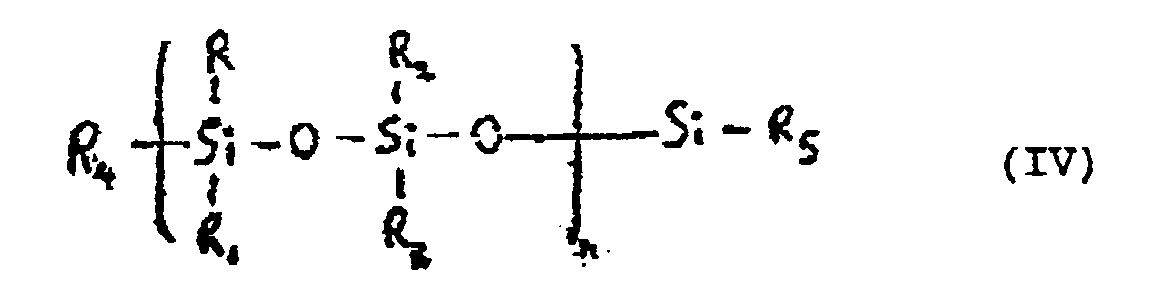 (b) der reaktive Verdünner ein polydimethylsilanolendender reaktiver Verdünner ist, mit geringerer Viskosität als die des vinylendenden Polyorganosiloxans aus obigem (a), wobei der reaktive Verdünner der Formel (III) entspricht
 (c) das zweite Polyorganosiloxan ein Organosiloxanpolymer der allgemeinen Formel (IV) ist, in der R, R₁, R2, R₃, R4, und R₅ in unabhängiger Weise aus Wasserstoff, und Alkyl- und Phenylgruppen mit 1 bis 4 Kohlenstoffatomen ausgewählt sind, wobei zumindest einige der R₂ Wasserstoff sind;
wobei die relative Menge an Siloxanverdünner von 2 bis 12 Gewichtsteilen, bezogen auf 100 Gewichtsteile des gesamten Organosiloxans beträgt;
wobei die Viskosität der flüssigen Mischung der Komponenten (a), (b) und (c) und des inorganischen Füllers im Bereich von 30 bis 65 Pa.s liegt, und(d) das Verfahren durchgeführt wird in dem die Komponenten (a), (b) und (c), Wasser und der inorganische Füller in einem Formbehälter zusammengemischt werden, um eine im wesentlichen homogene Mischung hiervon zu formen, der flüssigen Mischung in Gegenwart eines passenden Katalysators für eine Kondensations- und Additionspolymerisation erlaubt wird zu polymerisieren um einen feuerfesten Schaum geringer Dichte zu erzeugen, und Härten des derart erzeugten schaums. - Verfahren nach Anspruch 2, worin:(1) das vinylendende Polyorganosiloxan zumindest ein flüssiges ungehärtetes Organosiloxanpolymer ist, mit einer struktur, die der allgemeinen Formel (IIa) entspricht
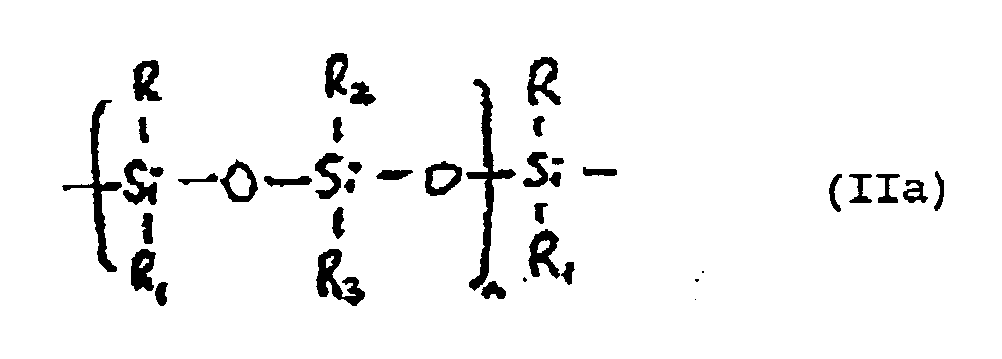 (2) das zweite Polyorganosiloxan zumindest ein flüssiges, ungehärtetes Organosiloxanpolymer ist mit einer Struktur, die der obigen allgemeinen Formel (IIa) entspricht, worin R, R₁, R₂ und R₃ in unabhängiger Weise aus Wasserstoff und Alkyl- und Phenylgruppen mit 1 bis 4 Kohlenstoffatomen ausgewählt sind, und wobei das zweite Polymer interne Si-H Bindungen aufweist;(3) der reaktive verdünner aus 2 bis 12 Gewichtsteilen, bezogen auf 100 Teile des Gesamtgewichts des Organosiloxanpolymers zumindest eines reaktiven Polydimethylsiloxanverdünners mit einer geringeren Viskosität als die der Polymere besteht, ein Molekulargewicht im Bereich von 1500 bis 2000 aufweist, eine Hydroxylfunktionalität Von zumindest 2,5% hat und im wesentlichen frei ist von Kohlenstoff-Kohlenstoff ungesättigtheit, und welcher der allgemeinen Formel (III) entspricht
wobei die Mischung von Komponenten (1), (3) und dem inorganischen Füller eine Viskosität von 30 bis 65 Pa.s aufweist, und(4) das Verfahren durchgeführt wird wobei die Komponenten (1), (2) und (3), Wasser und der inorganische Füller bei einer Temperatur nicht über 35°C zusammengemischt werden, um eine Flüssigkeitszusammensetzung zu bilden, die Reaktion dieser Zusammensetzung mit einem Katalysator auf Platin-Basis ausgeführt wird, um ein Gelierung zu erreichen, und Schäumen und Härten hiervon, um einen flexiblen Silikonschaum mit einer Dichte im Bereich Von 80 bis 224 kg/m³ zu ergeben. - Verfahren nach Anspruch 7 oder 8, wobei die Gruppen R, R₁, R₂ und R₃ im ersten Organosiloxanpolymer aus Methyl, Ethyl und Phenyl ausgewählt sind.
- Verfahren nach irgendeinem der Ansprüche 7 bis 9, wobei die Gruppen R, R₁, R₂ und R₃ im zweiten Organosiloxanpolymer aus Wasserstoff, Methyl, Ethyl und Phenyl ausgewählt sind.
- Verfahren nach irgendeinen der Ansprüche 7 bis 10, wobei das erste Organosiloxanpolymer in der Zusammensetzung in einer, das zweite Organosiloxanpolymer überwiegenden Gewichtsmenge vorhanden ist.
- Verfahren nach Anspruch 11, wobei die Organosiloxanpolymer-Mischung einen molaren Überschuss an Si-H Bindungen über die Vinylbindungen aufweist.
- Verfahren nach irgendeinen der Ansprüche 7 bis 12, worin die Zusammensetzung 3,5 bis 10 Gewichtsteile des reaktiven Verdünners, bezogen auf 100 Teile des Gesamtgewichts des Organosiloxanpolymers aufweist.
- Verwendung von Wasser und einem polydimethylsilanolendenden reaktiven Verdünner mit einem Molekulargewicht von 400 bis 2000, zum gleichzeitigen Bereitstellen von unterschiedlichen Hydroxylgruppenquellen im katalysatorunterstütztem Schäumen einer Polyorganosiloxanmischung welche ein erstes, vinylendendes Polyorganosiloxan mit einer höheren Viskosität als der reaktive Verdünner aufweist, und mit einem zweiten Polyorganosiloxan, welches in der Siloxankette Wasserstoffgruppen aufweist, die direkt an das Silikon in nicht endender Position gebunden sind, um eine gehärtete flexible, feuerfeste Silikonschaumzusammensetzung zu erzeugen, welche eine Dichte von weniger als 224 kg/m³ aufweist, mit einer polymeren Grundstruktur, die einen überwiegenden Teil (wie hier definiert) der allgemeinen Formel (II) der Silikonstruktureinheit enthält:

Applications Claiming Priority (2)
| Application Number | Priority Date | Filing Date | Title |
|---|---|---|---|
| US75425685A | 1985-07-12 | 1985-07-12 | |
| US754256 | 1985-07-12 |
Publications (3)
| Publication Number | Publication Date |
|---|---|
| EP0212829A2 EP0212829A2 (de) | 1987-03-04 |
| EP0212829A3 EP0212829A3 (en) | 1987-09-09 |
| EP0212829B1 true EP0212829B1 (de) | 1994-10-05 |
Family
ID=25034043
Family Applications (1)
| Application Number | Title | Priority Date | Filing Date |
|---|---|---|---|
| EP19860305343 Expired - Lifetime EP0212829B1 (de) | 1985-07-12 | 1986-07-11 | Schaumstoffe mit niedriger Dichte und Verfahren für deren Herstellung |
Country Status (3)
| Country | Link |
|---|---|
| EP (1) | EP0212829B1 (de) |
| CA (1) | CA1267750A (de) |
| DE (1) | DE3650085T2 (de) |
Cited By (1)
| Publication number | Priority date | Publication date | Assignee | Title |
|---|---|---|---|---|
| US7214735B2 (en) | 2004-02-02 | 2007-05-08 | 3M Innovative Properties Company | Microsphere-filled sealant materials |
Families Citing this family (10)
| Publication number | Priority date | Publication date | Assignee | Title |
|---|---|---|---|---|
| US4822659A (en) * | 1987-09-30 | 1989-04-18 | Bisco Products Inc. | Fire block sheet and wrapper |
| US5011865A (en) * | 1990-04-02 | 1991-04-30 | General Electric Company | Reduction of silicone foam density using buffers |
| GB9100707D0 (en) * | 1991-01-12 | 1991-02-27 | Dow Corning Sa | Silicone foams of improved fire resistance |
| DE4101884C2 (de) * | 1991-01-23 | 2001-05-03 | Sonderhoff Ernst Fa | Verfahren zur Herstellung von Schaumstoffbeschichtungen oder zur Flächenverklebung von Materialien und dessen Anwendung |
| US5414023A (en) * | 1994-05-18 | 1995-05-09 | Dow Corning Corporation | Thixotropic foamable organosiloxane compositions |
| DE102008011986A1 (de) * | 2008-02-29 | 2009-09-10 | Sonderhoff Chemicals Gmbh | Kondensationsvernetzende Silikonschäume |
| CN109161205A (zh) * | 2018-09-04 | 2019-01-08 | 杭州之江新材料有限公司 | 一种阻燃发泡硅橡胶及其制备方法 |
| CN110591378A (zh) * | 2019-09-26 | 2019-12-20 | 江苏矽时代材料科技有限公司 | 一种闭孔性有机硅发泡胶及其制备方法 |
| CN110903657B (zh) * | 2019-12-13 | 2022-10-18 | 成都拓利科技股份有限公司 | 可快速就地发泡成型的组合物及其制备的大尺寸发泡硅橡胶材料 |
| CN113956667B (zh) * | 2021-10-22 | 2023-04-07 | 东莞市曦晨启明新材料科技有限公司 | 一种发泡硅橡胶及其制备方法和应用 |
Family Cites Families (4)
| Publication number | Priority date | Publication date | Assignee | Title |
|---|---|---|---|---|
| US3923705A (en) * | 1974-10-30 | 1975-12-02 | Dow Corning | Method of preparing fire retardant siloxane foams and foams prepared therefrom |
| US4189545A (en) * | 1978-03-13 | 1980-02-19 | General Electric Company | Silicone foam composition which has burn resistant properties |
| GB2065661B (en) * | 1979-12-17 | 1984-02-15 | Gen Electric | Silicone foam compositions with burn resistant properties |
| NZ197154A (en) * | 1980-06-03 | 1984-02-03 | Gen Electric | Regulating the cure of silicone rubber compounds |
-
1986
- 1986-07-07 CA CA000513250A patent/CA1267750A/en not_active Expired - Lifetime
- 1986-07-11 DE DE19863650085 patent/DE3650085T2/de not_active Expired - Lifetime
- 1986-07-11 EP EP19860305343 patent/EP0212829B1/de not_active Expired - Lifetime
Cited By (1)
| Publication number | Priority date | Publication date | Assignee | Title |
|---|---|---|---|---|
| US7214735B2 (en) | 2004-02-02 | 2007-05-08 | 3M Innovative Properties Company | Microsphere-filled sealant materials |
Also Published As
| Publication number | Publication date |
|---|---|
| CA1267750A (en) | 1990-04-10 |
| DE3650085D1 (de) | 1994-11-10 |
| DE3650085T2 (de) | 1995-05-24 |
| EP0212829A2 (de) | 1987-03-04 |
| EP0212829A3 (en) | 1987-09-09 |
Similar Documents
| Publication | Publication Date | Title |
|---|---|---|
| US3425967A (en) | Foamable organopolysiloxane composition and foamed product obtained therefrom | |
| JP3052282B2 (ja) | ウレタンフォームを製造するためのポリエーテルシリコーン界面活性剤 | |
| US5162397A (en) | Silicone foams | |
| EP0212829B1 (de) | Schaumstoffe mit niedriger Dichte und Verfahren für deren Herstellung | |
| EP0116223B1 (de) | Verfahren zur Herstellung von nichtbrennbaren Polysiloxanschäumen und so hergestellte Schäume | |
| US4760098A (en) | Low density foams | |
| US6110982A (en) | Epoxy foams using multiple resins and curing agents | |
| US4026835A (en) | Method of preparing heat cured siloxane foams using rhodium catalyst and foams prepared therefrom | |
| JPS6221816B2 (de) | ||
| JPH0347657B2 (de) | ||
| EP0179640B1 (de) | Nicht zusammenfallende, schäumbare, Silica und Fasern enthaltende Polyorganosiloxanzusammensetzungen | |
| JPH0725915B2 (ja) | 弾性シリコーン・フォーム及びその製造方法 | |
| JPS61223034A (ja) | 発ぽう性ポリオルガノシロキサン組成物 | |
| EP0422319B1 (de) | Organosilikonzusammensetzungen | |
| US5574073A (en) | Curable silicone compositions which are foams or elastomers | |
| US4705810A (en) | Blowing agent admixture for foamable organopolysiloxane compositions | |
| US5900438A (en) | Thermosetting foamable organopolysiloxane composition and process of curing the same | |
| US6300382B1 (en) | Silicone rubber sponge composition and sponge articles therefrom | |
| JPH0710931B2 (ja) | 発泡性組成物 | |
| JPS59197438A (ja) | シリコ−ンエラストマ−形成組成物 | |
| US3823098A (en) | Foaming unsaturated polyester resins | |
| RU2111982C1 (ru) | Способ получения вспениваемых кремнийорганических композиций | |
| US3630997A (en) | Curable epoxy resin compositions and method of preparing same | |
| KR100195553B1 (ko) | 발포성 폴리오가노실옥산 조성물 | |
| GB2200357A (en) | Epoxy foams |
Legal Events
| Date | Code | Title | Description |
|---|---|---|---|
| PUAI | Public reference made under article 153(3) epc to a published international application that has entered the european phase |
Free format text: ORIGINAL CODE: 0009012 |
|
| AK | Designated contracting states |
Kind code of ref document: A2 Designated state(s): AT BE CH DE FR GB IT LI LU NL SE |
|
| PUAL | Search report despatched |
Free format text: ORIGINAL CODE: 0009013 |
|
| AK | Designated contracting states |
Kind code of ref document: A3 Designated state(s): AT BE CH DE FR GB IT LI LU NL SE |
|
| 17P | Request for examination filed |
Effective date: 19880222 |
|
| 17Q | First examination report despatched |
Effective date: 19890626 |
|
| RAP1 | Party data changed (applicant data changed or rights of an application transferred) |
Owner name: TETRAFOAM INC. |
|
| RTI1 | Title (correction) | ||
| RAP1 | Party data changed (applicant data changed or rights of an application transferred) |
Owner name: TETRAFOAM TECHNOLOGY CORP. |
|
| RBV | Designated contracting states (corrected) |
Designated state(s): DE FR GB IT |
|
| GRAA | (expected) grant |
Free format text: ORIGINAL CODE: 0009210 |
|
| AK | Designated contracting states |
Kind code of ref document: B1 Designated state(s): DE FR GB IT |
|
| PG25 | Lapsed in a contracting state [announced via postgrant information from national office to epo] |
Ref country code: IT Free format text: LAPSE BECAUSE OF FAILURE TO SUBMIT A TRANSLATION OF THE DESCRIPTION OR TO PAY THE FEE WITHIN THE PRE;WARNING: LAPSES OF ITALIAN PATENTS WITH EFFECTIVE DATE BEFORE 2007 MAY HAVE OCCURRED AT ANY TIME BEFORE 2007. THE CORRECT EFFECTIVE DATE MAY BE DIFFERENT FROM THE ONE RECORDED.SCRIBED TIME-LIMIT Effective date: 19941005 |
|
| REF | Corresponds to: |
Ref document number: 3650085 Country of ref document: DE Date of ref document: 19941110 |
|
| ET | Fr: translation filed | ||
| PLBE | No opposition filed within time limit |
Free format text: ORIGINAL CODE: 0009261 |
|
| STAA | Information on the status of an ep patent application or granted ep patent |
Free format text: STATUS: NO OPPOSITION FILED WITHIN TIME LIMIT |
|
| 26N | No opposition filed | ||
| REG | Reference to a national code |
Ref country code: GB Ref legal event code: IF02 |
|
| PGFP | Annual fee paid to national office [announced via postgrant information from national office to epo] |
Ref country code: FR Payment date: 20050719 Year of fee payment: 20 |
|
| PGFP | Annual fee paid to national office [announced via postgrant information from national office to epo] |
Ref country code: GB Payment date: 20050727 Year of fee payment: 20 |
|
| PGFP | Annual fee paid to national office [announced via postgrant information from national office to epo] |
Ref country code: DE Payment date: 20050729 Year of fee payment: 20 |
|
| REG | Reference to a national code |
Ref country code: GB Ref legal event code: PE20 |
|
| PG25 | Lapsed in a contracting state [announced via postgrant information from national office to epo] |
Ref country code: GB Free format text: LAPSE BECAUSE OF EXPIRATION OF PROTECTION Effective date: 20060710 |