EP0213064A2 - Relais électromagnétique - Google Patents
Relais électromagnétique Download PDFInfo
- Publication number
- EP0213064A2 EP0213064A2 EP86730127A EP86730127A EP0213064A2 EP 0213064 A2 EP0213064 A2 EP 0213064A2 EP 86730127 A EP86730127 A EP 86730127A EP 86730127 A EP86730127 A EP 86730127A EP 0213064 A2 EP0213064 A2 EP 0213064A2
- Authority
- EP
- European Patent Office
- Prior art keywords
- relay according
- intermediate member
- locking element
- contact
- relay
- Prior art date
- Legal status (The legal status is an assumption and is not a legal conclusion. Google has not performed a legal analysis and makes no representation as to the accuracy of the status listed.)
- Withdrawn
Links
- 238000006073 displacement reaction Methods 0.000 claims abstract description 7
- 230000005540 biological transmission Effects 0.000 claims abstract description 4
- 230000000284 resting effect Effects 0.000 claims abstract 2
- 230000000903 blocking effect Effects 0.000 claims 2
- 230000003993 interaction Effects 0.000 claims 1
- 230000001960 triggered effect Effects 0.000 claims 1
- 230000005405 multipole Effects 0.000 abstract 1
- 206010000496 acne Diseases 0.000 description 9
- 238000013461 design Methods 0.000 description 3
- 230000007257 malfunction Effects 0.000 description 3
- 230000007935 neutral effect Effects 0.000 description 3
- 238000005192 partition Methods 0.000 description 3
- 238000010276 construction Methods 0.000 description 2
- 230000000694 effects Effects 0.000 description 2
- 238000004519 manufacturing process Methods 0.000 description 2
- RYGMFSIKBFXOCR-UHFFFAOYSA-N Copper Chemical compound [Cu] RYGMFSIKBFXOCR-UHFFFAOYSA-N 0.000 description 1
- XEEYBQQBJWHFJM-UHFFFAOYSA-N Iron Chemical group [Fe] XEEYBQQBJWHFJM-UHFFFAOYSA-N 0.000 description 1
- 238000013459 approach Methods 0.000 description 1
- 230000000712 assembly Effects 0.000 description 1
- 238000000429 assembly Methods 0.000 description 1
- 238000011161 development Methods 0.000 description 1
- 230000018109 developmental process Effects 0.000 description 1
- 238000010292 electrical insulation Methods 0.000 description 1
- 230000005611 electricity Effects 0.000 description 1
- 230000002349 favourable effect Effects 0.000 description 1
- 238000010438 heat treatment Methods 0.000 description 1
- 238000005259 measurement Methods 0.000 description 1
- 238000000034 method Methods 0.000 description 1
- 230000008439 repair process Effects 0.000 description 1
- 238000000926 separation method Methods 0.000 description 1
- 238000012360 testing method Methods 0.000 description 1
- 238000004804 winding Methods 0.000 description 1
Images


Classifications
-
- H—ELECTRICITY
- H01—ELECTRIC ELEMENTS
- H01H—ELECTRIC SWITCHES; RELAYS; SELECTORS; EMERGENCY PROTECTIVE DEVICES
- H01H50/00—Details of electromagnetic relays
- H01H50/54—Contact arrangements
- H01H50/56—Contact spring sets
- H01H50/58—Driving arrangements structurally associated therewith; Mounting of driving arrangements on armature
-
- H—ELECTRICITY
- H01—ELECTRIC ELEMENTS
- H01H—ELECTRIC SWITCHES; RELAYS; SELECTORS; EMERGENCY PROTECTIVE DEVICES
- H01H3/00—Mechanisms for operating contacts
- H01H3/001—Means for preventing or breaking contact-welding
-
- H—ELECTRICITY
- H01—ELECTRIC ELEMENTS
- H01H—ELECTRIC SWITCHES; RELAYS; SELECTORS; EMERGENCY PROTECTIVE DEVICES
- H01H51/00—Electromagnetic relays
- H01H51/02—Non-polarised relays
- H01H51/20—Non-polarised relays with two or more independent armatures
Definitions
- the invention relates to an electromagnetic relay of the type specified in the preamble of claim 1.
- the known arrangement which can also work together with contact springs in the manner of a relay, has the disadvantage that, in the event that one contact does not open, there is a risk that the other contact will also fail, so that the desired increase in operational safety is not more is given.
- the invention has for its object to ensure in a relay of the type mentioned that if one of the contacts fails, the other can no longer be brought into the position in which the other is undesirably held, i.e. in particular, that if one of the contacts is kept closed, the other must not come back into the on state after opening the circuit again.
- The. invention is based on the knowledge that two elements which form a slide when the contacts are actuated engage control cams with a locking element in the manner of a mechanical slide or a rocker, the control cams each having a recess or notch which when the locking element gets in there, block the movement of the intermediate link - and thus the power transmission.
- the design is preferably such that, if only one of the intermediate members (Pimpel) is moved in the actuating direction of the armature, the locking element receives a prestress, which allows part of the same to get into the recess, preferably designed as a groove, of the further intermediate member, so that the latter Movement is inhibited. If both intermediate links are operated simultaneously with parallel feed, the pretension in the rest position is not sufficient to block one or both intermediate links. In order to apply the pretension or the movement of the locking element causing the locking action, it is a prerequisite that the pertinent intermediate member comes out of its rest position. The locking engagement of the locking element is only possible in this rest position.
- the locking element is designed or clamped in such a way that it automatically returns to a neutral position if it is not pushed out of this neutral position by one of the control cams attached to the intermediate links.
- the locking element can either be connected to an elastic element or can itself be made elastic and clamped at the ends.
- the actuation can also be carried out by a type of slide, which the transmits locking movement linearly from one intermediate link to the other, but the element must be compressible in length, so that it yields when both intermediate links are actuated at the same time without a locking effect being allowed to occur.
- This bar-shaped locking element should also be kept in a neutral position if none of the intermediate links is actuated.
- a plurality of intermediate links can also be provided, wherein "lugs" elastically connected to the locking element simultaneously engage in corresponding recesses in all intermediate links which are in the rest position when the locking element is driven by the control curve of at least one intermediate link which is in the actuating direction is moved.
- the relay according to the invention is designed in particular as a double armature relay in such a way that both control elements (Pimpel) are each driven by an armature.
- the arrangement is also secured against failure of the contacts to open due to "sticking" of one of the anchors.
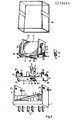
- the base plate 1 is U-shaped and takes the connections 2 designed for tabs for contacts and. Drive the relay on.
- two contact contacts consisting of a fixed contact 3 and a movable spring contact 4, are provided as contact sets.
- the two sets of contacts are each housed in a chamber divided by a vertical partition 5. In the drawing is only the front chamber is visible, the wall surrounding the internal connections of the tabs meandering or under the division of chambers, so that their electrical separation is ensured.
- the meandering partition wall contributes significantly to the strength of the base plate 1 of the relay forming a base group, the wall 5 on the one hand connecting element of the side walls 6 and 7 of the base part and on the other hand serving as a support surface for further horizontally extending elements to be inserted between the side walls.
- the side walls 6 and 7 are reduced in their wall thickness compared to the wall thickness in the area of the partition walls 5, so that they have an elastic spring effect when made from plastic.
- a cover plate 8 Placed on the base plate 1 - or inserted between the side cheeks 6 and 7 of the base plate 1 - is a cover plate 8, which likewise has a U-shaped contour and is supported on the side cheeks 6 and 7 with the lateral legs of the "U".
- the cover plate 8 has passages 9 and 10 on the one hand, which enable actuation of the contact spring sets 4 in the region of the base plate through the cover plate 8 by means of pimples 11 and 12 forming intermediate members.
- the major passages 9 and 10 are provided with cylindrical, downward-facing lugs 9a and 10a.
- the upward-facing cylindrical projection 13 has a recess 14 which is cut for part of its diameter in the region of the surface of the cover plate 8 and which forms a locking element Spring element 15 with symmetrically bent ends allows to reach the pimple 11 through the cylindrical element 13 and to penetrate within the cross section of the bore 9 into the recess provided there in order to block the movement of the pimple in the axial direction.
- the side legs 16 and 17 of the "U" of the correspondingly shaped cover plate 8 have, at their upper ends, semicircular molded spring elements 18 and 19 or 20 and 21, which in terms of their height when the parts 1 and 8 are in the relaxed state up to Extend recesses 23 and 24 or 25 and 26 into it and secure elements (which are shown in more detail below) engaging in these recesses against displacement.
- the cover plate 8 thus simultaneously forms an upper cover for the electrical contacting elements or connecting lugs of the flat plug 2, so that the electrical insulation values can be maintained here without additional measures.
- Lugs 27 and 28 which extend the side legs forming the "U" downward over the horizontal plane of the cover plate 8 and engage in the corresponding recesses in the base plate 1, secure the two workpieces 1 and 8 in the preassembled state against lateral displacements.
- the drive element for the contact sets of the relay shown here is a solenoid 47, which by a Winding enamelled copper wire is formed on a coil former 29 and an iron core 30.
- a yoke 31 is connected to the bobbin 29 and has web-like projections 32 and 33 or 34 and 35 at its ends extending in the longitudinal direction of the bobbin 28, each of which is directed parallel in pairs and forms a U-shaped structure in the horizontal plane. which is to be regarded as "ii" -shaped if all the webs 32 to 35 and the yoke are viewed together.
- the lugs 32 to 35 make it possible to mount the coil carrier with the further drive elements for the contacts in a particularly simple manner.
- the side cheeks 6 and 7, as legs of the U-shaped base plate 1 are bent up laterally and, after the cover plate 8 has been inserted, the yoke 31 with the coil 47 is inserted.
- the web-shaped lugs 32 to 35 of the coil body are secured in the recesses 23 to 26 of the side cheeks 6 and 7 of the base plate 1 by the bent spring lugs 18 to 21 of the cover plate against lateral displacement.
- a cup-shaped housing cap 36 is dimensionally adapted to the external measurements of the base plate 1 and is about the side cheeks 6 and 7 put over where it is kept free of play.
- the yoke 31 is laterally limited and held in the center by the cup-shaped housing cover 36, so that the yoke is automatically centered when the cup-shaped housing cover 36 is placed on.
- Angled anchors 37 and 38 are provided on both sides of the core 30 and are rotatably mounted between the web-shaped projections 32 and 33 or 34 and 35. Since the anchors form an angle which is slightly greater than 90 °, flags 39 and 40 provided at their lower angled ends act on the upper sides of the sticks 11 and 12 and thus indirectly actuate the contact sets located on the base plate.
- the oeiden armature 37 and 38 are held and pivotally mounted by means of "E" -shaped spring elements 41, the spring element 41 being shown separately in FIG. 2 to the right of the coil body.
- the two anchors are inserted laterally between the web-shaped projections 32, 33 and 34, 35 during assembly of the complete coil armature element. Due to the assembly rotated by 180 °, the two anchor parts can be made identical, but the flags 39 and 40 lie side by side in the plane and are spatially adjacent to the two pimples 11 and 12 for the transmission of force.
- the "E" -shaped spring element 41 is inserted from above between the web-shaped projections 32 and 33 or 34 and 35, the webs gradually widening towards the outside ze 50, behind which the outer legs of the "E" -shaped spring element are supported.
- the middle leg of the "E” protrudes due to its spring force out of the plane of the other two legs in the direction of the armature and has an elongated extension 42 which is slightly angled or bent in the direction of the armature 37.
- the approach 42 rests against the back of the outer surface of the armature, which is sharply rounded for angling, and secures it against falling outward.
- the anchor itself has in the area of its sharp bend in the vicinity of webs 32 and 33 (or 34 and 35) recesses which are limited by steps 51 to uie recesses 5u between webs 32 and 33 and thus between these webs Secure the inserted anchor against falling out or unintentional shifting.
- the spring element 41 forms an essentially force-free limitation of the mounting of the respective armature but is held in position by the pretensioning of the middle leg of the "E" and is secured against falling out by the bend 42. In this way it is achieved that the anchors are secured in position by inserting a single element which can be inserted from above, with the need for more cumbersome other storage means such as axles and the like Dismantle again, the production can be carried out in an expedient manner at any degree of automation.
- a further embodiment variant, not shown, which fulfills its purpose accordingly, can be realized in that, leaving out the middle leg of the "E" of the spring element, the two outer legs are angled in the area of their outer ends on the inside, as is approximately the end 42 corresponds to the middle leg.
- the relay shown as an exemplary embodiment is equipped with two separate armatures 37 and 38, which are attracted together when the coil is permeable to current.
- the contact sets driven by the two armatures are operated together.
- the two-containing sets of contacts are each normally connected in series and open together at the fall of the anchor, so that the two resulting between the contacts Air gaps prevent the flow of electricity for each.
- the air distances when the contacts are open are so dimensioned that they each ensure a shutdown. Should it happen that one of the contacts welds or one of the anchors sticks in the course of the operating life of the device, the current is switched off by opening the other set of contacts.
- the arrangement shown is extremely simple in construction and requires hardly any additional elements.
- the increase in the actuating force is only slight, since a locking element which is displaceable transversely to an actuating direction to be locked can be driven with relatively small forces.
- the embodiment of the invention is not limited to the preferred embodiment given above game. Rather, a number of variants are conceivable which make use of the solution shown, even in the case of fundamentally different types.
Landscapes
- Physics & Mathematics (AREA)
- Electromagnetism (AREA)
- Electromagnets (AREA)
- Details Of Connecting Devices For Male And Female Coupling (AREA)
Applications Claiming Priority (4)
| Application Number | Priority Date | Filing Date | Title |
|---|---|---|---|
| DE3530265 | 1985-08-22 | ||
| DE3530265 | 1985-08-22 | ||
| DE3617832 | 1986-05-26 | ||
| DE19863617832 DE3617832A1 (de) | 1985-08-22 | 1986-05-26 | Elektromagnetisches relais |
Publications (2)
| Publication Number | Publication Date |
|---|---|
| EP0213064A2 true EP0213064A2 (fr) | 1987-03-04 |
| EP0213064A3 EP0213064A3 (fr) | 1988-03-30 |
Family
ID=25835331
Family Applications (1)
| Application Number | Title | Priority Date | Filing Date |
|---|---|---|---|
| EP86730127A Withdrawn EP0213064A3 (fr) | 1985-08-22 | 1986-08-20 | Relais électromagnétique |
Country Status (3)
| Country | Link |
|---|---|
| EP (1) | EP0213064A3 (fr) |
| DE (1) | DE3617832A1 (fr) |
| FI (1) | FI863255A7 (fr) |
Cited By (2)
| Publication number | Priority date | Publication date | Assignee | Title |
|---|---|---|---|---|
| EP0292423A1 (fr) * | 1987-05-22 | 1988-11-23 | Paul & Siedler GmbH & Co KG | Relais électromagnétique |
| EP4336537A1 (fr) * | 2022-09-06 | 2024-03-13 | Pilz GmbH & Co. KG | Dispositif relais et appareil de commutation de sécurité doté d'au moins un dispositif relais |
Family Cites Families (4)
| Publication number | Priority date | Publication date | Assignee | Title |
|---|---|---|---|---|
| DE2905243C2 (de) * | 1979-02-12 | 1982-10-21 | Siemens AG, 1000 Berlin und 8000 München | Anordnung zum Öffnen von Stromkreisen |
| FR2517464A1 (fr) * | 1981-11-27 | 1983-06-03 | Bernier Raymond | Relais electromagnetique |
| DE3466316D1 (en) * | 1983-12-05 | 1987-10-22 | Siemens Ag | Device to switch off users |
| DE8507887U1 (de) * | 1985-03-16 | 1985-05-30 | Eberle GmbH, 8500 Nürnberg | Elektromagnetisches Relais |
-
1986
- 1986-05-26 DE DE19863617832 patent/DE3617832A1/de not_active Withdrawn
- 1986-08-11 FI FI863255A patent/FI863255A7/fi not_active IP Right Cessation
- 1986-08-20 EP EP86730127A patent/EP0213064A3/fr not_active Withdrawn
Cited By (4)
| Publication number | Priority date | Publication date | Assignee | Title |
|---|---|---|---|---|
| EP0292423A1 (fr) * | 1987-05-22 | 1988-11-23 | Paul & Siedler GmbH & Co KG | Relais électromagnétique |
| DE3717704A1 (de) * | 1987-05-22 | 1988-12-22 | Paul & Siedler Gmbh & Co Kg | Elektromagnetisches relais |
| EP4336537A1 (fr) * | 2022-09-06 | 2024-03-13 | Pilz GmbH & Co. KG | Dispositif relais et appareil de commutation de sécurité doté d'au moins un dispositif relais |
| US12431308B2 (en) | 2022-09-06 | 2025-09-30 | Pilz Gmbh & Co. Kg | Relay apparatus and safety switching device with relay apparatus |
Also Published As
| Publication number | Publication date |
|---|---|
| EP0213064A3 (fr) | 1988-03-30 |
| FI863255L (fi) | 1987-02-23 |
| FI863255A0 (fi) | 1986-08-11 |
| FI863255A7 (fi) | 1987-02-23 |
| DE3617832A1 (de) | 1987-02-26 |
Similar Documents
| Publication | Publication Date | Title |
|---|---|---|
| DE3908319C2 (de) | Elektromagnetisches Schaltgerät | |
| EP1121700B1 (fr) | Relais de securite | |
| EP0090176A2 (fr) | Disjoncteur de surintensité | |
| EP1394832B1 (fr) | Interrupteur électromécanique commandé à distance | |
| EP1143474A1 (fr) | Relais | |
| EP1843377A1 (fr) | Entraînement à aimant pour un relais | |
| DE10061394A1 (de) | Schaltvorrichtung mit schwimmend gelagertem, doppelt unterbrechendem Drehkontakt | |
| DE3219294C2 (fr) | ||
| DE60130143T2 (de) | Strombegrenzender schutzschalter | |
| EP0213064A2 (fr) | Relais électromagnétique | |
| DE2817036A1 (de) | Sicherheitsfedersatz, zugehoerig zu einem relais zur erfuellung erhoehter sicherheitsbestimmungen | |
| DE102011011578B4 (de) | Magnetventil | |
| EP1174897A2 (fr) | Système magnétique pour un relais électromagnétique | |
| DE10328499B3 (de) | Mechanische Verriegelungseinrichtung für Schaltschütze und Hilfswerkzeug hierfür | |
| DE3508302C2 (fr) | ||
| DE8614337U1 (de) | Elektromagnetisches Relais | |
| DE19705508C1 (de) | Elektromagnetisches Relais | |
| EP0213066A2 (fr) | Relais électromagnétique | |
| DE3530267A1 (de) | Elektromagnetisches relais | |
| EP1121701B1 (fr) | Relais de securite | |
| DE102015016914B4 (de) | Relais | |
| DE69206389T2 (de) | Mehrpoliges Schaltgerät mit teilweise vorübergehender Betätigung. | |
| DE3717704A1 (de) | Elektromagnetisches relais | |
| DE60117512T2 (de) | Elektromagnetischer Schütz mit einer Kontaktbrücke und unabhängiger Feder | |
| DE10035173C1 (de) | Magnetsystem für ein elektromagnetisches Relais |
Legal Events
| Date | Code | Title | Description |
|---|---|---|---|
| PUAI | Public reference made under article 153(3) epc to a published international application that has entered the european phase |
Free format text: ORIGINAL CODE: 0009012 |
|
| AK | Designated contracting states |
Kind code of ref document: A2 Designated state(s): AT BE CH DE FR GB IT LI NL SE |
|
| PUAL | Search report despatched |
Free format text: ORIGINAL CODE: 0009013 |
|
| AK | Designated contracting states |
Kind code of ref document: A3 Designated state(s): AT BE CH DE FR GB IT LI NL SE |
|
| 17P | Request for examination filed |
Effective date: 19880805 |
|
| STAA | Information on the status of an ep patent application or granted ep patent |
Free format text: STATUS: THE APPLICATION IS DEEMED TO BE WITHDRAWN |
|
| 18D | Application deemed to be withdrawn |
Effective date: 19910301 |
|
| RIN1 | Information on inventor provided before grant (corrected) |
Inventor name: LACHMANN, GERHARD |