EP0213142B1 - Verfahren zur abtrennung von gasen - Google Patents
Verfahren zur abtrennung von gasen Download PDFInfo
- Publication number
- EP0213142B1 EP0213142B1 EP85905691A EP85905691A EP0213142B1 EP 0213142 B1 EP0213142 B1 EP 0213142B1 EP 85905691 A EP85905691 A EP 85905691A EP 85905691 A EP85905691 A EP 85905691A EP 0213142 B1 EP0213142 B1 EP 0213142B1
- Authority
- EP
- European Patent Office
- Prior art keywords
- oxygen
- solution
- compartment
- carrier
- withdrawn
- Prior art date
- Legal status (The legal status is an assumption and is not a legal conclusion. Google has not performed a legal analysis and makes no representation as to the accuracy of the status listed.)
- Expired
Links
Images



Classifications
-
- C—CHEMISTRY; METALLURGY
- C25—ELECTROLYTIC OR ELECTROPHORETIC PROCESSES; APPARATUS THEREFOR
- C25B—ELECTROLYTIC OR ELECTROPHORETIC PROCESSES FOR THE PRODUCTION OF COMPOUNDS OR NON-METALS; APPARATUS THEREFOR
- C25B1/00—Electrolytic production of inorganic compounds or non-metals
- C25B1/01—Products
- C25B1/02—Hydrogen or oxygen
- C25B1/04—Hydrogen or oxygen by electrolysis of water
-
- C—CHEMISTRY; METALLURGY
- C25—ELECTROLYTIC OR ELECTROPHORETIC PROCESSES; APPARATUS THEREFOR
- C25B—ELECTROLYTIC OR ELECTROPHORETIC PROCESSES FOR THE PRODUCTION OF COMPOUNDS OR NON-METALS; APPARATUS THEREFOR
- C25B1/00—Electrolytic production of inorganic compounds or non-metals
- C25B1/01—Products
- C25B1/02—Hydrogen or oxygen
-
- C—CHEMISTRY; METALLURGY
- C25—ELECTROLYTIC OR ELECTROPHORETIC PROCESSES; APPARATUS THEREFOR
- C25B—ELECTROLYTIC OR ELECTROPHORETIC PROCESSES FOR THE PRODUCTION OF COMPOUNDS OR NON-METALS; APPARATUS THEREFOR
- C25B11/00—Electrodes; Manufacture thereof not otherwise provided for
- C25B11/04—Electrodes; Manufacture thereof not otherwise provided for characterised by the material
- C25B11/051—Electrodes formed of electrocatalysts on a substrate or carrier
-
- C—CHEMISTRY; METALLURGY
- C25—ELECTROLYTIC OR ELECTROPHORETIC PROCESSES; APPARATUS THEREFOR
- C25B—ELECTROLYTIC OR ELECTROPHORETIC PROCESSES FOR THE PRODUCTION OF COMPOUNDS OR NON-METALS; APPARATUS THEREFOR
- C25B15/00—Operating or servicing cells
- C25B15/02—Process control or regulation
Definitions
- Oxygen has been separated from gas mixtures containing oxygen by contacting such mixtures with organometallic complexes commonly termed "oxygen carriers". During the contact oxygen is bound to the carrier complexes. After all or a substantial part of the capacity of the carrier to bind oxygen to it has been exhausted the carrier complex is removed from further contact with the feed gas and the bound oxygen is separated from the carrier. In the past this separation has been made either by raising the temperature of the carrier containing bound oxygen causing release of the oxygen from the carrier or by introducing the carrier containing bound oxygen into a zone in which the pressure above the carrier is substantially below atmospheric pressure and this pressure reduction causes release of the bound oxygen. After release of the bound oxygen from the carrier, the carrier may be returned to further contact with the feed gas to repeat the binding of oxygen to the carrier.
- the metal complex carriers are commonly dissolved in a solvent and the feed gas is contacted with a solution containing the carrier.
- the gases other than oxygen contained in the feed gas commonly dissolve to an appreciable extent in the solvent and when either reduction of pressure or elevation of temperature is employed to release the bound oxygen the dissolved nonoxygen components of the feed gas are also released, reducing the purity of the oxygen recovered.
- US-A-4 475 994 discloses a process for separating oxygen from a mixture of gas containing it wherein said mixture of gas is fed into a closed vessel including an anode and a cathode forming an electrolytic cell and provided with an organic solvent, an electrolyte and an organometallic complex functioning as an oxygen carrier in which the metal is polyvalent and at a lower valence when the complex binds oxygen, a divider being used for separating the cathode compartment wherein the complex is oxided from the anode compartment, wherein oxygen is released from the oxided complex after an anode reaction and may be recovered.
- the oxygen carriers heretofore used and others are employed to bind oxygen to the carrier, the release of bound oxygen from the carrier and reactivation of the carrier for further use in binding oxygen being accomplished electrochemically. There is no pressure reduction and no temperature rise and the dissolved gas in the solution of the metal complex carrier is not much released along with the oxygen released by the electrochemical reaction.
- a solution which contains a polyvalent metal complex oxygen carrier, an electrolyte and a solvent.
- the three components of the solution must be chemically compatible with each other in the sense that they do not interact with each other.
- the solvent must be capable of dissolving sufficient of the oxygen carrier to give a molar concentration of at least 0.01 and preferably a higher concentration up to about 5 molar.
- the solvent must also be capable of dissolving a substantial quantity of the electrolyte selected and if desired may be capable of dissolving a moderate amount of water which permits the use of electrolytes, other than organic electrolytes, which may not be sufficiently soluble in the solvent itself to be useful.
- the metal of the oxygen carrier is at a lower valence.
- An oxygen containing feed gas is then passed through the solution until a substantial proportion of the capacity of the carrier to bind oxygen is exhausted.
- the product of this contact with the feed gas is then subjected to electrochemical oxidation which raises the valence of the metal of the oxygen carrier to a higher level and this oxidation concurrently releases oxygen.
- the released oxygen is removed and the oxidized carrier is then electrochemically reduced to bring the metal component of the carrier back to its lower valence and so to restore its capability to bind oxygen.
- the sequence of contact of the solution with the feed gas, electrochemical oxidation to release bound oxygen and then electrochemical reduction of the oxygen carrier to bring the metal to its lower valence level is repeated over and over as the process is carried on.
- the present invention is directed to a continuous process for separating oxygen from gas mixtures containing oxygen which comprises:
- the solution employed in the process of the invention for removing oxygen from gaseous mixtures of oxygen and other gases consists of three components, a polyvalent metal complex oxygen carrier, an electrolyte and a solvent.
- Analogs of these two compounds include those in which the polyvalent metal is a transition metal, preferably iron, nickel, manganese, rhodium, copper and ruthenium instead of cobalt, and in which the oxygen atoms are replaced by another element or group such as sulfur or NH 2 .
- the polyvalent metal is a transition metal, preferably iron, nickel, manganese, rhodium, copper and ruthenium instead of cobalt, and in which the oxygen atoms are replaced by another element or group such as sulfur or NH 2 .
- the electrolyte component of the solution may be any electrolyte which is soluble in the solvent employed and which is chemically compatible with the solvent and with the oxygen carrier complex.
- Quarternary ammonium salts such as tetrabutyl ammonium fluoborate, tetrabutyl ammonium chloride and other tetraalkyl ammonium salts of inorganic acids are suitable electrolytes.
- Quarternary phosphonium salts are also suitable electrolytes.
- the solvents employed are organic solvents, preferably polar organic solvents, such as dimethylformamide, N-methylpyrrolidone, dimethylsulphoxide and generally lactones, lactams, amides, amines and the like.
- the essential property requirements of the solvent are that it be capable of dissolving the metal complex oxygen carriers in amount to provide concentrations at least 0.01 molar and up to much higher concentrations, such as 5 molar, and that it also be capable of dissolving the electrolyte employed in amount sufficient to provide a high level of electrical conductivity to the total solution, and that further that it be chemically compatible with both the oxygen carrier and with the electrolyte employed.
- NMP N-Methyl-pyrrolidone
- B U4 NBF 4 tetrabutyl ammonium tetrafluoborate
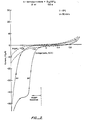
- Cyclic voltammetry was used to identify three electrochemical reactions: (1) the oxidation of the carrier, (2) the reduction of the carrier, and (3) the reduction of dissolved molecular oxygen. Observation of the first two electrochemical reactions serves to demonstrate the ability to oxidize and reduce the oxygen carrier complex, and observation of the third reaction serves to identify the presence of dissolved molecular oxygen in solution.
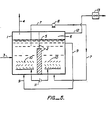
- Vessel 1 is either a cylindrical or rectangular container for the solutions employed in the invention.
- the vessel is divided into two compartments of approximately equal volume by a central divider 2, the lower portion of the divider is a permeable membrane which may be loosely packed fiber or asbestos or the like which prevents intermixing of the liquids in the lefthand and righthand compartments of the container but provides liquid electrolytic communication between the two compartments.
- the upper portion of the divider is a metal sheet.
- Feed gas is introduced through line 3 into the left-hand compartment of vessel 1.
- Line 4 is an exhaust line through which the feed gas depleted in oxygen content is removed from the compartment.
- the upper surface 5 of the solution lies at a level below the top of container 1 and provides a gas space 6 between the upper level of the liquid and the upper face of container 1.
- Solution is withdrawn from the upper part of the liquid body in the lefthand compartment through line 7 and is passed through that line into the bottom portion of the righthand compartment of vessel 1.
- Pump 8 controls the rate of circulation of the liquid material.
- Liquid is withdrawn from the upper part of the right-hand compartment through line 9 and is passed through that line into the bottom part of the left-hand compartment.
- Gas enriched in oxygen is pulled through line 12 by fan 13.
- Metal mesh electrodes 10 are placed in the lower portions of the left-hand and right- hand compartments of the vessel.
- Cell 11 is connected to the two metal mesh electrodes, the left-hand electrode being the cathode and the right-hand electrode being the anode in the system.
- Vessel 1 is filled with a solution, such as any of the solutions shown in the above table.
- the vessel is not completely filled but a gas space several inches in height is left above the liquid level and the top of the vessel.
- air is passed through line 3 into the left-hand compartment of the container until a substantial portion of the capacity of the solution to absorb oxygen has been exhausted.
- Pump 8 is then activated and the movement of solution between the two compartments is initiated. Passage of the electric current to the electrodes is initiated. Oxygen is taken up by the solution in the left-hand compartment of the vessel and air depleted in oxygen is withdrawn through line 4.
- the solution-containing carrier bound oxygen is then drawn through line 7 and introduced into the lower part of the right-hand compartment where it comes into contact with the anode.
- the metal component of the oxygen carrier is oxidised to a higher valence and the oxygen which is bound to the carrier is concurrently released.
- the released oxygen is withdrawn through line 12.
- Liquid is withdrawn from the upper portion of the right-hand compartment where the liquid contains the oxygen carrier metal at a higher valence and is passed through line 9 into the lower part of the left-hand compartment where it comes into contact with the cathode.
- the metal component of the carrier is reduced to a lower valence and its capacity to bind oxygen is restored and further oxygen is picked up from the air introduced through line 3. Operation is continuous.
- Air is continuously introduced into the left-hand compartment of the vessel. Air depleted in oxygen is continuously withdrawn through line 4.
- Solution containing oxygen bound to the carrier is continuously passed through line 7 from the left-hand compartment to the lower part of the righ-thand compartment, the oxygen carrier containing bound oxygen is continuously oxidized by contact with the anode and oxygen is continuously withdrawn through line 12 as product.
- Solution containing the metal carrier with its metal at a higher valence level is continuously withdrawn through line 9 and passed into the lower part of the left-hand compartment where it is contacted with the cathode and reduced to the lower valence level at which its capacity to bind oxygen is restored.
- the process may be operated at temperatures in the range - 30°C to + 100°C. Temperatures in the range - 15°C to 20°C being preferable, the process is ordinarily but not necessarily operated at atmospheric pressure.
- the oxygen recovered in the first contact of the solution containing bound oxygen with the anode may be accumulated and further purified by employing it as the feed gas.
Landscapes
- Chemical & Material Sciences (AREA)
- Engineering & Computer Science (AREA)
- Chemical Kinetics & Catalysis (AREA)
- Electrochemistry (AREA)
- Materials Engineering (AREA)
- Metallurgy (AREA)
- Organic Chemistry (AREA)
- Inorganic Chemistry (AREA)
- Automation & Control Theory (AREA)
- Oxygen, Ozone, And Oxides In General (AREA)
- Electrolytic Production Of Non-Metals, Compounds, Apparatuses Therefor (AREA)
Claims (3)
welches Verfahren dadurch gekennzeichnet ist, daß
Applications Claiming Priority (2)
| Application Number | Priority Date | Filing Date | Title |
|---|---|---|---|
| US695440 | 1985-01-28 | ||
| US06/695,440 US4605475A (en) | 1985-01-28 | 1985-01-28 | Gas separation process |
Publications (2)
| Publication Number | Publication Date |
|---|---|
| EP0213142A1 EP0213142A1 (de) | 1987-03-11 |
| EP0213142B1 true EP0213142B1 (de) | 1989-04-19 |
Family
ID=24792982
Family Applications (1)
| Application Number | Title | Priority Date | Filing Date |
|---|---|---|---|
| EP85905691A Expired EP0213142B1 (de) | 1985-01-28 | 1985-10-28 | Verfahren zur abtrennung von gasen |
Country Status (8)
| Country | Link |
|---|---|
| US (1) | US4605475A (de) |
| EP (1) | EP0213142B1 (de) |
| JP (1) | JPS62501573A (de) |
| KR (1) | KR870700266A (de) |
| CN (1) | CN85109247A (de) |
| DE (1) | DE3590684T1 (de) |
| GB (1) | GB2182057B (de) |
| WO (1) | WO1986004363A1 (de) |
Families Citing this family (11)
| Publication number | Priority date | Publication date | Assignee | Title |
|---|---|---|---|---|
| US4735634A (en) * | 1986-08-28 | 1988-04-05 | Air Products And Chemicals, Inc. | Pillared cobalt complexes for oxygen separation |
| US4680037A (en) * | 1986-08-28 | 1987-07-14 | Air Products And Chemicals, Inc. | Lacunar cobalt complexes for oxygen separation |
| WO1988002036A1 (en) * | 1986-09-22 | 1988-03-24 | Sri International | Gas separation process |
| WO1988006641A1 (en) * | 1987-02-25 | 1988-09-07 | Aquanautics Corporation | Polyalkylamine complexes for ligand extraction and generation |
| US5410052A (en) * | 1987-02-25 | 1995-04-25 | The Regents Of The University Of California | Symmetrical and unsymmetrical polyalkylamine metal complexes for ligand extraction and generation |
| US4808284A (en) * | 1988-01-29 | 1989-02-28 | The Dow Chemical Company | Process for the recovery of alkanolamines from their heat-stable salts formed during absorbent thermal regenerative step of gas conditioning processes |
| AU612238B2 (en) * | 1988-01-29 | 1991-07-04 | Dow Chemical Company, The | Process for the recovery of alkanolamines from their heat-stable salts formed in alkanolamine sorbent solutions |
| US6136222A (en) * | 1991-12-11 | 2000-10-24 | Bend Research, Inc. | Liquid absorbent solutions for separating nitrogen from natural gas |
| US5225174A (en) * | 1991-12-11 | 1993-07-06 | Bend Research, Inc. | Nitrogen sorption |
| US9657400B2 (en) * | 2008-06-10 | 2017-05-23 | General Electric Company | Electrolyzer assembly method and system |
| US10147893B2 (en) | 2015-04-10 | 2018-12-04 | Samsung Electronics Co., Ltd. | Organometallic compound and organic light-emitting device including the same |
Family Cites Families (7)
| Publication number | Priority date | Publication date | Assignee | Title |
|---|---|---|---|---|
| DE2007076C3 (de) * | 1970-02-17 | 1979-12-13 | Studiengesellschaft Kohle Mbh | Verfahren zur elektrochemischen Herstellung von CO-freien metallorganischen Komplexen von Übergangsmetallen der IV. bis VIII. Gruppe |
| NZ189722A (en) * | 1978-03-03 | 1981-05-15 | Nat Res Dev | Manganese complexes and sorption of gases |
| US4343715A (en) * | 1980-10-10 | 1982-08-10 | Duke University | Immobilized hemoglobin, and processes for extracting oxygen from fluids using the same |
| US4427416A (en) * | 1980-10-10 | 1984-01-24 | Duke University | Processes for extracting oxygen from fluids using immobilized hemoglobin |
| CS218296B1 (en) * | 1980-10-30 | 1983-02-25 | Antonin Stehlik | Method of continuous regeneration of the iron trichloride solution |
| US4451270A (en) * | 1982-06-30 | 1984-05-29 | Bend Research, Inc. | Absorption process for producing oxygen and nitrogen and solution therefor |
| US4475994A (en) * | 1983-12-27 | 1984-10-09 | Maxdem Incorporated | Method and apparatus for separating oxygen from a gaseous mixture |
-
1985
- 1985-01-28 US US06/695,440 patent/US4605475A/en not_active Expired - Fee Related
- 1985-10-28 EP EP85905691A patent/EP0213142B1/de not_active Expired
- 1985-10-28 WO PCT/US1985/002124 patent/WO1986004363A1/en not_active Ceased
- 1985-10-28 DE DE19853590684 patent/DE3590684T1/de not_active Withdrawn
- 1985-10-28 JP JP60505027A patent/JPS62501573A/ja active Pending
- 1985-10-28 GB GB08622206A patent/GB2182057B/en not_active Expired
- 1985-12-13 CN CN198585109247A patent/CN85109247A/zh active Pending
-
1986
- 1986-09-26 KR KR1019860700662A patent/KR870700266A/ko not_active Withdrawn
Also Published As
| Publication number | Publication date |
|---|---|
| US4605475A (en) | 1986-08-12 |
| KR870700266A (ko) | 1987-08-20 |
| EP0213142A1 (de) | 1987-03-11 |
| WO1986004363A1 (en) | 1986-07-31 |
| GB2182057B (en) | 1989-01-11 |
| CN85109247A (zh) | 1986-08-13 |
| GB8622206D0 (en) | 1986-10-22 |
| JPS62501573A (ja) | 1987-06-25 |
| GB2182057A (en) | 1987-05-07 |
| DE3590684T1 (de) | 1986-11-20 |
Similar Documents
| Publication | Publication Date | Title |
|---|---|---|
| EP0147012B1 (de) | Verfahren und Apparat zur Abtrennung von Sauerstoff aus einem Gasgemisch | |
| Wong et al. | The effect of weak Brönsted acids on the electrocatalytic reduction of carbon dioxide by a rhenium tricarbonyl bipyridyl complex | |
| US4605475A (en) | Gas separation process | |
| Saji et al. | Electron-transfer rate constants for redox systems of Fe (III)/Fe (II) complexes with 2, 2′-bipyridine and/or cyanide ion as measured by the galvanostatic double pulse method | |
| US4422911A (en) | Method of recovering hydrogen-reduced metals, ions and the like at porous catalytic barriers and apparatus therefor | |
| Puglisi et al. | Electrohydrodimerization Reactions: II. Rotating Ring‐Disk Electrode, Voltammetric and Coulometric Studies of Dimethyl Fumarate, Cinnamonitrile, and Fumaronitrile | |
| US3318735A (en) | Fuel cell employing internal primary oxidant regeneration | |
| Chung et al. | Catalysis of the electroreduction of O2 by cobalt 5, 10, 15, 20-tetraphenylporphyrin dissolved in thin layers of benzonitrile on graphite electrodes | |
| US4464236A (en) | Selective electrochemical oxidation of organic compounds | |
| Maeda et al. | Voltammetric study on the oscillation of the potential difference at a liquid/liquid or liquid/membrane interface accompanied by ion transfer | |
| Quijada et al. | Voltammetric behaviour of irreversibly adsorbed SO2 on a Pt (111) electrode in sulphuric acid medium | |
| El Murr et al. | Redox properties of iron carbonyl complexes | |
| Legzdins et al. | Organometallic nitrosyl chemistry. 21. Redox properties of bis [(. eta. 5-cyclopentadienyl) dinitrosylchromium] and related complexes | |
| Fleischmann et al. | The reduction of alkyl halides at a lead cathode in dimethylformamide | |
| Bond et al. | Electrochemical generation of soluble and reactive cadmium, lead, and thallium cations in noncoordinating solvents. Relative strengths of perchlorate, tetrafluoroborate, and hexafluorophosphate ligation in dichloromethane and benzene | |
| JPH036229B2 (de) | ||
| US3379626A (en) | Process and apparatus for oxidizing olefins | |
| WO1988002036A1 (en) | Gas separation process | |
| Ogura et al. | Reduction of carbon monoxide on a mediated and partially immersed electrode | |
| Pekmez et al. | Electrochemistry in aprotic solvents containing anhydrous perchloric acid: Electroreduction behavior of quinones | |
| US6296755B1 (en) | Electrochemical process for olefin recovery using transition metal dithiolene complexes | |
| EP0107213A1 (de) | Entfernung von H2S | |
| Aldous et al. | Clean, efficient electrolysis of formic acid via formation of eutectic, ionic mixtures with ammonium formate | |
| Weinberg | Electrosynthesis technology | |
| Pletcher et al. | Influence of magnesium (II) ions on cathodic reactions in aprotic solvents: the reduction of benzoate esters |
Legal Events
| Date | Code | Title | Description |
|---|---|---|---|
| PUAI | Public reference made under article 153(3) epc to a published international application that has entered the european phase |
Free format text: ORIGINAL CODE: 0009012 |
|
| AK | Designated contracting states |
Kind code of ref document: A1 Designated state(s): FR |
|
| 17P | Request for examination filed |
Effective date: 19870112 |
|
| 17Q | First examination report despatched |
Effective date: 19871130 |
|
| GRAA | (expected) grant |
Free format text: ORIGINAL CODE: 0009210 |
|
| AK | Designated contracting states |
Kind code of ref document: B1 Designated state(s): FR |
|
| PG25 | Lapsed in a contracting state [announced via postgrant information from national office to epo] |
Ref country code: FR Free format text: THE PATENT HAS BEEN ANNULLED BY A DECISION OF A NATIONAL AUTHORITY Effective date: 19890419 |
|
| EN | Fr: translation not filed | ||
| PLBE | No opposition filed within time limit |
Free format text: ORIGINAL CODE: 0009261 |
|
| STAA | Information on the status of an ep patent application or granted ep patent |
Free format text: STATUS: NO OPPOSITION FILED WITHIN TIME LIMIT |
|
| 26N | No opposition filed |